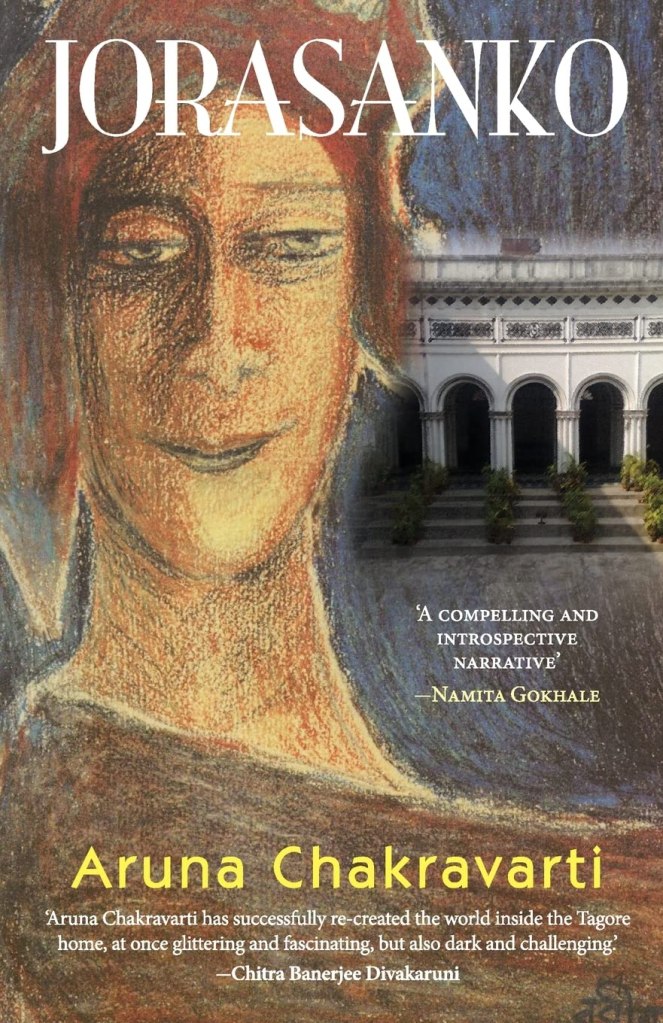
Genu stood where she was as though rooted to the ground. Her eyes were fixed on the masses of gold and gems that hung from Sarada’s neck and trailed down her vast bosom. Her ears were filled with the jingling from the rows of bangles that encased her mother-in law’s fat arms as she put the finishing touches to her daughter’s toilette. Then the girl turned and walked away.
As soon as she reached the door she started running. Stuffing the end of her sari into her mouth, willing the lump to stay stuck in her throat, she ran like a wild thing down the gallery towards her room. Suddenly, she heard a cry and her feet stopped. She stood nonplussed for a moment. Where had the cry come from? From within her? Had the pain she had tried so hard to suppress burst out of her chest in a wail so bitter? So piteous? Then she pulled herself together. Of course not. It was her mother-in-law’s newborn baby crying. A boy two months and twenty days old…
Following the direction of the sound, she came to a tiny room adjoining the birthing chamber. The room was dark and the child lay, all alone, on a narrow bed. There was no sign of the wet nurse or of anyone else. Everyone was busy enjoying the wedding. Lifting the baby in her arms, she felt something flow out of him, something that warmed and comforted her. They were of a kind, she thought. Both alone. Both unloved. She remembered what Subhankari had told her some days after the child was born. Though she had given birth to a boy, Sarada, she had said, was rather disappointed.
‘He’s ugly.’ Sarada had muttered, looking askance at her newborn.
‘He’s not ugly at all’ Subhankari had retaliated indignantly. ‘You’re too fussy, Saro.’
‘Well he’s certainly darker than my other children. And look at his cars. How big they are! And how they stick out!’ Instructing the midwife to bathe him in milk, she had turned over on her side and gone to sleep.
But what neither Subhankari nor Genu knew was that Debendranath had sent for Anandachandra Vidyabagish soon after the birth and asked him to prepare the little one’s horoscope as he had done for all the other children. And, a few days later, Anandachandra had burst into the baar mahal, his mouth stretched in an exultant grin. ‘An outstanding conjunction of planets! he had cried. ‘A birth like this happens once in hundreds of years. This child’s sun is so strong – he will dazzle the world with the light of his genius.’
Debendra had smiled. ‘A good thing,’ he had said. ‘One of my tasks has been simplified. I’ve been racking my brains to find a suitable name for the boy. Since he was born on a Monday, it could have been Somendranath but that, as you know, has already been taken. Now that you say his sun is so strong, I shall name him Rabindranath. But your calculations had better be correct, Ananda. I don’t want you coming to me with a long face, confessing you bungled them.’
(Excerpted from Jorasanko by Aruna Chakravarti, published by HarperCollins India)
About the Book:
In a sprawling novel that spans a unique phase in the history of Bengal and India, Aruna Chakravarti provides a fascinating account of how the Tagore women influenced and were in turn influenced by their illustrious male counterparts, the times they lived in and the family they belonged to. Jorasanko mirrors the hopes and fears, triumphs and defeats that the women of the Tagore household experienced in their intricate interpersonal relationships, as well as the adjustments they were continually called upon to make as daughters and daughters in law of one of the most eminent families of the land. ‘In her meticulously researched novel, Aruna Chakravarti has successfully re-created for the reader the world inside the Tagore home, at once glittering and fascinating, but also dark and challenging. The women of the Tagore family who are at the heart of this novel are complex beings who will raise many questions in the modern reader regarding the role of women in today’s society’, Chitra Banerjee Divakaruni, author of Palace of Illusions and One Amazing Thing.
About the author:
Aruna Chakravarti had been the Principal of a prestigious women’s college of Delhi University for ten years. She is also a well-known academic, creative writer and translator with seventeen published books on record. They comprise five novels, two books of short stories, two academic works and eight volumes of translation. Her first novel The Inheritors (published by Penguin Random House) was shortlisted for the Commonwealth Writers’ Prize and her second, Jorasanko (published by HarperCollins India)received critical acclaim and also became a best seller. Daughters of Jorasanko, a sequel to Jorasanko, (HarperCollins India) has sold widely and received rave reviews.Her novel Suralakshmi Villa, published by Pan Macmillan Ltd under the Picador imprint, has been adjudged “Novel of the year (India 2020)” by Indian Bibliography published in The Journal of Commonwealth Literature U.K. Her latest work, The Mendicant Prince, a semi-fictional account of the Bhawal legal case, was released by Pan Macmillan Ltd, in July this year to widespread media coverage and acclaim. Her second book of short stories Through a Looking Glass: Stories has just been released by Om International Ltd.
Her translated works include an anthology of songs from Rabindranath Tagore’s Gitabitaan, Sarat Chandra Chattopadhyay’s Srikanta and Sunil Gangopadhyay’s Those Days, First Light and Primal Woman: Stories. Among the various awards she has received are Vaitalik Award, Sahitya Akademi Award and Sarat Puraskar.
She is also a script writer and producer of seven multi- media presentations based on her novels. Comprising dramatised readings interspersed with songs and accompanied by a visual presentation by professional artists and singers, these programmes have been widely acclaimed and performed in many parts of India and abroad.
.
PLEASE NOTE: ARTICLES CAN ONLY BE REPRODUCED IN OTHER SITES WITH DUE ACKNOWLEDGEMENT TO BORDERLESS JOURNAL
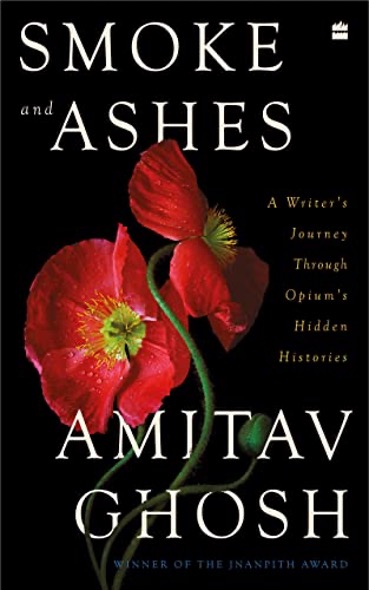
Title: Smoke and Ashes: A Writer’s Journey Through Opium’s Hidden Histories
Author: Amitav Ghosh
Publisher: HarperCollins India
Amitav Ghosh has been traversing the boundaries between fiction, non-fiction, history, anthropology with ease for a long time. After the publication of his Ibis Trilogy [Sea of Poppies (2008), River of Smoke (2011) and Flood of Fire (2012)] more than a decade earlier, he has been primarily focusing on issues related to environment, global warming and ecology in his later novels like Gun Island (2019), The Nutmeg’s Curse: Parables for a Planet in Crisis (2021), a non-fiction like The Great Derangement (2016), and two slim volumes of fables, Jungle Nama (2021) and The Living Mountain (2022). Now in his latest book Smoke and Ashes: A Writer’s Journey Through Opium’s Hidden Histories (2023), he blends travelogue, memoir, and historical tract into a multi-textured narrative that tells us about how ‘opium is a historical force in its own right’ and ‘must be approached with due attention to the ways in which it has interacted with humans over time.’ When he began his research for the Ibis Trilogy, he was startled to find how the lives of the nineteenth-century sailors and soldiers he wrote of were dictated not only by the currents of the Indian Ocean, but also by a precious commodity carried in enormous quantities on those currents: opium. Through both economic and cultural history, Ghosh traces the transformative effect the opium trade had on Britain, India and China; the trade and its revenues were essential to the Empire’s survival.
Of the eighteen chapters of the book, the first two enlighten the reader about little knowledge of China and the way tea (cha or chai) became an inevitable part of living both in the West and in India. It was after Ghosh’s first trip to Guangzhou (anglicized later to Canton) that the epiphany occurred about the very subtle influence of China and how the British actually stole the technology of tea plantation to make it flourish in the colonies. Thus ‘tea came to India as a corollary of a sustained contest – economic, social and military – between the West and China.’
From the third chapter onwards Ghosh gives us the history of the opium poppy and how social conventions that had developed through centuries of exposure to opium may have helped to protect some parts of Eurasia from highly addictive forms of opioid use and also how the drug was instrumental in the creation of a certain kind of colonial modernity. We get to know how it was the Dutch who led the way in enmeshing opium with colonialism, and in creating the first imperial narco-state, heavily dependent on drug revenues. But in India, the model of the colonial narco-state was perfected by the British. In the entire region of Purvanchal, the British created a system that was coercive to its core. The growth and cultivation of opium poppy was entirely controlled by them and the drug was mass produced in the two largest factories in Patna and Ghazipur. Though the dangers of opium were certainly no secret to the British government, yet they did not bat an eyelid in exporting the drug to China, knowing fully well it was a criminal enterprise utterly indefensible by the standards of its own time as well as ours.
Ghosh then gives details of the poppy cultivation in Malwa and the western provinces of India. By thwarting the British efforts to impose a monopoly on the trade, Malwa opium sustained Bombay and left a large share of the profits to remain in indigenous hands. Throughout the colonial era therefore, Calcutta and Bombay defined the two opposite poles of India’s political economy; the way in which business was conducted in the two cities were completely different and soon the Parsis turned out to be the maximum number of the non-western merchants who were present in Guangzhou in the years before the First Opium War. Thus, Bombay and its hinterlands benefited from Malwa’s opium in multiple ways. From Mumbai’s Parsis we go to the horticulturists and weavers, potters and painters of China, especially of the great city of Guangzhou. The intricacies of the Parsi Gara saris are traced back to weavers of Guangzhou, and so are the origins of an artistic ferment in Bombay when Jamsetji Tata, the founder of the Taj Mahal Hotel in Mumbai, brought back many paintings to India from China. The idea for an art school in Bombay came to Jamstjee Jejeebhoy after his Guangzhou visits, and the JJ School of Art came about.
Ghosh describes how opium money seeped so deeply into nineteenth century Britain that it essentially became invisible through ubiquity. After Britain, the country that benefited the most from the China trade and therefore, the global traffic in opium, was none other than the United States and the beneficiaries included many of the prominent families, institutions, and individuals in the land. By 1818 Americans were smuggling as much as a third of all the opium consumed in China thereby posing a major challenge to the East India Company’s domination of the market. Known as the Boston Concern, all the rich families from Boston, Massachusetts and the fortunate Americans were a series of names from the Northeastern upper crust — Astor, Cabot, Peabody, and so on. The young returnees from China ploughed their opium money into every sector of the rapidly expanding American economy. Even the opium money used in the railroad industry also came from China. “Opium was really a way that America was able to transfer China’s economic power to America’s industrial revolution”. In the United States the connection between opium and philanthropy has endured till the present day. It also left a distinct stamp on American architectural styles, modes of consumption, interior décor, philanthropy, and forms of recreation. Interestingly, Ghosh’s narrative keeps circling back to the present, when in the US as well in many countries around the world including India, the opioid crisis has reached epic proportions and the American government is bullish about its “War on Drugs”. Ghosh candidly states, “The ideology of Free Trade capitalism sanctioned entirely new levels of depravity in the pursuit of profit and the demons that were engendered as a result that have now so viscerally taken hold of the world that they can probably never be exorcised.”
Ghosh reiterates through the book that binary narratives about countries and culture — like, China is evil — that is entrenched in popular perception is misleading and takes away the historical context of trade relations among nations. “The staggering reality is that many of the cities that are now pillars of the modern globalised economy — Mumbai, Singapore, Hong Kong and Shanghai — were initially sustained by opium.”
There are many places in the book where Ghosh skilfully refers to his actual borrowing of historical details in his Ibis trilogy and these interjections add flavour to the non-fiction narration. Chapter Eight again is a memoir of Ghosh’s own lineage and how that has connections with the opium trade. Moving away from their ancestral home in East Bengal, it was the opium industry that took his ancestors to Chhapra in Bihar and kept them there. Like the millions of people that opium trading affected, uprooted, and dehumanised, his father told him stories of growing up in Chhapra and seeing opium ruin as well as make lives. These digressions add zing to the often-monotonous narration of facts and figures of the opium trade.
Ghosh goes on to devote pages to the nature of grassroots psychoactive substances and how opium was different in this class of psychoactive because it became a mainstay among pharmaceuticals too: “The reality is that all other efforts at curbing the spread of opioids have failed: the opium poppy has always found a way of circumventing them.” Towards the end of the book, after Ghosh finds that the wealthy and powerful people of the world to be suicidally indifferent to the prospect of a global catastrophe vis-s-vis the drug scenario, he asks a seminal question: “In such a world does it serve any purpose to recount this bleak and unedifying story?” Apparently, this question had haunted him since he first started working on the book, many years ago. It was the reason why, at a certain point, he felt he could not go on, even though he had already accumulated an enormous amount of material. It seemed to him then that Tagore had got it exactly right when he wrote: ‘in the Indo-China opium traffic, human nature itself sinks down to such a depth of despicable meanness, that is hateful even to follow the story to its conclusion.’ So persuaded was he of this that he decided to abandon the project: he cancelled the contracts he had signed and returned the advances he had been paid by his publishers.
Now we are happy that the story of the opium poppy had its cathartic effect upon Ghosh and in retrospect, after a period of more than a decade, he could give us the story from multiple perspectives today. Like his other books, this text is also accompanied by voluminous end notes which will deter the layman reader from enjoying the book. The amount of material and the different issues that Ghosh mentions is fit for at least four books but it is to his credit that he manages to present to us this world-roving tale in his signature method of weaving diverse narrative strands together into this book. How Ghosh establishes the interconnectedness of economic agency with geopolitics, a plant with human flourishing and wreckage and produces a narrative as luxuriant as it is painstaking in detail and density is his mastery as a prose writer and thinker.
.
Somdatta Mandal, author, academic and translator is former Professor of English at Visva-Bharati, Santiniketan, India.
PLEASE NOTE: ARTICLES CAN ONLY BE REPRODUCED IN OTHER SITES WITH DUE ACKNOWLEDGEMENT TO BORDERLESS JOURNAL
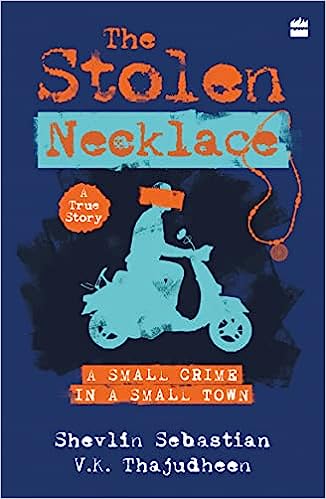
Title: The Stolen Necklace: A Small Crime in a Small Town
Authors: Shevlin Sebastian and VK Thajudheen
Publisher: HarperCollins India
With an enigmatic cover, reflecting the nature of the content, this is the true story of a small-town crime. A gripping narrative, it is the poignant saga of an innocent citizen, forced to suffer incarceration due to the mishandling of a theft case by the police.
Veteran journalist Shevlin Sebastian, and businessman, VK Thajudheen, are the authors. Thajudheen is the kingpin of this book, and also the victim. The incident took place a few years ago in the historic town of Thalassery in north Kerala.
Shevlin is based in Kochi, which is hundreds of kilometres away, in the south. Shevlin and Thajudheen came together following the media hype. With his impressive credentials, and long-standing in the journalistic field, Shevlin has proven his mettle by publishing more than 4500 feature articles in reputed periodicals. He has authored four children’s novels also.
Thajudheen, around whom the thriller revolves, has his home in Kadirur, a suburb of Thalassery. A middle-class businessman in Qatar, he had left his family of wife and three children at Kadirur. A God-fearing upright man, he is middle-aged and balding. His courage led him to an adventurous love marriage with his teenage sweetheart. Nasreena, being from a financially backward family, the alliance was considered of low status for his wealthy family.
Nevertheless, he had the temerity to ignore and disobey even his patriarchal father, in carrying on his long affair. However, before his secret wedding, his father passed away. Even then Nasreena had to wait for three years to be accepted in his home. That was after the birth of their second child – a son. The arrival of a boy child in his family after a long gap, mellowed his mother and two sisters who changed their hostile attitude against Nasreena.
All this happened years ago. Meanwhile, Thajudheen had a checkered career spread over different locations, which ended up with a business in Doha. That was when he fulfilled his dream of marrying his daughter to an eligible young man, Shiraz Abdulla.
The tragic turns of events, entangling Thajudheen in the stolen necklace fiasco, commenced a couple of days after the celebration of Thazleena’s wedding. The family was returning from his sister’s home after a sumptuous dinner hosted for the newly-wedded couple.
It was a rainy night. Suddenly, they spotted two police jeeps with eight occupants waiting near their Kadirur home. Three of the men were in uniform. The rest were also from the same genus, it was revealed. They were from a station outside Kadirur police control called Chakkarakkal. Stopping their car, their leader, approached the family with an expression of “You are all prey. I am a lion looking for a meal”.
Biju, having already earned a name as being reckless in controlling crime, was a known terror. He and his team had arrived armed with a phone evidence showing that Thajudheen was the culprit in a necklace-snatching crime. The incident was reported in his station a few days back. The CCTV camera that showed the purported thief cannot lie, they thought. It showed someone exactly resembling Thajudheen! But was it Thajudheen?
Thus started the ordeal of an innocent family man in the presence of his loving wife, and children. After a heart-breaking scene, near his home, Thajudheen was offered a compromise — pay the price of the stolen necklace and avoid litigation.
The offer was with a friendly ‘advice’: “I heard your daughter has just got married. The reputation of your family is at stake. We will inform the media that you are the thief.”
Anyone with a chicken heart would have yielded, but not Thajudheen, who always admired his late father for standing up to injustice. That was how Thajudheen had to languish in Thalassery sub jail till the story led to the final proverbial ‘happy ending’, nearly seven weeks later.
As a remand prisoner Thajudheen had the most undesirable company of robbers, underworld gang members, sex offenders, political workers, and so forth. At the same time, outside, his shattered family and Abdulla, the father of Shiraz, Thajudheen’s son-in-law, did not leaving any stone unturned to unravel the mysterious crime. They were making all-out efforts to obtain bail as well.
But Sub Inspector Biju was not to give up the big catch that easily. The police were even trying to trap Thajudheen in some other unsolved cases as a possible culprit.
This included even a murder case where the perpetrator was missing.
Ultimately, when the higher court decided to let him free, the readers, along with Thajudheen himself, are left to wonder about the dispensation of justice by the police in a democracy. It is true that the politicians, the legislature, and even the Chief Minister had to interfere in ensuring proper investigation in this case. But still the question remains: what can one do to enforce timely change in the method of handling of criminal cases by the police?
Imprisonment of innocents and their vindication in the end is nothing new in the annals of ‘crime and punishment’. Fiction being a reflection of fact, such cases are not uncommon in world literature. Inspector Javert of Victor Hugo’s ‘Les Miserables’ (1862) can very well match up with the modern-day Biju, the sub inspector.
Likewise, in Leo Tolstoy’s short story, ‘God Sees the Truth but Waits’ (1872), a young merchant named Ivan Dmitrich Aksionov was accused of a crime he did not commit. One can see the forerunner of Thajudheen! After all, human nature is basically the same whether in France, Tsar’s Russia or India.
Undoubtedly, Shevlin and Thajudheen have succeeded in bringing out the darker side of the police force. However, though the narrative is touching, one wonders at the intent of the book. Have the authors succeeded in openly projecting the atrocities of the police force to draw the attention of the establishment to prevent such incidents in future? Apart from presenting the insensitive and sadistic attitude of Sub Inspector Biju, little effort seems to be expended to indict the system to which he is linked. The fact that Biju is ‘punished’ for his ‘crime’ by just a transfer and withholding a few increments is an eloquent testimony to the laissez-faire attitude of our society at large.
Dr. KPP Nambiar, formerly a Consultant/Technocrat at the UN Food and Agriculture Organisation, is the author of many scientific papers and books, including a 1500-page Japanese-Malayalam dictionary.
PLEASE NOTE: ARTICLES CAN ONLY BE REPRODUCED IN OTHER SITES WITH DUE ACKNOWLEDGEMENT TO BORDERLESS JOURNAL.
There are many places that poetry comes from — desire, death, dream, memory, sharp sensuous apprehension, the wrist-grip of language’s freedom and magic, the joys and fractures of the world that we engage in everyday, the necessity to commit to paper (or to posterity) what weighs upon the heart or head, the existential imperative to express, or the naïve hope of making the world a better place.
In general, the act of poetic creation draws its sap simultaneously from several of these sources. Many a time, however, one of these inspirations is bound to tower over all the rest. In the case of Prerna Gill’s Meanwhile (HarperCollins, 2023), the mysterious seduction of words combined with an urge to dress the world in impenetrable veils of meaning by conscientiously shuffling the charted signifiers and signifieds of language, seem to offer the veritable will-to-poetry.
One is drawn to the studied casualness of the title which, with its quiet, meditated understatement, purports poetry to be a by-the-way affair, a random afterthought. Nothing could be farther from the truth. In the title as well as in the book as a whole, there is a skilled juxtaposition of two contiguous temporal frames — the physical and the psychic. The physical frame is the one in which the seemingly significant events of life take place. The psychic frame constitutes the ‘meanwhile’ of poetry.
This ‘meanwhile’ is not to be treated lightly for it is in these pockets of found time that the actual business of confronting the self for survival takes place. Here is a drawn-out negotiation with history, experience, emotions, pain, and trauma, and a poignant reconciliation with each of them. The psychological explorations of the ‘meanwhile’ in this collection are all-absorbing and have the potency to completely obstruct, offset and vanquish the eventful flow of physical time — “it’s always hungry in here” (‘An Hour Stays’). Nevertheless, this is not allowed to happen and both frames persist together, their density often overlapping.
If one pays sufficient aural attention, there is to be heard a silent ticking within Prerna’s poems, a tense balance between the physical or material and the psychic or mental, that threatens at any moment to collapse – “I sink through deep green waters/ To a cement floor buried/ Under boxes, old chairs, a pantheon in a funk” (‘Visit’). The fifty-nine poems in Meanwhile, then, manifest themselves as an acknowledgement of this essential fragility of time, balance, and life — a realisation that if the mind’s playhouse is affected or darkened, the lights in life’s theatre will inevitably be extinguished.
In the author’s words, the book is “an attempt to understand the less-than-shiny things that I can’t quite ignore any longer. The everyday things. The things that let the shadows in.” The paradoxical nature of time, emotional spontaneity and polyphony, the weaving/unweaving of the self, its fragile alignment/dealignment with the world, and the conglomeration of being constitute the thematic canvas of these poems. The cover image of a huge butterfly replacing the forehead and eyes of a human (woman’s) face looms to significance here. The symbolic suggestion of an alternative (inward or non-human) vision is hard to rule out (for animals occupy an enviable space in many poems of this collection) even as one is brought to mind of the butterfly effect of causation that operates, perhaps, most relentlessly in the headspace.
The acuteness of experience, the intensity of its processing, and its configuration through terse but often abrupt and abstruse images constitute the three essential prismatic walls of Meanwhile. Here is a carefully constructed theatre of the mind where lights and sounds radically transform in meaning through connotative and symbolic suggestions. In much of Prerna’s poetry is a semantic and narrative inscrutability that seems to operate as conscious poetic strategy. In the noumenon of these poems is both illumination and construction. Language is both torch and subterfuge, revelation and concealment, statement and retraction so that travelling through these poems is to traverse an experiential space that is deliberately half-lit.
In ‘Unmasked’, the poet writes:
Glaucous moon shivering inches of glass
She cuts her shape, cuts at it in echo
Grows it asking after her sons and rent
The possibility of rain and grandchildren
And if they glimpsed her first body
In birthmark, headline, running stitch
Here, as in many of her pieces, the real and the surreal walk together, undistinguished. In ‘Chedipe’, for instance – “Never could tell if she first saw him/ From behind green bottles or tall grass” – the atmosphere often turns disturbing and sometimes, singularly acherontic. In ‘Tributary’, the witnessing of the phenomenon of death opens a startling avenue of perception:
Until his splintering close enough to see
How easily a tributary is made:
A young man slipping from the course of the day
His hours held close as cards
In these poems’ handling of the self as subject, one finds little narcissism. The mind that is sculpted by particularity of experience, memory and upheaval of feeling is, to be sure, intensely subjective and yet, the distillation of these experiences in poetry makes way for a rich reading. What animates these poems and renders them more than abstract musings of an idiosyncratic mind is their keen and devout understanding of life’s complexity, its essential sense of injustice, and its brief but significant redemptions – “days pressed to currants between/ Pages folded for the edge of winter/And winters still” (‘Ant, Grasshopper’) or “Things of a hard blue sky yearn/ For the only light they do not share” (‘Before This Summer’) The use of short, clipped, often dramatic sentences; the frequent avoidance of punctuation; a polished, urban vocabulary; and an essential belief in the lability of time chisel these poems into pieces reflective of a deeper and highly nuanced reality of the mind as of the world.
The collection has several memorable poems. ‘Bucketsful’, for instance, brilliantly conjures childhood memory, loss, diminishing, and incommunicability through the bulbous image of frogs “Leaping to the rim/ Like it knew a boiling hurry” and ends with words that “balloon my throat and the only ones who would understand them/ Have long skipped town”. In ‘Trees’, the “verdant announcements” of foliage are capable of sustaining life despite its monotony – “Allergies, dry cleaning, soup” so that “in one glance/ The world becomes/ Leaves”. ‘Autopsy’ builds itself around a single cinematic image – “The naked bulb above the table/ Flickered too much” and as a verb, can symbolically extend itself from a person to a situation to life itself. ‘The Dollmaker’, one of those poems that makes the act of reading this collection inseparable from the recognition of the author’s experiences as a woman in the world, skilfully builds up the automated rhythms of a woman’s being in a sexist universe.
Meanwhile, thus, offers a whole new world for our absorption, intriguing in its opacity, and plumbing a depth that is accessible only to those who are prepared to lose themselves in the sharp silhouettes of its images. Here is the gradual but steady eclipsing of material geography to throw light upon the imperialism of the psyche and in this, there is a fine and fluid celluloid effect at work. On the wide screen of language, Prerna’s images travel with a terse celluloid confidence – aware, both, of being and non-being, of leading the reader through a range of signification that can never be pinned down to conclusion, of living a lie and yet upholding the truth.
As a debut collection of poems, Meanwhile stands out for its innovative experimentation with language which borders, often, on the existential, as if sanity and survival depended upon these elaborate linguistic disguises — the trickery of words, the enticement as well as the connotative distance of images, and the impossibility of locating a referential kernel to crack. In the measured pace of Prerna’s poems is a chromatic adventure that navigates the complex terrain of human emotions via a symbolism of shape, feeling and colour illuminating the little-known multiverse of the subconscious – “Square fingers running a pen/ Over prescription or continent” (‘Maps’) or “You, with nights under your fingernails/ Tell no one how it happened” (‘Black’).
In the excavated or found space of ‘meanwhile’ flows a continuous and consistent dialogue between the various selves – the past and the present, the mentor and the mentee, the seeing and the knowing, the forgetful and the cautious, and so on and so forth. When this space transforms itself into the intersubjective bond of poetry it becomes therapeutic, healing both the speaker and the listener from a pain that is deeply shared as inhabitants of a difficult world — “Some mornings I think of a rabbit with orchid ears/ The stray toms left her in a pit in my stomach/ Filled with lettuce and sweet straw (‘Keeping’) or “In this way, we are brittle femur/ And like this, we are sky” (‘White’).
The world will, perhaps, continue to be what it is. Meanwhile, here is a book that promises to be a friend.
Basudhara Roy teaches English at Karim City College affiliated to Kolhan University, Chaibasa. Author of three collections of poems, her latest work has been featured in EPW, The Pine Cone Review, Live Wire, Lucy Writers Platform, Setu and The Aleph Review among others.
.
PLEASE NOTE: ARTICLES CAN ONLY BE REPRODUCED IN OTHER SITES WITH DUE ACKNOWLEDGEMENT TO BORDERLESS JOURNAL
A discussion on Prerna Gill’s new book of poems, Meanwhile, published by HarperCollins India
In a social media world teeming with every banality that goes for poetry, Prerna Gill’s is a refreshing voice that does not pander to easy rhetoric and comprehension. If good poetry is all about the silences between words, the spaces between the lines, Meanwhile is a collection that lives up to the test. Shantanu Ray Chaudhuri spoke to the poet on her first collection of poems.
Your author’s note starts off almost defensive about ‘putting the book out’. It also provides a glimpse of what poetry means to you: ‘…when the guests leave … room is far too still’. Why do you call it narcissistic, and why poetry? Does it help cope with whatever it is that you seek?
Writing is a way through which I examine how I may still be compromised – by fears, by a stillness that some may call the blues, others ennui or even laziness. I think this form of introspection also helps me see how and where I have healed from issues I struggle with, like anxiety. It is therapeutic, almost, and points to how I may show myself grace and where I have some work to do. When poetry does so much for me it almost feels selfish, as though I put the reader second – which is, of course, not by design. I write what I know, but even this indulgence in examining my own psyche through wordcraft does seem terribly narcissistic, like I can’t stop staring into my own shadow. Not all of my poems are about this, but enough of them to make me a little uncomfortable when I do think about it.
When was it that you first realised the urge to write … and was it poetry or the dark mythology which I know is another passion? Do you remember your first attempt at a poem?
The first poem I wrote was in middle school and was about a bat. Animals are so fascinating, but there was always something about bats. I think they are adorable, really, and in no way deserving of their terrible reputation. As for the darker things that crept in later beginning with gothic novels, I loved the atmosphere, and how it was never too cheerful – this made me comfortable because, at the time I got into it, I was not in the sunniest of places in terms of my own headspace. Even now, when I feel much better and more balanced, it is my favourite genre along with horror and dark fantasy. It is quite an obsession, and has led to a supernatural-themed doll collection and a library of cherished horror computer games. At work, this manifests as a publishing list with many horror novels. I want to publish all the ghost stories and books on dark folklore and myths that I can get away with. It’s going quite well.
Do you read a lot of poetry? Are there any particular favourites who inspire you, or influence your poetry?
I read quite a bit, but probably still not as much as I should. I enjoy Anne Carson’s work, also Ella Frears. Currently I am reading Orexia: Poems by Lisa Russ Spaar. Of the older poets, my favourite is Sylvia Plath for how eloquently she captures small moments of violence. Also her free verse – which I enjoy because, in my opinion, it puts the words first and everything follows – like red chasing the scalpel.
Can you talk about the process – the birth of a poem. And whether you rework/rewrite or come upon the poem in one draft, ready… You can talk about, say, (i) ‘come teatime she will inherit the ice’ (On Not Drowning) … how does that line form, where does it begin, and (ii) ‘we will loosen our consonants’ (No Strings) … where does that line originate, and become a part of the poem?
A poem can begin with a name, a random word or thought. I can dwell on a poem for months and then delete the whole damned thing. Other times, I can return to a piece of verse and tinker it into a new animal. The rule I set for myself is to put all my finished poems in one folder and return to them in a different season, a different mood, and see if they still say something – even if it isn’t what I wanted them to. So many are erased, but the ones I like I keep in a new folder, ready to submit wherever I think they may have a chance.
About the line to do with inheriting ice: This is from a ‘Persona’ poem with bits of my own experiences with dissociating in difficult times – something that will eventually be harmful, in that you avoid confronting it. At the same time, the best way to look at something in the dark may be to look beside it – not at it. I am not a psychiatrist, but it is a poem about a coping mechanism, one I was once too familiar with. That said, I wanted to look at the hereditary nature of things like anxiety. I have, in my later teenage years, struggled with moments where I felt I could not move or feel. Like I was numbed by ice. I do not know where that came from, but the persona from the poem does know. Her mother and sister are mentioned at the end of the poem, pulling her out of the underwater world she creates as she drowns. Or rather, doesn’t. The choice of ‘teatime’ was to anchor this moment to a very domestic space with a certain pressure to be social and civil – a difficult moment in which to find yourself frozen in a way handed down by those sipping at their cups around you. I could only imagine what that is like and then it became this poem.
The second line you mention is from a poem that goes in the opposite direction, exploring a moment of fleeting intimacy. It is a line where caution slackens, and where sewing and strings and threads form a lot of the imagery … this lets language come into the picture of a quick moment. We have more consonants than vowels. They form so much of what we say, a lot of which may be sharper and faster moving, not rounded gently by ‘an’ like the apple it may precede. They are brisque, taut strings played more often. To me, they represent the more common things we discuss. Small talk. When looking into this moment in the poem, a one-night stand, the loosening is framed as a deliberate act to serve a purpose. It is affection implemented with steely resolve.
You have six poems on colours – and the author’s note also says ‘there’s no looking past the greys…’ What is it about colour that it plays through your poems.
The grey in the introduction was mostly to highlight the everyday moments compared to the more dramatic milestones. With the poems, I get to explore colour in a slightly different way.
Red: ‘and plain on every face … some of us are grey by twenty-five years’. Red is the first colour to fade from view under water, and that struck me as quite poetic all by itself. The deeper some of us get in our lives, in terms of time and age, or the deeper we sink into our troubles, I find we are at a greater risk of losing what red comes to mean. In terms of my own mental health, I saw red as the opposite end of a spectrum from the odd forms of silence that I would be overcome by: a silence of regular, reasonable thought that would normally counter exaggerated fears. There were also silences of action and movement with a very strange inability to will myself to get up from wherever I had perched at times during the difficult phases. In those times, I would think of red having gone from me. Once I got better, I could put those images into words.
‘Red loses the deeper it goes
And here the kelp and pale coral
        Here silence’
Green (Was struck by the contrast … mother’s rage, green, closing day green): ‘The colour of a closing day …The colour of one mother’s rage’. I do see the connection it has with nature. I also see how nature and a certain vicious protectiveness, especially that which is expressed in a paranoid postpartum state, are inseparable. Motherhood is natural, it is dangerous. The image of the snake on her nest and the way ‘her heart spreads its hood’ comes from a very personal encounter with that sort of anger –which one can do nothing about because it is locked and loaded in case of danger to one’s child. It is a primordial thing. I was very prepared for postpartum depression, so a state of constant, protective anger took me by surprise. It never fully slithered away though. Or rather, it hasn’t yet.
Blue: ‘seas no longer churning wine-dark … Spring draped flat over March … above all memory of the womb’. For ‘Blue’ I could not look past its role in culture, specifically gender. Also, how its symbolism has changed. Some cultures may never have categorised it as a colour and that is so fascinating as an example of how words have such power even over what we see so much of. When Homer described the sea as ‘wine dark’ it was understood to mean blue. It did confuse people for quite some time, that description. This is one of the theories, of course, but it stayed with me: that blue became part of certain languages much later. The poem then explores the link between blue and boyhood. Once, pink was a masculine colour. I suppose people saw that rosy shade as too visceral for young boys then, perhaps too close to the violence that comes just before the guests flood in to coo at a newborn. When you think of the sky and the open ocean it may be easier to forget the nature of birth and blood. Such a stark contrast to life and life-giving. To womanhood.
Yellow: ‘we live between forests … cage small birds in our mouths…’ The poem ‘Yellow’ started out with a different placeholder name: Canary. That’s why the mention of the bird for safety as we go digging deep into the rock for what our predecessors set in stone. The past comes with dangerous problems just waiting to be inherited. The image of having canaries in our mouths was to lay emphasis on how our words, our voices may be all that we have to signal danger when we find ourselves so deep in problems created by evils of the past.
Black: ‘…to a world so tepid green, the fireflies sail white … nothing is as still as you…’ The poem ‘Black’ on the other hand has more to do with very current problems, such as psychological ones, but also others – I wanted that part open to interpretation. What is does specify though is struggle. The way one might gather blood of skin of an assailant one struggles against is reflected in the opening line: ‘You, with nights under your fingernails.’ The rest of the poem moves from a shower stall, where the person, ‘you’, is drained far beneath what they know, to a place that is alien and unfamiliar. Haunting with a strange light, and places you beneath everything you know and remember: like a mute spectator. Unable to move. It ends back in the shower where:
In fogged-mirror silence
Nothing
  Is as still as you
Here is that stillness, that silence. This poem lets me confront it, like a pair of gloves keeping me safe as I study something I know to be tricky. Sometimes frightening.
White: ‘mogra … fragrant in their grief, we wear white in yearning … and like this we are sky’. With ‘White’ on the other hand the meaning is rather clear. We do wear white for mourning. Or ‘yearning’ as I see it. There is a softness I wanted to keep, given the subject here – death. I am an atheist, but I do believe in a peace that nothingness can bring. This is why I never write about spirituality – I would not know what to say. The beauty to me lies in the difference between nothingness and emptiness. In death you perceive the world in a way that is no different from how the mogra does. Or the smoke. Or the air.
Do you follow the contemporary poetry scene in India? How tough was it to publish a volume? Did it help being a part of a publishing house? Do you think that there is a lot of puerile wordsmithery that gets passed off as poetry on social media and self-publishing platforms … or do you see that as a boon?
I enjoy most contemporary poetry published in India. So many poems by Indian poets in India read like magic. I will say that social media poetry, though, is not for me. But it is working for many. Most of us don’t really have time to sit and chat about how we feel these days, and on social media all you get is quick and easy content to consume. I can see how the poems on certain platforms help people slow down as they scroll. I cannot say what is and isn’t art, but I know these works, often presented in a way that is easy to read and understand, are serving people. They would not be so popular otherwise. That said, I am still waiting for other forms of poetry to appear on mainstream accounts.
About publishing the book: I had a huge advantage. As a writer and editor, I need to show all my work that I intend to publish, to my publisher. I am extremely fortunate that Udayan Mitra liked the poems. I wouldn’t want to publish anywhere else in India because I know that we at HarperCollins India put authors first. Why go anywhere else?
Not many people know of your connection to Dharmendra ji. Since many of us are aware of his skills as a poet in Urdu, have you read his work, and more importantly what does he think of your poetry? Can we hope for the grandfather’s poetry translated by the granddaughter?
I think my Instagram account has made the connection clear to anyone who might look for me on the Internet. He was also kind enough to endorse the book and support it on social media and for that I am so grateful. I do not have any of his talent, but I am confident that I will always have his blessings. The same is true about my uncles. Many of their admirers and followers bought books, or at least wrote to say they would – that is one of the best ways of supporting poetry, which is always hard to sell. As for my grandfather’s poetry – with great sadness I must admit I know very little Urdu. I cannot read the script at all. If I could, I would love to translate his work, because I know he puts so much of his heart into every verse, just like he puts his soul into every character he plays on screen. I do want to publish his poetry – if only he would let me!
.
(Published in multiple sites)
.
Shantanu Ray Chaudhuriis a film buff, editor, publisher, film critic and writer. Books commissioned and edited by him have won the National Award for Best Book on Cinema twice and the inaugural MAMI (Mumbai Academy of Moving Images) Award for Best Writing on Cinema. In 2017, he was named Editor of the Year by the apex publishing body, Publishing Next. He has contributed to a number of magazines and websites like The Daily Eye, Cinemaazi, Film Companion, The Wire, Outlook, The Taj, and others. He is the author of two books: Whims – A Book of Poems(published by Writers Workshop) and Icons from Bollywood (published by Penguin/Puffin).
.
PLEASE NOTE: ARTICLES CAN ONLY BE REPRODUCED IN OTHER SITES WITH DUE ACKNOWLEDGEMENT TO BORDERLESS JOURNAL
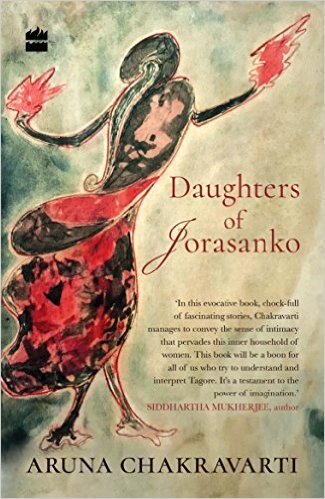
The twenty-fifth day of Baisakh dawned. A hot airless day when not a leaf stirred in the trees and the red earth burned like smouldering coals. Rabindranath was taken to the southern veranda in the morning as usual but he lay in his armchair so listless, so drained of energy, Nandita realized that something was wrong. ‘Let me take you back to bed, Dadamoshai,’ she said. ‘You had better rest the whole day and reserve your strength for the evening. The students have organized a programme for your birthday.’
‘I know.’ Rabindranath nodded. ‘I mustn’t disappoint the children. But I would like to give them something in return. Fetch a pen and paper. Closing his eyes, he sang slowly in an old man’s quavering voice. He nutan/dekha dek aar baar janmer pratham shubhokshan:
Oh ever new!
Let my eyes behold once more
the first blessed moment of birth.

Reveal yourself like the sun
melting the mists that shroud it.

Reveal yourself
tearing in two the arid empty breast.
Proclaim the victory of life.

Give voice to the voiceless that dwells within you;
the eternal wonder of the Infinite.

From emerging horizons conches blow;
resonating in my heart.
Oh callout to the ever new!
Twenty-fifth of Baisakh!
Rabindranath lay on his bed all day breathing heavily, the heat sapping his strength. He felt so exhausted that even to lift an arm or keep his eyes open was an effort. He could sense the activity that was going on around him. People were coming from far and near with gifts of flowers and fruit. They begged for a glimpse of him but he, who had never refused to meet anybody in his life, now lacked the energy to do so.
He felt a little better towards the evening when the heat of the day had dissipated and a cool breeze started to blow from the khowai. Then at dusk, Nandita came in. ‘Get up, Dadamoshai,’ she ‘ said brusquely. ‘You’ve rested long enough. Time to get dressed.’
Rabindranath sat up meekly and allowed her to put on him his birthday garments of silk dhuti and chador. He didn’t object even when she adorned his brow with sandal paste and hung a garland of fragrant juin flowers around his neck. But when Protima came in with a bowl of fruit he couldn’t stand the smell. ‘Not now, Bouma.’ He shook his head, ‘I’m not hungry.’
Protima wouldn’t go away. ‘You’ve hardly eaten anything today,’ she said firmly. Have a few pieces of mango. It’s your favourite himsagar. Prashanta brought a basketful.’
Lacking the strength to protest, he put a small piece in his mouth and shuddered with distaste. ‘The good days are gone, Bouma,’ he said sadly. ‘Else why does the king of fruits taste bitter in my mouth?’
‘But even last season you were eating five or six a day!’
‘I know.’ He smiled. ‘That is why I say the good days are gone.’
(Excerpted from Daughters of Jorasanko by Aruna Chakravarti, published by HarperCollins India)
About the Book:
The Tagore household is falling apart. Rabindranath cannot shake off the disquiet in his heart after the death of his wife Mrinalini. Happiness and well-being elude him. His daughters and daughter-in-law struggle hard to cope with incompatible marriages, ill health and the stigma of childlessness. The extended family of Jorasanko is steeped in debt and there is talk of mortgaging one of the houses. Even as Rabindranath deals with his own financial problems and strives hard to keep his dream of Santiniketan alive, news reaches him that he has been awarded the Nobel Prize for literature. Will this be a turning point for the man, his family and their much-celebrated home? Daughters of Jorasanko, sequel to the bestselling novel, Jorasanko, explores Rabindranath Tagore’s engagement with the freedom movement and his vision for holistic education, brings alive his latter-day muses Ranu Adhikari and Victoria Ocampo and maps the histories of the Tagore women, even as it describes the twilight years in the life of one of the greatest luminaries of our times and the end of an epoch in the history of Bengal.
About the author:
Aruna Chakravarti has been Principal of a prestigious Women’s College of Delhi University for ten years. She is also a well-known academic, creative writer and translator with seventeen published books on record. They comprise five novels, two books of short stories, two academic works and eight volumes of translation. Her first novel The Inheritors (published by Penguin Random House) was shortlisted for the Commonwealth Writers’ Prize and her second, Jorasanko (published by HarperCollins India)received critical acclaim and also became a best seller. Daughters of Jorasanko, a sequel to Jorasanko, (HarperCollins India) has sold widely and received rave reviews.Her novel Suralakshmi Villa, published by Pan Macmillan Ltd under the Picador imprint, has been adjudged “Novel of the year (India 2020)” by Indian Bibliography published in The Journal of Commonwealth Literature U.K. Her latest work, The Mendicant Prince, a semi-fictional account of the Bhawal legal case, was released by Pan Macmillan Ltd, in July this year to widespread media coverage and acclaim. Her second book of short stories Through a Looking Glass: Stories has just been released by Om International Ltd.
Her translated works include an anthology of songs from Rabindranath Tagore’s Gitabitaan, Sarat Chandra Chattopadhyay’s Srikanta and Sunil Gangopadhyay’s Those Days, First Light and Primal Woman: Stories. Among the various awards she has received are Vaitalik Award, Sahitya Akademi Award and Sarat Puraskar.
She is also a script writer and producer of seven multi- media presentations based on her novels. Comprising dramatised readings interspersed with songs and accompanied by a visual presentation by professional artists and singers, these programmes have been widely acclaimed and performed in many parts of India and abroad.
.
PLEASE NOTE: ARTICLES CAN ONLY BE REPRODUCED IN OTHER SITES WITH DUE ACKNOWLEDGEMENT TO BORDERLESS JOURNAL



 Borderless