Categories
Essay

A Brickfields Christmas Tale

By Malachi Edwin Vethamani

The Old Brickfields

The world changes. Yet, the memories captured and frozen in time, moments that one never thought would come to pass, remain. In my child’s eyes I still see and recall a world that has gone by, the space and the people and all in it that I still love. Brickfields was no remote Indian enclave even in the 1960s. It was about 5 miles from Kuala Lumpur, the capital town. The outside world would soon collide with my small space called Thambapillai Kampung[1] in Brickfields amidst 13th May 1969 race riots and my childhood world would become the past.

We were a small community, a kampung of about 100 households. We were all tenants to a lawyer landlord who charged a small rent to occupy a small portion of his land. It was home to many Indians who were barely scaping for a living above the poverty line. What we lacked in the material world, was made up with a sense of community. It was not perfect, but we co-existed amicably and often looked out for each other.

Thambapillai Kampung composed a good mix of Hindu and Christian families, mostly of Tamil ethnicity, both Indian and Sri Lankan. Mine was a Christian childhood here. The Methodist Tamil Church was a ten-minute walk away from our home. The Hindu temple, Sri Kandaswamy Kovil, at the end of Scott Road was even closer. The kampung is now replaced by condominiums none of us could have afforded, except the lawyer who sold his land for the gentrification of this place. The church and temple still remain.

The Days Before Christmas

Christmas Palagaram-Making

Our house was often the hive of Christmas palagaram making activities. My mother and her group of women friends, Hindu and Christian, all housewives, would plan a schedule on making traditional Indian palagaram[2] like muruku, achimuruku, chippi, neiyi orrundai, monturikottu and sometimes even kalu oorundai (almost as hard as cricket balls). They would take great care to get all the ingredients and make the palagaram from scratch.

Below is an excerpt from my poem ‘A Brickfields Christmas’ that narrates my childhood experience of witnessing this activity over several years:

December descends on us.
Womenfolk, friends of
Amma, Sithi and Paati,
all aunties to us arrive.
Palagaram-making begins.
Muruku, achimuruku, chippi
and neiyee oorundai –
South Indian festive fare.
We wait at the side lines
like cats for scraps.

My elder sisters put their
culinary skills to work.
The fragrance of freshly baked
cookies and cakes
waft through the house,
giving a sweetness
over the usual aroma
of curries in our home.
A festive air spreads
and seeps through the house.

Annual House Spring Cleaning

The days before Christmas fell during the school holidays and we the children were homebound. It was also the time for our big-time annual spring cleaning of our house as part of the preparation for Christmas and new year. All the children were involved in various tasks to clean and repaint the whole house. This is re-counted in the extracts from my poem ‘A Brickfields Christmas’:


It’s November and school’s out.
We are all home-bound.
There’s an excitement
despite the work at hand.
Paint brushes appear
and paint pails sit next to Appa’s bicycle.
The yearly routine is set to begin
in our house.


The house waits
like a patient giant
its coat slowly scraped away
and its nakedness to be clothed
by an eight-sibling work team.

Chores allocated according
to seniority and skills.
I am happy to scrape
last year’s peeling paint.

Limestone white
for personal living spaces
ICI blue paint just for the hall.
The worn-down white planks over
the months are slowly lapped up
by paint-laden brushes.

Large black spiders once secure
in crevices now scuttle about.
Plank by plank whiteness emerges.
A new brightness which in time
will wear off once more.
The house smells fresh
and a lightness caresses us.

Annual Christmas Shopping

Mutabak. From Public Domain

Our family practice was that all the children would get clothes for the festive season. Three set of clothes one for Christmas eve, Christmas day and New Year’s Day. Amma was the prime mover in all our activities. We would set out to Batu Road (now Jalan Tuanku Abdul Rahman) to Globe Silk Store and Kishu’s Departmental Stall, for their affordable prices, to buy our shirts. Along the way, we would stop at Central Shoe Shop or Bata to buy our shoes. Taking a break from shopping, we would be treated to murtabak at the famous Kassim Restaurant which was also situated among these shops.

It was also the time of year for buying gifts. For this, my eldest brother, Annan, would accompany us and we would go to Deen’s to buy our board games, toys for building and construction sets and even musical instruments. All these would be gift wrapped and placed under our Christmas tree. Besides our choice of gifts, there would some surprise gifts too.

Appa[3] was busy with his work and left this work to Amma[4]. Being a newsvendor, he had no holidays. He worked every day if newspapers were printed and needed to be delivered to his customers. Yet, he still found time to take the boys to the tailor near our house in Scott Road to get our short pants sewn.

Christmas Decorations for Our Home

The last few weeks, the postman would have brought tens of Christmas cards for the family and individuals who were of card-sending/receiving age. We used to look out for who would get the most greeting cards besides our parents. In the last few Christmases in Brickfields, I was among those assigned to write the greetings and addresses on the Christmas cards before they were sent off to the nearby Brickfields post office. I can remember the many times I wrote: To, Mr & Mrs xxx and fly … Best wishes from Mr & Mrs N Vethamani & fly (short form for family).

A few days before Christmas we would begin putting up the decorations. The cards we received would be strung and hanged on the living room walls using a string to hold them. Balloons were blown and hung in the corners and sides of the living room walls. Finally, the Christmas tree that had been stored away after last year’s celebration would be brought and decorated:


Last year’s Christmas tree
is uncovered from its yearlong dust.
My younger brother and I
hang the glittering trinkets
fearing a drop could shatter
the fragile bells and baubles.
Our friend Ahmad is cutting
out crepe paper and
making streamers.

A golden star crowns our tree.
Annan places the lights
A final touch, Akka sprays the snow.
For the first time that night
the lights come on again.
The multi-coloured twinkling bulbs
complete the advent of Christmas
into our kampung home.
Christmas Eve

Christmas eve marked the height of the festivities for us children. It was a day of giving and sharing. Christmas cheer through palagaram, Christmas goodies. Around five in evening, as the day grew slightly cooler, we would begin the palagaram-giving to our neighbours, both Hindu and Christian. Amma, Paati[5] and my elder sisters would arrange our homemade palagaram on trays. They would be covered with a tray lace.

It was a joyous occasion, carrying trays of goodwill to our neighbours’ homes. We were warmly greeted. Often, the mothers in the neighbours’ houses would receive our gift. They would then take our gift and often leave a small gift, one Ringgit or five Ringgit note even. These cash gifts often thrilled us to no end as it meant more spending money during Christmas. Seeing my elder siblings, even as a child, I knew that I best enjoy what I had as with each passing year the younger ones would take my place. What I didn’t know was how quickly this world would come to an end.

The Christmas tree would be lit in the evening, and our presents lay on the floor below the branches. Annan[6] would be playing Christmas carols on the gramophone. The day would end with playing with crackers and fireworks with my cousins who lived a few doors away. We would wait anxiously for the evening to pass and soon it would be Christmas. We seldom stayed awake till midnight. The excitement through the day wore us out and we were soon in our beds.

Some Christmas eves, our Sittappa[7] would butcher a young goat in his garden. We, children, we were not allowed to see the actual killing of the goat but once it was done, we would watch Sittappa cut and clean the carcass. On Christmas day and the next few days, we would have mutton curry along with mutton tripe, mutton dalcha and other mutton delicacies.

Christmas Day

On Christmas morning, the air was filled with everything fresh and new, the house with its freshly coated paint and all of us in our new clothes. Morning would have started early for Amma, Paati and my elder sisters. They would have started to cook the food for us and our guests who would arrive for our Christmas lunch. Amma was a good cook and all of us and our guests looked forward to her biryani and dishes. Often, we had turkey kurma curry for Christmas lunch. For breakfast we had fruitcake, jam tarts and other palagaram.

Turkey Kurma Curry. From Public Domain

Soon it was time to get ready for church. My poem ‘One Christmas Morning’ captures how the day began on a Christmas morning while we lived in Brickfields:

One Christmas Morning

The smell of curries
and familiar kitchen sounds
of Paati, Amma and my sisters
have awakened me.

My younger brother already about
caught up with his presents
opened at midnight by the Christmas tree
has no time for me.

Annan has switched on the gramophone
and Pat Boone sings carols
that he’d be home for Christmas
though not my sister, away in a distant land.

The smells of curries and ghee rice
waft through the house
guests will arrive,
but not yet.

Appa’s come back,
his bicycle still laden with the day’s newspapers
offices closed for the holiday
deliveries can wait another day.

A brother’s in the bathroom,
another awaits his turn,
soon we’d all have bathed
and dressed in our Christmas best.

Ready for church,
a quick walk away.

Now dressed in our Christmas best, we make our way to Church which is a few minutes’ walk. Amma, Paati and my elder sisters in their new sarees, Appa in his new vesti and shirt and we the sons in our new shirts, shorts and shoes. The church would be decorated in festive Christmas colours and among the congregation there was a general sense of joy celebrating Jesus’ birth.

Once the Church service is over and we are back home, the busy hours in our home begins. Our family friends begin to make their way to our home for lunch. We would have gone to their homes for Deepavali and other occasions. We, the children, would have invited some of our friends too and we get to play hosts to them. Annan’s and Akka[8]’s friends and work colleagues and our classmates come calling. 

Going to friends’ homes during festive occasions is very much a thing of a past. Malaysians used to invite friends from different races and religions to their homes. Unfortunately, the practice of ‘open house’ slowly declined and has mostly faded. There are no more closely knit communities as when we were in Thambapillai Kampung, Brickfields. Most people seem quite happy to celebrate in neutral places like restaurants where there is no fear of offending religious sensibilities. Muslims want halal food and Hindus should not be served beef. Then there are the vegetarians and the vegans. The spirit of coming together is lost by that which divide us and not celebrate our diversity.

All my Christmases have changed over the decades. Now many years on since the Brickfields Christmases, with our parents having passed away there is no family home Christmases. My siblings have their own families and my sons all grown up and with their own families do not celebrate Christmas either. So, I’m left with the happy memories of my childhood Christmases. Still, it is a happy occasion.

Merry Christmas, everyone!

[1] Malay word for village

[2] Tamil word for snacks, sweets and confectionary

[3] Tamil word for Father

[4] Tamil word for Mother

[5] Tamil word for Grandmother

[6] Tamil word for Elder Brother

[7] Tamil word for Uncle

[8] Tamil word for Elder Sister

 Malachi Edwin Vethamani is a Malaysian Indian poet, writer, editor, critic, bibliographer and academic. He is Emeritus Professor with University of Nottingham. More details at : www.malachiedwinvethamani.com

.

PLEASE NOTE: ARTICLES CAN ONLY BE REPRODUCED IN OTHER SITES WITH DUE ACKNOWLEDGEMENT TO BORDERLESS JOURNAL

Click here to access the Borderless anthology, Monalisa No Longer Smiles

Click here to access Monalisa No Longer Smiles on Kindle Amazon International

Categories
Conversation

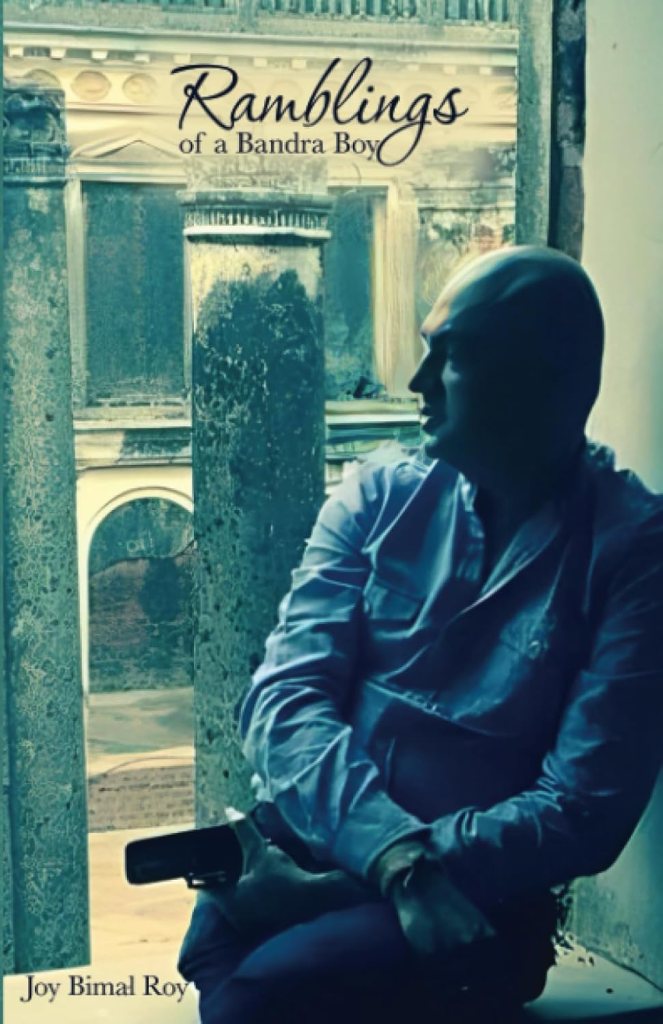
Ramblings of Joy Bimal Roy

‘So what is it like being the son of Bimal Roy[1]?’ Ratnottama Sengupta asked the author of Ramblings of a Bandra Boy
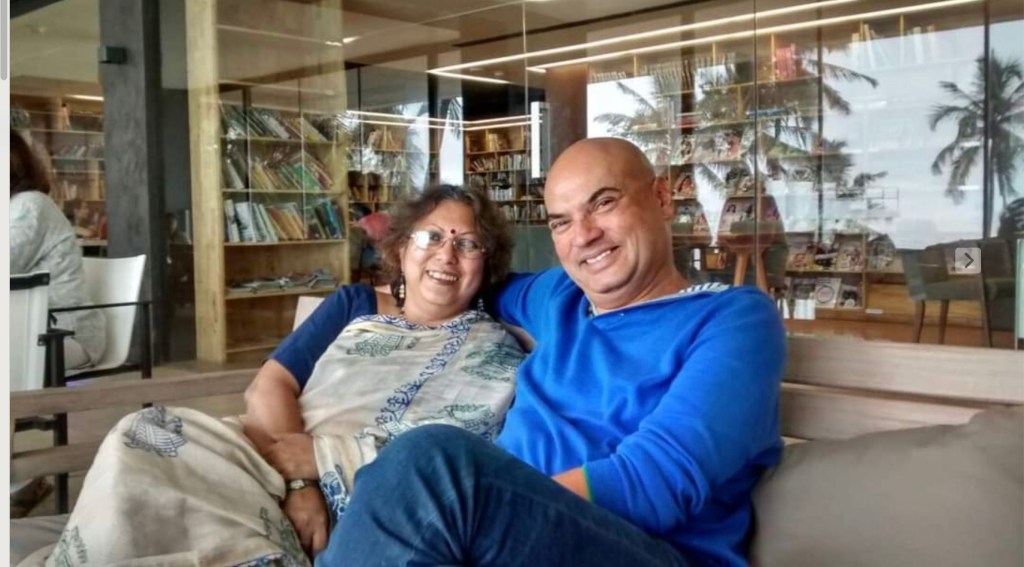
Ratnottama Sengupta and Joy Bimal Roy. Photo Courtesy: Debashish Sengupta

Rambling, when used for writing – or speech – implies unmapped, confused or, at worst, inconsequential flow of thoughts. In another usage, the word applies to walking in the countryside for sheer pleasure. It is in this second sense that Joy Bimal Roy’s digitally published text, Ramblings of a Bandra Boy is a perfect match of form and content. For, its sweeping take hops from landscape to landscape and life to life of persons who have peopled the world of the author born in a typical Bandra household precisely 70 years ago.
Why typical Bandra household? Because Bandra – derived from the word bandar, meaning harbour – is the Queen of Mumbai’s suburbs. This pocket of history in the heart of the Financial Capital of India is also the home of VIPs, of Bollywood and of political variety too. As the time-weathered Bandra Fort overlooking the Arabian Sea vouches, Bandra predates the British ownership of the Seven Islands gifted to the Crown when Charles II married Princess Catherine of Portugal. Indeed, St Andrew’s Church, in existence since 1575, came up on the strength of Jesuit Priests who won over Koli fishermen winning Christians a stronghold in this part of coastal Maharashtra, much like in Goa.

In the 21st century, Bandra is where Mehboob Studios and Lilavati Hospital stand. Where the Bandra-Kurla Complex defines the dreams of the rich and the rising, overshadowing Asia’s biggest shanty town, Dharavi. And where the awe inspiring Bandra-Worli Sealink bridges the southern extreme of ‘Bombay’ with its ever growing ‘suburbs’.

But all through my lifetime, Bandra has been better recognised as the home of celebrities. Bollywood thespians, Dilip Kumar and Sunil Dutt, to Shah Rukh Khan and Salman Khan; art personalities, KK Hebbar to Kekoo Gandhy; actors, Rekha to Raakhee; directors, Nitin Bose and Hrishikesh Mukherjee, writer Gulzar and cricketer Sachin Tendulkar; umpteen fashion designers and models too have boasted 400050 as their Pincode.

Joy Bimal Roy’s Ramblings takes you on a multi-stop tour of this ‘port’ of India’s social fabric. For, as you skid from one story to another, in no predetermined chronology or thematic order, you get to meet his Yusuf Uncle (Dilip Kumar of Devdas[2] fame) and Bhoba Kaka (Ritwik Ghatak of Madhumati[3]fame), Lata Bai (Mangeshkar) and the Dutts — father Sunil and daughter Priya — who have represented North West Bombay in Parliament even as one member of that family slogged in a jail.

Take a quizzical look at Bollywood divas and peep at actors in their skin labouring on in a posh gym. Get a warm handshake with Shashi Kapoor and gift a sari to Sanjana. Riveting tales of travels to Lebanon, Beirut, Abu Dhabi, Greece, Switzerland, England, San Francisco and San Jose – they’re crowned by nuggets like “I delved into my sister’s recipe book… it has taken the place of Bhagvad Gita in my life” and “I do wish food wasn’t such an important feature in my life. Because it directly correlates to my expanding waistline.”

That’s not all. Here’s a reverential insight into what constituted Shyam Benegal’s greatness — and several irreverent accounts of the crème de la crème schools and colleges that have shaped the author who could have been a top notch contemporary artist, a charming singer, an enviable fashion designer, or an accoladed filmmaker.

Joy Bimal Roy chose not to be either of these. Instead, he stitched together Images of Kumbha Mela when he chanced upon the footage that were to be Bimal Roy’s last film. And he directed Remembering Bimal Roy [4]when his father’s birth centenary came around. He has mounted a series of world class exhibitions to showcase the photography of his mother, Manobina Roy, who, along with her twin Debalina Majumdar, was one of India’s earliest woman photo artist. And in her memory he has installed an imposing sculpture of two hands raised in prayer, ‘Requeim’, at the Bandstand promenade. He has got a road named after his venerable father. He has designed the career of musical talents like Alisha Chinai. He has up-cycled heritage saris and jewellery to support hospices. And he has been editing a newsletter chronicling the life of Bandra, the neighbourhood he was born in, grew up in, and continues to breathe life into.

Now Joy has given us Ramblings, a compilation of his posts on social media between 2017 and 2020. These slices of life “served without any extra seasoning or fancy garnish” as he puts it, have been described by Rachel Dwyer, professor of Indian Cultures and Cinema at SOAS[5], London, as jottings in kheror khata, the traditional cloth bound notebook that Satyajit Ray — and his father Sukumar Ray before him — used to pen down thoughts and visuals that are world’s treasure. In this exclusive, he converses about his book and his life.

What is your earliest memory of being the son of Bimal Roy? 

Finding out in school from classmates that my father was famous!

What is the strongest impression you retain of 8th January 1966 – the day Bimal Roy passed into eternity?

I remember hearing a song from the basti[6] behind our house while I was taking a bath. That song still haunts me. I wasn’t allowed into the living room where Baba’s body was kept, so I peered in through the slats of the back door of the living room. We lived in an old Parsi Bungalow where the wooden doors were 8 ft high and had moveable wooden shutters. The room was packed to capacity but there was pin drop silence. Time stood still. It hadn’t yet sunk in that I would never see Baba again.

Did you develop a deeper understanding of what Bimal Roy was, in the process of making Remembering Bimal Roy?

Absolutely. It was a cathartic and moving experience to hear the memories of people he had worked with over 60 years ago. Not only Tapan Sinha, who was with him in New Theatres; poet, lyricist, director Gulzar who had started as assistant in Bandini; Sharmistha Roy, daughter of his art director Sudhendu Roy; and his accountant Amrit Shah – even next generation personalities like Javed Akhtar and Ashutosh Gowarikar remembered him with so much love and respect that it brought tears to my eyes. I discovered anew that Baba was not only a superlative filmmaker but also a wonderful human being.

Did you likewise get to know Manobina Roy a little more through her photography?

Not really. I was fortunate to have her presence for 46 years of my life. So I grew up being photographed and seeing her photos. But it was only after her death that I discovered from a Bengali book called Chhobi Tola that she and her sister Debalina were two of the earliest known women photographers of India.

Has the insight into Bimal Roy films equipped you to be a responsible filmmaker? Or did you gain greater practical experience as an understudy/ through your interactions with Shyam Benegal, Girish Karnad[7], Basuda[8], and Hrishi Kaku[9]?

I had no interaction with Basuda and Girish in connection with film making. What I learned after watching the making of Chaitali[10] — the last film made under the banner of Bimal Roy Productions, nine years after Baba passed away — was how NOT to make a film. 

Whatever I learned about filmmaking was from watching Baba’s films and my work experience with Shyam Benegal.

I wouldn’t really describe myself as a ‘filmmaker’ after making one documentary on Baba. However it is true that I have very high standards and living up to them was a big responsibility. After all, I am my father’s son. He was a perfectionist and so am I. It took me six months to edit a one-hour film simply because I was striving to do the best possible job with the material I had in hand. 

Before you got into films you have ‘dabbled’ in fashion designing, worked with HMV[11],  and now you are a most absorbing and prolific writer. Personally, I have always admired your painting (which I seldom see you do now). And I know you have mesmerised your college events with your singing. Which of these is your natural calling?

All of them unfortunately, which is why I didn’t know which one I should follow. As a result I have been a ‘dabbler’ — to use your own word. You could accuse me of being a dilettante but as I said before, I have high standards. So whatever I did, it was with all my heart and soul. 

Tell me about the joys and woes of assisting Shyam Benegal.

 That is impossible to describe as one question in an interview. It would be an entire interview! You can, however, get some answers in my book.

Which of the film stars of Bimal Roy’s team have you been closest to?

None. Because I was not even eleven when Baba passed away. But we did keep in touch with Yusuf Uncle. He was incomparable.

What difference in the work culture or cinematic ethics have you noticed between these two legends? 

Baba and Shyam? I can only judge Baba from his films, but I worked with Shyam. It’s a difficult question to answer.

Please tell us about Uttama, Papri, Roopu, Sharmistha (Buri?), Aloka – essentially, about the extended Family of Bimal Roy?

That’s what all of them were and are: Family. One accepts and embraces them as they are.

What led you to the Ramblings which has been described as ‘social document of our times’?

My Facebook friends led me to Ramblings. They drove me mad demanding a book. I did it more to oblige them and make them stop making demands.

What next — cinema a la Bimal Roy — or books after Monobina Roy, who, besides being an ace photo artiste and a fabled cook, wrote Jato Door Tato Kachhe?[12]

A Bengali translation of Ramblings of a Bandra Boy

.

[1] Bimal Roy (1909-1966) Legendary Film Director

[2] Hindi movie, 1955, Dileep Kumar (1922-2021) played the titular role

[3] Hindi movie, 1958, written by Ritwick Ghatak (1925-1976)

[4] Joy Bimal Roy lost his father filmmaker Bimal Roy when he was 11 years. Joy remembered very little of his father. ‘Remembering Bimal Roy’ made by Joy Bimal Roy is the search of a son for his father.

[5] School of Oriental and African Studies

[6] slum

[7] Girish Karnad (1938-2019) Actor, director, playwright

[8] Basu Bhattacharya (1934-1997), Film director

[9] Hrishikesh Mukherjee (1922-2006), Film Director

[10] 1975 movie directed by Hrishikesh Mukherjee

[11] His Master’s Voice, British music and entertainment retailer

[12] Distance draws us closer – translation from Bengali

Read the book excerpt by clickling on this link

Ratnottama Sengupta, formerly Arts Editor of  The Times of India, teaches mass communication and film appreciation, curates film festivals and art exhibitions, and translates and write books. She has been a member of CBFC, served on the National Film Awards jury and has herself won a National Award. 

.

PLEASE NOTE: ARTICLES CAN ONLY BE REPRODUCED IN OTHER SITES WITH DUE ACKNOWLEDGEMENT TO BORDERLESS JOURNAL

Click here to access the Borderless anthology, Monalisa No Longer Smiles

Click here to access Monalisa No Longer Smiles on Amazon International

Categories
Excerpt

Let’s Be Best Friends Forever

Title: Let’s Be Best Friends Forever: Beautiful Stories of Friendship

Publisher: Talking Cub, Speaking Tiger Books

From ‘The Tunnel of Friendship’ by Ruskin Bond

I had already started writing my first book. It was called Nine Months, but had nothing to do with a pregnancy; it referred merely to the length of the school term, the beginning of March to the end of November, and it detailed my friendships and escapades at school and lampooned a few of our teachers. I had filled three slim exercise books with this premature literary project, and I allowed Azhar to go through them. He was my first reader and critic. ‘They’re very interesting. But you’ll get into trouble if someone finds them,’ was his verdict.

We returned to Shimla, having won our matches against Sanawar, and were school heroes for a couple of days. And then my housemaster discovered my literary opus and took it away and read it. I was given six of the best with a Malacca cane, and my manuscript was torn up. Azhar knew better than to say ‘I told you so’ when I showed him the purple welts on my bottom. Instead, he repeated the more outrageous bits he remembered from the notebooks and laughed, till I began to laugh too.

‘Will you go away when the British leave India?’ Azhar asked me one day.

‘I don’t think so,’ I said. ‘My stepfather is Indian. My mother’s family have lived here for generations.’

‘Everyone is saying they’re going to divide the country. I think I’ll have to go away.’

‘Oh, it won’t happen,’ I said glibly. ‘How can they cut up such a big country?’

‘Gandhi will stop them,’ he said.

But even as we dismissed the possibility, Jinnah, Nehru and Mountbatten and all those who mattered were preparing their instruments for major surgery.

Before their decision had any effect on our life, we found a little freedom of our own—in an underground tunnel that we discovered in a corner of the school grounds. It was really part of an old, disused drainage system, and when Azhar and I began exploring it, we had no idea just how far it extended. After crawling along on our bellies for some twenty feet, we found ourselves in complete darkness. It was a bit frightening, but moving backwards would have been quite impossible, so we continued writhing forward, until we saw a glimmer of light at the end of the tunnel. Dusty, a little bruised and very scruffy, we emerged at last on to a grassy knoll, a little way outside the school boundary. We’d found a way to escape school!

The tunnel became our beautiful secret. We would sit and chat in it, or crawl through it just for the thrill of stealing out of the school to walk in the wilderness. Or to lie on the grass, our heads touching, reading comics or watching the kites and eagles wheeling in the sky. In those quiet moments, I became aware of the beauty and solace of nature more keenly than I had been till then: the scent of pine needles, the soothing calls of the Himalayan bulbuls, the feel of grass on bare feet, and the low music of the cicadas.

World War II had just come to an end, the United Nations held out the promise of a world living in peace and harmony, and India, an equal partner with Britain, would be among the great nations…

But soon we learnt that Bengal and Punjab provinces, with their large Muslim populations, were to be bisected. Everyone was in a hurry: Jinnah and company were in a hurry to get a country of their own; Nehru, Patel and others were in a hurry to run a free, if truncated, India; and Britain was in a hurry to get out. Riots flared up across northern India.

At school, the common room radio and the occasional newspaper kept us abreast of events. But in our tunnel Azhar and I felt immune from all that was happening, worlds away from all the pillage, murder and revenge. Outside the tunnel, there was fresh untrodden grass, sprinkled with clover and daisies, the only sounds the hammering of a woodpecker, and the distant insistent call of the Himalayan barbet. Who could touch us there?

‘And when all wars are done,’ I said, ‘a butterfly will still be beautiful.’

‘Did you read that somewhere?’ Azhar asked.

‘No, it just came into my head.’

‘It’s good. Already you’re a writer.’

Though it felt good to hear him say that, I made light of it. ‘No, I want to play hockey for India or football for Arsenal. Only winning teams!’

‘You’ll lose sometimes, you know, even if you get into those teams,’ said wise old Azhar. ‘You can’t win forever. Better to be a writer.’

One morning after chapel, the headmaster announced that the Muslim boys—those who had their homes in what was now Pakistan—would have to be evacuated. They would be sent to their homes across the border with an armed convoy.

It was time for Azhar to leave, along with some fifty other boys from Lahore, Rawalpindi and Peshawar. The rest of us—Hindus, Christians, Buddhists, Sikhs and Parsis—helped them load their luggage into the waiting British Army trucks that would take them to Lahore. A couple of boys broke down and wept, including our departing school captain, a Pathan who had been known for his unemotional demeanour. Azhar waved to me and I waved back. We had vowed to meet again some day. We both kept our composure.

The headmaster announced a couple of days later that all the boys had reached Pakistan and were safe. On the morning of 15 August 1947, we were marched up to town to witness the Indian flag being raised for the first time. Shimla was still the summer capital of India, so it was quite an event. It was raining that morning. We were in our raincoats and gumboots, while a sea of umbrellas covered the Mall.

(Extracted from Let’s Be Best Friends Forever: Beautiful Stories of Friendship, with an introduction by Jerry Pinto. Published by Talking Cub, the children’s imprint of Speaking Tiger Books.)

ABOUT THE BOOK

 An Afghan trader and a young Bengali girl form a touching connection that transcends cultural barriers in Rabindranath Tagore’s classic story ‘The Kabuliwala’. Jo March and Laurie from Little Women meet at a dull party and become companions for life. L. Frank Baum’s timeless characters Dorothy and Toto adventure around Oz forging magical bonds of friendship.

The brave queen of Jhansi and her ally Jhalkaribai come together to fight for freedom and dignity; Jesse Owens narrates an inspiring tale of sportsmanship and solidarity from his Olympic days; and twelve-year-old Kamala and her friends, Edward, Amir and Amma, endure the Partition riots together in Bulbul Sharma’s heart-warming story.

In these pages you will also meet Nimmi and her best pal, Kabir, whose school misadventures include spirited debates; Sunny, whose love for books leads to a new friendship on a trip to Darjeeling; Cyril and Neil, who face life’s challenges with inventive word games, and Siya, who discovers that true friends can come in the most unexpected forms—even as a cherished doll.

Animal lovers will delight in the escapades of Gillu, the charming squirrel, Harold, the handsome hornbill, Rikki-tikki-tavi, the loyal mongoose, Hira and Moti, the powerful oxen, and Bagheera, the brave panther who looks after the young boy Mowgli.

With stories from beloved and popular authors—Ruskin Bond, Rudyard Kipling, Mahadevi Varma, Jerry Pinto, Shabnam Minwalla, and many more—Let’s Be Best Friends Forever is an enchanting collection that celebrates the universal power and beauty of friendship.

.

PLEASE NOTE: ARTICLES CAN ONLY BE REPRODUCED IN OTHER SITES WITH DUE ACKNOWLEDGEMENT TO BORDERLESS JOURNAL

Categories
Stories

Felipe Jimenez’s Quest of the Unheard

By Paul Mirabile

Ever since his boyish days at the Seminary in Zamora, Spain, Felipe Jimenez acquired an unsual passion for mediaeval Visigothic architecture. A passion rarely shown in the mid 1800s. Another passion, too, swelled Felip’s heart and pride, one seemingly incongruous to the first: his fascination for the Quinta del Sordo, or the Villa of the Deaf; the villa or country-house where Francisco de Goya[1], a famed painter, alone and dwelling in his soundless world, drove out the fears and torments that haunted his sleepless nights by depicting a series of the most incredible frescoes that any painter up till then had painted. Frescoes that came to be called ‘pinturas negras[2]. Why Felipe Jimenez had associated these two passions into one maniacal life project is the drama of his heart and of this tale …

In the mid 1800s the only means of exploring the Spanish countryside with any speed was on horseback. Felipe prided himself as an excellent horseman. He loved horses, especially his own, whom he named with endearing irony, Rocinante[3]. As he roamed Northern Spain in search of the three extant Visigothic churches, he himself questioned his love of mediaeval art: Was it his voracious readings of mediaeval castles and knights? The glorious battles between Visigoth Christians and Muslim Arabs? The silent stones of ruined churches, castles and hamlets to whose voices no one wished to lend an ear?

And Goya’s frescoes? The deaf Master’s tortured figures and thickly layered pigments impressed on the solitary walls might have reflected the bleak, lonely landscape that Felipe was now traversing speedily. Reflected the bleakness, too, of his soul for a reason that he could not understand. He thought, spurring his steed faster, that the oddity of his passions might have been kindled, unknowingly, by the unexpected encounter of two very apparently contradictory visions, yet out of which Felipe had been magically touched or enlightened because of their estranged association, because of their incompatible commonalities.

With a genuine thirst to sate these emotions, our rider rode on and on until he came upon the seventh century Visigothic church of San Pedro de la Nave in his own region of Zamora. A pure joy to lit up his eyes when he saw the sculptured capitals[4] of twittering birds and intoxicating flowers, of the beloved Daniel in the Lion’s den, soothing the roaring beasts with his melodious chanting, of Saint Philip’s outstretched hands conducting his chant to Creation. These tickled Felipe’s ears as he listened to their concerted canticle. He had never before experienced such fineness of hewn stone and arched forms.

From his shoulder-bag he procured a sketchbook and began drawing the animated capitals, one after the other, carefully noting each cry of the bird, each chant of Daniel and of Philip. When this task had been meticulously completed, he stepped outside into the blackness of night, breathed in the thick air, then retrieved his bed-roll, rolled it out and slept peacefully against the outer wall of the church, whose stones, still hot from the scorching afternoon sun, afforded him warmth against the chills of the early autumnal night. He awoke refreshed, bathed in the swathes of a pure, reddish, morning glow.

Now if these treasures aroused enthusiasm in Felipe’s heart, greater would be the treasure trove that awaited him to the south of the great city of Burgos, when some weeks later, he discovered the seventh century chapel of Quintanilla de las Viñas, perfectly intact. Dismounting from his trusty but fatigued steed, in awe he admired the outer friezes[5] of exquisitely sculptured partridges and peacocks,  feasted his dust-filled eyes upon festoons of interweaving vines and clusters of hanging grapes. They were almost real to the touch those plump clusters! He listened in a sort of dazed ecstasy to the imagined screams of the partridges and peacocks as they paraded their plumage and fanned their tails inside the frieze. The sweetness of the grapes dripped off each pregnant cluster. How Felipe longed to quench his thirst by picking each one out of its stony bezel.

Unable to enter the chapel, the door being barred, Felipe brought out his sketchbook and reproduced those screams and sweet drippings as best as his artistic talents enabled him. He was an excellent artist. As he closed his sketchbook, a sudden thrill shot up his spine — a thrill that he had never experienced before. Felipe rode off filled with wonder, the early autumnal sun setting red and round over the arid plains of northern Spain. Had it all been an intimate communion with those birds and grapes? Had others bore witness to those storied stones? Felipe patted Rocinante’s jowls affectionately: all these questions remained enshrouded in the mystery of Spain … his own story within Spain’s … 

Over the scorching plains Felipe galloped wildly in search of the last Visigothic church, San Juan de Baños, locatedin the region of Palencia. He arrived after five or six days of riding under the blazing sun, sleeping under the gelid stars.

This jewel outshone the other two: the basilica-plan church’s naves[6] were supported by the most perfectly intact groined vaults[7]: they left him breathless. He began sketching them in feverish excitement. But what really astounded the drawer was the triumphal arch that welcomed the church-goer within. An arch that he had never laid eyes on before.

Just then Rocinante began pawing the hard soil with the hoof of her foot. She  snorted and pawed with steady blows in an unusual way. Felipe ran over to her. He noted that her horse-shoe had been displaced. As he bent to reshoe his horse, it occurred to him that Rocinante’s iron shoe bore an exact resemblance to the welcoming entry arch of the church. When he had finished the shoeing, he resumed his drawing, marking every detail of this incredible arch: It can’t be compared to the Moorish arch or to the Roman one- he mused. He then decided to coin this novelty the arco de herradura[8]; that is, the horse-shoe arch, for indeed unlike all the arches found in Spain, the opening at the bottom of this one was much narrower than its full span. But what attracted him most about this original work of art were the two abutting ends of the arches supported by the tops of the columns which gave the impression that they sought to join together to form a circle. Of course this impression was one of an artist’s …

Overjoyed by his coined expression, thanks to his trusty dark-maned Rocinante whose shoe had been properly shod, Felipe spent the rest of the day studying the church inside and out. When twilight set in he pulled out his bed-roll, lay down at the apse[9] of San Juan de Baños, imagining in his head his next and last halt, Recaredopolis, the only Visigothic town to be founded by the migrating Northern-Germanic peoples, built by King Leovigilda’s excellent craftsmen in 578 and finished by his son, King Recaredo, the first Catholic Visigothic king of Spain, baptised in 586. According to his map, Recaredopolis was located eighty kilometres from Madrid in a hamlet called Zorita de las Canes. According to several learned acquaintances, he had been informed that the hamlet lay in stoic silence, ignored by archeologists, unvisited by the curious. He liked that. He would ride to it at the red of dawn …

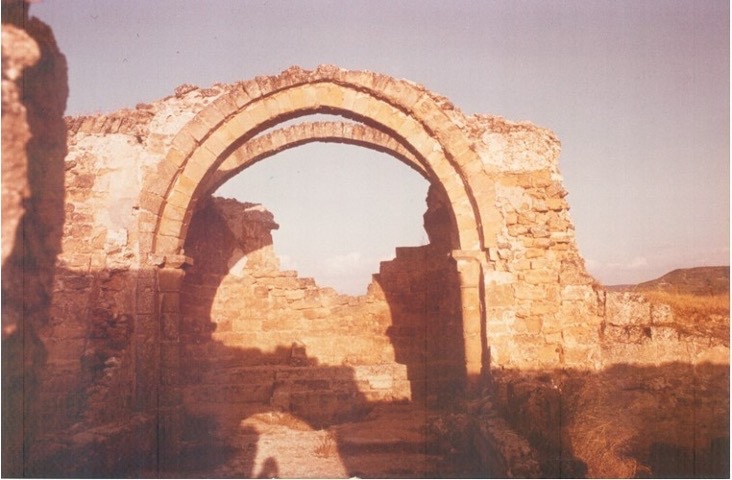
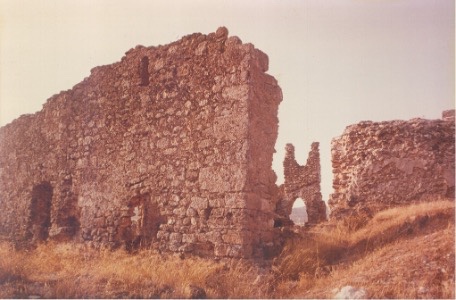
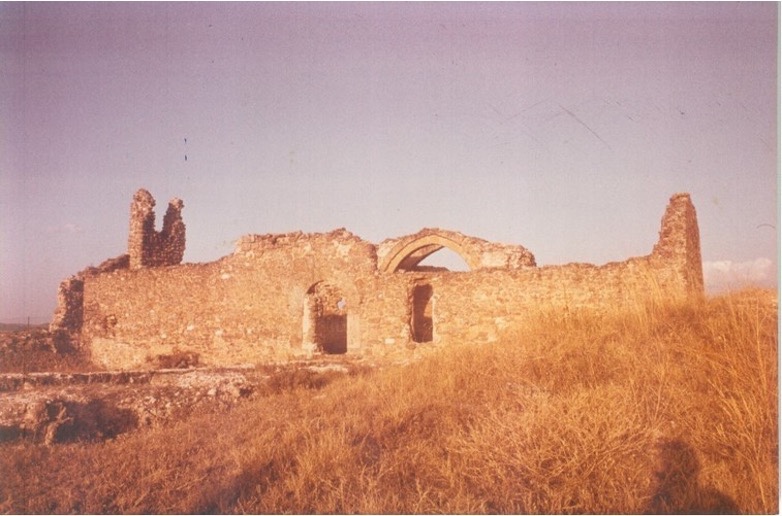
Five days later, the dark-maned Rocinante carried her exhausted rider, face-blistered and throat-swollen into Zorita de las Canas, then straight to Recaredopolis. Here the silence of the still standing stones welcomed the quester. Trotting through the remaining edifices he pulled up his steed before a horse-shoe arch, more or less identical to the one that he had admired and sketched at San Juan de Baños. The domed roofs of the churches and chapels had fallen into decay, but the untouched stones rang of a superior, magnanimous craftsmanship. This sixth century town had withstood the upheavels of History, the turbulence of Time, although the two-storey palace had lost its second storey entirely and the granary had been reduced to two walls and piles of heaped up stone.  

The horseshoe arch at Recaredopolis. Photo Courtesy: Paul Mirabile

Felipe let his horse roam about looking for a good feed whilst he meandered in and out of the moss-clad walls of the dilapadated palace, granary and sanctuary, filling his sketchbook with copy after copy of this fabulous mediaeval architectural trove. It seemed to him that no one, besides the villagers, had stepped foot in these ruins. Felipe felt estranged from himself, staggering about in a queer trance-like state from wall to wall, all so silent, yet deafening to his ears, so lyrical, so ecstatic that they strove to enter into communion with him. He sketched until the advent of night …

The ever-standing mediaeval sanctuary walls. Photo Courtesy: Paul Mirabile

Felipe built a fire and cooked a few potatoes and green peppers over it on a make-shift spittle. Lying on his bed-roll as he had done for so many star-studded nights, hands behind his head, he scrutinized the Autumn moon’s face mottled with huge black spots, listening to the deep, warm silence that surrounded him. He suddenly sat up: Had he not heard a runeful moaning skipping over the dry, empty plains? He bit his lower lip. The night air began to chill him. He continued to listen, attentively, his heart pounding painfully. Nothing. No one. Something frightened him: The horrors of war. Of famine and poverty ? Of old age creeping up upon him ? Or the ugliness of human depravity ? But why are these thoughts plaguing him at this very uninvited moment, as he lay so peaceful in this lieu of broken stones and tales ? 

The sanctuary rising over the dry, grass-swept plain. Photo Courtesy: Paul Mirabile

He counted the stars, mentally tracing the curved contours of the waxing alabaster moon. Nothing stirred. No breath of wind, no call or cry from animal or bird. Felipe felt a surge of loneliness here as if the slow decay and negligence of the ruins resembled his own, physically and mentally … He was well over fifty, and the hardships of aging were slowly creeping up on him. His hand trembled when he drew. His back hurt from riding. His mind thought thoughtless thoughts, adrift between the past and the present in some sort of dark chaos. 

Felipe ignored the fact that no thought arises by thinking. Thoughts burst upon you at the most unsuspecting moments. They dance and whirl about then penetrate as quickly as that! The thinker must welcome them no matter how abrupt, unforeseen, painful. Yet, Felipe was keen on welcoming them, eager to decipher their subtle choreography.

He awoke in a dull trance. The sun rose lethargically over the voiceless ruins, the curling, misty plains. He watched its entrance into the world whilst the dancing thoughts that had spun him about during the night, and at present were jarring him out of sleep, grew brighter and brighter into figures of acts to be enacted. He threw dirt over the embers of the fire, rolled up his rug, saddled the munching Rocinante, and with a last glimpse of Visigoth Spain, galloped at full speed towards Madrid.

However, not to the big city. What had he to do with big cities ? No, Felipe Jimenez spurred desperately to Manzanares, twenty kilometres outside of Madrid, where there, the enigma of his quest would be resolved, or so he hoped! For a wild, dancing thought had overwhelmed him last night. A thought so feral that it would surely unlock the door to the mystery of an overt sense of hopelessness. Felipe imagined that hidden recess, heard its muffled invocations. To Manzanares he thus rode hard. To the Quinta del Sordo (Villa of the Deaf) where those welled up voices would overflow and spill forth the truth of centuries and centuries of silent exuberance, ecstasy and crime … To him and him alone ? That sacred communion remained to be seen …

Francisco de Goya’s voice, one that the great painter no longer heard since his deafness had severed him from the rest of the world, lay dorment in that villa; or so it was said. The great Master heard only faint murmurs of the Other World, murmurs that conducted his hand, steered his strokes, governed his unbridled imagination.

To those strange frescoes Felipe flew, thrilled that the hidden recesses of somber existence would be laid bare at that villa, illumined by the fourteen pinturas negras (black paintings), those black, ochre and brown pigments telling a tale that no historian, no archaeologist, no artist has ever told. Muteness, deafness, voicelessness — beacons of existential raison d’être

Three days later, Felipe Jimenez and Rocinante arrived at the villa as wreaths of fog were lifting off the slow, rolling wavelets of the River Manzanares. He dismounted, tied his horse to a tree and stood for several minutes in front of a quaint, two-storey country house behind which rose a range of shaggy hillocks hardly visible in the morning haze. Between the wisps of mist he noted that the front walls were in a deplorable state, suffering no doubt from the humidity and heavy rains. The alabaster sheen of the roughcast had crumbled off in large, mossy patches into a front garden overgrown with yellowing quitch grass, spiky thistles and thorny nettles. Flower beds had become weedy, rank.

He walked up to the front door and knocked: once … twice … thrice: No one.

Felipe laughed and thought: “Of course, he can’t hear. He’s deaf !” Mustering a bit of courage, he pushed open the heavy door; it had been left unbarred. He peeked inside, then slipped in quietly. Once inside, the silence frightened him. All the shutters had been shut in the dining room. There was hardly any furniture. A foul odour of dissolution made him dizzy.

“Señor …  Señor Goya?” Felipe called in a feeble voice unlike his own, the echo filling the room and his ears with unfamiliarity. “Are you out ? Yes, you must be out!” he assured himself, after which he rapidly threw open the shutters allowing streams of greyish, morning, misty light into the Master painter’s dining room. He gasped in disbelief. Painted on the dirty, unpapered walls were six frescoes that glowered at him in irate mockery. Yes, they eyed this intruder, this interloper’s every gesture with incensed scorn: there, the toothless guffawing of two old men hunched over their bowls slurping soup, fleshless faces sneering in gnarled lechery. Whether it was the dull light or the artistic acuteness of Goya’s brush work, their faces gave the impression of being embossed with warts or malignant tumours. Their clothes drooped on them like tattered rags (Dos viejos comiendo sopa)[10] !

Then Felipe approached a most peculiar scene: the mythological god of Time, Saturn, its eyes popping out of its sockets, was chewing one of his sons alive in bloody gluttony, the ruthless, long-haired creature believing that if he devoured his sons, one by one, he would never be dethroned by them, thus interrupting the course of Time (Saturno devorando uno de sus hijos)[11]. To his left, the most frightening of all frescoes: El Aquelarre[12]. Felipe drew closer. Yes, this was the Master’s most horrid depiction of his mindset: a black mass! It was a huge depiction of a motley crew, attired in tatters, gloating, mottled faces tormented, distorted by unhealthy beliefs, listening in starry-eyed reverence to a goat-like creature, yes, Satan himself, robed in black, horns held high in haughty hallowedness. Upon these dank, lonely walls Goya expunged from his tortured mind the two pillars of his psyche: the ecstatic and the grotesque  …

In a state of feverish agitation Felipe took out his sketchbook and traced the six frescoes one after the other like a madman attempting to capture each frightful feature, every desperate detail, each and every harrowing stroke of the Master’s demoniacal brush.

Sketching as best he could, given the dusky dimness of the late morning light and the dark pigments of the paintings, Felipe, after having drawn the downstairs frescoes now rushed head-long upstairs to Goya’s study. He shrank back in a dazed shock overwhelmed by the sight of the other eight masterpieces. All of them depicted the dark recesses of a man’s deranged mind, a mind enmeshed in  darkened  recesses, questioning and questioning and questioning. Felipe went from one to the other gaping at the cheerless existence of an artist, whilst the artist’s cheerless figures gaped at him, at this unwelcomed stranger. With much difficulty he discerned two warty, bizarre figures suspended dreamily in mid-air as if set free from Earth’s weightiness, sailing over a battlefield where they observed the drama below in ecstatic grotesqueness. In the background upon a hill an embattled castle lent a glum foreboding to the outcome of the scene (Visión fantástica)[13]. And there, on the back wall, two men, buried up to their knees, battling to the death with cudgels, a delightful technique that only the Spaniards could have invented. (Duelo a garrotazos)[14].

“Hobgoblins, all of them!” Felipe cried out involuntarily in crazed delirium. He had lost control of himself, sketching and sketching the figures that glowered at him, talking aloud in an effort to expurgate the evil that gradually filled his soul. The horrors of war, death, violence.

The most phantasmagorical visions had been assembled here in this dreadful villa during the restless nights of a his heart, painted by the Master of painters who had shunned all contact with the outside world. A solitary, mute communion had occurred within these demented walls, whose commerce wallowed in the mire of old age decrepitude, of sickening lust for glorious butcheries and triumphant slaughtering. Did Francisco de Goya love the smell of blood?

Felipe hardly understood the obsession that had nettled him for so many years whilst he sketched until his wrist ached. The mute stones … the deaf ears … the pounding silence that had entombed the landscape with courtly crimes, pogroms and despot debaucheries, all of which had crumbled into speechless stone, into hollow, unspoken edifices.  Indeed, all had fallen into decay, a slow decay, like the colourless figures painted on these waning walls ; like Goya’s mind ! “And mine ? Yes, mine too ! Ecstasy and grotesqueness : the mindset of our national character …” he acknowledged ingloriously.

Felipe, utterly exhausted, completed his sketching just before nightfall. He tip-toed down the stairway to the front door that he had left ajar. A last glimpse behind him saddened his heart; he had not met the Master. Yet, at the same time, a faint voice told him it would have been a fruitless meeting: the deaf have no one but themselves to converse with.

Furthermore, perhaps that meeting would have divulged the dreadful truth of Goya’s painted visions, and more importantly, the truth of those stones whose own untold story might have spoken a truth that only Felipe would have comprehended, enwrapping him thus in many veils of a strange, naïve self-satisfied truth. A truth that went beyond human reasoning, struggling in a twilight zone of Felipe’s own story within the quagmire.

It stands to reason that Felipe Jimenez had experienced what some call the ‘sense of the past’. A troubling experience that may occur at any instant of time or by incessant galloping between the past and the present. Nevertheless, it must be recorded that Felipe never really believed that he would fully join or unite the stony vestiges of a lost kingdom to the ‘black paintings’ by Francisco de Goya. Perhaps this sentiment or fantasy can be compared to the horse-shoe arch whose two bottom abutting stones sought to conjoin in a circle … in vain …

Be that as it may, our heroic Felipe died without friends or family. Only three of his sketches have been preserved. Oddly enough, they were discovered on the inside cover of a 1780 Royal Spanish Academy edition of El Ingenioso Hidalgo Don Quijote de la Mancha written by Miguel de Cervantes[15], edited by Joaquin Ibarra. In this same edition were also found several scattered notes in the margins presumedly jotted down by Felipe.

Felipe Jimenez’s tomb has never been located. Does this obliterate his existence ? I for one believe he did exist. However, many historians contend that he never existed at all …

.

[1]          Francisco de Goya (1746 – 1828) born in Fuentedetodos, Spain died in Bordeaux, France.

[2]        ‘The Black Paintings’.

[3] Don Quixote’s mangy horse was named as such. Miguesl Cervantes’ Don Quixote was published in 1605.

[4]        Head or top of a column or pillar.

[5]        A horizontal band of sculpture usually filled with animal or vegetal motifs.

[6]        The central aisle of a church.

[7]        Arches supporting intersecting vaults or arched roofs.

[8]        ‘Herradura’ means ‘horse-shoe’. It comes from the Spanish ‘hierro’ ‘iron’.

[9]        A large domed recess at the end of a chapel or church.

[10]      ‘Two old Men eating Soup’ (1819-1823). All the frescoes were painted during that time period.

[11]      ‘Saturn devouring one of his Sons’.

[12]      ‘Witches’ Sabbath’.

[13]      ‘Fantastic Vision’.

[14]      ‘Duel with cudgels’.

[15]      The Ingenous Gentleman, Don Quixote of La Mancha by Miguel de Cervantes Saavedra (1547-1616)

.

Paul Mirabile is a retired professor of philology now living in France. He has published mostly academic works centred on philology, history, pedagogy and religion. He has also published stories of his travels throughout Asia, where he spent thirty years.

.

PLEASE NOTE: ARTICLES CAN ONLY BE REPRODUCED IN OTHER SITES WITH DUE ACKNOWLEDGEMENT TO BORDERLESS JOURNAL

Click here to access the Borderless anthology, Monalisa No Longer Smiles

Click here to access Monalisa No Longer Smiles on Kindle Amazon International