Categories
Interview Review

In Discussion with Rajat Chaudhuri: Spellcasters and Solarpunk

A brief overview of Rajat Chaudhuri’s Spellcasters, published by Niyogi Books, and a conversation with the author.

Spellcasters by Rajat Chaudhuri is a spellbinding fast paced adventure in a phantasmagorical world against the backdrop of climate change and environmental disasters. Chaudhuri, a proponent of solarpunk[1],  has nine books under his belt, including the Butterfly Effect (2018) a few fellowships (like Charles Wallace), and a sense of fun as the characters hurtle through the book gripping the readers with their intensity.

In this novel, Chaudhuri’s universe is run by a council, based on Akbar’s Navratnas[2]. They seem to be people in charge of running a chaotic world. This group — though not drawn from Akbar’s court but from various parts of the world — are known as the ‘Nine Unknown Men’. They are said to host great people from the past in another dimension. As they “fold the dimensions and transform matter from one form to another”, manipulating and yet healing characters like Chanchal Mitra, his protagonist, putting the world to ‘rights’ by destroying villainous capitalists who sport shrunken heads of their enemies and indulge in creating drugs that can lead to annihilation of humankind, there is a fine vein of coherence which gives credibility to Chaudhuri’s imagined world.

The locales are all fictitious but highlight real world problems of climate change, unethical scientific research and uncontrolled economic growth that only pamper the pockets of the rich craving power. He weaves in episodes that had made headlines in Indian media, like Ganesha drinking milk, and Himalayan disasters, a result of interferences by human constructs like dam building and ‘development’. A sensuous mysterious woman with curly hair, Sujata, who sets Mitra back on track and is as good as a Marvel heroine when accosted with villains, adds to the appeal of the book.

He describes a barefoot tribe which seems more idyllic than real. But given that it is a phantasmagorical fantastical novel, one would just accept that as a part of the Spellcasters’ world. However, the import of the message the tribal leader conveys to the characters on the run is astute. “We take little from this land and try to return what it gives us. So did our forefathers and all those who walk this country with the animals. But the settlers in villages and cities never tire of drawing out the last drop of earth’s riches…” A similar take on nomadism and settler communities can be found in nonfiction in Anthony Sattin’s Nomads: The Wanderers Who Shaped our World, who talks of the spirit of brotherhood, or asabiyya, that bound the nomads together, a concept borne in the fourteenth century in the Middle East. One wonders if the Nine Unknown Men who cast spells are also bound by some such law as at the end the ‘Perfect Lovers’ disappear into another adventure in time… perhaps, to resurface in Chaudhuri’s next book?

Chaudhuri is poetic with words. He writes stunning descriptions of storms and climate events: “The rivers are boisterous and overflowing, the skies are being torn apart by forests of lightning. The great snow-capped peaks from where these rivers emerge have vanished behind walls of water tumbling down from the skies.”

The thing that makes his book truly unique is the way his characters seem to internalise or grow out of the miasma that encapsulates the world below the mountains. They seem like an extension of the chaotic external environment with strange happenings. Even in the council meeting held by the Nine Unknown Men, some of the crowd seem to be wisps of mists. Chanchal Mitra has to go above the hovering fog to start healing back to normal. The novel starts in a seemingly dystopian setting. The ending is more of a fantasy. There is a strain of Bengaliness in his wry humour, in small factual details, like we find Jagadish Chandra Bose seated in the council hall, though  LJ drawn from RL Stevensons’ fictional pirate from Treasure Island (1883), Long John Silver, and Caligari from The Cabinet of Dr Caligari (1920), have larger and more crucial roles in the novel. Spellcasters is a thriller that entices with words, a gripping plot and suspense — set against a backdrop of strange climate events that are becoming a reality in today’s world, though the characters are more interesting than those drawn from real life.

The novel is written by an author who is compelled by perhaps more than a need to record his times. He has a vision… though not clearly laid out as a didactic message. But it hovers in the fog that is part of the book. One of the things that came across[3] was to create utopia, we need the chaos of dystopian existence…a theme that rebel poet Nazrul addresses in his poem, ‘Proloyullash’ (The Frenzy of destruction): “Why fear destruction? It’s the gateway to creation!”

Rajat Chaudhuri

In a past life, Chaudhuri had been a consumer rights activist, an economic and political affairs officer with a Japanese Mission and a climate change advocate at the United Nations, New York. Working in such capacities could have generated his vision, his worldview. Let us find out more about it by asking him directly:

What made you turn to writing from being an activist and climate change advocate? How long have you been writing fiction? What made you turn to fiction?

I am still involved with activism through my work with NGOs and my writing for popular media and other venues.  However, I have gradually shifted my energies to creative fiction through which, nowadays, I try to engage with climate change and other planetary crises.

I have been writing fiction for nearly two decades now, my first novel, Amber Dusk was published seventeen years ago.  As a full-time activist I have had the opportunity to interact and work with people from various strata of society right from the villages of India to international fora like the United Nations, where I have often noticed a tug-of-war of ideas between big business, sections of civil society, governments and other major groups like women, indigenous people and so on. While watching and participating in these, I had begun to realise how stories can open another flank in our efforts to communicate our ideas.  

Today, you see, storytelling is everywhere. Stories are being recruited for issues big or small, important or completely worthless, even dangerous! In my case, I realised that stories can be an important vehicle for communicating issues surrounding planetary crises to my audience. Stories tend to be sticky — they remain with us for a long time and studies are now showing that well told stories can trigger changes in perceptions, beliefs and ideas. But it took me a long time to transform this realisation into book projects. Before that I had written other books – contemporary fiction, urban fantasy and so on.  

 What made you conceive Spellcasters? How long did it take you to write?

There are two or three strands that came together in the writing of Spellcasters. Most important among these is my interest in psychology and mental disorders and specifically in the fact that the ideas that dominate the world today, you can call them spells too, make us behave like we are affected by some kind of mental illness. Ideas and practices like limitless growth, conspicuous consumption and so on, make us behave as if we have lost our minds as we go on plundering the planet for energy and resources despite the fact that `nature’ is striking back at us with ever-increasing fury. So, our mental illness is causing planetary illness and at the centre of all this are these powerful, mesmerising, false beliefs, which right from the time of the Club of Rome have been known to be dangerous.

So, when I began to plan this novel, all these thoughts were in my mind partly driven by my activism. And at the same time, I had been reading Sudhir Kakar’s works about magic and mysticism in India and the parallels between Indian and western psychology so all of that came together. It took me about five years to complete Spellcasters not at one go, there was other stuff I have worked on in between.  

What kind of research went into making the book?

To create the main character, the journalist Chanchal Mitra, I worked closely with my psychoanalyst friend Anurag Mishra who happens to be a student of Sudhir Kakar. And that research was really intense. We had long face-to-face and online sessions and I read a lot about the varieties and specificities of mental disorder.

Then there is of course that background layer of interest which oftenseeds ideas in your mind. This usually comes from your reading, and I had been interested in reading about the occult traditions of the East and the West for many years. Characters like Mme Alexandra David-Neel[4], the magic healers among indigenous peoples, the power of entheogenic substances like mushrooms have always fascinated me, and some of that came back while researching this book. Writing the climate layer of the story was comparatively easier because of my first-hand activist experience. 

Do you have a vision or a message that you tried to address in this novel? I felt it moved from a dystopian setting to that of a fantasy — though not to utopia. Do you think a dystopian vision is necessary to evolve utopia?

The message is simple, and we all know it: Ideas of limitless growth have affected us mentally and so we behave and act in ways (resource extraction, carbon emission) that are making the planet sick. We are passing on our illness to the planet.  The belief in limitless growth is a zoonotic disease that our species has transferred to the living planet. Still, we do not act because we are under the effect of these powerful ideas, these powerful spells, that’s where the novel gets its name. The message, if we can call it one, is to be aware of this and try to break out of these spells.

The path to utopia is not necessarily through dystopia. We can start hoping and acting today before things get really bad. Which is the locus of the whole solarpunk movement with which I am closely associated as an editor and creator. But `darkness’ can be redeeming too. Jem Bendell writes about this in detail. Grief and sorrow can indeed make us stronger; author Liz Jensen navigates grief and encounters hope in Your Wild and Precious Life, which is a must read for everyone asking these questions. But coming back to Spellcasters it is really neither dystopia or utopia if we are talking about the climate layer of the story, it’s very much set in the present. What might look dystopian are the gothic and magical elements and settings which serve as a counterpoint to the cold logic of the scientist character, Vincent.  

Your novel has broken various barriers by mingling different constructs. So, tell us, how do you combine realism with fantasy, science with literature and create your own world?

It’s not difficult actually. Fantasy, magic and `unreason’ are woven around the borders of the familiar. We see them often without noticing it. Leaping a little higher or using a prescription eye-cleanser can do the trick!

To answer the other part of your question, science and literature or nature and culture were never apart in the first place. They were sundered because of the partitioning project of modernity which goes back to the work of Hobbes and Boyle and has its own history and protagonists. Science fiction as you know does not care much for this division. Climate fiction because of its scaffolding of science and reason needs to bring the two together. As a climate fiction writer, I try to keep the scientific complexities in the background, but they remain as building blocks of the story. In this book however we have a full chapter which is out of a scientist’s journal, and I did that for a change in flavour and in the spirit of experimentation. 

 Are your imaginary locales based on real cities? Please elaborate.

Often so. In Spellcasters the cities of Anantanagar and Aukatabadare modelled on Calcutta and Delhi respectively. A close reader can easily pick out the similarities but then I also enjoy changing some details especially when I am writing mixed-genre work like this one. So, there is no Chinese joint (like the one Chanchal hangs out at) in Calcutta where you can openly smoke weed but there are places quite similar to the one I described and there is indeed a real person with an eye of glass who used to hang out in one of these.

You have spoken of storms on the hills. Do you also see this as an impact of climate change? Do you think building roads, tunnels or hydel power stations on the hills can, over a period of time, have adverse effects on climate or humanity? Can you suggest an alternative to such ‘development’?

The avalanches, the unseasonal rains, especially the cloudbursts are all closely connected to climate change. Having said that, we also have to be careful to avoid climate reductionism. Often it is a concatenation of factors (including carbon emissions and climate change) and processes, their effects amplified by feedback loops, that precipitate disasters. This is very true if we study migration, for which climate change can be one of the driving forces but there could be other factors like economic opportunities, cultural patterns etc implicated in such flows. 

Mindless development which does not take into account the fragility of nature and the interconnections between all beings big and small, microscopic or enormous, animate or inanimate, will set into motion processes that will precipitate crises like climate change. Yes, big dams are definitely a problem and small hydro is always a better option. We often hear that nature is self-healing or that there have been many previous extinctions, and that the planet has made and remade itself, but that’s like telling ourselves, please prepare for suicide while the super-rich and the cults of preppers, especially in the advanced industrialised nations, can escape to their doomsday bunkers.

The alternatives to the current development model is to be found in the ideas of Gandhi, of Schumacher, in solarpunk literature, in Vandana Shiva’s works among plenty of other places. The basic idea is to live in harmony with the planet, cut down on emissions, reduce resource extraction, try community based participatory solutions to problems instead of relying on economic, high-tech or market-based instruments, step back, go slow and let nature cloth and feed us so that we can live with dignity while forsaking greed.   

 In Spellcasters, you show climate change as an accepted way of life at the end. Do you think that can be a reality? Do you think climate change can be reversed?

A novel often presents itself as a bouquet of ideas without the author demonstrating any clear bias for one over the others. But as an activist-writer I usually drop clear hints as to what is more desirable without making it too obvious. There is always this ongoing duel between politics and aesthetics in a novel and the best among us balance the two quite well.

Climate change can of course be engaged with, controlled and reversed, if we can stick to the ambitious targets of the Paris climate agreement with the rich nations facilitating the process with more funds to poorer nations. Both producers and consumers have a role to play here, and we need serious lifestyle changes in the advanced industrial nations (or rather the global North) and a serious focus on climate justice for any meaningful change to occur. Only planting trees and carbon-trading won’t do.

Your language is very poetic. Do you have any intention of trying poetry as a genre?

Thank you. I haven’t ever thought of writing poetry because I am not gifted with the art of brevity which I think is essential there. But I have enjoyed translating poetry from Bengali to English, which was published as a book. I plan to do more of that.

What can we next expect from your pen?

I have been trying to finish a work of non-fiction about climate change and I hope to do this by the end of the year.

Let me also take this opportunity to thank you Mitali and your team at Borderless Journal for your service to literature. You are doing important work here and I am really grateful for your interest in my novel.

Thank you so much for giving us your time and sharing your wonderful book.

.

[1]Solarpunk is a sci-fi subgenre and social movement that emerged in 2008. It visualizes collectivist, ecological utopias where nature and technology grow in harmony. Read more by clicking her

[2]Navratnas or the nine gems were a bunch of very gifted men in his court, like Birbal and Tansen.

[3]The author does not agree to this reading in the interview. He sees his novel evolve out of the solarpunk movement.

[4]Alexandra David-Néel (1868-1969) https://openheartproject.com/the-path-post/alexandra-david-neel/

CLICK HERE TO READ AN EXCERPT FROM SPELLCASTERS

(The online interview has been conducted through emails and the review written by Mitali Chakravarty.)

PLEASE NOTE: ARTICLES CAN ONLY BE REPRODUCED IN OTHER SITES WITH DUE ACKNOWLEDGEMENT TO BORDERLESS JOURNAL. 

Click here to access the Borderless anthology, Monalisa No Longer Smiles

Click here to access Monalisa No Longer Smiles on Kindle Amazon International

Categories
Interview Review

The Gendered Body

In conversation with Meenakshi Malhotra and a brief introduction to The Gendered Body: Negotiation, Resistance, Struggle (Scopus Index), edited by Meenakshi Malhotra, Krishna Menon and Rachana Johri, published by Routledge

Why would one half of the world population be seen as evolved from the rib of the first man, soulless or as merely subservient to fulfil the needs of the other half? This is a question that has throbbed for centuries in the hearts of that half that suffers indignities to this date, women. While feminism became a formalised idea only in the 18th-19th century and things started improving for certain groups of women around the world, in some regions, like Afghanistan, the situation has deteriorated in recent years. Their government, recognised by world leadership, has ensured that women do not have schooling, cannot work in senior positions, have to be accompanied by men if they go out and remain covered as the feminine body could tempt bringing shame, strangely, to the female but not to the man who has the right to be tempted and hence to violence and violate her body and her mind.

Given this ambience, any literature voicing protest for patriarchal mindsets that accept situations like in current day Afghanistan passively, should be celebrated as an attempt to shard the silence of suffering by one half of the world population. The Gendered Body: Negotiation, Resistance, Struggle, edited by three academics, Meenakshi Malhotra, Krishna Menon and Rachana Johri, does just that. At the start, we are told: “This book situates the discourse on the gendered body within the rapidly transitioning South Asian socio-economic and cultural landscape.  It critically analyzes gender politics from different disciplinary perspectives…”

Featuring 22 writers, the narratives take up a range of issues faced by women in Pakistan, India, Bangladesh and Srilanka. The Pakistani implementation of Islamic law, under the Hudood ordinances, has been addressed in a powerful essay by Aysha Baqir, subsequently by Anu Aneja, in her discourse on Urdu poetry. It was interesting to read how the ghazal form started as a male-only art form where women were depicted as mysterious houris or pining with sadness. Birangona — a phrase that was given to rape victims of the 1971 Bangladesh Liberation War — has been explored by Sohana Manzoor through a classic, Rizia Rahman’s novel, Rokter Okshor[1](1978), written about such women driven to prostitution. Women’s voices in the Sri Lankan LTTE have been explored by Simran Chaddha. Nayema Nasir has taken up decadent customs in the progressive Bohra community in Mumbai and shown how things are moving towards a change. Colonial and Dalit voices have found a hearing in Malhotra’s essay on Mahasweta Devi’s short story, ‘Draupadi’, set against the Naxalite movement of 1970s.

Dotted with women’s responses to a variety of current issues, including the Anti-CAA-NRC uprisings (Tamanna Basu), Shaheen Bagh (Meenakshi Gopinath, Krishna Menon, Rukmini Sen and Niharika Banerjea), and the pandemic (Krishna Menon, Deepti Sachdev and Rukmini Sen), there is even a case study by Shalini Masih dealing with psychiatric trauma where both the psychiatrist and the patient, who might have evolved into a stalker or a rapist without the therapy, heal. A certain sense of hope echoes through some of these narratives, a hope to heal from wounds that have sweltered over eons.

The flow of words is smooth and the ideas should be able to rise against the tide of erudition to touch our lives with lived realities. There are responses that transcend the heaviness of academic writing for instance the impassioned start made by Giti Chandra in her narrative: “A woman’s body is a story that men tell each other. When it is full-hipped, it is a tale of their healthy children; when it is fair, it speaks of their wealth; when it is narrow, it proclaims their access to gyms; and when it is tanned, it flaunts their ability to vacation on sunny isles. If its feet are not small enough to convey a leisure that does not require walking, they are bound and made smaller and more childishly submissive; if its legs are not long enough befitting its trophy status, bone-crippling heels are added to them. When it is raped it is an assertion of power, a chest-thumping; when it is raped it is an aggression over its owner; when it is raped its womb is stolen from the enemy…” Chandra points out some things that make one think, like quoting Rahila Gupta, she suggests victims is not the word we should use for women, but we should refer to the sufferers as survivors.

This collection of essays questions social norms and niceties to realise what early woman’s rights activist, Elizabeth Cady Stanton, drafted, that “all men and women [had been] created equal” in July 1848. While the struggle continues through centuries and the discourse of these narratives, the last essay by a man, Brijesh Rana, attempts to give a broader and more inclusive outlook to the whole human body. The book comes across as a tryst — of academic and feminist voices — to speak up for mankind to equalise.

To further understand the intent and scope of this book, we have in conversation one of the editors— Meenakshi Malhotra, who teaches gender studies and literature, has to her credit two Charles Wallace fellowships and a number of books. She reflects on the bridge that is being attempted between scholarship and activism.

How and when did you conceive this book? Tell us a bit about your journey from the conception to the publication of the book.

This book was originally conceived due to the positive response my co-editors and I received after presenting a panel at an American Association of Asian studies (AAS) conference back in 2017. We were approached by an international publisher who encouraged us to take forward the work with a focus on South Asia. We were unable to take it forward at that time, however we revived the project a few months into the lockdown in late 2020 when we felt we had a little more time. Also, along the way, we were able to reach out to fellow travellers, working in and on Pakistan, Bangladesh and Sri Lanka.

Three of you have collaborated to compile and edit this book. Collaborations to bring out books are not easy. Tell us about this collaboration.

As we three had presented on the same panel, the collaboration was a natural corollary since we had a sense of being fellow travellers and sister academics/scholars. That worked well for us because each of us were engaged in research and research guidance and wanted to showcase the recent work in this area. Both the co-editors, Krishna working on gender and its intersections with politics and Rachna on gender and psychology are very well-established scholars in the field of gender. I work on gender and literature, had my own network and I must mention that in the course of writing for Borderless Journal, I was able to access the work of others on that platform.

Explain to us the significance of the title of your book.

I think we arrived at the title through two processes-one was the immediate situation of Covid which left us in a state of precarity. However, we felt that even within the context of the contagion, women — and other genders — were endangered in specific ways. Second is the understanding that the body is always already produced by multiple matrices of gender, race, caste etc. The human body is also always a gendered body.

We had initially suggested that we call it ‘The Gendered Body and its Fragments’ to connote the bundling of several discursive strands on gendered bodies, but the idea was vetoed (by the initial reviewer) since “fragments” had   resonances and nuances which we did not have space (or expertise) to go into, at that point.

You have a variety of contributors, some of who are non- academic. What did you look for when you chose your content?

Variety as you point out, is the key term. We were looking for something new, something interesting, flagging the variegated cultures of South Asian societies. The book comprises a mix of experienced researchers and some researchers whose essays are their preliminary forays into publishing.

Your book is divided into different sections ‘Negotiation’, ‘Struggle’, ‘Resistance’, ‘Protest’, ‘Critique’, ‘Representations and New Directions’. Can you tell us the need to compartmentalise the essays into this structural frame?

Just to give it a structure, organisation and coherence. Having said that, there are also frequent overlaps.

Would you call this book feminist? Feminism is as such a human construct. Why would this construct be essential for treating people equally? What is the need for feminism?

It is feminist in its orientation to the research areas as well as its methodologies. The key concept here is collaboration and therefore we have two conversation as an expression of feminist epistemology or knowledge-making.

Feminism, like other modes of affirmative action — like reservations, quotas — are an attempt to create a level playing field for historically disprivileged groups  and oppressed minorities.

Having said that, I/we would like to point out that feminism has become inclusive and an umbrella term that also includes the work on masculinities and trans-identities since the 1990s.

Isn’t feminism the forte of only women?

Not at all and that is why we have the term feminisms. We hope to do more work subsequently on masculinities, on trans bodies in the future.

You have 21 women writers who write of women’s issues. Yet the last is an essay by a man — not on feminist issues— but more to create a sense of inclusivity, if I am not wrong. Why did you feel the need for this essay?

It is not so much about women’s issues as much as about gendered bodies in contemporary South Asia, about identities, subjectivities, bodies in motion gearing up for political action(the conversation and the essay on campus movements are instances).

Also, the last essay which articulates a post-humanist perspective, I felt, would take us beyond the materialities of gendered bodies and flag the way recent research/scholarship has looked at the Anthropocene. It was attempting to give a meta perspective, to bring in a way of seeing, which probably will have an impact on how we understand and conceptualise human bodies.

Your book blurb says: “Topical and comprehensive, this book will be useful for scholars and researchers of gender studies, sociology, political sociology, social anthropology, cultural studies, post-colonial studies and South Asian studies.” Why would you limit the scope of your book when you have some essays that should be read by many and are like eye openers, like the ones on Hudood, Birangonas, Bohras, even your own on ‘Draupadi’ and more?

I think Routledge as an academic publisher, probably does this routinely, to highlight the academic terrain any new book covers.

Having said that, we would definitely want the book to be of general interest. Some of the essays discussed issues which were possibly eye-openers for us as well.

What is the difference between academic writing and non-academic writing? You do both, I know.

Academic writing has often a thesis and an argument underpinning it, which is not to say that non-academic writing — especially the essay — cannot have them.

Also, many of the essays were based on student papers/MPhil and even PhD dissertations. The panel we were a part of was an academic conference on South Asian studies.

Would this book be classified as women’s writing as majority of the writers are women and have written on women’s issues… and yet there is a man? Is it necessary to have such classifications? Would it rule out male readers?

Not at all to every question. It just happens that many of our contributors are women, but I would like to dispel the idea that “gender” is about women only. It is about boxes, stereotypes and role-based expectations, which are to be questioned. 

Thanks for giving us a powerful book and your time.

[1] Words of Blood

(The online interview has been conducted through emails and the review written by Mitali Chakravarty.)

PLEASE NOTE: ARTICLES CAN ONLY BE REPRODUCED IN OTHER SITES WITH DUE ACKNOWLEDGEMENT TO BORDERLESS JOURNAL. 

Click here to access the Borderless anthology, Monalisa No Longer Smiles

Click here to access Monalisa No Longer Smiles on Kindle Amazon International

Categories
Tagore Translations

The Funeral: A skit by Rabindranath

Translated from Bengali by Somdatta Mandal, this satirical skit[1] was part of Hasyakoutuk (1914) or Humour by Tagore

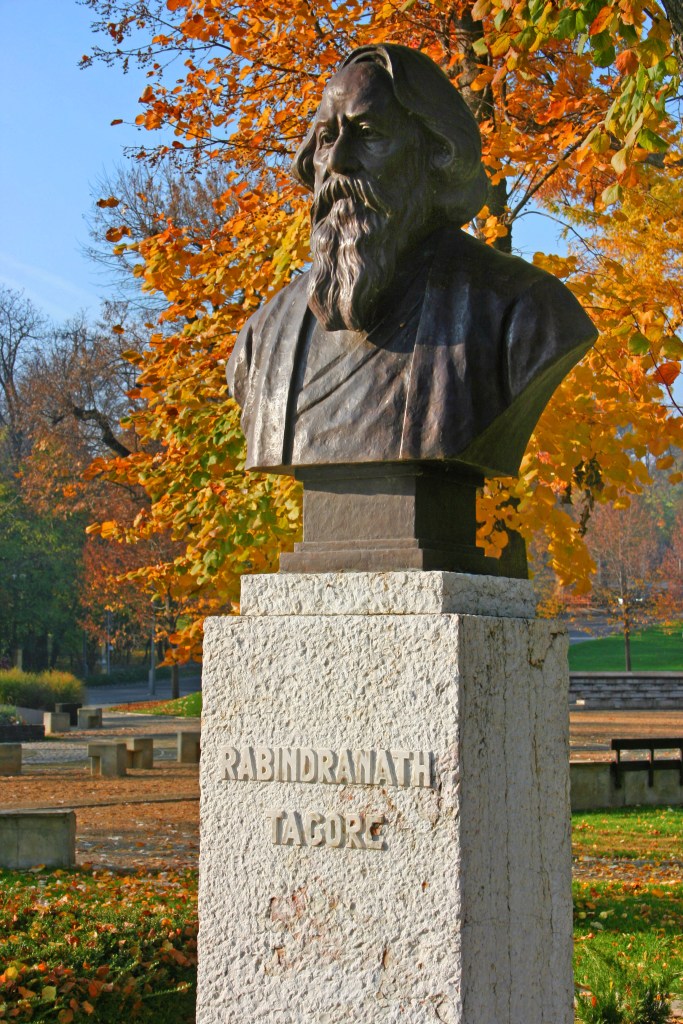
Rabindranth’s bust in  Hungary, Balatonfüred, Tagore promenade

Scene One

Ray Krishnakishore Bahadur is lying on his deathbed. His three sons Chandrakishore, Nandakishore and Indrakishore are busy consulting each other. A doctor is present. The women are close to tears.

Chandra: Who are the people we should write to?

Indra: Write to Sir Reynolds.

Krishna: (With great difficulty) What will you write, son?

Nanda: The news of your death.

Krishna: But I am not yet dead, son.

Indra: You might not die right now, but we have to fix a time for the event and write that down…

Chandra: We should collect the condolence letters from all the Englishmen here and get them published in newspapers. No point in publishing them when all the excitement is gone!

Krishna: Patience boys; let me die first.

Nanda: We can’t wait, father. Let’s make a list of the letters to be sent to the people in Shimla and Darjeeling. Come on, let’s get all the names down.

Chandra: The Governor, Sir Ilbert, Sir Wilson, Beresford, Macaulay, Peacock –

Krishna: Boys, what names are you chanting so close to my ears? Chant God’s name instead. When the time comes, He is the only one who can save us! Hari –

Indra: Yes, good thing that you reminded us, we forgot to include Sir Harrison.

Krishna: My sons, say Ram, Ram –

Nanda: Really, I had forgotten about Sir Ramsey.

Krishna: Narayan, Narayan!

Chandra: Nanda, write down the name of Sir Noran also.

Enter Skandakishore.

Skanda: So, you people seem so relaxed! You still haven’t done the real thing!

Chandra: And what is that?

Skanda: We have to inform in advance all the people who will be part of the procession going to the funeral ghat.

Krishna: Sons, which one do you consider the real thing? First, I’ll have to die, only then –-

Chandra: No worries on that account. Doctor!

Doctor: Yes sir!

Chandra: How much time is left for father to go? When do the public have to be here?

Doctor: Perhaps–

The women start wailing.

Skanda: (Disgusted) Ma, will you stop it? You’re creating quite a scene!  It’s better to sort out everything in advance. When doctor?

Doctor: Most likely this night at—

The women start wailing again.

Nanda: This is a huge problem! You shouldn’t disturb us during work. What do you think your crying will accomplish? We are planning to publish condolence letters sent by important Englishmen in newspapers.

The women are sent out.

Skanda: Doctor, what do you think?

Doctor: From what I can see I think he will expire around four a.m.

Chandra: Then there is no time – Nanda, go quickly, get the slips printed at once right in front of your eyes.

Doctor: But first mustn’t the medicine—

Skanda: Look here! Your medicine shop will not run away. On the other hand, we’ll be in trouble if the print ring shop shuts down.

Doctor: Sir, the patient might not —

Chandra: That is why you must hurry. For who knows what might happen if the slips are printed before the patient —

Nanda: Here I go.

Skanda: Write down that the procession will begin at eight tomorrow.

 Scene Two

Skanda: What, doctor? It’s already seven now instead of four.

Doctor: (Apologetically) Yes, yes, amazing the pulse is still strong.

Chandra: You are a fine one doctor to have got us into this mess!

Nanda: Everything went wrong when I was late in bringing the medicine. In fact, dad began to recover as soon as the doctor’s medicine was stopped.

Krishna: All this time you were so very cheerful, why is everyone looking so glum all of a sudden? I am feeling fine now.

Skanda: We aren’t feeling that great. We had already finalized all preparations to go to the funeral pyre.

Krishna: Is that so? I guess I should have died.

Doctor: (Feeling irritated) Do one thing and that will solve all problems.

Indra: What?

Skanda: What?

Chandra: What?

Nanda: What?

Doctor: Instead of him why don’t one of you die when the time is ripe.


Scene Three

A lot of people have assembled in the outer house.

Kanai: Hello, It’s already eight thirty. Why are you all late?

Chandra: Please sit down. Have some tobacco.

Kanai: I’ve been [chewing] tobacco from the morning!

Bolai: Where is everybody? I can’t see signs of any arrangements being made.

Chandra: Everything is ready – it’s not our fault – now only—

Ramtaran: Hey, Chandra, we shouldn’t waste any more time.

Chandra: Don’t I understand that – but—

Harihar: What is causing the delay? We’ll be late for office, what’s the matter?

Indrakishore enters.

Indra: Don’t be impatient. We are almost ready. In the meantime, why don’t you read the condolence letters?

He distributes them.

This is from Lambert, this from Harrison, this is Sir James’s—

Skandakishore enters.

Skanda: Here take them. In the meantime, read the obituary notices on father in the newspapers. Here is The Statesman, here The Englishman.

Madhusudan: (To Yadav) Isn’t this typical? Bengalis won’t ever learn what punctuality is all about.

Indra: You’re absolutely right. They will die and yet never learn to be punctual.

The guests shed tears reading the newspapers and the condolence messages.

Radhamohan:  (in tears) Oh God, the poor man’s friend!

Nayanchand:   Alas! To think that even such a good man has his share of troubles.

Nabadwipchandra: (in a deep breath) Lord! Everything is your will!

Rasik:‘The lotus that blooms in the heart’ – I’m forgetting what comes after that –

                        ‘The lotus that blooms in the heart

                        Has been plucked untimely

                        The lotus heart sinks in the sea of sorrow!’

This is exactly the case here. The lotus heart in the sea of sorrow. How sad! Add esquire. O tempora! O mores[2]!

Tarkabagish[3]: Challchittang challadbittang, challajiwan – The mind is inconsistent, wealth is transitory and one’s life is perishable. Oh how sad!

Nyayabagish[4]: Yadupathe kri gata mathurapuri, raghupate – Where is the city of Mathura that belonged to the Lord of the Yadavas (i.e. Krishna), to the Lord of the Raghus (i.e. Rama Chandra)? (chokes)

Dukhiram: Oh Krishnakishore Bahadur, where have you gone?

 A faint voice can be heard from within:  I am here. Please, don’t shout.  


[1] [Translated from “Antyashti-Satkar” in the Hasyakoutuk series Bhadra 1293 B.S. by Somdatta Mandal].

[2] “Oh the times! Oh the customs!” – Latin phrase, first recorded to have been spoken by Cicero

[3] Bengali title given to an expert debator

[4] Bengali title given to a legal expert

Somdatta Mandal is a former Professor of English and ex-Chairperson, Department of English, Visva-Bharati, Santiniketan, India. A recipient of several prestigious fellowships like the Fulbright Research and Teaching Fellowships, British Council Charles Wallace Trust Fellowship, Rockefeller Residency at Bellagio, Italy, Salzburg Seminar and Shastri Indo-Canadian Faculty Enrichment Fellowship, she has been published widely both nationally and internationally. She has also an award from Sahitya Akademi for the All India Indian Literature Golden Jubilee (1957-2007) Literary Translation Competition in the Fiction category for translating short stories series ‘Lalu’ by Sarat Chandra Chattopadhyaya.

.

PLEASE NOTE: ARTICLES CAN ONLY BE REPRODUCED IN OTHER SITES WITH DUE ACKNOWLEDGEMENT TO BORDERLESS JOURNAL

Categories
Author Page

Somdatta Mandal

Somdatta Mandal is a former Professor of English and ex-Chairperson, Department of English, Visva-Bharati, Santiniketan, India. A recipient of several prestigious fellowships like the Fulbright Research and Teaching Fellowships, British Council Charles Wallace Trust Fellowship, Rockefeller Residency at Bellagio, Italy, Salzburg Seminar and Shastri Indo-Canadian Faculty Enrichment Fellowship, she has been published widely both nationally and internationally. She has also an award from Sahitya Akademi for the All India Indian Literature Golden Jubilee (1957-2007) Literary Translation Competition in the Fiction category for translating short stories series ‘Lalu’ by Sarat Chandra Chattopadhyaya.

Interview

Where the Whole World Meets in a Single Nest

In Conversation with Somdatta Mandal, a translator, scholar and writer who has much to say on the state of Santiniketan, Tagore, women’s writing on travel and more. Click here to read.

Translations

Baraf Pora (Snowfall) 

This narrative gives a glimpse of Tagore’s first experience of snowfall in Brighton and published in the Tagore family journal, Balak (Children), has been translated by Somdatta Mandal . Click here to read.

 Himalaya Jatra ( A trip to Himalayas) 

This narrative about Tagore’s first trip to Himalayas and beyond with his father, has been translated from his Jibon Smriti (1911, Reminiscenses) by Somdatta Mandal. Click here to read.

Travels of Debendranath Tagore 

These are travel narratives by Debendranath Tagore, father of Rabindranath Tagore, translated from Bengali by Somdatta Mandal. Click here to read.

Travels & Holidays: Humour from Rabindranath

Translated from the original Bengali by Somdatta Mandal, these are Tagore’s essays and letters laced with humour. Click here to read.

Letters from Japan, Europe & America

An excerpt from letters written by Tagore from Kobi & Rani, translated by Somdatta Mandal. Click here to read.

Letters from Tagore

An excerpt from Kobi’ and ‘Rani’: Memoirs and Correspondences of Nirmalkumari Mahalanobis and Rabindranath Tagore, translated by Somdatta Mandal, showcasing Tagore’s introduction and letters. Click here to read.

A Bengali Lady in England by Krishnabhabini Das

An excerpt from Somdatta Mandal’s translation of A Bengali Lady in England by Krishnabhabini Das (1885). Click here to read.

Playlets by Rabindranath Tagore 

Two skits that reveal the lighter side of the poet. They have been translated from Bengali by Somdatta Mandal. Click here to read.

The Ordeal of Fame

A humorous skit by Rabindranath, translated by Somdatta Mandal. Click here to read.

The Funeral

A satirical skit by Tagore, translated by Somdatta Mandal. Click here to read. 

Tagore’s Gleanings of the Road

Book excerpt brilliantly translated by Somdatta Mandal. Click here to read.

The Welcome

A skit by Tagore, has been translated by Somdatta Mandal. Click here to read.

 The Treatment of an Ailment

A humorous skit has been translated by Somdatta Mandal. Click here to read.

Essay

Bengaliness and Recent Trends in Indian English Poetry: Some Random Thoughts

Somdatta Mandal browses over multiple Bengali poets who write in English. Click here to read.

Book reviews

Somdatta Mandal reviews Wooden Cow by T. Janakiraman, translated from Tamil by Lakshmi Kannan. Click here to read.

Himadri Lahiri reviews Somdatta Mandal’s ‘Kobi’ and ‘Rani’: Memoirs and Correspondences of Nirmalkumari Mahalanobis and Rabindranath Tagore. Click here to read.

A review by Meenakshi Malhotra of Somdatta Mandal’s The Last Days of Rabindranath Tagore in Memoirs, a translation from a conglomeration of writings from all the Maestro’s caregivers. Click hereto read.

Somdatta Mandal has reviewed BM Zuhara’s The Dreams of a Mappila Girl: A Memoir, translated from Malayalam by Fehmida Zakir. Click here to read. 

Somdatta Mandal has reviewed Shehan Karunatilaka’s The Birth Lottery and Other Surprises. Click here to read. 

Somdatta Mandal reviews  The Shaping of Modern Calcutta: The Lottery Committee Years, 1817 – 1830by Ranabir Ray Chaudhury. Click here to read.

Somdatta Mandal reviews Priya Hajela’s Ladies Tailor: A novel. Click here to read. 

Somdatta Mandal reviews Sudeshna Guha’s A History of India Through 75 Objects. Click here to read. 

Somdatta Mandal reviews Baba Padmanji’s Yamuna’s Journey, translated from Marathi by Deepra Dandekar. Click here to read.

Somdatta Mandal reviews Chitra Banerjee Divakaruni’s Independence. Click here to read.

Somdatta Mandal reviews KR Meera’s Jezebel translated from Malayalam by Abhirami Girija Sriram and K. S. Bijukumar. Click here to read.

Somdatta Mandal reviews Behind Latticed Marble: Inner Worlds of Women by Jyotirmoyee Devi Sen, translated from Bengali by Apala G. Egan. Click here to read.

Somdatta Mandal reviews The Past is Never Dead: A Novel by Ujjal Dosanjh. Click here to read.

Somdatta Mandal reviews Amitav Ghosh’s Smoke and Ashes: A Writer’s Journey Through Opium’s Hidden Histories. Click here to read.

Somdatta Mandal reviews Begum Hazrat Mahal: Warrior Queen of Awadh by Malathi Ramachandran. Click here to read.

Somdatta Mandal reviews Usha Priyamvada’s Won’t You Stay, Radhika?, translated from Hindi by Daisy Rockwell. Click here to read.

Somdatta Mandal reviews Ali Akbar Natiq’s Naulakhi Kothi, translated from Urdu by Naima Rashid. Clickhere to read.

Somdatta Mandal reviews Indian Christmas: Essays, MemoirsHymns, an anthology edited by Jerry Pinto and Madhulika Liddle. Click here to read.

Somdatta Mandal reviews Sudha Murty’s Common Yet Uncommon: 14 Memorable Stories from Daily Life. Click here to read.

Somdatta Mandal reviews The History Teacher of Lahore: A Novel by Tahira Naqvi. Click here to review.

Somdatta Mandal reviews Ilse Kohler-Rollefson’s Camel Karma: Twenty Years Among India’s Camel Nomads. Click here to read.

Somdatta Mandal reviews Radha Chakravarty’s translation of Selected Essays: Kazi Nazrul Islam. Click here to read.

Somdatta Mandal reviews Maya Nagari: Bombay-Mumbai A City in Stories, edited by Shanta Gokhaleand Jerry Pinto. Click here to read.

Somdatta Mandal reviews Knife:  Meditations After an Attempted Murder by Salman Rushdie. Click here to read.

Somdatta Mandal reviews Upamanyu Chatterjee’sLorenzo Searches for the Meaning of Life. Click hereto read.

Somdatta Mandal reviews Karan Mujoo’s This Our Paradise: A Novel. Click here to read.

Somdatta Mandal reviews Ammar Kalia’s A Person Is a Prayer. Click here to read.