Categories
Poetry

‘A Stray Feather of Blue’

By Saranyan BV

Courtesy: Creative Commons
TUMBLED BELIEF

We sit on 
one side 
of the seesaw plank,
and think 
we have conquered: 
When you conquer 
one side alone --
Know ye 
Men of Destiny --
There is 
another side 
which needs defending.
Never sit on 
one side 
of the seesaw
and think 
you have arrived.
It’s like collecting
a stray feather of blue,
mistaking it
for an ostentation.

Courtesy: Creative Commons

Saranyan BV is poet and short-story writer, now based out of Bangalore. He came into the realm of literature by mistake, but he loves being there. His works have been published in many Indian and Asian journals. He loves the works of Raymond Carver.

.

PLEASE NOTE: ARTICLES CAN ONLY BE REPRODUCED IN OTHER SITES WITH DUE ACKNOWLEDGEMENT TO BORDERLESS JOURNAL

Click here to access the Borderless anthology, Monalisa No Longer Smiles

Click here to access Monalisa No Longer Smiles on Kindle Amazon International

Categories
Poetry

Naïve are the Phosphenes

By Saranyan BV

Naïve are the phosphenes

Asleep, when our eyes close,
It is not darkness as we imagine --
A night of timelessness and of starry wisdom unfolds,
In whose halcyon ambience,
Eyes link to ears to
Compose lilt-lyre music of intriguing feathers.
The mind is more alert than when we are awake.
The kind breeze throws up phantasmagorias.
The swank phosphenes,
Unlimited by and native to parameters of the iris’s womb,
Rove with infinite images,
Roving the planet and roving the universe,
Chariots of legitimacy, more beautiful than the colours of rain --
Naïve are the phosphenes, that we have seen, known and never embraced. 

Saranyan BV is poet and short-story writer, now based out of Bangalore. He came into the realm of literature by mistake, but he loves being there. His works have been published in many Indian and Asian journals. He loves the works of Raymond Carver.

.

PLEASE NOTE: ARTICLES CAN ONLY BE REPRODUCED IN OTHER SITES WITH DUE ACKNOWLEDGEMENT TO BORDERLESS JOURNAL

Click here to access the Borderless anthology, Monalisa No Longer Smiles

Click here to access Monalisa No Longer Smiles on Kindle Amazon International

Categories
Poetry

Born To Be Me

By Rachel Jayan


Let no one tell me I'm falling short 
From expectations I so fiercely fought! 

Let no one tell me who I am 
Only me and the great 'I-am' --

Free from my chains, 
And free from pain.
Free to love my skin,
And free from so called sin.
Free from creed and colour
And free to find my Anchor!! 

I was born to be free! 
I was born to be me! 
I'm all of the above
And more than your eyes can see! 

I am my Father’s Daughter
And I just can't fall short! 
I don't want to measure up! 
And I don't want to match up!
I was born to be free!
I was born to be me!

Free from expectations I so fiercely fought --
Let no one tell me I'm falling short!! 

Rachel Jayan is the head of the primary school at Indus International School, Bangalore. She is a passionate educator who wishes to see a transformational change in her students. She believes it is important that each individual makes time to reflect, introspect, apply, express and inspire others to make, and be the change they wish to see in the world today.

PLEASE NOTE: ARTICLES CAN ONLY BE REPRODUCED IN OTHER SITES WITH DUE ACKNOWLEDGEMENT TO BORDERLESS JOURNAL

Click here to access the Borderless anthology, Monalisa No Longer Smiles

Click here to access Monalisa No Longer Smiles on Kindle Amazon International

Categories
Poets, Poetry & Rhys Hughes

What I Thought I Knew About India When I was Young

Courtesy: Creative Commons

I had a jigsaw of a map of India but it wasn’t a proper map. It had the names of cities on it but it was covered in pictures too, scenes of ‘typical everyday life’ for people who lived in various parts of the country. This jigsaw introduced me to India. I saw lots of elephants and tigers and women picking tea and men drinking the tea and coconut trees and mountains and a few deserts. The trees, elephants, tigers, women and mountains were all the same size. Sri Lanka was included in the map and because it is a much smaller landmass it only had room to show one elephant and one woman picking tea.

This jigsaw was one of several jigsaws that I had in the same series. They were all the same size too, so that I came away with the mistaken impression that India, Australia, New Zealand, Japan and South America were all as large as each other. I have checked just now and I see that these jigsaws were made by Waddingtons and called ‘jig-maps’ and now I also learn that the Indian one didn’t contain Sri Lanka after all. The fallibility of memory! Looking at it for the first time in almost fifty years I discover that Bangalore is represented by a man playing a flute to two cobras in a basket while a wise mongoose looks on. Was Bangalore ever really like that? Was it like that when the jigsaw was made? Clearly a lot has changed in half a century.

The jigsaw was only the starting point of my intellectual discovery of the Indian subcontinent. Films augmented my growing awareness. Films showed me that the meaning of India could be found in elephants, tigers and women picking tea, not to mention men drinking tea, coconut trees, mountains, deserts. The place seemed marvellous. I decided to go there one day. But when? The thing to do was to consult a proper atlas, not a jigsaw, in fact a battered old atlas bound in ripped green cloth that dated from the 1920s and was probably a book once owned by my great-grandfather.

India seemed far away, yes, but not as far as Australia, and because I had cousins in Australia who had come to visit (bringing me a boomerang as a gift), I knew the voyage was feasible. First, I would reach France, that was the first step, and I felt confident I could walk to France. There was the inconvenience of a stretch of open sea between Britain and France, but I believed I could construct a raft from driftwood and sail across without too much trouble. Once I arrived in France the remainder of the journey would look after itself. I equipped myself for the walk. I took a penknife and a flask of orange squash, and I set off. There was woodland near the house where I grew up and I walked for ten minutes or so before meeting a boy I knew who was unsuccessfully trying to climb a tree. He came down with a crash, asked me for a drink and I obliged. Half the squash went down his gullet and I knew I could never hope to reach France on a half empty canteen. I returned home.

But I never abandoned the quest to reach India, I merely postponed it. The country had snakes in baskets! How could I resist that? Where I came from, the only stuff you found in wicker baskets was laundry. Boring in comparison! The snakes in India were musical and loved flute melodies. That also was amazing. It occurred to me that snakes were flute-like themselves and perhaps had even evolved from flutes (or vice versa) which explained the association. What if the strong resemblance led to a flautist accidentally trying to play a snake instead of a flute? The question alarmed me for days.

Maybe the music produced as a result would be the best ever heard by any human ear? Or perhaps it would be the worst! Yet another thing to find out for myself when I got to India. In the meantime, to continue my research, I spent a lot of time with a toy called a ‘View-Master Stereoscope’ that showed images on slides in 3-D. It was a plastic box with two lenses and a lever that rotated a disc on which the images were fixed.

One of the discs in my possession was an arrangement of “spectacular views” from around the globe. It included Banff in Canada, the Golden Horn in Turkey (those are the only other two I remember) and yes, a frontal view of the Taj Mahal. I studied the Taj Mahal carefully. It was vast and white. What clues could I glean from it? I wasn’t sure. Someone told me it was constructed by elephants. I accepted this but wondered what use elephants had for such a grand monument. It wasn’t edible. It wasn’t a bun.

On a school trip I was taken on a bus to Bristol Zoo, which seemed to lie at an extraordinary distance from the small town where I lived. We were shown an elephant and informed by a teacher that it was an Indian elephant, because it had small ears. Those ears looked vast to me and from that moment I had no choice but to regard the teacher as incompetent, a fool who didn’t know the difference between big and small. The incompetence of adults was something I learned the hard way, like most children. For instance, another teacher told us that crude oil was ‘liquid gold’ but I knew he was wrong. Oil was black and gold was golden, they couldn’t be the same. He had neglected to explain it was a metaphor. That might have helped his credibility.

My grandmother knew a little about India because one of her uncles was a sailor and had been there. He came back full of stories about it. People in India were able to levitate cross-legged, he had told her, after studying a thing called yoga. But yoga was dangerous. Some men had tied themselves in knots doing it and couldn’t be untied. They had spent the rest of their lives as a knot. Only the lightest men could levitate as far as the ceiling. Occasionally one of them would go up the chimney and drift away on the breeze. He had sometimes been far out at sea and watched them drifting over his ship. He had waved to them but if they broke their concentration they would come back down and make a splash, so his cheerful greetings were ignored. No offence taken, he said, he understood their predicament. Well, that was India for you.

In Calcutta he had seen a magician with a rope who had thrown it up high in the air and it had become rigid. Then he climbed it and vanished at the top. It was an impressive trick but he couldn’t see the point of it. He preferred the men who slept on nails instead of mattresses. Had he actually seen any of these chaps himself? No, not exactly. Nails grew on trees in that country and during his stay there had been a drought and a bad harvest and there weren’t enough nails to spare and those magic men had to sleep on porcupines instead. It was better than nothing, he supposed. My grandmother passed these tales onto me, uncritically and with evident approval. She always regretted not being born a man and going to sea herself. She wanted to be a pirate.

My grandmother’s uncle knew all about curries but I didn’t and I waited a long time before I tasted my first. It blew off the roof of my mouth, but looking back, I imagine, it was a very mild curry. Like most British men I soon acquired a taste for spices and eventually I became what is known in common parlance as a ‘chilli head’, going so far as to munch on the spiciest raw chillies available and insisting through a forced grin that they were “nothing special”, but that was later. My first curry was an eye opener. On second thoughts, it was more of an eye shutter, as I squeezed back the tears into my ducts. Yet this experience is a necessary rite of passage for all British males. It is the ‘test of fire’ and no less important than ‘the test of liquid’ (one’s first beer in a pub) and the ‘test of hair’ (the first shaving of the chin). These are the three essential tests, although there might be some others of lesser importance.

It must also be admitted, and I don’t say this cheerfully, that Kipling had a deep influence too on what I thought I knew about ‘India’. He is a problematic author now, one who made too many assumptions about how acceptable it was to work within the rigid structures of an imperialist system and only petitioning for greater humanity within that system. We can look back now and chide him for not opposing the system itself, but as a young British boy, I had no thoughts about systems of any kind. I was unhistorical despite my interest in history. The past was a place of knights bashing each other with maces, the distant past was a place where cavemen bashed each other with clubs. The present could never be history because it wasn’t the past, a simple equation in my head, and when Kipling wrote of his contemporary India, I received his impressions in my own time. Therefore, his India became mine too. ‘Gunga Din’ was exactly the sort of chap one might meet in the streets today. It never occurred to me that Kipling was a relic, an antique, for the reason that his books stood on my bookshelves now, and thus had contemporary relevance.

My sister’s best friend at school was an Indian girl, Joya Ghosh by name, but because we lived in a small town in Wales, I don’t think it registered in my mind that her parents had come from elsewhere. I didn’t think about the matter very much, if at all. She was merely a person with a deep laugh, much deeper than the laugh any child ought to have, thinking back on it now. It rumbled. It was the sort of laugh I later came to associate with hearty men with big beards, Captain Haddock or Taras Bulba types. She didn’t have a big beard or even a small one, at least I don’t recall seeing one.

She once courageously interceded in order to stop a pillow fight between myself and my sister. Her diplomacy in maintaining her neutrality as she did so impressed me considerably. But I never asked her anything about India. Maybe she wouldn’t have known much, but that is beside the point. I never even made the attempt. Nor do I remember meeting her parents or siblings, though I surely must have. She was here and India was elsewhere, so no connection could be logically made. The Jungle Book cartoon film filled in all the gaps anyway. I learned that in India wolves held conferences, that monkeys had kings, and that vultures were willing to join forces with humans to frustrate the machinations of tigers. This seemed perfectly reasonable.

When I was 14 years old, a brief article on Buddhism in an encyclopaedia captured my imagination. I wanted to know more about this philosophy. Where should I turn in order to find out more? There were no books on the subject in my local library, which was the only source of reading material in the town, and no adults I asked knew anything about it. The Buddha had found enlightenment under a tree in India. Would I have to travel to India to find enlightenment about his enlightenment? That seemed probable. My grandmother’s uncle hadn’t said anything to her about it, strangely enough, so I had to extrapolate from that one encyclopaedia article. It mentioned reincarnation and I liked this idea. To get an opportunity to be every other animal under the sun! To understand that already I had been many of those animals. Sublime!

The deeper aspects of the philosophy were passed over in that article. But my mind was made up, I would henceforth be a vegetarian, and I have been one ever since. There was familial opposition to my decision, of course. If I was no longer going to eat meat, what would I eat? British food back then was famous for being terrible (some would say it still is) and there was no tradition of tasty vegetarian meals. A vegetarian meal was simply an ordinary meal but without a lump of meat included, in other words a plate of boiled potatoes, boiled carrots, boiled cabbage, sprinkled with salt and pepper. This was years before the Curry Revolution that shook our island nation to the core, threw out our complacency and shattered our culinary blandness.

I now decided that I was a Buddhist and would go to live in a monastery in the mountains when I was older. Unlike my first attempt at walking to India, my second attempt would see me equipped with more than just a penknife and flask of orange squash. I would go equipped with inner tranquillity. That was the idea anyway. If I met with an accident during the journey, savaged by wild beasts or attacked by bandits on mountain slopes, it wouldn’t matter too much because I would be reborn as some other animal, maybe a squirrel or goose, and have an interesting life in a new form. I might even be reborn as an animal with enough strength to turn the tables on my attackers. A rhinoceros or hippopotamus. That would be fun and I regretted that I wouldn’t be there to see what happened, even though in another sense I was there…

But I kept putting off the day of my departure. There were too many other things to do first, such as pass my school exams and save enough pocket money to buy a new bicycle. Also, I didn’t want to shave my head. Time and tide wait for no man, or so they say, and weeks turned into months, months into years, and then I lost interest in walking seven thousand kilometres overland because I had started to go on hiking trips with friends and was learning what distance really meant to legs and feet. My first proper manly hike was 28 Km through forested hills and my feet were blistered on the soles so badly that for the next three days I walked on tiptoes like a conspirator but while making noises that no conspirator would make, “Ouch!” and “Yow!”

I grew up even more than I already had, went to university, graduated and travelled. I had friends who went to India and came back and they told me tales of their adventures. These adventures were suspiciously devoid of canyon rope bridges and cobras swaying to flute music, and equally suspiciously full of ghee-laden sweets and cheap beer. I eventually made it to India, but I went first to Sri Lanka, for reasons too complicated to outline in an article of such a short length. Yes, there were ghee-laden sweets and cheap beer shortly after I landed in Bangalore, but I think that was just coincidence. As for canyon rope bridges I still haven’t encountered any, but I did see an incredibly rickety broken bridge when I went to Coorg, absolutely the sort of thing one finds in old adventure novels or in the films adapted from them.

And now I sit under a magnificent banyan tree and consider how all my current knowledge about India deviates from what I thought I knew about the country in my distant youth. I think I have only really learned one thing, which is that India is simply too large to comprehend. There is too much of it, and it is full of people doing things, and those things are baffling even when explained because the explanations, no matter how lucid they are, are also baffling. This is a complicated way of saying I haven’t found any snakes in my bed yet, no bears in my bathroom, and I still haven’t been eaten by a tiger and reincarnated as a mongoose. But anything at all can happen.

Rhys Hughes has lived in many countries. He graduated as an engineer but currently works as a tutor of mathematics. Since his first book was published in 1995 he has had fifty other books published and his work has been translated into ten languages.

.

PLEASE NOTE: ARTICLES CAN ONLY BE REPRODUCED IN OTHER SITES WITH DUE ACKNOWLEDGEMENT TO BORDERLESS JOURNAL

Click here to access the Borderless anthology, Monalisa No Longer Smiles

Click here to access Monalisa No Longer Smiles on Kindle Amazon International

Categories
Poets, Poetry & Rhys Hughes

My Love for R.K. Narayan

R.K. Narayan gives me a ‘warmer’ feeling than any other novelist. This doesn’t mean that his books make life seem easy. On the contrary, his work is absolutely committed to dealing with the travails of existence, but there is a deep humanity about his style that strongly appeals to my better nature, and I love immersing myself in his world. I feel that no more genuine and sincere guide can be found to our common reality than this author.

He was an author I was aware of for a long time before I actually read him. I planned to read his books one day, but most things that are postponed until that magical ‘one day’ seem never to happen. Finally, I dipped into a very small book of his short stories when I had a bout of flu. This was a sampler volume, pocket sized and easy to race through, but I paced myself at one story a day. They were a gift to an unwell man. I loved them. Nearly all of them had a twist at the end, but the twists didn’t feel at all contrived.

There was some other quality about them that intrigued me. They seemed to display not the slightest trace of self-consciousness. They reminded me of the authors I had most enjoyed when I first discovered the joys of literature, Robert Louis Stevenson, the early H.G. Wells, some Dickens. They allowed me to be a pure reader again, rather than an aspiring writer who was always on the lookout for ways to improve his own technique.

Hot lemon tea and short stories just like these are what a man needs when the flu takes hold of him. I finished the slim volume and recovered my health. I now knew that Narayan was an author who strongly appealed to me. Therefore, it was necessary to seek out his other books. I went to the local library, a library that happens to be one of the best I have ever visited, but all the Narayan books were already on loan. However, there was another author with an Indian name on the shelf very near where Narayan should be. I decided that he might act as a temporary substitute and I took out a volume at random. It turned out to be the very first book of V.S. Naipaul, certainly an Indian writer, but one who was also a writer from Trinidad, on the opposite side of the world to India. I read it, loved it, found it very different from Narayan.

Miguel Street is a brilliant collection of linked stories. These tales are set in one street in Port of Spain, the capital of Trinidad, and written in a deceptively simple style that Naipaul claims was inspired by the author of the old picaresque novel Lazarillo de Tormes, published in 1554 and probably written by Diego Hurtado de Mendoza, a book I read a few years ago with great enjoyment. But there is a rhythmic music to Miguel Street that clearly has little to do with that earlier work. It is a funny book, but behind the comedy is a certain measure of pain, and behind that pain is more comedy, and so on. The stories are therefore multi-layered, and this concealed complexity of form works as a very satisfying contrast to the singsong language of the telling. But these tales are hard. They aren’t as warmly embracing as Narayan’s.

I came to the conclusion, one I think I still hold, that Naipaul and Narayan are opposites, that they represent two poles on one spectrum of literature, that the first is hard and cynical, the other yielding and benevolent. Naipaul always seems to be a pessimist, and even in optimistic passages he is pessimistic about the worth of optimism. Narayan always seems to be an optimist, and even when things go wrong for his characters, he is optimistic about their pessimism. More to the point, their pessimism doesn’t endure, it dissipates rapidly. I admire both authors immensely, but I would much prefer to meet Narayan and drink coffee with him than meet Naipaul over any drink.

After I finished Miguel Street I returned it to the library, and now Narayan was back on the shelves, so I helped myself to The Bachelor of Arts, a novel that flows with incredible smoothness. It tells of Chandran, who graduates from college and falls in love with Malathi, a girl he sees on the river bank one fateful evening. His yearnings for her lead to the most dramatic adventure of his youth, as he impulsively but bravely decides to reject the world when he is unable to have her as his wife. But that is only one extended incident among many. The story is delightful, charming, innocent, but it also has elements of melancholy. It is humorous and yet serious. Reading it, I fully understood why Graham Greene said that Narayan was his favourite writer in the English language. Greene also claimed that Narayan had metaphorically offered him a second home in India, and that was exactly the way I felt too.

Then I learned that The Bachelor of Arts was one volume in a loose trilogy, and I obtained the other two books linked to it. Swami and Friends turned out to be almost as engrossing and fascinating, though a little simpler in structure. The English Teacher, on the other hand, was much more sombre in tone, with a plot concerning an English teacher who loses his new wife to typhoid. Narayan lost his own wife to the same disease. The sadness and poignancy of certain scenes in this novel are thus intense, yet the author never allows his narrator to become self-indulgent and the ending of this novel is beautiful. This is a trilogy that can be regarded as authentic, and what I mean by this is that there is no sense that the truth is being operated on by the tools of the writer’s trade for effect. Truth here is unadorned and more effective as a result. It takes gentle courage to write this way and succeed so admirably.

I do feel with Narayan that he is befriending the reader as well as relating a narrative. As I have already said, Narayan gives me a warm feeling that no other writers do to the same degree. His style is perfect for the needs of readers who wish to forget about the technical aspects of literature and feel exactly the same way they did when they were young and launching themselves into the mighty universe of literature for the first time.

Narayan is able to do two contradictory things simultaneously, namely (1) show that we are all the same throughout the world, and (2) show how cultures and people around the world differ from each other. And although other authors can pull off this trick, with Narayan it doesn’t feel like a trick at all but a natural expression of his being. It is true that I have enjoyed some of his books less than others, he is far from being the perfect writer. Talkative Man, for example is one of the weaker works, a short novel, more of a novella really, set in the fictional town of Malgudi as are most of his books, and it is charming and humorous and a little bit haphazard, a semi-picaresque in which the action always seems to be episodic and wide-ranging but in fact is firmly grounded in that one small town in a sleepy backwater of Southern India.

But it lacks bite, for although Narayan’s novelistic bite is gentle, unlike the bite of Naipaul, it is a bite all the same. The Painter of Signs bites, and although there are some slapdash passages in this novel (as there are in Talkative Man) they are easy to forgive, thanks to the compelling soft force of the poignant story about two individuals who despite being on different life-paths, meet and become deeply involved with each other.

Yet there is one Narayan book that is supreme above all his others, at least in my opinion, and it is a collection of stories I took with me when I travelled to East Africa and wanted a companion light enough to carry in my small rucksack and amusing enough to make each mosquito-filled night pass smoothly. The one quality possessed by Narayan that makes him such an agreeable companion on a long journey is that he never lectures or talks down to the reader but invites him to share his world, his vision. His fictional town of Malgudi feels absolutely real to me, so much so that it is my favourite invented location in all literature, and I always accept the invitation to stroll its dusty streets.

Malgudi Days is the title of this wondrous volume. I read it in Mombasa. It is a collection that displays enormous variety within the compass of its fictional setting, the remarkable town of Malgudi, only occasionally venturing outside it, into the countryside or the jungle where tigers and angry gods cause difficulties for the people who stray into their domain. Most of the time, the people settled in Malgudi, or just passing through it, devise deeply human strategies for coping with the difficulties thrown at them by circumstance and fate, often making their own difficulties through the accretion of actions over years. Despite the warmth of Narayan’s prose style, the gentle mood he evokes, the benign ambience of the setting, there is suffering and guilt here too.

Characters are not infrequently criminals who have fled the scene of their misdoings and have relocated to Malgudi in order to start afresh. Not always can they leave behind their pasts. And yet there are no simple morality lessons here, the resolutions are often chaotic, ambiguous, the stories of some lives are left hanging. Narayan is in control of his material but not of life and life bowls balls that his characters can’t always bat…

It is difficult for me to enthuse too precisely about this collection without ending up saying things I have no wish to say. The individual stories are superb, but the sum is greater than its parts. To choose individual tales to praise seems a mild insult to the integrity of the whole, though I am aware that it is perfectly acceptable to pick out particular pieces and talk about them. The collection was not designed as a whole anyway but amalgamated from two existing collections and updated with a handful of new stories.

I am merely delighted that I discovered R.K. Narayan and I fully intend to read everything he published. And there are districts of Bangalore and Mysore that evoke some aspects of Malgudi and are there to be explored without having any specific ‘sights’ to seek out. Ambience is everything. Friendship within that ambience is a blessing. Narayan is a friend on a shelf, a genuine friend, and the black ink of his words on the white pages of his books are like reversed stars on a night sky that is as radiant as daylight.

.

Rhys Hughes has lived in many countries. He graduated as an engineer but currently works as a tutor of mathematics. Since his first book was published in 1995 he has had fifty other books published and his work has been translated into ten languages.

.

PLEASE NOTE: ARTICLES CAN ONLY BE REPRODUCED IN OTHER SITES WITH DUE ACKNOWLEDGEMENT TO BORDERLESS JOURNAL

Click here to access the Borderless anthology, Monalisa No Longer Smiles

Click here to access Monalisa No Longer Smiles on Kindle Amazon International

Categories
Poetry

When the Road is Wet

By Saranyan BV

Courtesy: Creative Commons
There are times in life you want
Grandkids crowding around your legs,
And you want to be patient with them.
And times when you don’t want all this.
Want to quietly read books,
To punch the pedals on your bicycle.
There are times when neighbour’s kids
Come to play, they are old enough
To know this is not their home,
But they can come and go.
Fill your life with borrowed joy,
And fill it with space.
It’s time to feel like grandpa
When the road is wet 
And without potholes.

Saranyan BV is poet and short-story writer, now based out of Bangalore. He came into the realm of literature by mistake, but he loves being there. His works have been published in many Indian and Asian journals. He loves the works of Raymond Carver.

.

PLEASE NOTE: ARTICLES CAN ONLY BE REPRODUCED IN OTHER SITES WITH DUE ACKNOWLEDGEMENT TO BORDERLESS JOURNAL

Click here to access the Borderless anthology, Monalisa No Longer Smiles

Categories
Poets, Poetry & Rhys Hughes

I Went to Kerala

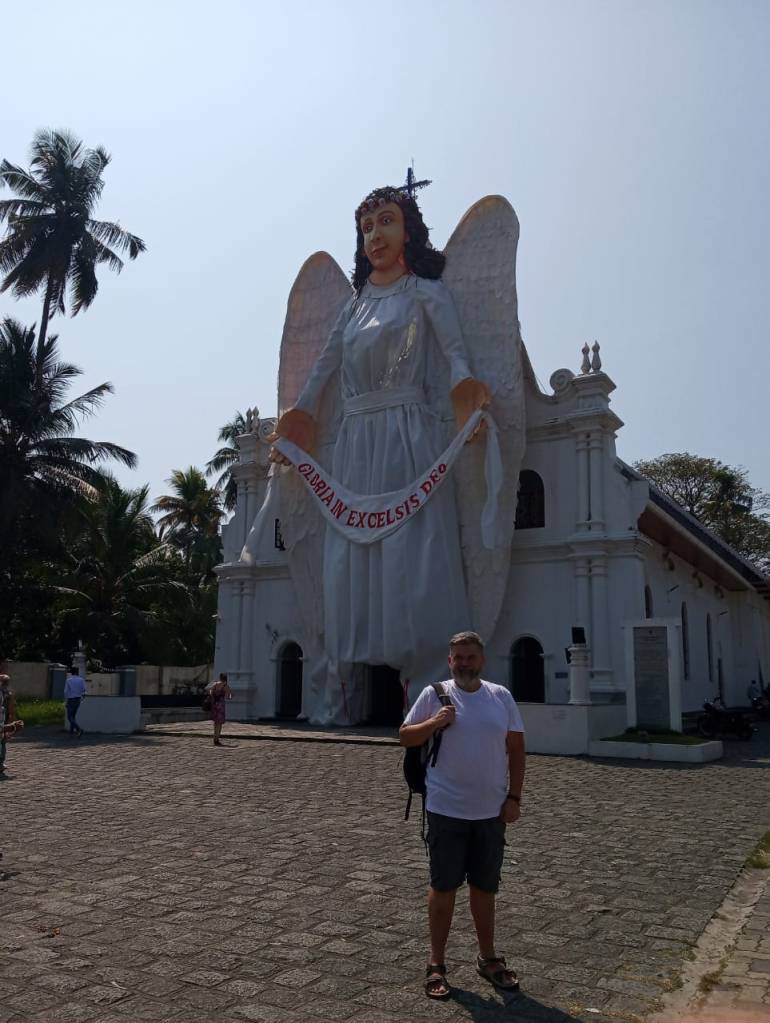
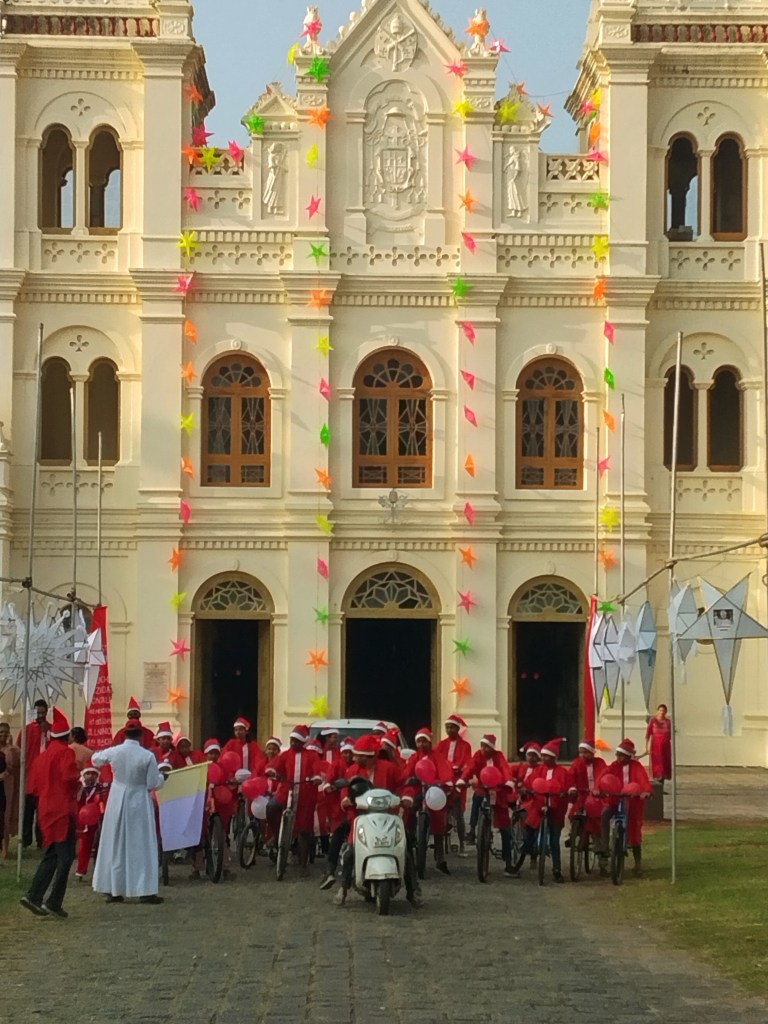
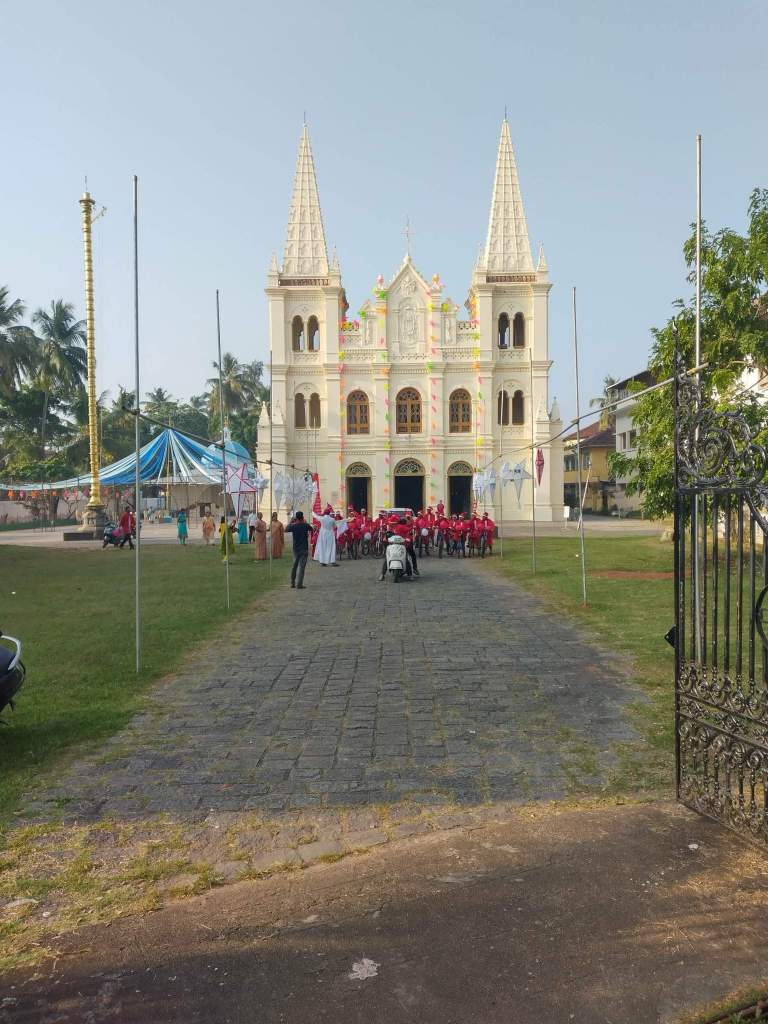
Photo provided by Rhys Hughes

I went to Kerala for Christmas, travelling from Bangalore on the night bus. It wasn’t the first time I had taken a night bus in India. The first time was when I went to Madikeri, high in the hills of Coorg. That bus was one with berths that one can lie completely flat on. In fact, you have no choice but to lie flat because there are no seats. It should be more comfortable than sitting upright all night, and I am sure many passengers find it so, but the vibrations of the engine made my body vibrate in sympathy and every bend in the road made me slide around the berth uncontrollably and when the bus climbed a slope all the blood rushed to my head, which was oriented towards the rear of the vehicle. I decided never to use this restful method of travel again.

This is why I chose a more old-fashioned style of bus in order to journey to Kerala. I understand seats. Your head is always up and your feet always down, and if this happens not to be the case then it quickly becomes obvious that some disaster has happened. Head up, feet down, seems to me the natural order of the universe when travelling a great distance. It was a twelve-hour journey. In India that might not be so remarkable, but I come from a small country where twelve hours on a bus is sufficient time to drive right across the land and a fair way out to sea. “Captain, there seems to be a bus overtaking us!” “Have you been at the rum again, bosun?” The immensity of India is something I doubt I will ever get used to. It is big even in terms of bigness.

Not that the bus with seats was completely free of problems. The seats had a lever by the side of them, and if this lever was pulled, the seats reclined. I was expecting something of this nature, but I was completely taken by surprise at the extreme angle they adopted. They reclined to an excessive degree. All was fine for the first fifty kilometres or so, then the young lady in the seat in front of me decided it was bedtime. She reclined the seat so precipitously that it whacked on my knees, and I was given no choice but to stare directly at the top of her head which was almost touching my chin. The only solution was to recline my own seat. I did so and heard a yowl from behind. I had taken my turn to crush some other innocent knees. And so I lay in this absurd position, sandwiched between two sleepers as the hours slowly passed.

The bus was soon filled with snorers and all of them were out of time with each other. I am a jazz aficionado, I love music with complex rhythms, and I also love polyrhythms, but the point of such intricate music is that there is resolution at some point along the melody lines. The contrasting rhythms ought to come together at least sometimes, in order to provide structure, but the snoring was far too avant garde for that. It was atonal and without time signatures. A man in a forest of lumberjack gnomes probably feels the same way I did, as the sawing takes place and the trees topple with a crash. There was no crash for me during that night, thank goodness, but plenty of jolting as the bus ran over potholes in the highway or swerved around unseen obstacles or accelerated to overtake rival night buses also full of snoring passengers.

Well, all this is a nuisance but one that is necessary for travellers to endure. I reached my destination safely and that’s what really counts. It was morning in Kerala and the heat was already intense. Bangalore is at altitude and altitude is a restrainer of temperature. The landscape shimmered and the port city of Kochi pulsated under the sun. No matter! Time to find my hotel and rest for a while in order to catch up on all the sleep I had missed on the night bus, whose motto is ‘sleep like a baby’, which turned out to be accurate, for I slept not at all and felt like wailing for hours. I went to the correct address and found that the hotel had been closed for the past two years. Ah well!

We are always advised to expect the unexpected, and we do this well, but I don’t think we are ever prepared for the types of unexpectedness we encounter. I was ready for the bus to break down, or for me to lose my way in the narrow entangled city streets, or for crows to swoop and peck my head. I wasn’t ready for a hotel to not exist. I soon found another and it was a better establishment with two ceiling fans instead of one, a balcony, even a fridge that was on the verge of working. That fridge later held two bottles of beer and cooled them from hot to lukewarm, and I drank them one evening and regretted it because I have no stomach for beer. Because of that warm beery incident, I missed out on sampling the palm wine that Kerala is so famous for.

The old part of Kochi is picturesque and labyrinthine. I wandered where I would and ended up somewhere, but I’m still not sure where. Christmas lights were strung between the buildings, large glowing stars had been erected on the summits of walls, on roofs, or dangled from gables. One church I passed had a façade in the form of a gigantic angel. This was really quite surreal. We tend to think of angels as radiant beings with a human form, perfect men and women, but if you read the Bible you will soon see that most angels have an appearance that is not human at all. The highest rank of angels, the Ophanim, resemble sets of interlocking gold wheels with each wheel’s rim covered with eyes. They float through the air without needing wings. A church façade based on one of these angels would be an example of experimental architecture. But the church in the shape of a personable angel was endearing.

I walked past another church and saw a fleet of Santa Clauses mounted on bicycles about to set off. Is ‘Clauses’ the plural of ‘Claus’? I have no idea, for it has never occurred to me that there might be more than one of them. This fleet consisted of children in costume and I have no notion of where they were going or what they would do when they arrived. I strolled onwards and they rode past me, guided by two men on a scooter, one steering and the other holding in his arms a loudspeaker and facing backwards, like a Pied Piper who has entered the Electronic Age. One by the one, the Santa Clauses pedalled past, laughing, waving, generally enjoying themselves.

This was Christmas at its most gentle, innocent and benevolent, a far cry from the Christmas ritual I witnessed exactly thirty years ago in Prague, where the tradition involves a saint, an angel and a devil chained together who stalk pedestrians in order to give them lumps of coal that represent the sins of the year. Prague was freezing, Kochi was broiling, and I know which I prefer, but the beer in Prague is certainly better. I reached the waterfront and sat under a tree and wondered if the mass migration of Santa Clauses I had seen was truly a fleet. Maybe it was an armada instead, or a division? Is there a collective noun for Father Christmas? A Splurge of Santas?

Kochi is riddled with waterways, and it feels like an excellent location for a port, which it is. No wonder it was established at that spot. I felt a small connection to the ancient mariners who had sailed here from the West long ago, from Europe and around the tip of Africa and across the Indian Ocean. One day I will travel from this very place to the islands of Lakshadweep. This has been a dream of mine for a long time, since I was eight or nine years old. I had entered a competition run by the Twinings tea company and I won. A map of the Indian Ocean was given with the names of islands removed and the entrants had to fill in those missing names. I consulted an atlas to do this, as I imagine every other entrant did, but I had an unknown advantage.

My atlas was very old, a green battered thing, and the Lakshadweep islands were marked by that very name. In other atlases the island chain was apparently named as the Laccadives. The administrators were looking for Lakshadweep and that is how I won a year’s supply of tea. It came regularly via the postman in an endless series of little tubs, Earl Grey, Lapsang Souchong, Peach Oolong. But in the end, this endless series finally ended, and my tea luck turned out only to feel inexhaustible rather than to be so. I have never won a competition since or even come close. But I have had a fondness for tea and Lakshadweep ever since, so it is imperative that I sail to those islands one day.

During my time in Kochi, I travelled on a boat only once, from Fort Kochi to Vypin Island. A battered rusty ferry crammed with foot passengers, cars and motorcycles. Cost of ticket? The equivalent of three British pennies. This is far cheaper than the cost of any ferry I have ever been on, with the exception of the occasional free ferries that I have encountered around the world, such as the one that takes passengers across the Suez Canal from one side of Port Said to the other, or the ferry that travels back and forth between Mombasa, which is on an island, and the African mainland. Sea travel is something special and I have done too little of it in my life. If I could have sailed back to Bangalore, I would have. As it happens, I went back on another night bus, but this time the person in the seat in front of me only reclined their seat to a reasonable angle. My knees were not crushed, and in return I did not crush the knees of the person behind me. I like and admire reasonable angles. They make geometry sweet.

.

Rhys Hughes has lived in many countries. He graduated as an engineer but currently works as a tutor of mathematics. Since his first book was published in 1995 he has had fifty other books published and his work has been translated into ten languages.

.

PLEASE NOTE: ARTICLES CAN ONLY BE REPRODUCED IN OTHER SITES WITH DUE ACKNOWLEDGEMENT TO BORDERLESS JOURNAL. 

Click here to access the Borderless anthology, Monalisa No Longer Smiles

Categories
Poetry

No OTP required

By Saranayan BV

Neeladri Road — Bengaluru. Courtesy: Creative Commons
NO OTP REQUIRED

	
The streets are full of Zomato guys,
Amazon, Swiggy courier boys,
These angels of delivery form the axis of weekend bonanza.
Today the pavements lean on kerb railings 
Laden with young men and women
Punching into their mobiles,
The women's skirts this evening shorter than what they normally wear.
The roads are difficult to cross at Neeladri Road,
Even God needs to be careful with the revellers.

How does it matter my pockets are empty and throat dry?
Someone's trying his voice in the rooftop bar,
Using an old mike with cutting-edge karaoke,
Why, I have music to keep me on buddy!

Life is only all it can give, no OTP required.
The range between Glenlivet and palm-toddy isn’t all that big --
I have no hassles with God or OTP.

Saranyan BV is poet and short-story writer, now based out of Bangalore. He came into the realm of literature by mistake, but he loves being there. His works have been published in many Indian and Asian journals. He loves the works of Raymond Carver.

.

PLEASE NOTE: ARTICLES CAN ONLY BE REPRODUCED IN OTHER SITES WITH DUE ACKNOWLEDGEMENT TO BORDERLESS JOURNAL

Click here to access the Borderless anthology, Monalisa No Longer Smiles

Categories
Poets, Poetry & Rhys Hughes

Infinite Tiffin

Because Indian food is the best in the world, as everyone knows, a scientist who worked for an educational institute on the outskirts of Bangalore once tried to devise a method of ensuring there was more of it. The more the better, was his motto. His attempts to construct a machine that would multiply chapatis, vadas, dosas, idlis and bowls of curry failed, for it turned out to be impossible to create new matter from nothing — thanks to the physical laws of the universe. But this scientist wasn’t a man to be so easily discouraged. Where there’s a will there’s a way, was his other motto. He had two mottos, just as he had two arms, two legs, two eyes and a pair of spectacles on his nose.

He thought of a way he could get around the particular law of physics that had sabotaged his first plan. Instead of multiplying the food in order to increase the amount available, why not shrink the eaters instead? A man or woman the size of a thumb would be confronted with chapatis that were like islands, vadas like boulders, bowls of curry like the craters of active volcanoes. Yes, that was the best solution. He got to work on it right away and he even stayed late in his makeshift laboratory at the institute and ignored all phone calls from his parents, who wanted to know when he was going to marry a nice girl, or failing that, any girl at all. He was wedded to his experiments.

At last, he chanced on a viable method of shrinking people to a specific size. He celebrated by going home and sleeping for three days. When he awoke, a wide smile on his face, he knew that finding volunteers would be fairly easy. He placed an advertisement in a local newspaper, and it wasn’t long before people began contacting him. He would pay them a small honorarium for taking part in the trial run and they would be allowed to eat as much food as they wanted. So many applicants contacted him that he was overwhelmed, and he had to declare that the offer was over. No more volunteers were required. He had two suitable candidates and wanted to use them immediately.

Pawan Kumar and Shruti Patil were both at loose ends, like pieces of string that knew knot what they had let themselves in for. That’s a pun, but neither one of them cared for wordplay. Pawan was an auto driver and Shruti worked as a maid in a gated community. Neither were gluttons but it must be admitted that they hadn’t had a notable feast for a long time. They jumped at the opportunity that the scientist offered. And in case you are wondering why this scientist has remained nameless so far, it’s because after what happened he preferred to stay anonymous for all time, and we must respect that.

Pawan had found a copy of the newspaper left by a passenger on the back seat of his auto, and Shruti had found one stuffed into the bin that she took out of the apartment she was cleaning. Both had paused for less than one minute in order to read the advertisement. This was a happy chance, if chance can ever be said to be truly happy and isn’t faking it, and then and there they had decided to plunge headlong into this new adventure. They were perfect volunteers, in other words, without a twinge of anxiety between them.

The scientist said, “Are you sure?”

They both nodded in agreement, bemused that he should seem more nervous than they were. All they were risking was their existence, but he was risking his entire career, and success in this unfortunate world is often held to be more important than life itself. He continued, “There might be complications, but I don’t think it is likely. I just want you to be aware.”

They were aware, fully so, and he ought to worry less.

“So be it,” he said dramatically.

It’s still a trade secret as to how he shrank them from ordinary sized people to miniature versions of themselves, so I am unable to describe the machine he used and the green rays it beamed on them from a series of crystal lenses all of which were carved into different shapes that were offset polyhedra, and even the copper coils and capacitors and diodes as big as cucumbers must be passed over in discreet silence, nor can I say how the whole contraption was powered by an array of solar cells on the institute’s roof.

Pawan and Shruti found themselves diminishing rapidly but that’s not how it seemed from their perspective. It appeared to them that the outside world was expanding, rushing to inflate itself, and the effect was so startling and alarming that they clung to each other for comfort, despite the fact they hardly knew each other, and their parents didn’t know each other either. This embrace also helped them to keep their balance as they rushed down the scale until they were almost exactly the size of the scientist’s thumbs.

The scientist spoke and his voice was so deafening that it boomed like the thunderclaps that sometimes echo from the crowded buildings of Bangalore and rumble down the streets before fading. They understood none of his words and it was a minute before they could gather their wits to act on their own initiative. He had simply said, “Please begin eating.”

He had picked them up and was lowering them on a long table that groaned with the amount of food it held. He was careful not to squeeze them too tightly. Then he released them, and they wandered in utter amazement among the plates, bowls, dishes and banana leaves, all heaped with delicious foodstuffs. The idea that they should devour this landscape seemed as absurd to them as any resident of Mysore supposing he can munch his way through the Amba Vilas Palace. It was too overwhelming, far too miraculous.

The scientist now clapped his hands impatiently. “Come, come, tuck in, I don’t have all day. Let’s see what happens!”

But his voice was still too low in pitch for their tiny ears to hear anything more than an incomprehensible booming. That was of no importance because the mission that had been assigned to them was plain. They had to eat as much as they liked in the time available to them.

It never occurred to Pawan or Shruti to ask whether the miniaturisation was permanent, and in fact even the scientist didn’t know if the effects would wear off naturally, or if he might find it necessary to try reversing the polarity of his machine in the hope it would restore them to their former size. But they had full faith in his competence and began nibbling at tasty objects that were in their vicinity. They were only a little cautious.

Soon they grew confident, then became joyous. They bounded between dishes and plates, climbed mounds of sweet and savoury foods, waded through curries, cavorted among the vegetables.

In the meantime, a reporter from the newspaper was on his way to the institute on the outskirts of Bangalore to find out why this scientist needed the volunteers he had asked for. The reporter smelled a story in the making. When he entered the building, after showing his press credentials, and approached the laboratory, he smelled something beyond a story. It was a banquet! He rapped on the door with his knuckles and cried: “Good afternoon, sir.”

To which the scientist replied, “Go away! You are disturbing the future of the human race. The door is locked.”

“I merely wish to interview your volunteers.”

“They are far too small to answer your questions. You must depart now. I will have you ejected from the premises if you refuse to leave of your own free will. The volunteers can’t understand your words, no matter what language you speak. They are cavorting on the table.”

“How so? You mean that they are monkeys?”

The scientist cursed at this.

The reporter struggled to see anything coherent through the frosted glass of the door. All he could make out was the shape of the banqueting table, which at this distance was like an operating table, and parallel rows of foodstuffs, which to him looked like an array of gadgets. The scientist stood with a spoon ready to serve rice onto plates and to the reporter it seemed he was clutching a surgical instrument that could probe brains.

“Is he brainwashing monkeys? Turning them into robots or assassins! I will write an article about this scandal.”

And he dashed out of the institute building as fast as he could run. During this rumpus, Pawan and Shruti had gained even more confidence. They started to eat with gusto and passed from dish to dish like explorers among the ruins of an ancient civilisation, taking morsels from every alluring display. Most of this food was from Karnataka but not all.

They chewed and swallowed bisi bele bhath, maddur vada, Dharwad peda, akki roti, saagu, upma, ladoos, three variants of idli, namely thatte idli, rava idli and Muday idli, churumuri and many other typical foods. They were soon full, but they continued eating, more on aesthetic grounds than from physical need. It was like a chain reaction. They would keep going until something exploded and that something would be their bellies.

But now something strange happened, and the simple adventure became a much more complex and tricky exploit. Pawan found a paper dosa, a very long and crispy example, and it had been rolled into a tunnel and he peered into the mouth of the tunnel and he was baffled.

“The landscape on the other side of the tunnel looks different,” he said to Shruti with a frown. “Come and see.”

She did so and she was no less astonished.

“There’s a garden there.”

“Yes, there is, and it makes no sense.”

A dosa with a tunnel. Courtesy: Creative Commons

They exchanged meaningful glances, but the exact meaning was unclear to both of them. Nonetheless they tingled with anticipation and Pawan gave into temptation and suggested they walk together through the dosa tunnel in order to see what the far side might actually be like.

Have you ever walked through a dosa yourself? It is surely an odd feeling. They stumbled on the batter, which yielded too readily to their feet, cracking a piece off here and there, but soon enough they emerged from the exit. And what they saw was remarkable. They were no longer on a table in a laboratory in an institute on the outskirts of Bangalore.

Pawan and Shruti were unworldly people and had never heard of the myth of the Garden of Eden, but that’s what they found on the other side of the magic dosa. There are some special points in our world that are portals to other worlds and if you step through them, you will end up in that new dimension. They saw that the garden was full of trees, but the trees had gulab jamuns hanging from the branches instead of fruits. Gulab jamun trees! Was that even possible? Clearly, yes it was, here in this incredible place.

Gulab Jamuns. Courtesy: Creative Commons

As they strolled deeper into the garden, enchanted by the sights, they took slightly diverging paths and ended up alone. Shruti stopped by a tree and despite the fact she was full, she reached up to pluck a gulab jamun that glistened most invitingly just above her head. And that’s when the snake appeared. It slithered down from the top of the tree and said:

“You are allowed to eat the sweets from any tree in the garden with the one exception of this tree, which is the tree of knowledge. But I think you should be a rebel and eat it anyway. Why not?”

The snake had the voice and face of the scientist.

Shruti pouted at him.

“Because that would be greedy,” she said.

“Don’t be so timid!”

“Knowledge is overrated. You have plenty of knowledge and what has it done for you? Turned you into a snake.”

“Don’t say that. I am an intellectual benefactor.”

“You eat it then.”

And she held out the gulab jamun for him.

He hissed and swayed in annoyance, his forked tongue flicking, but at that very moment Pawan came over to see what the fuss was about, and he shook his fist at the snake and warned him: “I am an auto driver. I often have passengers like you. I will throw you out of the garden if you don’t behave.”

The snake continued hissing angrily but it slid away and they still don’t know where it went because they have never seen it again. Meanwhile, the scientist mysteriously disappeared from the laboratory and the only theory that explained his vanishing was that he had turned the rays of his own machine on himself and shrunk down to a dot and then to an atom.

But why would he do that? Nothing made sense any longer. Pawan and his wife, Shruti, still live in the garden beyond the dosa, and because all the food in the laboratory has been taken away, there is no way for them to return to the real world. They don’t care about that. They are satisfied where they are. They keep the gulab jamun of knowledge safe and maybe one day they will take bites from it. But they are in no rush to do so.

The reporter wrote his story about monkey robots and assassins, but it was never published because his editor thought he had gone mad. He was told to take a week off work and go on holiday. He went but never returned. Searching for him proved futile but rumours persisted of a monkey on the coast who liked to read the newspaper as if he understood the words. Probably some sort of coincidence. The world is stuffed full of them.

.

Rhys Hughes has lived in many countries. He graduated as an engineer but currently works as a tutor of mathematics. Since his first book was published in 1995 he has had fifty other books published and his work has been translated into ten languages.

.

PLEASE NOTE: ARTICLES CAN ONLY BE REPRODUCED IN OTHER SITES WITH DUE ACKNOWLEDGEMENT TO BORDERLESS JOURNAL

Categories
Poetry

Entwined Places

By S Srinivasan

Artwork by Gita Viswanath
ENTWINED PLACES

Standing on the Juhu beach,
I heard, more than a decade ago, 
The winds from the Marina, 
In a smattering of Marathi and Tamil,
Accompanying birdsongs.

Blame that on a bout of homesickness
But what about last year, when

The Sealdah station, its turf
Pounded by the waves of human feet,
Seemed to me to reverberate 
With the weighty steps of the rush hour, 
Also felt in Mylapore and Nariman Point?

Perhaps, the crowds stirred me then
But that cannot be all, for

Often on cool Hyderabadi afternoons,
I have worn, in silence, the unease
Of Bangalore's woolen evenings;
And sensed in Delhi's nippy nights
The cold grip of other Indian winters...

Extremes sometimes addle the brain
And lull the heart, but…

Even when I take a leisurely stroll
On a summer dusk, around the lake
That girdles my neck of the woods,
I am greeted by the lush sights, of
The long winding ways yonder...

To Darjeeling and Kodaikkanal,
To Yercaud and Dehradun,
To Kashmir and Kanyakumari,
And to all that lies beyond.      

Srinivas S teaches English at the Rishi Valley School, India. He spends his free time taking long walks, watching cricket and writing poetry in short-form (mostly haiku).

.

PLEASE NOTE: ARTICLES CAN ONLY BE REPRODUCED IN OTHER SITES WITH DUE ACKNOWLEDGEMENT TO BORDERLESS JOURNAL