Categories
Stories

Nico Finds His Dream

By Paul Mirabile

From Public Domain

Vasiliki and Nico boarded the passenger steamer for Burgaz Island at Sirkeçi pier at Istanbul. As the steamer moved out slowly from the crowded port, Nico gazed at the dreamy silhouette of this storiedcity where for four days they had woven in and out of lanes and alleys, gardens and markets, prayed in the Greek churches.

They had left Hydra six days ago by boat and bus, arriving in Istanbul after a night spent in Thessaloniki. Now they were off to Vasiliki’s island of birth. He had never been back since his departure at the age of twelve, and the thought of returning excited him. “Look grandpa at the setting sun over Topkapı Palace,” shouted an elated Nico. And indeed Nico’s elation was not feigned.

The cypress trees and domes of the mosques and minarets were outlined against a sky alive with streaks of reddish flames whose reflections could be discerned in the unruffled waters of the Marmara Sea. The crenelated walls of Topkapı Palace undulated eerily in the ruddy, pastel twilight as did the silhouettes of the many domed mosques that embossed the mighty palace with a pinkish tinge. Nico stood hypnotized at the stern imagining himself as part of one of the yarns of A Thousand and One Nights. A sensation of estrangement, of magical transport had arrested his movements. Suddenly a flock of seagulls descended screaming into the wake of the steamer, snatched as many fish as possible and flew off towards Galata Tower, which they circled and circled until vanishing in the evening shadows beyond the hilly banks of the Bosphorus Strait, the yalıs[1], Dolmabahçe[2] and Berlerbeyi Palace.

“A fairytale city, Nico.” Vasiliki said, interrupting his grandson’s spellbound state.

“Yes, grandpa. It looks like one of the coloured pages of my A Thousand and One Nights.

 Vasiliki chuckled. “Perhaps it is, my boy.” And they both contemplated that marvellous city until it, too, disappeared under the orb of the sea …

They disembarked two hours later …

“Burgaz ,” sighed Vasiliki, stepping foot on to the soil of his birth. He took Nico’s hand and hurried him from the throngs of the port into the quiet of the main plaza where the statue of Saït Faïk greeted them. “There he is, Nico, one of the finest poets and short-story writers of the Turkish language.” Nico moved closer :

“He looks very thoughtful, grandpa. What do you think he’s thinking about?”

“That’s a good question. But for now we have to get a horse-drawn carriage to Zorba’s home before nightfall.”

For some unknown reason Nico’s thoughts roamed back to his Nefteli. “Do you think the Nefteli lay anchor at this island on her voyage to China, grandpa?” Vasiliki knitted his brows.

“I’m not so sure. She would have taken a more westerly route.” Nico nodded, unable, however, to imagine his beautiful Nefteli never having moored at this beautiful island with such a famous poet standing so thoughtful in the middle of the plaza. Whilst the boy ruminated these thoughts, Vasiliki hailed a horse-drawn carriage, and in broken Turkish directed the driver to take them to Soknar Sokak [3]located on the western side of the island.

“You speak good Turkish, grandpa,” Nico commented.

“My parents spoke it at home, but when we left Burgaz to settle in Greece, they chose to speak more Greek than Turkish. The Greeks never took a liking to us Greeks who lived in Turkey.”

“Why?”

“Oh, that’s a long and sad story. I’m too happy to be here on Burgaz to tell you now.” So Nico was left unsatisfied. “My brother’s friend’s name is Zorba,” Vasiliki continued. “He’s in the textile business in Istanbul. He comes to Greece often. His wife died two years ago and now lives alone in a big villa on a hillside overlooking the sea. He’s very wealthy and in his spare time writes poetry.”

“Like Saït Faïk?” Vasiliki puckered his lips.

“No one can write poetry like someone else, Nico. If that happens, it’s like imitating a poet’s poems and you shouldn’t do that. Anyway, you’ll soon meet him. And you’ll also meet my father’s friend Abi Din Bey, a Turkish Alevite who lives down on the beach. He knew Saït very well. He writes poetry, too. I remember one of his verses: ‘I wished to smell a rose./It feigned reluctance./No, it said, bring my scent …’ Oh, I forgot the rest.”

“But why did the rose not want to be smelt?” asked Nico curiously.

“I have no idea, my boy. It’s only poetry. Besides, I’m a fisherman, I haven’t had much instruction on those things.” And on that unscented note, Nico espied a flock of seagulls chasing the early evening cloudlets galloping far off towards the East.

They arrived. Vasiliki paid the driver and up they climbed a long flight of wooden stairs through a well-kept garden of intoxicating scents. Above them loomed a massive sun-bleached white, wooden pillared portico, above which rose three-balconed stories, surmounted by two towering turrets in the middle of which spiralled even higher a fretted gable. Nico stood awestruck as if he had come upon one of Zeus’s palaces. A minute later a huge, flabby-faced, moustachioed man burst through the front portico door to greet them in broken Greek.

“Welcome! Welcome! Come into my humble home, please,” Zorba gesticulated theatrically, dragging both guests into his home, which in the eyes of his two guests was far from humble …

Dragged I say through the lofty portico whose colonnade must have counted over twenty Doric-like pillars, then into a vestibule at the end of which a floating double staircase wound breezily above a bubbling marble fountain then on to a cambered, U-shaped landing bedecked with azaleas, wisteria and dwarfish palm plants. Hanging on the walls of the vestibule and the cambered landing were landscape paintings and several stately portraits. Zorba immediately escorted them into a brightly lit drawing-room whose frescoed ceiling teemed with Greek heroes and from which a shone a gigantic chandelier. Deep velvet-red draperies afforded a nineteenth century posh atmosphere, an atmosphere of opulent repose. They were seated on a plush, baize-covered ottoman. Refreshments were hurried into the room by a maid, set delicately on a superb pearl-inlaid coffee-table.

“Welcome to Burgaz, Vasiliki and Nico,” Zorba beamed, delicately seeping a large glass of mango juice. “Where will be your first visit if I may ask?” Vasiliki set his mango juice down, licking his lips.

“To Abi Din Bey’s beach home,” replied Vasiliki.

Zorba frowned. “Rather a shabby place his cabin on the beach,” he retorted gruffly.

“Perhaps, but I must see him. You know, he was a very good friend to my father.”

“Yes … yes, of course,” grumbled Zorba, ostensibly displeased at the mention of the beach comber. “Whatever ! You are my guests here and may stay as long as you please.” He looked at Nico affectionately: “What a wonderful adventure for your grandson. To relive his grandfather’s and father’s past …”

“And who knows, Zorba … perhaps his future …”

Zorba, a bit puzzled by that remark, smiled a gold-toothed smile, nevertheless. The smile seemed to set his well-fed, pasty face aquiver.

“Excellent, Vasiliki. But now we must dine.” Zorba ushered his guests into the tapestry-hung adjoining dining room where a long table had been set with all the delicacies that Burgaz Island could offer : sumptuous mezes[4]: stuffed vine leaves, eggplant caviar, marinated red peppers, homus[5], followed by lentil soup, fish and köfte[6]. This gargantuan meal terminated with strawberry sorbet and künefe[7].Two hours laterVasiliki and Nico sat back in their red upholstered chairs utterly exhausted.

Refusing any liquor, Zorba showed his guests their enormous room on the first floor whose bay-window overlooked a dark stretch of forest which gradually merged with the slow-moving lights of the steamers and cargoes on the Marmara Sea. Vasiliki and Nico, after unpacking, fell asleep as soon as their heads touched the pillows.

They awoke at nine o’clock, washed and rushed down the elegant, floating staircase for a quick breakfast. They ate alone, Zorba having breakfasted very early in order to meet customers in Istanbul, so said the maid. They set out for Abi Din Bey’s beach home, a half-hour’s walk down a winding path through the wooded hillside.

The sound and smell of the sea below, the laughing seagulls above thrilled Nico with an unequivocal joy. He felt drawn into an adventure. Once on the beach, they veered to the right and in two or three minutes stood at the Alevite’s welcoming gate, open to all and sundry. Charging out of the front door of a flat-roofed, one-storey little house, a handsome, stalwart, balding man greeted them with so many handshakes and kisses on the cheeks. He led them inside his three-room home, built under an arching rock shelf, overhung with a thick network of running vines and bougainvillaea which dangled over the front walls of the house.

Nico was astonished at all the books strewn on the rug-covered floor or lying open on the arms of a worn-out sofa. A low, wooden table, where a tea-pot and glasses had been set, comprised the rest of Abi Din’s ‘drawing-room’ furniture. The walls lay bare of pictures and the two front pane less windows bore no curtains. One naked lightbulb hung limply from a rafter. Nico, seated on the sofa, stared at the bareness of Abi Din’s abode. He could not decide whether the poet lived in poverty or simplicity.

As if reading his thoughts, Abi Din Bey, who had since served them black tea, said in his deep, authoritative voice: “Simplicity remains the poet’s true companion. All he needs is the whistling of the wind, the lapping of the waves, the rustling of the leaves. The true poet touches reality with his or her ears more than the eyes before voicing that reality, poetically. But I will acknowledge that the poet opens his or her senses to the moon at night and to the horizon-filled fishermen tossing their nets at the edge of the briny sea in the day.”

“You have been afflicted with Saït Faïk’s poetic madness,” laughed Vasiliki, translating his friend’s words for Nico.

“Anyone who came into contact with Saït became a poet … good or bad I am not to judge ! Who else listened to the talking seaweed or the weeping mussels?” Vasiliki agreed with a nod then translated for his grandson.

“Grandpa, how can seaweed talk and mussels weep?”

“Well, poets can hear things that we cannot, Nico.”

After tea, Abi Din Bey led them out to his front garden where the fragrances of oleander and honeysuckle muddled Nico’s imagination, already running amok due to  all this talk of weeping mussels and talking seaweed. Out beyond the wooden fence the glint of Marmara glowed turquoise.  

Vasiliki and Abi Din Bey spoke of Vasiliki’s father and grandfather, of a time when Burgaz bathed in a mellow light of unruffled peace and perfumed tranquillity. “And now look — Istanbul’s ‘hippies’ camp on weekends in the forests and on the beaches littering, smoking and drinking. Tourists swarm the island as if it were la Côte d’Azure. If Saïk or your father were alive … “ Abi Din Bey would repeat … but would never finish …

Towards late afternoon after a pleasant nap in their host’s hammocks, Vasiliki and Nico left Abi Din Bey to his domestic chores to stroll along the beach, avoiding the vast wracks of seaweed. “Let’s walk up to the Monastery of the Transfiguration on Bayrak Tepe,” Vasiliki suggested. “It’s the highest spot on the island. The monastery was built in the XIXth century and has never changed, so my father told me. We can talk to the Pope and his wife, they’re Greek … well, Turkish Greek.”

“You said there’s a difference, grandpa.”

“You see, the Greeks who came from Turkey to settle in Greece were never really liked by the Greeks because of their way of speaking Greek and their Turkish customs.”

“Why?” the boy insisted. But at that moment they halted in their tracks. A shirtless and shoeless man was busy erecting little pyramidal piles of stones here and there on the beach. Before Nico could enquire about this curious occupation the man turned towards the sea, opened his muscular arms wide, and in an eerie, sing-song voice chanted:

 “Women light the lamps of spirit with a blue light as they warm up coffee.

During the nights, in the darkness, on the peak of a mountain

a miller, his eyes closed,

sleeps, face down.

Villagers would come

To sell their copperware at the market,

To sell yogurt.

A naked child, begging in the street, was knee-deep in snow.

At the head of a bridge in the Big City

I would throw myself over,

Suspended above the waters.

I would hear the waters that I would cleave,

 Would see

The waters as I fell,

The waters that spurt up at the bridge.”[8]

The man turned his back to the sea and resumed his Sisyphean labour …

“What did the man chant, grandpa?”

“A poem by Saït, I think. A sad poem. You know, the life of a fisherman is not easy, but the life of a poet is not to be romanticised. Outwardly life may seem merry and bright. But deep inside, Nico, a poet’s lot is not to be envied. Saït’s short stories and poetry are filled with solemnity. Zorba thinks he understands this solemnity. Abi Din Bey is less pretentious; he leads a simple, lonely life and reads Saït for comfort. This solemnity has offered him a gratifying livelihood. He liked Saït so much and sought his companionship. But Saïk chose alcohol for a companion. Abi Din is a religious man, he doesn’t drink alcohol. Alcohol should never be a poet’s companion.”

Nico said nothing as they trudged up Bayrak Tepe to the Greek monastery, where after tea and honey cakes with the pope and his wife, they hurriedly trekked down the opposite side of the island, keeping the sea to the right. Two hours later they reached Zorba’s hillside home before nightfall. The sky blazed a crimson red as the sun set under the waveless Marmara.

Dinner having finished, Zorba and Vasiliki were served wine in the drawing-room and Nico a glass of lemonade. Zorba, exceptionally cheerful after a fruitful day in Istanbul, stood, poured himself another glass of wine and recited a few verses of his poetry :

“Honey is certainly a special nourishment;

Is truly medicinal.

He who eats honey thinks soundly;

He who does not, thinks ignorantly.”

Zorba sat down absorbed in the silence of his guests. “How I try to imitate Saïk,” he sighed at length.

“Can anyone imitate Saïk?” queried Vasiliki distractedly.

Zorba placed a pudgy hand to his heart: “Poets live to write and not write to live.”

Vasiliki agreed, heard the grandfather clock strike midnight, yawned and sleepily suggested that they be off to bed. Zorba acquiesced, promising a few more strophes the following night. A weary Vasiliki smiled perfunctorily …

Waking up with the larks, Vasiliki and Nico were served breakfast. Zorba had again left for Istanbul very early. The two tourists walked to the centre of town to visit Saint John the Baptist’s[9] church, then Saïk Faïk’s house-musuem and gardens. Saït’s former two-storey, balconeyed home rose into the blue island sky, the gable rising even higher than the palm trees that served as sentinels. The gardens were similar to Zorba’s — exceptionally well-kept. Inside, Nico was taken aback by the refined taste of the poet’s family: the exquisite, velvet cushioned chairs and sofas, the poet’s private library where many bookshelves contained poetry magazines, dictionaries and novels in Turkish, French and Greek. Nico surmised that the poet was a studious man.

“A very well-educated man,” whispered Vasiliki. “He translated too. His knowledge of languages inspired his short story and poetry writing.”

“Do you speak French, grandpa?”

“I’m afraid I don’t, my boy. You know, I’ve had little instruction. But you, Nico, look at those leather-bound volumes ; you may become a boat-building poet someday if you work hard at school.”

Nico’s little round eyes glowed a brilliant glow. How he loved to read, to touch the crispy pages of a book, to smell the print and paper. Spellbound by all this literature, he suddenly heard a fey voice :

“A table,

Flowerless.

Newspaper for cloth

Wine for love

 And for fancies …” [10]

The mysterious voice trailed off. Nico searched the room frantically for his grandfather. There he stood in front of a hanging portrait of Saït Faïk.

“Grandpa.”

“Yes, my boy.”

“I would like to be a poet.,” Nico asserted.

“A boat-building poet?”

“Yes, write poems and short stories like that man hanging on the wall. He has such a handsome face … a kind, smiling face. He must have been a gentleman.”

Vasiliki nodded. “I’ve no doubt he was. Those eyes speak the tremors of his soul, a soul filled with the love of life, all life : mineral, animal, vegetable, human.”

Nico screwed up his eyes which met those of Saït’s, a deep blue like the sea. Laughing eyes, like the seagulls’ … Five minutes later they stepped into the blazing Burgaz sun, white white …

The rest of the morning and afternoon was spent in Abi Din’s front garden, drinking tea, chatting about Burgaz fishermen. They ate grilled-cheese sandwiches and sardines for lunch.

The loquacious Abe Din turned to Nico: “A poet’s life has its highs and lows. It’s best to keep to the middle, no jealous rivals to spread scandal, no avaricious publishers to milk you like a cow. Thieves, all of them ! Just write poems, Nico. Don’t waste your energy on market reception, critic’s reviews or what publishers expect from you. Your poems speak for themselves. And do you know why ?”

Nico did not know why for two reasons: he couldn’t understand Turkish and he never wrote a poem. The animated man continued, nevertheless: “Because you organise the movement of the poem with your own voice, a poem is an activity not a product. Poems make poetry; poetry does not make poems. A poet has no regards for schools of poetry, for modes of poetry, for signs-of-the-time poetry. Writers of poetry express the signs of their times; writers of poems suggest images of untimely inspiration. Writers of poetry idolize poetic forms ; writers of poems organise their poems subjectively, free from poetic occult pedantry and cryptic complexity. Listen ! Listen to those outer and inner inspirations.”

Vasiliki translated his friend’s fiery tirade as best he could and when Nico had understood the ‘Listen! Listen!’ The obedient boy listened even harder. Abi Din Bey’s voice rose higher: “A poem is first heard in the heart then expressed by word of mouth or on paper. Open your ears wide, Nico, open them wide!” When those last words of wisdom were translated, Nico attempted to open his ears as wide as he could. It was not an easy task, much harder than opening his eyes wide …

When the sun began to set Vasiliki and Nico bid farewell to the poet, promising to return the following year. Little did they know that the solitary poet would pass from this world in the near future …

They spent four more nights as Zorba’s guests eating like kings, listening to their host’s business conquests and after-dinner poetry over a glass of wine or lemonade. They left Zorba on the long flight of steps, he waving good-bye with a pudgy hand as the horse-drawn carriage bounced his guests up and down towards Burgaz pier.

“Grandpa, I’m going to work hard at school and read Saït Faïk’s short-stories and poems.”

“We’ll find translations of them, Nico. I told you that Burgaz Island plays strange things on people who come here. Her soil inspires us. Her energy rises from the core of the earth into our hearts and spirits. Burgaz possesses a mystery that no one has ever solved.”

“Not even Saït Faïk, grandpa?” Vasiliki scratched his white beard.

“I have no answer to that one, my boy. Maybe he did solve it. Poems and stories were his livelihood, like my fishing, a daily labour of love and effort. Perhaps someday you’ll solve the mystery of Burgaz.”

“By boat-building and writing poems?” Vasiliki gazed up at the circling seagulls.

Nico was not sure. Meanwhile, ahead lay the pier and the steamer now steaming into port, smoke bellowing from her stack. Ropes had been thrown down to moor her as passengers straggled off and on. Grandfather and grandson rushed into the vortex of that rolling movement and disappeared within the bustling throngs …  

[1]        Wooden mansions or villas along the Bosphoros Strait.

[2]        Atatürk’s presidential palace.

[3]        ‘Street’ in Turkish.

[4]        ‘Appetizers or hors-d’oeuvres’.

[5]        ‘Mashed chick peas’.

[6]        ‘Meat rissole’.

[7]        A sweet dessert made of angel hair, (kadaif), cheese, butter and topped off with honey sirop and crushed pistachios.

[8]        Losely translated from ‘Bir Zamanlar’ ‘One Time’.

[9]      Iohannas Prodromos in Greek. It was built in 1899.

[10]      From Sait Faik’s poem ‘Masa’ ‘Table’, partially translated.

Paul Mirabile is a retired professor of philology now living in France. He has published mostly academic works centred on philology, history, pedagogy and religion. He has also published stories of his travels throughout Asia, where he spent thirty years.

.

PLEASE NOTE: ARTICLES CAN ONLY BE REPRODUCED IN OTHER SITES WITH DUE ACKNOWLEDGEMENT TO BORDERLESS JOURNAL

Click here to access the Borderless anthology, Monalisa No Longer Smiles

Click here to access Monalisa No Longer Smiles on Kindle Amazon International
Categories
Stories

‘Jai Ho’ Chai

By Snigdha Agrawal

From Public Domain

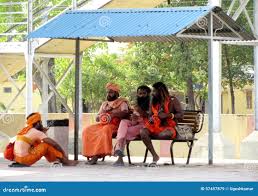
The sun beat down mercilessly on the railway platform of Karwar Railway Junction, where a group of rotund, saffron-clad priests huddled together, fanning themselves with cardboard pieces ripped from cartons. Their expressions were grim, their bellies noticeably less jolly than usual.

“It’s the end of an era, brothers,” sighed Pandit Upadhyaya, his triple chins wobbling like unset strawberry Jello. “First, they replaced bulls with tractors. Then, they put machines in our post offices. And now; NOW, they have brought AI into our temples!”

The sacred threads worn over their left shoulder, diagonally across the body, seemed to protest against their protruding bellies, yellowed and stringy, yet proudly declaring the caste hierarchy would soon be rendered null and void.  The looks of concern on their faces screamed, “Not fair…not fair at all”.

From Public Domain

“I still cannot believe it!” moaned Pandit Shastri, wiping his forehead with the end of his dhoti[1]. “A robot priest? Is this then the end of the Kalyug [2]? Else, how can a machine do what we do?”

“They say it chants flawlessly,” added Pandit Joshi, shaking his head. “Not one mispronounced shloka[3]!  No breaks for tea or chewing on betel leaves! No accidental burps during the aarti[4]!”

“Profaneness!” chorused the group, clutching their prayer beads in outrage.

“I even heard,” Pandit Sharma whispered conspiratorially, “that the AI priest does not accept dakshina[5]! No envelopes, no fruit baskets, no ghee-laden sweets. What kind of priest didn’t accept gifts?” they nodded looking puzzled.

Pandit Upadhyaya lamented. “What is our next recourse? If these AI priests take over, who will feed us? Who will drape us in silk? Who will offer us ghee-laden sweet boxes?”

A train pulled into the station just then; the platform transformed with the usual activity commencing on arrivals. Passengers stuck their heads out, looking around for tea and snacks.  Pandit Sharma suddenly came up with an idea. “Not all is lost yet.”

“Meaning?” asked Pandit Joshi, narrowing his eyes suspiciously.

“We shall sell tea! But not just any tea—Prasad[6] Chai! Sacred! Blessed! Tea infused with the wisdom of the Vedas!”

The priests considered this. It was true. If there was one thing, they were experts in, it was making offerings with dramatic flair. Why not apply that skill elsewhere?

Within weeks, they set up stalls on the platform, offering passengers their special chai.  As trains pulled in, the platform echoed with the chorus…”Om Chai Namah![7]” “Divine Masala Chai.  Guaranteed to bring you good karma!” “Blessed by Brahmins, brewed with bhakti[8]!”

Soon enough, their stall was milling with passengers keen to taste this unique concoction, prepared by none other than the four Brahmin Head Priests. The spectacle of their tea-making performance, with dramatic gestures, had everyone gawking. Served in earthen cups, each sip elicited murmurs of appreciation from the passengers.  The “Jai Ho” brand of tea didn’t take long to become a hot success.

Word spread like wildfire in the temple town.  Business boomed. The tea, laced with just the right amount of saffron, cardamom, and sacred nostalgia, had an irresistible charm. Soon, the platforms were buzzing with satisfied sippers. Every train passing through the station had passengers stepping out to sip on this special tea.

As they counted their first earnings, Pandit Upadhyaya sighed, “Brothers, who knew AI would push us into a more profitable business?”

But then, one day, a group of railway officials swooped down on them in their khaki outfits with officious looks on their faces. One of them, a spectacled man with a voice that needed no loudspeaker, spoke, “Pardon me, Swamiji’s, but we’ve received some complaints. Your tea business is so blessed that passengers are delaying boarding their trains. This is causing major delays and loss of revenue to the railways.  Moreover, it’s illegal to do business on the platform without a licence from the authorities.  Can you show the vendor licence?” he asked hesitatingly.

The priests exchanged guilty glances.

The official adjusted his spectacles, “Of course, we can set that right, as we have received a special request from the high command. The Railway Ministry wishes to introduce your “Jai Ho” chai at all major railway junctions!”

Jowls dropped, mouths agape, the priests couldn’t believe they heard right. The tufts of hair on the back of their shaved heads stood erect in surprise.

Pandit Upadhyaya beamed, “Brothers, the Gods have truly blessed us! It no longer matters that non-humans have overtaken our profession, we continue to gain from selling the brew the Gods’ drink!”

As they sipped their divine brew, laughing heartily, they looked up at the temple in the distance, where the AI priest continued chanting slokas flawlessly.

“Well,” chuckled Pandit Sharma, “at least that machine can’t make chai!”

And so, from AI adversaries to tea sellers, the priests of Karwar found their unexpected salvation—not in temples, but in terracotta cups of steaming, saffron-infused chai.

From Public Domain

[1] A loose piece of cloth wrapped in the lower half of the body

[2] The current age according to Hindu eras, supposed to be dark.

[3]Sanskrit chants 

[4] Holy offerings

[5] Honorariums

[6] Offerings blessed by Gods

[7] Bow to the blessed chai

[8] Devotion

Snigdha Agrawal (nee Banerjee) is an author of five books and a regular contributor to anthologies and e-magazines.  A septuagenarian, she has recently published a book of memoirs titled Fragments of Time, available on Amazon and Flipkart.

PLEASE NOTE: ARTICLES CAN ONLY BE REPRODUCED IN OTHER SITES WITH DUE ACKNOWLEDGEMENT TO BORDERLESS JOURNAL

Click here to access the Borderless anthology, Monalisa No Longer Smiles

Click here to access Monalisa No Longer Smiles on Amazon International

Categories
Stories

Disappearance

Story by Bitan Chakraborty, translated from Bengali by Kiriti Sengupta

Bitan Chakraborty. Photo Courtesy: Kiriti Sengupta

The black smoke rises in a straight line. It will fade into the air as it reaches a certain altitude in the sky. The wind feels still today, causing a grey layer to form. Not long ago, Lali experienced recurrent bouts of excruciating pain, but now it refuses to subside. She tries to relax, her spine loosely resting against the wall of the leather factory. Lali shrinks again as her little baby stretches its limbs inside her womb. In the distance, her husband, Fatik, is tending to their domestic belongings in the dilapidated house. He is vigilant, working hard to safeguard their utility items. He won’t let anyone take away their hard-earned household goods. Fatik does not know what will be put into the fire. A few government-appointed people collect the crushed bamboo walls from the ghetto and add them to the flames. The more they burn, the more smoke rises. At a safe distance, a curious crowd observes the unfolding events.

Fatik packs goods in small quantities and takes them to Lali, who is resting under the shade. He quips, “I could have packed up sooner if I had someone to help. You’re in pain, huh? Hold on for a bit; we will board the train shortly.”

“Hey scoundrels, that’s mine. Keep it there, I’m telling you! Otherwise, I’ll put y’all in that fire.” Fatik rushes to their ruined house. It’s not a house anymore! An empty stretch reveals the impressions of bricks laid down for years. Fatik’s shanty looks the same — a square piece of land with torn plastic sheets and scattered, fragmented earthen roof tiles.

Lali continues to endure pain. Fatik appears exhausted; he is busy organising goods. There’s no point in disturbing him further with another complaint of discomfort. Lali remains silent and attempts to sketch the new place they will inhabit for the next few months or possibly years. No one will be a stranger there; they cannot afford the luxury of exploring exotic living. Fatik once told her, “Shashthida has affirmed that we can come back here once the air cools down.”

It’s easy to earn a living in the city, but finding a job is difficult in the countryside, where opportunities are scarce. Once the flyover is built, Fatik plans to return and set up a small eatery for the evenings. In a tone filled with love and care, Fatik tells Lali, “No one can resist the mutton curry you cook. All visitors will become regular customers at our shop.” Lali adds a touch of sass to her response, “I won’t. I’d rather teach you the recipe. You can then cook and feed them.” Gazing at the ceiling with wide eyes, Fatik remains lying in bed.

Lali does not believe in Fatik’s words that they will be able to come back here again. A few minutes ago, Hema came to see her, “My bad luck; I won’t get a chance to see your child. But you never know if I will meet you again somewhere else.”

“Won’t you come back here?” Lali asks.

“They will not allow us here again,” Hema replies. “The officials informed us that they were planning to build a marketplace below the flyover after its construction.”

Mum’s the word when Lali relays the news to Fatik. He murmurs, “But then Shashthida[1] has assured…”

“You can pursue a small shop in the proposed market,” Lali advises.

“I can’t say; they might ask for a cash lump sum as advance payment.” Fatik appears worried.

The pain shoots once again. Lali flings her legs aimlessly. The dusty floor reflects her movements. She remains silent. On the other side, Fatik gets into trouble with Dulu and his family. Dulu’s mother seems to have taken Lali’s rice pot. Lali raises her voice, “The pot is mine!” Unfortunately, her words go unheard.

2

Fatik knocks Lali with his bag, “Come on, the Hasnabad local is at platform eight. Walk along the straight direction.”

Lali has heard of the Sealdah railway station, but she has never been there. It is a large station with several platforms, numerous trains, and huge crowds. Passengers jostle against one another. With great caution, Fatik quickly walks across the platform to board the train and get into a compartment by any means necessary. There are likely a few travelling ticket examiners around, but during this time, they usually don’t enter the coach. Lali is unable to keep pace with Fatik and remains far behind him, but she compensates for the distance by tightly gripping one side of the gamcha[2] draped around his neck. Fatik collides with the commuters approaching from the other end, and a few passengers express their annoyance with a word or two of irritation. Fatik does not respond at all. Lali pulls her saree to cover her breast. She has no control over the saree girded around her head, which has now slipped onto her back.

The train will start in ten minutes. All coaches are full; not a single seat is vacant. Fatik quickly decides on a favourable compartment and boards the train with his wife. Lali cannot stand any longer, so she sits on the floor beside the door, her hands resting on her belly. Fatik arranges their bags around Lali. An elderly gentleman asks, “Where will you get off?”

“Barasat,” Fatik answers.

“What the hell are you doing here? Get inside the coach. Have you lost your mind or what? How can a sensible man board the train in such conditions?”

Fatik turns to his wife and whispers, “There aren’t any vacant seats. Do you still want to go inside?”

Lali refuses to move. The spasm has taken over her body and mind. She cannot stand up. She wants to stretch her legs to give her baby more space. However, the situation does not allow for that privilege. With each passing minute, more passengers crowd the coach, and the draft is cut off. In a dry voice, Lali calls out to her husband, “I cannot breathe. I need some air.”

“Wait a moment. The crowd should thin out after we pass two stations,” Fatik says.

As soon as the train departs, more than a handful of late passengers hurriedly board the coach. They will travel a long distance and want to get inside. The bags and goods piled around Lali create an obstacle to their movement. One of them raises his voice, “Is this a place to sit?” Another man from the crowd yells at Lali, “Stand up, I said!” Someone empathetically informs, “Try to understand; she is carrying.”

“Oh! This is horrible. Hey brother, you aren’t pregnant, are you? Better you stand up. More passengers will enter the coach at Bidhan Nagar and Dum Dum. They will smash you to death.”

Fatik gets anxious and follows the instructions. Lali shrinks in fear, feeling breathless. In her womb, she carries their only child, who waits to see the world — as if the baby complains, “I cannot stay in this small dark space anymore, Ma!” The passengers become frightened as Lali lets out a low moan of pain.

“Are you okay?”

Fatik bends toward Lali as much as possible to ask, “I’m sure it’s terrible to bear any longer.”

“No air; it’s suffocating!” Lali sounds fragile.

“It won’t be long; I’ll take you to the hospital as soon as we reach there. Shashthida has shared the address.”

Lali’s facial muscles contort in extreme agony. Fatik isn’t sure whether she has heard him. Intoxicated, Fatik had seen her suffer from pain before; during those times, he did not feel her distress. Lali wept profusely. Fatik never intended to hurt her but lost control as he downed liquor. The very next day, Fatik committed to his wife, saying, “I won’t trouble you anymore. All I want is a son!”

With a hint of dejection in her eyes, Lali poked, “Right! So, he can run a liquor shop you longed for.”

“Shut up! I’ll make him a real gentleman,” Fatik readily addressed her concern.

3

Several travellers board the train as soon as it stops at the next stations. Lali, who somehow remains seated on the floor, gets pressed painfully against the legs. She feels worse than ever. Fatik seems restless and cautiously peeks out from behind the crowd to read the station names. At times, he turns to look at the goods around him. A few passengers become irritated, saying, “What’s wrong with you? Why don’t you stand still?”

“Be careful, dada! Take care of your pocket. You never know…Dasbabu lost three hundred bucks yesterday only.” Someone from the crowd airs the words of caution.

Fatik understands the meaning of such lines. He does not utter a word, for he knows if he begins an argument, they will forcibly push him out of the coach at the next station and beat him like hell. He requests the passenger beside him, “Dada, please let me know as we reach Barasat.”

“We are currently at Cantonment. Please be patient; it will take another thirty minutes or so to reach Barasat.”

4

Lali wants to scream. She feels thirsty. Amid the numerous legs visible to her, she cannot identify Fatik’s. Even when Lali looks up to see the faces, she is unable to locate her husband. The child in her womb revolts; it will not tolerate the torture to which the mother is subjected. The baby twirls, rapidly changing positions. Lali realises that her child is responding to the world — specifically, the passengers in the coach. The tiny tot wishes to emerge from confinement to greet them. Lali is afraid — will they treat the child as lovingly as their family?

Fatik bends down and says, “We will get off at the next station. Several others will disembark. I’ll first grab the bags, and then I’ll help you off the coach. Be careful.”

Lali gathers her courage and prepares for the exit. She moves her palm over her belly, saying, “A little more waiting, Baba[3]!”

The train halts at Barasat. Passengers disembark from the train like a vigorous flow of water. Fatik feels puzzled as the bags scatter. A few passengers are still getting off. Meanwhile, many commuters waiting to board the train begin to enter. Ignoring the chaos, Lali tries to stand but fails. Fatik quickly gathers their bags and helps them to ensure a swift exit. The passengers ready to disembark push him out of the coach. Fatik cannot withstand the force and is shoved away from the train. The coach has room for more passengers and fills up quickly. Lali crouches toward the gate and cries, “Help! I’ll get off; stop the train.” People leaning out of the coach warn her.

No one can hear Lali. Fatik rushes to the coach to grip the gate’s rod, but he fails every time he stretches his hand to grasp it. A guy leaning out of the coach holds it in such a way that Fatik cannot access the rod. He refuses to give up and keeps running alongside the train. The thick crowd challenges his swift movement. Amid several passengers inside the coach, Fatik sees his wife’s hands and the two pairs of bangles she wears. He reaches the far end of the platform.

Fatik breathes rapidly. He is exhausted and sweating profusely. He shivers while keeping his head lowered. A drop of sweat rolls down his forehead and falls onto the tip of his nose. Fatik can see the passengers hanging out of the coach, trying their best to get inside. Amid their relentless efforts, Lali’s hands disappear.

[1] Dada/Da: In Bengali, the elder/older brother is calledDada(Dain short).Dada or Daissuffixed to the first or last name when addressing an acquaintance, relative, or stranger during a conversation. Bengalis also suffix Babu to a name (first or last) to show respect.

[2] A traditional, thin cotton cloth (generally, a handloom product) of varyinglengths used in Bengali households to dry the body after bathing or wiping sweat. It is also used in several Hindu rituals.

[3] Baba is father. But parents often use this word affectionately to address their sons.

(Translated from the original Bengali by Kiriti Sengupta. First published in the EKL Review in December 2021)

Bitan Chakraborty is essentially a storyteller. He has authored seven books of fiction and prose, translated two collections of poems, and edited a volume of essays. Bitan has received much critical acclaim in India and overseas. Bougainvillea and Other StoriesThe MarkRedundant and The Blight and Seven Short Stories are four full-length collections of his fiction that have been translated into English. He is considered one of the flag-bearers of Indian poetry in English, being the founder of Hawakal Publishers. When Bitan isn’t writing or editing, he is photographing around Rishikesh, Varanasi, Santiniketan, among other places. He has successfully participated in the 3-day-long Master Class on Photography led by the legendary Raghu Rai. Chakraborty lives in New Delhi with Jahan, a pet Beagle. More at
www.bitanchakraborty.com.

Kiriti Sengupta has had his poetry featured in various publications, including The Common, The Florida Review Online, Headway Quarterly, The Lake, Amethyst Review, Dreich, Otoliths, Outlook, and Madras Courier. He has authored fourteen books of poetry and prose, published two translation volumes, and edited nine anthologies. Sengupta serves as the chief editor of Ethos Literary Journal and leads the English division at Hawakal Publishers Private Limited, one of the top independent presses established by Bitan Chakraborty. He resides in New Delhi. Further information is available at www.kiritisengupta.com.

.

PLEASE NOTE: ARTICLES CAN ONLY BE REPRODUCED IN OTHER SITES WITH DUE ACKNOWLEDGEMENT TO BORDERLESS JOURNAL

Click here to access the Borderless anthology, Monalisa No Longer Smiles

Click here to access Monalisa No Longer Smiles on Amazon International

Categories
Stories

The Mischief

By Mitra Samal

“If you don’t put it to good use, you will not be allowed to use it at all.”  My grandpa said in a stern voice, waving the magnifying glass on top of my eight-year-old head.

I had misused it twice in the past week and had already received a scolding from my grandma. To reprimand me and prevent any further mishaps, my grandpa decided to place it in the most unreachable top corner of the tall cupboard, where my height, even with the help of any furniture, would sadly not land me.

Apparently, my maternal grandpa, an eminent scientist in Odisha, wanted his firstborn granddaughter (me) to become a renowned physics teacher someday, while his grandson, my elder cousin, would become an engineer. After taking the liberty of deciding our careers—much to our discontent, as I wanted to be a lady police officer, influenced by my childhood soap Udaan[1], and my cousin dreamed of becoming a bus conductor (though I’m not sure of the source of his inspiration)— grandpa decided to teach us physics.

Of all the things he demonstrated in his lab, the one that made the strongest impression on me was how the lens of a magnifying glass, when focused on something, can set it on fire. My cousin, however, remained docile and completely uninterested in either the lens or the fire. He would roll the round Marie Gold biscuits on the floor, imagining them to be the tires of a bus, a bus for which he dreamed of being the conductor someday. My curiosity led me to do bizarre experiments with the lens. As long as I smouldered unused items, it went unnoticed, but eventually, I landed myself in trouble.

Mischief was my domain, not Tipu Bhai’s. Though my cousin was named Tipu, like the valiant Tipu Sultan, he would always retreat like a wet cat. His usual line was, “Do whatever you want, but don’t pull me into this, Nitu!”

Once, I asked him, “Tipu bhai, why do you want to be a bus conductor and not a driver?”

He simply said, “Driving is too much work. I don’t think I can drive such a huge bus. It looks like a gigantic beast. I would rather be a bus conductor.”

I knew bhai was that starry-eyed kid who loved watching the bus conductor almost falling out of the door, the wind playing in his hair, and his whistle piercing the air with a shrill sound. That must have seemed thrilling enough to spark bhai’s otherwise sorry imagination.

My grandma didn’t have many stringent parenting rules. Although she occasionally hollered at me when I was being naughty, most of the time, she pampered us with delectable food and gifts. I remember her sparing coins for us to buy chocolates.

Bhai and I would walk to the nearest market and buy lollipops in our favourite colours. People often asked if we were siblings, and I would reply, “We are cousins.” Sometimes, they would smile or say, “You both look so alike,” before resuming their stroll toward the stalls.

Bhai was too shy to even look at them, so I was usually the one to answer their curious questions when they saw two kids wandering around the market late in the afternoon.

*

We spent our school summer vacations at our grandparents’ house in Cuttack, about a fifty-minute bus ride from Bhubaneswar, where we lived with our parents. My grandpa’s house in Cuttack had a courtyard full of mango trees. That afternoon, my grandma and Malati, our seventeen-year-old maid, were busy collecting mangoes from the trees, most of them raw, to make mango pickles and chutney. The garden was covered with dried mango leaves, and my grandma had asked Malati to sweep them all to the far end and set them on fire.

I had two raw mangoes and a magnifying glass in the pockets of my overalls as I followed my grandma and Malati everywhere.

“Wait here, Nitu, while Malati climbs the tree to get more mangoes,” Grandma said, pointing toward the garden’s boundary wall before walking away.

Tipu bhai was fast asleep inside the house, and Grandpa was away at one of his meetings. I watched from a distance as Malati cautiously climbed one branch after another, tossing mangoes down for my grandma to collect. After a few minutes, I got bored standing in one place, watching Malati and Grandma work as a team while I stood feeling abandoned. I noticed a pile of dried leaves beside me and remembered the magnifying glass in my pocket—if I focused it just right, I could set anything on fire. So, I focused the blazing afternoon sun’s rays onto the leaves.

To this day, my grandma insists there wasn’t any kerosene on the leaves, while I still try to convince her that Malati must have spilled some, intending to sweep them to the other corner later. The leaves caught fire, and the flames quickly rose toward the branches of the tree, spreading fast. My grandma let out a scream and ran toward me, while Malati rushed in and together, they pulled me away from the fire. One of the burning branches fell onto the roof of the hut beside our house, setting it ablaze. The hut belonged to a woman named Foola, meaning flower, and it was her kirana[2] store.

Amidst the chaos, we didn’t realise that Grandpa had just arrived. Foola rushed out of the store in panic, and Grandpa quickly ran into the house to call the fire brigade. The fire brigade arrived ten minutes later and began pouring water on the Kirana store. By then, some neighbours, along with Malati, had already thrown buckets of water on the fire. The roof suffered some damage, but the store itself wasn’t affected much, thanks to the timely intervention. All the while, I stood there helplessly, engulfed by guilt.

In the evening, my grandma sat me down and asked if I knew how the fire had started. Her formidable figure loomed over my tiny one, her hands clasped behind her back, the serious green light from her eyes meeting my brown glaze.

“I didn’t do anything, nothing at all!” I blurted out but then grandma is an expert in studying body language and hearing the unspoken words.

“Look I know you had something to do about it. A fire doesn’t start out of the blue. Better confess it and I will not give you any harsh punishment.” Grandma said with her brows raised.

“It must have been completely accidental. I don’t remember much about how. I think there was kerosene in it.”

“There wasn’t any kerosene. I am positive.” This argument about the oil, as I mentioned, never really ended. I did my best to stay defensive without revealing any details.

Then, my grandma brought her right hand in front of my face, holding the magnifying glass. “I found this in your overalls. Any explanations about it? I may not be well educated but I had seen your grandpa demonstrating what it can do.”

That was it—I was caught red-handed. I knew any further argument would only spark more anger and trouble, so I bowed my head and kept my eyes on my toes. Suddenly, the idea of stealing my grandma’s nail polish and painting my toes red crossed my mind, but I quickly brushed it off.

My grandma pointed her index finger at me and said, “No lollipops for a week.”

“That’s too long!” I complained almost teary eyed.

“You argue more, I extend more. Your brother can have them though.”

I felt like Mowgli in The Jungle Book when he was abducted by the monkeys. However, Grandma paid no heed to my misery.

*

Foola came the next morning and stood on the veranda, sobbing. I could hear her telling my grandparents that although the fire brigade had extinguished the fire, the water had seeped into the sacks of rice and pulses, ruining almost a quarter of her grains.

“Babu, please pay for the damage. I am a widow, there is no one to look after me, with all this ruin I will be at a huge loss.” Foola said to my grandpa.

Grandpa knew that the fire had started in our courtyard, though he hadn’t bothered to find out the intricacies involved, and Grandma hadn’t cared to explain. She thought that barring me from eating lollipops for a while would be enough to teach me a lesson. I had felt guilty, then angry, and now I felt very sorry for Foola.

“How much do you think would be enough for managing the damage?” My grandpa asked Foola.

“I won’t quote more, Babu. I swear to God a hundred or two hundred rupees should be enough.” Foola answered with tears rolling down her cheeks.

My grandpa must have known that Foola was being honest. He exchanged a glance with my grandma, and she nodded in approval. I then saw him hand her two hundred-rupee notes. Grandma encouraged her to come again if she needed further help and the matter was somewhat settled.

Four days had passed without lollipops, and there were three more to go. I was craving them—their sweet and tangy taste, the scent that used to fill my nostrils. They always looked like my favourite coloured bulbs, capable of switching my mood to the happiest level every time I licked them. Furthermore, Bhai had committed the heinous crime of eating my favourite cola-flavoured lollipop the day before.

The guilt and desolation that had entangled me slowly began to be replaced by a sense of rage. I waited for my grandma to go to the bathroom, then reached under the mattress on her bed, where she kept the almirah keys. They were still there—two of them, one for the main door and the other for the locker inside.

Beside her jewellery box lay my magnifying glass. Her favourite green saree, the one she wore to the evening pujas, hung neatly on a hanger. When you’re a child and consumed by anger, reason hardly stands a chance. Without thinking, I focused the lens of the magnifying glass on the saree until it burned a hole through the fabric.

That was how, within a single week, I made two miserable mistakes. When Grandma found out, all hell broke loose in the house, followed by Grandpa reprimanding me.

*

When the anger and rage subsided, realisation dawned on me—guilt, more guilt, and an overwhelming sense of remorse, though I still occasionally craved lollipops. Grandma didn’t pamper me, and grandpa buried himself in his books, not once inviting me to his physics lab. Bhai was busy staring at every bus that passed by the house, lost in daydreams. Malati kept herself occupied with household chores and rarely engaged in outdoor activities. The mango trees had started bearing more fruit, some of them beginning to ripen. The sun was less scorching, though a hot loo blew occasionally, and a couple more weeks had passed. Soon, summer vacation would be over, and my father’d take me back home. He wouldn’t really be proud of my behaviour.

One afternoon it was hotter than usual. The sun blazed like a fiery orb, unleashing an army of relentless heat waves upon us. The air was thick with swirling dust. The garden hand pump and the water faucets in the house spewed only hot water. I sat on an armchair on the porch, with a mildly gloomy face, unperturbed by the heat.

Just then, a middle-aged woman in a saree, with a cloth bag slung over her shoulder, arrived at the gate. She looked fragile, as if the sun had drained all her energy. In a weak voice, she called out to me, “Girl, fetch me a glass of water, please.”

I rushed to open the gate and led her in by the arm. After making sure she was seated comfortably in the shade, I gave her the hand fan I wasn’t using and went inside to get some water.

“Grandma, come along. There is a woman at the door,” I said as I headed out with a jug full of water.

The woman gulped down the water, relaxed a bit, and wiped the sweat from her brow with the end of her saree. I sat close, fanning her, and asked, “Are you okay now?”

“I am, girl, I am. You saved my life!” The woman said with her hand on her chest.

“Do you want more water?” Grandma had just come out of the door.

“No sister. I am okay now. Have to get going.” The woman said, and with her hand patting my head, added, “She saved my life.”

She opened her cloth bag and gave my grandma a handful of ripe guavas. When my grandma offered to pay her, she gently refused, insisting they were a gift. She had traveled from a nearby village and often came to Cuttack to sell fruits and vegetables in the market. That afternoon, the ruthless sun had nearly exhausted her as she made her way to the bus stand. Desperate for some shade and water, she had somehow managed to reach our house.

After she left, grandma told me that good deeds bring blessings.

“You were very kind today,” she said with a smile. It had been a long time since she had given me such a radiant smile.

“And when you do wrong, Satan hovers nearby and doesn’t give you many chances to rectify your mistakes. This time, you did good. I will ask your grandpa to give you the magnifying glass back.”

She then handed me a few coins. “You can have lollipops tomorrow, but make sure to share some with Bhai.”

That was the last time grandma had been so strict, and I never got into such mischief again. After all, who would want to risk getting caught by Satan!

From Public Domain

[1] Flight, a 2014 soap on child labour

[2] Convenience or grocery store

Mitra Samal is a writer and IT Consultant with a passion for both Literature and Technology. Her works including poems, stories, essays, and reviews have been published in The Hooghly Review, Muse India, Borderless Journal, Madras Courier, The Chakkar, and Kitaab among others. She is also an avid reader and a Toastmaster. 

.

PLEASE NOTE: ARTICLES CAN ONLY BE REPRODUCED IN OTHER SITES WITH DUE ACKNOWLEDGEMENT TO BORDERLESS JOURNAL

Click here to access the Borderless anthology, Monalisa No Longer Smiles

Click here to access Monalisa No Longer Smiles on Amazon International

Categories
Stories

Lending a hand

By Naramsetti Umamaheswararao

From Public Domain

All the students of Seethanagaram High School stood in the playground for the morning prayer. The headmaster, along with the other teachers, was also present.

After the prayer, the headmaster addressed the students: “A new academic year began yesterday. Many new students will be joining us today. We will start lessons from tomorrow. For today, let’s spend the day playing games. Are you all ready?”

The mention of games excited the children. They enthusiastically replied, “Yes, Sir!”

“Alright! From where you are standing, try to reach the other end of the playground by hopping on one leg,” the headmaster instructed.

The students replied, “We can’t do that, Sir.”

“Don’t say that. You shouldn’t give up without trying. All of you, give it a shot,” he encouraged.

Some students stepped forward and tried to hop on one leg. A few managed to go a little distance before falling, while others gave up after a short while. The headmaster praised their efforts and asked them to return.

Next, the headmaster said, “Now, close your eyes and walk to the end of the playground.”

Just like before, the students shook their heads and said, “We can’t do that, Sir.”

“Don’t worry. We will be right behind you. No one should open their eyes or cheat,” the headmaster assured them.

Trusting his words, the students attempted the task. They walked slowly, but it was very difficult to walk with their eyes closed. They didn’t know what lay ahead—there could be stones or pits. They took each step with great fear. About three-quarters of the students gave up halfway, saying it was impossible. A few, with great difficulty, made it to the end of the playground. The headmaster praised their efforts and asked all the students to gather in the assembly hall.

Once all the teachers arrived in the assembly hall, the headmaster selected twenty students and paired them up to face each other. He tore some chits and wrote on them. Placing the chits in some of the students’ hands, he instructed them to convey the words in the torn scrap of paper to their partners using gestures. The students tried as instructed.

When asked if they understood what their partners were trying to convey, everyone said they did not.

Ravi, who had just started the tenth grade and was known for his courage, watched these games and asked, “Why did you have us do these activities, Sir? Do these games have anything to do with our studies? Walking on one leg, walking with eyes closed, and conveying messages through gestures were all very difficult. We struggled a lot, and some even fell. Why did you make us do this?”

The headmaster responded, “Ravi mentioned that walking on one leg, walking with eyes closed, and communicating through gestures were difficult. Do the rest of you agree?”

All the students nodded in agreement.

The headmaster then said, “You’re right. I agree with you. These tasks were indeed difficult. But due to the disabilities given to them by God, some people with physical impairments, like blindness or deafness, have to live their entire lives like this. Can we agree that their lives are more challenging than ours?”

The students remained silent, unable to answer. When the headmaster repeated the question, Ravi replied, “How would we know, Sir?”

“Didn’t you just experience what it feels like to be lame, blind, or deaf while playing those games? That should have given you some understanding. That’s why I asked,” the headmaster explained to Ravi, who nodded in agreement.

“Another question for all of you. If someone is in trouble, what should we do as fellow human beings?” the headmaster asked.

“We should help them,” the students replied.

“Good job! That’s the right answer,” the headmaster praised them, and the students responded loudly, “That’s right, Sir!”

The headmaster then asked, “We shouldn’t make fun of people like that, right?”

“No, Sir,” the students replied in unison.

At that moment, the headmaster called an attendant and had three students brought before the assembly.One student walked with the help of a stick. Another was visually impaired, and the third student’s disability was not visible but had a hearing impairment.

The headmaster showed these three students to the others and said, “These students joined our school yesterday. Two of their disabilities are visible, and the third has a hearing problem. They are already suffering from these disabilities. We should show compassion and offer our help to them. I have seen with my own eyes some students mocking and making them cry. That’s why I made you experience how difficult life is for those with such impairments through these games. These three students need your support and assistance. Not just these three, but anyone with disabilities, wherever they may be, should be helped. We should give them the assurance that we are here for them and give them moral support.”

The students responded loudly, “Yes Sir!”

At that moment, three students stood up and walked to the front of the assembly.

They said, “Sir, we were the ones who mocked them yesterday. We behaved wrongly because we didn’t understand their difficulties. Please forgive us.”

The headmaster advised them to help those in need and behave well in the future, and then he dismissed all the students to their classrooms.

Naramsetti Umamaheswararao has written more than a thousand stories, songs, and novels for children over 42 years. he has published 32 books. His novel, Anandalokam, received the Central Sahitya Akademi Award for children’s literature. He has received numerous awards and honours, including the Andhra Pradesh Government’s Distinguished Telugu Language Award and the Pratibha Award from Potti Sreeramulu Telugu University. He established the Naramshetty Children’s Literature Foundation and has been actively promoting children’s literature as its president.

.

PLEASE NOTE: ARTICLES CAN ONLY BE REPRODUCED IN OTHER SITES WITH DUE ACKNOWLEDGEMENT TO BORDERLESS JOURNAL

Click here to access the Borderless anthology, Monalisa No Longer Smiles

Click here to access Monalisa No Longer Smiles on Amazon International

Categories
Stories

Why I Stopped Patronising that Cheese Maker’s Shop…

By Zoé Mahfouz

Yes, Elise, I’m talking about you. Ever since you got all those positive Google reviews, you changed. You made the cheese prices go up faster than Cynthia Erivo in Defying Gravity. Seventy euros per kilogram for a Beaufort? I might as well buy the cow itself for that price. You tried to sell us the salmon eaten by “the Queen of Denmark” as if we were attending a Bridgerton ball, right after your pathetic attempt at lumbering us with your farmer’s friend’s uncooked bread and your wild garlic cheese that ended up in the compost for the worms to enjoy.

You pretend that hygiene is your number one priority, yet you let your employees lick their fingers before packing up the cheeses right in front of the customers, just like foetuses do in their mothers’ wombs. You might as well let them lap milk off the floor, like Nicole Kidman does in Babygirl; at least that would be edgy. But let’s face it, you could never. Your lack of reasoning and problem-solving skills could be explained by the smoked cheese currently replacing your cerebral cortex.

You got your feelings hurt when my mother told you we also bought cheese at Laurent Dubois’s shop, a cheese master who won Best Craftsman of France, yet you align your prices with his, even though you’re a nobody with a growth on her forehead and a little cheese shop in one of France’s poorest suburbs. And don’t give me that talk about gentrification already. You and I both know the only reason you planted your shop here is that you couldn’t afford to be in Paris itself…which would also explain why you hired your 70-year-old mom to work with you in the back of the shop, instead of paying her a proper countryside retreat like a decent human being; unless, of course, you find a way to milk her too.

But sure, keep making us pay for it by selling us expired goat’s milk cheese, because we deserve to be poisoned with food for your bad life choices. “But we have loads of bills to pay!” And we don’t? Your cheese store stinks so much that if Lily-Rose Depp decided to hide from Nosferatu there, she’d still be alive.

But hey, don’t lose hope! Maybe you could throw your cheeses in the River Seine to spread a bit more E. coli for the open water swimmers at the next Paris Olympics?

From Public Domain

Zoé Mahfouz is an award-winning actress, screenwriter and content creator. Her own writings have been featured in 20+ literary magazines and best-of anthologies across the globe. Her short screenplays and TV pilots have been recognised in Film Festivals worldwide.

.

PLEASE NOTE: ARTICLES CAN ONLY BE REPRODUCED IN OTHER SITES WITH DUE ACKNOWLEDGEMENT TO BORDERLESS JOURNAL

Click here to access the Borderless anthology, Monalisa No Longer Smiles

Click here to access Monalisa No Longer Smiles on Amazon International

Categories
Stories

Eyes of Inti

By Swati Basu Das

This happened far, far away from the home of the Incas; in a kingdom where Sindbad was born…

When the afternoon sun rays briskly melted into the sea and the sandy beach bathed in its glittering waves, a boy in his teens, sporting a mullet haircut, lounged in one of the decorative corners of an elite semi-outdoor eatery. He sat, busy scratching his legs with one hand and handling his phone with the other. The itchiness disturbed him. He failed to repel a menacing minuscule creature that lurked under the table. He spoke less. His eyes glued to the screen. The scowl he wore on his forehead highlighted his teenage disposition. His sombreness confirmed his teenage manifestations.

His family sat in awe to appraise the affluent ambience of the Peruvian-themed restaurant by the shore of the Arabian Sea.  An enormous vintage carved wood chandelier hung from the ceiling. It sprinkled dust of subtle golden light on the faces ogling up to adore it. Bonsai trees, creepers, elaborate Inca statues, and artefacts artfully contributed to the extravaganza. The crisp December draft made the semi-outdoor setting perfect for an exotic lunch. “Cheer up young man! The December heat has lulled the desert heat, what makes you frown?” a middle aged man, presumably his father interrupted his attention a little more.

“Welcome to the paradise!” A swanky waiter attended the guests in his customary white shirt, black pants and black waistcoat. He stood coated with a half-bistro apron around his waist and a pleasant smile. His generous hands served inviting prawn crackers and tempting avocado guacamole. “I would like to have Eyes of Inti[1],” the boy ordered a drink with a quick smile. “Great choice!” he hurried in and returned with the beverage. “Should you prefer sitting indoors? I must ask you this because some guests complained of mosquitoes two days back. Mosquitoes get nasty on you. It shouldn’t spoil your experience with us.” His teeth shone like pearls as he grinned.

 “Oh, they still didn’t trouble us. We prefer sticking to this table. It’s lovely out here,” the boisterous voice of the man answered. 

While methodically placed the cutlery on the table, the waiter continued. “No one fancies an attack from the monsters with their dangling moustache at lunchtime. They hum until they get tired of singing. When you become heedless, they sit on your bare skin to suck your blood with their straw-like weapon. Did you ever crush them between your palms to witness the lifeline in your palm raise a toast to your success with a daub of blood?” he chuckled at the boy and graciously served a glass of mocktail infusion with a smouldering orange hue popping out. “Eyes of Inti for you. It tastes like the nectar of immortality. While you enjoy the Peruvian meal, Inti shall keep a watch on those little devils.”

The banter amused him. Moving away from his phone, he began scrolling through the menu. “One Pargo a la Trufa and Inca’s Rage for me, please,” The red snapper ceviche with loads of truffle made his stomach growl for food. “So, these devils with dangling moustaches and trenchant weapons own free passes to Paradise? Or, perhaps Inti was too distracted. The wrath of Inti’s nemesis — I mean the mosquitoes – waned Inca’s rage?” the boy smiled.

“Ahh! I’m not quite sure,” the waiter chortled with a bland look. A simper smile lingered on the boy’s face.

Inti. From Public Domain

[1] Ancient Inca sun god

Swati Basu Das is a journalist based in Oman. Her columns and features on culture, and travel are published in newspapers and magazines. She relishes music, escapades, coffee and John Keats. 

PLEASE NOTE: ARTICLES CAN ONLY BE REPRODUCED IN OTHER SITES WITH DUE ACKNOWLEDGEMENT TO BORDERLESS JOURNAL

Click here to access the Borderless anthology, Monalisa No Longer Smiles

Click here to access Monalisa No Longer Smiles on Amazon International

Categories
Stories

In the Realm of Childhood

By Paul Mirabile

From Public Domain

1970s, Scotland

The three youngsters: Rachel, fourteen, her fifteen year old brother, Victor, both born in Edinburgh but raised in Moffat, Scotland, and Kenneth, sixteen, born in Moffat, were inseparable. After school or on week-ends they would explore all the surrounding forests and burr-filled heathers around their town. Victor, good at maps, chartered every trail twisting through, over and around the wooded hollows and hillsides of rowan, hazel, holly and hawthorn sloping up or down the cloven banks of the Annan River. Kenneth and Rachel, excellent artists, sketched all the cawing rooks, starlings and wild owls they espied perched in trees; all the weird insects they avoided crushing during their jaunts. Victor, also a fine artist, drew stags, wild boar, snakes and turtles which he observed at the foot of leafless trees or upon snow-packed hill-tops. They were quite an adventurous trio to say the least, unafraid of steep gorges or the trackless stretches of marshy woodlands.

Our tale opens on a warm spring day; a tale of artistic ardour, ingenious artifice, and especially childhood passions …

The entrance of the cave lay hidden behind a tangle of thorny bramble, thistle and snapdragons. Rachel was the first to discover it when from its mouth a swarm of swallows suddenly darted out, frightened no doubt by her approaching footsteps. Rachel advanced slowly, pushing aside thorny, arching thickets. She halted wide-eyed, staring at a narrow passage that slipped gently downwards deep into darkness.

“Kenneth … Victor, quick I’ve fund[1] a cave!” the excited girl cried, craning forward at its threshold. The boys, sleepy-eyed because they had been up with the larks, trudged towards the resounding shouts of their fellow explorer. They broke through the bramble and bush, joining Rachel at the mouth of the cave.

“Don’t go in,” warned Kenneth. “We have no torches and it may be a bear’s den.” Rachel, who had stepped into the passage, shuddered.

“Stop scaring her,” Victor snapped. “Da[2] said that a bear hasn’t been seen in this area since the 1920s.”

Kenneth raised his chin haughtily: “Perhaps … still, we need light to explore it.”

“Listen, tomorrow we’ll come back with torches, pokes[3], bits[4] and paper to make a map of it,”  Rachel suggested sagely. 

“A map of what?” asked her brother, poking his head into the cavernous umbers.

“Of our cave, laddie, what do you think? It may be full of treasure?”

“Gold … diamonds … rubies …?” asked Kenneth with sarcasm, giggling under his breath.

“Aye! Aladdin’s cavern,” echoed Victor quite seriously. “Let’s get back and make all the preparations.” The three jubilant explorers did exactly that after having zig-zagged through the patches of fabled forest and heather fields that girted their town.

They spent that evening readying their equipment: sandwiches stuffed into knapsacks, boots, torches, pocket-knives, pencils, paper and rope, if needed. Nothing was to be said about the cave to their parents. It was their secret, and their secret alone …

It was in the wee hours of a Saturday morning after a speedy breakfast that they penetrated the mouth of the cave, heedful of anything alive, wary of anything dead. Not once did they have to stoop. Training their torches on the walls, the youngsters at first walked down a long, narrow gallery whose walls glistened smooth like obsidian, yet brittle to the touch. Then the gallery suddenly widened into a huge chamber.

“It’s like a kirk[5],” whispered Kennth, almost with reverence.  

“How do you mean?” whispered Victor in turn.

“Well … look, we’re standing in the nave, and there, further back is the apse.”

Victor stared in awe. The chamber indeed bulged out in colossal dimensions; it did have a church-like configuration.

“Here … Here!” Rachel gesticulated in a hushed voice as if not to disturb anything … or anyone ! “It’s a well.” She stepped back. Victor and Kennth rushed over, stopping at the edge of a huge opening in the rocky floor. Kenneth picked up a pebble and tossed it down. Down and down and down it floated: soundlessly …

The children stared at one another somewhat put off. They walked cautiously back into the ‘kirk’ chamber.

Rachel stopped, scanning the walls: “I have an idea, laddies.” She paused to create a suspenseful sensation, a whimsical smile highlighting her bright, round eyes. “Why don’t we decorate the walls of the cave with animals … or hunters just like the cavemen artists did in their caves ? I’m first in my class in art and so is Kenneth. Victor, too, paints marvellously well.” The two boys eyed her curiously.

“But why would we want to do that?” Kenneth enquired superciliously, although intrigued by Rachel’s idea, for indeed Kenneth had proven himself the best artist at their school.

Rachel trained her torch on the walls then argued: “First, to practice our painting, right ? Then … then … to play a joke on everyone in town about their origins.” Rachel’s eyes glowed with mischievousness.

“What do you mean play a joke on everyone in town?” It was now Victor who sized up his sister suspiciously.

“We could tell everyone that we ‘fund‘ cave paintings and have our pictures in the dailies.” Rachel was absolutely radiate with rapture.

Kenneth laughed. Victor appeared to warm to the idea, albeit prudently. He paced the cavern floor, scanning the smooth, dry walls. He spun on his heels and faced an adamant Kenneth, who scrutinized both with a cool aloofness: “Aye! What a bloody good idea! It’ll be our project, a real artistic project; and who gives a damn if people are fooled or not. Don’t you see Kenneth, it’ll be a brilliant chance to paint what we want to paint.”

Kenneth passed his hand carefully along the cave walls, his finger-tips tracing imaginary designs. He chuckled: “Brilliant idea, Rachel,” he admitted. “Aye, a stroke of inspiration! We can ground and sift our own pigments with the forest and riverside plants and minerals just like the cavemen did. The rock isn’t granite, look, it just chips away when you scratch it. First we’ll engrave the pictures then paint them. It’ll fill the cave with a magical lustre, a true primitive or prehistoric aura.”

“We could steam vegetables and use the juice to paint,” added Victor, growing more inflamed.

“We could even mix the paintings with hot wax for a more aged effect,” Rachel suggested.

“Nae! That’s how the Greeks painted. That technique is called encaustic. We want a caveman’s artistic technique and touch,” Kenneth checked her.

“But won’t we be going against the law?” Victor asked in a subdued tone.

“Don’t be a dafty, of course not!” Rachel reprimanded him. “It’s our cave. We fund it, didn’t we ? We’re only decorating it.”

“Aye. But to play a trick on adults,” he continued lamely.

“A little trick won’t have us tossed into gaol, laddie,” reminded Kenneth. “It’s a swell idea, and we can really explore our painting techniques and colour schemes.”

And so in the depths of that cave, unknown to the rest of the world, the youngsters’ project, or should I say, scheme, had been sealed.

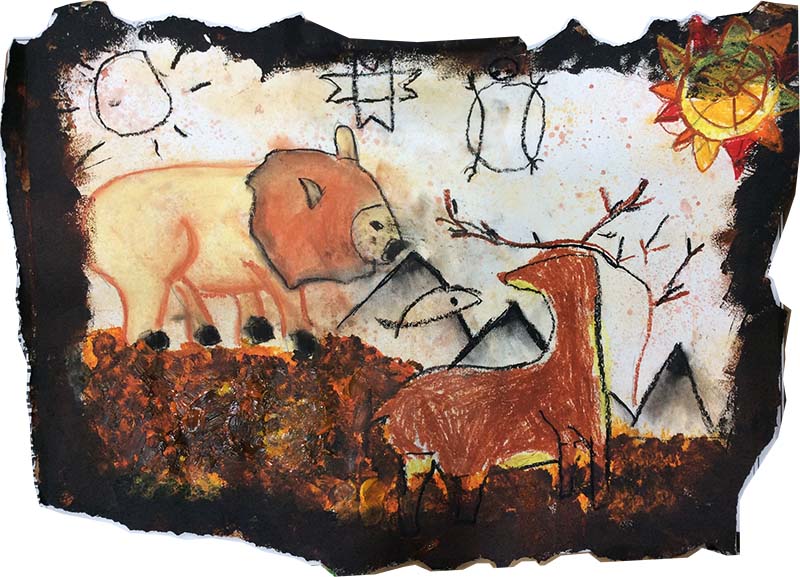
Hence, the cave became their point of reference, their realm of eternal childhood, more intimate than either school or home, their retreat of borderless imagination. Day after day on those barren walls within the dry darkness of their grotto-world, their imagination, so fertile because bubbling over with youthful turbulence, brought to life animal figures, first hewn with small chisels then painted with fingers (especially thumbs), or with sticks, brushed over with clumps of grass. No paint-brush was ever used. Their painting techniques remained those of prehistoric cave-artists.

Kenneth, well versed in rock painting from his school art classes and own research, chose the designs and advised Victor and Rachel how to apply the pigments. Each chose a section of the cavern to exercise his or her talents: Victor began to draw several cattle heads in the kirk with umbers that he ground and sifted from clay, boiled acorns, with their cups, and boiled mushrooms. It conferred to his cattle grey, tawny tones; tones that seemed to afford a glow of warmth to the cold walls.

Kenneth took charge of the western nave of the kirk, animating its walls with a big black cow, two galloping horses and two bison, all in charcoal black with a fringe of madder pigment. The plant had been gathered at the Annan riverside, then ground and sifted into a deep, crimson red.

As to Rachel, she applied her talent on the eastern nave wall with a two-metre long frieze of deer heads. Rachel also took charge of making a small fire to boil the plants and vegetables, whose steamed-juice transformed the plants or vegetables into liquid pigments. She poured the liquid into small glass containers and let them sit for one night before application.

“We’re like the cavemen who discovered fire,” Rachel said cheerfully as she steamed the plants and vegetables she had gleaned either from the forest or ‘borrowed’ from her mother’s kitchen.

“Not so, lassie. It was light that discovered fire, the cavemen merely rendered it physical,” corrected Kenneth smugly.  Rachel shrugged her shoulders …

With his customary pedantry, Kenneth advised: “Don’t forget mates, painting doesn’t reproduce what is visible, but restores or renders what no one has ever seen.”

Rachel and Victor ignored him, chuckling to themselves.

They worked diligently in rhythm with the stillness of the cave, their imaginations soaring to the height and breadth of their lithic horizon. For they were careful not to surpass those limits, not to crowd the walls with too many figures. The roaming animals needed space to breathe and the young artists provided them with that vital space: horses trot … cows graze … deer gambol. Kenneth, after having examined a hunter armed with a bow in a book of cave paintings, added this figure to his zoological repertoire. The hunter had let fly an arrow and followed its flight towards something unknown. Kenneth had his arrow fly towards one of his elks. The posture of the hunter having released his arrow from a taunt bow was crudely traced then coloured in rusty ochre. It would be the only human representation of the grotto paintings.

All the paintings had been previously drawn on a flat surface of paper by Victor. Rachel arranged the positions of their depictions and the boys made mental notes of them before undertaking the actual wall representation. Kenneth had reminded Rachel and Victor that the intention of the artist was not to copy what they see but to express it, and that their undertaking should not seek a tawdry or fantastic effect, but a simple one, for simplicity is essential to true art. If they really hoped to convince the townsfolk of the millennial authenticity of their pictures, then this artistic canon had to be respected scrupulously.

Gradually the cave walls burst out into a magical menagerie: Victor’s two-horned aurochs, painted in umber came to life and Rachel’s deer-head frieze boldly gambolled out of the rock in striking shades of madder red. Rachel, applying a prehistoric technique, blew the madder pigment on to the wall through a straw, then smeared it roughly with her thumb or a feather. 

The volume of their art thickened with vegetal and mineral glints as the volume of the walls, too, thickened with a phantasmagoria creatures depicted in a style they thought of as from stone ages.

Sometimes, the youngsters would dance and sing round the fire, recite poetry, or even compose a few verses of their own in joyful wantonness. “Our cave is the setting of an unfolding story, laddies,” Rachel giggled.

This pictural setting was indeed the fruit of their childhood imagination … and talent.

The day finally arrived when the cave-artists put the final touches to their masterpiece, an œuvre of considerable talent, even genius, given the lack of adult counsel and absence of light in the cave. For they had laboured as the prehistoric artist had laboured: by torch light (theirs, of course, electric!), and from the flames of their little fire’s chiaroscuro dancing upon the walls.

This being said, to divulge the discovery of the cave and its pictural contents would be a bit dodgy. They chose to wait several weeks to reflect on how they would announce their discovery. Kenneth, meanwhile, every now and then tossed dust on the pictures to harden and ‘age’ them. They lost their glint but the umbers seemed to strike the eye more prominently. They left nothing in the cave that would jeopardise their scheme. The ashes of their fire were swept into the well or used to tinge some of the figures in a rough, taupe grey.

Finally, on a clammy late Saturday morning, Rachel and Victor stormed into their parents’ home out of breath :

Maw! Da! Come quick,” exclaimed Rachel red in the face. “We fund a cave.”

“Aye, a real deep cave full of animal pictures,” seconded Victor, sweating from the brow, either from exhaustion or fear. “You have to come to see for yourselves,” he insisted. “The cave’s not far off, near the riverside.”

Their mother and father, not very eager to tear themselves away from their armchair reading, nevertheless let their panting children drag them to the mouth of the cave. Once there, they all entered, the parents a bit warily. Victor, at the head of the expedition, led them down into the cave, scanning the walls with his torchlight which exposed several paintings. His father, unversed in cave-paintings, had, however, studied art at university in Edinburgh. The paintings intrigued him. His wife stood dumbfounded before such a vast array of art work.

“What striking pictures!” she exclaimed, staring wide-eyed in admiration as her husband illumined one section of the wall after another. Bedazzled by such parental compliments, Rachel felt an ardent urge to thank them. She checked herself. Victor remained quiet.

“Aye!” uttered their father reflectively. “This is certainly not a chambered cairn tomb. I’ll contact specialists immediately. Meanwhile, you two (indicating his children) get the school authorities to photograph the cave and the paintings. Even if they’re not authentic, they do make for a good story in the local papers until the police find the culprits who contrived this whole thing.”

“What do you mean not authentic?” asked Victor timorously.

“Well, you know, there have been art counterfeiters over the ages, but it takes time before the experts uncover their ingenious device.”

“What happens to them?” Rachel dared ask, eyeing Victor sullenly.

“They’re tossed into gaol where they rightly belong!” concluded their father, puckering his lips. Rachel winced at the word gaol …

When their parents had returned home, Rachel and Victor made a bee-line for Kenneth’s house, where they informed him of their parents’ reaction, especially the tossing into gaol.

Kenneth chuckled out of the corner of his mouth: “Keech[6] ! Minors aren’t thrown into gaol, goonies[7]. Nae, you know what they say: ‘Fools look to tomorrow. Wise men use tonight.’” Neither Rachel nor her brother really understood that point, but it did have a pleasant ring to their ears.

The following weeks were hectic ones for the youngsters both at home and at school. Pupils bombarded them with questions whilst at home the telephone never stopped ringing. All the thorny bramble, thistle and snapdragons had been cut away from the mouth of the cave allowing photographers to take pictures and journalists to examine the figures for themselves. Soon travellers from afar reached the cave to feast their eyes on these wonderful works of prehistoric art.  During that feverish time no one dreamed that they had been drawn by our three adventurers …

Secretly the adventurers were delighted. And for good reason: they had their pictures taken in front of the cave by professional photographers, and had been interviewed not only by local reporters, but reporters sent from Edinburgh, Glasglow and even London. Experts had been contacted, seven to be exact, two of whom from London.

Kenneth brooded over the outcome. He sensed that the arrival of the experts bode ill-tidings. He knew they wouldn’t go to gaol, but, would they query of the age of the pigments however primitive their mixtures, their application and original whereabouts? Would they suspect foul play simply because, besides carved stone balls, prehistoric art work had never been discovered in Scotland? These men had very technical means to detect the precise date of pigments and their wall application …

All seven arrived together. Together they entered the cave brandishing large, powerful torches and miners’ helmets. Huge crowds had gathered for the occasion: photographers, journalists and even local writers swarmed throughout the surrounding hilly forests. Kenneth sat on a rock, his chin cupped in his hands. He felt miserable. Victor, wringing his hands frantically, paced back and forth near the riverside until his footfalls had traced a path. Rachel bit the ends of her hair nervously, casting furtive glances towards the thickening crowd. Dozens of people had been congratulating them on their find all morning.

“Would they congratulate us as much if they learned we were the artists?” snickered Victor sarcastically.

“Aye, I wonder,” Rachel responded drily.

“Bloody hell, why make things worse!” Kenneth snorted stiffly, staring at the backs of the crowd in front of the cave. “The whole thing was zany[8] to begin with. Those professors will be on to us, I’m sure.” All the three bowed their heads resigned to their fate in silent expectation.

The seven filed out of the cave with wry smiles difficult to decipher. A strange composition indeed: severe or cryptic … sharp or ironic … gruff or awe-inspired! No one appeared to be able to interpret those ambivalent smiles, especially our three young artists, who had by then stomped up the humpy hillside towards the murmuring crowd. Everyone present eyed the children in nervous anticipation as if they held the key to unlock those facial mysteries. Alas none had …

The experts pushed through the crowd and reached the standing children. One of them with a pointy beard and a sweet smile asked them very politely to lead them to the home of their parents where they would like to speak to them in private. Kenneth’s father ran up and immediately agreed to offer his home for their conference. Besides, it was the closest. He led the way through the fabled forest and over the heather fields. Arriving at the door, the pointy bearded expert informed Kenneth’s father that their conference was be held without parental intrusion. Had the father any choice ? Apparently not, for the front door of his humble home was shut quietly in his astonished face …

Now whatever took place behind the shut door of that humble home the ever-present narrator is, alas, at a loss to relate. For hours and hours and hours seemed to pass, and having reached the number of words permitted in this tale, it behoves him to abandon his readers to imagine the outcome … or the verdict themselves …   

From Public Domain

[1]        ‘found’ in the Scots tongue.

[2]        ‘Father’ in the Scots tongue.

[3]        ‘bag or pouch’ in the Scots tongue.

[4]        ‘Boots’ in the Scots tongue.

[5]        ‘Church’ in the Scots tongue.

[6]        ‘Rubbish’ in the Scots tongue.

[7]        ‘Idiots’ in the Scots tongue.

[8]        ‘Crazy’ in the Scots tongue.

Paul Mirabile is a retired professor of philology now living in France. He has published mostly academic works centred on philology, history, pedagogy and religion. He has also published stories of his travels throughout Asia, where he spent thirty years.

.

PLEASE NOTE: ARTICLES CAN ONLY BE REPRODUCED IN OTHER SITES WITH DUE ACKNOWLEDGEMENT TO BORDERLESS JOURNAL

Click here to access the Borderless anthology, Monalisa No Longer Smiles

Click here to access Monalisa No Longer Smiles on Kindle Amazon International
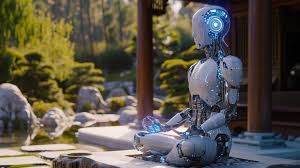
Categories
Stories

‘Solitude is a Kind of Freedom…’

By Munaj Gul Baloch

From Public Domain

Mehr’s fingers shivered as she turned the pages of Patrick Hamilton’s Slaves of Solitude. The words in the pages distorted together, but her mind was elsewhere, stuck in a maze of solitude.

Five years and seven months of isolation had made her life dazed with unrelenting queries. Mehr frequently grilled herself… how could she bring her past back? That would be impossible, but it had been beautiful and sad too. She had lost her companion, Nohan, to cancer that night more than five years ago. Nohan, from Mehr’s school cohort, had been her soulmate. During the recess at school, he often says to Mehr, “You are as fine-looking as the moon,” looking at Mehr’s brown eyes with a pure smile on his lips. She never praised but had deeply admired him.

The consciousness of Nohan and Mehr were akin. They loved gentle breeze, striking mountains, the elegant water of Nihing River, and the scenario of Jaalbaar. Most of their debates were grounded on the veneration of Balochistan’s beauty. Mehr had always aired her life’s grievances to Nohan and found relief in being with him. Since the day Nohan had departed from the world, she was in the room – alone.

Her room, once an asylum for her companions, now turned into a prison. The gentle breeze, the echoes of mountains, and the rain created a forlorn opus, adding her depression. Each drop of rain haunted her and reminded her of bygone days. Memories of her past unsettled and haunted her even in her most blessed hours. Her eyes, once perky, now seemed grey, weighed down by the tears she had shed in the isolated room with the pages of the book.

A voice whispered to her, “Take my hand, or you will go astray here—in the world of solitude.” Mehr’s heart pranced a beat. She spun around, however, there was no one there. She remained astound. Past mid night, the voice persisted again, “Look, there is a yellow river beside your room, flowing with blood and sorrows.” The words dripped torment. All of a sudden, Mehr’s gaze drifted towards the window, and for a moment, she saw nothing around. It was so dark, she found a yellowish glow, and after some seconds, the yellowish glow died out.

It was still raining outside. The voice continued to haunt her. Mehr felt like she was drowning in a sea of despair. Afterwards, something budged. The night turned into another day. She picked up another book, One Hundred Years of Solitude by Gabriel Garcia Marquez, which was kept in her personal collection. But nothing changed.  She still felt a sense of nervousness.

Mehr’s heart swelled with sensation as she approached the word solitude in the pages of the book. She smiled, and felt a weight lift off her shoulders. For the first time in years, she felt a sense of belonging. Though, the solitude, the memories, and the voices – they had all been a manifestation of her own fears and doubts. She smiled and knew that she still had a long way to go – perhaps an unknown destination. The phrase “Solitude is a kind of freedom” would continue to roll on her mind. She found solace in solitude– a feeling she could own. She lived by the line that said, “In solitude, the mind gains strength and learns to lean upon itself.”

.

Munaj Gul is a lawyer based in Turbat, Balochistan. He tweets @MunajGul

PLEASE NOTE: ARTICLES CAN ONLY BE REPRODUCED IN OTHER SITES WITH DUE ACKNOWLEDGEMENT TO BORDERLESS JOURNAL

Click here to access the Borderless anthology, Monalisa No Longer Smiles

Click here to access Monalisa No Longer Smiles on Kindle Amazon International
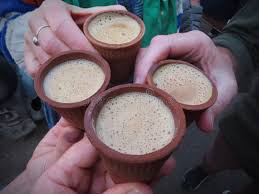
Categories
Stories

The Appropriate Punishments

By Naramsetti Umamaheswararao

From Public Domain

In a small forest next to Ramapuram, there lived a crow and a monkey who were friends. They would help each other when needed, but they were mischievous by nature and often looked for opportunities to harass others. Over time, they befriended a cunning jackal, and the three would team up to trouble travelers passing through.

The residents of Ramapuram and nearby villages had to cross this small forest to reach the town. Whenever a traveler passed through the forest with a bag in hand, the monkey would jump from the tree and snatch the bag, hoping to find food inside. It would climb up a tree, rummage through the contents, and if there was anything edible, it would keep it, tossing the rest to the ground. The monkey would then mock the traveler, showing its teeth and laughing at their distress. Once the traveler left, the monkey would share the food with its friends.

The crow, on the other hand, would swoop down and peck at the travelers’ heads with its beak or legs, causing them to flinch. If anyone rested under a tree, the crow would defecate on them and then hide in the branches, laughing at their misery.

The jackal was skilled at imitating the roar of a tiger. It would hide behind a tree and roar like a tiger, scaring the travelers who would then run away in fear, much to the jackal’s delight.

One day, a farmer named Rama from the neighbouring village of Shantipuram was passing through the forest. He was on his way to buy jewelry for his daughter’s wedding, carrying money in his bag. The monkey, mistaking the bag for food, leaped in front of Rama and snatched the bag, quickly climbing a tree. “Oh no, my bag!” cried Rama as he ran after the monkey. But the monkey, sitting on a branch, began searching through the bag. Finding nothing to eat, it became angry and tore the money into pieces, throwing them down.

Seeing this, Rama was filled with both sadness and anger. He spotted a dry branch on the ground and thought of using it to threaten the monkey. But before he could act, the crow swooped down and pecked him on the head. Meanwhile, the jackal, hiding behind a tree, roared like a tiger. Terrified, Rama ran away from the forest.

When he reached his village, Rama told the villagers what had happened. The villagers felt sorry for him and promised to help with his daughter’s wedding expenses.

A young man in the village suggested, “I know a sorcerer. Let’s tell him about this and put an end to these troubles.” So they took Rama to the sorcerer.

After hearing the story, the sorcerer said, “I will secretly observe what’s happening in the forest and punish the culprits.” He kept his promise and observed the mischief of the crow, monkey, and jackal for a few days to understand their behavior completely. Then, he devised a plan and set out for the forest.

When the monkey saw the sorcerer coming with a bag in hand, it followed its usual habit and jumped down to snatch the bag. But the moment its hand touched the bag, it stuck to it. No matter how hard the monkey tried, it couldn’t free itself. The sorcerer had applied strong glue to the bag beforehand, knowing this would happen. The monkey screeched in fear.

Hearing the monkey’s cries, the crow flew down intending to peck the sorcerer. But the sorcerer quickly threw a net over the crow, trapping it.

Meanwhile, the jackal, watching the humiliation of its friends from a distance, tried to roar like a tiger again. It went behind a tree to hide, but the sorcerer’s disciple, who had been waiting there, threw another net over the jackal, capturing it.

Realising that the sorcerer was not an ordinary traveler, the animals pleaded, “Oh, please forgive us. We won’t trouble anyone anymore.”

The sorcerer laughed and asked, “When you were troubling the travelers, where was your sense of right and wrong? Now that you’re in trouble, you suddenly confess and promise to end your mischief? How can you chnge so quickly?”

They replied, “We never expected someone like you would come. Please let us go. We promise to live without bothering anyone.”

The sorcerer, however, was unmoved. “There’s no question of letting you go. I will hand you over to the zoo so that travelers passing through this forest won’t be troubled anymore.”

The animals pleaded once again, “We’ve learned our lesson. Please let us go.”

Even the sorcerer’s disciple requested, “Please forgive them and let them go.”

But the sorcerer responded, “Don’t show mercy on these creatures. The monkey tore up Ramayya’s money. I’ll release the crow, and if it ever causes trouble again, I’ll capture it and starve it to death in a cage. I’ll train the monkey to perform tricks and take it with us for shows. As for the jackal, I’ll hand it over to the zoo.”

And the sorcerer did exactly as he said. He disciplined the three of them and put an end to their mischief. From that day on, travelers passing through the forest were no longer troubled by the crow, monkey, or jackal.

From Public Domain

Naramsetti Umamaheswararao has written more than a thousand stories, songs, and novels for children over 42 years. he has published 32 books. His novel, Anandalokam, received the Central Sahitya Akademi Award for children’s literature. He has received numerous awards and honours, including the Andhra Pradesh Government’s Distinguished Telugu Language Award and the Pratibha Award from Potti Sreeramulu Telugu University. He established the Naramshetty Children’s Literature Foundation and has been actively promoting children’s literature as its president.

.

PLEASE NOTE: ARTICLES CAN ONLY BE REPRODUCED IN OTHER SITES WITH DUE ACKNOWLEDGEMENT TO BORDERLESS JOURNAL

Click here to access the Borderless anthology, Monalisa No Longer Smiles

Click here to access Monalisa No Longer Smiles on Amazon International