Categories
Poetry

Ruminations

By Anasuya Bhar


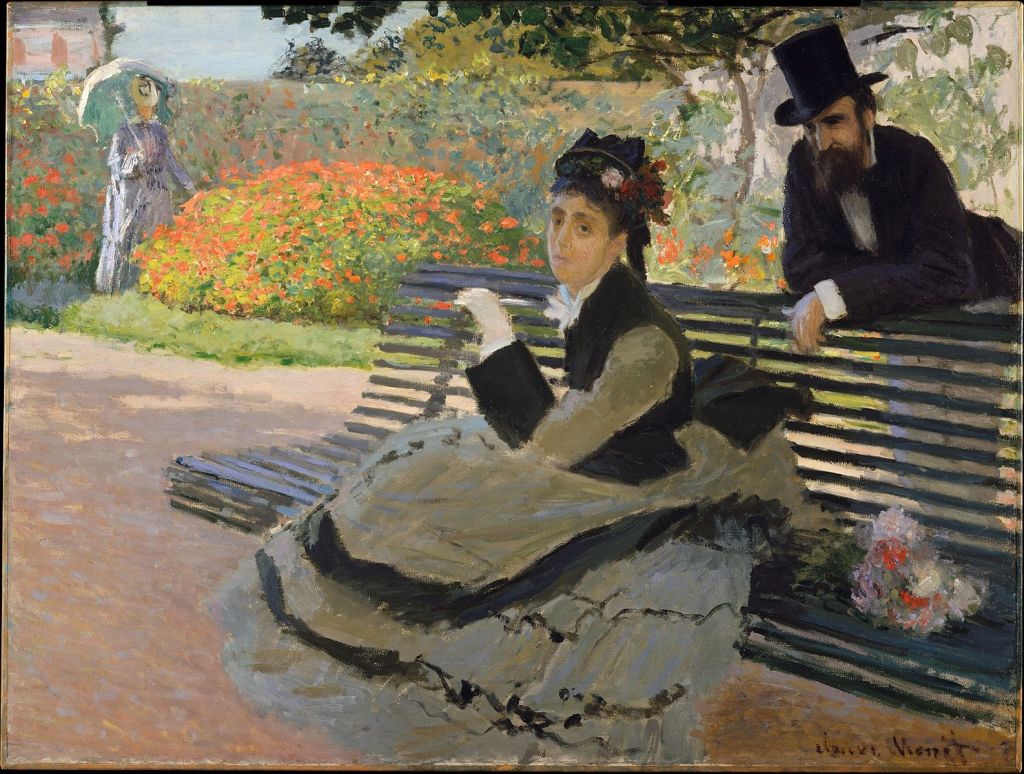
Camille Monet on a Garden Bench by Monet, 1873
Courtesy Creative Commons
Pollination 

From one thought to another 
My mind slips 
Like the insect who shifts
From one flower to another 
Trying out new flavours, new fragrances – 
My mind flits from one thought 
One task, one poem, one book
To another, in some never-ending game
Of restlessness, unease and disillusion,
Looking for some kind of satiety
Some fulfilment, some happiness. 
My mind waits to be held back 
With one thought, one look, maybe
One love of gratuitous pain - 
My mind rests from moving thought 
To thought, in the happy resignation 
Of paper to pen. 
 
Ruminations   

Silences lay pregnant 
Expectant, between them 
On that solitary bench 
Where, much could have been said, 
Much could have changed, 
But there was a ‘nothing’ between them.
Moments that flowed like lines parallel
From each heart, each soul,
But moments that hung 
Heavy with possibilities
Of somethings, happy or sad. 
In that time and mood,
Were they only two
Separated from the rest, the sundry?
In those silences, each lived 
For the other, even in non-acknowledgement,
In disdain or in pain.
There was prescient quietness where million 
Words could have stood – 
Silence lay pregnant between them 
In that bench, on that day. 

Dr. Anasuya Bhar is Associate Professor of English and the Dean of Postgraduate Studies in St. Paul’s Cathedral Mission College Kolkata. Dr. Bhar is the sole Editor of the literary Journal Symposium http://www.spcmc.ac.in/departmental-magazine/symposium/, published by her Department. She has various academic publications to her credit. She is also keen on travel writing and poetry writing. She has her own blog https://anascornernet.wordpress.com/.

.

PLEASE NOTE: ARTICLES CAN ONLY BE REPRODUCED IN OTHER SITES WITH DUE ACKNOWLEDGEMENT TO BORDERLESS JOURNAL. 
Categories
Poetry

Universal Language

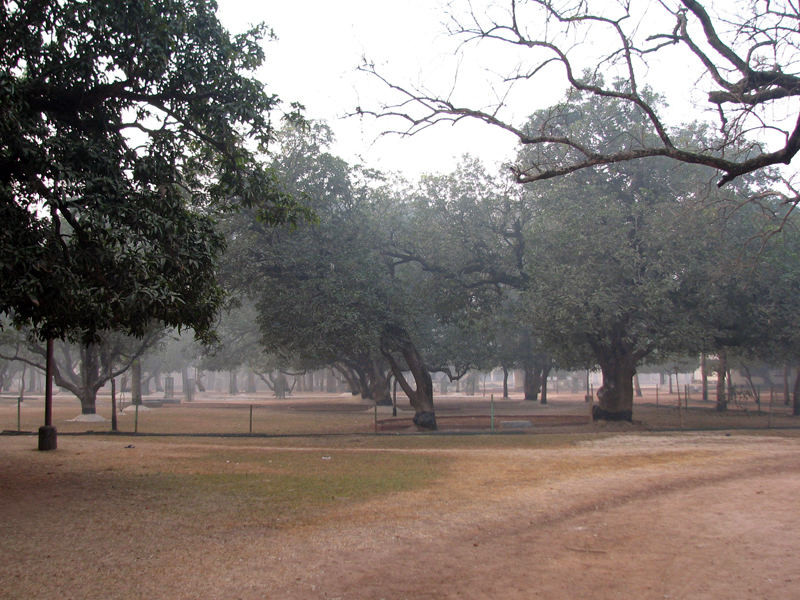
Composed by Ihlwha Choi from South Korea, while visiting a mango grove in Santiniketan, where Tagore started his unique experiment with learning.

Mango Grove in Santiniketan Courtesy: Creative Commons

In the mango groves* where children were playing,

I was reading of Jesus’ first miracle.

At that moment, two fledgling-like men came to me.

Hesitating and smiling an affable smile, mixed with playfulness and delinquency,

Gabbling about one hundred rupees and one thousand rupees in an unfamiliar language.

The only words I understood were one hundred rupees and one thousand rupees.

One hundred maybe meant he had no money for lunch.

One thousand maybe he knew nice girls somewhere.

Their fingers told me something about that. 

I thought Santiniketan, city of the great poet, was a holy city,

Though there were also some crimes, irrationality and evils.

The two appeared to me like the devil approaching the Son of Man, promising wealth, rank and splendours.

Finding the circumstances strange,

I escaped slowly from the spot and looked around after a few minutes.

They were looking at me like dogs having missed chasing the chickens.

The two, wearing rags, seemed starved for food.

Only for the reason of hunger,

Perhaps they might have thought of me as a traveller from a rich country.

So, they approached me for help.

That was maybe the last expression they could show — hospitality.

Maybe they approached me with the only universal language they knew.

.

Ihlwha Choi is a South Korean poet. He has published multiple poetry collections, such as Until the Time When Our Love will Flourish, The Color of Time, His Song and The Last Rehearsal.

.

PLEASE NOTE: ARTICLES CAN ONLY BE REPRODUCED IN OTHER SITES WITH DUE ACKNOWLEDGEMENT TO BORDERLESS JOURNAL. 

Categories
Poetry

Then Came the King’s Men

By Himadri Lahiri

Rabindranath Tagore by Sudhir Khastgir.
Courtesy: Creative Commons
Then Came the King’s Men

There he sat, a hermit under a chhatim tree
deep in meditation under the sun
that scorched the face of the earth with burning sores.
Brigands roamed about the territory at night
when it came alive with sounds of thousand crickets and glow worms.
There, there were born young saplings that grew up into dense foliage –
refuge of birds, insects and hundreds of other species.
There, there he founded a casteless ashram community
that reposed faith in God and man.

The bearded bard took the baton forward
turned the place into a nest where wise birds from distant places flocked.
They hummed different tunes in perfect unison – 
songs of diverse languages, cultures and knowledge.
With the end of the season many did not go back.
The village grew into a warm world.
The trees kept company when the young learnt 
the way chicks pick up small pieces of knowledge.
Fear was banished, freedom whispered to the innocents,
asked them of their playmates, pet dogs or birdlore
while the bard sang on.

As time moved on, the other freedom came.
With it slowly came sloth, self and salary.
The green faded into the walled universe
the size of a wooden ball.

Then came the king’s men 
manacles tied to their girdles, glistening. 
Wrapped in vanity and arrogance
with claws sharper than the wolf’s
threw a net around the greying green,
fragmented the universe into narrow walls.
Devices with strange names sprouted
with eyes on all things mortal,
turned men against men.
Wild messages ran riot
rotting the fabric of the place.
Closeted in a cold room in front of a bright screen,
the boss boasted,
“Mission accomplished, 
let us raise a toast to our great, newly bearded guru.”

Himadri Lahiri taught English at the University of Burdwan. He is now associated with Netaji Subhas Open University. His poems were earlier published in Borderless Journal, Rupkatha, Café Dissensus and in many more forums.

Categories
Poetry

Mystical reconnections: Reading Tagore

By Sunil Sharma

I know not what playmate of mine in the sky sends them down
the air to race with my boats!
When night comes I bury my face in my arms and dream that my
paper boats float on and on under the midnight stars.

Rabindranath Tagore

Trapped inside the cage, I look up at the sky 
and am, somehow, by cultural memory
reminded of the above lines of the
Immortal Bard who guides me on
in this astral voyage of recovery of
the  self and  the dim
pathways, out there, now visible again,
modes, perceptions leading directly
to the realities of the heavens and 
the heavenly songs, in our midst.
Gurudev! Pronam!
You restore -- in the post-modern,
post-industrial, consuming unit,
recipient -- a sense of the lost
grandeur, wonder, joy;
a promise of an
uplifting presence around
and, of the missing
 bliss that flows from
ordinary moments of the
enraptured
gazing at the stars from
a locked-down home’s
barred windows, thereby, 
that very moment, feeling
reassured of that
playmate for me, us, in
a single instant of reading,
viewing, experiencing
mystical reconnections
with an original vision,
heritage,
roots,
idiom of the lived lives,
profound
civilizational truths
in these cynical times!

Sunil Sharma is an Indian academic and writer with 22 books published—some solo and joint. Edits the online monthly journal Setu. Currently based in MMR (Mumbai Metropolitan Region).

.

PLEASE NOTE: ARTICLES CAN ONLY BE REPRODUCED IN OTHER SITES WITH DUE ACKNOWLEDGEMENT TO BORDERLESS JOURNAL

Categories
Poetry

Tribute to Tagore

By Mike Smith

All Things Are Connected

Touch this web
We call the world
However lightly
With your God-finger
And see
From each concentric strand
The dew is shaken
 
Not one strained string
There is that does not shimmer
With that motion
 
Even the hollow centre
Ring of nothingness
Into which we fall
Moves
 
And the guy-line cables
That hold this universe in place
                    Tremble.

(Published first in Acumen Magazine in 2006 and then in its anthology, First Sixty.)

.

Mike Smith lives on the edge of England where he writes occasional plays, poetry, and essays, usually on the short story form in which he writes as Brindley Hallam Dennis. His writing has been published and performed. He blogs at www.Bhdandme.wordpress.com 

.

PLEASE NOTE: ARTICLES CAN ONLY BE REPRODUCED IN OTHER SITES WITH DUE ACKNOWLEDGEMENT TO BORDERLESS JOURNAL

Categories
Poetry

Catabolic Woman by Arundhathi Subramaniam

We’re bound for the ocean 
and a largesse of sky, 
we’re not looking for the truth 
or living a lie. 
 
We’re coming apart, 
we’re going downhill, 
the fury’s almost done, 
we’ve had our fill. 
 
We’re passionate, ironic 
angelic, demonic, 
clairvoyant, rational 
wildly Indian, anti-national. 
 
We’re not trying to make our peace 
not itching for a fight, 
we don’t need your shade 
and we don’t need your light. 
 
We know charisma isn’t contagious 
and most rules are egregious. 
 
We’re catabolic women. 
 
We’ve known the refuge of human arms, 
the comfort of bathroom floors, 
we’ve stormed out of rooms, 
thrown open the doors. 
 
We’ve figured the tricks to turn rage 
into celebration,  
we know why the oldest god dances 
at every cremation. 
 
We’ve kissed in the rose garden, 
been the belles of the ball, 
hidden under bedcovers 
and we’ve stood tall.  
 
We’re not interested in camouflage 
or self-revelation, 
not looking for a bargain 
or an invitation.  
 
We’re capable of stillness 
even as we gallivant, 
capable of wisdom 
even as we rant.  
 
Look into our eyes, 
you’ll see we’re almost through. 
We can be kind but we’re not really     
thinking of you. 
 
We don’t remember names 
and we don’t do Sudoku. 
We’re losing EQ and IQ, 
forgetting to say please and thank you. 
 
We’re catabolic women 
 
We’ve never ticked the right boxes, 
never filled out the form, 
our dharma is tepid, 
our politics lukewarm. 
 
We’ve had enough of earnestness 
and indignation  
but still keep the faith 
in conversation. 
 
We’re wily Easterners enough  
to argue nirvana and bhakti, 
talk yin and yang, 
Shiva and Shakti.   
 
When we’re denied a visa 
we fall back on astral travel 
and when samsara gets intense 
we simply unravel. 
 
We’re unbuilding now, 
unperpetuating, 
unfortifying, 
disintegrating. 
 
We’re caterwauling,  
           catastrophic,  
           shambolic,  
           cataclysmic,  
           catabolic women.  
 

First Published in Love Without a Story, 2019.

Arundhathi Subramaniam is a poet who has recently won the Sahitya Akademi Award, 2020, for her book When God is the traveller (2014). She has authored a number of books and won multiple awards and fellowships. She has been part of a number of numerous anthologies and journals.

Categories
Poetry

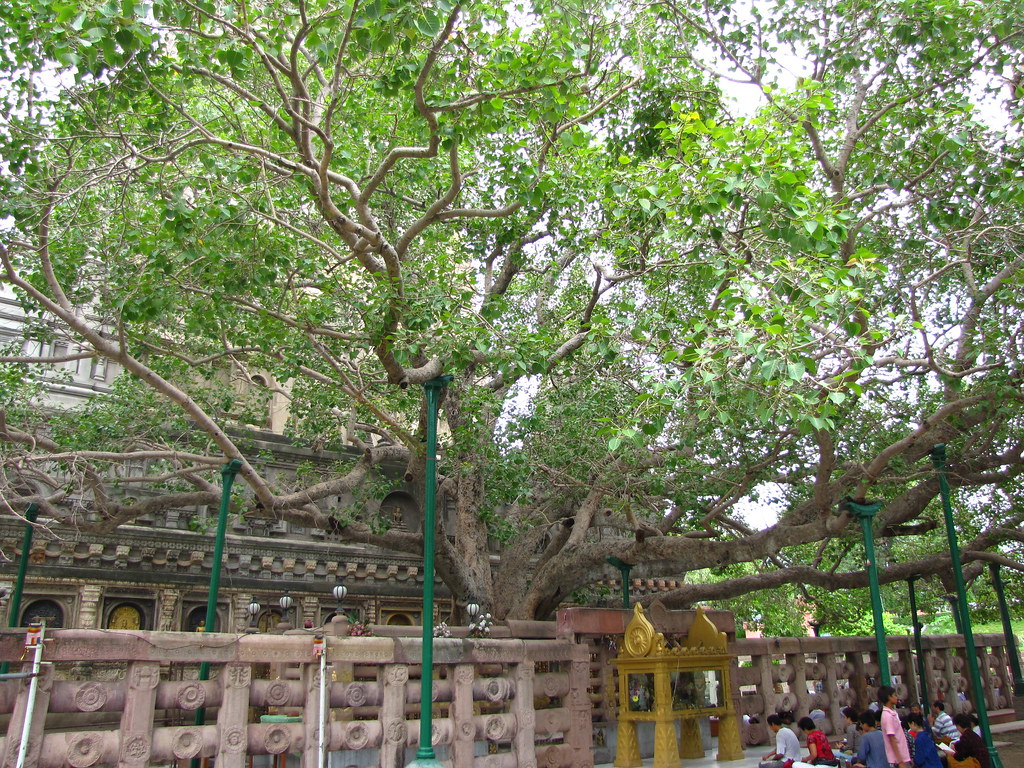
Bodhi Tree by Sumana Roy

Bodhi Tree. Courtesy: Creative commons licence

Here you can come without brushing your teeth –
the Buddha and the fig tree have never needed toothbrushes.

The myths that surround places are like ambulance sirens –
patients, pilgrims and tourists are all the same.

One comes to trees to escape the pornography of waiting.
There must be something about sitting under a tree,
in the bandaged conflation between shade and shadow.
Other men chose exile in the forest, vanwas –
Rama, the five Pandava brothers, their wives.
Only Siddhartha came to a solitary tree, to escape desire.
A forest is a hiding place, where men compete with trees.
So Gautama stopped walking and closed his eyes.
The uselessness of eyes, of legs, of combs, of words –
all this the Buddha learned from this tree.

Today, only bombs are living Buddhas.
When one went off in Gaya, everyone ran,
everyone except the trees.
For death also demands walking.

Now, after the fret of flowering,
I only seek the tree’s heart.
Guns are seedless fruits,
the gardens full of traitor trees.
Now I am free.
Only I know that the tree is Buddha.
And that the Buddha was a tree.

First published in Granta Magazine

.

Sumana Roy is the author of How I became a Tree, a work of nonfiction, Missing: A NovelOut of Syllabus: Poems, and My Mother’s Lover and Other Stories, a collection of short stories

PLEASE NOTE: ARTICLES CAN ONLY BE REPRODUCED IN OTHER SITES WITH DUE ACKNOWLEDGEMENT TO BORDERLESS JOURNAL

Categories
Poetry

Malayalam Poetry in Translation

Aditya Shankar translates a poem by Shylan

Shylan
Silencer

The silencer disengages
From the motorbike on the ascent.

Onward, 
The routes resonate multi-fold.

After stripping off 
The celebrated name 
That stuck by chance, 
May be my resonance too
Would turn glorious. 

Shylan (b.1975) is a poet and film critic. His poetry collections include Vettaikkaran, Nishkasithante Easter, Ottakappakshi, Thamraparni, and Deja Vu.

Aditya Shankar is an Indian poet, flash fiction author, and translator. His work has appeared in international journals and anthologies of repute and translated into Malayalam and Arabic. Books: After Seeing (2006), Party Poopers (2014), and XXL (Dhauli Books, 2018). He lives in Bangalore, India.

.

PLEASE NOTE: ARTICLES CAN ONLY BE REPRODUCED IN OTHER SITES WITH DUE ACKNOWLEDGEMENT TO BORDERLESS JOURNAL

Categories
Poetry

The Word by Akbar Barakzai

Translated from Balochi by Fazal Baloch

Akbar Barakzai

Akbar Barakzai was born in Shikarpur, Sindh in 1939. He is ranked amongst the proponents of modern Balochi literature. His poetry reflects the objective realities of life. Love for motherland, peace and prosperity and dignity of a man are the recurrent themes of his poetry. His love for human dignity transcends all geographical and cultural frontiers. Barakzai is not a prolific poet. In a literary career which spans over half a century, Barakzai has managed to bring out just two anthologies of his poems, but his poetry has depth and reaches out to human hearts with its profundity. Last year, Barakzai rejected the Pakistan Academy of Letters (PAL) award, quoting  the oppressive policies meted out to his region by the government as the reason.

The Word 

We begin with the word 
With the word we end 
Blessings and Salutations 
To the Apostle of the word! 

The word is God 
The very existence 
And the guiding ocean of time
The word brings forth 
Freedom and providence 
Prosperity and ruin 
Mountains trembles with the fear of the word 
Who could put out the ever-leaping flames of the word? 
Don’t ever bury the word 
In the chasm of your chest 
Rather express the word 
Yes speak it out! 
The word is freedom 
End of oppression 
Light and radiance 
Beauty and bliss
The word is Socrates’ free-spirited paramour 
The ember glowing in Mansour’s fervent heart 
The harbinger of a new dawn 
Don’t ever bury the word 
In the depth of your chest 
Rather express the word 
Yes, speak it out. 
The Word brings forth 
Freedom and providence.

Fazal Baloch is a Balochi writer and translator. He has translated many Balochi poems and short stories into English. His translations have been featured in Pakistani Literature published by Pakistan Academy of Letters and in the form of books and anthologies. Fazal Baloch has the translation rights to Barakzai’s works and is in the process of bringing them out as a book.

.

PLEASE NOTE: ARTICLES CAN ONLY BE REPRODUCED IN OTHER SITES WITH DUE ACKNOWLEDGEMENT TO BORDERLESS JOURNAL

Categories
Poetry

The Shadow of Disappointment

By Smitha Vishwanath

The shadow of disappointment

is long and grey

it lengthens

when expectation rises -- like the sun

and shortens

when it meets the horizon


The shadow of disappointment is darkest when it's closer

And lightens as it goes farther

lingering ominously, over everything in the path of light

Casting a veil of darkness on all in sight

dulling the brightness, reducing the sheen

of every living and non-living being


The shadow of  disappointment allures  

Turn, turn away, towards the light

And let it follow you -- silently into the quiet of the night

For that is where the shadow -- Erebus, 

child of Chaos resides, 

enveloped in the love of Nyx*”

Lay it at rest there so it no longer disappoints.


*Erebus – As per Greek mythology, was conceived as a primordial deity and represented darkness

*Chaos – was believed to be the father of Erebus. A state of void preceding the creation of the Universe

*Nyx- is the night as per Greek myth

Smitha Vishwanath is a banker turned writer. A management professional, she embarked on the writing journey in 2016, with her blog, https://lifeateacher.wordpress.com.Her poems and articles have been published in various anthologies. In July 2018, she co-authored a book of poetry: Roads – A Journey with Verses.

.

PLEASE NOTE: ARTICLES CAN ONLY BE REPRODUCED IN OTHER SITES WITH DUE ACKNOWLEDGEMENT TO BORDERLESS JOURNAL.