Categories
Excerpt

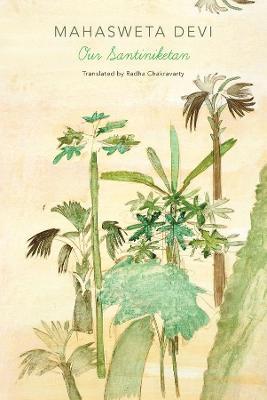
Mahasweta Devi, Our Santiniketan

Title: Mahasweta Devi, Our Santiniketan.

Translator: Radha Chakravarty (From Bengali)

Publisher: Seagull Books, January 2022.

I first visited Santiniketan at the age of four, I’m told.

If we calculate the date, that would be 1930, or December 1929. Whether it was that December, or the January of 1929, I don’t know. Ma said it was an awfully cold winter. Shivering all the way on our journey there, shivering all the way back.

How amazing! I used to remember my very, very young days very, very well.

Yet now I can no longer recall that first visit.

I can’t be expected to remember, either. For now, I’m in my seventy-fifth year.

For a long, long time, I lived with Ma, Baba, my mamas, mashis, kakas, pishis, Dadu, Didima, Thakurda (only I called him ‘Dada’), Thakuma— all of them.

Not just them. Also Ma’s kaka, jyatha, mama, mashi, and their children and grandchildren. In other words, I lived with relatives of a hundred kinds, our lives closely entangled. For as long as they were with us, there was constant talk. In that buzz of conversation, one heard people say things like:

‘You were four years old then!’

‘When you fell off the tree . . . ’

‘The time you boarded an aeroplane . . . ’

That was how one got to know about one’s own childhood. So many years since Ma left us—to whom can I narrate my tales of childhood now! What I want to say here is that, although my first visit to Santiniketan was something that really happened, it’s an event I know of only by hearsay.

What we learn of by hearsay can also be true, after all. Way back in 1936, I went to Jhargram. Those days, Jhargram was a sea of sal forests.

Like an island within that sea was a house where we stayed. When Baba was transferred to Medinipur, I got to see a great deal of the Gopa, Jhargram, Salbani, Belpahari of those times.

‘Khuku! In Medinipur we spent our happiest days,’ Ma used to say.

I say the same.

Look, I’ll tell you about my childhood. But there’s no one alive now who can understand what I’m talking about.

Never mind. I must talk about the first time I saw Santiniketan.

Baba had probably joined Visva-Bharati as a member. What was his reason?

Visva-Bharati was Rabindranath’s creation, after all!

Well, Baba had seen Rabindranath several times, gone to meet him as well. This time, he had decided to take Ma with him, and us two sisters too.

If I was four at the time, my sister Mitul would have been no more than six months old!

Trains those days had First Class, Second Class, Inter Class and Third Class compartments. We boarded a Second Class compartment. A pair of wide, leather-upholstered berths below, another pair above.

In addition, the First Class compartment had a wall-mounted mirror, and hooks to hang clothes, raincoats and umbrellas. Fixed to the wall between the two bathrooms was a table with no legs. As far as I can remember, these items were absent from the Second Class compartment. The cushioning of the First Class berths was heavier, and the other fittings much superior. White sahebs and brown sahebs, did they all travel First Class? I don’t know.

That they didn’t travel in the same compartment, was something I heard of all the time. The British were in power then. They were the ruling class.

Gandhiji always travelled Third Class, in compartments meant for common people. Incredible, as it seems today, once I saw Gandhiji too; but let that be.

Anyway, it was high winter then. On the train, Ma and I took the lower berth. A gentleman on the berth above us, another on the lower berth opposite. Baba on the upper berth, with Mitul. Ma and Baba had a massive war of words, I’m told.

‘You take the upper berth with Khuku. Mitul is so tiny, let her remain with me.’

‘Aha! You can recline comfortably.’

‘Mitul is so small, she’ll fall off!’

‘How can she, when I’m with her?’

And so, the verbal battle went on and on. The gentleman on the lower berth interrupted from time to time, saying things like:

‘Aha! Please stop this! The children are asleep after all, so why must you . . . ?’ and so on.

Ultimately, at some point, everyone fell asleep. Look, among all the trains of those days—BNR, INR, this Mail, that Mail, some other Mail—which one we were travelling in, I can’t say. I’m told that the moment we arrived at Bhedia station, it was either our co-passengers who declared: ‘This is Bolpur’, or my Baba who decided, ‘This is Bolpur’. How exactly it happened, there’s no way of figuring out now, after a gap of seventy years. From what I knew of my Baba, I suspect he tumbled out of the train, announcing:

‘This is Bolpur!’

Ma recounted how, as soon as he alighted at the station, Baba cried, ‘We’ve got off at Bolpur, so why is this station named Bhedia?’

‘Bhedia’ was the name displayed at the station, on a square glass chimney atop a heavy wooden stand.

Anyway. The station master emerged. He understood the situation and organized a bullock cart for us. It was lined with  a thick layer of straw, covered by a shataranchi. You wouldn’t know this, but if you sleep on a thick layer of straw with that chequered rug spread over it, it really keeps the cold at bay. Dumka in 1944, Ghatsila in 1945, I remember them very well. In December, we had travelled to those places from Santiniketan.

In that bitter cold, my parents had climbed on to the bullock cart and eventually arrived at Santiniketan. The house behind the Mandir, which I thought of as the Guest House since 1936, is where I think they had stayed.

In the morning, they set out for an audience with the poet. Seated beside Rabindranath was Ramananda Chattopadhyay. I was terribly precocious, and even more artless. Apparently, I asked Ramananda Chattopadhyay:

‘Are you Robi Thakur?’

Tell me, how was I to blame! Dadu-Didima, my grandparents back home, used the name ‘Robi Thakur’. Thakurda, my paternal grandfather, would say ‘Robi-babu’. I mean, he referred to the Poet as ‘Robi-babu’. Baba, Boromama, Ma, my mashis and pishis — they used the name ‘Rabindranath’. No wonder I had blurted out such a foolish question.

Even that anecdote is a matter of hearsay, after all.

What happened after this episode, I can’t recall.

So those were my first glimpses of Rabindranath, and of Santiniketan.

The Santiniketan I saw six years later, when I went there at the age of ten — that is what remains etched in my memory as ‘our Santiniketan’. Like a dazzling feather that has fluttered down from some unknown place. In my mind it remains, enclosed within a box made of glass. I can turn it this way and that, look at it from any angle, whenever I desire.

I can. It’s something I can do, even now. Still, I have travelled a long distance away from my childhood, so the glass box now seems far, far away. I gaze at it and realize that the colours are fading. I realize that, one day, all the colours will vanish.

Of course, they will vanish. Someday, someone will ask me to write about it, and with my dimming vision I will sit down to write. Sixty-four years now. How long will the feather keep its colours, waiting?

The ‘feather’ stands for memories of childhood.

Memories don’t wait either. Memories grow tired. They want to go to sleep.

About the Book: In Our Santinikentan, the late Mahasweta Devi, one of India’s most celebrated writers, vividly narrates her days as a schoolgirl in the 1930s. As the aging author struggles to recapture vignettes of her childhood, these reminiscences bring to the written page not only her individual sensibility but an entire ethos.

Santiniketan is home to the school and university founded by the foremost literary and cultural icon of India, Rabindranath Tagore. In these pages, a forgotten Santiniketan, seen through the innocent eyes of a young girl, comes to life — the place, its people, flora and fauna, along with its educational environment, culture of free creative expression, vision of harmonious coexistence between natural and human worlds, and the towering presence of Tagore himself. Alongside, we get a glimpse of the private Mahasweta — her inner life, family and associates, and the early experiences that shaped her personality.

A nostalgic journey to a bygone era, harking back to its simple yet profound values — so distant today and so urgent yet again — Our Santiniketan is an invaluable addition to Devi’s rich oeuvre available in English translation.


Mahasweta Devi (1926–2016) was one of India’s foremost literary figures from the late twentieth and early twenty-first centuries—a writer and social activist in equal right. Author of numerous novels, plays, essays and short stories, she received the Jnanpith Award, India’s highest literary honour, in 1996. She was awarded the Ramon Magsaysay Award in 1997 for her ‘compassionate crusade through art and activism to claim for tribal peoples a just and honourable place in India’s national life’.

Radha Chakravarty is a writer, critic, and translator. In 2004, she was nominated for the Crossword Translation Award for In the Name of the Mother by Mahasweta Devi.

.

PLEASE NOTE: ARTICLES CAN ONLY BE REPRODUCED IN OTHER SITES WITH DUE ACKNOWLEDGEMENT TO BORDERLESS JOURNAL

Categories
Excerpt Poetry of Jibananda Das

Banalata Sen translated by Fakrul Alam

Title: Jibanananda Das: Selected Poems with an Introduction, Chronology and Glossary

Translated by Fakrul Alam

Publisher: The University Press Limited, Dhaka.

BANALATA SEN

For a thousand years I have walked the ways of the world,
From Sinhala's Sea to Malaya's in night's darkness,
Far did I roam. In Vimbisar and Ashok's ash-grey world
Was I present; Farther off, in distance Vidarba city's darkness,
I, a tired soul, around me, life's turbulent, foaming ocean,
Finally found some bliss with Natore's Banalata Sen.
Her hair was full of the darkness of a distant Vidisha night,
Her face was filigreed with Sravasti's artwork. As in a far-off sea,
The ship-wrecked mariner, lonely, and no relief in sight,
Sees in a cinnamon isle signs of a lush grass-green valley,
Did I see her in darkness; said she, "Where had you been?"
Raising her eyes, so bird's nest-like, Natore's Banalata Sen.
At the end of the day, with the soft sound of dew,
Night falls; the kite wipes the sun's smells from its wings;
The world's colours fade; fireflies light up the world anew;
Time to wrap up work and get set for the telling of tales;
All birds home—rivers too—life's mart close again;
What remains is darkness and facing me—Banalata Sen!


LIFE'S MART HAS CLOSED AGAIN 
(Shesh Holo Jeebaner Lenden)

Life’s mart has closed again
			Banalata Sen!
Where have you gone at this time of the day
The kingfisher hasn’t forgotten its noontime play
The shalik bird to its nest has found its way
Excited, the river is foaming again
	But you are nowhere, Banalata Sen.

Was there anyone like you anywhere?
Why is it that you are the first to disappear?
	Why do you have to be the first
	To go and make the world a desert
	(Why are you always the first?)
The magician’s mantras have lost their hold over men
	But you are far away Banalata Sen.

Evening will always come and spread across the sky
	Often I go to sleep where slums are close by
	Often winds startle and go on a high
In a station in hijal jam forests has stopped the night train
	Late night’s Banalata Sen! 

(These translations are from  Jibanananda Das: Selected Poems with an Introduction, Chronology and Glossary, translated by Fakrul Alam, published by The University Press Limited, Dhaka, 1999. Republished with permission from the original publisher.)

About the Book: Jibanananda Das (1899-1954) is one of the most important poets of Bengal. Nevertheless, he remains a poet little known outside West Bengal and Bangladesh. Perhaps due to the absence of competent translations into English and other languages, Das achievement as a poet remains unrepresented in world literature. This selection of poems is designed to emphasise how Das’s poems are great treasures of our literature through the medium of translation. Fakrul Alam’s uniquely competent English translations were done originally mark the birth centenary celebrations of Jibanananda Das this year (1999). In this second edition, he has translated a few more poems to show even more fully the range of Das’s verse. Lovers of poetry outside the Bengali-speaking world should get a sense of the richness of Das’s poetry, his growth as a poet, and the extraordinary range of his work through these translations.

About the translator: Fakrul Alam is an academic, translator and writer from Bangladesh. He has translated works of Jibanananda Das and Rabindranath Tagore into English and is the recipient of Bangla Academy Literary Award (2012) for translation and SAARC Literary Award (2012).

.

PLEASE NOTE: ARTICLES CAN ONLY BE REPRODUCED IN OTHER SITES WITH DUE ACKNOWLEDGEMENT TO BORDERLESS JOURNAL
Categories
Excerpt

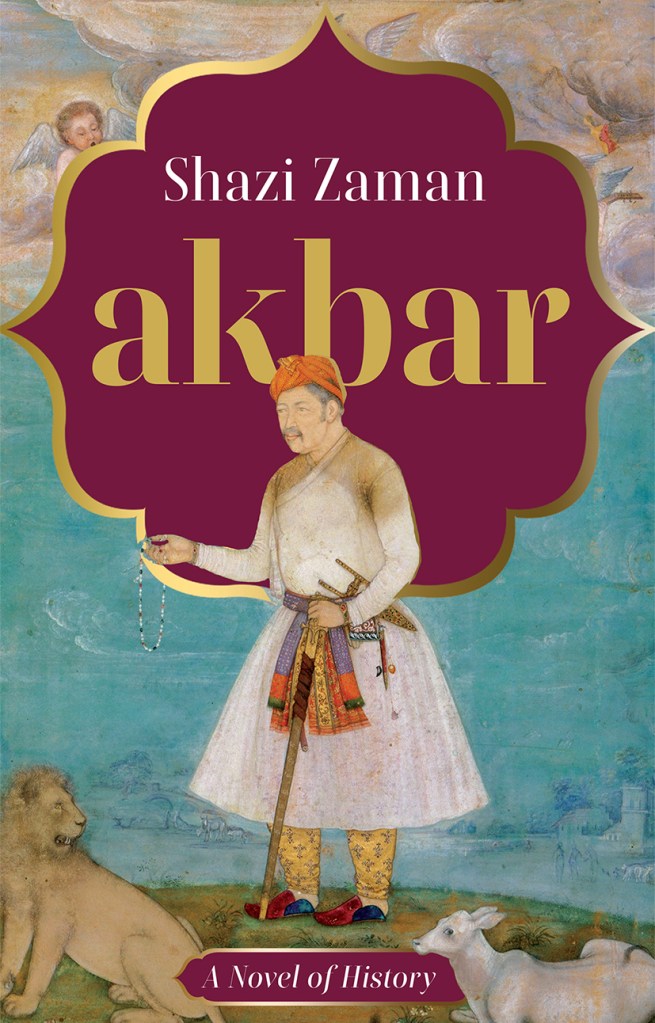
Akbar: A Novel by Shazi Zaman

Title: Akbar: A Novel of History

Author: Shazi Zaman

Publisher: Speaking Tiger, 2021

Now people began to hear of Badshah Salamat’s close links with the region of Braj. His visit was described in a dhrupad —

Shah Chhatrapati Akbar visits the Braj region,
Kings of the seven islands, nine regions and ten directions tremble.
Cavalry, infantry, elephants, and brave warriors,
With bows, arrows, swords and spears.
Not one blot on the clothes of Humayun’s son,
How formidable was the army of Jalaluddin Muhammad.

The region of Braj was not far from Fatehpur Sikri. It is said that Badshah Salamat, having listened to the poetry of Surdas, asked when he met him, ‘Surdas ji, God has made me powerful and all the talented people sing my praise. Why don’t you sing my praise too?’

Surdas sang the following words in reply: ‘No space in my heart.’

Badshah Salamat thought, ‘Why would he sing my praise? He would sing if he had the greed to seek something from me. He is a man of God.’

Finally, Surdas sang: ‘Seeing God is like nectar for the thirst that the eyes have.’

Badshah Salamat asked him, ‘Surdas ji, you can’t see. How do you know what this thirst is that the eyes have? How come this metaphor?’

When Surdas kept quiet, Badshah Salamat said, ‘His eyes are with God. He sees there and describes what they see.’

Badshah Salamat then thought, ‘He should be given something but he has been initiated into Vaishnavism. He has no desire.’

People say that when Badshah Salamat heard that the Vaishnav poet Govindswami sang very well, he went out to listen to him in disguise.

Badshah Salamat was fond of travelling incognito among people. In the sixth regnal year, corresponding to about 1560–61 ce, a large group from Agra had camped outside the city on the way to the shrine of Salar Masud Ghazi in Bahraich. Badshah Salamat went to their gathering incognito but some petty criminal recognized him and the word began to spread. To convince people otherwise,

Badshah Salamat rolled his eyes upwards. When people saw this they said, ‘Such eyes and expressions can’t be that of an emperor.’

As Govindswami sang the Raga Bhairav, Badshah Salamat was sure he would not be recognized. But suddenly, as he sat listening, these words escaped his lips, ‘Wah, wah!

Recognizing him, Govindswami said, ‘This raga has lost its value.’

At this Jalaluddin Muhammad Akbar said, ‘I am the Emperor.’

Govindswami replied, ‘If you are the Emperor, keep to it. But this raga has lost its value because you listened to it.’

Badshah Salamat then thought, ‘I am the ruler of one country. For him, the grandeur of three worlds is meaningless. Why would he obey my command?’

It is said that Badshah Salamat heard an artiste sing the poetry of the Vaishnav poet Kumbhandas and said, ‘Would there be anyone like him who sees God in this manner?’

The artiste replied, ‘Saheb, he lives even now!’

An excited Badshah Salamat asked for Kumbhandas’s whereabouts. The artiste replied, ‘There is a village near Shrigovardhan called Jamunawat. He lives there.’

When Badshah Salamat’s men reached the residence of Kumbhandas he was in Parasoli. Reaching Parasoli, these men said, ‘Badshah Salamat has asked for you.’

Kumbhandas said to them, ‘I am no servant to the Emperor. What do I have to do with him?’

Badshah Salamat’s men said, ‘How do we know what you have been called for? We are under orders from the Emperor to get Kumbhandas ji. Here is a palanquin and a horse. Please mount and come with us. We have to take you.’

Kumbhandas had no option. Wearing his shoes, he said, ‘Brother! I have never mounted a conveyance. I will go on my own.’ When Kumbhandas reached Sikri on foot, Badshah Salamat

said, ‘Kumbhandas ji, come. Please be seated.’

Badshah Salamat’s elegant tent had precious stones and frills. Even so Kumbhandas felt his home Braj was far better because Shrigovardhannath ji played there.

Badshah Salamat said, ‘Kumbhandas ji, you have written much poetry in praise of Vishnu. That is why we have called you here. Sing for me some poetry in praise of Vishnu.’

Kumbhandas thought, ‘The real patron of my voice is Shrigovardhandhar. But now that I cannot avoid it, I better sing something to ensure he does not ever ask for me. Let me say harsh words. If he minds, so be it.’

Kumbhandas remembered, ‘One who has been adopted by Lord Krishna is always safe. He would come to no harm even if the whole world turns against him.’

Then he recited —

Devotees have no need of Sikri.
One walks one’s shoes threadbare, God’s name forgotten,
And salutes those whose face brings no joy.
O Kumbhandas, without Lord Krishna, these are false destinations.

They say Badshah Salamat felt unhappy when he heard this but said to himself, ‘If he had any greed he would sing my praise. He is a true devotee of his Lord.’

Irritated with Badshah Salamat, Mullah Abdul Qadir Badayuni said, ‘… Hindu infidels, who are indispensable, and of whom half the army, and country, will soon consist and as whom there is not among the Mughals or Hindustani Muslims a tribe so powerful, he could not have enough. But to other people, whatever they might ask for, he gives nothing but kicks and blows…’

When it began to be murmured in Fatehpur Sikri that Badshah Salamat had turned Hindu, Sheikh Abul Fazl was forced to respond,

‘This rumour is spread because His Majesty, being of an open mind, would meet Hindu holy men, raise the rank of Hindus and be kind to them in the interests of the welfare of the country… There were three reasons these rumours spread by evil men gained currency. First, people following different religions gathered in the darbar, and because there was something good in every faith, everybody got some bit of praise. Secondly, because of sulh-i-kul, people of various kinds got spiritual and worldy success. Third, the crooked ways of evil people of the age.’

(Excerpted from Akbar: A Novel of History by Shazi Zaman. Published by Speaking Tiger Books, 2021)

About the book

Conventional historical accounts tend to paper over seemingly minor events related to Akbar’s life, to the detriment of a comprehensive appreciation of one of the most important figures of Indian history. Shazi Zaman fills the gap with this remarkable novel rooted in history.

Akbar’s writ ran from the Hindukush in the west to the Bay of Bengal in the east, an empire his father Humayun and grandfather Babur had only dreamed of. And his religious policy, boldly unorthodox, was as fierce a contest with the clergy, particularly Islamic, as were his military campaigns with his political opponents. Most histories give us Akbar the commander who never lost on the battlefield, and the fearlessly iconoclastic ruler. But we rarely come across the restless, questing soul who wished to reconcile a sensitive and compassionate heart to the sometimes ruthless obligations of statecraft; and the man who, in his struggle for sulh-i-kul, peace with all, could dare to treat as equal not only all faiths—Hinduism, Islam, Christianity, Jainism, Zoroastrianism and others—but all life as well—human or animal.

With a scholar’s rigour and a storyteller’s insight, Shazi Zaman, in this transcreation of his acclaimed Hindi novel, sifts through fact and many an anecdote to paint a complex yet enchanting portrait of one of the world’s great monarchs. There isn’t another book, as vast in scope and as layered, to help us fully understand the phenomenon that was Akbar: the unsparing pragmatist and benevolent ruler; the austere leader and indulgent friend; the unlettered prince and philosopher-mystic.

About the Author

Shazi Zaman started his three-decade-long career in broadcast journalism at Doordarshan and has since then worked with several media organizations. He has had a long association with the ABP News Network as a senior executive producer and as their Group Editor. He has been on the governing bodies of the Film and Television Institute of India, Pune, and the Indian Institute of Mass Communication, Delhi. Akbar is his third novel. His earlier Hindi novels are Prem Gali Ati Sankri and Jism Jism ke Log.

.

PLEASE NOTE: ARTICLES CAN ONLY BE REPRODUCED IN OTHER SITES WITH DUE ACKNOWLEDGEMENT TO BORDERLESS JOURNAL

Categories
Excerpt

A Glimpse Into My Country: An Anthology of International Short Stories

Title: A Glimpse Into My Country: An Anthology of International Short Stories

Editors: Andrée Roby & Dr Sangita Swechcha

Publisher: Book Hill International

1.

Excerpted from The Goats and the Cow by Sanjib Chaudhary (Nepal)

Shubhavati was humming a folk song. The sun was above her head. The easterly wind was hitting hard on her face. The wind along with the Peepal’s shadow provided her relief from the heat.

The 10 goats were grazing on the nearby field. The landowner had recently harvested rice and the juicy tender sprouts were perfect feast for the goats. While feeling the easterly winds caress she saw a humanlike spot in the horizon. Coming towards her, in a hurried pace. As the figure got nearer, the once single spot broke into four distinct figures. A woman in her mid-twenties, a 40 newly born baby clinging to her shoulder, a boy of around seven years trudging along her and a goat in tow.

 As the group came near her, Shubhavati asked the woman, ‘Why are you running so fast in the midday sun? Have some rest.’

The small boy, tired, sat next to her and started humming a Bollywood song. The woman tethered the goat to a small shrub and started suckling her baby, sitting beside Shubhavati. Her eyes were red with weeping and, as she saw Shubhavati gazing at her with love, she broke down. She started whimpering. Shubhavati consoled her, washed off the tears rolling down her eyes. The woman broke into a loud cry and the little boy, perplexed, started crying with his mother.

She said, ‘This boy’s father returned from Qatar a few days ago. We had a reunion after two 41 years. This little girl was not born when he left us. Everything was so good for few days and suddenly he beat me up.’

‘Small fights between wife and husband are a normal, my dear,’ said Shubhavati.

‘But it was not a small thing. His mother is so jealous that she wants everything that her son brought to be hers. Even the toys that he brought for this little boy!’ She was furious.

She continued, ‘Can you imagine? She threw away a bowl of milk he was sipping in. For me it had been always like that. My husband has been to Rajbiraj. But had he been there he would not say anything to her. He is a coward and doesn’t have courage to say anything to his mother.’

The goat was a small kid when she had brought it along with her from her mother’s house. She had run almost two kilometres and it was still three kilometres to reach her maternal house. Shubhavati lighted a biri and offered it to the young woman. She refused it, saying that she is a non-smoker. Shubhavati sent the puffs of smoke to the skies and started advising the young woman.

‘See, quarrels never will do any good to you, neither to you, nor to your mother-in-law. In between your quarrel, this little boy will suffer. He will be deprived of going to school for many days. Your husband loves you but he can’t take your side.’

‘If you take me as your mother, return to your home. But if you have already made your mind, go, stay for few days and return as your husband comes to fetch you.’ The woman nodded to her advice, clutched her baby and, with the goat and the little boy in tow, continued her journey.

Shubhavati thought had she had a baby girl in her early twenties, she would have had a daughter like the fleeing woman. As the four figures disappeared in the horizon, she saw a man running towards her. She at once knew that he was the father of the two little children when he asked whether she saw a woman running away with two young kids. She told him not to worry, asked him to pacify his wife and to try to maintain a cordial relation with her. The man ran in the direction the woman had headed.

Shubhavati felt good and thanked the lord.

2.

Excerpted from Crossing the Bridge  by Norma Hall (Zimbabwe)

Leila sat in the back of the blue Ford Mondeo, trying to peer out of the car window, over the larger figure of her older brother Spike, who sat next to her. On her other side, her sister Susan, head down, was engrossed in one of the pile of brightly coloured comics the children took with them on one of these long journeys over the border from Zimbabwe into South Africa. Leila’s father, who was driving, had half turned his head to exclaim to the children in the back, that they were now approaching the ‘Great, grey, green, greasy Limpopo River,’ and crossing the bridge, would bring them across the border.

Excitedly Leila looked at the huge muddy green river, which ran like a thick ribbon through the yellow stubbly countryside on either side. Some women could be seen on some of the rocks below doing their washing and a few children swam in the shallows. Then they were over the expansive bridge and soon arrived at the bustling border, with numerous buses, trucks and queuing people waiting out in the sun next to the buildings, beyond which the barrier gate could be seen guarded by some uniformed customs officers and a few soldiers, slouching around, talking and laughing among themselves. Knowing, like others, there was no hurry, they were in for the long wait.

The children were left in the car, windows wound down for the heat which made it almost too hot for the inevitable bickering that would ensue, while the adults, gathering up their various documents, sighed and went off resignedly for the long, arduous process they were accustomed to encountering at the Zimbabwe border post.

Car documents had already been checked by the required visit to the Harare Police Station a few days earlier, which was a mission in itself. There, similar queues, often lengthened by those who curried favour or paid bribes to receive attention first, had to be dealt with. Was the car stolen, who was the owner, where was the insurance, road worthiness, road recovery service documents? With all the requirements, it was strange how one later encountered so many wrecks on the roads caused by accidents and broken-down vehicles, as well as the number of stolen cars being reported.

Leila remembered having seen the strewn clothes and luggage in the bush alongside the road and remnants of a recently crashed car, they’d come across on a previous trip. One of her father’s friends had also been killed one night when his car had crashed into an army truck which was parked with no warning lights, sticking out into the road.

The family had done this journey every two years now, to visit family in South Africa and for the long-anticipated holidays by the sea. And it had been worth it, exciting and adventurous, despite the problems at the border or being stopped by Police on either side of the bridge, for whatever usually ‘cooked up’ reasons that could be used to elicit bribes for an underpaid work force. The two-day journey was long and hot, but they knew it well by now. The snake like road that never seemed to end, driving through small villages, sporadic rocky granite outcrops and rundown towns. Then the climb up Louis Trichardt with its mountain views and winding roads before the long exhilarating drive down to their destination for the first night, an inexpensive motel just outside of Polokwane.

Towards the end of another long day of driving, the children would crane their necks, eyes straining for the prize of being the first to see the sea. Zimbabwe was landlocked, mostly dry and that incredible expanse of aquamarine and then deeper greenish blue water encircling the land at this southern-most tip of Africa, never ceased to enthral the family on these much-anticipated trips.

Leila thought she could have watched forever the sight of that foam riding on the top of the waves, as they rushed to shore and then slowly retreated with a sigh.

About the Book:

A Glimpse Into My Country is a collection of international, fiction and non-fiction, short stories giving the reader a chance to travel from France to England, to Zimbabwe, to India, to South Africa, to Nepal, to Bangladesh and to discover something new about each country through the lens of new and published authors.

The writers from Nepal include Mahesh Paudyal, Sanjib Chaudhary, Mamata Mishra, Jayant Sharma, Neelima Shrestha, Sangita Swechcha & Deepak Rana. The other contributors are Mitali Chakravarty (India), Farah Ghuznavi (Bangladesh), Micaela Grove (South Africa), Norma Hall (Zimbabwe), Derek McMillan (England), Sara Kapadia (UK), and Andrée Roby (France).

About the Editors:

Andrée Roby

After spending over thirty-five years in South London, Régine, originally from France, now lives in West Sussex. She writes under the pen name of Andrée Roby, a name she chose as a tribute to her father (André) and her uncle (Roby). Régine is fluent in French, Spanish and English. As a language teacher, she has a passion for the written word. Her novella “Double Vision” – a creative crime drama, was published in January 2019 and revamped in July2021. Her second book published in April 2020 is a collection of original poems, flash fiction and short stories.  Her crime fiction “Failed Vision”, launched in October 2020, is the prequel to “Double Vision”.


Dr Sangita Swechcha

Dr Sangita Swechcha is an ardent lover of literature from an early age, Sangita has published a novel and co-authored a collection of short stories before the collection ‘Gulafsanga ko Prem’, collection of short stories. She has many short stories, poems and articles published in various international journals and online portals. She was the Guest Editor for the ‘Nepali Literature Month – Nov 2019’ held at Global Literature in Libraries Initiative (GLLI), a USA based organisation. ‘The Himalayan Sunrise: Exploring Nepal’s Literary Horizon’ edited by Sangita Swechcha and Karen Van Drie was released in London in November 2021. The book, A Glimpse Into My Country, is the second publication from Book Hill International. Currently, Sangita Swechcha is working on her second novel.

.

PLEASE NOTE: ARTICLES CAN ONLY BE REPRODUCED IN OTHER SITES WITH DUE ACKNOWLEDGEMENT TO BORDERLESS JOURNAL

Categories
Excerpt

Somdatta Mandal’s translation of A Bengali Lady in England by Krishnabhabini Das (1885)

Title: A Bengali Lady in England by Krishnabhabini Das (1885)

Translator: Somdatta Mandal

Publisher : Cambridge Scholars Publishing

Foreword

When, in 1882, teenage Krishnabhabini Das (1864-1919) left for an extended trip to England with her husband, leaving behind her six-year-old daughter, she regarded this as her self-sacrifice in the service of her long-suffering Bengali people.  Even before leaving home, she took on uncomfortable English-style clothing, diet and deportment in order to prepare herself for that alien Western world.  She determined to use her own challenging experiences in order to awaken and uplift her nascent nation, especially by improving the customary roles of women like herself.  She wrote and published her discoveries and evaluation of Britain as a book, England-e Bangamohila, in 1885, even before her own return home.  She would remain in Britain for a total of eight years, even as her in-laws married off her own distant daughter at age ten.  

With this current volume, Professor Somdatta Mandal has added to her already impressive body of books and other publications by making accessible for the first time to Anglophone readers this significant book by Srimati Krishnabhabini Das.  This translation enables non-Bangla readers to deepen our understanding this key transitional period in India’s and England’s connected histories from the acute first-hand perspective of a woman traveller and published author.

One of the striking features of Krishnabhabini’s fascinating account is how genuinely new and unfamiliar to her were her journey and life in England.  By that time, men and women from India had been venturing to Europe for more than four hundred years.  Even over the decade prior to Krishnabhabini’s own visit, many Bengali men and at least half a dozen Bengali women had preceded her.  Indeed, this was the second trip for her husband, Debendranath Das, having returned only months earlier after six years in England where he had narrowly missed entry into the Indian Civil Service and had taken a degree in mathematics from Cambridge University. 

Krishnabhabini, although married at nine and home schooled by her in-laws, had herself long read and heard about England.  But, even to educated middle-class Indian women, distant imperial Britain still seemed overwhelmingly intimidating.  Determined to enlighten her Bengali sisters through her book, Krishnabhabini still seems to have hesitated to assert her own authority to do so, publishing anonymously.  Even her first publisher in Kolkata condescendingly prefaced the book by apologetically asking tolerance from readers for her misperceptions and simple language but applauding her sincere attempt.

In her account, Krishnabhabini repeatedly raises two central dilemmas.  First, how can she and her compatriots preserve their own culture and values while simultaneously becoming Anglicized.  As an example of this danger, she criticizes her contemporary, Ms. Pandita Ramabai (1858-1922), for having abandoned Hinduism to become a Christian ‘and hence degraded the Hindu race’.  Initially, Krishnabhabini laments with shame how, through her own adoption of a ‘memsahib’ Englishwomen’s dress, she had distanced herself from her Hindu Bengali sisters.  But she takes heart from her conviction that she has done so for their sake. 

Krishnabhabini’s second dilemma is who should be included in her vision for the nascent Indian nation.  As she first leaves Bengal and journeys by train to Mumbai, she notes both the stereotypical differences and also the foundational commonalities among middle-class Hindu women and men of India’s diverse regions.  But she does not identify with people of lower classes or other communities living in India.  Thus, her evocative account tells us much about her own personal perceptions and cultural journeys and those of many comparable people of her time and status.

Through Krishnabhabini’s thoughtful ethnography, we also learn much about English Victorian society and culture.  Insightful outside observers like her can note and record customs and details that are so commonplace for natives that they often remain unremarked.  Her descriptions of the world of middle-class English households, as well as the indigenous racial and other cultural attitudes toward Indians and other foreigners, thus enrich our understanding of this transitional period for imperial England.

Readers of Krishnabhabini’s fascinating and significant book will therefore find much to learn from and savour.

Michael H. Fisher

Robert S. Danforth Professor of History

Oberlin College, USA

January 2015

Chapter Twenty

Last Words

I have seen so many new things in this country and have gained knowledge on so many new subjects; but the more I see and learn about it, the longer I am living here, the more I am remembering India and this makes my heart ache. As I compare this country with that, I understand the great differences between them even more. I am also suffering a lot of mental pain on seeing the pitiable condition of India. Sometimes, I feel totally frustrated and feel India’s sorrow will never be reduced. At other times, I feel a little hopeful and think just as I am feeling for my country, similar feelings are also reverberating in many people’s minds back there. Like me, many people are mentally suffering after seeing the miserable condition of my country and so, hopefully they will compare both the good and bad aspects of the homeland and foreign lands and try to do something for the well-being of our country.

After reading about the knowledge, trade, labour, and women’s education in England, every Indian will understand how much more developed England is in comparison to India. Again, when you read about the English society, domestic life, personal independence of every individual, their love for the motherland, self-respect, etc., you will understand how different English life is from the Indian one. We Hindus are the descendants of the famous Aryans. Right from ancient times, even before the Greeks, our civilisation, religion, knowledge and learning have been famous in the world. We admired truth and courage. Even when all civilised nations had the practice of owning slaves, the Hindus were the only people who restrained themselves from such a heinous act as they did not believe in keeping another fellow human being bonded for life. Their brave deeds and fame spread across the world and their excellence in ancient mathematics, astrology, and philosophy acted as a leading light for other civilised races to follow and get inspired from to make new discoveries. We are the children of those Hindus but why are we in such a state now? Today, we have lost our courage, strength, wealth, prestige, independence, and complete happiness. Why are we residing in our own country in such a pathetic condition? Why have we forgotten the great achievements of the Hindus in cities like Kashi (Varanasi), Prayag (Allahabad) and Mathura today and are paying all our respects to Calcutta only?  Everyone knows the reason why but no one is willing to give the answer or wants to listen to the answer. No one will even admit that this has happened due to our own fault. The English people have two hands, two legs, and no part of their body is different or superior to that of the Indians. Isn’t it our fault that now we are subservient to them?

The Hindu women who undauntedly committed themselves to the fire in order to maintain their sanctity when their husbands left for the battlefield were also, at one point of time, known in all corners of the world because of their bravery. Their religion, chastity and bravery were ideals to be followed but today we, their daughters, are subservient and are being crushed underfoot. Isn’t this the fault of India’s own sons and daughters? Where is the bravery and courage of the Indian women today? Where is their zeal today to offer all the jewelry for procuring food for the soldiers? Today, when we see the sons of India sitting idle like cowards, we ask: where is the zeal to ignite their minds once again? We have nothing now and we have lost everything due to our own fault.  Lack of unity, like an evil serpent, has caused our destruction. It is because of this lack of unity that India is divided into so many parts and after the rule of the Muslims, she has now fallen under the control of the English. It is because of their unity that the people of this very tiny island could defeat the huge Hindustan and rule over it completely. It is because of this lack of unity that we are now turning poor and powerless and in spite of being civilised, we are subservient and considered uncivilised. Tiny termites get together and create huge molehills and if man tries to torture them in any way, instead of getting scared of huge human beings, they come out aggressively in hordes and start taking revenge for the torture inflicted upon them. But we human beings, with huge bodies, do not get together to protest but are afraid to face our rivals instead. 

The Hindus were worshipped throughout the world at one point of time for their civilisation and repository of knowledge; but now they are considered uncultured, lifeless cowards who are subservient to the independent races of people. They are looked down upon and in spite of being creatures of flesh and blood, they remain complacent about it and endure all humiliation. Isn’t it our own fault that we do not even feel insulted about it? The Bengalis are the most intelligent and learned among all Indians but they are cowards and lack bravery. So, what is the necessity for all their wisdom and learning? Other people in different parts of India are not crushed under the feet of the British as the Bengalis are, nor do they quiver in fear after seeing a white man’s face.

These people behave very strictly with women. The educated Bengali youth are busy acquiring degrees and seeking their own pleasure but they are incapable of seeing the silent tears that the Bengali woman keeps on shedding while being confined in a cage. The English women are now struggling to become members of parliament, are creating a lot of commotion and trying very hard to win power for themselves. In a similar manner, if we could strike at the heart of each Indian and ask for women’s liberation, if we did away with our docile and tender nature, and instead of keeping all our sorrows confined within our hearts, could shout and create a commotion in front of them, probably the Bengalis would lend ears to our pain and suffering. But by remaining subservient for a long time, we have lost all our power and strength for an independent life and that is why we are incapable of being equal to men in all respects as the English women are attempting to be. 

There are so many kinds of pleasurable sights in this country but what I prefer to see most are the meetings where men and women participate equally, play games together and also, grown-up women going to school. I love to see how all of them move around like brothers and sisters and play and laugh together. Which Indian’s mind would not be filled with joy after seeing this? But after looking at their happiness, instead of forgetting our sorrow, we become doubly sad.  The more I see the mark of independence on the face of the English woman, the sad and demure face of the Indian woman arises in my mind even more.

Many people lack racial strength, intelligence or unity; but the firm love for their nation has helped them to uplift themselves from a miserable and subservient state. But we do not even know the meaning of what love for the nation is. We spend our days complacently and do not get excited or eager to sacrifice our leisure even when we see the torture being inflicted upon our homeland. Like animals, we only prefer self-gratification and are totally oblivious of the welfare of India. We do not sit down together to have serious discussions on issues that would either develop the nation or bring more harm.

To conclude, I want to say that it is no use lamenting ancient times. Instead, we should specifically think of the present and the future. A truly knowledgeable person should understand the issues related to the past and then, act carefully now as well as in future. When we consider both our homeland and the foreign land together, we understand the reality of the present condition. We should constantly evaluate and then, adopt methods that will improve our present condition and also be beneficial in the future. If we analyse the history of civilised and prospering nations, we find that they have been continuously changing. This change has come very slowly and the gradual development has brought in a new countenance. We also see that those races which have not undergone any change at all and have remained in the same static position for a long time are now declining to a worse position and moving towards an imminent downfall. Just as man, animals, trees etc. change continuously, in the same way the main goal of every race is also to bring forth change. So, the only way to rectify the current miserable state of our country is through change and development.

Many people are excited by the idea that “we have to become independent” and ignite false hopes in the minds of others. But we must first consider whether we have the requisite qualifications to become independent, whether we can retain that independence and whether we have the strength to gain that independence. Before succeeding in our goal, we should know the ways and means to be adopted to achieve that goal. We should know whether we possess the virtues of the race we want to defeat and bring them down from their position as rulers. We have to ascertain whether we have sufficient power, knowledge, and tactics within ourselves. If we don’t have those qualities collectively, instead of showing false chivalry, we have to do away with superstitions and all old and harmful traditions and try our level best to inculcate all their virtues.  

Leaving behind all my friends and relatives, I bade farewell to my loving motherland with a lot of difficulty and am now living in this foreign land. I don’t even know whether I will be able to see my birthplace and my loving friends and relatives again. Many thoughts have been disturbing my mind for a long time and at times, I cannot control the pain and anxiety within me. That suffering has doubled after coming to this foreign land and I am expressing parts of it in this book in order to offer solace to my own mind. If any part of this book seems bad to my fellow countrymen, they will hopefully pardon me by thinking that the more one is hurt, the more loudly one speaks out. Many people could have written this book in a more refined language, expressed the inner thoughts of my mind in better words; but no one else could experience the mental stress and turmoil that this Bengali woman is undergoing for residing in a foreign land.  My readers can discard the bad sections and select only the good portions, if there are any. If even one person is inspired by new thoughts and feelings after reading this book or thinks about his homeland and the foreign land, I will know that all my labour has been successful.   

Here, Mother! I have come to independent Britain
With lots and lots of hope
I thought I will win eternal peace
But Mother India! Where is the happiness?

The more I listen to songs of independence here
The more I see jubilant spirits all around
The more my heart breaks into hundred pieces
And flows away in tears.

This Britain, like your daughter
A tiny country, but vigorous in spirit
Shakes the earth with its strength and bravery
Humanity is scared in fear
Of its courageous feats.

But no one fears us
Finding us cowards, they chase us far away
Mother! They take away all your wealth
And chain you instead.

As I look at this zealous spirit
This great pleasure, rich in wealth,
I despise myself and loathe to remain alive
In low subservient disgrace.

If you were ugly, and
Only with deserts full of sand,
Even that was better than this slavery
And to live a life of abject disgrace.
Only the weak tolerate such torture.

Mother! It would even have been better
If we were all caught in a web of ignorance
If we were savages like the Zulus,
And possessed the wealth of freedom,
We would be free of all pain.

Of what use is the wealth of knowledge
Of art and civilisation
If the priceless wealth eludes us
And glorifies the whole world?
Only heartache abounds!

I can see you suffer
With greater clarity from this distance
But alas! This merely doubles the pain
And increases it further.
Mother! It’s a terrible Bengali life.

So I think once more
If we were seeped in sea of ignorance
I would not cry ceaselessly
Sitting with a broken heart,
In this distant land of free Britain.

I see lots and lots of wealth
In Britain that has come
Floating from India,
Leaving the country forever in poverty
They will never go back again.

I also see the flag in the distance,
Flying with pride on top of the palace.
Inside sits Queen Victoria,
Ruling from Britain our mother India
With the Kohinoor crown on her head.

But, as I contemplate how
The Kohinoor becomes your jewel
And finds a place in the heart of England,
I remember this and such events in history.
And feel overwhelmed.

The goddess of Britain is not above you
O Mother! What injustice!
Even now I cannot think of it
The jewel of Ranjit Singh on her head.
Blood boils in my veins.

About the Book

This is a translation from Bengali to English of the first ever woman’s travel narrative written in the late nineteenth century when India was still under British imperial rule with Bengal as its capital. Krishnabhabini Das (1864-1919) was a middle-class Bengali lady who accompanied her husband on his second visit to England in 1882, where they lived for eight years. Krishnabhabini wrote her narrative in Bengali and the account was published in Calcutta in 1885 as England-e Bongomohila (A Bengali Lady in England). This anonymous publication had the author’s name written simply as “A Bengali Lady”. It is not a travel narrative per se as Das was also trying to educate fellow Indians about different aspects of British life, such as the English race and their nature, the English lady, English marriage and domestic life, religion and celebration, British labour, and trade. Though Hindu women did not observe the purdah as Muslim women did, they had, until then, remained largely invisible, confined within their homes and away from the public gaze. Their rightful place was within the domestic sphere and it was quite uncommon for a middle-class Indian woman to expose herself to the outside world or participate in activities and debates in the public domain. This self-ordained mission of educating people back home with the ground realities in England is what makes Krishnabhabini’s narrative unique. The narrative offers a brilliant picture of the colonial interface between England and India and shows how women travellers from India to Europe worked to shape feminized personae characterised by conventionality, conservatism and domesticity, even as they imitated a male-dominated tradition of travel and travel writing.

About the Translator

Somdatta Mandal is former Professor of English and Chairperson of the Department of English and Other Modern European Languages at Visva-Bharati University, Santiniketan, India. Her areas of interest are contemporary fiction, film and culture studies, diaspora studies and translation. A recipient of several prestigious awards and fellowships, she has been published widely both nationally and internationally. She has also an award from Sahitya Akademi for the All India Indian Literature Golden Jubilee (1957-2007) Literary Translation Competition in the Fiction category for translating short stories series ‘Lalu’ by Sarat Chandra Chattopadhyaya. She has written two academic books and edited and co-edited twenty books and journals, including three anthologies, Indian Travel Narratives (2010), Journeys: Indian Travel Writing (2013), Indian Travel Writing: New Perspectives (2021) and “India and Travel Narratives” for Rupkatha Journal on Interdisciplinary Studies in Humanities Volume 12 (3), May 2020.

Among her translations on travel writing are The Westward Traveller by Durgabati Ghose with a foreword by Ashis Nandy, Wanderlust: Travels of the Tagore FamilyEnglande Bongomohila (A Bengali Lady in England) by Krishnabhabini Das, Bangamohilar Japan Jatra (A Bengali Lady’s Trip to Japan and Other Essays) by Hariprabha Takeda with a foreword by Michael H. Fisher, Chitrita Devi’s Onek Sagar Periye (Crossing Many Seas), Rabindranath Tagore’s Pather Sanchoy (Gleanings of the Road), and two travel memoirs of Nirmalkumari Mahalanobis along with Rabindranath Tagore, Kobir Shonge Europey (With the Poet in Europe) and Kobir Shonge Dakkhinattey (With the Poet in the South).

.

PLEASE NOTE: ARTICLES CAN ONLY BE REPRODUCED IN OTHER SITES WITH DUE ACKNOWLEDGEMENT TO BORDERLESS JOURNAL

Categories
Excerpt

The Baseball Widow

Title: The Baseball Widow

Author: Suzanne Kamata

Publisher: Wyatt-MacKenzie Publishing (2021)

Christine loved Trina’s oak table. She loved this kitchen with its American-sized refrigerator decorated with animal magnets and children’s art, its scent of baked bread, and the cross-stitch samplers on the wall. She loved Trina’s dishes, painted with blue Chinese landscapes, like the ones that she ate from at her grandmother’s house when she was a child. She remembered that once her oyster casserole or Thanksgiving sweet potatoes were cleared away, she’d wondered about the pagoda on her plate, wondered what it would be like to visit such a place. And then finally she had. She’d been to China, Thailand, Singapore, Malaysia, and of course, Japan, where she now lived. Ironically, although Christine had fled America in search of the exotic and adventurous, Trina’s Blue Willow patterned dishes, this room itself, now filled her with yearning for all that she had left behind.

“How was the send-off?” Elizabeth asked from across the table, snapping Christine out of her daydream. Elizabeth looked great, as usual. Even though she’d given birth just a little over a month ago, she managed to keep her bottle-blonde hair touched up, and her poplin blouses ironed and unstained. Right now the baby slept nestled in her arms.

Christine smiled. “It was fine. Nobody cried. Not even me.” She’d thought that sending her son off on his first day of elementary school – on foot no less, since the children were required to walk to school in groups — would have been more wrenching, but what she’d felt was mostly relief. For the first four years of her life, her daughter Emma had been in and out of hospitals, and then there was that one terrifying week when both kids were in the ICU at the same time with pneumonia. But now they were healthy and sturdy and ready to be out in the world. Plus, it was nice to finally have some time for herself.

Trina gently tapped a spoon against her “Support Our Troops” mug. “I hereby call this meeting of the American Wives’ Club to order,” she said.

Christine raised her coffee cup to Trina in a toast. “The American Wives’ Club” — AWC for short — wasn’t an official organization. There was no club secretary, no president. They got enough of protocol with the Japanese P.T.A. and Kodomo Kai and other Japanese mothers’ groups. In reality, the AWC was composed of the three of them – Christine, Elizabeth, and Trina, wife of a Japanese professor, whose two chestnut-haired children, not yet school-aged, were now under the table clawing at knees. Elizabeth’s eldest child, a daughter, was in the second grade at a private academy with an English immersion program.

Although coffee was enough of an excuse for a gathering, on this morning they’d gotten together to give Elizabeth a baby shower. According to Miss Manners, a baby shower was supposed to be held in the eighth month of pregnancy, but etiquette be damned; the members of the AWC put enough time and energy into keeping track of and adhering to Japanese customs (exactly how much to spend on a summer gift for one’s boss, where to stand in an elevator, which days were inauspicious for hospital visits, etc.). Sometimes a little anarchy was just the right thing. The belated celebration was also out of deference to Christine, whose daughter had been fourteen weeks ahead of schedule, during Christine’s seventh month of pregnancy. For days, weeks, months, Emma had struggled in an incubator at the university hospital, and they had all learned not to take a baby’s easy delivery and good health for granted.

The doorbell rang then, and Trina jumped up. “Oh, I forgot to tell you all. I met a woman at the library the other day. I thought she might like to join us. She’s Canadian, but I think we can make an exception. We can be the North American Wives.”

“Yes, of course,” Elizabeth said. “The more, the merrier.”

Trina went to open the door, and the others moved their chairs to make room for another guest. Their heads turned when a slender, pale woman with strawberry blonde hair stepped into the room. She held a little boy of about three by the hand. Christine could tell by his eyes and brownish hair that he was biracial (“hafu” as the Japanese said) just as all of their children were.

“Hi, I’m Sophia Lang,” she said. She extended her hand to Christine, and then to Elizabeth.

“Sophia has just signed on as an adjunct at Tokushima University,” Trina said. “Her husband is a scientist at Otsuka.” Christine nodded. They were all familiar with the pharmaceutical company, one of the area’s largest employers, and maker of that ubiquitous, ridiculously named sports drink, Pocari Sweat. Elizabeth’s husband worked there, too. “They just moved here from – where was it?”

“Maryland,” Sophia said. “My husband is originally from Tokushima. We thought it’d be nice for Kai, here, to get to know his father’s family better. And also, work on his Japanese language skills. My husband asked for a transfer, and here we are!”

She had that fresh-off-the-plane look about her. Christine had read somewhere about the stages of culture shock – she’d experienced them herself. First, was the euphoric falling-in-love stage, where everything was new and exciting. Pretty soon the shine would wear off, and irritation would set in. She’d get sick of having little kids point at her hair, and of people asking if she could use chopsticks. She’d discover that the bank machines closed early, at nine p.m., and that if she didn’t have her laundry out by eight in the morning (so late!), the neighbours would chat about her.

“Have a seat,” Trina said, ushering Sophia into a chair. “And Kai, maybe you’d like to go play with Misa and Kenta. Kids! Out from under the table! Show this nice little boy your toys!”

Trina’s two and three-year olds emerged, giggling and ran out of the room. Kai looked up at his mother for confirmation, before scrambling after them.

“Ah, peace at last,” Trina said, pouring coffee for Sophia into a University of Virginia mug.

They went around the table and introduced themselves.

“I’m Elizabeth Tanigawa, from Kentucky. I’m doing some research about expatriates in Tokushima,” she drawled. “I’m planning on writing a book or an essay or something.” She was always immersed in some project. For awhile, it had been indigo dyeing, and before that pottery, and even longer ago, she’d been obsessed with local folklore. During the latter phase, she’d compiled dozens of stories about trickster raccoon dogs, but she’d never tried to publish them. It was just something to keep her busy.

“Well, that sounds interesting,” Sophia said politely. “I didn’t know there were enough expats here for a book.”

It’s true that there were hardly any foreigners in Tokushima Prefecture. Christine had gone days without seeing another non-Japanese in the capital city, weeks, even. Although bridges now linked the island of Shikoku via sparsely populated Awaji Island with Honshu, there were no high speed bullet trains zipping across the island. There were few jobs for foreign women outside of teaching English or pouring drinks in hostess bars, and tourists from abroad rarely added the island to their agenda.

“Oh, but there have been lots,” Elizabeth said, and here, she nodded at Christine, “missionaries from South Carolina, an entire camp of German Prisoners of War, and there was also a Portuguese sailor who settled here and married the little Japanese girl that was his housemaid. Kinda like Madame Butterfly. There’s a museum about his life up on top of Mount Bizan.”

“A girl?”

“She was quite a bit younger,” Christine put in. “But she was an adult. I’m sure she knew what she was doing.” In truth, Christine thought the sailor, who appeared in photos with a long white beard, was way too old for his bride, but she suddenly felt perversely defensive of all things Tokushima. It was her home now, after all.

When it was her turn, she said, “I’m originally from Michigan, most recently from South Carolina. I’ve been living here for ten years. My husband is a high school baseball coach.”

“We call him the ‘imaginary husband,’” Trina said, “because no one has ever seen them together.”

Christine forced herself to join in the laughter, even though she was the one who’d first come up with the moniker. 

“She’s a baseball widow,” Elizabeth explained to the bemused Sophia, who hadn’t been in Japan long enough to understand how demanding high school sports could be. There was no such thing as a baseball season. Once students joined the club, they were busy practicing and playing all year round. The only days off were during the ten days of winter vacation. The rest of the time, even during the “off-season,” from the end of October till about the beginning of February, they had training sessions every day after school and on weekends. Hideki was almost never home.

“I saw your husband on television,” Elizabeth said. “Just a couple of weeks ago. His team made it to the quarter-finals, didn’t it?”

Christine nodded. “Yeah, I was there. Up in the bleachers.” Before the kids had come along, she’d gone to all of his games, but they were too young to enjoy baseball. The one time she’d brought Emma to the stadium, she was dismayed to find that there was no wheelchair access, even though the arena was relatively new. She’d had to ask a couple of high school boys to help carry Emma and her wheels up the concrete steps, into the stands. And then of course, after glimpsing Daddy at the sidelines and waving furiously with no response, both Emma and Koji had grown quickly bored. Now Christine mostly watched the games on TV. Once the number of teams was whittled down to eight, the games were broadcast on the local NHK station, or at least public access TV. It was hard to concentrate, though, when Koji and Emma were grabbing at the remote control, pushing for cartoons. The other day, Christine had asked her mother-in-law to babysit so that she could watch Hideki’s team live. Even though they’d lost, she’d felt emotionally involved in the game. Being there made her feel closer to Hideki, almost as if they were in it together.

“Do you have any children?” Sophia asked, bringing her cup to her lips. Christine saw that her fingernails had been manicured. A diamond glinted off her ring finger. In a couple of months, she won’t be wearing that, Christine thought. She’d figure out that it was way too gaudy for rural Japan.

“Yes, two. A boy and a girl.”

“Do they go to school?” Sophia asked.

“Koji’s at Aizumi West. He just started first grade today.”

“And your daughter? You said you have a little girl?”

Christine nodded. “Her name is Emma, after Queen Emma of Hawaii.” Christine and Hideki had gotten married at a plantation on Oahu. Afterwards, they’d done some sightseeing around the islands, and Christine had become captivated by the biography of Queen Emma, who was both Anglo and Hawaiian – a multicultural woman who did good deeds, a mixed race royal. The perfect role model and namesake, Christine thought. “My daughter goes to the kindergarten at the School for the Deaf.”

“Oh!” Surprise and pity flashed across Sophia’s face. By now, Christine was used to apologies and embarrassment at the revelation of her daughter’s disabilities. She forced a smile to show that it was no big deal, that there was no need to feel sorry for them. Everything was fine!

“Have you thought about taking her to the States?” Sophia asked. “My husband and I had a little scare after an ultrasound, and we decided that if our child had any handicap, we would stay in the U.S. Japan is a couple decades behind in that area, isn’t it?”

Christine felt the blood rush to her face. “We’re keeping our options open,” she murmured, though that wasn’t exactly true. Hideki was passionate about his job and she would never ask him to quit. He had become something of a local celebrity. People respected him, just as they seemed to respect her for being married to him. Whenever she dropped by the baseball field, say, to bring Hideki his forgotten cell phone, or drop off Koji to “help out” with Saturday afternoon practice sessions, the players doffed their caps and bowed to her, the coach’s wife. It made her feel like a First Lady. More importantly, as a public school teacher, Hideki was assured lifetime employment, and he also had good health insurance. With a kid like Emma, you had to have ample coverage. Christine suspected that with all of her pre-existing conditions, Emma was uninsurable in the States. And last, but not least, as the only and eldest son of his widowed mother, Hideki was expected to look after her and act, when necessary, as head of the family, representing the Yamada clan at weddings and funerals that his mother didn’t want to attend. He had responsibilities.

Not every family had the resources – or desire – to up and move across the world every time circumstances changed. And yet, Christine had often wondered if Japan was the best place for their daughter. Or for their son, for that matter. At times, she thought they’d be better off in Sweden, where parents were required by law to teach their deaf children sign language. (Here in Japan, Hideki was too busy to study anything but baseball stats, and Christine often had to interpret between father and daughter.) Other times she fantasized about moving to Hawaii, where multicultural was the norm.

 “Well, then, ladies,” Trina said, clapping her hands together. “I think it’s time for some games.”

About the book:

When Christine, an idealistic young American teacher, meets and marries Hideki Yamada, an aspiring Japanese high school baseball coach, she believes that their love with be enough to sustain them as they deal with cultural differences. However, Hideki’s duties, and the team of fit, obedient boys whom he begins to think of as a surrogate family, take up more and more of his time, just as Christine is struggling to manage the needs of their multiply-disabled daughter and their sensitive son. Things come to a head when their son is the victim of bullies. Christine begins to think that she and her children would be safer – and happier – in her native country. On a trip back to the States, she reconnects with a dangerously attractive friend from high school who, after serving and becoming wounded in Afghanistan, seems to understand her like no one else.

Meanwhile, Daisuke Uchida, a slugger with pro potential who has returned to Japan after living abroad, may be able to help propel Hideki’s team to the national baseball tournament at Koshien. Not only would this be a dream come true for Hideki, but also it would secure the futures of his players, some of whom come from precarious homes. While Daisuke looks to Hideki for guidance, he is also distracted by Nana, a talented but troubled girl, whom he is trying to rescue from a life as a bar hostess (or worse). Hideki must ultimately choose between his team and his family.

The Baseball Widow explores issues of duty, disability, discrimination, violence, and forgiveness through a cross-cultural lens. Although flawed, these characters strive to advocate for fairness, goodness, and safety, while considering how their decisions have been shaped by their backgrounds.

About the author:

American Suzanne Kamata has lived in Japan for over thirty years. She first arrived in Tokushima Prefecture as an Assistant Language Teacher in public schools. In her second year in Japan, she met her husband, a Japanese high school teacher (and later, high school baseball coach). While raising twins, she wrote and published Losing Kei (Leapfrog Press, 2008), her first novel for adults. Since then, she has published several more award-winning books including the novel Gadget Girl: The Art of Being Invisible (GemmaMedia, 2013) which was awarded an Asian Pacific American Librarians Association  Honor Award for Young Adult Fiction; Indigo Girl (GemmaMedia, 2019), winner of a Gold Nautilus Award and an SCBWI Crystal Kite Award; and Squeaky Wheels: Travels with My Daughter by Train, Plane, Metro, Tuk-tuk and Wheelchair (Wyatt-Mackenzie Publishing, 2019) winner of a CIBA Hearten Award and a Next Generation Book Award.  She is an associate professor at Naruto University of Education.

.

PLEASE NOTE: ARTICLES CAN ONLY BE REPRODUCED IN OTHER SITES WITH DUE ACKNOWLEDGEMENT TO BORDERLESS JOURNAL
Categories
Excerpt

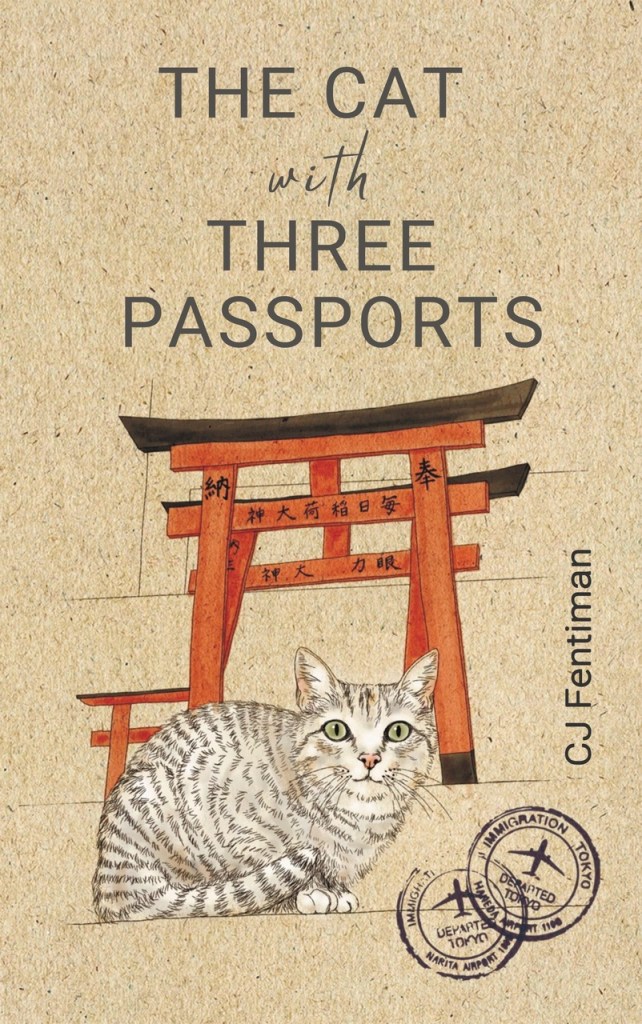
The Cat with Three Passports

Title: The Cat with Three Passports
Author: CJ Fentiman

Chapter 7: Better To Enclose A Cat Than to Scold It

Clothes shops kept irregular hours in Takayama. Three different days, at three different hours, we tried to visit a local vintage store, and each time we found it closed.

It was refreshing to see that a country that had appeared, at first, such a stickler for rules, actually had a whole community that seemed to do the opposite of what was expected.

‘It is ikigai,’ explained James, the bald Kiwi ALT whom we had called Jēmusu (the Japanese word for James) as a joke.

‘What is ikigai?’ I asked. ‘A fish?’

‘No,’ he said with a grin. ‘Ikigai means finding your purpose, your meaning in life, and combining it with your profession, your work. It is the balance of doing what you love while making a living and letting neither path control your life.’

I didn’t really understand ikigai until one spring day I actually found the vintage clothing shop open and went inside to explore as I’d longed to do for over a month. The owner, G-Kun, a snowboarder in his early thirties who wore his long black hair tied back in a ponytail, was busy checking orders on his computer.

Ryan was looking at skateboard tee shirts while I browsed some different-coloured beanies made from hemp that I loved and would probably never wear.

‘I’m so glad I finally got to come in,’ I said to G-Kun.

‘Why has your store been closed so often? Were you ill?’

‘Not at all,’ he replied with a friendly smile. ‘I have just been concentrating on something else.’

‘Like what?’

‘My music career.’

I stared at him.

‘I travelled in Europe some years back and became friendly with some European DJs,’ he continued. ‘I ended up co-producing some dance tracks with them.’

He had my rapt attention. To my very British mind, this was an entirely new concept. I had been told as a child to forget working with horses and get a job in a bank, because in England I was supposed to be a responsible adult with a steady good-paying job doing something I loathed rather than something I loved.

But in Takayama . . . Was what G-Kun telling me real? Could an avocation and a job actually be combined? And if they could, did I have my own ikigai, something that would bring deep satisfaction to my life?

Once I understood ikigai, I saw it all around me. In Takayama, many people had turned their passions into businesses from which they earned an actual living wage. Of course, that’s not to say all Japanese follow ikigai but it seemed widely practiced here.  And then there was Keisuke, who worked in a brewery and wanted to start his own saké company someday.

Twenty-something Keisuke was not particularly well educated or rich, but he seemed more contented than anyone I’d met in a long time. In fact, he was so happy and so passionate about his job that I never saw him in anything other than his cream-coloured brewery overalls.

One night in Keisuke ’s apartment, he proudly poured me his employer’s clear rice wine into a tiny white and blue ceramic cup, beaming with something more than pride.

Ryan took the first sip and beamed back at him. ‘This is good stuff! You’ve got the saké magic, Keisuke-san. Like Harry Potter.’

‘So, so, so,’ Keisuke said and paused for a moment to think. ‘You know what, I am not Harry Potter. But I am . . . the Saké Potter.’

And from that day on, that’s exactly what we called him.

A few nights later, while out for dinner with some friends, we came across a stray cat that was to begin my search for ikigai.

‘Kawaisō, it’s such a shame,’ Sayuri said. ‘There’s so many noranekos [stray cats] in Takayama. It’s sad.’

I leaned down to pat the bedraggled kitten and he tapped me with his paw, as if begging for more. ‘Poor baby,’ I said. ‘He must hang around the restaurant in the hope of getting food scraps,’ I said.

‘The staff probably feed him,’ Ryan said as he joined us, the kitten instantly turning to him for attention.

‘What should I do?’ I asked.

‘Why do you have do anything?’ Mike said, joining us.

Takako, our friendly waitress was standing at the door and confirmed our suspicions about the kitten. ‘Hai. Nora-neko desu.’ (Yes. It is a stray.)

‘Come on, you can’t save them all,’ said Dominic as he marched off down the pavement.

Reluctantly, I followed him, along with the others. But, as we wandered tipsily back to our apartment, the kitten tried to follow us. He looked unwell. Snot was dribbling down his scrawny face. Everyone picked up their pace.

I forced myself not to turn around as we walked back home. If I had, I’d have scooped that kitten up and to hell with the consequences. Actually, that would have saved me time and trouble, because when we got back to the apartment, all I could think about was the abandoned kitten with the big affectionate personality struggling to survive outside all by himself.

Our friends stood in the kitchen noisily making plans about how to get to the next party, oblivious to the kitten’s plight. I was unable to even smile, let alone participate. ‘I’m sorry. I’m not going to make it to any more parties or bars tonight. I’ve got a headache, so I’m going to stay here,’ I said.

After the noisy crowd, including Ryan, had left, I tried going to bed, but I couldn’t sleep. I was unable to purge the image of the friendly little feline from my mind. Finally, fuelled by Chu-Hai and cheese sticks, I got dressed, crept outside, grabbed my bike, and cycled along the fluorescent-lit pathway armed with dry cat biscuits and a cat carrier.

Sure enough, with no other place to go, the kitten was still at Murasaki begging for food and attention. He didn’t struggle one bit as I lifted him into the cat carrier and set it in the front basket of my bicycle. Apparently, taking his chances with the kindly stranger and her weird contraption was better than spending another dangerous night on the street.

I knew that Ryan would not be impressed with my philanthropy, and less than thrilled about this new addition to our household, but I also knew that this little boy didn’t stand much chance of survival if we left him on the streets. I also felt I could relate to the kitten’s predicament of abandonment. After all, I’d faced similar emotions myself as a child. Displeased boyfriend versus dead kitten? It was no contest.

Still, when I carried the cat carrier into the apartment, the enormity of what I had done hit me. Just as a matter of practicality, we couldn’t take on another kitten. We already had three cats we would have to re-home before we returned to England in December. Plus, this little guy was clearly sick. His eyes looked rheumy and painful. His nose was dripping. He might infect Iko, Niko, and Gershwin. I’d have to keep them apart. Into the laundry room he went with food, water, a litter box, and bedding. Fortunately, he had no interest in hiding under the washing machine.

Ryan got back the next morning looking a bit worse for wear, possibly hungover, and definitely sleep-deprived. Perfect. This was the right time to tell him what I’d done, while he was in a weakened state.

‘Don’t get angry,’ I said. ‘But there’s someone you might want to meet in the laundry room.’

Ryan looked at me with bloodshot green eyes. ‘Oh no! You didn’t. Did you?’

‘I couldn’t leave him there. Anyway, you’ve been gone nearly all night,’ I said, trying to shift the focus onto his fictional misdeeds.

‘Have you introduced him to the other cats yet?’

‘No, I’m waiting until I’ve taken him to the vet.’

‘Good idea,’ Ryan said wearily. He gave me a kiss and crawled into bed, leaving me to keep the cats separate as best I could, which was difficult, because Gershwin was eager to meet our houseguest.

It was at this moment that I realised I had found the start of my own ikigai. I wanted to incorporate my love of animals into my life’s work, but in order to do that, in the future I would need to find a healthier way to do so. So, my other cats didn’t get hurt.

I went to the vets that morning, surprising Dr. Iguchi when a bedraggled tabby kitten strode confidently out of the carrier, rather than Gershwin. Surprise turned immediately to concern as the kitten sat on the exam table, smiled at both of us, then sneezed violently, sending lots of yellow discharge all over the vet’s pristine white smock.

The prognosis was not good. ‘He could have feline flu,’ Dr. Iguchi announced. ‘Very contagious. Very bad. It could be much worse. He might have FIV virus.’

My stomach clenched. The dreaded and deadly cat AIDS.

‘There is a vaccine for your other cats,’ he continued. ‘For now, you must quarantine this kitten until we get his test results back.’

‘I think Gershwin has had the vaccination already,’ I said hopefully, ‘but I’m not sure about Iko and Niko.’

‘So, so, so. Gershkun had the vaccinations before, not the sisters. But you must keep all the cats away from the kitten for now.’

There was no alternative. If I didn’t want a house full of sick cats, and I didn’t, this was the only way. I just had to pray that the others hadn’t already been infected. I told myself they were strong, genki [healthy] animals and I was blithely certain they could fight off any infection, not realising in my ignorance how contagious and potentially deadly feline flu really was.

I drove home and put the kitten back in the laundry room, praying that he didn’t have anything that could kill him, or the other cats.

It wasn’t long before Gershwin wanted to go in and carouse with the kitten. He knew something was wrong straight away. He was always good at reading situations. So, he sat by the door and started meowing to be let in. When I came to see what was bothering him, he stared at me with every ounce of his feline superiority and demanded to see his potential Best Friend Forever. He uttered a particularly piercing nyan [meow] in protest at my having exiled the kitten to the laundry room.

‘You mustn’t go near him for a while,’ I said.

Gershwin rubbed his soft furry body against my even furrier legs and looked me straight in the eyes as if to say ‘Think again.’

When I wouldn’t give in to his demands, he started playing angrily, jumping onto the bookshelf, hurling himself off the top, somersaulting in mid-air, and landing unceremoniously a few centimetres from my feet.

‘Right, that’s it,’ I said as I picked him up, carried him to the bedroom, and shut the door.

It was always the same with Gershwin. Despite being a Ninja Attack Kitten, he had a delicate soul. Whenever he was reprimanded, he would become so hurt by the scolding that he’d disappear for hours (and once, for days) at the shock of being chastised. Then, it could be days before he would actually forgive us. He could out-sit our most ardent lures to be returned to his good graces. If I tried to tempt him with his favourite treats, he would sniff them with disdain, turn his back, and walk off scornfully. I was always the first to give in and let him have his way.

This time, Gershwin didn’t know best. He was banned from the laundry room. Iko and Niko took one look at the closed laundry room door, sniffed the scent of an unfamiliar feline, and avoided that part of the apartment just as they tried to avoid Gershwin when he came over all Ninja Kitten.

That night, I lay awake in bed worrying about what the test results would be. What if, in bringing this stray kitten home, I had inadvertently infected the other cats with the FIV virus? I felt deeply guilty at potentially jeopardising their wellbeing, even their lives. In trying to do the right thing by the sick kitten, I may have done an incredibly wrong thing by Iko, Niko, and Gershwin. If anything happened to them, it would be entirely my fault.

For the next week, while we waited for the test results, the poor kitten, whom I named Takashi after a jovial Bagus bartender, suffered from inflamed and discharging eyes and a badly running nose. I had never seen a cat in this condition before. His tatty coat needed some love and his sore eyes needed constant care. The vet had told me to wash them twice daily with saltwater, which helped them tremendously. He had also given me a medicinal orange powder that I was supposed to mix into his food. Cats being cats, he could smell the concoction a mile off and he was having none of it. I ended up mixing the powder with butter and rubbing it around his face, so he was forced to lick it off.

I agonised all that week. Ryan was equally concerned for the poor little guy. ‘When are you going back to the vets?’ he asked me daily. ‘You’re sure the other cats won’t get it?’ I dared not answer.

Finally, the dreaded, long anticipated morning arrived. A week after I had confined Takashi to the laundry room, I plopped him back into a cat carrier and drove off to see the vet and get the test results.

By now, I had become a regular and familiar face at the animal hospital. I was the only pet-owning gaijin in the vicinity, as far as I was aware, which meant I was a bit of a novelty in the waiting room. People stared at me and some smiled, a few of the braver ones even made conversation, which helped distract me from the potentially dreadful news I might be getting today.

Finally, Takashi’s name was called and, cat carrier in hand, I was ushered into an exam room. I waited nervously as the vet found the kitten’s file.

‘No Katto Eizu,’ he said.

Oh, thank God. Takashi didn’t have the FIV virus!

Before I could celebrate, he continued. ‘But Takashi-kun is very sick,’ Dr. Iguchi said in a somber tone. ‘He has cat flu.’

The tone of his voice was my first clue that feline flu was a far more serious disease than I had believed.

‘Very contagious,’ he continued. ‘Other cats should be immunised against the virus immediately, and Takashi-kun should be isolated from them for another week, maybe more. Keep giving him the medicine and bathing his eyes.’

My enormous relief that Takashi didn’t have a death sentence, and my fears for Iko, Niko, and Gershwin, warred within me all the way home.

CJ Fentiman with her cat

About the book: A girl struggling to fit in. A homeless kitten. An unexpected job offer in an unfamiliar country that changes everything. CJ had a long history of escaping places and people she wasn’t fond of. But for the sake of a silver tabby, she decided to stay in Japan for a while. This decision helped her open her heart and mind, revisit her way of thinking, and reconnect with her estranged family. Let this heartwarming memoir take you to the land of cats and cherry trees as you read about CJ’s adventures — from the craziness of Furukawa’s naked men festival, the experience of forest bathing and the significance of finding a life purpose or ikigai, to the temples of Takayama, and wonders of Cat Island — you’ll see what a homeless kitten found outside a temple in Japan taught her about an old culture and new beginnings.

About the author: CJ Fentiman is a British writer whose work has appeared in a wide range of the publications, from the Japan Times and Caravan World to Horses & People and Pets Bar. An expert on pet travel, she has featured in media in the UK and Australia including Readers Digest, SBS radio, Books on Asia, The Daily Telegraph, Herald Sun, the Courier Mail, and one of the biggest blog platforms on cats, Katzenworld. Her memoir, The Cat with Three Passports, received the award in animal narrative in the 2021 International Book Awards.

Categories
Excerpt

What it Takes to be a Redwood Tree: Arundhathi Subramaniam

Title: Women Who Wear Only Themselves: Conversations with Four Travellers on Sacred Journeys

Author: Arundhathi Subramaniam

Publisher: Speaking Tiger Books, 2021
                                                                           

What It Takes to Be a Redwood Tree

Lata Mani

When Lata Mani was driving to her office at the University of California, Davis, one morning in 1993, her life turned turtle. Quite literally. A stolen Pepsi Cola truck collided headlong with her on the freeway. As her car flew up into the air and spun several times before landing, much else plunged into a dizzying spin-cycle from which it would take years to emerge. Her career, her health, her worldview, her life as she knew it. 

It had to be one of the rudest and most catastrophic spiritual initiations in the book. A rebirth that turned things upside down, inside out. The most radical lesson in de-hierarchizing the world. The ground beneath her feet vanished, the mind was stunned into silence, the body shocked out of its illusion of solidity into a state of uncongealed pain and seismic uncertainty. And with that brain injury, everything changed. It has never quite been the same again.  

And so, sceptic turned spiritual apprentice. Marxist turned meditator. Scholar turned bhakta. 

I knew the old Lata Mani somewhat. She happens to be a second cousin. She also happened to live in Mumbai in her growing years. She was a remote figure, older by some years, inspiring as an articulate feminist of her generation, glamorous in the life of self-determination that she represented. She left for California to study, proceeding to author a major work of feminist scholarship on the debate around sati in colonial India. I lost touch with her after she left my city. 

But it is the new Lata Mani that I have got to know better. I had my first real conversation with her in 2010. Our connect was immediate, spontaneous, cutting through social natter and nicety with a directness and definitiveness that surprised me. I had known the ‘outer’ Lata somewhat sketchily. I now encountered what one might call the ‘inner’ Lata: contemplative writer, unabashed Devi devotee, a woman of clarity and unselfconscious poise. It was like meeting her for the very first time.  

And yet, there were connections with the Lata of old. The lucidity and incisiveness of mind was very much in evidence. The commitment to social justice remained, even if its textures were altered. And she was still blazing her own trail—interior, perhaps, but with no loss of self-reliance or intensity.  

‘“Falling upward” into the world of spirit is usually a metaphor. But in your case, it was absurdly literal!’ I tell her. 

‘I think some of us are hard nuts to crack, so it had to happen this way!’ Lata grins. 

My conversations with Lata have been largely telephonic, punctuated by fleeting meetings when I happen to be passing through her city. But I have a vivid recollection of a long evening I spent with her in her Bengaluru flat in 2011—an oasis of luminous quiet amidst the mayhem of metropolitan India. We talked a great deal that day, late into the evening, and again the next morning. We talked of family, books, the Goddess, love, as well as the spiritual ‘crash course’ that redefined her life. She had moved back to India in 2004—a major transition, but perhaps not as disruptive as the inner shift that had already occurred. 

I remember her saying her injury had dropped her into ‘a new neighbourhood’—a quietly laconic phrase with which she summed up this descent into horrifying and unrelenting pain. In her writing, she describes it even more vividly as a state of being ‘in pre-op for cosmic surgery’. The description reminded me of some calamitous rite of shamanic initiation. The experience compelled her to inhabit the body in a way she never had before. Was this a direct insight that happened as a consequence of the trauma, I ask her. 

‘Yes, it all changed when that desperate young man driving at hundred miles per hour sought to end his life by ploughing into my car. We both survived! But while I survived the collision, my brain was no longer intact. Gradually, I began to experience states of consciousness for which I had no language. I first began to sense the connectedness of everything. I had encountered the notion of a unifying substratum before, but only as an idea. Experiencing it was an altogether different matter.’  

The injury catapulted Lata into a land for which she had no name. When I think of the ways in which some saint poets have invoked it (Ravidas’ ‘Begumpura’, the utopian land without sorrows, taxes, travails and hierarchies, for instance, or Kabir’s ‘wondrous city’, the land where ‘fruit shines without a tree’), the descriptions are lyrical. They do not suggest the ordeal, the baptism by fire that can precede it. Lata’s term for the land in which she crash-landed is, by contrast, unsentimental. She describes it simply as abiding ‘isness’. She did not discover it as a lofty philosophical idea. There was no flight into the empyrean. No ‘top of the world looking down on creation’ brand of ecstatic high. No out-of-body experience. Instead, Lata Mani discovered isness in and through her body.  

‘As you know many spiritual experiences or insights are first experienced as spontaneous gifts for which we have no prior frame of reference,’ she says. ‘Isness was gradually revealed to me in the depths of a brain injury which had made thought and communication difficult. Everything was stripped to its bare essentials. And yet there was a certain vibrancy and richness that I was experiencing alongside the very real trauma of the injury. It was not a state in which I “transcended” my circumstances, but one in which I was breathed more deeply into it.’ 

And this is the most fascinating part about Lata’s journey: the upside-downness of it at every level. Her training thus far had prepared her to look at social structures ‘ground up’, but this was about a ‘ground up’ darshan of existence itself—orchestrated by a cellular intelligence rather than a cerebral one. The intellect was no longer in charge. As the reins were handed over to a more grassroots wisdom of marrow and viscera, the mind emerged, redefined—a democratic collaborator on the life journey, rather than dictator of it.  

I imagine this as the state of gob-smacked awe in which Yudhishtira might have found himself at the top of Mount Meru: a terrifying confrontation with reversal of every kind. But then other questions begin to surface. It is wonderful to think of some reversals, but not others. The Biblical image of lions eating with lambs, for instance, gives me consolation. But what of all our divisions of the world into good guys and bad, the forces of light and darkness, or even our political allegiances to left wing or right? What about our longing for poetic justice? How ready am I for a vision of utter and absolute equality, I ask myself? 

(Excerpted from Women Who Wear Only Themselves: Conversations with Four Travellers on Sacred Journeys by Arundhathi Subramaniam. Published by Speaking Tiger Books, 2021.)

ABOUT THE BOOK

 Sri Annapurani Amma left the safety of home and family to follow the summons of a long-dead saint. Like Akka Mahadevi and Lal Ded before her, she chooses to live naked, and sometimes delivers prophecies, but what shines through is her humour and crazily one-pointed devotion to her path.

Soon after her tenth birthday, Balarishi Vishwashirasini was predicting futures—in no time she was transformed into a guru. Now in her thirties, this gifted teacher of nada yoga admits to sometimes feeling she’s missed out on a real childhood.

Lata Mani, a respected academician in the US, was plunged into the path of tantra after a major accident left her with a brain injury. Today, she talks of how the spiritual life is deeply anchored in the wisdom of the body—not unlike the soaring yet rooted redwood trees of her adopted home.

Maa Karpoori, a feisty young woman, found her calling when she joined a local yoga class. Through a rollercoaster ride that catapulted her from marriage to monkhood, she retains her fierce independence and contagious joy of living.

In this extraordinary book, poet and seeker Arundhathi Subramaniam gives us a glimpse into the lives of four self-contained, unapologetic female spiritual travellers. Sensitive, insightful and spare, Women Who Wear Only Themselves is a revelation and a celebration.

ABOUT THE AUTHOR

 Arundhathi Subramaniam is the award-winning author of twelve books of poetry and prose. As poet, her most recent book is Love Without a Story. As anthologist, her books include an anthology of bhakti poetry, Eating God, and a book of essays, Pilgrim’s India. As prose writer, her work includes The Book of Buddha and the bestselling biography of a contemporary mystic, Sadhguru: More Than a Life. She has worked over the years as poetry editor, curator and critic.

Her book, When God Is a Traveller, won the Sahitya Akademi Award 2020; was the Season Choice of the Poetry Book Society, UK; and was shortlisted for the TS Eliot Prize in 2015. Her awards include the inaugural Khushwant Singh Poetry Prize, the Raza Award for Poetry, the Il Ceppo Prize in Italy, the Zee Indian Women’s Award for Literature, the Mystic Kalinga Award, among others.

Publisher: Speaking Tiger Books

.

PLEASE NOTE: ARTICLES CAN ONLY BE REPRODUCED IN OTHER SITES WITH DUE ACKNOWLEDGEMENT TO BORDERLESS JOURNAL.

Categories
Excerpt

In a Land Far From Home: A Bengali in Afghanistan

Title: In a Land Far From Home: A Bengali in Afghanistan

Author: Syed Mujtaba Ali

Translator: Nazes Afroz

Publisher: Speaking Tiger Books

Over the noise, you could hear the shout that ‘Bacha-e- Saqao is coming, Bacha-e-Saqao has arrived.’ Then we heard the bang of a rifle and the crowd lost all sense of reason. Throwing aside everything they were carrying, people started running for their lives, some landed in the roadside ditch, some slipped time and again while trying to run over the ice on the Kabul river. The blind beggar who used to sit by the road, stood up trying to find his way with his hands in the air.

I somehow managed to leave the road, crossed the ditch and stood on the front porch of a shop. I decided that I would rather die from the bullet on which my name was written rather than be trampled by mad horses or in the stampede of the crowd.

Within a minute another man appeared and stood next to me. An Italian colonello or colonel, aged about sixty, with a long corrugated beard.

He was the first person whom I could ask something cogently. I said to him, ‘I heard that the bandit leader Bacha-e-Saqao was coming to fight for Amanullah. But what is really happening?’

The colonello said, ‘Seems like wrong news. He’s coming to take over the city.’

If that was the case, then why were Amanullah’s soldiers not going to the north of the city to fight him? How did Bacha-e-Saqao arrive in Kabul so suddenly? How many men did he have? Were they carrying only rifles or did they have cannons? The colonello could not answer these questions; he only kept saying, ‘What an odd experience!’

I said, ‘I can understand why the ordinary Kabulis are afraid, but why have the foreigners joined them? Where are they going?’

The colonello replied, ‘To their own embassies or legations—for shelter.’

The sound of rifle shots was drawing closer. By then the crowd was moving in waves rather than in a stream. In between two such waves I told the colonello, ‘Let’s go home.’ He said he would not leave without seeing the last act. Military whim—there was no point in arguing.

Abdur Rahman was waiting for me at the door. His worries disappeared at the sight of me. As soon as I entered the house, he closed the door and started to fortify it with heavy rocks. Intelligent man. He had made all the arrangements for fortification when I was out. I asked, ‘Where is Benoit?’ Abdur Rahman informed me that Benoit had left for the French Legation in a tonga carrying only one suitcase.

By that time the sound of the gunfire had been overpowered by the heavy sound of machine guns. Abdur Rahman brought tea. Listening to the sounds carefully, he said, ‘The king’s soldiers have now attacked. From where would Bacha have gotten hold of machine guns?’

I asked him, ‘The king’s soldiers are facing Bacha this late? How could he reach Kabul so easily?’

Abdur Rahman said, ‘I asked many people while waiting for you at the door, but nobody could say anything clearly. It seems he has arrived without any resistance. He comes from the north of the country; my place is also in the north—Panjshir. I would have got some news of troop mobilisation in that region from my fellow Panjshiris in the bazaar, but there was none. The king’s troops have gone to the east under the command of Ali Ahmad Khan to fight the Shinwaris.’

The exchange of fire continued. Abdur Rahman served me dinner early that evening and then he sat down to tend to the fire in the fireplace. From our chat I could make out that he was worried about my well-being in case Bacha won, which would be followed by anarchy and looting. But clearly he was highly excited and curious—much like a small child when the circus came to town.

But who was this Bacha-e-Saqao? I did not have to ask Abdur Rahman, he told me many stories about him of his own accord. I realised that Abdur Rahman had many qualities—a jeweller of snow, a doctor of frostbite, chef-decuisine—but he certainly was no Boswell. You could have constructed an image of a Robin Hood from what he said about Bacha, but much of it was certainly a figment of imagination and myth.

After filtering through all the stories carefully, I had a glimpse of the life of Bacha; he was the leader of a gang of about three hundred bandits; lived in Kohistan, north of Kabul; he looted the rich and distributed a portion of his booty to the poor. When Amanullah was away in Europe, he became so powerful that he started to collect tax from the traders of Kohistan. After coming back, Amanullah proclaimed a price on his head, ‘Five hundred rupees reward on the head of bandit Bacha-e-Saqao.’ Bacha removed all the posters and put up his own proclamation, ‘One thousand rupees reward on the head of Kafir Amanullah.’

Abdur Rahman asked me, ‘But Sahib, help me solve a riddle. The colonel’s son asked me, if I cut off Bacha’s head and my brother cuts off Amanullah’s, then how much money would we make together? I said, one and a half thousand. He nearly rolled on the floor with laughter; he said, “You won’t get a penny.” Please Sahib, explain why wouldn’t we get any money?’

I consoled him, ‘Because neither of them will be alive to give you the rewards. But you can tell the colonel’s son that the throne of Afghanistan will then be bestowed upon your family.’

I had also heard that only a few days earlier Bacha suddenly turned up in front of some high-ranking officials and swore his allegiance to the king in the fights against the Shinwaris by touching the Koran. By doing so he managed to get hold of about a hundred rifles and then disappeared.

Did he turn those rifles against Amanullah?

About the Book

An intrepid traveller and a true cosmopolitan, the legendary Bengali writer Syed Mujtaba Ali from Sylhet (in erstwhile East Bengal, now Bangladesh) spent a year and a half teaching in Kabul from 1927 to 1929. Drawing on this experience, he later wrote Deshe Bideshe which was published in 1948. Ali’s young mind was curious to explore the Afghan society of the time and, with his impressive language skills, he had access to a cross-section of Kabul’s population, whose ideas and experiences he chronicles with a keen eye and a wicked sense of humour. His account provides a fascinating first-hand insight into events at a critical point in Afghanistan’s history, when the reformist King Amanullah tried to steer his country towards modernity by encouraging education for girls and giving them the choice of removing the burqa. Branded a ‘kafir’, Amanullah was overthrown by the bandit leader Bacha-e-Saqao. Deshe Bideshe is the only published eyewitness account of that tumultuous period by a non-Afghan, brought to life by the contact that Ali enjoyed with a colourful cast of characters at all levels of society—from the garrulous Pathan Dost Muhammed and the gentle Russian giant Bolshov, to his servant, Abdur Rahman and his partner in tennis, the Crown Prince Enayatullah.

About the Author

Born in 1904, Syed Mujtaba Ali was a prominent literary figure in Bengali literature. A polyglot, a scholar of Islamic studies and a traveller, Mujtaba Ali taught in Baroda and at Visva-Bharati University in Shantiniketan. Deshe Bideshe was his first published book (1948). By the time he died in 1974, he had more than two dozen books—fiction and non-fiction—to his credit.

About the Translator

A journalist for over three decades, Nazes Afroz has worked in both print and broadcasting in Kolkata and in London. He joined the BBC in London in 1998 and spent close to fifteen years with the organisation. As a senior editor in the BBC, Nazes was in charge of South and Central Asia for a number of years. He has visited Afghanistan, Central Asia and West Asia regularly for over a decade. A passionate photographer and a compulsive traveller, Nazes quit his job in the BBC and moved back to India in 2013 where he is based in Delhi. Currently he writes in English and Bengali for various newspapers and magazines and is working on a few photography projects.

(Excerpted from In a Land Far From Home: A Bengali in Afghanistan by Syed Mujtaba Ali, translated by Nazes Afroz. Published by Speaking Tiger Books)

Click here to read the review / interview with the translator

.

PLEASE NOTE: ARTICLES CAN ONLY BE REPRODUCED IN OTHER SITES WITH DUE ACKNOWLEDGEMENT TO BORDERLESS JOURNAL

Categories
Excerpt Tagore Translations

Kobi & Rani: Letters from Japan, Europe and America

Rabindranath Tagore’s selected letters to Nirmalkumari Mahalanobis had been published in 1938 under the title Pathe-O-Pather Prante. The sixty letters included in this volume had been personally selected by him from among the five hundred plus letters he had written to her. This volume was translated by Somdatta Mandal and included in the book ‘Kobi’ and ‘Rani’: Memoirs and Correspondences of Nirmalkumari Mahalanobis and Rabindranath Tagore (Bolpur: Birutjatio Sahitya Sammilani, 2020). Selections from some of these letters had been included in borderless journal in its September 2021 issue. A few more letters have been selected here for the benefit of the readers.

Letter 33

Yesterday I reached the Japanese port named Moji. Tomorrow I will reach Kobe. A bird builds its nest with straw and twigs; it does not take long for it to leave that nest and go away. We build our nests mainly with things of the mind, with work, studies and thoughts and an invisible shelter starts growing around us. Just as the seat of the plane moulds itself according to the pressure and shape of the body, the mind while moving along also creates differently shaped holes, and when it sits in that hole it gets stuck there. Later when it has to leave it does not like that at all. Something like that happened to me on this ship. In this cabin there is a writing desk on one side, and a bed on the other. Apart from this, there is a chest of drawers with a mirror, a cupboard to hang clothes and an attached bathroom. After crossing these, there is another cabin where my boxes, trunks etc. are kept. Within this my mind has arranged its own furniture. Because there is little space, my shelter is very intense and every necessary item is within my reach. After getting down from here, I was in Hsu’s house[1] in Shanghai for two days; I did not like it, it made me very tired. The main reason was that the mind did not get the measurements of the body in a new place; it was being hit on all sides and to add to that there was hospitality, welcome and chaos day in and out.

There is newness of thought and imagination everyday but the external newness tries to prevent them. We have imbibed new substances of life in their entirety and have understood that the newness exists within them. I have known for a long time that we do not have to leave them to look for something new. Like other valuable things one has to mediate to seek the new.  This means you have to make it old and then attain it. If you think that you have suddenly found something, then that is not true because within a few days its actual emaciated state is revealed. Nowadays man is engrossed in securing this cheap newness and that is why he wants change at every moment. Science is helping him in this obsession for change, so he does not get the time to sink deep and search for the forever new. This is why a base knowledge from text-books has spread everywhere in the education system. No one has the time to seek the ultimate truth in its real form. This is why obscenities that affect the mind in a strong way are being found in literature. Those who lack the time and have less power find this to be a cheap means of getting quick entertainment. The mind that has grown inert and has had its life strength reduced requires strong stimulation – its roots are starving.

                                                                                    Yours,

                                                                                    9 Chaitra, 1335( B.S.)

You will be surprised to know that when I was writing this letter I was feeling very sleepy. I was warding it off and progressing with my writing. Even now I have not overcome that drowsiness. But it is morning now, it is eleven o’clock – let me go and take my bath.

Letter 34

I have come to Tokyo last night and have put up in a famous hotel. It is not that less famous hotels are cheap or unsuitable for relaxation, but since it is my misfortune that I am also famous, I have to tolerate an equal amount of oppression. It is easy to hide in a small place, but the places to hide in this world are closed for me. Once upon a time I could not even imagine that it would be essential for me to hide from the public for self-defence. Those were the days when I was alone in the boat on the shoals of the Padma. So I haven’t developed the habit of warding off people and anyone can come and keep on pulling me. This morning when I was tired and was sitting down someone came and convinced me with a lot of words. He made me sit in a car and took me to their house inside the lane. In the end I realized that all this excitement was because they wanted to be photographed with me.

In our house we were first born amidst a simple lifestyle and were encircled by love and care from our own people. Then I was a totally private person and there was a very personal thing called a barrier. Gradually with age the relationship with the outside world started to increase. But however much it increased it had a simple measure and there was a balance between the private and the public self. Ultimately through the hands of fate my fame as an exceptional person began to grow and I became more public than I was private. The barrier which I was entitled to became insufficient now. Like an extremely ripe fruit the hard upper shell of my body has split up into seven pieces, and now any kind of bird with any sort of motive can come and peck at me and there is no one to prevent them. There is no harm if they really benefit from it. If they want to satiate their own greed through me, let them do it; but if you think about it, this creates a serious harm not only for me but also for their own selves. My heart is upset by the little demands, and I waste my strength available for doing sufficient work. Moreover, when I realize that I have become the vehicle of other people’s interests, and that those interests are trivial, then I feel reproached. I keep on wishing to return to my traditional and non-famous small house and take shelter among people who are willing to pay a price just for my existence. But at the same time I often meet people who are unknown to me, but who have accepted me within their heart even from a distance. They do not ask anything from me, do not judge me according to my fame, but accept me out of their own happiness. There is nothing more fortunate than this. This time when I was being tortured by my fellow countrymen with a cheap reception in the city of Kobe, then the wife of the English consul here came to meet me. After speaking to her a lot of my sorrow disappeared. I realized that for some people my work has been deeply successful and they do not want anything more than whatever they have received from me without my knowledge.

Today I have three invitations in Tokyo and it will extend from one o’clock in the afternoon till dinner at night. I will then travel to Yokohama by car. After that tomorrow I will have lunch with the Indians who invited me and then leave for Canada at three o’clock. After that I don’t know.

                                                                                                              Yours,

27 March, 1929.

Letter 43

Throughout my life I had to inwardly keep hold of a pursuit. That pursuit is to remove the veil, to keep myself far away from everything. It is the pursuit of releasing me from myself as a person. Stationing myself at one place, I often try to realize that each day this person is troubled with both sad and happy thoughts of work, which is equivalent to letting myself drift within an uncountable flow into another sphere without any fixed destination. This can be seen clearly when it is identified as an independent object, but if we try to associate and become one with it then that knowledge becomes false. I desperately need this realization and that is why I desire it so much. My mind is situated at the crossroads and all its doors are open, so all kinds of winds reach it and all kinds of guests enter the inner chambers. There is a place within man’s life which is that of pain, and all the feelings are located there. That is why only intimacy can enter it. Part of our domestic existence is to spend life with them both in pleasure and pain. Everything has to be tolerated within its limits. But my God, my jeevandebata, decided to make me a poet and that is why has kept my inner chambers unguarded. I don’t have a back door and there are main entrances on all sides. That is why both invited and uninvited people keep coming and going within my inner chambers. Therefore, the chords of the instrument of pain are always tuned to the highest pitch. If the music stops, then my own work would be left undone. I have to know the world through painful experiences; otherwise, what should I express? Unlike scientists and philosophers I do not have vast knowledge and my expression is that of my heart. Though these feelings are the tools of expression for a writer, it is necessary to leave them behind and move away. This is because if we don’t move to a distance, we are unable to perceive the whole at once and reveal it. Being too much engrossed in the world gives rise to blindness and guards the object that is to be seen. Besides this, the small object becomes large and the large one is lost. The great advantage of the domestic world is that it carries its own weight, but the small objects do become a burden. They are the most meaningless things but they create the greatest pressure. The main reason is that their weight rests upon falsehood. When the mind seems to be overwhelmed by bad dreams, it is also an illusion. If we encircle the world with that little ‘me’, then in that small world the small wears the mask of the great and creates anxiety in the mind. If whatever is really great, meaning that its boundaries cross that little ‘me’, is brought in front of the small, then the smaller one’s false intensity is dismissed and shrinks into littleness. Then one feels like laughing at what causes one to cry. That is why removing the big ‘me’ from my life becomes the greatest thing to pursue; and if that is done, the greatest insult to our existence is lost. The humiliation of existence is to live in a small cage that befits birds and animals. In this cage called ‘myself’ we are tied and beaten up, and that becomes a useless burden. That is why it is essential for Rabindranath to seat Rabindranath Tagore at least at a distance: otherwise, he gets to be humiliated by himself at every step. The sorrow of death brings in stoicism, and I have felt the freedom of stoicism several times, but the real stoicism is brought about by accepting the great truth. There is greatness within me and he is the observer; what is small within me is the consumer.  If both of them are combined, then the pleasure of vision is destroyed and the happiness of consummation is spoilt. If you keep pushing your work externally like a pushcart then it moves smoothly, but if you carry that pushcart on your shoulders then you get exhausted. I have taken up a work called Visva-Bharati, and it becomes simpler if I don’t bear the burden and dissociate it from myself. A work is either a success or a failure depending upon the circumstances but if it does not touch ‘myself’ then that work brings in freedom for itself and also for me. Our greatest prayer to the one who is the greatest is asato ma sadgamayo (take me away from whatever is false and lead me towards eternal truth). How will this prayer be successful? If His arrival within me is complete, if I see Him truly within me, then the torture of that ‘me’ can also be pacified.

I don’t know when you will receive this letter. I will be happy if you receive it on your birthday. If you don’t get it there will not be much harm in stretching your birthday by another day. It is not possible always to express all the innermost thoughts but they have to be spoken for the sake of myself.  That is why I wrote this letter on the occasion of your birthday; because freedom is the main mantra of every birth, and it is freedom from darkness to light.

                                                                                                                Yours,

                                           6 Kartick, 1336 (B.S.) 

Letter 48

I am writing this letter to you from Copenhagen, after having fallen into a whirlwind that does not let me pause even for a while. I am moving along garnering knowledge about strangers, but there is no time to store that knowledge. Moreover, I have a forgetful mind, and there is no lock and key in the storehouse of my memory. As soon as something accumulates, instantly something else comes and replaces it. Some just sink in, some get distorted and become hazy. I do not of course consider this to be a complete loss – if you cannot discard then you cannot earn; if you have to store it then you will have to sit firmly without any movement. For a long time, I have constantly ridden the chariot of my mind from one road to another and did not have the time to lock it up in the garage. Instead of fame, I would have found a lot of things if I had gone and sat firmly at the entrance of the museum. Just think of this simple fact: If I had the intelligence to remember everything then at least I would have passed all my examinations and could have left with pride by saluting the world and by gathering accolades. If I want to speak about something, I cannot quote references and so in intellectual gatherings I try to overcome the deficiencies of my education by covering them up naively with my own talk. Since I cannot think of paraphrases and parallel passages in seminars where poetry is being discussed, I try to retain my prestige by composing poems myself. I can clearly visualize that you are reading this and laughing out loudly both physically and also in your mind. You are saying that it is just empty politeness, a bundle of pride. There is no way out. Due to societal norms one can truly praise others but not oneself. So one has to praise oneself in the mind and instead of reduction it leads to more sin. The fact is that once you come abroad from your homeland your self-glorification becomes enhanced a great deal. Someone who doesn’t even have the fortune of having cold water is suddenly given champagne. Then I feel like calling your professors and telling them, ‘O, you masters! Don’t make the sudden mistake of considering me as your student. Don’t mark the papers that I have written in the same way as you mark your examination scripts, because they are demanded by the professors here.’ You know that by nature I am very polite but my tutors at home have beaten me to make me feel proud. This is why I often feel ashamed in my mind. But let me tell you the truth. I have received a lot of fame and respect, but even then my mind always looks across the Indian Ocean. Khuku[2] has written from Santiniketan, “Yesterday there were heavy showers and this morning the sunshine is like liquid gold.” These words were like the sudden touch of a golden wand. My mind became agitated; it said, all right, this is acceptable. I will go to those teachers again. If they make me stand up on the bench, then at least that ray of sunlight like liquid gold will come in through the open window and fall upon my brow and that will be my prize. In the meantime the letters of Bhanusingha[3] have been published once again and I have received them. The letters are full of the monsoon clouds and autumn sunshine of Santiniketan. Reading the letters in such a far off country makes them even clearer. For a brief while I forgot where I was. What a vast difference! The difference between what is good here and what is good there is like the difference between the music here and there. European music is big and strong and varied. It emanates from the victory of men; its sound resonates from all sides and creates a great impact on the heart. We have to congratulate it. But the raga that comes out from the flute of the shepherd in our country, it calls my lone mind to accompany him on the path which is full of shadows from bamboo groves, where the village belle walks with a pitcher full of water at her waist, the doves call from the branches of the mango trees and from a distance the special song of the boatman can be heard. All these excite the mind and blur the vision with a few unnecessary teardrops. They are extremely ordinary and that is why they can easily find a place in our minds. The letter which I wrote on that day seems to be written for today. But there is no way for me to revoke my reply. That day’s post office is closed. So let me end this letter with a deep sigh. I have several engagements and many other things before me.

                                                                                                            Yours,

8 August, 1930.

Letter 49

There is a word prevalent in Bengali called ‘Samoyik Patra’ that means periodicals. But there is no way by which we can hold back time and send them through letters. I do not know when the news of my painting exhibition in Germany reached you and now I got to know from your letter that all of you did not get the news at all. So probably the time for receiving the news is also over. On the other hand, my trip to Germany will be over today and I will go to Geneva tomorrow. Even before you receive this letter you must have already heard the news that my paintings have been received quite well in Germany. The National Gallery in Berlin has taken five of my paintings. I hope you understand the impact of this news. If Lord Indra suddenly sent his horse Ucchaishraba to take me to heaven, then I could compete with my own pictures. But I don’t know why I am not excited about discussing these things. Maybe there is some hidden hostility in my mind, and so there is almost no relation between my country and my paintings. When I write poems then an emotional link is automatically created with the message of Bengal. But when I paint the lines or the colours, they do not come with the identity of any particular state. So they belong to those who like them. Just because I am a Bengali does not automatically turn it into a Bengali thing. This is why I have eagerly donated these pictures to the West. The people of my country probably have come to know that I am not a special category of a human being and so in their mind they have been antagonized towards me. They do not feel any qualms of conscience about saying bad things about me. Let my paintings prove that I am not a hundred percent Bengali but belong equally to Europe as well.

I visited many places which I had known earlier and also delivered lectures there. But unlike my last trip, this time I have entered the inner spirit of Germany. I have come closer to them. Not that they have sufficient love for nationalism in the world, but by being rejected by other races of Europe, they have become strong nationalists in their hearts. Of course I cannot understand why they have a special liking for me. Whatever it might be, they have extraordinary strength, great intelligence and also the capacity to make all things equal. I feel that no other European race has so much strength in all aspects. I understand why France cannot get over the terror of Germany. These people are extremely irascible. After the nudge of poverty their strength has increased many-fold.

The enthusiasm for world nationalism has been brought forward in Geneva. The right tune has not been played in the League of Nations – it may not be played at all – but on its own that city has become the epicentre of the whole world. Those who believe in the unity of the world will automatically come and get united here. In that case I believe that a great power for the welfare of the world has been inaugurated here.

                                                                                                          Yours,

                                                                                           18August, 1930.

Letter 50

After planning to leave for quite some time, the day of my departure has ultimately come near. It has been almost one year. I liked it as long as I was in Europe. After reaching America my mind got suppressed and my health was also affected. The external world in America is too bold, aggressive and restless and so after being continuously shaken up, a sort of stoicism creeps in. I am in that condition now, and for quite some time have become eager to get some shelter within my inner self. After many incidents my mind had become outward-oriented, and the truth of the self was growing rusty without use. It was during this period that I came to America and saw how man has tried to develop his society with unnecessary failures. They have decorated rubbish with the glamour of wealth and spend their days and night behind them, thus creating an indecent burden upon the world. Within all this crass materialism, when the mind becomes restless the eternal longings within man express themselves. Just as cows are herded together to be taken back to their shelter in the evening, in a similar way I am calling my scattered self to return to the deep recesses of the mind. Maybe a shadow of the evening has descended on the late afternoon of my life and the strength of my mind, which had disseminated my endeavours in different kinds of work to the outside world, is also coming to an end. The guard at the entrance of the mansion has already rung the bell signalling that the main door will be closed, and so we cannot do without lighting a lamp in the andarmahal – the inner chambers.

         I haven’t written anything for a long time and I don’t feel the urge to do so. This means that the power of expression has also reached the end; it doesn’t have any extra portion in its coffers and therefore easily stop all dues from the outside world. I am not feeling bad about it. If the fruit starts growing inside, then there is no loss if the petals of the flower fall down.

         I shall begin my journey on the 9th of January in the ship called Narkanda (P&O) and will reach home at the end of the month.

                                                                                                           Yours,

                                                                                 29 December, 1930.


[1] Hsu-Tse Mu, Professor of Literature at the National University, Peking. In 1924 he had accompanied the poet during his China tour as an interpreter. [Mukhopadhyay, Rabindrajiboni, Vol.III, p. 166].

[2] Khuku was the nickname of Amita Sen, a noted Rabindrasangeet singer; Rabindranath adored her. She joined Sangeet Bhavan as a teacher but died very young.

[3] Rabindranath wrote a series of letters to a young girl called Ranu Adhikari. He signed the letters as ‘Robi Dada’ or sometimes as ‘Bhanu Dada’ which was the penname of the poet as Bhanusingha.

About the book:   Pathe O Pather Prante (On the Road and Beyond It) included in ‘Kobi’ and ‘Rani’: Memoirs and Correspondences of Nirmalkumari Mahalanobis and Rabindranath Tagore.

Rabindranath Tagore was a prolific letter writer and Rani Mahalanobis is the only person to whom he wrote more than five hundred letters, the maximum number written to any individual person. In 1938, in the third volume of the series entitled “Patradhara”[5], Rabindranath selected sixty letters written at different periods of time to her. This he titled Pathe O Pather Prante and it was published from Visva-Bharati Publications Department in Kolkata.

Incidentally, we find the first ten letters of this series as a supplement to the narrative where Rani’s memoir Kobir Shonge Europey ends in 1926. Since it was published much later, Rani has also included some of these letters in her memoir. The rest of the letters selected from those written up to 1938 describe various moods of the Poet for a period of twelve years. They include philosophical musings, his observations on the changing of seasons, news about the incidents and functions taking place in Santiniketan during Rani’s absence, and especially his views on his new-found interest in sketching and painting. In other words, unlike those written to Indira Devi and Ranu Adhikari, these letters are interesting because they cover multifarious topics and issues and reveal the Poet’s tone of intimacy with Rani. As per Prashantakumar Pal’s biography,

Rani Mahalanobis used to suffer from a sort of non-infectious tuberculosis, so for her fever was almost a regular affair. Naturally Rabindranath would get worried – he would suggest different medicines – and write innumerable long letters, which according to him would help Rani forget some of her physical ailments. (Rabijibani, vol.IX, p.297. Translation mine)

The sixty letters included in this volume also vary in length. Some are quite short, while others are lengthy. Again some of the letters are dated with the Bengali month and year, whereas others are dated according to the English calendar. A few of the letters do not have any dates at all. Also some of them seem quite sketchy, and do not have the usual beginning, middle or end. The reason for this becomes clear when we get to know that Tagore had drastically edited several sections of these letters, especially places which revealed his innermost self.

About the author:

Rabindranath Tagore (1861 to 1941) was a brilliant poet, writer, musician, artist, educator – a polymath. He was the first Nobel Laureate from Asia. His writing spanned across genres, across global issues and across the world. His works remains relevant to this day.

About the translator:

Somdatta Mandal is Former Professor of English at Visva-Bharati University, Santiniketan, India. A recipient of several prestigious fellowships and awards, her areas of interest are American Literature, contemporary fiction, film and culture studies, Diaspora studies and translation. She has edited three volumes of travel writing —Indian Travel Narratives(2010), Journeys: Indian Travel Writing (2013), and Indian Travel Narratives: New Perspectives (2021) and has translated from Bengali to English different kinds of Indian travelogues, with special focus on men and women in colonial times. Among them are: The Westward Traveller by Durgabati Ghose (2010), Wanderlust: Travels of the Tagore Family (2014), which records vignettes of travel by nineteen members of the Tagore family spanning more than 150 years, A Bengali Lady in England by Krishnabhabini Das, which is the first woman’s travel narrative from Bengal published in 1885(2015), Crossing Many Seas(2018) by Chitrita Devi, Gleanings of the Road (2018) by Rabindranath Tagore, and The Journey of a Bengali Woman to Japan and Other Essays (2019) by Hariprabha Takeda. Two other translated volumes on Rabindranath Tagore have been published recently, ‘Kobi’ and ‘Rani’: Memoirs and Correspondences of Nirmalkumari Mahalanobis and Rabindranath Tagore (2020) and The Last Days of Rabindranath Tagore in Memoirs (2021).