Categories
Poetry

The Vernacular of Silence

By Megha Sood

The vernacular of silence cannot be heard by ears which are profoundly ringing by the overwhelming tunes of lofty desires. Silence has no shape and a beautiful shape at the same time. It can fit itself in the trickiest of places. It can strip itself of any facades and stand stark naked in front of you and still, you cannot trace it. Sometimes it lives surreptitiously on the edges of the serrated palm leaves bathed by the shifty-eyed moon. The hushed whispers of the moon cleave a story out of the night’s cleavage. The balmy wind carries the whispers under the thick layers of the drapes. We all have a story to tell but only a few can interpret the silence. Silence culled in the bones can birth a rattling symphony for generations to tell. Silence culled in the twisted boughs of the wild oak. An unwanted witness to the miseries of mankind. A silent giant. Sometimes nature has its own lexicon of spoken and unheard. You just need the right pair of ears to listen to. Like the turbulent story of an ocean in roughly carved layers of the conch. I can still hear the waves if I press my ears too close to it. Nature is humming a sweet lullaby. Only a few can hear it. Silence and death are interchangeable the moment you part your lips.

.

Megha Sood is an Assistant Poetry Editor at MookyChick and Literary Partner in the project “Life in Quarantine” with CESTA, Stanford University, USA. Works widely featured in journals, newspapers, including Poetry Society of New York, WNYC, American Writers Review, SONKU, FIVE:2: ONE, KOAN, Kissing Dynamite, etc. She has numerous works in anthologies by the US, UK, Australian, and Canadian Press. Currently, she is editing ( “The Medusa Project”, Mookychick), and (“The Kali Project, Indie Blu(e) Press). She blogs at https://meghasworldsite.wordpress.com/ and tweets at @meghasood16

.

PLEASE NOTE: ARTICLES CAN ONLY BE REPRODUCED IN OTHER SITES WITH DUE ACKNOWLEDGEMENT TO BORDERLESS JOURNAL.

Categories
Poetry

Silly Questions

Poetry from Nepal by Nabin Pyassi, translated by Haris C Adhikari

Nabin Pyassi

Sometimes I feel—

.

Why does the breeze

Not blow only for itself, why

 Does the sun

Not say, ‘I’ll rise only in palaces?’

Why do the rivers

Not say, ‘This comes in other’s frontier?’

.

What happens if

The clouds get angry,

And soils sprout

Only weeds?

What happens if

Our own heart forgets

Our body?

.

I myself stand

In the dock, and question—

.

Why, without any fear,

Do flowers bloom?

Why don’t birds claim, ‘The sky is only ours!’

Why, without regret,

Do roads spill their nakedness

Far and wide?

.

Why does the mountain

Not keep on freezing

But melt as well? Why do

Nights have to take their leave, though reluctantly?

Why doesn’t the winter scream, saying

‘Let no new leaves sprout!’  

.

Why do babies come carrying

A great mountain of suffering

In the wombs and from the wombs?

Who

Do the cracked heels tease

Over and over again, grinning?

Why,

Why do revolutions always stand

On the

Labourers’ backs?

.

Placing my palm lines

On my forehead, I question—

.

Why does the dustbin refuse

To clean its own appearance? Why

Does the guitar not accept

The tunes brought to life 

With my inexperienced fingers? Why

Do our own eyes

Not see ourselves

As ‘beautiful’?

.

Why doesn’t the mirror show

My frustrations, my vanities, and my sins?

.

Why doesn’t

Time take

Commands of people?

Poets Bio:

Nabin Pyassi (b. Dec. 21, 1995) an aspiring poet and an avid reader of poetry, hails from Khotang district. He is pursuing his studies from Tribhuvan University, with English literature and sociology as his majors. Most of his poetic works are romantic, insightful and metaphysical as well as deeply rooted to the native soil.

Translator’s Bio:

Haris C Adhikari, a widely published poet and translator from Nepal, and an MPhil scholar in English language, teaches at Kathmandu University. He has three books poetry and literary translation to his credit. Adhikari’s creative and scholarly works have appeared in numerous national and international journals. Until 2017, he edited Misty Mountain Review, an online journal of short poetry. Currently, he co-edits Polysemy, a journal of interdisciplinary scholarship, published out of DoMIC, Kathmandu University. He can be reached at haris.adhikari@ku.edu.np

.

PLEASE NOTE: ARTICLES CAN ONLY BE REPRODUCED IN OTHER SITES WITH DUE ACKNOWLEDGEMENT TO BORDERLESS JOURNAL

Categories
Essay

Role of Editors in News Media

Bhaskar Parichha, a senior journalist, explores the role of editors in swaying public opinion.

In recent years the increasing influence of the media has changed the shape of Politics all over the globe. Consequently, it has raised provocative questions about journalism’s role in the political process. There are questions about media’s effect on the political system and the subsystems– the legislature, the executive and the lobbies.

Is media power in politics a myth or an exaggeration? Who influences whom? When does the media power peaks and when does it touch the bottom — these and similar other questions, however, defy any clear cut answer.

Research suggests that the media effect on politics cannot be answered in broad generalities. There are various types of effects, on various types of political dispositions, at various levels of political activity, under various conditions. Further, the mass media are highly diverse in content, of which politics is only a minuscule part .

In politics, the mass media influences not only individual opinion but also the way politics is conducted. If political roles are changing, so are the expectations of politicians. Changes take place even between the relationship of followers and leaders, and also, perhaps, some of the values of political life itself.

Walter Lippmann, the renowned American Journalist and political analyst, once said: “Journalists point a flashlight rather than a mirror at the world.” Accordingly, the audience does not receive a complete image of the political scene, they get a highly selective series of glimpses instead. Reality is also tainted. It was his view that the media cannot possibly perform the functions of public enlightenment that democratic theory requires. He  reasoned that  mass media cannot  tell the truth  objectively because  the truth is subjective and entails more probing and explanation  than the hectic pace of news production  allows.

Images of reality portrayed by the media differ from country to country. Judging by their respective media, audiences are apt to form varied images about events and the international ramifications. Different media produce different opinions. There is no commonality in   which political actors and actions deserve the spotlight and which should be regarded positively, negatively, or neutrally.

Influence also depends on the credibility of the media and on the esteem with which their audiences regard them. A TIMES NOW story or one by CNN-IBN will attract diverse opinion from viewers. So,credibility is the big thing in media exposes.

Nearly everyone acknowledges that  the media play a powerful role  in our public and private lives. Also,opinions about the media  and estimates of their influence  on society’s other institutions are  important barometers of democracy’s functioning. On the other hand, attitudes about the media have at times been   highly critical and  critiques of the press have spanned a century and several continents..

Whether the media actually impede the operations of the other three organs  of democracy is difficult to say, but as the Indian experience shows, media have  an abiding influence on government and its institutions than the institutions have on the media.

American humorist Will Rogers said long ago, “All I know is just what I read in the papers.” For many Indian politicians there is a good bit of truth in this aphorism — what they learn about ongoing political events — comes primarily from the news media.Therefore, media as a supplier of information undoubtedly  molds public opinion and influences political decisions. If the media guides citizens’ attention to certain issues and influences their thinking process, it goes without saying that the media influences politics. That, in essence, is the reasoning behind the agenda-setting hypothesis of scholars like Maxwell E. McCombs and Donald L. Shaw.

Agenda-setting or the ability of the media to influence the course of events in the public mind has been part of the   political culture of the United States of America for nearly a century. The idea of agenda-setting asserts that the priorities of the press to some degree become the priorities of the public. What the press emphasizes is, in turn, emphasized privately and publicly by the audiences.

In 1952, the Republicans  led by Dwight Eisenhower successfully exploited the three Ks — Korea, Corruption and Communism — in order to regain the White House after a hiatus of twenty years. The prominence of those three issues, cultivated by press reports extending over many months and accented by partisan campaign advertising, worked against the incumbent Democratic Party.

There are numerous instances of how popular American presidents’ actions and statements reported in the media affected public opinion. These include President Nixon’s  persistent opposition to accelerating troop  withdrawals from  Vietnam during 1969,1970 and 1971;Reagan’s  1981 argument of AWACS   airplane sales  to Saudi Arabia; Carter’s 1977-78 increased attention to Arab countries, his 1982 bellicose posturing  towards the Soviet Union; Ford’s 1974-75 defense of military spending and Carter’s advocacy of   cuts in domestic spending . In contrast, a number of  unpopular presidents made serious efforts to advocate policies but failed to persuade the public.

In no area of public life have practicing politicians take media effects more seriously than during elections. Political campaign organizers spend much time, effort and money to attract favorable media attention to candidates for major electoral offices. When their candidates lose, they frequently blame the tone of media coverage or rather the lack of it.

There is an old saying that there is many a slip ‘twixt the cup and the lip. It is one thing for politicians to try to create a particular image and another for that image to be conveyed to people and, through them, to the voting public.

Systematically establishing the impact of election communication on the public’s opinions and behavior is a real challenge. The nature of campaign coverage has also a profound impact on the way people vote. This is confirmed by how people tended to view the candidate – as the winner or the loser. As for the media, that old line of legendary coach Vince Lombardi – Winning Isn’t Everything, It’s The Only Thing — is taken to heart and the public response usually follows suit.

The media affect politics and public policies  in a variety of ways. By mobilizing hostile public or interest group opinions the media may force a halt to political choices. But, as a general rule, journalists should disclaim any motivation to influence public policies through their news stories. Except for the editorial pages, their credo calls for objective, neutral reporting. Only investigative stories may be the major exceptions to this rule.

Contemporary political folklore pictures the media as adversaries of officialdom who alert the citizens to governmental misdeeds or failures. In reality, there are, or may occur, many situations   when officials and journalists work together to bring about needed action.

The power of news people rests largely in their ability to select news for publication and feature it as they choose. Many people in and out of government try to influence these media choices.  But in the ultimate analysis, it is the editor and news directors –the gatekeepers in news media — who decide which item to pass and which to kill.

First published in Bhaskar Parichha’s blog

Bhaskar Parichha is a journalist and author of No Strings Attached: Writings on Odisha (2020) and Biju Patnaik – A Political Biography. He lives in Bhubaneswar and writes bilingually. Besides writing for newspapers, he also reviews books on various media platforms.

.

PLEASE NOTE: ARTICLES CAN ONLY BE REPRODUCED IN OTHER SITES WITH DUE ACKNOWLEDGEMENT TO BORDERLESS JOURNAL. 

Categories
Poetry

From Canada to India…

Poems by Sangeeta Sharma

The Song of Toronto lake

Raging waters in the lake

Sapphire, black, jade

On the ferry with a backpack

Waves rolling forth and back

Sparkling sunshine reflects

Staring through the waves you feel

It’s not the water but the skies

And millions of twinkling stars

In the waters

Where the earth and the sky meet

Expanse covered with a golden garment

Rolling waves, unbridled

Like a resplendent bright sheet

Spread over the translucent waters

The spray of the icy water

And unpolluted air

Break your trance!

Shevantis (Chrysanthemums)

It was a kind of cloudburst

A rainstorm

Creating flood-like situation

Orange-alert sounded

Rail tracks and highways

Water-logged

People preferring indoors

Nevertheless

The impoverished girl: frail and pale-faced

Shivering and completely-drenched

 Bare-feet waded

Towards the traffic jammed

Shook the bunch of wet beautiful blooming shevantis

Before the halting motorists at the red signal

Of a Mumbai-highway

My heart cringed at the pathetic sight

And I heard a voice within me:

“Can beggars be choosers?”

Monsoon and the Lockdown

Incessantly, the heavens poured

The young bride who had entered the new threshold

With dreams rainbow,

Felt stifled,

By the humdrum of the lockdown, deadened

For four months and more.

She drew the curtains of the French-windows

To let the thunderous rain droplets,

Sprinkle on her façe: yearning and dry

For every drop cool

Drenched her body and soul

To the core

And infused in her life manifold!

Dr. Sangeeta Sharma, a senior academician, is a widely published critic, poet and writer. In 2012, she authored a book on Arthur Miller and another a collection of 76 poems in 2017. She has jointly edited five anthologies on poetry, fiction and criticism and two workbooks on Communication. A free-lance journalist, she is also a Ph.D Guide appointed by the University of Mumbai. One of her books is also listed as a reference in the department of English, Clayton State University, USA.

.

PLEASE NOTE: ARTICLES CAN ONLY BE REPRODUCED IN OTHER SITES WITH DUE ACKNOWLEDGEMENT TO BORDERLESS JOURNAL. 

Categories
Review

Of Journeying between Worlds

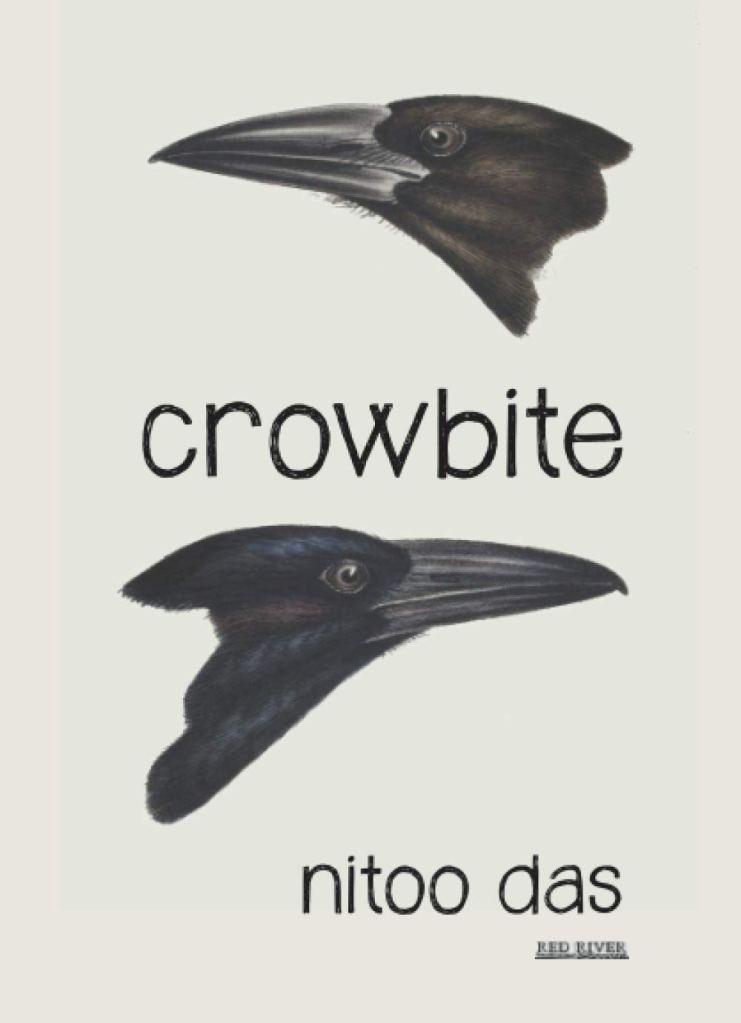
A Review of Nitoo Das’s Crowbite by Basudhara Roy

Title: Crowbite

Author: Nitoo Das

Publisher: Red River, 2020

In her essay, ‘Woman and Bird’ in What is Found There: Notebooks on Poetry and Politics, poet and essayist Adrienne Rich describes her sudden sighting of a magnificent great blue heron, a bird she has never seen from close quarters before and this brief encounter leads her on to a dialogic exploration of  “all the times when people have summoned language into the activity of plotting connections between, and marking distinctions among, the elements presented to our senses”, of the potentiality of making such experiences the means of interpretation of poetry and life. Concluding the essay, Rich writes:

“Neither of us—woman or bird—is a symbol, despite efforts to make us that. […] I made no claim upon the heron as my personal instructor. But our trajectories crossed at a time when I was ready to begin something new, the nature of which I did not clearly see. And poetry, too, begins in this way: the crossing of trajectories of two (or more) elements that might not otherwise have known simultaneity. When this happens, a piece of the universe is revealed as if for the first time.”

One of the apparent reasons that this essay comes to my mind after reading Nitoo Das’s third collection of poetry, Crowbite, is of course the fact that both these writings are undeniably watermarked by the experience of birdwatching. Nitoo Das, professor, bird watcher, bird photographer, and poet with many anthologies under her belt,  profoundly echoes Rich’s idea of poetry here – “the crossing of trajectories of two (or more) elements that might not otherwise have known simultaneity” and its revelation of a piece of the universe that has been scarcely perceived in the same way before.

As powerful as they are beautiful, as experimental as they are traditional, and as astounding as they are soothing, the thirty poems in this collection will take the reader on a journey that begins concretely in place and culminates in an existential place-less-ness that haunts both without and within. Close attention to topography is an important feature of Das’s poetry and each poem in Crowbite is testimony to the poet’s intimate communication and engagement with the landscape of her hometown in the hills. While even a cursory glance at the titles in the book reveals an intense grounding of most of these poems in a physical locale – like Mawphlang, Laitkynsew, Tawang, NEHU, Ka Kshaid Lai Pateng Khohsiew — all poems here are undoubtedly contextualized in a well-defined geographical space. Arne Naess in Life’s Philosophy writes, “There is a telling German word, Merkwelt, for which the closest English equivalent is “everything that a definite being is aware of”. When it comes to landscape poetry, Das’s Merkwelt is profoundly rich and she can penetrate the ostensible and concrete in it to arrive at the unusual and remote. In the poem ‘Root Bridge, Mawlynnong’, for instance, roots find their being in a metaphor from the world of fiction:

These roots are words that many hands have looped into a tale

With dangling subplots, conflicts, an infinite resolution …

In ‘Spotting a Spotted Forktail’, the “yin-yang bird” acquires an unusually graphic description:

He sprints

like the scattered prints of a newspaper.

he is a chess game speckled

with dots. A zebra bird

with strategic fullstops.

A monochrome

forktrailing a contrast

where the Rhododendron drops.

There are many markers – geographical, cultural and linguistic – with the North-East manifesting a presence as a protagonist within this collection. The poems themselves take on the serenity and wonder of the landscape they describe. However, it won’t take the reader long to realise that Das’s poetry, though, it stems from a territorial response to being and belonging in physical space, enacts itself essentially in the mind. Her landscape, rich though it is, telescopes almost inevitably into her mindscape and it is from this that her images acquire their rich visceral quality.

Examine, for instance, the opening and closing poems of the collection. The opening poem, ‘Mawphlang’ begins with a physical forest that threatens constantly to slide inwards:

The forest is something indecisive

between twig and soil.

It is an old woman opening

her mouth. She has nothing to reveal.

The closing piece, ‘The Cat’s Daughters’, as surreptitious, as mysterious and as metaphysical as the cat itself, closes with a journey that is decidedly inwards, a call towards primordiality, a return to the womb:

We imagine
our mother aging. We worry about her. She tells us:
If the basil dies and the milk curdles, come
save me. And so,
the basil dies and the milk curdles
and we go off on our travels. No,
we marry neither the merchant
nor the river prince. We birth
neither pestles
nor pumpkins. We want to find
our mother, see her silver eyes, touch
her old fur,
kiss her fish-mouth again.

It is this essential spatial tension between the landscape and the mindscape that accounts for a very different sense of temporality in Das’s poems, a fact that strikes one quite early into Crowbite. Though these poems are nourished by a deep affinity towards the natural world, the temporal rhythm they owe their allegiance to is neither chronological nor geological but purely intellectual, something I would call, mind time. Whether, it is observing a forktail, a leaf, a waterfall, an elephant, the rhododendrons, a painting or even a bus, Das’s reflections follow their own trajectory, their unique ratiocinative beat and it is through the subconscious meeting of these trajectories that her powerful poetry is born.

Poems like ‘Leaf in My Room’ and ‘In Which Mawlynnong is a Fractal’ are brilliant poetic ratiocinations explored through questions and answers. While in the former, each answer leads to more questions and in the latter, the questions don’t stop for answers, in both the poems we are brought only and amply close to the understanding of language’s failure to ask or answer, and in turn, to know or mirror the world. And this overpowering awareness of the powerlessness of language to make sense of the world is perhaps what bestows its greatest strength to Nitoo Das’s poetry.

Devdutt Pattnaik, a mythologist, in his article ‘The Song of the Crow’ writes:

“The word ‘why’ is translated as ka in Sanskrit, the sacred language of Hinduism. Ka is the first consonant of the Sanskrit language. It is both an interrogation as well as an exclamation. It is also one of the earliest names given to God in Hinduism. During funeral ceremonies, Hindus are encouraged to feed crows. The crow caws, ‘Ka?! Ka?!’ It is the voice of the ancestors who hope that the children they have left behind on earth spend adequate time on the most fundamental question of existence, ‘Why?! Why?!’ In mythology there is a crow called Kakabhusandi who sits on the branch of Kalpataru, the wish-fulfilling tree. The tree fulfills every wish but is unable to answer Kakabhusandi’s timeless and universal question, ‘Ka?! Ka?!’ “

Though the eponymous and incredibly moving poem ‘Crowbite’ in the book is engendered within a different cultural mythology and worldview, the crow remains here, as elsewhere, a “cawcawcaw of black” a cry connecting the soul to the Earth, a question-mark on civilization, a suspicion, a misgiving, a patch of darkness on the possibility of knowledge, an epistemological interrogation, a stark reminder of human vulnerability. In the closing lines of the poem, the crowbite that pursues Bhobai like both prophecy and legacy, becomes a metaphor not just for creative freedom but also existential freedom. It is freedom from civilization and its hierarchies of truth and knowledge, a crossing over of boundaries – from physical to metaphysical, and an affirmation of the ultimate embodiment of the world. Bhobai the man becoming Bhobai the crow acquires an in/sight that is terribly human and yet beyond the scope of the average, fallible person:

I went wherever I wanted to. I looked at people’s eyes and knew their secrets. I sang songs with the fishermen. I bathed in the sacred river and flew away from their temples before they could throw stones at me.

A word must be spoken for the publisher, Red River, whose superb designing of the book immensely succeeds in drawing attention to the tactile and visceral quality that inhabits these poems. Not to be missed are the remarkable illustrations by the poet that by bringing in another dimension of visuality and experience, lend a sinewy force to the overall interpretation of Crowbite – a collection that will as swiftly make a home in the readers’ hearts as it makes its way to their shelves.

.

Basudhara Roy is Assistant Professor of English at Karim City College, Jamshedpur, Jharkhand, India. Sheis the author of two books, Migrations of Hope (Criticism; New Delhi: Atlantic Publishers, 2019) and Moon in My Teacup (Poetry; Kolkata: Writer’s Workshop, 2019). Her second poetry collection, Stitching a Home, is forthcoming in 2021.

.

PLEASE NOTE: ARTICLES CAN ONLY BE REPRODUCED IN OTHER SITES WITH DUE ACKNOWLEDGEMENT TO BORDERLESS JOURNAL. 

Categories
Poetry

Wearing Silk Gloves Once More

By Jenny Middleton

Gloves, lined with silk’s soft blur

write my hands with memory;

their interior warm with the smooth touch

of things held and held before.

.

Creased and tender in their slide

over skin, it is as if we were relearning

our vows, as a language grown old sings

with words once rusted,

seized and deadened,

amongst a tangle of docks and nettles,

or choked with bind weed’s grasp.

.

Now as clay is worked clear,

turned on its wheel to rings

and worn up to the tenderness of sculpture

these words rise from their base vowels

to sentence the sublime

unfastening us from everyday

routine and rhyme.

.

Jenny Middleton has written poetry throughout her life. Some of this is published in printed anthologies or on online poetry sites, including ‘The Blue Nib’. Jenny is a working mum and writes whenever she can find stray minutes between the chaos of family life. She lives in London with her husband, two children and two very lovely, crazy cats.  You can read more of her poems at her website  https://www.jmiddletonpoems.com 

.

PLEASE NOTE: ARTICLES CAN ONLY BE REPRODUCED IN OTHER SITES WITH DUE ACKNOWLEDGEMENT TO BORDERLESS JOURNAL. 

Categories
Stories

I Grew into a Flute

This is Balochi folktale retold by Fazal Baloch. These stories would be related by a storyteller and they would end with a punchline defining their role in the story.

A storyteller telling a story to an eager crowd. Courtesy: Wiki

Once there lived a merchant. He had two children, a boy and a girl, from his late wife. Travelling to far off lands became difficult for him as he had to look after his children. In his neighbourhood, lived a widow who pretended to love the merchant’s children so much so that it filled him with the longing to marry her. However, she had a wicked heart, and in reality she had had her eyes on merchant’s wealth. At last the merchant tied the knot with her. Soon she began to treat her stepchildren very cruelly. As the merchant spent most of his time outside, he was unaware of his wife’s brutality to his children. She forced them to live on leftovers. As they feared her wrath, the children disclosed nothing to their father and silently suffered torment at the hand of their stepmother.

Time went by. The merchant’s wife was pregnant and eventually gave birth to a child. Her hatred for her stepchildren grew stronger. When the boy grew older, the merchant assigned him the flock to tend in the pasture. The boy spent most of the time away from home. On the other hand, his sister did all chores at home. Her stepmother would curse and beat her. One day, the stepmother made a plan to kill her stepdaughter.

So she took her stepdaughter to the forest on the pretext of collecting firewood. When they got there, she strangled the little girl to death and threw her body into a deep gorge and returned home wailing, “I don’t what befell my daughter. God knows if she ran away; or was devoured by a lethal beast; or did somebody kidnap her…”
The merchant was not at home nor were any men in the neighbourhood. The women looked for her but they could not find any trace of the girl.
Times passed by and the girl’s flesh and bones grew into a reed plant. One day, tending his flock, the merchant’s son passed by the gorge and caught the sight of the very reed plant. He bowed low and pulled up a reed stalk and made himself a flute. When he played the flute, a voice echoed:

‘Play on brother! Play on brother!

Curse the lowly brute

who killed and threw me into the gorge

and I grew into a flute

Goats nibbled my leaves

my brother played me.

The merchant’s son was taken aback. He grew a little afraid but soon he assumed it was her sister’s voice coming out of the flute. He played it again and the flute repeated again:

Play on my brother!

Whenever he played the flute he heard the same lines over and again.
On a moonlit night, a little distance away from home, in the sands the boy played the flute and the flute said:

Play on brother!

When flute’s call reached to the ears of merchant’s wife, she trembled in fear. She thought it was her stepdaughter’s spirit come to haunt her. In the morning, as usual, the boy drove the flock to the pasture and at dusk he made his way back home playing the flute:

Play on brother!

The merchant’s wife at last discovered the voice was coming out of the flute. She seized hold of the flute. Next day with a heavy heart, the boy drove the flock to the pasture. The moment he disappeared from the sight, his stepmother threw the flute into the burning oven.

A while later, an elderly woman came over to bake herself a bread. When she was taking the dough out from beneath the hot ashes, she found a ring stuck to it. The flute had transformed into a ring. She brought the ring home for her grandson. She wrapped the bread in a cloth and put it on the tablecloth.

When her grandson demanded bread, she told him where she had kept the bread. The boy walked over but instead of the bread she found a beautiful girl sitting there. The boy drew back in fear. The girl said softly: “Don’t get frightened. I’m your fiancée. Your grandma has brought me in.”

Meanwhile the grandmother walked in. The boy turned to her and said: ” There is no bread. Instead, there’s girl who says I’m your fiancée.”

The grandmother went to see and found a beautiful girl sitting there. She was happy to have found a fiancée for her grandson. The girl nevertheless warned her and said: “Never tell anyone about me.”

From that day, the girl did all chores at old woman’s hut.

One day a wandering fakir caught the sight of the beautiful girl. He thought that such a moon-like girl deserved to grace a palace rather than a hut.

The fakir immediately made his way to the palace of the king where they were deliberating where to find a beautiful bride for the prince. The king was asking everyone present in the gathering about princesses of nearby kingdoms. Everyone was giving their opinions. Finally the king turned to the fakir. The fakir replied politely: “O, Majestic King! I’ve been to Syria and Rome, China, Hind and Sind; I’ve visited the abodes of rich and poor. If I get my life spared, I want to say something in your honour.”

The king said, “Go ahead O Holy subject of the Lord.”

The fakir continued, “I’ve seen a girl in the huts. She is as beautiful as a houri.”

The prince said he would go and bring the girl himself. Hence, he took plenty of gifts and along with the fakir went to the old woman’s hut. When the old woman understood the intentions the prince, she moved the girl to an undisclosed location. The prince sent many people to the old woman demanding the hand of the girl in lieu of enormous wealth but she refused and said that other than a grandson, nobody lived with her in their hut.

At last, the enraged prince went to her. He placed hot roasted wheat on old woman’s palm and firmly clenched it in his hand. The old woman cried loudly and sought apologised to the prince and revealed the location of the girl and demanded a huge dowry for her.

The prince granted all her demands and gave her so much wealth that she could lead the rest of her days in peace and prosperity.

The storyteller concluded the tale:

I took the girl to the palace and made it back home.

.

This folktale originally appeared in Gedi Kessah ( The Folktales; Volume 07) published by the Balochi Academy Quetta shared with us with permission taken by the translator.

.

Fazal Baloch is a Balochi writer and translator. He has translated several Balochi poems and short stories into English. His translations have been featured in Pakistani Literature published by Pakistan Academy of Letters in 2017 and Silence Between the Notes — the first ever anthology of Partition Poetry published by Dhauli Books India in 2018. His upcoming works of translation include Why Does the Moon Look So Beautiful? (Selected Balochi Short Stories by Naguman) and God and the Blind Man (Selected Balochi Short Stories by Minir Ahmed Badini).

.

PLEASE NOTE: ARTICLES CAN ONLY BE REPRODUCED IN OTHER SITES WITH DUE ACKNOWLEDGEMENT TO BORDERLESS JOURNAL. 
Categories
Poetry

Three poems from Ukraine

By Lesya Bakun

Someone’s Dream

(Translated from Ukrainian to English by the poet herself)

Well then.

Finally, everything is done,

so that someone’s dream

does not come true.

Convene the musicians!

After all, this is hard work:

consistently doing everything

not to give anyone hope.

Or take it?

But in Mary’s poems,

Some weird, not at all like Zhadan’s*,

Angels are step dancing,

And, apparently, they feel good there

in the steppe.

*Zhadan – Well-known Ukranian writer Serhiy Zhadan

Rosehip Bush

(Translated from Russian to English by the poet herself)

I think life is

like a cauldron of boiling water:

No matter which side you touch,

you’ll get burnt.

I think life is

a rosehip bush:

Beautiful on the outside,

But it hurts a lot.

I think of life,

and its many aspects,

but I’m looking at the world

through my camera’s lens,

and it sees the world

with no lattice.

The Sad Philosopher

(Translated from Ukrainian to English by the poet herself)

How have I earned

such happiness?

This is more than good

for me.

I want to stay

a sad philosopher,

forever.

No changes.

No events.

No growth.

.

Lesya (Oleksandra) Bakun is a polyglot poet and non-formal educator who resides in Ukraine. She has been writing since the age of 14, in Ukrainian, Russian, and English; her poems were published in the local young poets’ anthology. Oleksandra has the ‘young’ and ‘adult’ periods of her writing life, and challenges of each are vividly seen in the words she’s sharing – both as texts and in poetry readings. Her poems revolve around complex themes like trauma, gender, societal issues, relationships, and mental health.

.

PLEASE NOTE: ARTICLES CAN ONLY BE REPRODUCED IN OTHER SITES WITH DUE ACKNOWLEDGEMENT TO BORDERLESS JOURNAL. 

Categories
Tagore Translations

The Library

A part of Bichitro Probondho (Strange Essays) by Rabindranath Tagore, this essay was written in 1885. It has been translated from Bengali by Chaitali Sengupta from Netherlands

Rabindranath Tagore

The stillness inside the library can be compared to the thousand-year-old roar of the mighty ocean that has now been tamed to sleep. A deep, peaceful slumber of a baby. A place where language is on hold, its rhythmic tide is locked and the brightest light in our souls is imprisoned behind the black and white words. I wonder, what would happen, if one day, the words revolt, breaking free of the bondage? Just as the Himalayas contain in its frozen ice a thousand floods, in the same way this library too preserves the best of human emotion in its breast.

Humans have been able to fence in electricity with iron wires, but who knew that man would lock words behind silence? Who knew that he could trap music, boundless hopes, the happiness of an awakened soul and the prophecy of the oracles in the pages full of words? That he would imprison the past in the present? And create a bridge upon the infinite ocean of time just with the help of a mere book?

We stand at the crossroads of a hundred roads in the library. Some paths lead to the boundless sea, some to the topmost peak, and yet another meanders to the inner crevices of the human heart. There’s no barrier, no matter where you wish to go. Man has created his salvation within the small perimeter of a book.

In this library, one can very well listen to the rise and fall of human emotions, like the echoing of the sea resonating through the conch shells. The living and the dead co-exist in close proximity here and opposition is a close relative of compliance. Trust and doubt, research and discovery are mates here. The popular and less popular live together amidst great peace and harmony. None ignore the other with contempt.

Crossing several rivers, oceans, mountains the voice of humans have reached here, galloping through several ages of time. Come, come here, for here we’re singing the birth song of light.

The Great One, who after discovering heavens, had given out a clarion call to all humans — ‘You all are the sons of heaven, this earth is your heavenly abode’ — it is his voice and millions of other similar voices, that reverberate within these walls through the years.

Have we then, from the foot of Bengal, got nothing to say, no message to give out to the human civilization? In the unified music of the world would Bengal’s contribution be only silence?

Doesn’t the sea at our footsteps speak out to us anymore? Doesn’t the Ganga bring forth the song of Kailas for us? And the vast blue canopy- isn’t it anymore there above us? And the galaxy of stars there, are they not for us?

Each day brings messages to us from far away countries from past and present. In response, are we only going to produce a few flimsy English newspapers? The countries around the globe are writing their names with the ink of immortality. Would we, Bengalis, be happy to put our names only on the application papers? Humanity is putting up a stiff fight against the preordained destiny; with the bugle calls, soldiers are being called upon. At a time like this, are we only going to be immersed in petty affairs?

Bengal’s heart is full after a long silence. Let her once speak out, in her own tongue. Her voice would indeed add melody to the music of the world.

Author’s bio

Rabindranath Tagore (1861 to 1941) was a brilliant poet, writer, musician, artist, educator – a polymath. He was the first Nobel Laureate from Asia. His writing spanned across genres, across global issues and across the world. His works remains relevant to this day.

Translator’s bio

Chaitali Sengupta is a published writer, translator, journalist from the Netherlands. She is involved in various literary & journalistic writing, translation projects for Dutch newspapers (Eindhoven News, HOWDO) and online platforms, both in the Netherlands and in India. Her works have been extensively published in many literary platforms like Muse India, Indian periodical, Borderless Journal, Setu Bilingual, The Asian Age. Her recently translated work “Quiet Whispers of our Heart” (Orange Publishers, 2020) received good reviews and was launched in the International Book Fair, Kolkata, India.

.

PLEASE NOTE: ARTICLES CAN ONLY BE REPRODUCED IN OTHER SITES WITH DUE ACKNOWLEDGEMENT TO BORDERLESS JOURNAL

Categories
Poetry

Poems of Hurt

By Sonya J Nair

1.
 
Fury 
 
Slow burn.
 
A screw  	
coiling, coiling, coiling 
A watch  
 	wound, wound, wound 
 
A screw to the heart  
 	wōund, wōund, wōund 
the sound of acid pumping 
 
 	a spring 		a snap  
 	 	 	recoil 	 	 			recoiling  	
re-coiling. 


Tangibility
The day you died, I forgot
— to fret over the numbness that resided
at the tip of my left little toe.
— and how annoyed I had been
 with you for refusing to believe 
the existence of
such a mustard seed of an anomaly.

"Totally in the extreme," you howled,
while I contemplated blue murder.
— how I once woke to find you 
nibbling away at my hypothesis, 
your face impishly inching closer, 
making me want to love you
in ten shades of tangibility.

It was only by night,
after they had buried you,
that I wondered — if
loss could send feeling
flooding into frozen digits —
the cascades of pain, a twinge?
the keening in my soul, a twitch?

I touched the spot.
Still cold.
As cold as you had gone.

Sonya J. Nair is the editor of samyuktapoetry.com. She is working on her first collection of poems. She has been published in the Shimmer Spring Anthology and Rewriting Human Imagination- an anthology published by IASE and the Centre for Digital Humanities.