Categories
Poetry

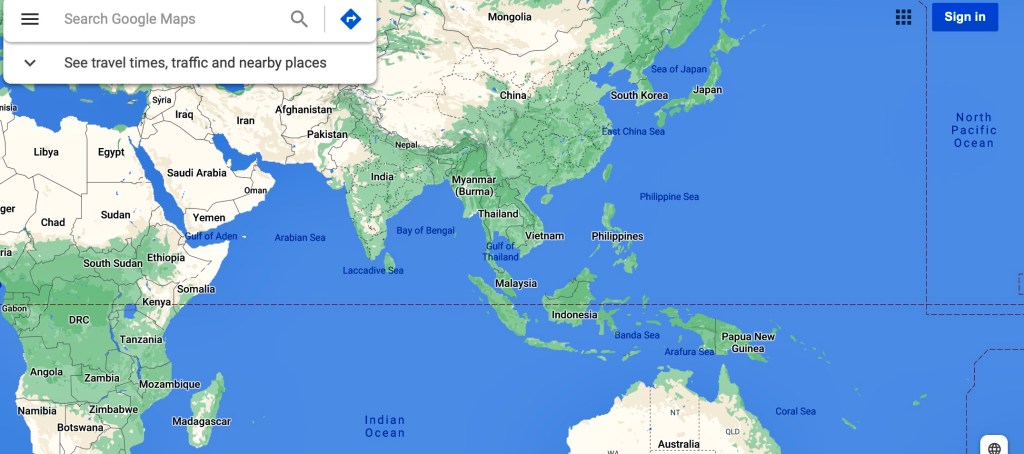
Ten Islands

                                  Poetry from Korea by Ihlwha Choi

Ten people are eating rice cake dumpling soup

Same price

Same taste in the same bowl

Made by the same cook

They are eating the same soup delivered by the same waiter

Among them

Young people arrive through the falling snow

One young girl wearing a red backpack

Another girl wearing a baseball cap slightly tilted on the head

One male student with black eyebrows 

who has ever written love letters

Sitting with a boy who has never written love letter

And also two privates coming out of army camp for vacation

One grandma with her little grandson

Among the ten

Some ones know each other and some not

Some seem to have seen each other somewhere

The wind is blowing very hard outside

Though ten people are eating hot rice cake dumpling soup

They are all islands surrounded by ten oceans

Ten islands different in shape

Are eating hot rice cake dumpling soup cooling huhu

.

Ihlwha Choi is a South Korean poet. He has published multiple poetry collections, such as Until the Time When Our Love will Flourish, The Color of Time, His Song and The Last Rehearsal.

.

PLEASE NOTE: ARTICLES CAN ONLY BE REPRODUCED IN OTHER SITES WITH DUE ACKNOWLEDGEMENT TO BORDERLESS JOURNAL. 

Categories
Musings of a Copywriter

Pray to Win

Devraj Singh Kalsi gives an entertaining account of ‘Tumpji pujas’ across India during the US elections

The strength he mustered to defy the writing on the Mexican wall and challenge the mandate had come from a country he had called dirty just a few days ago. We do not mind his saying so because our own writers and filmmakers have sold this image to the West for several decades.  

Faith can move mountains. Orisons can deliver miracles even in Arizona and the man in office – By Georgia! – knew something incredibly magical was on his way from the East. Kudos to the cabal of jingoist well-wishers who were engaged in performing yajnas* and havans* with pure desi* ghee to propitiate the powers of heaven to spread dollops of glee on his face, to ensure another term for him in Safed Ghar* and keep the world supposedly safe though I ran away from this false belief amid fears of a lurking strike in his second innings. Every nuke and corner of the world under his glaring watch would upset and reset the ticking clock of global peace. 

The feisty flames inflamed the mercurial man who was determined to trump his foes with his planetary virility. He spewed balls of fire to hang on and refused to cow down, setting a new precedent as a president in the history of the nation. Only if the organisers could spell his name correctly instead of Tump, the omnipotent gods would have transferred the votes he required to win, by influencing the counting officials to detect more inaccuracies with the postal votes that went against him.     

The inner voice guided and goaded him to prove winners never quit and quitters never win. He felt re-elected in his mind despite the mismanaged pandemic and wished to make a bonfire of all anti-incumbency votes in the havankund* – only if he could get those picked out by an invisible force in the closely contested polls conducted in the few crucial states that slowed down his juggernaut. Most of the leaders who swept to power around the time he had won were given another term and they would now feel lonely without his bombastic company and pack of white lies. 

Praying to win is a common – and effective – practice among contestants the world over. Cadres of all parties do so for their beloved leaders during election time. Sometimes the native people pour unadulterated love for global leaders perceived as friendly and helpful for the home country – those who can be a pillar of support against hostile neighbours. Tump Ji is one such beneficiary of generous and spontaneous love showered by legions of admirers here. 

Havankund and yajnas are also performed for friendly countries and their leaders. We want these friends to occupy the office for a long period. Though we cannot elect or re-elect them through the voting process, we can surely seek divine deliverance for them. Even if we have few friends around the world, a powerful ally is what we need to keep our neighbours under control. If Tump Ji remains in favour, we do not fear our neighbours. With Tump Ji as the ring master, the Chinese cannot drag on further with their LAC plans. He has been a pillar of support for us in the past few years – the one guy we can ring up any time to share our woes and he jumps to our defence by scolding our mischievous neighbours with veiled threats and dire warnings. 

When the news finally reached Tump Ji that the land of seers has the divine power to flip electoral outcomes and influence voters without any fraud, he was elated and wondered why his Indian buddies did not part with the secret mantras of success earlier. He suspected a conspiracy of sorts hatched in the native village of a democrat. He was now told there were many pundits with manic and talismanic powers who could swing the verdict right in his favour before the voting was over, but it was a tough call to reverse what was already cast. He was told of the potency of keeping red hibiscus and marigold underneath his pillow for nine consecutive nights to avoid getting pilloried. He was advised to chant Jo(e) Boley So Nahin Hovey555 times every daySuch tweets and messages were sent to him and he read and followed them all. 

Tump Ji was also advised to avoid kissing during this critical phase as it would suck out the chances of victory and spell the proverbial kiss of death for him. He was told to eat a vegetarian diet as this sacrifice would prove rewarding. Simple lifestyle modifications: Drink tall glasses of buttermilk instead of wine to show power without intoxication. He was assured of a divine shower of blessings if he stayed away from sausages and beef. As the election results began to pour in and his drubbing became imminent, he overheard his better half talking of a possible split though he could not be very sure whether she talked of a split in votes or their marriage.  

Coming to the aspect of divine intervention, the chanting of mantras gifted him with nerves of steel. He pinned high hopes on the judiciary to act as his saviour – the supreme power would reside in the unanimous verdict of judges. This would allow him the opportunity to ride back to power and occupy the same house instead of indulging in frivolous thinking of constructing another one on the opposite side because he still believed he was wanted by half of his countrymen. It was impossible to accept defeat with grace as he felt he was still very much in the presidential race. 

*yavanas, havan: prayers around the fire

*Desi ghee: Ghee made from cow’s milk

*Safed Ghar: White House

*Havankund: The container in which a fire is built for prayers

*Joe boley so nahin hovey: A take off that means whatever Joe utters shall not be fulfilled. The take off is from the shout of victory and exaltation among Sikhs, Bole so nihal.

Devraj Singh Kalsi works as a senior copywriter in Kolkata. His short stories and essays have been published in Deccan Herald, Tehelka, Kitaab, Earthen Lamp Journal, Assam Tribune, and The Statesman. Pal Motors is his first novel.  

.

PLEASE NOTE: ARTICLES CAN ONLY BE REPRODUCED IN OTHER SITES WITH DUE ACKNOWLEDGEMENT TO BORDERLESS JOURNAL. 

Categories
Poetry

Clocking a Harvester

By Tom Merrill

Clocking a Harvester by Tom Merril

Clocking a harvester,
from nut to underground larder and back,
              I found the course consistently run
              in thirty-five,
              forty seconds maximum—
              and I clocked his clockwork awhile;

and seeing how hard he worked
at building up his stockpile—
at such a relentlessly steady pace—
              and since a rest seemed due,
              I slipped out and scattered a few
              by the hole to his home.

              When I looked, later on,
              they were gone.
I had put out the peanuts to see
if the jays
or the squirrels would get to them first, but instead
               found a new mouth to feed—

               not at all to complain. Truth be told,
               sharing such stores I suppose is an old
               custom of mine,
and recalls a time
when all my best handfuls were aimed
at arming another against the coming cold.


Poems by Tom Merrill have recently appeared in two novels as epigraphs.He is Poet in Residuum at The Hypertexts and Advisory Editor at Better Than Starbucks.

.

PLEASE NOTE: ARTICLES CAN ONLY BE REPRODUCED IN OTHER SITES WITH DUE ACKNOWLEDGEMENT TO BORDERLESS JOURNAL

Categories
Humour Poetry

Christmas Poems

By Rhys Hughes

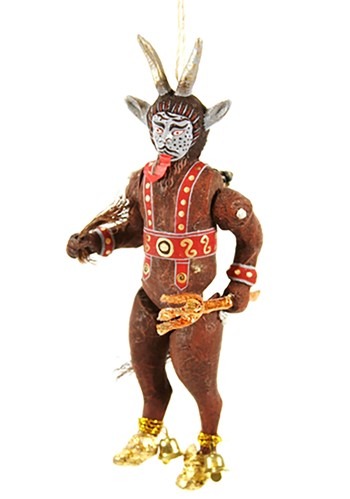
Krampus on Campus

Dear Admissions Tutor
I am rather too mature
a fellow
to present myself to you
in this manner
(it is true)
but I believe potentially
I will have a
bright future
if you allow me to enrol
at your university.

And let me now explain
the meaning
of my name. Krampus
the word derives
from ‘claw’
and I am wearied by my
seasonal chores
which unlike those of
Santa Claus
involves punishing bad
children instead
of rewarding the good.

I am hairy,
my long tongue lolls
and I have cloven hoofs.
I leap across
your roofs at night
giving children such an
awful fright!
and this has been my role
for years.
To cap it all my head
has horns.
My appearance generally
as you can see
is hardly prepossessing
but that’s
how I was born.

And now
I’ve had enough!
I want a
change of career,
no more
nastiness and no
more fear.
I long to improve myself.
Please permit
me to enrol and achieve
my goal,
a Krampus on campus
will be quite
a boon to your noble
institution.
My essays will all
be referenced properly
with the correct
attributions.
I promise this!
Yes, you
can provide the solution
to my woes!

I write this letter
with my talons crossed for luck.
I have inspected
your prospectus
and the course I choose is
“Mythology
and Cultural Studies,
modules one and two”
and in advance I am thanking
you. Sincerely yours,
without a fuss, Krampus.

P.S. What don’t
you want for Christmas?
A Krampus
Once I was an Elf

Once I was an elf
(a real elf)
and I was proud
and strong.
I loosed my arrows
at dragons
and never thought
it wrong
to engage in battle
with my other foes,
the goblins
of the underworld.


How I miss
those ancient days
with their better ways
when mounted
on a flying horse,
a quiver on my back,
I soared above
the mountain peaks
that chewed the clouds
like demon fangs,
ready to attack!


Few back then
were quite so bold
and fewer still
so keen to seek
mighty new heroic deeds
to perform each week.
Caring not for
fame or wealth
while swooping
from the sky,
I defeated giant lizards,
evil wizards
and necromancers
for I was an elf
well versed in magic
with nothing tragic
about my circumstances.

But times changed
as they always do
and the age of wonders
passed away,
for even valour
and honour too
must eventually decay.
I fell on hard times
like all the elves
and sold my golden arrows,
cut short my hair,
lost my flying horse
and begged for work
everywhere,
cursing the worsening
of my situation
until at last I found a boss
willing to take me on.


The work is seasonal
and very hard
and now is the busiest
time of year.
I sometimes weep
as I recall how long ago
the good times were
when to be an elf
earned both respect and fear.
I have become
little more than a slave
in the modern world
and it is cold
so near the North Pole.


Yes, once I was an elf
(a real elf)
but now I am a mockery
of myself.
I slay dragons no longer
but every day
I just make toys
from a very long list
for girls and boys
who doubt I even exist.

Rhys Hughes has lived in many countries. He graduated as an engineer but currently works as a tutor of mathematics. Since his first book was published in 1995 he has had fifty other books published and his work has been translated into ten languages.

.

PLEASE NOTE: ARTICLES CAN ONLY BE REPRODUCED IN OTHER SITES WITH DUE ACKNOWLEDGEMENT TO BORDERLESS JOURNAL. 

Categories
Essay

Hold the roast turkey please Santa !

Celebrating the festive season off-season with Keith Lyons from New Zealand, where summer solstice and Christmas fall around the same time

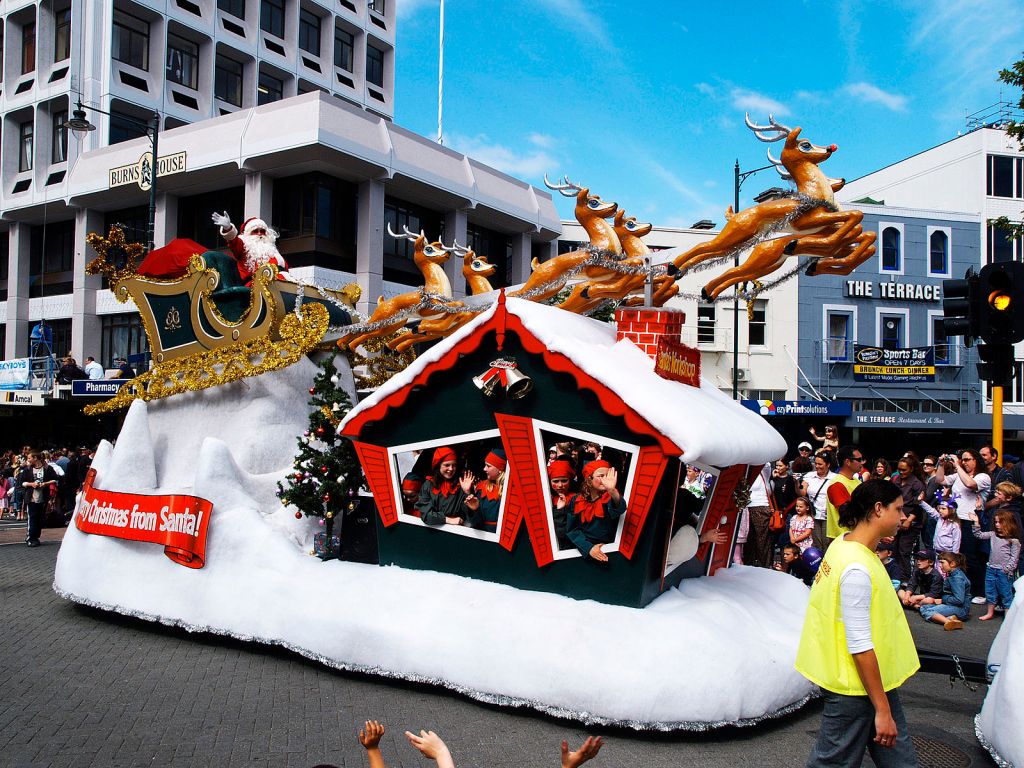
Santa Claus Parade Dunedin, New Zealand: Photo courtesy; Wiki

There is something quite surreal that happens across the Southern Hemisphere in the last week of December. It seems to be a mismatch between festivities and seasons. Temporarily, around Christmas, the world ‘down under’ somehow pretends it is winter, not summer. The European and North American cultural traditions associated with the birth of Jesus Christ, believed by Christians to be the Son of God, get mixed up when the seasons are reversed. Within the same week as the summer solstice, the longest day of the year, many throughout the South still celebrate the observance with images of snow, tinsel, evergreen conifers, mistletoe, reindeer, sleighs, and of course, jovial Santa. So, during the hottest months, when Christmas carols can be heard in petrol station forecourts and in the ‘music on hold’ when waiting for customer support, there is an artificial feel to the merry Christmas and tidings of great joy. 

As the child of immigrants to New Zealand, I guess Christmas time must have been both comforting and disconcerting for my Scottish and English parents, who had been used to chilly temperatures, the prospect of real snow, and the need to have hearty traditional British Christmas foods including roasted turkey, ham on the bone, puddings infused with brandy and hot drinks. For some reason, we always had the out-of-season Brussel sprouts on the table for the main Christmas day meal. 

For most of my childhood, we stuck to the typical Christmas foods, always eating too much of the plum pudding made with treacle and the beef fat suet after a huge meal prepared by my mother slaving away in the kitchen with the oven set at 180C on a 30C day. It was only in the 1980s that our family, like many other New Zealanders, gradually moved towards cold meats, seafood and salads. Eventually, the Christmas plum pudding was replaced by the pavlova, the meringue-base topped with whipped cream and fresh strawberries. More families gather together at the beach at Christmas time, listening not to sleigh bells but the sizzle from the BBQ. 

In recent decades, some New Zealanders have got seasonal-correct, by having a mid-winter Christmas complete with roast meat, potatoes, sweet potato, and pumpkin, at a time of year when such warming food is best appreciated. 

The first Christmas in New Zealand happened many centuries after the arrival of the first settlers, the Maori. In 1642 Dutch explorer Abel Tasman celebrated with fresh pork and extra rations of wine, while English navigator James Cook, who landed more than 250 years ago, feasted on pies made with seabirds on Christmas day in 1769.

Pohutukawa blooms

Over time, Christmas has become localised to its climate and geographic location. In New Zealand, there is a native tree, the Pohutukawa, which blooms vibrantly red during what is still known as the ‘silly season’, and this has been dubbed the Kiwi Christmas tree. Some Santas in shopping malls wear red shorts, and local businesses, community groups and churches make decorative floats for the annual Santa parade which always includes fire trucks reminding participants of the impending forest fire danger. 

Pohutukawa tree

With the warm temperatures and long days, the holiday time is more about a lazy game of cricket on the back lawn or getting sunburnt at the beach than excessive feasting and drinking, awkward gift-giving, and church attendance. One modern development in my hometown is that one neighbourhood has taken on the North American tradition of decorating houses with festive lights and kitschy displays. However, as it doesn’t get dark till after 9.30pm in December, parents must allow their children to stay up later to visit the suburb when the lights are on and glowing. 

I’m fascinated how cultural events (and religious festivals) have been exported and imported around the world. In New Zealand, where Indians make up 4% of the total population due mainly to recent arrivals for study and work, the Hindu festival of Diwali is celebrated in most of the main centres, with calls for it to be declared a public holiday from 2022. Sikhism is the fastest-growing religion in the country according to the latest census, and my hometown of Christchurch now has more than 10,000 Sikhs (more than 2.5% of the population), meaning that there’s a good chance that someone from Chandigarh, Amritsar, or Ludhiana lives in your street. 

When I’ve lived in other parts of the world, I’ve noticed how festivals, some with nature-based or pagan origins, may at first seem out of kilter with the seasons or time of year. Among the Yi, Bai and Naxi of southwest China’s Yunnan, a torch festival is held around the summer solstice to symbolise warding off locusts and ghosts. One legend about its origin tells the tale of a spirit being sent to torch the Earth and its evil residents, but when he fell in love, he convinced the inhabitants to light fires for a few days to make it seem that he’d accomplished his task. It’s an almost identical tale on the west coast of Ireland where an ancient midsummer festival to protect the crops is said to have its genesis in the desire of an angel for harm not to come to the Irish people. 

This year 2020, which for pretty much every one of the Earth’s 7,800 million human inhabitants has been interesting, to say the least, closes with some unusual phenomena, including the ‘Christmas star’ created by the conjunction of Jupiter and Saturn on the solstice, and perhaps a collective sigh of relief when midnight rolls over on the 31st of December. 

From afar it must have looked as if the world was both on fire and burned down, as wildfires have raged across Australia, the Amazon, Siberia and California, and whole populations have ‘sheltered in place’, deserting once crowded streets and landmarks, reducing pollution and carbon emissions. 

As we reflect on the year, perhaps we could learn from the words of prize-winning novelist and poet Robert Penn Warren: “History cannot give us a program for the future, but it can give us a fuller understanding of ourselves, and of our common humanity, so that we can better face the future.” 

.

Keith Lyons (keithlyons.net) is an award-winning writer, author and creative writing mentor, with a background in psychology and social sciences. He has been published in newspapers, magazines, websites and journals around the world, and his work was nominated for the Pushcart prize. Keith was featured as one of the top 10 travel journalists in Roy Stevenson’s ‘Rock Star Travel Writers’ (2018). He has undertaken writer residencies in Antarctica and on an isolated Australian island, and in 2020 plans to finally work out how to add posts to his site Wandering in the World (http://wanderingintheworld.com).

.

PLEASE NOTE: ARTICLES CAN ONLY BE REPRODUCED IN OTHER SITES WITH DUE ACKNOWLEDGEMENT TO BORDERLESS JOURNAL. 

Categories
Humour Poetry

Algae Masks

By Sekhar Banerjee

It is always easy to use Google maps

when you love to guess

a place but do not wish to reach,

as if, it is an old mulberry bench

in a bottomless sleep

.

However, you will not possibly find

this place

where I am sitting now in the middle

of autumn’s heavy late-afternoon traffic – an urgent

meeting of brown dry leaves

and some broken yellow sunlight

.

Here I am going to leave

all old latitudes and longitudes

neatly creased

and folded like a new tourist map

near the empty tea cup; in them, you may find

shadows of fish, bougainvillea seeds,

bees in November, dry deciduous leaves

and ample ember 

.

But coordinates are much like our obsessions– hard to go;

they will follow

you through the busy streets in the evening

behind every pedestrian with algae masks

like numerous notifications

for one lost search

.

Sekhar Banerjee is an author.  He has four collections of poems and a monograph on an Indo-Nepal border tribe to his credit. He is a former Secretary of Paschimbanga Bangla Akademi and Member-Secretary of Paschimbanga Kabita Akademi under the Government of West Bengal.  He lives in Kolkata, India. 

.

PLEASE NOTE: ARTICLES CAN ONLY BE REPRODUCED IN OTHER SITES WITH DUE ACKNOWLEDGEMENT TO BORDERLESS JOURNAL.

Categories
Essay

The Lost Art of Doing Nothing or the Pursuit of Wasting Time


                                                                                                                        By Anwesha Paul

The very act of writing is a “doing”, and hence, paradoxical to the theme of this particular discourse. Nevertheless, I shall make an attempt to give form to the formless, and resolve the anomalies contained therein.

The other day I was in the act of doing something completely silly. I was walking around the house barefoot, reveling in the smoothness of the marble floor beneath my soles. It had been a while that I indulged in such sensuous wanderings and the gnome in my mind kept interjecting — “Shouldn’t you spend your time in creative pursuits?” or, “Why don’t you make the most of your four-day holiday?” It went on to further castigate me, “You have already spent two of the four days in bed listening to lectures and hardly coming up with anything worthwhile.” Oh, well … the softness of marble… so delectable… I am one with this moment and its contentment. Ah…the senses take over and the mind formulates luxuriant phrases. I wonder if my attention to its properties awakens something within the stone itself? Almost as if in response to my thought it glows translucent in the sliver of sunlight, the green veins almost holographic, twinkling ever so slightly, stretching across the wide expanse of warm white, like the star clusters of Ursa Major, the snapshot of the universe etched in its most humble creation, the basest of life, a stone.

Turning my gaze upwards and outwards I perceive the street beyond my window. The hubbub of life, unnoticed in the routine of more important things, washes up on the shores of my consciousness. The raucous calls of the vendors belong to a forgotten era. The fragrance from the florists’ stalls wafts to my nostrils. Beguiling, bewitching memories take over the mind.

In a different age, seemingly eons apart, I used to notice my grandmother observe the busy street outside. Oh! What a forgotten activity is world-watching! I would often join my grandmother as she would lean against the railing, her hands crossed over it, extending outside, just observing. But was she just an observer? Or was she an active participant in Dionysian delusions? If not actually, in her mind, she surely participated in the scenes that unfolded outside? But, then again, does the world exist separately outside our mind?

 I remember pastry sellers with their delicious wares in boxes atop their heads, and other hawkers doing the rounds of the streets. These astute purveyors knew women were potential buyers, and if they came within their range of awareness, surely, they could make a sale or two. I remember the tableaux taken out on India’s Republic Day and Independence Day every year and how these shows went by the street in an awesome procession, and we would be privy to a glorious carnival, a free ringside view, at that.

This habit of world watching had another aspect to it. It was both an idle pastime and an active pursuit. As one lolled languorously against the wrought iron balconies, one inadvertently registered bits of information about neighbours as well as strangers. Though the verandahs have shrunk or disappeared altogether, and women actively make up the world now — having long given up their role as bystanders to throng the centre-stage of the theatre, there is this new platform, a kind of liminal extension which affords one a glimpse into the lives of others. It’s no longer a local thing like the flavour of aloo paranthas escaping from your lunchbox at school recess but a richer repast of global fare conveying people’s lives from across the world in the geography agnostic space of social media.

If we slowed down a little, perhaps we could once again discover the joys of being bystanders and absorbing the minute, ordinary, interesting details of life, which blossom into something extraordinary under the telescope of idle scrutiny.

In the early days of the lockdown and pandemic people were busy producing content. Everyone was dancing, singing, writing, painting, or engaging in some activity that was considered “fruitfully spent”. There was almost this urgency which required one to keep doing, and doing more, because somewhere, perhaps this thought lurked that if we did not “do” something we would cease to exist. Thus seen, “doing” comes across as a survival technique, an imperative which keeps one going. The thought occurs to me that “doing nothing” is not necessarily a counterpart, but a complement to the active life. Perhaps, one is meant to hibernate, and go within at times, in the alternating winters of the soul so that when the time comes, one can emerge out of her halcyon hollows, energized by ennui.

As the winter months draw closer and the nights become longer, the slight nip in the air feels delightfully welcome. Leaving the dream realm and the cozy warmth of the blanket becomes perhaps, the hardest achievement to pull off, no matter how brisk the mornings may be. The soft bed clothes and the duvet become my tribal totems, claiming me as their own and clinging on with the tenacity of limpet linen which seek to enclose me in their sybaritic shell. With a herculean effort I have to fight off the smothering love of the blankets to embrace the cheery day.

A warm bath and a brisk walk scented by the fragrance of the seasonal flowers is all it takes to get out of my morning tryst with torpor. In the sub-tropical climate, the winter months are short and longed for, and consequently savoured. I try and eke out the days of pleasant weather. Delhi winters are, of course, something I would really want to revisit. I remember it was zero degree the first winter I spent in Delhi. Fresh from the experience of a freezing Himalayan solstice in Kathmandu, I was sure Delhi would be a cakewalk. Was I wrong! Delhi surprised me with a zero that year. However, it did not repeat its feat in the following four winters that I spent there.

Winter is a paradox — it is bright and brumal; brisk and lazy. It is lethargy wrapped in mental discipline. It is agility layered in lassitude, only to be coaxed out with great effort. It is de jure dormancy. Now, if you cancel a plan stating, “It’s too cold and I cannot get out of my blanket,” you will probably be dropped from several social invitation lists in the near future. Conversely, you may be excused by the similarly lazily inclined who would probably have preferred to loll around in their sun-kissed balconies but, nevertheless, went wherever they had to.

The fear of missing out on things is a real ailment. I don’t know if a word for this condition exists in the English dictionary. The acronym FOMO (‘fear of missing out’) was added to the Oxford Dictionary in 2013 giving this pronounced social anxiety a lexical legitimacy. If I were to coin a word that describes this fear it may be something like “missophobia.” Well, I agree my inventive faculties are not that great, but they are, kind of instigated during this spell of doing nothing. Even as I pen this rambling enquiry into the lost art of doing nothing, I remember lying around on a camp cot on the terrace of a winter afternoon, consuming a whole lot of chocolates and oranges while listening to Simon and Garfunkel on loop, just indulging in daydreams.

The delectable indolence, the frenzy of life, the charmed memories waxing and waning like the moon, wakefulness followed by sleep, and birth by death, all turn in an endless, inevitable and anticipated cycle. Returning to the paradoxical nature of “doing nothing,” I’m tempted to agree with Tom Stoppard who famously declared, tongue firmly in cheek, “It takes character to withstand the rigours of indolence.”

Anwesha Paul is a UX designer and graphic artist from Kolkata, India who is also into writing, having published several pieces in various print and online publications. Anwesha is an animation filmmaker whose short films have been screened and awarded in various international film festivals.

.

PLEASE NOTE: ARTICLES CAN ONLY BE REPRODUCED IN OTHER SITES WITH DUE ACKNOWLEDGEMENT TO BORDERLESS JOURNAL.
Categories
Humour Poetry

Watch the Nose

By Vatsala Radhakeesoon


As Mr. Jologg was getting ready for a date
He was hooked by some twist of fate
.
In the centre  of his face
waved a red satin heart
all flappy and as soft as petal
.
“Oh my nose!
Where is my nose?”
He shouted
.
Hastily he cancelled his date
He called some healthcare modernists
He called some traditional  apothecaries
They prescribed him capsules
They prescribed him potions
Some even prescribed him songs
and some even pyramid- shaped canvas
He tried them all
Nothing worked
.
Then he jumped, jumped, jumped
on the green grassy hill
He ran, ran, ran
across the Antelope-fields
But nothing worked
.
Lost in despair, he called Vanilla –
his girlfriend,
the nurse with  sunflower smile
.
“There’s no curse, Jologg”
She assured,
“Go on , take this,
Sniff, sniff,
Breathe in”


As he did what she said
black and white pepper
swirled magically
A roman nose settled in

.

“Oh, my nose! My nose!”
he exclaimed overjoyed
“ It is back but never forget
Watch out!
That trickster! The nose!”


Vatsala Radhakeesoon, born in Mauritius in 1977, is the author of 11 poetry books, including Tropical Temporariness (Transcendent Zero Press, USA, 2019),  Whirl the Colours (Gibbon Moon Books UK/Kenya, 2020) and नीली हंसिनी के गाने – Songs of the Blue Swan (Bilingual Hindi -English, Gloomy Seahorse Press, UK/Kenya,2020). She is one of the representatives of Immagine and Poesia, an Italy based literary movement uniting artists and poets’ works. She currently lives at Rose-Hill and is a literary translator, interviewer and artist.

.

PLEASE NOTE: ARTICLES CAN ONLY BE REPRODUCED IN OTHER SITES WITH DUE ACKNOWLEDGEMENT TO BORDERLESS JOURNAL.

Categories
Poetry

Abandoned & Lost


By Netra Hirani

Soft glow of the sun,

warm rays smiling at the silky cool water

running in between my fingers,

polite teasing breeze whispering me to steel myself,

as your hands hold my fabric tight and keep me near,

.

A pearl on my hand,

a star on my neck resting between my collar bones,

ravens on my shoulder awaiting flight.

Smell of fresh baked cookies and a warm brownie,

that hugs your heart, melts the frost.

.

Gentle touches in this white,

your hands warming mine as I slip them in your cloak.

A few more hours until the bridge burns down to Ashes,

as we collect wood and build once again.

The time has its way, crisp and clear.

.

The green striped walls and elevated chairs,

a dash of an old stored marmalade on soft biscuits.

The pebbles on the streets where we wove hands.

Old cream cakes and milkshakes.

Before sunset, goodbye.

These paths and tastes,

remain abandoned and lost.

.

Netra Hirani is a sophomore at Thapar University, pursuing Computer Sciences. She has been writing since she was 12 and loves poetry. She is the author of ‘Breathings’, a compilation of her poetry and has a WordPress blog, ‘Scriptechtellus’. She loves music, has a playlist for every occasion and enjoys dancing. She likes solving Sudoku, appreciates good humour alongside a cup of hot tea.

.

PLEASE NOTE: ARTICLES CAN ONLY BE REPRODUCED IN OTHER SITES WITH DUE ACKNOWLEDGEMENT TO BORDERLESS JOURNAL.
Categories
Review

What is the idea of India?


On the first anniversary of a movement that seems to be a reaffirmation of democratic processes in a nation torn with angst, Meenakshi Malhotra reviews Shaheen Bagh and the Idea of India

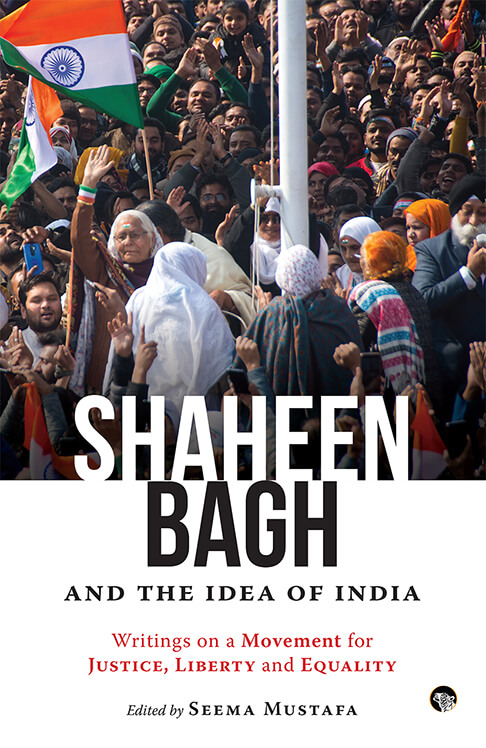
Title: Shaheen Bagh and the Idea of India: Writings on a Movement for Justice, Liberty and Equality

Editor: Seema Mustafa

Publisher: Speaking Tiger Books, 2020

Shaheen Bagh is a compendium of writings that document and comment on a watershed moment in India’s history, evoking memories of that other flashpoint in India’s history, the Partition. For Nayantara Sahgal, the nonagenarian writer, it is all too reminiscent of that other critical event in Indian history. Narrated and recounted by journalists, writers, social and political activists, it represents both the uniqueness of that moment when a movement propelled by one of the most dispossessed groups in Indian history took up cudgels on behalf of their communities, the men in their communities. It was a registering of both solidarity and political awareness, capturing moments of protest in a tone that was at times exhilarating, at times despairing.

The narrative incorporates the accounts of various women protestors who recount that significant moment when they were catapulted into assuming  unexpected and unlikely roles as torchbearers of democracy and custodians of democratic rights of citizenship. Shaheen Bagh, a Muslim neighbourhood in the capital city of Delhi in India became the epicentre of an unprecedented protest, an unbroken continuous sitting for over 70 days by citizens with Muslim women coming out in large numbers against the Citizenship Amendment Act adopted with a huge majority by the national parliament in December 2019 and also the National Register of Citizens, a notified national population register perceived rightly or wrongly to be hugely discriminatory against the Muslims and some marginalised groups. The CAA or the Citizenship Amendment Act is also perceived and presented by sections of the population as violating the spirit of the Indian Constitution adopted in 1950 as a sovereign democratic republic with the preamble adding the word ‘secular’, distinguishing it from a theocracy in 1976. The government however has refuted these claims and fears and with the counter claim that the CAA is only intended to grant citizenship to migrants, read as persecuted minorities, Hindu, Sikh, Buddhist, Christian and Parsi communities who came to the country from Pakistan, Bangladesh and Afghanistan on or before December 31st, 2014. Clearly the Muslims of all sects have been kept out of this particular dispensation. Just to remind us all, India has 11% of the world’s Muslim population around 16% of the Indian population , at least 226million of one billion population are Muslim. Interestingly the Supreme Court of India has refused to order a stay on its implementation which has been requested by about 144 petitioners and has granted the government time to come up with a response. It has also restrained other courts, the high courts for example from hearing please against the CAA till it arrives at a decision to take it forward.

Shaheen Bagh captured the imagination of the youth in India and of women’s groups in particular. India is still a young country, 50% of its population is below the age of 25, 65% below 35 years of age. The people that converge here everyday in large numbers are young women. Shaheen Bagh evokes memories of earlier resistances that the world has witnessed or known. US campuses against the Vietnam war, Occupy Wall Street, Tiananmen Square, Ken State University, Tahrir Square, the student uprising in Paris in the 60’s closer home to the US Montgomery March and Nashville Tennessee. But this was all that and more as many women  in burkhas and  hijabs crossed several boundaries, broke several barriers and some even stepped out of conservative homes and conventional customs and taboos for the first time in a civil disobedience vigil to uphold the values of equality and freedoms enshrined in articles 15 and 19 of the Indian Constitution. Placards that these women used often said: ‘Don’t be silent but don’t be violent’.

As the Introduction to the book Shaheen Bagh and the Idea of India pithily states: Shaheen Bagh became a “first in living memory. As the days passed, Shaheen Bagh acquired greater strength, for the women ,” brought no malice, no anger, no abuse into their protest, and countered every allegation hurled at them with a smile and an honest and forthright response. Moreover, “the idea of Shaheen Bagh ignited, and became, the idea of India for hundreds, because the women sitting in protest spoke a language that came from the compassion of the matriarch.   It was born of the love for children, and brought with it a smile and an embrace for the youth who spent the nights sitting and singing with the women.”

In the process, the protest empowered women. They played an agential role in the proceedings and the experience helped to develop their confidence in their own abilities, in their judgment and their decisions.  There was never any doubt that the women were in the lead. They were sitting on protest, they commanded the stage, they spoke to the media.

Shaheen Bagh became the site of a major exercise in the dance of democracy. It became a site which enabled and catalysed a kind of consciousness-raising for both the participants and the witnesses. While I would stop short of calling it a great leveller, it offered a kind of space for forging solidarities, of experiencing community and of practising democracy. Shaheen Bagh assumed a unique significance since it presented a vignette of inclusiveness from the start. “There was no religion or caste here. “

In a somewhat romanticised vein, a scholar who had spent a substantial chunk of time in Delhi , described it as a  “pilgrimage’’ for many Delhiites. A young professor from Delhi University  who spent time at the protest site said that “I come to Shaheen Bagh whenever the world outside depresses me. I find solace and peace here.” Whether to seek social salvation or rub shoulders with the Delhi literati, who were also here  from time to time, Shaheen Bagh represented an experience of democracy that few had imagined possible in the gloom and doom of our recent history. Many privileged youngsters also joined the milling groups around the protest site, preferring to savour this experience over their usual modes of entertainment. Some sat with the women as they collectively , and in solidarity, sang Faiz’s song, “Hum Dekhenge” ( “We shall see” in Urdu and Hindi) a stirring anthem raising a flag to unity and harmony .  All axes of identity — religion, castes, class — seemed to recede and fade in this space that helped  “Delhi find its conscience”. The moment seemed to resonate with other similar moments in the course of the freedom struggle. This laying claim to democracy and its variegated symbols by lower and lower middle class Muslim women, people  who were probably among the most dispossessed and marginalised groups, and among the most disaffiliated from the lineages of class and economic power, struck a chord. The question that had come up here was an enormously significant one: to whom does the nation belong?
The book captures the mood-defiant yet resolute-of the protest told in a racy journalistic idiom, conveying both its political implications and its historical significance. The mood of the nation — which was simmering with rabble — rousing hate speeches the order of the day and condoned and overlooked by the ruling dispensation, was brought to a boil by the unlikely protestors of Shaheen Bagh. Wearing their hijabs and burkhas in February 2020, the unlikely political actors of this moment were also making “history” or “herstory”. It was a unique moment of historical significance, as the women fought their numerous fears and limitations. It was also a moment of political and feminist assertion with women occupying the centre, not huddling on the margins or periphery.

The segment, ‘Timeline’ , covers the chronology and clarifies that it was the deliberately rigged  Delhi riots and then the lockdown in March 2020 that brought the gathering of crowds to a grinding halt. Seema Pasha’s chapter on ‘Women , Violence and Democracy’ presents witness and participant accounts as “Ground Reports from a Protest. “This engagement with people  and facts on the ground, the micro-histories of the protest constitutes one of the features which add to the readability of the book . Instead of an academic or theoretical approach, the book takes a lively “ankhon dekhi” (a vividly visual and engaging account, translated from Hindi) approach and this works well. In addition to this is the fact that the book brings in voices and narrative accounts  of some sane voices like that of Harsh Mander — of writers and activists– who represent a holistic and secular, democratic and not divisive, vision of Indian history and democracy. Collectively, these voices maybe said to articulate a vision which upholds an “idea of India” which is not idealised or utopic but reflects the vision of many of its founding fathers. It is in that vein that Seemi Pasha writes, that in spite of the terror unleashed in the run-up to the Delhi Assembly elections, “Shaheen Bagh endured, and continued to showcase the best of India’s tradition of secularism, liberalism and ethical, non-violent resistance.” It was a reminder that the idea of India was premised on a vision of democracy and freedom, which stands threatened  today. Shaheen Bagh was an attempt at reclaiming some of these affirmations which are in grave danger of erosion and violation.

Moving and poignant,the book is both a testimony and paean  to a beleaguered  idea  of India, as it is to the courage of  some of its marginalised citizens. It is also an interrogation of the protectors and ‘custodians’ of India and the idea of India.Till we all wake up to an awareness of our roles as active citizens, the idea of India continues to be a threatened and endangered  one.

Acknowledgements

The discussion of the CAA-NRC is drawn from Dr Meenakshi Gopinath’s observations as part of a feminist conversation on Shaheen Bagh and Citizenship, conducted under the aegis of the “International Feminist Journal of Politics.”

Dr Meenakshi Malhotra is Associate Professor in English at Hansraj College, University of Delhi. She  has edited two books on Women and Lifewriting, Representing the Self and Claiming the I, in addition  to numerous published articles on gender and/in literature and feminist theory. Some of her recent publications include articles on lifewriting as an archive for GWSS, Women and Gender Studies in  India: Crossings (Routledge,2019),on ‘’The Engendering of Hurt’’  in The State of Hurt, (Sage,2016) ,on Kali in Unveiling Desire,(Rutgers University Press,2018) and ‘Ecofeminism and its Discontents’ (Primus,2018). She has been a part of the curriculum framing team for masters programme in Women and gender Studies at Indira Gandhi National Open University(IGNOU) and in Ambedkar University, Delhi and has also been an editorial consultant for ICSE textbooks (Grades1-8) with Pearson publishers. She has recently taught a course as a visiting fellow in Grinnell College, Iowa. She has bylines in Kitaab and Book review.

.

PLEASE NOTE: ARTICLES CAN ONLY BE REPRODUCED IN OTHER SITES WITH DUE ACKNOWLEDGEMENT TO BORDERLESS JOURNAL.