Categories
Slices from Life

Historical Accuracy

By Ravibala Shenoy

 “He was badly beaten in lockup, denied medicine, and died soon after,” my cousin writes in his article on our Uncle Anand in a local Indian publication.

 “Uncle A. died of dysentery,” I respond via WhatsApp. “He was only eleven or twelve. Not fourteen as you state. And my father was eight at the time. It says so in my father’s writings.” Later in life, my father had kept notes on his brother’s death.

My cousin hesitated. “I have it on the evidence of Aunt S.,” Aunt S. is our only surviving relative from that generation. “She told me that the police warned our grandfather, that they were watching Uncle A. They finally arrested him. They threatened our grandfather into silence.”

 “With all due deference,” I say, because my cousin is nine years older than me, “Aunt S. was just a few weeks old in August 1930. She hardly counts as an eyewitness. And neither you nor I were alive then.”

1930 was the year of Mahatma Gandhi’s civil disobedience movement. Mahatma Gandhi led the fight for independence from the British Empire by nonviolent means. Even in the small coastal town of Karwar, men and women joined in the struggle. Uncle A. with a natural flair for leadership organised the monkey brigade” that was made up of youngsters. Townspeople hinted to my grandfather that his son, who was leading boys and girls every morning in the dawn marches, was perhaps neglecting his studies. To which my grandfather replied that his son was very smart and secured the first rank in class.

These dawn marches were accompanied by stirring patriotic songs, punctuated by lusty salutations to Mother India, Mahatma Gandhi, and Jawaharlal Nehru. Boys and girls accompanied Uncle Anand to the sea to produce salt out of seawater in defiance of the law. Making salt was a government monopoly. The spirit of swadeshi, of boycotting foreign goods for domestic ones, was in the air and Uncle A. learned how to make soap and taught it to others. He acquired a spinning wheel and showed his family how to spin cotton into yarn on a spindle. The finished yarn was mailed by Uncle A. in a parcel to the handlooms of Nandangadda.

The movement slackened a bit with the advent of the monsoons, and then in August 1930, Karwar was struck for the first time by an epidemic of dysentery.

I write to my cousin, “Uncle A. was not arrested or beaten. He was the first one to contract dysentery. Would you like to see my father’s writings?”

Dysentery was still an unfamiliar disease for the doctors in Karwar. The family doctor was very competent, and he gave Uncle A. the best treatment he knew. There were no antibiotics then. The family doctor believed that another doctor had the penicillin that could save Uncle A. He asked our grandfather to approach him, but the second doctor did not oblige. It was alleged that he was saving it for his own patients. (Our grandfather never forgave this second doctor.) Perhaps he never had any penicillin in the first place.

In the night of the fourth day of the attack, Uncle Anand died. Unexpectedly, the cloth made of yarn that he had spun arrived from Nandangadda on the morning of the funeral. It covered his body like a shroud as he was led to the cremation ground. The town held a large public meeting to mourn the death of Uncle A.

Several people died in the epidemic. My father also had a long brush with the disease, but he survived because this time the family doctor was able to acquire the penicillin.

I wonder why my cousin wants to falsify facts and revise history because that often results in making people believe none of it. This is how myths are born. Was dying from police brutality more tragic or glamorous than dying of dysentery? To me this was like an important intervention between historiography and the “woke” debate.

My cousin resents my contradicting him. Did I, a girl, albeit a grandmother now, younger than him, dare impugn his credibility? I was the unpatriotic one, removed from her heritage, a U.S. citizen who lived in the West with a westernized preciosity that downplayed the brave deeds of Indian patriots. How could I know better?

 My beef with my cousin is that he doesn’t check his facts and seeks out the sensational. My cousin’s “facts” came via an aunt whose information was based on hearsay because my grandparents never spoke of the tragedy that had befallen them.

In my cousin’s defense, I must admit that I have my biases too: I hero-worship my father and regard him as the custodian of historical truth; could he have overlooked the arrest and police brutality in recording his brother’s short but heroic life? My father’s memory could just as easily have been distorted.

I also had a grievance. On my ninth birthday, my cousin had snatched my new water colour set before I even had a chance to open it and mixed up the coral with the ultramarine and the white with the green. Maybe I found it hard to believe him.

We are in agreement on one point: that my grandparents could never bear to utter Uncle A.’s name again. His name “Anand” meant “joy”—and after his death the word was forevermore excised from their vocabulary.

Once, during one of my subsequent visits to Karwar, I came across a concrete till. It stood in the shadow of the road, at some distance from my grandparents’ house. The till had a slit for coins, and a sign asking for donations for the oil needed to light the lamp for the Brahma. The Brahma was believed to be the spirit of an unmarried Brahmin youth who haunted peepul trees and coconut palms. I suspect this was a ghost that predated Uncle A.

Then it struck me. The reason for the lamp for the Brahma was to memorialise the dead so that they were not forgotten. It was a way of bearing witness to their lives and the unrealised potential of their lives. Similarly, my cousin’s write-up on Uncle Anand was like a lamp that had been lit to rescue his memory from the jaws of oblivion. If some facts had been embellished for a “good story,” it was all part of the homage.

Ravibala Shenoy has published award-winning short stories, short stories, flash fiction, memoir, and op-ed pieces. She was a former librarian and book reviewer, who lives in Chicago.

.

PLEASE NOTE: ARTICLES CAN ONLY BE REPRODUCED IN OTHER SITES WITH DUE ACKNOWLEDGEMENT TO BORDERLESS JOURNAL

Categories
Pirate Poems

Pirate Blackarn Meets Neptune

By Jay Nicholls

PIRATE BLACKTARN MEETS NEPTUNE


Pirate Blacktarn, Terror of the Lemon Seas 
Swung in his hammock, taking his ease. 
The sea was calm and the day was hazy,
The pirate ship’s crew were feeling lazy. 

“But look,” said Fay, “what’s happening there?”
She pointed her finger and the crew turned to stare.
All except Blacktarn, whose eyes began to close. 
His head began to nod and he fell into a doze. 

“WOW!” cried the crew, “look, look, LOOK!” 
“What can be happening?” asked Big Bob the Cook. 
“Don’t make a noise when you know I’m having a nap, 
I must get my rest,” said Blacktarn with a snap. 

“But the sea’s gone purple and now it’s turning gold, 
Oh come on Captain, don’t wait to be told. 
Look how now the sea’s bright orange 
It’s so mysterious and strange.”
“Oh do stop bothering me,” said Blacktarn, very cross. 

“But the seabirds have gathered, even the albatross. 
And the dolphins are dancing and the flying fish are leaping. 
Oh Captain Blacktarn, do stop sleeping. 
Hey, do you hear all that wonderful singing?
The sea nymphs are chanting and the Mer bells are ringing. 
See all that spray? It’s the great whales blowing. 
And look, now watch, how the whole sea is glowing.”

Rising from the ocean, a figure started to appear 
Waving a trident, a huge three-pronged spear. 
His hair was green as seaweed and he wore a starfish crown
And he rode a giant seahorse which danced up and down. 

“I know who it is,” squawked Tim Parrot, all excited.
It’s Neptune, the sea god,” cried Bosun Mick, delighted.
And all Blacktarn’s crew roared out a great big cheer.
For every creature of the Lemon Sea was here, 
All waiting to greet Neptune, the sea’s great Lord,
All except Blacktarn, who just snored and snored and snored.

“I think he’s coming here,” gasped Stowaway Fay
For the great god Neptune was riding their way.
“Captain Blacktarn, you must be ready to meet him.
Neptune is here, quick, wake up and greet him.”

“Neptune,” muttered Blacktarn, “don’t be ridiculous. 
Neptune’s just a fairy tale, rather like St Nicholas.”

“No, no, he’s here Captain,” cried Mick in alarm. 
Come on, wake up now, it’s no time for calm.”

But Blacktarn closed his eyes again and sank into a slumber 
And Neptune gave a grin, for he’d got Blacktarn’s number. 
He borrowed a big feather from a seagull’s long grey wing 
And tickled Blacktarn’s nose, till soon he started blinking. 

“Go away,” huffed the Pirate, pushing the feather aside. 
Then all of a sudden, he opened his eyes wide.

“NNN Neptune! 
I thought you were a fairy tale but now I see I’m wrong. 
PPP please don’t prod me with that scary prong.” 
But Neptune hooked his trident fast on Blacktarn’s braces. 
“Now you pirate, let’s have no more airs and graces” 
He told the dangling captain in a very firm way. 
“This is a poor welcome, I’m very sorry to say. 
But as I’m in a good mood, you have a chance to please me. 
For the reason I’m visiting this lovely Lemon Sea 
Is most of all because I want a special cup of tea. 
I’ve heard from the mermaids that the finest brew to savour
Is made from water with that special lemon flavour. 
So now if you make me a special cup of tea
I might just forgive your lack of courtesy.” 

“Of course,” stuttered Blacktarn, “if you’ll just put me down.”
So Big Bob brewed the tea, all hot and strong and brown. 
“This is what I’ve been wanting,” said Blacktarn with glee
And now I think it’s time we had a tea party.”

So they had the best of parties, right there on the ship.
There was lemon tea and grog, rock buns and seaweed dip. 
Stowaway Fay did daring acrobatics
And Rakesh the mate did magic tricks.
Mick danced a jig and Tim Parrot squawked a solo
Which shivered the timbers, above and below.
Blacktarn cheered up and played the perfect host
Even though the sea horse ate all his toast.

And Neptune beamed a lot and enjoyed himself no end 
“Well I’ve had such a good time, I could happily spend 
Many days on your good ship but sadly I must go. 
I have important business in the deep ocean below.”
And lifting his trident high, he left them with a sigh.
Back into the sea he plunged, waving them goodbye.

“Goodbye,” called the seabirds, the dolphins and the whales,
“Goodbye,” called the Mermaids, swishing their tails.
“Well I’m glad I invited him,” said Blacktarn looking smug. 
Now it’s time to sail again – oh Neptune’s gone off with my mug!”

Note: The ‘Pirate Blacktarn’ poems were written in the early 1990s but were never submitted anywhere or shown to anyone. By lucky chance they were recently rescued from a floppy disc that had lain in the bottom of a box for almost thirty years. There are twelve poems in the series but no indication as to what order they were written in and the author no longer remembers. However, they seem to work well when read in any order. They all feature the same cast of characters, the eponymous pirate and his crew, including a stowaway and an intelligent parrot. The stories told by the poems are set on a fictional body of water named the Lemon Sea. (Dug up by Rhys Hughes from the bottom of an abandoned treasure chest).

Jay Nicholls was born in England and graduated with a degree in English Literature. She has worked in academia for many years in various student support roles, including counselling and careers. She has written poetry most of her life but has rarely submitted it for publication.

.

PLEASE NOTE: ARTICLES CAN ONLY BE REPRODUCED IN OTHER SITES WITH DUE ACKNOWLEDGEMENT TO BORDERLESS JOURNAL

Categories
Essay

Where Sands Drift Back in Time…

Shernaz Wadia explores Western Australia

The aquamarine Indian Ocean shimmered to our left on this sunny day along the drive up north from Perth. There was vague comfort in the thought that it connected us to distant India. This picturesque drive would take us to Lancelin, a small town about 129 kms. north of Perth, approximately an hour and half away. Its biggest attractions are the sand dunes and the sand boarding. As we drew closer to the small town, we passed by many small dunes They were so far from the ocean with tracts of shrub-land on both sides and the highway running through the middle that they seemed like freaks of nature.

From here it was another 3-km drive to the dunes. There was a car park at the entrance but we risked our jeep through the flat, stony terrain to park closer to the dunes and went the next bit on foot. The path was narrow. Having left all footwear in the car our bare soles were chafed walking the few meters of pebbly, coarse path to our destination. But voila! We rounded a bend and it seemed that someone had waved a magic wand!

Simply Stunning! Photo Courtesy: Daisy Wadia and Rajeev Ghodke

Snow white, wind-chiselled dunes rose up over silk soft sand that widened in an undulating carpet. The ocean glittered and foamed some distance away below an azure sky dotted with white clouds; and a wide, lush green strip acted as a barrier between the surf and the dunes. The snowy dunes stood lofty. Reaching the top could be quite a task with a sand board in hand as feet kept sinking into the cool sands! With effort, we managed the yielding surface as we climbed up a mound. Caps and hats blew off. Bare headed at the mercy of the cobalt sky, we lumbered up. But once on top, the panorama took our breath away more than the climb!

‘Have A Chat General Store’ on 104 Gingin Road in the town centre, hired out sand boards. Other than boards, there were buggies, quads, 4WD cars and motorcycles to zip up, down and around the dunes.

Sliding down appeared to be a lot of fun for adults and children alike but climbing back up the steep incline took the wind out of many. For those not quite physically fit, (which I wasn’t) this could be very daunting.

Sand Boarding. Photo Courtesy: Daisy Wadia and Rajeev Ghodke

Much as we would have loved to spend more time on the dunes, a merciless wind forced us to pack and leave. It blew sand into our eyes (we had sunglasses on), nose, ears, hair and even inside our well protected cell phones. The battery later had to be removed to blow out the fine grains. It was worth it, nonetheless.

Photo Courtesy: Daisy Wadia and Rajeev Ghodke

From the sand dunes we drove further north on this one day trip. Along the way, most of the vegetation was stunted. But flowering trees dotted the wayside to cheer us en route to the amazing desert of ancient limestone pillars, scattered across approximately 190 hectares, 60 meters above sea level and just a short distance away from the ocean. Coming upon this alien looking place, with its millennia old history, one’s reaction could only be of reverent awe. It was nature — raw and unrefined — a gateway into the unknown.

These limestone formations were within Nambung National Park, near the town of Cervantes. August to October was the best time to visit the Pinnacles. The weather was mild, wattles and wildflowers welcomed us. One could drive right into the desert, along a four-meter loop carefully demarcated with stones. There were delineated parking spaces where one could stop to roam among these pillars and enjoy a richer experience of the astounding landscape. They have been rightly nicknamed “The Rock Stars of the Outback”. These fragile structures demand to be treated with respect. The raw materials that went into forming these pillars were lime-rich sand and ancient sea-shells, but there are three theories regarding their formation and no consensus has been reached so far.

A diminutive view of the vast Pinnacles desert. Photo Courtesy: Daisy Wadia and Rajeev Ghodke

This millennia-old site, about 60 meters above sea level, evokes veneration. Thousands of the mystifying columns rise above a yellow shifting sand bed. Many of them daunt at 3.5 to 5 meters in height, some with jagged points and others mushroom-like with rounded, hard, calcrete caps that protect the frail formations. It is harder than the limestone below it and so takes longer to erode.

These Pinnacles and their surroundings are a very significant region for the traditional owners of the land, the aboriginal people. The aboriginals who inhabited this region were named the Nyoongar. A river called ‘Nambung’, meaning ‘crooked’, weaves through the region. The Pinnacles are sacred to the local tribe. During the wet season, the Nambung River made a chain of waterholes throughout the park, with the water flowing into the cave systems. These cave waterholes became essential for the survival of the tribe for hundreds of years.

There are many myths surrounding the region, with the local aboriginal people stating the large rock formations were the remains of fossilised ghosts. They were said to be young men who had wandered into the forbidden desert which was sacred and reserved for women. The gods punished them by burying them alive and leaving behind only their standing limestone figures.

It continues treated as a significant region for women, with many women groups gathering together in the desert to do traditional ceremonies, give birth, and camp beneath the stars.

The spectacular desert with its shrubbery is home to many native birds and animals like emus, black-shouldered kite, white-tailed black cockatoos, sand goannas, grey kangaroos, carpet pythons, bobtail lizards and more. Unfortunately we did not spot any of these. A visit to the Pinnacles Desert Discovery Centre, at the edge of the yellow sands gave us an idea of some of these splendid creatures through photos and taxidermy mounts. It also explained the geology of the formations and the cultural and natural heritage values of the area with soundscapes, videos and objects.

Photo Courtesy: Daisy Wadia and Rajeev Ghodke

Wandering among these ancient sage-like structures is to expand the margins of oneself and slide into a meditative trance; into a strange beyond. The ego slinks away; only deep awe fills the mind and spirit.

Lake Thetis

Photo Courtesy: Daisy Wadia and Rajeev Ghodke

As we drove back towards Perth, we made one more stop for a tryst with ‘Living Fossils” the modern versions of our Earth’s most ancient life-forms: living marine stromatolites. The lake has a circumference of 1.2 metres, with an easy walking path looping around it. A walk down a gravel path and then up a boardwalk and one reaches the lookout platform which has good, informative and instructive sign posts, like this one.

Photo Courtesy: Daisy Wadia and Rajeev Ghodke

Lake Thetis is one of the few places on earth where stromatolites or living fossils are to be found. They are built by microbes called cyanobacteria which are similar to the earliest organisms that produced oxygen for subsequent life forms. They have been growing here for about 3500 years. These rocklike formations teem with micro-organisms that are invisible to the human eye but these living communities of varied residents have population densities of 3000 per square metre! Stromatolites are layered, while their microbial cousins Thrombolites, which are also found here, are clotted structures.  

Fragile Stromalites. Photo Courtesy: Daisy Wadia and Rajeev Ghodke

The stromatolites are our only doorway into the emergence of life way, way, back in cavernous time. A small piece of stromatolite is encoded with biological activity that is thousands of years old. This community is threatened by nutrient enrichment and physical crushing, so visitors are requested to keep off these extraordinary forms.

.

Shernaz Wadia regards reading and writing as an inward journey. Her work has been published in various anthologies and e-journals. She sometimes dabbles in short Japanese forms of poetry too.

.

PLEASE NOTE: ARTICLES CAN ONLY BE REPRODUCED IN OTHER SITES WITH DUE ACKNOWLEDGEMENT TO BORDERLESS JOURNAL

Categories
Musings Travel

The Ocean & Me

Meredith Stephens writes of her sailing adventures in South Australia

The international borders are finally opening, but we still hesitate to embark on overseas or even interstate travel. The travel ban has afforded us the opportunity to explore our home state of South Australia, which until now we have largely ignored. After so long remaining here in this drawn-out pandemic, and the constant uncertainty about changing travel requirements, we lack the courage to venture abroad again.

Just as well, because after our local hiking adventures to Eyre Peninsula and Yorke Peninsula, Alex announces that next we will be sailing to Kangaroo Island. We will stay at Brian and Rochelle’s shack on Emu Bay. Alex drives Verity and me down the Fleurieu Peninsula, south of Adelaide, until we reach Carrickalinga Beach. Alex has taught me how to hike, and now he wants to share his excitement about sailing. He spends time on the long drive to Carrickalinga testing me on my sailing vocabulary. I have learnt words such as ‘headsail’, ‘mainsail’ and ‘jennika’. (Well, I thought it was ‘jennika’, but Alex tells me it is ‘jenniker’.) Meanwhile we pass through the sleepy towns of Myponga and Yankalilla, each boasting country bakeries with an array of doughnuts, buns and pasties which I try to put out of my mind. We successfully navigate these towns without stopping and I make do by simply remembering the array of treats at a sumptuous cafe in Moonta from our last trip.

Photo Courtesy: Meredith Stephens

“Just wait a little longer,” Alex entreats me. Brian and Rochelle will have some really healthy food for us at their shack.

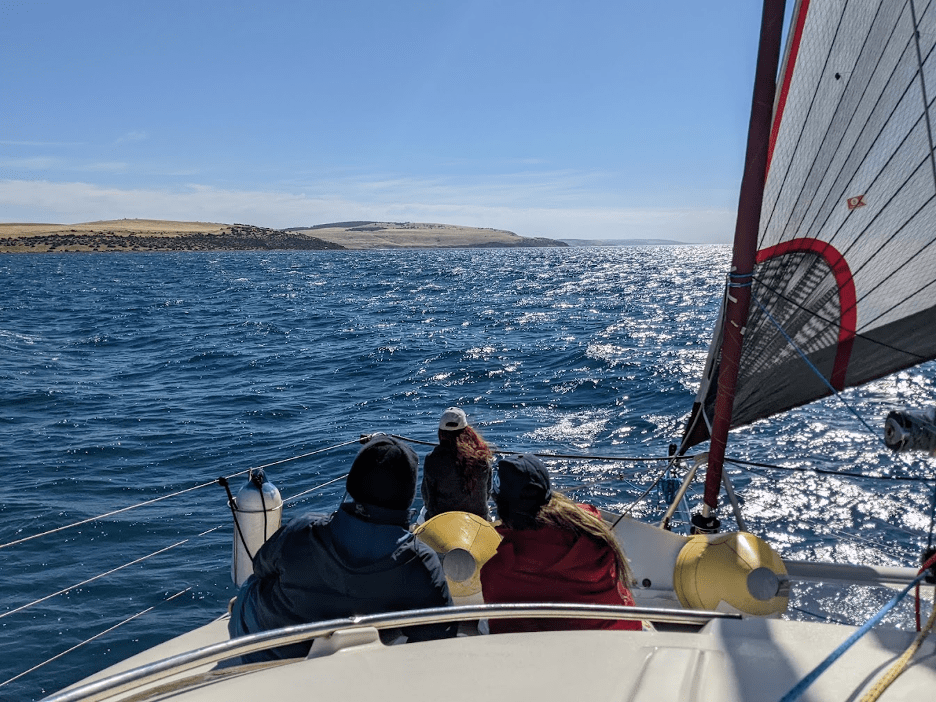
Brian and Rochelle are waiting for us at Carrickalinga with sparkling smiles and generous hugs. We maneuver ourselves and our luggage into the dinghy and head out to the boat. It’s moored in deeper water, and I have to scramble out of the dingy and onto the boat all the while making sure my laptop does not drop into the ocean depths. I clamber in and place the laptop inside the boat where it can’t get wet. Then I move outside to position myself at the bow where I sit with Brian and Rochelle. Alex is at the helm.

Photo Courtesy: Meredith Stephens

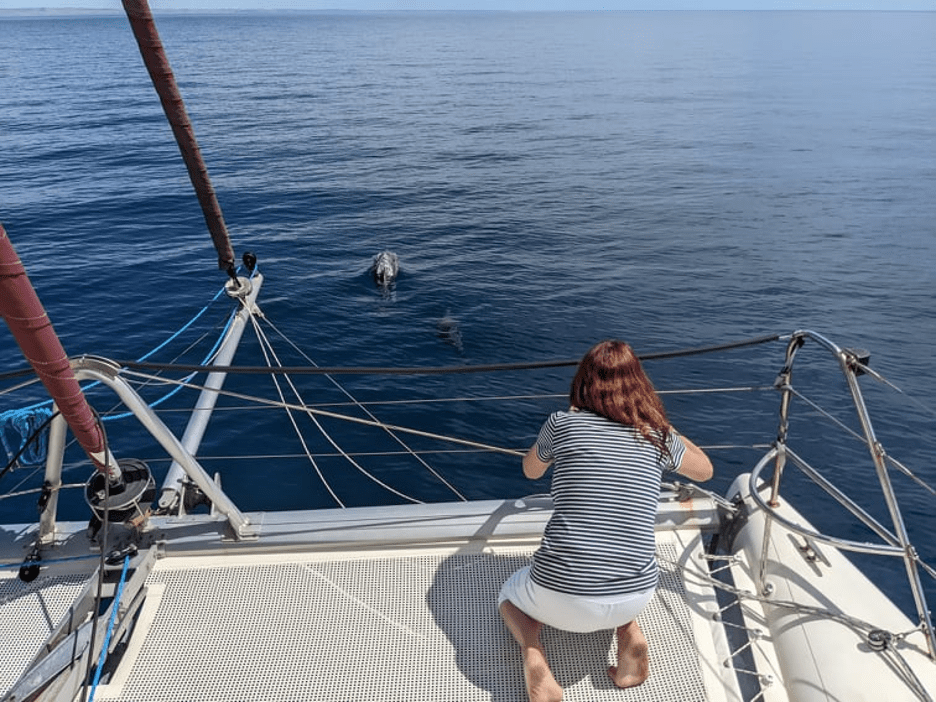
The others had busied themselves unfurling the sails but Alex tells me that my job is simply to look for dolphins. Before long five of them are approaching the front of the boat. They proudly swim in between the two hulls, gracefully easing themselves in perfect arcs in and out of the water to catch a breath. One turns her head around, her body at an angle, so we can make eye contact.

Photo Courtesy: Meredith Stephens

Once away from the shore and leaving the buffer of the hills, the wind picks up and Alex proudly announces that we are sailing at 16 knots. Carrickalinga has receded.

Photo Courtesy: Meredith Stephens

I sit at the bow for hours, trying to hide from the punishing Australian sun, wrapping my hair around my neck. It’s too choppy to risk walking along the side of the boat to retrieve my cotton scarf. Water splashes on my legs but I dare not move.

As the hours pass Emu Bay looms into view. We spot the bright yellow ball on the ocean surface which signals the mooring below. Alex directs the boat toward the ball while Brian extends a long pole towards it and hooks it up. He then drags it on the boat and tethers it to a cleat.

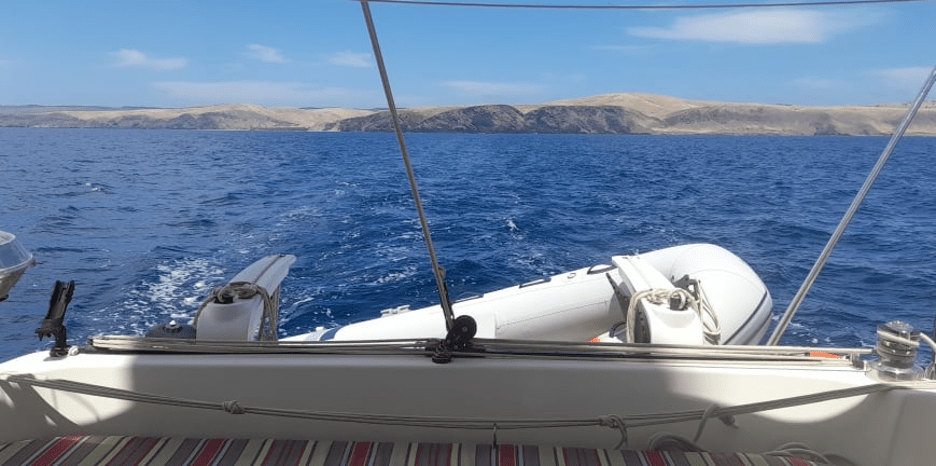
When alighting the boat onto the dinghy I will have to make sure once again my laptop does not drop into the ocean. Alex detaches the dinghy and loads our provisions onto the front end. Then he pulls the motor cord repeatedly but it does not start. Brian and Alex confer but the motor refuses to be coaxed back to life. The sun is retreating. I can see Brian and Rochelle’s shack on the coast tantalizingly close.

“Shall we paddle in?” I suggest.

“It’s a bit choppy,” explains Alex. “We could wait until the waters are calmer tomorrow morning. We could sleep on the boat.”

I yearn for a bed on dry land, but there are five of us and I have to consider what the others might want. We all seem to be concerned about imposing on the others. Verity comes up with a solution.

“Let’s have a secret ballot,” she suggests.

Verity tears up some paper into five pieces. We each write down our preference, “boat” or “shore”. I write “shore”. Rochelle seems to be taking a long time writing down her preference. Verity collects the pieces of paper and spreads them on the table. Two say “shore” and two say “boat”. The remaining one says “I don’t mind sleeping on either the boat or going to shore.” It’s evenly split. Meanwhile sunset continues to approach, the wind is picking up and the water starts to look foreboding. Could we safely put four adults and their luggage into a dinghy? Verity seems to have read my mind.

“I think Meredith wants to go ashore,” she announces.

“That’s our decision then,” confirms Alex. “We will paddle to shore in the dinghy.”

Alex asks Rochelle and me to hop into the dinghy. He places our laptops and phones in a waterproof bag. Brian enters next and Alex detaches the dinghy from the boat. Then we maneuver the dinghy close enough for Alex to slide in. Meanwhile, Verity kayaks to shore.

We each have a paddle, Rochelle and I on the left of the dinghy and Alex and Brian on the right. Alex identifies the safest place on the cove to reach land.

“Girls paddle harder,” he urges. “Meredith, you’ve got the paddle the wrong way around.”

I look down. Typically visually unobservant, I look down at my paddle and turn it around.

We labour, pulling the paddles more firmly and deeply, until we reach the rocks. We disembark and pick up our luggage. I gingerly tread over the craggy rocks in my sandals.

“Where’s the shack?” I ask Brian.

Brian points ever upwards. I follow the direction in which he is pointing and drag myself up in my wet sandals while carrying as many bags as I can. Finally we see the house on top of the hill, and gratefully allow Brian to usher us in. Brian immediately pours us some tonic water decorated with a slice of dried orange.

Photo Courtesy: Meredith Stephens

After nibbling on some nuts, cheese, hummus and crackers, Brian appears with home-made lentil burgers that he has revived from the freezer, topped with smashed avocado and haloumi. We devour these greedily as reward for our long sail and trek up the hill with luggage.

Photo Courtesy: Meredith Stephens

 I find myself enjoying a spacious bed with clean sheets. Sleep is as delicious and pleasurable as a drink when I am thirsty, or a longed-for meal when I am hungry. I savour these moments of the comfort of the bed and suddenly it appears to be morning.

The sunshine forces its way into my bedroom. The silence of the corner of this remote island is punctuated by the lively tones of Alex, Verity, Brian and Rochelle’s voices. How could they have recovered so quickly? Despite the sunshine penetrating my closed lids, I persist in a somnolence which is just as delicious as the evening before.

Meredith Stephens is an applied linguist in Japan. Her work has appeared in Transnational Literature, The Blue Nib, The Font – A Literary Journal for Language Teachers, The Journal of Literature in Language Teaching, The Writers’ and Readers’ MagazineReading in a Foreign Languageand in chapters in anthologies published by Demeter Press, Canada.

.

PLEASE NOTE: ARTICLES CAN ONLY BE REPRODUCED IN OTHER SITES WITH DUE ACKNOWLEDGEMENT TO BORDERLESS JOURNAL

Categories
Poetry

Robot Poems

By Rhys Hughes

BALL BEARINGS

My attitude is very caring
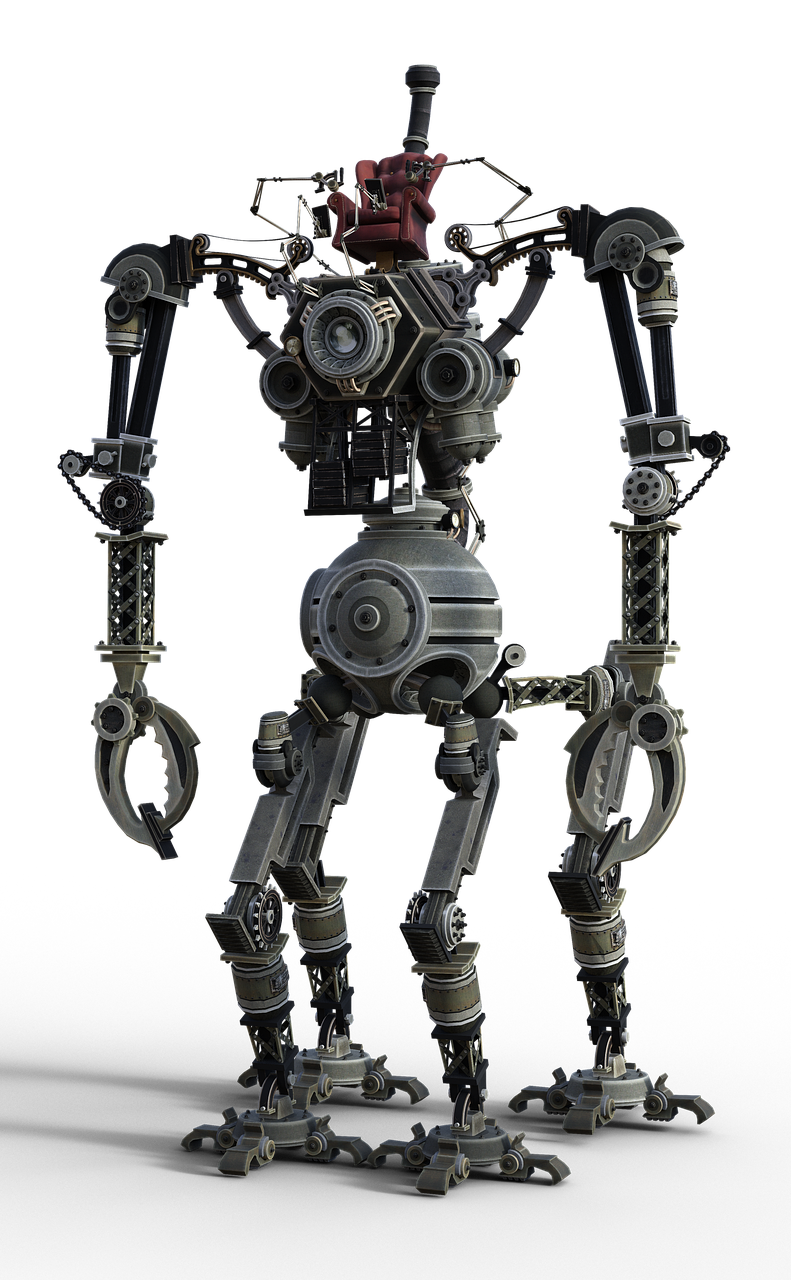
even to metal men
who come in sections.
Yes, I gave directions
to a robot today.
He was far out of his way
because he had
           lost his bearings.


ON MY SHOULDER

There’s a robot on my shoulder
and he’s looking rather older
as the rainy days rust him away.
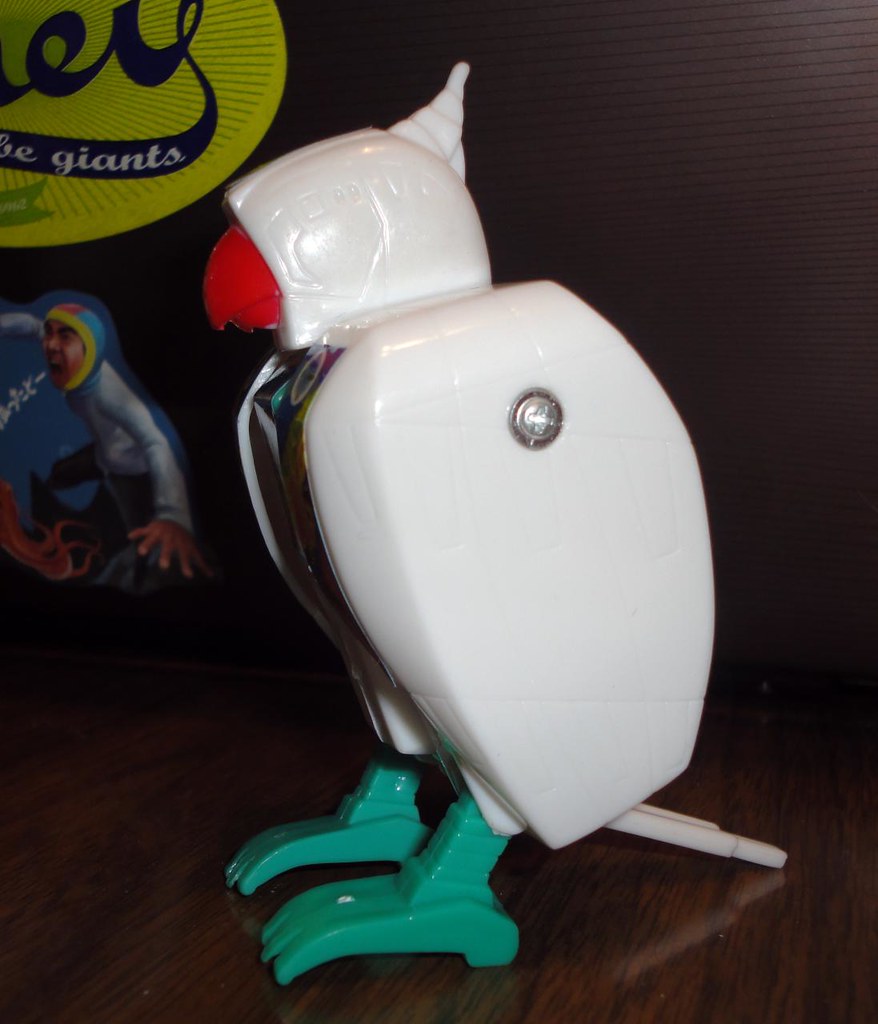
He’s an electromagnetic parrot
with an expensive taste in claret
who swears like a hasty sailor
on the rolling cobalt sine-waves
of the stormy feedback sea.
When we are both feeling bolder
I will send him to my tailor
for a suit of golden twine,
the risk of corrosion finally over
for that quantum chum of mine.


CLANKING FRANK

Clanking Frank
would like to thank
the technicians
who fixed his inputs
when they stopped working.
An android with
a battery leak
is afraid to speak
and answer the question:
Watt’s the matter
with you?
He will run out of juice
and never run again.
A powercut
is worse than a papercut
to a mechanical man
but Clanking Frank
continues to trundle
through the urban jungles
of the world,
going with the flow
of his own current.

Rhys Hughes has lived in many countries. He graduated as an engineer but currently works as a tutor of mathematics. Since his first book was published in 1995 he has had fifty other books published and his work has been translated into ten languages.

.

PLEASE NOTE: ARTICLES CAN ONLY BE REPRODUCED IN OTHER SITES WITH DUE ACKNOWLEDGEMENT TO BORDERLESS JOURNAL

Categories
Musings

Crotons

By Kavya R K    

The pandemic, I feel, has made us very contemplative. We’ve begun to ponder over subjects that range from the grave aspects of life to the most trivial ones. There is also this category of thoughts that belong somewhere in the middle. They usually begin as silly musings but gradually transform and align with thoughts of greater dimensions. Although I’m not sure where to classify my current thoughts, I think that this very ambiguity gives them a place in the middle.

I have never been a keen observer of gardens. I love to spend time in parks, but someone would usually accompany me, and we’d get immersed in conversation. This used to keep me off the pleasure of savouring the blossoms, even though their tempting fragrance had always seduced me. However, those visits used to be brief and the acquaintance temporary.

For some weeks now, I have been taking back-and-forth cycle rides in my courtyard; thanks to us, the ‘obedient’ citizens, and the lockdown. One such day, I chanced upon the front row of decorative plants in my home. Until then, I hadn’t really paid attention to these. I was aware only of the flowering plants, rose and hibiscus, which grew at the two corners of the front yard. Like any other hopeless romantic, I also had an affinity for these flowering plants. I used to have imaginary baby showers and baptism ceremonies every time they bore a new flower. Although these were at the relatively unnoticeable part of the house, I used to spare some time to visit them.

Now this front row, which suddenly came into being for my eyes, had some densely grown croton plants. I realised that it actually made up the lion’s share of our front yard. I looked at it for a while. The croton leaves have always appeared to me as too chaotic and flamboyant. They have seemed to me quite undisciplined and shabby, because of the multi-coloured large leaves. They somehow didn’t fit into the norms of beauty I was conditioned to believe in. I used to feel that they lacked the sort of uniformity and harmony that nature upheld; something which should have been ingrained in the hues they were blessed with. But that day, the croton leaves held a different attraction for me. The variegated leaves seemed to breathe out a serenity I had never imagined them to have. The leaves were nestled close to each other, in a wholesome embrace that seemed to shield them from all adversities. Designed and coloured differently, no two consecutive leaves looked alike. Yet, the way they held each other, the way they grew wide, and withstood the direst of heat and rains, I realised, is the zenith of harmony and togetherness.

As I pedaled back, my mind reverberated with the voice of the crotons that echoed the universal concept of peaceful co-existence. The kind that demands us to accept the uniqueness of all identities and modes of being. That which relishes every single hue in the spectrum of humanity. A life that no longer insists on blossoms but learns to cherish the beauty of the bloomless. And therefore, the one that reconnects us to the relentless potential of nature where all it takes to grow, is a perspectival change.

Kavya R K is a Research Scholar at The Department of Indian and World Literatures, The English and Foreign Languages University, Hyderabad. Her writings have been published in The Hindu Open Page, readingroomco.in , and in the anthology titled “100+ Splendid Voices“.

.

PLEASE NOTE: ARTICLES CAN ONLY BE REPRODUCED IN OTHER SITES WITH DUE ACKNOWLEDGEMENT TO BORDERLESS JOURNAL

Categories
Poetry

Sometimes, Losing is Winning

Written and translated from Korean by Ihlwha Choi

SOMETIMES, LOSING IS WINNING                              

All fights are not a war.
It's not necessary to win all battles.
In some, we do not win even if victorious.
I am willing to lose in that kind of fighting.
Although I lose in such a battle,
I will dance like broad leaved trees.

Losing can be a victory
in the fight which is not righteous.
But losing is not winning
if we must win inevitably.

My comrade has won.
He seemed to lose
but he won after all.

A fight is not the fighting itself
when victory is not won in the right way.
Though we do win doing our best,
now and then,
it's strictly not winning when we look back later.

Ihlwha Choi is a South Korean poet. He has published multiple poetry collections, such as Until the Time, When Our Love will Flourish, The Colour of Time, His Song and The Last Rehearsal.

.

PLEASE NOTE: ARTICLES CAN ONLY BE REPRODUCED IN OTHER SITES WITH DUE ACKNOWLEDGEMENT TO BORDERLESS JOURNAL

Categories
Bhaskar's Corner

Fakir Mohan: A Tribute

By Bhaskar Parichha

Fakir Mohan Senapati. Courtesy: Creative Commons

The 19th century Oriya novelist Fakir Mohan Senapati was a most oblique writer — he hardly said or meant anything in a straightforward manner. Much of his work is ironical and satirical, and of course irony and satire work through indirection, by way of the meaningful glance rather than the plainspoken word. Yet irony, while aiming to surprise, can sometimes be applied too predictably, and then it becomes as unsubtle as the more homespun narrative mode it disdains. Thankfully, this is not the case with Senapati: he worked with a very light and delicate hand.

-Chandrahas Choudhury (Author of ‘My Country is Literature–Adventures in the Reading Life’)

Father of modern Odia literature, Fakir Mohan Senapati’s birth anniversary is around the festival of Makar Sankranti (mid-January) every year. There are a bevy of festivals by various names celebrated across India during this period.

As a novelist, short story writer, poet, philosopher, social reformer and forerunner of Odia nationalism, Senapati (1843-1918) played a foremost role in establishing the distinct Odia identity. But for his sweat over a lifetime, Odia — which is today India’s sixth Classical language — wouldn’t have survived the onslaught by adjoining vernaculars. The life of Fakir Mohan is undeniably the story of the “resurgence” in Odia literature. He protected the Odia language from near extinction.  

Mallikashpur village of Balasore district neighbouring West Bengal is where Senapati began his formal education — when he was nine years old. Since he could not pay for his tutoring, he is said to have even worked at his teacher’s house to pay the fee. Balasore’s Mission School was his Alma Mater, and he went to become a teacher where he served until 1871. Still later, he rose to become the headteacher. Around this time, he started teaching Odia to the Balasore Collector John Beames. 

Fakir Mohan learnt English all by himself with the help of a dictionary. He readto read several famous classics — Arabian Nights, Robinson Crusoe, the English Bible, and Bengal Peasant Life by Lal Behari De — he started learning English at twenty-three. Fakir Mohan’s instinctive wisdom was recognised even by foreigners. 

The early life of Fakir Mohan was one of courage and dexterity.  His accomplishments were amazing. A multi-tasker, Fakir Mohan, even worked as a labourer in a port. He ventured into the wood and paper business having worked in a press only to become an editor. Besides being a teacher, Fakir Mohan became a dewan of Athagarh and later of Tekkali in Srikakulam district of Andhra Pradesh.

In the second phase of his life, Fakir Mohan worked as administrator in the princely states of Nilgiri, Dampada, Dhenkanal, Daspalla, Pallahara and Keonjhar. As a manager, Fakir Mohan was very efficient and successful. During Keonjhar Praja Meli (people’s agitation against the feudal lord), he escaped cleverly writing a symbolic letter to the king. 

Mayadhar Mansingh, another celebrated, Odia called Fakir Mohan the ‘Thomas Hardy of Odisha’. He had the ability and expertise in whatever arena he laid his hand on. These prodigious abilities were reflected in his later-day writings as well. Although Senapati translated from Sanskrit, wrote poetry, and tried numerous forms of literature, he is known primarily as the father of modern Odia fiction. His four novels, written between 1897 and 1915, mirror the socio-cultural conditions of Odisha during the eighteenth and the nineteenth centuries.

The time in which Fakir Mohan lived was the darkest period in the history of modern Odisha. The infamous ‘Naanka’ Famine of 1866 — which one third of the region’s population — hurt the economic and social condition of Odisha beyond recovery. The deprivation during this period has been documented in many of his stories and novels. In course of time, he emerged as a novelist of rare caliber not only in Odia but also in a pan-Indian setting.

Senapati’s Rebati (1898) – recently translated into thirty-six Indian and foreign languages — is widely recognised as the first Odia short story. It is the tale of a young innocent girl ‘Rebati’ whose desire for education in the context of a backward conservative society went beyond the ordinary. The village where the protagonist lived was hit by the killer epidemic, cholera. Rebati’s grandmother – the last survivor — believed that it was the craving for education that brought misfortune to the family. In fact, ‘Rebati’ was one of the earliest stories in the realm of world pandemic literature.

‘Randipua Ananta’ is a story of a very notorious, errant youth who in the end transforms himself. While the flood water entered the village through a hole of the river-embankment, Ananta pulled the wooden door of his house and covered the hole standing as the supporting pillar and asked villagers to pile soil onto it. Gradually, his body heaped-up up and at last he was buried. Ananta dedicated his life to the welfare of the village and was a rare character in the Odia short story genre. 

Dak Munshi (The PostMaster), ‘Sabhya Zamindar‘ (The Educated Feudal Lord), ‘Patent Medicine’, ‘Adharma Bitta‘ (The Ill-gotten Money) are the other famous stories for which Senapati is known far and wide. But, it is the   three novels — Chha Mana Atha Guntha  (Six and a third Acres,1902), Mamu (Maternal Uncle, 1913)and Prayaschita (Penance, 1915) — which have made  Senapati immortal because they explored the realities of community life in its manifold dimensions.

Chha Mana Atha Guntha is the first Indian novel to deal with the exploitation of landless peasantry by the feudal system. The importance of this novel is that it was written much before the October revolution and even before the emergence of Marxist ideas in India. Set in Orissa in the 1830s, it is about village politics, caste oppression, social malpractices, and land-grabbing under the zamindari system in colonial Odisha. Both a literary work and a historical document this novel provided a unique ‘view from below’ of Indian village life under colonial rule. Ten years after this novel came Mamu.

Prayaschita was the last of Fakir Mohan Senapati’s  ‘trilogy of crime and justice’ novels — to use the epithet coined by the eminent Senapati scholar John Boulton. It was published just three years before the death of Fakir Mohan. The novel is unique because it sheds light on Senapati’s increasingly dark and tragic perception of colonialism. The novel was a defender of the traditional values and the Hindu way of life which the writer saw was gravely threatened by an alien value system of the British which had made huge inroads into Indian society.

Lachhama is another novel by Senapati dealing with the anarchic conditions of Odisha in the wake of Maratha invasions during the eighteenth century. It narrates the historical romance of Rajput lady Lachhama and her husband Badal Singh, in the backdrop of the political disturbances between the Mughals and Marathas to gain supremacy in Odisha. The story is set in a period of early advent of the British in India during which Nawab Alivardi Khan was Governor of Bengal. The depiction of love, honor, courage and revenge of the woman protagonist Lachamma is significant.

Fakir Mohan also wrote the first-ever autobiography in Odia – Atma Jeevan Charita. It gives a socio-cultural account of Odisha along with the novelist’s own life spanning over half a century and makes for prodigious reading.

Senapati wrote a long poem, Utkal Bhramanam, in 1892. Literally meaning Tour of Odisha, this poem is not a travelogue but a commentary on the state of affairs of that time, written satirically. He has also translated the Mahabharata, the Gita, the Ramayana and Boudhavatar Kavya into simple Odia verse.

Fakir Mohan’s innovative technique, ineradicable characters, humour, imaginativeness, and the insights into the rural milieu had few parallels. His contribution to Odia language and its revival was immense.  

Senapati was a great genius, a versatile personality and an ardent literary artist who breathed his last on June 14, 1918, when Odisha hadn’t become a separate province for which Senapati fought relentlessly. He is unsurpassed and commands great respect among the authors. In the words of Dr. J.V. Boulton, Fakir Mohan is the Gorky of Odisha. The  Dhammapada estate conferred on him the enviable title Saraswati. He was also endowed with the title of Katha Samrat (Emperor of Fiction) and is rightly called Vyasakavi

His fiction and short stories reflected the theme of social realism, societal reform, and preservation of cultural values. Fakir Mohan dedicated his whole life to the development of the native language in the late 19th and changed the course of Odia literature.

Fakir Mohan is to Odia what Prem Chand is to Hindi and Rabindranath Tagore is to Bengali literature.

.

Bhaskar Parichha is a journalist and author of UnbiasedNo Strings Attached: Writings on Odisha and Biju Patnaik – A Political Biography. He lives in Bhubaneswar and writes bilingually. Besides writing for newspapers, he also reviews books on various media platforms.

.

PLEASE NOTE: ARTICLES CAN ONLY BE REPRODUCED IN OTHER SITES WITH DUE ACKNOWLEDGEMENT TO BORDERLESS JOURNAL

Categories
Poetry

Birds

By Vernon Daim

BIRDS

Tangled black ribbons knotting, 
Unknotting, in the fiery sunset sky.
Crossing seasons, the route in their blood.

Musical notation in mid-flight silhouettes,
Melancholic songs of lamentation,
Wind-teased susurration

Among mountains and along rivers
In countries broken and scarred.
See them return once again,

Wintering somewhere warm as blood,
Oblivious to unfolding bloodshed,
Altering borders on the map.

Vernon Daim is a Malaysian writer. His poems have appeared in local and international publications. As an English teacher, he has also presented papers at various ELT conferences.

.

PLEASE NOTE: ARTICLES CAN ONLY BE REPRODUCED IN OTHER SITES WITH DUE ACKNOWLEDGEMENT TO BORDERLESS JOURNAL

Categories
Stories

Folklore from Balochistan: The Pearl


Created from Balochi Folktales by Fazal Baloch


Once there lived a man who had three sons. He buried three pitchers full of gold coins in his home. Beside the gold coins he put a pearl into each pitcher. He was too old and eventually passed away. His sons knew about the pitchers. One day, thinking that his brothers were unaware of all the contents, the youngest son secretly stole a pearl from one of the pitchers.

Sometime after their father’s death, the sons decided to distribute their paternal inheritance amongst themselves. When they opened the pitchers, they found one pearl missing. “There must be a thief among us. Father must have distributed the wealth equally,” said the eldest brother. But all of them declared, they had not seen the pearl. At last, they decided to take the matter up with the king.

On their way to the palace, they noticed some footprints on the road. “It must be a woman”, said the eldest brother.

“She must have left her house after a quarrel,” said the middle brother.

“And she must be pregnant”, concluded the youngest brother.

After having covered some distance, they heard a man shouting behind. The man drew close and inquired if they had seen someone around. “Is she a woman?” asked the elder brother.

“Yes, she is,” replied the man.

“Did she leave her house in anger?” Asked the middle brother.

“Yes, she did,” so came the man’s reply.

“Is she pregnant?” asked the youngest brother.

“You are absolutely right. She is pregnant”

“We don’t have any idea where your wife has gone,” they told the man.

The man was shocked. “You know everything about my wife, you must have seen her.”

He warned them that he would drag them to the king’s court. As they were already on their way to the king’s court, they were willing to take up this issue too.

After covering some distance, they came across the footprints of a camel.

“I think there is honey in the basket the camel is carrying on its back,” remarked the eldest brother.

“I think the camel is pregnant.” So guessed the middle brother.

“I believe she is blind in one eye,” said the youngest brother.

In the meantime, a man came up to them and asked them if they had seen a camel.

“Is your camel carrying honey in a basket?”

“Yes, she is,” replied the man.

“Is your camel pregnant?” asked the younger brother.

“Of course, she is,” retorted the man.

“Is she blind in one eye?” asked the youngest brother.

“Yes indeed”, said the man.

“We haven’t seen your camel. Go and search for her yourself,” they told the man.

“How come you know each and every thing about the camel unless you have seen her? You must have stolen my camel.” He warned them that if they did not tell him the truth, he would drag them to the king’s court. As they were already on their way to the king’s court, they agreed to resolve this issue too there.

At the king’s court, the three brothers told the king the purpose of their visit and so did the two men. The king decided to give a hearing to the three brothers though it was late in the evening. At first, he turned to the eldest brother and asked him how he managed to identify the woman’s footprint. He replied: “A woman has a peculiar seating style on the ground. From the marks she left on the ground I assumed that was a woman”.

Then the king asked the middle brother that how he conjectured that the woman was pregnant. He replied: “I noticed the marks of her palms on the ground. She put her hands on the ground to stand up on her feet. I assumed she was pregnant as a pregnant woman always needs support to get up on her feet.”

Then the king turned to the youngest brother and asked him that how he concluded that the woman had left her house after a quarrel. He responded: “From her footprints, it was evident that after every few steps she turned back to see if somebody was following her. Hence, I speculated that she had left her house in rage.”

The king told the man that those three brothers possessed enormous wealth of wisdom and they asked him questions about his wife on the basis of their insight. He thus concluded that they were not the culprits.

Then the king asked the three brothers how they could precisely describe the features of the camel even without seeing it. The eldest brother said: “I noticed bees were buzzing on drops of honey along the track. Thus, I conjectured that the camel was carrying honey in the in a basket”.

The middle brother said: “I observed the branches of the trees along one side of the track were nibbled while the same on the other side remained untouched. Hence I concluded she was blind in one eye”.

The youngest brother, who had surmised the camel was pregnant, said: “A pregnant camel always has a frequent urge to urinate, and I noticed she had urinated at many spots. Thence, I concluded accordingly that the camel was pregnant”.

The man as well as the king were struck by the wisdom and insight of the three brothers. The king told the man to leave the palace and search for his camel.

Then the three brothers requested the king to help them settle their own dispute. The king kept quiet for a while and then said that his daughters would sort that one out. The king had three daughters, and each was wiser and more sagacious than the other. Thus, he put forth the details before his daughters. The eldest daughter said before identifying the thief she would want to determine how wise and shrewd they were.

She sent a messenger to the three brothers to ask them that what would they like to be served at dinner. They said that they wanted to be served pulao with meat. The food was prepared accordingly. The princess sat beside them. When they were done with the food, she asked them if they liked the food.

The eldest brother replied: “It was not too bad”. After a pause he continued, “The meat tasted like that of a dog.” The princess was taken aback. Without saying any word, she got up and strolled out.

She summoned the shepherd and asked him about the very goat. In reply the shepherd said, “At the time of birth, its mother eventually died, and I had it suckled from a bitch”.

Upon hearing this, the princess thought that she might not be able to tackle their problem. Hence, she informed the king that she couldn’t identify the thief.

Thenceforth, the king entrusted the task to the second daughter to detect the thief. She prepared food for them and sent seven loaves, seven pieces of meat and purified butter. She conveyed a message in an encoded language meant for the three brothers: “Seven worlds, with seven stars while the sky is covered with haze.” Midway through, the maidservant ate two loaves and the whole meat and the purified butter and handed over the reminder to the three brothers. She conveyed them princess message as well.

They ate food and asked the maidservant to convey their good wishes and kind regards to the princess. Moreover, they asked her to tell the princess that there were five skies, all clear and without stars. Upon hearing their message, the princess scolded the maidservant and asked her why she had consumed two of the loaves and the entire meat and purified butter meant for the brothers. The princess proceeded to the king and told him that the three brothers were amazingly clever and wise, and it was quite difficult for her to identify the thief among them.

Next day the three brothers went to the king’s court, The king was sitting with his youngest daughter, viziers, emirs and emissaries. The youngest princess turned to the three brothers and addressed them:

“Before trying to identify the thief, let tell me you a tale. The tale goes thus:

 “Once the daughter of a certain king was roaming about the garden. The gardener presented her some flowers. The princess asked him what she wanted in return. The gardener replied that he harboured no greed or lust in his heart. He just wanted her to pay him a visit before she would see her husband on her wedding night. The surprised princess looked at the gardener and after a little pause she said that she would surely see him.”

The princess continued, “On her wedding night she told her husband about the promise had made to the gardener and expressed her desire to see him to keep her word. The husband generously granted her permission, and she took the route to the garden. On her way she ran into a thief. He held her hand and told her that he would not let her go unless she gave him all her jewels. The princes pleaded with him that she was on her way to fulfil a promise, and if he would allow her to proceed, she would come back to see him. The thief too granted her permission and waited for her return.

“The princess visited the gardener and told him that she had come to keep her promise. The gardener showered her with prayers and good wishes for keeping her words. He gave her two gold coins as a gift and saw her off with affection.

“The princess made it back to the thief and told him to do whatever he liked to. The thief said that he would never think of robbing someone who kept their words. The princess at last made it back to her bridal chamber where the groom was waiting for her.”

The king, viziers, emirs and emissaries all attentively listened to the tale. When the princess finished the tale, she turned to the three brothers and asked them a question: “Of the three characters of this tale — the bride, the thief and the gardener, who do you think deserves appreciations the most?”

The eldest brother replied: “I think the bridegroom played the significant role in the tale by allowing his newly-wed bride to visit the gardener to keep her promise.”

The middle brother said: “I believe the gardener deserves eulogies as he gifted the princess two gold coins for honouring her promise.”

The youngest brother said: “I think thief’s role is duly praiseworthy because he refused to rob the princess bedecked with costly ornaments.”

After hearing the answers, the princess turned to the king and addressed him thus: “The thief has been identified. The eldest brother is a dignified and well-mannered man. He can never think of stealing something. The middle brother is a decent man with a kind heart. It is the youngest brother who committed the theft. He is obsessed with wealth and riches that is why he praised the thief. His words mirror his mind.”


(This is an assorted version of two Balochi folk tales “Barin Dozz Ke Beet” retold by Ghulam Jan Nawab and “Qeemati Gohar” retold by Wahid Bux Buzdar in Urdu from Shay Ragam’s Balochi version. These two tales are included in “Cher Andaren Neki” by Ghulam Jan Nawab and “Balochi Lok Kahaniyan by Wahid Bux Buzdar.)

Fazal Baloch is a Balochi writer and translator. He has translated many Balochi poems and short stories into English. His translations have been featured in Pakistani Literature published by Pakistan Academy of Letters and in the form of books and anthologies.

.

PLEASE NOTE: ARTICLES CAN ONLY BE REPRODUCED IN OTHER SITES WITH DUE ACKNOWLEDGEMENT TO BORDERLESS JOURNAL