Categories
Poetry

Poetry by Jason Ryberg

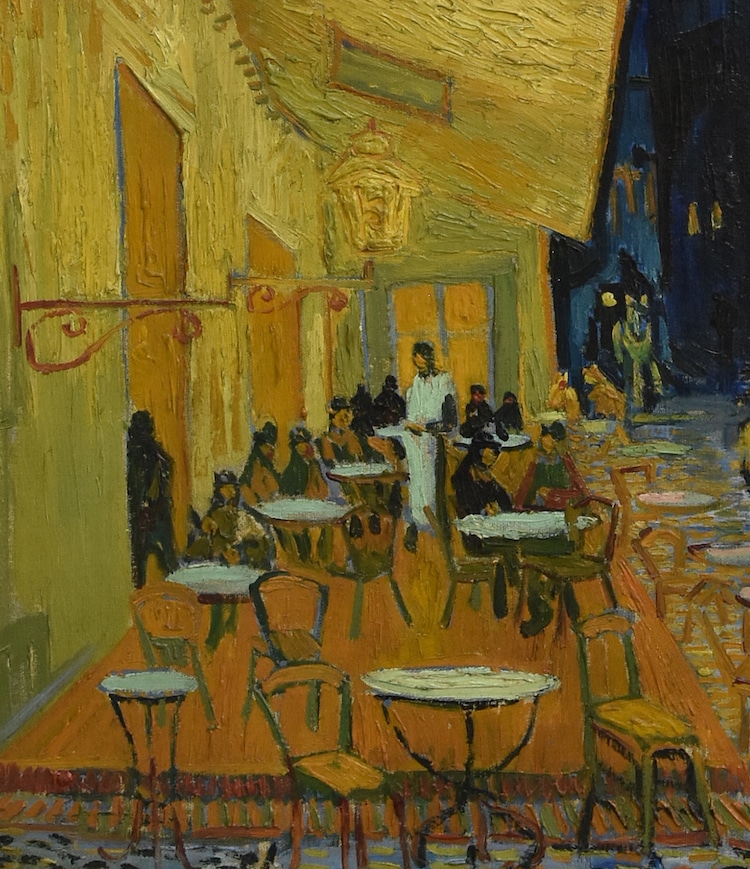
Cafe Terrace by Vincent Van Gogh (1853-1890) From Public Domain
MAKING THE ROUNDS 


You
can
see the
pink street lights
coming on at that
exact point where late afternoon
makes the exchange with early evening and you can
still smell the White Magnolias in the night wind
as it sweeps the sky clean of any last
clouds, and the streets are all deserted now except for
cats and crows and the odd patrol
car out making their
rounds. And some-
where
not
too
far
from here,
someone is
playing the cello.


ON-HOLD

Eight hours on-hold with
Public Assistance would make
the Dalai Lama
madder than a rattlesnake
caught in a hot clothes dryer.


NEVER GET OUT OF THE GODDAMN BOAT!
(Sleight Return)

It’s a wet, grey morning in mid-December, here in South
Central Missouri (the less fashionable foot-hills of the
Ozarks as it’s known by some), not exactly pouring, but
a fairly constant and consistent plip, plip, plipping, and not
exactly warm, but an unseasonably tropical 50-some-odd
degrees (almost balmy, you might say, for this time of year,
anyway) and I have only just woken from a strange surrealist
montage of dreams, broken by the sudden subterranean
trainyard rumble of thunder (though there haven’t been any
trains in these parts for decades); dreams of deer roaming
and snuffling, freely, through the sleeping streets of Kansas
City, Missouri, dreams of star charts on my inner eye- lids,
milk-white phantom dreams, blue-black storm dreams where-
in, every night, I go up the snaking circuit cable of the river,
and every night I get out of the boat and walk deep into the
sweating jungle to confront what must be my inner nemesis,
only to be stalked and devoured, again and again, by the
brightly burning tiger’s fearful symmetry.

Jason Ryberg is the author of eighteen books of poetry, six screenplays, a few short stories, a box full of folders, notebooks and scraps of paper that could one day be (loosely) construed as a novel, and, a couple of angry letters to various magazine and newspaper editors. He is currently an artist-in-residence at both The Prospero Institute of Disquieted P/o/e/t/i/c/s and the Osage Arts Community, and is an editor and designer at Spartan Books. His latest collection of poems is Kicking Up the Dust, Calling Down the Lightning (Grindstone Press, 2023). He lives part-time in Kansas City, MO with a rooster named Little Red and a Billy-goat named Giuseppe and part-time somewhere in the Ozarks, near the Gasconade River, where there are also many strange and wonderful woodland critters. 

PLEASE NOTE: ARTICLES CAN ONLY BE REPRODUCED IN OTHER SITES WITH DUE ACKNOWLEDGEMENT TO BORDERLESS JOURNAL. 

Click here to access the Borderless anthology, Monalisa No Longer Smiles

Click here to access Monalisa No Longer Smiles on Kindle Amazon International

Categories
Stories

A Queen is Crowned

By Farhanaz Rabbani

The grand images of a historic event flashed before her eyes, as 11-year-old Jui, flanked by her sisters, sat still in the dark hall of Gulistan Cinema Hall. There was a great buzz about the new Technicolor documentary on the coronation.

The week before she had heard her elder sisters, Ruby and Shelly trying to convince their mother to let them watch it at Gulistan. For an affluent wealthy Muslim family, allowing girls to watch movies outside was unheard of. But the matriarch of the family, Zubeida, was groomed in a different manner. Born of a renowned family in Munshiganj, she was educated at the Sakhawat Memorial Girl’s High School in the 1920s. Inspired by the values of the Bengali feminist writer and the founder of her school– Begum Rokeya Sakhawat Hossein, Zubeida was an avid reader and extremely aware of the social issues of her times. When she was married at the age of 14, her husband, a renowned physician, encouraged her to read at home.

Zubeida’s sons and daughters grew up reading the latest literary journals and novels written by legendary Bengali writers. Being the third daughter and the fourth among all the siblings, Jui was surrounded by casual conversations of the latest plays in town or the scintillating songs from the All India Radio. Her immediate elder sister Shelly was a huge fan of Dilip Kumar’s songs and was often seen pressing her right ear to the battery driven radio, swaying to the mellifluous melodies of S.D. Burman. But life was not all play in Zubeida’s home.

In the evenings, as soon as everyone completed their Maghrib prayers, the children had to study. Seven children had several different techniques of playing truant during this special time. The eldest son being an avid football player, would often stay away from home playing in tournaments for the Mohammedan team. The next child Ruby looked at life in a more serious manner. She sat on her table with the hurricane lamp illuminating her social studies book. But sometimes, Jui would often see books by Kamini Roy, or Ashutosh Mukherjee or Tagore hidden within the centrefold of the schoolbooks!

Once, their father had just returned from his medical chamber to catch Shelly pressing her right ear to the small battery driven radio intently listening to the latest Dilip Kumar song.

“Ruby’s Maa!” he exclaimed, “These girls will all get married to rickshawallas! All they do, every day, is to waste time. How will they ever pass their exams?”

 While the veteran patriarch was fuming in rage, Ruby’s Maa, Zubeida, appeared to be totally undisturbed by his lamentations. She never worried about the future. With her deep faith in God, she took life one day at a time,

Ruby and Shelly were intently looking at the screen transporting themselves to Westminster Hall amid all the grandeur of the Coronation. The sultry voice of Laurence Olivier wafted through the Cinema Hall of Gulistan as images of a sparkling crown being placed on the elegantly styled head of Queen Elizabeth II mesmerized the audience.

Zubeida, in her usual quiet persuasive way, had convinced her husband to give them permission to watch the famed documentary on the coronation of the new Queen — Elizabeth II. Abu Chacha– their darowan 1 went to great lengths to get 5 rickshaws for the journey from Naya Paltan to Gulistan.

The ladies adorned themselves in their best attires. The older daughters gave special care to apply their homemade surma2 on their eyes. The younger ones were just too excited to have a day out with the ladies of the household. Zubeida wore a beautiful cream coloured saree with a black border, the dark kohl accentuating her dreamy eyes, and she had mouthful of paan that made her lips ruby red. With a splash of attar, the ladies wearing saris got on the rickshaws– all veiled meticulously — so that passersby would not see their faces.

Abu Chacha was relegated with the noble duty of guarding the ladies–perched on a sixth rickshaw keeping track of the ladies at the front. As soon as Zubeida and her daughters reached Gulistan Cinema Hall, Abu Chacha stood on guard at the front of the Hall. He was not interested in the coronation of a foreigner. His life was not affected by the wonders of the colonial rulers. His only loyalty was for Doctor Sahib — who saved his mother from her deathbed. He would dedicate his life to the service of Doctor Sahib’s family.

Jui was silent– perhaps a little overwhelmed by the discipline and formality of the whole affair. She wondered if she would ever break away from the confines of her home and see the world outside. She was always the quiet one. Since she was not as robust as her sisters, she was considered to be docile and shy.  But the 11-year-old girl had a deep-rooted desire for breaking boundaries. The ornate gilded halls of Buckingham Palace flashed throughout the screen. Huge paintings framed in gold and the elegant procession of the Royal Guards clad in red and gold transported the audience to the glamour of the crowning of the new Queen of the United Kingdom. Jui, with her innate curiosity, watched the red canopy covering the Queen as she was anointed with holy oil. She had no idea about the significance of these actions. All she noticed was the splendour of a distant world – where women did not have to travel in covered rickshaws. 

Queen Elizabeth’s calm but firm look seemed to send a message to this little girl thousands of miles away. As she sat on the cushioned seats of Gulistan Cinema, surrounded by her protective sisters, Jui suddenly felt her resolve strengthening. She wanted to know more and see more of the world. She dreamed of visiting the land of the Queen one day. She dreamed of breaking out of the confines of her home one day.

 She would be the queen of her own destiny.

.

  1. Security guard ↩︎
  2. Kohl ↩︎

Farhanaz Rabbani loves to chronicle interesting stories and events that happen around her.  She is an avid listener. Contact: fnazrs@gmail.com.

PLEASE NOTE: ARTICLES CAN ONLY BE REPRODUCED IN OTHER SITES WITH DUE ACKNOWLEDGEMENT TO BORDERLESS JOURNAL

Click here to access the Borderless anthology, Monalisa No Longer Smiles

Click here to access Monalisa No Longer Smiles on Amazon International
Categories
Poetry

           Lunar Talk   

By Craig Kirchner

The Moon from Earth 1968. From Public Domain.
I have lived with over 27,550 moons.
Weather permitting, I speak to them.
Occasionally, one speaks back
depending on my schedule and needs.

Tonight, he’s full, starts the conversation.
This is new and exhilarating,
he describes quite poetically that he
sees himself as an island of truth.

I am responsible for tides, time and light,
my phases affect your sleep, he smiles.
I help birds migrate, navigate, and now
I need to get involved; it is true that

truth is subjective, depending on the tides,
two people will see the same event and have
different recollections, descriptions, analysis -
a third comes along and says it didn’t happen.


He says earth’s aura is turning murky grey,
indicating that its credibility is burning out,
that the lying and hate have become normal,
and the universe, the galaxies are watching,

They always have, thinking man humorous until
the last hundred years, caging, killing your young
isn’t acceptable. I see karma in man’s horoscope,
the planets aligning. You should leave, find an island.


Craig Kirchner thinks of poetry as hobo art, loves storytelling. He has had two poems nominated for the Pushcart, and has a book of poetry, Roomful of Navels.

PLEASE NOTE: ARTICLES CAN ONLY BE REPRODUCED IN OTHER SITES WITH DUE ACKNOWLEDGEMENT TO BORDERLESS JOURNAL

Click here to access the Borderless anthology, Monalisa No Longer Smiles

Click here to access Monalisa No Longer Smiles on Amazon International

Categories
Poetry

Becoming

By Nia Joseph


BECOMING

This monsoon: that darkened
Now dresses my windows in the glory of her wetted pearls

This monsoon: that (g)rumbled
Now sings an opera; sometimes whispers a Hallelujah

This monsoon: that quieted
Now visits the sonnets huddled upon the mantle of her mind

This monsoon: that scattered
Now draws us to the hearth, immersing us in the infinite unsaid

This monsoon: that shadowed
Is now a Hail Mary, that our Mother may bring forth Her flower and fruit

This monsoon: a monster unclothed
Now purrs like a kitten, that I may tickle her chin

This monsoon: an adversary
Now walks arm in arm. Innocent. Whistling a tune

This monsoon: pick-pocketer of hope
Now lends us a full breath of abundance divine


This monsoon: once a marshland
Washes away longing and regret, that we may flourish to be

Another Garden of Eden

Nia Joseph is a part-time poet with a published children’s book. She is of the belief that poetry says what no picture or thousand words can. She draws inspiration from nature, relationships and her three young children. 

PLEASE NOTE: ARTICLES CAN ONLY BE REPRODUCED IN OTHER SITES WITH DUE ACKNOWLEDGEMENT TO BORDERLESS JOURNAL

Click here to access the Borderless anthology, Monalisa No Longer Smiles

Click here to access Monalisa No Longer Smiles on Amazon International

Categories
Poetry

A Family Portrait

By G. Javaid Rasool

      A family of climate evacuees
Escaped the rage of magisterial Kali
In one of her imperious avatars,
Ingraining its identity,
And tears-strewn remains
Of missed lands – the lands with the promise
Of a tryst for life, long years ago.

The family in its distant perches
Was left with food not for its memories,
For aspirations and hopes.

Frail childhoods of children of the times,
Plausibly moulded by maladies of life, and
Bereft of love-struck reminiscences,
Inured in the given as divinely ordained.

Growing lives shrouded in the garb of serenity,
Construing the writing on walls
Making ends meet
All by themselves as alienated individuals
On estranged lands of prejudices.

The tide of time moved on
Bringing motherhood and fatherhood to them.
And their children, like those of a lesser god,
Find time to accompany them, occasionally,
With manifest sense of bonding,
Overshadowed by packages of individuality
Causing suffocation in posing for an unlikely family portrait.

G. Javaid Rasool, a self-proclaimed Lucknow boy, is professional social worker specialising in documentation services and training. The Wire has been publishing his poetic compositions.

PLEASE NOTE: ARTICLES CAN ONLY BE REPRODUCED IN OTHER SITES WITH DUE ACKNOWLEDGEMENT TO BORDERLESS JOURNAL

Click here to access the Borderless anthology, Monalisa No Longer Smiles

Click here to access Monalisa No Longer Smiles on Amazon International

Categories
Review

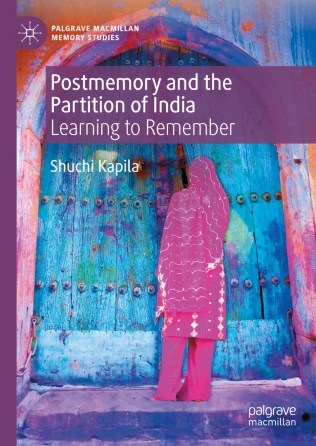
Remembering the Partition

Book Review by Meenakshi Malhotra

Title: Learning to Remember: Postmemory and the Partition of India

Author: Shuchi Kapila

Publisher: Springer

Shuchi Kapila’s book on Partition focuses on the hinge generation — the one separated by a generation or two from the actual experience of the Partition, but increasingly drawn to analyse its memories in their own lives and its significance for the future. Simply because, the Partition with its trauma and losses remains a huge part of their parental, familial and collective memory.

While Kapila’s book recovers these embedded memories through interesting anecdotes, the fact remains that the historical event of the Partition cast a huge shadow on her parents’ lives, and that of many like her. She, like others (Priya Kumar, Urvashi Butalia) are drawn to excavate and unpack this silence and trauma that impinged upon the parents’ lives and shaped them in umpteen ways.  Such postmemory is described by Marianne Hirsch as “the experience of those who grow up dominated by narratives that preceded their birth, whose own belated stories are evacuated by the stories of the previous generation shaped by traumatic events that can be neither understood nor recreated” (Hirsch 1996, 659, quoted by Kapila). She goes on to write: “It is the largeness of these stories that dominate our psyches even as we often know very little about them, a kind of haunting that is often not understood.”

Like many in this generation, Kapila  was protected from all knowledge of the event by the silence of those who had experienced it directly. At the same time, she strongly felt a compulsion and an ethical imperative to understand the legacy of the Partition on her own terms.

Kapila points out that the flood of writing on the Partition that has emerged since the fiftieth anniversary of independence in India and Pakistan includes scholarly histories, oral histories, feminist studies, and literary and cultural studies of the Partition (which have poured out in a steady stream in the decades after 1997), show a strong inclination to exhume buried and seemingly lost memories. Priya Kumar’s Limiting Secularism, one of the most significant studies of the ethics of remembering, presents a compelling summary of this terrain of ‘return’ to the Partition. She argues that it is not merely that the first generation of Partition migrants is now dying out leading to an understandable anxiety about capturing their voices(as Butalia also voices in her book The Other Side of Silence) but also that the fact that Partition is the “founding trauma” (Dominick la Capra) of the subcontinent to which we must return in constant acts of “avowal” (Kumar 2008, 87).

Kapila’s book then is one such act of return and avowal in exploring again from a post memorial position the travels and travails of Partition memory. The enormity of the Partition— around a million dead, migration of between twelve and fourteen million across the borders of Punjab and Bengal, 75,000 women of different faiths abducted and very few “rehabilitated”– the numbers are mind-numbing.

Given that Partition was a territorial, social, and political division of peoples who had lived together for the previous centuries, there were many who resisted the idea of this division but recognised equally that it was a moment for Muslim self-determination in the formation of Pakistan. A common feeling in this context which prevailed among all communities, Hindus, Muslims, Sikhs, was a feeling that the departing colonial powers had betrayed them. With these affects,the act of remembering Partition, the author feels, can never be a single, linear, decisive and discrete fact specific to communities but somewhat fuzzy and porous. It is inevitably marked by the recognition of multiple narratives jostling for attention with all communities involved as perpetrators and victims. The Indian nationalist myth that the Indian Congress party wanted a united India whereas Muhammad Ali Jinnah, the leader of the Muslim League, wanted to divide India and secure Pakistan for Muslims has been interrogated most famously by Ayesha Jalal who argues that literary narratives have also offered scholars the opportunity to think through the ethics of co-existence, which is the focus of Priya Kumar’s study, Limiting Secularism (2008), in which she considers how literary texts imagine possibilities and histories of productive relationships that seemed to have been irrevocably lost with partition.

Another significant area of research opened up was that of  collecting narrative oral histories, a methodology which has been referred to by Ritu Menon and Kamla Bhasin in Borders and Boundaries(1998) and used powerfully in Urvashi Butalia’s The Other Side of Silence(1998). These accounts revealed that women’s lives were deeply impacted by the rape and violence visited upon them during Partition and the silencing of their narratives as a patriarchal state was inaugurated. Jill Didur (2006) reads the silences and ambiguities of women’s stories as an important counter-narrative that unsettles Partition, revealing, for instance, how the agency of abducted women was completely eluded even in the recovery operations to establish a benevolent paternalist state. Given that there is a necessary relationship between the public and private realms of memory, it is unsurprising that some of the same themes can be found in testimonials and oral histories as well. This is the case made by Anindya Raychaudhuri (2019) whose attempt to think through Partition as “a productive event” is very much in line with Kapila’s  effort to highlight the different generational voices of  interviewees (Raychaudhuri 2019,13).

The book also considers private family memory and public institutions like the 1947 Partition Archive and the Amritsar Partition Museum. However, Kapila is aware that both these public institutions are relatively recent developments making it difficult to gauge their impact on private memory. Like literature and cinema, oral histories have also expressed themes of loss, violence, home, childhood, and trauma that appear repeatedly in stories of  Partition migrants. Yet,  as Kapila avers, “despite scholars’ clear understanding of the particularity of each oral history encounter, most studies distill them for themes and documentary evidence rather than as specific performances” based on “the subject position of interviewer and interviewee, time, space, social and regional position.” In contrast to this, Kapila is observant about the processual aspect of memory that are constituted by a more expansive understanding of “the filial and affiliative in each encounter as it rearticulates the nature of family, belonging, and community and while Partition literature and film have coloured narratives and tropes which shape how people remember or narrate,” her focus is on the interaction between the subject position of interviewer and interviewed.

Anjali Gera Roy’s significant work on Partition testimonies works toward an amplification of the historical record, which works by filling in “the personal, sensory, affective memories of both documented and undocumented historical events”(Gera Roy 2019, 24). She describes  her work,  as a “corrective and as supplement” to historical accounts. In the 160 testimonies gathered by her and her research assistants in many cities of North and East India, she unearths the ‘intangible violence’ of Partition.

The questions she poses sheds considerable light both on the processes and workings of memory as well as the methodology of such an enquiry: “How much of my parents’ relationship was structured by a deep and intimate understanding of Partition trauma? How much of their subterranean anxieties about their children were shaped by the experience of Partition? Heeding Marianne Hirsch’s description of postmemory mediated “not by recall but imaginative investment, projection, and creation,” she  asks how we could help in exploring its potential for progressive futures (Hirsch 2012, 5). Family history, though repeated many times and extensively written about is both representative and singular, each experience one more testimony to what millions experienced.

In emphasising a humanistic approach to Partition memory, she explores it not as aggregation of historical or social fact but for the relationship it sets up among post memorial generations and between them and first-generation migrants and the importance of each act of articulation. This book is thus a study of the culture of Partition memory that is being built by post memorial generations through public institutions, research, oral history, and family stories. For these generations, studying Partition is an experience in learning to remember from new socio-political locations not just in South Asia but also in its diaspora in Europe and the United States, and other parts of the world. These acts of memory are significant not only to gain insight into an event, but also ultimately to address the psychological impact of the event.

Kapila’s work is a significant contribution to Partition and memory studies. In revisiting Partition through the lens of memory, her book reminds us about the significance of processing painful memories as a way of approaching the past. The chronology is also significant, coming as it does, more than seventy-five years after Partition. Yet it is precisely this belatedness which makes it significant. In their preface to their edited book on The Psychological Impact of Partition in India, psychiatrists Sanjeev Jain and Alok Sarin (2018), mention the lack of conversation or research material on the psychological impact of Partition in the sub-continent. They flag the urgency of revisiting and processing traumatic memory. Understanding the delayed effects of trauma thanks to their extensive experience as psychiatrists and psychologists, they view the time lapse and belatedness as central to the way memories work.  

Kapila’s book has a chapter on the idea of ‘nostalgia’ for instance and then also on new institutions of memory like the museum. She explores different avenues that have been developing to rectify some of this missing memory of Partition, through extensive interviews.  This is the thrust of the first half of the book—these intergenerational conversations and understandings of Partition. The second half of the book looks more closely at the two physical spaces that have been established to communicate about Partition. These two physical spaces include the Berkeley, California 1947 Partition Archive, which now contains at least 10,000 oral histories of Partition, available for researchers, scholars, and individuals to explore and examine. India has also recently opened the Partition Museum, Amritsar, the first museum of its kind in India. Museums tend to craft particular narratives of events or experiences, and Kapila considers this new museum in that light

Postmemory and the Partition of India: Learning to Remember is a fascinating interrogation of this concept of remembering and memory, and how we craft narratives of our understandings of events through our memories or the memories of others. Ultimately, Kapila is asking the reader to consider how it is we learn to remember, particularly how we learn to remember complex, political events that shape who we are and how we think of ourselves in the world. Focusing on the centrality of processing traumatic memory in order to negotiate our daily lives, Kapila’s work is deeply interdisciplinary. Her scholarship can also be viewed as a labour of love and a tribute to her parents — and their generation — for the considerable emotional labour  they invested to ensure that their children were able to go beyond their own memories of loss.

.

Dr Meenakshi Malhotra is Associate Professor of English Literature at Hansraj College, University of Delhi, and has been involved in teaching and curriculum development in several universities. She has edited two books on Women and Lifewriting, Representing the Self and Claiming the I, in addition  to numerous published articles on gender, literature and feminist theory.  Her most recent publication is The Gendered Body: Negotiation, Resistance, Struggle.

.

PLEASE NOTE: ARTICLES CAN ONLY BE REPRODUCED IN OTHER SITES WITH DUE ACKNOWLEDGEMENT TO BORDERLESS JOURNAL

Click here to access the Borderless anthology, Monalisa No Longer Smiles

Click here to access Monalisa No Longer Smiles on Amazon International

Categories
Poetry

Poetry by Koiko Tsuuda

I’M NOT HAPPY 

I haven’t been happy for so long
I don’t even remember
How it feels to be happy
I’ve lost it
Somewhere along the way I lost it
And when I look back
And try to search for it
I find nothing
As if all the memories
That used to bring me joy
Have been eaten away
And all there’s left
Is a silent hollowness
And it feels so very mundane
So very normal
Like life has always been this way
So dead and wasted
So awful and useless
Even in the brightest of days
The sun can’t outshine the dark
And I don’t know how
To not notice it anymore
And I can’t hold it in anymore
But I can’t allow other people
To see me like this
I don’t want them to be sad
I don’t want them to cry
As they stare into my gloomy
Blank
Lifeless eyes
And witness the hell
That burns inside

I WISH I WERE STRONGER


I wish I could keep up the facade
But I can’t bear to plot through
Yet another masquerade
To paint happiness on sorrow
To say the lines without a hook
To pretend stars mean something in the sky
To act like nothing is wrong
When nothing is right
And smile
And smile
And smile
So nobody would worry about me
I know there’s a light somewhere
But I can’t pretend everything
Is just going to be all right
When it’s all still in my head
The unforgettable dreams
The inescapable present
The picture of a faceless man
Standing in an empty room
With no windows and no doors
Living a life
Punctured with an ache
That’s so fierce
So persistent
It breaks the spirit of his soul
And its will to resist
And I can’t help but wonder
Maybe the muzzle flash
Is the famous light
At the end of the tunnel
Everybody has been talking about

Koiko Tsuuda is a writer from a little town in Estonia. Originally, Koiko picked up writing for his band, where he played drums. But when the band ended, the writing stayed and became more important than the music ever was. In his work, Koiko explores the dark, the ugly and the grim reality of the human experience and does that in an honest and evocative language. These poems are from his book, Twenty Six and Twelve.

.

PLEASE NOTE: ARTICLES CAN ONLY BE REPRODUCED IN OTHER SITES WITH DUE ACKNOWLEDGEMENT TO BORDERLESS JOURNAL

Click here to access the Borderless anthology, Monalisa No Longer Smiles

Click here to access Monalisa No Longer Smiles on Kindle Amazon International

Categories
Musings of a Copywriter

Godman Ventures Pvt. Ltd.

By Devraj Singh Kalsi

Before setting up any new business, strengths, weaknesses, opportunities, and threats must be studied in detail. If the business involves trading in the commodity called faith, it is categorised as high risk. Where the stakes are high with a fantastic margin of profit, proper assessment of how contemporary dealers operate in the thriving, burgeoning market also becomes essential. With such pearls of wisdom forming the tapestry of my entrepreneurial necklace, I am confident that the time is just right to translate the long-cherished dream of becoming a popular godman with pan-India presence and acceptance, with multiple customers, oops, devotee touch-points, to deliver maximum satisfaction.

Finding a unique proposition, however, remains elusive, and without casting a magical spell on the masses the proposed venture cannot gather traction. Stiff competition in the fast-moving consumer category – with the faux cult and occult gurus mushrooming across the country – has rendered a creative challenge to package something inimitable and refreshing for the faith buds (read taste buds). Honestly, this plan was kept in abeyance in the hope that something clutter-breaking would emerge from my oversized head blessed with a tiny amount of grey matter. The post-pandemic world presents the right opportunity to attract the vulnerable poor and middle-class people besotted with the pursuit of happiness and predictable materialistic dreams.

Setting up an organisation with crowds of devotees demands a big investment. It has to begin with purchasing a vast piece of land, preferably barren and cheap, and then turning it into a fertile ground to rake in the wealth. Approaching a bank to finance the project should deliver a positive outcome. The alternative is of course usurping a disputed land owned by farmers or an estate where the claims of ownership are being battled. Such a locale would be ideal to establish a commune. In case this fails to materialise, catching hold of a local politician to donate land for community service could do the trick. This land parcel could later be converted into a veritable godman’s cave where a substantial chunk of humanity gathers to pray and prey every day.

I am at a loss to generate catchy ideas to repackage and give a brand-new appeal. For that, I have to study other godmen who touch the key pain points first and then deliver effective solutions. They have hundreds of volunteers called sewadars who accord a warm welcome to all those who come – with stolen roses from the gardens of other people in the neighbourhood or bought dirt cheap from farmers when they start drooping. Even though I wish to exploit, it should not look like that – my aura should cover it all.

I have found one godman who calls himself a Living God and millions of devotees attend his preaching sessions just to catch a glimpse and touch the dust of his feet or his bullet-proof limousine. This smart chap wears impeccable white and promises all his devotees that he will come personally to escort them at the time of their death. This is a big idea that has sold well. Till now, only heard of religion spelling out the concept of heaven and hell where ordinary mortals have to go alone based on their actions. But this charming godman with a flowing white beard has made it super easy ostensibly with his promise of companionship on the last journey. He escorts the dead – and comes personally to receive them. Wow! Simply brilliant! Devotees feel special, privileged, and liberated. They know they will not be alone after death. This is a very attractive service that has brought him mega success.

Nobody likes to think about what happens in case the godman dies before his followers as he has special powers. They are assured there will be a Living Master to escort them at the time of death. The succession plan is active as the godman has appointed a successor to take over his intermediatory role, to have access to the vast coffers they have raised. This man will carry forward the business. At the time of death or just before the eternal sleep mode starts functioning, a note emerges from the bed or a cupboard, proclaiming the name of the savvy successor who appears smart enough to shoulder the responsibilities and also proceeds with the expansion plans on the anvil.  

The assurance of royal treatment from the godman to liberate the dead appears a gripping idea but I wonder how many days one has to devote to this onerous job. With the pan-India presence of followers, this would become a burdensome task unless there are special teams appointed to perform it. Perhaps to streamline, to make it faster, the godman keeps his helicopter ready as he has to cover long distances to reach the dead and then escort them to their final destination or push them into the next life. Since death has no holiday and no fixed hour of arrival, the logistics factor needs to be borne in mind. If juniors are entrusted with this special task, then the godman loses appeal. This is one job he should perform personally to satisfy followers who believe the gospel truth that the godman himself will accompany to escort them post death. I am impressed with this special feature and would like to add it to the bouquet of my proposed offerings to ensure this does not remain the unique proposition of solely my competitor.

As a godman, one is self-styled but one has to be sure about the slew of plans one intends to launch. If the godman is lustful, then there are daily supplies of gullible women. He needs gun-toting guards or a private army to protect his honour while he dishonours the unsuspecting folks under his hypnotic influence. He could also extend supplies to his political contacts through the charities he runs, and nobody would suspect foul play for decades. He can dupe farmers and grab their land – use it for organic farming by making his resident followers toil on the land to grow crops. The godman can package and sell at a premium price to open another revenue source for the trust nobody distrusts. He can keep threatening to acquire more agricultural land and use political contacts to get the work done in exchange for a few favours like asking millions of his followers to vote for the political party of his choice.

He can parade his strength by inviting tall leaders to the commune who come in search of a vote bank. He can add more people from powerful positions who have abused power all their life and they can be showcased to convince more followers that the powerful are also meditation addicts seeking salvation just like them. With corrupt celebrities and VIPs roaming around, the common believers are convinced that this is the best place to ensure a good departure.

When a common man sees a respected personality falling at the feet of a godman then he is reassured. So, I would need to have such a network that impresses new entrants to my cabal, signing up for salvation. I should offer some relief package to retired public servants or other debauched professionals from various fields who have taken up this spiritual path for the well-being of their impure souls. I need to have their impressive testimonials to scale up the membership drive. Though it might sound unethical but only the successful survive. I should focus on embalming bereaved hearts. Hard-hitting stories cast a spell when these are narrated with tearful eyes. An atmosphere of divinity is created with a vast amount of healing energy building up in the space left by grief.  

My search for good ideas has led me to another godman who promises the complete transfer of sins. I’d heard of forgiveness for sinners and a general acceptance of such people, but this godman says no one need bear the burden of sins throughout their life as he is ready to accept all their sins, no matter how vast, major or filthy. This has rendered him popular as the masses love the idea of living guilt-free. They can pass on their past sins with the knowledge they can continue sinning and then transfer more sins to the godman. This is what the public expects to hear from God who disappoints by saying that everyone is responsible for their own sins. Afterall, there is this one godman who is ready to bear the entire burden and with this prime promise he shows immense potential to lure believers as the direct sin transfer scheme catches the imagination of the masses.

Although we all are sinners, we do not know how to wash our sins. We go for a dip or a confession, but this godman boldly invites sinners to come and register their names and get lifetime freedom from the guilt of accumulated sins. Besides, there is no need to set forth on any pilgrimage for atonement. Seek subscription and transfer sins to the godman’s account. It is a real innovation. I would like to add this to the list of key offerings. Well, bundling up of such strengths should make an irresistible fusion.

Leading godmen offer secret mantras to practice in isolation or or smear ash on the face – some offer exclusive mumbo-jumbo to baptize in this fashion so that they do not reveal it even if all their devotees have been blessed with the same code. In contrast, my package should be such that it gives maximum comfort to the mind, body, and soul. I should not talk of conquering the ego but show multiple ways to magnify it, show them routes to reach seven to nine heavens, and gain super sensory experiences – all during one lifetime. Since I target people from all religions to give up religion and follow me as a godman, I need to evolve into a cult figure to command attention and start building the base on the foundation of their frustration with existing religions. It is quite a challenge for any godman to shake them up from deep within – shake their roots of traditional faith and turn them into blind devotees.

Even though as a godman, I could fail to get their undivided devotion, I am willing to share their belief in gods and goddesses. But when it comes to choosing a godman, I should be the first and obvious choice. Devotees need to keep my photos in their wallets or wear it in a locket. I could play with their minds and be a good psychologist, reading their desires with perfection. I should be perceived as their sole saviour. Though as a godman I could run the risk of being exposed or shot at by rivals or crazy folks, I need to have an escape route ready in case there is a stampede. I must have followers in foreign lands to help me set up my base, buy islands for me, and help me escape in case of any emergency. When I challenge God, as a godman I should not depend on his mercy.

Since godmen are getting embroiled in controversies and getting a bad perception, I should be ready to be the new avatar. Some are out of the country, and some are languishing inside prisons so there is a great scope to enter this industry. Even though they all claim innocence after committing financial and sexual frauds, their popularity wanes as their claim of being framed with dubious intentions – just as gods had to suffer agony and brickbats for the common public – does not cut much ice. I should work with the mission that believers do not need to travel beyond two miles to find my ashram. I should have my branches sprouting all around. With big expansion plans, I must begin the journey like a corporate behemoth and corrode the fundamentals of faith for my landslide profit.

As a godman, my strategy should be to convert one member of a family first and entrust him with the job of bringing others to the fold. The multiplier effect could grow the numbers. But I need to sit back and draw up at least three solid points to allure devotees. A fusion of cutting-edge ideas would make devotees assured they are all super intelligent beings for choosing me as the logical and ultimate choice.

If I can add science and logic in the mixture of faith in a clever manner, I can have the educated queue up as well.  This topping would convert rationalists into believers. Instead of trying to convert them from their religion, I should offer them the scope to continue with their choice. I should focus on the vast groups of non-believers.

My research shows the burden of modern living is reducing the number of non-believers steadily. I need scientific-tempered preachers in my fold. We could deliver sense by making sure the journey of life is showcased as the most important one. Let me toss some ideas in that direction to emerge as a godman with a halo of human, super-human qualities. If divine justice ever trod my way, I would merely have to prove gods are losing out in popularity to godmen and therefore they have united to conspire against us, thus gaining back more sympathies and following. I would be unconquerable!

Devraj Singh Kalsi works as a senior copywriter in Kolkata. His short stories and essays have been published in Deccan Herald, Tehelka, Kitaab, Earthen Lamp Journal, Assam Tribune, and The Statesman. Pal Motors is his first novel.  


PLEASE NOTE: ARTICLES CAN ONLY BE REPRODUCED IN OTHER SITES WITH DUE ACKNOWLEDGEMENT TO BORDERLESS JOURNAL

Click here to access the Borderless anthology, Monalisa No Longer Smiles

Click here to access Monalisa No Longer Smiles on Kindle Amazon International

Categories
Musings

That Box of Colour Pencils

By G Venkatesh

I walked down the forest path in Karlstad, Sweden, wondering how best I could ensure that a box of 36 colour pencils (used to different degrees), when given away could continue to be used so that they could fulfil the purpose they were fabricated for, as completely as possible. I recalled a tarot reader having said that ideas do not come to us when we think, but rather when we have stopped doing so. They come unbeckoned from somewhere beyond the astral realm. I stopped the train of thought in its tracks, to let the engine cool down a bit, and surrendered to the divine process of ideation and inspiration.

The next day, I was walking down the very same path – this was a routine after a couple of surgeries, for the purpose of recovery and regaining strength in my lower torso – when I saw two little girls (less than 6 years old, perhaps) playing in the garden to my left. An idea bubbled up. I hastened to my apartment, fetched the box of colour pencils and rushed down to the garden where I had seen the little girls. They were still there, on the swings. I walked up casually, making sure not to scare them (my bearded foreign face told me that I need to be careful here), and called out from a distance, in Swedish – “Hallo, vill ni gärna ha den? (Hello, would you like to take this?)”

The younger of the two came a bit closer, looked at the box in my hands, and asked curiously – “Vad är det? (What is it?)”

I explained that it was  a box of 36 colour pencils, some used more than the others, and that I wished to gift it away to them. As more and more questions were hurled at me, I could not help but smile and recollect Rudyard Kipling’s poem:

I keep six honest serving-men
(They taught me all I knew);
Their names are What and Why and When
And How and Where and Who.

The elder of the two girls then came down to brass-tacks, and asked, “Är det verkligen gratis? (Is it really for free?)”

I said yes, and she took it from my hands.

As I was about to turn around and walk away, I heard some murmured whispers behind me. I thought they would have opened the box, started counting and marvelling at the various shades of blue, red, green and yellow in there.

Vänta, vänta…(Wait, wait).”

I turned and they came running towards me. The younger one was now holding the box of pencils in her hand.

“Vi vill gärna betala dig (We would like to pay you for this).”

I repeated that it was a gift and one does not have to pay for gifts.

“Nej, nej…vänta (No, no, wait).”

The older one then started searching in the little pouch she had around her waist, and fished out a 2 SEK coin. Summertime in Sweden, and little kids are provided with some money by their parents, which they carry around in these mobile piggy-banks strapped around their waists. Once they have accumulated enough, they spend the money on purchasing ice-cream or chocolates or candies.

“Här, (Here),” she said proudly with a smile across her face. “Den är för dig (This is for you).”

I accepted it with a smile, which hid mixed feelings. I did not wish to deprive the little one of the feeling of pride which she was experiencing – of having put aside money to ‘buy’ this gift from a stranger.

What it was that triggered the desire to monetarily compensate me for the gift I gave them, I would never know. I would also not wish to know. Maybe because I was a stranger to them, who also looked a bit bedraggled after the surgery. Maybe it made them feel good to also give me something in return for what I had given them. That would be another thing I would surrender to the realm of ideas, which had played a part in bringing these two little girls momentarily into my life that day – the invisible hand of God, of ideas floating around in the ether ready to inspire those who are fit to receive them.

Photo Courtesy: G Venkatesh

G Venkatesh is an Associate Professor in Karlstad University, Sweden. E-mail: Venkatesh_cg@yahoo.com

PLEASE NOTE: ARTICLES CAN ONLY BE REPRODUCED IN OTHER SITES WITH DUE ACKNOWLEDGEMENT TO BORDERLESS JOURNAL

Click here to access the Borderless anthology, Monalisa No Longer Smiles

Click here to access Monalisa No Longer Smiles on Kindle Amazon International

Categories
Poetry

Ghosting Sally Fairchild

By Ryan Quinn Flanagan

Lady With a Blue Veil (Sally Fairchild) by John Sargent(1856-1925). Sourced by Ryan Quinn Flanagan
GHOSTING SALLY FAIRCHILD 

What a ghost of a woman!
That Sally Fairchild, with hand raised to chest
as if poignantly aghast at the very sight
of her own faded rendering,
a noticeable accompaniment on the ring finger,
so there is that limited certainly,
but the thickets already seem to be gripping at apparitional days,
a loosening auburn bun swallowed up in blushing blues,
rimmed day hat, much the same:
perhaps, it is that maniacal jungle of colour
all around her, swirling spiked monsters
jumping out from a forgotten child’s scary closet –
what was John Singer Sargeant thinking?
No woman wants to be painted like that.
As if she is disappearing right out of existence.
Vanishing before everyone, even herself.

Ryan Quinn Flanagan is a Canadian-born author residing in Elliot Lake, Ontario, Canada with his wife and many bears that rifle through his garbage.  His work can be found both in print and online in such places as: Evergreen Review, The New York Quarterly, Borderless Journal, GloMag, Red Fez, and Lothlorien Poetry Journal

.

PLEASE NOTE: ARTICLES CAN ONLY BE REPRODUCED IN OTHER SITES WITH DUE ACKNOWLEDGEMENT TO BORDERLESS JOURNAL

Click here to access the Borderless anthology, Monalisa No Longer Smiles

Click here to access Monalisa No Longer Smiles on Kindle Amazon International