Categories
Stories

Too Much Light, Too Much Trouble

A Balochi Short story by Ghani Parwaz

( Translated by Fazal Baloch)

The moment he stepped into the office he was astonished to see the distorted features of his colleagues. Someone’s eyes were bulging out of their sockets. Someone’s ears were stretched out. Someone’s tongue was sticking out. Someone’s lips had swollen. He stared at them with bewilderment.

Aftab, the clerk, raised his head and bulged out his eyes a bit further and said: “You are looking at us in such a way as if we are creatures from some other planets.”

Imdad, the assistant, raised his ears a little more and asked him: “Why are you looking at us with such wonder”?

Zaheer, the cashier, stuck out his tongue and remarked: “I think he is not feeling well today.”

Muzzamil, the clerk, puffed his already swollen lips and said: “We need to bring him back on the track.”

He strolled ahead, stood right in their midst and said: “But why do you all look so strange today?”

First they looked at each other and then directed their gaze at him and asked him: “What is wrong with us, by the way?”

He smiled acerbically and retorted: “Someone’s eyes are bulging out. Someone’s ears are unusually raised. Someone’s tongue is sticking out. Someone’s lips are swollen.” 

Aftab, the clerk, instantly pulled out a small mirror from his pocket and looked into it.

“You damn liar,” he mumbled.

One by one they all looked their features in the mirror.

Someone lashed out at him, “Why do you fashion such big lie?”

“Is this the way to make fun of your colleagues?” Someone else expressed his displeasure.

Muzamil was not satisfied yet. He strolled over to the bathroom and thoroughly scanned his face in front of a giant mirror.

“Lies wouldn’t last long.”

Azhar sat on his chair and looked around and said: “Truth and lies apart, but your faces do not look as usual.”

Ms. Farhat, the secretary to the Chairman, stepped in.

“What happened? Why are you looking so flummoxed?” she asked them.

“Azhar says our features look distorted.” Muzzamal said while looking at Ms. Farhat.

She looked at their faces and said: “No. Everything seems to be as usual.”

“Look at yourself, madam,” Azhar said.

“What has happened to me?” Farhat was puzzled a bit.

“Your cheeks are swollen.”

“O my God!” She covered her face with her hands and scurried to the bathroom. She returned in a moment and blasted at Azhar: “You are a duffer. You don’t even deserve the slot of a watchman.”

“He thrashed at us and even didn’t spare you.”

Someone suggested, “We must take up the matter with the boss.”

“Don’t worry. Let the boss come. I will do the rest,” Farhat assured them.

A while later the door turned open and Zahir Ali, the Chairman, stepped in. He cast a cursory look at the staff and made it to his office. Farhat followed him.

“What is the problem, today you all look anxious?” The Chairman placed his sunglasses on the table.

“Today Azhar has lost his mind,” Farhat replied.

“How?”

“He is talking nonsense.”

“Just relax yourself I will see him.”

The Chairman pressed the bell and asked the peon to call Azhar in.

“Sir! Have you called me?” Azhar looked at him anxiously.

“Yes. Why are you misbehaving with your colleagues?”

“No, Sir, I haven’t done anything wrong. I just told them whatever I saw with my eyes.”

“By the way what did you see?”

“They all have distorted faces.”

“How? Any example.”

“Bulging eyes. Elongated ears. Puffed lips. Swollen cheeks.”

The Chairman asked him, “And you are also staring at me with amazement. Do you see any change in my features?”

“Sorry Sir! I wouldn’t be that rude. After all you are my boss.”

“Go ahead and tell me if you see something unusual in me.”

“As you wish Sir — you have a protruding paunch today,” he revealed in a somewhat trembling tone.

The Chairman walked over to the bathroom. He returned in a while and blasted at Azhar: “You rascal!”

Azhar trembled with fear and pleaded: “I am sorry Sir.”

“You don’t deserve any relaxation.” He looked at him with anger and pressed the bell.

The peon rushed in: “Yes Sir!”

“Call the staff in,” he commanded.

All the staff gathered in the Chairman’s office.

“Do you see any change in your own features?” The Chairman asked them with great concern.”

“No Sir,” was their answer.

“And something unusual in mine?”

“Not at all.” They replied.

“Then why on earth, is this knucklehead insisting that we have distorted features?” He was furious.

“Sir something must be wrong with his eyes.” Muzammil pointed towards Azhar’s eyes.

“Muzzamil is right; you must have an eye problem.” The Chairman looked at Azhar.

“Yes, indeed I had an eye-problem, but I have had them treated recently.”

“The treatment has further ruined your eyes,” the Chairman looked deep into his eyes.

“Anyway, what was the problem with your eyes?”

“My eyes used to twinkle,” he replied.

“What? Do eyes ever twinkle?” The Chairman was amazed.

“Yes, they used to twinkle and I felt new and brighter eyes were growing inside my eyes.”

“What was the nature of the treatment?” The Chairman asked him.

“I had an eye surgery.”

“I feel the surgery went terribly wrong.”

“It went wrong?” Azhar was confused a bit.

“Yes, it did,” the Chairman affirmed his statement.

“But now I have a much better and brighter vision than ever, Sir. Now even I can see the invisible things.”

“What do you mean by the invisible things,” the Chairman shot back.

“I mean that I can see what the bulging eyes are looking for. I can hear what the elongated ears desire to hear. I know what the swollen lips want to say. I know what the puffed out cheeks seek. And what the protruding paunch…”

“Shut your nonsense!” The Chairman cut into the middle of his speech. “Had you not been an old employee, I would have kicked you out of the office.”

“Have mercy on me Sir,” Azhar pleaded.

“I accept your apology but only on one condition.” The Chairman dragged his chair a bit forward and pointed his index finger towards Azhar.

“I accept whatever condition you set.” Azhar bowed his head in respect.

“I will get your eyes operated again and its expense will be deducted from your salary in nominal installments,” the Chairman gave the verdict.

“What do you think now?” Muzammil quipped with a sardonic smile.

“What can I say,” Azhar replied in a state of utter helplessness.

A few days after the operation Azhar resumed his routine in the office. Now everybody looked normal to him. He didn’t notice anything unusual in their features. He was standing by the door when the Chairman burst in.

The Chairman asked him sarcastically, “How are your eyes now?”

“As usual, Sir,” Azhar replied.

“Remember, too much brightness of vision is always disastrous. It can land you in deep trouble.”

“I will never forget your advice Sir.” A meaningful smile appeared on Azhar’s lips, “because I cannot endure too much suffering.”
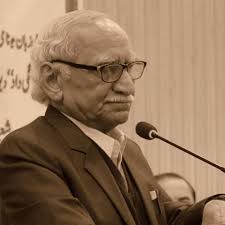
Ghani Parwaz is one of the most celebrated Balochi writers. He has been writing Balochi fiction for the past five decades. So far he has published seven anthologies of short stories and five novels.  Apart from fiction, he also writes poetry and literary criticism. He received several awards for his literary contributions including “the Presidential Award for the Pride of Performance”. He lives in Turbat Balochistan.
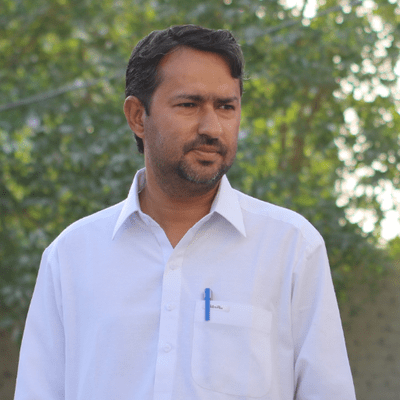
Fazal Baloch is a Balochi writer and translator. He has translated several Balochi poems and short stories into English. His translations have been featured in Pakistani Literature published by Pakistan Academy of Letters in 2017 and Silence Between the Notes — the first ever anthology of Partition Poetry published by Dhauli Books India in 2018. His upcoming works of translation include Why Does the Moon Look So Beautiful? (Selected Balochi Short Stories by Naguman) and God and the Blind Man (Selected Balochi Short Stories by Minir Ahmed Badini).
Categories
Review

Lines across the Ocean: Love and the Impossibility of Words

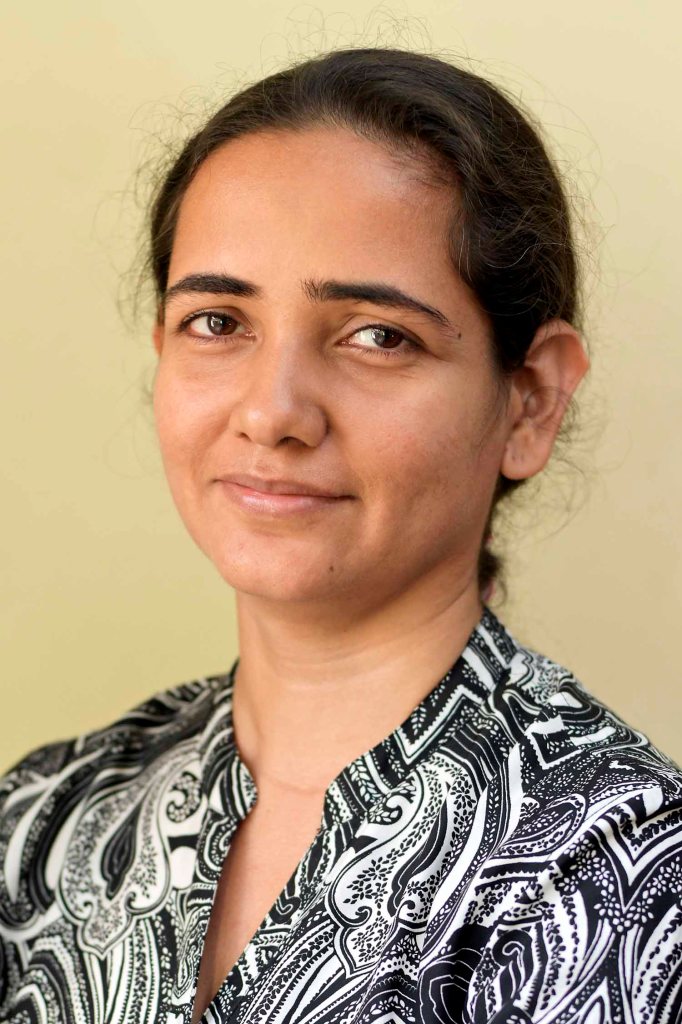
Book Review by Soni Wadhwa

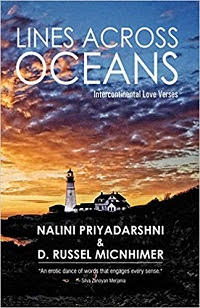
Title: Lines Across Oceans

Authors: Nalini Priyadarshni and D. Russel Micnhimer

A few days before this Valentine’s Day, Nalini Priyadarshni urged her friends on Facebook to  “consider getting a book of love verses for your sweetheart this Valentine”. The book is Lines Across Oceans: Intercontinental Love Verses which she has co-written with the late poet D. Russel Micnhimer, also a winner of Poet Laureate award in India. To those who love poetry and those who have been in love, Priyadarshni’s mischievous call to action invoked nothing less than a gleeful sentiment of “ooooh… another one” tinged with “oh no – not again!” It is a sentiment that gushes out of a lover/beloved every time a note of pleasure comes close enough to unfold aspects of loving.

While the book was published three years ago, it was a perfect moment to discover how the two poets from different continents would reinvent ways of understanding, expressing love and talking about it. The book does two wonderful things for the readers — it begins with Rumi and then somewhere in the middle declares what lovers already know about the impossibility of syncing love with speech:  

Listen if you must

Not my words, for they may be unbefitting

Listen to my silence in pure intent

My pauses bring forth what my words couldn’t 

If you don’t get my silence, my words were a waste

Anything that can be explained away in sounds and signs

can neither be deep nor abiding 

Eternal and elemental, the absolutely best in us

expresses itself as much in black as in white fire

Love cannot be spoken about, and yet, lovers continue to speak about it. Priyadarshni and Micnhimer affirm the paradox of writing about silence in love and so one can peacefully move on to enjoying the way of words that have the audacity to express being in love:

Words born in the recesses of your heart, I treasure 

Even before they rise in your throat 

Or find release from your lips 

I know them from another place, another time 

The refrain “another place, another time” throughout the piece concedes that being in love is being resonant with the idea of love that precedes the lovers in question. Hence, Rumi. Hence, poetry. Hence, reading. Hence, writing. This idea of another time, another place constitutes the iconography of love at the hands of Priyadarshni and Micnhimer:

We pour ourselves out to make room

For the best is yet to come.

What’s love poetry without the snapshots of togetherness? Here is an instance of the mood of the Valentine from the book:

Morning Ritual of shared coffee 

with a tea person should make you wary . . . . 

Mightn’t be the coffee they are after 

but coffee flavored kisses

One wants to blush at the thought of being outdone by the beloved thus. And then one wants to know how the beloved will walk the path of passion:

Knead me as a loaf with your fingers jaan . . . .

– I am growing, expanding, soaking 

in the joy of your laughter’s leavening 

overlapping the edges of meeting hearts. 

The eroticism spread throughout the book brings one back to words as the units constituting the idea of love:

How can I make my words taste as good as ice cream on a hot day 

make them tremble in your ears as they tumble from my tongue?

Lines Across Oceans is interesting for the way it weaves the idea of being together with that of writing together. This laying bare of the cohabitation in the text makes the collection of poems apt as more than a Valentine’s Day read. Sample the lines that articulate this: 

When you write poems for me

and I string my words together 

to write about you and us

we do more than make love

to each other with our words

we bestow each other with 

a slice of eternity

The book appeals to the right spot called desire – desire, that sits perched delicately on the suture between the pleasures of writing, loving, and being loved. In the ritual of reading a collection of love poetry, desire begins to linger on all rituals of living and making sense of life. 

While general readers will be able anchor their experience of love in the light and intense moments in Lines Across Oceans, “serious” and regular readers of poetry will find interesting for its experiments at the formal level in the way it incorporates less known forms of poetry – katuata, sedoka, choka and so on. A ‘choka’, for instance, works very tightly with a form organized around the alternating lines of five and seven syllables:

Let nights and days of

Our loving playfulness, stretch

Into forever

Love is about opening one’s self and shrinking it too. Each number in the book reflects that opening and shrinking in different ways. The collection affirms that love and poetry are so alike. 

Do pick it up — even though the Valentine’s Day is gone, the Valentine is still around.

Soni Wadhwa is an academician based in Mumbai. Her work can be found on Asian Review of Books and Deccan Herald, some of which has also got republished in Scroll and South China Morning Post

Categories
Poetry

Poetry from Nepal: Eyes and tears

Poetry by Sangita Swechcha, translated by Jayant Sharma

Dr Sangita Swechcha
Over the rim of the eyes
welled weary the tears,                                        
asking the eyes—
“Should I trickle or not?”
The poor couple turn oculus in utter surprise,
respond in a staggering and gruelling shape—
“How do you yearn to roll down?”
The tears sob at the oddity of the question
and reply in a state of being offended and distressed—
“If you’re embarrassed to show up in open,
I shall glide my way inside.
If you are in solitude otherwise,
I shall spill out in a surge.”
How wise the tears are—full of empathy!
To save the eyes from being abashed
they are ready to repress their outburst.
And to loosen up the eyes
they are all set to gush out
from creeks across the cheeks.
The eyes, meanwhile, are silent;
their heart already hard as stone.
And so retort—
“I get fused easily
even after countless fragmentation
only to be never fragmented again.”
Thus is the difference—
between the eyes and the tears.
The eyes are fixed
But the tears get dismembered many times only to be shattered again.
Hence—
The tears that once dropped off inadvertently in despair
have started asking for permission nowadays
before making their way out.
And the eyes that were inept in giving consent before
have started giving permission these days.
Thus is this alchemy between the eyes and the tears—
The tears ask—
“Should I trickle or not?”
And the eyes respond—
“How do you yearn to roll down?”

Dr. Sangita Swechcha has been an ardent lover of literature from an early age. She has published a novel ‘Pakhalieko Siudo’ (Washed Vermillion) and co-authored a collection of short stories ‘Asahamati ka Pailaharu’ (Hoofmark of Discord) before the collection ‘Gulafsanga ko Prem’ (The Rose: An Unusual Love Story). Her second novel is under publication and her short story collection is being translated into English. She has many short stories and poems published in various journals and online portals including Radio Nepal, Nepal Television, Global Literature in Library Initiative (GLLI) – USA based site and Your2Read, a London based venture dedicated to short story genre.    Email: sangyshrestha@hotmail.com , Website: www.sangitaswechcha.com.


Jayant Sharma is the publisher and editor of an English literary magazine Sathi which promotes Nepali literature through English translations and the founder of translateNEPAL which is an initiative to represent Nepal to the global literary scene. As a writer and translator, Jayant also contributes to major national dailies and South-Asian journals regarding arts, literature, and culture. 

Categories
Essay

The Economy, Lemurs And Us

By Sally Dugman

The underlying human horror and destruction from the nearly worldwide COVID-19 disease is truly daunting. Not to undercut the seriousness of the devastation, but this type of happening is hardly new. For example, consider the Black Plague that wiped out half of Europe and the fact that many British people are immune to Smallpox unlike many Native Americans whose ancestors were never exposed to the disease.

All the same, there are many other horrific events afflicting people and members of other species. Indeed, we all face floods, famines, pestilence, tornadoes, hurricanes, water shortages, tsunamis  and more. It seems that these sorts of events have existed since almost times immemorial for some dire happenings.

We also have another type of trouble and it involves decimation of the natural world. There is nothing new in that pattern either except that we have ever so many more people than in earlier times trying to eek out a living by dismantling the world’s forests, meadows, waterways and so on to have self-economic advances for oneself, family members and others.

In relation, it seems to me that desire for great self-gains indirectly accounts for greedy money mongers, people with giant homes filled with belongings and ditto for their vacation homes, vacation travel and other perks associated with having wealth.

Further there exist game shows in the USA wherein people compete for money. In some shows, the money to be potentially gained is a lot and in others — a little.  And some of the people in these programs act covertly or overtly savagely to get that moola for themselves. How nasty! … Civility can be quite far from the surface in these programs, and you can see the lack through body language, eyes, tone of voice, pretense, etc. (Such behaviors can sometimes be fascinating to watch as they show some degree of depravity in my opinion.)

All considered, it is not surprising one iota when a friend sent me this analysis titled “Your brain evolved to hoard supplies and shame others for doing the same.” It demonstrates in a way the desire to get ever more for oneself.

Two excerpts:

“The media is replete with COVID-19 stories about people clearing supermarket shelves – and the backlash against them. Have people gone mad? How can one individual be overfilling his own cart, while shaming others who are doing the same?

As a behavioral neuroscientist who has studied hoarding behavior for 25 years, I can tell you that this is all normal and expected. People are acting the way evolution has wired them.

“At the same time they’re organizing their own stockpiles, people get upset about those who are taking too much. That is a legitimate concern; it’s a version of the “tragedy of the commons,” wherein a public resource might be sustainable, but people’s tendency to take a little extra for themselves degrades the resource to the point where it can no longer help anyone.

“By shaming others on social media, for instance, people exert what little influence they have to ensure cooperation with the group. As a social species, human beings thrive when they work together, and have employed shaming – even punishment – for millennia to ensure that everyone acts in the best interest of the group.”

So let’s look at lemurs in this ravenous backdrop:

I saw in an environmental documentary that there are only around 20,000 left in the world with numbers dwindling (as their land is increasingly snapped up by humans) as compared to around 7.8 billion humans with the number of the latter kind growing. And blood samples were taken from them for study and possible drugs to be developed for humans.

Why? It is because they get many of the same ailments like Parkinson’s and Alzheimer’s as people do and how could that be so?

Look at your juxtaposed thumb. It came from natural selection based on a mutation and it is from lemur ancestors. In other words, the wild lemurs are your very distant cousins.

This has long been suspected as being the case. Yet it was only recently that two, yes — two, fossil samples prove it. After all, we are the only species with the opposed thumbs, which are very useful in myriad ways. And the fossilized evidence satisfactorily proves it since they have our thumbs.

Now, it is fine enough in my opinion that some people want to literally believe that humans derived from Adam and Eve. It is fine that they believe that life originated from some being standing on a turtle shell or aliens from outer space seeding our planet with life.

All power to them if such ideas bring comfort and joy. Good for them!

Meanwhile I like looking at my thumb while marveling at its origins. That view in light of empirically derived facts suffices for me.

Sally Dugman lives in MA, USA.

This piece was first published in Countercurrents.org

Categories
Poetry

The Moment and more…

By Dustin Pickering

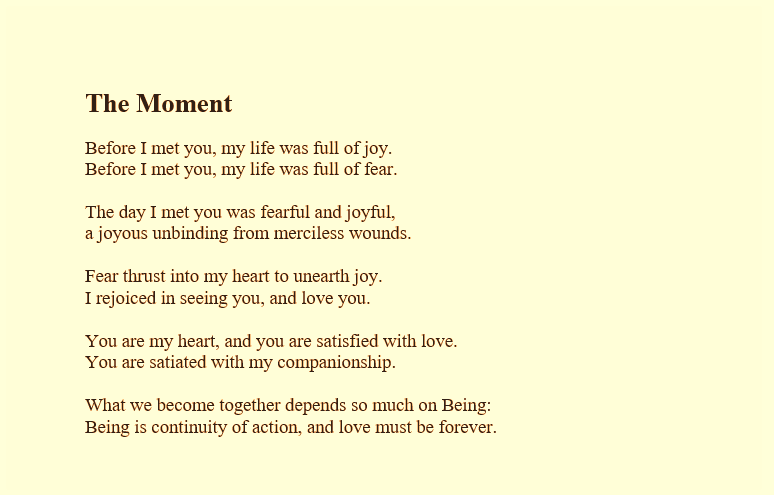
The Moment

Before I met you, my life was full of joy.
Before I met you, my life was full of fear.

The day I met you was fearful and joyful,
a joyous unbinding from merciless wounds.

Fear thrust into my heart to unearth joy.
I rejoiced in seeing you, and love you.

You are my heart, and you are satisfied with love.
You are satiated with my companionship.

What we become together depends so much on Being:
Being is continuity of action, and love must be forever.


promising darkness

words in violation
of strict premises
	glory or face
times diluted in fear

pretense tightens the mask
a failure of childhood
	buried beside insolence
your mind lays unaddressed

who opened the door to chaos
feelings flayed in the open
	dreams and reflections
against promising darkness


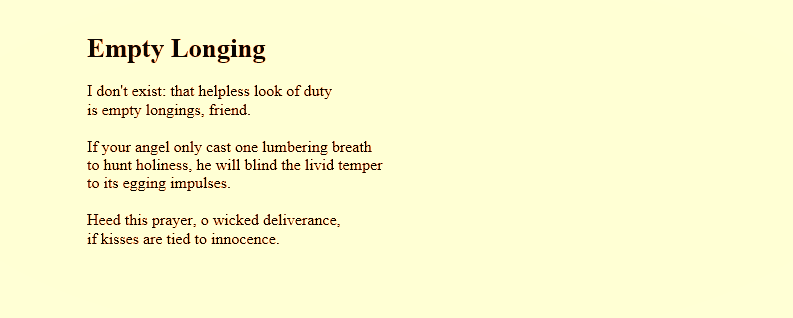
Empty Longing

I don't exist: that helpless look of duty 
is empty longings, friend. 

If your angel only cast one lumbering breath 
to hunt holiness, he will blind the livid temper 
to its egging impulses. 

Heed this prayer, o wicked deliverance, 
if kisses are tied to innocence.

Dustin Pickering is the founder of Transcendent Zero Press and editor-in-chief of Harbinger Asylum. He has authored several poetry collections, a short story collection, and a novella. He is a Pushcart nominee and was a finalist in Adelaide Literary Journal’s short story contest in 2018. He is a former contributor to Huffington Post. 

Categories
Musings

Rumination : Lockdown is a long flight.

By Sapna Agarwal

I haven’t travelled much recently but I remember when I was in the middle of a ‘hi-flying’ job (literally here) and had to travel internationally twice a month, the only good sleep I had was in-flight. This was unusual because most people I know cannot sleep well — especially in economy class.

The reasons I could sleep so well were many – the ordinary ones were that I was generally fatigued after my fourteen-hour job; I was not interested in the alcohol on board; I am 5ft nothing and could be comfortable in the economy class seat ( much to the envy of the Germans in Lufthansa flights ); the microwaved  food didn’t excite me so I didn’t need food breaks and hence loo breaks.

But the real reasons (and that is why I am linking it to the lockdown) was that I was mentally at peace since once on board there was nothing under my control.

I was blissfully devoid of FOMO – fear of missing out on the chance of utilising my time better. There was nothing I could do high up there – no clearing long pending tasks like visiting the bank, replacing my torn handbag,  arranging for a birthday party,  getting my car serviced — in general all the tasks that I postponed with guilt while on land. In air, I was at peace that for the next 22 hours everything could wait. Once I had mental peace, I could just roll up and go to sleep. It was magic. There were times when the air hostess ( Quantas and Thai in particular) would wake me up and insist I eat something instead of sleeping for 15 hours straight.

The other thing that made in-flight sleep so peaceful was that there was little my accident-phobic self could do to save myself in case of a disaster. I do not have the same peace of mind while travelling by taxi, bus or train. In a taxi or bus, I always keep an eye on the driver willing him to avert any head-on crash. In a train where I cannot see the driver, I am normally evaluating my chances of escape in case of a collision. But in a flight, it is binary – in the unlikely event of a crash there is nothing a hapless passenger can do. So, I could sleep in peace.

Now after many years the lockdown is giving me the same feeling — a calm, soothing feeling that there is not much I can do except wash my hands.

One — There is no urgent task I can complete because everything is closed and legitimately so.

Two — In case of a disaster, that is the deadly virus takes over the entire world, there is very little I can do.

So I’d rather say my little prayer, roll up and catch up on my sleep – peacefully.

Sapna Agarwal is a management professional and has worked in the corporate and education sectors for long years. She writes short poems and articles  mostly on current issues. She is a keen observer of human nature and how they react in good times and bad. She lives in Bangalore with her eleven-year-old daughter. 

Categories
Editorial

Let’s Celebrate in the Spirit of Ubuntu

The date Borderless Journal completes its first month, 14th April, coincides with Poila Baisakh, or the first day of the Bengali new year, the Tamil New year, Sinhalese and Nepali New year, the second day of Songkran, the Thai new year (April 13- 15), the start of Bohag Bihu (an Assamese festival commemorating harvest and the new year, April 14 to 20), the second day of the Indian new year, Baisakhi. Let us celebrate along with the journal’s first month birthday this profusion of festivals, which would have been big with celebration for many but shrinks to online greetings because of the pandemic. Hey, did I use the word ‘shrink’? It actually grows bigger because there are so many more of us celebrating the occasion together in a virtual world.

The good news is though the pandemic continues to infect the globe, some areas look hopeful with the curve flattening. The way this virus has unified mankind is unprecedented. Bill Gates has acknowledged this in an interview with CNBC by just mentioning 7 billion doses of the vaccine… thus gathering all mankind into one-fold, beyond all boundaries. It was wonderful to have a world thought leader reach out to the whole humanity, even if for a moment — the thought of all of us being considered as part of an aggregate made for a feeling of inclusion.

This is the inclusivity that one hopes to highlight in Borderless Journal.

Today, borderlessjournal.com completes a month of its existence in our virtual world connecting all of us beyond all borders. Hopefully, it will be a virtual journal for all seven billion people that populate this wonderful green planet we call the Earth. We have travelled with writers to various parts of the world — many still remain unexplored. When some of the contributors ask me, which country does the journal belong to — I tell them — we are where you are. When astronauts watch the Earth from outer space, what do they see? What do clouds see?

The first month of the journal has been promising with many writers sharing their narratives — poetry, essays, short stories and musings. Readers have come back to us with wonderful feedback. I hope you will keep visiting us. Our editorial board has been active sending writers and their own writing too. They are all fabulous writers much like all of you. The resultant effect is Countercurrents.org has offered content sharing — where we exchange content. A number of our essays and musings have been republished in Countercurrents.org. A couple of articles have been quoted, one was in an Urdu journal with credits acknowledged to Borderless. One of our articles was also republished in another online journal with an acknowledgement to us. We also discovered our name in a Canadian listing (Mississauga Writers’s Group) for submissions — a pleasant surprise. We are crossing borders without a passport!

We have had a good start — perhaps you can call it a beginner’s luck, or will it continue?

That depends on all of you! Because this journal is yours, ours and belongs to everyone. I wish, I dream of 7.8 billion humans living in equity with access to food, potable water, housing, education and internet — reading and contributing to Borderless Journal in the spirit of “oneness to humanity” or ubuntu.

Let’s make it happen!

Mitali Chakravarty

Founding Editor, borderlessjournal.com

Categories
Musings

This is not a drill

Farouk Gulsara from Malaysia

 People, mainly the theistic type, are in a dilemma now. They are currently undergoing a test of faith of sorts. On the one hand, they feel they should not have been subjected through such a trial. Whoever had heard of man-made laws preventing believers from performing their daily mandatory salutations of the Divine Forces? Furthermore, at this time of calamity, if they cannot turn to the Divine for help, what else can they do?

 But wait…

Why did the Divine Forces ‘send’ such a test to us? Does He not love us so much? After all the cajoling over generations, and the importance that humankind had accorded to the divine forces all times, why are we continuously put to the test? Is it some kind of Divine Mirth for the amusement of the Maker and a testbed to gauge our devotion?

Why are the first spaces to be emptied all the places of worship? How can they be hotbeds for infection? Are they justified is asking, “My Lord, why hast thou forsaken me?”

Has God ditched his followers stricken with COVID-19 by shutting down religious centres with no prayer meetings? Social distancing seems to be the only panacea for the pandemic. Perhaps He is telling us that blind faith does not work.

 Above all, intelligence and cognitive power would make us stronger as a race. Perhaps the answer would be, “I am here just for your solace. I cannot possibly change the trajectory of the Universe just because you cajoled me in prayers. Imagine the catastrophe that could cause to the others. I have other requests too, you know!”

 It has happened many times before…

 There was a time when worshippers were contented when their scriptures protected them from dangers of the pleasure of the forbidden fruit. They thought it was only the deviants who were at the receiving end of God’s wrath. So, when people like Paul Ehrlich came up with his magic bullet, Salvarsan, to treat syphilis, a sexually transmitted disease willed to punish the wayward, he received no accolades but instead, Ehrlich was pelted with stones, and his home was torched. He was scorned for siding with the sinners and going against the overpowering might of God.

All through our civilisation, believers took it upon themselves to symbolise the omnipotence of Divinity by constructing grandiose erections in the name of His splendour. True — these abodes have been useful to house believers and non-believers at times of crises before. These robust megalithic structures are of limited use as they are of restricted use to care for the homeless. They have been labelled as sites of super-spreaders and is out of bounds to worshippers and asylum seekers alike…

 We are left with the power of human intellect and science to overcome this as we have done many times. In years to come, this current episode would be just a fleeting moment in the annals of human history. Catastrophes, one after another, we have bowled over. Floods, famines, earthquakes, tsunamis, world wars — we have defeated all. This will add another feather to our cap.

We did not attain the status of the de facto spokesperson of the planet for nothing.

We shall overcome.

Farouk Gulsara is a daytime healer and a writer by night. After developing his left side of his brain almost half his lifetime, this johnny-come-lately decides to stimulate his non-dominant part on his remaining half. An author of two non-fiction books, ‘Inside the twisted mind of Rifle Range Boy’ and ‘Real Lessons from Reel Life’, he writes regularly in his blog ‘Rifle Range Boy’.

Categories
Poetry

Happening and more…

By Vasile Baghiu

Happening

Yesterday, I met poetry 
on the stony Loch Long shore,
near Ardpeaton.
The place was empty, and I think
she felt very well as she was: ignored, 
neglected, abandoned among the wood pieces 
and dry sea wracks.
Though I had suspected for some time 
she was not just the kind of a thing written 
on a paper sheet, 
it was at that moment 
I viewed the truth.

The waves looked like real sea;
the breeze, kingfishers, 
the insistent wind bringing clouds, 
by heaps,
carrying them further away, like in 
a movie shown with high speed,
yet other details, not very easy 
to be described - 
all made me recognize her 
from the distance. 

I had my camera close at hand, so I took 
many photos 
thinking to impress my friends later, 
as I knew they would not believe my story.

In the evening, when 
the images were downloaded, 
nothing could be seen 
on the monitor.
I resigned then to sadness and insight,
and I confine myself to write here. 

Still I am sure I really met 
poetry yesterday.

Under Wave

It is as if I were ill sometimes,
feverish, lonely, 
abroad.  

I do not share myself between
me and my own person.

The world swishes inside;
and the heart, 
agreeing secretly with the brain,
makes waves to show I am still alive.

Despite the smile, 
I am not on the wave --
quite under it. 

Maybe I am in vacation
and try to take advantage of
the good weather. 

Striving to be at least 
a part of what I will never be,
I dare not venture too deep
but splash a bit with the oars here,
where I suppose the shore is nearby
helping me feel safe.


I Do Not Write
Today I do not write. 
I wish I could live a bit more than I do 
in normal circumstances. 
I put aside all the pencils and papers,
close the computer
and come into the midday sun. 
I do not write, 
so I go for a walk,
and think of the things 
concerning me closely
these days:
the life at home,
and the new British poetry
at “Bloodaxe”
I spent all the last evening.

This morning I sent e-mails 
to two persons who 
do not get along very well, 
hoping they would make up 
when seeing
they have a mutual friend in me. 

Wordsworth was right: long and solitary 
walks are good for inspiration,
but today I do not write. 
I feel good, but I would not pretend this 
comfortable feeling will infiltrate 
my writing too, 
in case tomorrow I begin
the story again. 

I get a bit more distant from myself
so that I can see me better. 
A fit of laughter seizes me. 

Today I do not write.

(First appeared in the volume Cât de departe a mers/ How Far Have I Gone, 2008)

Vasile Baghiu (b. 1965) is a Romanian writer, author of eight books of poetry, a collection of short stories and three novels published in his country. He has been awarded a few writers-in-residence grants, in Germany, Austria, Scotland and Switzerland. Some of his works have appeared in translation in magazines and anthologies such as Penmen Review, Magma Poetry, Southern Ocean Review, The Orange Room Review, Stellar Showcase Journal, L.A. Melange, Poetry Can, Banipal, Cordite Poetry Review, The Aalitra Review, Bordertown. Co-author of the poetry collection Transatlantic Crossings: The Constant Language of Poetry, (TJMF Publishing, USA, 2006). Vasile had in the past diverse work experiences as a nurse, including a sanatorium. A psychologist and a teacher now, married, he has a daughter and a son. He currently is working simultaneously on a new novel, a new collection of poems and a non-fiction book.

Categories
Musings

Hope in the Pandemic: Notes from a Wuhan Physicist

By Tao Wang from Wuhan

Keeping busy: Tao Wang at his home during the lockdown period in Wuhan, China. (Courtesy: Tao Wang)

I run a research group made up of more than 20 graduate students, and in a “normal” workday my job is to supervise and direct them on research activities related to opto-electronic devices such as solar cells and light-emitting diodes. I also teach an undergraduate course in polymer physics during our teaching season, with lectures two times a week. I would normally also go to conferences, although not every week.

The city of Wuhan and the residential compounds within it responded differently at different stages of the pandemic. At the beginning of the outbreak, normal life was not affected much as the number of infected people was low. On 23 January, Wuhan was locked down, with nobody able to leave the city; however, in the early days of the lockdown people could still walk freely outside their homes. This was soon changed so that nobody could leave their residential compound except those involved in essential work, as evidence showed that less strict measures were not preventing the spread of the corona virus.

Life under lockdown

During the lockdown, a lot of medical and other resources were sent to Wuhan, and many volunteers helped deliver groceries to residential compounds, assist the vulnerable, and bring food to doctors and nurses on the front line. At first, patients with mild symptoms were asked to return home and self-isolate – partly due to the shortage of hospital beds and other resources, and partly due to a lack of experience in how to treat a virus that humans had not encountered before. Again, this soon changed, as the virus continued to spread, clusters of infections appeared, and people with mild conditions developed more serious symptoms.

To deal exclusively with corona virus patients, Wuhan constructed two new hospitals from scratch in 10 days. Another 16 makeshift hospitals were also built, some of them in one day. Other provinces in China also sent many thousands of doctors and nurses to hospitals in Hubei.

This enabled health workers to collect and treat all patients in hospital and closely watch those who have been in close contacts with patients. The number of new cases reduced immediately with these actions, and this – along with a reduced number of patients in hospitals after their cure and discharge – helped to ease the crisis.

I have kept myself fairly busy while self-isolating at home during the lockdown time in Wuhan. Whilst we report our body temperatures every day to local health volunteers and try to keep our life free of chaos and panic, we also try to do some of the work we would expect to do in a normal time.

My students and I have online meetings every two weeks, during which we discuss some of the latest literature related to their projects. We finished writing and revising a few manuscripts, and I also wrote two grant proposals (it is proposal writing time between January and March in China). At the beginning of the new semester in March, university students in Wuhan were asked not to return on campus due to the outbreak of COVID-19, and all face-to-face lectures have been turned to online virtual ones. This minimizes the disruption to their studies, while also ensuring their health and safety.

Emerging from the epidemic

For the past 20 days, very few new cases of corona virus have been reported in Wuhan, and as of today the total number of corona virus patients is less than 500. So, after 11 weeks of lockdown, people in Wuhan were allowed to leave the city from midnight on 8 April.

Thanks to the great achievement of putting down a pandemic in about two months, people in “epidemic-free” residential compounds are now allowed to leave their homes, for example to do grocery shopping in supermarkets. A lot of commercial units have resumed functioning. The authorities are evaluating how to ensure public health and safety in these new circumstances, and when that is settled our students will be allowed to return to campus. I actually tidied up my office today, and I am waiting for our students to be back, which I am sure won’t take long.

With great efforts from people in every country, this extraordinary crisis will surely be overcome, and we will be back to “normal” life.

 But this new normality won’t be the same as the one that existed before. It is going to change our society in ways we haven’t fully anticipated. I hope the changes are positive rather than negative. We should live in more healthy ways so that we can share this planet with other beings, and that will require everyone to think things over after the disruption is finished.

I do see positive things in all nations across the globe: responsibility, selflessness, self-discipline, unity and resolve. As for positive things in my professional life, the lockdown gave me time to look back and think over what I have done in my research activities over the past few years, and particularly to evaluate whether they are as methodologically robust as they could be. I have some thoughts on that and will start from those once I am able to return to my laboratory.

I hope the rest of the world can get hope from my experience in Wuhan. If we stick to social distancing, wash hands and wear masks, this pandemic is certainly controllable.

This post is part of a series on how the COVID-19 pandemic is affecting the personal and professional lives of physicists around the world. If you’d like to share your own perspective, please contact us at pwld@ioppublishing.org.

Tao Wang is an experimental physicist in the School of Materials Science & Engineering at Wuhan University of Technology in Wuhan, China.

First Published in Countercurrents.org