Unaccompanied Baggage

Sometimes things get lost in transit,
left behind on wide sidewalks
next to the warning signs and the
presence of police cameras.

Sometimes the language of distance
surveils us in untranslated dreams.
Or maybe this is just temporary
and somebody will return to claim it.

Sometimes an announcement will be
made for a lost child, a missing passport.
Misplacing one’s identity is too common
in a country founded on myth and merit.
Marc Nair is a poet who works at the intersection of various art forms. He is currently pursuing projects that involve photography, movement and creative non-fiction. His work revolves around the ironies and idiosyncrasies of everyday life. He has published ten collections of poetry.
.
PLEASE NOTE: ARTICLES CAN ONLY BE REPRODUCED IN OTHER SITES WITH DUE ACKNOWLEDGEMENT TO BORDERLESS JOURNAL
Death came to Richard Hughes a little over a quarter century ago — precisely on 4th January 1984. For his friends it was more than a personal loss, not just the occasional twinge of sorrow. It was a permanent bereavement. Richard Hughes was the foreign correspondent of the Far Eastern Economic Review from 1971 to 1983 and was one of Asia’s top-notch reporters.
Born to an Irish mother and Welsh father, Hughes combined Catholicism and Calvinism. Hughes was a pressman, complete and unassuming. He began his life with a writing job in the public relations department of the Victorian Railways. He soon joined the MelbourneStar (he was reported to be cracked, leaving PR for journalism is like running away from sea to go to school). Then he joined Sydney’s Daily Telegraph and was sent to Tokyo. Hughes reported the events of World War II. After the war ended, he continued reporting for other wars — particularly, the Korean War (1950-53).
His journalistic stints hovered around The Economist and The Sunday Times. Like all great reporters, scoops were his forte — the best known being an exclusive interview in Moscow with Burgess and MacLean, both British men who spied for the USSR. Later he shifted to Hong Kong and began writing his weekly columns.
Richard Hughes was more than a pressman. A towering personality who loved his job eminently, he was equally in the company of eminent people. Ian Fleming who was penning his James Bond thrillers was Hughes’ foreign editor and John le Carre wrote him into his books. Dikko Henderson of the Australian Secret Service in Fleming’s You Only Live Twice (1964) and Old Craw in Le Carre’s The Honourable Schoolboy (1977)are none other than Dick or Richard Hughes.
The life of Hughes as a reporter spanned many decades, most of which was spent in Asia. Hughes wrote extensively about Asia and his memoirs of those decades are chronicles of some important happenings in the continent. From hilarious events to the macabre ones, Hughes wrote about them and with great elan.
Hughes was an avid China-watcher and in most of his reports China figured prominently. Even the first report he filed on 16 October 1971, carried a commentary on Chairman Mao Zedong’s health and Lin Biao being anointed heir-apparent.
The year 1972 was, like 2008, the Chinese year of the Rat. Hughes wrote rather assertively: “The late Comrade Marx may not have heard of this celestial law of the animal calendar, and Chairman Mao himself does not refer to it in any of his manifestos; but stubbornly it persists, real and abiding, if non-ideological.”
President Nixon was visiting Peking early 1972. Hughes in his ingenious style commented: “The Chinese comrades have their own Maoist version of champagne, which was available in an alleged nightclub in a hutung behind the old Peking market as late as 1957; but the less said about that bastardized product the better for the Washington-Peking detente.”
In yet another of his weekly columns, Hughes described how Comrade-Prince Sihanouk of Cambodia (1922-2012) feared and distrusted the communists and the Vietnamese (Hanoi and Saigon alike) more than he feared or distrusted the Americans and the West.
Hughes’ oeuvre spanned from small little facts to great tributes. His piece on the death of Mitsugoro Bando VIII, the 69-year-old Kabuki actor, which he wrote in February 1975,was not only an homage but it carried an incisive analysis of the cause of this theatre personality’s death-eating fugu or Japanese globefish. Mark these details which Hughes had appended in his dispatch:
“Globefish poisoning is caused by tetrotoxin, usually found in fugu liver or ovaries, which can be far deadlier than potassium cyanide and causes violent paralysis. Since 1958, when a total of 289 diners suffered from globefish poisoning in Japan and 167 died, only licensed cooks have been authorized to prepare fugu dishes.”
Hughes was once expelled from the press galleries of both the Senate and the House of Representatives in Canberra because of his critical remarks about an irresponsible Senate vote against John Curtin’s Labor government. As he was re-seated after being exonerated in the galleries, he was not only delighted but gave this bit of information in his column that the Canberra press is one of the friendliest in the world.
Richard Hughes’ dispatches were not always matter-of-fact reporting; some of them were comical and conversational. One such backdrop was the lunar zodiac in which Chairman Mao and Premier Zhou were born.
Here is another account of Kim II Sung of North Korea (1912-94), who was speculated to have disappeared from public life owing to an incurable malignant neck cancer. Hughes wrote:
“Many of my barefoot spies in Peking and Seoul believe that when Kim II Sung sought medical advice in Rumania in 1974, he was told that he could expect to continue in public office for only two more years. This story certainly helps to explain his family-cult buffoonery and the controversial promotion of his 37-year-old son Kim Jong II as his successor.”
A September-1978 column of Hughes takes us to what happened in Indonesia in the late sixties — Ratna Sari Dewi, the one time Tokyo geisha hostess and the third wife of the late president Sukarno, denouncing the CIA for complicity in the abortive 1965 communist coup. In the same vein, Hughes wrote eulogistically about President Suharto: “He sought to retire Sukarno, the father figure of Indonesian revolution, with relative dignity and avoid humiliation of the man who had been the country’s voice for two decades. But Sukarno, that arrogant hypocrite, never gave Suharto credit for his characteristically Indonesian perception and generosity.”
No newspaper columnist can ever keep himself aloof from writing about newspapers themselves. So, when Hughes attended a reception of Shimbun’s 35th anniversary celebrations he was nostalgic about the Foreign Correspondents’ Club of Japan and how it had grown to a strong 250-member association by 1946. In a similar vein, he argued in one of his reports in November 1981 that the world’s first daily newspaper was not The Times but the contest was between west and East Europe or Korea. Based on various sources Hughes resolved that The Leipziger Zeitung (Korea) was the world’s first daily newspaper.
Richard Hughes’ last column was on the charade by former Australian prime minister Harold Holt’s espionage and his submarine escape to China. He, no doubt, called him a patriotic Aussie and recalled their friendship from the debating days of Melbourne. This column was submitted on 15 December 1983 and after which he never returned to write those brilliant columns once again.
Hughes columns were hilarious and sensitive to prevailing situations. He touched those niceties of life which he could handle with great aplomb. Whether it was the slave children of old Shanghai, plunging pathetic, claw-like hands into vats of boiling water to prepare silk cocoons for spinning or the Teikoku poisoner who massacred a bank’s staff for a haul of US 80 dollars, Hughes’ columns were down-to-earth.
No wonder he was called the ‘barefoot reporter’!
.
Bhaskar Parichha is a journalist and author of No Strings Attached: Writings on Odisha and Biju Patnaik – A Political Biography. He lives in Bhubaneswar and writes bilingually. Besides writing for newspapers, he also reviews books on various media platforms.
.
PLEASE NOTE: ARTICLES CAN ONLY BE REPRODUCED IN OTHER SITES WITH DUE ACKNOWLEDGEMENT TO BORDERLESS JOURNAL
             Zhèngzài

I pause now, on the mountainside,
          to add these lines
To those inscribed by others. Wide,
          the gulfs of time

Between us, yet the paths we chose
          still brought us here.
Far down the river, early snow
          falls through the sheer

Defiles and cliffs. A flight of birds
          has lost its way.
The rock face where I scratch these words
          is streaked with gray.
正在 Zhèngzài, a mandarin word means just at (that time) or right in (that place) or right in the middle of (doing something).
(First published in Indiana Voice Journal)
Jared Carter’s most recent collection, The Land Itself, is from Monongahela Books in West Virginia. His Darkened Rooms of Summer: New and Selected Poems, with an introduction by Ted Kooser, was published by the University of Nebraska Press in 2014. A recipient of several literary awards and fellowships, Carter is from the state of Indiana in the U.S.
.
PLEASE NOTE: ARTICLES CAN ONLY BE REPRODUCED IN OTHER SITES WITH DUE ACKNOWLEDGEMENT TO BORDERLESS JOURNAL
ThePirate and the Pirate Queen
Pirate Blacktarn quaked with fear
For his deadly enemy was near.
Tim Parrot saw her, out on the waves,
With her dreadful ship and her crew of slaves.
“Oh help, oh fear, what shall we do?”
Blacktarn muttered to his anxious crew.
“The Pirate Queen is on her way,
This is a woeful, miserable day.”
“Our Captain is such a terrible wimp.
Even his whiskers have gone all limp,”
Thought Stowaway Fay, who cared not a bean,
“Who is this fearsome Pirate Queen?”
The Pirate Queen’s hair was fiery red,
She waved a cutlass around her head.
She was tall and strong and brave and bold
And her crew all did as they were told.
The sails of her ship were the colour of blood.
Across the sea they watched her scud.
“She’s coming, she’s coming,” the crew all cried.
Pirate Blacktarn went off to hide.
Tim Parrot flew to the top of the mast.
“Quick,” said Mick, “we must get away fast.”
But the Pirate Queen’s ship was faster by far.
They heard her crew laugh, “Harr harr! Harr harr!”
Soon, very soon, she drew alongside.
Across ships jumped the Queen in one great stride.
“All aboard! All aboard!” her fierce crew roared.
And onto Blacktarn’s ship they stormed,
Over the decks the ruffians swarmed.
Till even brave Fay felt fear and panic
And into a tar barrel she jumped dead quick.
The tar glooped around her, all sticky and thick.
But there she lay hiding, watching the mayhem
And everyone wondered what would become of them.
The baddies tied up the crew and swilled all the grog
And went looking for Blacktarn, who lay like a log
Under the table, flat on his belly
His eyes tight shut, quivering like jelly.
“Yo ho ho,” said the baddies, to the Captain’s alarm,
“Don’t worry Blacktarn, we don’t mean you no harm,
We just plan to hang you up from the yardarm.”
They dragged him on deck, all of a swagger
But one by one, they started to stagger.
They’d drunk far too much grog
And their brains were in a fog
But they held on to Blacktarn as they tottered around
“Here he is,” they shouted with a fierce sound.
The Pirate Queen swished her cutlass about
Then raised it high to give Blacktarn a clout.
“No, no!” cried Fay, with a wild shout
And from her barrel she leapt right out.
She was covered in tar, from head to toe
As she stood repeating, “No, no, no, no!”
She looked so sticky and strange and weird
That the enemy crew were all afeared.
“A demon, a monster, a sea devil’s here!
Get away quick, before it comes near!”
Their fuddled brains were dreadfully scared
And they raced to their ship as fast as they dared.
“Come back you cowards,” the Pirate Queen roared.
But at that very second, Tim Parrot soared
Down from the mast and pecked at her head
And even the Queen jumped back in dread.
“Come away Queen, from that terrible ship,”
Called the enemy crew, “quick, give them the slip.”
The Pirate Queen turned and reluctantly ran.
“Come on,” yelled her crew, “fast as you can!”
So back she turned and set sail at once.
“She’s gone, she’s gone,” cheered Fay in response.
“We’re free again now, the Pirate Queen’s beat.
Quick, let’s get our crew back on their feet.”
Tim flew to the crew and pecked at their knots
Till all were untied and rubbing at sore spots.
“Get up Captain,” said Mick, all happy and cheerful.
Blacktarn stared at Fay, so scared he was tearful.
For brave Fay was still covered in tar and dirt,
So they turned on the hosepipe and gave her a squirt
And swilled her down till at last she was clean,
Chanting, “We’ve got rid of the Pirate Queen!”
“That’s better,” said Fay, smiling happily.
“Oh,” said Blacktarn, “it’s Fay I see.
It’s Fay! It’s Fay!” and he jumped up at last,
While the enemy Queen sailed away fast
And only a glimpse of a blood red sail
Told of an adventure to make a sailor quail.
“I handled that well,” said Blacktarn with glee,
Come on crew, let’s get sailing across the Lemon Sea.”
Note: The ‘Pirate Blacktarn’ poems were written in the early 1990s but were never submitted anywhere or shown to anyone. By lucky chance they were recently rescued from a floppy disc that had lain in the bottom of a box for almost thirty years. There are twelve poems in the series but no indication as to what order they were written in and the author no longer remembers. However, they seem to work well when read in any order. They all feature the same cast of characters, the eponymous pirate and his crew, including a stowaway and an intelligent parrot. The stories told by the poems are set on a fictional body of water named the Lemon Sea. (Dug up by Rhys Hughes from the bottom of an abandoned treasure chest).
Jay Nicholls was born in England and graduated with a degree in English Literature. She has worked in academia for many years in various student support roles, including counselling and careers. She has written poetry most of her life but has rarely submitted it for publication.
.
PLEASE NOTE: ARTICLES CAN ONLY BE REPRODUCED IN OTHER SITES WITH DUE ACKNOWLEDGEMENT TO BORDERLESS JOURNAL
Five rupees

In front of the house where Mother Teresa was laid to rest,
Several women took up their position at the entrance with
Young six or seven years olds.
Whenever I went near the house,
They gathered around me shouting -- five rupees –-
with palms open, arms outstretched.
I gave each of them one coin several times.
That became the source of the calamity.
Whenever they saw me in the morning or the evening,
They scrambled to get a coin.
Especially one woman with a baby around her waist,
Approached me more vehemently, shouting five rupees.
She followed me not only to the distance of ten or twenty meters,
But also to the other side of the road.
So I gave her several times more.
I forgot the guide's request that I must not give them,
Because someone had victimised them for wealth.
I felt very sorry to shake off the hands of the women.
It hurts to think of the young mothers,
Who seemed not to eat a plate of cereal all day,
And the baby who seemed to have no more tears to shed.
Ihlwha Choi is a South Korean poet. He has published multiple poetry collections, such as Until the Time When Our Love will Flourish, The Color of Time, His Song and The Last Rehearsal.
PLEASE NOTE: ARTICLES CAN ONLY BE REPRODUCED IN OTHER SITES WITH DUE ACKNOWLEDGEMENT TO BORDERLESS JOURNAL.
I knew about Mr. Roy’s obsession, ever since that day on the beach. We were out to attend a meeting, and at the end of the day we decided to unwind at the beach. In the dying light of the day when the horizons of sky and the land unite in the distance, I saw Mr. Roy suddenly rushing into the sea. He lowered himself in the water and stopped for a moment, before thrusting his hands in it. After a second or two, he pulled out his hand holding a fish.
The whole thing happened so swiftly that it left me flabbergasted.
“Mr. Roy,” I said. “What are you doing?!”
He looked at me with a riant smile on his face and said “Look!”
I looked at the fish. It was wriggling in his hands, struggling, grasping for breath.
“What about it?”
Mr. Roy pointed me to stop. He ran his finger along the spine of the fish. Then, not giving me any time to prepare, started to dig out the flesh with his bare hands. I saw the fish wriggle out once and then fall limp, but it did not stop Roy. Soon, he had finished his work and triumphantly held the fish bone in front of me.
“What is going on?” I asked, bewildered.
“Well,” he explained demurely, tucking the bone in his pocket. “This is my hobby.”
On the train back the same day, I came to know more about Mr Roy’s ‘hobby’. It seems some time ago, at lunch, he had been served a preparation of hilsa fish. While savouring it, a bone stuck in his throat. Rather than trying to get it out or be frustrated, Mr Roy was enamoured of the situation. Since then, he had started collecting fish bones.
“So, you are interested in ichthyology?” I asked.
“No,” he said. “This is just a hobby.”
However, by the way in which he described the incident, it seemed to me more like an obsession than a hobby.
Some days passed and I forgot all about the incident. One evening, while preparing to leave work for the day, Mr. Roy asked if he could walk with me to the station. He wanted to head to the general store, and it was on the way. I agreed.
It had begun to drizzle by the time we were on the street.
“What do you make of the weather?” I asked looking above.
“Fine!” He said, “Good for fishes.”
“Yeah, I too like –” He did not let me finish. Mr. Roy ran to the nearby bin. A cat was trying to look inside but Roy gave such a squeal, that the feline ran for its life. Roy put his head inside the bin and then stretching his hand inside, retrieved a fish bone.
“A pomfret bone,” he said. “The cat was about to run away with it.”
“Mr. Roy what–”
“I am sorry,” he declared, “I need to store the bone safely in my home now.” And he left me dumbfounded on the street.
A month later on a busy day at work, a parcel bearing the name of Mr. Roy arrived in the office. It was a large box and piqued the interest of more than one of us colleagues. We kept guessing what could it possibly contain – books, computer parts, perhaps a new juicer-mixer? When Roy arrived, we surrounded him with questions about the parcel.
Pleased, Mr. Roy gathered us around his table and unsealed the box with a paper-cutter.
Immediately, a putrid smell engulfed the room.
Inside the box, wrapped in a plastic bag, were dead fish. A few of them were in skeletal form, but most of them were in a state of rot.
Mr. Roy seemed happy and remarked “Just as I wanted them.”
Mr. Roy’s obsession with fish bones had another aspect. When one day he called in sick, I was given the task to deliver some important files to him.
Roy thanked me for my help and invited me in.
“You know,” he said. “I am not sick…it is just an excuse.”
“Oh!” I exclaimed, intrigued. “Do tell what the real reason is.”
He told me to wait and retreated into his kitchen. It was then that I got a chance to look properly at the walls. On each wall, in a series, were framed fish bones of all shapes and sizes.
“Hey!” Mr. Roy called me from behind “I see you have discovered my collection.”
“What is all this?” I asked.
“Well,” He said demurely “Just my hobby. Anyways, here is why I called in sick.”
He placed a large tray on the table. In it was a large, half skeletal fish. Beside it were several tools – scalpel, forceps, knife, a fork, and a small motor drill. Then, with great enthusiasm, Mr. Roy explained to me why he needed them. Apparently, just any fish bone was not sufficient for him. He needed to replicate the same bone that stuck in his throat on that fateful afternoon. Equipped with these tools, he first retrieved and then shaped the fish skeleton, to make it into a skeleton of the fish that held his desired bone. Any fish bones that failed to achieve this form would be thrown out without consideration. “They are vile and useless,” he explained.
“I have a lot of dealers,” he said. “Who give me a steady supply of fish-bones.”
“Why do it at all?” I asked.
He fell silent for a moment and then said “I don’t know. Perhaps because that primal bone was the best of all.”
“Huh?”
“That bone” He whispered “Was superior bone. All others are inferior.”
How can there be a ‘superior’ and an ‘inferior’ fish bone I could not figure out. I did not know what he meant and neither did I wanted to know.
Shortly after this bewildering visit, Roy left town to attend a meeting. It was on a hot afternoon that we received the word that Mr. Roy was dead. Apparently, he had died from choking.
The official report was that they found him dead in his hotel room. He had swallowed a fish bone, which the authorities thought was intentional, given that no trace of any other fish or food material was found in the room. In his belongings was found some medical equipment – scalpel, forceps, knife – strange things to be discovered in an office worker’s suitcase.
Mr. Roy had found his perfect fish bone. The same ‘superior’ fish bone from the afternoon. However, it cost him his life, much like all those fish. At the end, Mr. Roy, the fishes, and the ‘superior’ and ‘inferior’ fish bones, were all equated the as same at the sunset of their lives.
.
Swagato Chakraborty is an undergraduate student from Kolkata, India. He is currently pursuing a BA degree in English Literature and has had a nag for writing since childhood. His work has been published in Aphelion Webzine.
.
PLEASE NOTE: ARTICLES CAN ONLY BE REPRODUCED IN OTHER SITES WITH DUE ACKNOWLEDGEMENT TO BORDERLESS JOURNAL
Leave

If I ever have to leave this place,
I will carry with me a jar full of
soil, may be a few pebbles and
petals of some dried flowers,
A picture of the butterflies and
the deep blue sky, often with
scattered clouds,
A short audio clip of a humming
bee and the singing birds,
A painting of moon upon the
deep waters of the river.
I will take with me the memory of
its weary evenings and the appealing
sunrise of a beautiful morning.
I will carry its scent in my breath and
have love for it in my wistful smile.
I may leave this place for a while
but it will remain with me forever.
Mitra Samal is a poet and a software professional with a passion for both technology and literature. She has a book of poems, Beginning, and participates in poetry open mics. Her works have been published in various online and print media. She is also an avid reader and a Toastmaster who loves to speak her heart out.
.
PLEASE NOTE: ARTICLES CAN ONLY BE REPRODUCED IN OTHER SITES WITH DUE ACKNOWLEDGEMENT TO BORDERLESS JOURNAL
IN THE FALLING DUSKI.
On a sand bar near the sea, seven
young boys play pelota*.
With long sticks, they battle to hit
the small yellow ball on the ground.
The sticks clack-clack-clack as the ball
nears the opponent’s goal sticks.
And it finally goes past the goalie ….
The ball is tossed skyward
and their silhouette bodies
jump
to hit it with clacking sticks.
II.
On a dirt street along the beachfront,
a young mother dances with her infant
daughter cradled on one hip.
Their arms are around each other, are
raised in the air. Music blasts from speakers
set in the street.
To the rhythm the pair flows ‘round
and ‘round.
Small dust clouds rise and swirl
around mother’s feet.
*Pelota -- ball
Lorraine Caputo’s works appear in over 250 journals on six continents; and 18 collections of poetry. She travels through Latin America, listening to the voices of the pueblos and the Earth.
.
PLEASE NOTE: ARTICLES CAN ONLY BE REPRODUCED IN OTHER SITES WITH DUE ACKNOWLEDGEMENT TO BORDERLESS JOURNAL
Marjuque-ul-Haqueexplores a Mughal fort left unfinished in Dhaka, a fort where armies were said to disappear during the Sepoy mutiny of 1857
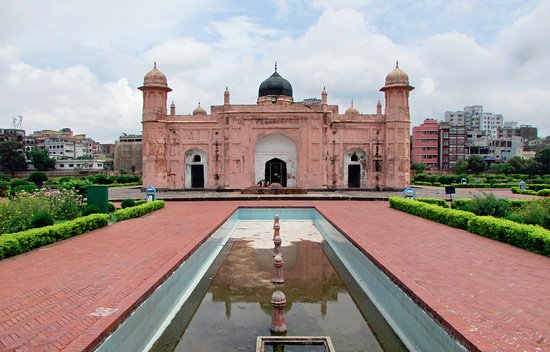
Lalbagh Fort, Photo Courtesy: Marjuque-ul-Haque
We decided suddenly to visit the Lalbagh fort. Normally, I would never have considered going there, except the night before we had been discussing with our cousin how nice it would have been if our whole extended family could go on a trip together somewhere. So, the next day the three of us — my brother, my cousin and I — decided on a day long visit to the famous Lalbagh fort.
The fort was an architectural complex from the Mughal era in the late 17th century. The three main structures of the fort included the tomb of Pari Bibi, the diwan-i-Aam (the hall of audience) and a mosque. The story of the fort’s creation begins with Muhammad Azam Shah, the son of the emperor Aurangzeb who was then the subahdar (governor of a subah or province) of Bengal. He was recalled and he left the construction to Shaista Khan, the later subahdar of Bengal. Khan also discontinued work on the fort after the death of his daughter Pari Bibi, who lies buried there. The bereaved father halted construction, believing the fort was cursed. It remains abandoned and unoccupied to this date.
The walk leading to the fort’s compound is lined with gardens in neat rows and patterns on both sides. Parallel to it runs a long strip of pool. The entrance is several feet long and domed at the top. The walls are grooved with rectangular recessions for decoration. The tomb, being a few hundred years old, seemed pinkish and off colour. However, the mausoleum with its high red dome was the most impressive of the three monuments. It housed the grave of Pari Bibi.
The Grave of Pari Bibi. Photo Courtesy: Marjuque-ul-Haque
We next went to the diwani-i-aam. The interior is far more impressive than the exterior. Inside are exhibited various Mughal weapons of war and everyday artifacts from the same period lined the walls of the museum. Swords, shields, spears, hand cannons, chain maces, clubs and other interesting things are part of the exhibits.
The last of the three monuments we visited was the mosque. This proved to be a disappointment, owing to the fact that the interior was not open to visitors as indicated by a placard. From the entrance, we peeped and saw clotheslines with garments drying on them and men in tupi (cap) and jubbah (a gown worn by Muslim men). Apparently, it seemed that they had a madarsah (Muslim school) and the students and staff resided inside. As we were but outsiders, we could not enter. However, we were able to climb atop a roof (or was it a verandah) to get a view from above. Up on that ledge, the breeze was light and frequent. We took a few pictures and spent some time before heading down.
Sauntering away from the mosque, we noticed a woman, a foreigner, a European tourist no doubt, dressed in pinkish white, quite absorbed in photographing of one of the buildings. Unfortunately, three eve teasers started making remarks in English near her. In the sunlight, she had shades on as she ceremoniously took pictures pointedly ignoring the three miscreants as they occasionally walked around her. The three of us felt embarrassed and discussed how this experience would impact the way she would describe Bangladeshi people to her friends and family. We were dismayed by their bad behaviour.
We had completed two circuits of the compound. It was five in the evening and the microphones blared an announcement that the place would close in forty minutes and that the visitors needed to leave the precincts.
The evening sky that swathed the nearest monument in a bluish glow was different from the one I had seen in the light of the afternoon. I recalled a few instances when buildings evoked a distinct aura. In fact, the buildings had been in a state of flux at all times but I had only been present to observe it at certain moments. The protagonist of the translation of Yukio Mishima’s The Temple of the Golden Pavilion had been shown as obsessed with the building’s beauty, reflecting in the same manner as me. In seeking respite from his imperfections, the protagonist of the novel had endowed the ancient temple with unattainable beauty. Unfortunately, his obsession with its appeal led him to set fire to the monument with himself inside; thus hoping to prove the mutability of the Golden Pavilion’s beauty. The Lalbagh Fort has endured a long stretch time and no doubt grown in beauty like the temple, but hopefully its beauty will only serve to inspire.
The Lalbagh Fort. Photo Courtesy: Marjuque-ul-Haque
Marjuque-ul-Haque is an MA student Department of English at the University of Liberal Arts Bangladesh.
.
PLEASE NOTE: ARTICLES CAN ONLY BE REPRODUCED IN OTHER SITES WITH DUE ACKNOWLEDGEMENT TO BORDERLESS JOURNAL
We’ve all heard the adage, those who don’t know history are bound to repeat it. Maybe like any good saying, it’s been over-used and we’ve forgotten to consider its core truism. But think about it. If we don’t remember, we tend to repeat former mistakes, because human-beings are very alike in their actions and reactions, and we have a horrible habit of thinking we’re so unique when we’re anything but that. The ego of is young. Occasionally, ignorance shields us from historical realities. When we get older, we sometimes stop caring and leave it to those younger to us. But both approaches have deep flaws. They abdicate the responsibility of living in this world.
What reason could any of us have for truly abdicating responsibility to our grandchildren, and those who will invariably come after we are gone? Is being young an excuse? Is being old? Or are we intrinsically fond of passing the buck, as American’s say, and not believing we’ll make enough of an impact in this world to even bother? I don’t think it’s that. I think it’s apathy and a childish belief someone else will do it for us. Just look at people who drop litter in the ocean, they don’t care that it will cause havoc on sea-life, they are not thinking of the future repercussion, they are thinking only of now. They don’t see how that one act has this deleterious knock-on effect that reverberates throughout our planet.
If you’re rolling your eyes and are about to give up reading, consider this: What is your value? What do you stand for? If you died tomorrow what would have been your legacy? Don’t think wealth or children, but your place in the chain stretching from the beginning of humanity to now. What have you done to help that chain? If you don’t think that is relevant, consider why this isn’t important to you and why being self-interested is justifiable to you when so many suffer, and the world is damaged by those like yourself who don’t care.
Maybe that sounds judgmental because of course, it is. Too often we can look back in time and see these pioneers and campaigners who try to make a change and be swallowed by disinterest on the part of the masses. Literally speaking then, the masses are the problem, because whilst a few good apples stand out and speak to things we need to do, the majority are thinking of just their survival and their immediate gratification. The concept of immediate gratification has taken deep roots in the current times.
Psychologists and thinkers have many ways to explain why the majority do nothing and seem apparently not to feel they have any obligation to improve the world we live in. Some say, it’s about human development; few attain that stage of self-realization where they feel a need to contribute beyond themselves. Others point to the hardship of life, and how when you struggle, you often do not have enough left over to help others. Of course, we all know notable examples of those who despite a hard life, gave in abundance to others.
If we remove religion and its dictate that people should help each other as part of being a good (Christian, Hindu, Muslim, Jew, Buddhist) would we have a lawless approach to giving and caring, that made social concerns null void? I would say it has less to do with dogma and religion and more to do with personal ethics. There are plenty of atheists who do a great deal for others and this planet, without any desire for recompense or a place in heaven. Therefore, it seems to be a deeply personal choice or evolutionary step.
If so, why do some evolve more than others? What do we need to do to achieve that selflessness and why do not many not want to achieve it? Those questions many never be answered, but they are part of a larger picture, that of our place in this world, and what we do to ensure there is a decent world for our progeny. I’ve been told this is a utopian way of thinking and human nature is baser, seeking only to procreate and thrive, sometimes at the expense of others. I am an idealist in that I believe there is intrinsic good in many (not all) people and that’s what gives being alive its deepest worth. Without helping make the world a better place in some way, we are just oxygen users, having too many children, using too many resources and trying to kid ourselves this won’t affect the future.
Growing up I was familiar with the peace sign so popular in the sixties, and we touted many of those symbols without really considering their history or how ‘working toward peace’ had actually played out through history. Maybe like many words, ‘peace’ is over-used and we don’t consider what it means in relation to today’s world. It’s as relevant as ever. If we think we’re not needed to increase peace, we’re living in cloud cuckoo land. Peace is one of the only consistent needs we have, aside food and water. It is the erosion of peace that causes the majority of our concerns, and the dismissal of peace that leads to some of our greatest strife.
So many continue to live in a part of the planet where peace doesn’t ever reign. Let’s stop and really think about that for a moment. Those of us who don’t live in those parts often try not to think about it, because it makes us feel guilty. What can we really do? Yet if we watch the news, almost nightly politicians debate about how best to deal with this issue. Or that’s what we’re led to believe.
What if we’ve been lied to? What if major world governments and thus, the puppet political system, do not wish for peace but thrive on discord because it permits them to do what they really want, which usually has to do with power, domination/control and profit. Think of all the wars since the second World War America has been involved in. Not one of them has brought peace, not one of them has ensured or guaranteed peace. The money spent is unfathomable and would have been enough to resolve many countries crisis’s forever. The profit is hidden and often in the sole possess of those who really pull the strings and many lives are lost. For what? Peace?
The idea of going to war to promote or guarantee peace is not a new concept. Traditionally however wars were fought for one reason only, one side wanted to conquer the other side to gain something (profit, land, slaves, control) and war was typically a male endeavor and one that seemed to exist in every society where human beings existed. You could say, war was uniquely human. Similar fighting has been witnessed in other primates, and animals, and they often share the occupation or protection of territory as their prime objective, so perhaps it’s an instinctual thing within our animal psyches to go to war. However, wars in the modern sense of the word have not been as basic, and their motivations have increased with the complexity of our societies, to make what we understand by war, a thoroughly human concept.
A complex society, invariably thinks of many more strategies related to war than a simple brawl in the old days, with sharpened rocks. The more complex, the more devastating and wide-reaching and drawn-out wars, think of Rome and their stampede across the world, or Alexander the Great’s conquests. Wars have been the cause of so many negatives, not the least; sexual assault, slavery, subjugation of people’s, famine, destruction of land and property and livelihood, physical and mental suffering and the collection of extreme wealth by the minority. Does that begin to sound modern to you? It does to me.
Today’s wars are all about the optics, the phantom, the illusion. Countries go to war to act out their own strength to ensure other countries don’t forget how mighty they are. The people who get caught in these, die or suffer terribly, the displaced cause huge economic fallouts and a minority get rich. It sounds a lot like a pyramid scheme to me. I began to think of the military machine as a pyramid scheme when I began studying the wars America has been in since WW2. One could argue without America half of Europe would be speaking German now. I personally don’t believe this is true, but it’s a common myth that thanks to America, Europe wasn’t destroyed. It might be worthwhile considering how WW2 began, what part America had in it, and the specific strategies employed, because it’s never as simple as it seems, not least this repeated thirst for groups to condemn and persecute other groups. Everyone involved has an agenda, few are as civic minded as they appear, and so a war is, as I said, more complicated.
What we do know is this: The World Wars (which sadly are being phased out of being taught at schools throughout the world, begging the question, if future generations don’t know what happened and why, how can we avoid a repeat?) was a consortium of countries, spearheaded by Germany, seeking to over-run vast parts of the world, and to promote a new ideology. I can resolutely say this needed stopping and at any cost because within that, were persecutions towards groups that led to mass slaughter. This is true in most wars but the difference is, this was on a larger scale (comparatively speaking with the then-populations) and anything less than involvement would have brought disaster.
What’s different about the wars since?
World Wars one and two were world wars, they involved nearly everyone, aside from Switzerland who decided in their neutrality they could make a tidy profit, and Spain, who were having their own civil war, and made a deal to be left out of it. When everyone is involved in a war that involves everyone, we can argue, this is a war that cannot be avoided, defused or worsened by involvement.
Can the same be said of Vietnam? Were the involvements of France and then America beneficial? Could the war have been avoided? Was it necessary?
The same can be said for many other so-called necessary wars, from the smaller (Falkland’s and the UK) to larger Korean or Afghanistan. In every situation, the involvement of other countries that were not directly affected, only worsened the war and suffering, the involvement was not simply to ‘help’ others, that was never the intention, the involvement had many motivations, and only one was a true sense of ‘aid’ with a view to peace. So why is it, when we see the soldiers leaving out, or the declaration of war, we also hear the word ‘peace’ bandied around? Why do people truly believe ‘going to war’ will ensue peace when history tells us, this is rarely the case?
Too often I have heard that people have to go to war for peace, or that peace-keepers will be sent in. I find it hard to find any war that has led to peace and even then, everyone involved would agree, if it could have been avoided, that would have been a better strategy altogether. In truth, WW1 and 2 could have been avoided, if you consider what really caused them. The feelings of helplessness and loss of face, led the German population for example, to vote for candidates who promised them a better future. Nobody knew how bad this would become, but the feelings of resentment and despair were the fuel for why extremism won the vote. In that sense, it’s very much a domino effect.
If then, most modern war begins with issues that can be resolved if identified, isn’t true peace keeping, to deal with those issues, before a war begins, rather than after that? Of course, those people are called diplomats and to be fair to them, many have thwarted worse outcomes through diplomacy, but just as diplomats can be successful, they are also used as pawns in a bigger system, that of the war machine. Certain countries wish to go to war almost at any cost. Consider the war between Pakistan and India and how culpable the English were for their interference with both countries as ‘peace keeper’ when in reality it was all about subjugation, control and imperialism. If we think this is an old-fashioned term, consider the patronizing tone of Western societies when ‘peace keeping’ in other countries, taking the paternalistic approach instead of considering what got them there in the first place. Years of exploitation aren’t easy to undo.
While this is never acknowledged and is hidden behind rhetoric about trying to protect others and ensure peace, we should bear in mind the true motivation. This doesn’t make us conspiracy theorists or negative thinkers, so much as realists who see history and its repetition of such wars and quiet conquests. The homogenization of the media has seemed on the surface, a good thing, but if the ‘facts’ are controlled then it’s more of an illusion of information, although preferable to the situation in those countries where international news is altogether restricted. When I moved to America, I was surprised at how little international news was on nightly TV and of that, how they only glossed over the most salient points. But it seems the rest of the world has followed suit, with the once immutable BBC now expressing opinion rather than fact, it seems they’re all spurred on by the rush to entertain rather than inform.
The outcome of exploitation is today greater than ever. It is the reason why so many refugees seek refuge in countries overburdened with too many asylums for their fragile infrastructures. A no win situation, begun after WW2 where Jews were not permitted asylum and the Geneva Convention acted to prevent this ever occurring again, to displaced peoples, yet countries who do not possess the jobs or social infrastructure like Spain, could not realistically take in the numbers arriving. War is not always the sole determinant for asylum seeking, but it remains the main reasons. Small wars unreported on daily newscasts, prevail in areas ravaged by gangs and corrupt governments. The West might consider themselves far advanced from this desperation but if we consider how many times the West has been implicated (or should have been) in foreign affairs that led to wars, it’s definitely a fully fledged partner in the root cause.
Take the South and Central American refugees streaming into Mexico as I write, seeking asylum in America as a prime example. Thanks in part to years of American meddling in local politics. We can wash our hands of it and say: This is their war! But we should be mindful of what led to the war. It’s never as simple as it seems. Years of erosion, weaponization and drug sales that would not exist if wealthy countries were not buyers, there are so many factors to consider, many of which originate outside of the actual country in question. When civil or border wars begin, they are rarely unprovoked and locally generated, but the result of years of exploitation and meddling from foreign interests.
Maybe we don’t want to admit that. And many times, that’s what politicians do, they simply refuse to see what history proves is true. By stating categorically, ‘this is not our fault or problem’ they tap into those people who desperately want to hear that, rather than take responsibility for something they feel they had no part in. Sometimes they genuinely didn’t have a part in it, but oftentimes we are a part of the problem, even if we aren’t willing to admit it. Every time we buy deeply discounted goods from other countries, we condone through our purchase, the maquiladoras where underaged women work for pittance, displaced from their home towns because NAFTA (North American Free Trade Agreement) created a bigger market and eroded the traditional farmers. They now make our Levi’s jeans which we want at a good price, and therein is our part in the exploitation cycle.
True, we don’t have to admit this. We can turn away from the oceans filled with debris cast off from giant containers routinely sunk poisoning the sea and sea life, even as those containers give us the affordable middle-class existence, we feel we are owed. We can turn away from child labour, gunrunning, drug-crimes, all related to things we set in motion from influential countries. We can say if we specifically didn’t sell Mexico a US gun, we’re not responsible for kids being shot; if we didn’t smoke a joint at college, we can’t be responsible for the drug-trade and its fall out; but the situation is far more insidious. No one trade is in isolation, they are all linked. So, when you smoke a joint from weed coming out of Mexico, you’re not just supporting the drug-trade, you’re supporting the heroin trade, the smack trade, the child-prostitute trade etc.
None of us want to own that kind of legacy, so it’s easier to just say: I have nothing to do with it. I find myself thinking that when I want to buy a cheap dress from a chain store that makes things in China, I should be thinking of the worker who made it and how little they were paid. I feel it when I go for a cheap taco for lunch or expect a Mexican local lawn cutter to charge less for their services, there are so-called levels of ‘innocent’ subjugation we permit because they’re enshrined into our system and only the most moral will ever have the strength to protest them. With regard to peace, we also turn a blind eye, instead of holding people responsible, perhaps because we don’t know how to, we condone non-peaceful interventions throughout the world, in the ‘name’ of peace all the time.
With 9/11 the outrage in the US was at an all-time high. It was the perfect timing for launching a war that in any other setting would have been pronounced doomed, foolish and already tried and failed many times. Yet based on emotion and rhetoric that’s exactly what America did and few protested, because fear, fearmongering and inaccurate emotive rhetoric rules the day. Now with social media, this tendency has run amok and very little fact exists so much as knee-jerk reactions, immediate- gratification and social outrage which is more false outrage than accurate. We feel good if we speak out about injustice as we perceive it, cherry picked by social media as the dish du jour and we don’t ever question how much social media manipulates us.
I find those who are not on social media have the vantage point of not being susceptible to this invariable bias. When we go back and check our ‘facts’ as we perceive them, we run into mine fields of websites littered with inaccuracies and who has the time to truly fact check? Today, the media en mass is less accurate, more reactive, more immediacy-based, and we’re junkies of the like button and click bait more than ever before. In fact, I just finished watching a documentary about how social media is specifically set up to emulate the impulses you have when gambling, with one example being that tempting ‘ding’ we receive when getting a message and how hard it is not to check. This is all psychological programming, and it’s deliberate, but who ever considers that and its far-reaching consequence on truth?
As long as we have our new iPhone (criminally expensive), we’re all good. The modern world keeps us too tired and busy to really muster lasting outrage about anything. In fact, we’re gaslighted if we do. Unless of course it’s the sanctioned ‘approved outrage’ that’s flavour of the week. We’re controlled in our responses more than ever before but believe we are freer than we’ve ever been. What a fallacy and what a stellar job those who control us have done. And before you say, “I’m not controlled!” Think about it – really think about it.
So how can we live in a peaceful world if our very notion of peace is perverted by the long-standing agendas of those who really set the schedule? How do we as individuals have any power for change? If we send our cousin off to war with misgivings and we’re told we’re not patriotic if we question his/her service, how can we ever expose the lies behind the notion of ‘peace keeping’ and what modern-notions of peace really mean? Just like Missionaries who originally might have had good intentions but essentially forced their way into cultures and demanded they adhere to a foreign God, we’re going into countries that have problems, possibly historically caused by the West, and thinking we know best. But there is absolutely no proof we do.
In fact, there is ample proof we don’t and we don’t learn. Of course, there are worse offenders. Iran’s shameful human-rights legacy, their determination to build a nuclear weapon are terrifying. But on the flip side, whilst I will never condone their punishment tactics or human-rights violations, I can see why they would wish to have access to a nuclear weapon if others have. What makes one country have the right to be weaponized and not another? Personally, I wouldn’t want Iran to have nuclear weapons but I also think it’s wrong of countries like America, the only country to have used (and some would argue, abused) a nuclear weapon, to dictate which countries can have access. It’s also wrong when you consider it is the very countries with weapons and power who often have sold those weapons to the countries, they then sanction for trying to build said weapons.
Ultimately as a peace striving person, I would wish NO country had nuclear weapons but how realistic is that nowadays? I think it’s like the Smallpox scenario. We can all agree to get rid of our Smallpox because we have eradicated Smallpox but what if one country keeps theirs and then has the upper hand over the rest? Can we ever trust other countries? Ideals aside, history tells us human nature is such, we rarely can trust even those closer, even our own governments. So perhaps skepticism and mistrust aren’t so much a peace-breaker as a natural response?
I’ve never felt there could be an ideal of total peace. I don’t think it’s within our purview as humans to achieve that. I hope I’m wrong and I hope the day comes that’s proven. Meanwhile, with America and Russia acting like stupid cold-war frien-amies again, I pause before I trust any country totally, not least my own. As such, we invariably have weapons of mass destruction to act as ‘deterrents’ as a stale-mate to prevent out-and-out war. Whether this will be our undoing, remains to be seen. It only takes one nuclear accident to prove anything nuclear wasn’t such a hot idea. Surely, we’ve learnt this? I would argue the younger generations haven’t because it’s not being taught and it takes me back to the idea of those who don’t know history are doomed to repeat it. If you believe your generation is ‘better’ and won’t make that mistake, consider how many generations had the same (wrong-headed) concept and the consequences thereafter.
Is there really an answer? I don’t have it But I think if we all stop hiding from reality and try to figure things out, we have a greater chance. Certainly, having a pie-in-the-sky approach doesn’t work anymore than being too reactionary does. At the moment, America is stymied by its polarization of thought and its reluctance to think. Until those change, we’re just a bunch of fussy children wishing bad things didn’t happen. I believe we can be more than that. Even if we don’t attain total peace, we can get closer.
.
Candice Louisa Daquin is a Psychotherapist and Editor, having worked in Europe, Canada and the USA. Daquins own work is also published widely, she has written five books of poetry, the last published by Finishing Line Press called Pinch the Lock. Her website is www thefeatheredsleep.com
.
PLEASE NOTE: ARTICLES CAN ONLY BE REPRODUCED IN OTHER SITES WITH DUE ACKNOWLEDGEMENT TO BORDERLESS JOURNAL.














 Borderless