Well, I suppose it seems so to you, who are not normal,*

Become a hermeneut. Ditch your tour guide.
Doubt the psychopomp who offers you a boat ride.
Challenge the river Lethe to prove that you forgot anything
when meaning is invented, when power is inverted,
when memory is a collage
and lucid dreams are preferable to the life you are leaving behind.
Shake the water from your arms,
where the drops fall, plant seeds.
Walk away from your garden. Leave it to the bees.
They will make honey, they will question the colours,
mix the nectar into syrup, and paint their hexagonal murals.
Do not return to the bees. Bees taste of honey, and stings.
That is their allegory. Their truth is their own.
Experience the sound of loneliness.
Empty your mouth of other people’s words.
Do not speak until you know the difference between
conversations and crossword puzzles. Do not
compare the descriptions of conversations and crossword puzzles.
Find a new difference between them. Cultivate that difference in your daily life.
Meaning: meaning making, making meaning making.
Somewhere, in there, exist.
Give thanks to what cups you in its ineffable hands.


* The title is a line from “The Last Romantic” by John Ashbery (1927-2017)
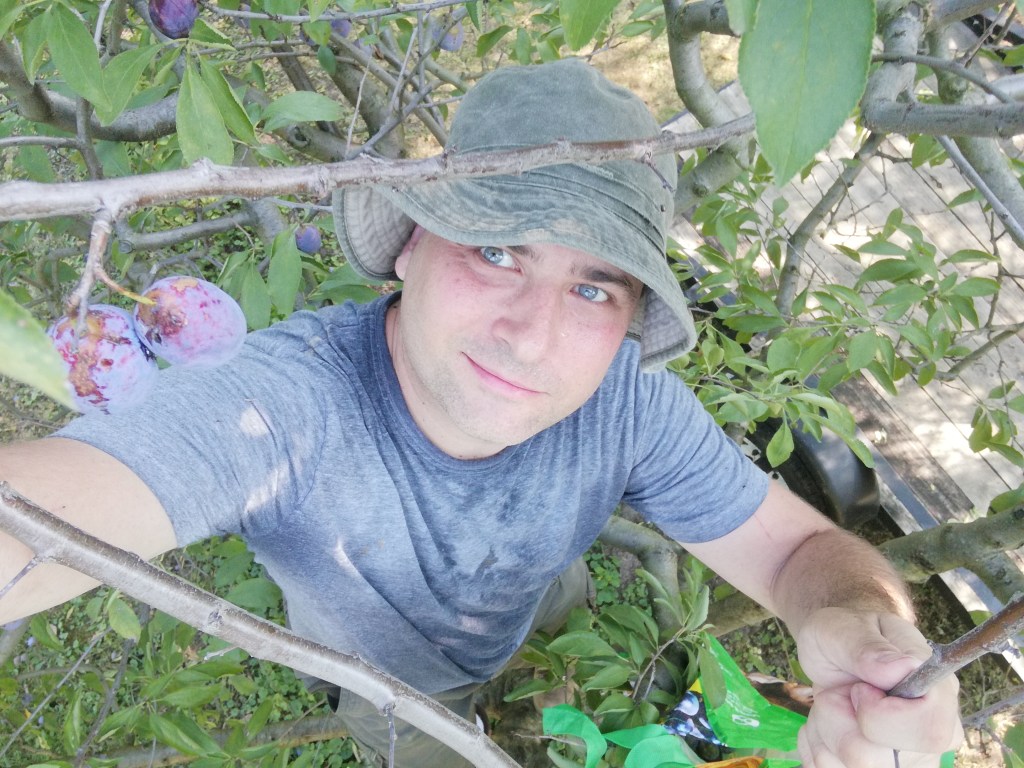
Poetry by Canadian plum farmer Terry Trowbridge has been published in over 60 journals, zines, and magazines, including The New Quarterly, Brittle Star, Orbis, The Dalhousie Review, subTerrain, paperplates, The Nashwaak Review, Carousel, Episteme.
.
PLEASE NOTE: ARTICLES CAN ONLY BE REPRODUCED IN OTHER SITES WITH DUE ACKNOWLEDGEMENT TO BORDERLESS JOURNAL
“Always for the people and never with the establishment”- that sums up the persona of George Fernandes. One of India’s firebrand leaders, Fernandes (1930-2019) lived his life fully and with resolve. He was a multifaceted personality: a trade union leader, a socialist, and a powerful orator. No other politician in India had risen to such heights of popularity as Fernandes was. A down–to–earth politician, he has left behind him an unparalleled legacy.
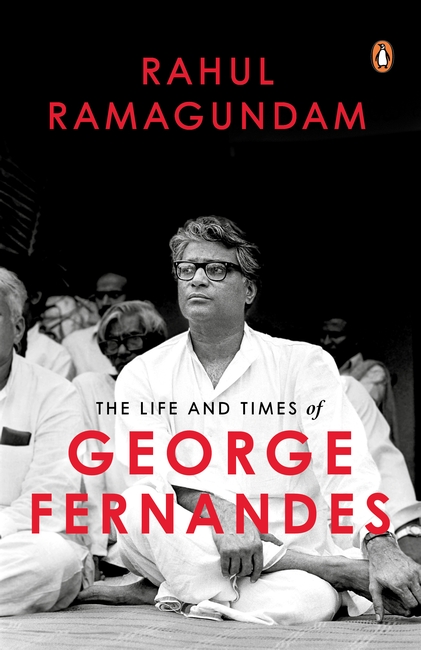
The Life and Times of George Fernandes by Rahul Ramagundam is one of its kind biographies – well-researched, colossal, and one which tells the story of a leader in minute detail. It is hard to find a biographer so immersed in the subject that it becomes a monumental work.
Reads the blurb: “George Fernandes is popularly known for leading the All India Railwaymen’s Federation (AIRF) in 1974 and calling upon its approximately 1.7 million employees to strike, which brought India to a halt for twenty days. Often described as a rebel, he pursued every cause he took up with passionate devotion, heedless of the many ups and downs in his life. From the early years of fighting for the rights of the dock and municipal workers of Bombay through the Emergency, which he resisted by going underground, to his last private decade as a bed-ridden Alzheimer’s patient, his fights were always persistent and single-handed. It chronicles the story of George, who rose from the streets of Bombay to stride the corridors of power.”
If Fernandes was known for trade union militancy, politically he was dauntless. A rebel political leader, he was an anti-capitalist dreamer. George could call Bombay to shut down and rose from its streets to become India’s Defense Minister.
In this amazing biography, Ramagundam records George’s political evolution and traces the course of the Socialist Party in India — from its inception in the 1930s to its dissolution into the Janata Party in the late nineteen-seventies. In the process, the book explores the trajectory of India’s Opposition parties that worked to dislodge the long-ruling Congress Party from its preeminent position in the thick of the emergency.
Ramagundam received his doctoral degree in modern Indian History at Jawaharlal Nehru University. He was associated with a grassroots movement in the united Madhya Pradesh for many years. Presently, he teaches at a Delhi-based university and also is the author of Gandhi’s Khadi and Socially Excluded.
In the prologue, Ramagundam writes: “The book tells the story of India s tortuous post-Independence building and the role of George Fernandes in it. In some ways, the book presents a contemporary history of India through the lens of George’s life and his political work. The story has George’s political emergence at its center but does not emanate merely from his perspective.”
Explaining the basic objective of the book, the author says, “This is not a narrative of events – however defining they might have been. A biography is a chronicle of an evolutionary process and not a conglomeration of self-standing events in the subject’s life. Events shall feature here, as they are bound to be in a book dealing with a political personality. But more than the events, the book is a delineation of processes that define Indian politics. It delves deep into the evolution of India where George lived and worked tor. He also attempts to enter the political mind and probe the political choices George made.” If the book tries to present an insider’s account it also strives to construct those processes with documentary evidence and oral testimonies.
Divided into a dozen chapters with acronyms, a chronology of events, dramatis personae, and a guide to sources, there is nothing that the author has not covered about George’s action-packed life.
From his Christian beginning to the revolutionary road, George’s Bombay days, the sobriquet that George earned — More Dangerous than the Communists– the most hunted man, George’s underground days, how he was chained and confined, the gritty years — the book has all that Fernandes was made of. But it is in the last chapter (‘They Hate My Guts’) that Ramagundam exposes the double-speak of leaders who were close to Fernandes.
Says the book: “The pedigreed hated him. The plebeians felt jealous at his powerful expression of their predicament with a perspective they lacked. Left with Bihar alone, the English-speaking socialist imports (J.B Kripalani, Asoka Mehta, Madhu Limaye, and George) won there because of their national and wider outlook to the disadvantage of the homegrown socialists. Sooner or later, to survive in Bihar politics, when caste-parochialism was raising its monstrous head all over, it was inevitable that George would have to depend on the accruing local elements and accord them primacy.”
This particular incident was one of the saddest ones in George’s life and was played out in full glare then. Ramagundam recollects the episode in the book: “In the 2004 general elections, Nitish Kumar made his return to Muzaffarpur, where he won, but in 2009, when he again desired to stand for election from the same constituency, his party headed now by Sharad Yadav, a front of Nitish Kumar, denied him a nomination. As a consequence, a fumbling George, Alzheimer’s disease already having taken some visible grip over him, was made to fight the election as an independent and he lost his deposit, denying him a graceful exit. The unsavoriness of George contesting the election against his party was opposed by his family members, who blamed Jaya Jaitly for it. Michael Fernandes wrote to Jaya about it and asked her not to make a mockery of him. And, after the election, in which he not just lost his deposit but showed up as decrepit his inability to campaign exposed to the world, Leila Fernandes put out a public statement expressing her displeasure at the goings-on in his life and politics.”
Concludes Ramagundam: “George Fernandes lived a life driven by a commitment that was experientially born, he had ideologies to believe in, and for most of his life these ideologies seemed to be personified in his endeavors and struggles, but beyond that, he lived a life of experiences, up close and personal, that is left for future generations to sort out and sift through, and learn from.”
Comprehensive, evocative, and unputdownable, this definitive biography of George Fernandes is a tour de force. It is not only the biography of George Fernandes but also an account of the times gone by in contemporary India.
.
Bhaskar Parichha is a journalist and author of Unbiased, No Strings Attached: Writings on Odisha and Biju Patnaik – A Political Biography. He lives in Bhubaneswar and writes bilingually. Besides writing for newspapers, he also reviews books on various media platforms.
.
PLEASE NOTE: ARTICLES CAN ONLY BE REPRODUCED IN OTHER SITES WITH DUE ACKNOWLEDGEMENT TO BORDERLESS JOURNAL
Painting by Abraham Rattner(1895-1978). Courtesy: Creative Commons
“HUNTERS”

On our way to the first picnic of Spring,
my daughter points her index finger to the uniformed crowd,
shouts “hunters”.
I did not teach her that.
She must have gathered some idea from the stories of those around her
and some from the pictures while ravaging through my laptop.
My daughter does not understand the news;
I think mistrust for the television was innate in her;
In that moment, I decided I’d tell her in bits and pieces truth and lived realities,
ones they ask us to keep away from the reach of younger children --
Shows with visuals of Violence flash warnings too --
Content warning: Violence. . . 16+ only.
But the world tends to ignore that our children live in the wretched embrace of shrouded stories.
So, the next time my daughter shouts “Hunters”,
I will not give in to my fears and paranoia,
And while protecting her remains my first priority, I will nod my head in affirmative- “Hunters!”
Quratulain Qureshi is a Kashmiri native, who is currently pursuing her Masters in English Literature from New Delhi. She has published poems with journals such as Livewire, Wande Magazine, Inverse Journal and more.
Dignity of expression is an underestimated phenomenon; in times like ours where everything has to be blurted out loud from the biggest amplifiers, subtlety has become a jaded mode of creative power. What can be understood in two words and understatement needn’t be stretched to a point of vulgar oversimplification through metaphors and symbolism anyway. The sorry state of affairs obviously then finds an outlet through the arts. Ideally, painting should capture the world as a beautiful sanctuary, where our place as heavenly creatures endowed with virtues galore and innate innocence, is sanctified. This it does in thousands of visual motifs. But painting also evinces an ample canvas on which our internal world of chaos finds an adequate representation. That is where ‘art’ finds its footing.
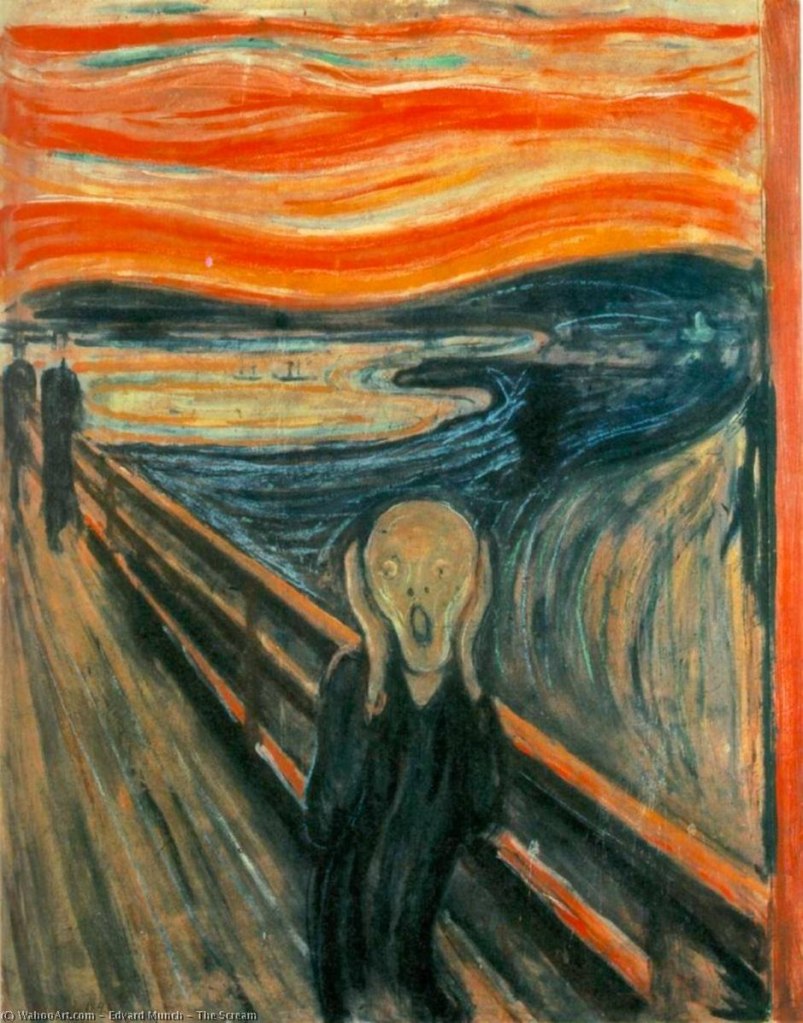
For me, one artwork that will always stand the test of time when it comes to representing our internal implosion affected by socio-cultural, political consequences is Edvard Munch’s ‘Scream’ (1893).
I don’t know when exactly I discovered it because it seems to bear such an omnipresent place in our cultural consciousness. However, to the best of my memory, my tenacious relationship with ‘Scream’ commenced more than a decade ago when I first set sight upon its hollowed out, skeletal figure, a personality who, it seemed, had placed us instantly in his/her shoes. Munch’s work thus has gone on to frame every moment that has blown the lid off societal hypocrisies and depravity, for this writer. It’s a scream that we all innately identify with because so much of our lives is spent repressing our self-expression, our sense of self-esteem and by extension, our rights. As our mental health, a culturally coded reality ignored throughout modern humanity’s materialistic stride, becomes a perennial victim of that repression, we yearn to speak. Recount our potential lost chances. Claim our minds, bodies and souls as our own. Retaliate at the status quo and in fair essence, scream. Scream at the void, at our preceding generations, at calloused authority.
If you ask me then personally, the painting’s stance of an individual left in the middle of nowhere, imploding with the gesture of putting his hands on his ears and crying out, melting with the weight of the world, is most likely to be identified with my journey till now. That literal and oftentimes implicit scream is attached to parts of my whole being where nothing of prejudice, repression or even plainly documented neglect from our adults and guardians should reside. Yet they do.
I scream when my talents as a writer are taken to be temperamental or above careful analysis, as only an individual feat. I scream when a writer’s sensitivity doesn’t translate to a real vocation in the eyes of the world. I scream when my sustained silences groan and moan for days on end, only to be met with a premise of being ‘physically weak’ on my part; when my insides churn with inflaming pain attributable to chronic stomach troubles and indigestion since that day in 2000 where I was cursed with a bout of jaundice. When the strength to write gets overpowered by my depressive disenchantments; when gender roles are used as a rapier in common discourses, I scream. I scream. I scream. Never audible enough to be heard. Always observing a kind of bourgeois tact that makes me come undone. I scream when the men tail me in moments of solitude at riverside parks, put hands on my body and refuse to acknowledge that there are asexuals out there who don’t crave the crassness of physical pleasure. Or even verbal grooming and cajoling.
I scream when the river gets dirty, filled with pollutants. The trees fall down. When a peaceful day is brutalised by the ancient prophecies of time; when concrete balls, lances of disease and traffic blasts produce a most grotesque symphony of the nature of the world, a preserve of noise, sound and fury signifying nothing especially as our mental states are poured out into doctors’ tables for consultations and fees, I scream. Gulping the air around me and melting with all the foregrounds and backgrounds this world can assist me with, to no avail, I get hollowed out.
Peace is a luxury to us mere mortals. Chaos is the lightning rod that governs us throughout. Since truth can never be shortchanged, Scream always haunts us with its presence, intimately involved in our implosions through the clogged networks of time and memory. I felt its echoes in Apichatpong Weerasethakul’sMemoria(2021), as Jessica, the protagonist, travelled along a network of vibrations emanating from aural worlds around her, dictated by the stillness of nature holding more than it dares to reveal; or, in that eight-minute unbroken piece de resistance in Dea Kulumbegashvili’s Beginning(2020) where her central figure drowns out the pandemonium of sexual defilement by laying her head on the ground, to keep herself sane and from death’s purview.
That scream is released in the final two minutes of the lyrics of Phoebe Bridgers’ breakout single ‘I Know The End’ (2020) where an apocalypse of the mind finds its literal projections compounded by rock guitars and drums, where the serenity of the preceding passages leads to an honest overflow, where aggression is supplanted by an exhausted sigh in the final coda. But also one, where silence is not an option. To me, Munch’s imprints let me reconcile with the fact that more than the politics of life and death as well as class, we are eternally doomed to imparting a facade of silence and repression to our ethos. It’s the inescapable truth and when bigotry such as the ones we encounter infects discourses, The Scream gags to be left out. It should, must be let out.
.
Prithvijeet Sinha, has built a prolific published corpus based on the intersection of poetry, cinema and culture. He hails from the cultural epicentre that is Lucknow, India.
.
PLEASE NOTE: ARTICLES CAN ONLY BE REPRODUCED IN OTHER SITES WITH DUE ACKNOWLEDGEMENT TO BORDERLESS JOURNAL
Story by Shankhadeep Bhattacharya, translated from Bengali by Rituparna Mukherjee
I wake up with a start in the morning. Breathing deep, I realise that the essential substances are not permeating into my lungs in proper amounts. My limbs are turning a blackish blue. It seems as if someone is hammering my skull right behind my ears. My head, like a ticking bomb, is almost fit to burst. This claustrophobic, terrifying existence is of course not new to me. The scientists proclaim that they have recorded the highest degree of air pollution in the Babynamen region. It was Kikoro about a month or two back. I was there the last time. I reach Babynamen without wasting a lot of time. I sit there like an ancient monk and inhale deeply for seven hours. My body feels relaxed. The colour of my body turns normal, from a blackish blue to a healthy pink. I write the name of Babynamen right below Kikoro in my diary as well as the details of the day’s events.
My house is not near any human settlement. I don’t even know if there is any human activity nearby. My home is a twelve feet by twelve feet room made of porous, rough plastic. My routine happiness lies sedimented in the resting peace of the room. There are no windows in this room, not even the smallest hole lest the flies enter. There is a reason for such an arrangement. I don’t want the pure air — a rare treasure these days — that comes from the forest across the river, touching the lush trees, to enter my room. If that unadulterated air finds its place in my lungs, there will be trouble. The colour of my skin will immediately turn a blackish blue. I check the two sides of my abdomen just to be sure. There is a hint of red tinged with pink across my skin, which means my body is completely normal. I break into a song in joy. My song is interrupted by a knock on the door about a minute later. Someone is knocking gently at the door. I open the door and my body shivers with a feeling of deep happiness and sudden thrill. Samapti stands in front of my eyes.
I had first seen her around thirty years back. We were both twenty-one in the first year of the twenty-first century. Seeing her for the first time, I had felt that Samapti [1]was a beautiful young woman, a newly bloomed red oleander flower in flesh and blood. Samapti has always been my first and only love. The sunflower was our favourite. We used to listen captivated to Raga Hangsadhwani in dusk. We loved building shelters for birds and animals with the wet sand near the sea. We often travelled close to the mountains in search of pure air. We inhaled calming oxygen to our fill. We gazed silently at the mountains clad in clouds hand in hand, stared at the white stars twinkle in the black sky from tents in the middle of the forest.
Samapti used to speak of her work then. Her work comprised waking up the people from their untimely sleep, to ensure that their five senses worked properly. She was exceptionally good at keeping people alert and full of life, the very best in her team. When she would finish talking about her work, she would ask about mine. My task lay in spinning stories, poems and songs for these lively people, the history of human struggle, stories of the sea, poems of the river or the cuckoo’s songs. Listening to these, they would themselves inspired to write poetry about the squirrel at times or to empathise with the suffering of an unknown, distant humanity. Our work was a long process. We weren’t always successful in our work.
Initially our work had been very fulfilling. But after ten years or so, Samapti told me with a worried face, “Humankind is not waking up from its slumber anymore, Diganta [2].” I had also observed that the alert and lively human beings were no longer mesmerised by the songs or the stories of the trees or the dance of the peacock, neither were they moved by the suffering of others.
Another ten years later, our travel in search of pure air was also stopped. Humankind started living inside their homes. The entire world outside was plagued by a deadly disease. Samapti and I could not meet as well. I used to flap around claustrophobic in my house like a fish caught in a net. I found breathing normally inordinately difficult. My body would turn a blackish blue in absence of pure air. I would often think of Samapti then. I didn’t have a trace of her after that time. Today Samapti stands at my door, awakening the latent questions in my consciousness. Her face doesn’t look as lovely as before. Samapti used to be dark-skinned. Her skin has turned somewhat sallow now, sunflower yellow.
I say, “You have changed Samapti.”
Samapti laughs and says, “I have long been dead, Diganta.”
“Dead?”
“Yes, when we were cooped up in our homes, the disease outside found its way into my body. I could not be saved even after a lot of effort. I died from a lack of pure air. But you are alive Diganta, even after such a catastrophe. I am so happy to see you.”
“Why don’t you come inside Samapti?”
Taking her hands in mine I say, “Don’t leave me alone anymore, stay with me. Promise me you’ll stay.”
“I don’t have anywhere else to go. Diganta, tell me, how many times does a person die?”
“I don’t know.”
“Seven times if it’s a man, seventeen if it’s a woman. I have only one step left to reach seventeen.”
I didn’t really understand what Samapti is saying but I tried to figure out which of those seven stages of death I was in.
Samapti looks very thin. I think she is hungry.
I say, “Will you eat something?”
Samapti says, “I haven’t really eaten anything since my death. My tongue doesn’t feel taste neither can I smell anything. Everything I see is blurry. I don’t even feel hungry.”
I take out a watermelon, an apple and an orange, a few vegetables and some more delectable food items. Samapti is looking at me. She has deep love in her eyes, on her face a gentle smile. She watches me suck all the formalin and carbide from the watermelon and apple into my body. I have been doing this quite easily for a long time. I lick away the pesticides from the vegetables. I cook the clean vegetables, cut the fruits, and present a wholesome meal to Samapti.
Samapti says, “If you eat the food you have just given me, will you experience stomach pains, nausea, insomnia?”
I nod my head in agreement.
Samapti has her fill of all the food. She says, “I have eaten such uncontaminated food for the first time Diganta. I could taste and smell all the food items.” A sliver of memory makes its way into my mind at this moment. Samapti’s eyes and face used to be filled with pure delight on watching the rain. She would swim in the river on hot summer afternoons. She would not want to leave the water. I would join her. Not just that, I could feel in my very bones that even the simple act of drinking water would give her immense satisfaction.
I have heard water is hailed as life itself, an element without which human beings cannot survive. I pull away arsenic and other harmful chemicals from the life-giving water into my stomach and give Samapti the clean, fresh water in a brass tumbler. I realise she has been thirsty for long by the way she drinks water.
After drinking her fill, she observes, “You don’t drink pure water anymore Diganta. You might get rashes, problems in your kidney, even cancer, isn’t it?”
I nod my head again in agreement.
Samapti has tears in her eyes. Wiping her tears away, she says forlorn, “Why did everything turn to this Diganta? What was our mistake? We have spent our entire lives with the humankind. You would sit on a hunger strike in the streets for days on the disappearance of the honeybees. You would be heart-broken at the death of a butterfly. You gave your best to rejuvenate the sad humanity. Were you the only one to love nature? What about the rest of humanity?”
I take Samapti in my embrace. Breathing in her smell, I smile to alleviate her dismay, and say, “Do you remember Samapti, you had once cooked chital fishcakes for me? I had promised myself that I would treat you to steamed hilsa one day. But I could only feed you boiled rice and omelette. An omelette was the best I could do. Do you remember?”
Samapti laughs. She is still laughing. She must have remembered a lot of other things, which means I have succeeded. I relish these moments. We walk through the pleasant alleys and lanes of memory through the day. We stare at the star-filled night sky for a long time. The stars in the night sky, so many light years away, are the same still. Perhaps they are intact because they are away from the earth. Samapti holds my hand tightly and says, “Listen to me Diganta. The earth will heal itself and will again become what it used to be. I firmly believe it. It will come to pass. Humankind will return the earth to its former glory. A peaceful earth. An earth where children can play carefree. You will get untainted fresh air again, Diganta. It will happen. Just don’t give up hope.” Samapti hugs me and lies down very close. She falls into a deep sleep. Having spent many nights without sleep, my eyes become heavy with slumber soon.
When I wake up the next morning, Samapti is nowhere to be found. I can’t see her anywhere in the room. She has left. But where has she gone? She had said yesterday that she had nowhere to go. Is she then in the last rung of death…?
I am in pain. Salty tears form at the corner of my eyes and trickle down. I do not want to lose Samapti. How can I live without her! She has said that the earth would regenerate itself to its former glory! I will get fresh pure air back in my lungs! She has urged me not to give up hope.
I suddenly feel very scared, fear of death from the pure, fresh air. I usually avoid any contact with pure air. The hope in Samapti’s words has somehow channeled itself into my being. I am torn between unadulterated hope and terrifying fear of death. With an overwhelmed mind, I search for a small forest of green trees. By the time I make my way to the middle of the forest, the colour of my body begins to turn. My body temperature is getting warmer and the skin colour is rapidly changing to a blackish blue. My breath seems to be choking in my throat. I do not have much time on my hands. I do not want to die. I reach Babynamen as fast as I can. I fill my being with the most polluted air of the world. But even that cannot not allay my breathing troubles. The insides of my chest feel empty. Consequently, I lift the cover of a manhole on the street and put my entire face inside. I pull in deep breaths. The blackish blue colour seems to fade out a little. I am still not out of danger completely. An old matador stands near. As soon as it starts, the exhaust of the vehicle spews dense black smoke. I quickly take the exhaust pipe and shove it inside my mouth till it reaches my throat. I fill my lungs with the fumes like I was enjoying a hukkah.
The colour of my skin is now pink. The area around my navel is somewhat red. I feel healthy. My breathing is almost normal. I am calm. I return to the middle of the forest. I have not given up yet, Samapti. I touch the branches and leaves of the verdant trees; the fresh air seems to graze past my nose. Although it is risky, yet I splay my fisted hands to the sky as if I want to enfold the forest in my arms.
I breathe in with all my might. My body gradually turns a blackish blue. But I do not give up. Like one crazed, my burnt and withered lungs suck in the lost purity to return to a life, fresh and animated, as it used to be before lakhs were born and lakhs had died.
(First published in Bengali in 4 Number Platform in August 2021)
Shankhadeep Bhattacharya is a software engineer who is keenly interested in spreading awareness about the environment, society, the socio-economic impacts of technology through regular seminars and webinars. He likes writing for little magazines. He is associated in the editorial capacity with Pariprashna and Sangbartak magazines. He has strived to create narratives in his stories and personal essays that centre around the current realities. He was awarded the “Namita Chattapadhyay Sahitya Samman” in 2022. He has published three books so far: Parisheba Seemar Baire (a collection of short stories, Parashpathar publications, 2018), Manush, Samaj, Prakriti (a collection of essays, Sangbartak Publications, 2021) and Prayukti Tokko Golpo (theory fiction, Sopan Publications, 2021)
Rituparna Mukherjee is a faculty of English and Communication Studies at Jogamaya Devi College, under the University of Calcutta. She is currently pursuing Doctoral degree in Gendered Mobilities in West African and Afro-Diasporic Literature at IIIT Bhubaneswar. A poet and short fiction writer, she works as a freelance translator for Bengali and Hindi fiction and is an editor at the Antonym Magazine. She is also an ELT consultant and ESL author outside of her work and research schedule.
.
PLEASE NOTE: ARTICLES CAN ONLY BE REPRODUCED IN OTHER SITES WITH DUE ACKNOWLEDGEMENT TO BORDERLESS JOURNAL
MANNEQUIN

All those weekends with my mother.
Driving out to that K-Mart in the mall
along Bayfield Road.

Leaving me in the toy section
back when such things were okay.

So she could shop on her own.

And how I quickly bored of the toys.
Heading over to the clothing section
to pretend to be a mannequin.

Standing perched up on that display still as I could.
Posed like the family of mannequins
around me.

A few women smiling at my pretend
as they wheeled by.

Even a wink or two.
A moment of shared knowing.
Ryan Quinn Flanagan is a Canadian-born author residing in Elliot Lake, Ontario, Canada with his wife and many bears that rifle through his garbage. His work can be found both in print and online in such places as: Evergreen Review, The New York Quarterly, Borderless Journal, GloMag, Red Fez, and Lothlorien Poetry Journal.
.
PLEASE NOTE: ARTICLES CAN ONLY BE REPRODUCED IN OTHER SITES WITH DUE ACKNOWLEDGEMENT TO BORDERLESS JOURNAL
Sitting in a humble bar,
Two men in late sixties are talking friendly.

Sitting alone in the corner I drain my glass.

They are retired salaried men I suppose.
I realise the fact as words drift from their conversation.
After leaving their lifelong work,
Maybe, they are talking about their bygone days.

I wonder if they got a large amount of retirement pay?
Are they getting enough pension to sustain old age?

Across the tables from a distance,
I am now looking at myself of tomorrow,
On a relaxed Saturday afternoon,
While the sun continues to shine brightly outside
Ihlwha Choi is a South Korean poet. He has published multiple poetry collections, such as Until the Time When Our Love will Flourish, The Colour of Time, His Song and The Last Rehearsal.
.
PLEASE NOTE: ARTICLES CAN ONLY BE REPRODUCED IN OTHER SITES WITH DUE ACKNOWLEDGEMENT TO BORDERLESS JOURNAL
I have a confession to make; I opened the suitcase you asked me not to. Well, it was a good two weeks after you were buried. While sorting a million things in your room with aunt and mom, I found it, a small, grey one stacked under the pile of boxes in the corner.
For as long as I remember, it had been there in the east corner of your wooden floored room and was out of bounds for adults and children alike. When I pulled it out, there were a few moments of silence in the room. I held the forbidden grey box and the three of us looked helplessly at each other, caught in between the right and wrong as Rumi would say.
When the burden of silence grew unendurable, we opened the suitcase. You may feel betrayed for the three women you trusted the most had the audacity to intrude your private space.
That night, while in bed, my body turned heavy as I sunk deep into the darkness and chaos of guilt. I gasped for air and the mountain wind heavy with moisture, did little to help. I ran helter-skelter through the chasm of my memory. Your ringing laughter guided my way and your stories echoed like strange noises that reverberate while you walk into a deep cave. The familiar name you had often uttered resounded as I traversed the dark channels. When did I first hear it? I don’t remember.
I do remember some instances of you mentioning the name. It was a random conversation of good-looking men in our vicinity and you did say, a certain someone’s son. On one evening while we were discussing the achievements of men and women in our neighbourhood, you mentioned that name again — a man in your neighbourhood, a certain someone’s son. You told us he was your playmate.
One summer evening, when the winds of the hills touched our skins gently as they basked in the last traces of light from the setting sun, you mentioned that name again. You said that my friend, seated next to me, dressed in a white shirt and beige trousers, reminded you of that man. “Majestic demeanour,” you looked into my friend’s eyes and said, “Yet spirit as gentle as the wind outside.” You smiled as you held his hands. Then, as you uttered the familiar name for the last time in my presence, your eyes turned moist — “You remind me of a certain someone’s son.”
Still wriggling in bed, as images and voices from the past haunted me, I thought of your prized possession, the suitcase. Aunt and mom watched that evening as I flipped opened the case. My hands failed to steady themselves. The three of us gasped as your precious box lay bare, revealing what it had steadfastly concealed all these years — a bunch of safety pins, bundles of ribbon, a crocheted purse with a tie-up opening, some old coins that carry no value, a few pebbles, a bizarrely shaped quartz stone with what looked like columns and faces on it and another crocheted purse with tie-up strings concealed underneath all this.
The quartz that has paled from its years in hiding fit perfectly in my palms. Amid the chaos of sharp edges on it was a central pillar, standing tall. There were odd figurines on either side. I left it on the table facing the window.
Finally, aunt laid her hands on the last item– a crocheted purse in a medley of colours. The pouch had the hues of the rainbow, held together intricately with a string in white. Aunt gave it to me to untie the white knot atop the small bag. We all knew that if there was one person who would be forgiven for trespassing, that would be me.
As I put my hands into the pouch, a palm-sized photograph in black and white print emerged. I held it between my fingers. A man dressed formally in a suit and tie with curls spilling over his forehead looked straight into my eyes. He was seated on a stool. The years between us melted as I gazed at his big, bold eyes, which were probably coffee brown, just like yours.
In an instant, I was transported into the room where the photograph was being taken. I asked him about the young girl I did not know– the girl who saw certain magic in him and carried it concealed deep within her even when her octogenarian memory failed her at times. He spoke of your smile and your innocence.
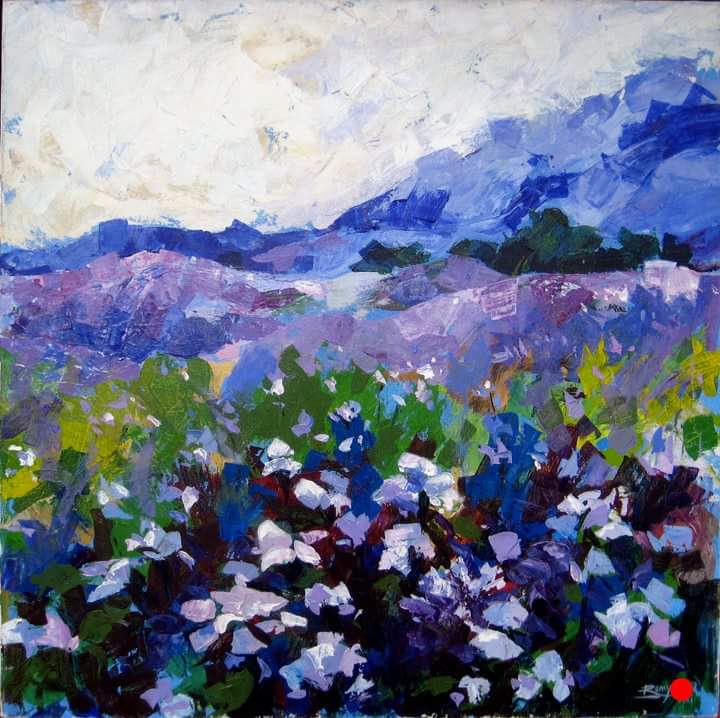
He told me stories about the blue Kurinji that blooms once every twelve years in the mountains and the anticipatory excitement that lingered in the air when the buds appeared, and then gradually how the stretches of the mountains turned an enchanting blue as the flower bloomed — a vision that no combination of words can do justice to. To him, the memory of appeasing blue was visceral and he elaborated how it pacified him during the dark moments when his strength had nothing to grasp. The Kurinji may blossom and spread its vigour just once in a decade, but he saw its unfurled radiance all the time; behind his closed eyelids, and that was his elixir, a perpetual force his life depended on. He believed that the bewitching plant was your totem, and your spirit lived in it.
Behind the photograph was a name written in blue fountain pen, the name from my distant memory that you had mentioned on a few occasions and beneath it, ‘son of ………………….’
As I left the room, a strange shadow reflected from the quartz stone on the table. A boy and a girl (with flowing hair) held each other’s hands from around the pillar. They could not see each other but both of them felt the other, all the time.
Love,
Your Doll
Kurinji blooms that flower in the Neelgiri hills of India. Courtesy: Creative Commons
Monisha Raman’s essays and short stories have been published by various magazines in Asia and internationally. Her first collection of short stories is being represented by Zuna Literary Agency, India. Her work can be found at https://linktr.ee/Monisharaman.
.
PLEASE NOTE: ARTICLES CAN ONLY BE REPRODUCED IN OTHER SITES WITH DUE ACKNOWLEDGEMENT TO BORDERLESS JOURNAL
There have been too many suns in the sky lately,
too many times outnumbering the indefinite stars,
too dull, and yet too many for you and me.
I begin each day with a name, a number and a notice,
typed out in a grammatically incorrect frustrating format,
that I mentally attempt to correct over a breakfast of overcooked cereals.
As I work on a mediocrely fancy desk with a nonfunctional WIFI – I often imagine you smiling – high
still on the share of my favourite white wine.
My mornings are the dullest part of the brightly sunlit
yellow brick walls, as they slowly cradle me to uncomfortable conversations at work.
I no longer complain intentionally as the afternoons
are rapidly habitualising me to an ungrateful existence.
I face a crowd, six times a week, and that alone
defines my love and command of the foreign English in
an unbearably unkind Indian locale.
I am trying not to hate the place for the people,
I am trying not to abandon the people for the pain,
I am trying not to starve myself as the final consequence.
The food here carries an unfamiliar rural smell, far
divorced from what I read while growing up in a city,
and I unlearn each lunch as a survival necessity.
I often take the longest path after work, watching
the sunset sky as I walk, wondering
how unfriendly the clean air can get.
I feel really hungry at night but refrain from eating,
punishing myself for being too afraid to execute the mistakes at work that I promised myself to commit.
Each night I examine the things in my hostel room,
mentally chalking out a plan to travel,
weighing the odds of it against my unsanctioned holidays
Amrita Sharma is a guest faculty at the Indian Institute of Information Technology, Una, Himachal Pradesh. She has worked as a Fulbright Fellow at the University of Notre Dame, USA. Her works have previously been published in several journals. Her first collection of poems is titled The Skies: Poems.
.
PLEASE NOTE: ARTICLES CAN ONLY BE REPRODUCED IN OTHER SITES WITH DUE ACKNOWLEDGEMENT TO BORDERLESS JOURNAL
I first learned of Therese Nagai while listening to a student presentation. I was teaching a class of first year pharmacology students at Tokushima University. Their assignment had been to make a group presentation on something related to their major. One group chose to introduce Nagayoshi Nagai [1844-1929], the Father of Pharmacology in Japan, and the founder of Tokushima University’s Pharmacology Department. My ears perked up when the student mentioned that he had married a German woman.
How was it that I had lived in Tokushima for 26 years, yet no one had ever mentioned her to me? Didn’t ordinary people know of her? I knew of the Wenceslau de Moraes, the Portuguese sailor who’d settled at the foot of Mt. Bizan and who wrote about Tokushima in Portuguese. There was a museum dedicated to him at the top of the mountain. I also knew of the German prisoners of war who’d been interred in nearby Naruto during World War I. Because of these foreign men, the prefecture had established ties with both Portugal and Germany. But what about this woman, Therese? I was determined to find out more about her.
In the photo of Therese and Nagayoshi Nagai that pops up in a cursory Internet search, she is staring off in the distance, her expression determined, resolute. Her hair is pulled back, her Victorian dress buttoned up her neck and decorated with a large cameo pin. She looks serious, sensible. He is wearing Western clothes as well — a suit, and a tie. He gazes directly at the camera, but his head is tilted toward hers. She looks as if she might be lost in thought, thinking of her native Germany, or how to improve upon her life in Japan. He seems to be thinking only of her.
Nagayoshi was born in Myodo District in Awa Province, which is now known as Tokushima Prefecture, on the island of Shikoku. His father, a physician, taught him about the medicinal properties of plants, and expected his son to follow in his footsteps. His mother died when he was a child. As a young man, he embarked for study in Nagasaki, at the Dutch Medical College. Nagasaki was the first port of call in a country newly open to foreign trade, and the influx of Western culture, after 230 years of isolation. There, Nagayoshi saw pale, big-nosed Europeans for the first time in his life. He got a job at the first photography studio in the country, where he took photos of foreigners and Japanese, such as folk hero Ryoma Sakamoto. Sakamoto, who was also originally from Shikoku, albeit further south, in Kochi, encouraged Nagayoshi to go abroad and learn from the West.[1]
From Nagasaki, Nagayoshi went on to study at Tokyo University, Japan’s equivalent to Harvard — not bad for a boy from the backwoods. Still, when he was awarded a coveted study-abroad slot at Berlin University, he felt compelled to ask his father for permission to go. His father was afraid he would never come back. “You have a responsibility to become a great doctor,” he told his son. Nagayoshi couldn’t bring himself to tell his father that his interest had turned to chemistry and pharmacology. He had no interest in becoming a doctor.
After getting the go ahead from his father to set out on this great new adventure, he sailed by boat to San Francisco, then took a train to New York, and finally sailed on another steamer to Liverpool. In Europe, everything was shiny and new – the water pipes, the gas lamps, the glass windows. He was also deeply impressed by the architecture in Berlin, declaring in a letter to his father “Everything that is built by humans is finely detailed.”[2]
Although there were several boarding houses that catered to young Japanese men, he took up residence with Frau von Holzendor, where no other Japanese student was living in order to expedite his German language learning[3]. After she passed away, he moved into a boarding house run by Frau Lagerstrom.
The young Nagayoshi was intense and single-minded, too caught up in his studies to bother with a social life. His mentor, German chemist August Wilhelm von Hofmann, suggested that if he was planning on staying in Germany, he should marry a German woman.
“That’s not as simple as you think,” Nagai allegedly replied. “Orientals are still a rarity in Germany. In Japan, foreigners are considered outsiders, and they’re called ‘Meriken’ and held at arm’s length. It will take time to get the consent of my father.”[4]
According to one biographer, Hofmann began plotting to find a German bride for Nagai. He invited his protégé along for an unveiling of a statue of his former teacher, Justus von Liebig, the founder of organic chemistry, the University of Giessen. The proprietor of the boardinghouse where Nagai was staying also accompanied them, perhaps as part of Hofmann’s plan. After the ceremony, Nagai decided to take a trip to Switzerland. On the way, he stopped at the Nassauer Hof Hotel in Frankfurt.
Looking out of his pension window, he spotted an attractive, young German woman, and asked Frau Lagerstrom how he might go about meeting her. She conspired for the two of them to have a meal with young Therese Schumacher and her mother. The Schumachers were visiting from their home in Andermach, a picturesque, medieval town on the left bank of the Rhine. Therese’s father was a local lumber and mining magnate. Nagayoshi was so tongue-tied at breakfast that he could barely manage to get a word out. When he finally spoke, he asked if she would like some honey for her bread. “Yes,” she replied.
After breakfast, Nagai and his landlady ran into the mother and daughter in town.
“Will you be going out somewhere tonight?” he asked.
“Yes, I’m going to the opera,” Therese replied.
Nagai invited himself along.
That evening they went on their first date to the Frankfurt Opera House, chaperones in tow. When asked later what the performance had been, Nagayoshi laughed and said that he didn’t remember. He’d been so mesmerised by the young woman sitting next to him, he hadn’t paid any attention to what was happening on the stage.
The next morning, Therese and her mother departed by boat to Wiesbaden. They continued on a day or two later to Schlagenbad, where the Schumchers had an exclusive contract to provide building materials for a new hotel under construction. When they returned home to Andernach, Therese was astonished to find Nagai, wearing a suit newly tailored for the occasion, waiting on the docks.
For the next three days, he was the guest of the Schumacher family. Therese gave the dapper scholar a tour of the main house, built in 1746, and the stone and lumber works.
“You’ve caught yourself a Chinaman,” Therese’s brother Mathias teased. More likely it was Therese who’d been snared by this polite, erudite Japanese visitor.
The following year, a delegation arrived from Tokyo Imperial University, inviting Nagayoshi to return to Japan head the university’s first Department of Pharmacology. In the film version of their story, Nagayoshi is torn between staying in Germany with the woman he loves and returning to the land of his birth. Of course, he was obligated to return. The university had sent him to Germany to learn for the benefit of his nation, after all.
He proposed marriage to Therese. She said “yes.” After becoming engaged, he returned to Japan alone. He worried that his bride-to-be would be discontent in backwards Japan, where country folk still clattered around in wooden geta clogs, and rickshaws were the choice mode of transportation. In the Japanese movie version of the story, his younger sister assured him that if Therese truly loved him, she would be happy to be with him no matter where they lived. It’s likely, however, that his father and sister were not quite as agreeable as they appear in the film. After all, in that era Japanese men rarely married for love, and Nagai, the only son, was eager for his father’s approval.
In 1885, Nagai experienced a breakthrough in his research, when he successfully isolated the active ingredient of Ephedrine. Later, his findings would be instrumental in the development of medication for asthma and cough suppressant. And even later, he would develop methamphetamine.
Nagayoshi and Therese were separated for months. When he finally returned to Germany, he was 40 years old. Therese was 21. They married on March 27, 1886, in a church in her hometown, Andernach, despite the fact that Nagayoshi was not Catholic. He would convert to Catholicism thirteen years later.
Once in Japan, Therese sent a flurry of letters back home to Andernach. She wrote of homesickness, but also of “standing firmly on two feet in their new life. I feel as if gradually new roots form and I become habituated to this strange way of life, to unusual manners. I’m making progress.”
Broadened by his own experiences abroad, and influenced by his sharp, young bride, Nagayoshi was a strong proponent of education for women. He co-founded Japan’s first college for women, now known as Japan Joshi Daigaku, where Therese was employed as an instructor of German. She was, reportedly, an energetic teacher, enriching her lessons with instruction on manners, customs and German cooking.
Eventually, they would have three children – Alexander, Willy, and Elsa, all brought up to be bilingual, and with an awareness of their German heritage.
In addition to being the Father of Modern Chemistry and Pharmacy in Japan, Nagayoshi served as president and founder of the Japanese-German Society. Therese is credited with introducing German food and culture to the Japanese, and, along with her husband, hosted Albert Einstein and his wife Elsa during part of their visit to Japan in 1922. Therese also helped to interpret for the couple.
Therese died in 1924.
When the eldest son, Alexander, first visited his mother’s hometown, Andernach, he claimed it as his second home. Later, during World War II, Alexander Nagai, would serve as a Japanese diplomat to Germany at the embassy in Berlin. One writer mused that his cross-cultural upbringing made him especially sensitive to the plight of the German Jews. Alexander was a member of a group that resisted intolerance toward Jews and is reported to have helped enable the issue exit visas to Jews who sought to escape Nazi Germany.[5]
In 1994, Teigi Nagai, grandson of Nagayoshi and Therese, donated an ornate chandelier to the church where his grandparents were wed in homage to their legacy and love.
[2] Hoi-Eun Kim, Doctors of Empire: Medical and Cultural Encounters between Imperial Germany and Meiji Japan (Toronto: University of Toronto Press, 2014), 91
[4] Nobuko Iinuma,Nagai Nagayoshi to Terēze : Nihon yakugaku no kaiso (Therese and Nagai Nagayoshi: Father of Japanese Pharmacology), Tokyo : Nihon Yakugakkai, 2003
Suzanne Kamatawas born and raised in Grand Haven, Michigan. She now lives in Japan with her husband and two children. Her short stories, essays, articles and book reviews have appeared in over 100 publications. Her work has been nominated for the Pushcart Prize five times, and received a Special Mention in 2006. She is also a two-time winner of the All Nippon Airways/Wingspan Fiction Contest, winner of the Paris Book Festival, and winner of a SCBWI Magazine Merit Award.
PLEASE NOTE: ARTICLES CAN ONLY BE REPRODUCED IN OTHER SITES WITH DUE ACKNOWLEDGEMENT TO BORDERLESS JOURNAL







 Borderless