The ocean breeze swipes the water page after page turned in waves of succession,
one after another sweeping the air and stirring it in the sounds of coming and going.
The waves move as the wind dictates: some taller, some more shallow, still others less certain.
These are the waves of times, when Fall just begins and the air knows nothing of Summer—
in days blessed by what came but were cursed when they left, with just the newest day now with me,
where only what left is what I wanted— where only waves of its time came and are now over.
Water comes then recedes motion upon motion, each one pulled from the edge of the sea,
each one returned to where it once came. I do not see its subtle direction-change
except its withdrawal, except to see them extracted in distant sentiments of their own.
Can it be that this is what was always meant to be, and did I miss more than I could have remembered?
Did I not notice them when they were there one after another in chances I hadn’t realised were given?
But now I see I was wrong: each day the shore doesn’t forget each wave’s sentiment,
each wave holds its own where there is no end to them, where I’m offered a memory wrapped by the pain
of their leaving, but stays bound to every one where I hold on to the gift each one carried. DESIGNS
so much of what consumes me is mired in redundancy mental gymnastics wound ‘round and ‘round like an old watch spring and even when encased as permanent and making promises of permanence revolve with the earth in an air of inconsistency— both tensioning and reverting
maybe sorrow was designed this way maybe it was honed from some common metal where fissures stayed hidden but are the cause of its denigration over and over daylight comes deepens then fades mired in a cycle where change speaks only to change ‘round and ‘round in steps that hold its own brightness
A STEP AT A TIME
I can’t walk far once sunlight begins leaving, once the sweet music of unnamed birds begins to end, after rain fell again in the morning and clouds regrouped in early evening, the day without a before or after, only itself with two hands giving all I come to breathe— the two of us here in waning sunlight remembering: another day only mine to take, only the day to give— whether I cherished it or had choices when it ended, a day in the light that remains with an intensity of its own.
SR (Salvatore Richard) Inciardi was born in New York City and attended Brooklyn College and New York University. SR Inciardi’s poetry has appeared in the USA and in Europe in various online and print magazines including Green Ink Poetry, Harrow House Journal, Grey-Sparrow Journal, Borderless Journal, Written Tales,among others. He was a contributor to Green Ink Poetry for their publication on Kennings: Equinox Collections: Autumn released on Amazon in October, 2024.
.
PLEASE NOTE: ARTICLES CAN ONLY BE REPRODUCED IN OTHER SITES WITH DUE ACKNOWLEDGEMENT TO BORDERLESS JOURNAL
It’s those words in the smaller pairings that offer imagined depth but inexact dimension with eyes that cannot see newness in weakened light absent colour words that can be read from the ashes of what never was in a time escaping into the dimming sunset: if only I could see my choices replayed if only I could hold them when the air was younger when they floated on a gentle breeze and were touched by an earlier sunlight when I knew what it was to be in the moment and I was captured by words still to come. If only they were here if only the words I heard then continued to speak now.
SR (Salvatore Richard) Inciardi was born in New York City and attended Brooklyn College and New York University. SR Inciardi’s poetry has appeared in the USA and in Europe in various online and print magazines including Green Ink Poetry, Harrow House Journal, Grey-Sparrow Journal, Borderless Journal, Written Tales,among others. He was a contributor to Green Ink Poetry for their publication on Kennings: Equinox Collections: Autumn released on Amazon in October, 2024.
.
PLEASE NOTE: ARTICLES CAN ONLY BE REPRODUCED IN OTHER SITES WITH DUE ACKNOWLEDGEMENT TO BORDERLESS JOURNAL
Now the changes have stopped and what it’s come to has settled in a curtain masking as it spreads so what was at one time discernible is painted in thicker darkness. At this point I see it will not reverse another day weathered another string of moments shaded by insistence—soundless sketches of how real objects appear bloodless stripped of their depth blended with their variances.
It’s not the daylight I miss but the touch of what once stood before me the comfort seeing it knowing it was there in the light now both unreachable. It’s the darkness that seems to hold the more natural light among the new air that’s turned cold shifting between two selves: one that knows what the daylight once gave and the other that knows when the light returns each day will be different.
SR (Salvatore Richard) Inciardi was born in New York City and attended Brooklyn College and New York University. His poetry has appeared in USA and Europe in various online and print magazines including Green Ink Poetry, Harrow House Journal, Grey-Sparrow Journal, Written Tales,among others. He was a contributor to Green Ink Poetry’s Kennings: Equinox Collections: Autumn (2024, Amazon)
PLEASE NOTE: ARTICLES CAN ONLY BE REPRODUCED IN OTHER SITES WITH DUE ACKNOWLEDGEMENT TO BORDERLESS JOURNAL
I don't need your devotion -- your attention -- or to listen, connect with my emotions -- or to tell me I'm forgiven,
I don't need your affection or to feel your tender touch, I don't need your protection -- your support -- to be my crutch,
I don't need adoration -- all your compliments and thanking, your true appreciation -- all your patience -- understanding,
I don't need all the accolades -- your gratitude -- respect, your sympathy -- your serenades -- your charming intellect,
I don't need all your lavish gifts and all your good advice, don't save me in a snowdrift - I don't need your sacrifice,
I don't need your agreement or to see my point of view, just be good to me on Sunday -- and be good to me on Monday too.
Stephen Philip Druce is a poet and surrealist from Shrewsbury in the UK. He is published in the USA, Hungary, India, Canada, Ireland, the UK and South Africa. Stephen has also written for London theatre plays and BBC Radio 4 extra.
PLEASE NOTE: ARTICLES CAN ONLY BE REPRODUCED IN OTHER SITES WITH DUE ACKNOWLEDGEMENT TO BORDERLESS JOURNAL
It is a truth almost universally acknowledged that Jane Austen is a great writer. The world created by her in just six novels continues to regale generations of readers with tales of love, marriage and money, a sentiment which would be reiterated by substantial numbers of her fans all over the globe. We could well echo Evelyn Waugh on the comic writer P. G. Wodehouse: that his (Wodehouse’s) inimitable world could never grow stale….that he has made a world for us (readers) to live in and delight in…
Jane Austen(1775-1817) has acquired a kind of cult status in the last couple of centuries. Such is her reputation that it has helped birth a veritable Jane Austen industry, replete with museums, memorabilia and mementos. There have been numerous novels and films inspired by Pride and Prejudice and Emma and many films (and remakes and adaptations) based on her novels.
16 December 2025 marks her 250th birth anniversary. Many museums in the UK and the USA have showcased exhibits which give viewers delightful glimpses into her life and writing. Her novels, full of wit and satire, provide an insightful commentary on the social hierarchies, as well as the quirks and oddities of her milieu.Their plots and themes are woven around women and the necessity of marriage, money and the determining power of money.With considerable irony and subtlety, she turns the mirror on how manners are a function of morality and good sense and not just a matter of appearances. Rarely didactic or preachy(with Mansfield Park as the only exception), her novels convey in perfectly nuanced and measured prose, how difficult and crucial it is for women to find the right spouse and space.
As the youngest daughter of a poor clergyman, mostly educated at home, Jane Austen was well aware of the value of an independent income and a home of their own. After the death of her father, she, her sister Cassandra and mother, rather like the Dashwood women in her novel Sense and Sensibility, had to move around as they were dependant on the financial support of her brothers, especially her wealthy brother, Edward. The pain of this unequal fortune and frequent shifts, which Jane and her sister Cassandra may have experienced, is expressed by Elinor and Marianne in the novel where they have to practice small economies and learn to scale their expectations according to their situation.
Austen led a largely sheltered and sequestered existence, surrounded by her family, bound to family duties which “might have been the more expected of a dependent spinster aunt such as she was.”[1] Many intelligent women, like Charlotte Lucas, Elizabeth Bennett’s friend in Pride and Prejudice are shown to accept inferior matches to escape from spinsterhood and the expectations of their natal families. The absence of livelihood opportunities for women in her day and the lack of any income of her own would have proved irksome to Austen and provided her with a further impetus to “write her way into some money,” as she wrote in a letter to her brother, Captain Francis Austen, in July 1813. Further, in another letter to her niece Fanny Knight, she writes that “single women have the propensity to be poor which is one very strong inducement for women to marry.”
Her novels often do not always reveal the full measure of Jane Austen’s remarkable achievement: how she, constrained by genteel poverty, “the lack of a room of her own”, and writing materials which had to be put away often to attend to obligatory family commitments, wrote her novels based on such close observation of, and acute insight into contemporary life. Her eye for detail is such that it invites frequent references to her own words: “A little bit of ivory, two inches wide, on which I work with a brush so fine as to produce little effect after much labour.” This modest disclaimer and “little effect” have, however, fascinated generations of readers and inspired hosts of writers.
That Jane Austen’s 250th anniversary is being celebrated and commemorated all over the English-speaking world perhaps comes as no surprise but it still leaves us with some questions. What is the relevance of her novels now? Are her novels relevant to present-day political realities, in addition to their astute observations on graded social hierarchies? Can we view her as a feminist? Does she merit inclusion and study in universities of the global south at a time when there is a strong drive to decolonise English, the language of the erstwhile colonial masters?
In her book Jane Austen: The Secret Radical, Helena Kelly writes of the subversive and radical potential and intent of Jane Austen’s novels. Kelly goes a step beyond Marilyn Butler’s 1987 Jane Austen and the War of Ideas that had suggested that Austen leaned on the conservative Burkean side when challenged by new-fangled Jacobinism with its ideas of equality and brotherhood, coming from France which disturbed hierarchies, ideas and values long held to be sacrosanct in traditional English society. Kelly suggests that far from being conservative, insulated from contemporary political concerns, Jane Austen held radical and possibly subversive views which she did not express openly but which are clearly configured in the world of her novels. In doing so, she made the novel a meaningful art-form and a vehicle for the expression of ideas around love, marriage and additionally also of debates on slavery, female education and emancipation.
“It is a truth universally acknowledged that a single man in possession of a good fortune must be in the want of a wife.”[2] This famous ironic opening sentence of Austen’s has captured attention and elicited many critical commentaries. It’s a brilliant masterstroke where Austen underlines the mindset of young women and their anxious mothers on the lookout for eligible bachelors. Articulated like a truism, it seeks to facetiously universalise a partial truth. The omniscient authorial tone and tenor encompasses the dominant themes of Pride and Prejudice in the opening statement itself. Marriage, women’s responses, men’s reactions, social rank and wealth — all the principal subjects of Austen’s writing are near universal themes. In her novels, Austen communicates the constraints within which women function and the limited or literally the only ‘choice’ available to them. Having experienced financial instability and economic dependence, she had a clear understanding of the constraints experienced by women in early nineteenth-century England.
The happy ending that we see where Elizabeth Benett indeed becomes “mistress of Pemberley” symbolises the moment when some women, having acquired a certain status, become custodians of the home and the private sphere. Some feminist historians like Gerda Lerner, however, have pin-pointed this moment as one where the economic marginalisation of women is complete, in the aftermath of the Industrial Revolution, and they are pushed back from the public sphere.
Even as women were participating in print culture and taking their place as readers and writers, they were increasingly relegated to the private sphere. The tendency to relegate women to the private sphere and making them responsible for the entire range of domestic tasks of nurturing and care-giving and thereby sustaining the edifice of domestic life is something that persists even now. The fact is that women’s participation in the paid economy and public sphere has added to their ‘double’ burden in the 21st century.
Many critical voices have pointed out that Jane Austen’s writings do not directly mention the political situation, philosophical debates or religious discourses of the day centering on questions of social equality, justice, economic questions or the rights of man. Yet her fine crafted depiction of socio-economic relations, the dynamics of human relationships shaped and moulded by the struggle for wealth or power or status exposes the political reality, social hierarchy and the economic structure in society which shaped and informed all social transactions.
While the position of women may have improved in some spheres, there are still glaring gaps when it comes to women’s access to equality or justice. Changes in the last two centuries have gone beyond superficial tokenism. There are still miles to go in our march towards equality. It is in this larger context where there is a grudging acceptance or disavowal of women’s rights that the Jane Austen heroine’s negotiations with patriarchy remain relevant.
They demonstrate a mode of assertion, of agency in the face of inequality and in socially disadvantaged situations, which sustain an illusion of female empowerment and wish-fulfilment. It is this vision of romance, which, informed by a comic and somewhat ironical view of life, consolidates the exercise of female agency and makes the reading and re-reading of Jane Austen’s novels a rewarding and enriching experience. Her astute delineation of human delusion and human folly holds up a mirror to her society that often impels recognition on our part and remains forever relevant. Her perceptive analysis of the warp and weft of her society remains almost unmatched.
…yet he (Byron) cannot match the shock she (Austen) gives me;
Beside her, Joyce is as innocent as young grass. I feel truly uneasy, my mind unsettled,
Watching the English middle-class spinster
describe the power of money to attract love,
so plainly and soberly revealing
the economic foundations that sustain human society.
W.H.Auden’s lines on Jane Austen and the unlikely comparison with the prince of notoriety, Lord George Byron, never fails to instruct or entertain us. Such is the mark of great literature which leaves its imprint decades and centuries after its inception.
Meenakshi Malhotra is Professor of English Literature at Hansraj College, University of Delhi, and has been involved in teaching and curriculum development in several universities. She has edited two books on Women and Lifewriting, Representing the Self and Claiming the I, in addition to numerous published articles on gender, literature and feminist theory. Her most recent publication is The Gendered Body: Negotiation, Resistance, Struggle.
.
PLEASE NOTE: ARTICLES CAN ONLY BE REPRODUCED IN OTHER SITES WITH DUE ACKNOWLEDGEMENT TO BORDERLESS JOURNAL
Spring, summer, and autumn, while the birds sang their seasonal tunes humans beat loudly their own drums.
The bees collected their nectar well while swans in the lake nearby found their life-long mates and yapped their love notes,
while sound and sights captured much of the yearly gifts to bless, while in silence, a rose bush gave her cloying fragrance and red flowers.
In life, we give of ourselves: the best of what we have.
HOPES AND DREAMS
The year 2025 found the world at a crazy stage on which life danced.
Amidst the maddening politics, natural calamities and wars took the hardest hits. In the turmoil, I feel like an ant under an elephant
When I wish to make a difference in life for someone in need — what have I to give?
Mother Teresa’s advice echoes “If you cannot feed a hundred people, then feed just one.” I get up and venture out.
Surely, since I am alive and well; there is something I can do for someone?
When hope for a better world crumbles like sand, I send prayers up to heaven--- I know, they can move mountains. And with prayers, I plant new seeds of dreams for a peaceful world of tomorrow.
Tulip Chowdhury, a novelist, poet, and columnist, writes from Georgia, USA. Her books are available on Amazon.
PLEASE NOTE: ARTICLES CAN ONLY BE REPRODUCED IN OTHER SITES WITH DUE ACKNOWLEDGEMENT TO BORDERLESS JOURNAL
On the sidewalk of his existence,
he signs a lease for his coming days.
He earns a license of freedom
that puts him above the king of kings.

He’s a drifter waiting for the tide to turn
but happy if it never does
cause what he feels is the envy of people,
what he does not have is their fear.
On the surface, they pity him.
In the depths of their soul, they envy him.

Their expectation leads to disappointment.
Their defeat sounds like confinement.
His truth smells like liberation
and his liberation provides him with freedom.

Fortunate are those who have very little,
for they may not know that they own the world.
Poor are those who have a lot,
for they may not know that they own nothing.

He sits on the sidewalk
lays back on his blanket,
his pillow is deeper than the ocean.
He watches the stars,
wishes the kings could share his view,
and wonders if the tide will ever turn.
Ramzi Albert Rihani is a Lebanese-American poet who resides in Maryland, USA. His poems have been published in the US, Canada, UK, and Ireland. He received the 2024 Polk Street Review first-place poetry award.
PLEASE NOTE: ARTICLES CAN ONLY BE REPRODUCED IN OTHER SITES WITH DUE ACKNOWLEDGEMENT TO BORDERLESS JOURNAL
Nothing works in my small flat - it's a catastrophic habitat,
the key to the flat won't turn in the door, the sign says three but it's really number four,
the letterbox opening's a millimetre wide - the doorbell rings but only outside,
security was fitted with the burglar proof - so the thieves broke in through the leaking roof,
a fire broke out and the smoke alarm failed, the wall fell down when I pulled the curtain rail,
the power cuts are frequent so I'm often in the dark, the cat can't meow and the dog can't bark,
the stereo is broken and the bathroom mirror cracked, no signal on the wi-fi -- the extractor wont extract,
the microwave blew -- there's a hole in the bin, the ceiling fell through and the goldfish can't swim,
the fridge won't close and the cupboards don't fit -- like my wrong-sized clothes and the washing line split,
the rocking chair snapped and I landed on my head, I bounced into the bedroom and I broke the waterbed,
the toaster burns the bread when the settings on low -- the cork's stuck in the bottle and the plants won't grow,
the vacuum cleaner won't suck -- the light bulbs have popped, the superglue has never stuck and all the clocks have stopped,
they undercut the window panes -- they all have two inch gaps, the gas pipe burst -- I must be cursed -- the building just collapsed.
THEY'LL NEVER KNOW THE WAY WE FEEL
They'll never know the way we feel.
they'll know our names and what we earn -- our capital gains -- our tax return, and what we're worth -- our height and weight, our place of birth -- the time and date, our number flat -- our fixed abode, our habitat -- our postal code, our social links -- our network friends, the way we think -- how much we spend, our DNA -- the streets we go, our resume -- the bills we owe, our hidden scars -- our blood relation, where we are -- our information, star sign -- if our passport's real -- but they'll never know the way we feel.
From Public Domain
StephenPhilip Druce is based in Shrewsbury UK. He is published in the USA, India, the UK and Canada. He’s written for theatre plays in London and BBC 4 Extra.
Contact: Instagram – @StephenPhilipDruce
.
PLEASE NOTE: ARTICLES CAN ONLY BE REPRODUCED IN OTHER SITES WITH DUE ACKNOWLEDGEMENT TO BORDERLESS JOURNAL
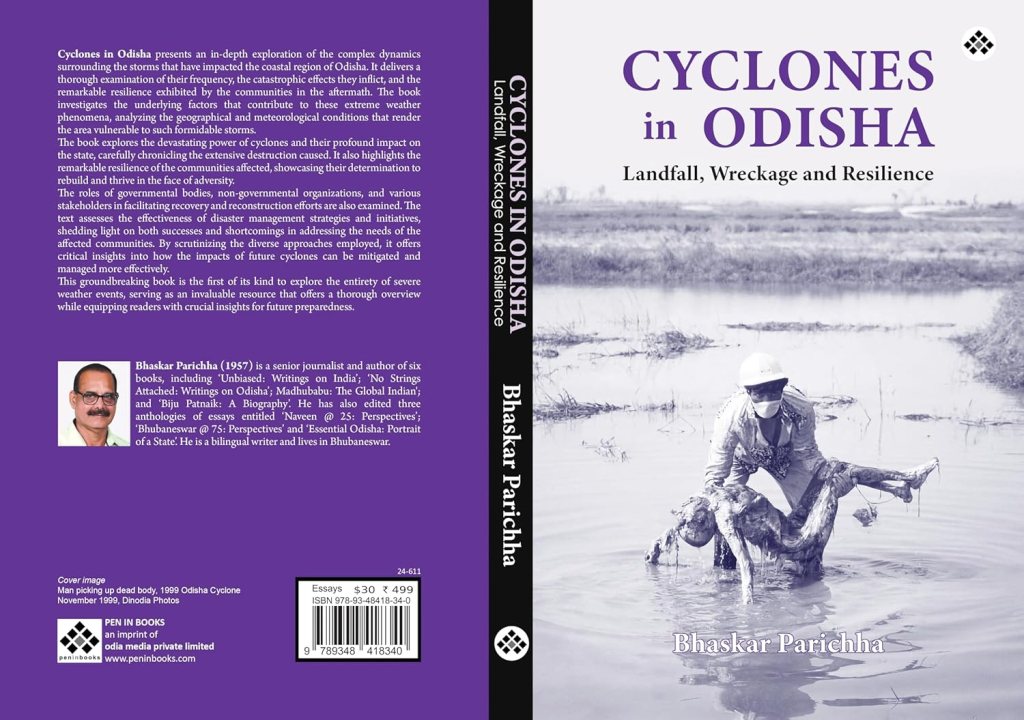
A discussion with Bhaksar Parichha, author of Cyclones in Odisha, Landfall, Wreckage and Resilience, published by Pen in Books.
While wars respect manmade borders, cyclones do not. They rip across countries, borders, seas and land — destroying not just trees, forests and fields but also human constructs, countries, economies and homes. They ravage and rage bringing floods, landslides and contamination in their wake. Discussing these, Bhaskar Parichha, a senior journalist, has written a book called Cyclones in Odisha, Landfall, Wreckage and Resilience. He has concluded interestingly that climate change will increase the frequency of such weather events, and the recovery has to be dealt by with regional support from NGOs.
Perhaps, this conclusion has been borne of the experience in Odisha, one of the most vulnerable, disaster prone states of India, where he stays and a place which he feels passionately about. Centring his narrative initially around the Super Cyclone of 1999, he has shown how as a region, Odisha arranged its own recovery process. During the Super Cyclone, the central government allocated only Rs 8 crore where Rs 500 crore had been requested and set up a task force to help. They distributed vaccines and necessary relief but solving the problem at a national level seemed a far cry. Parichha writes: “As a result, the relief efforts were temporarily limited. To accommodate the displaced individuals, schools that remained intact after the cyclone were repurposed as temporary shelters.
“The aftermath of the cyclone also led to a significant number of animal carcasses, prompting the Government of India to offer a compensation of 250 rupees for each carcass burned, which was higher than the minimum wage. However, this decision faced criticism, leading the government to fly in 200 castaways from New Delhi and 500 from Odisha to carry out the removal of the carcasses.”
He goes on to tell us: “The international community came together to provide much-needed support to the recovery efforts in India following the devastating cyclone. The Canadian International Development Agency, European Commission, British Department for International Development, Swiss Humanitarian Aid Unit, and Australian Government all made significant contributions to various relief organisations on the ground. These donations helped to provide essential aid such as food, shelter, and medical assistance to those affected by the disaster. The generosity and solidarity shown by these countries underscored the importance of global cooperation in times of crisis.” They had to take aid from organisations like Oxfam, Indian Red Cross and more organisations based out of US and other countries. Concerted international effort was necessary to heal back.
He gives us the details of the subsequent cyclones, the statistics and the action taken. He tells us while the Bay of Bengal has always been prone to cyclones, from 1773 to 1999, over more than two centuries, ten cyclones were listed. Whereas from 1999 to 2021, a little over two decades, there have been nine cyclones. Have the frequency of cyclones gone up due to climate change? A question that has been repeatedly discussed with ongoing research mentioned in this book. Given the scenario that the whole world is impacted by climate disasters — including forest fires that continue to rage through the LA region in USA — Parichha’s suggestion we build resilience comes at a very timely juncture. He has spoken of resilience eloquently:
“Resilience refers to the ability to recover and bounce back from challenging situations. It encompasses the capacity of individuals, communities, or systems to withstand, adapt, and overcome adversity, trauma, or significant obstacles. Resilience involves not only psychological and emotional strength but also physical resilience to navigate through hardships, setbacks, or crises.
“Resilience is the remarkable capacity of individuals to recover, adapt and thrive in the face of adversity, challenges, or significant life changes. It is the ability to bounce back from setbacks, disappointments, or failures, and to maintain a positive outlook and sense of well-being despite difficult circumstances.
“Resilience is not about avoiding or denying the existence of hardships, but rather about facing them head-on and finding ways to overcome them. It involves developing a set of skills, attitudes, and strategies that enable individuals to navigate through difficult times and emerge stronger and more capable.”
He has hit the nail on the head with his accurate description of where we need to be if we want our progeny to have a good life hundred years from now. We need this effort and the ability to find ways to solve and survive major events like climate change. Parichha argues Odisha has built its resilience at a regional level, then why can’t we? This conversation focusses on Parichha’s book in context of the current climate scenario.
Bhaskar Parichha
What prompted you to write this book?
Odisha possesses an unfavorable history of cyclones with some of the most catastrophic storms. People suffered. My motivation stemmed from documenting this history, emphasising previous occurrences and their effects on communities, infrastructure, and the environment.
What kind of research went into this book? How long did it take you to have the book ready?
The idea for the book originated more than a year ago. It was intended for release to commemorate the twenty-fifth anniversary of the 1999 Super Cyclone and the cyclones that followed. Having witnessed the disaster first-hand and having been involved in the audio-visual documentation of the relief and rehabilitation initiatives in and around Paradip Port after the Super Cyclone, I gained a comprehensive understanding of the topic. The research was largely based on a thorough examination of the available literature, which included numerous documents and reports.
Promptly after you launched your book, we had Cyclone Dana in October 2024. Can you tell us how it was tackled in Odisha? Did you need help from the central government or other countries?
Cyclone Dana made landfall on the eastern coast on the morning of October 25, unleashing heavy rainfall and strong winds that uprooted trees and power poles, resulting in considerable damage to infrastructure and agriculture across 14 districts in Odisha. Approximately 4.5 million individuals were affected. West Bengal also experienced the effects of Cyclone Dana. After effectively addressing the cyclone’s impact with a goal of zero casualties, the Odisha government shifted its focus to restoration efforts, addressing the extensive damage to crops, thatched homes, and public infrastructure. The government managed the aftermath of the cyclone utilizing its financial resources.
Tell us how climate change impacts such weather events.
Climate change significantly influences weather events in a variety of ways, leading to more frequent and intense occurrences of extreme weather phenomena. As global temperatures rise due to increased greenhouse gas emissions, the atmosphere can hold more moisture, which can result in heavier rainfall and more severe storms. This can lead to flooding in some regions while causing droughts in others, as altered precipitation patterns disrupt the natural balance of ecosystems.
What made people in Odisha think of starting their own NGOs and state-level groups to work with cyclones?
The impetus for establishing non-governmental organisations and state-level entities in Odisha is fundamentally linked to the region’s historical encounters with cyclones, which have highlighted the necessity for improved community readiness. Through the promotion of cooperation between governmental agencies and civil society organisations, Odisha has developed a robust framework that is adept at responding to natural disasters while simultaneously empowering local communities.
What are the steps you take to build this resilience to withstand the destruction caused by cyclones? Where should other regions start? And would they get support from Odisha to help build their resilience?
Building resilience to withstand the destruction caused by cyclones involves a multi-faceted approach that encompasses infrastructure development, community engagement, and effective disaster management systems. Odisha has established a robust model that other regions can learn from. Odisha’s experience positions it as a potential leader in sharing knowledge and best practices with other regions. The state has demonstrated its commitment to enhancing disaster resilience through partnerships with international organisations and by sharing its model of disaster preparedness with other states facing similar challenges. Odisha can offer training programs and workshops based on its successful strategies, guide in implementing early warning systems, building resilient infrastructure and also collaborating with NGOs and international agencies to secure funding for resilience-building initiatives in vulnerable regions.
You have shown that these cyclones rage across states, countries and borders in the region, impacting even Bangladesh and Myanmar. They do not really respect borders drawn by politics, religion or even nature. If your state is prepared, do the other regions impacted by the storm continue to suffer…? Or does your support extend to the whole region?
Odisha is diligently assisting its impacted regions through comprehensive evacuation and relief initiatives, while adjacent areas such as West Bengal are also feeling the effects of the cyclone. The collaborative response seeks to reduce damage and safeguard the well-being of residents in both states. Odisha’s approach to cyclone response has garnered international acclaim.
Can we have complete immunity from such weather events by building our resilience? I remember in Star Wars — of course this is a stretch — in Kamino they had a fortress against bad weather which seemed to rage endlessly and in Asimov’s novels, humanity moved underground, abandoning the surface. Would you think humanity would ever have to resort to such extreme measures?
The idea of humanity seeking refuge underground, as illustrated in the writings of Isaac Asimov, alongside the perpetual storms on Kamino from the Star Wars franchise, provokes thought-provoking inquiries regarding the future of human settlement in light of environmental adversities. Although these scenarios may appear to be exaggerated, they underscore an increasing awareness of the necessity for adaptability when confronted with ecological challenges. The stories from both Kamino and Asimov’s literature act as cautionary narratives, encouraging reflection on potential strategies for human resilience in the future.
With the world torn by political battles, and human-made divisions of various kinds, how do you think we can get their attention to focus on issues like climate change, which could threaten our very survival?
A comprehensive strategy is crucial for effectively highlighting climate change in the context of persistent political conflicts and societal rifts. Various methods can be utilised to enhance public awareness, galvanise grassroots initiatives, promote political advocacy, emphasise economic prospects, frame climate change as a security concern, and encourage international collaboration.
Can the victims of weather events go back to their annihilated homes? If not, how would you suggest we deal with climate refugees? Has Odisha found ways to relocate the people affected by the storms?
Individuals affected by severe weather events frequently encounter considerable difficulties in returning to their residences, particularly when those residences have been destroyed or made uninhabitable. In numerous instances, entire communities may require relocation due to the devastation inflicted by natural disasters, especially in areas susceptible to extreme weather conditions. Odisha’s proactive stance on disaster management and community involvement has greatly improved its ability to address challenges related to cyclones. The state’s initiatives not only prioritise immediate evacuation but also emphasize long-term resettlement plans to safeguard its inhabitants against future cyclonic events. For instance, residents from regions such as Satabhaya in Kendrapara district are being moved to safer locations like Bagapatia, where they are provided with land and support to construct new homes. This programme seeks to reduce future risks linked to coastal erosion and flooding.
Thanks for your book and your time.
(This review and online interview is by Mitali Chakravarty.)
Don't you strive for the fame or pursue its fortune -- play a roulette game like a business tycoon, climb a high status ladder? don't even start,
you've already made it, you've got a good heart,
don't boast your conquests - your qualifications, the talent contests -- the expectations, don't conquer the mountains or top the charts --
you've already made it, you've got a good heart,
don't be frightened to lose, or to take a rejection, wear an ego bruise for your imperfection, your legacy is sleeping - you've got a head start,
you've already made it, you've got a good heart,
don't stack on your power, don't you mass on appeal, build the tallest tower or sign a record deal, bin your trophies - certificates - rip them apart,
you've already made it, you've got a good heart.
StephenPhilip Druce is based in Shrewsbury UK. He is published in the USA, India, the UK and Canada. He’s written for theatre plays in London and BBC 4 Extra.
Contact: Instagram – @StephenPhilipDruce
.
PLEASE NOTE: ARTICLES CAN ONLY BE REPRODUCED IN OTHER SITES WITH DUE ACKNOWLEDGEMENT TO BORDERLESS JOURNAL











 Borderless