Categories
Stories

The Wedding

By Sohana Manzoor

From Public Domain

Ishrat looked at the girl staring at her from the computer screen. Smooth and silky dark hair framed a face with wide eyes and lips that curved into a tender smile. According to her bio-data, Raihana Mimi finished her Bachelor’s from Stony Brook three years earlier. Then she did a Master’s in Social Work from UMASS Boston before going back to Bangladesh. Ishrat wondered why the girl liked Asif. At first glance, Asif seemed like an ordinary young man, even if pursuing a PhD in Computer Science. He was not handsome and he carried himself like a bear with a perpetual frown on his forehead. So why this lovely girl took a liking to Asif seemed a mystery to Ishrat. She hoped it wouldn’t end like the affair two years ago. It had broken Asif’s heart, and until very recently he would not hear of marriage.

“She’s very pretty,” Ishrat finally said. “But marriage is a life-long commitment, Asif. Do not marry for the wrong reasons. Do you love her?”

Asif looked at the somber face gazing upon him and smiled sadly. “Love? I thought I was in love the last time I went home. You know the rest.” Both of them went silent reminiscing about the unprecedented series of events that occurred about two years ago when Asif had gone back to Bangladesh to marry the girl he had been planning to wed for years. He came back alone a month later as the girl’s family had refused to allow their youngest daughter to marry him, and his sweetheart accepted the decision made by her family without protest.

Ishrat still remembered the bleak look on Asif’s face when he had asked her after returning from home, “What’s wrong with being fatherless, Apa[1]? And is an American passport essential for marriage? Tania’s uncle told me to get a US passport and then ask for their daughter’s hand in marriage.”

Ishrat couldn’t tell him that the marriage mart in Dhaka was a fish market. Most people with assets in the capital city would turn up their noses at someone like Asif whose father had died leaving his children still struggling to make a place for themselves. Instead, she had said, “It’s better that this match didn’t work out, Asif. Obviously, the girl didn’t care enough to stand up for you. I’m sure that you have a better person waiting for you in the future.”

“I told you Apa, she got married last year, didn’t I?” asked Asif.

“Who? Tania? Yes, you did. But Asif, I hope you are not planning to get married just because you want to show off that you’ve got a better wife,” said Ishrat with a frown. “Raihana is surely prettier than Tania and more accomplished. But just that would be a wrong reason for getting married.”

Asif shook his head. “That’s not why I want to marry Mimi. I’ve been talking to her for a few months now. She seems. . . how to put it. . . very mature, level-headed and practical. Has a lot of good sense,” he paused and then added, “something Tania never had.”

Ishrat asked again, “So, how does your family take it? I thought your mother had somebody in mind?

“That was years ago,” Asif said. To him, Kakon was just a next-door girl, the daughter of her mother’s best friend. It was a plan hatched by the mothers. He and Kakon never discussed this. There was never an occasion. “My sisters have already paid Mimi’s family a visit. And Mimi’s eldest brother and one of her sisters went to my elder sister’s house to meet my mother. Anju Apa is complaining even though Laiju is quite taken in.”

Ishrat nodded, “What does Laiju say?” Laiju was Asif’s younger sister, and not sentimental like Anjuman.

Asif smiled. “She says that Mimi seems friendly and sensible. Even though Anju Apa pulled a long face in front of everybody, she didn’t take offense. When Laiju apologised on her behalf to Mimi she said that she didn’t mind. People say a lot of things during such negotiations. It’s not wise to hold on to them.”

Ishrat nodded approvingly. “That sounds like uncommonly good sense to me. Marriage is a complex business though. Since you two like each other, you must keep a level head.”

*

Hamida Khatun looked helpless as her eldest daughter ranted about her brother’s marriage. “You’ll see that it will come to no good. That girl’s family is way better off than ours. Two of her sisters are settled in the US. And you still want him to marry her?”

“And how do you propose that I stop it, Anju?” asked Hamida. “You heard him. He is determined to have her.”

“I still don’t understand what was wrong with Kakon,” grumbled Anjuman. Kakon was their neighbour from their hometown in Khulna. They had known her since childhood. Kakon’s mother, Nahar, and Hamida once made plans to get their children married. But Asif was always busy with other things and once he went off to Dhak to study at BUET[2], he changed altogether. He fell in love with a girl named Tania who practically abandoned him at the altar. After that Hamida had tried to incline him toward Kakon once more. But Asif did not budge. At one point he told his mother, “If you nag like this, I will marry an American girl and never return home.” That sealed her mouth as Asif knew it would.

Hamida heaved a sigh and said, “Look, daughter, I don’t have a choice in this. If he can’t marry this girl, I’m afraid he will marry an American Christian girl. Do you want that?” Anju looked up at her mother, horrified. “You must be mad! What will our relatives say? American! And Christian too!”

“What do I care about our relatives?” asked an irritated Hamida. “Their tongues have been wagging since your father died. I just want my son to marry well and be happy.”

Anjuman grimaced. She was sure that this rich girl will only bring trouble for their family.

At this point, Laiju entered the room with a bundle of shopping bags in hand. She was buoyed up by the upcoming wedding of her only brother. Many of their close relatives had already arrived in Dhaka. She and her mother were staying in Rampura where Anjuman lived with her husband and two children.

Laiju looked at her elder sister keenly and said, “I don’t understand why you’re making such a big deal. I like Mimi Bhabi already. She is not like those typically snobbish rich girls. On the contrary, she seems very nice and sensible.” She paused and then added, “The kind of scene you made at their house! ‘I know our brother will be taken away from us after his marriage’—That was poor taste, Apa. I would have been mad if I was in her place.”

Anju shuffled uneasily and Hamida nodded gravely. “Yes, that was really bad.”

Laiju was about to say something more when they heard a commotion outside. Several voices were shouting, and one gruff voice most of all.

“I need to talk to Bhabi[3]. Where is she? This is insufferable and totally unacceptable. . .”

“Oh no, that’s Chhoto Chacha[4]!” groaned Laiju. As soon as she uttered the name, a dark burly man entered the room.

Without preamble he said, “Did you buy a saree for my wife? The eldest son of our family is getting married—where is the saree for his Chhoto Chachi?”

“We got sarees for everyone,” said Laiju. “And of course, Chhoto Chachi has got one too.”

“You call that a saree?” sneered their uncle. “That’s a gamchha[5]! If my brother was alive…”

“Unfortunately, he is not,” Laiju interrupted. “And his son is still a student. If you don’t like the saree we got for your wife, go and buy one yourself. Do you ever get anything for her?”

“You have such a foul mouth! No respect for elders at all!” growled Chhoto Chacha. He turned to his sister-in-law and bellowed, “I won’t come to the wedding, Bhabi. And I won’t allow my family to attend either.” He stormed out of the room. They heard him slam the front door shut.

Hamida Khatun heaved another sigh. “When will Asif come? I can’t take all this any longer. My poor boy! Nobody to give him peace of mind.”

Anjuman dried her eyes and said, “I won’t give you any more trouble. I, too, will keep away from the ceremony. . .” she stopped as her mother’s eyes started gleaming ominously. Laiju said, “For once, Apa, please act your age. How long will you behave like a 15-year-old?”

“What did I say?” asked a nervous Anjuman.

“You will act like a proper, respectable elder sister,” said Hamida quietly. “If I hear you babbling like a fool, I will leave your house. Just because we’re staying in your flat, don’t assume that you can do and say whatever you want. If necessary, I will rent a place and conduct the marriage ceremony from there. Understood?”

Anjuman eyed her mother with a newly found apprehension. Laiju gaped at her mother too. Then recovering herself she said half-laughing, “O dear! I didn’t know you could talk like that! You should take on that tone more often, Amma[6]. Chhoto Chacha will never dare to say anything again.”

*

“I still don’t understand why she has chosen that guy,” Gulshan Ara grumbled. “He looks more like an ape than a human being.”

Her fourth daughter Moni shook her head. “Ma, you’ve said that at least ten times.”

“So?” asked Gulshan Ara. “Your headstrong little sister doesn’t pay heed to anything I say. She has her heart set on that ape.” She stopped and lowered her voice. “You and I are the only two with good sense. Even Muhib and Moin are taken in.”

“I’m more worried about his family,” said Moni. “Remember how the elder sister spoke?”

“I can’t understand why you’re so worried about the family,” said a third voice. Moin had entered the room silently like a cat. “Mimi will be living abroad with her husband. She may have to visit Khulna only once or twice in her lifetime. Honestly, how much trouble can her in-laws cause?”

In the next room of the plush apartment in Dhanmondi, the subject of their conversation was busy wrapping up the gifts for her wedding. She had already brought several sarees for herself. She meant to save at least some money for Asif. She understood that he was still a graduate student and could not be expected to spend a fortune on his bride. He also had nobody to support him with expenses. She insisted that there should be only one ceremony and the expenses should be borne by her family. She used to be indifferent when her family members rejected one suitor after another. But something about Asif made her stand up for him and maneuver her siblings, especially her brothers and eldest sister, into accepting him as a prospective candidate. Asif also went out of his way and visited her two elder sisters in New York. Whatever initial reservations they had about his appearance vanished after meeting him face to face. Both spoke approvingly of him, and Mimi’s parents also gave in reluctantly.

When her sister Moni had asked her what she liked so much about Asif, Mimi avoided a direct answer and asked, “What’s wrong with him? He is a good guy, pursuing higher studies. That’s what you wanted too.” She paused, then added, “Okay, so he is not very handsome. But Mishu Apu’s husband was. Did that help?” Mishu was her second sister who had died a few years ago. Her husband was the most handsome and obnoxious man imaginable. Mishu’s untimely death had cast a perpetual gloom on their family.

Moni wrung her hands, “No, but…”

“If you people continue like this, I may never get married, you know,” Mimi had said, half-teasingly. “I’ll be thirty in November.”

Mimi counted the boxes and eyed the suitcase carefully. These were mostly things for her in-laws. They still had not got anything for Asif who was arriving in Dhaka that very afternoon. The two of them had planned to do the shopping for their wedding clothes themselves. Asif’s mother already had the jewelry. Apparently, she had them made three years ago, which proved to be an excellent decision.

Asif’s elder sister Anjuman and Mimi’s mother had been raising a hue and cry over every little thing. Anjuman took it to her head that her brother’s wife should have her nose pierced, and Asif should give her a diamond studded nose-pin. Mimi let Asif handle that. Both of them had discussed the situation and decided to largely ignore their comments and avoid unreasonable suggestions without being directly offensive. Asif seemed to rely a lot on her judgment, which Mimi appreciated.

She remembered when her eldest brother’s wife had shown her Asif’s Facebook page. “He’s so funny, Mimi. Just take a look! Says he has all A’s in everything except in his love life. There he has an F!” Mimi had smiled, but somehow it didn’t appear funny to her. She still thought Asif shouldn’t have put such personal information on Facebook, but it pulled a string at her heart. She knew exactly how it felt to get an F in love. She wondered where Dipak was, and if he was still looking for a pretty face with a ton of money. Mimi’s family was very affluent and that turned out to be his main reason for pursuing her. Dipak was gone from her life forever, and Mimi had no intention of bringing him back.

Once upon a time she held Dipak dear, but now she shuddered to think what might have happened if they had been married. He was making advances on three girls at the same time, and Mimi was one of them. The incident taught Mimi a number of things. She promised herself that she would only marry someone she could trust and would look beyond physical appearance. She may never have love, but she would also never feel humiliated or pitied.

*

When Asif and Mimi finally met in person, it was the most unromantic situation possible. His flight was delayed, and he arrived three hours late. After assuring his nervous mother, a pouting elder sister, and an over-enthusiastic younger one, he reached his future in-laws’ house around 9 p.m. along with two uncles and a cousin. He looked tired and harassed, in a crumpled purple shirt and khaki pants. Mimi’s parents were a bit awkward, but her brothers were very cordial as they had heard glowing reports about Asif from their sisters in New York.

While the others were talking, Mimi observed her intended husband surreptitiously. She almost smiled at his attire—he was so unpretentious. Obviously, he was more worried about keeping his engagement than his appearance. She noticed that he also looked at her once in a while, and realized with a jolt that he wished, just as she did, to talk to her, to be away from this crowd, just to be by themselves. Mimi was surprised at her own reaction—she had known this man for only a few months, and yet she longed to be with him. She tried to concentrate on the conversation and heard that they were discussing her Kabin. Asif was saying, “Whatever you decide is fine with me. I won’t be able to pay it right away, though, as I am still pursuing higher studies.”

Her eldest brother Muhib said, “Of course, we understand as much. Will 10 lakhs be too much for you?”

At this point, her mother spoke up. “I won’t allow my daughter’s Kabin[7] to be less than fifteen.”

“Fifteen!” someone in Asif’s party gasped. “Fifteen lakhs is too much! Even ten is a lot.”

Everyone in the room shifted uncomfortably while Gulshan Ara sat straight and glared at Asif with animosity. Mimi was about to pinch her brother Moin when Asif said in a quiet voice, “Whatever you say, I will accept. It’s your daughter we are discussing, after all.”

Even Mimi gaped at Asif. As everybody in the room started talking once again, Mimi realised that Asif’s move was the best possible strategy. Gulshan Ara would not complain any more. And Asif was not in serious trouble because he did not have to pay the amount right away. She didn’t know how Asif’s family would take it, though. She promised herself that she would always try to make things easier for him. He didn’t have any idea how rich her family was. He wanted to marry her.

*

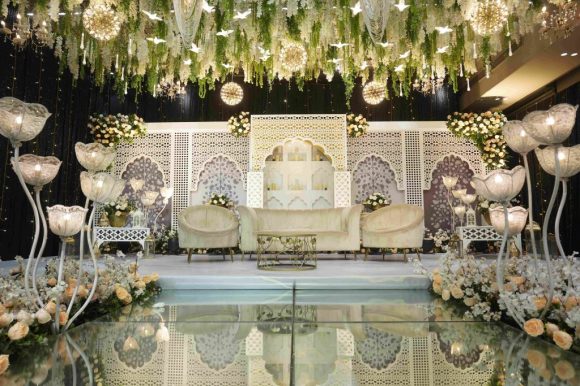
The wedding reception was held at a posh restaurant in Dhanmondi. Asif sat on the stage and watched his bride smile and greet the guests who approached them. She was as beautiful as a fairy, thought Asif. Wise and kind too.

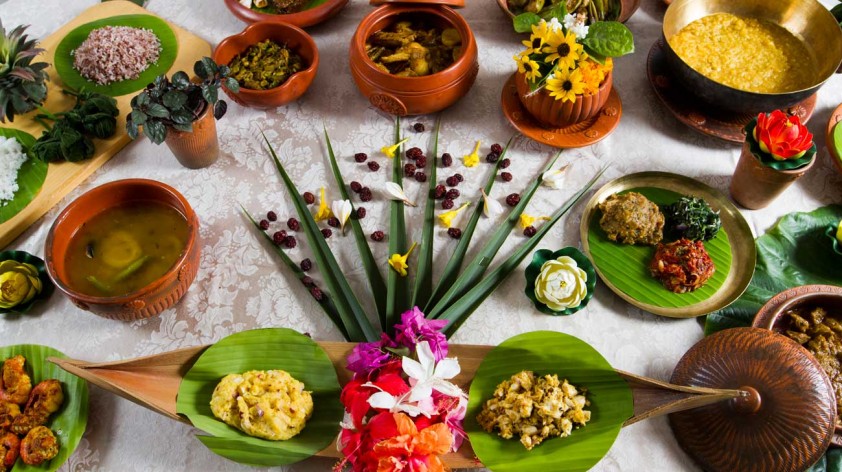
Then Asif saw his Chhoto Chacha approaching the stage and he said a swift prayer so that nothing disastrous happened. His uncle addressed Mimi, “The others are saying that the food is good. But I felt it was aida.” He looked triumphantly at Asif, as if saying, “You can’t fool me!” Mimi also looked at Asif, not knowing what aida meant. Asif hastily said, “That was kachchi biriyani, Chacha. It is the standard food for weddings in Dhaka. But we will have a reception in Khulna too. You can have your menu there with your favourite fish.” Chhoto Chacha nodded, looking pleased. “You have a pretty wife,” he said approvingly, “much prettier than your mother ever was.” He walked away. Asif heaved a sigh of relief.
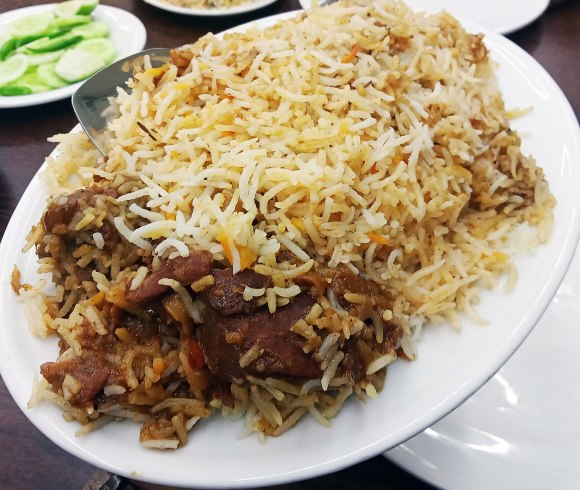
Kachchi Biriyani. From Public Domain

Mimi whispered, “What’s aida?”

“I’ll explain later,” mumbled an embarrassed Asif. How could he say that aida meant food that has been half-eaten by somebody else? Basically, it suggested that the guests had not been properly treated.

Then came Asif’s friends. They were all laughing and joking. Asif was quite popular among his friends, and they seemed happy about Asif’s marriage and his choice of bride. Mimi had very few friends present—understandable, since she did her bachelor’s in the US. Someone mentioned that they had attended Tania’s wedding the previous year whose husband was a bald man in his forties and held an American passport.

A heavily bejeweled, fat lady appeared before them, and Mimi introduced her to Asif. “This is my Chhoto Mami. Mama[8] couldn’t come as he is in Singapore right now.”

Asif smiled and greeted her. “I’ve heard a lot about you,” the lady said with a broad smile like a crocodile. “You are not very handsome, are you? But then, Rahat was very handsome, and it didn’t help us at all.” She sighed, then added, “Hopefully, you’ll take good care of Mimi.”

Mimi made a face as she walked away. “Sorry about that.”

“Who is Rahat?” asked a puzzled Asif.

“My ex-brother-in-law,” replied Mimi briefly. “I’ll tell you later.”

“You and I both seem to have a fine lot of relatives,” observed Asif. Mimi smiled. “It seems so, doesn’t it?” They smiled at each other, and Asif knew that they would be working as a team. Their relatives wouldn’t be able to make a rift like they did in his parents’ case. He thoughts turned to Tania probably for one last time, and he wished he had never met her. Then he realised that it did not really matter. She was already a distant memory. Asif started to comprehend what Ishrat had meant by marriage being a life-long commitment.

Mimi sat contentedly. She liked her husband, she thought. Fair enough. He was sometimes a little rash, but good-natured. He had also shown himself to be sensitive to her needs. She remembered the scuffle over her wedding saree. They got it from Mansha. It was quite expensive and Mimi did not want to buy it even though she liked it very much. Asif, however, insisted that at least the main wedding saree should be costly, so that everybody was content.

*

Anjuman sat in one corner, still resentful at the turn of events. She looked at her children on stage with their uncle, nodding and smiling at their new aunt. Anjuman wondered how nobody could see what she saw—her only brother slowly moving away from them. She remembered what Laiju had said a few days ago: “He is not the same guy who left Bangladesh 4 years ago. He has changed. He has been leading a different life, his friends and peers are of a different sort. His world has changed, Apa. He couldn’t be happy with someone like Kakon. Don’t you see?”

No, Anjuman did not see. All she saw was a rich and beautiful girl taking her only brother away from them. Her resentment rose higher. She had tried to derail her own husband—to move him away from the influence of his nagging mother. But she had failed. The old woman had died only recently, and her husband still cried like a baby over the loss. And here was this girl, a mere chit of a girl, accomplishing what she could not in nine years. “If only it was Kakon!” thought Anjuman wistfully, their brother would have always been theirs. She did not see why he would be unhappy. What was the duty of a wife? To cook, bear children and maintain the house. Their mother did all this, she herself was doing the same; what more could Asif want? And in spite of all her good looks, what could Mimi give him that Kakon could not? Did he have to sell himself to money?

Somewhere at the back of her mind, Anjuman felt cheated. She felt that her brother got something she never even dreamt of. She saw the light of a different life on Laiju’s face, or even on their mother’s, a light she could not share. She thought of the flat in Rampura where she had so far lived with her husband and children. The 1200 square feet she had been so proud of owning suddenly seemed to have diminished into nothing. Owning a flat in Dhaka did not seem so great anymore as she wondered what kind of a house Asif and his wife would have in the US.

Hamida Khatun noticed the tear-stained face of her elder daughter from a distance and heaved a sigh of relief. “Thank God she realises that they are happy, and she is praying for them,” she thought, and smiled with misty eyes. Her thoughts then flew to the future where she saw herself surrounded by grandchildren. She did not see even the flicker of any dark shadow on the bright stage where her son gazed lovingly at his bride.

[1] Elder sister

[2] Bangladesh University of Engineering and Technology

[3] Sister-in-law

[4] Younger uncle

[5] Thin, coarse, absorbent cotton towel

[6] Mother

[7] Marriage registration fees determined by the dowry

[8] Mami is wife to mother’s brother referred to as Mama

.

Sohana Manzoor is a writer and academic from Bangladesh, with a PhD in English from Southern Illinois University Carbondale. Her works have appeared in Bellingham Review, Eclectica, Litro, Singapore Unbound, Borderless Journal, and elsewhere. She was the Literary Editor of The Daily Star from 2018- 22. Currently, she is pursuing an MFA in Creative Writing at UBC, Vancouver.

.

PLEASE NOTE: ARTICLES CAN ONLY BE REPRODUCED IN OTHER SITES WITH DUE ACKNOWLEDGEMENT TO BORDERLESS JOURNAL. 

Click here to access the Borderless anthology, Monalisa No Longer Smiles

Click here to access Monalisa No Longer Smiles on Kindle Amazon International
Categories
Excerpt

Ostia Antica: The Fatehpur Sikri of Rome?

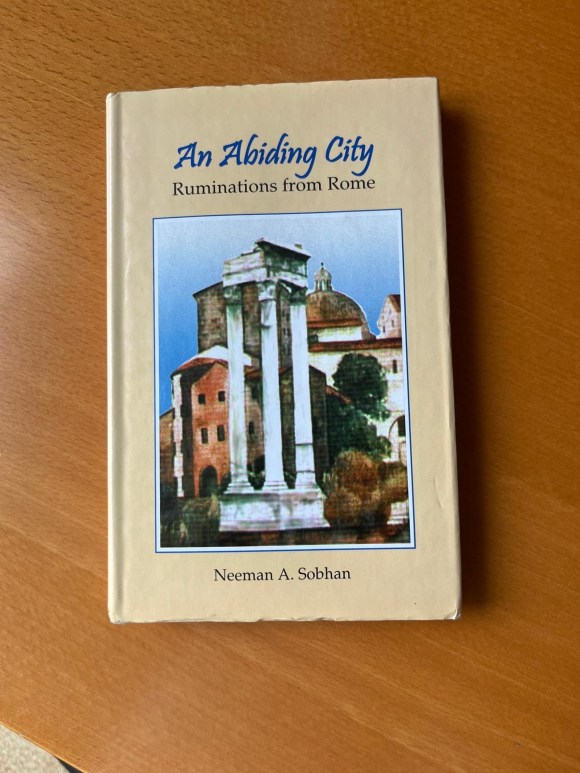
Title: An Abiding City: Ruminations from Rome

Author: Neeman Sobhan

Publisher: University Press Limited (Dhaka)

Ostia Antica

Sometimes, when my visitors to Rome, arriving in the sweltering month of July or August, voice over-zealous ambitions to ‘do’ Pompeii, I don’t have the heart to discourage them. But I beg off from accompanying them. I have nothing against Pompeii as such, but I am not sufficiently suicidal to relish the thought of trudging miles of arid ruins under a punishing sun for the twenty-third time!

It’s at this point, usually, that I try to sell what I call my ‘Lazy man’s Pompeii’: Ostia Antica. I could have called it the ‘Poor man’s Pompeii’ as well, but the riches of the ancient city can almost equal a Herculaneum to the imaginative tourist. And its biggest plus-point is that it is so much closer to Rome (as against Pompeii, about 200 kilometers away, towards Naples), and may I add, that much shadier!

Less than an hour away from Rome, Ostia Antica was founded in the fourth century B.C by King Arcus Martius (a historical persona of whom I readily admit to being shamelessly ignorant) it became Ancient Rome’s commercial and military port, and during Emperor Constantine’s time, it boasted a population of 100,000!

Ostia reminds me of another ancient city I once visited and loved: Fatehpur Sikri in India, the Mughal king Akbar’s doomed capital near Agra. The comparison to Akbar’s city is justified because, although Ostia is a remarkable example of historic Roman towns like Pompeii and Herculaneum, unlike them, it was not destroyed, rather, like Fatehpur Sikri, it was abandoned.

While the Mughal city was abandoned due to a lack of sustainable water supply, in the case of the Roman city, it was mosquitoes. Strange but true that an epidemic of malaria drove out the inhabitants of this once flourishing port city. An odd quirk of history and biology that a puny anopheline community managed to drive out a powerful anthropical one, hundred times its size!

A quick reminder here: in talking about Ostia, we must make a clear distinction between Ostia Antica, the archeological site, and the present-day beach town of Ostia, a popular seaside resort within the municipality of Rome, further down.

The excavated areas of ancient Ostia abound in numerous ruins and reminders of a thriving commercial city of times past: public and private buildings, streets, defensive walls, and harbors.

I find the residential streets most fascinating because it brings to life a real world of ordinary people. Much has been written about Roman tenement-housing and remains of these buildings abound in Ostia.

Reconstructed models apparently reveal that a typical apartment block could be five-storeys high, and that the flats were probably quite functional, mostly reached from courtyards or from the street by stairs running between shops on the ground floors.

I think of all this as I stop at a crumbled courtyard here, touch a moth-eaten wall there, step over a threadbare threshold, or mount a mysterious flight of steps that end abruptly in mid-air, leading nowhere.

For me, it’s in this residential environment that I find the faint but persistent pulse of a bygone life. Visiting it on some empty afternoon, while I might be sitting on the broken steps of a roofless room, I can surmise the life of the ordinary man or woman who once lived here: I smell the fragrance of fresh baked bread in the gutted bakery next door; I hear the sound of children playing in the silent streets, or the hum of voices in the tavern with its dusty counter; and suddenly, the entire history of the humble populace seems to be whispered and echoed by the sea-spiked breeze among the pines and cypresses.

Let the Archeologist and Historian keep their details. To me the romance of a ruined city is not necessarily in the structures themselves, in the revealed or concealed splendor of its remains, it is in the mystique of its very presence, its undefined shape as a messenger from lost times, telling us stories of the long ago.

A dead city serves to remind us that it once existed, and that the past, although it is no more, is never completely wiped out, never obliterated from the collective memory of the world. In leaving behind its footprints, the spirit of the city has defied negation and accompanies me this afternoon.

And thus, I love to sit, under the peristyle of a vanished villa, absorbing the atmosphere of this long-deserted city, contemplating the history not just of this particular Roman town, but all the nameless cities of countless civilizations in the past. I wonder at the basic story it tells of our collective and individual engagement with Life, of the heroic audacity of the human spirit attempting, again and again, to build its sandcastles against the wind, trying to carve a permanent niche on the elusive surface of Time.

Whether the crumbling habitation is in Ostia Antica or Mohenjo-Daro, in Petra or Machu-Pichu, in Moinamoti or Fatehpur Sikri; each is a monument to the Spirit of Man, the builder of cities, the creamer of dreams.

[ Extracted from An Abiding City: Ruminations from Rome. Published by UPL (University Press Limited, Dhaka), 2002 ]

ABOUT THE BOOK

An Abiding City: Ruminations from Rome is a fresh look at Italy and Rome from the perspective of a long-time resident of non-Italian origin. Neeman Sobhan, living in Italy, since 1978 wrote for two decades a personal column in the Bangladesh English language daily, The Daily Star, spinning vignettes and sketches out of her daily encounters and reflections living in Rome. Here, in vivid prose and poetic detail are selections from her work.

Among some of the myriad themes in this collection of essays and poems: the charm of everyday Rome; the romance of history; the adventure of the expatriate’s eternal quest for home; the poetry of seasonal transformations; the mysteries of relationships; the kaleidoscope of life in general, and of one woman in particular, who within her journey through the Eternal City, shares with her readers her passage through life.

The writing is enhanced by ink sketches by Italian-American artist/writer Ginda Simpson.

ABOUT THE AUTHOR

Neeman Sobhan is a Bangladeshi-Italian fiction writer, poet, columnist. She writes in English, and her fiction and poetry have appeared in many anthologies and literary journals within the sub-continent. Till recently she taught English and Bengali at the University of Roma, La Sapienza.She lives in Rome with her husband. She has a collection of short stories, Piazza Bangladesh (2014) which has been recently translated to Italian; a volume of poetry, Calligraphy of Wet Leaves (2015) and a collection of her columns, An Abiding City: Ruminations from Rome (2002). Presently, she is finishing her first novel, and lives between her home in Rome and Dhaka.

.

PLEASE NOTE: ARTICLES CAN ONLY BE REPRODUCED IN OTHER SITES WITH DUE ACKNOWLEDGEMENT TO BORDERLESS JOURNAL

Click here to access the Borderless anthology, Monalisa No Longer Smiles

Click here to access Monalisa No Longer Smiles on Kindle Amazon International
Categories
Stories

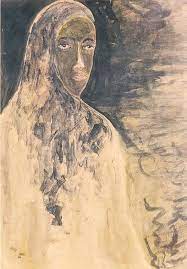
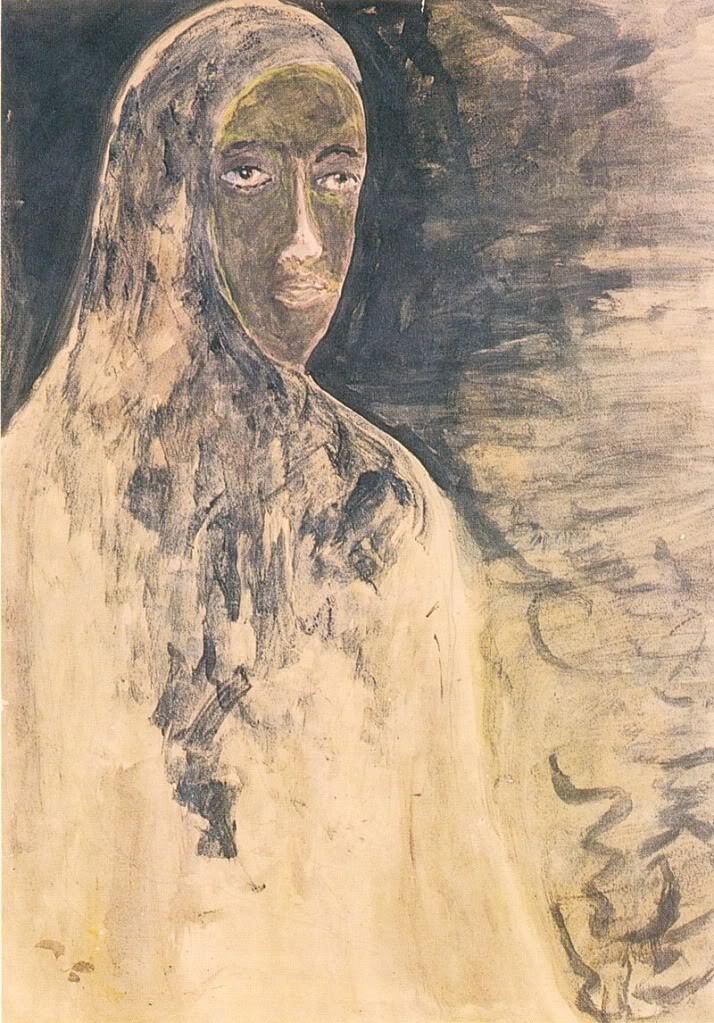
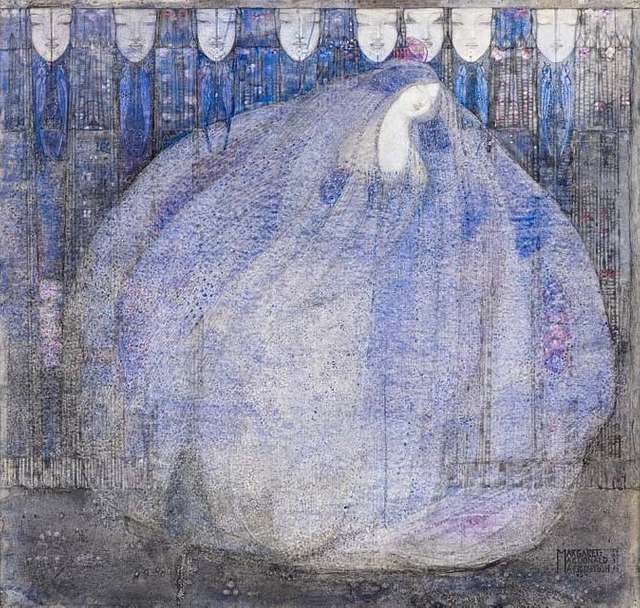
Persona by Sohana Manzoor

Painting by Margaret Macdonald Mackintosh (1864-1933)

Toma flopped onto the cushioned sofa in resignation and disgust. She cursed herself for being persuaded into believing that it would be a nice evening. She should have trusted her instincts. Now she regretted her decision to come to the party. Nothing to look forward to but the time when her uncle and aunt would decide to leave.

She sighed and took a sip of lemonade and noticed her uncle casting a worried glance at her. Feeling somewhat sorry for him, she smiled to assure him that nothing was amiss. It was not his fault, really. Her Latif Uncle and Rashida Aunty were doing their best to introduce Toma to the Bangladeshi community in Arlington. Back in Dhaka, Toma’s mother had lately been upset by her wayward daughter’s decision to stay on in the US to pursue a PhD after completing her Master’s. So, to appease her mother, she agreed to go to this party while visiting her maternal uncle and aunt in Virginia—a place to meet prospective bridegrooms and such. Toma herself had not been completely averse to the idea—she wouldn’t mind settling down eventually—but what she had seen so far was not very encouraging.

Early in the evening she had met Faiyaz, son of an eminent Bangladeshi doctor living in Fairfax, and himself a well-paid systems analyst with an MS from MIT. His mother had been crowing to the crowd about his recent raise. Toma could not help cringing. To her, such information was absolutely private, and she considered it as distasteful as a display of undergarments. Faiyaz, a stocky fellow of about 5 feet 4, smiled coyly at Toma, who was taller than him, poised, and very attractive. Throughout the evening, she had noticed quite a few men sizing her up and down. An elderly man even asked her if she had been in the Girl Scouts as she seemed to have an athletic body. Toma smiled politely and answered “no” before moving away feeling irritated and embarrassed.

Next came Tanvir and his parents. “Oh, how interesting! Both Toma and Tanvir begin with a T!” the father said with great mirth. Tanvir worked in a law firm in New York and was on the lookout for a prospective bride who would be smart and attractive, but not too career-oriented. He would be earning a lot, so he was more in need of a homemaker. The first question he asked Toma was what she planned to do after her master’s. When she replied that she was continuing into the PhD, he looked at her very seriously and said, “You are in physics, right?” Before Toma could reply he ploughed on. “You know, girls don’t have the right kind of aptitude for science. I don’t mean any offense. It’s just that research has shown that girls are better at languages while boys are better at mathematical and spatial cognition. In any case, with your degree and looks you can get a good job—why would you waste several years of your life on a PhD?”

Toma felt like scratching his eyes out. She took a moment before replying. “It has been my dream to become a physicist since I was in eighth grade,” she said. “Besides, I got accepted and funded at Purdue, so presumably, they didn’t find any problems with my mathematical and spatial skills.” Toma forced a smile before moving away.

After meeting Habib and his blabbering fool of a sister, Toma decided to take a break. After all, there was only so much one could take. She heaved a sigh and took another sip, no, a gulp at her drink. She could not understand why these people, who claimed to be so well-educated and cultured, acted the way they did. She looked across the room at the bevy of women in all their jewels and finery. To think that some day she might have to join their ranks made her feel nauseated. She saw a fat Mrs. Zoardar gesturing with her hands in such a way that everyone could see her emerald-studded bracelets. Another woman in a pale purple muslin saree was talking in a high-pitched voice, “Daud and I are planning to visit Europe next summer. I simply loove Paris—the Louvre is my soul. People here boast about cars and houses. You should all open your eyes and try to see the world. What is there in life, eh? Enjoy it!”

Toma grimaced and thought that the only person she could confide in about such nonsense was Mayeesha. Like Toma, Mayeesha too had been lately facing these situations. Actually, her case was worse since she lived in a city with a larger Bangladeshi community, whereas Toma had only come here to visit. Soon she would be back in the small university town in Indiana where the community would leave her largely at peace.

“Why so sad a face?” said a voice that sounded rather amused. Toma saw a woman occupying another sofa across from hers. She remembered seeing her before—a young woman who was accosted by a mother with two marriageable sons. She had deflected her by saying that she was already married and then had moved gracefully away from the vicinity. She was holding a glass in her hand, probably fruit punch, and Toma could not help noticing her fingers—the long, tapering fingers of an artist. She had an amused smile on her lips, but it was her eyes that made Toma take a second look at her. Her eyes were almost violet—a very unusual color for a Bangladeshi woman. Must be colored contacts, Toma thought. Still, there was understanding and compassion in her eyes. Unlike the other women in the room, she wore a simple vegetable-died, earth-toned cotton saree which made her all the more attractive.

“I am Urbee, I’m visiting too,” she said.

Toma smiled back. “I am Toma.”

“And you’re in the marriage mart?” said Urbee with her eyes dancing. It was more of a statement than a question.

Toma squirmed and then tried to change the topic. “I heard you say that you’re married. Is your husband around?”

“No,” replied Urbee solemnly. “I am actually separated from my husband. But I say I’m married to save myself from the old vultures. A woman here has no place unless she is under a man’s name.” She made a face and said, “Pathetic, isn’t it?”

Toma didn’t know what to say in response to this frank admission. “You’re not dressed like the other married women though,” she said.

“I’m still a student. So I can wear what I want. Besides, my husband is not here, right?” came the reply. “But there are also exceptions. See that lady over there? Urbee inclined her head and Toma followed her gaze to see a woman with a child seated on a sofa. She wore a crumpled silk shalwar-kameez, and seemed oblivious to the world. Her hair was casually tied at the back and she wore no make-up. As far as Toma could see, the only jewelry she had on was a pair of earrings, nothing gold or glittering. “Her husband is an economist, and she herself is a doctor. But she does not give a fig as to what people think of her,” murmured Urbee. “And now take a look at that decked-up camel.” Toma turned to see a tall, lanky woman in bright fuchsia pink lehenga passing by. She wore false eyelashes. The kohl eyeliner reminded Toma of Elizabeth Taylor in Cleopatra. She gave Toma and Urbee a fleeting glance as she walked by. Toma could almost see a camel in her awkward gait.

“She is a grad student at Virginia Tech—does she look like it? Her father pays for it, of course,” confided Urbee. “And there’s her sister who has come to visit from Texas.”

The sister looked normal, thought Toma. As if reading her thought Urbee said, “Wait till you see her with her son. They have a birthday bash for him once every month in anticipation of his first birthday this coming February. Oh, and they order several identical birthday cakes: one for the photos, one for the kids to smash, one for the kids to eat, one for the diabetic grandparents—you get the idea.”

Toma turned to look at her companion. “You’re kidding!” she spluttered. Urbee shook her head sadly. “No, I am not. Their father is a notorious government officer in Bangladesh. He is filthy rich. They have a ranch somewhere in Texas. The whole family spends time there every year. The decked-up camel is also in the marriage-mart, by the way.”

“She will fit in very well, I think,” answered a disgusted Toma.

Urbee smiled. Suddenly, a woman appeared from nowhere. “There you are. I’ve been looking all over for you.” Toma looked up to see a rather pretty but anxious-looking woman bending towards Urbee. “Don’t you think we should leave now?” she asked.

A flicker of annoyance crossed over Urbee’s face. But she replied in an even voice, “Come Rehnuma, I’ve just started enjoying myself. Don’t spoil it. Meet Toma. She is visiting too—like me. Toma, this is my cousin Rehnuma.”

Rehnuma glanced at Toma uncertainly and her lips stretched in a tight smile. Then she left abruptly but looked back at least twice. Toma felt somewhat uneasy. “Is there anything the matter? Your cousin does not like me, I think.”

Urbee laughed. “It’s not you. The problem is with me. I don’t fit in, you see. And she thinks I will get into trouble.”

“Do you get into trouble?” Toma was curious.

“Oh yes,” Urbee giggled. “If people bother me too much, that is. I told Mrs. Zoardar that she has a lot of similarity with the queen of pigs. And when Harun Ali’s brother came to look for a prospective bride, I told him nobody would be interested in a bald dwarf like him!”

Toma’s jaw dropped open. “What? No way! But why? Because they’re stupid?”

“Not just because they are stupid. Mrs. Zoardar has a daughter-in-law whom she treats very badly. And look at the woman—she thinks she looks like a queen. Yes, she is the Queen of Pigs.”

“And the other one?”

“That one is an absolute ass. He is a short, bald, hirsute fellow—not to mention almost middle-aged—yet he was looking for someone ‘beautiful and fair.’ Also, the bride would have to be less than twenty-five years of age. So I told him the truth. He has not found his bride yet, and that was three years back.”

A thought occurred to Toma. “You seem to know a lot of people around. How long have you been here?”

Urbee looked away. “I come here every December to visit my uncle. This is my fourth year in the US.”

“And Rehnuma is your cousin – I mean your uncle’s daughter?”

“Yes.” Urbee smiled. “She is rather cautious. Doesn’t like my ways.”

“Well,” laughed Toma. “I admire your courage. But I won’t be able to do what you do.”

“Oh, but you will,” replied Urbee with conviction, turning her shining eyes on Toma. “I, too, was polite and courteous once. But it seems a long time ago now. Sweet and enduring as my name. ‘Urbee’ means earth—did you know that?”

“I was thinking that yours is an unusual name. I have known a couple of Urmees, but no Urbee. But, seriously, you’re talking as if you’re my grandmother,” Toma laughed. “You cannot be more than three or four years older than I am.”

“I am thirty-seven, Toma. I may not look it but I am. When you reach my point in life, you too will think and feel differently.” She looked at Toma directly. “You too don’t fit in. You see things differently already.”

Toma shuffled uncomfortably. “A lot of girls feel like me. My best friend Mayeesha, for example.”

Urbee laughed. “I don’t know your friend. But you remind me of myself ten years back. I married because I thought I was in love.” She shrugged.

“I won’t get married until I find the right person,” Toma replied quietly.

Urbee peered into her face and laughed again. “And are you sure you’ll recognize the right person?” She shook her head. “You’re very romantic, just as I was,” she paused. “There’s no right person,” she shook her head. “There’s no man in this world to fit in the shoes….” Her voice trailed off. Then suddenly she got up and smiled brightly. “Best of luck in your groom hunting.”

Toma was suddenly angry. “I’m not looking for a husband,” she said firmly.

“Nooo?” Urbee looked at her wide-eyed. “What are you doing here then? Haven’t you been looking around and passing judgment too? ‘This one has a nosy mother, that one is too short, this one is too bossy’—isn’t that what you had been doing?”

Toma was too flustered to reply.

Her companion observed placidly, “We all do it, Toma. All the time. We are all in the same boat, only we think we are different.”

Toma found her tongue. “But you just said that I don’t fit in.”

“That too,” Urbee nodded. “You don’t fit into their world. You belong to another. That’s the problem. How will you survive in their world? Good luck.” Urbee walked away before Toma could stop her.

* * *

“Come dear, it’s time to leave,” Toma’s reverie was broken at the voice of her aunt. Rashida was smiling at her niece with genuine affection. Toma got up, relieved at the prospect of getting out of this place at last. Latif was already at the door, collecting their coats.

“I saw you talking to Tonima,” observed Latif when they were seated in the car. “What do you think of her?” he asked.

“Tonima?” Toma asked blankly. “Who is that?”

“The girl you were chatting with,” her aunt supplied.

“Oh! But her name is Urbee —was that her nickname, then?” Toma was a little perplexed.

Her uncle and aunt glanced at each other. “That was Tonima. What else did she say?” her aunt asked.

“I rather liked her,” Toma smiled. “She seems nice, though at the end I thought she was a bit strange. I would love to meet her again.”

“Did she say anything about herself?”

“She said she’s a grad student. But I don’t know what her discipline is, or where she studies. Why do you ask?” Then Toma added hastily, “She did mention that she is separated from her husband. . . you don’t disapprove, do you?”

Latif sighed. Toma went on, “She is a fine person, I think, even though different from most people.”

“She is not. . .  er, normal,” her uncle blurted out, a little embarrassed.

“Not normal!” Toma echoed.

“She used to be a scientist, a molecular biologist doing cancer research, but then she went crazy,” Rashida said quietly. “She lost her only child in an accident. Never recovered from the blow fully. Her mother-in-law blamed her for being careless. It was not her fault though. She tried having another child but miscarried. Her in-laws interfered and poisoned her relationship with Biplob. A year later, they were divorced. Tonima and Biplob used to be a lovely couple, always the life of the party.” Rashida looked out at the lighted building they had come out from. “She was such a talented young woman—such a waste,” she sighed.

Toma fumbled for words, “But. . . uh. . . why was she . . . what was she doing in the party, then?”

“It’s her uncle’s house. She has a nurse, I think, who checks on her from time to time.”

Toma remembered Rehnuma and her anxious face. “Rehnuma,” she whispered.

“What?” Latif asked absent-mindedly. “She has this weird habit—takes on the persona of different people. And makes up strange tales.” He looked at Rashida. “Do you remember how she freaked out poor Ashraf by telling him that she is the re-incarnation of some Indian goddess?”

Rashida laughed. “Yes, Kali. I thought that was hilarious.” She looked at Toma explaining, “I don’t like Ashraf. He acts like Mr. Know-It-All. I thought Tonima gave him a good put-down.”

Toma was still struggling to grasp it all. “But she seemed quite normal to me. I mean—I mean the way she observes people.” Toma repeated some of the things she heard from her new friend. “And she has a very good sense of humour,” she added.

Latif sighed again and started the car. “That’s the problem. She seems normal—almost. But then, she has these hysterical fits when she remembers what she had and lost. Her uncle loves her very much and takes utmost care. Sometimes she is very charming, but. . .”

“And that Biplob!” Rashida grumbled. “He simply relocated. Married again—lives somewhere in California, I heard.” Then she added viciously, “The only good thing is that the new wife banished her mother-in-law from the house when she tried to meddle too much.”

Toma sat quietly, thinking of all she has heard. Urbee seemed so natural, intelligent, sane, and normal. Her observations on the people of the room were accurate and exactly as Toma thought. Suddenly, she jolted and felt a shiver run down her spine. Tonima—that name was so much like her own. And she used to be a scientist, just like she herself hoped to be. But what was she actually looking for in her prospective husband? Was she just a husband-hunter, as Tonima had said? Would she find the right person, or the right direction? Didn’t Tonima say that Toma will become like her?

As the car plunged into motion, Toma sat still and looked out into the darkness, trying to imagine what the future had in store for her.

.

Sohana Manzoor is a writer and academic from Bangladesh, with a PhD in English from Southern Illinois University Carbondale. Her works have appeared in Bellingham Review, Eclectica, Litro, Singapore Unbound, Borderless Journal, and elsewhere. She was the Literary Editor of The Daily Star from 2018- 22. Currently, she is pursuing an MFA in Creative Writing at UBC, Vancouver.

.

PLEASE NOTE: ARTICLES CAN ONLY BE REPRODUCED IN OTHER SITES WITH DUE ACKNOWLEDGEMENT TO BORDERLESS JOURNAL. 

Click here to access the Borderless anthology, Monalisa No Longer Smiles

Click here to access Monalisa No Longer Smiles on Kindle Amazon International
Categories
Poetry

Nights Out in Dhaka & Other Poems

By Jahanara Tariq

CHILDHOOD IS A PERFORATED TAMARIND TONGUE 

Childhood is a perforated tamarind tongue:
Through which drops a table in a lawn of green silk,
Its spindly legs— the kind which made Victorians go heavy with lust—chase me.
I break into a run. I have grown in caterpillar widths in all these years
They web themselves around me, a breakfast of lettuce bloomed salmon flesh
And papaya juice, the colour of a lime-yellow towel soaked in vacation days made of scraped knees and 300 languid liquid summer hours
There, fathers striding through corridors and the deeper ends of pools
Brown skin glistening, singing a cigarette laugh, while swaying with an awkward ease to Armstrong beats, evaporating with the sandcastle rook
Someone blows loony moons through bulbous glasses
My toes stretch, spilling red pulpy bits, having it appear amusing like a deconstructed omelet, on its white legs
My memories, a mushy fishbone
I hear the dead wear rings of cedar and wings of the sea at day break

GOD COMPLEXES

A feast of eternal sweet nothings by baby pink angels
By the bubbly cobblestone alleyways hinged at 225 degrees, I swelled up.
How the winglet of the winter night quivered, ready for a flight to snowless lands away
The lady in the leopard print blew smoke morphing the mountains into giggly balloons
I peered my head within and gave him a bellyful of rose rinsed stars
Which fell, soft as a coo, for poets to grasp
Humming of how the sane do not know the deliriums of longing and that of love
Under the disco fresco we became a turquoise conference of peacocks
An engineered eternity, held by giant fingers of bluish distillate.

NIGHTS OUT IN DHAKA

She scooped out sweetmeats and fed them to him.
Outside Louis Khan’s sketch, a man with infinite ringlets on his chest
Climbed out of a three wheeled vehicle with God’s blessings and
Passed on the paper box to an instrument of delight,
With a tucked in pink pocket; purrs of little deaths.
Dainty fleets of laughter, sheens on cheap chiffon salwars*.
A dappled moment of hunger, an affection barely imaginable.
They floated on an amorous sea of saturated orange trucks.


*Salwars are South Asian harem pants

Jahanara Tariq is a writer based in Dhaka, Bangladesh. She is currently serving as a lecturer at the Department of English and Humanities at the University of Liberal Arts Bangladesh and is also one of the founding editors at Littera, a literary magazine which she co-owns. Her essays and reviews have been published in The Daily Star among other places.

PLEASE NOTE: ARTICLES CAN ONLY BE REPRODUCED IN OTHER SITES WITH DUE ACKNOWLEDGEMENT TO BORDERLESS JOURNAL

Click here to access the Borderless anthology, Monalisa No Longer Smiles

Click here to access Monalisa No Longer Smiles on Kindle Amazon International
Categories
Essay

Ah, Nana Bari!

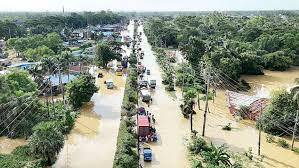
Fakrul Alam writes nostalgically of his visits to Feni in Noakhali, a small town which now suffers from severe flooding due to climate change. 

Every year, twice a year, during winter and summer vacations, my family would travel to Feni, Noakhali, where we would spend our holidays in our Nana Bari, the home of my Nana, or maternal grandfather.

For days before the journey, our excitement would keep mounting. For one thing, Amma[1] would make frequent trips to Nawabpur, or what was then called Jinnah Avenue, to buy fabrics or wool which she would then sew/darn/weave into clothes or woolens to gift her family members when in Feni. She would also spend more time in the kitchen than usual, cooking as many dishes as she could for my father, the only one of us who would be staying behind since he had his office to attend to; he would join us, if at all, for a few days at the end. For days before she left, Amma would repeat instructions to our household help until, by the time we left, we had memorised what they were supposed to be doing while we were away. Moreover, she would spend the last few days before the journey packing and repacking since she had to ensure that we had everything we needed, not only for the fortnight or so we would spend in Feni, but also for the journey back and forth.

And then, finally, the day of the journey to Feni would arrive! The six of us would board two or three rickshaws in the morning elatedly and head for the railway station in Phulbaria. We would have to thread our way through a platform overflowing with passengers and hangers-on, coolies and vendors, beggars and con-artists, as well as railway police and ticket checkers. Intrepid and inspired, Amma would lead us through the milling and tense crowd. It was as if the whole world was heading for the same interclass compartment; indeed, it seemed that we always managed to reach it just when the train was ready to leave the station.

Eventually, the train would leave Phulbaria and we would relax and feel exhilarated again. Because we did the trip so often, we looked forward to the highlights on the way. Bhairab Bridge, huge and unending, had views of the riverscape that were breathtaking in all seasons and for as long as the train clanged through it we were awestruck. Kasba, the station on the border where Pakistani and Indian troops skirmished frequently throughout the 1960s, was always the place where we tensed up a little. The red hills of Mainamati looked incongruous in the green world of Bangladesh. There were junctions like Brahmanbaria and Laxam, where vendors hawked their wares and cries of “cha gorom[2]” and “deem[3]” filled the air. Although the trip to Feni was supposed to be seven or eight hours long, by the time the train reached Feni station, it would be late in the evening and we would be exhausted, worn out by a journey that seemed to have gone on and on.

Feni in the 1960s was a small mofussil town, and to us Dhakaites, quaintly interesting. Rickshaws were often veiled! The traffic consisted almost entirely of rickshaws and bullock carts; the buildings seemed rickety or run-down, as if someone had forbidden them all to look good or completed or told them not to stand up straight. Although the trip to our Nana Bari from the station was not more than a few minutes by rickshaw, to us, it seemed to take forever; we just couldn’t wait for the journey to end by this time.

But all our fatigue evaporated as soon as our rickshaw took a bend and Nana Bari swung into view, revealing our uncles and aunts waiting eagerly to take us in. Nana, intensely religious at this stage of his life, would often be waiting to greet us with the warmest of smiles before hurrying off to prayer. My Nani[4] would first embrace Amma and the two of them would sniff a little, both overcome by the emotion of the oldest daughter returning home after some months. Then she would hug the five of us turn by turn and dash for the kitchen where she had been supervising the cooking. We would join her there as soon as we had washed and changed so that she could serve us delicious pithas[5] and all sorts of delicacies that Amma could cook in Dhaka only now and then. If it wasn’t too late, Amma’s relatives and friends would drop in, making us feel very important, for everyone wanted to know what we children were doing in school and the details of our Dhaka life. Eventually, we would drop off to sleep in utter exhaustion, but not before our uncles and aunts revealed the plans they had for us for the next few days.

The next few days, in fact, would go in a whirl. If it was summer and the heat was too intense or the rain too heavy, we would play carom or snakes and ladders inside for a while; if there was a cloud cover or only a drizzle outside, we would play hopscotch or football in the courtyard or retreat to the shaded grove in the backyard. Sooner or later, though, we would head for the pond, the centre of our daily rituals. Once we went into the water, we stayed in till Nani and Amma dragged us out for lunch. It was in this pond that we all learned to swim in successive trips; here we floated on banana-trunk rafts for hours and were thrilled at the way my uncles caught fish either with a net or a fishing rod. Sometimes, a tiger-skinned snake would slither past us shushing us instantly until it disappeared. Then we would resume our water games once again. If it was winter, on the other hand, we would stay in bed as long as possible, until the sun was completely up; afterwards, we would head for the courtyard where we would play hopscotch or cricket or go to the farthest reach of our Nana Bari in the plot of land adjacent to the pond, pretending to be picnicking. And then after we had psyched and warmed ourselves adequately we would go to the pond for a quick dip and rush out shivering to dry ourselves and have lunch in the sun.

Some evenings Amma would take us out to visit her relatives. Other evenings, we would go out for strolls. At least one evening we would spend promenading all around the dighi (large tank) around which colonial Feni had grown and where there were dak bungalows and the offices of this sub-divisional town. On one of these evenings, our uncle would take us to the edge of the town to show the old bridge and the massive and ancient banyan tree on the Grand Trunk Road, narrating to us, as we went, the story of how Sher Shah had built it and the bridge hundreds of years ago as part of his plan to administer efficiently the territories he had wrested from the Mughals. On another evening, our uncle would take us to see the ruins of Feni airport, for the town was once one of the key forward bases of the Royal Air Force, even though it would be abandoned at the bend of our history when India was partitioned. At least once during every visit to Feni, we would sneak out to go to see a film, for our now-puritan Nana was known to frown even at the mention of the cinema and would get mad at my uncles and aunts if he came to know where they had taken us.

At night, we would occasionally go to dawats[6]. Once every trip, Nanu would reciprocate by inviting relatives, friends, and even acquaintances she considered important to Nana Bari so that they could also meet us over dinner. On nights when we stayed home all by ourselves, Nana would join us after evening prayers, relaxing and joking with us for at least an hour, and thus remind the other elders of how he had been full of life and a Swadeshi (self-rule) campaigner once, an activist in the cause of one Bengal, but how he had become other-worldly now. Sometimes his stepbrother would visit us, tooting his odd-sounding bicycle horn entirely for our benefit as he came and went, and filling Nana Bari with his booming voice and loud laughter. Nani, too, would join us for a while, finally relaxing after another day of hard work, and would tease us as grandmothers are supposed to do, making us grandchildren feel silly and important at the same time.

Reluctantly, we would go to sleep after dinner; some on beds and some on the mats spread out on the floor. But sleep would take long to come, for we would first review the events of the day or plan for the one that was coming up, exchange secrets in the dark, or whisper stories about the ghosts and robbers that were supposed to be all around Nana Bari.

But we felt totally secure in Nana Bari, wrapped up in the love of my grandparents and uncles and aunts. Every part of the Bari[7] was full of family history. “There,” an aunt would say, “was where you were born!” “Those rooms are where all of us used to live before your Nana decided to extend the house for all you grandchildren,” my Nani would tell us proudly. In time, I began to fill parts of Nana Bari with my own memories too, although I was still a boy. Wasn’t that the room, for instance, where I was painfully initiated into the faith, though the occasion led to a feast in my honour afterwards? Occasionally, we all became part of family history in the making, as an uncle or an aunt got married, or one of us or a cousin had his akika[8] or birthday celebrated, and Nana Bari would then take on a festive air for days.

For the fortnight or so we were in Nana Bari, we were thus completely happy. Little did we know then the financial difficulties my Nana was experiencing due to the religious turn he had taken in old age; the hours he was spending in prayers and meditation meant that other people were taking advantage of him, encroaching on his land and trying to defraud him in business. Little did we know the strain Nani was going through then, running the large family on a reduced budget—Amma had three brothers and seven sisters—for she was always generous with us. Little did we realise that our uncles and aunts had to make do with much less than they had been once used to, for they seemed to be totally indulgent and giving whenever we asked them for anything.

No wonder that when the time to return to Dhaka came we were all quite unhappy. As we departed, Amma (and Nani) cried a lot, this time because mother and daughter knew that they would not be seeing each other for at least another six months, and because every leave-taking now confirmed to them that the first parting was irrevocable. We felt a little sad too. School was something to look forward to, but how could the cramped life we led in the busy city compensate for the freedom and the open spaces and the love swirling all around Nana Bari? The journey back, therefore, would seem uneventful and unending and we would go back to Dhaka a fatigued and melancholy lot.

*

Last year, two of our sisters and I visited Nana Bari for a few hours. My Nana had died in 1970, and my Nani went in 1997; all my uncles and aunts were now in Dhaka or abroad. Nana Bari had shrunk in size, for my uncles had decided to sell parts of it in a strategic move to secure the main house from the machinations of the covetous lot that controls remittance-rich and hooligan-infested Feni. The pond, the shaded groves, and all our favorite haunts were gone and we felt totally depressed at the diminished thing that the Bari had become. Better not to come any more, I told myself, better to keep Nana Bari intact in memory than confront the diminution of the place where more than anywhere else we had once been totally happy. Better to wax nostalgic than be confronted with the ever-increasing intimations of mortality.

Ah, Nana Bari!

.

[1] Mother

[2] Hot tea

[3] Eggs

[4] Maternal grandmother, also referred to as Nanu affectionately

[5] Traditional Bengali Sweets

[6] Feasts

[7] House

[8] A celebration that takes place seven days after a baby’s birth

(First published on January 20, 2007 in The Daily Star)

Fakrul Alam is an academic, translator and writer from Bangladesh. He has translated works of Jibonananda Das and Rabindranath Tagore into English and is the recipient of Bangla Academy Literary Award (2012) for translation and SAARC Literary Award (2012).

PLEASE NOTE: ARTICLES CAN ONLY BE REPRODUCED IN OTHER SITES WITH DUE ACKNOWLEDGEMENT TO BORDERLESS JOURNAL

Click here to access the Borderless anthology, Monalisa No Longer Smiles

Click here to access Monalisa No Longer Smiles on Amazon International

Categories
Stories

Half-Sisters

By Sohana Manzoor

Nara

She was as beautiful as a fairy-child. Her face was angelic as was her nature. She did not know jealousy and during the days of my childhood in that large palatial house of my stepfather, she was my only friend. She shared all that she had with me. Or, rather, she tried to share. Her mother, actually I should say our mother, tried to keep her away from me. After all, I was only her half-sister. I was a creature of wildernesses. My skin was darker, and I climbed the trees like a monkey. In return for her niceties, I shared with her all the fruits of the trees I had rampaged. We were both very young then. She was five and I, ten. Our mother often caught us in the garden rolling in the mud, stained with the color of blackberries or devouring green mangoes. Of course, I was the one who always got punished. She was the darling of her father’s eyes. Who would dare to touch her?

I often wonder if I loved Priya back then. I do not know. Do children love one another? Looking back on those years, I believe I treated her as a doll that was denied to me. I wanted to please her so that she would come to me behind our mother’s back. I knew as early as then that mother didn’t love me. My own father was twenty years older than her, and I was born to her when she was barely eighteen. But he had died in an accident before I was born, and she caught the eye of an extremely rich man, and they were wedded in no time. I was born six months after my mother’s marriage to her second husband. And mother made it very clear that the man she had married was not mine to claim even if he was my father in papers.

I can still recall that particular day I was leaning out of the living room door to watch the family tableau of father-mother-daughter and wishing I was part of it too. Suddenly, mother turned back and saw me. She hissed, “Get inside. What are you doing here?”

Then Priya and her father turned too. Priya waved and laughed, “Come, Apu[1]. Can’t she come too, Abbu[2]?” Her upturned face was radiant with expectation as she looked at her father who also smiled back. “Yes, of course. Come along, Nara.”

Mother glowered, but at Priya’s insistence she agreed to let me join them all on the terrace. Of course, I did not sit with them at the tea-table, but I did hang around them. I watched them contentedly as I had received more than I ever expected.

That was, however, only the beginning.

Up till this moment I only wished that he was my father too. But ma always made sure that I remembered my place. I was always the other sister, the other daughter, the other girl in the family. From this moment onward, I walked behind Priya as her shadow, taking care of her needs, and she depended on me as if I was a second mother. I believe, she loved me too because she knew that nobody else loved her as I did.

I remember the wedding ceremony of Atushi. Atushi was Priya’s cousin, the only daughter of Farzand Fuppi[3]. Priya was of course, as lovely as a rose. She wore a pink coloured lehenga[4] embroidered with seed pearls. It was outrageously expensive as her parents made sure that she had the best of things. But she was still a young girl of thirteen and it was I, the eighteen-year-old Nara, who caused a stir that evening. I was dressed in a peacock blue lehenga that my stepfather almost bullied my mom into getting for me.

“I won’t have one daughter wearing the most expensive thing and another dressed like a pauper,” he had bellowed.

Mother protested, “Nara’s not your daughter.”

He roared, “She’s mine as much as Priya. Don’t you ever say she’s not my daughter.”

Mother cringed and went as pale as a waif. She tried to say something but could not form a single syllable.

Some young male cousins of Priya wowed at our entrance and a female relative sneered, “Goodness gracious! Look at Nara! She just sailed in! Fayaz Uncle will have a Draupadi in his hands in no time.” At some innermost corner of my heart, I reveled. As I turned to look at my mother and Priya, I saw contrasting emotions. Priya was beaming with pure blithe, my darling sweet sister. But in mother’s eyes, I saw panic. She appeared like a terrified deer and clung to Priya. I could not understand why she was so afraid of her very own daughter. But I was naïve, and I did not know the world as she did. Nor did I know the darkest secret she held in her heart.

Priya

They called me a princess. From my childhood I was pampered like one and my mother guarded over me with utmost jealousy. I was an only child and the doctors had said that my mother could not bear another. But then I also had Nara Apu even though everybody called her my half-sister. Technically, she was my half-sister as we had different fathers. Mother always made it clear that she did not care for her at all. And she disliked her even more because I loved her to distraction. In that palace-like prison, she was the only person who cared for me truly. Love shone in her eyes like a beacon, and I cannot help wondering how Nara Apu, who got so little love herself, could love me with such abundance.

She had dark complexion, but that made her all the more beautiful. Her eyes were like pools of black water, the only feature she had inherited from our mother. My eyes are of greenish hue, the eyes that came from my father’s side of the family. When we were children, father was kind of indifferent toward Nara Apu. But Apu had such an unselfish nature that it was difficult to remain unresponsive towards her. And even though my father was a busy man, he did not miss how much she cared for me. Slowly, his attitude toward her changed.

And there was that one time when she practically saved my life. I jumped into the lake after being goaded by some of my cousins even though I did not know how to swim. I realised how stupid the move was as I gulped water and I saw my two dumb cousins standing by the shore gaping at me in horror. I heard a piercing cry, and I sensed it was my mother and then there were several splashes. Then someone got me by the hand, “Don’t grab me,” it said. “Just hold on to my hands.” I flailed and splashed and cried. Then two stronger hands got hold of me.

As I was lying in bed later with mother crying beside me, I learnt that I had two saviours—Nara Apu and Shahnewaz Uncle. It was Nara Apu who had reached me first, and Shahnewaz Uncle reached a few seconds later and grabbed us both and brought me ashore. From that day, everybody knew that Nara and Priya belong together.

By the time she was fifteen, Abbu made sure that mother was not mistreating her daughter from her first marriage. I heard him once telling her, “Salma, do you consider me such a petty creature that I would be jealous of that slip of a girl? You don’t have to treat her so bad, you know, to prove that you love Priya more.”

Mother wept and I could see she was disturbed. But she never really loved her. It is one mystery I never understood until years later.

I also formed a close bonding with Shahnewaz Uncle. Of course, he lived in the same house, but he was always busy with painting. He was Abbu’s younger brother, but they did not have a very close relationship. But he did take notice of me and sometimes patted me on the head. After this particular incident, he started taking interest in both me and Nara. He brought for us licorice of different shapes and tastes and other delicacies. My favourite was orange, while Apu liked peppermint. He laughed at her, “What an old woman you are!” Nara Apu made faces at him and grinned impishly.

During these times, I also started to note that Mother was actually afraid of Nara Apu. It did not make sense to me at all. But whenever Apu was around either Abbu or Shahnewaz Uncle, she would fidget uncomfortably and say nasty things. Once I heard her grumbling to herself that Nara Apu was out to grab men. Poor Apu was only sixteen years old at that time. Then on her nineteenth birthday Mother suggested that she could be married off to Rabbi, a poor relation who worked in our country estate. When Abbu realised that she was serious, he suddenly went very still. Then he said in a very low voice, “If you ever utter such nonsense, or if I ever hear that you’ve initiated something like that, I will have you drowned. Daughters of my family don’t marry servants…. And, from today, she is mine. Forget that you ever gave birth to her, you wretched woman.”

I don’t know what come over her, but mother just fainted away.

Nara

Mother was always a troublemaker. In those days, I could never understand why she hated me so. Our father (I had started calling him Baba[5] at some point; I did not call him Abbu though) was away on a business-trip. And that is when I discovered a terrible secret. I never knew the whole story, but I can still recall the strange conversation that night when Priya was raving in fever and Baba was away. I had fallen asleep in the sofa in Priya’s room and the words streamed into my consciousness:

“All these years, I’ve waited. I’ve waited for him to die. Is there nothing you can do? Priya will always be known as someone else’s daughter.” I heard the sound of muffled weeping of a woman. She whimpered as she said, “And I have to remember all the time that the child that is legitimate is actually the result of rape. I… I … can never love Nara… I was young and I didn’t want her… I hated that man… why couldn’t she die at birth…Why didn’t you let her die?”

Even in my sleep I went numb with pain. Until that moment I had resented that my mother never loved me. There in that nightmarish darkness, in a half-conscious state I learnt the nature of the relationship that existed between my mother and father. I knew, of course, that he was way older than she was. But I never knew that she was married off to him because he had raped her.

Then I heard the voice of a man. The voice was sad but steady, “He’s the rightful son of my father, Salma. I cannot do anything. Even if he dies, I won’t inherit the family property. My mother was only my father’s mistress, you know. Fayaz bhaiya[6] has been generous enough to let me live here. If his mother was alive, he would never be able to do so. You already know that. And Priya has to be recognised as his daughter, otherwise she will get nothing either.”

I was so shocked that a sound escaped my mouth, and my mother was at my side within a moment. In that semi-darkened room, I saw her dark eyes glazed with sheer terror. And I knew that a woman in her predicament would not allow anything or anyone to get between herself and her object of desire. I pretended that I had had a bad dream about Priya. Then we both ran toward Priya’s bed.

A week later, before Priya had completely recovered, mother fell from the stairs and was killed. But a lot of things started to fall in place. Since she could not have any more children, she was protective about Priya and so possessive too. She had no choice but to pass her off as the daughter of her husband. She also wanted to remain the wife of the man who was as rich as a king. She had nowhere to go either. The man she loved, she could not have. And the other daughter, that is me, was a child she never wanted. My father, she never loved. Poor woman! What a life!

It was a strange house after that—two brothers grieving for the woman they both loved. Shahnewaz Uncle suddenly seemed to have grown old. He reminded me of Tithonus bereft of his Dawn. And our stepfather seemed distant and gloomy like a thunderstorm. Yes, that’s how I started thinking. He was Priya’s father only as much as mine. Somehow, the running of the household fell into my hands and Priya became my shadow. She grew to be afraid of the dark. She saw mother’s shadow in the darkness, and I started sleeping in her room. We grew closer than ever. That’s the time when I learnt to love her truly, like my very own sister, without the slightest trace of jealousy.

Priya

I saw the woman in shroud for the first time about two weeks after Mother died. She was sitting in the veranda in the evening. I called out without thinking and when she looked back, I shuddered because she had no face. Yet I knew she was a woman. I heard a piercing scream and when two arms gathered around me, I realised that it was Nara Apu and that I had screamed. I think I fainted and when I woke up, I was in my bed and Apu was sitting by my bed, her eyes clouded with worry.

“I saw her, Apu,” I whispered. “I think I saw Ma.”

Apu’s face paled, but she shushed, “You saw nothing, darling. It was just a shadow. And don’t worry, I’m here. I’ll take care of everything.”

But I saw the woman again a few days later. She was watering the plants on the rooftop at the wake of dawn. I saw her from my window, and I knew it was her. Why was she haunting me? And why did nobody else see her?

Nara Apu made sure after that I was always surrounded by people, esp. in the evening. At night, she slept in my room. Initially, she slept in a cot, but later at my insistence, she slept in the same bed with me. During those days, Nara Apu was strong. She walked with grim determination; she protected me like a warrior-princess. I felt safe when she was around. During daytime, things were normal, but as soon as the darkness crept in, a fearful feeling rose in my heart. I was afraid of shadows. I realised I had to bring Nara Apu in. But how to tell her? I could not give away my secrets; hence I told her only what I could.

That night when we were getting ready for bed, I caught her hand and whispered, “Apu, I have to tell you something. Have you seen Shahnewaz Uncle’s mother?”

Nara Apu gaped at me in incomprehension.

“I saw her picture in his closet. He said it was the picture of his mother.”

Very slowly Apu got up and sat again. And then she said even more slowly, “She… was… drowned… in a… pond, they say. I wonder…”

I stuttered, “Nara Apu, she… looks … exactly… like me.”

Nara Apu did not say anything, but just looked at me. And I realised with a jolt that she knew. When did she come to know that? And she still protected me like anything? When did she learn about it?

I burst into tears, and she held me close like she always did. “Shush, shush, my pretty. You’re safe with me. None can harm you when I’m here. Shush…” What if she knew the truth? Could she bear it? Could I bear if she did not?

Nara

I had to be strong and brave for the sake of Priya. I could not tell her what Baba had told me. Sometimes I wonder how was it that my own mother never loved me, but I got so much love from a complete stranger. No, I am not talking about Priya, I mean Baba. That rainy afternoon when he called me to his study, haunts me still.

He was standing by the window watching the rain. When I entered, he bade me sit. He did not turn to look at me but spoke:

“Sit, Nara. I have some things to tell you.”

I waited patiently.

“We’re in a strange situation here, are we not? Your mother has died, and you are stuck within the walls of a strange house with people whose ties to each other are stranger.” I shuffled uneasily. What was he saying? What was he referring to?

“This is a big house. Do you know that walls have ears?” he ploughed on. “There are many secrets this house holds and even I do not know them all.” Here he turned to look at me. He had smoky eyes, eyes he inherited from his mother. He was a very handsome man even though he was in his mid- fifties. He sighed and said, “I know who Priya is.”

I bolted from my chair, and I knew my face had lost its colour.

He shook his head. “I have known it for quite some time now. Priya looks a lot like Shahnewaz’s mother. I had not realised when she was younger, but as she is growing up, I’ve been detecting the resemblances.”

I sat trembling. Was he planning to punish us? Why was he telling me all these?

“Sit, Nara. I am not going to hurt you or Priya for something your mother did.”

A terrible suspicion started to creep in my mind. And I had thought… “Did… you… you did not kill her, right?” the words tumbled out of my mouth.

He looked at me sadly. “I did not kill her.” He paused and searched my face. “But why do you say that, Nara? Your mother died in an accident, did she not?”

I remained silent.

“Nara, I want you to know that I have drawn documents with my lawyers and have divided my property equally between you and Priya. Both of you are my daughters, mind you. I do not care who the natural fathers are, I recognise you as my children. And I want you to take care of Priya, no matter what.” He paused again and asked, “Do you understand?”

I nodded mutely. Then I asked, “But why? I mean, are you going somewhere?”

He seemed lost in thought. But then he raised himself out of his reverie and smiled, “I guess, you can say that.” He paused and then added, “You can trust Shahnewaz. Like me, he loves both of you. I believe that he loves you even more because you are not his child. He has no hold over you and yet he owes you for saving his daughter’s life.” At that moment I realised how much he loved us both. I felt a wrenching pain for this man who was more than a father to us, and yet he was not our father.

As I was walking out of the room he called me back, “You’re strong, Nara. Far stronger than any of us. You’ll survive.”

Nara and Priya

There was total chaos in the family after Fayaz Chowdhury’s disappearance. The bulk of the property was left to Nara and Priya with Shahnewaz Chowdhury as the legal guardian. Neither Nara, nor Priya could claim their share until their 25th birthday. If either of them died before that, their share would pass on to Shahnewaz. Fayaz Chowdhury’s sisters could not make head or tail of their brother’s wishes. Why did he leave half of his property to Nara? Even though adopted, she virtually was no blood relation to him. Naturally, not any of them could accept that she had suddenly been elevated to the status of a princess.

Priya’s problem at this point was she still saw the shadow of a woman periodically. But by now they both had accepted that Priya would keep on seeing her. She became more and more dependent on Nara.

On that particular afternoon, Nara was making tea on the veranda. Priya was sitting on the small sofa when she just could not take it any more. “Apu, do you know that you are the most beautiful girl that ever lived?” she asked with an unnatural fervency.

Nara raised her dark eyes and laughed. “What got into you, sweetie? If I’m the most beautiful one, what are you?”

Priya smiled in spite of herself. “Apu, will you go away when you get married?”

“I’ll never get married,” Nara suddenly went somber.

“Why not?”

“I don’t trust men,” came the simple reply. She paused and then proceeded to say, “Our poor mother! I just feel so sorry for her.”

“Why do you feel sorry for her? She was a selfish bitch!” There, it was out in the open, thought Priya. It still bothered her that the wretched woman never learnt to love her elder daughter.

Nara shook her head. “No, Priya, she was just a miserable woman. She could not have the man she loved and had to deal with two other men.”

Priya’s eyes stung as the words tumbled out, “You loved her?”

“She was my mother,” said Nara matter-of-factly. “What she did was done out of her own miserable state of mind. I cannot help loving her.”

Priya’s face went as white as chalk. “Apu, I killed her.” The whispering confession was as soft as the first snow. Nara went still. When she turned to look at her sister, she said with a sadness that only tremendous love for a child can produce, “I know. Baba knew too, I believe.”

Priya cried with an abundance that knew no limit. “She hated you. That wretched woman! She wanted to kill you when you were born. Did you know that? Shahnewaz Uncle did not let her. Those two men—they have had so much love in them for that wicked woman. And you love her too? How can you love her? … Sh she was… a witch… an evil witch… I can never… forgive her… never…. Do you know she planned on killing you again? She… she had come to … sus… suspect that you knew the secret of… my birth. I p-pushed her d-down the stairs. I would n-never let anyone harm you… never…” by this point Priya had become hysterical.

Priya was still screaming when they took her away. Her mind had gone completely berserk. She certainly was not a criminal. No wonder the pressure she had retained through the two years after her mother’s death overwhelmed her completely. Nara pulled through the time, and she dragged her Shahnewaz uncle through it too. When Fayaz Chowdhury finally returned home, it was once again a strange household—two fathers held together by a daughter who belonged to neither. And yet, she was the daughter of the woman they both had loved. It is strange that Nara’s mother never loved the child begotten through rape and abuse, and yet Nara had so much to give. That made all the difference.


[1] Elder sister

[2] Father

[3] Father’s sister

[4] Long full skirt

[5] Father

[6] Elder brother

Sohana Manzoor is Associate Professor, Department of English & Humanities at ULAB. Her short stories and translations have been published in many journals and anthologies in South and South-East Asia. Currently, she is also the Literary Editor of The Daily Star, Bangladesh. This story was first published in Six Seasons’ Review.

.

PLEASE NOTE: ARTICLES CAN ONLY BE REPRODUCED IN OTHER SITES WITH DUE ACKNOWLEDGEMENT TO BORDERLESS JOURNAL

Categories
Stories

A Cat Story

By Sohana Manzoor

Courtesy: Creative Commons

“O my poor Putli, why did I let you go out? O Allah, why did you take my Putli away?” Rupa heard Kohinur’s ma wailing as soon as she entered home. She sighed. Everyone in the house had been down since Putli disappeared about ten days earlier. Then three days ago, one of the guards of their apartment complex brought the news that he had seen Putli’s remains near the Niketan bazaar. Of course, nobody could be completely sure that it was Putli because the body had been lying there for some days and had partially decomposed. All they were certain of was that a black and white cat that looked like Putli had been killed. Rupa wanted to go herself but, in the end, could not bear the thought of seeing the rotten corpse of their cuddly family member. But since then their old maid, who took care of the cat, had been absolutely inconsolable.

Today Rupa could not take it any longer. She felt it was high time to find another cat, preferably a kitten; their house felt empty and desolate. Putli was an adorably frisky cat, about two years old. It was really fun to observe him jumping and playing with imaginary friends, raising his tail erect, or clawing at his own image glaring back from the mirror. Only recently he had started going out and was courting a cute white cat that Rupa had often seen reclining on the corrugated tin roof top of a nearby garage. He even had a fight with a street cat over his sweetheart. He had disappeared once before, but had come back after three days. This time probably he had ventured too far away from home and met his end.

It was summer; the schools were closed and Rupa’s two younger siblings were sulking in the house all day. Rupa studied at a private university and soon the semester would be over, and she resented the thought of residing in a house without any feline presence. There was always a cat in their home as far as she could remember. Even their father, who was a businessman and was busy all the time, seemed to have noticed Putli’s absence. Only yesterday Rupa had heard him saying, “That sofa by the window was Putli’s favorite spot; I can’t believe he’s gone.”

Rupa’s younger brother Yen had been trying to allure a neighborhood cat. Rupa did not like the looks of the cat he was inviting in though — looked more like a hobgoblin, greedy and sneaky with shrewd yellow eyes. She had occasionally seen it lurking in the back alley. It took the half-eaten drumstick that Yen had placed on the pavement, and ran behind a small pile of rubble. Rupa was certain that it would cause nothing but trouble. Besides, Kohinur’s ma hated any human or animal sneaking into her domain—the kitchen. She would surely wrinkle her nose and comment, “Couldn’t you get anything better than that susa bilai?[1]” But then nor could Rupa approve of the white fluffy cat Lira was nagging about the other day. She had seen one in the movie Stuart Little, and wanted a cat like Snowbell. Now that was a Persian cat and Rupa certainly did not want their entire family rolling in a bed of hair. She would rather have a deshi[2] regular cat than one of those overrated foreign ones.

The ornate clock in the dining room chimed 3 in the afternoon. If she started right away, she might get to Katabon and even return before evening. She was not very sure what kinds of kittens were available at the pet shops there, but it would not hurt to take a look. She grabbed a quick snack, filled her water-bottle and got out of the house. Her mother was taking a midday nap, and hence Rupa did not disturb her. But she knew her ma would not mind even if she brought in an entire brood of fluff balls. They were a family of cat lovers. Sifat, her best friend, often joked that they were surely Egyptians in some other life.

Rupa looked at the elevator which seemed to be stuck at the 6th floor. So, she took the stairs. On her way down, she saw the helping-hand from the fourth floor. The boy stared at her and as always Rupa found his look disconcerting. She had often wondered if the boy was mentally sound. She had never heard him speak, and on several occasions heard him wailing incomprehensibly in the stairwell until someone dragged him home. She noticed that he had a shopping bag in hand from where greens and the top of a gourd were peeping out. Obviously, he spoke, reasoned Rupa, otherwise how could he buy those?

Rupa’s way to the Katabon was uneventful other than occasional stops at the traffic lights. After paying the fare she started walking past the pet shops. The first one had birds and fish and aquariums of different sizes. After three shops she found one sporting caged dogs. But there were no cats.

At the next shop, the shopkeeper and his assistant showed her three black kittens claiming that they were Siamese cats. Rupa could not be sure if they were Siamese, but she was willing to bet that they were previously owned by some evil witch. They glared at Rupa with open hostility, their bright eyes burning like green fire. Rupa shook her head negatively and walked toward the next shop.

A boy of around 12 or 13 years of age beckoned her to a box like cage where she saw the kitten. It was small, surely not more than a few weeks old. The orange tabby looked up at Rupa with its large brown eyes and sneezed. She looked inside the box and saw another kitten, a black and white one, whimpering. She continued meowing piteously as Rupa turned to look at the tabby and took it from the boy. Dirty and malnourished, the tabby yet seemed absolutely adorable to Rupa.

“How much?” she asked.

“One thousand taka, apa[3]. It’s pure breed.”

“Sure,” Rupa grimaced. “It’s just a regular deshi cat, mixed breed at best.” The other kitten was still crying for its friend. Rupa calculated something quickly, and said, “Okay, I will accept your price, but I want that other kitten for free.”

The shop keepers started arguing, “But you won’t get two cats for only 1000! And they are first rate kittens.”

“Then I am not taking any,” she placed the tabby in the cage and turned away, even though her heart cried out for the poor kitten. She had not taken two steps when she heard the elder guy, “Okay, okay, they’re yours.”

Rupa took out two five-hundred-taka notes and asked, “Do you have any box I can carry them in?

“No boxes. But we’ll wrap them up for you.”

Wrap up living cats? Rupa waited to see what kind of wrapping they provided.

After about 5 minutes she was staring dumbfounded at the boy holding out the kittens in two brown paper bags. How he got them inside the paper bags so quickly, and without any tearing was a mystery to Rupa.

“Are you mad?” she spluttered. “I am going home in an auto-rickshaw. Those two will tear out of the bags in minutes. Get me at least a net bag or something.”

The boy put the paper bags of cats in a large fluorescent green net bag. Rupa took the bag cursing herself as well as the shopkeepers and hopped on a CNG auto-rickshaw for a hundred taka extra.

Surprisingly, the kittens were quiet in spite of the loud noise emitting from the auto-rickshaw and the vehicles in the surrounding streets. Rupa suspected that they were just too weak to protest. After about 10 minutes, however, Rupa heard a rustling sound, and she saw a small orange muzzle tearing from a brown bag. “Baghu,” thought Rupa. “I’ll call him Baghu.” It was a male cat, she had already noted, whereas the black and white one was female. She could be Nishi. Nishi made no sound at all, but Baghu kept on rustling and clawing at the paper bag until half of his body came out. “He does have spirit, after all,” thought Rupa. But she certainly did not want him out of his bag right now. So, she put the bags and cats all on her lap holding on to them tightly, praying all the while that they didn’t pee on her.

“What do you have in there, apa?” a child’s voice asked, and Rupa realized that the CNG had stopped at a traffic signal. Several curious street urchins with flowers, lemons, water bottles and other knickknacks were peering inside her auto-rickshaw. By now Nishi had also started pushing forward and mewing piteously. And the hawkers were obviously drawn by the sounds made by the kittens, and the commotion in the bags.

Rupa sighed and replied, “Don’t bother. Just go your way.”

But their numbers increased. “O my, you’ve got cats!” observed a flower girl with a merry laugh.

“No, no, those are kittens,“ said one boy of about seven or eight. He was selling mineral water. Two of his front teeth were missing. “How many do you have?”

“Two,” Rupa tried to maintain her gravity. “Now, GO!” her voice rose two octaves.

The children moved back a few steps only to get closer again. They were all grinning. “Look, look, there’s a red kitty.” “And a black and white one too!” “That one looks like Harun’s kitten!” Rupa could hear all kinds of comments.

Another CNG driver who had stopped right next to Rupa’s auto rickshaw, looked at her driver and asked, “What’s going on?”

“Young girl—taking two friends home. Only they have fur, tails, and they meow,” replied the CNG driver with a straight face.

Rupa went beet red. As the red signal turned green, she heaved a sigh of relief. As soon as the CNG started moving both Baghu and Nishi quieted down. Baghu started to nuzzle her, while Nishi looked up at her with dark hazel eyes. Her coloring reminded Rupa of Putli, her main reason for getting her. Nishi seemed much more docile though. Rupa suddenly felt very protective of the two kittens, and at the same time she could not help wondering why she did not feel the same way about human children. Why was it she had this urge to take home every kitten she saw in the streets? Then she amended that not every kitten perhaps but the cute ones surely. But those street children could be cute too. She remembered the ones that were commenting over her cats, particularly, the boy with the missing front teeth and another little girl with pig tails. How come she never felt like taking them home, wondered Rupa uneasily. She wondered about the boy who lived upstairs, the one she suspected was mentally disabled. Would her parents be equally welcoming to these children as they were to the cats?

Apa, which road?” Rupa realised they had reached Niketan. She directed the driver to road no 10. Their apartment was on the second floor. The old caretaker, Abu bhai[4] looked at the bundle in her hand, two small heads, one orange, and one black and white peeping out. He grinned, “You’ve got kittens, apa. That’s so wonderful.”

Rupa nodded and smiled.

And then Abu bhai said, “Something unfortunate has happened, apa. The crazy boy from the fourth floor fell down the stairs.”

“What crazy boy?” gasped Rupa. “Not that servant-boy they call Khokon, or Rokon?”

“Rokon. That very one,” replied Abu bhai.

Abu bhai said, “A maid from another flat had gone out to buy her paan[5]. And then when she came back, the boy was lying sprawled and motionless on one of the landings. Apparently, he fell down, and he has been taken to the hospital.”

Rupa remembered the greens and the gourd peeping out from the bag in the boy’s hand.

“Pets are replaceable, human beings are not,” she mused as she got on the elevator. She wondered if Rokon had parents. What parents could send such a boy work for other people?

“Where’s everybody?” Rupa shouted. “We have cats in the house!”

Yen came running, followed by Lira. Kohinur’s ma, who had opened the door, stood by with a smile on her face.

“They’re so small… and dirty!” commented Yen.

“But they’re cute!” cooed Lira.

“They need a shower and food,” observed their mother who had also joined them. “Kohinur’s ma, why don’t you take them to the kitchen and feed something? Give them a thorough bath tomorrow morning. They probably have lice on them.”

Rupa turned to her mother and asked, “Amma, did you hear about the servant-boy who fell down the stairs?”

Her mother looked surprised, “No. There was some commotion in the stairwell, but I didn’t realise that’s what happened.”

A few hours later the two newly acquired members of their family were playing on the living room carpet. They had licked themselves clean. Nishi was a bit shy and was sitting demurely on her haunches, but Baghu had already started scampering around. He was also a little bigger and probably older than Nishi. Everybody had approved of the names. Lira clapped her hands and laughed gleefully as Baghu did a summersault. Baghu looked up at Lira and did it again, and everybody laughed.

“He’s clever, isn’t he?” Kohinur’s ma observed.

“He actually understood that I liked his summersault!” Lira’s eyes went round. “Wow! Baghu, you’re amazing!” She picked the tabby up and kissed the top of his head and Baghu clung to her with all his four paws. Her mother shrieked, “Eeks! Don’t kiss them just yet! Let them have a shower tomorrow morning and you can do what you want.”

“But they are clean,” protested Lira.

“Not yet,“ Rupa shook her head. “And don’t carry them to bed with you tonight,” she warned. “You can snuggle with them after they have visited the vet’s office.”

At night Kohinur’s ma produced an old basket with rags of clothes for the two kittens to sleep in. Rupa recognised the basket that had belonged to Sisu, another cat they had lost years ago. She smiled as she said, “Something tells me that in a few days they will be sharing beds with Lira and Yen.”

Lira whooped and nodded vigorously while Yen displayed a huge toothless grin. Rupa again remembered the boy from the fourth floor. And the boy she had seen on the street, with his missing front teeth.

She brushed her teeth, changed into a loose T-shirt and pyjamas and went to bed. She dreamt of a gorgeous green meadow where children played and laughed, and they were all naked as the first day they were born. Rupa saw Yen and Lira and the street urchins along with Rokon. They all looked the same: clean and happy. Rupa heaved a sigh of contentment. Dreamland was perhaps the only place where her siblings could play with the likes of Rokon and the street-children without raising eyebrows and derision from any quarter.

Sohana Manzoor is an Associate Professor at the Department of English and Humanities at ULAB. Currently, she is also a Deputy Editor of The Daily Star, a leading newspaper in Bangladesh.


[1] Gluttonous kitty

[2] Local

[3] Elder sister

[4] Brother – a polite way of addressing helpers

[5] Betel leaf

.

PLEASE NOTE: ARTICLES CAN ONLY BE REPRODUCED IN OTHER SITES WITH DUE ACKNOWLEDGEMENT TO BORDERLESS JOURNAL

Categories
Interview

At Home Across Continents

In Conversation with Neeman Sobhan

Neeman Sobhan is an expat who shuttles between Italy and Bangladesh and writes. She has a knack of making herself at home in all cultures and all spheres. Having grown up partly in Pakistan (prior to the Liberation War in 1971), Bangladesh and completed her studies in United States, she has good words about time spent in all places. Her background has been and continues to be one of privilege as are that of many Anglophone writers across Asia. Her stories have been part of collections brought out to celebrate the fiftieth anniversary of Bangladesh.

One of her most memorable stories from her short story collection Piazza Bangladesh, located around the 1971 war takes on an unusual angle, where the personal seems to sweep the reader away from the historic amplitude of the event into the heart-rending cries of women at having lost their loved ones in a way that it transcends all borders of politics, anger and hate. The emotional trajectory finds home in a real-world event in the current war. The fate of innocent youngsters dying while not being entrenched in the hatred and violence wrings hearts as reports of such events do even now. I find parallels in the situation with the young Russian soldier whose mother did not know he was in Ukraine and who was killed while WhatsApping his mother his own distress at being there. And yet her stories stay within certain echelons which, as she tells us in the interview, are the spheres that move her muse.

When and how did you pick up a pen to write?

I have always written. The written word has always held a powerful fascination for me, which has not dimmed at all. From my childhood through my teens, I was a voracious and precociously advanced reader, as well as a passionate writer of poetry, and a keeper of a daily journal. My poetry was regularly published in The Pakistan Observer’s Junior page.  I don’t dare look at them now to even assess whether they were embarrassingly bad or surprisingly good enough to be salvaged and resurrected now! I preserved them as the earliest evidence of my continuing evolution as a writer and a poet today.

During those early days, I also won the first prize in a national essay writing competition sponsored by the newspaper. The Pear’s Encyclopedia I won still holds a precious place on my bookshelf.

English was my favourite subject in school and college, and I knew I would study English literature at university. I started out at Dhaka University in 1972 but by some perverse logic, I actually enrolled in the newly opened International Relations department and not the English Department (in which I had applied and been accepted). The reason, I now recall is because the English department was over-flowing with students, while the International Relations department was something exclusive and admitted a handful of students. However, after a few months I realised I had made a disastrous choice.

Meantime, my marriage was arranged, and I was whisked away to Marlyland, U.S. My husband, Iqbal, an ex-CSP officer (the Civil Service of Pakistan) was a Ph.d student of Economics at the University of Maryland, and in no time I enrolled as an undergraduate student and blissfully went on to study English and Comparative Literature, graduating eventually with a Masters in English Literature.

That I was going to be a writer was for me, even as a teenager, like a pre-ordained and much desired fate. I never wanted to pursue any other vocation.

What gets your muse going? 

Anything, and everything.  A view, a scent, an overheard conversation, a line of poetry, a memory……If I’m angry and seething, I write; if I’m sad or grieving, I write; if I’m joyous or ecstatic, I write; if I feel aa surge of spiritual bliss, I write; if I’m confused, I write. What form that writing takes is unpredictable. It could become a poem, or a paragraph in my notebook, which later could be part of my fiction, or a column. I wrote a regular column for the Daily Star of Bangladesh.

Writing is my food and nourishment, my therapy, my best friend, my passion. The writer-Me is the twin that lives inside me. It’s my muse and guide that defines my essential self. I am a contented wife of almost 50 years of marriage, a mother of two sons, and a grandmother of four grandsons (aged 5-4-3 & 2). These gratifying roles nourish my spirit, give me joy and inspiration, teach me lessons that help me grow as a human being. But my writer-self exists in its own orbit, proceeding on its solitary journey of self-actualisation, following its inner muse.

You have written of Italy, US and Bangladesh. How many countries have you lived in? 

Yes, I have lived in Italy, US and Bangladesh, which makes 3 countries. But, in fact, I have lived in 4 countries.

Remember that I was born not just in the undivided Pakistan of pre-71, when present day Bangladesh was East Pakistan, but I was actually born in West Pakistan, present day Pakistan, in the cantonment town of Bannu, near the borders of the Khyber Pass and Afghanistan, (formerly, the NWFP or NorthWest Frontier Province, presently KPK or Khyber Pakhtun-Khwa). Although my parents were Bengalis from Dhaka, my father’s government job (not in the army but under the Defence department, ‘Military Lands and Cantonments Services’) meant being posted in both wings of the then Pakistan. So, during my childhood and girlhood, I grew up in Karachi (Sindh), Multan and Kharian (Punjab) and Quetta (Balochistan). As a family of five siblings and our adventurous mother, we always accompanied our father on his official tours, by car or train, over the length and breadth of that country.

In the English medium school I was enrolled in, I had to choose Urdu as the vernacular subject, since Bengali was not taught in West Pakistani schools, though the opposite was not true! Anyway, I have no regrets. I am proficient in both Urdu and my mother tongue Bangla/Bengali, which I learnt at home from my mother, who in Quetta actually set up a small Bengali learning school for Bengali Army officers’ children. I am proud of the fact that I carried my mother’s tradition when I taught Bengali to Italians at the University of Rome, many decades later!   

What is it like being an immigrant writer? Which part of the world makes you feel most at home? Why? 

To start with, and to be honest, I do not really consider myself a true immigrant — someone who bravely and definitively leaves his familiar world and migrates  to another land because he has no other options nor the chance or means to return; rather, I feel lucky to be an ex-patriate — someone who chooses to make a foreign country her home, with the luxury of being able to revisit her original land, and, perhaps, move back one day. In fact, I have dual nationality, and am both an Italian citizen, and continue to hold a Bangladeshi passport. I might be considered to be an Italian-Bangladeshi writer. I consider myself a writer without borders.

I feel equally at home in Italy and in Bangladesh. Before the pandemic, my husband and I would make an annual trip to Dhaka for two months from December to February end, since my classes started in early March. Presently, I am back in Dhaka, after two almost apocalyptic years.

Despite the continuing hurdles of mastering the Italian language and trying to improve it constantly, we love our Roman home as much as our Dhaka home. Still, living away from ones’ original land, whether as an expatriate or an immigrant, is never easy, beset by nostalgia for what was left behind and the struggle to create a new identity of cultural fusion within the dominant and pervasive culture of a foreign land. But in this global age, it’s quite usual to live in a mix of cultures and live in a borderless world where ones national or cultural identity is not so clear cut. (I have a daughter-in-law who is Chinese, and another who is half-English, half-Thai! And my grandchildren are the heirs to a cornucopia of cultures and are true global citizens). Nevertheless, in the four and a half decades of my living away from Bangladesh, the eternal quest for that illusory place called home has shaped the sensibility that nourishes my creativity and compels me to write. Often, it’s the pervasive and underlying theme in my columns, stories and poetry. There is a poem of mine, “False Homecoming” which underlines the poignant sense of displacement a person can feel, not in a foreign land but in ones’ own motherland, or the version from the past. After all, many people who live away, exist in a time-warp.So, no matter which part of the world you feel at home in, it’s temporary. For me, as a writer between countries and homes, it is an external and internal odyssey.

It is the endless journey of a writer in constant evolution.

Tell us a bit about your journey. 

I realised early on that our real world being increasingly borderless, it’s not a tract of land that makes me feel at home. It’s my writing. The Mexican poet Octavio Paz once said, “Words became my dwelling place.” This has always resonated deeply with me, because for me, too, language and literature have been my sanctuary and true homeland. I have lived in that comfort zone at the heart of my creativity, imagination and writing: my dwelling place of words.

Of course, there are as many shapes to the sheltering place of language as there are literary forms. My nest of words was also feathered by my particular exigencies, followed a particular route and journey.

Though I speak various languages, my mother tongue is Poetry. For as far back as I can remember I have always written poetry, like writing in a journal, considering it to be the shorthand of my heart, a secret language. I am a reticent person, and there are writers like me who are content to use writing, whether poetry or prose, as a tool for self-exploration, self-knowledge, self-definition, with no thought of being published. At least, not my personal poems.

Yet with poetic irony, despite being a private person, my career as a writer started when I was jettisoned into that most public form of literary expression: the world of weekly column writing. At the urging of a friend, the editor of the Bangladeshi national daily The Daily Star, I turned into a public chronicler of the minutiae of my world, my life and times. Now I discovered my professional language, my father tongue if you will, the language of prose and my journey as a writer started.

When one reads your writing, it is steeped in a number of cultures. Which culture is most comfortable for you while writing and which one for living? 

There’s no place as beautiful and pleasurable to live in as Italy. Except for two or three months of winter, the climate during the rest of the year is perfect; the natural beauty and historical and artistic richness are unsurpassable, the food is delectable whether it’s based on nature’s bounty or the simple elegance of its distinctive cuisine. But for a writer who is also a housewife, the most comfortable country to write in, for me, is Bangladesh. With the culture of household helps abounding, I often get more writing done in two months of living in my Dhaka apartment than a whole year in Rome. My domestic staff are like family to us, and valued parts of our life. They sustain us and we sustain them, helping them educate their children to stand on their own feet. I miss this support network in Italy.

What are your favourite themes and your favourite genre? Expand on that a bit. 

My favourite genre to both read and write is the short story, poetry, humorous essays, travel writing and insightful book reviews. I read fewer novels now, and I have been writing and struggling to finish my first novel for years. I suspect, this is because I am temperamentally more attuned to the short sprint dash of producing a discrete work of imagination than the long-distance run of a lengthy work. But I am determined to conclude this opus before it becomes an unfinished relic.

I never approach fiction-writing through themes. But in non-fiction prose writings, like essays and articles for columns, I love to write about certain topics, or about books, places, and people, from all walks of life. I also love to write about nature, food, history and traditions, about how to improve our world, our lives and our relationships; and the happy, hopeful moments of life. As far as reading goes, I love reading about travel, love and friendship, human compassion, and anything with a happy ending.

You seem to have centred much of your work on people who are affluent. What about the rest — especially the huge population who serve the affluent? Have you written on them? Tell us why or why not.

That is an incomplete picture, and a wrong perception of my writing. To start with, as a writer I am more interested in the richness of the inner lives of human beings, and less so in the outward, economic and class differences. To me, no one is merely affluent or poor, but human and worthy of a compassionate gaze. The diversity and motivations of characters, whichever strata of society they belong to moves my imagination. I do not write to either preach or disseminate ideas of social justice or to right wrongs, but to explore and present the world we live in, in all its complexities and subtleties, the joys and ugliness, the small dreams and grand passions, the disappointments and triumphs of individuals and generations. I like to delve into the psychological or political motivations of human behaviour, especially within the domestic sphere, the family, an ethnic community.

I have many stories about those who serve or are not from privileged classes. My story ‘A Sprig of Jasmine’ is about a sweeper woman at a school in Bangladesh. Then there is the story ‘The Farewell Party’ about a temporary domestic help in a Bangladeshi home in Rome, suspected of stealing. I also have a sequel to that which explores the life of the same Bengali help now working as a nurse-companion to an old Italian woman.  These and many more are awaiting to be published soon in another collection.

But I never consciously choose a subject or set out specifically to tell the story of an under-privileged, oppressed, or marginalised person. It can happen that the story turns out to be about them, but for me a story reveals itself randomly, through an image or scent or a view or an overheard conversation, once I witnessed a slap being delivered, etc, and I follow its trail till it leads me to an interesting bend where it starts to shape into a story. I never know how a story will start or end. It grows in organic but unpredictable way. That is the challenge, and adventure of writing a story.

For example, one of my most newest stories, titled ‘The Untold Story’, (published in a recent anthology for Bangladesh’s 50th anniversary, When the Mango Tree Blossomed, edited by Niaz Zaman), is two parallel tales of two Birangonas (‘war heroines’ or raped victims during the Bangladesh liberation war ), but it came to me more as a way to explore the craft of storytelling, which is something that always engages me: how a story is narrated, as much as what the narrative is about.

By and large, I like to write stories about the world I know, and the people in my own milieu because no one writes about the expat society of Europe. I like to write about my world in all its details and extrapolate from its larger truths about humanity in general.

Jane Austen wrote about the landed gentry and her corner of England, but the stories ultimately reach our hearts not merely as stories of the affluent but of human foibles. John Updike wrote about his American suburban world. Annie Proulx writes about Wyoming. Alice Munro about the middle-class world of her neck of the Canadian world. Henry James focused on American aristocrats. But what is human and vulnerable, or worthy or unworthy, transcends class barriers. People are interesting, subtle, unpredictable, noble or wicked, no matter whether they are affluent or of straitened means. Tagore’s tales of women trapped in their roles in rich households are just as moving as those among the poor and underprivileged.

There are plenty of writers with a sociologist’s background who can chronicle the lives of the downtrodden whom they meet. I applaud them. My younger son works with the Rohingyas; my brother-in-law, a doctor worked for years with children of addicts. They have their stories to tell. I have mine. I’m interested in humanity, wherever I find them.

In the little I have read of your stories, Bangladesh is depicted in a darker light in your narratives — that it is backward in values, in lifestyles etc. Why? 

I don’t know which particular story or stories you have in mind where you felt that this impression was consciously created. Unless the story was indeed about a backward area, like the dingy alleys and neighbourhoods of old Dhaka in the 60’s and 70’s. Or, the murky values resulting from the explosion of wealth and the rise of corruption, undermining civic and ethical values in the rampantly urbanised zones.

In which case, it’s an unavoidable fact and not a depiction.

However, since I write more in a nostalgic light about Dhaka past rather than the reality of the present, I actually have not really written about the darker sides of the country; and which country or society does not have its seamy side. A good question would have been why I have not depicted Bangladesh in a darker light as contemporary writers of Bengali fiction do, dealing courageously with sinister aspects of politics and corrupt moral values at every level of society.

There is much in the Bangladeshi culture that we are proud of, beautiful traditions, and so much beauty in our natural world. I like to weave these into my narrative. So, I’m surprised that you found my stories to be dark.

 What are your future plans?

One of my most urgent projects is to get my novel-in-progress published.

I’m also planning to come out with another collection of stories, and a collection of my columns on travel, and an Italian and Bengali translation of my fiction.

So far, my three published books, and all the stories that have appeared in various anthologies are just a few milestones but do not define my journey as a writer. Daily I grapple with the insecurities of a writer, and daily I learn new things that help me grow towards being the writer I aspire to be. It’s still a long way to a full flowering, but each passing day I dabble in words, I feel the creative petals unfolding, slowly but surely.

Thank you for your time.

(This is an online interview conducted by Mitali Chakravarty.)

PLEASE NOTE: ARTICLES CAN ONLY BE REPRODUCED IN OTHER SITES WITH DUE ACKNOWLEDGEMENT TO BORDERLESS JOURNAL

Categories
Stories

The Doll

By Sohana Manzoor

A veiled woman, painting by Tagore. Courtesy: Creative Commons

Aronee closed the door behind her. Softly, very softly. She was always soft. “Soft”, “polite”, “quiet” were the epithets her friends and relatives used to describe her. As a child, a teenager, a young woman, she was always the good one, the sacrificing one. Now as a mature woman of forty-two, she is still considered a caring wife, a loving mother and a concerned daughter. As a teacher, she is excellent and well-loved.

She looked at the mirror in her bathroom. Her hair was still raven black. A slight frown etched her smooth forehead. But it’s her eyes that signalled that something was very, very wrong. Her eyes that are usually calm and reassuring were dark and stormy. Aronee could not remember that she ever felt so furious and mad in her entire life. She closed her eyes and counted up to 10 and opened her eyes again. It did not help.

She turned the tap and let the water run. She looked at the running water and tried to think straight. How did it come to this? When? How? What did she do wrong? She thought of herself as a toddler. She was the doll of her family. They always told her so. Sweet-tempered, Aronee never had a tantrum like her other siblings or cousins. She just stared at Ashik, her elder brother, who yelled at the slightest discomfort, or Alena, her younger sister who screamed incessantly when her whims were not fulfilled. As she grew older, she learned to be patient, accepting things rejected by Ashik or Alena. Sometimes, she did try to complain, but her mother told her reproachfully, “Aren’t you a good girl, Ronee?” Being a good girl sucked, she often thought, when Alena got away with the best things, and she had to do with the leftovers. But Aronee was beautiful. Whatever she wore, however she dressed, she appeared elegant, composed and lovely. And Alena was forever jealous of her elder sister.

Her only comfort was when she heard her mother say to others, “She is such a doll, my Aronee. She never complains.”

Her grandmother said, “Be patient, my girl. Allah will be good to you.”

What was the definition of good, and what was bad? Wondered Aronee unmindfully, trying to catch the running water in her fingers. But the water slipped away as did time.

*

“Ronee, Ronee,” the whimpering voice of her sister carried over from the past. She refused to call her “apa” as she was only 15 months younger. Aronee raised her eyes from the book she was reading to see a pouting Alena. “I can’t find my white petticoat. Can I borrow yours?”

“No,” replied Aronee swiftly.

“Why not? And you know Ammu will tell you to give it to me, if I tell her,” said Alena half-laughing. “She hates it when I screech and yell.”

Aronee looked at her sister witheringly. “The last time you took my blue jamdani, you tore it at the bottom. Aren’t you ashamed?”

Alena went quiet. And then she looked up at her elder sister smiling, “You are so good, Aronee. And you preserve your things so well. I just looked at the white starched petticoat of yours and felt that mine looks crumpled and dirty.” She changed her tone and wheedled, “Please, Ronee, can I have your white petticoat? Pleease?”

Aronee sighed. “Okay, go ahead. Just be careful, okay?” Alena jumped up and kissed her sister and ran off gaily, “You’re a doll, Ronee.” Aronee shook her head and concentrated on the mystery novel she was reading.

*

Ashik had gotten into the most horrendous possible mess. He got his cousin Shabanm pregnant while being engaged to his girl-friend Myra. He was not even particularly perturbed by it—putting the entire fault at Myra’s door. “Well, she said she would not sleep with me before marriage,” he had shrugged. “And Shabnam was available; more than willing actually.”

Then there was pandemonium.

Myra cut off from him, and for the first time in his life Ashik was forced into giving in. His father went livid, and Aronee heard him yell at his wife, “It’s all your fault. You never reprimanded him for anything. Now look what has come to your darling boy. If he doesn’t marry Shabnam, I will throw him out of the house without a penny. And I mean every syllable.”

Aronee’s mother tried to speak up, “Shabnam is not an innocent. She seems to have no …” she could not finish as her husband said ominously, “Don’t. Whatever you’re about to say, don’t.” He paused and added, “She is MY sister’s daughter. You wouldn’t have acted this way if she was YOUR niece. Just make sure that he marries her. If he does not, you too can move out of the house.” He stormed out of the room.

Aronee was listening to the hubbub and wondered at Ashik’s audacity. She had to agree with their father. It was always like this — he could get away with murder with his mother as his staunch supporter.

When Aronee approached her mother, she was in tears, “How can Shabnam be my son’s wife? And she got pregnant out of wedlock too! Oh, Allah, my poor son! How would I know that it is his even?” Then she turned to Aronee, “Ronee, tell your father that Shabnam has another relationship. He will believe you.”

Aronee stared at her wailing mother and realised how pathetic and unscrupulous she was. Would she have been able to say the same things if it was Alena, or her? Aronee felt ashamed. She said quietly, “Bhaiya has already admitted to his part in the matter. And even if he did not, I would not say such a blatant lie. Amma, how can you? What if it was me, or Alena?”

Aronee’s mother sprang up. “My daughters would never bring such shame on the family. I have raised them differently,” she said proudly. “It’s all Rahela’s fault. Like mother, like daughter.”

“And yet,” thought Aronee sadly, “Your son did it? How did you bring him up?”

But then he was a son, the only son of her parents.

*

On her wedding day Alena winked from under her bridal veil, “Aren’t you happy now? I won’t be bothering you anymore.”

So, Alena was getting married before Aronee, at the age of twenty-one—to the man of her dreams. No, to the man of their dreams. Aronee had loved him in silence for years, but Alena was vocal, and she claimed him. Aronee did not know back then that Swaron also loved her, and not the sister he was getting married to. But since Aronee kept silent knowing about Alena’s infatuation with him, he did not know what to think. Meanwhile, Alena went on pestering him, and he gave in.

Aronee looked at her sister critically, “The make-up is a bit too much. They have virtually white-washed you!”

“Let it be. Let me be fair for one day,” Alena rolled her eyes. And then sighed, “You will always be the more beautiful one, Ronee.”

Aronee tsked, “You are getting married to the man you love. What more do you want?”

Suddenly Alena whirled around, “You,” she whispered. “I’ve always been so jealous of you, Ronee. Everybody loves you more. Even our good for nothing big bro thinks you’re an angel. Can you teach me how to be like you?”

Aronee sighed, “There you go again! You’ve been blabbering like this for the last three weeks. What’s got into you?”

Alena threw her arms around her elder sister and started bawling. “I’m so sorry Ronee. I know I’m a terrible sister! Please, forgive me. Oh, please.” It took a while for Aronee to calm Alena down. “Hey, you’re my li’l sister, remember? Annie, what’s wrong? We all love you so much… look at me. Your make up will be ruined in no time now.”

Finally, Alena calmed down and allowed Aronee to fix her make-up.

But the perky, lively girl that got married one summer evening lost her spirit soon. Everybody noticed the change. Whenever she came to visit her parents and, she seemed down and pale. No, Swaron was attentive. Never mistreated her or said anything nasty. But nor did he look at Alena the way he looked at her sister. His countenance lit up whenever Aronee was in the room. He gave Aronee the due respect of an elder sister-in-law. But Alena knew. She had always known. Only she thought that like everything else she could make Swaron love her. She failed miserably.

If Swaron was abusive and complaining, she could have said something. But he did everything correct. He paid her attention, took her to shopping, dinner. They had gone on honeymoon. And all the time, she felt that his heart was in an impenetrable glass box. She could see it but could not touch it. Once, she had pleaded with him, “Swaron, you married me. Not Aronee.”

Swaron looked at her, his eyes like glass, “Yes?”

“Can’t you love me a little?”

“I told you long ago that I love your sister, not you. Still, you persisted — you threatened to tell your family that I had compromised you. I warned you that I would never love you. Why are you complaining now?”

Alena looked at him helplessly. Yes, he had told her, but she thought time would change things. They change in movies. Now over a year into the marriage, nothing changed.

Yes, Alena confessed all these to her sister, finally, bitterly. By that time, she, too, like her brother had caused a huge uproar. Out of anger and frustration, she had run away with a neighbour, who had been trying to catch her attention for some time. Their father had a heart attack and became an invalid. It was Aronee who was strong during those days, who took control of the household. Her brother’s marriage also did not work out; after two years of stormy conjugal life, Ashik and Shabnam parted ways. And stupid Alena had said, “You can marry Swaron, if you want.”

Aronee shook her head, “Are you insane, Alena? Or do you pretend to be dumb?”

“Why not?” sniffed Alena. “You too love him.”

“Love is not the most important thing in the world,” retorted Aronee. “Can you imagine what will happen to our family? How people will talk?”

Alena just stared at her. Aronee had said simply, “The paths of heart and duty are not always the same.”

She never thought otherwise, until today. She looked at the woman in the mirror. “What did I do wrong, can you tell me?” she whispered.

*

Aronee married, of course, but according to her parents’ choice. Her husband Taufique was an engineer from a respectable family. They were not in love when they married, but they came to a good understanding. They even came to care for each other, had a good partnership—something most marriages lack. They had two children, Abeer and Trina.

Now, after 14 years of steady marriage life Aronee just realised that all she stood for had been  a sham. Wasn’t there anything called stability and truth in life?

*

Aronee waited. She sat in the veranda and looked calmly through the bright orchids she had planted and the ivy that ran down the red brick wall. The place she had called home for over a decade was not her home after all. The course of her life was crystal clear.

*

When Taufique came home late at night, the apartment was seemingly empty. There was no sound of Abeer and Trina, or even Aronee. He had informed that he would return after a business dinner. So, the lights in the dining room were turned off. Nothing unusual. But for some reason he felt something different. He stood at the door of the bedroom that he and Aronee shared. Yes, she was there as she always was. Suddenly, he felt guilty. He has been feeling uneasy for some time now. He realised that he needed to talk about Shuvra except that what could he say? That Shuvra made him feel like a man? That he felt like taking care of her? Or that Aronee was so strong and capable that she made him feel less than he was? The woman who sat in the middle of the room, looked up and Taufique’s heart gave a little leap. Her coffee brown eyes were calm, but there was a tremendous sadness in them.

Taufique walked in, faltered, and stopped. Didn’t he tell Shuvra that Aronee would be devastated if she knew? Instead, why did he feel so weak? And helpless?

Aronee looked at him steadily and he realized that no confession was necessary. He felt like a little boy caught at stealing jam.

“Why?” whispered Aronee. When he did not answer, she simply said, “Abeer and Trina are visiting their nanubari. I guess, it will become temporarily permanent.” She paused and said, “I stayed on to tell you that I am leaving. I will file a case for divorce. You can contend if you like. But considering everything I hope you won’t.”

“You’re taking Abeer and Trina? Just like that?” Taufique’s voice was a hoarse whisper.

Aronee was calm. “You want them with your future wife?”

“They are my children,” he choked, feeling completely unmanned. Aronee may not like Shuvra, but Shuvra was raising her two younger siblings by the hand. She knew all about children. But Taufique suddenly realised that the sentence he had been rehearsing for many months was pretty dumb.

“They are mine too,” responded Aronee.  “I certainly won’t allow my son and daughter to be raised by a whore.” The emphasis on the last word shattered Taufique. Why didn’t he ever think that Aronee would object to him having the children? Or maybe because he was so absorbed in Shuvra, he never examined his stance about them. Now he knew that Aronee would not budge from her position. Good girls like Aronee acquiesced most of the time. But when they finally take on a standing, they do not give away an inch.

“You can’t leave. Not like this,” he almost whimpered.

Aronee turned away from him and picked up her large brown bag. She was wearing a deep blue striped handloom saree. Her face betrayed no emotion.

“You can contact me at my mother’s house number. Just don’t try to call me on my cell phone. I don’t want any alimony. But Abeer and Trina still will need you. I hope you will act accordingly.”

The door closed softly. But to Taufique it seemed like a bang.

The doll was finally awakened.

Who exactly was Shuvra?

Taufique felt like a dead man.

*

Sohana Manzoor is Associate Professor, Department of English and Humanities, ULAB. She is also the Literary Editor of The Daily Star. This story was previously published in Six Seasons Review.

Categories
Slices from Life

Pohela Boishakh: A Cultural Fiesta

Sohana Manzoor shares the Bengali New Year celebrations in Bangladesh on April 14th, pausing on the commonality and differences with Poila Baisakh, the Indian version of Pohela Boishakh celebrated in the Eastern part of India

Happy & Prosperous New Year or ‘Shubho Nabobarsho’ in Bengali script

“Shubho Nabobarsho” (happy and prosperous new year) is the traditional greeting for the Bengali new year. The upcoming April 14 will herald the beginning of the Bengali year 1428 in Bangladesh, but in the Indian states of West Bengal, Tripura, Odisha and parts of Assam it will be the 15th of April. In Bangladesh, Pohela Boishakh is one of the biggest occasions of celebration, next to perhaps the two Eids.

Whereas the celebrations of Pohela Boishakh is now a regular thing, its history is somewhat unclear. According to most historians, the Bengali year or Bangabda was introduced by the Mughal Emperor Akbar. In those days, agricultural taxes were collected according to the Hijri Calendar. But then the Hijri calendar is a lunar calendar and naturally, it did not coincide with the agricultural year. The tax collecting time was not a time when the peasants and farmers could pay the taxes. It only added to the confusion of the people who tilled the land in various capacities. To streamline the tax collection, Akbar ordered a reformation of the calendar. As a result, in 1584 Bangabda was born. But the year started from 963, the Hijri year it was modeled on. According to some historians, however, it was adopted by another Muslim ruler called Hussain Shah of Bengal. There is yet another group that alludes to Shashanka, a seventh-century King of Bengal, for inventing Bangabda. It is quite possible that it existed before Akbar’s time and the Mughal Emperor reinvented it with the help of his royal astronomer and other pundits of his court.

An interesting aspect of Bangabda is that the names of the months were different in those times. The story of how the months of Farwardin, Urdibahish and Khordad became Baishakh, Jyoshthyha and Ashar is lost to us. But we do know that just as he had helped in modernizing the Bengali language, Dr. Muhammad Shahidullah helped in modernizing the Bengali year. Partially accepting his reformative suggestions, the Bangla Academy saw that the first six months had thirty-one days each and the last six, thirty. Hence there is no further confusion about which day of the Gregorian calendar Pohela Boishakh coincides with. In Bangladesh, it is always 14 April. But in West Bengal and other parts of India, it can be either 14 or 15 of April.

When the Bengali new year was first introduced, the most important activities on the first day of the year involved halkhata, opening of a new book for zamindars who would treat their tenants with sweets. On the last day of the old year, there would be Chaitra Sankranti, a day celebrating the end of the year. Actually, in rural areas, this day was more colourful than Pohela Baishakh. Charak Puja, a Hindu festival honouring the god Shiva is central to this celebration. The actual puja used to take place on the midnight of Chaitra Sankranti, and it was a very special kind of ritual and not too many people even know about it anymore. The preparation would start a month ahead of the actual puja and a total of twelve devotees would take part in it. There would be different kinds of festivities through the day, and snacks like puffed rice, ground gram called chhatu,  dry sugary sweets like khoi, murki, batasha, kodma, and many varieties of leafy vegetables would be available. In today’s Bangladeshi scenario, Chaitra Sankranti has almost disappeared except in some distant villages. Only lately, some initiatives are being taken in Dhaka to reintroduce the fair, even though it looks like any other fair and very different from the original Chaitra Sankranti.

With urbanization, the more secular Pohela Boishakh became popular. However, some elements from Chaitra Sankranti have been integrated in Baishakhi celebration. For example, there are fairs that still showcase puffed rice, khoi, murki, batasha and kodma. There are products made by rural artisans. Performances on musical instruments like ektara, dotara and dhol by rural artists are show cased. Riding the nagardola (a mini and wooden version of the Ferris wheel, reminiscence of the charak) is a central attraction of the fair.

It is impossible to conceive of any Bengali festival without food. The first food item that comes to mind regarding Pohela Baishakh, is hilsa fish. Different preparations of mouth-watering taste are prepared with hilsa. Then there are panta bhat (fermented rice) with green chili, all kinds of bhartas (mashes) starting with potatoes to tomatoes, sweet pumpkins, lentils, beans, shrimps and different types of fish, chutneys, shutki (bitters), authentic Bengali sweets, savoury snacks like fuchka, chotpoti and even traditional ice-creams, kulfi. Bigger cities find fairs and programmes in almost every locality.

Chhayanaut, an institution devoted to the propagation of Bengali culture, started celebrating the Bengali Nababarsha under the Ramna Botomul (a historic banyan tree) in 1967. Since the Liberation War of 1971, Pohela Boishakh has grown into a national festival for all Bangladeshis irrespective of religions. In Dhaka, the Pohela Boishakh procession begins from the Faculty of Fine Arts, University of Dhaka. The students start taking preparation for the procession from days ahead. They make masks and banners and wear elaborate costumes. This is known as the festive Mangal Shobhajatra, translated procession showcasing good fortune. In 2016, this festivity organized by the Faculty of Fine Arts was listed as UNESCO cultural heritage. Specific roads around Dhaka city are decorated with white and red alpanas, elaborate designs made with rice flour mixed with water.

At the break of dawn on Pohela Boishakh, people gather at the Ramna batamul festival ground. The day starts with singing the famous Tagore song, “Esho he Boishakh*” along with many others. The whole day is spent in celebration. Radios and TV channels air special programs on the day too. People dressed in white and red and other colourful attire flock around the city. It is also observed as a national holiday and a fun-day for everybody.

Sohana Manzoor is an Associate Professor of English at ULAB. She is also the Literary Editor of The Daily Star.

.

PLEASE NOTE: ARTICLES CAN ONLY BE REPRODUCED IN OTHER SITES WITH DUE ACKNOWLEDGEMENT TO BORDERLESS JOURNAL