
An Abridged Version by Andriy Nivchuk
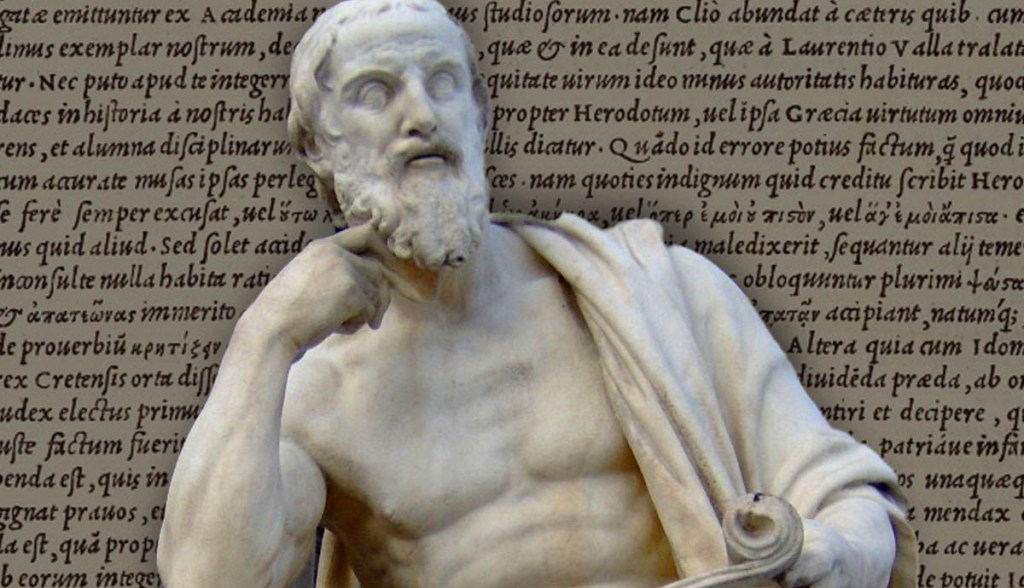
The phrase “irony of fate” is usually illustrated with the image of a sailor dying of thirst in the desert. Neat. Canonical. But as a mental exercise, one might try to find others, less obvious, less obedient. For instance, history has no grave for Herodotus, the very man whom Cicero, with the confidence of a Roman who knew how to assign paternity, called the father of history.
No tomb. No urn. No reliably identified city where he saw his last sunrise, or survived (or failed to survive) upto his final day. No one knows now. No one knew three hundred years ago. And judging by the silence, no one was particularly eager to know then either.
What remains are versions. Hypotheses. And the thick, practiced silence of old Hellas.
Thurii[1] gave him his second name, his last one, acquired while still alive. Yet, Thurii never returned the favour. No monument. No plaque. No modest column leaning into oblivion. Athens, meanwhile, built him something closer to a pedagogical complex. It was recommended for students who expected from the Lyceum not only rhetorical muscle but moral posture. Almost a museum. Almost a cult.
This asymmetry conveniently feeds the supporters of the so-called Periclean Scraper theory. According to them, Herodotus died not in some conveniently barbarian elsewhere, but in radiant Athens itself. Symbolic. Elegant. As the theory goes, he was removed along with other initiates into Pericles’ grand ideas by men who had begun to feel less like assets and more like liabilities. Or worse, witnesses.
We are not inclined to dignify such conjectures by reinforcing their place in history. Still less to supplement them with later interpolations produced by interested hands. These surface periodically in northern Aegean archives as lists or tables.
Yet one fact remains stubbornly intact. Herodotus was involved in the founding of Thurii.
A “common” colony, raised almost at the site of ancient Sybaris. Almost. Instead of theatrically restoring the legendary city of pleasures and refined excess (the Sybaris that gave its name to an entire philosophy of living), Thurii was assembled in haste, shoulder to shoulder with the ruins.
It was populated by Athenian volunteers, new settlers, descendants of Sybarites by blood or coincidence. Every day they walked through the ruins of yesterday. Every evening they returned to today. Dour, makeshift Thurii, assembled without taste or patience, it was like a punishment for former luxury.
The only unresolved detail was the addressee of that punishment.
Herodotus’ role in the final phase of Athenian democracy remains opaque. So opaque that one is tempted to suspect the opacity was the point. Too many moments in his biography coincide neatly with zones where documents stop leaving footprints. From fragments, partial transcripts, unsigned notes, and a couple of discreetly scraped tablets, the following version has been reconstructed. Its coherence is provisional. Responsibility for interpretation rests with the reader.
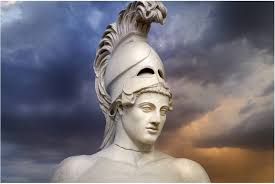
Pericles acted with the confidence of a mature servant of democracy. His concept of an external threat (Persia) was remarkably versatile. It justified emergencies, softened expansion, and wrapped ambition in collective security. The threat itself worked better than any actual invasion. While others clung to the marathon, Pericles spoke of the future. A unified alliance of poleis, decisions made swiftly, centrally, and preferably in his office.
In practice, matters were simpler. The democratic faction wanted more. Territory, tribute, votes in foreign councils. Everything else was rhetorical upholstery. Their opponents could read subtext too, so Pericles began by clearing the flanks at home. The Areopagus was “reformed,” officially. Thucydides and his circle were removed next, with minimal explanation and maximum finality.
In the end Pericles remained one of the ten Strategoi[2], exactly as the constitution prescribed. But he alone decided. The others attended meetings, signed when prompted, nodded often. Formally, it was a democracy. In reality, a political singularity noticed by everyone and addressed by no one, because addressing it would have required rewriting the rules.
Only then could the Idea of a greater Hellas[3] be carried beyond the sacred city.
Herodotus arrived in Athens the way one arrives when one’s biography has already begun to resemble the synopsis of a tragedy. Still negotiable, but increasingly reluctant to change genre. There had been an attempted coup in Halicarnassus. It failed, but failure in Athens was judged alongside the elegance of the leap itself. Exile followed. He sailed with the Athenian fleet. More excursion than service, but the checkbox mattered. What he brought back was not heroism so much as stories, trimmed, calibrated, arranged with care. Athens was perpetually hungry for narratives, especially those that began as personal experience and ended as matter of state.
Pericles learned of him long before shaking his hand. By their first meeting, Herodotus had already been tested in conversation, whetted at banquets, evaluated through third parties of both sexes and varying loyalties. When Pericles finally invited him, first informally, then into his office, Herodotus was already half-installed. They spoke like men who had been reading the same books for years and drawing incompatible conclusions. Herodotus offered careful directness, still marketable. Pericles listened, then made the small, economical gesture Athenians read fluently. This man would be allowed closer.
From that moment on, Herodotus ceased to be merely a gifted interlocutor and became part of the infrastructure. His notes were quietly reclassified as “auxiliary material for decision-making.” He began to appear at discussions of issues that officially did not exist, meetings without agendas, where unrecorded questions were discussed and ideas could not to be seen walking alone in daylight.
It was elegant. Herodotus believed he was being heard. Pericles ensured he was being used. Athens congratulated itself on the illusion of mutual benefit. In conversations with Pericles and those nearest to him, Herodotus eventually let slip two places that unsettled him by their scale, precision, and absolute dissimilarity to anything he had encountered among any monuments created by human.
It was an even octagonal platform, a night’s march east of Tyre, made of marble cracked by age, yet laid so carefully, and on such a foundation, that no one, however motivated, managed to pry out blocks or grind it down into reusable rubble. The vacant expanse, roughly the size of four Athenian quarters, stubbornly refused conversion into cheap building material. And also a pyramid sunk deep into sand, referred to as Shaytep by locals. Later it was imitated with scholarly enthusiasm by Egyptians who inherited the territory above it. Its accessible chambers suggested the scale of a ten-story palace, if such a structure could ever make sense as habitation. Immense, curiously pointless, poorly translated allegories, it had the same heavy geometry, the same sensation that it was not built for people.
The locals knew nothing. Those who called them tombs did not argue with those who believed them to be stations of the gods. But one detail struck Herodotus as well as Egyptians, Persians, border tribes – all speaking different tongues had the same conviction – structures like these existed elsewhere.
No one had seen them. No one had mapped them. Yet everyone “knew” they must be there. Drunken sailors’ tales from the inhospitable north. Evening stories about distant shores of the Pontus. No names. No coordinates. Only background noise, the shadow of something once called knowledge.
Then there was Lampon, a seer, a priest, an interpreter of higher meanings knew how to speak with the gods or at least how to simulate the effect convincingly. In Athens he was respected not as a person but as a function. He had a lifelong right to dine in the Prytaneion, where the Council of Five Hundred formalised the will of the people. Lampon had access without election as he was said to have authority delegated directly from the sky. His task was to ensure no decision passed that might anger Olympus. A dizzying appointment for a supervisor overseeing assemblies theoretically designed to lack any single supervisor.
Lampon stayed close to Pericles, intimately close. Either Pericles believed in signs, or he understood the value of myth and knew how to deploy it. The two are not mutually exclusive. On the square, the people saw a priest and heard a voice as to who stood behind that voice remained speculation.
It was almost certainly Lampon who conceived the idea, layered like honeyed pastry. He compiled all reports of megalithic structures, convened a council of moderately learned men to interpret them, dispatched colourfully dressed priests with sombre escorts to the empire’s edges. And made the big announcement.
Athens, the statement would go, had recovered forgotten pre-literate knowledge. The knowledge of how to turn piles of stone into defensive infrastructure. Or, with fewer syllables, a wonder-weapon. Against it, Persian arrows and anonymous triremes would amount to little more than wind in a vineyard.
Domestically, it was signal geometry. Parallelograms of fact intersecting triangles of legend, with the Athenian party standing at the centre beneath the slogan. We read stone better than anyone. Anyone asking unnecessary questions simply would not be invited to the next symposium.
Externally, it was never about hoisting a catapult atop a pyramid. It was about saturating every diplomatic front with a myth. Athenian hegemony was not merely foreign policy. It was access to ancient knowledge, to a power beyond imagination.
Beneath the ornamentation lay the real goal – to ensure recalcitrant polies[4] would arrive voluntarily, bread and butter in hand, at a confederation where Athens controlled the bread, the butter, and the ledger.
Pericles did not merely approve Lampon’s hypothesis. He sealed it with an official nod and an unofficial proceed until it smoked. Marketability mattered more than the truth. If more than three neighbouring poleis believed it, it would cease to be a local myth and begin to function.
Herodotus received two sets of instructions. The written one was to collect and systematise material on the Greco-Persian Wars. Paperwork for the Academy and the gullible. The oral one was simpler – to locate traces of the “ancients” across the edges of the oikoumene[5], and try not to damage them too badly while taking measurements.
What would be done with the material was not explained, not out of mistrust, but pragmatism. Knowledge without leverage becomes ballast. And Herodotus already carried enough weight — nobility. faith in democracy coupled with dependence on his own authorial voice. Throughout the expedition, whose geography we know in exhausting detail, he sent Lampon encrypted reports with exemplary regularity about the locations of structures of titanic scale and improbable forms.
The earliest reports were meticulous, almost embarrassingly enthusiastic. As if he were seeking revelation in massive forms. He analyzed slab placement, light behavior, hypothetical priestly processions, even the dietary preferences of imagined builders. But by the eighth object the style thinned. By the tenth it collapsed into two lines, as if the text itself had grown embarrassed.
Geodesy and geometry remained precise. His team continued to perform duties in full compliance with instructions and payroll. But metaphors vanished. Comparisons evaporated. The rhetoric crumbled. The stones remained. The words did not.
Lampon followed the change with mounting concern. Some blamed fatigue, barbarian cuisine, women insufficiently trained in Hellenic desire. But Lampon was not convinced.
Herodotus’ second arrival in Athens was calm, without excessive praise. His report to Lampon was scheduled without urgency, for the evening. The time when architecture becomes philosophy and political maneuvering turns into liturgy. This meeting has been reconstructed below as per the authors’ assumptions.
“We’ll pour the wine ourselves,” Lampon smiled. “So, did you bring us an oracle from the barbarians?”
“I did,” Herodotus said. “The oracle, and the barbarians.”
He did not elaborate.
Lampon pressed gently. Herodotus replied, almost apologetically. “I’m avoiding language. When you try to describe what was created outside description, you don’t move closer to understanding. You build a private labyrinth of words and find a sign reading Museum Closed.”
“At first there were words,” he admitted. “Epithets. Analogies. Cyclopean observatories. Celestial surgery. Shafts draining souls to Sirius. But these similarities are projection phantoms. My culture reflected onto something without a reflective surface.”
Lampon asked what changed.
“We see a monument like an unsolved equation and immediately insert familiar context,” Herodotus said. “Circle means cult. Twelve means zodiac. Stone means ancestors lacked better materials. And we’re satisfied because we’ve obtained an answer that stops thought. That isn’t research. It’s mental self-fertilization.”
“So you went looking for a different answer?”
“No. A different question.”
A pause, then. “If you want to understand a shadow, you don’t stare at the object. You examine the source of light. I looked at the invisible craftsmen. At the light they emitted so we could amuse ourselves by drafting plans in the shade of their buildings.”
“How do you encode emptiness?” he added. “The impulse faded. I accepted the emptiness as it was. And I began to write accordingly. As a witness, not an apologist.”
Then, unexpectedly clear, as though rehearsed to the point of premiere. “They caught the wind not for movement, but for taste.”
“That’s all?”
“I found not an explanation,” Herodotus said, “but an understanding. That if among the ancestors there was one whose mischief outweighed his fear, he said: let’s place the stones like this. By the stars. Or the other way around.”
“And others followed,” he continued. “Not because they understood, but because it felt exciting. Amusing. New. And it spread, like a fire no one meant to light, but everyone enjoyed feeding.”
Lampon pressed. “You reduce the work of titans to a game?”
“A game,” Herodotus shrugged. “Or play. Or fashion. Rituals without gods. I searched for depth where there was only the width of a moment. Sometimes a dolmen is just a dolmen. The imprint of laughter that has gone silent.”
Lampon looked inward, auditing the contents of his guest’s soul. He found no deceit. Herodotus had tried earnestly to assign cult and function to chaos. Each new structure replied: “No. Nothing. Calm down.”
By the tenth, the traveler had calmed down.
In practice, however, Thurii happened.
The initiative came from the democrats, formally from Pericles’ associates, informally perhaps from Pericles himself. Here the fog thickens. Was this merely bureaucratic arrhythmia, or the final phase of a longer operation? The sponsor colony’s paradox remained. It did not eclipse Sybaris. It multiplied despair by forcing a daily view of its ruins.
It was there that Herodotus acquired his enduring epithet, the Thurian. It was there, tradition says, that he unified his Histories, at least in the “recommended” reading. The sequence gently guides an inexperienced reader toward the conclusion that the author prioritised events that glorified Hellas. Everything before appears as clay, material to be kneaded into anonymous coating for tablets meant to record the “truly significant” milestones.
Later editors, we now know, divided the work into nine books. Another irony. A life devoted to weaving disparate accounts into a chain. Successors dismantled it into links, then displayed them in whichever sequence proved momentarily convenient.
For a time Athens mentioned Thurii only occasionally, as one recalls a long dinner with dull relatives. Then something occurred to pull Herodotus back into the field of managerial imagination.The answer is disarmingly prosaic.
The old man decided it was time. Not to die. To speak.
Publicly. Before an audience. With scrolls and a lectern, and that expression professional speakers wear just before and do you know what else? Publication was discussed. Workshops began calculating margins.
Word of this reached Lampon not as a fresh wind but as a warm exhalation of antique panic. Ready for readings was enough. He knew how easily Herodotus could forget the boundary between narration and confession when listened to attentively. The danger was not a direct accusation. Herodotus was no enemy. Far worse, he was a witness. In the vortex of his diegesis[6], scraps of geography, personal reflections, unapproved versions could be swept together. Everything Pericles had ordered to be formulated, but not pronounced.
The decision was swift. Herodotus was summoned to Athens. The pretext was patronage. A chair. An audience. A laurel wreath and a lifetime bust. Perfect timing. If there were readings, let them occur at the center of the world.
And on the way back, a stone, rain, a robber, a horse — the classic, well, age after all. In modern terms, something we would call prevention. The Greek lexicon offered a more refined word. Hygiene. If nothing else, the Hellenes knew how to keep a narrative clean. Thus, according to proponents of the Scraper theory, the true story of Herodotus ends. Pericles methodically erases associates from the commemorative board.
His work survived, though not without excisions, and the factual foundation thinned accordingly. Speculation about conjecture and truth continues to feed professional unmaskers.
Pericles never obtained his diplomatic wonder-weapon. No column trembled under an egregore’s vibration. Instead, two blocs of poleis emerged, welded by paranoia and ambition, and the Peloponnesian War followed. An internal conflict of unprecedented scale, like a culinary dispute between the two heads of a single serpent.
As if that were insufficient, a plague disembarked in the Piraeus — classical symptoms with a metaphysical aftertaste. Pericles himself exited through an emergency door politely opened by the Queen of Epidemics.
Lampon, however, seems to have drawn a different conclusion — divine retribution for attempting unauthorised access to the gods’ toy chest. He dissolved his name into topical comedies and administrative archives.
Time, as is well known, is not the enemy of knowledge, but its only victor.
The pyramids sink deeper each year, as if the earth were ashamed of their nakedness. Island statues once mistaken for fallen heroes increasingly resemble quirks of terrain. The blurrier the outline, the freer the hypothesis. The fewer the features, the louder the voices eager to explain.
Perhaps this is how history repaid Herodotus. Monuments built in the style of titans (?) simply fade just as the meaning of their existence once faded, just as Herodotus of Thurii himself faded, leaving behind only a controversial image.
Sometimes that is a form of immortality.
Sometimes, the only one.
.
[1] Ancient Greek city
[2] Greek military general
[3] Ancient name of Greece
[4] Ancient Greek city-states
[5] Civilized, the known or inhabited part of the world
[6] Narrative
Andriy Nivchuk is a Ukrainian-born author with a background in IT engineering. He spent fifteen years working as an artistic photographer in Paris and now lives in Ukraine.
PLEASE NOTE: ARTICLES CAN ONLY BE REPRODUCED IN OTHER SITES WITH DUE ACKNOWLEDGEMENT TO BORDERLESS JOURNAL
Bibliography
Herodotus (life, association with Thurii, traditional framing of the Histories)
Encyclopaedia Britannica: “Herodotus” (overview; biography and the tradition connecting him to Thurii; general context)
https://www.britannica.com/biography/Herodotus-Greek-historian
Cicero’s “father of history” attributionCroALa / Latin text of Cicero, De Legibus 1.5 (commonly cited locus for “Herodotus, father of history”)
https://croala.ffzg.unizg.hr/eklogai/capsa/cic-leg-1-5-1-9/
Thurii as an Athenian-backed “panhellenic/common” colony near Sybaris; Herodotus in the tradition of its founding
Encyclopaedia Britannica: “Thurii” (founding context; location near Sybaris; standard summary of the colony)
https://www.britannica.com/place/Thurii
Athenian political dynamics in the Periclean period (power consolidation as described by ancient biographical tradition)
Plutarch, Life of Pericles (ostracism of Thucydides son of Melesias; Pericles’ dominance in politics—useful for the political atmosphere the story draws on)
https://en.wikisource.org/wiki/Plutarch%27s_Lives_(Clough)/Life_of_Pericles
Areopagus “reform” and democratic reconfiguration (mid–5th century context)
Encyclopaedia Britannica: “Areopagus” (summary of the council and the traditional account of the curtailing of its powers)
https://www.britannica.com/topic/Areopagus-Greek-council
Athenian institutions referenced in the story (Council of Five Hundred; civic machinery)
Encyclopaedia Britannica: “Council of Five Hundred” (Boule; function and structure)
https://www.britannica.com/topic/Council-of-Five-Hundred-ancient-Greek-council
Click here to access the Borderless anthology, Monalisa No Longer Smiles
Click here to access Monalisa No Longer Smiles on Amazon International


 Borderless