Categories
Review

A Lyrical Love Song for Milkwood Trees

Book Review by Basudhara Roy

Title: A House of Rain and Snow

Author: Srijato, translated from the Bengali by Maharghya Chakraborty

Publisher: Penguin Random House

“I believe I would want nothing else if I am allowed to just think. If it were a real job, I would be the first to get it. The only problem then would be that I would have to think on someone else’s command. Now I am free to think whatever I want.”

A quiet tenderness beckons the reader to A House of Rain and Snow. The title suggests everything generous and hospitable. Once inside the cosy house of this novel set in days before the internet revolution, there is, indeed, no disappointment. A translation of Srijato’s[1] Prothom Mudran, Bhalobasha [2]from the original Bengali into English by Maharghya Chakraborty[3], the novel offers, on the face of it, a simple coming-of-age story but such simplicity is only deceptive. Churning within the novel’s agonised romantic spirit are vital interrogations of the relationship between life, living, and livelihood, art and the market, the value and significance of art to life, and the question of integrity in both.

A Künstlerroman[4] that primarily focuses on Pushkar’s journey from an aspiring poet to a published artist, the novel frames more narratives than one. There is the story of Pushkar’s parents – Abanish and Ishita, of his friends, Abhijit and Asmita, and that of his mentor, Gunjan (and Parama), each constituting a mirror of the narrative prism in which Pushkar, the reflected subject, kaleidoscopically understands himself and his journey better. But Pushkar is not alone. Journeying with him in spirit are Nirban and his circle of poet-friends, the girl he is in love with – Saheli, and his most cherished friend and ‘confession box’, the milkwood tree.

Where does art come from? For Srijato, art is not extraneous to life but intrinsic to the very fabric of living. Every character in the world of the novel needs art, in one form or another, to survive. Not everyone, however, can become an artist. This privilege and responsibility is offered to the chosen few — those who can step out of their self-obsessed private worlds to establish a sincere relationship with the wider currents of life. Pushkar, for instance, tells the milkwood tree:

“…solitude is entirely a relative thing, silence too. I cannot understand myself without the immense tumult of this city, that’s where my silence lies. Unless I am standing in this swiftly moving crowd, I cannot find any solitude.”

Art, as the novel seems to assert, cannot be born except within life’s chaotic womb. A house of rain and snow can only be a nursery, a protected locale to nurture vision and aspiration. For the artist to grow, an engagement with the wider world would be mandatory.

But how does one engage with the world? Would the world even be worth engaging with? Is art a means of engagement or retreat, activism or escapism? No clear-cut answers to these questions are possible but A House of Rain and Snow attempts, as all worthy stories do, to shine its own light upon them. The novel’s world is divided into two kinds of people — those who view art as an existential end and those who, like Parama or Sumit Dastidar, view it only as a means or an avenue to something else. Those who see art as an end in itself understand that commitment in art does not necessarily guarantee accomplishment. Neither does accomplishment guarantee material success. As an aspiring artist, one can only bring all of one’s life and living to art without expecting anything in return, the fact of journeying being the artist’s only receipt.

There is very little physical action here. The journeys in A House of Rain and Snow, as the reader will observe, are all psychological. Place and time are important coordinates in this movement. The city of Kolkata emerges evocatively as inspiration and muse, its descriptions exuding a clear eye for detail, a deep sense of cultural nostalgia, a delineation of not just place but of spirit, and a documentation of the city’s multifarious, shapeshifting life — its strength, tenacity, and bustling beauty. Concrete yet shapeless, definite yet blurred, prosaic yet poetic, the city firmly anchors this novel as both stage and ship, contouring its artists’ perspectives on life and art.

The idea of time, in the novel, is as fluid as that of space. There is the constant sense, awareness, and reminder of its passage and yet, in Srijato’s fictional world, time refuses to be linear with the past, present, and future merging frequently through hallucination, dream and memory:

“Today, Gunjan notices the newspaper, he has never seen one in the moonlight. He bends over to pick it up from the mosaic floor gleaming under the light of the moon and, instead of the paper, comes back up with a tiny doll that had fallen on the ground a little while ago. A little more than seven years, to be precise.”

There is a strong visual quality about Srijato’s writing, intricately woven cinematographic effects which, had they been of any significance to the plot, might have amounted to magic realism. But being strictly organisational and descriptive in function, this cinematic quality is instrumental to the novel in other ways — it insulates the narrative from realism, liberates it from answerability to everyday logic, defamiliarises the familiar, and renders the strange intimate. Most importantly, it creates a surrealist impression, reminding us of all that remains constant in our consciousness in the most bizarre of circumstances, and manifests itself in the novel as an artist’s specialised and idiosyncratic way of relating to the world. Examine the windows of rain and snow, for instance:

“No one other than Pushkar knows about this, neither does he wish to tell anyone. There are two windows in his room, side by side, one almost touching the other. Outside one of them it rains the entire day and snows throughout outside the other. On the days this happens, Pushkar finds himself unable to leave the house.”

It is worth noting that it is not Pushkar alone who has such experiences. Other characters like Abanish and Gunjan also experience such strange reconfigurations of time and space — expansion, compression, repetition, alternation, all of which can be interpreted at a symbolic level.

Surcharged with intense lyrical passages, A House of Rain and Snow is quintessentially an exploration of the aching need for art in life. Life, in the pages of the novel, is almost unliveable without the solace of art. Art, in turn, can be born only out of love, the kind of love that Pushkar can extend to the milkwood tree and the world around him:

“He, Pushkar, is in love. A little too much, with everything. …Why, he is not sure. How, he is not sure either. All he knows is that at this very moment, it is love that is becoming his language, his constant recourse. Love. Not just for the people close to him or his writings or his own life. Love for everything. Everything happening around him at this moment, the moving earth, every incident everywhere in the world, the forests, the oceans, the mountains, the plains, the cities, the sky, even the vast outer space beyond earth.”

The translation wonderfully captures the linguistic nuances of Bengali in the English language, its semantic eccentricities, syntactic pace, and its lush images, making the novel a rich and rewarding read. A number of images linger steadily in the reader’s mind long after the book has been read – a tall, wet milkwood tree, an idol-maker shaping a goddess out of clay, and a young boy lifting his exhausted father on his palm.

.

Click here to read an excerpt.

[1] Srijato, one of the most celebrated Bengali poet-lyricists of our times, is the recipient of Ananda Puroskar in 2004 for his book Udanta Sawb Joker (All Those Flying Jokers).

[2] Literal translation from Bengali: First Gesture of Love

[3] Maharghya Chakraborty is a well-known translator. He teaches at St Xavier’s College in Kolkata.

[4] A coming-of-age novel about an artists

Basudhara Roy teaches English at Karim City College affiliated to Kolhan University, Chaibasa. Author of three collections of poems, her latest work has been featured in EPW, The Pine Cone Review, Live Wire, Lucy Writers Platform, Setu and The Aleph Review among others. 

.

PLEASE NOTE: ARTICLES CAN ONLY BE REPRODUCED IN OTHER SITES WITH DUE ACKNOWLEDGEMENT TO BORDERLESS JOURNAL

Click here to access the Borderless anthology, Monalisa No Longer Smiles

Click here to access Monalisa No Longer Smiles on Kindle Amazon International

Categories
Review

Anime Novel Comes of Age

Book Review by Aditi Yadav

Title: She and Her Cat

Author: Makoto Shinkai and Naruki Nagakawa

Translator: Ginny Tapley Takemori

Publisher: Penguin Random House

Makoto Shinkai is a giant in the world of anime. His animated movie Kimi no Nawa (Your Name) garnered worldwide critical acclaim and commercial success. He is often hailed as the ‘next Miyazaki’ in the world of animation.  His first work as a director was a five-minute long monochrome Japanese animation movie titled Kanojo to Kanojo no Neko (She and her cat) released in 1999 which won grand prize the DoGA CG Animation Contest in 2000. In 2013, Shinkai along with Nagakawa wrote a novel under the same name, whose English translation, She and Her Cat, was released in 2022.

The novel narrates four interwoven sub-plots involving four females and their feline companions.  Shinkai weaves a rich tapestry which plays out like a movie capturing a wide spectrum of colours, sounds and emotions. The cats appear more caring and observant about their humans, while the latter often seem indifferent or distant. Nevertheless, they give each other support and much needed warmth of life.

The novels starts on a rainy day in spring, when Miyu happens to find an orphaned kitten in a carton. A chance encounter or a fated one, either way, they discover each other on a depressing spring day with dripping skies. Notwithstanding the crestfallen  hearts and morose weather, the blossom of a soulful bond springs to life.

There is a cryptic hint of shared melancholy as the kitten remarks “… her hair and my fur were heavy from the rain.” It’s like one sad heart recognising the other and finding inexplicable comfort and sense of belonging as it feels, “I was now her cat.”

Miyu names him Chobi. The novels voices alternately between felines and humans, as we get to see their respective worlds in the narration.

Chobi is a restless fur ball as he skips about in animated action to catch Miyu’s attention; and watches her all day long as she cooks, sings, washes laundry, wears makeup, and so on. He is happy in a warm, cozy world where he is cared for. He thinks of Miyu as his ‘grown-up girlfriend’. In contrast, the owner doesn’t think of it as any life changing experience. But subconsciously, she begins to change, without a trace of conscious awareness.

While Chobi goes around the neighbourhood, he makes friends with other animals. He shares an endearing relationship with an old dog named Jon. Jon has the demeanour of a stately guardian. His encouragement uplifts Chobi’s spirit making him feel a part of the world. He has interesting tales to shares about life, cosmos and philosophy. Chobi opens his heart to Jon wishing to ‘fill the gap’ in Miyu’s heart. 

Chobi also befriends a white chirpy cat. She discovers an ‘awesome’ human named Reina who doesn’t shoo her away as a stray cat. Instead, she feeds her and names her Mimi.  Reina studies art at the technical college where Miyu is an administrative officer. Mimi notices how passionate Reina is about painting and sketching and how ‘weird’ she smells –- of paints, spices, alcohol, perfume and tobacco. Despite being talented she is struggling to find her footing in the world of growp-ups.

Mimi brings back memories of the cat she owned during high school. While the adults around the adolescent Reina were critical of her talent, her feline companion gazed at her paintings with fascination. The cat’s innocent gesture had the warmth of sunshine in the winter of her troubles. Reina has a resilient personality. As Mimi was an abandoned frail kitten, she finds strength in Reina’s optimism, independence and self-confidence. There is a mutual bond that serves to fill the vacuum inside them.  

The story saunters along the neighbourhood detailing various encounters between humans and animals.

Cookie, Mimi’s kitten gets adopted by Aoi’s family. Aoi is a chronically sad girl because she carries an emotional scar in her heart. Cookie notices that permanent sadness around her and wants her to get better. As they live together, the little feral companion, thaws the frigidness inside her.

The non-human characters often give deep insights into the human world… “no human is always strong, but then no human is weak forever, either.”

Kuro, a fat old cat isn’t scared of his own death, but worried that his owner Shino would have a tough time after he departs, as he says, “humans are really frightened of death…not just of their won deaths, but of those of us dogs and cats too.” While Jon, the dog, claims he’d become eternal when he dies.

The book begins with on a wet spring and winds its way through the sound of summer cicadas and the winter snow, through life and death, to reach a bright scenery of cheerful cherry blossoms.  

Shinkai paints a multi-layered world through the eyes of humans, cats and dogs, which comes alive in Takemori’s lucid translation. It is a heartwarming and uplifting read that moves like a ‘slice-of-life’ anime and reminds you of reasons to be grateful for this life as Chobi concludes, “I love this world…with absolute clarity”.

.

Aditi Yadav is a public servant from India. She is also a South Asia Speaks fellow (2023). Her works have appeared in Rain Taxi Review of books, Mint Lounge Magazine, EKL review, Usawa Literary Review, Gulmohur Quarterly, Narrow Road Journal, Borderless Journal and the Remnant Archive

PLEASE NOTE: ARTICLES CAN ONLY BE REPRODUCED IN OTHER SITES WITH DUE ACKNOWLEDGEMENT TO BORDERLESS JOURNAL

Click here to access the Borderless anthology, Monalisa No Longer Smiles

Click here to access Monalisa No Longer Smiles on Kindle Amazon International

Categories
Review

Anthem of Hope

Review by Basudhara Roy

Title: Greening the Earth: A Global Anthology of Poetry

Editors: K. Satchidanandan and Nishi Chawla

Publisher: Penguin Random House

At a time when apocalyptic unease about the precarity of our home on this planet grips us as a civilisation and is concomitantly coupled with the irremediable apathy that governs our everyday mundanity, a collection of poems on the subject by some of the finest poets from around the world writing in our times, is both an existential alarm of urgency and a spiritual balm that soothes our despondency enough to spur us to action. Greening the Earth: A Global Anthology of Poetry edited by K. Satchidanandan and Nishi Chawla, and recently brought out by Penguin Random House is, as its editors point out, an act of “responsible activism”.

A tonal sequel to Singing in the Dark, their first co-edited anthology of poems around the pandemic which had already foregrounded nature’s clear vengeance against human greed, this collection attempts to grapple with the more sinister and nemetic darkness of environmental crises by establishing a dialogic space for the affirmation of ecological citizenry through poetry and “the articulation of a new aesthetic of survival”.

Poetry has, always and undeniably, been at the forefront of every revolution and the reasons for this are not hard to seek. Out of the circuit of formal epistemology, poetry has mostly been free to encode and perform alternative knowledges. The language of poetry, being generically unanswerable to established patterns of syntax and semantics, has been, historically, at liberty to pursue and present its own ensemble of meaning. Again, just as poetry, dispensing with literacy and formal training, has offered little resistance or discouragement to potential creators, it has also always been widely accessible to the general public owing to its capacity for oral dissemination and circulation in minor media such as notes, letters, greeting cards, placards and advertisements.

But poetry’s chief merit, most significantly, lies in its ability to accomplish a multifaceted and compound expression encompassing reality and possibility, facticity and vision, statistics and emotions. To declare in editorial essays or news reports that the world is coming to an end is one thing, to express its consequences in poetry is something else. Ecological poetry or ecopoetry has been on the scene for a considerable period of time now. An extension or intensification of the genre of nature poetry, ecological poetry evinces a keen political and activist consciousness geared to fight back the environmental crisis through determined human effort. Integrating perspective, observation, information, emotion, vision and testimony, ecopoetry attempts to establish a deeply personal relationship between man and nature underlining, thereby, their indispensability to each other’s survival.

Greening the Earth with its staggering set of around a hundred and eighty-five poets and poems from across the world, offers us an essentially global anthem of hope. The planet cannot be greened by afforestation alone. Greening the planet requires a systemic reconstruction of our relationship with it that envisages love, responsibility and sustainability. It is a recognition of  nature’s intrinsic worth beyond her instrumental value and the fierce acknowledgement of the inextricability of the two.

A walk through the anthology is an immensely moving and personal tour through innumerable poetic moods and ecotopes, our teeming biodiversity, and our shared vulnerability as inhabitants of the cosmos. At the heart of each of these astonishingly diverse and beautiful poems is a sense of kinship to a wider and infinitely unknown world, an awareness of the mutability of life-forms within the unmapped continuity of time, a strong condemnation of human selfishness and myopia, and a more-than strong suspicion of the imminent end of humanity.

At the same time, here is also the urgent and extraordinary tenderness that arrives only with the knowledge of transience and the prophecy of loss. If life and the world are to be lost to us as a species, there will never be time enough to dwell on all that we love. Each of these poems is, therefore, also about love – love not merely for the natural world but for every little thing that holds up our lives and which we have been taught to discount as inessential or marginal in our daily drive to build a living.

Greening the Earth, thus, advocates a different ontological ethics – one that calls for wide inclusiveness, greater mindfulness, minute attention, and an adjustment to the flow of time around us instead of attempting to govern this flow. It embodies an intense desire to reverse the cycle of alienated technological growth and to revert to an era of deep feeling and conscious interconnectedness. Here is joy, agony, grief, fear, beauty, despair, isolation, and community but most significantly, here is the possibility of building both ourselves and the world anew through searching self-analysis.

In ‘Signs and Wonders’, Paul Hoover sketches a barren civilization which can be revived only when “a child will write them back into existence,/one branch at a time”. Toi Derricotte’s ‘Unburying the Bird’, similarly, is a deeply moving poem about bird deaths “because of too much/ something” and yet, the poem’s onus is on resurrection rather than on accusation:

Feed her from the tip of your finger.
Teach her the cup of your hand.
You breathe on her.
One day,
you open up your hand
and show her sky.

The recognition of the human as one insignificant dot within the immensity of the universe marks many of these poems. Sarah Key’s ‘Ode to the Scarce Yellow Sally Stonefly’ is one among several poems where humans are treated as textual equals with other species. The poem pays tribute to a critically endangered variety of the stonefly that was rediscovered in the United Kingdom after a period of twenty-two years owing to the efforts of conservation biologists like John Davy-Bowker. After eight stanzas of describing the stonefly, its disappearance, and its rediscovery, the poem in its final stanza, deftly but unassumingly, turns to the larger and logical picture – the extinction of homo sapiens from the planet:

Tell me, flighty friends, will there be
A Mr. Davy-Bowker for me?
Will some AI god come along, algorithm my scent,
go where my species has gone?

Rochelle Potkar’s ‘Confluence’ raises concern regarding the legal personhood and rights of our natural environment. Embodying the spirit of the ‘Rights of Nature’ movement that believes in the right of every ecosystem to flourish without victimisation by humans, the poem makes a strong case for the rights of water bodies which are relentlessly drained, contaminated, and exploited by human activities, its opening line being highly potent in its irony:

Waters when they evaporate, meet…
at a global conference, to speak of fish dropouts,
obscura of clouds, near-deaths, hydrological dynamics,
monocultures, and metals:
nickel, lead, chromium, at their beds.

The constant awareness of despair and inertia runs in a large number of poems as in Michael Cope’s ‘We Watch the Signs’ where the awareness of danger leads to numbness rather than action, the first and third lines of this first stanza being a constant refrain throughout the poem:

We watch the signs in numbness and regret.
Midwinter summer, chaos in the year,
And still our money’s on the outside bet.

David Ebenbach’s ‘Viaduct Greene’ eloquently traces the possibilities of companionship in a posthuman world – a date through “this expanse of soda bottles and human waste” when “a subway dies and you make it a garden.” In Meg Eden’s ‘Scene of a Dismantled Village outside Pripyat’, “The forest has become/ a radioactive living room.” Humans are absent from this scene altogether, their “heirloom china,/ covering the forest floor!” Animals have taken over:

Inside one cup, a chipmunk
makes its home. Inside another,
a spider breeds. Soon, her eggs
will hatch and from where
there was one body, there will be
thousands. Think about that –
something still lives after all of this. 

‘Lakeside Walks’ by Arvind Krishna Mehrotra is, entirely, an exercise in mindful perception, the poetic consciousness establishing itself as intimately one with its immediate environment. Here rain, squirrel, friend, four-lane highway, letter, piebald cow, pinwheel flower, poem, face mask, mynah and park bench are all emotive equals drawing the poet’s attention “aimlessly, which is the same as purposefully”, articulating thereby an intense ecopoetic vision of connection and harmony. 

What makes the book a trifle inconvenient to handle is the absence of a table of contents so that attempting to look up a specific poem in this anthology becomes entirely a matter of labour, memory, and chance. Its Preface, however, constitutes a comprehensive and well-researched essay on ecological consciousness in literature and will be an appreciable resource for readers in general and those with special interest in ecocriticism. What is also valuable about this anthology is its inclusion of poems in translation from a wide variety of global languages.

With a memorable green cover showcasing an opulent spread of maple leaves, here is a body of poems intended to woo us to an earth-centric view of life and the world, and as Rainer Maria Gassen writes here in his poem ‘To Nature – Three Sonnets’, “should this poem fail to win you over/ there’ll be hundreds if not thousands more of them.”

Basudhara Roy teaches English at Karim City College affiliated to Kolhan University, Chaibasa. Author of three collections of poems, her latest work has been featured in EPW, The Pine Cone Review, Live Wire, Lucy Writers Platform, Setu and The Aleph Review among others. 

.

PLEASE NOTE: ARTICLES CAN ONLY BE REPRODUCED IN OTHER SITES WITH DUE ACKNOWLEDGEMENT TO BORDERLESS JOURNAL

Click here to access the Borderless anthology, Monalisa No Longer Smiles

Click here to access Monalisa No Longer Smiles on Kindle Amazon International
Categories
Excerpt

Greening the Earth

Title: Greening the Earth: A Global Anthology of Poems

Editors: K. Satchidanandan & Nishi Chawla

Publisher: Penguin Random House

Preface

Humanity’s power to degrade the environment has become unprecedentedly dangerous. In fact, we have already changed the environment irreversibly, and suicidally so. What we call nature is no longer nature in its pristine glory. Human intervention has transformed it into something sub- rather than semi-human: a combination of climate, topography, the original environment and the effects of the long history of human intervention. If it was agriculture that had transformed the landscape once, it is now urbanization that has affected the broader areas of our environment. Managing the environment is becoming a practical rather than a theoretical problem. It is not enough that we create theme parks or conserve a select few areas. ‘Museumizing’ nature and landscape will not be enough. Several animals and birds are on the verge of extinction; the list is growing, and human beings can easily be next in the at-risk list. What we require today is not isolated action, but concerted action at the global level. Techno- fascism that leads to eco-fascism—both have their roots in human greed and aggression—is one of the inevitable fall-outs of blind and unsustainable patterns of development.

While a few poems in this anthology offer a perspective on how humans can respond to the reality of extinction, others give us an awareness of how we can struggle to keep what we still have. Some poems share earnest insights into our own evolution, and others offer grim warnings or raise voices against the imminent threat of extinction and the fate of our planet. Some poets spin interconnected incantations and weave healing nature through their blood, and others honor it by connecting the sustainable with their personal poetic bones. The environmental theme of most poems can inspire meditation as well as a commitment to apocalyptic action. The poets anthologized here offer landscapes of beauty and joy, of rustic retreat, of communion with our natural world, against the larger looming questions of human survival, of spurring towards conservation and preservation, of recognizing our ancestral knowledge, of a complicated pact and a complex impact. The anthology, in short, is our kind of shock tactic to the glaring lacunae within our urbanized, post-industrial society. What distinguishes us further, is that our anthology is a global chorus of poetic voices. We cannot stress enough the ‘sustainable’ route felt in the ‘sustainable’ poetic voices of our anthology. Along with our conscious eco warrior poets, Greening the Earth is our kind of responsible activism.

Extinction

Maren Bodenstein

here

on the prairie we measure

the years

by the extinction of insects

that visit our porch lamps

the brittle

longhorn is gone

for a while now the giant

stick insect no longer flares its scarlet wings even

the bluewhite chafers have succumbed

to the heat

by day we dwell in the creek

my sisters and I

one of us pregnant

but I keep forgetting

if it is me

look I am full term now

I tell them stroking my flat belly

on the horizon

a fire roars

through the grasses and over

the houses it marches

the last army of insects

into the bellies of storks

a confusion of vehicles

full of belongings flees

towards us

Ma in her car

with the poodle

comes rushing at us

get in she shouts

misses the bridge

plunges deep

we must rescue her

I tug at the metal

but my sisters

heavy with chatter

do not hear

Ma broken mermaid sneezes

opens her blue-eyes

happy

to see me

Beholden

Erin Holtz Braeckman

I come to you as Crow. But not before you first come to me. My bones are left like tinder in the dark ashes of my feathers when you find them. Crouching low in the crisp clutch of Spring the way the grandmothers once did, you speak words of ritual from the cave of folk memory you’ve walked right into without knowing. And you ask—before you hear my totem call from the pines high overhead; you ask before you slip one of my bones into your pocket. Because wrapped inside the song of that old teaching circle you stepped within was this telling: what you collect, you become the caretaker of. Not the thing itself, but its living story. Those crystals on your altar? You are the steward of their mountains. Those shells lining your windowsill? You are the custodian of their oceans. The pressed petals and dried acorns and vials of sand—the bones; in them there are entire fields and forests and feral ones of whom you are a curator. Which is why I come to you this time, a cackle-caw of shade-shifters stalking through your sister spruces. The others fly when you near, leaving me below in the corner fencing, the wing you took the bone from a tangle of black shadow throwing back the light. I feel the moment you are beholden, Crow-Keeper; how you fold the wild beating of my body into your hands, placing me like a stone on a cairn into the bracken beyond; how those grandmothers come to braid feathers into your hair.

(Excerpted from Greening the Earth: A global Anthology of Poetry, Penguin Random House)

About the Book:

Greening the Earth is a rare anthology that brings together global poetic responses to one of the major crises faced by humanity in our time: environmental degradation and the threat it poses to the very survival of the human species. Poets from across the world respond here in their diverse voices-of anger, despair, and empathy-to the present ecological damage prompted by human greed, pray for the re-greening of our little planet and celebrate a possible future where we live in harmony with every form of creation.

Editors:

K. Satchidanandan is a leading Indian poet He is also perhaps the most translated of contemporary Indian poets, having 32 collections of translation in 19 languages, including Arabic, Chinese, Japanese, English, Irish, French, German and Italian, besides all the major Indian languages. He has 24 collections of poetry, four books of travel, a full length play and a collection of one-act plays, two books for children and several collections of critical essays, including five books in English on Indian literature besides several collections of world poetry in translation. He has been a Professor of English, and also the chief executive of the Sahitya Akademi, the Director of the School of Translation Studies, Indira Gandhi Open University, Delhi and National Fellow, Indian Institute of Advanced Study, Shimla. He is a Fellow of the Kerala Sahitya Akademi and has won 52 literary awards from different states and countries, including the Sahitya Akademi award, India-Poland Friendship Medal from the Government of Poland, Knighthood from the Government of Italy and World Prize for Poetry for Peace from the Government of the UAE. His recent collections in English include While I WriteMisplaced Objects and Other PoemsThe Missing RibCollected Poems, Not Only the OceansQuestions from the Dead and The Whispering Tree: Poems of Love and Longing.

Nishi Chawla is an academician and a writer. She has six collections of poetry, nine plays, two screenplays and two novels to her credit. Nishi Chawla holds a Ph. D. in English from The George Washington University, Washington, D.C. USA. After teaching for nearly twenty years as a tenured Professor of English at Delhi University, India, she had migrated with her family to a suburb of Washington D.C. She has taught at the University of Maryland from 1999 until 2014. She is now on the faculty of Thomas Edison State University, New Jersey, USA. Nishi Chawla’s plays get staged both in the USA and in India.

PLEASE NOTE: ARTICLES CAN ONLY BE REPRODUCED IN OTHER SITES WITH DUE ACKNOWLEDGEMENT TO BORDERLESS JOURNAL

Click here to access the Borderless anthology, Monalisa No Longer Smiles

Click here to access Monalisa No Longer Smiles on Kindle Amazon International

Categories
Excerpt

Tagore’s Last Birthday Celebration

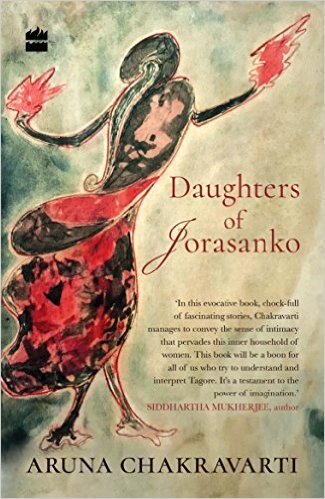
Title: Daughters of Jorasanko

Author: Aruna Chakravarti

Publisher: HarperCollins India

The twenty-fifth day of Baisakh dawned. A hot airless day when not a leaf stirred in the trees and the red earth burned like smouldering coals. Rabindranath was taken to the southern veranda in the morning as usual but he lay in his armchair so listless, so drained of energy, Nandita realized that something was wrong. ‘Let me take you back to bed, Dadamoshai,’ she said. ‘You had better rest the whole day and reserve your strength for the evening. The students have organized a programme for your birthday.’

‘I know.’ Rabindranath nodded. ‘I mustn’t disappoint the children. But I would like to give them something in return. Fetch a pen and paper. Closing his eyes, he sang slowly in an old man’s quavering voice. He nutan/dekha dek aar baar janmer pratham shubhokshan:

Oh ever new! 
Let my eyes behold once more 
the first blessed moment of birth.

Reveal yourself like the sun 
melting the mists that shroud it.

Reveal yourself
tearing in two the arid empty breast. 
Proclaim the victory of life.

Give voice to the voiceless that dwells within you; 
the eternal wonder of the Infinite.

From emerging horizons conches blow; 
resonating in my heart. 
Oh callout to the ever new! 
Twenty-fifth of Baisakh!

Rabindranath lay on his bed all day breathing heavily, the heat sapping his strength. He felt so exhausted that even to lift an arm or keep his eyes open was an effort. He could sense the activity that was going on around him. People were coming from far and near with gifts of flowers and fruit. They begged for a glimpse of him but he, who had never refused to meet anybody in his life, now lacked the energy to do so.

He felt a little better towards the evening when the heat of the day had dissipated and a cool breeze started to blow from the khowai. Then at dusk, Nandita came in. ‘Get up, Dadamoshai,’ she ‘ said brusquely. ‘You’ve rested long enough. Time to get dressed.’

Rabindranath sat up meekly and allowed her to put on him his birthday garments of silk dhuti and chador. He didn’t object even when she adorned his brow with sandal paste and hung a garland of fragrant juin flowers around his neck. But when Protima came in with a bowl of fruit he couldn’t stand the smell. ‘Not now, Bouma.’ He shook his head, ‘I’m not hungry.’

Protima wouldn’t go away. ‘You’ve hardly eaten anything today,’ she said firmly. Have a few pieces of mango. It’s your favourite himsagar. Prashanta brought a basketful.’

Lacking the strength to protest, he put a small piece in his mouth and shuddered with distaste. ‘The good days are gone, Bouma,’ he said sadly. ‘Else why does the king of fruits taste bitter in my mouth?’

‘But even last season you were eating five or six a day!’

‘I know.’ He smiled. ‘That is why I say the good days are gone.’

(Excerpted from Daughters of Jorasanko by Aruna Chakravarti, published by HarperCollins India)

About the Book:

The Tagore household is falling apart. Rabindranath cannot shake off the disquiet in his heart after the death of his wife Mrinalini. Happiness and well-being elude him. His daughters and daughter-in-law struggle hard to cope with incompatible marriages, ill health and the stigma of childlessness. The extended family of Jorasanko is steeped in debt and there is talk of mortgaging one of the houses. Even as Rabindranath deals with his own financial problems and strives hard to keep his dream of Santiniketan alive, news reaches him that he has been awarded the Nobel Prize for literature. Will this be a turning point for the man, his family and their much-celebrated home?
Daughters of Jorasanko, sequel to the bestselling novel, Jorasanko, explores Rabindranath Tagore’s engagement with the freedom movement and his vision for holistic education, brings alive his latter-day muses Ranu Adhikari and Victoria Ocampo and maps the histories of the Tagore women, even as it describes the twilight years in the life of one of the greatest luminaries of our times and the end of an epoch in the history of Bengal.

About the author:

Aruna Chakravarti  has been Principal of a prestigious Women’s College of Delhi University for ten years. She is also a well-known academic, creative writer and translator with seventeen published books on record. They comprise five novels, two books of short stories, two academic works and eight volumes of translation. Her first novel The Inheritors (published by Penguin Random House) was shortlisted for the Commonwealth Writers’ Prize and her second, Jorasanko (published by HarperCollins India)received critical acclaim and also became a best seller. Daughters of Jorasanko, a sequel to Jorasanko, (HarperCollins India) has sold widely and received rave reviews.Her novel Suralakshmi Villa, published by Pan Macmillan Ltd under the Picador imprint, has been adjudged “Novel of the year (India 2020)” by Indian Bibliography published in The Journal of Commonwealth Literature U.K. Her latest work, The Mendicant Prince, a semi-fictional account of the Bhawal legal case, was released by Pan Macmillan Ltd, in July this year to widespread media coverage and acclaim. Her second book of short stories Through a Looking Glass: Stories has just been released by Om International Ltd.

Her translated works include an anthology of songs from Rabindranath Tagore’s Gitabitaan, Sarat Chandra Chattopadhyay’s Srikanta and Sunil Gangopadhyay’s Those Days, First Light and Primal Woman: Stories. Among the various awards she has received are Vaitalik Award, Sahitya Akademi Award and Sarat Puraskar.

She is also a script writer and producer of seven multi- media presentations based on her novels. Comprising dramatised readings interspersed with songs and accompanied by a visual presentation by professional artists and singers, these programmes have been widely acclaimed and performed in many parts of India and abroad.

.

PLEASE NOTE: ARTICLES CAN ONLY BE REPRODUCED IN OTHER SITES WITH DUE ACKNOWLEDGEMENT TO BORDERLESS JOURNAL

Click here to access the Borderless anthology, Monalisa No Longer Smiles

Click here to access Monalisa No Longer Smiles on Kindle Amazon International

Categories
Review

Explaining Life Through Evolution 

Book Review by Bhaskar  Parichha

Title: Explaining Life Through Evolution 

Author: Prosanta Chakrabarty

Publisher: Penguin Random House

Evolutionary biology is a branch of biology that deals with the processes responsible for the evolution and diversity of life on earth. From the very first ancestor to all life on earth to the very first modern human ancestor, a lot of questions remain answered. The emergence of related fields like genetics and specialised tools like radiocarbon dating has enabled scientists and evolutionary biologists to put together a clearer picture of how life would have probably evolved.

Explaining Life Through Evolution by Prosanta Chakrabarty opens a window to four billion years of eight million species that we see on this planet. It not only adds to existing literature but also gives straight answers to straight questions on the evolution of life on earth. Indeed, it is an unputdownable book that explains life. 

Chakrabarty is an evolutionary biologist at Louisiana State University where he is a professor and curator. A Senior Fellow at TED, a Fulbright Distinguished Chair, and a Fellow of the American Association for the Advancement of Science, this is his first and indeed a great work. 

The schema of the book is clear: it does not simply narrate the story of evolution; it is more than about where we came from. It brings to light who we are. As humans, we logically focus more on identifying differences between us; no matter how small they are. Chakrabarty demystifies the notion to emphasise our similarities with each other than many of us are willing to believe.

As more and more people take ancestry tests, sending their DNA samples and money to genealogy testing centres, Chakrabarty says, we need to be educated on what the results actually mean, scientifically; and we all have to decide together what it means socially. We should be celebrating the fact that this diversity comes from the same little drops of water and sunlight, each just shining a little differently. Like all species, we are defined by our differences as much as by our similarities.

He begins the book by saying: “There is a beautiful Sanskrit word, ‘ayurveda’ that translates in English to the science of life. Although generally relating to human health or homeopathic medicine, I’d like to see the shift of the usage of ayurveda to its literal translation as perhaps an enlightened synonym of biology, élan vital or perhaps of evolution. It is a term that makes me think of how words and phrases can have different meanings for different people and how words too can evolve. Even the word evolution’ evolved in Charles Darwin’s time from a meaning closer to development (in the sense of a developing embryo) to its current definition, essentially the accumulation of heritable changes in organisms that can lead to the formation of new species from ancestral forms.” 

He goes on: “Interestingly, Darwin and others instead used the now obsolete word transmutation, which then meant something closer to our current definition of ‘evolution. Over time, the meanings of words can change, but previous usages remain part of their history, just like species can retain the historical features of their ancestors. Except in biology, modifications often lead to entirely new species, so perhaps if we changed ‘ayurveda’ to ‘ayurvedology’ we’d have a better fit with the evolution analogy.”

Through this intelligent and aptly illustrated book, Chakrabarty encourages us to think of life which is always in the making.  If we look at the eight million species with who  we share this planet, we have to imagine them all as having evolved over four billion years. They’re all the product of that fruition. Visualise all as young leaves on this ancient and gigantic tree of life and we will appreciate that all of us are connected by invisible branches not just to each other, but to our extinct relatives and our evolutionary ancestors.

Divided into four parts (‘A Personal Prologue’, ‘The Evolution Revolution’, ‘Questions and Misconceptions’ and ‘Why Understanding Evolution Matters’), this book — all of the 230 pages– is a reader’s delight. Chakrabarty weaves his lived experiences into this poignant discussion on evolution, covering key concepts that are vital to the understanding of current conditions like change and natural selection. 

If it is important for any book on evolutionary biology to discuss how the discipline has been misused to puff up socially constructed categories like gender, Chakrabarty does that with precision. 

The glowing analysis sheds light on the problems with historical and present-day interpretations of evolution while enlightening us about those who work at the cutting edges of the field. Another important feature of the book is that it guides us through viral pandemics and social change, and provides the three R’s[1] to enable us to work together toward a thriving future.

Somewhere in the book Chakrabarty differentiates between science and religion. “Science is about observing and testing natural phenomena in order to give a reasoned, evidence-based explanation for those events. Religion, on the other hand, can provide answers to questions science doesn’t cover (e.g., what is the meaning of life?) but it can also provide answers that can’t always be tested. For instance, let’s say your answer to why apples drop to the ground when they fall out of a tree is ‘God made it happen’; that isn’t something I can prove false, because I can’t test it. There isn’t room for questioning things or scientific inquiry if you believe flatly that ‘God controls everything that happens’.” 

He further points out the pitfalls of deep-seated religious conviction in the present-day world: “The other problem with teaching religion in a science class is that there are many religions with a variety of beliefs. Faith-based beliefs about creation differ by your religious persuasion. In one version of the Hindu creation myth, the Earth was part of the lotus flower that grew from the navel of Vishnu, and then the world was populated by Brahma and will be destroyed by Shiva. If l taught that version of creation as the truth in my science class, [I] wouldn’t last very long as a teacher. However, maybe this religious take would do well in the so-called ‘Indian Science Congress’, especially among participants pushing fringe Hindutva ideas that take some religious ideas literally (e.g. Brahma discovered dinosaurs).” 

Chakrabarty presents one of the most accessible texts about evolution. It is a handy volume for an educator, scientist, or curious reader because the presentation of the theory of evolution provides a charmed balance between solid scientific research and hilarity that teaches, advises, and entertains.

Meaningful, wide-ranging and argumentative, this is a must-read book. It will propel us to imagine and reimagine life around us.


[1] Guiding principles like reading, writing Arithmetic

.

Bhaskar Parichha is a journalist and author of UnbiasedNo Strings Attached: Writings on Odisha and Biju Patnaik – A Political Biography. He lives in Bhubaneswar and writes bilingually. Besides writing for newspapers, he also reviews books on various media platforms.

.

PLEASE NOTE: ARTICLES CAN ONLY BE REPRODUCED IN OTHER SITES WITH DUE ACKNOWLEDGEMENT TO BORDERLESS JOURNAL