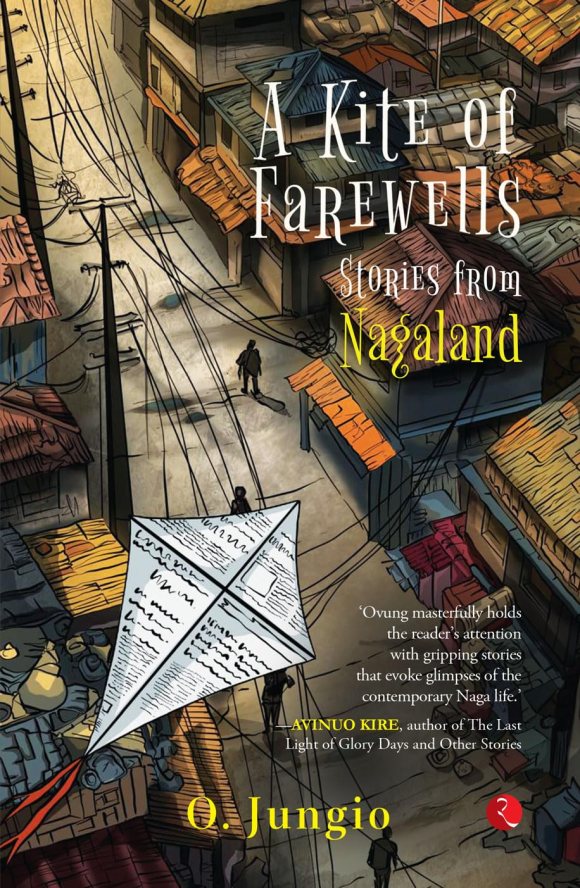
Title: The Kite of Farewells: Stories from Nagaland
Author: O’Jungio
Publisher: Rupa Publications
O. Jungio’s The Kite of Farewells: Stories from Nagaland is a collection of short stories of longing and grief set in contemporary Nagaland. The author is a tribal studies scholar, and cultural historian whose research and essays focus on oral traditions, folklore, and socio-cultural changes among Naga communities. In the book’s preface, he writes, “The objects—mute spectators to human sorrow—become the vessels of collective grief, the repositories of the most intimate of the farewells”. And every story in this collection does explore of longings of different kinds followed by farewells.
The first story, ‘Fire’, begins with a man driving in a downpour. He forgot to carry the food packed by his Ayo’s(mother’s). Like many others she believes hotels are “vectors for every ungodly disease in the world masquerading as something palatable.” What follows is at night he ends up in a strange village for food and shelter; where it seems like the lines between the living and the dead are blurred. The narrator chances upon a man who serves him raw food. He notes, “perhaps by way of some idiosyncratic tradition, this village served raw food on this particular day of the great harvest” and starts a fire to cook himself only to be spooked out by the man. Despite his longing for food, he has to make an escape.
In ‘The Encyclopaedia of a Salesman’, a young man selling encyclopaedias meets a retired government official. Initially, the narrator is cautious about why a man so steeped in command would be interested in something as democratic as encyclopedias. He reflects: “With a career of bossing around subordinates, were more inclined to be loud in their admission of suspicion and disinterest in things that challenged and subverted their sphere of command. What annoyed such men more was the vague possibility that for once in their life they would be hoodwinked by a lesser man like me. It would amount to an abominable upset of social order.” This single observation is enough to collapse multiple distances of age, profession, class. The salesman’s mind, seasoned by years of observation, becomes its own encyclopedia. Just when the disparity gets real, Jungio reminds us of a harder truth: that conversations end.
Jungio tries play on the longing for nostalgic memories in ‘Scoreboard’, highlighting an exchange about keeping a manual scoreboard for FIFA world cup 2017; the son arguing “you can get match summaries and stats from google” for the father to brush it off with “it has been a tradition for me”. The whole act of hanging a whiteboard with teams playing and the predictions along with their scores stands out as a cherished activity for the season. When tragedy strikes, that brief exchange transitions itself into a way of longing, in the practices we all hold on to after the passing of loved ones.
It is not just about the personal objects of longing, but also the social objects, or feeling like a forgotten object that has stood still in time. In the story ‘Showroom’, we meet a middle-aged man, who has always “shopped cheap and done so unapologetically,” visits a new mall in town after much contemplation, only to find himself embarrassed when he misunderstands the mall purchase policy. The story is tinged with humour.
In ‘Sacred Crow’ the concept of ‘Echu Li’ is introduced to the reader and the protagonist at the same time as “a world not different from ours. It is a transient stop for the dead before they move on to the Great Home, where they all would become noble spirits, formless like the wind” — which presents itself as an acceptance of loss. The protagonist awaits the black crow, building curiosity only to close on a note that better fits the tales passed around orally in rural Nagaland.
The final story, ‘The Newspaper Kite’, features four rowdy boys who “create” trouble for their neighbours with their games, their little understanding of familial financial struggles and a bond they both form with a man in his sixties. They lovingly call ‘Amotsu’ when he kindly returns them their newspaper kite in a new frame the boys “dropped” in his garden. The boys find joy in a paper boat because “Lofty ideas are, to an extent, a luxury when the means to materialise it are limited or absent. When you are poor, you train your mind to dream on a budget, and some days, you surprise yourself by getting so much out of so little.” When the boys find about the sudden demise of the Amotsu, they remember his words, “There is always a next day,” with the awareness that the coming days would be without Amotsu. It is in the memory of “that thread trick Amotsu used to do” while flying kites, the boys stay connected to the person who left this world.
O. Jungio does a balancing act between inherited lore and the present. He subtly hints at that it is the lore that differs from landscape but not the emotions or beliefs. Regardless of the objects that offer solace, people connect with the commonality of emotions.
.
Madhuri Kankipati is a reader, writer, and translator with too many hobbies and refuses to pick just one. She was raised to follow instructions, but the real world doesn’t work that way, she just stares at her problems. You can find her on instagram @withlovemadhuu
PLEASE NOTE: ARTICLES CAN ONLY BE REPRODUCED IN OTHER SITES WITH DUE ACKNOWLEDGEMENT TO BORDERLESS JOURNAL
We all know that Christmas Day, the night that Jesus came to earth, bringing with him peace and love for all humanity, is celebrated by Christians all around the world with great enthusiasm and merriment. Interestingly, for a multicultural country like India, Christmas is equally celebrated — not only as a religious festival but also as a cultural one. For a country where less than three percent of the population is Christian, the central celebration is the birth of a child, but it takes on new meaning in different Indian homes. Known in local parlance also as “Burradin”[big day] Indians from all classes and communities look forward to this day when they can at least buy a cake from the local market, shower their children with stars, toys, red Santa caps and other decorative items, and go for a family picnic for lunch, dine at a fancy restaurant or visit the nearby church. This syncretic cult makes this festival unique, and for Jerry Pinto and Madhulika Liddle editing this very interesting anthology comprising of different genres of Indian writing on the topic – essays, images, poems and hymns, both in English and also translated from India’s other languages is indeed unique.
Mary and Jesus’ a painting by Sister Marie Claire. (Picture courtesy: SMMI Provincialate, Bengalaru) ‘Adivasi Madonna’, a painting by Jyoti SahiImages from Indian Christmas: Essays, Memories, Hymns
In his introduction which he titles “Unto All of Us a Child is Born,” Jerry Pinto reminisces how he was surprised when he saw his first live Santa Claus. He was a figure in red that Akbarally’s, Bombay’s first department store, wheeled out around Christmas week. “He was a thin man, not very convincingly padded… seemed to be from my part of the world, someone who would climb up our narrow Mahim stairs and leave something at the door for us at three or four a.m., then take the local back to his regular job as a postman or seller of second-hand comics. The man in the cards and storybooks preferred London and New York. And a lot of snow. … Today, it is almost a cliché to say that Christmas, like every other festival, is hostage to the market.”
The other editor, Madhulika Liddle in her introduction “Christmas in Many Flavours” states, “According to the annals of the Mambally Royal Biscuit Factory bakery in Thalassery, Kerala, its founder Mambally Bapu baked the first Christmas cake in India”. It was way back in 1883, at the instance of an East India Company spice planter he set about trying to create a Christmas cake. Liddle wondered what that first Christmas cake tasted like; how close it was to the many thousands of cakes still baked and consumed at Christmas in Kerala? She also writes about the situation in India, where instead of wholesale and mindless importing of Christmas ideas, the people have been discerning enough to amalgamate all our favourite (and familiar) ideas of what a celebration should be and fit them into a fiesta of our own.
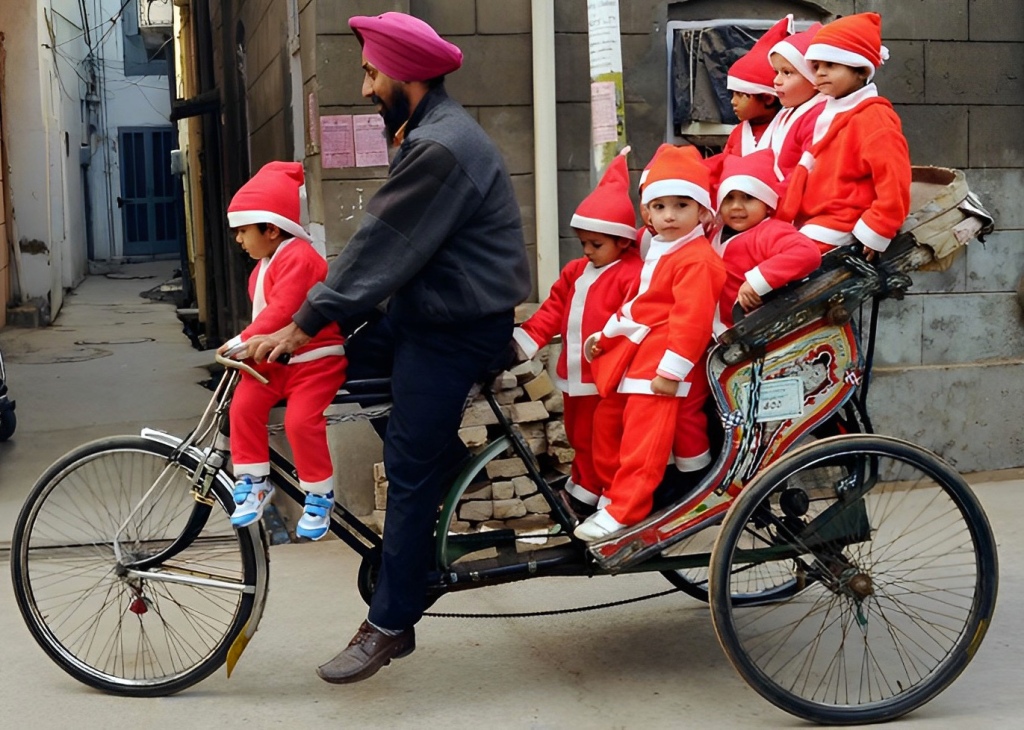
Images from Indian Christmas: Essays, Memories, Hymns: dressed up as Santa Claus leave for school in Punjab. (Picture courtesy: Ecocabs,Fazilka).
There are several other aspects of Christmas celebrations too. The Christmas bazaars are now increasingly fashionable in bigger cities. The choral Christmas concerts and Christmas parties are big community affairs, with dancing, community feasts, Christmas songs, and general bonhomie. Across the Chhota Nagpur area, tribal Christians celebrate with a community picnic lunch, while many coastal villages in Kerala have a tradition of partying on beaches, with the partying spilling over into catamarans going out into the surf. In Kolkata’s predominantly Anglo-Indian enclave of Bow Bazar, Santa Claus traditionally comes to the party in a rickshaw, and in much of northeast India, the entire community may indulge in a pot-luck community feast at Christmas time. Thus Liddle states:
“Missionaries to Indian shores, whether St Thomas or later evangelists from Portugal, France, Britain, or wherever brought us the religion; we adopted the faith, but reserved for ourselves the right to decide how we’d celebrate its festivals.”
Apart from their separate introductions, the editors have collated twenty-seven entries of different kinds, each one more interesting than the other, that showcase the richness and variety of Christmas celebrations across the country. Though Christianity may have come to much of India by way of missionaries from Europe or America, it does not mean that the religion remained a Western construct. Indians adopted Christianity but made it their own. They translated the Bible into different Indian languages, translated their hymns, and composed many of their own. They built churches which they at times decorated in their own much-loved ways. Their feasts comprised of food that was often like the ones consumed during Holi or Diwali.
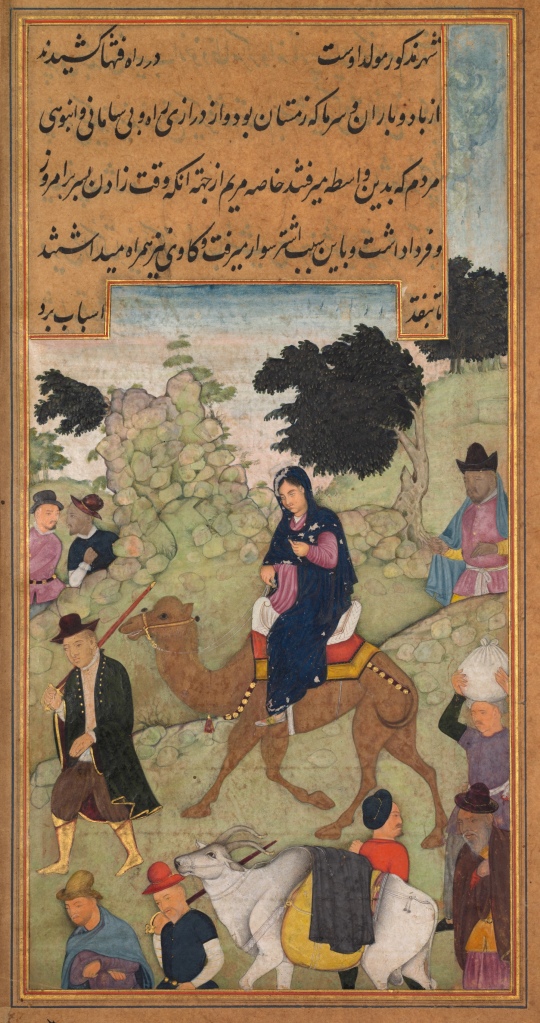
Thus, Christmas in India turned to a great Indian festival that highlighted the syncretism of our culture. Damodar Mauzo, Nilima Das, Vivek Menezes, Easterine Kire, Hansda Sowvendra Shekhar, Nazes Afroz, Elizabeth Kuruvilla, Jane Borges and Mary Sushma Kindo, among others, write about Christmas in Goa, Nagaland, Kerala, Jharkhand, Delhi, Kolkata, Mumbai, Shillong and Saharanpur. Arul Cellatturai writes tender poems in the Pillaitamil tradition to the moon about Baby Jesus, and Punjabi singers compose tappe-boliyan about Mary and her infant. There are Mughal miniatures depicting the birth of Jesus, paintings by Jyoti Sahi and Sister Claire inspired by folk art, and pictures of Christmas celebrations in Aizawl, Bengaluru, Chennai and Kochi and these visual demonstrations enrich the text further.
Seventeenth-century painting depicting Mary and Joseph travelling to Bethlehem. From a Mir’at al-quds of Father Jerome, 2005, Cleveland Museum of Art. (Wikimedia Commons) ‘Mother Mary and Child Christ’. Mid-eighteenth century, late Mughal, Muhammad Shah period. National Museum of India, New Delhi (Wikimedia Commons)Images from Indian Christmas: Essays, Memories, Hymns
Interestingly, the very first entry of this anthology is an excerpt from the final two sections of one of Rabindranath Tagore’s finest long poems, inspired by the life of Jesus Christ. Tagore wrote the poem “The Child” in 1930, first in English and translated it himself into Bengali the following year, titling it “Sishutirtha.” But many years even before that, every Christmas in Santiniketan, Tagore would give a talk about Christ’s life and message. Speaking on 25 December 1910, he said:
“The Christians call Jesus Man of Sorrow, for he has taken great suffering on himself. And by this he has made human beings great, has shown that the human beings stand above suffering.”
India celebrates Christmas with its own regional flair, its own flavour. Some elements are the same almost everywhere; others differ widely. What binds them together is that they are all, in their way, a celebration of the most exuberant festival in the Christian calendar.
Apart from the solemnity of the Church services, there is a lot of merrymaking that includes the food and drink, the song and dance. The songs often span everything from the stirring ‘Hallulujah Chorus’ to vibrant paeans sung in every language from Punjabi to Tamil, Hindi to Munda, Khariya and Mizo tawng.
Among the more secular aspects of Christmas celebrations are the decorations, and this is where things get even more eclectic. Whereas cities and towns abound in a good deal of mass decorating, with streets and public places being prettied up weeks in advance, rural India has its own norms, its own traditions. Wreaths and decorated conifers are unknown, for instance, in the villages of the Chhota Nagpur region; instead, mango leaves, marigolds and paper streamers may be used, and the tree to be decorated may well be a sal or a mango tree. Nirupama Dutt tells us how since her city had no firs and pines, she got her brother’s colleague to fetch a small kikar tree as kikars grew aplenty in the wild empty plots all over Chandigarh. In many entries we read about how Christmas decorations were rarely purchased but were cleverly constructed at home.
A very integral part of the Christmas celebrations of course is music. In many Goan Catholic neighbourhoods, Jim Reeves continued to haunt the listeners in his smooth baritone: “I’ll have a blue Christmas without you/ I’ll be so blue thinking about you/ Decorations of red on a green Christmas tree/ Won’t mean a thing, dear, if you’re not here with me.” Simultaneously, the words and music of “A Christmas Prayer” by Alfred J D’Souza are as follows: “Play on your flute/ Bhaiyya, Bhaiyya/ Jesus the saviour has come./ Put on your ghungroos/ Sister, Sister/ Dance to the beat of the drums!/ Light up a deepam in your window/ Doorstep, don with rangoli/ Strings of jasmine, scent your household/ Burn the sandalwood and ghee,/ Call your neighbour in, smear vermillion/ Write on his forehead to show/ A sign that we are one/ Through God’s eternal Son/ In friendship and in love ever more!/ Ah! Ah!” But the most popular Christmas song was of course “Jingle bells, jingle bells, jingle all the way….”
In “Christmas Boots and Carols in Shillong”, Patricia Mukhim tells us how the word ‘Christmas’ triggers a whole host of activities in Meghalaya and other Northeastern states that have a predominantly Christian population. Apart from cleaning and painting the houses, everything looks like fairyland during Christmas, a day for which they have been waiting for an entire year. She particularly mentions the camaraderie that prevails during this time:
“Christmas is a time when invitations are not needed. Friends can land up at each others’ homes any time on Christmas Eve to celebrate. Most friends drop by with a bottle of wine and others pool in the snacks and the party continues until the wee hours of morning. It’s one day in the year when the state laws that noise should end at 10 p.m. is violated with gay abandon. …Shillong [is] a very special place on Planet Earth. Everyone from the chief minister down can strum the guitar and has a voice that could put lesser mortals to shame. And Christmas is also a day when all VIPism and formalities are set aside. You can land up at anyone’s home and be welcomed in. It does not matter whether someone is the chief minister, a top cop, or the terrifying headmistress of your school.”
One very significant common theme in all the multifarious entries is the detail descriptions provided on food, especially the makeshift way Christmas cakes are baked in every home and the Indian way meat and other specialties are being prepared on the special day. There are several entries that give us details about the particular food that was prepared and consumed at the time along with actual recipes about baking cakes. “Christmas Pakwan[1]” by Jaya Bhattcharji Rose, “The Spirit of Christmas Cake” by Priti David, and “Armenian Christmas Food in Calcutta” by Mohona Kanjilal need special mention in this context. Liddle in her introduction wrote:
“Our Christmas cakes are a reflection of how India celebrates Christmas: with its own religious flair, its own flavour. Some elements are the same almost everywhere; others differ widely. What binds them together is that they are all, in their way, a celebration of the most exuberant festival in the Christian calendar.”
Later in her article “Cake Ki Roti at Dua ka Ghar[2],” the house where they lived in Saharanpur, Uttar Pradesh, she wrote how her parents told her that ‘bajre ki tikiyas’, thin patties made of pearl millet flour sweetened with jaggery, used to be a staple at Christmas teatime at Dua ka Ghar[3], though she has no recollection of those. She of course vividly recalls the ‘cake ki roti’. This indigenisation of Christmas is something that’s most vividly seen in the feasting that accompanies Christmas celebrations across the country. While hotels and restaurants in big cities lay out spreads of roast turkey (or chicken, more often), roast potatoes and Christmas puddings, the average Indian Christian household may have a Christmas feast that comprises largely of markedly regional dishes.
In Kerala, for instance, duck curry with appams is likely to be the piece de resistance. In Nagaland, pork curries rich in chillies and bamboo shoots are popular, and a whole roast suckling pig (with spicy chutneys to accompany it) may hold centre stage. A sausage pulao, sorpotel and xacuti would be part of the spread in Goa, and all across a wide swathe of north India, biriyanis, curries, and shami kababs are de rigueur at Christmas.
This beautifully done book, along with several coloured pictures, endorses the idea of religious syncretism that prevails in India. As a coiner of words, Nilima Das came up with the idea that ‘Christianism’ in our churches is after all, a kind of ‘Hinduanity’ (“Made in India and All of That”). This reviewer feels guilty of not being able to mention each of the unique entries separately that this anthology contains, so it is suggested that this is a unique book to enjoy reading, to possess, as well as to gift anyone during the ensuing Christmas season.
On 26 th January, 1950, India was declared a republic, an independent entity with the complete withdrawal of colonial support of any kind. The country adopted an independent constitution. The Republic Day celebrations conclude on 29th January with ‘Beating the Retreat’,where more than seven decades ago the British withdrew all armed support from India.
In this edition, we will explore how the idea of an independent India has evolved over the decades. We have poetry by Asad Latif that celebrates the Indianess across borders. On the other hand, Beni S Yanthan from Nagaland explores the republic in the shadow of displacement, which makes one wonder if cultural hegemony can help make a country? Ukraine is faced with a war over it.
Tagore’s poem builds empathy around human suffering as does Premchand’s story, translated by C Christine Fair — these are texts written at the start of the turn of the last century. Have we come out of that suffering? Perhaps, the answer can be found in Bhaskar Parichha’s review about a book that spans almost the whole of twentieth century in India. He tells us the author, “MA Sreenivasan (1897-1998) lived through almost the entire 20th century and was among the very few people who witnessed at close quarters the enormous changes that took place in India during this period.” This has been recorded in his book and its review. Rhys Hughes’ humour winds up this edition where he recounts the differences in the cultural ethos of India and a region of the country that despite losing an empire where the sun never set, still retains its sense of humour!
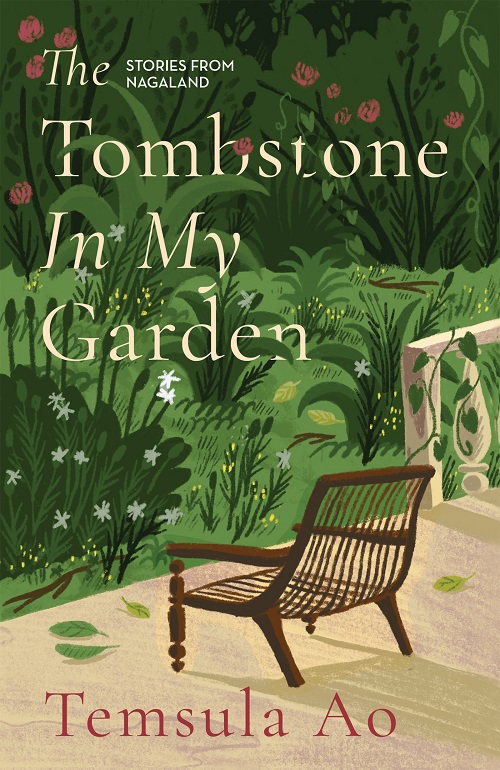
Title: The Tombstone in My Garden: Stories From Nagaland
Author: Temsula Ao
Publisher: Speaking TigerBooks
The problem with any place that’s politically disturbed is that the rest of the aspects of the place – its culture, society, myths, beliefs – are obscured to outsiders. The place comes to be seen only through the prism of the disturbances and not savoured for its characteristics, its turmoils casting an impregnable shadow on its people, myths, its flora and fauna. Slowly even literature gets so obsessed with its ‘issues’ that it becomes difficult to find anything to read on the place which doesn’t talk about them or delves deeper.
Temsula Ao’s The Tombstone in My Garden cuts through that roughage and takes its readers to the soul of Nagaland – to its villages, tribal myths, social practices that have been woven into five short stories that light a torch into every aspect of society in Nagaland. Without the pretence of being a social observer or commentator, the narratives unfold with the unobtrusiveness of a storyteller who doesn’t highlight social practices judgementally but as ordinary things — unworthy of special attention. The perniciousness can be felt only after they arrive at their narrative outcomes.
A very significant voice from Nagaland and contemporary Indian literature, Temsula Ao, has won several prestigious awards including the Padma Shri in 2007 and the Nagaland Governors’ Award for Distinction in Literature in 2009. Her Laburnum for My Head, a collection of short stories, won her the Sahitya Academy Award in 2013.
The opening story, ‘The Platform’, takes us into the world of Nandu, a Bihari migrant to Nagaland who earns his living working as a coolie in Dimapur railway station. Promoted to become a senior among other porters for his hard work and his knowledge of various languages, including Nagamese, one day Nandu picks up an abandoned Muslim boy from the platform. He, slowly, develops paternal feelings for the waif despite a constant tension between the two due to their religious differences.
But life in a railway station is hardly far from the lives who make a living from vices. As the boy grows up, he falls into the company of Shankar, a pimp. One day a fight breaks out between the boy and Shankar over a prostitute – and it ends in the boy’s carefully guarded religious identity getting exposed. The next day Nandu sees a crowd in the platform. He goes to find out what it’s about – and finds the boy dead.
‘Snow-Green’, the third story in the collection, is thematically an open-ended story – where enthusiasts of many stripes will find something for them. The fate of the self-centred mistress will warm the cockles of the environmentalist’s heart. When Snow-Green’s trauma starts, the climate enthusiast will feel vindicated about his convictions about human treatment of nature being responsible for our current climate-induced miseries. The turn of the events at the end is impressive.
In the ‘Saga of a Cloth’, when a brawl becomes the last straw, leading the village Council to expel Imlijongshi from the village, you will feel a bit vindicated: Imlijongshi, the self-destructive fool has finally got what he deserved. However, when the story makes a complete U-turn after that, you will feel you should have held back your judgement.
“In a small voice almost breaking with grief and perhaps regrets too, Otsu addressed the departing figure, ‘Jongshi, wait, I have something important to tell you which you must know; do not leave me to die alone with this secret’.”
This passage brimming with suspense is almost a start to another story retreating three generations, to a different time and space, when Otsu was a young girl dating Imdong and being stalked by Lolen unaware of what the future held in store. By the time the narrative descends three generations and returns to Imlijongshi, your feelings about the boy, his fate, his grandmother and the whole business of life — will be much more introspective, much more nuanced, much less stereotypical.
‘The Tombstone in my Garden’, the title story of the collection, has some similarities with ‘The Saga of Cloth’. Both are long stories spanning generations; both have a woman at the centre suffering because of marriages to men they hadn’t intended to marry. But there the similarities end. Whereas ‘The Saga of Cloth’ has a rural, rustic setting, ‘The Tombstone in my Garden’ has an urban setting. Whereas Otsu is rooted in Naga traditions, Lily Anne is just the opposite, an Anglo Indian who deals with jibes about her dual cultural identity her whole life. But that is just one aspect of ‘The Tombstone in my Garden’.
A first-person narrative, the story starts on a suspenseful note, an old lady explaining her relationship with a tombstone, the graveyard of her husband, in her garden. Using the tombstone as a starting point, she slowly meanders into her story. The reader is kept guessing till her narrative is complete. The story has a feminist touch.
The stories in The Tombstone in My Garden may be short but they are very unlike short stories. They don’t rely on snappy twists in the tale to keep them going. Instead the plots move at an unhurried speed, one subplot making way for another seamlessly and gracefully. For instance, the impact of Lolen’s contempt for Otsu’s life riles not so much while reading of the deeds, their immediacy and narrative pace preoccupying the reader, but impacts when Otsu’s entire later life seems mangled by Lolen’s intemperate actions. Similarly, the reader is miffed not so much by the supercilious indifference of the mistress to the Snow-Green, a flowering plant of rare beauty but how a shallow human need of the mistress — her desire to win the first prize in the annual flower show — towers over the most existential concerns of the flowering plant.
You may argue this is the nature of all narratives – to take you to extraordinary outcomes through seemingly ordinary occurrences – but where Tombstone In My Garden differs is that it acquaints with the ‘ordinary’ things about a place where we have come to believe the ordinary is always in short supply.
At the end, almost all the stories have clearly demarcated epilogues narrating the later fates of the characters. This helps remove the conclusions from the immediacy of the preceding story leaving the reader ruminating with the advantage of hindsight and a melancholic feeling, like an aftertaste of a novel.
As time goes short stories are moving away from their parental identity – the novel. They are getting shorter all the time and are being seen as tools for instant gratification. The current song and dance over flash fiction is an example. Temsula Ao’s collection of short stories makes the reverse journey, taking the short story back to its parental origin – the novel.
.
Indrasish Banerjee has been writing and publishing his works for quite some time. He has published in Indian dailies like Hindustan Times and Pioneer, and Café Dissensus, a literary magazine. Indrasish is also a book reviewer with Readsy Discovery. Indrasish stays and works in Bangalore, India.
.
PLEASE NOTE: ARTICLES CAN ONLY BE REPRODUCED IN OTHER SITES WITH DUE ACKNOWLEDGEMENT TO BORDERLESS JOURNAL
What if I uproot you?

If I uproot you from my heart,
I would have spare breath to
squander among the babel of crows
that swaddles this wayward house.
I would have space to house abandoned
love songs that have been sleeping
in the mouths of robins.
I could take in the dead-silence
that arrives at the end of
a long day with a hard kiss,
I would have room to shelter
uncompanionable poems like this one
that prickle with vulgar melancholia,
I could describe every regret with digestible
verbs without having to blame
it on my foibles…
     I could break tradition –
     speak my mind, get worked up,
     pick the choicest meat from the table
     and hold it up as a homage to forgotten deities
     all in the presence of outraged men,
     without breathing in your scent -
     I could do all this and not allow
     anger to walk into our world but -

Of what use is a republic,
even if it’s a republic of one,
if there is nothing inside of
       us.
Beni S Yanthan (Yanbeni) is a tribal, feminist poet and academic from Nagaland, India. She belongs to the Lotha tribe. She teaches English and Cultural Studies in Nagaland University, Kohima.
.
PLEASE NOTE: ARTICLES CAN ONLY BE REPRODUCED IN OTHER SITES WITH DUE ACKNOWLEDGEMENT TO BORDERLESS JOURNAL
In his debut novel, Veio Pou weaves fiction to chronicle the forgotten history of Naga people, a past whose dust, even after three long decades, is yet to settle. Waiting for the Dustto Settle is set against the backdrop of Indo-Naga conflict in Northeastern India.
The story of this novel follows the life of a ten-year-old Rokovei from Senapati district in Manipur from late 1980s onward. He lives a peaceful life with his parents. Fascinated by the convoy of army trucks passing daily in front of his home, he secretly wishes to become an army officer. Once, while visiting his native village of Phyamaichi, he witnesses atrocities committed by the soldiers on the villagers. His disenchantment with the army comes to the fore when he becomes aware of his people’s sufferings as a consequence of confrontation between Naga undergrounds and the Indian Army. At the center of this novel is the Operation Bluebird, carried out in the state in 1987.
In September 1958, the Government of India enacted Armed Forces Special Powers Act (AFSPA) in the North-Eastern states to quell Naga resistance. In July 1987, the National Socialist Council of Nagaland (NSCN) attacked an Assam Rifles post at Oinam village, in Manipur’s Senapati district. The Naga undergrounds of NSCN looted large arms and ammunition from the post. The Assam Rifles launched a counter-insurgency operation code-named “Operation Bluebird” to recover the looted arms and ammunition. This intense search operation, which was carried for three months in nearly thirty villages, was a torturous period for the residents of those villages. The Rifles committed large-scale human rights violation, including forcing two pregnant women to give birth to their babies in full view of the soldiers.
By spinning the narrative around the operation, the author attempts to give voice to the otherwise erased account of a people’s history from the consciousness of a country. The final erasure came when in 2019 the Manipur High Court disposed case against the Assam Rifles, filed by Naga Peoples Movement for Human Rights (NPMHR), after twenty eight years citing dislocation of entire record of the case. Nandita Haksar, who was the lawyer who filed the case on behalf of NPMHR, wrote in an essay that the entire record consisted of twelve volumes of evidence and ran into thousands of pages.
Through account of Rokovei and his family’s life after Operation Bluebird, Veio Pou brings to notice the physical as well as mental sufferings endured by the victims of army brutality. Disillusionment of natives with respect to Naga undergrounds and their cause, the splitting of NSCN and rivalry between Naga factions, increased awareness among natives for better education, the issue of racism that people from North East face in Mainland India, are the themes dealt prominently within this novel.
Rokovei, while studying in Imphal, witnesses the hostility between Kuki and Naga factions after their conflict in the 1990s. When he moves to University of Delhi few years later, he comes in contact with Lalboi – a Kuki, but does make friends with him because he is the only other boy from the state in his class. After coming to Delhi, he realises the difference of living in a place where no ASFPA is enacted, an experience which should have come as a breather but is marred by racism which he confronts and leaves him astounded. The prejudice that he faces makes him wonder about his identity. Rokovei wishes to find answers. His conversations with his cousin Joyson, with whom he lives in Delhi, gives him a clearer perspective on the history, issues and realities of his people and state.
Finally, keeping in mind better prospects for the future, he settles down in Delhi. It is the year 2008, five years after the leaders of NSCN visited Delhi to meet PM Vajpayee and yet a solution to the political question his people face is nowhere near. Rokovei ponders over the relevance of Naga resistance which had once started with the dream of a sovereign state but was subsequently made weaker by the split in the party. He reflects upon the corollaries of a struggle which had left the natives disappointed because at stake was a peaceful existence that has long been denied them. For him the dust hasn’t settled yet and his hopes are tinged with despair.
The history of a place is essentially the history of its people. To recapitulate it, especially when it is complex and painful to remember, must be an arduous task for the people who have witnessed harrowing times and have lived every subsequent day of their lives watching the repercussions unfold. To pen a fictional account of such history therefore requires conviction and also courage to endure the trauma all over again.
This book is not only an attempt at chronicling the events which led to the political question that kept haunting the lives of the Naga people but is also an effort to bring their predicament to the attention of people who have little idea about their sufferings and about the gravity of denial of justice to them.
.
Rakhi Dalal is an educator by profession. When not working, she can usually be found reading books or writing about reading them. She writes at https://rakhidalal.blogspot.com/ .
.
PLEASE NOTE: ARTICLES CAN ONLY BE REPRODUCED IN OTHER SITES WITH DUE ACKNOWLEDGEMENT TO BORDERLESS JOURNAL.






 Borderless