MY MANTRA

In the mesmerising twilight,
I see untapped sources of delight.
There are no regrets,
But a new awareness, a new insight.

My prayers are now warm,
Not mere words uttered in haste.
My enthusiasm never fades
Even if I’m not ideally placed.

I cannot remain unmoved,
If I see the poverty-stricken in plight.
In the world torn by wrongdoings,
Clashes and mutual distrust,
My jivan mantra* is simple:
‘Trust in God and do the right.’


* Jivan Mantra: Guiding principle of life
Ashok Suri is a retiree and is settled with his family in Mumbai. He tries to convey in simple words what he wants to say.
.
PLEASE NOTE: ARTICLES CAN ONLY BE REPRODUCED IN OTHER SITES WITH DUE ACKNOWLEDGEMENT TO BORDERLESS JOURNAL
There is the import and export of desires in one of the oldest cities in the world, beside one of the most revered rivers, as Keith Lyons discovers in Varanasi.
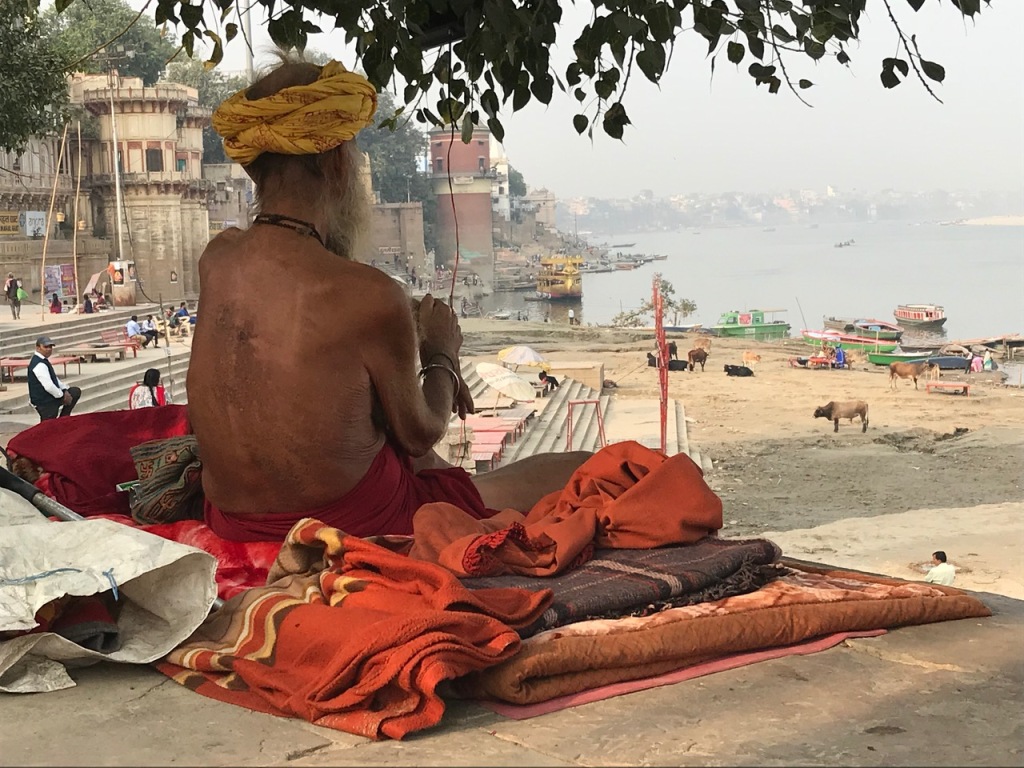
A sadhu watching over the early morning activity on the banks of the Ganges at Assi ghat. Photo Courtesy: Keith Lyons
Most who come to Varanasi, deep down, are seeking peace. The ancient city formerly known as Kashi and Benares is the holy site for three religions: Hinduism, Jainism, and Buddhism. For Hindus who flock to India’s spiritual capital from all over the country, bathing in the sacred Ganges is said to wash away all sins.
For me, as a non-religious outsider, I was also seeking inner peace, and perhaps a deeper understanding of the questions of life and death. But amid the surrealness of the labyrinthine old city, with its wandering bulls, revered shrines, marauding monkeys, and burning bodies, one thing I found was a place to satisfy my earthly material needs.
“It’s to die for,” exclaimed an American bohemian I’d met a few weeks earlier in Bodh Gaya, where the Buddha gained enlightenment. I ran into him strolling along the ghats — steps down to the Ganges that line the western bank of the curve in the wide river. Despite the 1256-page heavy Lonely Planet India, TripAdvisor and social media, there is nothing like word-of-mouth recommendations from fellow travellers. “So you are already at that party,” said Brad, impressed that I too had made it that far along the waterfront almost 2km from where I was staying. “Well, you can’t miss it, can you,” I replied. “It’s probably the only place of its kind right at the water’s edge, and if you don’t see it, you probably smell it.”
For many travellers who don’t want to be seen as sightseeing tourists but are in search of the authentic and the local, Varanasi seems to offer quite an array of experiences, some beyond the comfort level of leisure tourists who keep to the beaten path. Of the 88 ghats of Varanasi which are used for bathing, washing and ceremonial worship, there are two which are synonymous with the spiritual centre. Those two are exclusively used for cremations.
The same reason for bathing in the sacred waters to obtain forgiveness for transgressions applies, but for the recently deceased, it is believed that if their ashes are scattered into the purifying Ganga, their reincarnation cycle will end — and they will reach nirvana.
As the one of the ‘seven sacred cities’, the place supreme deity Shiva (known as ‘The Destroyer’) brought into being by meditation, Varanasi and its cremation ghats represent the ultimate ‘geographical cure’. There are rest homes and ashrams where the elderly and terminally ill wait to die, believing that if they die in the old city, they will be redeemed of all their sins by Lord Shiva on the cremation pyre.
Varanasi straddles the known world and the hidden, with the Ganges a crossing point between earth and heaven. For tens of thousands of foreigners who have Varanasi on their itinerary routes, it is fair to say many are seeking peace, but definitely not of the kind that involves the death of their current material existence. Instead, there is a curiosity about the openness of death and its rituals, and the chance to bear witness to the process which can be at the same time sad and soul-destroying yet also joyous and life-affirming.
For those that don’t share the faith that propels people to this city, perhaps any visit to Varanasi could be described as macabre or dark tourism, fueled by the antagonism between testimony and voyeurism. The epitome of this is the quest by foreigners to get as close as possible to take photos of burning bodies. As if normal travel isn’t stressful enough, the macabre tourist seeks out encounters that have the potential to be emotional and even traumatic.
I must admit, I did have a certain curiosity about witnessing wooden pyres where corpses were placed to be burned. And I did have a fear that I might identify a limb or hand being consumed by the fire, or even that somehow a writhing contorted face might emerge from the flames and snarl at me menacingly.
That didn’t happen. What did happen is that I passed the cremation grounds numerous times during my walks up and down the riverbanks, occasionally pausing to observe from a distance, but the sight didn’t stir me as much as the reflection that this was how a culture and a religion farewell their dead. Having been an altar boy in the Catholic Church, I’d seen my fair share of embalmed bodies in coffins at teary sad funerals, but there was quite a different feeling at Varanasi. Anyway, I didn’t want to intrude as a gawking foreigner.
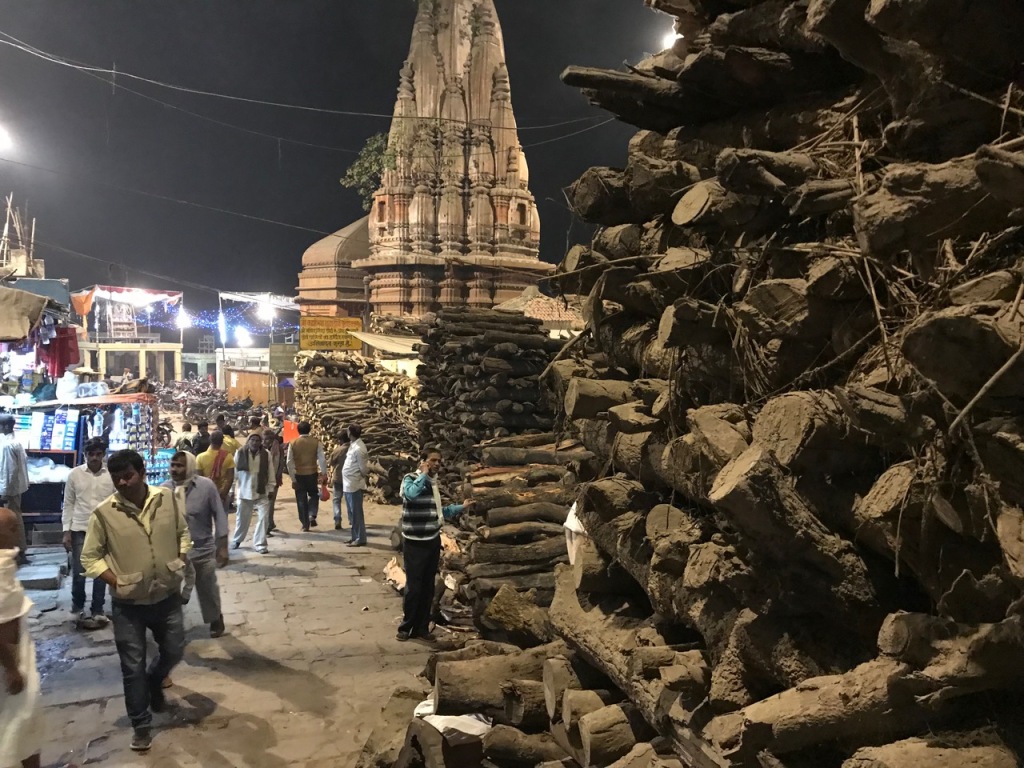
I was just as interested in the negotiations for firewood between relatives and the lower-caste Doms. The price for 400 kg of wood can be around Rs 4,000 (around US$52), a visiting insurance broker from Mumbai tells me, as we stand on the steps beside towers of split logs from the Himalayas. “The better wood is more expensive, but the government is trying to encourage using things like coconut shells and cow dung cakes instead of cutting down more trees,” he says, before the discussion turns to cricket, and a New Zealand cricketer I’d never heard of who played for his beloved Mumbai Indians. Later that evening, to make up for my lack of patriotic sporting knowledge, I impress some local boys playing cricket on the uneven surface of a terrace by catching a whizzing ball with one hand.
Wood merchant stack wood for cremations. Photo Courtesy: Keith Lyons
I noticed that after the initial shock of seeing dead bodies, and after a few days, the constant exposure to these late rites meant that I could be sitting in the open-fronted government-approved 70-year-old Blue Lassi Shop and I wouldn’t even look up when a procession march along bearing a body destined for the Manikarnika ghat. Everyday hundreds of bodies are burned on the riverbank, with the no-frills natural gas crematorium operated 24/7.
I had already taken on board — and possibly ignored through denial – the message of Varanasi: Death is unavoidable. One day, I will die. My body will be destroyed. Life on earth is finite. Make the most of it.
I reflected on this as I stood sipping my tea at Dada ki Chai, or as I sought out the best kachori sabzi[1], or the sweet and sour channa1, dahi vada[2]on the crooked and crowded streets.
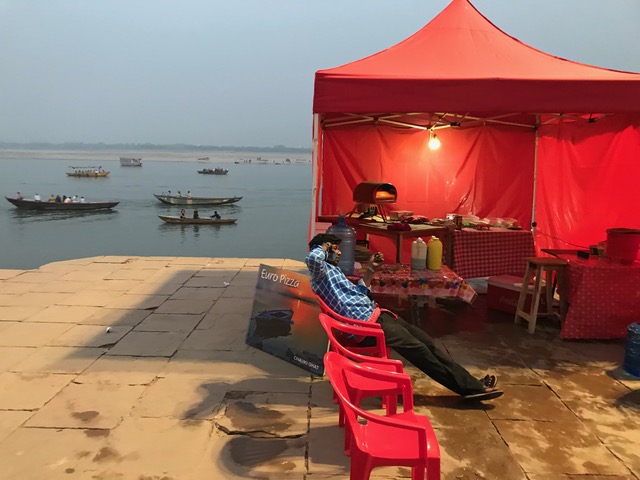
So what else did I discover among the maze of alleyways, the crumbling palaces and the riverbank steps down to the river? Don’t dismiss me as a lousy traveller who can’t be without the comforts of home, but I have to admit one of the finds of my waterside wanderings was a red tent erected on the wide path, where a family had recently set up a low-key pizza eatery.
Pizza? Yes, hand-made, wood-fired pizza. When I first visited, Sunil has only just started the venture. He was going to get some pizza boxes and a label for Euro Pizza and arrange a takeaway and delivery service. The only seating was a few plastic seats.
Diners waited patiently in the cool evening, not so intent on breaking the cycle of death and rebirths but wanting respite from the hot spicy food served up in train stations and roadside dhabas.[3]
In the distance, only a few minutes’ walk away, flames could be seen from the Maharaja Harishchandra ghat, Varanasi’s second, and smaller burning ground. Further along, sounds from the evening ceremony could be heard. But none of that mattered really. There was always a friendly grin from Sunil or a nod of recognition from his family members who cranked out the vegetarian pizzas. It was Rs.150 (US$2) for a ‘small’ pizza, but it was large enough to share. Which people did, with fellow travellers they’d just met, the whole of life made up of many triangle segments, their Varanasi stories to be told later about the burning corpses, the ashes scattered into the river, and the weirdest yet most wonderful thing: a pizzeria perched by a crematorium and a crossing to paradise.
Euro pizza’s humble red tent on the banks of the Ganges. Photo Courtesy: Keith Lyons
Keith Lyons (keithlyons.net) is an award-winning writer, author and creative writing mentor, who gave up learning to play bagpipes in a Scottish pipe band to focus on after-dark tabs of dark chocolate, early morning slow-lane swimming, and the perfect cup of masala chai tea. Find him@KeithLyonsNZor blogging at Wandering in the World (http://wanderingintheworld.com).
PLEASE NOTE: ARTICLES CAN ONLY BE REPRODUCED IN OTHER SITES WITH DUE ACKNOWLEDGEMENT TO BORDERLESS JOURNAL
To embark on a relationship with a meaningful collection of short fiction is to hone one’s awareness of the world that shapes us and is, in its turn, shaped by us. A well-conceived short story is a sharp ray of light that undertakes to illuminate a particular plane of the compound and poly-faceted experience that reality will always be. Urging us to concentrate on that angle alone, the short story crucially assists in peeling off our familiarity with life at that point of being and invites us to locate new meaning in what we might have long known.
In the company of Sunil Sharma’s Burn the Library and Other Fictions, a collection of twenty dense pieces of short fiction, one is on a riveting journey into the physical and psychological entrails of a society that is blissfully absorbed in plotting the architecture of its own doom. Sunil Sharma is an academic from Mumbai who has relocated to Toronto post-retirement. Acutely conscious of the subtle but definite ways in which social life, interaction and communication are being endangered by stereotypes, prejudices, capitalist strategies, ICT, artificial intelligence, eroding faith, self-doubt and the surrender to myopia, Sunil Sharma attempts, in these tales, to not merely draw our attention to what ails us as a society but also offers valuable possibilities of grace and redemption.
Ranging in form from flash fiction to full-length short stories, the themes in this collection are eclectic. Dreams, conjugal relationships, diasporic intimacy, the plight of migrants, women and elderly people, the breakdown of the family, the disruption of social cohesiveness and harmony, the threat of being transformed from consumers to victims of hyper-functional gadgets, and the consistent search for meaning amidst life’s ruins contour this collection through angst, satire, tenderness and hope.
What immediately draws one towards Sharma’s style is his capacity for intricate observation and his incisive, almost brutal honesty in his descriptions. Here is a writer who does not hesitate to call a spade a spade without resort to satire, irony or humour to dilute the effect of his statements. In fiction where it is easy to camouflage and refract ideas, Sharma impresses and inspires by keeping critique frank and unencumbered by location, ideology or craft.
In ‘Love: Beyond Words’, the reflective narrator-husband observes:
“Our worlds, exclusive, were held together by an arranged marriage and later on, by the kids only…like rest of the middleclass Indians. Two perfect strangers brought together by common practices who discovered each other in initial years of marriage and then lost by the pressures of work and antiromance conditions of our living in an Indian metro…like others of our ilk.”
In the poignant flash fiction ‘Skeleton in the Attic’, once the skeleton has been identified as that of the paternal grandmother whom the family forgot to unlock from the attic when it left for its vacation in a hurry, the omniscient narrator quietly points out, “Once the shock was over, food was ordered and video of the visit played out and they forgot the skeleton.” In ‘Beware! Migrants are Coming!’, the interrogator minces no words in establishing the migrant’s statistical invisibility and thereby his ontological dispensability:
“You are a scum. A bloody scum. You come first to our holy land. Then you bring your entire hungry village that sucks us dry. We will no longer tolerate this N-O-W. The thieves are disposable. None cries for a thief. You are not human. You are not us, your death will not affect us, or anybody here, or anywhere.”
Concern for the margins remains central to Sharma’s intellectual, emotional and moral vision of a sane and progressive society. In story after story, it is these interstices that he examines, emphasizing their structural importance to the well-being of the centre. The malady, as the writer establishes, is rampant and global. Whether it is women, the poor, the elderly, the disabled or the migrant, the health of the margins directly determines the health of the centre. In ‘Two Black Stones and an Old God’, for instance, faith in divine reward and punishment becomes a device of empowerment for the grandmother and granddaughter both of whom are victims of the family’s neglect. In ‘The Street’, the narrator maps the entire cultural change that has taken place in his native town of Ghaziabad by observing the difference in the metrics of spatial arrangement and communication. The transformation of the public space that once symbolised community, shared concern and active empathy into a space of inequality, indifference and social apathy marks, for the narrator, the apotheosis of postmodernist social fragmentation and alienation.
However, the most stringent and memorable critique of postmodern and posthuman culture is perhaps put forward through the eponymous story ‘Burn the Library’. Though the setting of the story is 2071, around fifty years into the future, the conflict that it explores between information and knowledge, between programmed intelligence and creative thinking and between human growth and entropy is vital to the fabric of contemporary intellectual debate. What is the future that we are enthusiastically chasing, the writer seems to ask. Does it promise an unfolding of our rational and emotive powers or does it seek to arrest and freeze them unconditionally? For Sharma, the possibility of resistance to the omnivorous challenges of technology usurping humanity lies only in and through the circulation of ideas via writing. Ideas alone, for Sharma, are indestructible and even if all libraries were to be burnt and all sources of information were to be destroyed or corrupted, new knowledge could be founded and resurrected in the world through the strength of individual creative thinking alone. The Advanced Homer (AH) virus that seeks to alter “consciousness about culture” says, “Wake up! Find out authenticity. Life. Real life beyond the wired universe. Think – alternatively. Subdue the dominant of technology. It is not our master anyway. Go human. Re-think culture.”
‘Go Human’ is a powerful slogan, lethal in its simplicity as it indicates how far we have strayed from what we were meant to be. For me, it richly encapsulates the vision of the entire collection since it is only by the reclamation of our own humanity and that of others around us that we can battle the evils of discrimination, prejudice, violence and self-destruction.
Basudhara Roy teaches English at Karim City College affiliated to Kolhan University, Chaibasa. Author of three collections of poems, her latest work has been featured in EPW, The Pine Cone Review, Live Wire, Lucy Writers Platform, Setu and The Aleph Review among others.
.
PLEASE NOTE: ARTICLES CAN ONLY BE REPRODUCED IN OTHER SITES WITH DUE ACKNOWLEDGEMENT TO BORDERLESS JOURNAL
Masala and Murder is a tantalising detective novel by Patrick Lyons, who is an Anglo-Indian writer based in Melbourne, Australia. He has had an interest in crime stories since childhood and has been writing from a very young age. His writing reflects his experience as an Anglo-Indian growing up in Australia during the 1970s and 1980s, which paves the way for Lyons to explore broader concepts of exclusiveness, racism, identity, and duality. These notions subtly sprout in his work and fortify the plot and characters in his story.
The whodunit comes in a well-packed set of 40 chapters with a prologue and an epilogue. The opening of the murder mystery is at a place called Uluru, or Ayers Rock, a scenic, sacred place for the aboriginal Australians which houses a massive sandstone monolith in the heart of the country’s arid “Red Centre”. On the fateful day, a mix of noise and silence, natural and artificial at the foot of the Uluru after sunrise await the tourists along with the Bollywood crew as they prepare to scale the famous rock. The Bollywood celebrity, Subhani Mehta, is all set to shoot a dance number on the top of the Uluru. As they reach the summit, amidst the heat and dust, the lead lady readies herself. High-pitched music plays. The camera rolls. They all move in unison. All of a sudden, Subhani Mehta gasps for air and falls. She dies in a matter of seconds.
This makes headlines in India although it was just another crime news in Australia. Aamir Mehta, a well-to-do industrialist, and father of the dead actress, suspects foul play and approaches Samson Ryder, a private investigator in Melbourne to investigate the incident. Ryder, who was not a private investigator by choice, accepts the case for easy money. Ryder also empathises with the helplessness of Subhani’s father as he had lost his only sister and had seen his parents suffer similarly. He still carries the pangs of guilt for not having done enough to save his sibling.
An initial inquiry to Subhani’s case is dismissed as her demise is listed as a “natural death”. What had actually led to her death continues to be a puzzle as the incident was wrapped up in a hurry. Widespread corruption made way to create an easy exit for the case. Little did Ryder know that the task would lead him to unknown territories that would not only give a fair share of closure for the case but also, add to a better understanding of his messed-up work and life.
Lyons manoeuvres the crime novel with a set of interesting characters that harmonise to make an intriguing tale. Besides the fee, Ryder’s own past and his relationship with his family make him want to bring solace to the torments of the loss of a child to a family. Cross-cultural exchanges on the aspects of beliefs, rituals, taboos, faith, and spiritualism, black magic, talisman, spirits, tantric, curses, exorcism, Kali worship, etc. in the story are ingredients of the masalas that spice the scrumptious murder mystery. Traversing inner lanes of glamour and darkness, the narrative excitingly reveals the rawness of humans in Bollywood. Lyon presents the Anglo-Indian communities in Australia and Mumbai, with more focus on food and lifestyle to create a feeling of universal belonging. Additionally, his experience as a citizen and as an NRI, ultimately shares a greater awareness of stereotypes and realities of identity.
Lyons beautifully brings up the idea of dreams in relation to our state of mind through Ryder. Themes of minority, infidelity, jealousy, ego, vengeance, depression, grieving, trauma, death threats, abuse – physical and drugs — are touched upon as the story meanders to figure out who murdered Subhani.
Was it the Singhs, Nair, Nadar or Ms. Khan, or was it just a natural death? The suspense interestingly lingers till the end. There is a tussle of love and hate, good and bad, atheism and faith, fear and strength, an exploration of identities bringing to life the duality in characters and unraveling stories within the story. That people cope with personal loss in different ways is subtly shown. Ryder’s father and his godmother, Mabel, resort to faith and worship and his mother keeps herself busier with cooking.
Lyons brings in timely wit and humour. The romantic grids with Rebecca, Ryder’s love interest, and conversations on the unfolding of the crime with Mabel are the lighter shades in the story. Through the descriptions of traffic, lanes, scent and sights of the cities of Melbourne and Mumbai, Lyons also captivates with glimpses of relatable beauty and distasteful sides of the cityscape. Throughout Ryder’s investigation that unravels as he takes taxi rides, walks, runs, making smart moves, breaking laws or flying across cities, there is not a dull moment in the novel.
The mystery behind the murder trickles from one circumstance to another making a string of unbelievable coincidences. The protagonist advances to the core of the investigation to be stuck with the question — was it all mere coincidence or planned? With every turn of the page, suspense is in the air right from the start to the end. The plot mingles the mysteries of murder with masalas that throw light on love and loss, blatant racism, complexities of identity and belonging, tradition and beliefs across cultures, and the constant battle of good and evil that we play out as human beings. Patrick Lyons’ Masala and Murder (2021) published by Niyogi Books is a crime novel that is refreshingly told and is a compelling read with content that is contemporary and relatable. A beautiful cover design complements the thrill of the narrative.
.
Gracy Samjetsabam is a freelance writer and copy editor. Her interest is in Indian English Writings, Comparative Literature, Gender Studies, Culture Studies, and World Literature.
.
PLEASE NOTE: ARTICLES CAN ONLY BE REPRODUCED IN OTHER SITES WITH DUE ACKNOWLEDGEMENT TO BORDERLESS JOURNAL
RETIREMENT

Happier times descend,
Hectic ones come to an end.
Time to be with your family,
Relax like leaves on tree.
Time to pursue nobler passions,
Extend yourself to your fellow men.
Time to see how the sun rises, how it sets,
How the stars wander, how they rest,
How the moon sails and comes out of clouds,
Like a young prince moving out of crowds.
And times to know
Who is behind this eternal show?
Lord brings you the best,
A sky to fly and a warm nest to rest.
Ashok Suri is a retiree and is settled with his family in Mumbai. He tries to convey in simple words what he wants to say.
.
PLEASE NOTE: ARTICLES CAN ONLY BE REPRODUCED IN OTHER SITES WITH DUE ACKNOWLEDGEMENT TO BORDERLESS JOURNAL
Can a patch of foreign sky and Earth speak to you in the manner it earlier did to the lost tribes guided by the bright stars, suns and moons?
The way it spoke to the early Greeks or the Vedic-era folks — among other pre-industrial cultures — that created marvelous odes, arts and regions that still appeal to a new-millennial audience hooked to gadgets as their reality?
A Homer that continues to inspire!
Possible?
The trance where natural elements convey profound truths; enabling the viewer to recover a lost innocence and old mode of perception.
Could such a luminous past be re-lived?
Could it recur?
Yes.
Here is the how of this communion.
.
In Canada, escaping colours is impossible.
In Mumbai, finding colours, impossible.
The contrast shocks. Toronto is dressed up in multi-splendoured gown.
You are participating in a romantic landscape.
.
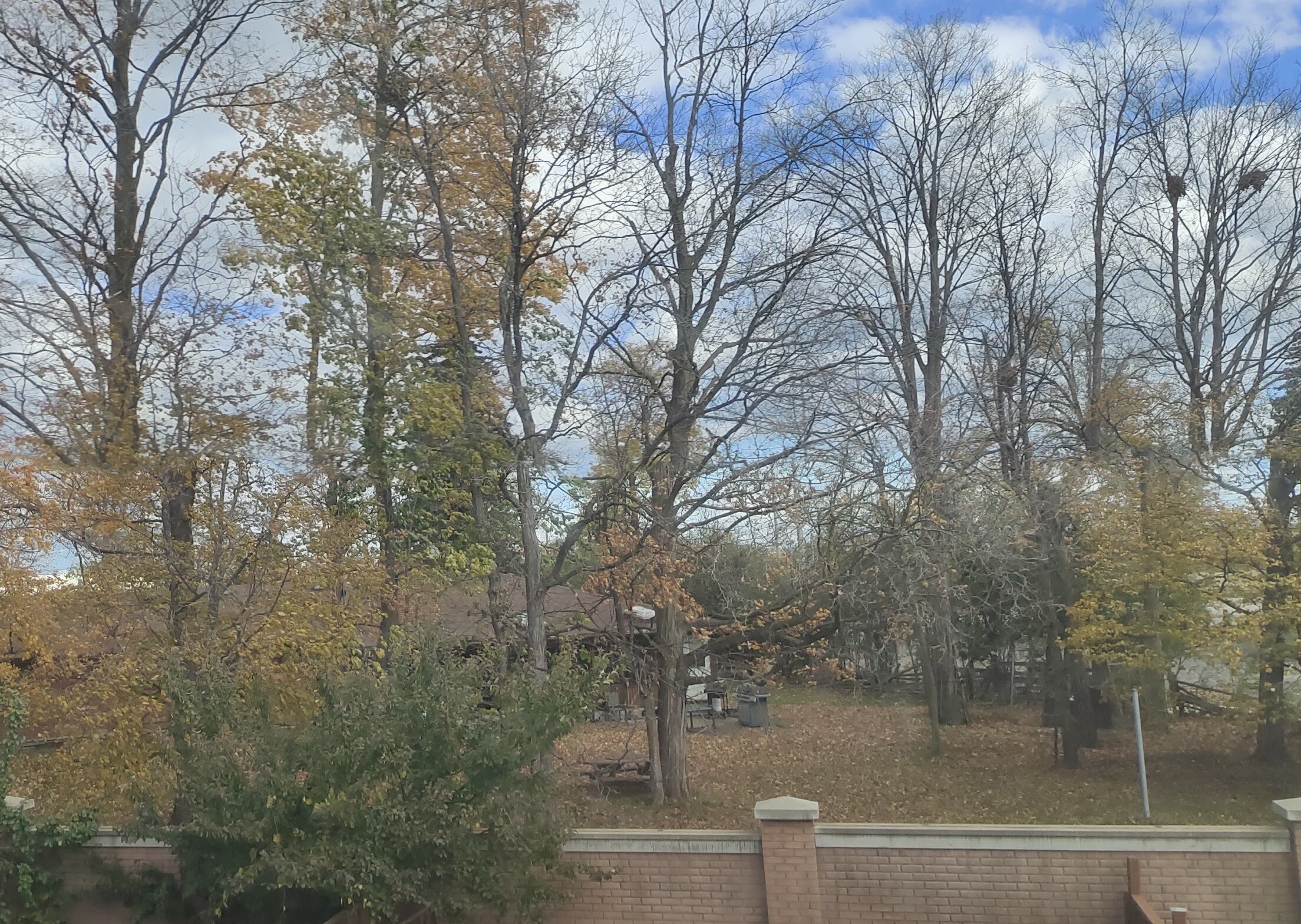
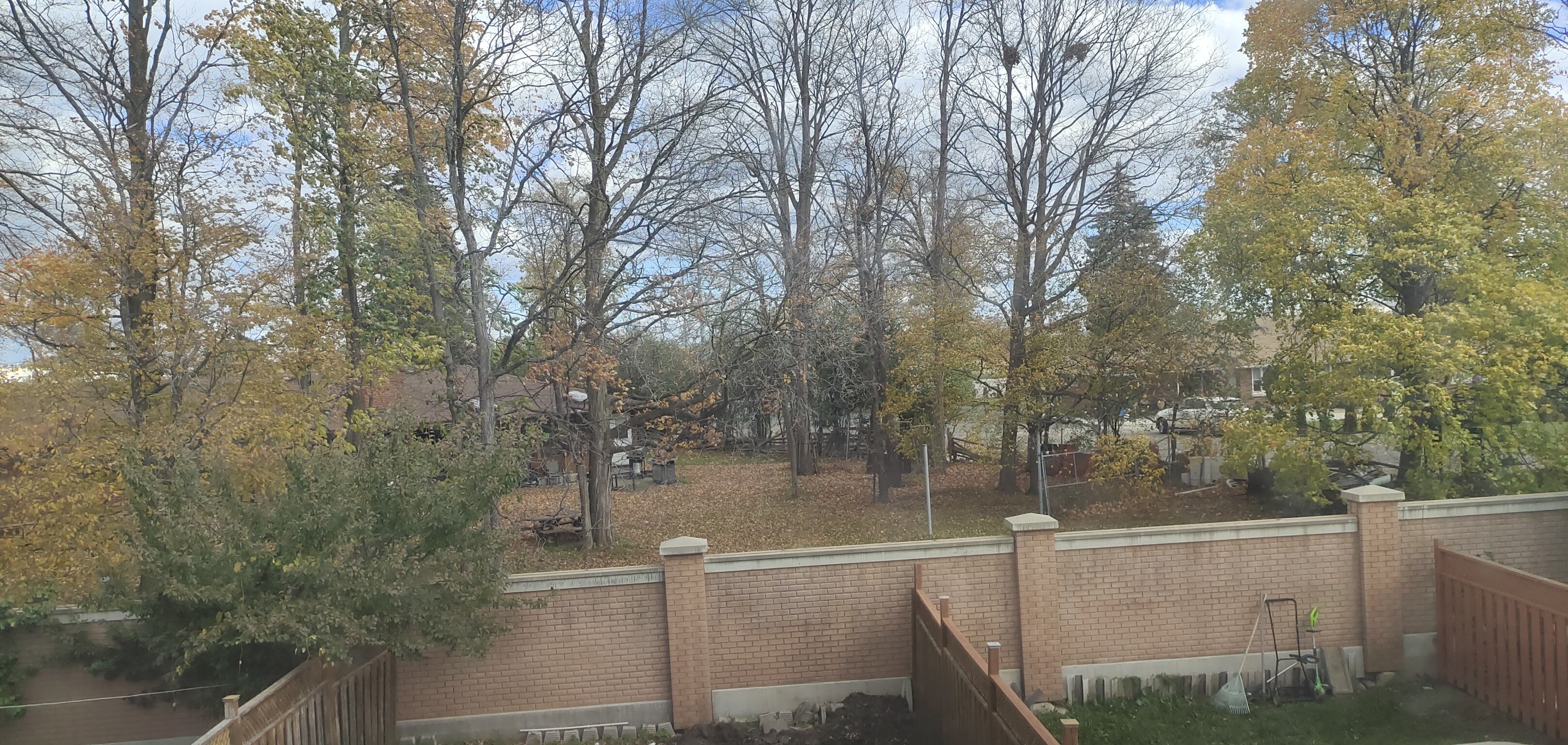
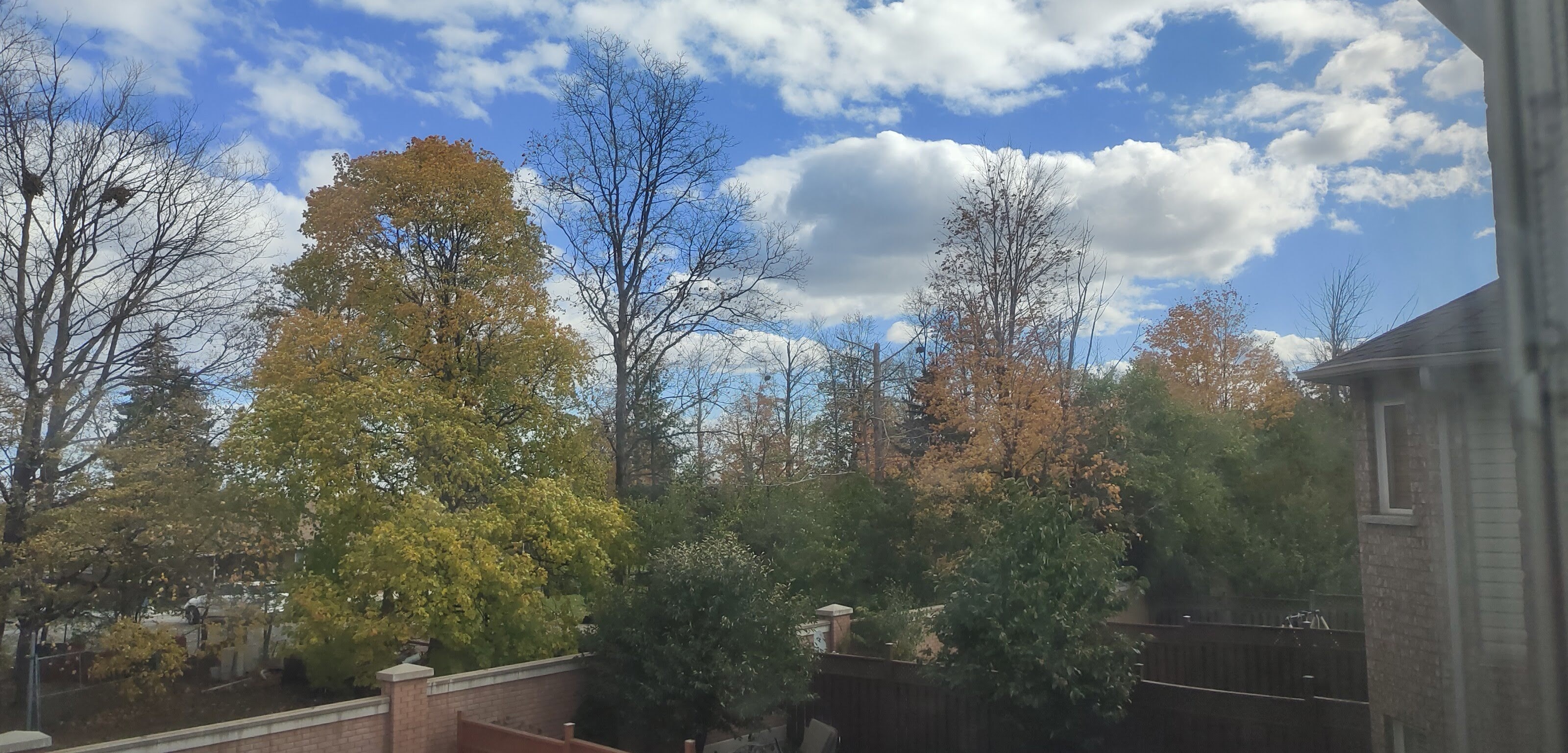
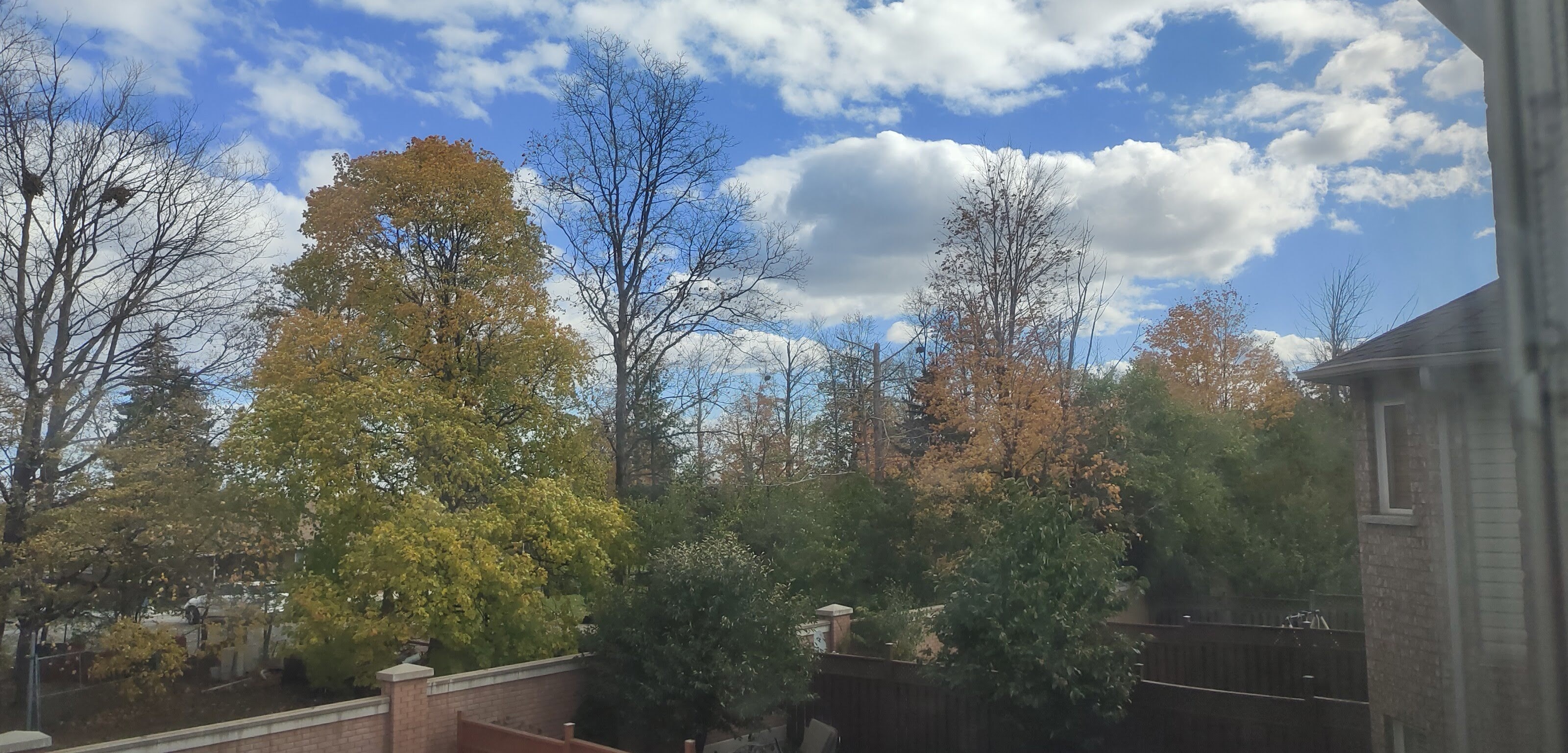
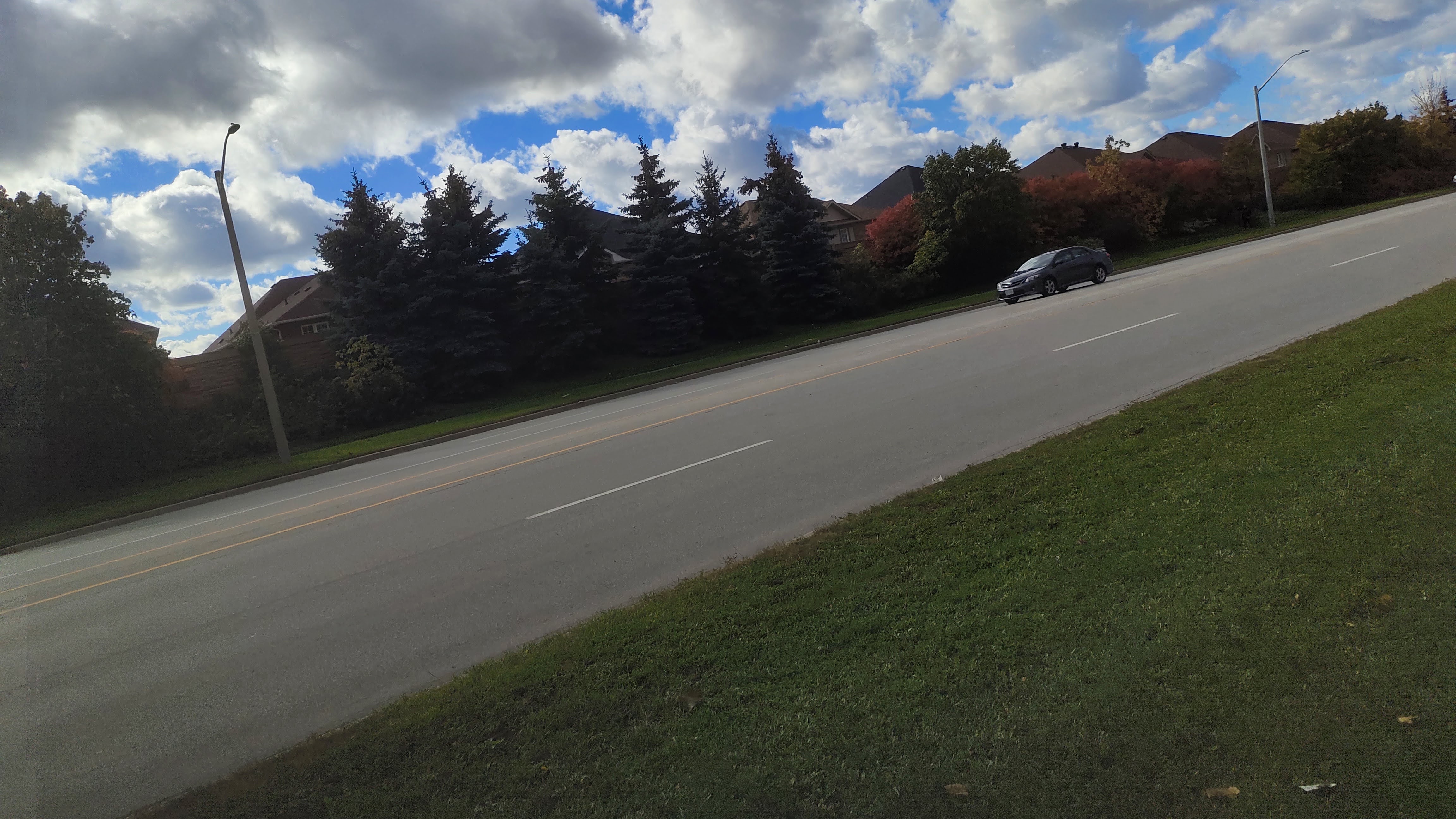
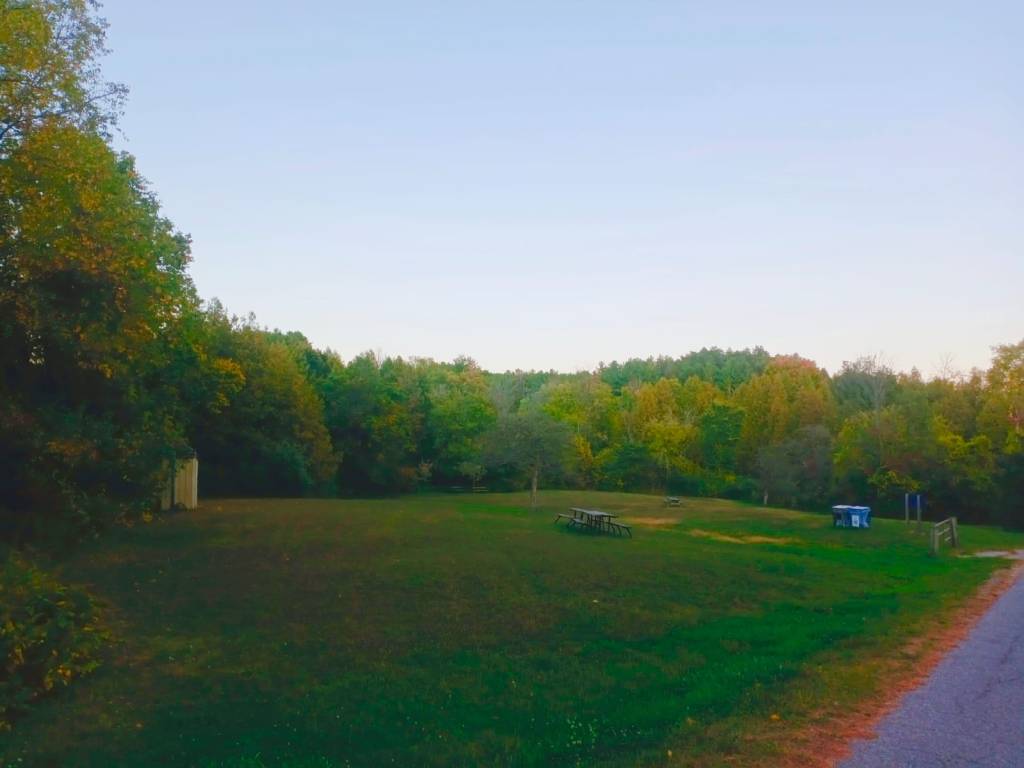
October morning. We walk down along a trail in the heart of a busy neighbourhood.
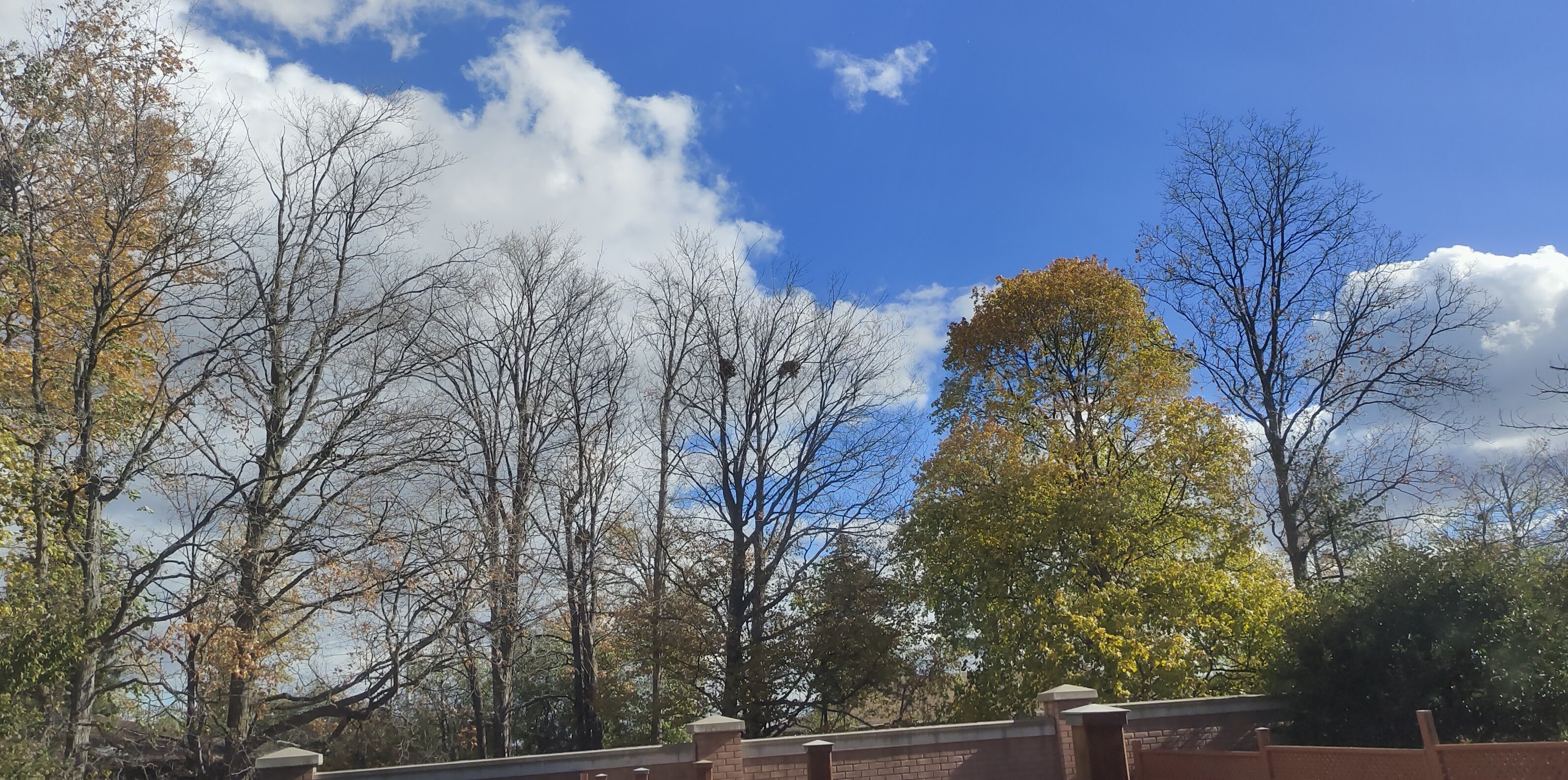
The sky is dotted with daubs of grey and white against the brilliant blue— reminiscent of a Monet.
In countries like Canada, to a large extent, you enjoy the sensory wealth and free interaction with the dales and meadows and lakes…and trails that make you discover surprises after a sudden bend, a leafless tree; ducks in a pond; the luxuriant trees and shrubs, and, a protean sky; journeys that make you negotiate not only the turns and twists of solitary pathways, the physics of the urban planning but also, the metaphysics of space by diving into the inner self; the internal landscape, on clear, crisp mornings or even dim nights, getting luminous, transmitting silent codes to an awakened self — glued into an ancient map.
Nature is your new interlocutor, releasing routes, inner and outer, with a switch of a button.
Nature in Canada makes a compact with the sensitive seeker; it changes the viewer into an artist, a co-creator of the aesthetics of colours, spaces and patterns!
The dialectics of nature and praxis operates — a walker stops and takes selfies against a tree in bloom or against a pond full of ducks, as mementos.
Such moments of serenity are rarely found in Mumbai or Karachi or any other stifling mass city.
Oddly I hear Wordsworth humming in a glen off the Highway 50.
It is a collage curated by an invisible force. The air is pure. The solitude borders on the spiritual.
The background is fascinating: Electric scarlets. Grays. Oranges. Reds. Yellows. The trail takes you deep inside self. The internal calmness is matched by an external silence.
Uplifting!
The magnificence induces a reverie.
The elements merge seamlessly into a heightened consciousness, an extraordinarily lived experience.
A Joycean epiphany! All staged within a moment.
A hungry mind absorbs the altering spectrum. The sky transmits a message that folks like Paul Coelho decode for a mind craving for another dimension of a drab one-dimensional existence.
It is a strikingly different reality.
Nature — enabling philosophy.
You are aware of its presence.
In developing nations, it is the absence that is hardly missed. You are stuck in a development-dystopia there. In such locations, citizens have to fight against the degradation of nature through liberal media, courts and advocacy groups, on the broad themes of having the right to breath easy, clean air and inhabit liveable cities. Yet walls of indifference keep on rising and cases of mangroves being destroyed, hills plundered, trees hacked, in the name of urban development and growth, under the patronage of corrupt bureaucracy and political class, go unreported, thus leaving honest taxpayers only layers of smog, pollution and bronchial diseases that reduce productivity…and creativity. Trapped inside a dull and deadening grind of a daily routine of long commutes in overcrowded public transport and hours hunched over small screens in airless cubicles, the professionals are reduced to nothing but robots, androids, cut-off from their scorched Earth and a dark sky, self-enclosed atoms, unaware of the romance of a full moon in a wintery sky or the power of a red rising sun, giving hope to the millions of workers…
.
Back in the trail, thoughts rush out and form into whole units of novel poetics, symbols and artistic meanings.
A kind of radicalisation has been executed by a natural scene carefully preserved by the civilly conscious fathers of a huge land worked on by immigrants and other settlers.
In the sky, I see messages and patterns that take me back to the happier times of the concord between humans and nature, now disrupted.
The colours of fall are staggering in range, impact and variety.
You have become a part of a dynamic natural landscape—and feel elevated!
And feel privileged to be a witness to the preserved bounty of Mother Nature here in Canada, much better than in India.
You breathe easy.
Oxygen hits the lungs directly — not the smog that produces cough and cold.
No noise — refreshing from the mad cacophony of the noisy overcrowded unplanned ungovernable cities of Asia.
People are distant but polite. Fellow nature enthusiasts. The pagans of the post-industrial society, trying to reclaim a bit of humanism and nature, for forging a newer human being full of empathy in a peaceful country.
“Hi!” I say to the passerby.
“Hi! How are you?” answers the tall man.
“Fine! Thanks.” I answer…and move on.
A significant human exchange unfolds, gets executed by a cultural consensus — and the colours of white and brown intermingle in that common gesture of politeness and affirmation, thus confirming the redness of bloodstream of the diverse species of a planet threatened by climate change, ethnic strife, racism and alt-right forces that immediately do the “othering” of the groups not found matching their own.
As we walk away, composed and tranquil, enjoying the cool sun and fragrance in the air, few steps away from the neat bungalows on winding streets, the epiphany strikes, like a gentle rain in the moorland:
No land is bad. Or its hard-working honest lawful people. What is bad is the corrupt and cynical ruling elite that places it above the people. If they do not pay heed, refuse to listen to the rumble on the ground, popular change will follow soon.
Headed home, I realise home is a mobile space, a social unit of a shared collective of similar aspirations and dreams. You keep on searching for an ideal place where dreams and realities coexist as realizable values and make you evolve into a dignified, creative citizen — the main goal of a full and functional democracy anywhere.
Perhaps, that is the main drive for migration, internal or external, for welcoming areas and countries, globally.
Returning, I find I am at home, in Canada, at last. A place where colours of the Earth and sky meet, fuse together to produce newer styles of wholesome aesthetics of meaningful, integrated living, in cosmopolitan setting, with shared systems of beliefs.
The colours of Canada do speak to a harmonious mind.
Canada is a live canvas for sentient beings. You are an element of a dynamic complex of co-existing patterns, producing wholesome meanings!
Thus, you become real and alive, in an animated environment, organic but not yet fully and cynically degraded, unlike in other more commercialised nations.
Photo Courtesy: Sunil Sharma
.
Sunil Sharma, is a Toronto-based academic, critic, literary editor and author with 23 published books. His poems were published in the prestigious UN project: Happiness: The Delight-Tree: An Anthology of Contemporary International Poetry, in the year 2015. Sunil edits the English section of the monthly bilingual journal Setu published from Pittsburgh, USA: — https://www.setumag.com/p/setu-home.html For more details, please visit the link:— http://www.drsunilsharma.blogspot.in/
.
PLEASE NOTE: ARTICLES CAN ONLY BE REPRODUCED IN OTHER SITES WITH DUE ACKNOWLEDGEMENT TO BORDERLESS JOURNAL.
A daily commute or a long-distance one, humans undertake movements that affirm the principle of belief. Belief in certain ideals.
The pull of a dream!
Kinesis is the fundamental science of change; it is the force behind the evolution of species.
You want to grow wings — and soar!
Migrations.
Birds and animals do the challenging migrations across geographies and climates –for survival.
JoF involves love. For the dear ones!
.
Embark on the journey of LOVE. It takes you from yourself to yourself.
—Rumi
.
Indeed! It is a similar terrain with similar topography yet varied.
And when love calls, nothing stopping the voyager.
Faith becomes the compass.
.
Similarly, we began a travel across continents, deserts and sea, mountains and plains, stalked by an invisible and silent killer.
Homer could be heard in a recess of the mind:
The roaring seas and many a dark range of mountains lie between us.
Travel in the Time of Covid!
From Mumbai to Toronto via Maldives — a journey of five days.
And Love and Faith are our guiding angels.
.
Exit
September 8, 2021
Kalyan
12.30 pm
It is raining hard. Suitcases are all piled up. The taxi is waiting. Few friends have come to bid us a quick goodbye.
Brief but final.
We spent months together to dismantle a secure life for the “unfamiliar”. You feel nothing. Just a quick bye — a last lingering glance.
It is over– 30 years come unstuck in a gliding instant. Joys, disappointments; tragedies and triumphs; losses-n-gains. Personal narratives unravel and evaporate, simultaneously, in that single gesture.
The anticipated moment arrives as an anti-climax.
No surge of emotions. No sense of loss.
Nothing.
And the ride begins.
.
We arrive at the Hilton in the afternoon. The sky is overcast. Hotels around the airport are not fully occupied. Covid-19 is real. Third wave is expected.
Mumbai is unlocked yet locked up. There is pervasive fear.
Hotels are badly hit. We retire early. Next morning the expedition, our JoF, begins.
.
We are sleepless in Mumbai.
A new home calls from Toronto.
One home traded for another — and a long arduous journey involved in the transition.
Certain things end.
Fresh things begin.
Hope. Fear. In equal measure.
Travel, real time.
No looking back now.
All set.
Foreign shores call.
The journey of a thousand miles begins with a single step.
― Lao Tzu
.
September 9, 2021
CSM International Airport, Mumbai
6.0 am
We are in the early-morning queue at the counter which is closed. After half-an-hour, a young female executive sits at the counter of the airline, rest are still closed. In fifteen minutes, the queue gets long, and people wait for their turn. Slow. She takes time to check every document. Finally, another staff comes to open the second counter. Nobody complains.
The jostling passengers in the serpentine queue hardly have the mandatory two meters for practicing social distancing. There are official checks but the global safety protocols cannot be implemented due to the crowds and general apathy.
Nobody minds the non-compliance.
It is India, dear!
After a long wait, we get the boarding passes.
Next, we queue for security and immigration checks. They ask some routine questions. Finally, we are cleared. We move to board the airbus. No social distancing is maintained while boarding.
.
Maldives.
Time: 1.15 pm
The small airport is full of tourists.
Maldives is suddenly full of Bollywood celebrities and hapless students on their long and tortured way to Canada.
For the former, it is a luxury getaway — beaches, sun-bathing, the over-the-water cottages; perfect Instagrammable moments, fodder for the paparazzi.
For the latter, middle-class, wide-eyed young adults separated from their small or big-city cages, it is a pricey gateway to Canada, some kind of a Promised Land, a utopia — the western Shangri-La!
Two different sets of travelers in the Corona period.
At this moment, no stars are to be seen in the airport.
Only large number of Indian students, some parents, and workers, all bunched up, bit tense, ready for the official interrogation.
It is smooth sailing for the Indians and few other nationalities, mostly Asians, at that particular hour.
People move and get directed to various counters.
The documents are scrutinized. Faces, uncovered, and covered.
The long lines are quickly cleared. Officers are polite.
Female officers, covered up, are monosyllabic but overall helpful.
There are more female officers visible here than in Mumbai or Delhi airports!
We are relieved.
The immigration officers can be tough. They might ask you reason for transiting via Maldives. Give them the truth. They may detain a passenger but normally will allow the entry.
— Our had agent informed us prior to our departure.
The WhatsApp group discussions had been confusing. Hostile officers! Some claimed. Friendly! Others countered.
That did not help.
The almost two-hour-and-half flight was spent on worrying about which 50 per cent would fall our way!
To be detained in a foreign city can be daunting. Linguistic and cultural differences, poor internet connection, a roaming number that does not work — all these factors add up to the complications in an unknown location buzzing with people from many countries. Anything can go wrong and you are in a modern limbo; incommunicado with the outside world, on your own.
Incognito!
These fears played on our minds, as we land on a sunny and humid afternoon.
Once we embarked on the adventure, there could be no turning back, Covid or no Covid.
Ready for worst, praying for the best!
Breathing easy, we headed for the exit.
Then, the bump!
Our baggage is held up for additional checks. A female officer asks, “Are there idols inside your suitcase?”
“No,” we say. She nods and asks us to leave. Idols and liquor are prohibited items.
Relieved!
“If any other country does this, prohibiting the sacred objects of a given faith, that government will be dubbed as anti-Islamic. Media will call them spreading Islamophobia. What is this? Liberal governance?’’ asks an Indian co-passenger sotto voce.
The hotel is a large property and full of the Indian students. Few whites also. The view of the ocean and sky is terrific!
Maldives. Courtesy: Sunil Sharma
A picture-perfect venue.
Chain of atolls stretches in the middle of the Indian Ocean. The sky and the ocean mirror each other, twinning in blue that electrifies the senses.
Here we saw a green ecosystem curated by the travel industry for the wealthy. The resort packs up natural beauty into a commercial package — spas; massages; food; liquors; boating and fishing; surfing and snorkeling.
Other side of Male is poor where workers and other classes live in bleak condition. Covid-19 ruined the economy, but things hope to improve now.
The barriers had been lowered. Vaccinated tourists were returning.
The hotel was on the edge of the ocean. Young Indian and foreign women swim and relax under umbrellas. Indian couples unwind. Women in swimsuits roam uninhibitedly, feeling emancipated, free, under an alien sky.
Outside, along the narrow strip leading to the airport– small stretch — women of any age get that malevolent male gaze!
We spent the night and the next day enjoying the breeze, ocean and the short walks.
And get revived.
.
September11
Time: 2.30 pm
The batch of new arrivals is largely from the north of India—Delhi and Punjab. They are sitting in the lobby, bags unpacked, ears plugged in. Some are talking to parents via video calls and reporting their minor discoveries about Male. Eyes are tired but dreams, burning.
“Headed for Toronto?” I asked a strapping bearded man in early twenties.
“Yeah,” he said. “We have to come here for our RT-PCR report. It has cost us a mini fortune!”
“Same here.” I responded.
“They should have set up a lab at the airport in Delhi.”
“Who?”
“The Canadians. They know we will come, the students, via a third country.”
“Yes. No options.”
“Bizarre! We bring skills and money and that is how Canada is treating us! Making us do additional travel for entering the country.”
I nod. “It is a regular brain drain but our country does not care.”
“Yes,” he observed. “1.3 billion! Deaths or migrations, even on a large-scale basis – it matters not. The youth have to re-write their destinies there.’
He was an engineer going to do the data analytics course from Canada.
“Why you want to leave?”
“Well, for better quality of living. What else?”
“It is tough there.”
“Not for the weak, any foreign country. One thing is sure. Merit is recognised in North America. India lags behind. We do not get what we deserve. Hence, the recent exodus.”
He has a valid point.
Same grit is seen on the faces of the young women. They left the security of homes for a dream.
These are the Young Pioneers doing the Journey of Faith. For a dream of equitable society, merit driven.
The young are obsessed to find better versions of a civilization — humane, well-policed and well-regulated.
To escape the grind of a country mired in extreme corruption, casteism, communalism, regionalism, linguistic chauvinism — and subtle racism.
Each one of the group is in search of a Brave New World, mythical or real.
The Talented are exiting.
No policy maker is bothered.
.
The hotel has got staff from India, Nepal and Malaysia. The food is good. Service, impeccable.
We do the PCR tests in the evening and wait.
Next morning, reports come — negative.
We are ready to leave Male for Toronto via Doha.
.
September11
Time: 4.50—7.45 pm
Male airport
The horror!
The counter at the business class had a long queue. When our turn came, the female staffer went ballistic. She asked for all the documents related to our son based in Canada. Other documents — RT-PCR reports and vaccine certificates, passports and tickets — were ready but not the papers like sponsorship letter, address, and proof of kinship. She was stern, asked us to leave the counter and return with the soft copies of the documents. It was most harrowing! We pleaded. Told her the embassy had given us visas, but she did not relent.
Paperwork.
Bureaucracy.
She was more of a controlling clerk than a sympathetic customer-care staff willing to help tourists.
Cold logic.
We had a mild shock.
Never expected this treatment from a customer-care agent of an airlines.
No relief was in sight. She was deaf to our requests.
The internet link was unstable in the airport. There was a language barrier. No other senior officials were around to help. The time zones were different. We were stuck.
Boarding would commence soon.
We were almost detained. If denied passage, our schedule would go haywire. We would be spending night in the airport till alternative plans could be made.
Uncertainty can be crippling!
We made frantic calls. Somehow, things worked out. Papers were shown. Boarding passes issued.
We rushed, exhausted but happy.
Bye-bye Male, a city of contrasts. Leaves a bad taste.
.
September 12
Doha
Night layover
We tried to rest in the Lounge. It was a crowded airport and all the lounges full for the business class passengers. It was chilly. I stretch out my legs and try to grab sleep but give up in that lit-up space. The big airport is buzzing with passengers. Few passengers managed to sleep bent over the chairs.
Lucky ones!
Middle of the journey, near dawn, I heard Odysseus singing:
I long for home, long for the sight of home.
.
September 12
Doha
Early Morning
It was 8.50 am.
We had boarded the long-haul flight to Toronto — finally. The bunks were narrow in the business class. The entire flight was full. Families. Young students. Everybody in a hurry to reach their destination. About 14 hours to spend on board. It is a demanding job to remain fully masked in those tiny but pricey cubicles.
The economy class is packed.
We are slightly better in that limited area. Bit secluded and safe.
.
I watched two movies. Lay down. Sat propped up. The food was not very appealing. The crew was a mix of ethnicities. Polite but bored. Most passengers were sleeping. I was unable to take a nap…instead I dreamt of the spires of the city of Toronto beckoning from afar under a bright sun in a clean blue sky, the latter a heavenly sight for the sore eyes.
I waited for that site as a conclusion to the long journey.
Like every journey, this would end soon.
And that was the award.
.
Arrival
September 12
4.0pm
Destination—reached!
Almost on time.
It is sunny outside.
And a magical city springs into a startled view!
It is Sunday afternoon. And we have arrived in a single piece!
We walk briskly across the less-crowded Pearson airport. Minds relaxed. Luckily, the queues were not long. We were cleared fast by friendly officers, collected our bags, came out, tired but delighted…and united with our family, after a long gap.
At last!
It was intoxicating!
.
PS: The ban on the India-Canada direct flight got lifted on September 27th onwards. But we do not mind. It was a long odyssey of love and faith on choppy waters and variegated landscapes.
We enjoyed the thrill of becoming mobile again during the endemic curfews imposed by a monarch called Corona and understood the benefits of a science termed kinesis.
Takeaways
…Third day, morning, I have this gnawing emptiness typical of a traveler: Now what?
— Next morning, the epiphany: The end of a formal journey signals the beginning of the other journey.
— Endings. New beginnings.
–That life is a series of journeys only, some within and some, without– constant flux, transformations.
— Every journey delivers this enduring message: Embrace the change, otherwise die by stasis, stagnation…you are already dead inside, if stuck up inside a black hole!
Adventures! We all need them.
Ask Alice. Or listen to Ibn Battuta:
Traveling—it leaves you speechless, then turns you into a storyteller.
Or, to this shout out by Jack Kerouac for the ones restless for another expedition of body-mind-spirit:
There was nowhere to go but everywhere, so just keep on rolling under the stars.
Murder in Daisy Apartments (2021) by Shabnam Minwalla is a young adult murder mystery story set in Colaba, Mumbai, India during the COVID-19 lockdown days.
Shabnam Minwalla has worked as a journalist with the Times of India. Her debut novel, The Six Spellmakers of Dorabji Street (2012) won the Rivokids Parents’ and Kids’ Choice Awards. She writes children’s fiction now. She has written a number of children’s story books including the Nimmi series, and a forward to an edition of Little Women brought out by Speaking Tiger Books.
Murder in Daisy Apartments starts on the forty-third day of the lockdown when 78-years-old Mr. Sevnani a resident of Lily Apartments, who had a bad heart, and an even worse temper was mysteriously hospitalized. The emergency that led him to be rushed to the hospital did not come as a surprise to the residents. Sevnani’s case was one in which a swarm of men wearing masks and sinister blue safety suits took him away in an ambulance.
But it happened again. On the forty-fourth day, a BMC (Brihanmumbai Municipal Corporation) van drove to the housing complex to pick up a dead body. People grew apprehensive. The shock deepened as residents came to know that Raghunath, a long-time resident of these apartments had been evicted by Baman Marker, the Chairperson of the Daisy and Lily Apartments as he had tested corona positive, and the complex had been declared a containment zone. During such severe lockdowns, movements were restricted.
On the forty-sixth day, Mr. Marker was found poisoned in his apartment. Since he was murdered during the pandemic lockdown, the killing could have only been masterminded by a resident of the complex. Nandini Venkat, a 15-year-old murder mysteries enthusiast, who calls herself and her twin brother as “standard issue South Bombay brats” is glued to the details of this “OMG (o my God) moments” in the history of Daisy and Lily Apartments. She joins the dots to detect and solve Marker’s murder mystery. Honing her investigative skills, with keen observation of people and the chronology of events, Nandini turns into a detective on the fiftieth day of the lockdown. Her sunny, social and festival loving brother, Ved, and her best friend, Shanaya, join her to find out more about this mysterious death.
Who could have murdered Baman Marker? Was it the Kurians, the Carvalhos, the Khambatas, the Habibullahs, the Lambas, the Burmans, the Kapadias, Lina Almeida, Maria, Alfonso, Mr. Shetty or Chemmen Saab? Who was the mysterious man that Mrs. Kurain saw early in the morning of the fateful day? Whose were those “black legs” that Nandini spotted climbing up and down the stairs on the night of the murder? More questions assail Nandini and the air gets thicker with thrill, nervousness and excitement all at the same time. Ved sings in a low voice:
"Beware, beware, he’s out and about,
So be careful ’bout the rumours you monger, the panic you spread.
The Big Bum’s at the door, revenge cooking in his head."
Ved and Shanaya make the best investigating team with Nandini. Nandini’s “LIST OF SUSPECTS—Means, Motive and Rating” tactfully streamlines the possibilities of finding the murderer. The strong suspects in the list includes Mr. Carvalho, Daniel’s father and a physics teacher who took crazily expensive tuitions and has a shady history; Amrita Aunty, Shanaya’s mother, who had had major disagreements with Marker; old and mean retired principal Lina Almeida, the granny gruesome who makes fabulous immunity boosting juices and detox smoothies; Marker’s chartered accountant Ranjit Burman with whom he had a nasty fight some months back; the secretly courageous Rashida Habibullah; and, the aged and immobile Mr. Alimchandani, who had long-buried secrets.
Amidst the fearful environment of death and pandemic in the Daisy and Lily Apartments, Minwalla beautifully brings out the characters of the young investigators and the residents with many details. The role of internet and social media during the pandemic and in the present day is infused in the narrative. For instance, she has highlighted the unavoidable participation in the Apartment’s WhatsApp groups of adults, where daily updates that thrive with rumours or gossips and the Daisy-Lily kids’ group for the children who discuss school, crushes, movies, people and latest information. Nandini and Shanaya discuss TikTok and Instagram followers, zombie teenagers addicted to social media, FOMO, Zoom call with school friends, Netflix and WiFi connections. Nandini on the verge of solving the mystery says, “My mind will be thinking about nachos or the red boots on sale in H&M, while my fingers pick up my phone, click, swipe, click.”
Minwalla also uses subtle humor to make the story a delightful read. This is evident in the children calling Mr. Sevnani “the Abominable Snowman”, or in imagining Baman Marker, the shrewish Chairperson of Daisy and Lily Apartments as “an arch criminal—a sort of Macavity the Cat” or “SoBo version of Kaa the python” and more. Minwalla’s use of phrases like ‘Work from Home’, disowning someone, sealed apartment, social distancing, stay safe, compulsory registry of visitors, tested corona positive, online meetings, and mental deterioration, instantly connects us and sheds light on the shift in the usage of language for depicting the pandemic. Nostalgia, empathy, magic and mystery mingle as one reads with a sense of enjoyment, revelling in the suspense-filled clandestine moves taking the mystery forward.
Murder in Daisy Apartments is entertaining and organically Indian. It gives a flavour of Mumbaikars to those willing to step into a local residential complex and mingle with the residents.
.
Gracy Samjetsabam teaches English Literature and Communication Skills at Manipal Institute of Technology, MAHE, Manipal. She is also a freelance writer and copy editor. Her interest is in Indian English Writings, Comparative Literature, Gender Studies, Culture Studies, and World Literature.
.
PLEASE NOTE: ARTICLES CAN ONLY BE REPRODUCED IN OTHER SITES WITH DUE ACKNOWLEDGEMENT TO BORDERLESS JOURNAL
A serpentine road, unpaved, badly lit, and completely deserted; a damp chilly early-night of December; the moon-lit fields running down to the distant horizon, a gleaming railway track parallel to the long gloomy stretch, and a lonely traveler walking briskly along the empty road to a distant suburb, lights beckoning.
The main town is tucked away far behind, receding, merging with shadows, finally swallowed by the wintry darkness. An occasional fire illuminates a remote gypsy camp, on the left side of the railway tracks and a faint folk song can be heard.
There are stars in the clear sky and a biting wind eerily blowing into the face of the young and thin male traveler. Then the traveler suddenly becomes aware of another man, walking a few paces behind, along the empty road.
Where has he sprung from?
Maybe he has come on the road from many of the short cuts.
He is just a few paces behind. There is nobody around. Mild darkness. Thicket of trees harbors other figures.
Is he safe out here? The traveler has no answer—no defense, either.
The man is quickening his pace. He is trying to be level with me. Who is he? Let me not hurry to show to him that I have panicked. Here he comes… one-two-three … He is now walking by my side: a head taller than me, stout, bearded, with a glowing cigarette in his hand.
I search for another man along that stretch of road. No, none is there. He is quietly walking beside me. I am getting upset. Who can he be? A fellow traveler? But why is he walking side by side? Why does he not walk either ahead of me or behind me as people normally do? Only friends walk like this, not strangers.
Look, he is slightly unsteady.
Drunk! He sure is.
I abruptly stop, reach for my cigarette packet, take out one from it. He has also slowed down. Let me light it…he has stopped a few paces ahead. The match is unsteady in my hand, the wind blows it off. He is there patiently standing…these bloody matches, the wind is too powerful for them. Oh, God! That bearded stout man is coming towards me.
Tonight, I am going to be mugged by him.
My fault. I love taking evening walks along this completely deserted road. I love its deathly silence, the ghostly fields around it, the moon and the stars — the touch of nature which is missing in the heavily congested small town where I live, with its back-to-back houses, twisted narrow lanes and overcrowded bazaars. I love open spaces, the solitude of ploughed fields and the cold wind buffeting me in my face and chest. A sort of communion with nature; of meditation on life in the tranquilized moments — these are things I discover almost daily in my night walks.
Tonight, it will be a different story. He is here, reaching for his pocket. Goodness, he is going to kill me with a knife. Sweat stands out on my forehead.
“Hello? Let me light your cigarette with my lighter,” the stranger says to me in a thick voice, lighting my cigarette from a red-coloured lighter. Paralysed, I obey him.
We both exhale a ring of smoke and smile. And resume walking side by side.
“It is raw here in the outdoors,” he observes, his voice slurring slightly.
“Yes, it is cold tonight,” I return almost mechanically, my mind racing: What are his intentions? Why did he stop to light my cigarette? What does he want with me? I do not have cash with me. Suppose he gets angry after learning that I have only two rupees with me and starts hitting me. I will hit back.
A lonely stretch, no soul around. “A bit frightening, isn’t it?”
“Frightening?” he is asking the obvious.
“No, not exactly,” I say, trying to steady my voice, “I love the quiet of a lonely place. It is so charming, so heavenly.”
“Ha-ha-ha. You sound romantic. What are you? A poet?”
“Yes, I write poems, stories and…”
“V-e-r-y good. Where do you live?”
I see. So, he is interested in knowing my address so that he can burgle it. He is a patient mugger. Enjoys stalking a hapless stranger.
“I live in the main town”.
“Everyone lives in a town or in a village. Ha-ha-ha. Where exactly in a town?”
“Near the clock tower. A bit crowded. I do not like crowded places”.
“Near the clock tower. That is near the vegetable market”.
I have given him false address. I changed the topic.
“And where do you live brother?”
“Me? I live in a village three kilometers away from here.”
“Will you walk down to your village?”
“I often do. I come to the town to visit my elder brother, spend few hours, toss down a couple of drinks and return to my village on foot. I enjoy these walks”.
I am feeling a little reassured by his friendly voice. But can it be deceptive? I do not know. These criminals come in different disguises. I must be on my alert. Why is he so gregarious?
The road stretches far into the night.
I ask him, “Are you not afraid?”
“Of whom?”
“Of, er, robbers,” I say, bit hesitant. “Muggers. Chain snatchers. Druggies.”
He stops suddenly, his huge body lurching. He fumbles in his coat-pocket and brings out a spring-actuated knife. My stomach chums. Now, I am trapped. Only God can save one from this drunken mugger. “This is a knife. This cuts into your belly and you are dead meat. And I am an expert with a knife. Tell me now: who should be afraid? Me or the robber?”
“Of course, the other party,” I sound to be normal, despite cold sweat and churning in my stomach. How to get rid of him? I suddenly see a moonlit short-cut going through the fields.
I hit upon a plan. “Okay, dear friend, here we part. I will take back this path to my home. Already it is cold. I must hurry up.”
The man stops too. He grins broadly. “Why are you making a fool of me?”
I freeze then and there, “What do you mean?”
“You are lying to me. You say you live in the town but no normal person will come to this place except those who live in the outlying neighbourhoods over there.”
I laugh away the truth, “Why should I tell a lie? I live in the town and often come here for my customary evening walks.”
He eyes me for some seconds — an eternity for me — and then says, “Okay. But do not return by this short cut. Can be dangerous for a townsman. Come with me till the next crossing and there I will point out a shortcut which is more frequented. Come.”
Again, feeling paralysed, I automatically begin walking by his side. Next crossing. At least, a seven-to-ten minutes walk. Enough time for him to mug me. I should be cautious. In case he threatens me, I can break into a run. Old stories come into my mind — dangerous or lunatic men waylaying innocent people and then doing them physical harm. Here I have a friendly and drunk highwayman with a knife. He seems to be enjoying his hold over me. Fear can make a man completely robotic!
“I also take this road,” he says in a natural manner, “I also love walking. Does a lot of good to your body. Often, I run into total strangers here and we talk, while walking. It helps while away the time”.
My suspicions grow stronger, “What do you do, Mr.?”
“I am a farmer.”
“Then you would be quite well-off.”
“By His grace, I am rich. I have many bighas (acres) of farm. 1 also have a shop at the town. Yes, we are well-off’.
“You must be having lots of enemies?”
“Why should I?”
“Because folks in a village are hot-tempered and pick quarrels easily.”
“They know me very well. My name inspires terror. I was jailed for a couple of years for a minor offence. I had murdered a thug in the open…in the day light. A goonda terrorizing the poor.”
That settled everything!
I do not have the nerve to further probe him for his past. I look sideways at him. He looks ordinary like a stout bearded farmer we come across in the bazaar. We walk quietly. He is lurching a little. The empty and silent road stretches ahead of us. All around us is deep tranquility.
The brilliant moon is shining in a cloudless sky. Now, far off, faint silhouettes of some houses spring into view. The crossing also is getting visible. We can see paan (betel leaf) shops and tea shops. One or two rickshaws are standing idle. A well-lit square has people in it. I feel greatly relieved. Thank God, I have been spared a painful experience on this deserted road. My companion has not hurt me. We reach the square. He insists that I must have a paan and a cigarette from one of the small shops. The owner greets him respectfully. They exchange pleasantries. I critically study my recent friend in the light of the shop: he is middle-aged, pockmarked, bearded and stout man of good height; an impressive man.
He looks harmless now in the changed context.
The paan-and-cigarette ritual over, the man writes down his name and the name of the shop and hands me the slip, “Well, you are welcome at my shop during evenings. I come down there in the afternoon and remain till evening. Come any day, buddy. I like poets.”
He smiles broadly, shakes my hand and bids me good night.
I start back from the square to my colony, a few paces from the next turning, which is ten-minute walking distance, I put the chit carefully into my hip pocket.
Relieved, I grin broadly. I am no longer afraid. Things become ‘normal’ again. I pat the chit.
One day I am going to visit him and explain my urban fears that can be spine chilling when I meet a fellow human being on an empty road on a moonlit wintry night.
.
Sunil Sharma is an Indian academic and writer with 22 books published—some solo and joint. Edits the online monthly journal Setu. Currently based in MMR (Mumbai Metropolitan Region).
.
PLEASE NOTE: ARTICLES CAN ONLY BE REPRODUCED IN OTHER SITES WITH DUE ACKNOWLEDGEMENT TO BORDERLESS JOURNAL.
A policeman wearing a ‘corona’ helmet in India to educate civilians on the pandemic
With the onslaught of the massive pandemic worldwide, state and central police forces’ activities increased significantly in India. From the street corner to the deep alleys, the police became one of the frontline forces having close proximity with the suspected victims and also with communities. While describing the exercise of power by the state apparatus on public, Foucault, the French historian and philosopher asserts, “We should not forget that in the eighteenth century the police force was not invented only for maintaining law and order, nor for assisting governments in their struggle against their enemies, but for assuring urban supplies, hygiene, health, and standards considered necessary for handicrafts and commerce” (The subject and power, p784).
Pondering upon the huge impact of the first wave and the ongoing second wave, we can see a close resonance of Foucault’s words in our present condition: the pandemic, nationwide lockdown, stay-at-home orders, curfew, and the overcrowded vaccination centers. This new avatar of police forces started to be seen, initially, with the awareness campaign during the first wave of the corona. Several creative re-creations of popular songs and dance numbers were performed by the police at the street corners, residential areas, markets, and other public spaces. Kolkata police gave a twist to Anjan Dutt’s iconic song ‘Bela Bose’ and cheered up the citizens staying inside the home during the national lockdown. The initiative taken by the Gariahat police station was acclaimed worldwide and shared by the Kolkata Police Twitter handle. Similarly, the celebrated song from Satyajit Ray’s Goopy Gyne Bagha Byne (1969) ‘O re sahar basi (Oh, the city dwellers)’ was deftly modified by the Rabindra Sarobar Police Station to reinstall patience and faith in the citizens.
Policemen in Kolkata performing Satyajit Ray’s famed film song adapted to create COVID awareness
Madhya Pradesh and Maharashtra police also adapted the popular Bollywood number ‘Zindagi maut na ban jaye Yaaro’(Friends beware, life should not become death)’ from the 1999 Amir Khan action-drama Sarfarosh and made it a corona awareness song.
Madhya Pradesh police performing corona awareness song, an adaptation from Bollywood movie Sarfarosh
Few more popular reincarnations of songs like, ‘Ae Mere Humsafar’ from the film Qayamat Se Qayamat Tak (1988) to “Ae mere deshbaisyo, ghar me hi tum raho. Bahar coronavirus hain, bahar na niklo (O my countrymen! you stay at home. Coronavirus is out there, do not come out)” by the MP Police; ‘Mera mulk, mera desh, mera ye watan (My country, my homeland)’ from the film Diljale (1996) by the Andaman Nicobar Police; and many more were modified and sung by Indian policemen to spread awareness as well as to keep people positive during the new-normal.
The Kerala police went a step ahead in this new creative exploration came up with a unique dance number, and the official uploaded video became an instant hit. Following a similar line, police from Chhattisgarh, Pune, Delhi and other states and cities, also made us experience a new creative side of them: an experience like roadside concert even in the lockdown. Not only in India but also the Spanish policemen were seen singing on the empty street of Majorca during their nationwide lockdown.
Police officers adapting popular song to educate on the pandemic
Holding placards, wearing coronavirus-inspired helmets, donning the attire of the Yamraj ( the god of death in Hindu lore), and the pop-cultural renderings of singing and dancing are the innovative side of the police, directing us towards a new orientation and new conception of the word ‘police’. Owing its origin to the Medieval Latin ‘politia’ meaning citizenship or government, it has changed its significance a lot with time. In the past few decades with growing urban violence, Maoist upsurge in several parts of India, student protest in the premier institutions, and communal combats around events and organisations, the term police and its social significance tend towards a more limited understanding of law, order, and control.
The ongoing pandemic presents before us a new image of police who sing songs, deliver food, campaign for health awareness, assist the migrants with food, water, and shelter; quite a close rendering of the words of Foucault, showing a new compassionate side of them. While we are disturbed, both physically and mentally, watching the viral videos of lathi-charge following the Tablighi Jamaat, huge mass gathering at Bandra (Mumbai) or Anand Vihar, or the farmers’ protest at Delhi, we should also look at the other side of the coin: a new public role that Indian police have been assigned.
Lokmani, a low-income wage-earning woman in Andhra Pradesh, giving cold drinks to the on-duty policeman with affection, was a warm acceptance of this new role: a mutual exchange of respect and care. The Indian police, which is often criticized for rudeness, bribery, and high-handedness, has to be seen from a more humane angle during this ongoing pandemic. A report prepared collectively by Hanns Seidel Foundation and Janaagraha Trust in Bangalore suggests that ninety percent of the surveyed citizens are accepting the police from a new positive perspective. A similar narrative prevails almost throughout the globe.
But what is the new lesson to be learned? It is something that demands mutual consents from both the government and the citizens. What corona taught us is a new image of the police and thus refers to a reformed legal sensibility that we all should bring into existence and carry forward. Our popular Bollywood films have often presented the hero figure or the ‘saviour’ image of police in the hits like Singham, Mardaani, Simba to Article 15, and many others. But when it comes to the real scenario of the police-public relationship, the narrative is quite different.
They are seen as the ‘privileged alien forces’ who are an obstacle to the smooth life conduct of general citizens. Similarly, the police station is also perceived as a place of fear and terror. The different spectacle of ‘policing’ by the police and other contextual brutalities created a fear-figure of them, very authentically. In our childhood, policemen were used to instill fear in us. This was probably the start of imbibing the ‘fearful-figure’ syndrome into our minds. But it is essential to bridge the gulf between reel life and real life, and the corona crisis provides us an idiom for that. This new attentiveness of the police towards the public, their different methods of spreading awareness, helping families in cremation, and other pandemic related help have made them a new emblem of hope and courage. As the Commissioner of Delhi Police, SN Shrivastava tweeted recently, “Policemen are living upto the motto of ‘Service’, even though it entails risk to their own safety. Despite many of them falling sick, it has not dented their morale and desire to help citizens gasping for breath. They are the ultimate saviour.”
On our part, we need to transform our concept of tyranny associated with policemen to a more humane identification of these men as our local guardians or local legal representatives. The government, on their part, should ensure the same by giving a permissible space where the local police and administration can frolic at ease. The police, because of its proximity to the public, can become a significant tool for public health, risk management, and other inclusive public services. The legal system could re-animate its view of law and police, from as an over-autonomous power which is separate and self-contained, to a kinder configuration where they are more constructive, interpretative, and contextual: rooted in the local life, local necessities. It is like giving the police more power: power to become more humane.
However, though this will not change mindsets overnight, it widens the possibility of making the police and the citizens work for each other in the future. Hopefully, corona will respond one day by becoming endemic or disappearing, to either the ‘Go Corona, Corona Go’ chanting at the Gateway of India, or to the vaccination drive (the sooner, the better), but the new affinity that is building up between the police and the civilian should be retained for a better future. As the corona crisis continues to hover, it has proven that we could learn to build a reciprocal sensibility between police and public for the benefit of both.
Go Corona chanting in Mumbai
Whenever the necessity comes, we should again be together with a safe distance and sing with the Chhattisgarh cop, “Ek pyar ka nagma hai, hum sabne ye thana hain, milke ab humko corona ko harana hain (This is a song of love, we have all decided in unison, together we need to defeat corona).”
.
Subhankar Dutta is a Research Scholar and Teaching Assistant at Humanities and Social Sciences Department, IIT Bombay. For more details, please visit the link. https://subhankarduttas.wordpress.com/
.
PLEASE NOTE: ARTICLES CAN ONLY BE REPRODUCED IN OTHER SITES WITH DUE ACKNOWLEDGEMENT TO BORDERLESS JOURNAL











 Borderless