Categories
Stories

Unspoken

By Spandan Upadhyay

The city hummed in the distance, a restless body of lights and shadows. From the 10th-floor balcony of an aging apartment building, the sound of honking cars, barking dogs, and occasional train whistles formed a chaotic symphony. The night air was thick with the scent of rain-soaked pavement, diesel exhaust, and something else, something old, unspoken, waiting: like the breath of a forgotten tomb.

Flat 10-B faced east. At dawn, sunlight strained through grime-caked windows, pooling weakly on floors that hadn’t seen polish since Madhavi’s husband died. The walls, once eggshell white, had yellowed like ancient newspaper clippings. Cracks branched across the ceiling in fractal patterns, mapping silent histories of monsoons absorbed and endured.

Madhavi Bose had lived in this apartment for twenty-seven years. She had moved in as a young bride, her heart brimming with the quiet satisfaction of middle-class security. Her husband had been a government officer with a voice like a rusted hinge and hands that smelled always of mustard oil and ink. She’d learned to love him through ritual: starching his shirts, packing his tiffin, listening to his stories of petty office politics. Her world contracted to the geometry of his needs, his nap times, his preference for fish on Thursdays, his mother’s backhanded compliments about Madhavi’s rice.

And then, suddenly, he was gone. A heart attack at forty-five, slumped over a stack of tax files. No time for goodbyes, no time for regrets. Just the scent of his hair oil lingering on pillowcases, and the pension that arrived every month like a condolence card.

Left with a sixteen-year-old daughter and a life halved, Madhavi had done what was expected of her. She survived. She woke each morning, brewed tea for one, and scrubbed the balcony tiles until her knuckles bled. She learned to kill cockroaches without flinching. She stopped wearing sindoor.

And then there was Riya.

Riya, now twenty-four, had been a bright, sharp-eyed child, full of questions, full of hunger. At eight, she’d torn maps from schoolbooks to tape above her bed. Patagonia! Istanbul! Marrakech! Places whose names rolled like marbles in her mouth. At fourteen, she wrote stories about women who rode motorcycles through deserts. Too restless for a city like this, too impatient for a life like her mother’s. She devoured novels as if they were contraband, hiding Rushdie under her mattress, scribbling poems in the margins of math notebooks.

University had been a brief reprieve. For three years, she’d rented a hostel bunk near campus, subsisting on muri[1]and the euphoria of all-night literary debates. She fell in love twice, once with a Marxist poet who quoted Faiz, once with a biology student who sketched ferns in her notebooks. Both left for Delhi. Both promised to write. Neither did.

Her first job interview had been at a glossy magazine office where the editor yawned while she spoke. The second, at a publishing house, ended when they asked her to fetch chai for a visiting author. “You’ll start as an intern,” they’d said, though she’d graduated top of her class. Soon, she found herself in a cubicle the colour of wet cement, editing corporate brochures about cement. The future is built on solid foundations. Her colleagues wore polyester saris and discussed baby formulas. At lunch, she hid in stairwells, nibbling canteen samosas gone cold, scrolling through friends’ Instagrams: New York! Berlin! — until her eyes burned.

And so, she returned to Flat 10-B. To her mother. To a house where the only real conversations happened in the spaces between words.

The apartment’s rhythm was metronomic. Madhavi rose at 5:30 AM, the click of her alarm clock splitting the dark like a dry twig. She brewed Assam tea, the pot whistling two precise notes. The newspaper arrived with a thud; she read it front to back, circling typos in red pen. By 6:45, she descended the ten flights (the elevator had died with her husband), her cane tapping each step like a metronome. She walked exactly three laps around the park, nodding at the same widows on the same benches, their saris fading to identical shades of ash.

Riya woke at 8:00 AM to the smell of cumin seeds burning, Madhavi’s eternal attempt at breakfast. She dressed in the dark, avoiding mirrors. The corridor to the front door felt longer every day, lined with family photos fossilized in time: her parents’ wedding portrait, Madhavi’s smile stiff as starched cotton, Riya’s fifth birthday, half the cake uneaten, her father’s garlanded graduation photo gathering dust.

Evenings condensed into separate silences. Madhavi parked herself before the television, absorbing soap operas where women wept over stolen inheritances and switched-at-birth babies. The flickering blue light etched her face into something statue-like, immovable. Riya retreated to her room, headphones blaring punk rock, rereading The Bell Jar [2] for the twelfth time. She’d marked a passage years ago, I saw my life branching out before me like the green fig tree, but now the figs seemed rotted, the tree petrified.

Dinner was a sacrament of avoidance. “There’s dal in the fridge.” “Okay.” They passed each other like shadows, careful not to touch. Once, Madhavi’s fingers brushed Riya’s wrist while handing her a plate. Both recoiled as if scalded.

They never argued. Arguments required collision, and collision required caring enough to crash.

Then the sleepwalking began.

It was Riya who noticed it first. She woke one morning with grit beneath her nails, the taste of soil sharp on her tongue. Her legs ached as if she’d climbed mountains. On a hunch, she checked her shoes, the soles caked with mud.

The next night, she hung her mobile around her neck. The footage, grainy and green-tinged, showed her move out at 2:17 AM. Her movements fluid as that of a marionette. She glided past the cracked full-length mirror, her reflection blurred, as if out of focus, turned the doorknob with eerie precision. Moments later, Madhavi emerged from her room, eyes milky in the dark, nightgown billowing like a sail. Together, they drifted into the hallway, bare feet soundless on cracked tiles.

Riya didn’t speak of it. Words would make it real. Instead, she began stealing glances at her mother, really looking, for the first time in years. Madhavi’s hands fascinated her: long fingers calloused from scrubbing, nails pared to the quick, a silver band still indenting her ring finger. Once, she caught Madhavi humming a Rabindra Sangeet tune while chopping onions, her voice girlish, almost playful. The sound froze Riya mid-step. By the time she exhaled, the humming had stopped.

One rain-heavy evening, Madhavi broke the unspoken rules. “I wanted to be a teacher,” she said abruptly, ladling dal onto Riya’s plate.

Riya’s thumb hovered over her phone screen. “What?”

“At Bethune College, I’d been accepted. History. Your grandfather said educated wives were headaches. So.” She shrugged, a single lift of the shoulder that contained a lifetime of folded dreams. “Your father preferred my fish curry to my opinions anyway.”

The admission hung between them, delicate as a cobweb. Riya thought of her own application to Columbia’s MFA program, buried under a strata of rejection emails. She wanted to ask, Were you angry? Did you ever scream? Instead, she muttered, “The dal’s good.”

Madhavi stared at her, eyes glinting with something that could’ve been pity. Or recognition.

The sleepwalking intensified. Riya began waking in strange tableaus: perched on the fire escape, her toes curled over the edge; kneeling in the building’s puja[3] room, marigold petals stuck to her knees; once, standing in the parking lot, arms outstretched as if awaiting crucifixion. Her phone footage revealed nightly pilgrimages, down ten flights, through the lobby’s broken turnstile, into the skeletal garden behind the building. Always, Madhavi followed.

Then came the monsoon night.

Rain sheeted the balcony grilles, the wind howling through gaps in the window seals. Riya was sleepwalking, mud squelching between her toes, her nightdress plastered to her skin. She stood in the garden’s center, lightning fracturing the sky. To her left, Madhavi hovered, drenched and spectral, her gaze locked on Riya.
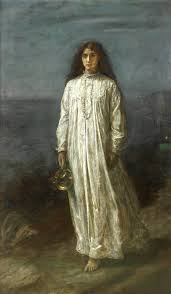
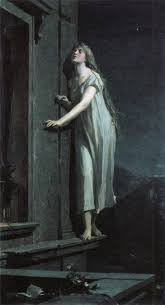
A current passed between them, not a spark, but a surge.

Madhavi spoke first, her voice unspooling like smoke. “At last. At last, my enemy.”

Riya’s jaw clenched. The words came out involuntarily. “Hateful woman. Selfish and old. You want my life to be your epilogue.”

“You devoured my youth.” Madhavi’s hands flexed. Her eyes had a glassy look, but they were inanimate. Still. “You, who blames me for her cage.”

“You never fought! You just… folded.”

“And you?” Madhavi’s laugh was a dry leaf crushed underfoot. “You run, but only in circles. You think I don’t see your applications? Your hidden bank account?”

Riya’s breath hitched. The garden seemed to pulse, neem leaves trembling, earth exhaling decades of buried words.

“I could’ve left,” Madhavi whispered. “After he died. Gone back to school. But you-”

“Don’t.”

“– you needed stability. Security.”

“I needed a mother, not a martyr!”

Lightning flashed. For an instant, Madhavi’s face was a mask of cracks. Then, a dog barked, the neighbor’s irritating new resident, and the spell snapped.

Madhavi blinked, rain dripping from her lashes. “Is that you, darling?”

Riya hugged herself, shivering. “Yes, Ma.”

And then, as if nothing had happened, they went back inside. They climbed the stairs in silence, leaving wet footprints that evaporated by dawn.

.

[1] Puffed rice

[2] Novel by Sylvia Plath published in 1963 under the penname of Victoria Lucas

[3] Prayer


Spandan Upadhyay
 is a new writer whose work captures the vibrant nuances of everyday life. With a deep appreciation for the human experience, Spandan’s stories weave together subtle emotions and moments of introspection. Each of his stories invite readers into a world where ordinary occurrences reveal profound truths, leaving a lasting impact.

.

PLEASE NOTE: ARTICLES CAN ONLY BE REPRODUCED IN OTHER SITES WITH DUE ACKNOWLEDGEMENT TO BORDERLESS JOURNAL. 

Click here to access the Borderless anthology, Monalisa No Longer Smiles

Click here to access Monalisa No Longer Smiles on Kindle Amazon International
Categories
Essay

The Comet’s Trail: Remembering Kazi Nazrul Islam

By Radha Chakravarty    


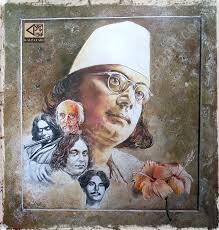
The abiding image of Kazi Nazrul Islam (1899-1976) is that of the “Rebel Poet,” who defines himself as a fiery comet streaking across the firmament, emblazoning in the sky a message of revolutionary change. Unlike Rabindranath Tagore, Nazrul was not born into social and intellectual privilege. He has been described, in fact, as “the ‘other’ of the elite Kolkata bhadralok”.[1] Born in Churulia village in the Bardhaman district of Bengal, Nazrul was the son of the head of a mosque, studied in an Islamic school, and during his youth, joined a Leto group, a travelling band of local performers. When in high school, he was recruited into the British army, and served in Karachi. Even after he returned to Bengal as a young poet who had already acquired fame and repute, he remained something of an outsider to the intellectually sophisticated world of the literati. It was from this position of an outsider that he fashioned his own image as the bidrohi or ‘Rebel poet’ who challenged the structures of the political, social, cultural and literary establishment with the sheer force of his iconoclastic writings.

Though best known as a poet, composer and revolutionary, Nazrul’s oeuvre also includes novels, essays, stories, editorials and journalistic pieces on a remarkable variety of topics. He was also a lyricist and composer, creator of the iconic genre called “Nazrulgeeti”. Nazrul’s brilliant literary career lasted from 1919 to 1942, when illness brought it to a sudden end. During this short span of time, he wrote on an amazing range of subjects, including politics, nationalism, social change, religion, communalism, education, philosophy, nature, love, aesthetics, literature and music. He saw it as his mission to arouse public awareness about pressing issues, and to jolt them out of their complacency and general apathy. Remembering Nazrul on the 48th anniversary of his death, it is daunting to think about his extraordinary legacy, but also a timely moment to reflect upon his significance for our own times.

In his political stance, Nazrul argued passionately in favour of armed struggle for total independence from colonial rule, rejecting the Gandhian path to advocate a freedom won via armed resistance. The trope of violence recurs in his writings. Yet his apparent espousal of the principle of destruction springs from a utopian dream of constructive change. “Reform can be brought about, not through evolution, but through an outright bloody revolution,” he says in the essay ‘World Literature Today’. “We shall transform the world completely, in form and substance, and remake it, from scratch. Through our endeavours, we shall produce new creation, as well as new creators”.[2]

Nazrul’s ideas on education counter the colonial pattern, advocating instead a curriculum that draws on indigenous contexts and models. He feels that the new education policy should emphasise empathy, inclusiveness and heterogeneity, with a special focus on psychological and emotional development. “It is our desire that our system of education should be such that it progressively makes our life-spirit awakened and alive,” he says in ‘A National Education’, adding: “… We would rather produce daredevils than spineless young men.” [3]

Inclusiveness and acceptance of heterogeneities are central to Nazrul’s vision. During his stint as a soldier in Karachi in his young days, he became interested in Marxist thought. The influence of this line of thinking can be felt in his emphasis on economic egalitarianism, and his passionate support of the cause of the downtrodden peasantry, particularly in his journal Langal. Following the 1926 riots in Kolkata, he expresses his anguish at the communal antagonism between Hindus and Muslims, critiquing different forms of orthodoxy in both religions. In the poem ‘Samyabadi (Egalitarian)’ [4], he declares:

I sing the song of equality—
Where all divisions vanish and barriers dissolve,
Where Hindu-Buddhist-Muslim-Christian
merge and become one …

Nazrul was also a supporter of women’s rights. In his poetry, he speaks of equality between men and women. In ‘Nari (Woman)’ he argues: “If man keeps woman captive, then in ages to come, / He will languish in a prison of his own making”.[5]

Not surprisingly, Nazrul’s fearless, unconventional attitude aroused hostility in many quarters. His bold, outspoken magazine Dhumketu enraged the British. The journal was banned, and Nazrul condemned to rigorous imprisonment. At his trial in 1923, he delivered a resounding rejoinder in his speech ‘Rajbandir Jabanbandi (Deposition of a Political Prisoner)’.  He remained a thorn in the flesh for the British administration because of his revolutionary views. Nazrul’s religious views also raised many hackles. He married Ashalata Sengupta, or Pramila, who belonged to the Brahmo Samaj. This antagonised conservative Hindus as well as orthodox Muslims.

Nazrul’s success as a writer, especially Rabindranath Tagore’s appreciation of his work, also caused jealousy among contemporary writers. For Tagore had dedicated his play Basanta to Nazrul, and also sent a telegram to him when he was in prison, exhorting him to give up his hunger strike. In 1922, Tagore had written a poem addressed to Nazrul, which appeared in successive issues of the journal Dhumketu[6]:

Come, O shining comet! Blaze
Across the darkness, with your fiery trail.
Upon the fortress-top of evil days,
Let your victory-pennant sail.
What if the forehead of the night
Bear misfortune’s sinister sign?
Awaken, with your flashing light,
All who lie comatose, supine.

Rabindranath Tagore’s recognition of Nazrul’s talent created a lot of envy in literary circles. In 1926-27, parodies of Nazrul’s poetry started appearing in Shanibarer Chithi, a journal published by the Tagore circle. It came to be rumoured that Tagore had not liked Nazrul’s use of the Persianate word khoon (blood) instead of the Sanskritised word rakta, in his composition ‘Kandari Hushiar’. This gave rise to a controversy that became known as khooner mamla (the bloody affair), which drew a strong reaction from a deeply perturbed Nazrul, in the shape of an essay ‘Boror Piriti Balir Baandh” (A Great Man’s Love is a Sandbank)’, in which he blamed Tagore’s followers for the entire misunderstanding. The situation was resolved through the mediation of friends, and relations between Tagore and Nazrul remained cordial. When Tagore died in 1941, Nazrul broadcast a moving elegy, “Robi-Hara”, on Calcutta Radio.

In some ways, Nazrul was ahead of his time. Not many people know that he was aware of environmental issues and the threat of climate change, pressing problems in our own times. In ‘The Day of Annihilation’, he writes in a prophetic vein, of global warming, dissolving ice-caps and a changing ecology, cautioning his readers that if humans exploit the planet, we will eventually be responsible for the destruction of life on earth.

In Nazrul’s life and writings, we encounter the constant pull of contraries. His consciousness was simultaneously rooted in local culture, and infused with a broad transnational spirit. He felt inspired by movements in other parts of the world, such as the Turkish Revolution, the Irish Revolution and the Russian Revolution. In the essay ‘Bartaman Viswasahitya (World Literature Today)’, we discover his awareness about literary developments across the globe. In his political writings he espouses the path of violence, but he also composes exquisitely tender love songs, devotional songs drawing on both Hindu and Muslim imagery, and songs about the beauty of nature.

Nazrul’s style is a volatile mix of colloquial, idiomatic expressions, formal Bengali, Sanskrit and Persianate vocabulary, a smattering of English, and multiple registers of language. His polyglot sensibility also surfaces in his practice as a translator. He translated Omar Khayyam and Hafez from Persian into Bengali. His translations from Arabic into Bengali include 38 verses of the Qu’ran, part of the Mirasun Nagmat (a treatise on Hindustani classical music) and some poems. He translated Whitman’s ‘O Pioneer’ from English into Bengali. He is also known for his innovative ghazals in Bengali.

In 1942, Nazrul suddenly lost his speech. His illness brought his literary life to an abrupt end. All the same, the impact of his writings continued to be felt. In the Bangladesh Liberation War of 1971, the freedom fighters adopted Nazrul’s music as a source of inspiration. He was later declared the National Poet of Bangladesh. Today, while Nazrul’s poems and songs continue to delight and inspire, the true extent of his achievement remains in shadow. It is time for a comprehensive reappraisal of this much underestimated literary genius, because his writings have so much to offer us in our present world.

[1] The Collected Short Stories of Kazi Nazrul Islam, ed. Syed Manzoorul Islam and Kaustav Chakraborty (Hyderabad: Orient Blackswan, 2024), p. xviii. Bhadralok translates to gentleman

[2] Kazi Nazrul Islam, Selected Essays, translated by Radha Chakravarty (New Delhi: Penguin Random House, 2024), p. 137.

[3]  Kazi Nazrul Islam, Selected Essays, trans. Radha Chakravarty (2024), p. 60.

[4] Translation by Radha Chakravarty

[5] Translation by Radha Chakravarty

[6] The Essential Tagore, ed. Fakrul Alam and Radha Chakravarty. Cambridge, Massachusetts: Harvard University Press, 2011, pp. 115-116; Translation mine.

Radha Chakravarty is a writer, critic, and translator. She has published 23 books, including poetry, translations of major Bengali writers, anthologies of South Asian literature, and critical writings on Tagore, translation and contemporary women’s writing. She was nominated for the Crossword Translation Award 2004.

.

PLEASE NOTE: ARTICLES CAN ONLY BE REPRODUCED IN OTHER SITES WITH DUE ACKNOWLEDGEMENT TO BORDERLESS JOURNAL

Click here to access the Borderless anthology, Monalisa No Longer Smiles

Click here to access Monalisa No Longer Smiles on Kindle Amazon International
Categories
Excerpt

Out of Sri Lanka

Title: Out of Sri Lanka: Tamil, Sinhala and English Poetry from Sri Lanka and its Diasporas 

Editors: Vidyan Ravinthiran, Seni Seneviratne and Shash Trevett. 

Publisher: Penguin India (Vintage)

AAZHIYAAL
(b. 1968)

Aazhiyaal (the pen name of Mathubashini Ragupathy) was born in Trincomalee in Eastern Sri Lanka. She taught English at the Vavuniya Campus, Jaffna University, before moving to Australia in 1997 where she worked for two decades in the IT sector and commercial management in Canberra. Aazhiyaal has published four collections of poetry in Tamil: Uraththup Pesa (2000), Thuvitham (2006), Karunaavu (2013) and Nedumarangalaai Vazhthal (2020), the last honoured by Canada’s Tamil Literary Garden. Her poems have appeared in anthologies and have been translated into several languages. She in turn has translated Australian Aboriginal poetry into Tamil (Poovulagaik Kattralum Kettalum, 2017). Aazhiyaal writes about women’s place within patriarchy and uses her work to make sense of the war in Sri Lanka: ‘I believe that poetry is the antidote to the present rat-race. It is needed, it is necessary.’


Unheeded Sights

After the rains
the tiled roofs shone
sparklingly clean.
The sky was not yet minded
to become a deeper blue.
The tar roads reminded me
intermittently of rainbows.
From the entire surface of the earth
a fine smoke arose
like the smoke of frankincense, or akil wood,
the earth’s scent stroking the nostrils,
fragrant as a melody.

As the army truck coming towards me
drives away,
a little girl transfers her candy-floss
from one hand to the other
raises her right hand up high
and waves her tiny fingers.

And like the sweet surprise
of an answering air-letter
all the soldiers standing in the truck
wave their hands, exactly like her.

The blood that froze in my veins
for an instant, in amazement,
flows again rapidly, asking aloud,
‘War? In this land?
Who told you?’

[tr. from Tamil by Lakshmi Holmström]


BASHANA ABEYWARDANE
(b. 1972)

Rohitha Bāshana Abeywardane was a member of the founding editorial board and later editor in chief of the Sinhala alternative weekly newspaper Hiru. In 2003, he was one of the activists who organised the Sinhala-Tamil Art Festival. His journalistic commitments brought on threats to his life, and he had to leave Sri Lanka. He continues to publish and coordinates Journalists for Democracy in Sri Lanka, an organisation founded by journalists in exile. Following a stay in the Heinrich Böll House, Langenbroich, Abeywardane took part in the PEN Writers in Exile Program from September 2007 to August 2010. Today, he lives in Germany with his wife.


The Window of the Present

Nightmares, long dead,
peer through the shattered panes
of the window of the present.

The dead of the south, killed on the streets,
with bullet-riddled skulls,
walk once again, through an endless night,

and those of the north drowned in deluges of fire
when rains of steel drench their unforgiving earth,
gaze through the shards of glass empty eyed;

as slaughtering armies, prowl under starless skies,
upholding sovereignty
with blood-soaked hands.

PACKIYANATHAN AHILAN
(b. 1970)

Born in Jaffna in the north of Sri Lanka, Packiyanathan Ahilan has lived through the thirty-year civil war. An academic as well as a poet, he has published three collections of poetry and is Senior Lecturer in Art History at the University of Jaffna. As well as writing about the visual arts, poetry, theatre and heritage, he curates art exhibitions and is co-editor of Reading Sri Lankan Society and Culture (Volumes 1 & 2). Ahilan’s poetry is sparse and staccato, like a heartbeat: he is one of the most influential poets writing in Tamil in Sri Lanka today.


Days in the Bunker III

Good Friday.
The day they nailed you
to the cross.

A scorching wind
blew across the land and the sea.
One or two seagulls
sailed in an immaculate sky.
The wind
howling in the palm trees
spoke of unfathomable terror.
That was the last day of our village.

We fishermen came ashore,
only the waves
returned to the sea.
When the sun fell into the ocean,
we too fell
on our knees
and wept.

And our lament
turned slowly into night.

In the distance
our village was burning
like a body being cremated.

Good Friday.
The day they nailed you
to the cross.

[tr. from Tamil by Sascha Ebeling]


A Poem about Your Village and My Village

1
I do not know.
I do not know if your village
is near the ocean with its wailing waves
or near a forest.
I do not know your roads
made from red earth and
lined with tall jute palms.
I do not know
the birds of your village
that come and sing in springtime.
I do not know
the tiny flowers along the roadsides
that open their eyelids when the rains pour down.
I do not know the stories
you tell during long nights
to the sound of drumbeats
or the ponds in your village
where the moon goes to sleep.

2
Tonight,
when even the wind is full of grief,
you and I know one thing:
Our villages have become
small
or perhaps large
cemeteries.
The sea with its dancing waves
is covered with blood.
All forests with their
trees reaching up to the sky
are filled with scattered flesh
and with the voices of lost souls.
During nights of war
dogs howl, left to themselves,
and all roads and the thousands
of footprints our ancestors left behind
are grown over with grass.
We know all this,
you and I.
We now know about
the flowers that died,
the abandoned lines of poetry,
the moments no one wants to remember.


3
But
do you know
if the burnt grass
still has roots,
or if the abandoned poems
can still be rooted in words?
If, like them, you do not know
whether our ancient flames
are still silently smouldering
deep down in that ocean
covered with blood,
know this today:
They say that
after he had lain in hiding
for a thousand years
one day
the sun rose again.

[tr. from Tamil by Sascha Ebeling]

ABOUT THE BOOK:

Out of Sri Lanka shines light upon a long-neglected national literature by bringing together, for the first time, Sri Lankan and diasporic poetry written in and after Independence.  Featuring over a hundred poets writing in English, or translated from Tamil and Sinhala reshapes our understanding of migrational poetics and the poetics of atrocity. Poets long out of print appear beside exciting new talents; works written in the country converse with poetry from the UK, the US, Canada and Australia. Poems in traditional and in open forms, concrete poems, spoken word poems, and experimental post-lyric hybrids of poetry and prose, appear with an introduction explaining Sri Lanka’s history.

There are poems here about love, art, nature – and others exploring critical events: the Marxist JVP insurrections of the 1970s and 80s, the 2004 tsunami and its aftermath, recent bombings linked with the demonisation of Muslim communities. The civil war between the government and the separatist Tamil Tigers is a haunting and continual presence. A poetry of witness challenges those who would erase, rather than enquire into, the country’s troubled past. This anthology affirms the imperative to remember, whether this relates to folk practices suppressed by colonisers, or more recent events erased from the record by Sinhalese nationalists.

 ABOUT THE EDITORS:

Vidyan Ravinthiran was born in Leeds, to Sri Lankan Tamils. His first book of poems, Grun-tu-molani (Bloodaxe, 2014), was shortlisted for the Forward Prize for Best First Collection, the Seamus Heaney Centre Poetry Prize and the Michael Murphy Memorial Prize. His second, The Million-petalled Flower of Being Here (Bloodaxe, 2019) was shortlisted for the Forward Prize for Best Collection, the T.S. Eliot Prize and Ledbury Munthe Poetry Prize for Second Collections. After posts at Cambridge, Durham and Birmingham, he now teaches at Harvard.

Seni Seneviratne, a writer of English and Sri Lankan heritage published by Peepal Tree Press, with books including Wild Cinnamon and Winter Skin (2007)The Heart of It (2012), and Unknown Soldier (2019), which was a Poetry Book Society Recommendation, a National Poetry Day Choice and highly commended in the Forward Poetry Prizes 2020.

She is currently working on an LGBTQ project with Sheffield Museums entitled Queering the Archive and her latest collection, The Go-Away Bird, was released in October 2023. She lives in Derbyshire.

Shash Trevett is a Tamil from Sri Lanka who came to the UK to escape the civil war. She is a poet and a translator of Tamil poetry into English. Her pamphlet From a Borrowed Land was published in 2021 by Smith|Doorstop.

Shash has been on judging panels for the PEN Translates awards and the London Book Fair, and was a Visible Communities Translator in Residence at the National Centre for Writing. Shash is a Ledbury Critic, reviewing for PN Review and the Poetry Book Society and is a Board Member of Modern Poetry in Translation. She lives in York.