Ratnottma Sengupta revisits an exhibition full 25 years later
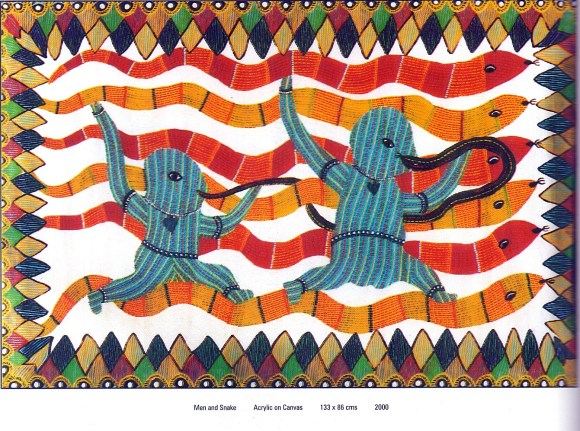
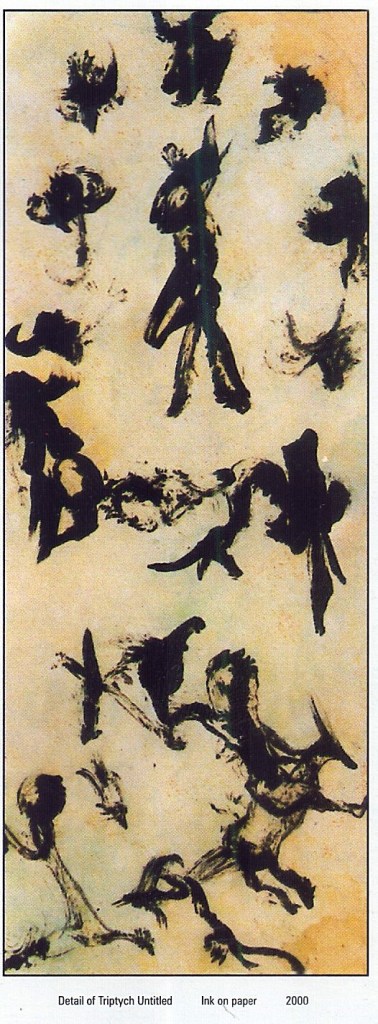
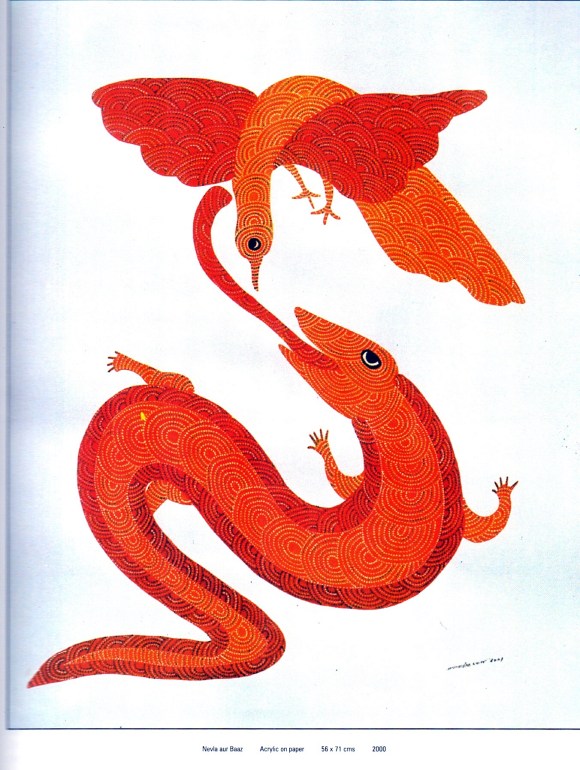
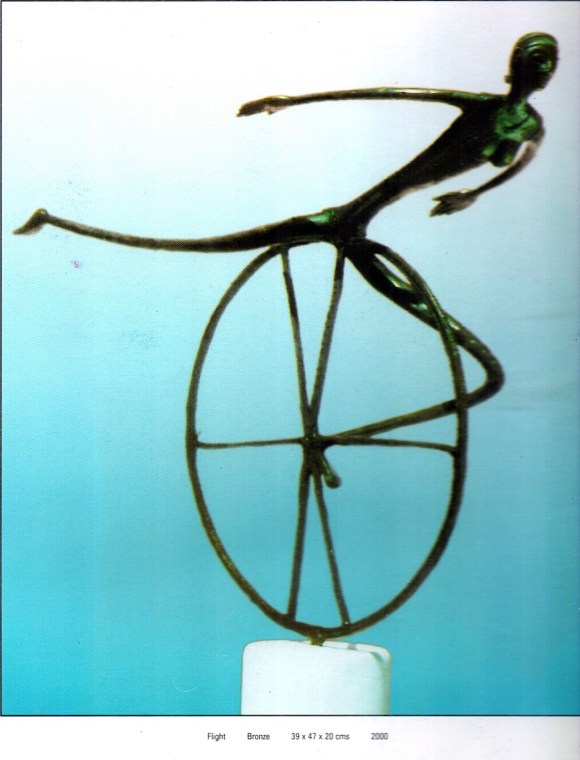
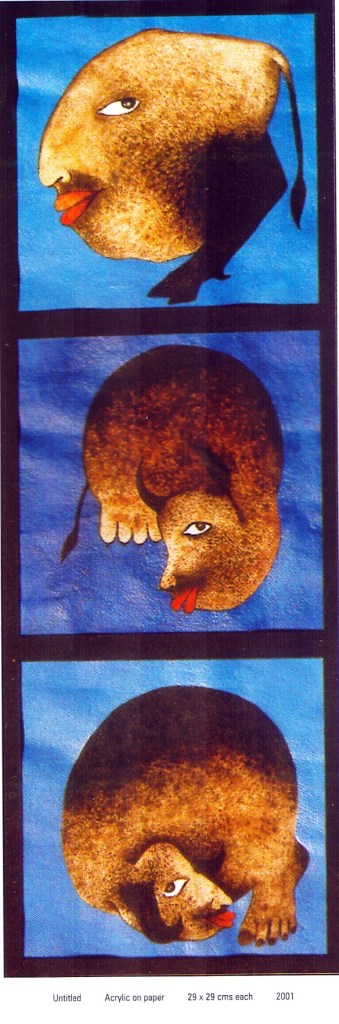
Images from exhibits at Anadi . Provided by Ratnottama Sengupta
On November 1 of 1956 was born a state in Central India called Madhya Pradesh. And 44 years later, on exactly the same day of November 1, in the year 2000 it was remapped. A new state — Chhattisgarh — was carved out of the land that had been home to the oldest Indians: the men and women who had peopled the caves at Bagh and Bhimbetka.
Standing at the threshold of that new beginning, I had curated an exhibition titled Anadi – that which has no beginning and, therefore, no end. The exhibition card was designed by M F Husain who came on the inaugural day in Delhi. The next day was graced by the presence of Madhavrao Scindia, scion of the royal family that continues to throw up political leaders. I was fortunate to have friends like collectors Anand Agarwal and H K Kejriwal, bureaucrats Bhaskar Ghose and Sarayu Doshi, art lovers like poet Gulzar and artists like Yusuf Arakkal. Happily, then, the exhibition travelled to Birla Academy in Kolkata to Chitrakala Parishath in Bangalore to the National Gallery of Modern Art in Mumbai. And with it travelled a batch of youngsters who were soon to be among the most sought after names in Indian Contemporary Art.
What made that exhibition so special? The card? The multi-venue display? The star viewers? The exhilarating combination of tribal paintings, figurative sculpture, and abstract images? Twenty five years later, I will look back to find an answer.
Images from exhibits at Anadi . Provided by Ratnottama Sengupta
At the intersection of two millennia I was amazed to note there was no rupture in continuity. Anadi offered a fresh look at a continuum that lives on beyond the geopolitical redefinition, because it began at a time when Chhattisgarh was not Madhya Pradesh, nor the Central Province of the Raj. Bhopal, Indore, Raipur, Jagdalpur, Sanchi, Vidisha, Malwa… these cities had no chief minister back then, nor a Prime Minister. Why, there were no Begums nor a Buddha. No Baj Bahadur loved a Roopmati nor did Kalidasa send a Cloud as Messenger. It was a time when the intrepid fingers that harnessed stones and hunted hides also painted rocks to sing of life. In the process – around 10,000 BCE – they crafted the rockbed of Indian Art at Bhimbetka, the UNESCO World Heritage Site mere miles away from Bhopal.
Bare lines that captured with only a twist and a turn the vigor of hunting and the verve of dancing, rock art is that elusive genre which is narrative, figurative and abstract – all at one go. And that is a characteristic common to the tribal stream of art which flourishes in the state from a forgotten past. There is a story in every figure painted by Bhuri Bai or Sukho Korwa. She paints a cart and tells you of the festival day when on its wheels it goes round habitats, collecting all the bimari and driving illness out of the village. He paints a bird that pounces on a snake which devours a rat, recounting the lifecycle that sustains ecological balance. But where is the third dimension? Where’s the likeness to the world of five senses? We see no effort here to evoke either. Instead, there is a stylization which is unique to the region that is home to the Bhil, Gond, Sahariya, Baiga, Saur and other tribes. A stylisation that abstracts the essence of the physical reality they celebrate through colour and line.
Images from exhibits at Anadi . Provided by Ratnottama Sengupta
Dots and crosses, circles and squares all come into play as the vivacious blues and reds, yellows and greens acquire life. A line is not simply a straight line or curve: that would be an unappetising repetition. The quest for variety and individuality finds Kala Bai, Lado, Sumaru break up the lines into an intricate arrangement of countless motifs. When the subject is the same, as too the colour, it’s the dots and crosses, dashes and stars that give the work the imprint of individuality. In the process, these artists who work in a community and send off their creations to markets in distant cities, have worked out a way of ‘patenting’ artistic property. Tradition did not require them to ever sign off a work with their names. In the age of copyright awareness and intellectual property rights, they might put their signatures on the canvas – but the unmistakable imprint of the artists lie in the manner of their assembling the familiar patterns.
That, make no mistake, is the sign of a master, be he in the tribal mould or a modernist. For corroboration, we have only to look at a painting by Maqbool Fida Hussain, N S Bendre or Syed Haider Raza. Madhuri or Mahabharat, Gandhi or Indira, M F Husain constantly painted figures. Eminent and easily recognised ones at that. And yet, they lived not in the details of their features but in the lines and colours that spelt ‘Husain’ to seasoned viewers. Likewise Bendre’s forms had little concern for photographic realism. In Raza’s case, it is the arrangement of colourful geometrical bindus (circles) and squares alone that speaks of the artist. So, regardless of whether or not there is a ‘McBull’ or ‘Bendre’ inked on the canvas, we readily identify these masters who, incidentally, all came from this same state of Madhya Pradesh.
Images from exhibits at Anadi . Provided by Ratnottama Sengupta
Note one more thing about these names. Each of them had set new watersheds for Indian contemporary art. All of them had opened up new avenues for artists who came after them. Bendre, the first to head the art education at the Maharaja Sayajirao University of Baroda, gave not just one more centre for mastering the brush. He gave shape to an institution which still assimilates the best of the home and the universe, giving the MSU artists a rare acceptability in India and in the West. Raza, who lived in Paris for years and years, did not sever his umbilical cord with this soil, yet carved a niche for Indianness in the Mecca of contemporary art. And Husain? The life as too the art of this ‘Picasso from Indore’ had become a legend in his own lifetime. Who else but MF could raise the high water mark at auctions, again at again, at home and abroad? Who but him could open up the markets for Indian artists, including those who preceded him like Jamini Roy?
Images from exhibits at Anadi . Provided by Ratnottama Sengupta
Talking of the masters who opened vistas, especially in the context of Madhya Pradesh, one comes to J Swaminanthan who facilitated a two-way transaction. While holding the reins of Roopankar Museum in Bhopal, he assimilated tribal art to such an extent that he could understand it, explain it, talk about it, write about it and paint after them, using their earth colours, and the bareness of their lines. At the same time, the outsider who became an insider gave, through Bharat Bhavan, all of Madhya Pradesh a new standing in the realm of contemporary art. Artists from all over the country would congregate in Bhopal with their art, exhibit it, discuss it threadbare in seminars, impart it to those keen to learn. Small wonder, the state boasts a host of artists like Akhilesh and Anwar, Seema Ghuraiya and Manish Pushkale, Yogendra and Vivek Tembe, Jaya Vivek and Jangarh Shyam. Artists who steal the attention of the world today.
This breed, which was born with the emergence of the state, came of age in artistic terms as the province consolidated its presence on the marquee. And an overwhelming number of them express themselves in just lines and colours. They care not for things like market – which seems to have an insatiable appetite for figurative art. Nor for the narrative tradition of the forefathers who painted on rocks. These neo-masters are all distilling forms, extracting experiences, working out their own equations with abstraction.
But, come to think of it, isn’t this exactly what the original artists of this land – and every other land on earth – set out to do when they picked up the sharpened tool that was millennia away from the paint brush?
Ratnottama Sengupta, formerly Arts Editor of The Times of India, teaches mass communication and film appreciation, curates film festivals and art exhibitions, and translates and writes books. She has been a member of CBFC, served on the National Film Awards jury and has herself won a National Award.
.
PLEASE NOTE: ARTICLES CAN ONLY BE REPRODUCED IN OTHER SITES WITH DUE ACKNOWLEDGEMENT TO BORDERLESS JOURNAL
A stock taking of women in Bengali cinema – as protagonists, actors and directors – by Ratnottama Sengupta
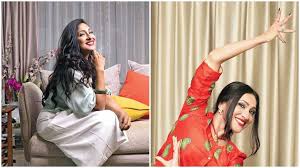
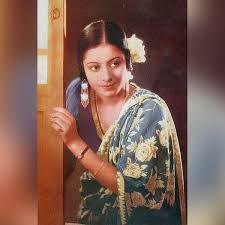
Actress Rituparna SenguptaLate actress Kanan Devi (1916-1992)From Public Domain
“Mother, allow me to go and get a slave for you,” this conventional line may have been uttered by the husband essayed by Anil Chatterjee in Mahanagar (The Big City, 1963), as he set out to marry Aarati alias Madhabi Mukherjee. Women of those years had no problem accepting such husbands as their Lord and Master. But the lead actress of Ray’s film evinced determination of a different order. That’s why even today, 52 years after its release, Mahanagar remains so contemporary.
Time was when women in Indian — rather than just Bengali — films were typecast as mother, sister or beloved of a male character. The mother would sacrifice her creature comforts, her career, her every happiness for her son — but if she cared for her brother, she would be rebuked (Mejdidi, Second Sister, 1950; 2003). If she offered shelter to her orphaned sister, she would have to ‘repay’ her in-laws for the favour by making her work overtime (Streer Patra, The Wife’s Letter, 1972). It was ‘her’ responsibility to stay ‘pure’. If she were ‘tainted’, she had no option but to embrace death. The long-suffering Indian woman has left way behind her ‘helpless’ (abala) definition: No Nirbhaya needs to die of shame if she’s the victim of rape. The silver screen is reflecting this transformation. She’s no goddess (devi) nor a slave (dasi) — she’s proud to be what she is: a woman (nari).
But a woman is always more vulnerable, more fragile compared to a man. Reason? Could be biological, economic, social structure, or her lack of confidence born of mental malnutrition. Perhaps that is why women have provided material for intense human drama. At times she is Lady Macbeth or Lady Chatterley, at other times she is Mrinal (of Streer Patra), or Ashapurna Devi’s Subarnalata (1981). Besides, Bengal worships Goddess Durga — in this state, women are simultaneously Saraswati, the goddess of learning; Lakshmi, the deity of prosperity; and Kali, the icon of destruction. That may be why, from the beginning of Bengali cinema, lead personalities have enjoyed multidimensional projection. Sometimes a mere ‘actress’ becomes a mouthpiece for a socially sensitive and relevant issue, sometimes she is the face of psychological conflict, sometimes she is a philosopher, preacher.
Un-Covered
There are many different ways to approach the projection of women in Bengali films. Literature has always been the first to convey their self-sufficiency — be it on this soil or elsewhere. Gems mined from Bengali literature provided the raw material for pioneers like Naresh Mitra (1888-1968), Pramathesh Barua (1903-1951), Debaki Kumar Bose (1898-1971), Nitin Bose (1897-1986), Bimal Roy (1909-1966) — giving us landmarks such as Jogajog (Connections, 1943; 2015), Durgesh Nandini (Queen of the Fortress, 1956), Bishabriksha (The Poison Tree, 1922; 1983), Debi Chaudhurani (1974; upcoming 2025), Biraj Bou (Biraj, the Wife, 1972), Pather Dabi (The Right of Way, 1977), Udayer Pathey (Towards the Dawn, 1943). However, the minute we utter the two words — ‘women’ and ‘literature’ — in one breath, we think Pratham Pratishruti (The Early Promise, 1971) and Subarnalata (1981). Together they are a flawless portrayal of social transformation and women’s emancipation.
Dinen Gupta had filmed Pratham Pratishruti even before Ashapurna Devi had won the Jnanpith Award. Its protagonist Satyawati kept at it but did not succeed in altering the social dynamics of Women’s Education. Her daughter Subarnalata is married off in her childhood, into an urban family with rustic mindset. Alone, unsupported she fights the male chauvinists (and this includes the women too!) who were unfamiliar with the word ‘self-identity’; whose only understanding of women’s honour, sanman, comprised of ghomta-sindoor, the veil and the vermilion. Despite her efforts, how often do we hear of a Bakul (Subarnalata’s daughter) who rides a bike to drop off her elder brother to his college?
Streer Patra devolves around ‘Mejo Bou’ Mrinal (Madhabi Mukherjee). She has the freedom to offer shelter to her sister-in-law’s sibling but not to love, educate, and honour her. When the sister, pushed into marriage with a mentally deranged person, commits suicide, Mrinal leaves home in protest. But her protest is not a sentimental reaction, so she does not end her life in the ocean. Nor does she sign off her letter as ‘Mejo Bou’ — the Second Bride of the joint family – which was till then her only identity. She is now ‘Charantalashray Chinna Mrinal’, one who has lost the protection of her husband’s feet.
*
Long before Purnendu Pattrea, Bimal Roy had set an example in ‘deconstructing’ the well-entrenched structure of male domination even in wealthy families. When it came in 1943, Udayer Pathey had broken several norms: Jyotirmoy Roy was an unknown writer, Binata Roy was not a conventional beauty. As the daughter of an industrialist — read, a 20th century princess — she takes up the fight for labourer’s rights and leaves the shelter of her father and brother to make a home with a ‘hired’ writer. She was emboldened by her predecessors like Kanan Devi who became a star in Mukti (Liberation,1937).
Rebellion need not necessarily be a battle — won or lost — as Sujata (1974) showed. Litterateur Subodh Ghosh, who created the character, imagined her as a sweet, caring persona, who is alert to every little need of her foster family. But, despite all her care and love, she doesn’t become ‘a daughter’ to the parents she dotes on. Her fault? She is born of ‘untouchable’ genes. An even bigger fault? She is loved by the man whom the foster parents want to see as the husband of their biological daughter. Film director and writer, Pinaki Mukherjee, fired away with this double-barrel gun although he knew it was impossible to overshadow Nutan’s performance in Bimal Roy’s Sujata (1959).
Director is Special
Follow the director and you land at the door of Satyajit Ray. If his filmography opens with Pather Panchali (Song of the Road, 1955), his depiction of the mother, Sarbajaya, opens the pantheon to women who are found in any middle-class home. Women who are not dressed like the shiny stars of saas-bahu shows but cringe nevertheless when it comes to feeding their aged mother-in-law. Women who have no big dreams for their children but to protect them from any hint of slander by the neighbours.
Half a century later Mahanagar remains a head-turner. Its protagonist Aarati is a working woman whose pay-cheque keeps the kitchen fire going. But this does not place a halo around her head. Instead, society crinkles its brow at her. Still, she does not shy from protesting a wrong done to her colleague. Still, she does not think twice before turning in her resignation. She is not scared of the dark days ahead — because she has light within. She has confidence in her own entity.
Prior to that Ray had etched with care the homemaker Charulata (1964). She too is a housewife but from another world, in terms of both time and social status. The educated wife of a wealthy intellectual — an editor who has no time to chat with his wife or hear her out — she sews, she writes, she is published in journals… If the devotion of such a woman finds an anchor in her brother-in-law, what would the world say of the ‘homebreaker’?
Charu’s husband Bhupati must shoulder the blame for wrecking the marriage, but Nikhilesh (Victor Banerjee) of Ghare Baire (The Home and the World, 1984)? The zamindar stood by his wife when Bimala (Swatilekha Sengupta) stepped out of the inner courtyard and wedded herself to the nationalist fervour of Sandip (Soumitra Chatterjee). Perhaps that is why, when she realises that Sandip loves himself far more than his motherland, the disillusioned wife returns to her original ‘guru’ — her husband. There is no shame nor despondency of defeat in this, for this is not regressive, it is merely a ‘course correction’.
*
Ritwik Ghatak, a contemporary of Ray, envisaged women as the Lakshmi-Saraswati-Kali of a partitioned Bengal.
Nita (actress Supriya Devi) in Meghe Dhaaka Tara (The Cloud Capped Star, 1960) earns to feed her parents, marry off her sister, build her brother as a vocalist… But who cared for her love? Her dreams? Her sheer desire to live? At the other end of the spectrum is Sita (Madhabi Mukherjee in Subarnarekha, 1965). She had held her fatherly elder brother’s hand when the child had to seek refuge across the barbed wires. She sacrificed that secure shelter (of her brother) to her love. When that love proved ephemeral, she sought survival in the world’s oldest profession. When that profession placed her face to face with a fallen angel — her brother — she turned into Kali, the destroyer.
Mrinal Sen’s Baishe Shravan (The 22nd of Shravan, 1960) was an essay in marital discord in the disjointed times of war. But times change, and with that going out to work becomes routine for women in Bengal. No one looks askance — so long as she returns home by nightfall. For, that is one routine that hasn’t changed: even today, exceptions to it are meant only for men. Even today, if a Nirbhaya is gang-raped, many react by asking, “Why was she out so late?!” So, when the breadwinner daughter in Ekdin Pratidin (And Quiet Rolls the Dawn, 1979) does not return home, she is branded a siren even before she is given a hearing.
Tapan Sinha has repeatedly pointed to women’s vulnerability. His Nirjan Saikate (The Desolate Beach, 1963) depicts the barren lives of single women, be they widows or spinsters. Jatugriha (The Inflammable Home, 1964) paints the pangs of legal separation and divorce. Adalat O Ekti Meye (The Law and a Lady, 1981) highlights the legal ‘molestation’ of a rape victim. Aapanjon (Dear Ones, 1968) bestowed a new kind of dignity on the uncared for senior widows. Wheel Chair (1994) became the symbol of struggle when a chairbound woman fights the injustice of a rape that leaves her incapacitated for life. Antardhan (Missing,1992) opened our eyes to the base trade in human flesh. And the Daughters of This Century (Satabdir Kanya, 2001)? Better not talk of them, Sinha might say, for like Kadambini of Jibito O Mrito (Alive and Dead), they have to die in order to prove they were living!
Aparna Sen, as a popular actress, did characterise some women of substance. She charmed us in Ekhane Pinjar (Caged Here,1971)as she slaved to provide her family a life of some worth. Much seen? Yes, it was a much seen reality in our midst. Shwet Patharer Thala (The Marble Plate, 1992), Prabhat Roy’s adaptation of Suchitra Bhattacharya, showed that despite the changed times, a widow’s is still a solitary struggle. A single shot in Paramitar Ekdin (House of Memories, 2000), under her own direction, makes her unforgettable. As the mother-in-law who loves fish, she’s chewing on a fishbone with deep satisfaction when she learns her husband is dead. “Over,” says the blank expression on her face, in her eyes, in her entire being, “no more fish.” That single look bespeaks sadness, disappointment, vacuum in the life of a Bengali widow. Why is it that a man does not stop having fish when his wife dies?
As a director Aparna uses the same fish, to establish a progressive mindset. When her daughter-in-law, Paromita (actress Rituparna), takes her to a restaurant and treats her to a fish fry, we viewers are delighted. She herself has suffered, so the daughter-in-law understands the mom-in-law’s suffering. Not for her the ‘revenge’ story of family dramas.
At the very outset Aparna Sen had given a fair indication of the road ahead. Elderly and lonely, Ms Stoneham in 36 Chowringhee Lane (1981) is poised against her ebullient, self-centred, even ruthless student Debasri Roy. The two worlds of seniors and youth clash again in Goynar Baksho.(The Aunt Who Wouldn’t Die, 2013). But this child widow, Pishima (the aunt), extracts every inch out of life. Even after death she demands her pound of flesh: she smokes, she bikes, she zealously guards her dowry, streedhan. She even encourages extramarital love! But, perhaps, Aparna Sen’s boldest statement is Paroma (The Ultimate Woman, 1985). Should a woman bury her sexuality simply because marriage has turned her into someone’s aunt or a sister-in-law? “No” — comes the unflinching reply.
*
Women are deprived, exploited. They protest, they rebel. They stride ahead alone and draft a path for others to follow. Their confidence gets a boost, they enlighten hide-bound males, transform mindsets. This is how we see women in Rituparno Ghosh’s oeuvre. He drew our attention towards several issues, but the empathy in his tenor led us beyond the immediate pre-occupation and endowed his scripts with such universality that free-thinking men, too, had no issues with them.
In Unishe April (Nineteenth April, 1994), the national honour of a Padmashri for Sarojini angers her daughter. Because? She chose to be a danseuse rather than a homemaker, and sent her daughter to a hostel so that she could dance on. Dahan (Crossfire,1997)sees Ramita molested by strangers on the street, but the man in her bedroom? What about him? Surely you won’t construe a ‘husband’s conjugal right’ as ‘marital rape’?! On the other hand, Jhinuk has to pay a price as the witness. She is put in the dock by the law of the land, and dropped by her boyfriend. Banalata in the Bariwali (The Landlady, 2000) has aged but not married. Her dreams of a family are somewhat fulfilled when a film unit comes to shoot in her ancestral mansion. She drapes a red-bordered sari and dons sindoor in her hair too, for a single shot. But that’s mere acting! The director’s praise and love for her too was acting! Kiron Kher as Banalata realises this when she sits in the darkened theatre, and finds the scene has been clipped out of the film. How many times will you be shortchanged, lady, emotionally too?
In Antarmahal (The Inner Chamber, 2005), Zamindar Jackie Shroff authorises a sacrificial yagna to ensure the continuity of his line with the birth of a son. And what is that sacrifice? In the presence of his first wife (Rupa Ganguly), he will copulate with his child bride (Soha Ali Khan). Night after night. Isn’t this mental as well as physical torture? So what! Isn’t he a zamindar and the husband too!
Dosar (Companion, 2006) sees the husband (Prosenjit Chatterjee), a corporate bigwig, returning with his secretary from a weekend retreat in his love nest. A massive accident leaves the woman dead, the husband bedridden, and the wife in a fix. Should she leave the helpless man, or restore life in the faithless marriage?
Even when All his Characters are Fictitious (Sab Charitra Kalponik, 2009), Rituparno Ghosh speaks an Eternal (Abahoman, 2009) truth: Women’s efforts to create an identity for themselves have been wrecked by men. Women have had to confront layer after layer of inhibition, prejudice, agony. But it is much worse to be a woman trapped in a male body, Rituparno showed in his last film, Chitrangada (The Crowning Wish,2012).
*
Bengali cinema was meant to be thus: modern, lively, brilliant. Viewers have said this time and again. After the release of Anuranan (Resonance,2006) Antaheen (The Endless Wait, 2009), Aparajita Tumi (You Undefeated, 2012) this was said for Aniruddha Roy Chowdhury. He has continuously shown that women ‘culture, nurture, explore’ life. Viewers had applauded when Bappaditya Bandopadhyay (1970-2019) handed over the right to ‘give away the daughter’ in marriage to the mother in Sampradan (The Offering, 2000). The director of films like Kaal (An Era, 2005) on human trafficking and Kantataar (Barbed Wire, 2005) on illegal migration, Bappaditya was ecstatic that in the present century, women are being recognised as ‘Researcher in Child Development and Interpersonal Relationships’. Women are morally superior, declares Srijit Mukherjee in Autograph (2010), when the jean-clad Srinanda (Nandana Sen) leaves her live-in partner (Indraneil Sengupta), for encashing the accidentally recorded confession of the star Arun Chatterji (Prosenjit) in an inebriated moment of weakness. Somnath Gupta projects a mofussil girl in Aadu (2011) who does not hesitate to write to the President of America to find out the whereabouts of her immigrant husband who went missing in Iraq after the outbreak of Gulf War 1. With Shunyo E Buke (Empty Canvas 2005), Kaushik Ganguly raises a question that still seeks an answer: Is a big-hearted woman less attractive than a big-chested one?
We have watched films that break stereotypes in startling ways. The protagonist of Atanu Ghosh’s Rupkatha Noy (Not a Fairy Tale, 2013) is a bride who flees home; an IT professional who admits to taking a life, and a gritty though little educated delivery girl at a petrol pump. Judhajit Sircar’s Khasi Katha (Saga of a Goat, 2013), centres around Salma, the motherless daughter raised in a convention bound Muslim family who works in a leather factory to feed her unemployed father and brother but fights to become a professional boxer!
The Actor is the Star
Irony, thy name is cinema. For, here, the deception of ‘acting’ must turn imagination into ‘real’. The personas are imagined, but they are rooted in our soil. Naturally, some characterisations remain with us forever. Thus, some actresses become the voice of women’s fight for emancipation. Suchitra, Supriya, Madhabi, Arundhuti, Aparna, Rituparna, Paoli –any of these actors in the central role promises a powerful document in the fight for women’s rights.
* It started even before Suchitra Sen (1931-2014), when Kanan Devi (1916-1002), Bharati Devi (1922-2011), Chhaya Devi (1914-2001) and Sabitri Chatterjee (1937) were playing at New Theatres, Chhayabani, Radha Films. We will return to Kanan Devi but meanwhile, let’s revisit Suchitra Sen. A married woman, mother of one, Mrs Sen became — and still remains — an icon, not only in the two Bengals but pan India. No gossiping with unit members, the detailing of her character, its costume, its co-actors kept her busy as long as she was in the studio. Understandably, her fame ignited jealousy and she was tarnished as temperamental, aloof, selfish…
Yes, unwilling to compromise in matters pertaining to her role, Mrs Sen would not spare even haloed producers like R D Bansal or Haridas Bhattacharya. But her glamorous dignity ensured a so-far unknown respect for actresses in Bengali filmdom, especially when her name was printed above Uttam Kumar’s, in posters pasted all over the town. Nylon sari, sunshades, short hair, sleeveless blouse — every expression of ‘modernity’ became Mrs Sen. She came to personify the middle-class Bengali woman who — married or not — could be a professional: journalist, nurse, doctor, singer, lawyer… On the other hand, the single-minded determination that characterised courtesan Pannabai and her hostel-educated daughter Suparna (Uttar Falguni, In Her Autumn, 1963), Rina Brown (Saptapadi/ Seven Steps, 1961), Archana (Saat Paake Bandha, Knotted by the Vows, 1961), and Radha (Deep Jwele Jai, To Light a Lamp, 1959) only reflected Mrs Sen’s own firmness of intent.
One Meghe Dhaka Tara alone was enough for Supriya Devi to shine through the annals of Bengali cinema. Add to that the appeal of Komal Gandhar (Soft Note on Sharp Scale, 1961). In many a film she is the beloved of matinee icon Uttam Kumar. What firmed her position was her boldness in accepting roles with negative shades. Be it Lal Pathar (The Red Stone,1964), Sanyasi Raja (The Monk Who Was a Monarch, 1975) or Mon Niye (All About Her Heart, 1969) — her presence gave a shine to both, the persona and the film.
* Sharmila Tagore went away to Bombay and Bollywood gobbled her, but she remains evergreen as Aparna of Apur Sansar (The World of Apu, 1959), the newly wedded bride in Devi (Goddess, 1960), the journalist in Nayak (The Hero, 1966), the questioning eyes in Seemabaddha (Company Ltd, 1971) and the irrepressible, dark-complexioned tomboyish Ghetu of Chhaya Surja (Overshadowed, 1963). If Ray films cast her as the silent conscience speaking mainly through her eyes, Partha Pratim made her unforgettable in casting her in an opposite role.
* For a while, Tanuja ruled the Bengali heart from the theatre chain of Minar-Bijoli-Chhabighar. The frothy actress from Bombay became a hit with the superhit musical romance, Deya Neya (Give-n-Take, 1963). Uttam Kumar’s Antony Firingee (1967) immortalised her as Saudamini. And Nandini of Teen Bhubaner Pare (Beyond Three Worlds, 1969) broke new grounds in a society where it was customary for men to marry illiterate women, but unthinkable for an academic woman to marry an unlettered, alcoholic blue-collar worker. Husbands, after all, had to be superior, right? That’s why the highly educated princess of Ujjain during the Gupta period (3-4 CE) was ‘taught a lesson’ by being fooled into marriage with the worthless Kalidas, who eventually rose to be the peerless poet of Sanskrit classics like Abhijnana Shakuntalam and Meghdoot!
* In recent decades, Debasree Roy bagged the Golden Lotus through significant films like 36 Chowringhee Lane (1981),Unishe April (19the April, 1994), Asukh (Ailing, 1999), Ek Je Achhe Kanya (There’s This Girl, 2001), Dekha (Vision, 2001), and Nati Binodini (The Actress, 1994). Her contemporary, Rupa Ganguly scored nationally as Draupadi in the television serial Mahabharat (1988). The riveting beauty of the epic had ruled the five Pandava brothers who took on the male order of the Kauravas — the clan that de-robed her — even as their patriarchal head remained a silent spectator. Rupa endowed the persona with a rare dignity that came to the fore again in Antarmahal (The Inner Chamber, 2004) saving it from becoming voyeuristic. Instead, she evoked pathos and a certain sadness in us when her husband proceeded to copulate with a younger wife in front of her eyes. Again she won our applause and institutionalised laurels in Abosheshey, (Finally, 2011) as the mother whose separated son, raised in America, comes to know her heartbreaking love for her child after her death. And in Sekhar Das’s Nayanchampar Din Ratri (The Tale of Nayanchampa, 2019) she breathes life into the marginalised character who epitomises the multitudes that travel from the suburbs to serve as maids in urban homes.
Rituparna Sengupta, the first of the divas from Bengal today, wears the mantle of Kanan Devi. Like the icon, she excelled in acting, bagged the Golden Lotus for her performances, and then started a production house, Bhavna Aaj O Kaal. This has enabled her to get a veteran like Tarun Majumdar to direct her in Aalo, (Light, 2003) and a young Ranjan Ghosh to explore her creativity in Aaha Re! (Wow! 2019).
Form and Content Too: Actor Turns Director
Roopey tomay bholabo naa – I will not entice you by looks alone, women directors have been saying for long. Thus, Manju Dey (1926-1989) not only starred in Jighansa (Blood Lust 1951), Neel Akasher Neechey (Under the Blue Sky, 1959), ’42 (1942, 1951),her Abhishapta Chambal (The Blighted Ravine, 1967) based on Tarunkumar Bhaduri’s accounts. recounted the life of legendary dacoits of Chambal who paved the way for Phoolan Devi.
Arundhati Devi, (1924-1990) the unforgettable Bhagini Nivedita (1962) who lives on through Tapan Sinha’s Kshudhita Pashan (Hungry Stones,1960), Jatugriha (1964), Harmonium (1976), turned director with Megh O Roudra (Clouds and Sunshine, 1969) to highlight a young widow’s quest for education. Apart from making Chhuti (Vacation, 1967) and Padipishir Bormi Baksho (The Burmese Casket, 1972), she also composed music for Shiulibari (The House of Jasmines, 1962) and produced Bicharak (The Judge, 1959). In her personal life the independent minded actress-director had divorced writer-director Prabhat Mukherjee to marry Tapan Sinha — later highly decorated — in the-then convention-bound Tollygunge. Prior to her only Kanan Devi, the singing star of New Theatres classics who was celebrated across India, had taken upon herself the onus of producing films, by setting up Srimati Films.
Coming after them, Madhabi Mukherjee did not produce films. But the “beautiful, deep, wonderful … (lady who) surpasses all ordinary standards of judgment” justified the praises heaped on her Charulata by not merely acting in Baishey Shraban (22nd Srabon— July-August, 2011) Mahanagar, Subarnarekha, Kapurush (The Weakling, 1965), Dibaratrir Kabya (The Poetry of Everyday Lives, 1970), Streer Patra, Biraj Bou, Utsab (The Festival, 2000). She also took on the then chief minister Buddhadeb Bhattacharya in an election.
* Aparna Sen has been an inspiration to an entire generation of women directors. Satarupa Sanyal has garnered praise in the multiple roles of an actor, producer, director and editor. Her Anu (1998) exemplifies an idealist who is raped by the political opponents of her incarcerated fiancee. It is a crime they perpetrate, but a greater crime is perpetrated when her fiancée, Sugato, refuses to marry her because she has been raped!
* With financial help from NFDC, Urmi Chakravarty made Hemanter Pakhi (Autumn Bird, 2003). It offered another new experience. A housewife shoots into the limelight by authoring a book, but her middle-class husband and sons are not thrilled. They would rather she remained the demure housewife, cooking and caring only for them.
* Aditi Roy won Rupa Ganguly a Lotus through her Abosheshey. Meanwhile Anumita Dasgupta won awards with Jumeli (2012) that tells the story of a tribal woman whose husband turns her pain of losing her child into a business commodity. How? The only balm for her pain lies in breastfeeding newborns. So? Get her pregnant, repeatedly, and get her to abort, again and again! The impact on her health? Her morale? Her childbearing ability? Who cares!
* Now we have Nandita Roy and Sudeshna Roy. Both are creating a buzz with their co-directors Shiboprasad Mukherjee and Abhijit Guha respectively. Nandita-Shiboprasad have come out with Icche (Desire, 2011), Muktodhara ( The River of Freedom, 2012), Accident (2012), Alik Sukh ( Unreal Happiness, 2013), Ramdhanu ( Rainbow, 2014) — all of which including their latest Amar Boss (My Boss, 2024) focus on various walks of our social life, be it education, accident, medical ethics, or jail reforms.
* Sudeshna-Abhijit started with focusing on the sexually free relationship of gen-next, or the unrestricted use of abuses by urban youth, and graduated to Jodi Love Diley Na Prane (If There’s No Love, 2014), which shows that even undying love, once behind us, should be left behind. They used Chaplinesque spoof to tell the story of Hercules (2014), the power within us, which alone can give us the strength to fight bullies. Their latest Aapish (Office, 2024) recounts the plight of working women, whether they belong to the upper class or come from the suburbs.
Post Script
To conclude: Be it men or women, as director or actor, or even a writer like Suchitra Bhattacharya — they have all made it clear — that women in Bengali films are not mere sex objects. Yes, many films still use ‘item-numbers’ to titillate the male fantasy. But then, with Takhan Teish (When He Was 23, 2010), Atanu Ghosh records the attitudinal change in our men — through a woman protagonist who is a professional porn star. Rightly, then, we may say that Bengali films carry on the tradition of Kanan Bala who outclassed her humble origins to become the revered Kanan Devi.
.
Ratnottama Sengupta, formerly Arts Editor of The Times of India, teaches mass communication and film appreciation, curates film festivals and art exhibitions, and translates and writes books. She has been a member of CBFC, served on the National Film Awards jury and has herself won a National Award.
.
PLEASE NOTE: ARTICLES CAN ONLY BE REPRODUCED IN OTHER SITES WITH DUE ACKNOWLEDGEMENT TO BORDERLESS JOURNAL
In a medium that is known for its regressive content, Gajra Kottary, novelist and short-story writer, has time and again gone against the tide and broken taboos. Shantanu Ray Chaudhuri looks at five shows she has written that went against the grain and emerged triumphant…
Growing up in the 1980s, one of the many pleasures of a less cluttered and leisurely time was the birth of the TV series. Many people I know would swear by the fact that the first of these represented the best of Indian television. Even close to forty years later, I can still rattle off the days on which each was telecast: Karamchand on Mondays; Hum Log[1]and then Buniyaad[2] on Tuesdays and Saturdays; Khandan[3] on Wednesdays; Ados Pados[4]on Thursdays; Yeh Jo Hain Zindagi[5]on Fridays. You had stalwarts like Satyajit Ray, Mrinal Sen, Shyam Benegal and Basu Chatterjee make fine works for the television.
Sometime by the end of the decade kitsch entered in the shape of Ramayan and Mahabharat. I moved on and lost touch. A resurgence of sorts happened with the coming of cable television, and we had path-breaking shows like Shanti and Tara. And then it became increasingly difficult to keep track of TV shows. The shows changed beyond recognition. Led by the likes of Kyunki Saas Bhi Kabhi Bahu Thi,[6] they became more and more ridiculous in the worlds they represented. One word came to be bandied about regularly with respect to soap operas: regressive.
However, like all generalised judgements, a blanket application of the word is unfair to a number of serials that tried to, and often succeeded in breaking taboos, while operating within the limitations dictated by the medium and the grammar of its narrative. And the one writer who has time and again bucked the trend, gone against the tide, is Gajra Kottary, the creator of historic shows like Astitva: Ek Prem Kahani[7]and Balika Vadhu.[8]
Gajra Kottary with Shantanu Ray Chaudhuri. Photo provided by Shantanu Ray Chaudhuri
Journalism and Fiction Writing
One of the reasons Gajra manages to break new ground in her television narratives might have something to do with her training as a journalist. “IIMC [Indian Institute of Mass Communication] was a tough course to get into and we had a few fresh graduates like me, and a whole lot of older and established professional journalists from other non-aligned countries studying with us, a great mix,” she says. It provided her with a grounding in fact-based narratives while polishing her skills as a writer, of which she had provided glimpses in college, when two stories she wrote got published in Eve’s Weekly, along with two fiction-style middles in TheTimes of India. “The IIMC stint helped because as I have observed over the years, I have more respect for the sanctity of facts even while taking my flights of fancy than others in the business. I take fewer creative liberties than others. I have done more realistic shows on television which helped forge a distinct identity for my writing.” But it also left her confused since political and economic writing held no interest for her and Delhi offered avenues only for those.
Destiny intervened in the form of Cupid. Falling in love with Sailesh Kottary, a “hotshot and hardcore journalist”, she moved to Bombay. It was here, as a “stay-at-home mom”, that she gave wings to her imagination and honed her writing skills. Watching serials like Saans[9] and The Bold and the Beautiful might also have helped imbibe certain aspects of writing for a visual medium. Her first work of fiction, Fragile Victories, a collection of stories, led to her first assignment in television. She had sent a copy of the book to Mahesh Bhatt, who passed it on to Soni Razdan. Impressed by the collection, the latter signed Gajra up for the story and screenplay of her first TV production, Hamare Tumhare[10](2000), which marked her TV debut, before Astitva made everyone sit up and take notice.
If IIMC shaped her in some ways, another skill-set that has held her in good stead probably came from her experiments in writing fiction. Fragile Victories was followed by another collection of stories, The Last Laugh, and the novels Broken Melodies, Once Upon a Star, Girls Don’t Cry and Not Woman Enough. These helped her to keep to a discipline that could go missing in the never-ending juggernaut that is the TV soap opera. They also are testimony to her willingness to push the envelope when it comes to narratives and characters. Not many know that much before Indian writers, particularly women, began addressing issues of sexual identity and same-sex relationships, Gajra had written about these in her fiction. As she puts it, these themes “continued to ‘consume’ me”. Not Woman Enough may have been published as an e-book only recently, but it evolved from a story that she had published way back in 2003. “I felt that I hadn’t done justice to the theme in the short format, so I wrote a full-length novel titled Not Woman Enough and felt finally relieved of my obsession.” Another story, ‘Two Gold Guineas’, evolved to her third novel Girls Don’t Cry, a pun on the expression ‘boys don’t cry’ and “an ode to the bravery of women and the friendship between a grandmother, mother and daughter”.
What is startling about these works of fiction is her ability to address taboos. Not Woman Enough not only deals with a same-sex relationship, but Gajra has the audacity to set it in rural Rajasthan as opposed to an urban setting, where it would have probably been just another story. She has the perspicacity to understand that the stakes are so much higher for first-generation characters experiencing the forces of social liberation while battling age-old customs. It is the same acuity that she brings to bear upon her iconic TV shows, which have time and again shown what is possible in a medium that allows little leeway for out-of-the-box thinking.
Astitva: Ek Prem Kahani (2002-2006, Zee TV)
Running 668 episodes, over a period of three-and-a-half years, this is the series that launched Gajra into the big league. Today, twenty years after the first episode was aired, an older woman-younger man relationship might appear staid. But back then it was bold, and Indian television had not seen anything like it. It made an icon of its lead, Niki Taneja, who plays a doctor who falls in love with a man ten years younger. What stood out is the maturity with which the series unfolds, largely devoid of the excesses that came to mark television in later years. “The first TV show maker I decided to call upon was Ajai Sinha, who had directed shows like Hasratein[11]and Justajoo[12]. He had been planning a show called Astitva with a bold theme and my timing was bang-on. It spoilt me enough to believe that television too was conducive to the kind of work I felt happy doing.” That this show managed to hold its own against a raging Kyonki[13], speaks volumes of the writer.
Balika Vadhu (2008-2016, Colors TV)
2167 episodes! Yes, you read that right. One of the longest-running shows on Indian television, this cemented Gajra’s reputation as a writer. Here again, Gajra was going out on a limb addressing a much-abused tradition prevalent in large parts of India. And sure enough, the press wasn’t flattering. It is one show that divided opinion like few others. “Yes, we received some negative press, because Anandi was this irrepressible kid, a happy child who kept bouncing back despite dealing with the dark consequences of child marriages of the past playing out in the present. It was a calculated approach as child marriage is a dark and gloomy issue. It was a conscious decision here as we needed to keep the cheer, but critics felt that we were glorifying child marriage. I think they were missing the woods for the trees.”
One possibly needs to understand the medium and its viewership to get a sense of what Gajra means. Unless the packaging is glossy enough – colourful clothes and jewellery – audiences might have been put off entirely by what is a repulsive subject. “And that would mean we would not be able to get across the underlying message of the show. These tactics are important due to the challenge of the medium of television, and the terror of the remote control. It was a classic case of the sugarcoated pill doing its work.”
Apart from the writing, the series was also recognised for its iconic performances and comments on several social issues that ail Indian society, which were woven in organically without being preachy. It also had an authentically rustic feel thanks to Purnendu Shekhar, whose concept it was. Those decrying the glossy packaging forget that the issues the series addressed included girl child education; peer, sibling and parental pressure to do the best; child labour; the begging racket; forced prostitution behind a legal façade; quacks and medical malpractices; date rape; adoption; alcoholism; divorcee and widow remarriage; trafficking in women; surrogacy; juvenile delinquency and teenage crimes, among others. From the comfort of our air-conditioned condos and offices, far removed from these realities, it was easy for the elitist press to criticise the series.
One standout episode dealt with the protagonist’s first experience of menstruation. This is a subject still, despite Padman and the increased conversation around it, spoken of in hushed tones. It is fascinating to hear Gajra’s take on this: “I remember how we involved Avika’s [the child actor who played Anandi] mother to explain to the child privately about menstruation before we shot the scene showing a young girl’s trauma when it happens to her as a bahu in a conservative household. Lots of people wrote to us about delaying the marriages of their girl children after watching Balika Vadhu. There was a girl who was emboldened enough to annul her marriage that had happened as a child when she turned eighteen. We received mails even from parents of city girls who were now reversing their decisions to get their girls married by the time they were sixteen.”
There was of course the flipside of popularity, when the writer received a death threat on Twitter if she dared to kill off the character of Shiv (played by Siddharth Shukla). “Those were the early days of social media, so real people started to write in with their reactions which were usually very intense and sometimes downright ridiculous.”
This series, spanning 55 one-hour episodes, was a huge challenge, involving as it did a historical figure, and one of the most important religious figures of the world. But trust Gajra to approach the subject from a refreshing point a view: as she points out, in school textbooks we go straight from the story of Gautama leaving home to being under the Bodhi tree and achieving enlightenment. But his experiments to arrive at the truth had many stages to it. As she says, “What it did was to dispel my own myths about the Buddha’s life. I had always felt disturbed about his abandonment of his wife and child for his own spiritual search.”
It helped that the show came to her at a point in life when the strong opinions and idealism of youth, both professionally and personally, had given way to the realisation that nothing is or can be ‘perfect’. By the time the show was done she too had evolved to accept that the Buddha had to be true to his heart’s calling. “I understood the ‘larger purpose’ of his life. I came to terms with the ‘abandonment’, though my heart still bleeds for Yashodhara and Rahul. What also helped was learning about Yashodhara’s evolution, albeit painfully, to want to join his sangha voluntarily, and him helping her find her ‘larger purpose’.” The series focuses on aspects of his life after the Enlightenment that many are not aware of. It is this larger view that shapes the series, making it a departure from the dime-a-dozen ‘mythological/religious’ shows with ‘special effects’ that blight our senses.
Extramarital affairs are the oxygen to the beast that is the TV serial. Offhand, I can think of not one serial that does not have a million and more permutations and combinations of the theme. So, it takes a really perceptive writer to give this tired trope a new perspective, and Gajra manages that in Silsila, upending the traditional way that extramarital affairs are portrayed. “Is the ‘other’ woman necessarily a femme fatale, a super-cool career woman, and the wife a boring domestic goddess or could it be the other way round also?” she asks.
The series provides further proof of her ability to give a new spin to a theme that’s been done to death. As she says, “I am emotional about this show as it was inspired by what happened with some close friends and associates. I needed a relief from all the social stuff in Balika Vadhu. Also, I believe that an author’s voice in terms of standing for the right thing can and should reflect in any kind of story, even if it’s not apparently one on a social issue. The classic extramarital affair with the eternal conundrum is a fascinating aspect of human relationship … does a third person enter the picture because a marriage is already collapsing or does the entry of a third person lead to the collapse of a marriage. Is it the cause or effect?”
Molkki (2020-2022, Colors TV)
After Silsila, it was back to a classic social issue for Gajra. At the heart of this show is the tradition of bride-buying in Haryana, which in turn has its roots in the scarcity of brides due to female feticide/infanticide. As Gajra says, “Molkki was a Covid baby, my second project with Ekta Kapoor and it was made keeping in mind all commercial considerations.”
Female infanticide is a recurrent theme in several of her stories. She writes about it in her novel, Girls Don’t Cry, while Not Woman Enough, published as an e-book by Juggernaut, has this as a strong strand, being part of the protagonist’s backstory impacting her psyche. Again, what needs to be noted here is the writer’s willingness to explore issues that contemporary television is not known for, even if the execution falters given the demands of the medium.
Addressing the Regressive Nature of Television
But Gajra does agree that on the whole, television is regressive. Though it is described as a writer’s medium, there’s only so much that writers can do in terms of trying to infuse new ideas and nuanced storytelling in the face of TRPs[16] and other market considerations and entrenched beliefs that ‘bas yahi chalta hai’[17]. So, writers take the easy way out, churning out what the studio executives want. “For the handful of people prepared to take the risk and at least try to do things differently, there are scores of others who would like to use every gimmick in their book and keep regurgitating bad content.”
In terms of audience profiling too, what’s happening with television is that most of the intelligentsia has shifted to web shows. The television viewership class has gone lower down in the social scale. So when content is being made and consumed by a non-thinking class, it also starts reflecting in the TRP studies. The classic chicken-and-egg syndrome.
Looking Ahead
Gajra is currently basking in the success of her latest show, Na Umr Ki Seema Ho,[18] which recently celebrated its hundredth episode. The show is being hailed as ‘different’ by many. As she says, “The most heartening comment that I often get to hear is that ‘it’s the first TV show I have started watching after many years’, from people who had switched full time to watching web shows.”
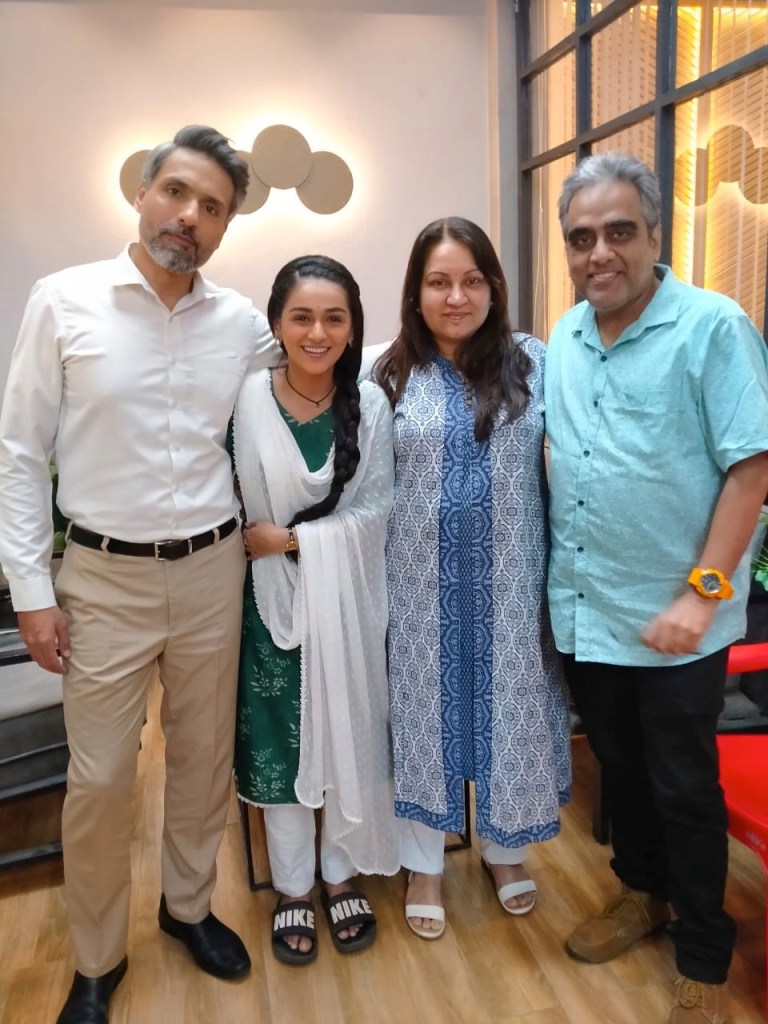
Shantanu and Gajra with the lead actors of Na Umr Ki Seema Ho. Photo provided by Shantanu Ray Chaudhuri
Any grand obsession, a show she would like to write? “As far as TV goes, I have always dreamed of doing a version of one of my all-time favourite films, Abhimaan[19], with or without the music background. The subject becomes more and more relevant every decade. Frankly, no channel wants to touch it. Though the people one speaks to share my admiration for the story, the ‘system’, they say, is not conducive to making it. I also want to adapt my first novel, Broken Melodies, as a web show or film. It’s the story of a girl growing up in the seventies, torn between the values and stifling world that her classical musician father [an autobiographical element given that Gajra is the daughter of the classical maestro Pandit Amarnath] represents and the liberation that the English education sponsored by her mother affords her.”
One can only say, more power to writers like her, and the breaking of glass ceilings and taboos.
(Originally published in The Telegraph, Kolkata)
Addendum
Shantanu: You grew up in Delhi in the 1980s. That was the birth of the TV era with Hum Log, Buniyad, and all those glorious serials. Did any of these influence you?
Gajra: You’re so right, Shantanu, they hugely did, except that there was no plan that I had then, to actually use that impact to write something similar. I loved both these shows purely as a viewer. HumLog did tackle social issues, for example, dowry, but why I liked it was that it showed the clash of values within a family with different generations, and through that, it entertained and made one feel and think – the sensitization process as its termed. Later, I learned that Hum Log was inspired by the Sabido method (originating in Mexico) where TV is used as a medium to bring about positive social change by making viewers ‘feel and think’ rather than preaching to them.
I loved Buniyaad for a purely sentimental reason. My parents were from Lahore and Multan respectively and had come as refugees to Delhi, so we had grown up hearing stories of Partition and here was a show that brought that era alive for me in an extremely moving and entertaining way. So maybe subconsciously both these shows did impact my psyche – as in it was possible to talk emotions that were universal, even while having a responsible author’s voice.
Shantanu: What do you attribute the change in the style and content in TV soaps, first with Tara and Shanti, and then Kyunki Saas Bhi…
Gajra: Tara and Shanti were the first movers, coming in like a breath of fresh air after the DD days which were associated with somewhat stodgy storytelling, Buniyaad etc., being the shining exceptions. Tara and Shanti were great in terms of revolving around thinking and evolved women, but perhaps were ahead of their times…they still are, given where TV storytelling has gone.
By the time Kyunki Saas came to TV screens, middle- and lower-middle-class homes could afford a TV set, so there was a genuine need for TV to go more middle class in its appeal. So, we had a plethora of shows with joint families and generations under one roof, which truly was the reality of such homes, and which therefore connected with the masses easily. Ekta Kapoor also upped the drama quotient hugely, so there was no way it wasn’t going to work with the masses.
Unfortunately, however, everyone went about copying the formula and there was the overdose factor. So, TV honchos were afraid of trying different subjects and worlds and that for a very long time became the bane of TV writers.
Shantanu: On Buddha: ‘dispel your own myths, you say …’ What apart from his abandonment of his wife and child haunted you. Do you reconcile with the abandonment once you had done the writing for this? Did it make sense now?
Gajra:Buddha, the show, came to me at a point in life when the strong opinions and idealism of youth – both in professional and family life – had given way to some acceptance and the realisation that actually nothing is or can be ‘perfect’. And certainly not any decisions of life that we might make. So, we might as well make the decision, and accept and live with the consequences as positively as one can. I know that that’s so ‘anti’ the way today’s youngsters think!
So yes, from his wife and family’s point of view his decision seemed ‘selfish’ but he had to be true to his heart’s calling and that so-called ‘selfishness’ of his is what made him give so much to the world to make it a better one. I understood the ‘larger purpose’ part of the Buddha’s life after I started researching more and more while writing the story for the show. I came to terms with the ‘abandonment’, though my heart still bleeds for Yashodhara and Rahul, when I think about them. What also helped was me learning the historical truths about how Yashodhara evolved, albeit painfully, to want to join his sangha voluntarily at some point, and him helping her find her ‘larger purpose’.
Also, what I realised is that in school textbooks we go straight from the story of Buddha leaving home to being under the Bodhi tree and achieving enlightenment and uplifting the world. This had been my myth too. But, in reality, the Buddha’s many experiments to arrive at the truth had many stages to it. He went through extreme deprivation, abnegation, self-loathing and much else, before he arrived at the eight-fold path – the most practical and fair way to lead life in any time and space.
And he certainly did not advocate renunciation for all or even the perception of Buddhism as a religion. His was the ultimate live-and-let- live approach to life – just that his methods helped his followers lead a life of peace and equanimity within their chosen path. Through writing the show I realised that there could be no other way of life that was so compatible with the modern way of thinking and doing. So I am not a ‘Buddhist’ but I still try to recall the eight-fold path at various difficult points in my life and it really helps me.
Shantanu Ray Chaudhuriis a film buff, editor, publisher, film critic and writer. Books commissioned and edited by him have won the National Award for Best Book on Cinema twice and the inaugural MAMI (Mumbai Academy of Moving Images) Award for Best Writing on Cinema. In 2017, he was named Editor of the Year by the apex publishing body, Publishing Next. He has contributed to a number of magazines and websites like The Daily Eye, Cinemaazi, Film Companion, The Wire, Outlook, The Taj, and others. He is the author of two books: Whims – A Book of Poems(published by Writers Workshop) and Icons from Bollywood (published by Penguin/Puffin).
These are stories written by youngsters from the Nithari village. They transcended childhood trauma and deprivation for many decades. The column starts with a story by Sharad Kumar in Hindustani, translated for us by Grace M Sukanya
Sharad Kumar is a 22-year-old engineer / artist from Nithari, Delhi, currently in the final year of his B. Tech in Information Technology. He has also performed as an actor and singer for various college productions. He has been associated with pandies’ theatre group since 2010. His performance at the American Center, Delhi, with 40 more children from the school Saksham, Nithari, was the audience’s pick. Working with younger children in Nithari, teaching them Physics, Maths and also, how to perform on stage, he hopes to be able to give back to the community he comes from. His desire: quality education and opportunities to children from under-served backgrounds.
Stranger than Fiction
When it had begun, it had seemed it would just be for a short while and would get over quickly. But it had now been three months since the lockdown had been announced.
Mumbai’s streets were so quiet that it seemed the multitudes had been anaesthetised. Only the sound of dogs continued to disrupt the silence of the alleyways. Even the air felt cleaner.
But there was still one pollutant left: the virus.
The corona warriors worked away at their jobs as though this was the battle of Mahabharat. Excepting a few people, everyone was busy waging a personal war.
On national television, people initially behaved admirably. But now they too showed symptoms of being infected by the virus of television rating points.
Mritunjay, an ordinary hawaldar, took time out of his busy schedule to lay out his gamchha and rest on it, as he did every day, and started knitting a dream from the past — his grandfather’s memories.
He traveled back in time to an era when the British Empire extended to almost all parts of the world.
*
Somewhere far away from the Indian sub-continent, Mritunjay’s grandfather, Dirghayu, was a soldier in the British Indian Army. Due to the circumstances of that time, Dirghayu and his compatriots were beholden to do the British’s bidding, waging war in trenches, pits, and holes for their colonial masters.
Meagre rations, living in squalor with rats, snakes, and other parasites, were all part of their war time trials. Standing every day in the cold water and the wet mud of waterlogged trenches had started taking its toll. With each passing day, Dirghayu’s legs were becoming more painful.
Then, one day the commander’s voice had announced the beginning of war, and everywhere cartridges, canons, and weapons poured forth rivers of blood. Perhaps, because of his name, Dirghayu, meaning the long-lived one, the hawaldar’s ancestor had been blessed with good luck and courage. He survived the enemy gunfire, the terrible living conditions, the horror of warfare, and managed to win the British their victory. The Commander was happy with his performance and decided to send him back to his homeland.
Back in the Indian subcontinent, the Jallianwala Bagh massacre had just taken place. General Dyer’s order to fire at point blank range on a peaceful prayer meet had shocked the empire to its core. The cruelty of the British Raj had been increasing since Gandhiji’s successful Champaran Satyagrah. Some political parties had taken to violence and arms, challenging the British to a direct conflict.
The Spanish Flu too, was at its peak. Millions of people had lost their lives. The death count was rising every day. Some scientists had estimated the death toll at as much as 5% of India’s entire population.
Economy and communications had collapsed. The rulers, in an attempt to veil their incompetent handling of the pandemic, had busied themselves in passing a variety of bills and ordinances. The only relief forthcoming from them was a lockdown.
The people in the Indian subcontinent were faced with starvation, unemployment, lack of education, and an utter lack of services.
Seeing the country in this state, Dirghayu realised there were three more battles that he had to face: (i) to provide for the comforts and security of his family; (ii) to take precautions against the spread of the Spanish Flu; (iii) and, to continue to work honestly for the British government without compromising his principles.
One day, Dirghayu’s son asks him, “Why is the Spanish Flu known as the Spanish Flu?”
Dirghayu, who has had a little education, and had gleaned some information from the company of the British officers he served, told him: “It is because the Spanish were the first to report it, but people’s mind-set is such that they started calling it the Spanish Flu.”
Then his son suddenly changed the topic and asked him, “Why are you opposed to Gandhiji and the other freedom fighters?”
Dirghayu, shocked, attempted to circumvent the issue by proffering a false excuse: “Gandhiji has gotten the flu, and he must not be allowed to spread it to other people through these huge public gatherings. This is why I am opposed to them. In any case, my priority is the safety of you people. I have to earn money so I can look after you!”
“So, if you had been there at Jallianwallah Bagh, would you too have fired at the crowd?”
At this, Dirghayu was upset. He scolded his son, telling him to focus on his studies instead of asking unnecessary questions.
A few months later, however, Dirghayu faced a challenge that could lead to his losing all the three battles of his life simultaneously.
Dirghayu was summoned by the senior officials of the British Army. They told him that they had been informed by their secret services that some university students were involved in a massive conspiracy against the Rowlatt Act passed in 1919 to allow indefinite incarceration without a proper trial.
They gave him two options: He could either give up his post in the army and be dismissed in disgrace, losing his right to a pension, or he could arrest the mastermind of the conspiracy: his own son.
Keeping his priorities in mind, Dirghayu chose to give up his post in the army even though he knew he would not be able to support his household without that money. Without the army pension, his fight against the Spanish Flu would also slow down, and he would have to face the problems that the many had to face in the subcontinent.
However, he gave his son some money, and managed to send him to a safe place.
He was brought in for questioning by his own colleagues. They cajoled him, coaxed him, threatened him, even tortured him — but he refused to give up his son’s location. Eventually, the authorities gave up and let him go.
After his wife’s death, he was left alone but he has managed to conquer at least two of the battles he had set forth for himself.
Night and day, like a Spanish Flu warrior, he was engaged in helping people, getting them medicines, arranging food for the poor, encouraging the sufferers to live, and helping them out in any way required as he fought against the devastation wrought by the disease.
But perhaps he could not win this last battle. His name had protected him so far, but he met his end at the hands of the Spanish Flu.
*
Suddenly, Mrityunjay was woken up by the voices of his colleagues.
They were asking him: “What are you dreaming? You seem to be lost in your dreams.”
He said: “Perhaps this is not a dream, but the reality. After all these years, things are still exactly the same.”
Grace M Sukanya is a 28-year-old filmmaker based in Delhi, India. She is interested in creating arts-based educational interventions for children that respond to socio-political issues. She has been associated with pandies’ theatre since 2020.
.
PLEASE NOTE: ARTICLES CAN ONLY BE REPRODUCED IN OTHER SITES WITH DUE ACKNOWLEDGEMENT TO BORDERLESS JOURNAL

 Borderless