Categories
Stories

Hope is the Dream of a Waking Man

By Shevlin Sebastian
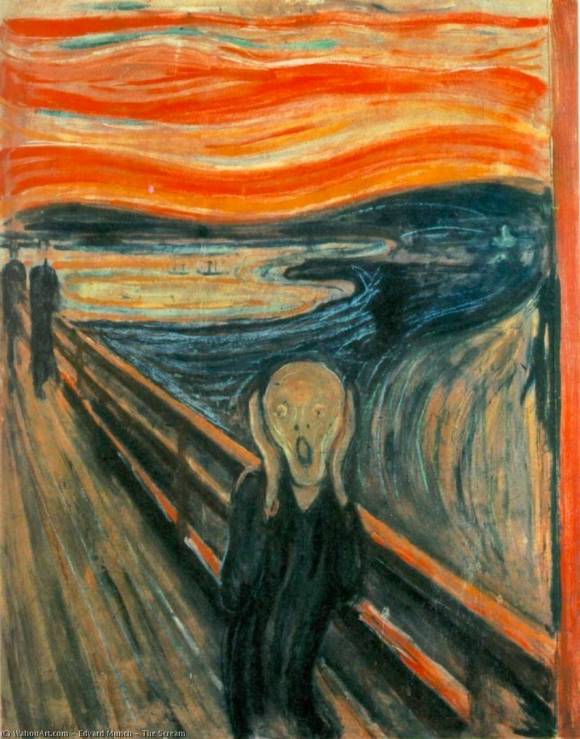
The Scream by Edvard Munch (1863-1944)

There is a large grey wave painted in the middle of the canvas. It is falling over a large group of people standing on the edge of a seashore. Many men wear skullcaps. The women have black burkas. The group has widened eyes and open mouths. Some have turned their backs to flee. Others have raised their arms and clenched their fists, as if they are about to break into a run.  

At the bottom of the canvas, on the left, there is another group of people. They are also standing on another seashore, with windswept hair. There is a woman with a large sindoor in the middle parting of her hair. A young man, in jeans, has a necklace with a gold crucifix. A boy stands with a placard showing a dove with a leaf in its beak. The words, ‘Let’s all live in peace,’ are written in bold, red letters. Others raise placards with slogans like ‘Say No to communalism’, ‘Syncretism is in our DNA’, and ‘We are all brothers and sisters in this great nation’.  

Painter Ashraf Mahmood steps back and stares at the image. A slight smile plays on his lips. He had woken up that morning and this image had come floating into his mental screen. Ashraf kept staring at it, eyes closed, lying on his back. His wife had got up and gone to the kitchen. Alia liked to make her tea using Tata Gold. He preferred Brooke Bond Red Label. So they made separate cups. 

When he entered his studio on Mira Road, in Mumbai, at 9 am, he got down to work, using an easel and grey paint. 

He worked steadily. It was silent inside. But Ashraf did register the outside sounds of a typical Mumbai street. The horns blowing. Tendrils of smoke from exhaust pipes floated in through the window. His nose twitched as he noticed a foul smell. It seemed as if somebody had thrown garbage on the street. Ashraf closed his nose with the tip of his fingers for a few seconds. “The crazy smells of Mumbai,” he thought. 

He grew up near Mandvi Beach in Ratnagiri (343 kms from Mumbai). The air was fresh, and the wind blew constantly. The only sound was the roar of the waves and the beautiful sight of seagulls making circles as they flew above the sea. Ashraf’s father, Mohammed, was a government school teacher. His mother was a homemaker. He had two elder brothers and three sisters. Ashraf was the youngest. He displayed artistic talent from his school days.

Unlike most fathers, Mohammed encouraged his son. His father took him to an art teacher, who taught him how to draw and paint. Ashraf’s major breakthrough happened when he got admitted to the JJ School of Art in Mumbai. After that, there was no looking back…  

It was evening when he finished the work. His soles ached. Ashraf had been standing for hours. 

This image reflected all that he felt. The grey resembled the growing intolerance towards Muslims. This seemed to be overwhelming especially in places like Uttar Pradesh and Madhya Pradesh. There was the rise of majoritarianism. And the fracturing of relations between people of different communities. And yet, Ashraf felt that the DNA of the people over centuries was syncretic. A ready acceptance of people of all faiths. 

It was only the hate campaigns, through speeches, social media, and songs, that had swayed the people. He was sure the fever would die one day. Syncretism would rise again. “After all,” he thought, “throughout human history, love always conquered hate. But it took time.” 

Ashraf wanted to tell the viewers of his work not to lose hope. And hence the pigeon and the symbol of peace. For the title, he used a quote by the Greek philosopher, Aristotle, “Hope is the dream of a waking man.”

Ashraf rubbed his chin a few times and walked to a table on one side. A packet of fresh buns lay on the table. Ashraf opened a fridge. He took out a container which contained butter and a bottle of strawberry jam. He sliced the bun into half with a stainless steel knife, placed butter and jam in between, and began eating it. These were fresh buns from a nearby bakery. Ashraf had bought them when he had stepped out for lunch. He made tea on the gas stove. Then he sat on a stool near the table and sipped it. 

This was his 35th year as a painter. Now, at 55, he could look back with reasonable pride. He took part in regular exhibitions and won a few awards and grants. Profiles of him appeared in the newspapers and on social media. His paintings sold, thanks to his realistic and simple style. An art sensibility was only gradually building up among the people. Ashraf knew that images drawn from his unconscious mind had a pulling power. Why this was so, he did not know. He remembered how one art critic described a David Hockney painting as having a ‘psychological charge’. Hockney was a renowned English painter. Ashraf realised that art needed to have a psychological charge if it had to have an impact.  

But Alia had already made an impact on him. He met her when she came to view his exhibition one day at the Jehangir Art Gallery. She was slim and tall, with curves that were accentuated by the chiffon saree she wore. Like Ashraf, she came from a small town. Through grit and perseverance, she passed competitive exams and got a government job. They went for dates. Ashraf was smitten. Within a year, he proposed and they got married. 

Alia was a superintendent in the sales tax department. She would earn a pension once her career got over. She had another ten years to go. Their two daughters had married and settled down in Aligarh and Delhi. Both had two children each, a boy and a girl. 

Alia wanted Ashraf to earn more money. But he was not a hustler or a man who liked to build a network. If a buyer came and offered a decent price, he sold it. Most of the time, he remained isolated. Sometimes, he met other artists at exhibitions and art seminars. He would chat with them. But that was all. 

He was not keen on extramarital flings or experimenting with drugs or drinking too much. Ashraf led a steady life. In many ways, he was happy with the way his life had turned out. 

He washed the cup and the pans. Ashraf placed the cup on a hook which hung on a wall. He had yet to finish the bun. 

He made his way back to the painting. It was 5.30 p.m. In half an hour, he would close his studio and walk back to his house, fifteen minutes away. The couple owned their apartment. Alia, with help from Ashraf, had cleared the bank loan over 15 years. 

At this moment, he heard a murmur of voices from outside the door. Ashraf wondered what it was. The sound arose. “Was there an emergency?” he thought. “Is the building on fire?” 

He came to the door. Ashraf saw that the lock was coming under strain. It seemed to be bulging backwards towards him. Somebody gave a violent kick and the door sprang open. Ashraf moved to one side.  

A group of young men rushed in. Some wore red bandanas. Many were in T-shirts and trousers. Some had thick, muscular arms. They were shouting. It seemed like slogans. In his shocked state, Ashraf could not register the words. They rushed to the canvas on the easel. One man, using a long knife, sliced the canvas into two. He pushed the easel.  It fell with a clattering sound to the floor.

There were a bunch of finished canvases placed on one side. Ashraf had been doing work to showcase in an upcoming solo exhibition. The group spotted it. They rushed there, pushed the canvases to the floor, and began ripping them one by one with their knives. Within a few minutes, the work of several months lay ripped out. Ashraf remained by the side of the door. He had not moved. 

“Hey you Muslim kutta (dog),” one of them said. “We will come again if you carry on working. No art for Muslims. Clean the sewers. That’s the only job you are good at.” 

Ashraf half-expected one of them to stab him. But they didn’t. They left as quickly as they came. 

Ashraf felt as if a large, round ball had settled at the base of his throat. He could not swallow it nor could he spit it out. 

He blinked many times. Ashraf wasn’t sure whether this event had actually happened. It took place so fast. But there was no doubt about the ripped canvases lying all over the floor.

He felt a pain in his heart. Ashraf rubbed the area. “I hope I am not having a heart attack,” he thought to himself, as he took in lungfuls of air to calm himself down. Employees from other offices on the same floor came to the door. They entered. Most had goggle-eyes. 

“Sir, what happened?” one young man said.

Ashraf shook his head. 

“I don’t know,” he said. 

“Who were these people?” a woman said. 

“No idea,” Ashraf said, as he surveyed the damage. 

“Sir, you will have to call the police,” another man said. 

“Yes, I will,” said Ashraf. 

A couple of men shook his hand. 

All of them surveyed the damage silently. Work was calling them. “All chained to their desks,” thought Ashraf. “At least, that way, I am free. No boss on top of me. No attendance marking every day. No targets to meet. No one shouting at me. But then, no steady income. And no camaraderie. Large amounts of time spent alone.”  

Then he returned to the stool, returned to the present, and placed his head in his hands. 

‘What’s happening to this country?’ he thought. ‘‘There seems to be a collective madness. Indians attacking Indians. And these young people were ruining their lives by working for political leaders. They will be used and discarded.”

He had not seen them before in the locality. They might have come from some other area. Was it a deliberate ploy to send a shock wave through him and the community? Who knew how they thought?  

What should he do now? 

Ashraf realised he had to think rationally. He stood up and went to the door. He realised immediately, he could not do anything immediately. A carpenter would have to be called tomorrow. 

He called Alia and informed her about what had happened. She said she would come directly to the studio from the office. Ashraf called up his media contacts, both in the print and visual media. They said they would arrive with their photographers and cameramen. Ashraf took several photos and videos on his mobile phone, documenting the damage. 

He would have to report the attack at the police station and file an FIR.     

Ashraf realised his work had been ruined, but he would recreate it. He had photos of all the canvases. 

To prove to himself, he had returned to normality, he went back to the table and finished the rest of the bun. He put the butter and the jam back into the fridge. He washed the plate and the knife. 

Fifteen minutes later, Alia arrived. 

In silence, she stared at the canvases lying on the floor. Ashraf saw her press her hand against her open mouth. He realised it was a silent scream. 

In the end, she came up to Ashraf and said, “They have tried to violate your dignity as an artist and a person.” 

The couple hugged. 

After a while they broke away. 

“Don’t keep the canvases here anymore,” she said. 

Ashraf rubbed his chin with his fingers. 

Finally, he nodded. 

“There was something strange about the attack,” he said. “They didn’t overturn the table or the fridge. And for some reason, they did not assault me. It seemed to me they had to leave in a hurry. So I got saved.”  

Alia said, “They are keeping a watch on everybody.” 

“Yes, I read online there is a pervasive deep state,” said Ashraf. “In every neighbourhood there are spies who report about all that is happening.” 

“What is the next step?” she said. 

“I am waiting for the media to come. After that, I will file the FIR,” he said. 

At that moment, a few print and TV journalists arrived. 

Ashraf spoke to the reporters. The photographers and cameramen began recording all that had happened. 

They left after half an hour. 

The couple then shut the door, as best as they could. But there was a small gap at one side. They went to the police station. The police allowed an FIR to be filed against ‘unknown persons’. He faced no hindrances because, as Ashraf surmised, the police were aware of his reputation as an artist. 

The couple took an autorickshaw and returned to their apartment.  

Alia changed into a nightgown. She washed her face, and informed their daughters about what had happened on her mobile phone. 

Ashraf changed into a T-shirt and shorts. He made a glass of whisky mixed with water for himself. Every night he had one peg. 

As he sat on the sofa, nursing his drink and staring at the TV screen, he felt the pain arise in him. It was an ache in the middle of the chest. To see his work treated in such a callous manner was a calamity. He wondered whether he would ever overcome this fear that had come into him. Work on a piece the whole day and in the evening, somebody could come in and rip it up. 

Closed doors did not offer any protection. It was a time of lawlessness. People with criminal behaviour could operate with impunity. Leaders wanted to instil fear in people. 

And would he be able to recreate these ripped-up paintings with the same intensity? He was not sure.  

On the screen, some leader was having his say. His eyes enlarged, he made violent movements with his hand, and spoke with a loud voice. “Horrific,” thought Ashraf. “How do you create art in this environment?”

Yes, indeed, how do you? 

But it did not take long for him to tell himself, “But we must, whatever be the cost. Art is the candle that brings light to the darkness.”

.

Shevlin Sebastian has worked for magazines like Sportsworld, belonging to the Ananda Bazar Patrika Group in Kolkata,​ The Week, belonging to the Malayala Manorama Group, ​in Kochi, the Hindustan Times ​in Mumbai, and the New Indian Express in Kochi. He has also briefly worked in DC Books at Kottayam. He has published about 4500 articles on subjects as varied as films, crime, humour, art, human interest, psychology, literature, politics, sports and personalities. Shevlin has also published four novels for children.

.

PLEASE NOTE: ARTICLES CAN ONLY BE REPRODUCED IN OTHER SITES WITH DUE ACKNOWLEDGEMENT TO BORDERLESS JOURNAL. 

Click here to access the Borderless anthology, Monalisa No Longer Smiles

Click here to access Monalisa No Longer Smiles on Kindle Amazon International

Categories
Review

‘Burradin’: An Indian Christmas

Book Review by Somdatta Mandal

Title: Indian Christmas: Essays, Memories, Hymns

Editors: Jerry Pinto and Madhulika Liddle

Publisher: Speaking Tiger Books

We all know that Christmas Day, the night that Jesus came to earth, bringing with him peace and love for all humanity, is celebrated by Christians all around the world with great enthusiasm and merriment. Interestingly, for a multicultural country like India, Christmas is equally celebrated — not only as a religious festival but also as a cultural one. For a country where less than three percent of the population is Christian, the central celebration is the birth of a child, but it takes on new meaning in different Indian homes.  Known in local parlance also as “Burradin”[big day] Indians from all classes and communities look forward to this day when they can at least buy a cake from the local market, shower their children with stars, toys, red Santa caps and other decorative items, and go for a family picnic for lunch, dine at a fancy restaurant or visit the nearby church. This syncretic cult makes this festival unique, and for Jerry Pinto and Madhulika Liddle editing this very interesting anthology comprising of different genres of Indian writing on the topic – essays, images, poems and hymns, both in English and also translated from India’s other languages is indeed unique.

In his introduction which he titles “Unto All of Us a Child is Born,” Jerry Pinto reminisces how he was surprised when he saw his first live Santa Claus. He was a figure in red that Akbarally’s, Bombay’s first department store, wheeled out around Christmas week. “He was a thin man, not very convincingly padded… seemed to be from my part of the world, someone who would climb up our narrow Mahim stairs and leave something at the door for us at three or four a.m., then take the local back to his regular job as a postman or seller of second-hand comics. The man in the cards and storybooks preferred London and New York. And a lot of snow. … Today, it is almost a cliché to say that Christmas, like every other festival, is hostage to the market.”

The other editor, Madhulika Liddle in her introduction “Christmas in Many Flavours” states, “According to the annals of the Mambally Royal Biscuit Factory bakery in Thalassery, Kerala, its founder Mambally Bapu baked the first Christmas cake in India”.  It was way back in 1883, at the instance of an East India Company spice planter he set about trying to create a Christmas cake. Liddle wondered what that first Christmas cake tasted like; how close it was to the many thousands of cakes still baked and consumed at Christmas in Kerala? She also writes about the situation in India, where instead of wholesale and mindless importing of Christmas ideas, the people have been discerning enough to amalgamate all our favourite (and familiar) ideas of what a celebration should be and fit them into a fiesta of our own.


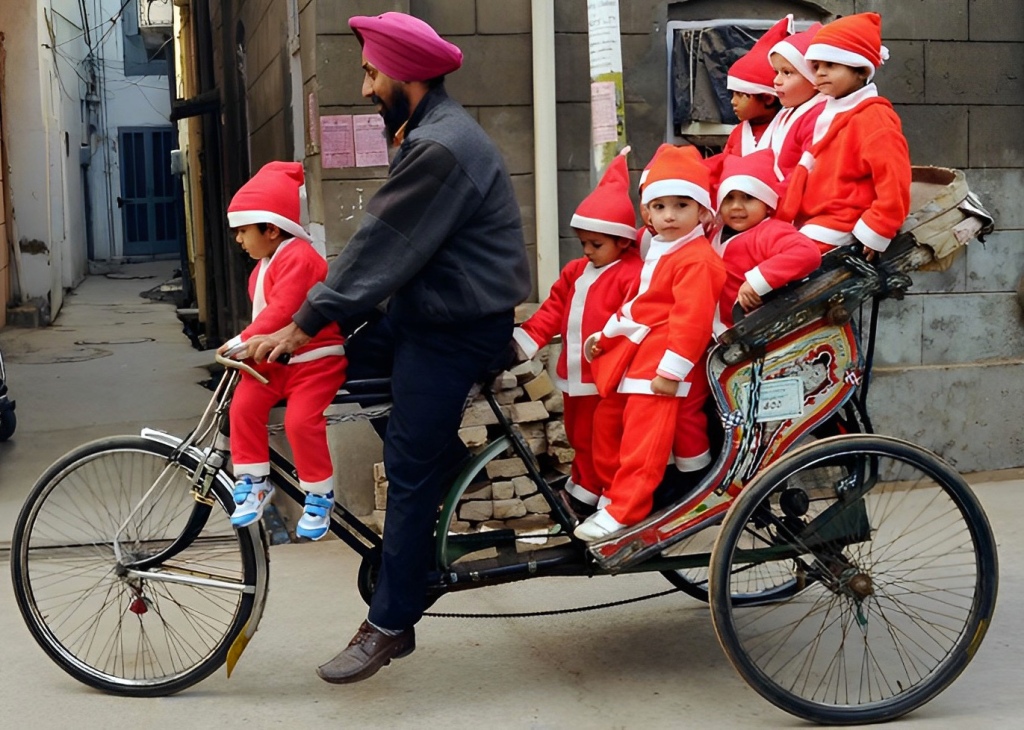
Images from Indian Christmas: Essays, Memories, Hymns: dressed up as Santa Claus leave for school in Punjab. (Picture courtesy: Ecocabs,Fazilka).

There are several other aspects of Christmas celebrations too. The Christmas bazaars are now increasingly fashionable in bigger cities. The choral Christmas concerts and Christmas parties are big community affairs, with dancing, community feasts, Christmas songs, and general bonhomie. Across the Chhota Nagpur area, tribal Christians celebrate with a community picnic lunch, while many coastal villages in Kerala have a tradition of partying on beaches, with the partying spilling over into catamarans going out into the surf. In Kolkata’s predominantly Anglo-Indian enclave of Bow Bazar, Santa Claus traditionally comes to the party in a rickshaw, and in much of northeast India, the entire community may indulge in a pot-luck community feast at Christmas time. Thus Liddle states:

“Missionaries to Indian shores, whether St Thomas or later evangelists from Portugal, France, Britain, or wherever brought us the religion; we adopted the faith, but reserved for ourselves the right to decide how we’d celebrate its festivals.”

Apart from their separate introductions, the editors have collated twenty-seven entries of different kinds, each one more interesting than the other, that showcase the richness and variety of Christmas celebrations across the country. Though Christianity may have come to much of India by way of missionaries from Europe or America, it does not mean that the religion remained a Western construct. Indians adopted Christianity but made it their own. They translated the Bible into different Indian languages, translated their hymns, and composed many of their own. They built churches which they at times decorated in their own much-loved ways. Their feasts comprised of food that was often like the ones consumed during Holi or Diwali.

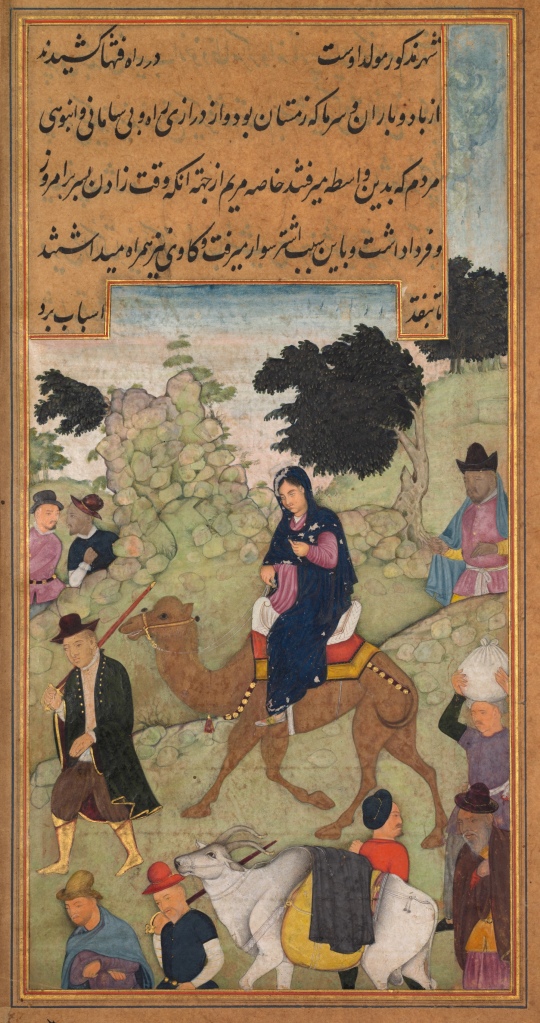
Thus, Christmas in India turned to a great Indian festival that highlighted the syncretism of our culture. Damodar Mauzo, Nilima Das, Vivek Menezes, Easterine Kire, Hansda Sowvendra Shekhar, Nazes Afroz, Elizabeth Kuruvilla, Jane Borges and Mary Sushma Kindo, among others, write about Christmas in Goa, Nagaland, Kerala, Jharkhand, Delhi, Kolkata, Mumbai, Shillong and Saharanpur. Arul Cellatturai writes tender poems in the Pillaitamil tradition to the moon about Baby Jesus, and Punjabi singers compose tappe-boliyan about Mary and her infant. There are Mughal miniatures depicting the birth of Jesus, paintings by Jyoti Sahi and Sister Claire inspired by folk art, and pictures of Christmas celebrations in Aizawl, Bengaluru, Chennai and Kochi and these visual demonstrations enrich the text further.

Interestingly, the very first entry of this anthology is an excerpt from the final two sections of one of Rabindranath Tagore’s finest long poems, inspired by the life of Jesus Christ. Tagore wrote the poem “The Child” in 1930, first in English and translated it himself into Bengali the following year, titling it “Sishutirtha.” But many years even before that, every Christmas in Santiniketan, Tagore would give a talk about Christ’s life and message. Speaking on 25 December 1910, he said:

“The Christians call Jesus Man of Sorrow, for he has taken great suffering on himself. And by this he has made human beings great, has shown that the human beings stand above suffering.”

India celebrates Christmas with its own regional flair, its own flavour. Some elements are the same almost everywhere; others differ widely. What binds them together is that they are all, in their way, a celebration of the most exuberant festival in the Christian calendar.

Apart from the solemnity of the Church services, there is a lot of merrymaking that includes the food and drink, the song and dance. The songs often span everything from the stirring ‘Hallulujah Chorus’ to vibrant paeans sung in every language from Punjabi to Tamil, Hindi to Munda, Khariya and Mizo tawng.

Among the more secular aspects of Christmas celebrations are the decorations, and this is where things get even more eclectic. Whereas cities and towns abound in a good deal of mass decorating, with streets and public places being prettied up weeks in advance, rural India has its own norms, its own traditions. Wreaths and decorated conifers are unknown, for instance, in the villages of the Chhota Nagpur region; instead, mango leaves, marigolds and paper streamers may be used, and the tree to be decorated may well be a sal or a mango tree. Nirupama Dutt tells us how since her city had no firs and pines, she got her brother’s colleague to fetch a small kikar tree as kikars grew aplenty in the wild empty plots all over Chandigarh. In many entries we read about how Christmas decorations were rarely purchased but were cleverly constructed at home.

A very integral part of the Christmas celebrations of course is music. In many Goan Catholic neighbourhoods, Jim Reeves continued to haunt the listeners in his smooth baritone: “I’ll have a blue Christmas without you/ I’ll be so blue thinking about you/ Decorations of red on a green Christmas tree/ Won’t mean a thing, dear, if you’re not here with me.”  Simultaneously, the words and music of “A Christmas Prayer” by Alfred J D’Souza are as follows: “Play on your flute/ Bhaiyya, Bhaiyya/ Jesus the saviour has come./ Put on your ghungroos/ Sister, Sister/ Dance to the beat of the drums!/ Light up a deepam in your window/ Doorstep, don with rangoli/ Strings of jasmine, scent your household/ Burn the sandalwood and ghee,/ Call your neighbour in, smear vermillion/ Write on his forehead to show/ A sign that we are one/ Through God’s eternal Son/ In friendship and in love ever more!/ Ah! Ah!” But the most popular Christmas song was of course “Jingle bells, jingle bells, jingle all the way….”

In “Christmas Boots and Carols in Shillong”, Patricia Mukhim tells us how the word ‘Christmas’ triggers a whole host of activities in Meghalaya and other Northeastern states that have a predominantly Christian population. Apart from cleaning and painting the houses, everything looks like fairyland during Christmas, a day for which they have been waiting for an entire year. She particularly mentions the camaraderie that prevails during this time:

“Christmas is a time when invitations are not needed. Friends can land up at each others’ homes any time on Christmas Eve to celebrate. Most friends drop by with a bottle of wine and others pool in the snacks and the party continues until the wee hours of morning. It’s one day in the year when the state laws that noise should end at 10 p.m. is violated with gay abandon. …Shillong [is] a very special place on Planet Earth. Everyone from the chief minister down can strum the guitar and has a voice that could put lesser mortals to shame. And Christmas is also a day when all VIPism and formalities are set aside. You can land up at anyone’s home and be welcomed in. It does not matter whether someone is the chief minister, a top cop, or the terrifying headmistress of your school.”

One very significant common theme in all the multifarious entries is the detail descriptions provided on food, especially the makeshift way Christmas cakes are baked in every home and the Indian way meat and other specialties are being prepared on the special day. There are several entries that give us details about the particular food that was prepared and consumed at the time along with actual recipes about baking cakes. “Christmas Pakwan[1]” by Jaya Bhattcharji Rose, “The Spirit of Christmas Cake” by Priti David, and “Armenian Christmas Food in Calcutta” by Mohona Kanjilal need special mention in this context.  Liddle in her introduction wrote:

“Our Christmas cakes are a reflection of how India celebrates Christmas: with its own religious flair, its own flavour. Some elements are the same almost everywhere; others differ widely. What binds them together is that they are all, in their way, a celebration of the most exuberant festival in the Christian calendar.”

Later in her article “Cake Ki Roti at Dua ka Ghar[2],” the house where they lived in Saharanpur, Uttar Pradesh, she wrote how her parents told her that ‘bajre ki tikiyas’, thin patties made of pearl millet flour sweetened with jaggery, used to be a staple at Christmas teatime at Dua ka Ghar[3], though she has no recollection of those. She of course vividly recalls the ‘cake ki roti’. This indigenisation of Christmas is something that’s most vividly seen in the feasting that accompanies Christmas celebrations across the country. While hotels and restaurants in big cities lay out spreads of roast turkey (or chicken, more often), roast potatoes and Christmas puddings, the average Indian Christian household may have a Christmas feast that comprises largely of markedly regional dishes.

In Kerala, for instance, duck curry with appams is likely to be the piece de resistance. In Nagaland, pork curries rich in chillies and bamboo shoots are popular, and a whole roast suckling pig (with spicy chutneys to accompany it) may hold centre stage. A sausage pulao, sorpotel and xacuti would be part of the spread in Goa, and all across a wide swathe of north India, biriyanis, curries, and shami kababs are de rigueur at Christmas.

This beautifully done book, along with several coloured pictures, endorses the idea of religious syncretism that prevails in India. As a coiner of words, Nilima Das came up with the idea that ‘Christianism’ in our churches is after all, a kind of ‘Hinduanity’ (“Made in India and All of That”). This reviewer feels guilty of not being able to mention each of the unique entries separately that this anthology contains, so it is suggested that this is a unique book to enjoy reading, to possess, as well as to gift anyone during the ensuing Christmas season.

[1] Cuisine

[2] Cake bread

[3] Blessed House

Somdatta Mandal, critic, academic and translator, is a former Professor of English at Visva-Bharati, Santiniketan, India.

Click here to access an excerpt of Tagore’s The Child

PLEASE NOTE: ARTICLES CAN ONLY BE REPRODUCED IN OTHER SITES WITH DUE ACKNOWLEDGEMENT TO BORDERLESS JOURNAL

Click here to access the Borderless anthology, Monalisa No Longer Smiles

Click here to access Monalisa No Longer Smiles on Kindle Amazon International

Categories
Poets, Poetry & Rhys Hughes

I Went to Kerala

Photo provided by Rhys Hughes

I went to Kerala for Christmas, travelling from Bangalore on the night bus. It wasn’t the first time I had taken a night bus in India. The first time was when I went to Madikeri, high in the hills of Coorg. That bus was one with berths that one can lie completely flat on. In fact, you have no choice but to lie flat because there are no seats. It should be more comfortable than sitting upright all night, and I am sure many passengers find it so, but the vibrations of the engine made my body vibrate in sympathy and every bend in the road made me slide around the berth uncontrollably and when the bus climbed a slope all the blood rushed to my head, which was oriented towards the rear of the vehicle. I decided never to use this restful method of travel again.

This is why I chose a more old-fashioned style of bus in order to journey to Kerala. I understand seats. Your head is always up and your feet always down, and if this happens not to be the case then it quickly becomes obvious that some disaster has happened. Head up, feet down, seems to me the natural order of the universe when travelling a great distance. It was a twelve-hour journey. In India that might not be so remarkable, but I come from a small country where twelve hours on a bus is sufficient time to drive right across the land and a fair way out to sea. “Captain, there seems to be a bus overtaking us!” “Have you been at the rum again, bosun?” The immensity of India is something I doubt I will ever get used to. It is big even in terms of bigness.

Not that the bus with seats was completely free of problems. The seats had a lever by the side of them, and if this lever was pulled, the seats reclined. I was expecting something of this nature, but I was completely taken by surprise at the extreme angle they adopted. They reclined to an excessive degree. All was fine for the first fifty kilometres or so, then the young lady in the seat in front of me decided it was bedtime. She reclined the seat so precipitously that it whacked on my knees, and I was given no choice but to stare directly at the top of her head which was almost touching my chin. The only solution was to recline my own seat. I did so and heard a yowl from behind. I had taken my turn to crush some other innocent knees. And so I lay in this absurd position, sandwiched between two sleepers as the hours slowly passed.

The bus was soon filled with snorers and all of them were out of time with each other. I am a jazz aficionado, I love music with complex rhythms, and I also love polyrhythms, but the point of such intricate music is that there is resolution at some point along the melody lines. The contrasting rhythms ought to come together at least sometimes, in order to provide structure, but the snoring was far too avant garde for that. It was atonal and without time signatures. A man in a forest of lumberjack gnomes probably feels the same way I did, as the sawing takes place and the trees topple with a crash. There was no crash for me during that night, thank goodness, but plenty of jolting as the bus ran over potholes in the highway or swerved around unseen obstacles or accelerated to overtake rival night buses also full of snoring passengers.

Well, all this is a nuisance but one that is necessary for travellers to endure. I reached my destination safely and that’s what really counts. It was morning in Kerala and the heat was already intense. Bangalore is at altitude and altitude is a restrainer of temperature. The landscape shimmered and the port city of Kochi pulsated under the sun. No matter! Time to find my hotel and rest for a while in order to catch up on all the sleep I had missed on the night bus, whose motto is ‘sleep like a baby’, which turned out to be accurate, for I slept not at all and felt like wailing for hours. I went to the correct address and found that the hotel had been closed for the past two years. Ah well!

We are always advised to expect the unexpected, and we do this well, but I don’t think we are ever prepared for the types of unexpectedness we encounter. I was ready for the bus to break down, or for me to lose my way in the narrow entangled city streets, or for crows to swoop and peck my head. I wasn’t ready for a hotel to not exist. I soon found another and it was a better establishment with two ceiling fans instead of one, a balcony, even a fridge that was on the verge of working. That fridge later held two bottles of beer and cooled them from hot to lukewarm, and I drank them one evening and regretted it because I have no stomach for beer. Because of that warm beery incident, I missed out on sampling the palm wine that Kerala is so famous for.

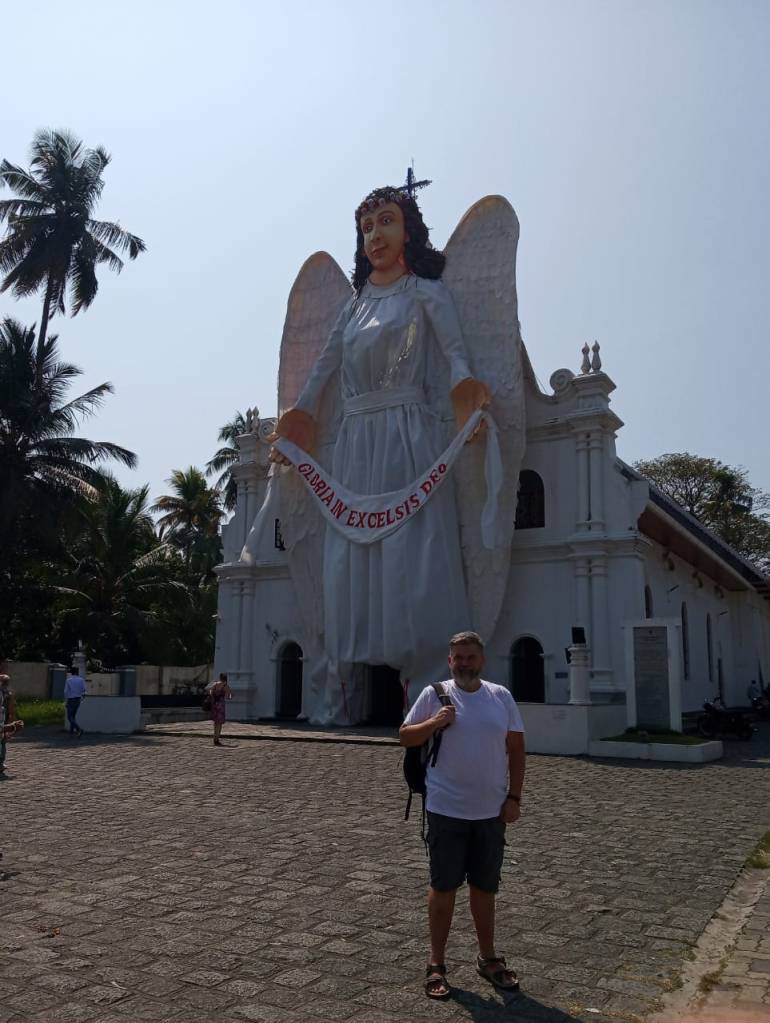
The old part of Kochi is picturesque and labyrinthine. I wandered where I would and ended up somewhere, but I’m still not sure where. Christmas lights were strung between the buildings, large glowing stars had been erected on the summits of walls, on roofs, or dangled from gables. One church I passed had a façade in the form of a gigantic angel. This was really quite surreal. We tend to think of angels as radiant beings with a human form, perfect men and women, but if you read the Bible you will soon see that most angels have an appearance that is not human at all. The highest rank of angels, the Ophanim, resemble sets of interlocking gold wheels with each wheel’s rim covered with eyes. They float through the air without needing wings. A church façade based on one of these angels would be an example of experimental architecture. But the church in the shape of a personable angel was endearing.

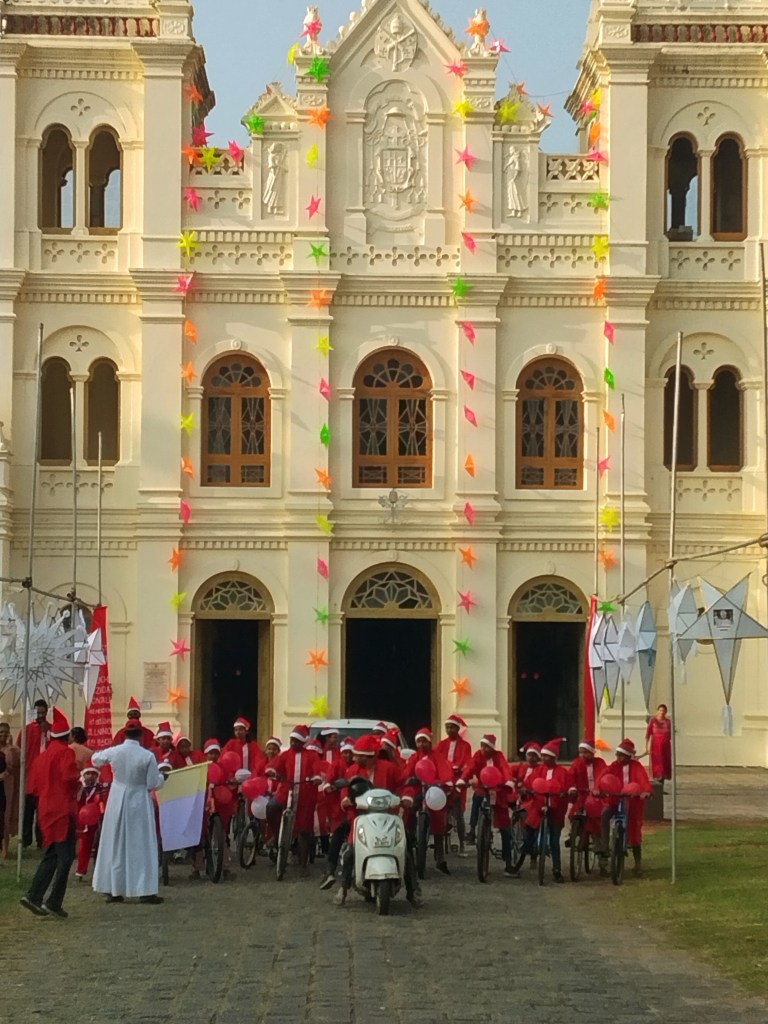
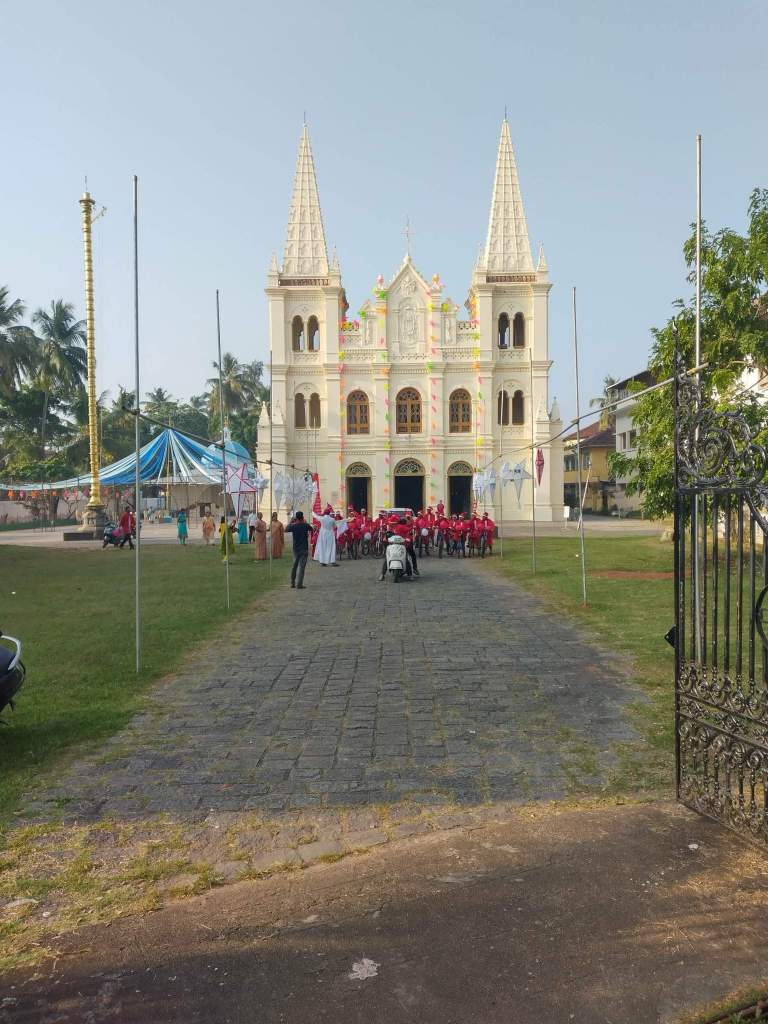
I walked past another church and saw a fleet of Santa Clauses mounted on bicycles about to set off. Is ‘Clauses’ the plural of ‘Claus’? I have no idea, for it has never occurred to me that there might be more than one of them. This fleet consisted of children in costume and I have no notion of where they were going or what they would do when they arrived. I strolled onwards and they rode past me, guided by two men on a scooter, one steering and the other holding in his arms a loudspeaker and facing backwards, like a Pied Piper who has entered the Electronic Age. One by the one, the Santa Clauses pedalled past, laughing, waving, generally enjoying themselves.

This was Christmas at its most gentle, innocent and benevolent, a far cry from the Christmas ritual I witnessed exactly thirty years ago in Prague, where the tradition involves a saint, an angel and a devil chained together who stalk pedestrians in order to give them lumps of coal that represent the sins of the year. Prague was freezing, Kochi was broiling, and I know which I prefer, but the beer in Prague is certainly better. I reached the waterfront and sat under a tree and wondered if the mass migration of Santa Clauses I had seen was truly a fleet. Maybe it was an armada instead, or a division? Is there a collective noun for Father Christmas? A Splurge of Santas?

Kochi is riddled with waterways, and it feels like an excellent location for a port, which it is. No wonder it was established at that spot. I felt a small connection to the ancient mariners who had sailed here from the West long ago, from Europe and around the tip of Africa and across the Indian Ocean. One day I will travel from this very place to the islands of Lakshadweep. This has been a dream of mine for a long time, since I was eight or nine years old. I had entered a competition run by the Twinings tea company and I won. A map of the Indian Ocean was given with the names of islands removed and the entrants had to fill in those missing names. I consulted an atlas to do this, as I imagine every other entrant did, but I had an unknown advantage.

My atlas was very old, a green battered thing, and the Lakshadweep islands were marked by that very name. In other atlases the island chain was apparently named as the Laccadives. The administrators were looking for Lakshadweep and that is how I won a year’s supply of tea. It came regularly via the postman in an endless series of little tubs, Earl Grey, Lapsang Souchong, Peach Oolong. But in the end, this endless series finally ended, and my tea luck turned out only to feel inexhaustible rather than to be so. I have never won a competition since or even come close. But I have had a fondness for tea and Lakshadweep ever since, so it is imperative that I sail to those islands one day.

During my time in Kochi, I travelled on a boat only once, from Fort Kochi to Vypin Island. A battered rusty ferry crammed with foot passengers, cars and motorcycles. Cost of ticket? The equivalent of three British pennies. This is far cheaper than the cost of any ferry I have ever been on, with the exception of the occasional free ferries that I have encountered around the world, such as the one that takes passengers across the Suez Canal from one side of Port Said to the other, or the ferry that travels back and forth between Mombasa, which is on an island, and the African mainland. Sea travel is something special and I have done too little of it in my life. If I could have sailed back to Bangalore, I would have. As it happens, I went back on another night bus, but this time the person in the seat in front of me only reclined their seat to a reasonable angle. My knees were not crushed, and in return I did not crush the knees of the person behind me. I like and admire reasonable angles. They make geometry sweet.

.

Rhys Hughes has lived in many countries. He graduated as an engineer but currently works as a tutor of mathematics. Since his first book was published in 1995 he has had fifty other books published and his work has been translated into ten languages.

.

PLEASE NOTE: ARTICLES CAN ONLY BE REPRODUCED IN OTHER SITES WITH DUE ACKNOWLEDGEMENT TO BORDERLESS JOURNAL. 

Click here to access the Borderless anthology, Monalisa No Longer Smiles

Categories
Musings

And then the tranquility got shattered

By Shevlin Sebastian 

At 11 p.m., on a Saturday a few weeks ago, I was cruising down National Highway No 47 in Kochi. Elton John’s ‘Circle of Life’ was playing on the music system. 

The mood inside the car was tranquil. My daughter, Sneha, had just landed from Bangalore. My wife, teenage son and I had gone to collect her from the airport. She has just started studying in a college in Bangalore. Dressed in jeans and a cream top, blue sneakers, without socks, she smiled happily as she entered the car. 

The conversation began. Sneha spoke about the quality of the food in her hostel, her roommates, lecturers, classmates, and the latest movie she had seen. My son, two years younger, sitting next to her on the back seat, listened silently. 

The highway was relatively deserted: a few trucks and some cars. Kochi sleeps early: the metro service, besides the pillars of which we were travelling, had closed. And so were the private bus services. An occasional long-distance Kerala State Road Transport Corporation bus trundled past, with its distinctive red and yellow colours. 

I was driving at 50 kms per hour as we were in no hurry and I was listening to what my daughter was saying rather than concentrating on the road. 

Children grow up so fast. It seemed only the other day that I held Sneha in my arms. And now she was all grown up. When she was in Class 12, I remembered the large birthday card, almost the size of an A 3 size chart, that some of her classmates had made in which they drew and wrote greetings, using red, green, blue and purple felt pens. However, one comment from a boy made me stop breathing for a few moments. “You have a nice ass,” he wrote. It took me some time to digest that. And accept. My daughter was a sexual being to her male contemporaries. 

In the car, Sneha suddenly asked, “Baba, do you mind if I put my music on?”  

“Sure,” I said. And she leaned forward and pressed a cable wire into the socket of the music system and her mobile. Soon, her songs started to play. The first one was Selena Gomez’s haunting ‘Lose you to love me’. 

Incredibly, I had heard it the day before. I read an article about the song and decided to hear it on YouTube. In her song, Selena was indirectly commenting on her failed romance with pop superstar Justin Bieber. Sneha was shocked and impressed when I told her all this. 

Baba, you are in touch,” she said, with a smile. 

“Just a fluke,” I said, modestly.   

She hummed the first few lines: 

‘You promised the world and I fell for it

I put you first and you adored it

Set fires to my forest

And you let it burn’

All of a sudden, a red Maruti Suzuki car swerved in from an outer lane and cut in front of me. I instinctively half-pressed the brake and dropped my speed to 40 kms an hour. The other car moved ahead. I was wondering why the driver had the need to cut in. There were three lanes on our side. He could have easily gone straight ahead. 

I thought: “Is the driver drunk, high on drugs or has he slept off for an instant?” 

 I could see a few heads in the car.  

Inexplicably, a few moments later, it swerved violently to the right and hit a pillar of the Kochi Metro at high speed. The thud sounded like a thunderbolt. All of us looked through the windscreen with bulging eyes and open mouths. I braked as a black piece, probably a part of the bumper, ricocheted away and came to a stop just in front. I quickly moved the vehicle to the left, without looking at the rear-view mirror. Thankfully, there was no vehicle behind us. I parked on one side.  

 Inside the stricken car, there was no movement for several moments.  

Sneha suggested that I call the police. I pulled out my mobile and did so. By the time I passed all the relevant information to the helpline, including the number of the metro pillar where the accident took place, a crowd had gathered. When I reached the damaged car I saw that the two white airbags in front had burst open. That probably explained why the driver, a thin man with curly black hair, had escaped with just a cut on his upper lip. A thin line of blood could be seen. He looked about 22, and stood to one side, with blank eyes, as if he could not see. 

Somebody said, “Did you sleep off suddenly?” He quickly shook his head and said, “No, I lost control.” Somebody asked whether it was a brake failure. He shook his head. Was he drinking? The reply was a tightening of his jaws.   

A woman, who was in the back seat, was pulled out gently by a few bystanders, with her husband cradling her head. She was laid down on the road — a middle-aged lady in a green salwar kameez. From the look on her face — the eyeballs almost vanishing as the lids closed — she was rapidly losing consciousness. There were two children, a boy and a girl, both below ten years of age. They stood nearby staring at their mother. 

Soon, a white car which was going past was stopped by several people, with raised arms and shouts. Again the woman was carried to the back seat, men holding her arms and legs, and somebody placed his palms under her back to balance her. The husband put his children on both his knees, as he sat in the front seat, next to the driver. They headed to the nearest hospital. 

Meanwhile, drivers, who were going past, slowed down, slid their window panes down, and stared with frozen eyes at the shattered engine. Where the bonnet had been smooth, now it was all crumpled metal. Ten minutes later, the police arrived. 

Some passers-by expressed the hope the woman would be okay.  

A couple of days later I called the Kalamassery police station under whose jurisdiction the accident had taken place. A policeman said that the woman had been declared brain-dead on her arrival at the hospital. The doctors put her on the ventilator. They informed the husband. He spoke to his family members. They agreed there was no point. Two days after the accident, the ventilator was switched off. And she passed away. She was only 37 years old and worked in the administration section of a government hospital in Kochi itself. It seemed she hit her forehead on the back of the front seat with great force, and this proved to be fatal.   

From the time the driver lost control to hitting the pillar was all of two seconds. That was the minuscule time taken for a tragedy to take place. 

So, why did this event take place? Why did God take the mother away from the children at such a crucial stage in their lives? What will be the psychological blow on them? Who can replace their irreplaceable mother? Nobody, I guess. How will the husband handle the situation of being both father and mother? As strangers, we will never know the answers.   

Meanwhile, when we set out again, there was a tomb-like silence in the car. Everybody stared straight ahead, lost in their thoughts. My wife told me later that Sneha had been deeply affected, especially when she came to know that the woman had died. 

So, how does one respond when a fortnight later Sneha was involved in a two-wheeler accident in Bangalore? She was travelling behind a classmate on a scooter on a Sunday morning. They took a right turn, a car came speeding up, hit them and sped away. My daughter was flung onto the pavement. She had scratches on her face, arms, elbows and knees. 

Sneha called us from the hospital. My wife shed tears but she quickly regained control. We decided to leave immediately. At that time, there were no flights. The runway at Kochi airport was being re-carpeted. So, the flights were only in the early mornings or at night. 

We took a train to Salem and then a bus. By the time we reached it was 11 p.m. Thankfully, a relative’s wife, a homoeopathic doctor, had handled matters. She went to the hospital, got my daughter discharged and took her to a better hospital. An X-ray revealed a crack in her pelvic bone. The healing had to be natural. A two-month rest was advised by the doctor. So, we brought her back to Kochi. Sadly, she missed many classes. 

I did wonder how much of seeing the first accident played a role in my daughter getting involved in an accident of her own? Who knows how the mind works? The subconscious is a mystery. 

In retrospect, I wished that we had not seen the accident. 

When asked what he feared the most as Prime Minister, the late Harold Macmillan said, “Events, dear boy, events.” 

Indeed, this seems to be right.   

The repercussions of an event can lead one to sunlight or darkness. 

Shevlin Sebastian is a journalist based in Kochi. He has published around 4500 articles over 30 years, most of them feature stories. He has worked in Sportsworld magazine, (ABP Group), The Week magazine (of the Malayala Manorama Group), the Hindustan Times in Mumbai and the New Indian Express in Kochi and in DC Books, Kottayam.