Categories
Excerpt

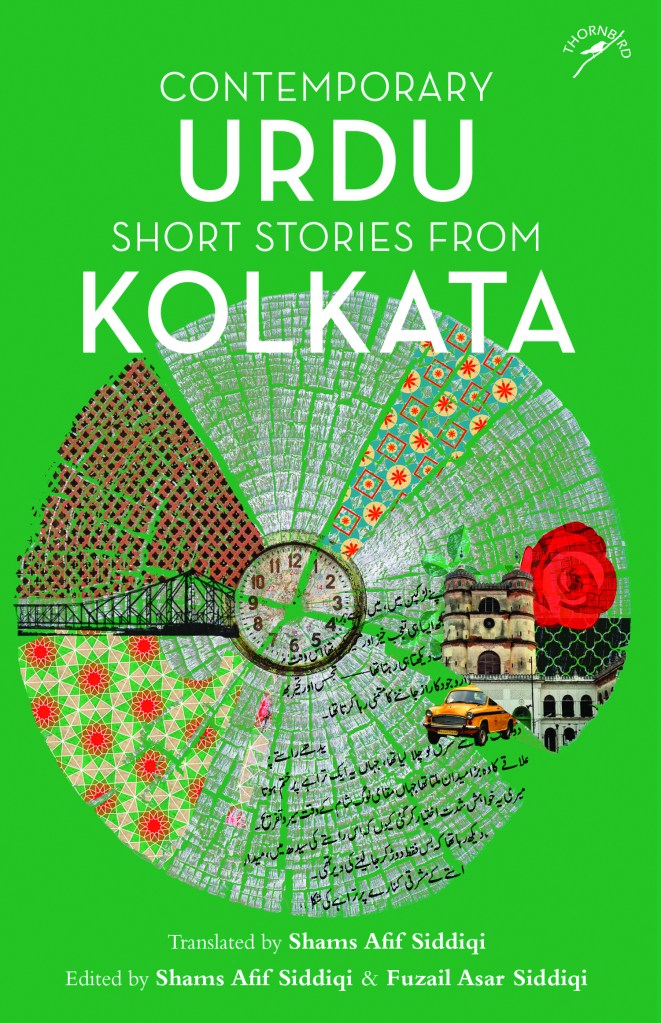
The Stopped Clock

Title: Contemporary Urdu Stories from Kolkata

Authors: Sayeed Premi, Firoz Abid, Anis Rafi Siddique Alam, Mahmoud Yasien, Shahira Masroor Anisun Nabi, Reyaz Danish

Translated by Shams Afif Siddiqi, edited by Shams Afif Siddiqi and Fuzail Asar Siddiqi

Publisher: Niyogi Books

The Stopped Clock

By Siddique Alam

The hands of the clock had stopped permanently at 13 past two and two seconds. Sitting on the bench under the shed, I am trying to understand the oval dial of the clock, the Roman letters of which had become dimmed and its edges covered with spider webs. I wonder when the clock might have stopped. I am 35 years old. Is there apparently any difference between us? Just like the clock, I have also stopped for a while because there was no announcement about the arrival of my train, its departure time being four hours ago.

I am trying to survey the place with wide open eyes. It is a usual day and an ordinary station that we are accustomed to see.

I have bid farewell to the city of my birth. I am leaving the city like a failure. But it seems after relinquishing me, the city, with a feeling of guilt, now wants to take me back. Its first step in this direction is to delay my train for an indefinite amount of time.

Despite being in the midst of a city, a station is free from its clutches. I am enjoying that freedom with a one-way ticket in my pocket. A bit of patience, I tell myself, and I would be far away. Nobody can stop me, neither by erecting obstacles in the way of the railway tracks nor by stopping the hands of the clock. Maybe I am a loser, but the journey of my life is yet to end. I am only 35 years old. I have to go far away from this place. The most important thing is that I am satisfied that the address I am carrying in my pocket is not my last destination.

It is a temporary waiting place that can help me make a new beginning. After all man is born free. The sun does not select a particular spot to shine, nor is every wave that dashes against the shore the last one, losing which the boatman would have to wait all his life for another wave.

An old coolie, wringing khaini[1] in the palms of his hands, passes by me. He is clad in a white banian and dhoti, his red flannel shirt thrown on his left shoulder.

‘Since when has the clock stopped?’ My question stops him in his stride. He turns around, his tired, thoughtful eyes staring at me. A sense of shame overpowers me. He may be an illiterate coolie, not a station employee who is answerable for such a question. ‘I am sorry,’ I quickly add, ‘I should not have put the question to you. I take back my words.’

‘Why sir?’ he stands by the side of the bench, and looks at me with a sense of intimacy. ‘People will be asking questions about a stopped clock, isn’t it? They cannot to be blamed. The story of the stopped clock is well known but only the signal man Gocharan Ray has the right to tell its tale. He had spent all his life showing green and red flags to trains and has retired today.’

‘Who has replaced him?’ my question betrays my foolishness. My imprudence had always entangled me in thoughtless acts.

‘Why don’t you ask the station master?’ The coolie moves away. ‘It’s a question that requires an answer; otherwise, you will regret it all your life.’

I was not ready for such an unexpected turn of events. I thought that my relationship with the city had been cut off forever. What do I make of a station that has ignored me, as if the ticket in my pocket is of no worth? Once again, I look at the dial of the clock hanging from the shed. It had stopped at 13 past two and two seconds. What might have happened when it stopped? Did an accident take place at the station? Had any incident of murder taken place? Was it at the time of the departure or arrival of an important leader? An attack by Naxalites? Or was the place the site of a communal incident?

The coolie returned again. This time he was wearing his shirt. ‘Unless you hear the story,’ he says, ‘your train will not arrive. This is the rule here. It may take weeks, months, or even years and you have to move from one platform to another with your suitcase. Once, a passenger alighted here to board another train. He faced a similar dilemma. He asked the same question about the clock but I do not know what happened and why he refused to listen to the story. Do you know what happened to him?’

‘How can I?’ I replied impatiently. ‘The city hardly gave me any time so that I could listen to stories.’

‘You are becoming irritated unnecessarily, Sir,’ he said. ‘I want to tell you about the man. The fact is nobody knows much about him. Some say he went to the city and did not return. Others say he took another train that never reached its destination. Some may even tell you that a prostitute took him to her house by the railway tracks where he developed leprosy and is slowly dying there. There is also no dearth of people who say he is still moving, suitcase in hand, amidst platforms, difficult to spot in the teeming crowd of passengers.’

‘You mean to say he can be anyone, even me?’

‘Did I say that, sir?’ He was on the verge of leaving. ‘It seems you have tasted bitter gourd.’

I was staring at the departing coolie’s back. The constant use of the flannel shirt had not only exposed its fibres, it had also thinned the material exposing the bones of the man’s neck. I have no hesitation in saying that I did not believe him. Since the time when suitcases developed wheels, the number of coolies has dwindled in stations. The last nail was the introduction of the backpack. Either passengers drag their suitcases on wheels, or carry luggage in their backpacks, leaving the coolies with little work. So, this may be their way of passing time.

About the Book

Dealing with love and loss, dreams and reality, as well as history and violence, this is a collection of best 19 short stories that encompasses the whole gamut of human experience, seen through the eyes of current Urdu writers from Kolkata.

Stories from Kolkata are often assumed to be about bhadralok culture and the Bengali way of life. But Kolkata is a city with amultiplicity of stories to share. Contemporary Urdu Short Stories from Kolkata highlights the diversity of recent Urdu short stories fromthe city. In one of these stories, a writer trying to escape the city wants to find the reason why the railway clock has stopped working, in another, a new friendship sours as soon as it blossoms, while some other stories show how the complexity of human relationships is explored. There is an experiment in abstraction, and legend and reality are brought together when three sleepers of an earlier civilization wake up in the modern world.

About the Editor and Translator

Shams Afif Siddiqi, former Associate Professor of English (WBES), author, short story writer, and literary critic, was born in 1955 in Kolkata. He taught in government colleges of West Bengal for 35 years and was a faculty member at MDI, Murshidabad. Khushwant Singh selected his short story for publication in The Telegraph in the 1980s. His publications include The Language of Love and other Stories (2001), a critical look at Graham Greene’s novels, Graham Greene: The Serious Entertainer (2008), and an annotated edition of G.B. Shaw’s Arms and the Man (2009).

Fuzail Asar Siddiqi is currently a PhD candidate at CES, JNU, New Delhi, researching on the modernist Urdu short story, in general, and short stories of Naiyer Masud in particular. The founder/editor-in-chief of an academic editorial services company, he has been an Assistant Professor of English at Gargi College, New Delhi.

[1] Khaini: Tobacco

.

PLEASE NOTE: ARTICLES CAN ONLY BE REPRODUCED IN OTHER SITES WITH DUE ACKNOWLEDGEMENT TO BORDERLESS JOURNAL

Categories
Essay

My Love Affair with (Printed) Books

By Ravi Shankar

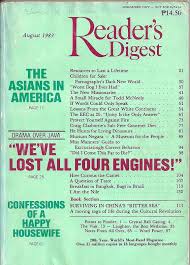
The last two years have been especially sad ones for printed books and magazines. Toward the end of 2023, the iconic magazine, National Geographic stopped selling its print issues. And in April 2024, Reader’s Digest stopped publishing. Many other print magazines have also downed their shutters though the online version continues.

I grew up with the Reader’s Digest. My father subscribed to the magazine and each month a copy wrapped in a brown envelope arrived at our door. The envelope partially covered the magazine inside, and you could see the top and bottom of the magazine. The size was small, and this made for easy handling. Reader’s Digest was a magazine you could read comfortably in bed. During the festival of Diwali, there was a special wrapping for the magazine. We had several magazines in our house when I was growing up. My mother used to read many magazines in Malayalam (our mother tongue).

Reader’s Digest provided shortened versions of stories and articles that had been published elsewhere. Their skill was in condensing the material while still retaining the interest. There was a rich collection of reading material. There were also advertisements for other books published by Reader’s Digest. Unfortunately, these were beyond our family budget. I wanted to purchase these when I grew up and became financially stronger. My neighbour who was a scientist had some of these books that I occasionally borrowed.

Another favourite of mine was the National Geographic. My father was a faculty member at a banker’s training college in Mumbai and their library subscribed to National Geographic. He often brought the magazine home. I was mesmerised by the articles and the photos in the magazine. The artistic quality of the photos was superb. The magazine had only three or four articles in an issue but addressed these at great depth. I travelled to faraway places, to the bottom of the ocean, to within the human body and to outer space with the magazine. Later, National Geographic started a television channel, and I would watch the documentaries in the nineties.

We also subscribed to the Illustrated Weekly of India. This was in a large format and again had very good photographs. I still remember the column by the journalist Khushwant Singh titled ‘With malice towards one and all’. I was also a fan of the comics section of the magazine. I had a huge collection of comics and my father purchased both Amar Chitra Katha and Indrajal Comics. Amar Chitra Katha introduced me to the rich history of India. Indrajal comics had superheroes like Phantom, Mandrake, and Flash Gordon. I used to eagerly await new issues. Most of my comics were lost when we shifted houses.   

When the news magazine, India today, made an appearance, we subscribed to it and to Outlook and The week (Indian news magazines). During my school days in May, I used to eagerly await the new textbooks and notebooks for the next class following the results. I used to go with my mother to purchase these from a stationery store near the railway station. The smell of the new paper and the fresh ink was mesmerising. I loved to read some of the easier chapters in these books. Covering the notebooks with brown paper was another major activity. Our school year started with the rains in June.  

My good friend, Sanjay Mhatre had a good library and loved to collect books. I loved to borrow from his vast collection. His collection on physics and cosmology were extensive. In those days, the erstwhile Soviet Union used to have cheap books of high quality for Indian readers. I remember the publishers Mir and Progress and I had several of their collections on science. The Soviet publishers used to hold exhibitions in our college. For twenty or thirty rupees, you could purchase high quality hard bound books. My introduction to quantum mechanics and to chemistry was through one such book.

At Thrissur in Kerala most of our medical textbooks were western and predominantly from the United Kingdom. There used to be an English Language Book Society (ELBS) that published cheaper versions of textbooks for developing countries. With our limited resources purchasing textbooks was a challenge. The two major textbooks published from the United States were those of Anatomy and Pathology. Those days we did not have online textbooks and online sources and were limited to the printed word.   

I used to write for our medical college magazine and eagerly waited for the annual issue to be published. During my residency days at PGI, Chandigarh I was the literary secretary and was very involved in bringing out the annual magazine, The Resident. We also introduced a newsletter, ARDent Voice, with ARD standing for the Association of Resident Doctors.

At Pokhara, Nepal the college library had a good collection of general books and novels in addition to medical books. I used to read a lot of novels and the author, Frederick Forsyth was one of my favourites. His meticulous research blurred the lines between fact and fiction. Sidney Sheldon was another bestselling author. Novels enabled me to travel vicariously to different places and through varied situations.

Today reading has become less common among the younger generation. Reading strengthens creativity and the imagination as you must imagine in your mind’s eye the situation the author is creating. Is it not magical that the author can communicate with you, the reader through squiggles on a page across the boundaries of space and time?

I started writing during my MBBS days. I still remember the versification competition I took part in and won the first prize. I used to participate in different literary events at my college. In Nepal, I combined my triple loves of writing, photography and hiking with articles for the newly started newspaper, The Himalayan Times. I met my writing guru, Don through the magazine, ECS Nepal. Don was the editor of the magazine and a powerful writer with a deep knowledge of Nepal. I learned a lot from his comments and suggestions and the workshops he conducted. I also used to write a medical column for ECS Nepal. ECS Nepal was a beautifully produced magazine with great photographs. Unfortunately, it stopped publishing around the beginning of the pandemic.

Other travel and lifestyle magazines were also published from Nepal but could not sustain themselves. In the Caribbean Island of Aruba, I used to write off and on for a daily newspaper published in English. Again, the newspaper ceased publishing. During the last two decades several print magazines have ceased to exist. I feel it is a great loss.

I do not read much on paper these days. Most of my reading is done online on computers, laptops and tablets. I also have a Kindle reader. Kindle screen mimics the appearance of paper closely, but it is not the same as reading a printed page. You can no longer feel the smoothness of glazed paper, the smell of fresh ink and the vivid colours of photographs. With the closure of the print version of Reader’s Digest, an era in print publishing has ended. The demise was sadly expected. Without printed books, our (my) world may never be the same again!

.

Dr. P Ravi Shankar is a faculty member at the IMU Centre for Education (ICE), International Medical University, Kuala Lumpur, Malaysia. He enjoys traveling and is a creative writer and photographer.

.

PLEASE NOTE: ARTICLES CAN ONLY BE REPRODUCED IN OTHER SITES WITH DUE ACKNOWLEDGEMENT TO BORDERLESS JOURNAL
Click here to access the Borderless anthology, Monalisa No Longer Smiles

Click here to access Monalisa No Longer Smiles on Kindle Amazon International

Categories
Review

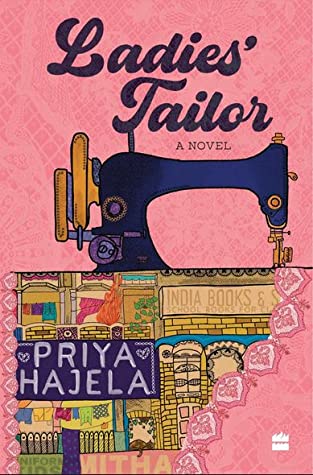
Ladies Tailor

Book Review by Somdatta Mandal

Title: Ladies Tailor: A Novel

Author: Priya Hajela

 Publisher: HarperCollins

Seventy-five years after the Partition of India took place, the cataclysmic event on both sides of the country — in Bengal in the East and in Punjab in the West — has fuelled research on the trauma of migration, loss, and resettlement, and the interest in the theme is still proliferating today. It is interesting to note that apart from documentation through innumerable non-fiction and memoirs, stories of grim reality of the Partition as documented in stories by earlier writers like Sadat Hasan Manto or Khushwant Singh’s Train to Pakistan, the interest on the theme remains unabated even today. The only difference now is that with the passage of time, writers are often relying on memory of the Partition as narrated by their ancestors firsthand, or through books, films and documentaries in a new sort of writing that blends fact and fiction and try to use the background events of migration and displacement into stories of resilience, grit, and people rebuilding their lives anew after crossing borders as refugees with even more stamina.

Priya Hajela’s debut novel Ladies’ Tailor is an attempt to recreate the story of the actual Sikh migration of her paternal grandparents Bakshi Pritam Singh (Papaji) and Beant Kaur (Biji) who left their home in Harial Gujarkhan (Pakistan) and made a new life in Ludhiana, Punjab. Dedicating the book to them, she mentions in the foreword how the places she has written about in the novel – Delhi, (Nizamuddin, Patel Nagar, Khan Market, Shahdara, Kingsway Camp), Lahore, Amritsar and Sukho are all real, but many elements are fictional. All these places provide the setting needed to tell the story, many details imagined and manipulated based on the needs of her characters. Ladies’ Tailor is a story that captures a setting and a group of characters that represent the immigrant and the refugee spirit, the optimistic spirit of never giving up on what you want and a spirit of adventure and entrepreneurship that to this day is the driving force in Delhi and Punjab.

The novel begins primarily with the protagonist Gurdev, a Sikh farmer who had deliberately moved from his parent’s house in Lahore to settle and work in a remote village called Sukho for ten years where all the religious communities lived in harmony and led peaceful lives. It took a lot of time for people to realize the Muslim-Sikh violence in the village that began around 1946 and that resulted in fear, hatred, insecurities as real and when large-scale massacres, butcheries, annihilation of entire clans, that was beyond Gurdev’s imagination happened, and he participated like everyone else. He made a brief visit to Delhi where he judiciously deposited cash with different people so that he could use it later. When he finally decided to migrate to India along with his wife Simrat and their two children, he could not convince his parents in Lahore to join them as they were determined never to leave Pakistan, the birthplace of their gurus.

After braving the horrific massacres and ordeals along the way, Gurdev landed up at Kingsway Camp in Delhi only to reach safety and find new problems ahead of him. Not only is he determined to make a fresh start for himself, his wife and sons, but he proves to be quite a meticulous, strategic planner and motivator for fellow refugees in the camp. Simran, the all-enduring and never complaining type of wife, turns sick and is admitted to the hospital and by the end of the ninth chapter, she silently disappears after that when Gurdev hands her some ornaments that his mother had given her. We don’t hear from her again as well as the two sons who accompany their mother.

Though taken aback, the indomitable Gurdev takes it all in his stride and tries to concentrate on his business and survival instincts. He befriends two sardars, Nirmal Singh, a Ladies’ Tailor, and Sangat Singh, and convinces them to start a business venture for readymade and customised garments of Khadi, an affordable hand-woven fabric preferred by women in the refugee camp and for those who wouldn’t like to wear British fabrics and wanted only ‘Made in India’ clothing. He sets up shop in the upcoming Khan Market, provided by the government in lieu of his land in Pakistan, forms a partnership with a trader in Shahadra to supply superior quality Khadi exclusively to them, and together the four of them start attracting a steady clientele, with Noor, a Muslim war widow from nearby Nizamuddin, as their brand ambassador. Hajela focuses on interfaith camaraderie with intricate details about how survival strategies result in Hindu-Muslim marriages and how names are changed to remain safe in the community.

The next move in the plot comes when Nirmal, the tailor, is somehow dissatisfied with the output because his clothes lack ornate embroidery work, a very important embellishment that used to make his outfits stand out across the border in Lahore. He wants a special sort of embroidery on their garments that was the kind crafted by two orphaned boys in Lahore, who he had nurtured like his own sons. Gurdev, the mastermind, plans a daring trip to Pakistan with Noor as his partner, to bring the two boys to Delhi for Nirmal and for their business to succeed. A complicated procedure begins with Gurdev cutting off his hair and shaving his beard to take on a new Muslim identity, and procuring a false passport, plans to visit Lahore along with Noor posing as his wife. This is where Hajela finds ample opportunity to implant a sort of interfaith romance and love relationship between the two of them. Once they arrive in Lahore, they take shelter in a Hindu man’s house and both of them feel trapped because Shakeela Begum, the mistress, seemed suspicious of their visit and itch to see them in jail. More complications arise with the driver Akbar and actual agents who keep on shadowing them.  

Hajela’s narrative is full of intricate details, be it in the furniture, clothing, food, social mores, and other material objects that prevailed in the Indian subcontinent in the 1940’s and 1950s. She fills the novel with little details like how the cut of the ladies’ salwar could determine which side of the border you belonged to, differences between the taste of the same food in Delhi and Lahore, and how people on both sides believed that one day, when things settled down, they could go back to their homes. Noor’s shopping for glass bangles, jootis, and dupattas with Phulkari[1]work in the tiny stalls of Liberty Market and Anarkali acts as a camouflage for their real mission to trace the two young boys who excel in embroidery. The novelist describes things here in great details, especially with new problems arising each day. But with his survival instincts, Gurdev takes each stride adapting to the situation and his determination to overcome all odds and thrive with new beginnings remains praiseworthy.

Despite crowding the plot towards the end with too many ramifications, like suspicion, counter espionage, breach of trust, car chases, bribing people with American dollars, the protagonists are constantly shadowed by unknown people. Strange twists to the story occur where Gurdev manages to locate his aged parents forcibly living in the outhouse of their grand home in Lahore when they were assumed to have been burnt alive during the riots. The way Gurdev plans to cross over to India once again through a remote and lesser-known spot along the border by bribing people left and right with dollars sounds a bit contrived no doubt and it seems that Hajela wanted to put in too many imagined situations to make her book a page-turner till the end with ample amount of suspense like a mystery thriller. It celebrates the unvanquished spirit of the Punjabi refugees, who, using their skills and energy, made a success of their business. Fairly linear in narration, a lot is left to the imagination at the end and therefore the novel is a feel-good read that celebrates the human spirit’s victory in the face of terrible odds. Apart from narrating the lingering afterlife of the Partition, Hajela’s statement clarifies the mission of her writing quite clear — “It’s not what sets us apart but what brings us together that’s important. How we resist the forces that are intent on separating us is what defines us. How we recover from past transgressions is what carries us forward. Ladies’ Tailor takes a resolute look at stumbling and making amends, at holding close and letting go and at turning back in order to move on.”

[1] A type of folk embroidery of Punjab

Somdatta Mandal, critic and translator, is former Professor of English at Visva-Bharati, Santiniketan, India.

PLEASE NOTE: ARTICLES CAN ONLY BE REPRODUCED IN OTHER SITES WITH DUE ACKNOWLEDGEMENT TO BORDERLESS JOURNAL

Click here to access the Borderless anthology, Monalisa No Longer Smiles

Categories
Excerpt

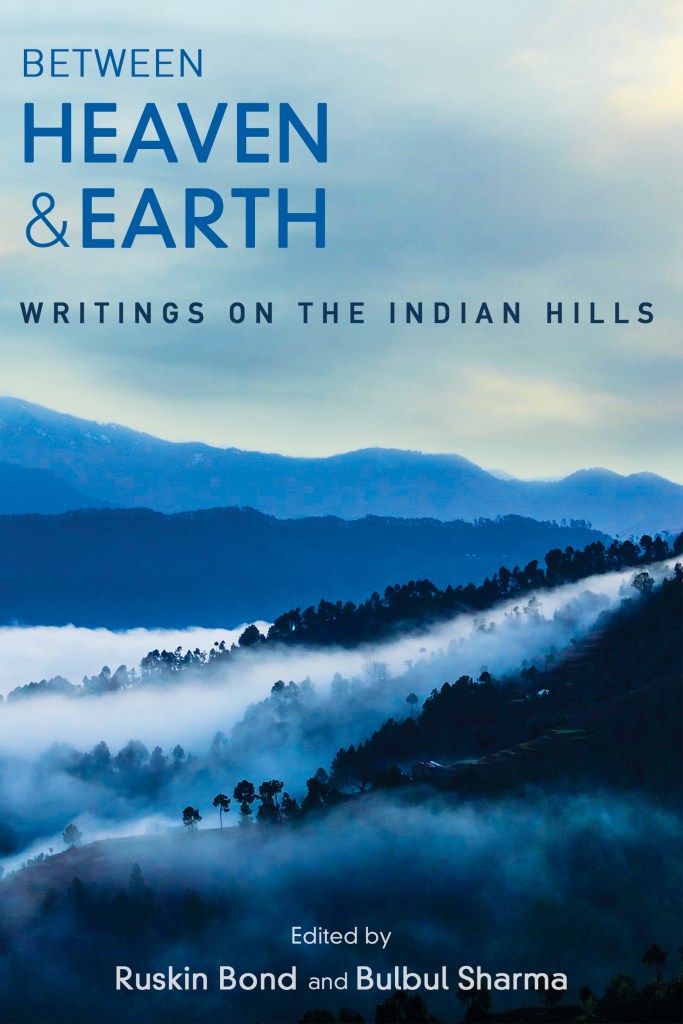
Ruskin Bond Recalls…

Title: Between Heaven and Earth: Writings on the Indian Hills

Editors: Ruskin Bond and Bulbul Sharma

Publisher: Speaking Tiger Books

She was eighty-six, but looking at her you wouldn’t have guessed—she was spry and took some care to look good. Not once in the five years that we spent together did I find her looking slovenly. The old-fashioned dresses she wore were clean and well-ironed, and sometimes she added a hat. Her memory was excellent, and she knew a great deal about the flowers, trees, birds and other wildlife of the area—she hadn’t made a serious study of these things, but having lived here for so long, she had developed an intimacy with everything that grew and flourished around her. A trust somewhere in England sent her a pension of forty or fifty rupees, and this was all the money she had, having used up the paltry sum she’d received from the sale of her property.

She’d had a large house, she told me, which she had inherited from her parents when they died, and she’d had an ailing sister whom she had nursed for many years before she too passed away. As she had no income, she kept boarders in the house, but she had no business sense and was losing money maintaining it. In the end, she sold the house for a song to one of the local traders and moved into two small rooms on the ground floor of Maplewood Lodge, a kindness for which she remained grateful to her friends, the Gordon sisters.

It must have been lonely for Miss Bean, living there in the shadow of the hill, which was why she had been excited when I moved into the floor above her. With age catching up, she couldn’t leave her rooms and her little garden as often as she would have liked to, and there were few visitors—sometimes a teacher from the Wynberg Allen School, the padre from the church in town, the milkman twice a week and, once a month, the postman. She had an old bearer, who had been with her for many years. I don’t think she could afford him any longer, but she managed to pay him a little somehow, and he continued out of loyalty, but also because he was old himself; there wouldn’t have been too many other employment opportunities for him. He came late in the morning and left before dark. Then she would be alone, without even the company of a pet. There’d been a small dog long ago, but she’d lost it to a leopard.

Camel’s Back Road, going to a tea party at a friend’s house, the dog sitting in her lap. And suddenly, from the hillside above her, a leopard sprang onto the rickshaw, snatched the dog out of her hands, and leapt down to the other side and into the forest. She was left sitting there, empty-handed, in great shock, but she hadn’t suffered even a scratch. The two rickshaw pullers said they’d only felt a heavy thump behind them, and by the time they turned to look, the leopard was gone.

All of this I gathered over the many evenings that I spent chatting with Miss Bean in her corner of the cottage. I didn’t have anyone to cook for me in the first few years at Maplewood. Most evenings I would have tinned food, and occasionally I would go down to share my sardine tins or sausages with Miss Bean. She ate frugally—maybe she’d always had a small appetite, or it was something her body had adjusted to after years of small meals—so I wasn’t really depriving myself of much. And she returned the favour with excellent tea and coffee.

We would have long chats, Miss Bean telling me stories about Mussoorie, where she had lived since she was a teenager, and stories about herself (a lot of which went into some of my own stories). She remembered the time when electricity came to Mussoorie—in 1912, long before it reached most other parts of India. And she had memories of the first train coming into Dehra, and the first motor road coming up to Mussoorie. Before the motor road was built, everyone would walk up the old bridle path from Rajpur, or come on horseback, or in a dandy held aloft by four sweating coolies.

Miss Bean missed the old days, when there was a lot of activity in the hill resort—picnics and tea parties and delicious scandals. It was second only to Shimla, the favourite social playground of the Europeans. But unlike Shimla, it had the advantage of being a little more private. It was a place of mischief and passion, and young Miss Bean enjoyed both. As a girl, she’d had many suitors, and if she did not marry, it was more from procrastination than from being passed over. While on all sides elopements and broken marriages were making life exciting, she managed to remain single, even when she taught elocution at one of the schools that flourished in Mussoorie, and which were rife with secret affairs.

Do you wish you had, though,’ I asked her one March evening, sitting by the window, in the only chair she had in her bedroom.

‘Do I wish I had what?’ she said from her bed, where she was tucked up with three hot-water bottles.

‘Married. Or fallen in love.’

She chuckled.

‘I did fall in love, you know. But my dear father was a very good shot with pistol and rifle, so I had to be careful for the sake of the young gentlemen. As for marriage, I might have regretted it even had it happened.’

A fierce wind had built up and it was battering at the doors and windows, determined to get in. It slipped down the chimney, but was stuck there, choking and gurgling in frustration.

‘There’s a ghost in your chimney and he can’t get out,’ I said.

‘Then let him stay there,’ said Miss Bean.

Excerpted from Between Heaven and Earth: Writings on the Indian Hills, edited by Ruskin Bond and Bulbul Sharma. Published by Speaking Tiger Books, 2022.

ABOUT THE BOOK

 ‘What is it about the hills that draws us to them again and again?’ asks one of the editors of this collection. In these pages, over forty writers—from a daughter of the Tagore family and a British colonial officer in the 19th century, to a young poet and an Adivasi daily-wage worker in the 21st century—show us what the many reasons could be: Green hillsides glowing in the sun; the scent of pine and mist; the wind soughing in the deodars; the song of the whistling thrush; a ritual of worship; a picnic, a party, an illicit affair. They show us, too, the complex histories of hill stations built for the Raj and reshaped in free India; the hardship and squalor behind the beauty; the mixed blessings of progress.

Rich in deep experience and lyrical expression, and containing some stunning images of the hills, Between Heaven and Earth is a glorious collection put together by two of India’s finest writers, both with a lifelong connection with the hills. Among the writers you will read in it—who write on the hills in almost every region of India—are Rumer Godden, Rabindranath and Abanindranath Tagore, Emily Eden, Francis Younghusband, Jim Corbett, Jawaharlal Nehru, Khushwant Singh, Keki Daruwalla, and of course the two editors themselves. Together, they make this a book that you will keep returning to for years to come.

ABOUT THE EDITORS

 Ruskin Bond is one of India’s most beloved writers. He is the author of nu­merous novellas, short-story collections and non-fiction books, many of them classics and several of them set in the hills of north India. Among his best-known books are The Room on the Roof, Time Stops at Shamli, A Book of Simple Living, Rain in the Mountains and Lone Fox Dancing. He was awarded the Padma Shri in 1999 and the Padma Bhushan in 2014. He lives in Landour, Mussoorie.

Bulbul Sharma is an acclaimed painter and writer, author of best-selling books of fiction and non-fiction, including My Sainted Aunts, The Anger of Auber­gines, Murder in Shimla and Shaya Tales. Bulbul conducts ‘storypainting’ work­shops for special needs children and is a founder-member of Sannidhi—an NGO that works in village schools. She divides her time between New Delhi, London and Shaya, a village in Himachal Pradesh.

.

PLEASE NOTE: ARTICLES CAN ONLY BE REPRODUCED IN OTHER SITES WITH DUE ACKNOWLEDGEMENT TO BORDERLESS JOURNAL

Categories
Essay

What’s Novel in a Genre?


By Indrasish Banerjee                             

  I mostly read commercial fiction and novels the first eight to ten years after I started reading. At that time, I was not familiar with the concept of genres and didn’t know – much less cared – about them. I was taking my first steps into the world of books and reading a new novel and finishing it was all that mattered. A decade or so later, now much more comfortable in the bibliographic world, I started experimenting with other types of books. Freakonomics (2005) by Steven Levitt was my first foray into non- fiction.  Then I experimented with a few more history non-fiction books (history was one of subjects in graduation) mainly by William Dalrymple and Jawaharlal Nehru but also by other writers. Keen on territorial conquests of another kind, I experimented with Khushwant Singh, Anita Desai, RK Narayan and a few works by a few more Indian writers. Further from home, I tried out Charles Dickens (had read some abridged versions of his novels in school), Thomas Hardy, EM Forster and more. I read their novels, short stories and essays whatever I found.

 I had travelled very far from where I had started many years ago, crisscrossing genres. But my idea of what makes a good read had hardly changed. Whether it came to fiction or non-fiction, contemporary or classic, it still revolved around ‘a story well told’. Of course, some characteristics had changed. I had become more patient with slower narratives, more adept at handling complex narratives, more comfortable with narrative calisthenics and more at ease with diverse types of writing. I had also developed an understanding about the basic differences between literary and commercial works. Even so, my idea of a good read had remained resistant to transformative changes, engendering the question in my mind: “Do genres really matter?”

 The answer is both yes and no. Genres help categorise books based on what the reader can expect of them. There are millions and millions of books in the world and just imagine there being no basis to separate one book from another. The reader would have to go from the beginning to end of a book to understand what it was all about or start a journey without knowing what lay ahead. As much as it could be a delightful experience, it would bring in its own challenges. One of them would be to market the book.

Even if we don’t want to overlook the importance of commerce to art, let’s admit that no two things in the world treat each other with as much suspicion. Be that as it may, writers have, from to time, expressed their derision for genre. Kazuo Ishiguro, who has written many genre benders, once said in an interview that genres have no profound literary purpose or any substantial contribution to literature. They are creations of book marketers and their purpose is solely to sell books.

  But is literary genre’s relevance to literature only archival and commercial? Maybe a minor digression will bring in a new perspective.

 In Hindustani music, genre plays a vital role: it adds variety and richness. There are multiple gharanas (schools) in Hindustani music. Their identity is based on their geographical regions (Lucknow gharana, Carnatic gharana) they come from, the distinct musical heritage and ancestry they represent and the musical form they practice. However, the uniqueness of each gharana is determined by the raga it engineers by combining several suras (pitches). There are seven suras (notes) in Hindustani music.

 Film genres contribute to films, of course, in terms of variety but also by creating slots based on audience preferences, social anxieties, aspirations and various other factors which allow filmmakers to address the associated emotions by placing their films in the predefined categories which helps to find a ready audience. Film genres are more fluid than Hindustani music genres. They come and go and also get clubbed creating a hybrid genre where different genres are built into one narrative to appeal to a wider audience.

On the other hand, traditionally, book genres have had rigid boundaries with very minimal or no cross-genre exchanges. In fact, the boundaries have been so rigid that authors of one genre have never shied away from expressing their disdain for their counterparts in another genre. Broadly speaking, the two warring factions have been literary and commercial fiction.  

In The Naive And The Sentimental Novelist (2011), Orhan Pamuk says commercial novels (detective, crime, romance, sci fi novels) lack a ‘centre’ – a profound reflection on the meaning of life – which is integral to literary novels. This absence of a centre in commercial novels makes almost all of them same with nothing substantial separating one genre novel from another except their characters, plot twists and the murderer. This lack of substance makes it important for genre novels to always provide excitement to their readers, he alleges. On the contrary, according to Pamuk, a literary novel is a constant quest for the centre not just for the reader but also for the writer.

 Some writers may not know the centre to start with discovering it while writing the novel as an act of serendipity. Some may structure their plots such as to illuminate the centre.  Tolstoy had to change War and Peace (written in 1869, Translated in 1899) many times to discover its centre. Pamuk informs that Dostoyevsky had suffered epileptic attacks, after writing The Devils (1871-72, translated 1916), when he had realised that he had made a mistake leading to the sudden appearance of a new plan. And he had changed everything radically, Dostoyevsky had claimed.

 Howevee, in The Miraculous Years, Joseph Frank, Dostoevsky’s biographer had said Dostoyevsky was exaggerating. The new plan had indeed changed the novel from a mediocre novel with one dimensional characters to a brilliant political one, but Dostoyevsky hadn’t changed more than forty pages of the 250 pages he had written the previous year. Apparently, it’s the ‘centre’ of the novel the great writer had referred to when he had said he had radically changed it, Pamuk concludes.

  In The Great Derangement: Climate Change and the Unthinkable, Amitav Ghosh blames this obsession of serious literature with daily humdrum, or the ordinariness of life has traditionally kept it away from dealing with subjects which are not considered ‘serious’ leaving them for the humbler genre fiction. Climactic events like a gale flattening a town or massive rains drowning it were considered too incredulous, not making the cut for nineteenth century literary gravitas.

 Until 19th century the division between fiction and non-fiction was fuzzy. In the 19th century, thanks to Industrial Revolution, there was a profusion of factories – moving workforces from unorganised, ruralized setups to more disciplined and controlled environments.  What followed was people constructing their lives around their workplaces. This transformed rural and agricultural societies into orderly and urbanised ones bringing about a new kind of society which was far more cloistered, sober and unexciting than earlier societies which, being agricultural and rural, were far rougher and exposed to vagaries of life and nature. The colourful stories of pre 19th century couldn’t adequately capture this new reality; it needed a new kind of literary tool. In came the serious fiction or what we call today the literary novel.   

Pamela by Samuel Richardson (1740), Shamela by Henry Fielding (1741) and Tristram Shandy by Laurence Sterne (1760) were the first attempts at literary novel dealing with such solemn themes as social differences, inner conflicts and women’s sexual autonomy. This style of writing travelled far and wide. Among others, it was adopted by Bankim Chandra Chatterjee, among the earliest practitioners of the novel in India, digressing from the earlier traditions of storytelling in India, the Jataka tales and so on, informs Amitav Ghosh in The Great Derangement: Climate Change and the Unthinkable.

 Over a period of time, puritanism around contours of literary fiction set in, and it’s difficult to say when the wall between serious and literary fiction collapsed – in fact one can say it never did. But just as literary novels had emerged to accommodate a new kind of reality in 19th century, breaking away from genre fiction, genre benders have accounted for another kind of changing reality which is presenting challenges hitherto unimagined within the conventional boundaries of human life, like the effects of climate change and technological advances like artificial intelligence and machine learning.

  To capture the idiosyncrasies of modern life, many literary writers have flouted the boundary between literary and genre novels by setting their plots in the genre format while retaining the treatment of literary fiction. In Kazuo Ishiguro’s When We Were Orphans (2000), Christopher Banks, now a private detective in London, sets out to investigate how his parents disappeared from Shanghai during the Second Sino-Japanese War.  The novel is about life’s profundities like memory, nostalgia at its heart, although it’s written like a detective novel. The plot constantly moves from one incident to another keeping the reader waiting for the end, even as it draws a detailed picture of Shanghai society during the war. In Ishiguro’s recent book – Klara And The Sun (published in 2021) – he explores what separates human from robot even after the robot has acquired human-like intelligence. The book has a children’s book like element to it which is its main charm.

  Many writers have experimented with multiplicity of forms, but among the notable books are Kobo Abe’s 1950s novel, Inter Ice Age 4, which starts as a hardwired sci fi but slowly evolves into a political thriller and Italo Calvino’s If on a Winter’s Night a Traveller (1979) whose plot bifurcates into two in the middle of the novel. There on, in some chapters, the reader is solving literary mysteries while the other chapters are the first chapters from other novels of varied styles.

 The novel like any other art form has survived and moved ahead through adoption from within its various forms or external influences. When a new form arrives as a reaction to a social change or occurrence or an enterprising writer pushing back the boundaries, puritanism sets in to preserve the form in its purest state if it achieves literary acceptance and fame. Novels with magic realism and migration are some examples. When the form outlives its utility or is made obsolete by emerging trends or excessive repetition, it gets subsumed by another form and survives as part of it or slowly dies out. And thus, a new form, a mix of the two or many more, emerges. And the novel lives to fight another day.

.

Indrasish Banerjee has been writing and publishing his works for quite some time. He has published in Indian dailies like Hindustan Times and Pioneer, and Café Dissensus, a literary magazine. Indrasish is also a book reviewer with Readsy Discovery. Indrasish stays and works in Bangalore, India. 

.

PLEASE NOTE: ARTICLES CAN ONLY BE REPRODUCED IN OTHER SITES WITH DUE ACKNOWLEDGEMENT TO BORDERLESS JOURNAL