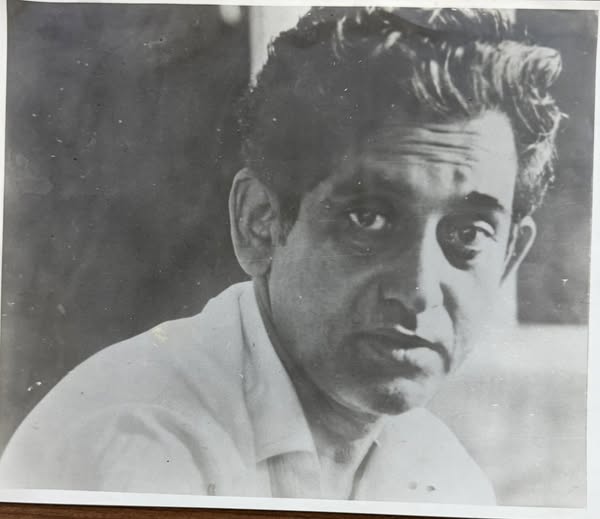
The death of Ramakanta Rath, a provocative figure in contemporary Odia poetry, has left a considerable gap in the literary landscape. Born on December 13, 1934, in Cuttack, Ramakanta was a prominent modernist poet in Odia literature. He obtained his Master’s degree in English Literature from Ravenshaw College and joined the Indian Administrative Services (IAS) in 1957.
His work was significantly shaped by the influences of poets such as T.S. Eliot and Ezra Pound, often delving into themes of mysticism, mortality, and human isolation. Ramakanta Rath’s contributions have profoundly impacted modern Odia literature in various ways. He brought modernist themes and styles to Odia poetry, drawing significant inspiration from Western poets such as T.S. Eliot and Ezra Pound. His examination of topics like the search for the mystical, the concepts of life and death, and the experience of inner solitude facilitated a transition in Odia poetry towards more contemporary and universal themes.
Rath’s poetry is marked by symbolic references to spiritual and metaphysical dimensions of existence, which enhanced the intellectual richness of Odia literature. This methodology enabled readers to engage with intricate philosophical concepts through the medium of poetry. Rath’s poetry is noted for its somber tone and symbolic references to the spiritual and metaphysical dimensions of existence.
His significant literary contributions include Kete Dinara (Of Bygone Days, 1962), Aneka Kothari (Many Rooms, 1967), Sandigdha Mrigaya (Suspicious Hunting, 1971), Saptama Ritu (The Seven Seasons, 1977), Sachitra Andhara (Picturesque Darkness, 1982), Sri Radha (1984), and Sri Palataka (Mr Escapist, 1997). Rath was honoured with the Sahitya Akademi Award in 1977, the Saraswati Samman in 1992 for Sri Radha, the Bishuva Samman in 1990, and the Padma Bhushan in 2006. He also received the Sahitya Akademi Fellowship in 2009 before which he was the vice-president of the Akademi.
Rath is particularly celebrated for his lengthy poem, Sri Radha, in which he reimagines Radha, freeing her from theological limitations and depicting her as a remarkable character who embodies deep emotions, love, defiance, and resilience. This poem uniquely intertwines themes of erotic love with existential introspection. This notable work initiated a new trend in Odia poetry that echoed the confessional styles of poets like Sylvia Plath, infusing a personal and introspective quality into Odia literature.
He skillfully combined traditional Odia poetic meters and techniques with contemporary free verse, creating a unique hallmark of his artistic expression. Odia poetry is characterised by its extensive use of classical meters and forms, such as chhanda, chautisa and champu which serve to articulate intricate emotions and themes in a structured and rhythmic manner. By incorporating these traditional elements, Rath infused his poetry with cultural richness and musicality, thereby amplifying its emotional resonance and thematic depth.
Ramakanta Rath’s integration of traditional Odia meter enriched his themes in multiple ways. By using these familiar poetic forms, his work connects more profoundly with readers who recognise them. This cultural connection amplifies the emotional resonance of his themes, making them easier for his audience to relate to. Additionally, traditional Odia meters often hold symbolic significance, which Rath skilfully utilises to deepen his modernist themes.
The combination of symbolic annotations and modernist concepts enhances Rath’s poetry, adding depth and encouraging reflection. By contrasting traditional forms with modernist ideas, his work creates a dynamic tension. This tension amplifies the emotional resonance of his poetry, prompting readers to navigate the clash between traditional values and contemporary realities, which adds layers to his themes. Rath’s incorporation of traditional meters with modern free verse invites readers to think critically about his poetry.
This fusion of styles encourages a deeper exploration of his themes, leading to a more profound appreciation of his work. While the traditional Odia meters offer a cultural base, Rath’s modernist themes keep his poetry relevant on a global scale. This interplay between tradition and modernity enables his work to reach beyond local confines, attracting a wider audience interested in existential and philosophical questions.
Rath’s poetry stands out for its masterful incorporation of irony and wit, elements that add depth and complexity to his body of work. Critics note that his use of irony can often be challenging to interpret, reflecting the nuanced and multifaceted nature of his poetic viewpoint. This unique approach, combined with his thematic explorations, has sparked a resurgence among a new generation of Odia poets, playing a crucial role in the advancement of modern Odia literature.
Ramakanta Rath’s impact has been instrumental in shaping the landscape of contemporary Odia poetry, solidifying his reputation as a monumental figure in the realm of Indian literature today. His passing signifies the conclusion of a significant era in the narrative of Odia literature, leaving behind a legacy that will continue to inspire future writers and poets.
Bhaskar Parichha is a journalist and author of Cyclones in Odisha: Landfall, Wreckage and Resilience, Unbiased, No Strings Attached: Writings on Odisha and Biju Patnaik – A Political Biography. He lives in Bhubaneswar and writes bilingually. Besides writing for newspapers, he also reviews books on various media platforms.
.
PLEASE NOTE: ARTICLES CAN ONLY BE REPRODUCED IN OTHER SITES WITH DUE ACKNOWLEDGEMENT TO BORDERLESS JOURNAL
Going up from East River to all heated up 46 Street,
Crossing quite a few avenues one after another,
Just where 5th Avenue comes into view jarringly,
One comes across America’s biggest bookstore, Barnes and Nobles,
Poised at this point of the city like an ancient philosopher.
And when I say “biggest”, I mean one store of a really big bookshop chain.
There may perhaps be a bigger shop than this one somewhere else,
Or perhaps there may be none comparable in size!

On weekdays I stand there for some time around ten
Perhaps because of its proximity to Diamond District,
The morning sunlight here—an amalgam of diamond and gold—
Streams onto the 5th Avenue pavement.

Perhaps to pick them up,
Causal and loosely clad, white-skinned women flood the street.
Usually, I buy a glass of smoothie from the Mohican youth
Making energy drinks on his machine,
Savouring afterwards a glass of the diamond-gold drink.

I can take many roads to come to F train station,
But I always use this particular crossing point.
On evenings, while returning from the UN building,
Unthinkingly, I enter Barnes and Noble’s cavernous stomach
Two concrete monsters cover the orange-coloured cloud.
What can a man possibly need in a bookshop?
It is quite one thing if it is a bar or a meat shop!
Of course, Americans crowd vegan shops nowadays,
Who knows if one day vegans will alter the American language?

From some aisle of the shop, on any given day, I’ll pick up any one.
The other day it was that old man from the Vermont Hills, Frost.
As soon as I picked him up, he wanted to make me wise in my ways.
“Try and fathom out the music of verse—that is it essence!”
What rubbish! The guy is still stuck in the 1960s!
The world of poetry has marched forward a lot,
And has been crossing all sorts of holes and pits nowadays,
And prose’s highs and lows.
The old man is such an ignoramus!

Holding a milk-honey concoction on her lap sat the Punjabi girl, Rupi Kaur.
Seeing me, she sprang into my lap.
India seemed to tremble as fingers touched soft dark skin.
Though someone who was still in her teens only yesterday,
She couldn’t resist dishing out advice. She said:
“Forge a knife on your own dear poet; hold the weapon in your hand,
The time has come to slice things with one stroke after another!”

The day I banged against Rae Armantrout, was the day I learnt about her verse,
About how in their silences became representative of language movement poetry.

I saw many others in their welcoming aisle as well!

I saw Ezra Pound trying to suppress a smile when I entered,
For sure I did not dare go near him out of fear
But let me whisper this into your ears:
I sure did mangle his poetry in trying to translate it!

I saw Amiri Baraka’s unruly beard fly in the air conditioner’s wind.
Nude Ginsberg was walking up the stairs leading to the second floor,
Shouting as he did so, “They don’t understand people’s sufferings
So obsessed are they with “development”!
John Ashberry was looking at the Hudson with one eye,
His tears stonily registering some hidden pain there
The other eye was all ablaze
All of a sudden, like a scene in some animation film,
The man’s eye’s fire made Manhattan burn.

I fled the fire that was burning so
Thinking as I did then—
How could Barnes and Nobles accommodate such hostile pronouncements,
                                                                                              such wrath!

				Holliswood, New York
				24 June, 2022
Quazi Johirul Islam has been writing for over 3 decades. He has published more than 90 books, 39 of them are collections of poetry. His travelogues are very popular. He has been with United Nations, has traveled all over the world, worked in conflict zones, his bag is full of colourful experiences. In 2023, Quazi was awarded Peace Run Torch Bearer Award by Sri Chinmoy Centre, New York. He has also received many awards and honours in Bangladesh, India and abroad.
Poet, creative writer and teacher Adam Aitken talks about cross-cultural identity, and the challenges of travel, writing, and belonging with Keith Lyons.
Adam Aitken
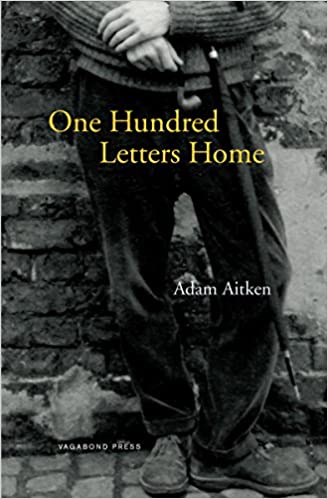
Adam Aitken is a London-born teacher and writer with a PhD in creative writing. He migrated to Sydney after spending his early childhood in Thailand and Malaysia. His poetry and prose have been widely anthologized. He has published poetry, chapbooks, essays on Asian Australian literature, book reviews, and was co-editor of Contemporary Asian Australian Poets. The story of his mixed heritage is featured in his creative non-fiction work One Hundred Letters Home. In this exclusive, he shares about the challenges of writing, identity and place.
You were born in the UK and have spent most of your adult life in Australia but tell us about your early childhood in Thailand and Malaysia.
It was a very happy childhood, and I was spoilt by everyone, except my mother, who was chronically anxious every time my father appeared. I was unaware of it at the time, but they were not happy together. I remember my fourth birthday in Birkenhead Liverpool. Then we moved to Southeast Asia. In Thailand, my father was almost always absent. I had good schooling in Kuala Lumpur, at a Catholic pre-school run by the Good Shepherd order. I remember my first day, I was illiterate in prayers and scared of the large carving of Jesus crucified and bleeding from his crown of thorns. Around seven, I went to an international school in Bangkok, which was great except for the bullying I received from an American kid. After he hit me on the head with his sneaker, I reported him, and he was publicly shamed. There are few worse things you can do than insult someone with your shoe, especially by touching the head.
What was your experience like moving to Australia when you were still young? How did your sense of identity or ‘home’ develop?
Worse, the racism in Perth was total, violent, totalitarian. Teachers were complicit. Nothing was done about it. My brother and I were once howled out of the school as we went home. I am afraid that when I talk about the worst aspects of ‘Whiteness’, I remember that time. My father was again absent, unable to get a job he liked and implicated in a civil adultery case involving another couple. We left for Sydney after a year. My poem ‘The Far East’, is an attempt to record that kind of trauma.
When did you first discover that you liked writing creatively, and in particular, writing poetry?
About aged 14, after six years living in Sydney, I started to enjoy my English classes. I had a fabulous teacher Rick Lunn, who I think became a successful sci-fi writer. I will never forget the magic of listening to ‘The Rime of the Ancient Mariner‘. After that I had access to David Malouf’s library in Sydney, when we stayed at his flat for a few months. I discovered the alternative reality that books provide. I bought a typewriter and enjoyed the process of typing on paper. A few years later I attended a poetry reading at Exiles Bookshop in Sydney and was enchanted by the strange glamour and seriousness of the writers. Martin Johnson, John Forbes, Gig Ryan, John Tranter were all there.
What early recognition or encouragement meant you saw being a writer as a career option?
At my primary school, I wrote a poem about a forest walk we did, and on seeing a sea eagle, and that was read to the whole class. At high school in Sydney, a poem or two made it into the school magazine. I think the English Master also recognised me and encouraged me. I was lucky to grow up in a time when creative writing was still valued but not necessarily seen as a vocation for which tertiary qualifications were essential, but at Sydney University, I enjoyed lunchtime poetry workshops when there were no creative writing courses to do at all. I met practising writers in a very informal atmosphere and so ‘being a poet’ seemed a comfortable choice. My mentors were real writers but there was no pressure of assessment. The goal was to get poems into magazines. This happened when I was in 3rd year. I had great lecturers who loved poetry. I was published in Southerly. I featured in an issue of Chris Mansell’s Compass. It was a thrill to have a few pages in a well printed and produced ‘zine. I also read at what was then the largest reading in Sydney, The Harold Park Hotel. Probably Sydney’s most dynamic place at the time, and since.
How did you develop your mastery of the craft, own voice and style?
I baulk at this question as I am not sure how I can define my voice or style. Certainly, early imitation of other poets, practice and attention to poetic technique (metaphor, simile etc.) helped me develop the craft. Listening to poetry out loud helps. Revising and trying out new versions. It’s like writing music. I also have a very good ear for languages so pick up stylistic and prosodic patterns quite quickly. I listened to early advice about metrics and line endings and spent a lot of time reading traditional verse and learning the metres and forms (ie. sonnets), even though I don’t apply them much these days. Writing ‘in the style of’ is an enjoyable exercise and imitating others is fun, even though it can be unoriginal. I tend to allow a line or sentence to suggest its own metrics, then use that to write a draft. I am very much more into allowing content to dictate form.
What do you think is unique about your work, that makes it distinctly yours?
In terms of the questions of form and craft, I don’t think there are many Asian Australian poets who had a traditional training in English Lit, augmented by Modern American literary influences (like the Imagists, Ezra Pound, and the New York School). I was there in the early days of postmodern theory. I was starting out during the ‘Poetry Wars’ in the ‘seventies. I also studied linguistics and became an English language teacher. I was there in the heady days of the Sydney early ’80s. I think this gives me a kind of technical awareness of language and grammar, form and genre. I am probably one of most well know of migrant poets for having been recognised since then. I was fortunate to not have to work so much and so I had plenty of time to develop my craft. On a personal level I don’t know many other Australian poets who have had my parents who were literary enthusiasts, and both culturally eclectic. Of course, Thai heritage has given me a lot. Few Asian Australian writers have had a childhood like mine, or possibly the eclectic experience of reading as I have had. I don’t know of any Asian Australian writer who has explored their cross-cultural heritage as I exhaustively as I have in both poetry and memoir.
How do you communicate through poetry something very personal, to an audience that is on the outside?
I received a ‘New Critical’ dogma about the poem being an impersonal object, but it did not stop me reading Sylvia Plath or Frank O’Hara. I begin by thinking about how the personal could be interesting to someone I don’t know. Attend to the particulars and details of the personal, and to avoid sentimentality. Be as brave as possible as to the trauma of an experience and celebrate the positive. My own preference is to avoid histrionic outbursts, something a learned writing my memoir. Again, the particulars and exactitude of description work better than bare statements. I do still hold to the dictum of showing, not telling.
One of the characteristics of your work is attention to detail. Does that start with being observant and taking notes? How do you then find the most poignant moments or parts?
I often know I have a poignant subject, but often writing leads you to it. The previous answer is relevant here also. I don’t do a lot of notes, but I do a lot of drafts that grow into larger structures. What seems poignant early may pale into insignificance later, so I do a lot of revisiting of old notes and drafts. I often take note of dreams and reflect on what they might mean. I have always been interested in painting, photography, and films, (which I studied at Uni) so I do spend a lot of time thinking about what is ‘in the scene’, what the detail is, how close ups and panning work, what a montage is. As a child I liked to look through microscopes at insects. As far as grammar in concerned, I am fascinated by how grammars work in other languages, and in the etymology of words.
How do you go about writing a poem?
Again, often I start with a fragment, a line, a phrase, and go from there. Sometimes, I set out trying to describe a scene, a photo, a painting, an experience of looking, whether that be looking at a film or a view. Interior monologue or talking to myself and putting thought onto a page helps. I occasionally address a theme, most often at the instigation of a journal issue callout. I also have a long running series of satiric poems written in the character of an avatar, though I sometimes doubt that these amount to anything lasting.
Is poetry about finding meaning and making sense, or looking at something from different perspectives?
The Cubist method has a lot going for it, and I don’t really make the distinction between making sense and the various means we use to perceive of something. I do struggle with the fragmented poem that does not seem to find meaning, that I can’t find the sense in, or that lacks context, a heritage, a precedent in a more powerful text. But that is part of the job, to struggle towards meaning, using what is at hand.
How different is it writing an essay or review, does it use a different part of your brain or a different process?
Well, audience and purpose are more important in an essay, though not as important as I often thought. A review should help a reader decide whether to go and read the text, and I am pragmatic about this. I find writing essays almost impossible now, because I don’t have the patience and attention span needed. Essays and reviews (arguably) have strong generic patterns to follow, whereas I write poetry without constraining myself too strictly to generic considerations. Long forms are exhausting, and my eyesight is deteriorating and so long sessions at the computer are unpleasant.
If the financial rewards from writing aren’t great, does being a writer mean you have to hold a ‘day job’ or other income streams (teaching) to enable you to write?
I have always earned most of my income from teaching English as a Foreign Language, but since COVID, I live on savings. In the space of my career, grants and prizes have only amounted to about a year or two of an average income salary. I admire my peers who are full time creative writing academics but still manage to produce books in between the admin and marking. I’ll be taking up a Visiting Writer job in Singapore in 2024, and I am very much looking forward to that.
How useful have awards, being shortlisted for prizes, and residencies been to your progression as a writer? What specific things have been springboards into new worlds?
Apart from allowing me to take time off from the day job, residencies and grants have helped me to keep going and to believe in myself and has added some motivation for many in the community of like-minded poets where I live now. It is interesting to follow up on what writers have written after a stint in Rome for example.
Residencies help you reside for a longer time than average in places that you can explore. The most difficult residency I have had was probably the Paris Studio, even though I found writing time. I was overwhelmed by ‘Paris’ as a grand subject and theme and had to learn to look for the personal relevance and the original detail again. My stint as Visiting Writer in Hawai’i was powerful, as I had to rethink my use of English and my relationship with the local scene. Working with creative writing students there taught me a lot and brought me into a new way of writing that was alive to vernacular American and local patois.
Certainly, winning a postgraduate award to do a doctorate in creative writing cemented my self-belief while giving me four years of income and time to write my memoir and a thesis on hybridity and cross-cultural desire as a theme in Australian writing. My most productive period was funded by an Australia Council grant that allowed me to live and write for a year in Cambodia. While time and freedom to read and write is unarguably valuable, it allows writers to defamiliarise their surroundings. I was challenged to really question my own privilege as a w\Westerner, and as a relatively wealthy Asian Australian living in a poor country. I was already familiar with the history of the region, but the time there allowed me to have encounters with the real actors (and their descendants) in that history.
How has travel in Asia reinforced/challenged your sense of self and personal/national identity? Do you feel like an Australian, or more of a global citizen?
Travel always brings up questions of where you come from, and where you are headed, but most importantly you begin to situate your identity across a range of places. I am talking about Thailand and France, which have personal family ties. I have spent a lot of time learning French and Thai, in order to be able to feel more at home with people in these places. I feel more intimate with these regions, but not at all with places like the UK, where I was born. Obviously, Sydney is my home, and Sydney is not Cairns or Melbourne, places with which I have a lot less intimacy. I think Sydney was once more of a community, but almost none of my closest university friends live here, and a lot of writers I know have moved elsewhere.
I don’t believe that I personally can embody the concept of a Global Citizen, which is a fiction unless you are rich enough to be able to go where-ever you like and whenever you like and can afford to live anywhere.
I recently flew back from Bali, and the crowd at Denpasar airport were for the most part Australians — somewhat diverse, but also unfamiliar to me, people who would probably not want to hang out with me!
In your memoir One Hundred Letters Home what did you learn about your parents and yourself?
I learned that having intended to explore my mother as the leading agent in our lives, I became drawn into my relationship with my father. He took over the book as a subject, and I learned how complex he was. I learned also that there was a whole stretch of his life that were off limits to me, and I didn’t know enough to write about them. I learned that writing about parents can be a frustrating way to get to learn about yourself. I did learn a lot about my own attempts at identity transformation, I mean the attempt to ‘become a Thai man’. The book is self-analysis, though I did not intend it to be limited by that theme. I think I learned more about intergenerational trauma that is specific to Australian men who were born last century, and of course, more about ways of writing about the father-son relationship that move beyond Freud.
I also learned a lot about my father’s ancestry, that he was descended from an Army family, even though he had been an anti-Vietnam war Moratorium activist. I learned how his branch of the family had been rich, but that a lot of the wealth had never come done to him. I learned that I am the descendant of the founder of Victoria Brewery, or VB. I also learned that my great-grandfather was a survivor of Gallipoli and the Western Front. My father never told me any of this. I also learned that my maternal great-grandfather had been a Protestant Minister of the Australian church, and that he was a pacifist and a teetotaller.
How does writing challenge the status quo/ colonialism/ stereotypes? Was your first poetry collection seeking to challenge Marco Polo’s narrative?
Writing should, in some aesthetic way ‘contaminate’ the status quo, while calling out the conditions of oppression. Naming the invader, and resisting is the intention. Methods can vary from diction and descriptions of outright violence to underhand subversion. Poison the invader’s food, dress as them, but turn it to your advantage. My first book Letter to Marco Polo was a way of putting together poems about foreign travel, as I had spent a year in Thailand and the title of the book seemed obvious after I had written the poem that goes by that title. I liked the casual postcard style of address, – ‘Dear such-and-such the natives do this and that…’ Then it was easy to parody the renaissance ‘travel’ genre (which is a fantasy genre for sure), and it felt like a duty to write my own questions of travel, and to add ‘reality’ to the encounter by re-casting the traveller’s gaze as that of a lost son returning to his ancestral home. My encounters with my mother’s family were life-changing and Letter to Marco Polo was a snapshot into that encounter.
John Kinsella has commented on how my recent poems enact the colonial voice in order to undermine it, which seems paradoxical. He refers to these lines in Revenants (2022):
I read my father’s letter on Hong Kong,
how he loved it:
the heat, the beer in bottles, the tailoring, the freedom.
I imagine him reading Somerset Maugham
with the temperature at 105. Waited on by one silent Chinese boy (sic)
who lights his cigarettes.
Eastern food, and chopsticks. If you can’t use them you can’t eat!
Dense traffic and ceaseless din.
John Kinsella saw me draw attention to colonialism through citing Maugham, and quoting his and my father’s language, only to undermine it, which is a form of irony. John explains it better than I can:
“He contests the language of bigotry (always seeking to ‘centralise’ itself) through the ‘borrowed’ or ‘quoted’ language, as he does through the evocation of a bigoted colonialist and lauded British writer such as Maugham. A colonial positioning takes place and then is undone. The aligning of ‘tailoring’ and ‘freedom’, and the lighting of the cigarettes in the arrangement of master and mastered is painful and unaugmented. It is what it is. The chopsticks line is configured against the Western cliché of density and noise. This weaving of the marginal into the central dialogue of colonial behaviour and colonial imposition is polysituated into the fact of inheriting the array of experiences and impositions, and acting and enacting out of conflicting experiences. Aitken’s poems de-centre racist discourse. They break the binaries. That is not to say that Aitken is aligning his voices as either ‘subaltern’ or ‘master’, but rather attempting to deconstruct the language of such experience without owning that experience.”
It makes some sense to think of this approach as a tactic of mimicry and soft parody, I suppose, rather than a didactic approach.
What’s your process for bringing together work created in different places — such as in Revenants — to create something that is linked and unified?
I had originally intended to put together poems only situated in France, but then I found I wanted the poems situated in other places. Early drafts did not achieve much linking and unification, but Giramondo’s editor Lisa Gorton and I worked through drafts to find something more or less unified. What were unifying tropes were linked to how my father’s travel and my own were comparable: we had both travelled to Asia. We were both foreigners in alien territory and I wanted the book to work on one level as an elegiac dialogue with my father who died in 2017. Memory and the return and siting/sightings of the spirit, of the revenant, were emplaced, embodied and situated, and every place in Revenants has some allusion to the idea of a return of the past. In a way I am mining a post-romantic pantheism. Or perhaps, it’s the spirit, or mana, or the Dreaming (though I am wary of appropriation here!)One can return to a place and feel the past come back through that place, just as one can read a poem and it evokes their presence by quite simply addressing the dead. I speak to the tombstones; I tell my monsters to go away; I speak to my father as if he were listening etc. Of course, in the end the book is tonally and stylistically consistent despite the intertextuality. The unity has to do with editing, the order of the poems, and compression of the lines themselves. I use quoted material economically, but there is quite clearly a ‘lyrical’ pulse to the whole collection.
What are you working on next?
There are the dramatic monologues I have collected over the last 11 years, but also more poems that did not fit into Revenants, but still seem to have legs. I have just returned from three months travel in Thailand, Malaysia and Bali, and I haven’t really written anything related to that yet. I spent time in around 35 hotels, so this suggests a framing device and maybe a new title.
For aspiring writers, what’s your advice?
I have often felt like giving up, but I remind myself that not writing is like death. Persistence but also having a supportive network, especially if you are putting together a book. It’s very important to have trusted readers who are also critical. I don’t react so much to unhelpful reviews these days, though I asked ChatGPT what adverse criticism my poetry has generated and it listed ‘overly experimental’, obscure’ and ‘difficult’. I have always fretted about not connecting with readers, but there are readers for all kinds of poetry these days. My advice is read a lot.
Keith Lyons (keithlyons.net) is an award-winning writer, author and creative writing mentor, who gave up learning to play bagpipes in a Scottish pipe band to focus on after-dark tabs of dark chocolate, early morning slow-lane swimming, and the perfect cup of masala chai tea. Find him@KeithLyonsNZor blogging at Wandering in the World (http://wanderingintheworld.com).
.
PLEASE NOTE: ARTICLES CAN ONLY BE REPRODUCED IN OTHER SITES WITH DUE ACKNOWLEDGEMENT TO BORDERLESS JOURNAL.



 Borderless