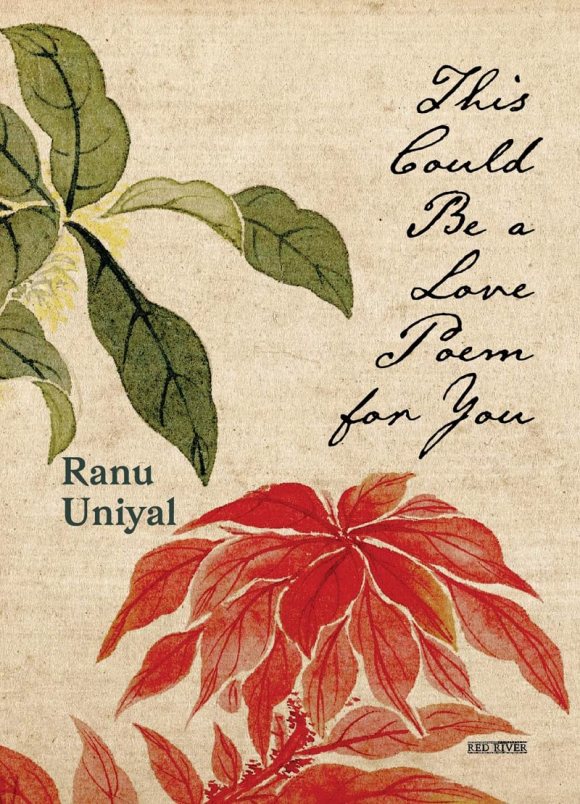
This Could Be a Love Poem for You by Ranu Uniyal, is her fifth collection of poems. Uniyal is a passionate bilingual poet at heart, a retired professor of English literature by profession and an inspiration to many budding poets. Across the Divide (2006), The Day We Went Strawberry Picking in Scarborough (2018), December Poems (2012) and Saeeda Ke Ghar (In Saeeda’s home, Hindi, 2021) are some other significant contributions made by the poet.
“Poetry and beauty are always making peace. When you read something beautiful, you find co-existence; it breaks walls down.” A quote by Mahmoud Darwish is reflective of Dr Uniyal’s poignant portrayal of human existence layered with love, grief, crises and relationships with the One (Self) and the World.
The collection is an aesthetic delight that traverses the heart of the readers with astute directness and a distinct confessional tone. It has three segments: ‘Dust My Regrets’, ‘Be a Good Girl’ and ‘Thy Eternal Grace’. Collectively, there are 62 poems in all.
The poems start from the personal and move to the universal with their intricate details. The poetic sensibilities take us to the female imaginary of the physical, psychological and spiritual domains. If Kamala Das in the 20th century introduced the readers to her brazenness in poetry, then Ranu Uniyal in the 21st century coerces her readers to travel from the common routine to the coveted spiritual abode found in the creative doctrine of poetry. The poetic depth can also be inferred through the rhythmic structure, the play with the words through alliteration and rhymes introduce jibes in poems such as ‘The Shop and the Shutter’.
The themes of love, identity, self-expression, language and power, old age, body’s fragility, vulnerability, precarity, loss, women and domesticity, motherhood, death and memory are persistent throughout the collection. She poetically contours the theme of human existence and its distinct flavours like WB Yeats in Sailing to Byzantium with — “That is no country for old men.”
The poetic pondering over the question of ‘Self’ or recurrent declaration of ‘I’ is developed through linguistic, racial, and geographical temporal identities. For example, the poet’s ‘Garhwali’ identity is camouflaged with the the more modern Anglophone identity. The declaration of the personal “self” and dedication to some personalities like Mohini Mangalik, S. A. Hamid and Amma takes us to the glints of the poet’s biography in the most poetic manner. Gulzar once uttered that, “we poets are errant grains of dust… life takes us and tosses us, we do not know where it will end.” The poems hail the essence of life’s evolutionary journey, especially the one of experience and the mature years of life.
Her poems present multiple binaries: of love and grief, seller and buyer, life and death, through picturesque imagery. Additionally, the poet familiarises the readers with the references to the pagan myths from diverse cultures, Christ, Nachiketa, Yama, Isis, which also introduce us to the eco-folklorists’ traditions which is a delight to explore.
She writes in aphorisms at times and critiques the personal and public crises. The poem, ‘Only Grief’, provocatively emotes the climate crisis as an apocalyptic warning through a distant voice from the future, wherein, critiquing the war-torn present world and the catastrophic space left for the progeny of the future.
We sang dangerously of the failure.
Of our prodigal ancestors.
Another poem, ‘From One Life to Another’, reflects a similar concern about the cataclysmic/tragic climate situations left for the future:
Sparrows and crows have
been hushed to silence.
The once-green acacia shrieked
as they chopped her limbs.
Nature and motherhood hold each other’s hands in sharing the identity of exploration and exploitation. Furthermore, the intricate details through the lens of the ecofeminist poetic sensibilities highlight the diversified literary corpus in the anthology. The same poem states further:
I was once a tree- all green.
Very tall, bobbing in the wind.
I had leaves, branches.
And occasional flowers.
I, too, had a name.
A woman. A mother.
Once a tree.
I brush them aside,
My tears, an upright foliage
Lying heavy on my chest.
Dr Uniyal can be set alongside the “literary greats” like Kamla Das and Sujata Bhatt.
The usage of the colloquial vernacular Hindi words and phrases makes it more personal, tinctured with cultural aesthetics.
The eponymous poem in the anthology, ‘This Could Be a Love Poem for You’ is raw and personal between the one waiting for the other partner far away from a distance is the talisman of the relationship, the theme that finds its way again and again in the poet’s poetic oeuvre. This colourful and mature anthology glossed with distinct sonorous imagery could indeed be a reflective love poem for the present and for our progeny, the rightful claimants, who would reminisce over the past. It’s a love poem about resilience and human existence that shall follow the hearts of the readers for a long, dialogic course of expressions and insights.
Gazala Khan teaches in the Department of English at Doon University, Dehradun, India. She has published poetry in magazines such as Setu, Borderless, and The Fictional Café and has been consistently working on creative and literary projects.
.
PLEASE NOTE: ARTICLES CAN ONLY BE REPRODUCED IN OTHER SITES WITH DUE ACKNOWLEDGEMENT TO BORDERLESS JOURNAL
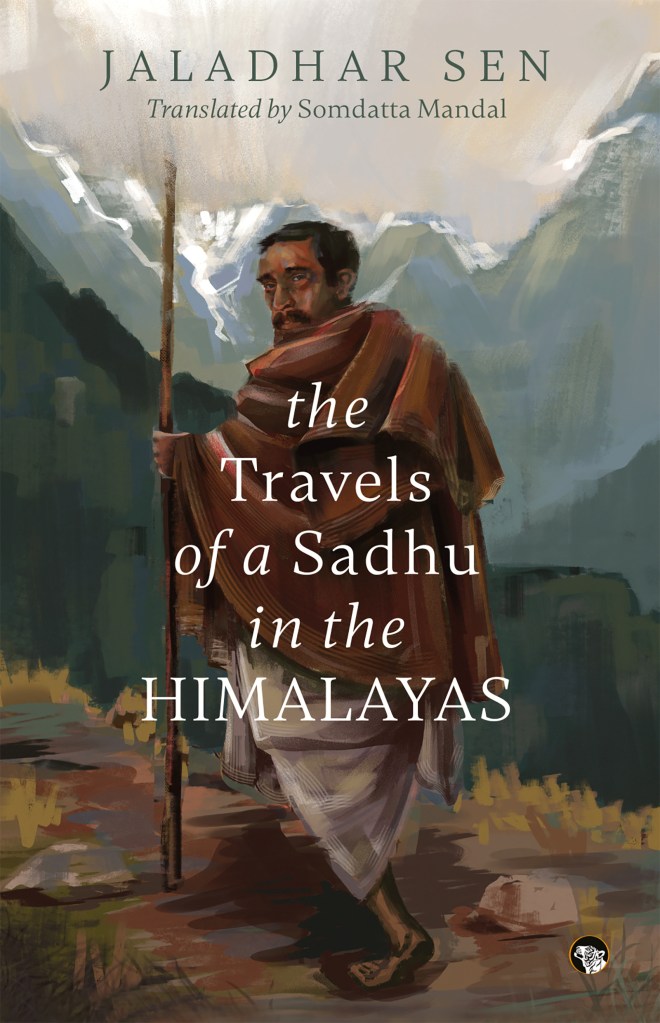
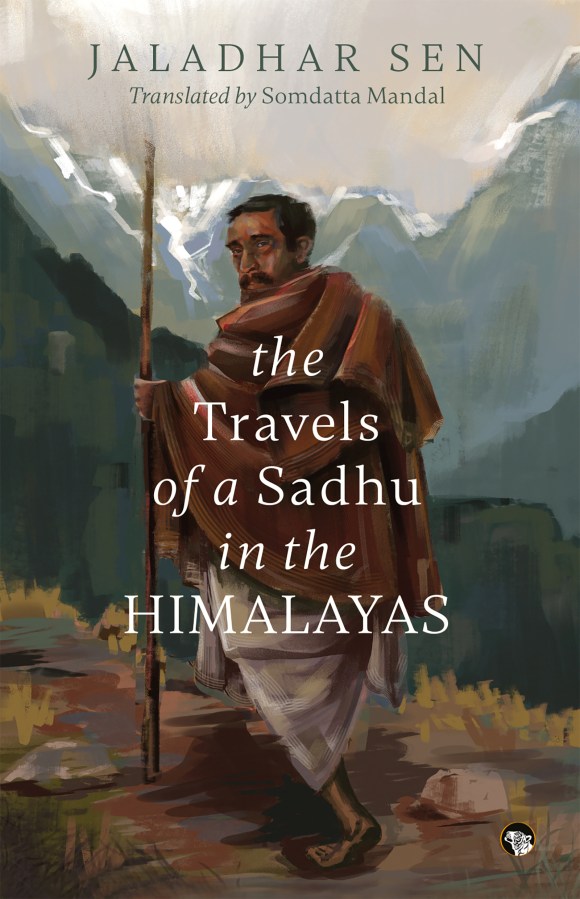
A review of Jaladhar Sen’s The Travels of a Sadhu in the Himalayas, translated from Bengali by Somdatta Mandal, published by Speaking Tiger Books, and a conversation with the translator.
Jaladhar Sen (1860–1939) travelled to the Himalayas on foot with two sadhus[1] in quest of something intangible. His memoir makes us wonder if it was resilience, for after all he lost his daughter, wife and mother — all within a few months. He moved to Dehradun from Bengal for a change of scene after his tragic losses before journeying into the hills.
Written in Bengali and first published as a serial in the Tagore family journal, Bharati, in 1893, the book was brought out in 1900 as Himalay. It has been brought to Anglophone readers by Somdatta Mandal, an eminent translator who has extensively translated much of Tagore’s essays and journals. She is a critic and scholar, a former professor of Santiniketan, an excellent translator to bring Jaladhar Sen’s diary to light. Mandal has given a lucid and informative introduction to Sen, his book and her translation — very readable and without the use of scholastic language or words which would confuse readers. Her commentary adds value to the text by contextualising the people, the times and the circumstances.
Her translation is evocative of the journey, creating vivid visual impact with the play of words. Sen is a Bengali who has picked up Hindi during his brief stay in Dehradun. That he uses multiple vernaculars to move around with two more Bengali migrants who have turned to a religious life and meets locals and pilgrims from a variety of places is well-expressed with a smattering of expressions from various languages and dialects. Mandal has integrated the meanings of these words into the text, making it easy for readers unfamiliar with these phrases to read and enjoy the narrative without breaking the continuity.
Sen is secular and educated — not ritualistic but pragmatic. You can see his attitudes illustrated in an incident at the start of the book: “We quickened our pace, but when we caught up to the two sanyasis, I felt a mix of amusement and irritation. One of them turned out to be my former servant, whom I had dismissed twenty or twenty-five days earlier for theft. His transformation was remarkable—dressed in the elaborate robes of a sanyasi, with tangled hair and constant chants of ‘Har Har Bom Bom’, he was barely recognisable as the thief he once was. It was sheer bad luck on his part that our paths crossed that day.”
At the end of the journey too, Sen concludes from his various amusing and a few alarming experiences: “Many imposters masquerading as holy sanyasis brought disgrace to the very essence of renunciation. Most of these so-called sanyasis were addicted to ganja[2], begged for sustenance, and carried the weight of their sins from one pilgrimage site to another.”
Yet, there is compassion in his heart as the trio, of which Sen was a part, help a sick young youth and others in need. He makes observations which touch ones heart as he journeys on the difficult hilly terrain, often victimised by merciless thunderstorms, heavy downpours and slippery ice. He writes very simply on devotion of another: “I felt happy observing how deep faith and belief illuminated his face.” And also observes with regret: “We have lost that simple faith, and with it, we have also lost peace of mind.” He uses tongue-in-cheek humour to make observations on beliefs that seem illogical. “In such matters, credit must be given to the authors of the Puranas. For instance, Hanuman had to be portrayed as colossal, so the sun was described as being subservient to him. However, with the advancement of science, the estimated size of the sun grew larger, and instead of diminishing Hanuman’s glory, his stature had to be exaggerated even further. Similarly, Kumbhakarna’s nostrils had to be depicted as enormous, so that with each breath, twenty to twenty-five demon monkeys could enter his stomach and exit again.”
Mandal has translated beautiful descriptions of the Himalayas from his narrative with lucid simplicity and elegance. When Sen chances to see the first snow peaks, the wonder of it, is captured with skill: “We were amazed to see a huge mountain of snow, its four large peaks encircling us. The sun was already quite high in the sky, and its bright rays fell upon those mountain peaks, radiating hues that cannot simply be described in words. Even the best painter in the world could not replicate the scene with his brush.” And: “Yet the scenery that unfolded before my eyes was simply magical. Standing in front of this pristine beauty, man’s power and pride were humbled. He could recognise his own triviality and weakness very clearly and, to a certain extent, grasp the greatness of the creator within his heart.”
And of course, there is the typical Bengali witty, sardonic banter creeping in to the narrative: “On certain days, when I felt inclined to indulge in minor luxuries, I would purchase a few pedas. However, such bravado was rarely worth the effort, as one might have needed the assistance of archaeological experts to determine the sweets’ actual date of origin—no one could tell how many generations of worms had made their home inside them!”
The translation has retained the simplicity of the narrative which Sen tells us was essentially his style. He had no intention of publishing what he wrote. He had started out in company of a sadhu with a staff, a blanket and a stock of Baul Kangal Harinath’s songs. He writes at the end: “I didn’t intend to write a diary. I had a songbook with me, and when that book was being bound, I had added a few blank pages with the idea of writing down new songs if I came across them.” He scribbled his notes in those blank pages.
The journey makes a wonderful read with its humorous descriptions of errant sadhus, frightening storms, descriptions of geographies and travel arrangements more than a hundred years ago, where the pilgrims live in shop houses and eat meagre meals, the perseverance, the wonder, the love and friendship one meets along the way. Though there is greed, theft and embarrassment too! Some of his narrative brings to my mind Nazes Afroz’s translation of Syed Mujtaba Ali’sIn a Land Far from Home: A Bengali in Afghanistan.
Mandal tells us: “A prolific writer, Sen authored about forty-two books, including novels, travelogues, works with social messages, children’s literature, and biographies.” In real life, she describes Sen as “a writer, poet, editor, philanthropist, traveller, social worker, educationist and littérateur.” That’s a long list to wear. There’s more from Mandal about what the book offers and why she translated this unique travelogue in this exclusive interview.
Traveller-translator Somdatta Mandal
How did you chance upon this book and why did you decide to translate it? How long did the whole process take?
I have been writing and researching on Indian Travel Writing for almost over two decades now and so was familiar with the sub-genre of travel writing about the Himalayas. In Bangla, there exists a great number of books on travel to holy places as part of a pilgrimage from the mid-19th century onwards. But this book was unique because it was written by a secular person who did not go to the Himalayas as part of a pilgrimage but nevertheless got influenced by the other pilgrims with whom he went along. It was in the summer of 1890 when he actually travelled, and later in 1893, his perilous experience was published serially in the Bengali periodical Bharati which was then edited by Rabindranath Tagore’s niece, Sarala Devi Choudhurani.
During that period, with the proliferation of travel narratives being regularly published in several contemporary Bengali periodicals, Jadadhar Sen’s narration became very popular and after 1900 when it was published in book form, it took the Bengali readers of the time by storm. Its popularity led to it being included as part of the syllabus at Calcutta University. Feeling that pan-Indian readers who could not read the original text in Bangla should get to read this interesting text in English, I was inspired to translate this travelogue for a long time and Speaking Tiger Books readily accepted my proposal a couple of years ago.
The places visited by Sen might not seem unique in the present context, but the period during which he undertook the travel and the culture-specificity of it needed special attention. I was busy editing two volumes of travel narratives to Britain then, and after I finished my project, I took up translating this text in full earnest. It took me about three months to complete the translation, and I send the manuscript to the publishers in January this year. After several editorial interventions, it ultimately saw the light of day in July 2025.
Did you need to input much research while doing the translation? How tough was it to translate the text, especially given that it has multiple language and cultural nuances?
I did have to do some biographical research on Jaladhar Sen as his narrative is absolutely silent about why he moved from Bengal to Dehradun and the actual reason for his setting out on this particular journey. Interestingly, I was also researching about Swami Ramananda Bharati, who was the first Bengali traveller to Tibet and Manas Sarovar, and who wrote the famous book Himaranya (The Forest of Snow) whom Sen knew earlier and with whom he actually undertook the journey. With several cross references I could fill in a lot of biographical gaps in the narrative.
Regarding translation, it must be kept in mind that though something is always lost in translation, one must always attempt to strike the right balance between oversimplification and over-explanation. Translation is also a sort of creativity and the challenges it poses are significant. The intricate navigation between the source language and the translated language shows that there are two major meanings of translation in South Asia – bhashantar, altering the language, and anuvad, retelling the story. Without going into major theoretical analyses that crowd translation studies per se, I feel one should have an equal grasp over both translated and source languages to make a translated piece readable.
What are the tools you have used to retain the flavour of the original narrative? Please elaborate.
Readability of this old text Himalay in the present context is of paramount importance and though it is very difficult to replicate the grandiose writing style of late nineteenth-century Bangla, I have attempted to retain as much of the original flavour of the text as possible. Without using glossary or footnotes, the meaning of certain words becomes evident through paraphrasing the text. Thus, in keeping with Jaladhar Sen’s original work, the names of some words have been retained as they are. For example, the words dharamshala and chati—resting places on the pilgrim’s path—are so culture-specific that they are retained in their original forms. Sen also uses other culture-specific words such as panda (the Brahmin middleman who acts as the intermediary for worshipping the deity), the kamandalu (the water jug carried by sanyasis), lota-kambal (the jug and blanket that emphasise one’s identity as a sadhu), the jhola (the typical cloth bag that hangs from the shoulders), and the mahanta, or the head priest of the temple. Again, different terms such as sadhu, sanyasi, and yogi are used at different points to define ascetics and are often employed interchangeably. The term math, denoting seats of authority and doctrinal learning, has also been retained in its original form. As a Bengali gentleman settled in western India— Dehradun—the author often refers to Bengal as his desh, which literally means ‘country’, but in his parlance refers to the region of Bengal, which is as much a part of India as Dehradun. This definition should not create any confusion in the reader’s mind.
You, like the author, never clearly tell us why Sen starts out on such a perilous journey. Why do you think he went to this journey?
From evidential sources we get to know that like any other domestic person Jaladhar Sen began his career as a teacher in a High School in 1883 in Faridpur in Bengal. He got married in 1885 but however, a few years later he endured a great personal tragedy, losing his family members in quick succession. In 1887, his newborn daughter died on the twelfth day after her birth, and his wife passed away another twelve days later. Within three months, his mother also died. Overwhelmed by grief and seeking solace, he moved to Dehradun at the foothills of the Himalayas, where he worked as a teacher.
It is known that Sen did not venture into the Himalayas out of wanderlust. Dejected with domestic life, he apparently went to Kumbh Mela in Haridwar, where he chanced upon Swami Ramananda Bharati, an elderly Bengali sadhu whom he had known previously. He decided to accompany him on a trek all the way to Badrinath on foot. This was the background to his Himalayan travels and how he became a paribrajak sadhu or a traveller saint. The year was 1890.
Even though the memoir spans only a month, the author underwent many changes. Would you regard this book as a bildungsroman of sorts, especially as there is a self-realisation that comes to Sen at the end? Please elaborate.
In his travel account Sen documents his experiences of journeying to various places of religious significance, namely Devaprayag, Rudraprayag, Karnaprayag, Vishnuprayag and Joshimath before reaching the temple town of Badrinath in the upper Himalayas. He undertook this journey as a secular sojourner. But the travel impacted his soul in such a way that at the end of his narrative he admits that he had ventured in the Himalayas with a funeral pyre burning within his heart; and he merely embraced the cool breeze of the mountains with his hands and pressed the hard snow against his chest. He is doubtful whether he had the time or the state of mind to witness the eternal glory of the Lord revealed in the heavenly scenes around him. Could he lift his head and look towards heaven? That sense of wonder was absent within him. But some sort of change had already appeared within him. In this context, I feel the last two sentences of his narrative to be very significant when he states: “If anyone feels inspired to visit the Himalayas after reading this simple travel narrative of mine, then all my writing will have been worthwhile. And if anyone journeys towards the feet of the god of the Himalayas, my life would have been fulfilled.”
What was your favourite part of the book. Did you enjoy translating some things over others? Please elaborate.
There are several sections in the book which I really enjoyed translating. Most of them relate to specific incidents that Sen encountered during his travels and how human nature was the same everywhere. The first one was when they were on their way to Devaprayag and in his diary entry on 11th May, he tells us about the incident when his money pouch along with the Swamiji’s tiger skin was stolen on the way and how with the help of a panda he managed to retrieve it after a lot of effort. Though they were not very much spiritually inclined, they realized that there were crooks on the way to the pilgrimage sites who also dressed up as sadhus and everyone could not be trusted in good faith.
The second memorable incident is when trekking during extremely inclement weather — rain and thunderstorm– and when stones rushed down from the mountain slopes nearly killed them, how Achyutananda or Vaidantik who was accompanying them managed to protect him by shielding from the natural calamities with his own body as a mother hen does to protect her chicks.
The third interesting incident that Sen narrates is dated 3rd June when they got stranded at a chati in Pipul Kuthi. The head constable or jamadar sahib arrived there to enquire about a theft and Sen tells us how even in that remote mountainous region, the police had the reputation for rudeness and stern behaviour as the Bengal police had. He writes, “These officers, tasked with restraining wrongdoers and protecting civil society, displayed the same demeanour no matter where they were stationed. It seemed that the police were the same everywhere.”
Another memorable section is when they chance upon a young boy who probably ran away from his house and was trekking with them for some part of the way. The way in which the sick lad was ultimately deposited under the care of a doctor in the local hospital is extremely moving. Several other sections can also be mentioned here but it will turn my reply excessively long.
Why did you feel the need to bring this book to a wider readership? Are you translating more of his books?
I have already mentioned the importance of Sen’s travelogue in charting the long tradition and rich repertoire of Bengali travel narratives on the Himalayas that focus on travel as pilgrimage. As early as 1853, Jadunath Sarbadhikari embarked on a journey from a small village in Bengal to visit the sacred shrines of Kedarnath and Badrinath. Returning in 1857, he chronicled his travels in Tirtha Bhraman (1865). Two lesser-known pilgrimages to the Himalayas were undertaken by monks of the Ramkrishna Mission order – Swami Akhandananda and Swami Apurvananda—in 1887 and 1939, respectively. Their travelogues were published many years later by Udbodhan Karyalaya, the official mouthpiece of the Mission. In both narratives, we find vivid details of the hardships of travelling during that period, marked by limited financial resources and minimal material comforts.
Jaladhar Sen’s narrative also holds a significant position in this chronological trend of writing about travelling in the Himalayas. From the 1960s onwards we find a proliferation of Himalayan travel writing in Bangla by writers such as Prabodh Kumar Sanyal, Shonku Maharaj, Umaprasad Mukhopadhyay and others, and many of these texts need to be translated provided one finds a responsive publisher for them. I am not translating Jaladhar Sen anymore, though as a prolific writer Sen authored about forty-two books, including novels, travelogues, works with social messages, children’s literature, and biographies.
How do you choose which text to translate? You always seem focussed on writers who lived a couple of centuries ago. Why do you not translate modern writers?
There is no hard and fast rule for selecting which text I want to translate. I have already translated several travel texts by Bengali women beginning from Krishnabhabini Das’s A Bengali Lady in England, 1876, to later ones. But I have not translated any travelogue about the Himalayas before. Here I must be candid about two issues. I pick upon writers usually whose texts are free of copyright as that does not entail a lot of extra work securing permissions etc. The second more practical reason is that I still have a long bucket list of translations I would like to do provided I find an agreeing publisher. But that is very difficult because several of my proposals have been rejected by publishing houses because they feel it will not be marketable in the current scenario.
As for the query about translating modern writers let me narrate a particular incident. As a woman writer and as someone interested in translating travel narratives of all kinds, I had approached Nabanita Dev Sen through a willing publisher to translate her visit to the Kumbh Mela that she wrote about in her book titled Koruna Tomar Kone Poth Diye[3]. After seeking necessary permission and meeting her personally on several occasions to discuss several chapters, I gradually got frustrated because even after three sets of corrections, the translation did not satisfy her.
She consulted several other people, including her own daughter, and ultimately told me that she couldn’t accept my translation because she ‘didn’t find herself in it.’ The colloquial Bangla humour in some places were not sufficiently translated. As far as I got to know from the publisher, she changed editors thrice, and in the end the translated book was published with one of the editors named as the ‘translator’. When I chanced to meet her at my university on a different occasion, Nabaneetadi told me that she had mentioned my name in the acknowledgement section of the book, which of course I didn’t bother to buy or check. From such a bitter experience, I feel staying with writers dead long ago is a safer bet for me.
You are working on a new translation. Will you tell us a bit about your forthcoming book?
As I have already mentioned, I found Swami Ramananda Bharati’s Himaranya (The Forest of Snow) to be a companion piece for translation. Not only is this significant because it was the same Swamiji with whom Jaladhar Sen travelled to the Himalayas, and though his name is not mentioned anywhere by Sen, we get to know a lot about him already through his narrative. As a monk, Bharati travelled to Mount Kailash and Manas Sarovar in Tibet during 1898, the first Bengali to do so. These travels form the basis of Himaranya. It was not entirely ‘spiritual’ or ‘theological’ but rather depended on the traveller’s own temperament. There are presentations of secular interests and considerations, and modern readers can relate to them easily, especially because the route to Kailash and Manas Sarovar has now been opened for Indian pilgrims once again and several groups are going there every other day. The manuscript is already with the publisher and hopefully the book should see the light of day by the end of this year if everything goes well.
You have translated so many voyages by Tagore, by Sen, do you now want to bring out your own travelogues or memoirs?
I have been translating travel narratives of different kinds for a long time now. I still plan to do a few more if I get a proper publisher for the same. I am an avid traveller myself and have actually trekked to Kedarnath, Badrinath, Gangotri and Yamunotri twice. I have also trekked for fourteen days to visit Muktinath in Nepal way back in the early 1980s, and during the pandemic days when I was confined at home, I managed to key in that experience in Bangla from the diary I kept at that time. That narrative was published in the online journal Parabaas which is published from the United States. But I have never taken writing about my own travelogues or memoirs seriously. Of course, last year and also forthcoming this year, a special Puja Festive number of a Bengali magazine has been publishing my travel articles. But there is nothing serious or academic about it.
Do you have any advice for fledging writers or translators?
Translating has caught up in a big way over the past five or six years. Now big publishing houses are venturing into publishing from regional bhasha literatures into English and so the possibilities are endless. Now every other day we come across new titles which are translations of regional novels or short stories. My only advice for young writers or translators is that since copyright permissions have become quite rigid and complicated nowadays, it is always advisable to seek permission from the respective authorities before venturing into translating anything. I was quite young and naïve earlier and just translated things I liked without seeking prior approval and as usual those works never saw the light of day. Also, as time went by, I learnt that translating should have as its prime motive current readability and not always rigidly adhering to being very particular about remaining close to each individual line of the source text. The target readership should also be kept in mind and so the choice of words used and glossary should be eliminated or kept to a minimum. The meaning of a foreign word should as far as possible be embedded within the text itself. All these issues would definitely make translating an enjoyable experience.
Thanks for the wonderful translation and your time.
[1] Mendicants. Sadhu and swami also have the same meaning
[3] Translates from Bengali to The Path to Compassion, published in 1978. The translation was published by Supernova Publishers in 2012 as The Holy Trail: A Pilgrims Plight. Soma Das is mentioned as the translator.
(This review and online interview is by Mitali Chakravarty)
I had arranged to leave at half past four in the morning; my friends arrived even earlier to bid me farewell. It was a moonlit night, and the entire world lay silent and still. Could this small change in my life affect the grand workings of the earth? I was leaving everyone behind; friends and relatives accompanied me for quite some distance. It was evidently difficult for them to sever the affectionate ties they had nurtured with me for so long. I requested that they not proceed further; in the end, they reluctantly turned back. I, too, glanced back several times to take one last look at them. I couldn’t help but wonder—if this separation from friends was so painful, how much more difficult would it be to part from one’s own family?
A few days ago, I had read Pilgrim’s Progress*, and one scene from the book kept recurring in my mind. As we walked, my thoughts wandered to such reflections. Soon, the sun rose. We began moving towards Hrishikesh. This was an unfamiliar route—rarely travelled by others. After crossing several mountains and forests, we arrived at a small village called ‘Khanu’† around 11 a.m. This peaceful village with only five to seven houses nestled beneath a canopy of trees, resembled a tiny bird’s nest. A small stream meandered near the village. We went and took shelter under a tree by the stream, and, parched and famished, we gratefully drank its water to our hearts’ content. After eating our meal there, we resumed our journey around 5 p.m.
After leaving the village, we noticed two monks walking ahead of us. Since it was just the two of us travelling, I thought, why not join these holy men? At least the four of us could travel together for a while. We quickened our pace, but when we caught up to the two sanyasis, I felt a mix of amusement and irritation. One of them turned out to be my former servant, whom I had dismissed twenty or twenty-five days earlier for theft. His transformation was remarkable—dressed in the elaborate robes of a sanyasi, with tangled hair and constant chants of ‘Har Har Bom Bom’, he was barely recognisable as the thief he once was. It was sheer bad luck on his part that our paths crossed that day.
I recounted the whole story to Swamiji, who commented, ‘Perhaps his companion has some money in his jhola, and he has disguised himself in this manner to swindle it.’
Indeed, there seemed to be no limit to the number of people who cloaked themselves in saffron robes, with matted hair and a kamandalu, only to engage in theft, deceive innocent people, or even commit heinous crimes when the opportunity arose. Readers will encounter many such so-called sadhus in my travel narrative.
At first, my servant seemed confident I wouldn’t recognise him in his new guise. He appeared smug, believing that his ‘western intelligence’ would outwit my ‘Bengali intellect’. Seeing us, he began chanting ‘Bom Bom’ even louder, as if to reinforce his act. Unable to tolerate his pretence any longer, I burst out laughing and said, ‘Aare lounde, kabse chori chhod ke sadhu ban giya?——Oh, you scoundrel, since when did you give up thievery to become a monk?’
He was utterly stunned and rendered speechless by my words. I then explained everything to his companion, a naïve and well-meaning man. This stout young fellow had accepted my servant as his disciple, feeding him well in exchange for a few religious sermons. I said, ‘Sadhu, you may keep him and feed him—I have no objection. But if you have any money in your jhola, guard it carefully. If a man can become a sadhu in ten or twelve days, there’s nothing stopping him from becoming a murderous dacoit in a few hours.’
Later, I heard that the sadhu heeded my unsolicited advice.
By evening, we reached Bhogpur. This village was home to many people, and the presence of small brick houses suggested that some wealthy residents lived there. Close to the homes of these affluent villagers stood a dharamshala, built and maintained by the villagers themselves. Travellers and sadhus from afar could find shelter here, with food and amenities provided by the locals. However, if a traveller carried money or the village had a shop, they need not rely on these dharamshalas.
There is a great deficiency of dharamshalas in Bengal. In many respects, we are far more developed and civilised than people from other parts of India; however, we are so preoccupied that we do not have the leisure to spare time for travellers or sick people who might perish on their journeys. Of course, it must be acknowledged that there are still a few among us who are exceptions to this. Nevertheless, I feel that the uneducated Garhwali farmers, who help others, offer shelter to the distressed, and wholeheartedly care for guests, are far more sincere than the educated people of Bengal.
We spent the night at the dharamshala in Bhogpur. Exhausted from the rigours of travelling, we had no need for food and instead went straight to sleep.
7th May, Thursday
We resumed our journey early in the morning and entered the forest of Hrishikesh, which we had traversed before. Although the forest was familiar, the path was entirely unknown; we could not determine whether we were following the same route we had previously taken. We reached Hrishikesh at 1 p.m. and rested beneath a tree, still without any food. Once the afternoon sun’s glare had lessened, we resumed our journey and reached Lakshman Jhula by evening.
The few shops overlooking the Ganga at Lakshman Jhula were bustling with travellers. A group of Udasi sanyasis had arrived that very day. They were Sikhs.
(Excerpted from The Travels of a Sadhu in the Himalayas by Jaladhar Sen, translated by Somdatta Mandal. Published by Speaking Tiger Books, 2025.)
THE BOOK
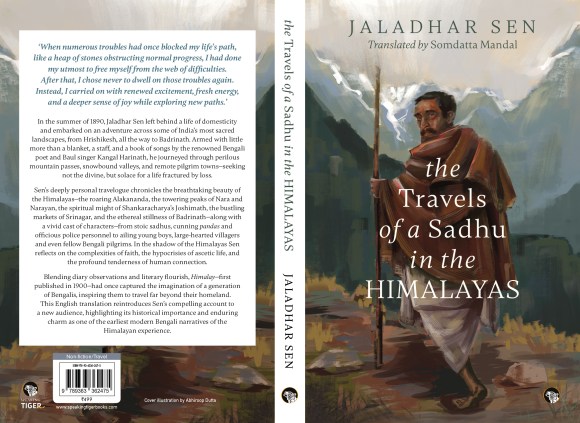
In the summer of 1890, Jaladhar Sen left behind a life of domesticity and embarked on an adventure across some of India’s most sacred landscapes, from Hrishikesh, all the way to Badrinath. Armed with little more than a blanket, a staff, and a book of songs by the renowned Bengali poet and Baul singer Kangal Harinath, he journeyed through perilous mountain passes, snowbound valleys, and remote pilgrim towns—seeking not the divine, but solace for a life fractured by loss.
Sen’s deeply personal travelogue chronicles the breathtaking beauty of the Himalayas—the roaring Alakananda, the towering peaks of Nara and Narayan, the spiritual might of Shankaracharya’s Joshimath, the bustling markets of Srinagar, and the ethereal stillness of Badrinath—along with a vivid cast of characters—from stoic sadhus, cunning pandas and officious police personnel to ailing young boys, large-hearted villagers and even fellow Bengali pilgrims. In the shadow of the Himalayas, Sen reflects on the complexities of faith, the hypocrisies of ascetic life, and the profound tenderness of human connection.
Blending diary observations and literary flourish, Himalay—first published in 1900—had once captured the imagination of a generation of Bengalis, inspiring them to travel far beyond their homeland. This English translation reintroduces Sen’s compelling account to a new audience, highlighting its historical importance and enduring charm as one of the earliest modern Bengali narratives of the Himalayan experience.
THE AUTHOR
Jaladhar Sen (1860–1939) was a Bengali writer, poet, editor and a philanthropist, traveller, social worker, educationist, and littérateur. He was awarded the title of ‘Ray Bahadur’ by the British Government. In 1887 he suffered the greatest loss in his life when his mother, wife and daughter died in quick succession. Overwhelmed by grief and seeking solace, Jaladhar moved to Dehradun at the foothills of the Himalayas, where he worked as a teacher. It was during this time, in 1890, that he travelled to the Garhwal Himalaya. This journey inspired his travelogue Himalay.
THE TRANSLATOR
Somdatta Mandal is the Former Professor of English and Chairperson at the Department of English & Other Modern European Languages, Visva-Bharati, Santiniketan. Somdatta has a keen interest in translation and travel writing.
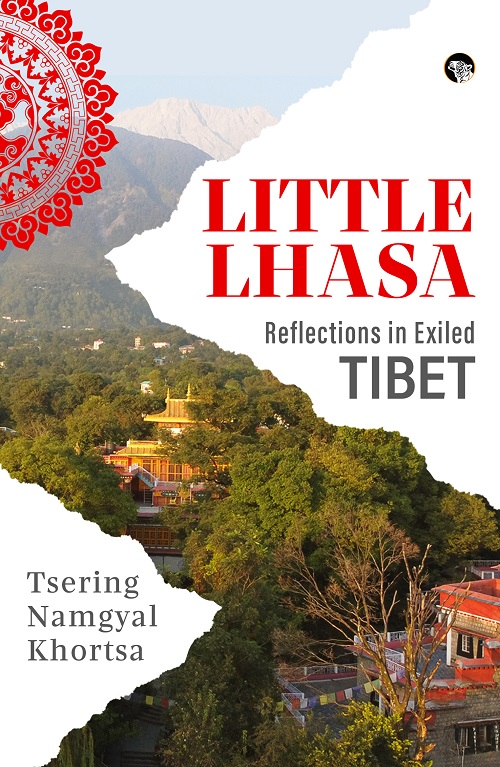
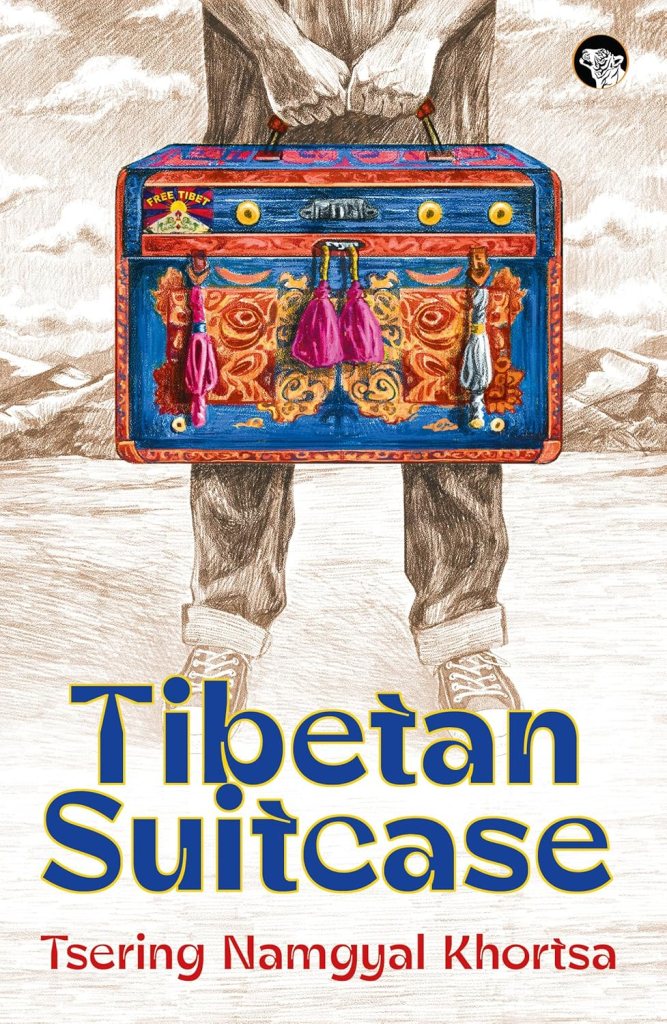
Titles: Little Lhasa: Reflections in Exiled Tibet and Tibetan Suitcase
Author: Tsering Namgyal Khortsa
Publisher: Speaking Tiger Books
Following the forced escape of His Holiness the Dalai Lama in March 1959, thousands of Tibetans were forced to flee Tibet, and it was these refugees who formed the early exiled community. The refugee community now stands at a figure of around 130,000, with Tibetans spread across numerous settlements in India, Nepal and Bhutan, and thousands more displaced all around the world. The Tibetan government in exile is based in Dharamsala, India. It is called the Central Tibetan Administration (CTA) and was founded in 1959 by the 14th Dalai Lama. In the 1980s, a second wave of Tibetans fled due to political repression. The CTA advocates for human rights, self-determination, and the preservation of religion and culture for Tibetans. The CTA has a parliament, judiciary, and executive branch and its principles include truth, non-violence, and genuine democracy. The Dalai Lama has said that the exile administration would be dissolved as soon as freedom is restored in Tibet.
After over seventy years of being in exile, a whole generation of Tibetans have come of age in a land far from home. With the Dalai Lama and other great masters as their spiritual guides, they have grown up cut off from their homeland. Their experiences have been unique, as they have, despite globalization, kept alive their religion and culture. In Little Lhasa: Reflections in Exiled Tibet, Tsering Namgyal Khortsa writes comprehensively about the different aspects of their life today. Comprising of ten essays and six interviews, this volume becomes an eye-opener on the multifarious aspects of the present situation of Tibetans at large. Beginning with different writers writing about Tibet and exile in the very first essay titled ‘Little Lhasa’, the next one ‘Shangrila Online’ tells us about the role of social media, internet cafes and how technology in remote Dharamsala often enables one to participate in other people’s experiences in real time. The writer describes in detail how such lifestyle changes in contemporary times have enabled the creation of a “virtual Tibet”. In the next essay ‘Buddha’s Children’, Khortsa describes the young generation of exiled children in India and how their religious identity has triumphed over all other identities. We are also told about the different kinds of foreigners who come to India to take religious courses, and the writer wonders whether they go home feeling merely inspired by their visit to India and their meetings with Tibetan masters or whether such exposure and experience actually triggers a paradigm shift in the way they view the world.
In the next essay we are told how Tibetans lead demonstrations in Dharamsala and other parts of India every year, especially the one held on March 10th that commemorates the anniversary of the failed uprising against Chinese invasion. ‘Movies and Meditation’ mentions a film festival in Dharamsala which reveals how recent Tibetan films highlight a growing and vibrant filmmaking community within the Tibetan diaspora, but Khortsa laments the paucity of full-length films about Tibetans in exile and the issues they confront, namely patriotism, individualism, and reconciliation of personal fulfilment with the Tibetan cause. The titles of the three following essays, ‘Dharma Talk’, ‘The Lure of India’ and ‘The Monk at Manali’ are self-explanatory. The last essay of this section ‘Nation of Stories’ tells us about writers who write and publish in the English language, and though diverse in terms of their education, upbringing, background and geographical location, one common condition that they all share is the collective trauma of the Chinese occupation of Tibet, which is invariably a leitmotif in Tibetan literature.
Part Two consists of six interviews, each one different in perspective than the other, and they must be mentioned here to understand the kaleidoscopic nature of the people involved in the Tibetan cause. Thus, we have conversations with Lisa Gray as ‘A Western Buddhist’, Ananda Nand Agnihotri as ‘An Indian Tibetan Buddhist,’ Ngawang Woeber, ‘An Ex-Political Prisoner’, Nyima Dhondup, ‘A Swiss Tibetan’, Tenzing Sonam, ‘A Tibetan Writer and Filmmaker’ and Tenphun, ‘The Tibetan Poet’. All in all, Little Lhasa becomes a valuable record of the life of a people who refuse to bow down or forget, and even while adapting to a rapidly changing world, continue to nurture their roots.
II
After the non-fiction, Tsering Namgyal Khortsa comes up with a brilliant piece of fiction and read together, each text complements the other beautifully. In the ‘Editor’s Note’ at the very beginning of the novel Tibetan Suitcase, Tsering Namgyal Khortsa tells us that while he was working as a business journalist in Hong Kong he once ran into Dawa Tashi, an old acquaintance and an aspiring novelist from Dharamsala, India who was working as a meditation teacher and was quite busy with his job. He had a suitcase full of letters and documents and wanted him to turn the contents of the suitcase into a book. After going through the collection, Khortsa discovered that the contents of the suitcase, if organized with care and discipline, could indeed make for an epistolary novel. So, he declares that except for correcting a few typos here and there and add note and datelines to the letters, he had not done anything. He also categorically states, “None of the letters are mine, except some entries that I wrote, making the book partly fictionalized.” He also wanted to leave room for readers to imagine (or ‘feel’ for themselves) what is not mentioned in the book, in deference to the Tibetan culture of reticence and taciturnity, rather than turning himself into an all-knowing chatterbox.
Tibetan Suitcase is a remarkable novel about the peripatetic Tibetan community in exile. It is divided into six parts, beginning roughly from 1995 to 2000. It opens in Hong Kong where a tycoon Peter Wong opens a meditation centre and employs Dawa Tashi, our protagonist as a meditation teacher and a guru, though he is not really trained to be a lama. Dawa Tashi is an India-born Tibetan. His parents fled Tibet when the Chinese invaded, and Dawa has grown up in the quiet, verdant Indian Himalayas. When Dawa applies to a well-known university in America (Appleton University in Wisconsin) to pursue a course in creative writing, his hitherto ordinary life changes dramatically. At the university he befriends, and falls in love with, Iris Pennington, an unusual American student who is studying Buddhist literature. He also comes in contact with Khenchen Sangpo, a renowned scholar of Buddhism and a reincarnated Rinpoche himself. Circumstances lead Dawa back to India too soon, but the connections he makes take his life into many new directions. Some, with Iris and Khenchen, take him deeper into the mystical and mysterious world of Buddhist scholarship. Other journeys take him back to his roots, making him question his life’s directions.
Apart from the interesting incidents and characters we meet in the first four parts of the novel, Part Five is an exceptionally engrossing to read. Beginning with the reportage in the Fall Issue of the journal Meridian, which is edited by Brent Rinehart, we are told that on his seventy-ninth birthday Khenchen decided that he had to go back to Tibet to see his native land. Having gained a quick residency status in the United States, and possessing an American passport, Khenchen still had many relatives in Tibet, some of them quite alive and well, despite the Chinese occupation. He travels to Lhasa in 1996 and goes for a trip to Lake Manasarovar but things take a different turn when he is arrested by the Chinese authority because he was apparently “endangering national security”. What follows are different press releases from the US Statement Department, reports from the International Association of Tibetan Studies in London, address by the President of Appleton University and as Iris writes to Dawa, she never expected herself to be so politically involved and “did not realize Tibet was such a political subject”. It was ironic that one of the world’s most spiritual places was one of its most burning political issues. Tibet might be a small place, but it has a reasonably big space in the collective consciousness of the world. Of course, Khenchen Sangpo is ultimately released and without disclosing the actual ending of the novel, which in a circular fashion ends in Hong Kong from where it began, many loose ends are tied up and life came to a full circle for everybody, especially for Iris Pennington who finally managed to find her roots.
Both the non-fiction and the fiction book by Tsering Namgyal Khortsa prove to be eye-openers for all readers who have very little knowledge about the sorrow and plight of the uprooted Tibetans who live in exile and many of whom do not even have a country to call their own. Based in Dehradun, India at present, Khortsa’s narratives are so powerful that it has aptly prompted Speaking Tiger Books to reprint the updated versions of both the books in 2024 and one can call it a yeoman service to readers both serious and casual. A must read.
.
Somdatta Mandal, critic and translator, is a former Professor of English at Visva-Bharati, Santiniketan, India.
.
PLEASE NOTE: ARTICLES CAN ONLY BE REPRODUCED IN OTHER SITES WITH DUE ACKNOWLEDGEMENT TO BORDERLESS JOURNAL
The Uttarakhandi bemuse over the beauty of the forests: the primordial mitochondria of nature with forty five per cent forest cover. Prometheus, hailed as a hero, gifted fire: the primordial flames to mankind, seen as a blessing.
A blessing! Alas! Promethean wildfires engulf the forests. The serpentine red flowers hiss and haunt millions of lives: animals, birds and humans horrifically embraced.
The annual rituals of firestorms begin. Spring and summer frown and tremble. The lush green blanket of the forest turns to a lifeless grey terrace. With tense expressions and hearts at low, we move our lips and pray. The Bonbibi of Uttarakhand is left powerless.
Binsar in Almora leapt into a wildfire. Five were burnt alive. An old reaper from Thapli was engulfed in the forest flames with more.
O Promethean Wildfire! The annihilator fleetingly swept lives as embers from the mountaineering terrain set ablaze the land till it was ashen-grey, dead and helpless.
Gazala Khan teaches in the Department of English, School of Languages at Doon University, Dehradun, India. She has also been working on creative and literary projects.
ENTWINED PLACES

Standing on the Juhu beach,
I heard, more than a decade ago,
The winds from the Marina,
In a smattering of Marathi and Tamil,
Accompanying birdsongs.

Blame that on a bout of homesickness
But what about last year, when

The Sealdah station, its turf
Pounded by the waves of human feet,
Seemed to me to reverberate
With the weighty steps of the rush hour,
Also felt in Mylapore and Nariman Point?

Perhaps, the crowds stirred me then
But that cannot be all, for

Often on cool Hyderabadi afternoons,
I have worn, in silence, the unease
Of Bangalore's woolen evenings;
And sensed in Delhi's nippy nights
The cold grip of other Indian winters...

Extremes sometimes addle the brain
And lull the heart, but…

Even when I take a leisurely stroll
On a summer dusk, around the lake
That girdles my neck of the woods,
I am greeted by the lush sights, of
The long winding ways yonder...

To Darjeeling and Kodaikkanal,
To Yercaud and Dehradun,
To Kashmir and Kanyakumari,
And to all that lies beyond.
Srinivas S teaches English at the Rishi Valley School, India. He spends his free time taking long walks, watching cricket and writing poetry in short-form (mostly haiku).
.
PLEASE NOTE: ARTICLES CAN ONLY BE REPRODUCED IN OTHER SITES WITH DUE ACKNOWLEDGEMENT TO BORDERLESS JOURNAL


 Borderless