Categories
Essay

To Be or Not to Be or the Benefits of Borders

By Wendy Jones Nakanishi

Art by Sohana Manzoor

It may seem perverse to submit an article advocating the benefits of borders to a journal entitled Borderless. I hasten to explain that I agree with the guiding principle of this publication – that the human spirit should be encouraged to soar, transcending cultural limitations and national boundaries. But I’m also reminded of the observation made by the American poet Robert Frost that high fences make good neighbours.

Borders! It’s one of those words that has developed an almost completely negative connotation in recent years, having taken on the emotive sense of exclusion and unfairness. A second example of this phenomenon is the term patriotism, which now is denigrated for similar reasons. Borders and patriotism refer to values and beliefs valorized in the past that are currently under vigorous attack. Their stock has plunged dramatically in this modern globalised society.

It’s no wonder. We inhabit the age of EDI – equality, diversity, and inclusion. Few voices are raised to question its tenets. Most people seem, for example, unreservedly to believe in multiculturalism as an undisputed good, and love of one’s own country has become a questionable – often dismissed as a deplorable – sentiment.

The present disdain for borders and patriotism is unsurprising. We are witnessing the mass migration of people from one part of the world to others on a scale unseen since the post-1945 refugee crisis, when an estimated 175 million people were on the move, in part because of the defeat of the Axis powers but also because of new civil wars. Nowadays, the US, the UK and Europe are proving particularly attractive destinations for individuals fleeing countries troubled by violence, corruption, poverty, religious persecution, and social discrimination. I would like here to explain why I believe in the benefits of borders while acknowledging their potential demerits.

I think the propensity to erect borders is an essentially human trait, coexistent with human existence. The world’s first walls originated with its first cities – places like Jericho in the Bible, constructed twelve thousand years ago – where Joshua waged his famous battle to bring them down. The ancient cities had walls for defensive purposes. Walls intended to divide countries came much later, with the first instance originating in Mesopotamia in 2000 BC.

David Frye observes in his book Walls: A History of Civilization in Blood and Brick that the idea of constructing barriers to keep people out is as ancient as human civilisation. It is only the people excluded that has changed. In the past, it was invading hordes of armed warriors. Now barriers are erected to control immigration, to keep out terrorists, and to halt the flow of illegal drugs.

In Frye’s opinion, borders originated as a means of creating a safe space where civilization could develop and flourish. Walls gave people the security to sit and think.  Frye links the building of the Great Wall of China in the late third century B.C. with the creation of the ancient Chinese state. In Britain, Hadrian’s Wall was constructed around 112 A.D. by the Romans to keep out the ‘barbaric’ tribes in the north while they ‘civilized’ the inhabitants further south.

Borders seem to be coming back into vogue. Donald Trump’s vow to expand and reinforce the Mexico-United States barrier was a crucial component of his successful 2016 presidential campaign platform. But in January 2021, the newly elected president Joe Biden halted construction of what had become known as ‘Trump’s Wall’. Since that date, the southern border of the States has been swamped with illegal migrants, and in July 2022 Biden backtracked, announcing a plan to fill in four gaps in the barrier in Arizona that had seen some of the busiest illegal crossings. Some might argue it’s too little too late. In July 2022, there were reports of four thousand Mexican family encounters at the border; a year later, that number had quadrupled. And that’s only Mexican immigrants. Economic and political turmoil in such countries as Venezuela, Haiti, Ecuador, and Columbia has seen large numbers of people trying to escape to the States: their near neighbor where they seek not only safety but a place where they can aspire and thrive.  

Similarly, the EU is in the process of having to reconsider what it once identified as one of its guiding principles: the unrestricted movement of people (in particular, workers) within its twenty-eight EU member states. Countries such as Austria and Denmark have significant percentages of their populations who are opposed to this policy. It has been argued that citizens in richer member states are more likely to have negative views. Until the 2000s, only one percent of EU citizens lived in a country other than the country of their birth. That situation has changed dramatically in recent years with the EU’s enlargement to central and eastern Europe. Now intra-EU migration involves millions of EU nationals who are, in general, their countries’ best and brightest – their most highly educated or highly skilled workers – moving from poorer to richer EU member states. What some EU nationals see as an opportunity, others regard as a threat.

Borders not only keep people out but also keep people in. That is one of their least attractive features. The barbed wire that was the first manifestation of the structure that came to be known as the Berlin Wall appeared almost overnight in August 1961. But this wall had an unusual purpose. It was erected to prevent immigration from East Germany to West Germany when the economy of the former was on the verge of collapse because of the many people fleeing to the west. The Berlin Wall staunched that flow of emigration, leading President Kennedy to observe that ‘A wall is a hell of a lot better than a war’.

Arguably the Korean Demilitarized Zone constructed after 1953, which is 250 kilometers long and five kilometers wide, separating the north and south of what was once a single country, has similarly acted as a deterrent to armed conflict. It has been described as a ‘comfortable wall’ that ensures an ‘uncomfortable peace’. For the North Korean government, it acts as a barrier to invasion from the far more prosperous and less repressive government of South Korea. But it has also trapped millions of people in a state that increasingly resembles a huge prison camp. North Koreans are among the poorest people in the world as well as the least economically free. It is estimated that a tenth of the population died during a famine that lasted from 1995 to 1998. While a thousand escape the country every year, many are imprisoned, tortured, and even killed while making the attempt. But they are willing to brave the danger, reluctant to remain in a country where they are systematically denied any civil, religious, or political rights.

Borders are not limited to the demarcation of cities and countries. Physical structures indicating property limits are a fact of everyday life for people throughout the world. In my native America, fences are a prominent feature, indicating boundaries for houses and fields. In Japan, where I lived for many years, the traditional family compound – including farmhouse and storehouse and courtyard – is enclosed within clay walls. In the corner of northwest England where I am currently residing, the countryside of rolling green hills is crisscrossed by dry stone walls and hedges. Hedges in Britain have their origins in the Bronze Age (2500-700 BC), when they were used to manage cattle and to keep them separate from crops. There is speculation that some hedges of sufficient age, density and size may even have once served as military defenses. But while their first function was to act as barriers, they now serve an important role in the environment, as the preserve of insects and wildlife, including sixty species of nesting birds.

A house itself represents a kind of delimitation: a declaration of private space as opposed even to the yard or garden, which are semi-public. Americans tend to be house-proud, their dwellings often boasting large picture windows that afford a view to passers-by of the carefully decorated front room. Japanese, on the other hand, are sometimes ashamed of inhabiting a cramped small house sometimes separated only by a matter of inches from their neighbours’ homes on either side, and they tend to use opaque rather than clear windows to preserve their privacy. Even the big traditional Japanese farmhouse is somehow secretive – bearded in heavy shrubbery, stooping under the weight of a heavy tiled roof. Of course, there are many types of houses in Britain, but I happen to live in one of the most common – a terraced house with a tiny garden out front and a cement yard at the back. My bay window looking out onto the street has its lower half shrouded in a thin net curtain. When I stand nearby, I can look out at my domain – my little plot of earth densely planted with bushes, flowers, and shrubs.

Living in the UK, I’m often reminded of the saying ‘An Englishman’s house is his castle’. The typical British home has an emphasis on the cozy and comfortable, and while few still have coal fires, many retain the old fireplaces as a decorative feature. Alas, nowadays, many British people pave over their little front gardens to use the space for parking. But traveling by train affords wonderful views of long strips of narrow gardens backing on to the tracks, and I sometimes think their owners are like public benefactors, entertaining us with the sight of their patios and pergolas, their beds of flowers and rose trellises as we speed to our destinations.

The observant reader may have noticed that I have begun this short essay on borders by examining those surrounding countries and cities, and then continuing with an ever-narrowing perspective. I would like to conclude by looking at the barriers we put up between ourselves and others.

As I noted at the beginning of this piece, the American poet Robert Frost wrote a poem eulogising high fences for ensuring good relations with our neighbors. Because the States is a relatively new country – and one of considerable size – many Americans can enjoy the luxury of living in houses surrounded by a good deal of land. Driving through any suburb you can see large expanses of grassy lawn separating the house, often a ranch-style dwelling, from the road. In that sense, Frost’s high fences aren’t needed. Unlike the Japanese, crammed into close quarters with each other, or Europeans, fond of renting flats, Americans are used to having their own space. The pioneer spirit lingers on with a focus on rugged individualism.

This can be a curse as well as a blessing. There have been shocking instances in recent years of abducted American women and children spending years as captives in houses so remote or so barricaded against the outside world that their kidnappers could act with near impunity.

Such a situation is unimaginable in Japan. Many Japanese, and especially those in Japan’s cities, live in what they call ‘mansions’ – huge buildings with apartments the inhabitants own rather than rent. Few secrets can be kept in such an environment. In towns and rural areas, the strong emphasis on community activities means that there is constant interaction between households.

While many Americans like to preserve a physical distance from others, the Japanese have developed ways to preserve their privacy in public places as a sort of psychic skill. During my long residence in Japan, I often marveled at how the Japanese can make a virtue of necessity, and this is a case in point. On packed trains, the Japanese self-isolate by reading or dozing or using their phones. In dense crowds in cities, they manage to retain personal space by skillfully skirting each other, scarcely touching, as they walk. Whenever I find myself in one of the huge subway stations in Tokyo or Osaka, I occasionally pause to marvel at what looks like a carefully choreographed dance. Throngs of well-dressed people silently rush past me. They are dignified, intent on their own business, and no confusion or chaos is perceptible. Despite the closest proximity imaginable to each other, they somehow manage to preserve their own personal borders.  

The situation in the UK is between those two extremes. Despite inhabiting one of the most densely populated countries in Europe, the British can enjoy incomparable scenery preserved as so-called ‘green belt’ areas around cities as well as landscapes protected by their designation as national parks or as areas of outstanding natural beauty. Unsurprisingly, the British are great walkers. As an American, I’ve had to learn that when a friend suggests a stroll, it can easily mean a four or five-mile hike. The British can escape to the great outdoors when they feel a need to be alone.

There are those who dismiss national stereotypes as nonsense, but I’m inclined to credit them with at least a grain of truth. I think, for example, there are affinities between the Japanese and the British that are perhaps attributable to their both inhabiting island nations and being, as a result, insular. They are bad at learning other languages. They are traditionally characterised by a certain reserve – lacking, for example, the American fondness for confessing details of their private lives to complete strangers.

Borders. Patriotism. The two are connected. It is often said that those who do not learn from the mistakes of the past are doomed to repeat them. The lesson we might be tempted to draw from the bloody history of the twentieth century is that nationalism is reprehensible and that borders can lead to wars.

But I prefer to draw another moral. It can be argued that the world was plunged into two world wars because evil, opportunistic leaders like Hitler chose not to respect national borders while also twisting patriotism felt by Germans and Austrians into a perverted version of what is a normal human impulse to love one’s own country. As I write this piece, I can’t help but think of how topical it is, with the tragedy unfolding in the Middle East which concerns borders and contested land. I pray a just settlement can be reached and peace achieved as soon as possible.    

Finally, I believe we all resort to a variety of measures to define ourselves. We are individuals; we are residents of a certain neighborhood; we are citizens of a particular country. I believe that it is by respecting each other’s borders – personal and public – that we can achieve the ideal of living together on this crowded globe in harmony. Public borders – such as the political boundaries of our own country – can inspire altruism by leading us to identify with an entity greater than ourselves. Private borders – those parameters for conduct and behavior we draw for ourselves, in our daily lives – can confer peace and a sense of individual self.

Wendy Jones Nakanishi has published widely on English and Japanese literature and, under her pen name of Lea O’Harra, has written four crime fiction novels available on Amazon.

PLEASE NOTE: ARTICLES CAN ONLY BE REPRODUCED IN OTHER SITES WITH DUE ACKNOWLEDGEMENT TO BORDERLESS JOURNAL

Click here to access the Borderless anthology, Monalisa No Longer Smiles

Click here to access Monalisa No Longer Smiles on Amazon International
Categories
Essay

The Story of a Land at War with Itself

If religion has bound people of different lands, religion has also crafted gulfs between people who shared the birthplace and spoke the same language. If religious hatred led to the holocaust, religion became the cornerstone of India’s Partition. The crimes against humanity in Bosnia also were rooted in religious intolerance, as Ratnottama Sengupta retraced when her brother, Dr Dipankar Ghosh wrote to her from Bosnia-Herzegovina, as part of the peace-keeping forces in 1996.

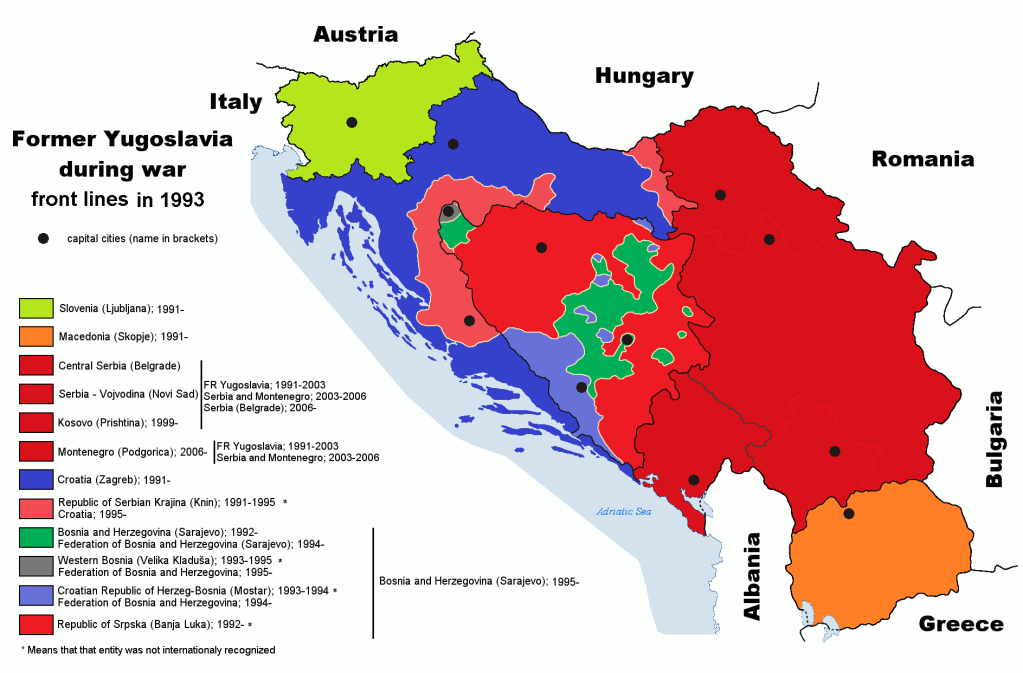
Map of former Yugoslavia in 1993. Courtesy: Creative Commons

The Bosnian War (1992-1995) was an immediate fallout of the break-up of the Socialist Federal Republic of Yugoslavia. It began to disintegrate when Slovenia and Croatia seceded in 1991. Serbia, the largest constituent in the Republic of Yugoslavia, did not want Croatia’s independence as a large Serb minority lived in Croatia. But the rest of the state declared national sovereignty in October 1991 (two years after the fall of the Berlin Wall) and held a referendum for independence on 29 Feb 1992.

Bosnia, the largest nationality, was home to Muslim Bosniaks – they wanted Bosnia to be a unitary multi-ethnic state. The Serbs wanted to be independent if not to unite with Serbia. Likewise, the Croats wanted significant autonomy for their majority areas or secession to Croatia.

The referendum favoured independence, but the Bosnian Serbs opposed this, as they aimed at creating a new state – Republika Srpska (RS) that would include Bosniak majority areas. So, their political representatives boycotted it. And a day before the outcome of the referendum, on 28 February 1992, the Assembly of the Serb People in Bosnia and Herzegovina adopted the Constitution of the Serbian Republic of Bosnia and Herzegovina.

Eventually, the European Union formally recognised the newly constituted Republic, as did the UN. It was inhabited mainly by Muslim Bosniaks, Orthodox Serbs, and Catholic Croats. As this Republic gained international recognition, the earlier Cutiliero Plan proposing a division of Bosnia into ethnic cantons collapsed.

Now the Bosnian Serbs, led by Radovan Karadzic and supported by the Serbian regime of Slobodan Milosevic and the Yugoslav People’s Army (JNA), mobilised their forces inside Bosnia and Herzegovina in order to secure ethnic Serb territory. Soon war spread across the Balkan land, accompanied by ethnic cleansing.

Siege of Sarajevo (1992-1996): The Bosnian Serbs who would settle for nothing less than a new state, Republika Srpska (RS), now encircled Sarajevo, the capital of Bosnia-Herzegovina. With a siege force of 13,000 stationed in the surrounding hills, they assaulted the city with artillery, tanks, and small arms. The army of RS, which had transformed from the Yugoslav Army units in Bosnia, fought the army of the Republic of Bosnia and Herzegovina (ARBiH).

Inside the city ARBiH, which was the Bosnian government’s defence force composed of Bosniaks and Croat forces in the Croatin Defence Council (HVO), was poorly equipped. It could not break the siege and for six months, the population of Sarajevo lived without gas, electricity or water. It is estimated that of the 13,952 killed during the siege, 5434 were civilians.

Within a year increased tension between the Bosniaks and the Croats led to escalation of the Bosnian war, in 1993. Here on, the war was characterised by bitter fighting, indiscriminate shelling of cities and towns, ethnic abuse, forcible transfer and systematic mass rape of Bosniak Muslim women – perpetrated mainly by Serbs and, to a lesser extent, by Croat and Bosniak forces. Events such as Markale massacre and Srebrenica genocide, perpetrated to raze the Bosniak’s morale and willingness to fight, became iconic of the conflict.

Markale Massacre: In February 1994, the open-air market in the historic core of Sarajevo. Mortars were shelled. This act of targeting civilians in the marketplace was carried out, it was later confirmed, by the Army of Republika Sprska (VRS).

Initially the Serbs were militarily superior due to the weapons and resources from the JNA. Eventually they lost momentum as the Bosniaks and Croats allied against RS following the creation of the Federation of Bosnia and Herzegovina in 1994.

The repeat shelling of the Markale Market in August 1995 prompted the NATO airstrikes against Bosnian Serb forces and eventually led to the Dayton Peace Accord. The peace negotiations were held in Dayton, Ohio and signed on 21 November 1995.

Srebrenica Genocide: In July 1995, more than 8000 Bosniak Muslim men and boys in and around the town in eastern Bosnia were killed by the Bosnian Serb Army of Republika Srpska (VRS) under the command of Ratko Mladic. Prior to the massacre UN had declared the besieged enclave of Srebrenica a “safe” area but had failed to demilitarise the area or break the siege of Sarajevo.  By 2012, close to 7,000 genocide victims were identified by DNA analysis of the recovered body parts.

Some Serb accounts say that the massacre was in retaliation of civilian conflicts on Serbs by Bosniak soldiers from Srebrenica. This claim has been rejected by the UN and ICTY as “bad faith attempt to justify the crime against humanity”.

US Inaction: The United States took no action till 1995 against the smuggling of arms that had become rampant. It was widely believed that the CIA funded, trained and supplied the Bosnian Army. EU intelligence sources maintained that the US organised arms shipment to Bosnia through its Muslim allies. Pakistan, for one, ignored the UN ban that declared it illegal for other Muslim countries to supply arms in the war. It not only supplied arms and ammunition to Bosnian Muslims, it also airlifted anti-tank missiles.

Serbia did not fight but supported RS with money, arms and volunteers. Croatia too did the same for Croats.

The war ended with the signing of the General Framework Agreement for Peace in Bosnia and Herzegovina in Paris on 14 December 1995. British soldiers were first deployed in 1992 to protect aid convoys in Bosnia during the vicious civil war. They stayed on for peacekeeping duty.

War Crimes: Radovan Kradzic, the first President of Sprska during the Bosnian war, was a trained psychiatrist who was also known for his poetry. But the co-founder of the Serbs Democratic Party was declared a War Criminal. He was hunted down after 12 years as a fugitive in Belgrade and Austria, and extradited to the Netherlands which was then heading EU. There the International Crimes Tribunal for Yugoslavia (ICTY) convicted him on 11 counts of crimes against Bosniak and Croat civilians. Found guilty of the genocide in Srebrenica, he was sentenced to 40 years imprisonment.

Reportedly hundreds of people had demonstrated in his support. Others pleaded that Bosnia and Serbia could not move ahead economically as long as he was at large.

By 2008 ICTY had convicted 45 Serbs, 12 Croats, and 4 Bosniaks of War Crimes against Humanity. Estimates suggest that around 12,000-50,000 – mostly Bosniak – were raped, mainly by Serb forces. About 1 million people were killed and 2.2 million were displaced. This makes the Bosnian war the most devastating conflict in Europe since the end of World War II.

Net Outcome: The Bosniaks accomplished their goal of independent Bosnia. But the Serbs preserved their territorial gains a change in the demographic and self-rule in Republika Sprska. Also, the ethnic cleansing led to changes in the demographic composition of the Bosnian region – with the Serbs gaining the most.

History of the Conflict: The roots of the Bosnian War lies in the history that dates back to the 6th and 7th century when the region came to be inhabited by Slavic tribes. Bosnia was conquered in 1463 by the Ottoman Turks. Under their rule, large sections of the population converted to Islam while the rest remained either Orthodox Christians or Catholics. The Christian Orthodoxy came to be associated with Serbian nationality and Catholicism with Croat nationality. It is interesting to note that all these people spoke the same Slavic language.

Ethnic violence has been endemic in Bosnia and Herzegovina that had been under Austrian rule (1878-1918) before becoming a part of Yugoslavia. Violence engulfed it during WW2 when it was under Croatia, a puppet of Nazi Germany. In 1943-44, most of Bosnia was conquered by Serb-dominated Communists. Consequently, when WW2 ended, Bosnia became a constituent of the Socialist Federal Republic of Yugoslavia. It was led by Josip Broz Tito (1892-1980), an ethnic Croat who tried  to create a common Yugoslav identity based on adherence to Communist ideology. When that glue wore off, the nationalist separatist forces surfaced again.

*

Dipankar Ghosh, since he went to Pune’s Shivaji Preparatory Military School as a teenager, was mentally equipped to face the tribulations a war brings in its wake. His graduation from Kolkata’s Neel Ratan Sircar Medical College armed him to care for the ailing. And, being the firstborn of celebrated writer Nabendu Ghosh, he had a flair for writing.

All three qualities surfaced whenever the doctor, who retired as a Colonel in Britain’s Royal Army Medical Corp, put pen to paper. And he did that whenever he felt the urge to touch base with his parents in Bombay. From wherever he was camping — Belize, Belsen, Brunei, Cyprus, or in the Gulf War…

In the process, he breathed life into the now lost art of writing letters — which often became travelogues… like this letter to his father:

*

Mrkonic Grad. Photo provided by Ratnottama Sengupta

Lt Col D Ghosh, RAMC

RMO, 1 WFR

SHOE Factory, Mrkonic Grad

BFPO 551.U.K.

5th July 1996

Dear Baba,

I have just received your last letter from Bombay. I was worried about your health, which is why I rang you last night. Sorry it was so late. There was quite a queue for the phone, so I had to wait for my turn, Lt Col notwithstanding! I am reassured that you are okay.  

I am sorry the line was so poor, but it is a satellite line, which travels from Bosnia to the USA then is beamed on to India — hence all the static. Mind you, it is full of static when I speak to Lesley and Children in the UK too. Sadly, it is only an outgoing line, which takes call out, but no incoming calls. If you need to get in touch with me urgently, the best thing would be for you to ring Lesley and she can get in touch with me via the Ministry of Defence. 

We have been out in Bosnia for just over three months now, and the problems here seem to be in a state of very uneasy peace, now that Dr Radovan Karadzic has finally handed over the reins of power (Oh Yes!?). We are somewhat concerned that the proposed elections in September might bring about fresh unease and disturbance, even without Dr Karadzic at the hustings, and we might be, willy-nilly, dragged into a situation of tension to try to maintain peace.  Nonetheless, the Bosnians are making some efforts to keep the peace, albeit because we are waving a big stick whilst holding out a carrot.  

The position is especially delicately balanced for us at the moment, due to the ICFWCB’s (International Commission for War Crimes in Bosnia) declaration of the good Dr Karadzic and his General, Ratko Mladic as ‘War Criminals’ for genocide against the Muslims of Bosnia. There’s little doubt, this is due to pressure from the countries with more than a few spare billions of petrodollar in western banks. We are hoping that we will not need to confront the Bosnian Serbs by having to arrest these two persons (since this was not a part of the Dayton agreement that has laid the framework last year for ending the war ravaging Bosnia for more than three years). These two still hold considerable political sway, and have a significant following in this country. 

It seems likely that we (British Army as well as the Americans, much as they might dislike it) will have to stay on in Bosnia for quite a while longer than we’d initially made allowance for. If the yanks want out, I hope we shall pull out as well. The Serbs seem to prefer having us around, to maintain the peace, than any other European nation, as they feel the British army of IFOR has, so far, been fair and reasonable in their dealings with them. (IFOR, you do know, is the NATO-led multinational peace enforcement force here under a one-year mandate). 

This was not the feeling they had about us last year though!

The biggest single problem at the moment, which might cause a major flare up for us, is Mostar. The people of this divided town straddling the river Neretva in south-east Bosnia have selected a Muslim majority council: this, the minority Croatian population are unwilling to accept, and have been boycotting. So far the town, which is known for its mediaeval arched bridge Stari Most, has been run by a peace committee from the European community with the help of IFOR, but they have threatened to hand over the council and resign from running it. 

This would effectively ring the death knell for the first election in Bosnia. Which would mean that the results of all the country-wide elections, due in September, may be an exercise in futility. 

The sad news this morning is that the iconic bridge, which connected the two parts of the city, was blown up by ‘unknown miscreants’ – very likely to have been Croats. Thankfully, Mostar is in the French sector of IFOR overall, so let’s hope and pray.

*

Now to give you some idea of all the other things that I’ve been up to, here in Bosnia. In May we started what we call a G5 project, a ‘Hearts and Minds’ operation to try and persuade the people at the grassroots about the benefits of Peace. This is in a small village called Podrasnica, with medical logistic support — essentially, medicines — from Medicine Sans Frontier (MSF), an international humanitarian organisation that provides medical assistance to people affected by wars, epidemics or other disasters.

Podrasnica is a village of some 950 people and is, like most places in the Balkans, nestled in a valley, about ten miles from our location in Mrkonic Grad. 

The people are mostly poor agrarians, eking out a living on small land holdings, or are involved in the logging industry. I run a Primary Health Care Clinic here, twice a week. The locals and also some people from the surrounding villages (though they never let on they are from another village!) are very grateful to have this facility, as they are very poor and many of them are unable to afford the price of medicine, or have transport to travel to Mrkonic Grad, and certainly not to their only surviving big hospital at Banja Luka. We do the basic medical care and also provide them with medicines which are given to us by MSF. 

Most of my patients are elderly people and small children, as the majority of young healthy men and women go to other places, bigger cities or towns, to earn a living  as best as they can. I’ve never come across so many people, in such a small community, with so much Hypertension amongst them. How much of that is the result of the stresses of war and how much of it due to the Turkish coffee they drink, would be interesting to investigate.

The majority of people are by and large sick of the war, and this is the first time, in five years, some of them will be able to harvest their own crops. The vast quantity of what they grew in the last few years was either commandeered by their own Army or looted by the opposition (Muslims and/or Croats). 

The clinic is now quite popular, but it is time consuming as we have to use an interpreter, and I am lucky if I can get through more than 15-20 patients per clinic.  

I have a special admirer called Milija (Serbian version of our dear Emily!) who brings us Turkish coffee. She was one of my first patients. She is sixty-two years old, and is a real darling. She doesn’t believe I’m fifty, which is wonderful for my morale! 

Later this month, possibly on the 16th, we will ‘hand over’ the clinic to the local Serbs, to continue the clinic with ongoing Medical support from MSF and support from us, if they want it. If they do take over the clinic completely, I shall miss seeing the patients. I’m hoping that they will be happy to allow me to continue the clinic, at least once a week. 

The clinic work sustains me through the boredom and the non-events (in real life terms) of the remainder of the week. So far I have had one bottle of ten-year-old Brandy, and a bottle of the local firewater called Sliivo — a fruit brandy they make out of plums). I’ve found out the hard way that it is safer to keep a hand over the little glasses they offer the slivovitz in, otherwise it gets automatically topped up! Even better, so that I don’t drink whilst on duty. 

The vegetables are coming on a treat in Milija’s garden, and the palm trees are loaded with fruits, as are the apple trees next to the clinic. Milija thinks they will have a decent harvest, if the peace holds, and she’s trying hard to dissuade her oldest son from drinking too much — otherwise, she says, she will force him to come and see me! 

The men who do not have regular employment, and there’s a lot of them about, have become apathetic. So alcoholism is rife, and hence, I think, Hypertension and Peptic disease. All my boys have now developed a taste for Milija’s Turkish coffee, but I try to dissuade Milija, as I am fairly certain that the coffee beans must cost quite a bit. 

We always have an interpreter for the clinic, who are generally Bosnian girls, or fellers. They are generally chary (maybe even contemptuous) of the local yorkels, as is normal in all developing nations, and certainly in India. But the vast majority of them seem to have developed a special protective shell, to help them cope with the business of dealing with the needs of their poorer country folks, as the vast majority of them (the interpreters) get paid some DM 1000–12,00/ a month. This is eight to ten times what the ordinary folks in the country earn.  

There are some really bright students amongst these interpreters, who have given up career courses in order to take up jobs with IFOR, so that they can look after their families. One of the girls we have with us in Mrkonic  Grad was a second year medical student when the war broke out. Another girl, the daughter of a Chemistry Professor (her mother), is a graduate Electronic Engineer. She is trying to get funds organised so she can do a Master degree, and then probably a PhD. What will happen to all these blighted lives eventually, who knows?

I am constantly amazed how well these girls cope with living amongst all of our sex-starved, often foul mouthed soldiers. Some, of course, cope better than others, the youngest being just over 16 years old! IFOR has arranged a free scholarship for her, to study in the UK after she’s done her stint with the Army.  

It is hard to be surrounded by so much tragedy and not be repulsed by war and the people who lead nations into them. But draw the experiences of N Ireland into the reckoning and you realise that humankind has still some way to go before being called truly civilised. Amongst all this, when one has to cope with the petty point scoring of the self-seeking people, and self-aggrandizement of personalities around you, then it can get somewhat wearying. 

So far I am managing to cope with the changes that have occurred in my life, and find it comforting to accept that “This too shall pass”. Your letter was a solace.

I hope that my dear mother is keeping well. Please convey my pronam and love to Maa. Hope you are both well when this gets to you. I’ve rambled on too long for now. 

With pronam and love, 

Yours, as ever, Khoka

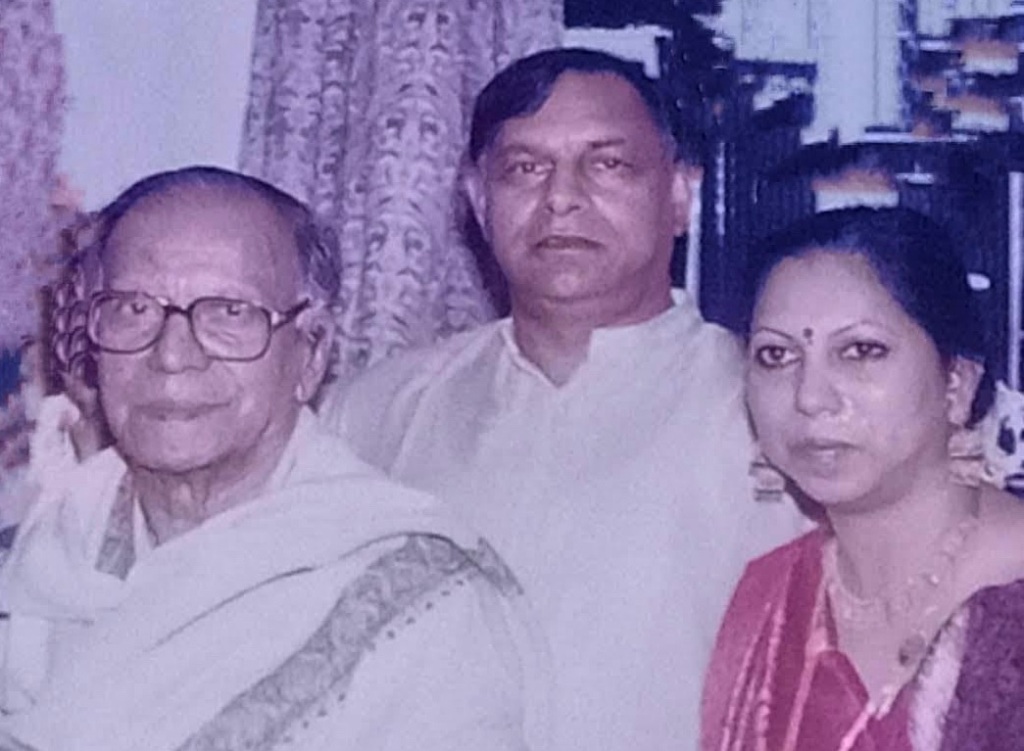
From left to right: Nabendu Ghosh, Dipankar Ghosh and Ratnottama Sengupta. Photo provided by Ratnottama Sengupta.

Ratnottama Sengupta, formerly Arts Editor of The Times of India, teaches mass communication and film appreciation, curates film festivals and art exhibitions, and translates and write books. She has been a member of CBFC, served on the National Film Awards jury and has herself won a National Award. 

.

PLEASE NOTE: ARTICLES CAN ONLY BE REPRODUCED IN OTHER SITES WITH DUE ACKNOWLEDGEMENT TO BORDERLESS JOURNAL

Click here to access the Borderless anthology, Monalisa No Longer Smiles

Click here to access Monalisa No Longer Smiles on Kindle Amazon International