Categories
Stories

Heather Richards’ Remarkable Journey

By Paul Mirabile

Bangkok

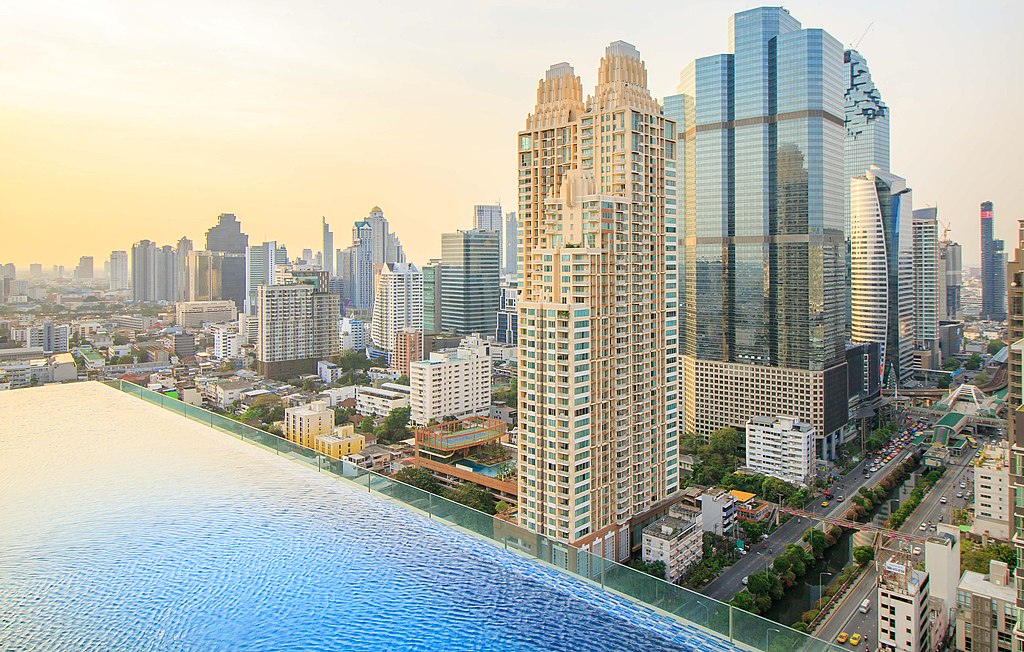
Mrs Heather Richards’ aeroplane landed at the Bangkok airport after a gruelling eleven-and-a-half hour flight.

Her initial enthusiasm since leaving Stevenage and England seemed to flag a bit even before the landing. The uninspiring food lay heavy on her stomach, the people sitting by her – mostly Brits — made no attempt at casual conversation. The choice of pictures bored her to sleep. Mrs Richards squirmed in her seat as the faces of Francis and Jonathan floated queerly in her somnolence; the first in grievance, the second in indignation. Had Jonathan found her quickly scribbled note? Would he ever understand her sound resolution, however painful for him? Thick clouds suddenly hid the late afternoon sun. The aeroplane began to descend. How glad she was when they finally landed and could rid her mind of these disturbing, contorted faces.

Bangkok’s early evening heat and humidity made her gasp for breath as she stepped out of the airport into a taxi which wildly drove her to the Lamphu House. The sultry air seeped into her hair, silkily, penetrated the pores of her kneaded, wizened skin like the bites of tiny insects. She rolled down the window but the hot, oily air left her panting. She felt like candle wax melting under the ardour of the flame.

Shown to her pleasant, airy room at the Lamphu House, Mrs Richards dropped onto the bed and stared blankly at the slow turning sails of the ceiling fan, turning and turning lethargically. –No, there was no other choice — a fey voice reminded her. No other choice ! She pricked up her ears. Let Jonathan relish his despondency, you must bear the burden. You must now find what has gone so mysteriously missing.

After a cold shower she felt much relieved. Then at the downstairs café-bar she ordered a fine dish of Pad Krapow Moo[1] which she enjoyed immensely. At the reception desk she enquired about buses to the coastal town of Mawdaung in the province of Prachuap Khira Khan where her son had been teaching. According to her plan, she would begin her investigations there. She refused to believe that Francis had become a monk to hide from the law; refused to think of him as a criminal, although she was perfectly aware of the accounts of the drowned children at his school through newspapers and her hired detective’s report. But she wanted details of these facts. Where that evasive detective had failed she would prevail. Mrs Richards knew her mission would not be a sinecure, but it was her only hope; perhaps her last gesture of maternal love towards her only son, whom she believed to be still alive.

And this gesture of maternal love brooked no concessions … no repining after-thought.

Bright and early the next morning Heather Richards, dressed in a flowery robe of light cotton, agreeable to the skin, sandals and a huge straw hat, made for the bus terminal. The heat had already begun to rise. “Was it possible that Francis relinquished his British upbringing to embrace Buddhism?” she mused as her clear, blue eyes followed the swaggering gait of a bow-legged dwarf crossing the dusty street. His hunched back oscillated wavily through the particles of dust that his erratic movements caused. The sun rose ever higher. She stopped to wipe the perspiration off her wrinkled forehead.

Soon, through a concussion of vehicles, animals, men and women in sarongs, and locals in Western clothes, Mrs Richards caught sight of the bus terminal wavering dreamily amongst the colours of this moving spectacle. It all so amazed her. The scents, too, of juniper and camphor from the temples, jasmines, all amazed her. She experienced moments of unexplicable excitement, of enigmatic fervour; an almost religious experience.

The man at the ticket office spoke excellent English. She bought her ticket without even queuing up, an exploit she considered odd, given the fact that her guide book warned visitors to South-East Asia that queuing up at train or bus stations could last hours ! Be that as it may, armed with her ticket, she regained her hotel, had a quick lunch of tom yum goong[2] at the café-bar and packed her meagre belongings. She would leave on the morning bus.

Indeed, she had chosen to travel light and fast. Heather Richards had not come to Thailand as a tourist but on a mission … a very special mission. On the bus speeding to Mawdaung the morning sun, glowing orange, crept slowly over the crests of the bamboo forests. She brooded over Francis’ misfortunes, his mysterious disappearance. Intuition told her something had gone amiss. Something had not been touched upon during the investigations. All her thoughts converged on that ‘something’

The bus didn’t pull into the Mawdaung terminal until the following afternoon due to several unexpected delays and two flat tyres. Exhausted but determined, Mrs Richards followed the indications on the map and notes she had taken in England until she spotted Francis’ school perched on the brow of the hill overlooking the tragic bay, now, however, having regained its initial configuration, although the scars of that terrible event could still be detected here and there. The security guard escorted her to the office of the headmistress, a certain Anong Saetang, who on the phone two days back sounded not overly enthralled to meet Mrs Richards, judging by the frostiness of her voice.

Her ‘welcoming’ phrase stunned Heather as she strode deferentially towards the woman who throned behind her majestic mahogany bureau: “What did you expect by coming here, Mrs Richards, a letter of recommendation for your son’s exemplary teaching and moral qualities?” Mrs Richards stopped dead in her footfalls, stunted by the violence of such a ‘greeting’; Her face sunk. “The deep wounds of the parents who suffered loses of their loved ones remain open,” rasped the headmistress. “Do not expect any help from them nor from our school. Besides, your son has gone fugitive for over eight years, and I can assure you not one of the parents who lost their loved ones caused his equivocal disappearance.”

These words, spoken with pontifical stiffness, jolted Mrs Richards to the core of her pride. She had not come either as a defender or accuser of her son’s conduct, but only to learn more of Francis’ flight. To call his disappearance equivocal made her blood boil. She clenched her fists …

“He ran off like a coward,” pursued Miss Saetang, happily noting her ‘guest’s’ surging rage. “And perhaps like an arrant renegade he is still hiding behind his monkish mask.” She snarled. “And I will also inform you that because of your son’s irresponsible attitude, the headmaster was sacked!” 

Mrs Richards’ glowered at her, eyes ablaze. She thrust out her square jaw in defiance: “Well, I’m sure you had no qualms about that since you’re now seated in his fine cushioned chair!” she riposted with overt disdain. Miss Saetang, shocked at the barely disguised insinuation was about to retort but her ‘guest’ put up an authoritative hand: “I’ve heard enough of your overbearing uncouthness towards my son. Whatever had been the fault which caused such a tragedy, I apologise for him. But do not try to overwhelm me with your supercilious self-importance and contemptuous righteousness.” Miss Saetang remained stoic in her sephia-upholstered chair. “And may I ask what has been done with his belongings?” Mrs Richards added tersely, staring at the headmistress with overt contempt.

The other threw back her haughty head: “They’ve been burnt and his bungalow fumigated with juniper leaves. At present, a pleasant gentleman from Scotland is teaching at our school, and I will add, is doing an excellent job of it.”

Mrs Richards jeered : “I’m sure he is!” She turned her back to the headmistress and walked out of the office without a goodbye, leaving the door wide open …

Infuriated but undaunted by the unsophisticated welcome of that brazen hussy, Mrs Richards took a last glance at the lieu of her son’s mournful destiny, and that too of those poor school children, a shared destiny that only an act of God could have brought about … and perhaps, too, a bit of heedlessness on the part of her son …

Although weary from a sleepless night and from that woman’s disdainful bantering, she directed her footsteps to the bus terminal, bought a ticket for Bangkok, and waited patiently for the night bus, a three hour wait, time during which she struggled with her thoughts. She needed to travel to Laos, but first had to meet the Laotian consul, Mr Inthavong, who had issued the visa to Francis. He would surely provide her information about her son … information and hope! As she ruminated these thoughts, she ploughed through a delightful dish of gaeng daeng or red curry. Indeed, the former barmaid was beginning to enjoy Thai food, spicy though it be. More tasty than that British Airways slop or that over-cooked fodder at the Lawrence’s Duck or Grouse

Once in Bangkok, she bought a ticket for Wiang Kaen where the Laotian consulate was located. She had to change buses, but thanks to the smooth roads she was there the following afternoon and lost no time in locating the charming two-storey bungalow. She had spoken to Mr Inthavong on the phone from the Lamphu Guest House and he was expecting her, his voice as excited as hers to get to the bottom of Francis’ imbroglio, which he considered scandalous given all the rumours that his name had produced in Laos and abroad.

To tell the truth, bus travel in Thailand had become somewhat of a second nature to Mrs Richards. Those passengers who spoke a smattering of English greeted the ‘old lady’ from England warmly, plied her with coconut milk and gaeng daeng. She was beginning to feel quite at home here ! Some passengers even taught her several words in Thai, especially the names of the savoury dishes she now so relished. The ‘old lady’ from England began to sense her son’s fascination for this country, for Southeast Asia. There was something large and generous about the inhabitants, and the looming mountains mantled in thick forests, something so unbridled. A something that lacked in England, so regulated, so close-fisted. Francis had deciphered this nobleness of spirit, this betokening loftiness. Was this why she too had come ? And Jonathan ? She hadn’t written one letter to him as of yet. Well, he would just have to wait …

Before meeting Mr Inthavong, Mrs Richards indulged in her favourite dish at an outdoor eatery near to the consulate, a sai gok [3]! Delicious. How Mrs Richards loved those sausages …

At nine o’clock sharp she was at the consulate gate. The same puffy-eyed, indifferent security guard who had sized up her son some eight years back now sized up his wizened-face mother. She quickly explained (or rather gestured) her urgent need to see Mr Inthavong. The guardian nodded lethargically, then shuffled off to the front door of the consulate with her passport. Several minutes later Mr Inthavong came flying out to greet his friend’s mother. All agog, he ushered her into his spacious, air-conditioned office.

“How delighted I am! How delighted!” an enthusiastic Mr Inthavong tooted sonorously. Mrs Richards smiled unable to put in a word. For the loquacious consul had read the police reports, had even made enquiries with the secret police in Laos, coming to the conclusion that Mr Richards had not been abducted and was alive, living in Upper Laos in one of the Mekong River temples. Mrs Richards’ eyed glowed with renewed hope. She even stamped her feet in joy.

However, in order to ferret out the whereabouts of her dear son, Mr Inthavong would arrange for her to be accompanied by one of the monks at the Jin Jong Jaong Temple in Pak Beng where Francis had been studying. The proposition brought tears to Mrs Richards’ sleepless eyes. She did not know how to thank the kind consul, given the fact, too, that his non-stop volubility left no intervals to do so.

He picked up the phone and called his wife upstairs, notifying her that they would have a very important guest with them for a few days.

Mrs Richards objected: “But sir, truly … “

“Please … Please, it is our pleasure. We had your son stay with us for three or four days. Our conversations were most illuminating. He even played with our two children like a big brother.” Mrs Richards hardly believed that one could converse with the winsome Mr Inthavong. Nevertheless, the consul’s wife, a middle-aged woman of exceptional beauty, attired in a silken sarong of ochre, over which she had thrown a beautifully embroidered black shawl led her upstairs to the guest room of their lightly furnished flat.

Heather Richards spent a wonderful three day sojourn at the Inthavong’s, listening to Mr Inthavong enlightening her about her son’s prodigious teaching talents and odd, but heroic plunge into Buddhahood. Mrs Richards and Mrs Inthavong, tea-cups held high, sat politely, nodding their heads in approval, oftentimes quite perfunctorily. As to the children, they ran amok, upsetting furniture, fighting over toys or books, much to the stoic displeasure of their mother and to the manifest joy of their father.

To make her stay all the more enjoyable, Mrs Inthavong, a marvellous cook, served her guest with mok pal[4], tam mak hoong[5], and her very favourite dish, sai gok, those mouth-watering sausages served with khao niaw, sticky rice. And the more Mr Inthavong jabbered on, the more Mrs Richards’ images of Jonathan, Stevenage and England faded from her mind. It were as if she had returned home after having spent many years as an immigrant in the West. An odd sensation really that she herself could not quite fathom …   

With many tears shed by both parties, Mrs Richards parted from her benefactors and boarded the same Nam Ou boat that had eddied her son to Laos. Whilst the sturdy vessel cleaved the waters of the Mother of all rivers, Heather let her thoughts drift back to Jonathan. How was he spending his time? In idle gloom, drowning himself in self-pity, wandering aimlessly from one room to another … from one pub to another, pissing it up with that fatuous Andy, plunging into the hissing cauldron of lust? She knew that leaving Jonathan alone for so long would be devastating to their marriage, but Francis … Yes Francis … He was alive somewhere in the wilds of Northern Laos, waiting for his mother’s maternal embrace. This she knew. And this Jonathan never understood. Would she ever write him a letter to explain this inexplicable presentiment ? She pursed her lips. As to Francis, he had been right from the very beginning: their home, neighbourhood, England as a whole had been too tiny for his august ambitions and dreams. “I’m sure he takes after me,” she gloated aloud as Ban Houei Sai rose to her extreme excitement.

The same collective taxi that sped the ‘Western monk’ to Pak Beng now sped Mrs Richards. The sun rose high. The heat too. She patted her neck and cheeks, fanning herself with her straw hat.

Stepping daintily out of the packed taxi at Pak Beng, she was warmly welcomed by two monks and quickly escorted to the Satu or Venerable Father. There in a spacious room for visitors, the ceiling fan stirring up the midday heat, he reminisced over her son’s seven-year sojourn at the temple. The wiry Father did not believe that Francis had been killed at the Pak Beng Grand Hotel, nor that he had been kidnapped by a group of Thais. Witnesses confirmed his presence in Upper Laos, albeit the reasons for his leaving the temple and travelling to Northern Laos remained obscure.

“And where would my son be?” implored Mrs Richards, wringing her knotty hands. The Venerable Father eyed her compassionately and in a mild voice intoned :

“Reports from wandering monks say that he may be living in the temples of Hatsa, Chao Dan Tra or U-Thai. I have received several letters from Mr Ithavong and assured him of my staunch collaboration in helping you locate your son. Please, stay with us several days and gather strength, the journey up north will be strenuous. You will be accompanied by Jai, one of your son’s former students at Luang Prabang.”

Mrs Richards clasped her hands in gratitude and stammered humbly that she would be honoured to spend a few days at the temple. “You will be given Francis’ cell, quite comfortable if you are not too accustomed to five-star hotels.” She smiled, waving her hand. The Satu stood, a sign that their audience had come to an end. She immediately rose out of her cane chair, bowed and was escorted to the ‘Western monk’s’ cell by Jai, who an hour later, knocked at her wooden door with a huge dish of tam mak hoong and khao niaw.

For those three days Mrs Richards did indeed relax, partaking of the temple’s excellent food, sauntering in the gardens, observing the monks’ morning and afternoon exercises. On the second day of her stay, she strolled to the Grand Pakbeng Hotel and thought of doing some enquiries there, but on second thought let it drop. No doubt, the staff would have changed by now, and the personnel would not even understand her questions. 

On her last day at the temple before setting out with Jai, the Satu offered his honourable guest an ochre-coloured robe of pure cotton and a new pair of sandals. She placed a hand to her forehead and bowed, so beholden was she to this revered, saintly man.

Like snakes slithering with difficulty upstream, Mrs Richards and her guide Jai, slid their way upon the sullen waters of the Nam Ou River on an eight-padded chaired vessel. They were the only passengers. The stoic Jai. The uncanny silence of the surrounding jungle. The muteness of the navigator frightened her. Jai sat alongside her, face taunt, eyes alert, back straight as an arrow. His English was excellent. But his translated information to her was always measured in a very bland, monotonous tone, like a machine registering the input and output of data. She wondered whether or not the monk had chosen to accompany her or was chosen, against his will. He never sought to converse with her, nor did he ever smile, unless perfunctorily. Mrs Richards did not take this badly ; it was no doubt Jai’s personality, and she respected that. His presence alone comforted her in the mission to be completed. Nevertheless, Mrs Richards experienced this ghastly silence as an equivocal omen; a silence mantled by thick wavy wisps of mist through which oftentimes she caught fugitive glimpses of frail floating barks or dugouts, catamarans, rosy water buffaloes bathing, gigantic rhizomatous configurations of elephant ear leaves arching over the swirling waters.

The navigator had heard of this ‘Western monk’ praying in the temples of Nong Kiaw further upriver. But this was a few years back. Mrs Richards winced. Jai nodded his tonsured head.

The days wore on and on. They slept in village guesthouses, or in temples, eating sticky rice and fish served by monks clothed in saffron-coloured gowns whose velvety footfalls stealthily stole across the marble floors of the temples, their tonsured heads blending dreamily into dim corridor frescoes as the sun set behind the incandescent forests.

At Muang Khwa, Mrs Richards hired a dugout paddled by a huge muscular man. Here the river churned up a frightening white foam. The brittle hull shook at each cross-current, at each turbulent whirlpool of the dappled greys of the dangerous shoals of sunken rocks. The towering cliffs cast ominous shadows on their frail vessel. The sun was at its zenith. The courageous Heather beheld the most startling images: gutted jungles, lush foliage suddenly illumined by flaming orange foliage, bevies of buffaloes bathing in the mud of the banks, kingfishers perched on their coarse backs. Her eyes feasted on these primeval scenes, and with each lattice-work of aerial or gossamer vines, with every grunt of the black pig or sight of a stilt-home precariously sinking into the ever shifting clayey banks, she became more and more fascinated by the marvels of this living spectacle; by the savage vortex of energy into which she felt drawn. She no longer envisaged a Jonathan … a Stevenage … an England. She had penetrated the pristine world of Francis! Yes, she knew she was drawing nearer and nearer to him. She felt the horrors of his forced solitude, his lonely struggle for survival … the horror! The horror!

Meanwhile the dugout struggled upriver where former guesthouses lay in ruins, covered with thick vines. Where the eateries were scarce. Rare were the temples that offered them food.

One morning, the dugout hauled on to the bank, the navigator ran off to fetch water whilst Jai to gather mangoes and papayas. Mrs Richards sat upright in the dugout, weakened by a diet of one meal a day, exhausted by lack of sleep and the incessant mosquitoes. Haggard, her face red and sore from the heat, her lips swollen from insect bites, she had the nerve-racking impression that the jungle was closing in around them … slowly … ever so slowly. The navigator suddenly emerged from a thicket, threw a gourd of water into the dugout and pushed it out into the current.

“The Western monk is at U-Thai!” he shouted out hoarsely as he turned to her.

Words that Mrs Richards hardly understood but whose coarse inflexions she deciphered instinctively. He began paddling in strong strokes, the muscles of his naked back breaking into runnels of sweat. But where was Jai? She looked back towards the bank: No one! Nothing! She tapped the navigator on the shoulder. He smiled, nothing more. The dugout waded through a gaggle of reed and thistle. Above, the spiralling precipices arched over them, the sun had long since vanished, and a creeping blackness enshrouded them. Mrs Richards was now on her own … all alone, like Francis. She fixed her fatigued eyes on each bend of the great river, on each scene of their long-awaited reunion rehearsed again and again … and again …

As the steaming mist of evening tide rose off the white-crested waters, Mrs Richards’ vessel disappeared into their thick folds, the splashing of the navigator’s paddle fading … fading away, borne into the darkness and distance …  

[1] Stir-fried basil and pork.

[2] Hot and sour shrimp soup.

[3] Sour sausage

[4] Steamed fish.

[5] Green papaya salad

.

Paul Mirabile is a retired professor of philology now living in France. He has published mostly academic works centred on philology, history, pedagogy and religion. He has also published stories of his travels throughout Asia, where he spent thirty years.

.

PLEASE NOTE: ARTICLES CAN ONLY BE REPRODUCED IN OTHER SITES WITH DUE ACKNOWLEDGEMENT TO BORDERLESS JOURNAL

Click here to access the Borderless anthology, Monalisa No Longer Smiles

Click here to access Monalisa No Longer Smiles on Kindle Amazon International
Categories
Stories

The Wave of Exile

By Paul Mirabile

Mr Richards, employed by the British Council, had been teaching English at a posh, private preparatory school in Thailand for more than four years in the Province of Prachuap Khira Khan in a coastal town named Mawdaung. His first and sixth form pupils enjoyed his humour much more than his tedious grammatical explanations, and Mr Richards had no qualms about this.

Mr Richards taught twelve hours a week which offered him ample time to learn Thai, travel extensively throughout the country, especially up North in the dusk-filled jungles and along the Mekong River shores exploring villages and temples.

The one-storey school, perched high up on the brow of a hill, overlooked the turquoise-tainted Indian Ocean. The large windows of his class afforded pupil and professor much visual pleasure when grammar became too much of a bore, and Mr Richards too weary or hot to break the boredom.

“Now, instead of casting cursory glances out of the windows,” shouted a nettled Mr Richards, one very grey, windy day, “who can tell me what function the word ‘chewing’ plays in the composed word ‘chewing-gum’ ?” All the smiling faces and darting eyes happily translated their perfect ignorance of the answer. However, a minute later, a very pretty girl, one of the brightest in his class, excitedly cried out, “A verb, sir !” Mr Richards gave her a benign smile and shook his head.

“No, no. It is not because it ends in -ing that it is a verb,” he lectured in a paternal tone, so overtly exercised by Mr Richards, and so perfunctorily accepted by the pupils. He scanned the eager heads of the others ; alas none had the desire to crack the enigma. He checked his watch : “Oh well, I’ll let them out ten minutes or so before the bell rings. I have to catch that bus to Bangkok,” he sighed, still waiting for an answer that never came.

“No bother. Tonight think about it and tomorrow morning let me know, right ?” He stood up. “Go on now … down the hill … off to the beach, I’ll give you a treat this afternoon.”

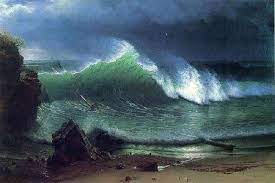
Before he had even finished the word ‘afternoon’ the whole class, besides two girls, grabbed their books and scrambled for the door. Out they stormed, racing downhill towards the shingled beach of the crescent-shaped bay. Mr Richards observed them from the large windows. Their delightful screams made him a bit queasy: he had been told never to allow the pupils out before the bell. He, nevertheless, had done so on several occasions. He shrugged his shoulders, picked up his books and papers from the wooden desk and was about to make for the door when a terrible thundering or roaring sound froze him in his footfalls. He swivelled on his heels and gasped in horror as rolls and rolls of water smashed against the plate glass of the window panes. The violence of the impact threw the two girls to the floor screaming, but besides a few chinks through which spouts of water gushed in, the windows had miraculously withstood the brunt of the tidal wave. For a tidal wave it was, and a tremendous one! The two girls remained lying on the floor, crying but unhurt.

Mr Richards ran to the windows. The waves had receded, but what he espied below on the crescent-shaped seascape, or what had been a crescent-shaped seascape, caused him to fall back and scream involuntarily : “Dear God! There’s nothing left!” Indeed nothing remained: no palm trees, no vendors’ shacks along the shore, no boulders. No shore ! Only a vast ocean that lay several metres below the school, now churning a glaucous thickness under grey, sultry skies, upon which floated a myriad bobbing flotsam: uprooted palm-trees, lifeless cows and dogs, shoals of bloated fish, roofs of straw, pots and pans, planks, bright coloured robes with or without their proprietors’ bodies inside them !

“Bodies !” he cried covering his mouth. “My pupils … Have they all …” He dared not finish his sentence. The two girls stared at him, mouths agape, eyes deorbited. “The boys and girls floating in the water … Dear God they’ve all drowned !” He wept and wailed, stamping his feet, grabbing at his hair. The girls too began to weep and wail.

In an instant he came to himself. “Their deaths are my fault,” he mused. “I let them out too soon … against all school regulations. Blast ! Why did I do that … just today ?” He soon realised that the headmaster would be on to him soon enough; he feared his starched character. And the parents ? They would accuse him of manslaughter.  He would be arrested and put in prison, even hanged for involuntary homicide ! He had every call to be frightened …

Taking hold of himself, Mr Richards knew he had to flee very quickly from Thailand before the headmaster and the parents learned about his unpardonable blunder. And they would learn about it soon enough when the panic and hysteria had died down.

He leapt over the still supine girls and rushed out the door. Once outside he noted that the town near the school had hardly been damaged. But below, he caught glimpses of undulating corpses being poled out of the waters by villagers and policemen in pirogues, rowboats or catamarans. The tidal wave had been gigantic. He turned his attention away from the catastrophe and fled home …

He jogged up to his bungalow further up the grassy hill at the edge of town. Speedily he gathered what he could, for the alert would be out for him at any moment … Or, so he believed. A change of clothes, one or two books and his official documents he stuffed into a small backpack, and without locking his door quickly made a bee-line for the bus station, where luckily he managed to jump on a bus for Bangkok. Apparently no one recognised him, nor followed him. He paid the fare, settled into one of the many empty seats and stared stony-eyed out of the window. His red, puffy eyes filled with tears. What a blithering fool he had been ! And now, what had he become ? A fugitive … no, worse, a murderer ! “Dead ! All dead !” rose a ghastly whisper in his ear.  He had to get away as far as possible as the scenes of the bloated pupils danced before his bloodshot eyes.

Once in Bangkok he wasted no time. Further North he travelled by bus into the Province of Chiang Rai. There, in a village whose name he hardly recalled, he spent two nights pondering his dilemma, assuaging his jaded nerves, chary of leaving any sign or evidence of his frantic intinerary, thinking only of a plan to save his neck. He couldn’t possibly stay in Thailand, the police surely were now on his trail, or would be very soon. Neither could he return to England: the bobbies would be waiting for him at the airport, ready to handcuff the murderer of over a dozen innocent children !

Then in the middle of a hot, sleepless night it suddenly occurred to him: he would shave his head and eyebrows, don a monk’s robe, change his expensive Russell and Bramley shoes for sandals and set out for Laos. He had travelled widely in Laos and could even speak a smattering of Kra-dai. He had taught in Luang Prabang for three years and had many friends amongst his former pupils, two of whom had entered monkhood in Pak Beng at the Wat or temple Jin Jong Jaeng. “I shall escape naked from the shipwreck of mundane life,” he  murmured, smiling inwardly at his little metaphor which he recollected from his childhood upbringing. But would he ?.. Mr Richards sunk into his lumpy bed: the figure of an outlaw, a pariah, a self-exile stood before him like a shadow … a double of himself: -swollen little bodies drift like flotsam in waters, darkly … that fey voice droned above a tumult of incongruous thoughts.

Mr Richards shook his head and said aloud, “To Pak Beng. There I’ll join the sangha[1] of the Theravada monks. There I shall seek spiritual solace, rid my mind and spirit of those drifting bodies of cheerful boys and girls, swept away from the joys of life because I had a bus to catch!” So he hoped.

Yet the obstacles of reaching the temple caused him concern. The Laotian government frowned upon Western spiritual-seekers cluttering their monasteries and temples. He needed a visa. Where would he find a consulate in the North of Thailand ? And would they issue one to a ‘Western monk’ ?

He jumped up from the bed, and as he did his mind cleared of all that tumultuous tossing. He had befriended many of his pupils’ parents whilst working in Luang Prabang, and he knew, by correspondence, and his frequent voyages to Laos, that one of them, Mr Inthavong, had been appointed consul in one of the North Thailand consulates. He rushed down to the reception and asked at the desk where the nearest Laotian consulate could be found.

“You must travel by bus to Wiang Kaen near the Mekong River, sir.”

“Are there any other consulates ?”

“Not that I know of, sir.”

Mr Richards heart skipped a beat; Mr Inthavong must be working there. He had to take the chance.

The next morning the ‘Western monk’ got on a bus for Wiang Kaen, carrying only a small bag for his passport, photos and a bit of lunch. All along the tedious journey to the North-Eastern town Mr Richards prayed that Mr Inthavong would be there; it was his only chance to obtain a visa for Laos.

He reached Wiang Kaen by nightfall, found accommodations at a temple guest house and spent a horribly sleepless night, tormented now by the thought of the failure of his plan, now by the screeching rats and buzzing mosquitoes.

At nine o’clock sharp he was at the front gate of the bright new consulate, a lovely two-storey bungalow-like edifice enshrined by lush gardens carpeted with the most perfume-scented fruit trees and flowers. He rang. The security guard strolled out and sized him up. Mr Richards politely mentioned his friend’s name. The unshaven security guard raised two quizzical eyebrows, but took his passport and photo and left him to ruminate the events that were about to unfold behind that iron barrier, inside the lovely bungalow. It all seemed hours to him as that voice repeated  “irresponsible murderer !” Suddenly the security guard stood before him, together with a small, portly man dressed in a suit and tie.

“Can that be you Mr Richards? A bonze? A monk? What have you done? Where is all your beautiful black hair ?” All this was said in imperious tones much to the delight of the monk who sighed in relief: his pupil’s father had recognised him! He wiped the perspiration off his furrowed brow. “Step in, please … out of the heat,” the consul pleaded. So they both strolled into the air-conditioned consulate, Mr Inthavong wearing Russell and Bramley shoes, recently polished, Mr Richards, a pair of worn-out sandals.

Inside the monk was served tea and a bowl of rice in Mr Inthavong’s office, he himself abstaining from joining him since he had already breakfasted. “I’m so happy to see you Mr Richards,” began the enthusiastic consul. “What brings you here, and dressed like that ? Are you really a monk now ?” Mr Richards broke into a tapestry of lies that, as time went by, he himself began to believe: Living so long in Asia had infused his soul with the compassionate virtues of Buddhism, and in Laos, he hoped to pursue his path deeper in the compassionate depths of Buddhahood in order to glean its treasures. The consul smiled like a child does when listening to his or her favourite nursery rhyme.

Mr Richards then got down to business: his visa ! Mr Inthavong nodded, examining his passport and two photos. “You shall have it in three days. Meanwhile, you are to be my guest here, upstairs with my wife and two children.”

And so the first snag had been circumvented. For those three days, Mr Richards, plied with food, drink and homely conversation, had all but forgotten the wave, the floating bodies and merciless whisper … the abominable figure of a self-exiled …

On the morning of the fourth day, armed with a three-month visa, the Western monk set out to cross the Mekong River to Ban Houei Sai on a Nam Ou boat with six other passengers. It had been so long since he had been on the Mother of all Rivers. He inhaled the tropical river air in silent jubilation. As they navigated slowly downstream, his thoughts interlaced with the flecks of foam, wandered back to his days spent on the Mekong at Guan Lei on the Chinese border, where having been temporarily stranded, he finally was welcomed aboard a small six-cabin dai, a Chinese boat, heading for Thailand.

What a voyage! They had anchored by the soundless jungles at night, machetted through them in the evenings in search of mangoes, navigated by bathing rosy water buffalows and by tiny golden stupa-tipped isles. What an adventure! The crew had left him off in a small Laotian village where he made his way to Luang Prabang on one of those blue, wooden box-boats, gliding by stilt-home villages under whose piles lounged or snorted huge black pigs, scenes so reminiscent of Alix Aymé’s paintings[2] housed at the Luang Prabang Royal Palace. Then the real adventure began, upstream on the Nam Ou in a frail six-seater river boat, slowly weaving between treacherous snags and swift cross-currents. He passed the Park Ou caves, Nong Khiaw and Muang Khwa, sleeping in bungalows and eating rice with thick pieces of pork in the pristine territories of the Hmong tribal peoples. Alas, his grand voyage to Hatsa ended in Sop Pong near the Vietnamese border, the authorities refusing him an entry visa to cross Vietnam then back into Laos where he wished to continue on his river voyage to Chao Dan Tra at the Chinese border.

Ah yes, those were the days of freedom … of existential sovereignty. And now ? A fugitive … a prisoner to his own wretched egoism, Mr Richards suddenly felt overwhelmed by a deep loneliness. His mixed recollections were suddenly interrupted by shouts from the shore : they had reached Ban Houei Sai.

Once the formalities were completed, Mr Richards managed to hop on a collective taxi which sped him towards Pak Beng on a smooth road. He reached the town before nightfall, and to his joy he spotted his two former pupils seated on the temple steps. Were they waiting for him ? Indeed they were, thanks to a letter sent by Mr Inthavong who had explained in great detail to the Satu or Venerable Father of the temple-sangha Mr Richards’ religious fervour and enthusiastic intentions to enter monkhood. The consul had added that nothing should be said to the police or to other state authorities of his entry into Buddhahood.

His former pupils, who had grown into full manhood, heads shaven and bare foot, happily led him to meet the Satu Father. To tell the truth, Mr Richards hardly recognised them. But that made no difference. As expected, he deposited a large donation (all the cash he had on him which amounted to some six hundred pounds), then was given three bright new ochre-coloured robes of pure cotton, shown to his splayed window cell, through which he had a slight view of the inner temple gardens, and was told the daily procedures of his initiation as a pha or a novice: collective prayers in the Prayer Hall, breakfast, Sutra readings until lunch, discussion, rest period, an hour or two of manual labour such as gardening, restoring frescoes or termite-riddled woodwork, personal perpetual moving meditations, yoga exercises, then a light meal before the final collective prayer and sleep until the sound of the gong at four o’clock in the morning.

When the two monks had left him, Mr Richards lay back on the straw mat on the earthen floor that served as a bed. He had been given immaculately clean sheets and a pillow. A mosquito net had been nailed to the splayed window. The walls bore no images nor any other colour than a light beige. Putting his hands behind his head he followed the slowly turning ceiling fan with his eyes: yes, his plan had succeeded. No one would ever find him here. Yet he had no reason to rejoice. He would never again see his aging parents seated at the hearth reading or conversing in low voices, his trusty Irish Setter … his friends at the pub. A sharp pain of remorse, or better put, compunction stabbed at his chest. “Dead! Drowned ! All dead !” the whispers hammered at his temple. Would that relentless voice ever grant him respite ? Would anyone ever forgive him ? Only penance. Only the fires of tribulation could scrape away the rust of vice that had corroded his being. A life of contrition would be the most appropriate path for him, the most responsible. Tears again began to well up in his eyes. He fell asleep and awakened to the cascading sound of two or three vibrating gongs.

So began Mr Richards’ initiation into Therevada monkhood. He had to learn the akkara alphabet in order to read the sutras, the Buddhist acriptures. His practice of many languages enabled him to accomplish this in two months. What he enjoyed most was the tham nong or the musical rhythm method which empowers the monks to memorise the hundreds of sutras of the Sacred Books ; it formed part of the didactic games that the bonzes played every morning and afternoon. These didactic games also included dancing and chanting sessions. The ‘western bonze’ adapted quite rapidly to his new lifestyle … his new home … No doubt his last …

As time passed, the rigours of the monastic code, the kindness of all the monks towards him, his slow but steady immersion into the Kra-Dai language and the marvels of the modality of Buddhist life attenuated, to a certain extent, the mortifying effects his spirit and body had suffered since that horrendous wave. Images of the drowned bodies did wake him up in the middle of certain nights, heaving and panting in one sweaty mass of anguish. However, the whispered voice had long since been silenced. His prayers and ruminations served as a watershed for those waves of guilt, an oceanic ointment for his slowly healing wounds. He was so glad to do service at the temple, run errands for the personnel who worked in the kitchen, wash and hang to dry the three robes of all twenty or so monks.

Gradually he succumbed to the beauties of Buddhahood, of attaining inner peace, his mind having all but vacated that remorseful past. His wide struggles between jubilation and despondency, gaiety and sorrow, ecstasy and debasement dwindled to a few chinks of dread. In short, he enjoyed his laborious leisure …

It was his seventh year at the temple. In spite of his three-month visa having expired, the Satu Father allowed him to take up his begging bowl and go into town to beg for donations, and even have a bite to eat at one of the roadside stands if he so desired. Mr Richards beamed with joy. In all those seven years he had hardly stepped out of the temple. He knew nothing of Pak Bent besides several photos that had been left behind by some tourists on the bench of the veranda of the main Prayer Hall.

He strolled about the crowded streets of the main arteries admiring the colourful markets and smelling the cooked food that had once given him pleasure, especially the pork and prawns. He went from shop to shop, his bowl filling with dented coins and frazzled bills. He was about to order himself a vegetarian meal in one of the market eateries when a group of well-dressed men addressed him in broken English. He shrugged his shoulders, prudently. They then spoke in Thai which he feigned to understand a bit. They appeared to be part of a large tourist group. One man placed a five-dollar bill in the monk’s bowl. They spoke very politely to him, and even invited the good monk to their hotel for a bite to eat … vegetarian of course ! The monk hesitated at first, but finally agreed. Who knows, perhaps these good men, quite wealthy-looking, would donate a fine sum to the temple-sangha.

They hailed two taxis and soon stood outside the palacial Le Grand Pakbeng, a sumptious five-star hotel. The finest in Pak Beng. In the lift that shot them up to the Presidentielle Suite, he looked at himself in the lift mirror ; he hadn’t seen his face for over seven years (the temple-sangha had no mirrors) and noted that the corners of his eyes had shrivelled into crow’s eyes. He winced.

ThePresidentielle Suite was fabulously fitted out with an outdoor spa and living area. The majestic terrace looked out upon the rolling Mekong which snaked through the rich greens of the mountainous forests.

The door was slammed shut and locked behind him … 

And that was the last time anyone ever saw the monk from the Wat Jin Jong Jaeng, alias Mr Richards.

An investigating detective, sent by the Richards’ family, after a year or two of intense enquiry, believed that their son had been abducted by the group of Thai tourists who had checked into Le Grand Pakbeng. The detective, once learning their names, discovered that three or four of them were the parents of the pupils who had drowned in the terrible tidal wave that struck southern Thailand some nine or ten years back. Alas nothing could be proven against them. What proved very odd was the fact that Mr Richards’ parents had no idea their son had been the cause of the drowned children in Thailand, and even ignored his entry into monkhood, having received no letter from him for over seven years ! The detective had nothing to say about this silence. Nor did he wish to say anything.

The detective concluded in his report to the grief-stricken parents, rather sententiously, that no human being has ever disappeared completely, however altered his or her appearance. This trite remark hardly brought a ray of solace to them.

.

[1]        A monastery or convent of Buddhist monks.

[2]        (1894-1989) French painter. She discovered the use of lacquer in her landscape paintings of Southeast Asia.

.

Paul Mirabile is a retired professor of philology now living in France. He has published mostly academic works centred on philology, history, pedagogy and religion. He has also published stories of his travels throughout Asia, where he spent thirty years.

.

PLEASE NOTE: ARTICLES CAN ONLY BE REPRODUCED IN OTHER SITES WITH DUE ACKNOWLEDGEMENT TO BORDERLESS JOURNAL

Click here to access the Borderless anthology, Monalisa No Longer Smiles

Click here to access Monalisa No Longer Smiles on Kindle Amazon International

Categories
Interview

In Conversation with Adam Aitken

Poet, creative writer and teacher Adam Aitken talks about cross-cultural identity, and the challenges of travel, writing, and belonging with Keith Lyons.

Adam Aitken

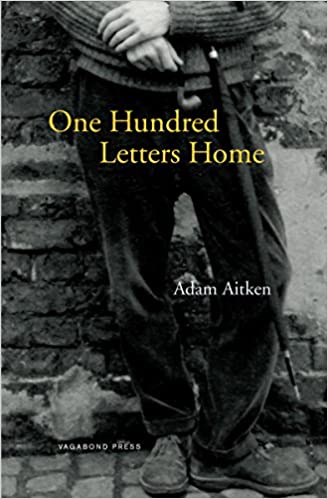
Adam Aitken is a London-born teacher and writer with a PhD in creative writing. He migrated to Sydney after spending his early childhood in Thailand and Malaysia. His poetry and prose have been widely anthologized. He has published poetry, chapbooks, essays on Asian Australian literature, book reviews, and was co-editor of Contemporary Asian Australian Poets. The story of his mixed heritage is featured in his creative non-fiction work One Hundred Letters Home. In this exclusive, he shares about the challenges of writing, identity and place.

You were born in the UK and have spent most of your adult life in Australia but tell us about your early childhood in Thailand and Malaysia.

It was a very happy childhood, and I was spoilt by everyone, except my mother, who was chronically anxious every time my father appeared. I was unaware of it at the time, but they were not happy together. I remember my fourth birthday in Birkenhead Liverpool. Then we moved to Southeast Asia. In Thailand, my father was almost always absent. I had good schooling in Kuala Lumpur, at a Catholic pre-school run by the Good Shepherd order. I remember my first day, I was illiterate in prayers and scared of the large carving of Jesus crucified and bleeding from his crown of thorns. Around seven, I went to an international school in Bangkok, which was great except for the bullying I received from an American kid. After he hit me on the head with his sneaker, I reported him, and he was publicly shamed. There are few worse things you can do than insult someone with your shoe, especially by touching the head.

What was your experience like moving to Australia when you were still young? How did your sense of identity or homedevelop?

Worse, the racism in Perth was total, violent, totalitarian. Teachers were complicit. Nothing was done about it. My brother and I were once howled out of the school as we went home. I am afraid that when I talk about the worst aspects of ‘Whiteness’, I remember that time. My father was again absent, unable to get a job he liked and implicated in a civil adultery case involving another couple. We left for Sydney after a year. My poem ‘The Far East’, is an attempt to record that kind of trauma.

When did you first discover that you liked writing creatively, and in particular, writing poetry?

About aged 14, after six years living in Sydney, I started to enjoy my English classes. I had a fabulous teacher Rick Lunn, who I think became a successful sci-fi writer. I will never forget the magic of listening to ‘The Rime of the Ancient Mariner‘. After that I had access to David Malouf’s library in Sydney, when we stayed at his flat for a few months. I discovered the alternative reality that books provide. I bought a typewriter and enjoyed the process of typing on paper. A few years later I attended a poetry reading at Exiles Bookshop in Sydney and was enchanted by the strange glamour and seriousness of the writers. Martin Johnson, John Forbes, Gig Ryan, John Tranter were all there.

What early recognition or encouragement meant you saw being a writer as a career option?

At my primary school, I wrote a poem about a forest walk we did, and on seeing a sea eagle, and that was read to the whole class. At high school in Sydney, a poem or two made it into the school magazine. I think the English Master also recognised me and encouraged me. I was lucky to grow up in a time when creative writing was still valued but not necessarily seen as a vocation for which tertiary qualifications were essential, but at Sydney University, I enjoyed lunchtime poetry workshops when there were no creative writing courses to do at all. I met practising writers in a very informal atmosphere and so ‘being a poet’ seemed a comfortable choice. My mentors were real writers but there was no pressure of assessment. The goal was to get poems into magazines. This happened when I was in 3rd year. I had great lecturers who loved poetry. I was published in Southerly. I featured in an issue of Chris Mansell’s Compass. It was a thrill to have a few pages in a well printed and produced ‘zine. I also read at what was then the largest reading in Sydney, The Harold Park Hotel. Probably Sydney’s most dynamic place at the time, and since.

How did you develop your mastery of the craft, own voice and style?

I baulk at this question as I am not sure how I can define my voice or style. Certainly, early imitation of other poets, practice and attention to poetic technique (metaphor, simile etc.) helped me develop the craft. Listening to poetry out loud helps. Revising and trying out new versions. It’s like writing music. I also have a very good ear for languages so pick up stylistic and prosodic patterns quite quickly. I listened to early advice about metrics and line endings and spent a lot of time reading traditional verse and learning the metres and forms (ie. sonnets), even though I don’t apply them much these days. Writing ‘in the style of’ is an enjoyable exercise and imitating others is fun, even though it can be unoriginal. I tend to allow a line or sentence to suggest its own metrics, then use that to write a draft. I am very much more into allowing content to dictate form.

What do you think is unique about your work, that makes it distinctly yours?

In terms of the questions of form and craft, I don’t think there are many Asian Australian poets who had a traditional training in English Lit, augmented by Modern American literary influences (like the Imagists, Ezra Pound, and the New York School). I was there in the early days of postmodern theory. I was starting out during the ‘Poetry Wars’ in the ‘seventies. I also studied linguistics and became an English language teacher. I was there in the heady days of the Sydney early ’80s. I think this gives me a kind of technical awareness of language and grammar, form and genre.  I am probably one of most well know of migrant poets for having been recognised since then. I was fortunate to not have to work so much and so I had plenty of time to develop my craft. On a personal level I don’t know many other Australian poets who have had my parents who were literary enthusiasts, and both culturally eclectic. Of course, Thai heritage has given me a lot. Few Asian Australian writers have had a childhood like mine, or possibly the eclectic experience of reading as I have had. I don’t know of any Asian Australian writer who has explored their cross-cultural heritage as I exhaustively as I have in both poetry and memoir.

How do you communicate through poetry something very personal, to an audience that is on the outside?

I received a ‘New Critical’ dogma about the poem being an impersonal object, but it did not stop me reading Sylvia Plath or Frank O’Hara. I begin by thinking about how the personal could be interesting to someone I don’t know. Attend to the particulars and details of the personal, and to avoid sentimentality.   Be as brave as possible as to the trauma of an experience and celebrate the positive. My own preference is to avoid histrionic outbursts, something a learned writing my memoir. Again, the particulars and exactitude of description work better than bare statements. I do still hold to the dictum of showing, not telling.

One of the characteristics of your work is attention to detail. Does that start with being observant and taking notes? How do you then find the most poignant moments or parts?

I often know I have a poignant subject, but often writing leads you to it. The previous answer is relevant here also. I don’t do a lot of notes, but I do a lot of drafts that grow into larger structures. What seems poignant early may pale into insignificance later, so I do a lot of revisiting of old notes and drafts. I often take note of dreams and reflect on what they might mean. I have always been interested in painting, photography, and films, (which I studied at Uni) so I do spend a lot of time thinking about what is ‘in the scene’, what the detail is, how close ups and panning work, what a montage is. As a child I liked to look through microscopes at insects. As far as grammar in concerned, I am fascinated by how grammars work in other languages, and in the etymology of words.

How do you go about writing a poem?

Again, often I start with a fragment, a line, a phrase, and go from there. Sometimes, I set out trying to describe a scene, a photo, a painting, an experience of looking, whether that be looking at a film or a view. Interior monologue or talking to myself and putting thought onto a page helps. I occasionally address a theme, most often at the instigation of a journal issue callout. I also have a long running series of satiric poems written in the character of an avatar, though I sometimes doubt that these amount to anything lasting.

Is poetry about finding meaning and making sense, or looking at something from different perspectives?

The Cubist method has a lot going for it, and I don’t really make the distinction between making sense and the various means we use to perceive of something. I do struggle with the fragmented poem that does not seem to find meaning, that I can’t find the sense in, or that lacks context, a heritage, a precedent in a more powerful text. But that is part of the job, to struggle towards meaning, using what is at hand.

How different is it writing an essay or review, does it use a different part of your brain or a different process?

Well, audience and purpose are more important in an essay, though not as important as I often thought.  A review should help a reader decide whether to go and read the text, and I am pragmatic about this. I find writing essays almost impossible now, because I don’t have the patience and attention span needed. Essays and reviews (arguably) have strong generic patterns to follow, whereas I write poetry without constraining myself too strictly to generic considerations. Long forms are exhausting, and my eyesight is deteriorating and so long sessions at the computer are unpleasant.

If the financial rewards from writing arent great, does being a writer mean you have to hold a day job’ or other income streams (teaching) to enable you to write?

I have always earned most of my income from teaching English as a Foreign Language, but since COVID, I live on savings. In the space of my career, grants and prizes have only amounted to about a year or two of an average income salary. I admire my peers who are full time creative writing academics but still manage to produce books in between the admin and marking. I’ll be taking up a Visiting Writer job in Singapore in 2024, and I am very much looking forward to that.

How useful have awards, being shortlisted for prizes, and residencies been to your progression as a writer? What specific things have been springboards into new worlds?

Apart from allowing me to take time off from the day job, residencies and grants have helped me to keep going and to believe in myself and has added some motivation for many in the community of like-minded poets where I live now. It is interesting to follow up on what writers have written after a stint in Rome for example.

Residencies help you reside for a longer time than average in places that you can explore. The most difficult residency I have had was probably the Paris Studio, even though I found writing time. I was overwhelmed by ‘Paris’ as a grand subject and theme and had to learn to look for the personal relevance and the original detail again. My stint as Visiting Writer in Hawai’i was powerful, as I had to rethink my use of English and my relationship with the local scene. Working with creative writing students there taught me a lot and brought me into a new way of writing that was alive to vernacular American and local patois.

Certainly, winning a postgraduate award to do a doctorate in creative writing cemented my self-belief while giving me four years of income and time to write my memoir and a thesis on hybridity and cross-cultural desire as a theme in Australian writing. My most productive period was funded by an Australia Council grant that allowed me to live and write for a year in Cambodia. While time and freedom to read and write is unarguably valuable, it allows writers to defamiliarise their surroundings.  I was challenged to really question my own privilege as a w\Westerner, and as a relatively wealthy Asian Australian living in a poor country. I was already familiar with the history of the region, but the time there allowed me to have encounters with the real actors (and their descendants) in that history.

How has travel in Asia reinforced/challenged your sense of self and personal/national identity? Do you feel like an Australian, or more of a global citizen?

Travel always brings up questions of where you come from, and where you are headed, but most importantly you begin to situate your identity across a range of places. I am talking about Thailand and France, which have personal family ties. I have spent a lot of time learning French and Thai, in order to be able to feel more at home with people in these places. I feel more intimate with these regions, but not at all with places like the UK, where I was born. Obviously, Sydney is my home, and Sydney is not Cairns or Melbourne, places with which I have a lot less intimacy. I think Sydney was once more of a community, but almost none of my closest university friends live here, and a lot of writers I know have moved elsewhere.

I don’t believe that I personally can embody the concept of a Global Citizen, which is a fiction unless you are rich enough to be able to go where-ever you like and whenever you like and can afford to live anywhere.

I recently flew back from Bali, and the crowd at Denpasar airport were for the most part Australians — somewhat diverse, but also unfamiliar to me, people who would probably not want to hang out with me!

In your memoir One Hundred Letters Home what did you learn about your parents and yourself?

I learned that having intended to explore my mother as the leading agent in our lives, I became drawn into my relationship with my father. He took over the book as a subject, and I learned how complex he was. I learned also that there was a whole stretch of his life that were off limits to me, and I didn’t know enough to write about them. I learned that writing about parents can be a frustrating way to get to learn about yourself. I did learn a lot about my own attempts at identity transformation, I mean the attempt to ‘become a Thai man’. The book is self-analysis, though I did not intend it to be limited by that theme. I think I learned more about intergenerational trauma that is specific to Australian men who were born last century, and of course, more about ways of writing about the father-son relationship that move beyond Freud.

I also learned a lot about my father’s ancestry, that he was descended from an Army family, even though he had been an anti-Vietnam war Moratorium activist. I learned how his branch of the family had been rich, but that a lot of the wealth had never come done to him. I learned that I am the descendant of the founder of Victoria Brewery, or VB. I also learned that my great-grandfather was a survivor of Gallipoli and the Western Front. My father never told me any of this. I also learned that my maternal great-grandfather had been a Protestant Minister of the Australian church, and that he was a pacifist and a teetotaller.

How does writing challenge the status quo/ colonialism/ stereotypes? Was your first poetry collection seeking to challenge Marco Polo’s narrative?

Writing should, in some aesthetic way ‘contaminate’ the status quo, while calling out the conditions of oppression. Naming the invader, and resisting is the intention. Methods can vary from diction and descriptions of outright violence to underhand subversion. Poison the invader’s food, dress as them, but turn it to your advantage. My first book Letter to Marco Polo was a way of putting together poems about foreign travel, as I had spent a year in Thailand and the title of the book seemed obvious after I had written the poem that goes by that title. I liked the casual postcard style of address, – ‘Dear such-and-such the natives do this and that…’  Then it was easy to parody the renaissance ‘travel’ genre (which is a fantasy genre for sure), and it felt like a duty to write my own questions of travel, and to add ‘reality’ to the encounter by re-casting the traveller’s gaze as that of a lost son returning to his ancestral home. My encounters with my mother’s family were life-changing and Letter to Marco Polo was a snapshot into that encounter.

John Kinsella has commented on how my recent poems enact the colonial voice in order to undermine it, which seems paradoxical. He refers to these lines in Revenants (2022):

I read my father’s letter on Hong Kong,

how he loved it:

the heat, the beer in bottles, the tailoring, the freedom.

I imagine him reading Somerset Maugham

with the temperature at 105.
Waited on by one silent Chinese boy (sic)

who lights his cigarettes.

Eastern food, and chopsticks.
If you cant use them you cant eat!

Dense traffic and ceaseless din.

John Kinsella saw me draw attention to colonialism through citing Maugham, and quoting his and my father’s language, only to undermine it, which is a form of irony. John explains it better than I can:

“He contests the language of bigotry (always seeking to ‘centralise’ itself) through the ‘borrowed’ or ‘quoted’ language, as he does through the evocation of a bigoted colonialist and lauded British writer such as Maugham. A colonial positioning takes place and then is undone. The aligning of ‘tailoring’ and ‘freedom’, and the lighting of the cigarettes in the arrangement of master and mastered is painful and unaugmented. It is what it is. The chopsticks line is configured against the Western cliché of density and noise. This weaving of the marginal into the central dialogue of colonial behaviour and colonial imposition is polysituated into the fact of inheriting the array of experiences and impositions, and acting and enacting out of conflicting experiences. Aitken’s poems de-centre racist discourse. They break the binaries. That is not to say that Aitken is aligning his voices as either ‘subaltern’ or ‘master’, but rather attempting to deconstruct the language of such experience without owning that experience.”

It makes some sense to think of this approach as a tactic of mimicry and soft parody, I suppose, rather than a didactic approach.

Whats your process for bringing together work created in different places — such as in Revenants —  to create something that is linked and unified?

I had originally intended to put together poems only situated in France, but then I found I wanted the poems situated in other places.  Early drafts did not achieve much linking and unification, but Giramondo’s editor Lisa Gorton and I worked through drafts to find something more or less unified. What were unifying tropes were linked to how my father’s travel and my own were comparable: we had both travelled to Asia. We were both foreigners in alien territory and I wanted the book to work on one level as an elegiac dialogue with my father who died in 2017. Memory and the return and siting/sightings of the spirit, of the revenant, were emplaced, embodied and situated, and every place in Revenants has some allusion to the idea of a return of the past. In a way I am mining a post-romantic pantheism. Or perhaps, it’s the spirit, or mana, or the Dreaming (though I am wary of appropriation here!)One can return to a place and feel the past come back through that place, just as one can read a poem and it evokes their presence by quite simply addressing the dead. I speak to the tombstones; I tell my monsters to go away; I speak to my father as if he were listening etc. Of course, in the end the book is tonally and stylistically consistent despite the intertextuality. The unity has to do with editing, the order of the poems, and compression of the lines themselves. I use quoted material economically, but there is quite clearly a ‘lyrical’ pulse to the whole collection.

What are you working on next?

There are the dramatic monologues I have collected over the last 11 years, but also more poems that did not fit into Revenants, but still seem to have legs.  I have just returned from three months travel in Thailand, Malaysia and Bali, and I haven’t really written anything related to that yet. I spent time in around 35 hotels, so this suggests a framing device and maybe a new title.

For aspiring writers, whats your advice?

I have often felt like giving up, but I remind myself that not writing is like death. Persistence but also having a supportive network, especially if you are putting together a book. It’s very important to have trusted readers who are also critical. I don’t react so much to unhelpful reviews these days, though I asked ChatGPT what adverse criticism my poetry has generated and it listed ‘overly experimental’, obscure’ and ‘difficult’. I have always fretted about not connecting with readers, but there are readers for all kinds of poetry these days. My advice is read a lot.

There’s more information on Adam at https://adamaitken.wordpress.com/

.

Keith Lyons (keithlyons.net) is an award-winning writer, author and creative writing mentor, who gave up learning to play bagpipes in a Scottish pipe band to focus on after-dark tabs of dark chocolate, early morning slow-lane swimming, and the perfect cup of masala chai tea. Find him@KeithLyonsNZ or blogging at Wandering in the World (http://wanderingintheworld.com).

.

PLEASE NOTE: ARTICLES CAN ONLY BE REPRODUCED IN OTHER SITES WITH DUE ACKNOWLEDGEMENT TO BORDERLESS JOURNAL. 

Click here to access the Borderless anthology, Monalisa No Longer Smiles

Click here to access Monalisa No Longer Smiles on Kindle Amazon International