Nazrul’s lyrics of Mor Priya Hobe Eso Rani (My Sweetheart, Be My Queen) has been translated from Bengali by Professor Fakrul Alam
From Public Domain
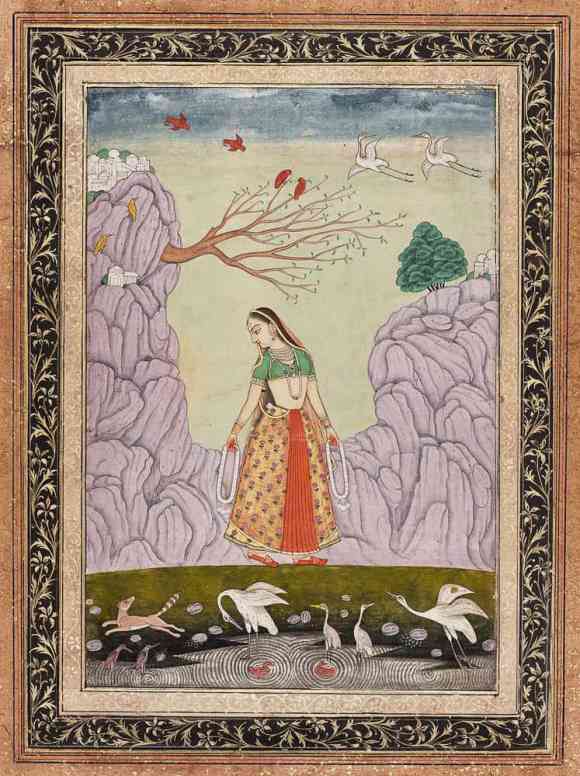
MY SWEETHEART, BE MY QUEEN

My sweetheart, be my queen!
Let me make a garland of stars for your chignon.
Dear girl, your ears I’ll adorn
With the spring moon’s third visitation.
Your throat, dear girl, I’ll deck with a pair of dangling swans.
I’ll make a ribbon too to tie your cloud-coloured disheveled hair
Out of the lightening in the spring moon’s third visitation!
A paste blended from moonlight and sandalwood
Will be your body’s balm. The red of the rainbow
Will be the lac-dye used to color your feet
The seven notes of my song will compose
Your bridal chamber’s decor
While my muse’s bulbul bird will sing a song for you—
in full-throated ease!
Born in united Bengal, long before the Partition, Kazi Nazrul Islam(1899-1976) was known as the Bidrohi Kobi, or “rebel poet”. Nazrul is now regarded as the national poet of Bangladesh though he continues a revered name in the Indian subcontinent. In addition to his prose and poetry, Nazrul wrote about 4000 songs.
Nazrul’s Ashlo Jokhon Phuler Phalgun(When Flowers Bloom Spring) has been translated from Bengali to English by Professor Fakrul Alam
From Public Domain
When flowers bloom spring, Gulbagh’s roses would rather leave.
On such a day though, why would one want to leave a friend behind?
Even before daybreak, a forlorn bulbul bird cried out in the flower garden,
Before their buds could bloom, flowers shed in the chilly breeze.
This is how it always was in old flower gardens! Men want fresh flowers,
But the cruel gardener keeps plucking away from the garden that is life!
The soil is where all golden body parts lie hidden, covered by dust,
Emperors and newly married brides too—everyone in the prime of life.
The world’s colourful blossoms may shed well before dusk descends
So sorry a sight it is to see souls leaving still young bodies to survive!
Tread thoughtfully dear wayfarer, for you’ll be treading on dead flowers
As the earth’s pathways are always strewn with dust blowing from graveyards.
It’s time for you, Hafiz, to give up all worldly desire and attractions,
Time to leave home for a spouse in a faraway world calling out to you!
Born in united Bengal, long before the Partition, Kazi Nazrul Islam(1899-1976) was known as the Bidrohi Kobi, or “rebel poet”. Nazrul is now regarded as the national poet of Bangladesh though he continues a revered name in the Indian subcontinent. In addition to his prose and poetry, Nazrul wrote about 4000 songs.
Akashe Aaj Choriye Delam Priyo (I sprinkle in the sky) by Nazrul has been translated from Bengali by Professor Fakrul Alam
From Public Domain
Dearest, I sprinkle in the sky my lyrics this day.
I’ve woven on my own a garland of songs
From the flowers produced by my words.
Pick it up if you can, please.
Let my tune’s rainbow be a transient joy,
Orchestrating my sense of loveliness,
And embodying sweetness through the passions of its colours.
What does it matter if you fail to note
The tears moistening my eyelids?
My voice quavers because of my tears!
Spreading across the lotus that is my heart,
Lyrics make the round, buzzing like a bee in flight.
Do taste my mind’s loveliness from that bee if you can!
Born in united Bengal, long before the Partition, Kazi Nazrul Islam(1899-1976) was known as the Bidrohi Kobi, or “rebel poet”. Nazrul is now regarded as the national poet of Bangladesh though he continues a revered name in the Indian subcontinent. In addition to his prose and poetry, Nazrul wrote about 4000 songs.
Nazrul’s Shoore O Baneer Mala Diye (With a Garland of Tunes and Lyrics) has been translated from Bengali by Professor Fakrul Alam.
From Public Domain
With a garland of tunes and lyrics, you caressed me.
To my body and mind, you gave buds of affection.
Why, then, didn’t you instill love in my heart?
Having played the flute, where was it that you hid?
The flower that you had helped bloom is drying
And losing something dear. My soul cries out, alas!
If you wanted something so, why didn’t you take it?
Having hugged me tight, why did you leave me?
Tell me, what upset you? Why doesn’t joy stir me now?
Where is the sweetness and delight I once felt in my soul?
I must have misunderstood you completely
For surely you had come to make my love bloom.
Dearest, why didn’t you speak out at that time?
Why, why didn’t you hurt and correct me then?
You can listen to the Bengali rendition of this song by contemporary eminent singer, Ajoy Chakraborty, by clicking on this link.
Born in united Bengal, long before the Partition, Kazi Nazrul Islam(1899-1976) was known as the Bidrohi Kobi, or “rebel poet”. Nazrul is now regarded as the national poet of Bangladesh though he continues a revered name in the Indian subcontinent. In addition to his prose and poetry, Nazrul wrote about 4000 songs.
Nazrul’s Musafir, Mochh re Aankhi Jol(O wayfarer, wipe your tears) has been translated from Bengali by Professor Fakrul Alam.
Art by Sohana Manzoor
O wayfarer! Wipe your tears,
Return only with yourself.
The flower blooming on its own
Shed all by itself.
O foolish one! So hapless is your state,
Will you now build your nest in water?
Thirsts are not quenched here
For this is no lake to allay thirsts.
Will the bokul that didn’t bloom in monsoon
Blossom when it’s winter?
On this path forever, errors shed
Covering the grove of frustration.
Oh poet! You’ve illuminated many lamps
With your own light
But your own revered Krishna hasn’t come
To light up the darkness pervading your world.
A rendition of the lyrics by Feroza Begum (1930-2014) in original Bengali
Born in united Bengal, long before the Partition, Kazi Nazrul Islam(1899-1976) was known as the Bidrohi Kobi, or “rebel poet”. Nazrul is now regarded as the national poet of Bangladesh though he continues a revered name in the Indian subcontinent. In addition to his prose and poetry, Nazrul wrote about 4000 songs.
Jani Jani Priyo, Ea Jebone (I know my dear one, in this life) by Nazrul has been translated from Bengali by Professor Fakrul Alam
Art by Sohana Manzoor
I know, know very well my dear one,
No desire of mine will ever be fulfilled
In my lifetime. Like a water-lily, I’ll shed
In a watery grave. Moon-like, from above
You’ll shed tears. Between us, my bride,
Forever will blow a wind of parting. Forever,
You’ll be heaving deep sighs.  I won’t get to hold
Or grip you close to the heart. And yet,
The moon keeps slandering the lotus. Far away
That you are, how does honey still gush from you?
Stay within my reach, dear night moon of mine,
Though so out of my grip and so untouchable!
My empty heart cries out with desert-thirst.
Everyone says I’m the one you love. And yet,
By your providing balm to that shameful act
My anguish at parting has become sweet tasting!
A rendition of Nazrul’s love song by Feroza Begum (1930-2014) in original Bengali
Born in united Bengal, long before the Partition, Kazi Nazrul Islam(1899-1976) was known as the Bidrohi Kobi, or “rebel poet”. Nazrul is now regarded as the national poet of Bangladesh though he continues a revered name in the Indian subcontinent. In addition to his prose and poetry, Nazrul wrote about 4000 songs.
Professor Fakrul Alam transcreates powerful lyrics by KaziNazrulIslam
From Public Domain
Smash the iron shackles of prisons.
Make them all disappear.
Free yourself from the shackle of worship.
Young ones—do what befits you best
Sounding horns signifying demolition,
Break through all Eastern ramparts.
Play music for the Supreme One.
Who’ll Lord over you? Dare to act kingly
Or threaten to punish you?
Who is truly free and really sovereign?
Ha, ha, ha! I feel like laughing.
Will God Himself wear a noose? Destroyer!
Who tipped the flame with such awful news?
Oh crazy, forgetful one, storm and rock prison bars.
Yank them with sudden force.
Pull, pull them with gale force.
Bear on your shoulder a kettle drum,
Beating it rhythmically, summon Death.
Let drumbeats bring it back to life!
Let’s see you shake the base of all forbidding prisons.
Kick them hard; break, break their locks.
Burn, burn all prisons and do away with them!
A rendition of the song in Bengali from Coke Studio, Bangladesh
Born in united Bengal, long before the Partition, Kazi Nazrul Islam(1899-1976) was known as the Bidrohi Kobi, or “rebel poet”. Nazrul is now regarded as the national poet of Bangladesh though he continues a revered name in the Indian subcontinent. In addition to his prose and poetry, Nazrul wrote about 4000 songs.
Nazrul’s Lyrics translated from Bengali by Professor Fakrul Alam
Born in united Bengal, long before the Partition, Kazi Nazrul Islam(1899-1976) was known as the Bidrohi Kobi, or “rebel poet”. Nazrul is now regarded as the national poet of Bangladesh though he continues a revered name in the Indian subcontinent. In addition to his prose and poetry, Nazrul wrote about 4000 songs. Pictures from Public Domain
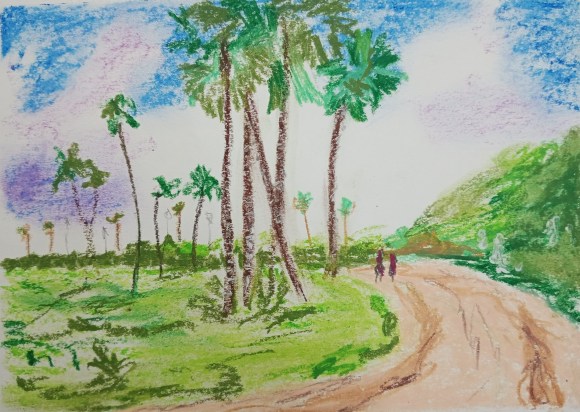
Generations after generations I’ve trod the path of hope.
Yet, O desert wayfarer, there seems to be no border in sight.
Year after year have come and gone for someone like me.
When I tried quenching my thirst even as my eyes watered
Lighting up hope’s lamp futilely, mirages crowded my vision.
Hundreds of songs seemed to sing out of desert groves
Which once upon a time must have been part of the ocean.
Desert wayfarer that I am, I see its watery expanse in dreams
And think of the ocean’s bottom, where my craft had sunk—
A craft I was in with my mate whom I keep looking for now!
A Bengali rendition of the song by Feroza Begum (1930-2014)
Professor Fakrul Alam translates two songs by Nazrul on social isssues from Bengali
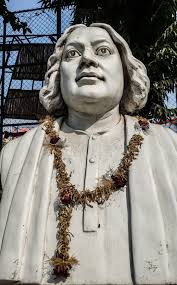
Kazi Nazrul Islam (1899-1976)
Born in united Bengal, long before the Partition, Kazi Nazrul Islam(1899-1976) was known as the Bidrohi Kobi, or “rebel poet”. Nazrul is now regarded as the national poet of Bangladesh though he continues a revered name in the Indian subcontinent. In addition to his prose and poetry, Nazrul wrote about 4000 songs.
Arise O Woman

Arise, o woman, arise flaming!
Arise, daubing your forehead blood-red,
Everywhere unfold your flaming tongue.
Dance wildly—excited, inspired.
Arise, hapless, maligned snake,
Awake, kindling the world aflame!
Burn briskly, o fume-filled smoky one,
Arise, mothers, daughters, brides, wives, nieces.
Arise prostitutes, cast out, exiled ones
With the tidal force of the Ganges, arise,
Down-trodden ones. Streaking clouds with lightning
Arise, aroused by Durga, the ever-triumphant one.
‘Arise O Woman’ performed in Bengali
Two Flowers on One Leafstalk

Hindu and Muslim -- two flowers on one leafstalk --
Muslim its jewelled eyes, Hindu its heart and soul!
In the lap of their mother, the same sky is reflected,
Where sunlight and moonlight alternately sway.
Within their bosoms the same blood courses
While the same navel string binds the twain.
We breathe the same earth mother’s air
And drink the same earth mother’s water.
In her bosom, the same fruits and flowers grow.
In the soil of the land are burial sites quite akin --
Doesn’t matter if one is called Gore -- the other Shoshan!
We call out to our mothers in the same language.
We sing for them songs strung in similar tunes!
A very wise, experienced scientist has recently decided that the day our world will be annihilated (we may call it pralay or roz-qayamat) is not really as far away as we think. Let us discuss this, keeping in mind all the discussions on the subject that have been unfolding over the last few years.
In the last half-century, it has been observed that the floating icebergs in the South Polar region are expanding continuously. Edmund Smitharth, captain of The Edmont, first sighted an iceberg 580 feet high. Subsequently, Mr Scott saw an iceberg even higher than 600 feet. But a sailor aboard The Edgenta discovered, even in the ocean, a floating iceberg higher than 1000 feet, and that left the whole world wonderstruck. It was later calculated that this iceberg was 9612 feet thick: in other words, it was more than a mile and three-quarters wide.
In the southern hemisphere, the number of gigantic iceberg-clusters has been steadily increasing. And it is for this reason that the temperatures in the South Polar regions are rising tremendously. The remote floating iceberg-clusters in the North have created extreme cold weather in South Africa and South America. Other places can’t compare with these regions when it comes to freezing temperatures. Buenos Aires has recently experienced a snowfall. The country had never witnessed a snowfall before.
What does all this mean? In the opinion of Professor Lewis and other great scientists, the second Great Flood or Great Destruction of our Earth is imminent. Even if the whole world is not destroyed, there is no doubt that at least part of it will be annihilated.
The vast, sky-high ice-cap that covers the South Pole is 1400 miles in length. There is no knowing how many hundred miles wide it might be! Now, what will be the result of this continuous, unbearable warming of the atmosphere at the South Pole? Everyone knows that ice melts when heated. Hence, on account of the extreme heating of the South Pole, those thousands and thousands of giant iceberg clusters covering immense expanses of space will break and dissolve, and a mass of waves, surging sky-high, like the Himalayas in motion, will spread in all directions, drowning everything in their wake. First of all, the low-lying parts of the world, the southern continents will be afflicted by this great deluge.
In ancient times, our ancestors were terrified of comets, for they did not know what comets are. Our forefathers of subsequent generations had acquired more knowledge on this subject, but they too were very afraid of comets and considered them inauspicious. For they believed that the head of such comets was solid, hence a chance collision when passing so close to Earth might destroy the whole world.
Now we have got to know that the comet is not a solid unit, but vaporous like the mist. Hence, if by chance the odd comet does collide with Earth, it would not smash a deep crater into any part of our planet, nor would it fling us out of Earth’s gravitational field.
But the famous French astrologer Monsieur Camilles Flammarionhas arrived at a dreadful conclusion. It is his belief that the vaporous tail of the comet is full of poisonous gases, and hence, if the comet once comes into contact with Earth, all life on our planet will be extinguished by those toxic gases, in a single instant. The beauty, flavour and fragrance of planet Earth will be wiped out forever!
The complete chemical explanation for the creation of comets is not yet within our grasp, but everyone can easily apprehend that the comet surely loads its tail with gas. This gas can easily suck the nitrogen from our Earth’s atmosphere, and if that were to happen, it would spell death for us, no matter what! It was not for nothing that our forebears disliked this thing called a comet so intensely! As the saying goes, ‘He appeared on the horizon of my destiny like a comet!’ For the fortunes of Earth, too, the comet is indeed inauspicious and harmful.
Anyway, if the comet sucks nitrogen from the air, then we will receive only oxygen. True, oxygen enhances blood circulation and physical as well as mental efficiency, but then, pure oxygen can be terribly dangerous. Hence, if we receive only volatile oxygen when we breathe, our body temperature will continue to rise, and eventually, we will burn to ashes.
In the Coal Age, the atmosphere of our Earth was heavily loaded with carbonic acid. In those times, humans could not have tolerated that air. Only fish and reptilian creatures survived in flowing waters and still air. Gradually, with the vast, extensive growth of plants, trees and vegetation, that poisonous still air began to disappear, the sky grew clear, and thus did this atmosphere become suitable for warm-blooded creatures.
At present, the human race is terribly busy mining coal and utilizing it. Do you know what age this coal belongs to? It can only be the legacy of that age many hundreds of thousands of eons ago when the atmosphere was full of carbonic acid, and of the trees and vegetation of those times, for even now, it is only the wild trees and vegetation that can absorb that carbonic acid.
Every lump of coal, every matchstick that is lit, depletes, daily, the oxygen that is vital for us. A famous English scientist has recently announced that the world’s supply of oxygen is continuously being dissipated, and therefore the air is also steadily becoming polluted. Hence the day is nigh when everything on earth will be transformed into the life forms of the age of carbonic acid.
Human beings will gradually become smaller and more fragile, until they begin to resemble Lilliputians and ultimately, they will become completely extinct! And then, it will end as it all began! In other words, just as fish and reptiles were the only life forms at the beginning, so also, in the future, the avatars of those humongous giant-fish and giant-reptiles will flourish again here, their health and vigour restored. Even the very thin, long, humble reptilian creatures of the prehistoric age, such as earthworms and snakes, will rule again over our mounds and ant-hills, in very large numbers.
If the human race gives up the harmful over-use of coal that we see today (just burning coal is wasting 1600 million tonnes of oxygen per year), and subsequently, if they manage with electricity as a substitute for coal, then we will again be forced to fall into the abyss of a new threat! In other words, whatever path you take, death is inevitable. We are caught between the devil and the deep blue sea!
The gradual transformation of the environment over time has become noticeable. Thunderbolts—especially, the incidence of thunderbolts in winter—are continually increasing. And the reason is simple: it is the clash between the electricity of the earth and that of the sky that is causing this barrage of thunderbolts! So, what is the way out? That is why, perhaps, Pannamoyi has already sung, as if to predict the future: “moribo moribo sakhi, nischoyei moribo!” (“I will die, I will die, O friend, for sure I will die!”)
Suppose, for instance, if we were to increase the current pressure on the atmospheric electricity a hundredfold or a thousandfold. Would flowers ever bloom again in basanta, the season of spring? Will new green leaves appear? Will the ardent downpour of varsha, the rainy season, ever moisten the earth’s bosom again? No, no, they wouldn’t! Instead, it is the thunderbolts that would become the regular daily occurrences on our Earth. Struck by hundreds of thunderbolts every day, the earth would be torn apart. An astute meteorological scientist says, “Yes, yes, that is what will happen, ultimately!” How horrifying! What we should do now is, to convince ourselves, collectively, that the gentleman’s words are untrue, and he has misinterpreted the situation. Look at Sujji Mama—Surya the sun, our maternal uncle—our source of life and light! He not only creates light and heat, but is also the progenitor of electric power. And he the only mama we have, who will move circumspectly, to maintain the balance of this mysterious unknown force of nature. Long live Mama!
At present, Sujji Mama’s power is so tremendously forceful, that if all his rays and brilliance were to fall solely upon this poor earth of ours, then in just a minute and a half, the giant ice-mountains I spoke of earlier would all melt down and begin to boil. And if it lasted another eleven seconds, the vast ocean stretches of this world would all dry up, the earth’s surface cracking open to reveal yawning chasms.
But even Sujji Mama is growing diffident, and shrinking day by day. We don’t know yet how much mass his giant bodyloses, little by little, each day. Professor Burns vehemently declares that this shrinking of Sujji Mama is progressing at a very rapid pace. So rapid that we can’t even hazard an approximate guess. In a very short time, observing the reduction in the sun’s heat, we will be able to understand whether it is actually shrinking or not.
Shrinking to a smaller and smaller size in this manner, when Sujji Mama gives up the ghost—in other words, when he ceases to exist— it is terrifying to even imagine what the plight of planet Earth will be. All the water will freeze and become harder than stone, but it will be a fine sight—dazzling as a diamond! This air, which we can’t see at present, will then descend in a shower of giant drops. These will again collect in the cavernous spaces, and turn into lakes clearer than glass, but waveless, indifferent, unruffled! For no breeze will blow then, after all. In the harshness of the merciless cold, the whole Earth will then become frozen, still, immobile. Only fog and a dim mistiness will remain.
The sun will gradually turn red, and remain the same hue of red all day. Just like a half-cooled, burning, molten iron mass! In the daytime itself, the whole sky will fill with even brighter stars! Let us pray to Allah the Great!
[From Selected Essays by Kazi Nazrul Islam. Translated by Radha Chakravarty. New Delhi: Penguin Random House & Nazrul Centre for Social and Cultural Studies, 2024. Published with permission from Penguin Random House India}
Born in united Bengal, long before the Partition, Kazi Nazrul Islam(1899-1976) was known as the Bidrohi Kobi, or “rebel poet”. Nazrul is now regarded as the national poet of Bangladesh though he continues a revered name in the Indian subcontinent. In addition to his prose and poetry, Nazrul wrote about 4000 songs.
Radha Chakravarty is a writer, critic, and translator. She has published 23 books, including poetry, translations of major Bengali writers, anthologies of South Asian literature, and critical writings on Tagore, translation and contemporary women’s writing. She was nominated for the Crossword Translation Award 2004 and the Pushcart Prize 2020.
.
PLEASE NOTE: ARTICLES CAN ONLY BE REPRODUCED IN OTHER SITES WITH DUE ACKNOWLEDGEMENT TO BORDERLESS JOURNAL









 Borderless