Categories
Musings

COVID-19: Days by the Arabian Sea

By Gracy Samjetsabam

COVID-19 lockdown continues. I am stationed in a small modern town, surrounded by rustic villages in coastal Karnataka. From some of the tallest buildings in the locality, you can see the mighty Arabian Sea in the horizon, far and wide like a steamy mirage. It’s dreamy!

As uncertain as the pandemic, the day kicks off with the thoughts of the “what ifs,” “What numbers?” and “What next?” Waking up to birds chirping, calm sunrise, though the sun’s the same — shining bright and ever brilliant — I wondered if today was going to be the same or any different. It was the same. It was a melodious morning with birds chirping and singing, except that I was missing the honking and bonking of the pre-office and office hours rush of children and people moving, waiting, walking, rushing, driving in or away, or embarking on their respective buses to work or school. My mind was not merry but having decided to ceremoniously spend some time in the garden before breakfast, I freshened up and invited my husband to join me. He isn’t always interested in garden stuff but agreed. In disbelief, he uttered, “COVID-19, it’s truly a Black Swan situation.”

I called home to find out their condition. Unsurprisingly, identical stories of the contagion loomed large enmeshed with gloom, grim and grimace. Feeling cynical, I asked my husband what would happen if things would get worse? Would we never go out again till some vaccine or a solution took the form of a saviour, or, if things got out of control, would we all fall sick and die — unable to get back to the old normal?

He just said, “Don’t be silly. It will be over soon. I mean, it has to …” Watering the plant leisurely, I was happy for those moments that I was able to spend tending plants, admiring the blooms and nurturing my garden. I wanted to think that this day was going to be a blessing in disguise.

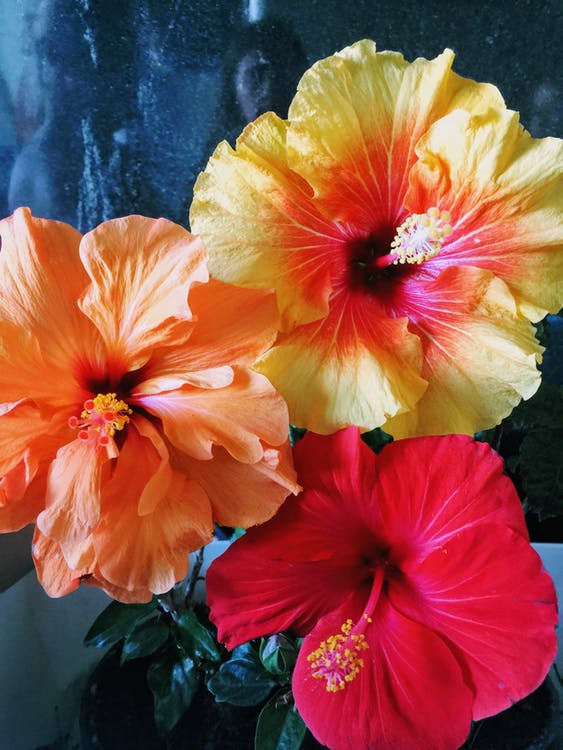
Multi-coloured Hibiscus

As I watered the plants, I was greeted by a couple of sunbirds sucking the nectar of the multi-coloured variety of hibiscus plants that grew along the fence in a row interrupted by jasmines followed by a parade of Ixora flowers mostly red, a couple of tall jackfruit trees bearing jackfruits big and small, a middle-aged cashew tree, a budding chikoo tree, curry leaf trees with its young ones sprouting around it like little children gathered around to listen to stories and, an alternate of tall coconut palm trees and lanky areca nut trees in each corner.

In one of the corners, was a family of plantains with one out of the two bigger ones that stood out gracefully, bearing tender bananas. They hung like braided hair with a flower at its tip. As I reached the corner, I could look up to the coconuts that hung so bountifully with spiky leaves that stretched out fiercely and proudly against the azure sky. For a moment I felt I was wrapped in a blue bubble.

I thought the sky is the same as the one I had seen from the rooftop of my house in Imphal on certain days when there were no clouds and the sky was exceptionally clear. But as I continued to look up almost breaking my neck, I twisted my head a little and wondered that it was the same sky yet it was different like a picture with filters. Spellbinding both though, in their own ways. 

Coucal

Spotting a greater coucal (crow pheasant) taking a quick-short flight from the cashew tree to the bushes reminded me of the Hume’s pheasant (Nong-in), the state bird of Manipur, which too loves to utilise the early hours of the day for food and fun. It reminded me of the familiar and at the same time made me curious.

Atypically, I missed rava idlis for breakfast, which I relished on certain mornings in the canteen, and so I had made plans to finally try cooking some at home. I always thought that the people of the place made it best, which surely is the case, but I thought of giving myself a chance. I looked up for the recipes and the procedures and made some with the emblematic coconut chutney. As I gave the final touches and made ginger tea, I thought of friends and family in this cosmic crisis. I could not help but feel heavy in my heart. I poured the hot aromatic tea into my favourite cups.

We were supposed to be home at this time of the year. By home, I mean my home in Manipur. A time we always look forward to, as the summer breaks are long and it has become a luxury to spend time at my home with dear and near ones. Along with the idea of longing and belonging, the idea of home too, keeps redefining with the passing time. And each time it gets defined, I get redefined too.

I remember, the first time I saw the Arabian Sea, it breathtakingly blew my mind. At the first glance, I felt like I was on the moon. The sea was calm and teeming blue. On the contrary, during the monsoons, the sea is wild, rough and voluminous. The sea, the waves, the sounds and sights of the beach slowly, becomes more familiar, the more I visit, the feeling is the less of a surprise but more of an endearing one.

Precarious as it may seem, the pandemic injected a moment of retrospection on the accustomed and the unaccustomed.

I continue to hope. I looked out into the garden from my window and smiled contentedly. I picked up my cup, sipped my tea and thought of home and of homes, at home. It captivatingly dawned on me that it was quite the same, yet not the same.

Gracy Samjetsabam teaches English Literature and Communication Skills at Manipal Institute of Technology, MAHE, Manipal. She is also a freelance writer and copyeditor. Her interest is in Indian English Writings, Comparative Literature, Gender Studies, Culture Studies, and World Literature. When not reading or writing, she loves to indulge in Nature.  

Categories
Musings

Creativity and Corona: Responses of Artistes

By Ratnottama Sengupta

Dil dhundta hai phir wohi fursat ke raat din

Baithey rahe tasavvur-e-jaana liye huye…

Garmiyon ki raat jo purvaiyaan chaley

Thandi safed chadaron pe jaagey der tak 

Taaron ko dekhtey rahe chhat par parey huey…

My words for Gulzar’s lyrics taking off from a Ghalib couplet?

Once more, my heart seeks 

Those days and nights of leisure, 

To simply lose them

In thoughts of the beloved!

Or, the balmy summer night 

When the Easterly breezes in,

To stay up till it’s dawn 

Only gazing at the stars…

Lying on cool white sheets 

Spread out on the roof…

Gulzar Sa’ab, how many more stanzas would you add to these lines, now that we have endless fursat ke raat din (days and nights of leisure)? 

A lot of people are seeking — no, not days and nights of leisure but ways to harness the close-door hours that are stretching on and on, yet leading to heated debates the world over whether to end or to extend the lockdown for some more days/weeks/months…

Meanwhile, the students and teachers of FTII — Film and Television Institute of India — have been making short films exhorting us to stay at home. Bollywood stars led by Amitabh Bachchan and including all others, have made a comedic short wherein they’re all searching for Big B’s misplaced chashma or glasses — from the confines of their individual homes.

Celebrated actor-director Aparna Sen has used the distancing hours to translate and audio recite evergreen poems of Tagore and Jibanananda. Members of the Contemporary Dance group Sapphire have been recording their creations conceived and executed in artistic isolation. Nandita Roy and Shiboprasad of Windows have come up with a series beginning with Hing or Asafoetida, a short about how being locked at home is providing new insights into the role of homemakers. Director Debesh Chatterjee has used Nabarun Bhattacharya’s concept of Fyataru – flying humans – to cinematically comment on the plight of people stockpiling food. 

With Tobu Maney Rekho (But Remember),  actor-anchor Aparajita Ghosh has initiated Galpo Toru, an audio series recording stories by contemporary authors from Bengal and Bangladesh. My dancer-actor niece Priyamvada Kant, living in Mumbai away from her Delhi-based parents, has made a short that asserts social distancing does not mean Dil Se Door (Far from the Heart). Documentarist Arindam Saha Sardar has crafted Ghaire Baire (Home and Outdoor), and Manush O Maanchitra (Contours of Human Subsistence), both involving his seven-year-daughter, Rupkatha. But what I’ve been most taken up with is You Can Fly by Kumaar Chowdhury wherein a little boy climbs up to the  roof or chhat and lets loose his imagination… 

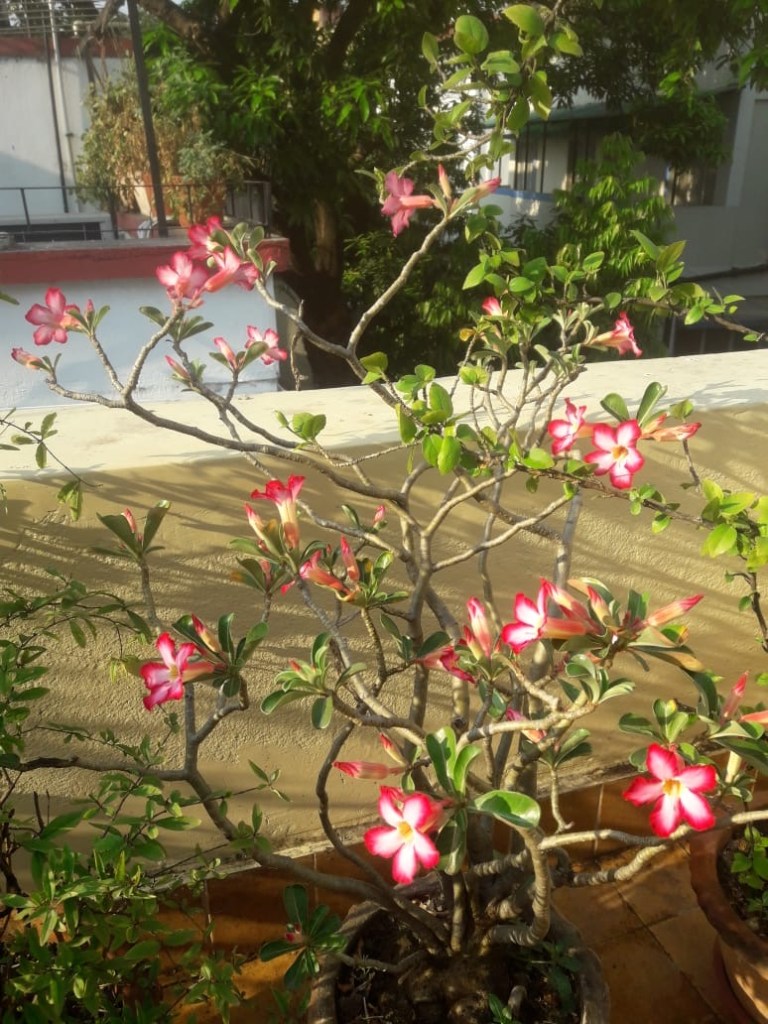
Because? It comes closest to my experience of rediscovering the chhat — the key word of Gulzar’s lyric from the feature film, Mausam. Every flagstone of the open terrace on my house in Kolkata is shining like marble. Not one dry leaf in sight, and not just crows but doves and sparrows, bulbuls and mynahs are flocking to drink  from the earthen gamlas (basinets) I fill up for them. Ever since Biplab and Biru — the brothers who water my obsession with plants — bowed down to the lockdown, I have been going up to the terrace sharp at 6 pm, armed with a khurpi (hand trowel) and pruning shears. The hundred-and-more plants have never been so happy. The buds are blossoming into lilies and roses, adenium and petunia, genda and mogra, jaba and sthal padma, birds of paradise and orchids too!

This has prompted my husband to spend an hour in the morning and three every evening on the rooftop. The morning walk up the stairs mitigates his lack of exercise, and he paces the terrace too — a necessary part of the recovery process prescribed by doctors for his recent illness. And in the evenings he lies on a cot looking up at the stars and listening to music and jokes and stories on his handset. 

But bear with me: this piece is not about us. I have been amazed to see how many people have brought their so-far neglected rooftops back to life. Biswanath, CA by profession, finishes his brisk 30-minute walk on the house to our left. And on my right Bubai, my son’s childhood mate — in forced separation from his wife and baby girl stranded in Pune — is watering the plants for his mother. Across the street, Kailash has been putting to good use the cycle his ailing Mama is unable to exercise. As the boys are back from their campuses, the Bagadias next door have added clotheslines to sun-dry the joint family’s washing. One house away, I spot Aalo’s Dada assiduously keeping his mask in place when he alternates with his wife on the rooftop walks! From the adjacent terrace Ramola Di waves back a “Howdy?” in reply to my “Kemon achho (How are you) ?”

Diagonally across, on the rooftop of a multi-storied structure, I see three heads — one salt-n-pepper, one bald, one raven black — bobbing up and down.

“Are they playing badminton?” I wonder to myself. For, the terrace of the stand-alone next to theirs has been converted into a maidan by a lone child who’s scoring run after run with his football!

This brat, away from school, is not wanted downstairs where his mother is juggling with the mopping-chopping-cooking-serving-washing-cleaning as her kaajer mashi (home help) cannot relieve her from the drudgery of chores, while his father gravely sits before his laptop to comply with the ‘work from home’ ruling of his bosses. This child is not allowed to play with the neighbourhood kids, nor is he permitted to fiddle with his parents’ mobile phones. Lonely? He is. Forlorn? He is not. For he has his football, his terrace, and the liberty to let his imagination fly!

It is this liberty to fly, riding on imagination, that has fuelled the aforementioned Creativity in the countdown times of Corona. For, as Vilayat Khan once said to me, “If I don’t play my sitar for 2-3 days, saaz bhi kitne nakhre kartey hain ( even the chords will play up)! I have to put so much effort to appease them before I can tune them.”

A true artist can, then, never sit idle.

Remember Bengali litterateur Manik Bandopadhyay’s Madan Tanti? When the weaver of classy Balucharis grew tired of idling the days of bandh (strike), he sat on his loom all night, weaving the warp and weft — without a single strand of thread!

Ratnottama Sengupta turned director with And They Made Classics, on the unique bonding between screen writer Nabendu Ghosh and director Bimal Roy. A very senior journalist, she has been writing for newspapers and journals, participating in discussions on the electronic media; teaching mass communication students, writing books on cinema and art, programming film festivals and curating art exhibitions. She has written on Hindi films for the Encyclopaedia Britannica; been a member of CBFC, served on the National Film Awards jury and has herself won a National Award. The former Arts Editor of The Times of India is also a member of the NFDC’s script committee. Author of Krishna’s Cosmos and several other volumes, she has recently edited That Bird Called Happiness (2018/ Speaking Tiger), Me And I (2017/ Hachette India), Kadam Kadam (2016/ Bhashalipi), Chuninda Kahaniyaan: Nabendu Ghosh (2009/ Roshnai Prakashan).

Categories
Musings

Observer at Home

By Devraj Singh Kalsi

During the lockdown phase, I started taking interest in what did not interest me earlier. As a writer fond of observing people and the world outside, my operating space was restricted now. Everything inside the house began to draw my attention. The small, minor issues and objects assumed greater importance than they actually deserved. My appetite for keen observation was evident every hour of the day.  

I had no memory that the ceramic mug I drank coffee from every morning was chipped. Quite like the small scratches you do not notice when they first appear. I held it close to my eyes to check whether it was fresh. Unable to reach a definite conclusion, I shared my observation with my partner to see how she reacted. My words did not elicit her glance in my direction so I placed the coffee mug on the table without making the slightest noise.  

After a long-drawn silence in which I had forgotten my query, she confirmed the coffee mug was chipped due to an accidental brush against the gushing steel tap in the sink almost month ago. Since it was emblazoned with her favourite motivational quote, she decided not to discard it. Maybe the coffee mug supplied her with the daily dose of positivity when I sat in front of her, holding it in my hand. A visual meditation with open eyes.  

It was amazing to discover the curtains of the windows in my study had two colours. Unwilling to blindly trust my vision, I walked to the window, held the fabric and double-checked it. What I had considered beige had a tinge of pink as well. I resisted for a while the urge to ask my partner to spell out the colours. I framed it a bit differently soon: Is the curtain in my study room baby pink?

Her reply was prompt this time: The curtain has been washed so many times that from fuschia pink it was now turned into pale baby pink. The presence of subtle elements in everything surrounding a writer is always elevating. Subtleties make art richer. And writers always look for possible signs of it. After this observation, I was filled with the joy of imagining a reader who finds a new shade of meaning in my stories years later. Maybe someone who reads my works with great passion is the one who locates fresh sensibilities in my writing.

On the top of my bookshelf, there had been a miniature terracotta elephant and a horse. I do not exactly remember when I last saw them there. But I remember seeing them whenever I looked that side. I found them missing for the first time in three years since they were purchased from the local arts fair and placed right on top. I needed an update regarding their present location. Had they been shifted elsewhere recently? I asked my partner about the elephant first. 

Thank God, you noticed that.  When they came, they were small. Now they have grown up. How can they fit in there?  

I was not getting what she was trying to imply through her sarcasm. Finding a blank expression on my sullen face, she said she had moved them to the terrace last year. For one year I had not noticed this change of location. It showed how unfamiliar I was with the house I was living in.

I know the rooms of my characters very well. Every nook and corner is vivid in my mind. When the world of fiction becomes so real, the real world the writer lives in tends to grow distant. Something of this kind had happened in my case.

While shaving during the afternoon, I noticed the mirror was not square anymore. The mystery of how it had become rectangle deepened. Various implausible plot angles took shape in my fecund mind. Laying them at rest because thrillers are not my genre, I rushed to seek clarity regarding my visual disturbance from my spouse who was ironing clothes.

Holding the hot iron in one hand like a shield, she looked vexed with arched eyebrows. She dismissed my repeated attempts at observing more inside the house and clarified that the square mirror fell off the wall last winter. Maybe the lizards engaged in combat had toppled it to gain more space. 

I realised this tendency would continue in this manner for weeks. Many striking differences would come to my attention and it was useless to irritate others with my queries. Instead of trying to update myself with the changes I was observing quite late now, I should ignore them all and give more rest to my frenzied brain during the lockdown phase.    

Devraj Singh Kalsi works as a senior copywriter in Kolkata. His short stories and essays have been published in Deccan Herald, Tehelka, Kitaab, Earthen Lamp Journal, Assam Tribune, and The Statesman. Pal Motors is his first novel.  


Categories
Musings

And then the tranquility got shattered

By Shevlin Sebastian 

At 11 p.m., on a Saturday a few weeks ago, I was cruising down National Highway No 47 in Kochi. Elton John’s ‘Circle of Life’ was playing on the music system. 

The mood inside the car was tranquil. My daughter, Sneha, had just landed from Bangalore. My wife, teenage son and I had gone to collect her from the airport. She has just started studying in a college in Bangalore. Dressed in jeans and a cream top, blue sneakers, without socks, she smiled happily as she entered the car. 

The conversation began. Sneha spoke about the quality of the food in her hostel, her roommates, lecturers, classmates, and the latest movie she had seen. My son, two years younger, sitting next to her on the back seat, listened silently. 

The highway was relatively deserted: a few trucks and some cars. Kochi sleeps early: the metro service, besides the pillars of which we were travelling, had closed. And so were the private bus services. An occasional long-distance Kerala State Road Transport Corporation bus trundled past, with its distinctive red and yellow colours. 

I was driving at 50 kms per hour as we were in no hurry and I was listening to what my daughter was saying rather than concentrating on the road. 

Children grow up so fast. It seemed only the other day that I held Sneha in my arms. And now she was all grown up. When she was in Class 12, I remembered the large birthday card, almost the size of an A 3 size chart, that some of her classmates had made in which they drew and wrote greetings, using red, green, blue and purple felt pens. However, one comment from a boy made me stop breathing for a few moments. “You have a nice ass,” he wrote. It took me some time to digest that. And accept. My daughter was a sexual being to her male contemporaries. 

In the car, Sneha suddenly asked, “Baba, do you mind if I put my music on?”  

“Sure,” I said. And she leaned forward and pressed a cable wire into the socket of the music system and her mobile. Soon, her songs started to play. The first one was Selena Gomez’s haunting ‘Lose you to love me’. 

Incredibly, I had heard it the day before. I read an article about the song and decided to hear it on YouTube. In her song, Selena was indirectly commenting on her failed romance with pop superstar Justin Bieber. Sneha was shocked and impressed when I told her all this. 

Baba, you are in touch,” she said, with a smile. 

“Just a fluke,” I said, modestly.   

She hummed the first few lines: 

‘You promised the world and I fell for it

I put you first and you adored it

Set fires to my forest

And you let it burn’

All of a sudden, a red Maruti Suzuki car swerved in from an outer lane and cut in front of me. I instinctively half-pressed the brake and dropped my speed to 40 kms an hour. The other car moved ahead. I was wondering why the driver had the need to cut in. There were three lanes on our side. He could have easily gone straight ahead. 

I thought: “Is the driver drunk, high on drugs or has he slept off for an instant?” 

 I could see a few heads in the car.  

Inexplicably, a few moments later, it swerved violently to the right and hit a pillar of the Kochi Metro at high speed. The thud sounded like a thunderbolt. All of us looked through the windscreen with bulging eyes and open mouths. I braked as a black piece, probably a part of the bumper, ricocheted away and came to a stop just in front. I quickly moved the vehicle to the left, without looking at the rear-view mirror. Thankfully, there was no vehicle behind us. I parked on one side.  

 Inside the stricken car, there was no movement for several moments.  

Sneha suggested that I call the police. I pulled out my mobile and did so. By the time I passed all the relevant information to the helpline, including the number of the metro pillar where the accident took place, a crowd had gathered. When I reached the damaged car I saw that the two white airbags in front had burst open. That probably explained why the driver, a thin man with curly black hair, had escaped with just a cut on his upper lip. A thin line of blood could be seen. He looked about 22, and stood to one side, with blank eyes, as if he could not see. 

Somebody said, “Did you sleep off suddenly?” He quickly shook his head and said, “No, I lost control.” Somebody asked whether it was a brake failure. He shook his head. Was he drinking? The reply was a tightening of his jaws.   

A woman, who was in the back seat, was pulled out gently by a few bystanders, with her husband cradling her head. She was laid down on the road — a middle-aged lady in a green salwar kameez. From the look on her face — the eyeballs almost vanishing as the lids closed — she was rapidly losing consciousness. There were two children, a boy and a girl, both below ten years of age. They stood nearby staring at their mother. 

Soon, a white car which was going past was stopped by several people, with raised arms and shouts. Again the woman was carried to the back seat, men holding her arms and legs, and somebody placed his palms under her back to balance her. The husband put his children on both his knees, as he sat in the front seat, next to the driver. They headed to the nearest hospital. 

Meanwhile, drivers, who were going past, slowed down, slid their window panes down, and stared with frozen eyes at the shattered engine. Where the bonnet had been smooth, now it was all crumpled metal. Ten minutes later, the police arrived. 

Some passers-by expressed the hope the woman would be okay.  

A couple of days later I called the Kalamassery police station under whose jurisdiction the accident had taken place. A policeman said that the woman had been declared brain-dead on her arrival at the hospital. The doctors put her on the ventilator. They informed the husband. He spoke to his family members. They agreed there was no point. Two days after the accident, the ventilator was switched off. And she passed away. She was only 37 years old and worked in the administration section of a government hospital in Kochi itself. It seemed she hit her forehead on the back of the front seat with great force, and this proved to be fatal.   

From the time the driver lost control to hitting the pillar was all of two seconds. That was the minuscule time taken for a tragedy to take place. 

So, why did this event take place? Why did God take the mother away from the children at such a crucial stage in their lives? What will be the psychological blow on them? Who can replace their irreplaceable mother? Nobody, I guess. How will the husband handle the situation of being both father and mother? As strangers, we will never know the answers.   

Meanwhile, when we set out again, there was a tomb-like silence in the car. Everybody stared straight ahead, lost in their thoughts. My wife told me later that Sneha had been deeply affected, especially when she came to know that the woman had died. 

So, how does one respond when a fortnight later Sneha was involved in a two-wheeler accident in Bangalore? She was travelling behind a classmate on a scooter on a Sunday morning. They took a right turn, a car came speeding up, hit them and sped away. My daughter was flung onto the pavement. She had scratches on her face, arms, elbows and knees. 

Sneha called us from the hospital. My wife shed tears but she quickly regained control. We decided to leave immediately. At that time, there were no flights. The runway at Kochi airport was being re-carpeted. So, the flights were only in the early mornings or at night. 

We took a train to Salem and then a bus. By the time we reached it was 11 p.m. Thankfully, a relative’s wife, a homoeopathic doctor, had handled matters. She went to the hospital, got my daughter discharged and took her to a better hospital. An X-ray revealed a crack in her pelvic bone. The healing had to be natural. A two-month rest was advised by the doctor. So, we brought her back to Kochi. Sadly, she missed many classes. 

I did wonder how much of seeing the first accident played a role in my daughter getting involved in an accident of her own? Who knows how the mind works? The subconscious is a mystery. 

In retrospect, I wished that we had not seen the accident. 

When asked what he feared the most as Prime Minister, the late Harold Macmillan said, “Events, dear boy, events.” 

Indeed, this seems to be right.   

The repercussions of an event can lead one to sunlight or darkness. 

Shevlin Sebastian is a journalist based in Kochi. He has published around 4500 articles over 30 years, most of them feature stories. He has worked in Sportsworld magazine, (ABP Group), The Week magazine (of the Malayala Manorama Group), the Hindustan Times in Mumbai and the New Indian Express in Kochi and in DC Books, Kottayam. 

Categories
Musings

When your Child Becomes a Vegan

By Meredith Stephens

“Stop cooking meat! I can smell it all the way up here,” my younger daughter Annika upbraided me from her upstairs bedroom.

I had made a rare purchase of mincemeat as part of a packet of ingredients to be assembled for the evening meal. Choices were so limited when you had a vegan in the family. I had almost given up buying meat and chicken, but persisted in buying eggs, fish and dairy. Eventually I found words to describe myself which I could use to feel virtuous, such as a ‘pescatarian’ – a fish eating vegetarian, and ‘flexitarian’ – a vegetarian when it was convenient. Annika didn’t mind if I made vegetarian dishes, but wouldn’t partake unless they were vegan.

“It’s okay for you to be vegan,” I retorted. “But you don’t have to impose your values on the rest of us. You don’t always conform to my values either.”                                                                                                                                                        

“Like what?” she asked.

“I’m not getting into that now. It’s okay for you not to eat meat but you can’t force the rest of us to give it up too,” I repeated.

I descended the stairs to the kitchen and took in the unusual smell of cooking meat, which has been absent from our kitchen for a couple of years. Then I bravely assembled the meal, spreading out the wrap, adding the mince mixture and topping it off with some tzatziki (a Greek yogurt sauce. I folded the wrap and sat down to eat it with my trusted Labrador Tia in front of me. Tia fixed her eyes on me unwaveringly and pricked up her ears. It was my habit to share all my meals and snacks with her.

When we had bought her at the Royal Society for the Protection of Animals (RSPCA) I had asked the vet whether it was okay to give her human food. He asked whether I meant sharing my toast with her in the morning. When I nodded he affirmed, “Of course!” From that moment I considered myself to have official approval to share any healthy food with Tia. If I were eating an apple, I would bite off one bit for her and one for me. When I was making a salad, I would hygienically feed her lettuce leaves, tomato tops, or slices of cucumber. (I do confess to feeding her occasional crumbs from my chocolate cake when no-one was looking.) The day that Annika scolded me for cooking meat, Tia was even more excited than usual. She was anticipating that I would share the mincemeat with her. I started to ingest the meat, but the smell put me off, so I passed most of it off to Tia. Needless to say, she was delighted. However, she didn’t savour it, but rather gulped it down quickly without leaving time to enjoy it.

Annika had always shown a sensitivity to the feelings of animals, even rodents. When we first moved into our house we would sometimes see a sudden movement as a mouse darted between the sofa and the fireplace. It was embarrassing to have a well-to-do guest suddenly ask you, “Was that a mouse?”

I wasn’t sure how to get rid of mice without killing them, and tried sonic deterrents which you could plug into an electric socket. Once Annika spotted a mouse in the house. She thought it was a native mouse, a marsupial, because its forelegs were shorter than its hind legs. She could even see the mouse’s heart beating through its chest as it trembled. Then she felt sorry for it and left it alone. After that I asked my husband to deal with the mice, and didn’t ask any more questions. The mice disappeared.

Until Annika became a vegan I had disassociated meat from animals. The packets of neatly wrapped meat in the supermarkets had nothing to do with the animals that you passed on farms in drives through the country. One day Annika drew a connection between Tia and meat, asking if I would eat Tia. From then on I could associate meat with living animals. The meat shelves in the supermarket became distasteful and I had to look the other way as I passed.

A friend has a business selling kangaroo meat overseas. She made a post on social media explaining why kangaroo meat is better than meat from farms; kangaroos are game, and they are not killed in the abbatoirs. I hesitated over the ‘like’ button as I read this. I was convinced by her argument but reluctant to agree with the notion of killing Australia’s national symbol, featured in our Coat of Arms and decorating the tail of the national carrier.

A kangaroo in the countryside

I work overseas and return to Australia every holiday. My pleasure in Australia’s fauna and flora is enhanced because of my long absences. When I return I am delighted to spot kangaroos in the countryside, possums in tree hollows, and koalas sleeping in trees in the neighbourhood.

Possum

A koala on a tree

Every morning is a visual and auditory feast. I spot rainbow lorikeets on the balcony, and cockatoos feeding on neighbouring lawns.

Cockatoos on the neighbour’s lawn

I listen to families of kookaburras cackling, and magpies serenading me. I am enjoying the fauna more than ever, and I can understand Annika’s feelings for them.

Not only that, times of global turmoil when movement is restricted are ideal for slowing down and appreciating nature. As Alain de Botton says on his homepage, “You normally have to be bashed about a bit by life to see the point of daffodils, sunsets and uneventful nice days.” In these tumultuous and uncertain times there is an exquisite pleasure to be had in communing with animals and birds. Now I can find the time to still myself for long enough to enjoy watching the sulphur-crested cockatoos squawking as they land on the lawn to peck for their dinner.

Nevertheless, my dietary resolutions are more due to the impact of the younger generation than the enhanced appreciation of wildlife afforded by the time for reflection in the lockdown. I will probably remain a pescatarian, or even a flexitarian. I won’t become a vegan and I will respect the choices of my friends and family to eat whatever they want. However, I do understand the younger generation’s commitment to veganism, and am prepared to admit that older is not necessarily wiser.

Meredith Stephens is an applied linguist in Japan. Her work has appeared in Transnational Literature, The Blue Nib, The Font – A Literary Journal for Language Teachers, The Journal of Literature in Language Teaching, The Writers’ and Readers’ MagazineReading in a Foreign Languageand in chapters in anthologies entitled What’s Cooking Mom? Narratives about Food and Family, The Migrant Maternal: “Birthing” New Lives Abroad, and Twenty-First Century Friendshipall published by Demeter Press, Canada.

Categories
Musings

If All I Have is Now

By Aysha Baqir from Singapore

Tsunamis of viral microscopic particles surge across continents to flood our cities, streets, and bodies. I stock up on masks, sanitizers, all that is anti-viral and anti-bacterial and watch my ‘home-store’ burgeon with a manic fascination ready to protest that I am not hoarding.

 Day or night, I check the news and numbers before I sleep, when I wake up, and every hour in between with a strange obsession until the whirlpool of theories statistics pulls me down. I strike out. Fear. Anger. Grief. Shame. What should I feel and when?  I clutch onto my planner and my to-do lists like a lifeboat only to see the ink fade and paper dissolve.

I click online to grasp a burst of pictures. I devour the jokes, memes, foods, and brain teasers for a few warm minutes until a cold post floats to the surface about someone who’s lost a friend, a friend of a friend, a good person, someone’s brother, sister, father, mother, aunt, or uncle. I mourn the loss. I knew them. The news doesn’t end. The news reports the youngest, the eldest, the first, the last, from my college community, or another group.  Too many are leaving, and leaving too soon.

Being a seventy’s child, I look to the ‘old heroes’ in the West for leadership. Someone will step up and lead the way. Someone will find a free cure. Someone will save the world.  Instead, I see the nations embroiled and torn in confusion, chaos and conflict as the numbers spike. My hope dissipates watching blame games, self-glorification, and trade wars. It’s a twenty-four hour non-stop live soap opera on the world stage. The headlines flash a new twist and slant until it’s hard to decode what’s true or not. I can’t help but grudge the movie directors for implanting a fallacy.  There are no supermen or superwomen left there, or perhaps I am not looking in the right direction.

I meditate. I focus on the rhythm and the sound of my breath. I move with my breath as I inhale and exhale. A ping. My phone flashes, my heart lurches, and my attentions wavers. Lying on my yoga mat, I breathe long and deep while hundreds of thousands of young and old fight for each breath in crowded hospitals or might not even make it there and die at home or on the way. Should I look inward or outward, here, there or where? What should I pray for, who should I pray for, and in what order? 

I step out for a walk and my husband turns back with a smile to hum one of his Steely Dan favourites. I snap, “Don’t do that.” He stares. I have no answers. I step out in fear, yet out of choice.  Thousands don’t have a choice but to step out to earn a living. Thousands more are carried out in body bags to be buried into mass graves.

At home, I crib about missing my weekly trip to the grocery store. It is impossible to order online. I cannot see, feel or smell the fruits and vegetables. I moan when the plain yogurt runs ‘out of stock’, when the page stalls and crashes, when the message pops out that there are no more delivery slots, and when three of the thirty five items I have ordered are dumped out of my cart because they are not available. How do I forget that million will go hungry tonight?

I call family back home. The connection breaks. I call them again, and the connection breaks again. I sit down. A hot darkness swirls around me. I sink into a sense of loss. What’s happened? What’s wrong? No flights. No connection. No control. What will I do if I can’t reach them? The phone rings and I am able to breathe again.

I know then that if I lose control, I lose this battle.

Every day across the world, hundreds of thousands of government staff and healthcare and essential industry workers leave their loved ones to fight an amorphous and dangerous enemy. Can I do the same while staying home? They are at the front line. I must stand right behind them. It’s not their battle alone. It’s my fight too.  

I cannot return to the past. I long to though, I admit.  Yes, I can try to imagine a future, a better and different future, but I cannot control it. I straddle an uncertain present between the past and the future knowing I cannot go back and I have little jurisdiction over the future. But, in hedging between the past and the future, do I forget about the power of now, the power that I possess to change, to create change, to sustain change this very instant for myself, my family and for others around the world?

It’s not easy to open myself to the power of now. There are distractions, blockages energies that I have to move past or simply ignore. I push my own needs aside. It’s not about me. It’s about others. I stumble, fall, and then rise up again. When I focus on gratitude and goodness and all that is positive around the world, there is a shift, a change and opportunities glow around me. In wonder and silence, I appreciate and applaud the change-makers around the world. The virus is now part of my eco-system. It will recede but can rise again, mutate and swell again. Why do I wait and for what? If I live now, then I must live in this moment, to act in this moment and change in this moment.

I salute all the healthcare workers and the essential services providers for saving lives. I salute the charities and not profit organizations for helping the homeless, the needy, and the hungry. I salute the trainers, the teachers, the chefs, the artists, the writers, the poets, the drivers, entertainers, and comedians who keep young and old engaged and entertained at this time. I salute my husband who gives me hope. I salute the young Singaporean graduate of NUS school of Medicine who has built a website that makes translations easily accessible to all the medical care teams. And again, I salute the thousand of healthcare and essential industry workers who are in battle now.

I pick up the phone to call my loved ones. I click my phone to help charities and the communities of migrants that need food or medical supplies. I donate to the homeless, the hungry, the needy or just reach out or mail a note to someone who has made me smile. I share information that can help others. I reach out wanting to create change this very instant and now. If I open myself to the power of now and the power of this moment, then I open myself to immeasurable and sustainable change and part of the future I imagine.  

Aysha Baqir grew up in Pakistan. Her time in college sparked a passion for economic development. In 1998 she founded a pioneering not for profit economic development organization, Kaarvan Crafts Foundation, with a mission to alleviate poverty by providing business and marketing training to girls and women in low-income communities. Her novel Beyond the Fields was published in January 2019 and she was invited to launch her book at the Lahore and Karachi Literary Festivals and was featured in the Singapore Writers Festival and Money FM Career 360 in Singapore. Her interviews have appeared in Ex-pat Living, Mount Holyoke Alumnae Quarterly, Kitaab, and The Tempest.  She is an Ashoka Fellow. www.ayshabaqir.com

Categories
Musings

Kolkata Diaries: Lockdown


By Ketaki Datta

Lockdown! Stay at home!

I know not how long this period of incarceration will continue! More than a couple of weeks have already sped by!

But believe me, days are not appearing long, neither the nights.

The self, I was groping for in the closet of my being, peeped out and hollered to me, “So finally we meet!”

I cheer up, eyeing a happy prospect of getting a friend, though supernatural, ‘otherworldly’ , or non-existent to the ordinary mortals like me! But I get a friend here, in this apartment, where stay I and the Self!

 Last evening, just after I slurped the last drop of soup from my tureen, I saw her sitting in front of me, asking me, “So are you happy?”

 She is my lookalike. I feel uneasy, sometimes, to talk to myself. But, when I see her crooning old, long-forgotten numbers to me, when I find her analyzing my past deeds with a serious face, I simply sit back, relaxed, thinking that I am in good hands.

Last evening, my next-door neighbour, rang me up to inquire about my whereabouts and said, “I find you in good mood these days. Yesterday, in the afternoon, while I was having my siesta, I heard you talking loudly to someone. But in these lockdown days, who has dropped in at your residence? Please ask him/her to leave at the earliest. You may fall ill. It may even turn fatal.”

I told her, “I was taking classes, online.”

“I see, then it’s fine.”

I am not just working from home, but I also love to indulge in exploration of the self and the world around me. I did not know that the afternoon sky has so many shades, apart from azure. I was not aware of the morning breeze that has a fragrance latent in its being. I had no idea that the cuckoo that coos beneath my balcony has a companion who answers its call from the coconut tree, standing tall in my neighbour’s courtyard. I was blissfully ignorant of so many things, how could it be so? Why was it so?

A few weeks of the lockdown are over by now. I keep wondering how a virus goes raging across the length and breadth of the world, claiming lives, taking pride in a large toll, escalating with each passing day. Just a microbial being and all experiments in all world-class laboratories are failing to discover a vaccine, let alone an antidote! All sorts of primitive measures are being followed: Wash hands again and again, as though an indelible mark of wrong-doing gets stuck in between palms of each inhabitant of this planet, which “ all the perfumes of Arabia” cannot sweeten, not to speak of washing it off!

Why are we being fooled by a virus, which if contracted, or smitten with, will land us straight before the gate of Paradise, nay Hades? Or if spared, may leave us crippled with a pair of weak lungs? I cannot think any further.

At one point of time, I kept toying with the idea of going out. Yes, I am running out of provisions. I have curtailed many a thing, putting embargo (self-imposed) on luxuries; for example, I am not casting a glance even at the chocolate bar, the last of its kind, lying at one corner of my fridge, trying to lure me with its tantalising taste whenever I fling open the refrigerator-door! I am now going to curb all of my cravings, it seems.

My mom used to say, “You can attain nirvana by saying ‘no’ to all sorts of temptations but winning the allurement of chocolates would be the Achilles heel, for which your nirvana might have to wait or be deferred to an unknown date in future. You may even cease to exist without tasting the nectar of nirvana!”  Nirvana or no nirvana, I was happy with my irresistible love for chocolates! But these days, I am trying to say ‘no’ even to chocolates! If by any chance, I nibbled at the last bar, what would happen if I felt a craving at midnight with no chocolates around? So, I have to save it for some unforeseen desire for it!

  When through my balcony I cast a glance overhead at the purplish-black sky, I can see a few stars, a few dim celestial bodies but I cannot tell one apart from the other. I try to trace the Milky Way, but a zigzag row of stars pop-up, which might or might not be the one. Standing there, for quite some time, I was trying to empathise with the people from all walks of life, who are terribly affected by this lockdown, a 21-day-period of total collapse of social life, gregarious existence of the populace, beyond home, even normal buying-and-selling in the shops.

The picture at a medicine shop may be different, chock-a-block with people, who are queuing up mostly to buy Vitamin B or C strips or even expectorants or common medicines for cough and cold or diarrhea. I went out only one day after a gap of about fifteen days to buy essentials, mainly eggs and biscuits. That too, at about seven in the morning. I was astounded to see the busy thoroughfare, which generally teems with life at cockcrow was desolate. Absolutely secluded. The old man who used to sit and beg outside the metro station was not there anymore. I was worried as I used to buy him medicines for his heart condition.

I found the dog, who is generally sprightly and feisty, sitting dejected, in front of the closed shutters of a shop. I was happy to see the birds chirping on the trees. They trilled, crooned, twittered, whistled as they pleased. They were probably so delighted to find a sky — clear, above their head, with not a speck of smog in it. The greenery outside got a shade extra, it seemed.

The air outside also seemed fresh. The roads were just devoid of the shouts and screams of the jostling crowd, there was no sign of any sick hurry of the regular commuters to distant places. It appeared as though, life needed a respite, the thoroughfares needed a break from daily schedule, a nagging routine. The small lane that leads up to the main road usually stay crammed with vehicles since 6.30 a.m., but the serene road seemed to enjoy a breather with no vehicles honking or waiting in a long queue. The traffic light changed colours as usual, but there was no hurry, no avid wait of people for the ‘red’ changing to ‘green’.

  The sweet shop was about to open its doors. As I looked at it like a sleuth with my surgical mask on, the man drew a cloth mask from the counter and kept tying it round his nose and mouth. All of us, who came out risking our safety, were behind masks, as though to conceal our identities. A terrible something was about to transpire, it seemed. Only Nature and its feathered creatures seemed to have a field day. I could not sing within, I caught myself unawares, praying for the corona-affected patients who fought for life on the hospital bed, “Oh Lord, give them life! Let all the people come out unscathed and come around soon. Let others who are yet not affected by the viral attack enjoy health and secured existence. Amen.”

I was coming back that day with a vow to stay indoors from then on, and not to come out at all, howsoever necessity it would be. I haven’t reneged on my resolution as yet.

Ketaki Datta is an Associate Professor of English at Bidhannagar Government College, Kolkata, India. She did her Ph.D. on Tennessee Williams’s late plays and later it was published, titled, “ Black and Non-Black Shades of Tennessee Williams”. She has quite a few academic publications along with two novels, two books of poems and quite a few translations. She had been interviewed by Prof. Elisabetta Marino, University of Rome, archived by Flinders University, Australia. She won grants for working at American Studies Research Centre[1993,1995], Hyderabad, India. She presented academic papers at IFTR Conference[Lisbon], University of Oxford and University of California, Santa Barbara. Her debut collection of poems, Across the Blue Horizon, had been published from U.K. with the aid of Arts Council, England. Her latest poetry-book, Urban Reflections: A Dialogue Between Photography and Poetry has been published by KIPU, University of Bielefeld, Germany, with Professor/Photographer Wilfried Raussert [photographs of Street Art of Americas]. She has interviewed American novelist, Prof. Sybil Baker, recently for Compulsive Reader. She is a regular reviewer of poetry volumes with Compulsive Reader, USA. She interviewed poet Lucha Corpi of San Francisco, in 2018. She is the Regional Editor, India, of thetheatertimes.com, headed by Prof. Magda Romanska, Emerson College, Boston, U.S.A.

Categories
Musings

COVID claims jobs

By Devraj Singh Kalsi

Covid-19 seems far away from the district I live in. But deprivation has already set in. On my way home with a bag full of grocery items from the nearby kirana store (minimart), I was stopped by two masked women outside the park. One of them flashed a weak smile that disappeared as soon as she measured from my bag and body language that I was not the person she was waiting for. She asked me whether the distribution of food grains was scheduled in the park – whether they should queue up and wait. Being absolutely clueless regarding any such distribution plan and feeling a sense of remorse for carrying something these women were eagerly waiting for, I chose to suggest the adjacent house for reliable information in this regard.

I replayed her question in my head to assess her plight. Her voice did not quake with any sentiment of doom. But her face did carry a disproportionate mix of hope and worry. From her readiness to wait, it appeared she was expecting recovery and normalcy to return soon. Just like her, the entire nation was pregnant with hope of a turnaround. Except the corporate world that had already aborted it.  

Despite chanting mantras of positive mindset and chewing the motivational gum year after year, there seems to be a well-orchestrated unanimity in the prediction of business slump. Salary cut sounds a pretty neat term – quite like a bearded guy choosing to become clean-shaven and still looking dapper. Nobody seems to grudge pay cuts and there is a smile on every face if you mention it, as if it is an increment or Diwali bonus.

Weighed against the other alternative of job loss, this seems like a life-saver. While we are still a long away from finding the vaccine, it seems we have already found the cure that keeps us immune from lay-offs. Thousands of employees and workers are going to serve with renewed motivation because they have families to feed and regular debts to service. The vicious cycle continues.

It is barely a month of lockdown in India and companies are feeling the heat. They have to pay salaries when there is no cash flow. It pinches them hard. This comes as an ideal opportunity to downsize the workforce. Instead of waiting for two months to see how the situation evolves, companies have already started communicating their new human resource policies through email and phone. Seems there is no contingency fund to tide over the crisis and emergency credit lines will not meet their requirement.  

Before the Covid-19 crisis set in, I met my employers for a raise and the first draft of their script was ready. Every single line suggested they were waiting for the pandemic to blow up before they unfolded their mega plans in front of employees. It was a clear indicator that they were going to release a voluntary retrenchment scheme, or they would come up with a revised plan of salary packages.

After the 21-day lockdown ended and the extension happened, the advertising agency began its trial run on me. To be honest, I had an inkling that this exercise would begin with me. The owners communicated their decision to flatten my salary curve – slash 50% of it from next month. It was cold, insensitive, and brutal. The email exuded the same indifference. Since I was not ready to accept the new offer, I communicated my decision to quit my job in the next three months and served them my notice period.

Some friends called me to know about my job status. Did you get hit? The urban workforce hides its collective shame in this clever expression that helps salvage pride and dignity by playing the victim card — as if it was an enemy bullet that hit us while we were serving our corporate dukes in the battlefield.    

During Covid-19 times, the chutzpah to leave a job is certainly not what any employer would expect. A meek, timid acceptance would have warmed the cockles of their hearts. What I delivered was a bitter pill of gross insubordination and rebellion. I knew all their domestic clients were on board, and several of them were government clients. This was a temporary setback and the clients would resume operations after the lockdown. What was the tearing hurry then?

Imagine what happens to hordes of employees in the private sector in the coming months. People are going to suffer heart attacks, strokes and even contemplate suicide. And the organisations have no humanitarian approach or policy to address such a major problem. If they do not wish to utilise the resources acquired over the years of operations for the benefit of employees, it shows their rank opportunism and insensitive disposition in such trying times. 

Most of the companies operating in India have not existed since 1971. The corporate boom is a fairly recent phenomenon that arrived after liberalization was introduced in 1991. They have not seen wars or famines during their lifetime. All they are busy doing is axe, axe, and axe. As if jobs are like overgrown branches that need to be pruned from time to time.   

Corporates have a fairly typical mindset: expand hiring processes when business grows and contract when business shrinks. Remember the faces of those animals that perceive the slightest danger and curl up for protection – corporates are like that. Unreliable, fair-weather friends you can go on a date with provided you carry an umbrella or a raincoat of your own. When it starts pouring suddenly, do not expect them to take you under their umbrella.

Covid-19 crisis is yet another eye-opener that reveals the real predatory nature of corporate entities. Sadly, this realisation will soon be forgotten as the corporate juggernaut resumes its roll.   

Devraj Singh Kalsi works as a senior copywriter in Kolkata. His short stories and essays have been published in Deccan Herald, Tehelka, Kitaab, Earthen Lamp Journal, Assam Tribune, and The Statesman. Pal Motors is his first novel. 

Categories
Musings

Time is money

By Sapna Agarwal

Today my daughter came to me and said – ‘its evening, lets make tea’. A common statement but uncommon because it did not have a time stamp – as in ‘Its 5:30 pm, lets make tea’.

It set me thinking what a luxury it has been to be free of the ever-ticking time bomb.

For the past many years my life has been a series of time stamps – get up at 5:30 am, wake daughter up by 6:00 am, make sure she’s at the bus stop by 7:00 am, get ready by 7:30 am and reach destination by 9:00 am ( before the traffic builds up) etc etc…ending in – switch off the lights by 10:30 pm so that the same routine can start again.

Its as if my entire 24 hours have been mortgaged to some force and I get them back in bits and pieces. I have forgotten that the day has many hours that can be morning, afternoon, evening or better sounding dawn, dusk etc. The time is all mine and not all these hours have to be productively used – some can be used doing nothing or just relaxing or doing some activity which does not have an end time.

Now that the time bomb is relaxed (albeit temporarily and for the larger good hopefully temporarily) I am just revelling in the luxury of time. The clock is immaterial – just another accessory. The sunrise and sunset are indicators enough and no two days are alike in time schedule. No amount of money can buy this state of mind. As a child I learnt that ‘time is money’ and after all these years I really understood the meaning.

Sapna Agarwal is a management professional and has worked in the corporate and education sectors for long years. She writes short poems and articles  mostly on current issues. She is a keen observer of human nature and how they react in good times and bad. She lives in Bangalore with her eleven-year-old daughter. 

Categories
Musings

Distant Worlds Converging on Screens during the Global Pandemic

By Meredith Stephens

Adelaide is half an hour ahead of Japan, and today while in lockdown in Adelaide I keep an eye on the clock so I can join a meeting over 7000 kilometres away in Japan. Ten years ago this would have been a scene in a science fiction novel (at least for me), but now I just have to click a link and I can participate in meeting in a distant place and in a different language. Until now my worlds of Australia and Japan have been hermetically sealed. It has been impossible to be simultaneously present in both, but this crisis has brought them together for the first time. I can sit in front of the screen and attend a meeting in Japan, with the comforting presence of my ageing Labrador snoozing at my feet in Adelaide.

Until now my worlds have been separated by distance, language, culture, friends, acquaintances, food, pets, seasons, flora and fauna. Despite these innumerable differences we share one important commonality — the time zone. Adelaide shares its longitude with Japan and is only thirty minutes ahead in the Australian winter, and ninety minutes ahead in the Australian summer. Few have shared my two worlds other than family, a few friends, and a few students. When I go to check in at the airport in Adelaide the ground staff have never heard of the Japanese city where I live. I am the sole person regularly making this particular commute. I rarely tire of having parallel lives in locations which don’t intersect. My work is in Japan, and when I am there, I commute to the workplace, visit the shops and go to the doctor by bicycle. In spring I can enjoy plum blossoms, cherry blossoms, azaleas, irises and hydrangeas. What’s more, nothing rivals the stark beauty and symbolism of Japanese gardens.

I have Japanese friends, so I can enjoy daily conversations in their beautiful language. I can exchange emails in a language which is flexible enough that it can be written both horizontally or vertically. I also have English-speaking friends, mainly Americans and Canadians. It’s very exciting to make North American friends from such distant places as Arkansas, South Carolina, Philadelphia, New York and Spokane in the US, and Quebec, Ontario and Vancouver in Canada. I could never hope to meet such friends in Adelaide, which is in the southern hemisphere and faces the Southern Ocean. So my world has expanded not just because I am in Japan but also because of my ex-patriate friends.

In Adelaide my world is characterized by immediate and extended family, my doggie, and native birds with distinctive birdsong that you will not hear anywhere else. It is always a great pleasure to arrive in Adelaide back from Japan and be woken early in the morning to a family of cackling kookaburras, magpies, and lorikeets.

In the older suburbs, the spaces between houses are wide enough that you can forget that you have neighbours and imagine you are living in the country. Japan has taught me to be alert to seasonal change, and has enhanced my enjoyment of the Australian spring, when I can enjoy golden wattle, bottle brushes, eucalyptus flowers, jacaranda and roses.

It’s gratifying to participate in two different cultures and landscapes as I commute between Japan and Australia. However, each side is pulling my allegiance in a different direction. My colleagues in Japan think that I take off to Australia too often, and my family in Australia tell me it is time to come home. Each side seems to be unaware of how important the other side is to me. I feel guilty that I cannot please both parties, but I can give up neither. I hope the decision will be taken out of my hands. There is a word in Japanese to indicate the struggle between two children when they fight for a toy and neither will let go- toriai – and I feel like that toy which is being pulled in two directions.

It has taken a global pandemic for these two worlds to converge. Protecting people’s health has led to Australia’s international and state borders being closed. International flights have been cancelled. My lifestyle of commuting to Japan has come to an abrupt halt. Social distancing has been imposed. Shops, other than supermarkets and pharmacies, are closed. Most medical appointments are now by telehealth. Meanwhile my employer has entreated me to return to Japan and I feel guilty for refusing, but I am frightened of both the trip and being marooned in a country where I have no family.

A hurried solution to this has been online participation in meetings. This has been facilitated because of sharing a common time zone. If I were in America or Europe I might find myself participating in meetings during the night. My hitherto mutually irreconcilable worlds are finally converging. I have been able to click on a link and hear the familiar voices of Japanese-speaking colleagues from the comfort of my Adelaide sofa, with my faithful doggie at my feet. Never has participation in a meeting been so pleasurable. I can listen to my sweet Labrador’s regular deep breathing, progressing to gentle snoring as she rests, oblivious to this international communication. When I rest my eyes on the computer screen during the meeting I see the familiar Japanese writing, and watch the movement of the mouse as the moderator indicates the progression of the agenda. Meanwhile the intense Australian sunshine forces its way through the slats in the blinds. For the first time I might be able to hear kookaburras competing for my attention during a meeting which is being held in Japan. The hermetic seal between these two worlds over 7000 kilometres apart has been punctured, and I feel a sense of relief that the familiar voices of Japanese colleagues can reach me not only in the southern hemisphere, but also on the southern coast of this Antipodean continent.

Meredith Stephens is an applied linguist in Japan. Her work has appeared in Transnational Literature, The Blue Nib, The Font – A Literary Journal for Language Teachers, The Journal of Literature in Language Teaching, The Writers’ and Readers’ MagazineReading in a Foreign Language, and in chapters in anthologies entitled What’s Cooking Mom? Narratives about Food and Family, The Migrant Maternal: “Birthing” New Lives Abroad, and Twenty-First Century Friendship, all published by Demeter Press, Canada.