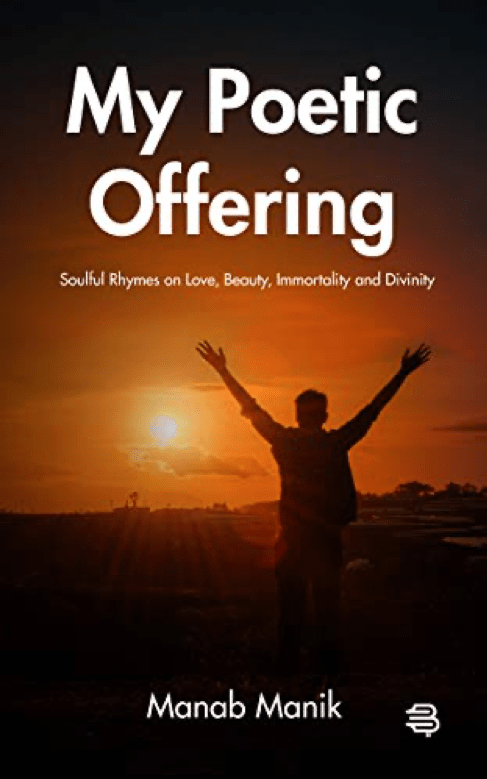
Manab Manik’s My Poetic Offering is clearly an invocation to the Divine. Manik seeks the bosom of the Eternal Lord present in all religions and poetries. In this delightful and unpretentious presentation of sonnet-styled verse, the poet reminds us that divinity is not a fruitless quest. To seek the divine is the heart of poetry itself and the poet in these verses makes it abundantly obvious that he is presented with divinity in his soul. Edgar Allan Poe writes in The Veil of the Soul that the definition of art is “the reproduction of what the Senses perceive in Nature through the veil of the soul”.
These verses are formal in character and not for the frivolous minds. These poems are not for indulgence but rather for enlightened thought. He writes in the opening poem ‘Prayer to the Almighty’:
Oh Lord! I have a simple prayer to thee,
I pray to thee,
I pray to thee,
Not for my own happiness and peace,
But for those,
Who remain in darkness,
Who are half-fed, unfed, and badly dressed.
The composition style is direct, formal, and delightful to read. Manik’s verses often are intoned with Wordworthian splendour in the “tranquil remembrance of emotion” to paraphrase the famous statement.
Wordsworth writes a seeming reflection on the thought in ‘The Solitary Reaper’. He writes
“Behold her, single in the field,
Yon solitary Highland Lass!
Reaping and singing by herself;
Stop here, or gently pass!”
Manik seeks in solitude to enrapture himself around the question of divinity. These verses are not so much seeking, as expressing what is already found by the poet. God becomes a teacher and muse as in poems such as ‘Thorny Way of Thy Life to Immortality’ where the poet writes this sublime verse: “In my mind’s eye glows and glows thy life and thorn, / Leaving bloody foot-prints thou invent a wise morn.” Nature is seen a book in several poems such as ‘Thy Inspiring Eternal Voice’ and ‘Shining Pages of Thy Life-Book’.
The inspiration for My Poetic Offering is not the crowd of believers. Manik writes to the earnest seeker, but his work is consecrated to the power of God, and to God Himself in the most eloquent of commendations. We do not read about the poet in My Poetic Offering. This collection is not confessional and does not intend a social message. It is what it claims to be on the cover: an offering to God through poetry.
However, we question throughout how the poet comes to know God. Does he provide any clues?
Life’s indeed a pamphlet, not a great book tho’,
Its pages can be turned o’er and gone thro’ at one go.
But the pages of thy life-book’ll ne’er end and stop
Thy book neither white ants nor Time can tear and chop.
By invoking Nature as the presence of white ants, the poem endears the reader to a sense of gentleness and eternal love. Even the smallest creatures are life’s guidebook. However, something eternal and essential to life exists in the Beyond. The poet indicates eternity can be perceived through Nature.
With these notes, do we even conclude the poet knows God? In what sense does the poet know God? We understand through the lines of verse that the writing speaks for itself and is a consecration to divinity. However, we cannot assess how the poet concludes God actually exists. We can only surmise this through his eloquent and dedicatory verse written in passages such as:
The stars, planets, satellites’re lone in cosmic address,
But in my mind’s cosmos thou art crowned with laurel headdress.
(From ‘My Apollo’)
The individual mind grasps intuitively, or through faith, what is not revealed. Within each person, there is a universe; as microcosms, we contain infinitely small things within us.
Manib Manik is not a seeker himself but appears to one who is found. It is written in the Bhagavad Gita that, “Maya makes all things: what moves, what is unmoving. / O son of Kunti, that why the world spins…” and Jesus Christ speaks to the crowd thus, “And why take ye thought for raiment? Consider the lilies of the field, how they grow; they toil not, neither do they spin.” (Matthew 6:28, KJV)
When someone is curious and lacks conceit in God, the Creator may make His presence known. However, it is a choice of the poet to use his gift to acknowledge the beautiful God within us all. In his designations and mythical allusions, Manik completes the circle of what we call divine humanity. St. Augustine wrote, “God is a circle whose centre is everywhere, and its circumference nowhere.” These poems express heady and highly refined sentiment toward God. With such spiritual fervour does the poet write that the reader may only listen to what he or she already intones within the soul.
.
Dustin Pickering is the founder of Transcendent Zero Press and editor-in-chief of Harbinger Asylum. He has authored several poetry collections, a short story collection, and a novella. He is a Pushcart nominee and was a finalist in Adelaide Literary Journal’s short story contest in 2018. He is a former contributor to Huffington Post.
.
PLEASE NOTE: ARTICLES CAN ONLY BE REPRODUCED IN OTHER SITES WITH DUE ACKNOWLEDGEMENT TO BORDERLESS JOURNAL.
Taranidhi Regmi, 37, of Morang, lives in Kathmandu and runs Sunbarshi bookstore in Dhapasi and delivers literary books to about 90 bookstores across the country within two or three days of its publication. When Covid-19 started to linger a month ago, he posted a photo of himself milking a cow in his home on his Facebook page. During this time, he was asking publishers which books were to be popularised for the new season, and was promoting some of the books published earlier. He was also expecting to open the market that had been sluggish since last year. However, that did not happen. The world was shaken by the pandemic of COVID 19.
Printed books by authors from around the world did not reach the market and the books that were about to be published got stuck in the printing presses. Thousands of literature festivals as well as book-tours were put on hold. As Nepal went into lockdown, all sectors and industries were locked down too. Citizens were seen returning home from east to west and from west to east, dreading an uncertain future.
How would the world economy fare? How would the developed countries revive their collapsed economies? When would the land ports and airports open? At the same time, there was the speculation that the pandemic may push about 40 percent of the world’s population into starvation.
You may think that this is not the time to talk about books but rather to talk about lentils, rice, vegetable or to talk about how to earn a living! But, it is essential that we should talk about the mind too.
What will people do inside their house during the lockdown? It is natural that people will spend time with their family members.
I also watched movies and read books. The pace of reading seemed to be such that after going through the books that had been lying at home for so many years, many people repeated them; e-books on various sites and on social media gained popularity. This time, it has been proven that books are really an integral part of human lifestyle. It is almost impossible to imagine a home, a school, a society and a person without books in today’s world.
Nepal’s book market is badly hit by the pandemic. Literary books account for only 10 percent of the NPR 4.5 billion book trade which also includes textbooks. It accounts for 75 percent of textbooks and stationery and 15 percent of imported and research related books.
Nepal’s literary book market is small with a total investment of around US $2.6 million. Nevertheless, the publishers who have invested in it are not in a position to even pay the rent due to the slowdown and near closure of economic activities during the pandemic. Likhat Pandey, President of the Nepal National Book Dealers and Publishers Association, says, “If the lockdown continues for long, most bookstores will close for not being able to pay the rent.”
As Pandey said, book publishers are also in trouble at the moment. Books printed are stuck in the warehouses and the ones ready for printing are on computer files. It is becoming difficult to get money from the sellers due to adverse conditions. In such a situation, new books cannot be published. It is very difficult to run a publishing house. Many publishers are saying that they will choose an alternative trade if the book market does not open for about six months.
Many may think that it is foolish to talk about books in the absence of a secure livelihood. But books are necessary to keep society moving, to entertain and to raise education levels. Books, as I pointed out earlier, have proven to be an indispensable asset through the pandemic.
The Ministry of Finance in Nepal has also transferred the budget allocated for the purchase of intellectual property to the Corona Fund during the lockdown. This clearly will impact the purchase of literary books by government schools. It is increasingly unclear if the NPR 6 billion in the President’s Education Fund will now be spent on buying and selling computers, school furniture and books.
The market for Nepali books, which has been on the decline since last year, was also hit by the government’s customs duty on imported books. The only alternative seems to be e-books.
Rakuten Kobo, a Canadian multinational company, did well in the global market for e-books and audio-books during the pandemic. Similarly, Amazon, Apple Books, Google Play and others also made a profit in the book trade during this time. At a time when the sale of printed books is difficult and the world is advancing in digital technology, it is necessary to find a market for it in Nepal too. I wonder if any company in Nepal will be able to do business as these multinational companies are doing.
A few companies in Nepal have been trying to test its feasibility and some books are being digitized. Publishers in Nepal are, thus, optimistic about the sale of books from such digital platforms. If such efforts find fruition, the few technology-loving and technology-friendly readers will benefit. However, about 90 per cent of Nepal’s readers depend on printed books as ebooks are not popular with them.
According to the Wall Street Journal, best-selling books sell at least 3,000 to 5,000 copies. The Publishers’ Weekly states that books which sell 1,100 copies a day for about a month after its publication can be categorised as one of the top five best-selling books. Whatever the international rules, good books usually sell 3,000 to 6,000 copies in all in Nepal.
Publishers overwhelmed by the current situation brought on by the pandemic and the lockdown would not dare to publish books by any random authors. Also, the numbers of writers who write poorly but publish books by investing on their own will be reduced due to financial constraints.
Only high quality books in fiction and non-fiction will be written and published due to all the above constraints. We can only hope that that the market for Nepali literary books will become bigger and wider, even if it takes a little longer.
.
Bhupendra Khadka is the CEO of Book Hill publications, one of the leading publishing houses in Nepal. Khadka not only leads a publishing house, he himself is a poet, a popular radio jockey, a public speaker, book editor and a national award-winning lyricist. Having written songs for more than 5 dozen movies and also recorded more than 350 songs, he also holds a record in bagging almost all prestigious music awards in Nepal. Email: bhupikhadka@gmail.com, Twitter: @KhadkaBhupendra
This article has been translated by Sangita Swechcha.Sangita Swechcha is a Communications Professional, Researcher and a Fiction Writer. Email: sangyshrestha@hotmail.com, Twitter: @sangyshrestha
.
.
PLEASE NOTE: ARTICLES CAN ONLY BE REPRODUCED IN OTHER SITES WITH DUE ACKNOWLEDGEMENT TO BORDERLESS JOURNAL.
I look up to find the evening sky stretch out like a canvas with a multitude of hues, change like a kaleidoscope of colours. It is the like the work of an artist, our Creator. I have often been startled by the beauty of life amidst my own fake despair.
I do not have many concrete problems in life. Not the ones that could be touched with bare hands, seen with naked eyes. Not the ones that could be described with a flourish. Not as if problems could ever be explained.
The world is a living, breathing cauldron. A little whimper gets turned into a moan, a slight regret gets carried into a lament, an awkward glance becomes a fleeting affair and dissatisfaction with life snowballs into melancholy. Disclosures of unhappiness are difficult to make. Affability comes with ease. Life is often dictated by societal norms. And the mind is in constant harmony as one amongst them.
The evening sky beacons for an escape. The birds wielding their wings high up in the sky, pumping the air beneath their wings, soar high, up and up away. I wonder what it takes to be happy, to be alive for them. I wonder if they suffer the throes of existential chaos. I wonder what life would be like, bereft of any problems, of any conflict, of misery. Why cannot it be a perpetual ride of ease and comfort?
I am not particularly unhappy. I am positive, rearing to go. I can talk endlessly about my dreams. My dreams about my life, my future, security, approval, turning the negatives into positive in times of lockdown and much more.
I have a privileged life. I have the money, enough to satiate the needs of my life. Enough to buy me clothes of myriad shades of colors and designs.
Yes, not the very expensive ones. I know my reach. Salaried middle class. But there have been days I have spent thousands of rupees on things I never cared to wear. The money trapped in my greed for something new had lain in the closet for months and sometimes years. It’s only when the cloth have aged enough, humbled by its disregard that I have picked it up and given it an audience.
My tendency has been only to hoard. I have not felt any concrete need or significance of that particular object in my life. My happiness has been short lived. It has dazzled me with its existence but it only turned out to be a mirage.
Happiness can never be found in what you wear. It gives you a momentary delight to be dressed in the choicest of clothes. But for that prolonged calm and poise clothes are a far cry. The closets are full of clothes new as well as old yet somedays there is nothing to wear.
The stark nakedness of the soul shines on those days. This depravity, the greed for more reflects on me. There are people who have nothing to wear yet brave life with a smile embarrassing us with their unseemly flesh on display. And here I am all covered in swathes of sequined clothes yet I am unhappy, grumbling, complaining about an imaginary chaos in my life. I will only be able to see clearly when the dust settles. But I never stopped spinning like a top around my axis. How will I ever see what my mind tells me to see? It’s the haze that whirrs around me unsettling me with the frivolous.
Food! I wonder if that provides a semblance of happiness. We eat to live or we live to eat! Making a living to buy the essentials or splurging it all on mindless eating leading to flabs of flesh. How much meat do I need around my bones?
The aroma of food being cooked at home fizzles into my nostrils but when I sit down to eat I am not hungry at all. As if the very thought of food has inundated my palate filling it up to the brim.
I am often enamoured by the colorful paraphernalia of junk present on display in shops. The packet of chips, biscuits and other knick-knacks in iridescent colours; red, blue, green, neon, beckon with delusions. Just one wafer thin chip can bring dollops of pleasure with the crunchiness alone. As long as the packet tempts me I think about the buying it and parting with a few rupees from my wallet.
I keep on putting this momentary satisfaction away, of being able to possess them is madness. What food value does this frivolous entity have? It is not the worth my money. But the temptation of the color and taste finally leads me to the shop.
The packet unopened, uncared will lie in the drawer for many hours before I decide to open it. I look for the promised happiness displayed on the cover of the packet. A smile of a nondescript man, so profuse, deep, enchanting, carrying assurances unbeknown. And yet the savory did nothing to fulfill the promise of that happiness.
I grab the packet and give it away to the household help. Her children would be grateful for this treat. Food does not give comfort. When you do not have the means to buy it, it becomes the single motivating factor in your life. When you have the luxury of choice, the comfort of having too much on your plate, you lose the narrative. Enough money can buy enough food but not a healthy appetite.
I live in a big home. Big enough to the eyes of the outsiders who would often throw a casual remark just looking at the façade. There are two floors and a couple of rooms. I often do not have the place to keep my stuff which lies on bed and chairs, crying for my attention. There are not enough cupboards? I rue the lack of storage facilities. I take my home for granted.
While the homeless of the world scourge for a roof above their heads, I pompously shun the comfort of my abode to look for more privacy inside my home. I need a snug home, like a kennel, something to wrap around myself. Something too close for comfort yet close enough to fill my senses.
Those with bigger houses are oblivious to the luxury of space while those with smaller homes keep on pandering about their desires. Life becomes a never-ending desire to escape from the real.
A mad dash to be somewhere else. In some other country, state, city, village, travelling to far off places — all the while contemplating the comforts of home. Comparing, making notes, concluding that life is best lived in the sanctity of home. And once back, the confined existence of home is repressive. Start another search, home if far away.
There is no comfort and joy to be found living in well-furnished big houses. Home is where heart is! And the heart needs to be molded to fit in a casket to be cared for a life time.
Home is valuable yet not valued enough, heartfelt desires often soar high escaping the restraints of one home. I have multiple homes in a surreal world and I often flit from one to another. Only there is no comfort grand enough to chain me to one amongst them. In the real world, home looks miniscule, a tiny room, a tinier closet, a heart in the casket. Some days I gasp for breath and rush out of my house.
I have often searched for the meaning of being happy. A comfortable home, lots of material comforts, oodles of tasty and expensive food, money in the wallet as having a limitless purchasing power is never a guarantee of bliss. It’s a reason for dissatisfaction for some.
Why we have it all when there are people who do not have anything and yet they are living with an aplomb, a carefree life? Their remorse at living ill-equipped lives does not reflect on their faces somedays depriving me of the perverse pleasure which I derive while making comparisons. An absence creates a want, fulfillment of that particular need. The alleviation of it becomes the sole purpose of life promulgating happiness. But then what do I know about the needs of those who sleep on the roads with an empty stomach, search for shelters during the rain, garble for morsels of food, for them home is a distant dream.
I wonder if happiness is empathy. Only being sympathetic yet not taking any concrete steps to alleviate the suffering. But then I do not think about the destitute of the world all the time. My mind is crammed with my very own self. My own attempts at navigating my life seems gargantuan. My own attempts to find peace, hope, salvation outwit me into thinking as I assume that my problems are larger than life yet they are not.
As I sit in the verdant lawn in front of my home wondering about life and happiness, a world of silver oak trees, palm spruces, rose bushes, peaches and plums in full bloom, ripe with fruit, fecund, living, breathing reach out to me. The honey bees buzz around collecting nectar of flowers. The butterflies flit from one bloom to another.
For a fleeting moment, one with silken wings alights on my shoulder. It has pink and yellow wings, a combination so strange. It looks hideous and, yet, I wonder if it is blessed with the knowledge to castigate itself.
It is happy. And for a moment, just for that brief moment that happiness is transferred to me. Amidst constant movement the unassuming insect gives stillness to my mind. Shrouded in the constant chaos of nature, my mind feels at peace. The butterfly on my shoulder with its fluttering motion lends me its momentary joy before making its way towards the evanescent dusk.
A brief snitch of happiness before I start the tireless journey full of recriminations. But I am glad there was a moment to escape. I wonder if the constant fluttering of its wings unsettles the winged one as it seems to be on perpetual move. A life in motion yet in peace. I spread my dormant wings to give myself a push. I make them flutter only to imagine myself taking that giant leap towards the sky.
It is constant work to keep myself above the ground but I guess this is what life is all about. Working, moving, flying, spreading your wings, striving to meet the horizon, dreaming, desiring the beautiful, happiness untamed. As I close my eyes to let myself soar I could see million butterflies let lose in the sky. Living, breathing, jostling to color the evening sky.
To give untamed hopes and dreams, wild desires, unleash the madness yet guide it with a serenity to halt that drive with a serene composure — what is it?
Happiness is above all a search, a thought, a way to live amidst constant contemplation.
.
Rana Preet Gill is a Veterinary Officer with the government of Punjab, India. Her articles and short stories have been published in The Tribune, Hindustan Times, The Hindu, The Statesman, The New Indian Express, Deccan Herald, The Hitavada, Daily Post, Women’s era, Commonwealth writers. org, Himal, Spillwords press, Setu Bilingual, Active Muse and Indian Ruminations. She has compiled some of her published pieces into a book titled Finding Julia. She has also written two novels – Those College Years and The Misadventures of a Vet.
.
PLEASE NOTE: ARTICLES CAN ONLY BE REPRODUCED IN OTHER SITES WITH DUE ACKNOWLEDGEMENT TO BORDERLESS JOURNAL.
Obinna Chilekezi is a Nigerian poet and insurance practitioner whose poems have been published in journals and anthologies. He has three published collections which are: Son Chikeziri too died, Rejection and other poems and Songs of a Stranger in the Smiling Coast. One of his insurance texts won the 2016 African Insurance Organisation Book Award. He can be used on ugobichi@yahoo.com or obinnachilekezi1@gmail.com.
Ever since Hasan came to Cox’s Bazar, he noticed a child in a vegetable shop, close to his residence, sitting by her father. He always praised the child to his colleagues. He felt her eyes were the repository of all kindness in this world.
She was, maybe in between seven or eight, a thin, brownish girl with her hair in a bun. She wore an off-white T-shirt with night pajamas. Hasan always looked at her when he passed the shop, and she looked back till he merged into the distance.
One day, it was drizzling, and Hasan went to the shop to buy some vegetables, while the girl helped her father choose the fresher ones for him. All his purchases fitted into four polythene bags. It was difficult for him to hold all of them in one hand and carry an umbrella on the other.
“Would you mind if I carry two bags for you?” she asked.
“It’s fine. I myself can manage.”
“Sir, I’m used to, and not as young as you think.”
“Please allow her to take you home,” said her father.
“Okay, come under my umbrella,” Hasan responded.
They both were walking on the muddy road and Hasan asked her, “Do you go to school?”
“Yes, I do.”
“Which class (grade)?”
“Two.”
“Wow, is it? Really, you are not little at all.”
“How many books do you need to study?”
“Three.”
“What’s your name?”
“Maya.”
The single word reply made him uneasy – Maya in Bengali meant illusion!
“Sir, we’ve already reached your flat; please take your bags.”
Hasan was looking deep into her eyes, not uttering even a single word. It seemed to him that within a fraction of a second, the child disappeared.
***
One week later, Hasan happened to meet Maya in Kalatoli beach, one of the most crowded spots in Cox’s Bazar.
“Why are you dabbling in this unclean water?” Maya asked as Hasan walked bare feet in the sea water.
“I love to wet my feet in the sea water, and what more I can expect in the beach; the water is the same in all the beaches.”
“True. But, haven’t you gone to the beaches in the southern part while commuting to the Rohingya camp through marine-drive road?”
“Yes, the water does seem bluer and clearer in those areas. Maybe because there are less visitors there. Would you mind walking with me?”
“Why not?”
Both began to stroll along the beach strewn with wastes left scattered by visitors. The seawater was littered with polythene bags, coconut remains, plastic bottles, and chips packets afloat. Hasan was feeling sad thinking of the world longest sea beach’s potential to compete with Galle in Sri Lanka or Pattaya in Thailand– renowned beach holiday destinations– while passing a turtle that lay dead on the sand.
Recently, the Cox’s Bazar’s Teknaf Sea beach had been declared an ecologically critical area by the department of environment. They had prohibited all sorts of activities that would adversely affect the water, marine life, air and sand of the beach — immediately after the publication of a recent study by Bangladesh Fisheries Research Institute, which found the presence of micro-plastic in fish and salt collected from the Bay of Bengal.
Straight away Maya pulled Hasan’s baby finger and said pointing to some hotels somewhat away from the beach, “This area was a small forest of tamarix and just beside it there were hills, hilly forests and hillocks. Even the seawater you see polluted now was clean; fishes used to be seen jumping out of the water and doing somersaults contorting their body,” she added.
“But this is now a history only; how do you know all these?”
“My father said. He also heard them from his father.”
Taking a deep breath and with a tone of disappointment he replied, “I see.”
“Sir don’t get disappointed; nature is going to reclaim its space very soon. You will soon see what my grandfather or ancestors saw many years ago. No one can fight nature.”
***
It was March 2020; people were getting infected with a new disease named COVID-19, caused by a newly discovered coronavirus in China on December 2019. Being much contagious in nature, the government announced a complete lockdown of the country. People left the city immediately after the declaration; all the government and non-government institutions were closed, except a few working on emergency services.
Hasan was not on leave amidst the lockdown as he was a development worker in an emergency project for Rohingya refugees from Myanmar, run by a Switzerland based non-government organisation– Fondation Hirondelle– in Kutupalong Rohingya camp, the largest refugee camp in the world.
In the afternoon, he ventured out wearing a mask to buy some daily necessities. He found the vegetable shop closed; Maya’s father left the city too in fear of the outbreak. Law enforcing agencies were patrolling the street to control people’s movement. People were told to stay quarantined at home to combat the spread of the virus.
On that beautiful March morning, Hasan was sauntering on the shore of Kalatoli, where there was no sign of human activity. All the seats installed for tourists were empty. The normally brownish seawater was looking blue; some turtles were crawling on the beach as if they had been playing with the crabs.
Hasan heard some sounds of splashes in addition to the roar of the seawaves and he turned his head toward the ocean. To his surprise, dolphins had returned to the beach at Cox’s Bazar and were jumping and doing multiple somersaults. The dance of these creatures with the multiple spiral shapes of the crystal water seemed to him like the smiling face of Maya.
Mohin Uddin Mizan is a Publication Officer at the Bangladesh Institute of Development Studies (BIDS) and the National Consultant at UNDP Bangladesh. He has published book reviews, poems, articles in The Daily Star, The Daily Sun, The Financial Express, The Daily Observer, The New Age, The Dhaka Courier, Indian online journal The Ashvamegh, and so on.
.
PLEASE NOTE: ARTICLES CAN ONLY BE REPRODUCED IN OTHER SITES WITH DUE ACKNOWLEDGEMENT TO BORDERLESS JOURNAL.
The Ape was their chosen leader, as he was considered by the rest of the heterogeneous assembly, the nearest cousin of the people who had terrorized them for centuries but were now behind the bars, refusing to come out of their hide-outs, due to the pandemic.
Besides that, the apes were generally regarded as intelligent primates, almost rivals of the creatures that walked on the two legs. The apes understood the humans better but were repelled by their behaviour and action.
The meeting was essentially a stock-taking exercise in a locked- down city.
The animals were openly roaming the waterfronts and boulevards, earlier places of terror, capture and possible death. They enjoyed these outings, reclaiming the city from its architects. They were not afraid of being run over by the traffic or caught in a trap.
The Ape was young and confident. He was trained by a reputed scientist in a huge lab but had managed to escape captivity and gone on living in the woods that bordered the city, as a fugitive. The Ape was huge but gentle in demeanour, never hurting anybody in or out of captivity. He knew the ways of the “civilized” masters and was a painter and wore frocks in his earlier life in the camp, where labs were run by a crooked man — who owned half the burgeoning city — for developing serums for the biological warfare.
As an elected boss, The Ape was tasked to strategise and lead the campaign of the equality as the animals felt they were often mocked, called dumb in the zoo or hit on the streets, by the drunks and the kids alike.
He told the mixed gathering of different species assembled in the Central Park, “Friends, welcome to the New World Order. All the bipedal tyrants have been locked in their vertical cages, thanks to the COVID-19. What a joke! An invisible virus can stall the manic world of mad humans! We are free now.”
“And we thought the human masters were invincible, these spoilt and arrogant people, most ungrateful!” exclaimed an abandoned horse, in anguished tone, “Serves them right.”
“These guys called us animals! See their temerity. Always treated us as inferiors. Tortured us. In fact, they are the true animals,” an African grey parrot retorted.
“They kept us in the cages. For display. Fun. Small cages that almost killed us. Now they understand our pain,” a gold finch observed.
“And us, on tight leashes and muzzles,” joined in the German Shepherd Dog, barking ferociously. “Breeding us for business. Training us for their ways. Expecting us to obey their commands. We are their pets and slaves. Then shot dead by them. They must be punished.”
The elephants, lions, foxes, monkeys, squirrels that had escaped from circuses and menageries chorused a loud, “Yes.” And the wise wolf added, “Real brutes! Tormentors! Killers. They whip, starve and tame us for profits, always, everywhere. Keeping us all in cages and chains, the cruel raiders of the jungles. Shame on them! Now they are in the cages. Serves them right, the bastards.”
“Shh!Shh!” the old mama bear cautioned. “Mind your language, friend. There are many children and women here. We never curse like them. Bad manners!”
“The most cunning species in the world! They label us as cunning. Ironical! Is it not?” asked a hurt fox. “Always judgmental! Always treating those unlike them in dress, skin-tone, language, region and creed, as the perpetual Other. Never trusting each other. Killing their own for property or woman or money. We never kill our tribe.”
Everybody praised the fox for her “clever” observations and contrasts with the incarcerated humans that walked clumsily and dressed in outer skins and wore heads on their heads called hats!
“Now do not talk and act like the human masters,” cautioned the old bear. “Let us be ourselves. We must never imitate them. Never pretend to be like them, our oppressors. Mind it friends, we have our own code. Be natural. Be yourself.”
“Right. They term us as predators and kill us for hides and body parts and tusks,” said a senior tusker, towering over the gathering, trunk raised; one tusk missing, another broken. “Fact is they are the greatest predators on this crowded planet.”
“And looters and invaders,” replied the woodpecker. “They have destroyed nature and our nests.”
“Poisoned our rivers,” shouted an otter. “We cannot breathe regularly. We are dying along with the fish and other creatures. Plastic and garbage choke us. Oil spills worsen the living conditions. It is a watery hell!”
“Now,” commanded The Ape, “We must destroy their nests. Gardens. Streets. Vehicles. We must shake down the very ground underneath their feet. Show our strength to these brutes.”
The animals immediately agreed. They wanted to get even.
“Let us take back their spaces, as they did with us,” thundered the Orangutan, “Virus or no virus.”
The enraged animals first declared themselves as Free Species of the Quadrupeds and the Gentle Vertebrates and the city and woods as their New Republic.
Then, during the lockdown, they took over human habitats rising towards the sky like a hive of vertical columns.
The unexpected take-over by the animals filled the trapped inmates with fear and dread of another newly-arrived threat.
There were many scary encounters reported on the blogs or social media, with pictures or videos posted of the uncanny sightings.
One account said:
“Friends of the besieged city — here comes a fresh danger. Early morning, I opened up the French windows of my ground-floor bungalow…only to stare into the red eyes of a hungry tiger looking straight into mine! Believe me, I stood paralyzed, mind and body benumbed with cold fear, a trickle of sweat prickled down my spine, the bad hangover gone. I faced certain death. The tiger lazily yawned, baring deadly fangs, eyes glittering, this huge striped animal– one paw swung at me and I would be gone. My body stiffened. Never expected such a deadly morning guest on my porch! He saw my rifle and mounted trophy on the wall and emitted low roar. His eyes were filled with revulsion. Yes, I would never forget that look of hatred!
“Just then my grand kid walked in and smiled and said, ‘Hullo, tiger!’ She giggled and walked up to the ferocious beast, this six-year-old innocent. My old heart leapt into my mouth. I was reminded of a hunting expedition where, years ago, I had shot dead a tigress before her cubs! There was an instant transformation and the big cat dropped his head and did not growl.
“They played with each other and as her mom came searching for her, the tiger vanished! Disappeared into thin air. I thought I was dreaming the whole thing. The excited child said, tiger, tiger! Her mom could not understand her. She told the kid, ‘Okay, we will bring you a tiger soon.’ The poor child could not explain her joy of meeting a real tiger on the porch. Strange but true encounter with the beast, truly majestic—never thought it could happen and end like this, real time, in my house! Thank God we escaped death by mauling. It was Him who turned a ferocious beast into a lamb! A miracle only! Praise to the Lord.”
There were other interesting accounts of simian, reptilian and mammal surprise visits to homes. The most common experiences from the humans were utter shock, dread, intimations of mortality and a sense of deep disbelief from this unexpected rendezvous in most unlikely urban settings. Most narratives ended with the question: Was it real? Or, imagined?
As the animals gained confidence and COVID-19 pushed humans further into isolation, self-isolation and quarantine, the general fear of the animals spread like another contagion. People were bewildered. Infants wailed inside their little airless homes. The old and sick and the chained dogs were getting restless over the long summer days and hot-humid nights in that coastal city. Overpopulation did not help either.
And compounding their collective miseries was the daily appearances of animals in their midst, on their well-landscaped and maintained properties and other glitzy places.
The superstitious found indications in hostile stellar positions.
The religious chided the younger generation for abandoning faith and their dissolute ways — things that brought down the plague on a prosperous, modern city.
The youngsters called them hypocrites and blamed wars, famines and flooding to the older generation’s selfishness and indifference.
The city changed — an open-air zoo run by what they earlier called ‘wildlife’!
The only change: The previous spectators were behind the bars and the timings of activities. The new arrivals freely roamed any time of the day and the nocturnal ones, in the night, enjoying the sites.
The media blamed the virus and the country of its origin for this new mess. Others called it racism and dirty politics. Power blocks were formed. Politics played itself out along predictable lines.
Meanwhile, the capitalists sensed a good opportunity to fire half of the working population, citing recession and losses. Social scientists called it downsizing! Academia studied the development clinically and conducted webinars — mere sound and fury signifying nothing, as they used to quote often.
“One virus! It has overturned their world!” declared The Ape, during one of his meetings in the Central Park, now totally theirs!
As the days rolled down in flat succession — uneventful; dull; seamless stretch of darkness and light, and, one date followed another — the citizens felt breathless, stressed-out and despairing. They envied the freedom of the birds and animals moving around on the spaces once the privilege of the human race only.
And cursed foreign bats for the outbreak of the deadly virus!
It was a painful reversal of fortunes!
The masters were now slaves.
Slaves, new masters.
Each one of the citizens were afraid of the other and maintained social distancing. The class and caste persisted in the subtle play of power from earlier. It got more complex by the presence of this tiny virus that could not be seen by the naked eye. Corona — the general lament went on– had dramatically changed the communal life style of the people that were earlier unbeatable. Now, they cowered before the invisible threat. It was a leveler also. Elites were quarantined but were slightly better off than the others.
The Ape called his Council and declared, “We have no enmity with the masses. Our fight is with the Club that runs this city and the country. We will not spare them in case of a war against us. We will target the Club and its militia.”
“What is that Club?” asked the donkey.
“The Club is run by the wealthy and powerful– five-ten folks. Some of them are into drugs, weapons, prostitution, wars and other illegal activities. They enter politics and gain power, position and respectability. And decide the agenda for the rest.”
“The rogues. Ha!” exclaimed the donkey as the others of the Council hissed in sheer contempt for the shenanigans of the corrupt ten.
“The Club runs the politicians and public offices. Nobody can cross these raiders. Those defying get killed. It is a dirty world out there.”
The Council agreed with the summing up of the “civilised” by one of their best from the “wild” side of the divide.
“Be prepared!” The Ape warned. “These guys can attack us any time. Very deceptive!” “How?” asked the donkey again.
“They attack their own. Family. Community. Nations. They fight and kill each other. We never do that. We follow our herds and never kill for money, land or profit. Or sex.”
The donkey brayed in full agreement, “I have seen this with my mistress many times, this digression.”
The animals laughed at the un-satiated appetites of the humans.
Few days later, the fox woke up The Ape.
“The Club is meeting in the Town Hall. Planning to hit us. Let us give them a visit.” The fox said, “One of the humans sympathetic to the animals and their rights told one of our mutual friends. They are meeting after midnight.”
The Council agreed to pay a sudden visit.
The humans were completely taken by surprise as the animals entered the Hall by disarming their police outside. In fact, the cops quivered and ran away after seeing the real brutes coming towards them. They stood no chance.
“What do you want?” The Chair asked, surrounded by his body guards who cowered before the Ape and the Gorilla and Lion and Tiger. The quadrupeds could smell fear in the stale air of the large Town Hall—and relished it.
The Chair was tall, wiry with bulging eyes. He began aggressively: “Yes. What do you want, you a bunch of intruders?”
He tried to act brave, but the bluff was called-off in a minute; in fact, his raspy voice croaked and he gasped for breath, hands shivering, as the mighty animals surrounded his gilded high throne.
The other members of the Club hid behind the chairs, eyes closed as the Lion filled the chandeliered room with a blood-curdling roar that shook the silver ware and lamps and windows. The Tiger growled and the Gorilla screamed a waaaaaaah. That scared the entire assembly of the two-legged creatures. Many bipeds shouted and fainted, so terrified they were of their new guests and their controlled aggression.
The Chair got disoriented by the general racket but willful as he was, recovered fast and said in a softer tone, and with a false smile, “OK. What do you want? Tell me, pals.”
“You tell us, Boss,” mocked the Ape. “You run illegal mining and extortion and killing of wildlife operations. Tell us what do you want? A campaign to finish us off permanently? Finish off the jungles and the life there?”
The Chair grew very friendly, “No, Mr Ape. Never, ever. You are our distant cousins, remember? We are all related. Ha. Why would, er, should, er, I think of mass extermination?”
“Then, what is the problem? Why this clandestine meeting in the night?” demanded The Ape, hairy hands clenched tight, nostrils flaring.
“We want you beasts to leave our land, please. That is all. LEAVE us ALONE.” The Chair almost commanded.
That was a terrible mistake.
“Who is the beast here?” asked the Gorilla as he stood up and thumped his chest. “You are the beasts. Leave our land. You beasts of the two legs.” And the Gorilla did his chest-thumping again and released a wave of the classic sound: waaaaaaah.
The humans shrank further by this dual assault — aural and physical –in that closed space. Some searched for the exits but those were blocked by the animals that were enjoying the discomfiture of their former tormentors.
The air was getting thick with the stench of urine and sweat.
“And what land you are talking of? Is it not our land also?” asked the Ape. “It belongs to us as well. Not your monopoly. It is our land now.”
“But…,” whined the Chair.
“But?” asked The Ape.
“We have…I mean…hmm,” stuttered the Chair.
“Go on.”
“OK, Mr. Ape. We have cleared the land and invested millions in developing the land, you know, the infra, you know…”
This time the Gorilla spoke: “Developing or destroying the land, hills, rivers? You call it development? You have totally ruined the planet by now. Understood? Time to payback now.”
“Made extinct many species. Destroyed rain forests. Created a hole in the Ozone layer,” added The Ape furiously. “And you capitalists and leaders never cared! Never listened to the saner voices!”
The Chair was taken aback. “How do you know all this, big and brainless monkey…I mean, Mr. Ape?”
The Ape stared hard. “I was trained by one of the top scientists in your labs only. One of the best minds. Later on, he went mad, feeling betrayed by you and your greed for more and more. In that notorious virology lab, he committed suicide for betraying ethics of science and applied research, that fine mind duped by your glib talk of patriotism and all that shit.”
“Oh!” the Chair grunted, going slightly pale. “The poor man! Most scientists are mad anyway.”
The Ape did not like this, “You are a bastard!”
Both the sides faced each other now.
“You speak our language well. Even the cuss words so well,” fawned the vice-chair, “How come?”
He sounded condescending, despite the efforts to be otherwise.
“Learnt your language but you have forgotten our language, you, the hunter with a rifle. The language spoken by nature. Sad! That is the cause of the present crisis, this imbalance.” retorted the Tiger. “You killed many of our species, but I spared your cub that day. Remember, hunter?”
The hunter said nothing. He was past that emotion of contrition or feeling sorry for his wanton acts of destruction and cruelty.
Killing gave him a libidinal high, as money did to the capitalists.
There were tense moments. The confrontation was becoming inevitable.
Both waited for the other to blink first.
Finally, the Chair coughed discreetly.
The Ape looked at him hopefully.
“We apologize, friends for our foolish acts of the past,” said the Chair. “We mean no harm. We can share the same spaces with you guys. Now leave the Hall as there are some women here who have fainted and need hospitalisation.”
The Ape agreed to withdraw, after seeing the plight of the fair and pale women, mere appendages of the wealthy.
Before leaving, the Ape said to the Chair, “If you break your promise, there will be mayhem.”
The Chair promised on his holy book never to attack friends who did not look like them, as the words beast and savage and brutes were found offensive by the guests radicalised by the human language, and therefore, banned.
“I do not trust them,” said the fox, once outside.
“Let us see,” said the Ape. “Let us give them a last chance.”
***
Three days later, the animals were brutally attacked.
A family of deer were sitting in the park when they were killed by the bullets of hunters.
More attacks followed on the animals roaming the streets. The Ape met the Council.
They launched a counter attack on the humans and destroyed their vehicles and labs and released animals from zoos, private and public.
Many humans were badly mauled. Some died of fright and shock and bleeding.
The pitched battle continued for the control of the territories during the day and night.
The hunters and the army used tranquillizers, guns and darts. But the primates were smart and dodged these tactics. Their agility was superb and might, matchless. They climbed the trees and buildings swiftly and could immobilise the militia by their screams and swinging fists and flinging trees at them.
Throughout the night, the battle went on.
The Chair was keen to trap The Ape, but the latter was as evasive as a trained assassin.
Next morning, the Chair and his goons adapted a new tactic to capture The Ape, the leader of the animals: They used a baby chimp from a private zoo as bait and asked The Ape to surrender or they would roast the baby alive on the live coals for its tender meat.
“Barbeque the babe!” That was their chant over the public address system.
“Surrender! Surrender, you beast!” They taunted The Ape.
Despite the Council’s reluctance, The Ape decided to surrender in order to save the baby chimp as he could not bear the hapless wailing of its young mother. The Chair was jubilant and put him in the shackles and lashed the big guy mercilessly and then something strange happened.
It began raining heavily. The skies darkened. As the hunter aimed to kill the shackled Ape before the mass of cameras — the ritual killing was to be televised live as some kind of reality TV, with the commentary by the triumphant Chair, as the vindication of the superiority of the homo sapiens over the dumb, witless brutes of the lower order before an audience of millions lusting for blood, as done earlier, in the Roman era, by the wild crowds— a troupe of baby monkeys sprang into view. The hunter was astonished to see his granddaughter, the six-year-old, leading one of the simian babies, and, hold your holy breath; the teenage daughter of the Chair and other school children formed a human chain and moved forward.
What the hell! The Chair shouted over the public address system.
The teenage daughter named Gaia by his third wife looked straight into the cameras and said, “Dad, shoot us before you shoot The Ape!”
And hundreds of uniformed kids and old women stood around the shackled Ape and shouted in unison, “Kill us! Kill us, first! We will not allow you to murder such a fine creature.”
The hunter’s grand kid shouted, “Tiger! Tiger!” as the same tiger came out of shadows and joined the human protestors, all unarmed. The kid said, “Tiger! Come here!” He did and nobody panicked. They all stood still, linking arms together, facing the hunter and his goons, as it rained.
The hunter and his killers were stunned by this turn of events.
Gaia said, “Today, it is a virus. Tomorrow, more pandemics will follow, if you kill the wildlife so brazenly. Learn to respect these creatures of God. Beware. We are wild, not them. If they are destroyed, we will be totally annihilated.”
“Kill us! Kill us!” The children and women shouted, daring them to shoot.
More animals joined the protestors in the main plaza as millions watched on their TV screens.
The children hugged the wounded Ape and patted him lovingly, applying turmeric and herbal medicines on his wounds.
The Ape cried for the first time in is life of struggles and humiliation.
The militia waited.
The chain of humans increased in length.
So did the chant: “Respect them. Respect Nature, our mother!”
There was thunder and lightning.
And the rain beat down furiously on the players on that open stage, witnessed by the rest of the world, on that memorable day…
.
Sunil Sharma, an academic administrator and author-critic-poet–freelance journalist, is from suburban Mumbai, India. He has published 22 books so far, some solo and some joint, on prose, poetry and criticism. He edits the monthly, bilingual Setu: http://www.setumag.com/p/setu-home.html For more details of publications, please visit the link below: http://www.drsunilsharma.blogspot.in/
.
PLEASE NOTE: ARTICLES CAN ONLY BE REPRODUCED IN OTHER SITES WITH DUE ACKNOWLEDGEMENT TO BORDERLESS JOURNAL.
Granny cranes her neck to find a primrose waiving at her.
.
Notes:
Cheli: Small sari worn by little girls in Bengal
Thaan: Borderless white sari widows were forced to wear
.
Dr Sutanuka Ghosh Royis Assistant Professor and Head Department of English in Tarakeswar Degree College, The University of Burdwan. She did her doctoral dissertation on Two Eighteen Century British Women Poets: Hannah More and Lady Mary Wortley Montagu. She has been teaching at the undergraduate and postgraduate level for years. She is currently engaged in active research and her areas of interest include Eighteenth Century literature, Indian English literature, Canadian Studies, Post colonial Literature, Australian Studies, Dalit Literature, Gender Studies etc. She has published widely and presented papers at National and International Seminars. She is a regular contributor of research articles and papers to anthologies, national and international journals of repute like The Statesman, Muse India, Lapis lazuli, Setu etc. She is also a reviewer, a poet and a critic.
.
PLEASE NOTE: ARTICLES CAN ONLY BE REPRODUCED IN OTHER SITES WITH DUE ACKNOWLEDGEMENT TO BORDERLESS JOURNAL.
The epidemic is almost over in Italy. After almost three painful months of lockdown and the loss of about 30,000 lives, the daily number of victims of the coronavirus is slowly dwindling to zero. In a couple of weeks at most, the epidemic will be completely gone. It is time to restart, but the damage has been terrible.
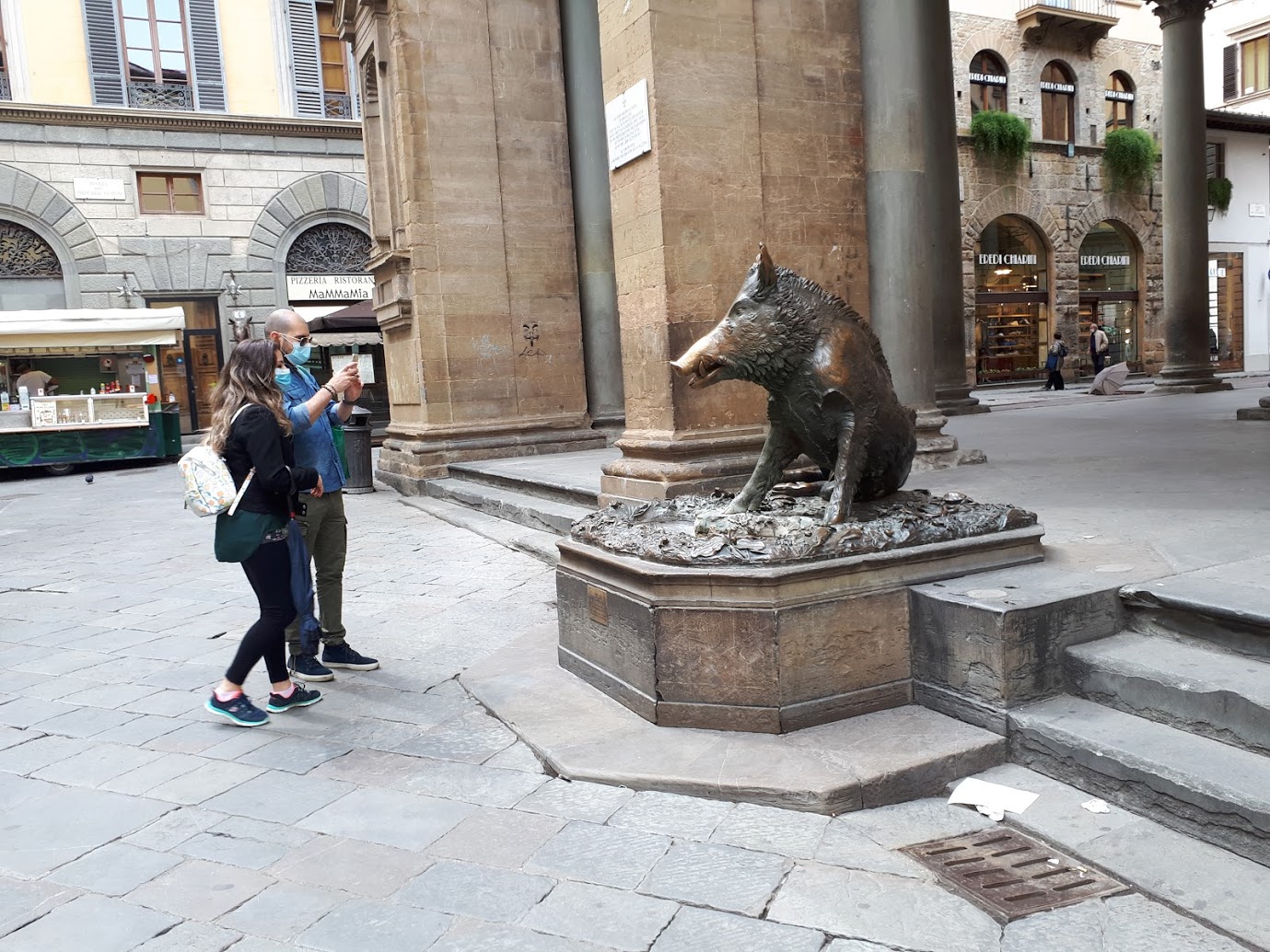
The lockdown is over and the Florentines are back, walking in the streets, wearing face masks, but free to go wherever they want, provided that they don’t form groups (“assembramenti“). A few tourists can be seen, slowly walking around, a little bewildered. Below, you see a picture of a few days ago with two lone tourists taking a picture of the “Porcellino” (Wild Boar) (the boar looks a little bewildered, too.).
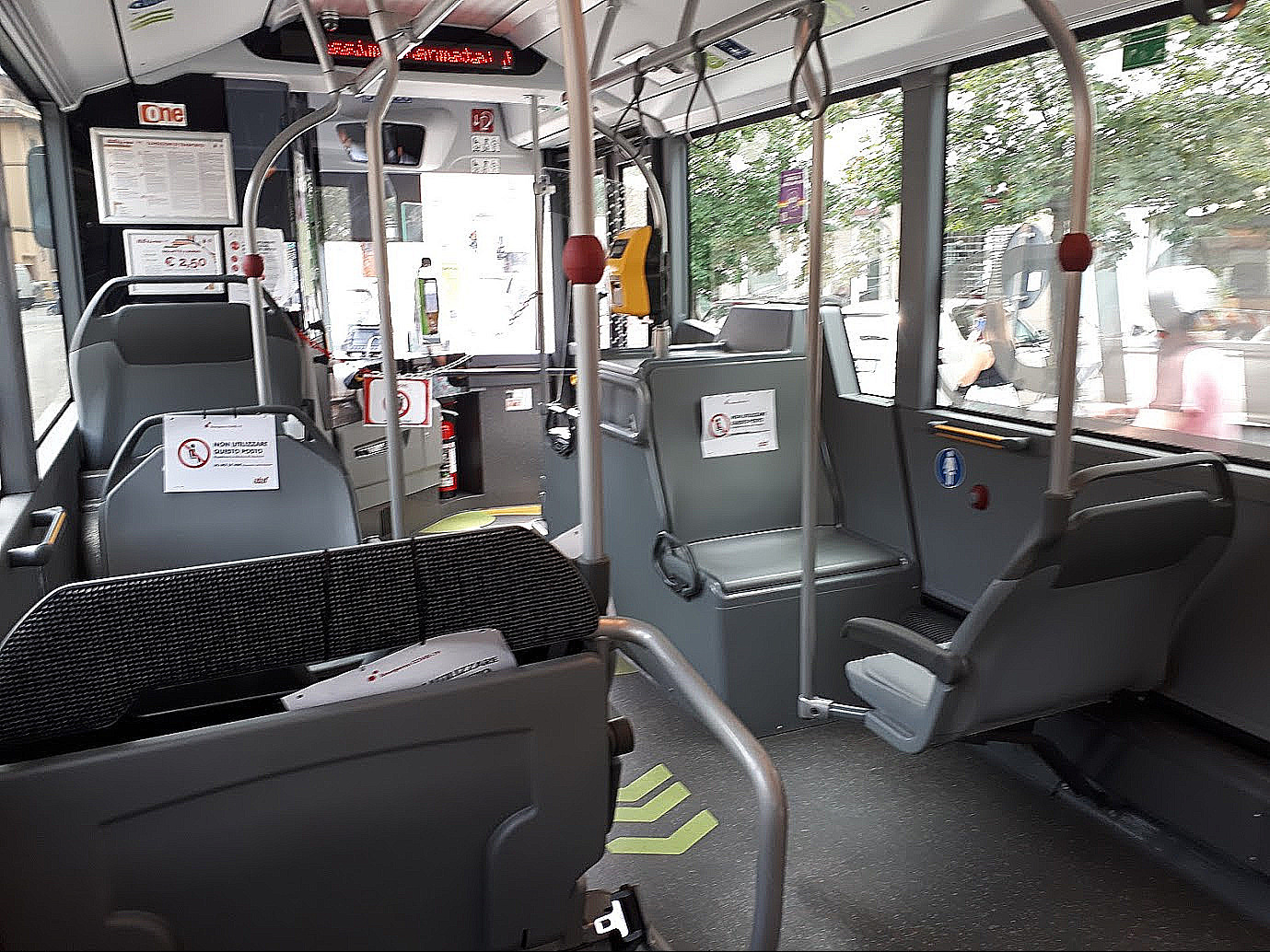
Many shops have reopened, but not all of them — maybe 30% are still closed. For what I could see this morning downtown, all the open shops are empty of customers. The restaurants also look empty. The buses are nearly empty, too. Here is a picture taken this morning, with me and my wife the only passengers of a bus that used to be packed full before the epidemic. Note the signs saying “You cannot sit here!” They don’t seem to be necessary, given the situation.
To pass to you some idea of the somber atmosphere in Florence these days, here are two fragments of conversations I had or witnessed in the street. Maybe these people are too pessimistic, but I have a feeling that they have correctly evaluated the situation.
***
First, an exchange I overheard a few days ago while waiting in line at the entrance of a supermarket. I don’t know the names of the protagonists, two men in their 50s. The one who said he had a shop I recognized later standing at the entrance of a small clothing shop in Via Romana, in Florence. I am reporting from memory, but the gist of what they said is there
– Hello. How have you been doing? I haven’t seen you around, recently.
– Oh, nice to see you! Of course you didn’t see me! I was at home, like everybody else.
– Yeah, I was at home, too. But are you reopening the shop? I saw it is still closed.
– Yes, it is still closed, but I am reopening on Monday.
– That’s good, right?
– Not so good, really.
– Why?
– What do you think I can sell? There are no more tourists.
– Well, you didn’t sell just to tourists. They don’t come here so often.
– No, but you see. Someone from Spain would come and buy something. Then someone from America would come and buy something. And so on. See? It made the difference.
– I see….
– So, I am opening yes. But I am just selling off the stock I have. Then I’ll close for good. In a month or two, I think.
– Really? Are you sure?
– How do you think I can pay the rent and the taxes? And for renewing the stock?
– Well, I think the government will help us.
– Yeah, sure.
***
Now, a conversation I had this morning with a man who had a kiosk selling used books downtown. Again, it is reported from memory, but I tried to reproduce the sense and the tone of what I was told.
See? This kiosk has been around for a long while. Really long, see, it was here during the war already. The woman who had started this business sold the license in 1946. Oh, yes, and I have been selling books here for a long time. Sure, I am 66 now. Last year I thought I could retire, but then I decided I could keep going for a little longer. But they have been ruining me. First, there used to be an antique market right behind the kiosk, you know that, and then the city decided to send them away — not elegant enough for the city of Florence. Sure. Before, people would visit the market and then stop here and buy books — I had some good books, even antique ones. I was known, people knew that I had those books. I still have a few. But the antique market is gone — they sent it somewhere out of town. Yes, it was not elegant enough for here, they said. They call it “decorum” of the city. Sure, and the people of the market are not selling anything anymore, where they are now. And I wasn’t selling anything, either. Well, a little I was still selling. Not much, but a little. But then this. I have been forced to close down for three months. And I told them that I couldn’t pay the license and the tax. And they say, fine, you don’t need to pay for three months. Then you have to restart paying, and that’s final. And if you don’t pay, they said, you bring back your license to us and we’ll give you a compensation of Eur 600, and that’s it. And good riddance. You understand? They are happy that I close. Perfectly happy. A kiosk is not elegant enough for the decorum of the city, they say. Maybe they think that when tourists see my kiosk they run away screaming. Tourists like fancy shops only. And I have to pay 54 Euro per day — yes, 54 euros in taxes and fees to the city. And I have to sell books for more than that if I have to eat. And to buy more books to sell, otherwise, what am I going to sell? Don’t you see? There is no way. Nobody walking around, nobody buying anything, no tourists, they have gone. I should have retired last year, but I couldn’t have imagined…. how could I have imagined this? And the city helping us? Ha! The mayor says he is furious, yeah, sure, he said that. I read it in the newspaper. He said he is furious because the central government didn’t give him any money for the epidemic. That’s what he said. And what should I say, myself? If the mayor is furious, how about me? I have been giving money to the mayor for 30 years and the mayor now is furious because he has no money to give to me. Aw…. even if he got some money from the government, I am sure he won’t give any money to me or to the people who have shops and who need money. Like me, that’s it. And so I’ll be closing down. I’ll be just selling the books I have and then good riddance. This square will be empty: no antique market no kiosks, nothing. I figure they’ll be happy. It is what they wanted all along, decorum, yes. An empty square, and that’s it.
(*) The owners of the Calzoleria Leonardo Tozzi in Via Romana were kind enough to give me permission to publish the photo you see at the beginning of this post. If you happen to be in Florence, and you need a shoe repair job, you can find them in Via Romana 135r, just a few steps from the clothing shop mentioned in the first conversation reported in this shop.
.
Ugo Bardi teaches physical chemistry at the University of Florence, in Italy and he is also a member of the Club of Rome. He is interested in resource depletion, system dynamics modeling, climate science and renewable energy. Contact: ugo.bardi(whirlything)unifi.it
The child. You hide your face in my harassed hair,
Blow the blue smoke into its strands.
Tell me.
.
The lights have been switched off,
Only the night light pours in through the gauzy curtains,
Tell me. You clink the glass and blow the smoke
Into my hair, my mouth.
.
The mulberry tree is the marker. After l leave,
Do not sit under any mulberry tree.
There is a light cardboard coffin
Buried beneath it.
.
Chandini Santosh is a novelist, poet and painter. Her poems have been published widely in solo collections, journals, anthologies and magazines. Her third novel, `Blood Brothers` is ready for release.
.
.
PLEASE NOTE: ARTICLES CAN ONLY BE REPRODUCED IN OTHER SITES WITH DUE ACKNOWLEDGEMENT TO BORDERLESS JOURNAL.
The fiery accents of orange-gold in the western sky had gingerly muted into a soft peach. Rich hues of champagne and pastel pink blended with the steely greys in the horizon. A flurry of various birds and their dark silhouettes dotted the myriad tints as they returned to their roosts. They cackled joyously as they flew overhead. The chorus and the orchestra of the birds gradually drifted into the distance until I could only hear an echo or a settling-in faint cluck from a faraway tree. Everything had gone quiet and still outside.
I felt anything but elated with these songs and sights of creation which would otherwise have stirred a sense of exhilaration in me and have me hurriedly rummage about for my camera. Those were the extremely wretched of days when I had just about struggled to get my bearings together after an unfortunate and untimely demise of an infant in the family, a few days earlier. The disbelief and emotional upheaval was taxing, to say the least.
Snapping out of my reverie, I realised that the sun had long since set. It was a cloudless night and the sky was an enveloping petal of spring Iris, all aglow with a serene silvery sheen.
A faint voice relentlessly cooed and called out from somewhere inside the house. Being conditioned to all the chatter of the mynahs and the clucking of pigeons which roost in some hidden alcoves of the tall apartment building that I stay in, it was also a common sight of them fluttering across the common corridors outside, which went unperceived sometimes.
Quite engrossed with my last minute dinner preparations after a long, busy day at work and running errands, I regretted to have failed to notice this melody sooner. When the cobwebs finally cleared from my befuddled head, I rushed on tiptoe, ever so quietly to find the source of this tune. Standing her ground firmly and boldly in a shaft of moonlight, in one of the rooms was the tiniest of birds, as yellow as butter. A first-time visitor, who had separated herself from her flock and had stopped by to actually trill a birdsong. Long after sundown.
Birdie noticed me but was not startled. Confidently, and in a higher pitch, with every ounce of energy, she gave an overjoyed tweet upon seeing me. I whistled to her in varied tunes and Birdie responded likewise. This musical opera continued for a while and I lost track of time.
Having sung and done that, Birdie decided it was about time to leave.
She made her way out and disappeared without a trace. Never to return.
The pearly luminescence outside captured only a silhouette in flight of my sublime emissary. Rare birds they say are fairies in disguise, who come to comfort you, reassure you! The mystical message in her beatific lyrical was for me to decode.
I believe in the Mystique and the Magic.
Magic comes to me, it sends me signs from the unseen world, the mystical realms.
I know all is well up there and the Heavens are kindly taking care of you.
***
I
Nigh 2 years later
April, 2020
It was eight at night. She was yellow-bellied with shimmers of green as I looked closely, the only light emitting from the living-room I was watching her from. No bigger than my thumb, one could easily mistake her for a toy, but for her incessant chirruping. She sat dangerously close to the edge of the window sill and was seemingly in dire need of help. I stretched out my hand as much as I possibly could, leaning against the window frame. But she was just out of reach.
A nestling on the window sill! Or was it a magically minute bird that had come to life out of a fairy-tale?
With a frame so tiny and wings so frail, it was next to impossible for her to fly all the way up to the top floors of this high-rise or for her to fall out of any nest, considering that there weren’t any trees or even overhanging branches anywhere close outside this window.
Habitually, as I give my own names to any stray animals or birds that I come across, this little bird for all intents and purposes was aptly dubbed Thumbelina. I kept her engaged with my own animated banter.
Are you hurt, injured, sick or lost little birdie?
But Thumbelina just cocked her head and looked at me with twinkling eyes. She never seemed livelier or more than happy to just warble away to me. After a while, she roosted snugly on the sill.
Sending up a quick prayer to Archangel Michael to protect her from toppling over in her sleep, another one to Archangel Raphael to heal her if she was in distress, I finally hit the sack.
These two angels had never failed me whenever I had called out to them and I was rest assured that Thumbelina would be in Divine hands.
The next day, the break of dawn brought with it a bustling multitude of chirps, twitters, cheeps and the laughter of my feathered friends. I rushed to check on Thumbelina, but she was gone! My heart did a somersault at her absence, thinking of the worst tragedy that might have befallen her. Although that bleak thought niggled at the back of my mind, my faith in the angels was steadfast.
As the day progressed and when the sun was strong enough, I slid open my bedroom window to let the natural light in… and there she was!
Thumbelina!
She had flown a full circle from a window at the other side of my apartment to be right outside my window!
She squawked a quick ‘Hello’. Thumbelina was more exquisite in the bright sunlight. Her dazzling feathers were an iridescent green.
Perched on the ledge, she fanned open her tiny wings and flapped them to show me that she wasn’t injured. She hovered a bit off the ledge of my window sill to show me that she was strong enough. With a swish of her tail feathers, she flew the entire perimeter of the building effortlessly and turned the corner. I craned my neck outside, until I could catch sight of her no longer.
***
Gleaning back into the events of a few days preceding this, I realised that I had been constantly dwelling on the past thinking about Mamama, my maternal grandmother.Although three decades had gone by since her mistimed passing, the memories of a companion with whom I had a deep bonding and attachment right from my childhood, until my early teen years had never truly faded away. From her, I had had a complete absence of judgement, share what I may. The advice that I got from her was always right, full of wisdom and logic.
While in meditation and also during my last state of wakefulness every night, I always and to this day, have invoked her for guidance through dreams or an intuition.
Thumbelina had come precisely at this time as a harbinger— to see me, meet me and to symbolically show me that:
No matter whosoever is bigger and stronger around me, I’m not cowed.
Nor is my spirit injured. It is always whole and restored.
God and his angels always have my back, no matter how tiny, frail and lost I feel.
The essence was delivered, which I could interpret.
This reinforced my belief that our beloved, departed are among us in various forms and spirits. Birds, moreover are said to be oracles from heaven. The more eye-catching they looked, I would always be comforted with the thought that they were from a Godly realm.
And Thumbelina was just that — rare and exotic.
To all other eyes, she was just a nestling… lost at night.
***
II
Thumbelina Returns
April 2020
Lockdowns had given me long stretches of time to reflect and introspect. Preferably, I would like to call it my Retreat. Lockdowns sound more like serving a term, so a big no-no to this word.
With huge encouragement, repeatedly in the past from my mother, and also from a dear friend to whom I always turned to for advice had given me great moral boost, to hone my craft of writing. It was about and the right time to give it a try. The opportune moment brought with it a synchronistic, fortuitous guidance and a nudge in the right direction from my professor in English.
Making the most of this downtime, I flipped through my archived journals to whip into shape some closely guarded, drafted reminiscences to present a chronological storyline
I had decided on my debut to be a grand tribute to Mamama.
A symbolic affirmation from a bird was all that I needed when Thumbelina had first made a cameo appearance in my life, some days back. I always upheld the belief that I have spiritual guides in all forms and most importantly, birds topped my list. They do, and had shown up at crucial moments and decision-making times.
These were signs from the Universe, little intuitive and affirmative green lights to go ahead. To take that chance and to submit my piece, showcasing my humble tribute.
Apprehensively, as a raw newbie writer, I was open to the realistic possibility to outright rejection with a lot of critique. Nevertheless, strong will ruled the day, to take the plunge. Reintroducing myself to Microsoft Word, with which I was out of touch for ages now, I typed away fervently from my diary. In effect, it was an immense unburdening and a cathartic release of emotions all over again.
April 9th, 2020 went down in my calendar, a date marked for life. For two reasons.
The unbelievable had happened! Nothing short of a miracle when my debut memoir which documented a toddler’s attachment to her grandmother up until her early teens until fate cruelly separated them by her ill-timed decease, got a wider audience through its publication.
Something so nostalgic, so sacred, so close to my heart had got validated. It was like the Universe saying to me with a huge benevolent smile— “You asked, you believed, you received.”
***
I hadn’t in my wildest dreams imagined Thumbelina to make a reappearance. But to my amazement, she did. On this very blessed night that my Memoir got acceptance.
Epiphany! Blink and I would have missed her. If she hadn’t made a great deal of grabbing my attention.
She flapped away furiously with her frail wings with all her might against the thickness of the drapery of my bedroom window. My heart had missed a beat, wary of the strange sounds outside, thinking it could only be a dreaded bat.
But it was Thumbelina. With an iron-will she inched her way in through the window bars into the room. Gliding gracefully in slow swirling arcs above me, her melodic voice trickled with high-pitched piping and congratulatory tweets.
Without asking for much, except to see me, the air resonated mellifluously behind her as she made her way out swiftly after her mission was accomplished.
No doubt, a celestial guardian or…a seraph?
Well, it could only be a loved one, come down to bless me… in person!
And it has been so ever since.
Birds and I have a thing!
Thank you for the melody, that’s precisely why my heart sings with a better chord today and is a steady, rhythmic drum to your chime and hymn.
.
Sangeetha Amarnath Kamathis a B.com graduate from St. Agnes, Mangalore, India. She has resided in Singapore for the past 19 years as a homemaker. She has a passion for writing which is self-taught. She has published her work with Twist and Twain.
.
.
PLEASE NOTE: ARTICLES CAN ONLY BE REPRODUCED IN OTHER SITES WITH DUE ACKNOWLEDGEMENT TO BORDERLESS JOURNAL.












 Borderless