Categories
Musings Tagore Translations

Two Birds: Musings on Tagore

Ratnottama Sengupta muses as she translates Tagore’s song, Khachar Pakhi Chilo (1892, The caged bird was)

TWO BIRDS

In a coop of gold, lived Cage Bird,
In the forest dwelt Free Bird --
How did the twain meet on a dawn?
What had Fate ordained?

"Dear One in cage," Free Bird called out,
"Come, let's fly into the wood."
"You come inside," chirped Cage Bird,
"The enclosure can be our home!"
"No!" Free Bird cried, "the chains are not for me!"
"Alas!" Cage Bird sighed, 
"How can I live in the holt!"

Free Bird sat outside and sang
All the forest songs he loved.
Cage Bird parroted all 
The tricks it had been taught -
'Twas as if they spoke two tongues!
Free Bird pleaded, "Dear one!
For me sing one Forest song!""
Cage Bird said, "You better rote
Songs of the cage, loved one!"
"No!" Free Bird wailed, 
"I do not parrot cliches!"
"Alas," sobbed Cage Bird,
"How do I sing what I've never heard!"

The Free Bird chimed, "Deep is the blue 
Of the sky above,
There's no bar in its expanse!"
"See!" Cage Bird twittered,
"How well-netted is the aviary
on all its four sides!"
"Let go of yourself!" Free Bird whistled,
"In the clouds above, just once!"
"This cosy corner is so very tranquil!"
Cage Bird chirped, "Why not 
Submit to its peace?"
"No! Where will I then fly?"
"Alas! Where in the clouds 
Will I find a perch?"

Thus the two birds loved each other
But could not unite.
Through the gaps their beaks would kiss
Their eyes bespoke their longing
But neither could understand
Nor express to the other
Their biding constraints.
They flapped their wings
They stretched their arms
"Come to me dear, let me
Hold you to my heart!"
"No!" the Free Bird feared,
"The door might snap shut!"
"Alas!" lamented the Caged Bird
"I have no might to fly!"
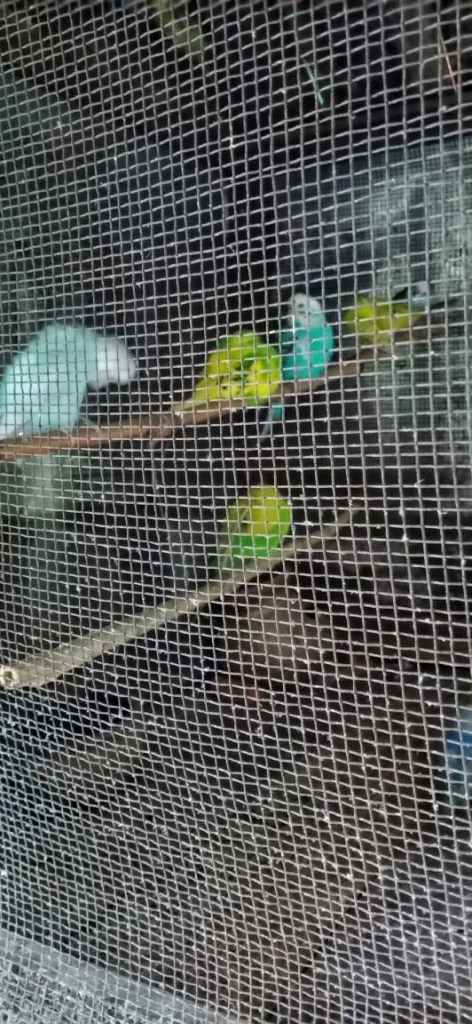
Birds in a large cage in Saratchandra’s home. Photo Courtesy: Ratnottama Sengupta

Growing up in a Vaishnav family where kirtan was a part of daily life, I had always loved this song Rabindranath Tagore composed in the kirtan style. In my later years I thought the Universal Poet had penned the Natya Geeti — song drama — in the context of the Freedom Struggle. No, I learnt in an essay by the poet: it was penned in 1892 to put into words a more universal philosophy — the duality that is part of every human existence. 
Difficult to comprehend? Perhaps not, once we obliterate the sameness of the two birds and attribute gender markers to them. Tagore himself thought of the caged bird as the woman in every man, and the free bird as the man in every woman. Perhaps that is why it is structured along the lines of the traditional Shuk Shari samvad — a conversational song between between two birds (parrots perhaps?) — wherein Shuk is a follower of the masculine, Purushottam Krishna, and Shari of Radha, the essence of femininity. However, I was prompted to look up the poem recently when I saw a large birdcage in a corner of Saratchandra Chatterjee’s house in Deulti some 60 km from Kolkata. It was pretty routine, apparently, for households then to have aviaries ‘domesticating’ finches, canaries, parakeets, cockatiels, lovebirds and other feathered pets — much like today’s people with pet dogs and cats. But I was struck by a different thought: Did the two birds represent the two stalwarts of Bengali Literature who lived at the same time? Did one look inside homes and scan woes besetting the happiness of their human relationships? And did the other take off from his perch on a branch of the tree rooted in terra firma, to swim in the boundless ocean above? Even today, one draws you out into the vast expanse while the other pulls you homeward. Together? They give us a  universe…

Notes:

Kirtan is devotional music.

Tagore (1861 to 1941) and Saratchandra (1876-1938) were contemporaries. While Saratchandra wrote stories based on real life to expose and reform social ills, Tagore’s work was more philosophically inclined, though he has written of such societal issues too.

In 1894, Rabindranath wrote in Aadhunik Saahitya while commenting on the works of the poet Biharilal Chakraborty –

“… There is an independently moving masculine entity within our nature, which is intolerant to bondage alongside a feminine one which preffers to be enclosed and secured within the walls of the home. Both of them remain united in an inseparable fashion. One is eager to develop significantly his undying strength in a diverse way by savouring ever-new tastes of life, exploring ever-new realms and manifestations and the other remains encircled within innumerable prejudices and traditional practices, enthralled with her habitual deliberations. One takes you out into the vast expanse and the other seems to pull towards home. One is a forest bird (or the free bird of the translation by Ratnottama Sengupta) and the other is a caged bird. This forest bird is the one that sings much. Although, its song expresses with its diverse melodies the whimper and its craving for unrestricted freedom.”

Rabindranath Tagore was a brilliant poet, writer, musician, artist, educator – a polymath. He was the first Nobel Laureate from Asia. His writing spanned across genres, across global issues and across the world. His works remains relevant to this day.

Ratnottama Sengupta, formerly Arts Editor of The Times of India, teaches mass communication and film appreciation, curates film festivals and art exhibitions, and translates and write books. She has been a member of CBFC, served on the National Film Awards jury and has herself won a National Award. 

.

PLEASE NOTE: ARTICLES CAN ONLY BE REPRODUCED IN OTHER SITES WITH DUE ACKNOWLEDGEMENT TO BORDERLESS JOURNAL

Categories
Poetry of Jibananda Das

If Life were Eternal

Translated By Professor Fakrul Alam

IF LIFE WERE ETERNAL…

Given the boon of eternity, I would walk the ways of the world eternally.
All, all alone -- what if I would see lush green grass in full bloom then?
And what if I beheld the yellowing grass withering away -- And view
The sky full of wan white clouds at dawn? Like a tattered munia bird
Blood reddened breast in the evening -- I would see the stars repeatedly;
I would see an unknown woman’s hair drifting away from a loosened bun;
A woman who would leave -- with a face bereft of the evening sun’s glow.  

Jibonanada Das (1899-1954) was a Bengali writer, who now is named as one of the greats. During his life he wrote beautiful poetry, novels, essays and more. He believed: “Poetry and life are two different outpouring of the same thing; life as we usually conceive it contains what we normally accept as reality, but the spectacle of this incoherent and disorderly life can satisfy neither the poet’s talent nor the reader’s imagination … poetry does not contain a complete reconstruction of what we call reality; we have entered a new world.”

Fakrul Alam is an academic, translator and writer from Bangladesh. He has translated works of Jibanananda Das and Rabindranath Tagore into English and is the recipient of Bangla Academy Literary Award (2012) for translation and SAARC Literary Award (2012).

.

PLEASE NOTE: ARTICLES CAN ONLY BE REPRODUCED IN OTHER SITES WITH DUE ACKNOWLEDGEMENT TO BORDERLESS JOURNAL

Categories
Stories

The Doll

By Sohana Manzoor

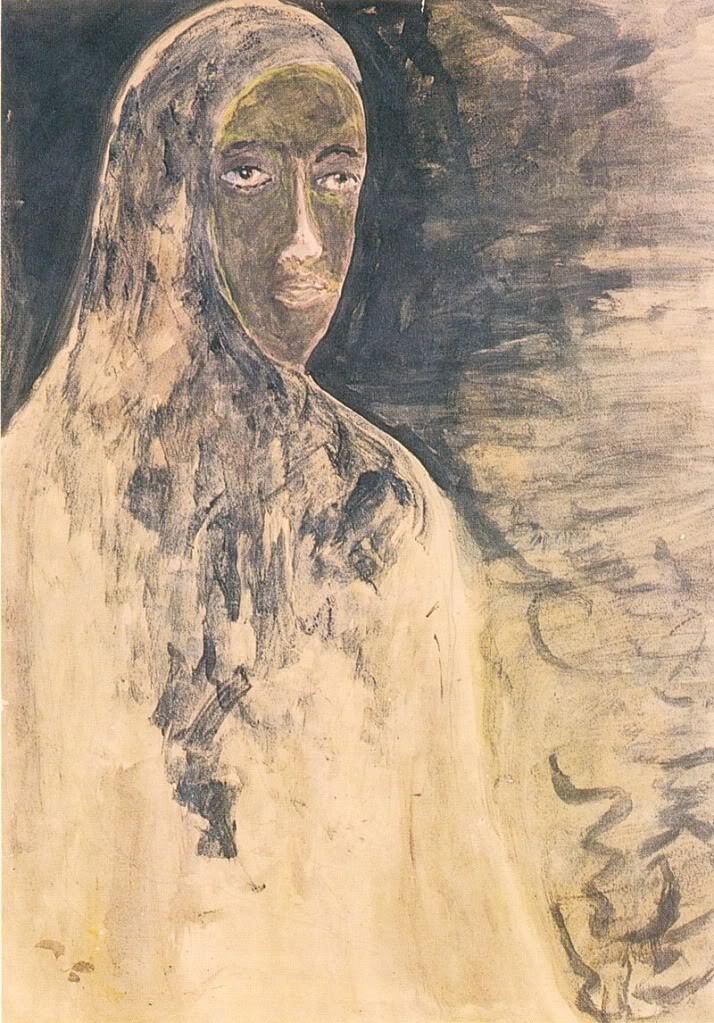
A veiled woman, painting by Tagore. Courtesy: Creative Commons

Aronee closed the door behind her. Softly, very softly. She was always soft. “Soft”, “polite”, “quiet” were the epithets her friends and relatives used to describe her. As a child, a teenager, a young woman, she was always the good one, the sacrificing one. Now as a mature woman of forty-two, she is still considered a caring wife, a loving mother and a concerned daughter. As a teacher, she is excellent and well-loved.

She looked at the mirror in her bathroom. Her hair was still raven black. A slight frown etched her smooth forehead. But it’s her eyes that signalled that something was very, very wrong. Her eyes that are usually calm and reassuring were dark and stormy. Aronee could not remember that she ever felt so furious and mad in her entire life. She closed her eyes and counted up to 10 and opened her eyes again. It did not help.

She turned the tap and let the water run. She looked at the running water and tried to think straight. How did it come to this? When? How? What did she do wrong? She thought of herself as a toddler. She was the doll of her family. They always told her so. Sweet-tempered, Aronee never had a tantrum like her other siblings or cousins. She just stared at Ashik, her elder brother, who yelled at the slightest discomfort, or Alena, her younger sister who screamed incessantly when her whims were not fulfilled. As she grew older, she learned to be patient, accepting things rejected by Ashik or Alena. Sometimes, she did try to complain, but her mother told her reproachfully, “Aren’t you a good girl, Ronee?” Being a good girl sucked, she often thought, when Alena got away with the best things, and she had to do with the leftovers. But Aronee was beautiful. Whatever she wore, however she dressed, she appeared elegant, composed and lovely. And Alena was forever jealous of her elder sister.

Her only comfort was when she heard her mother say to others, “She is such a doll, my Aronee. She never complains.”

Her grandmother said, “Be patient, my girl. Allah will be good to you.”

What was the definition of good, and what was bad? Wondered Aronee unmindfully, trying to catch the running water in her fingers. But the water slipped away as did time.

*

“Ronee, Ronee,” the whimpering voice of her sister carried over from the past. She refused to call her “apa” as she was only 15 months younger. Aronee raised her eyes from the book she was reading to see a pouting Alena. “I can’t find my white petticoat. Can I borrow yours?”

“No,” replied Aronee swiftly.

“Why not? And you know Ammu will tell you to give it to me, if I tell her,” said Alena half-laughing. “She hates it when I screech and yell.”

Aronee looked at her sister witheringly. “The last time you took my blue jamdani, you tore it at the bottom. Aren’t you ashamed?”

Alena went quiet. And then she looked up at her elder sister smiling, “You are so good, Aronee. And you preserve your things so well. I just looked at the white starched petticoat of yours and felt that mine looks crumpled and dirty.” She changed her tone and wheedled, “Please, Ronee, can I have your white petticoat? Pleease?”

Aronee sighed. “Okay, go ahead. Just be careful, okay?” Alena jumped up and kissed her sister and ran off gaily, “You’re a doll, Ronee.” Aronee shook her head and concentrated on the mystery novel she was reading.

*

Ashik had gotten into the most horrendous possible mess. He got his cousin Shabanm pregnant while being engaged to his girl-friend Myra. He was not even particularly perturbed by it—putting the entire fault at Myra’s door. “Well, she said she would not sleep with me before marriage,” he had shrugged. “And Shabnam was available; more than willing actually.”

Then there was pandemonium.

Myra cut off from him, and for the first time in his life Ashik was forced into giving in. His father went livid, and Aronee heard him yell at his wife, “It’s all your fault. You never reprimanded him for anything. Now look what has come to your darling boy. If he doesn’t marry Shabnam, I will throw him out of the house without a penny. And I mean every syllable.”

Aronee’s mother tried to speak up, “Shabnam is not an innocent. She seems to have no …” she could not finish as her husband said ominously, “Don’t. Whatever you’re about to say, don’t.” He paused and added, “She is MY sister’s daughter. You wouldn’t have acted this way if she was YOUR niece. Just make sure that he marries her. If he does not, you too can move out of the house.” He stormed out of the room.

Aronee was listening to the hubbub and wondered at Ashik’s audacity. She had to agree with their father. It was always like this — he could get away with murder with his mother as his staunch supporter.

When Aronee approached her mother, she was in tears, “How can Shabnam be my son’s wife? And she got pregnant out of wedlock too! Oh, Allah, my poor son! How would I know that it is his even?” Then she turned to Aronee, “Ronee, tell your father that Shabnam has another relationship. He will believe you.”

Aronee stared at her wailing mother and realised how pathetic and unscrupulous she was. Would she have been able to say the same things if it was Alena, or her? Aronee felt ashamed. She said quietly, “Bhaiya has already admitted to his part in the matter. And even if he did not, I would not say such a blatant lie. Amma, how can you? What if it was me, or Alena?”

Aronee’s mother sprang up. “My daughters would never bring such shame on the family. I have raised them differently,” she said proudly. “It’s all Rahela’s fault. Like mother, like daughter.”

“And yet,” thought Aronee sadly, “Your son did it? How did you bring him up?”

But then he was a son, the only son of her parents.

*

On her wedding day Alena winked from under her bridal veil, “Aren’t you happy now? I won’t be bothering you anymore.”

So, Alena was getting married before Aronee, at the age of twenty-one—to the man of her dreams. No, to the man of their dreams. Aronee had loved him in silence for years, but Alena was vocal, and she claimed him. Aronee did not know back then that Swaron also loved her, and not the sister he was getting married to. But since Aronee kept silent knowing about Alena’s infatuation with him, he did not know what to think. Meanwhile, Alena went on pestering him, and he gave in.

Aronee looked at her sister critically, “The make-up is a bit too much. They have virtually white-washed you!”

“Let it be. Let me be fair for one day,” Alena rolled her eyes. And then sighed, “You will always be the more beautiful one, Ronee.”

Aronee tsked, “You are getting married to the man you love. What more do you want?”

Suddenly Alena whirled around, “You,” she whispered. “I’ve always been so jealous of you, Ronee. Everybody loves you more. Even our good for nothing big bro thinks you’re an angel. Can you teach me how to be like you?”

Aronee sighed, “There you go again! You’ve been blabbering like this for the last three weeks. What’s got into you?”

Alena threw her arms around her elder sister and started bawling. “I’m so sorry Ronee. I know I’m a terrible sister! Please, forgive me. Oh, please.” It took a while for Aronee to calm Alena down. “Hey, you’re my li’l sister, remember? Annie, what’s wrong? We all love you so much… look at me. Your make up will be ruined in no time now.”

Finally, Alena calmed down and allowed Aronee to fix her make-up.

But the perky, lively girl that got married one summer evening lost her spirit soon. Everybody noticed the change. Whenever she came to visit her parents and, she seemed down and pale. No, Swaron was attentive. Never mistreated her or said anything nasty. But nor did he look at Alena the way he looked at her sister. His countenance lit up whenever Aronee was in the room. He gave Aronee the due respect of an elder sister-in-law. But Alena knew. She had always known. Only she thought that like everything else she could make Swaron love her. She failed miserably.

If Swaron was abusive and complaining, she could have said something. But he did everything correct. He paid her attention, took her to shopping, dinner. They had gone on honeymoon. And all the time, she felt that his heart was in an impenetrable glass box. She could see it but could not touch it. Once, she had pleaded with him, “Swaron, you married me. Not Aronee.”

Swaron looked at her, his eyes like glass, “Yes?”

“Can’t you love me a little?”

“I told you long ago that I love your sister, not you. Still, you persisted — you threatened to tell your family that I had compromised you. I warned you that I would never love you. Why are you complaining now?”

Alena looked at him helplessly. Yes, he had told her, but she thought time would change things. They change in movies. Now over a year into the marriage, nothing changed.

Yes, Alena confessed all these to her sister, finally, bitterly. By that time, she, too, like her brother had caused a huge uproar. Out of anger and frustration, she had run away with a neighbour, who had been trying to catch her attention for some time. Their father had a heart attack and became an invalid. It was Aronee who was strong during those days, who took control of the household. Her brother’s marriage also did not work out; after two years of stormy conjugal life, Ashik and Shabnam parted ways. And stupid Alena had said, “You can marry Swaron, if you want.”

Aronee shook her head, “Are you insane, Alena? Or do you pretend to be dumb?”

“Why not?” sniffed Alena. “You too love him.”

“Love is not the most important thing in the world,” retorted Aronee. “Can you imagine what will happen to our family? How people will talk?”

Alena just stared at her. Aronee had said simply, “The paths of heart and duty are not always the same.”

She never thought otherwise, until today. She looked at the woman in the mirror. “What did I do wrong, can you tell me?” she whispered.

*

Aronee married, of course, but according to her parents’ choice. Her husband Taufique was an engineer from a respectable family. They were not in love when they married, but they came to a good understanding. They even came to care for each other, had a good partnership—something most marriages lack. They had two children, Abeer and Trina.

Now, after 14 years of steady marriage life Aronee just realised that all she stood for had been  a sham. Wasn’t there anything called stability and truth in life?

*

Aronee waited. She sat in the veranda and looked calmly through the bright orchids she had planted and the ivy that ran down the red brick wall. The place she had called home for over a decade was not her home after all. The course of her life was crystal clear.

*

When Taufique came home late at night, the apartment was seemingly empty. There was no sound of Abeer and Trina, or even Aronee. He had informed that he would return after a business dinner. So, the lights in the dining room were turned off. Nothing unusual. But for some reason he felt something different. He stood at the door of the bedroom that he and Aronee shared. Yes, she was there as she always was. Suddenly, he felt guilty. He has been feeling uneasy for some time now. He realised that he needed to talk about Shuvra except that what could he say? That Shuvra made him feel like a man? That he felt like taking care of her? Or that Aronee was so strong and capable that she made him feel less than he was? The woman who sat in the middle of the room, looked up and Taufique’s heart gave a little leap. Her coffee brown eyes were calm, but there was a tremendous sadness in them.

Taufique walked in, faltered, and stopped. Didn’t he tell Shuvra that Aronee would be devastated if she knew? Instead, why did he feel so weak? And helpless?

Aronee looked at him steadily and he realized that no confession was necessary. He felt like a little boy caught at stealing jam.

“Why?” whispered Aronee. When he did not answer, she simply said, “Abeer and Trina are visiting their nanubari. I guess, it will become temporarily permanent.” She paused and said, “I stayed on to tell you that I am leaving. I will file a case for divorce. You can contend if you like. But considering everything I hope you won’t.”

“You’re taking Abeer and Trina? Just like that?” Taufique’s voice was a hoarse whisper.

Aronee was calm. “You want them with your future wife?”

“They are my children,” he choked, feeling completely unmanned. Aronee may not like Shuvra, but Shuvra was raising her two younger siblings by the hand. She knew all about children. But Taufique suddenly realised that the sentence he had been rehearsing for many months was pretty dumb.

“They are mine too,” responded Aronee.  “I certainly won’t allow my son and daughter to be raised by a whore.” The emphasis on the last word shattered Taufique. Why didn’t he ever think that Aronee would object to him having the children? Or maybe because he was so absorbed in Shuvra, he never examined his stance about them. Now he knew that Aronee would not budge from her position. Good girls like Aronee acquiesced most of the time. But when they finally take on a standing, they do not give away an inch.

“You can’t leave. Not like this,” he almost whimpered.

Aronee turned away from him and picked up her large brown bag. She was wearing a deep blue striped handloom saree. Her face betrayed no emotion.

“You can contact me at my mother’s house number. Just don’t try to call me on my cell phone. I don’t want any alimony. But Abeer and Trina still will need you. I hope you will act accordingly.”

The door closed softly. But to Taufique it seemed like a bang.

The doll was finally awakened.

Who exactly was Shuvra?

Taufique felt like a dead man.

*

Sohana Manzoor is Associate Professor, Department of English and Humanities, ULAB. She is also the Literary Editor of The Daily Star. This story was previously published in Six Seasons Review.

Categories
Essay

Potable Water Crisis & the Sunderbans

By Camellia Biswas

Many projected climate change impacts, including sea-level rise, temperature increase, heavy rainfall, drought and cyclone intensity, is increasing yearly flooding, riverbank erosion, salinity intrusion, etc. These pose severe impediments to the socio-economic development of India, especially the coastal areas. The coastal area of India, especially the Bay of Bengal, is located at the tip of the northern Indian Ocean. It is frequently hit by severe cyclonic storms, generating long tidal waves aggravated by the shallow bay.

At least one major tropical cyclone strikes the Eastern/south-eastern coast each year with powerful tidal surges. The Chakraborty et al (2016, 13-19) report states almost 2.3 million people were affected by Cyclone Aila more than a decade ago in May 2009. Many people were stranded in flooded villages. The tidal surge was about 10-13metres in height. It washed away enormous number of households, lives, livestock, crops and all other resources of the affected region. Aila was not a powerful storm, but its heavy incessant rains and storm surges were enough to swamp the mouths of the Ganges in both Bangladesh and India (Biswas 2017).

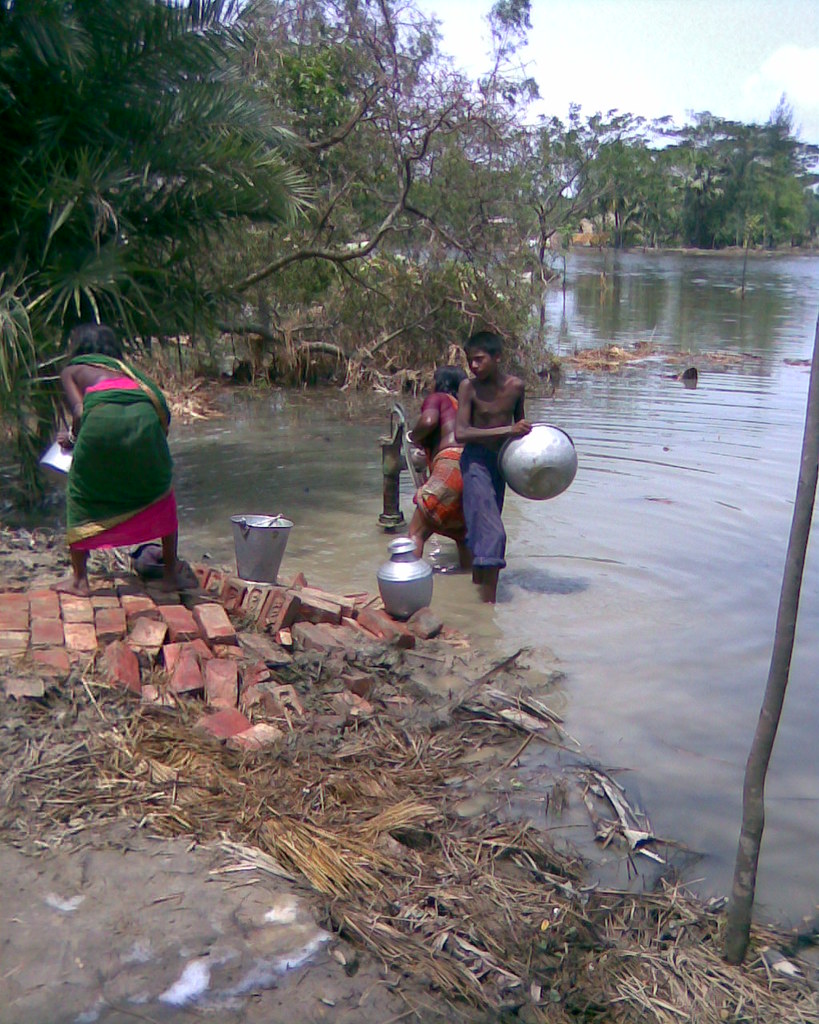
Some islands in the Bay of Bengal and the mangrove forests of the Sundarbans region were wholly submerged underwater. This catastrophe happened within a brief period, which resulted in people becoming homeless, leaving their assets in the households. A tiny percentage of the affected people could take shelter in the nearby cyclone shelter or schools during the cyclonic event. However, in several discussions, the affected people criticised that most cyclone shelters were built post-Aila and schools had only ground floors, which was anyways inundated. Most people thus took refuge on elevated roads. The extreme flooding also resulted in thousands of people losing access to safe drinking water and exposure to floodwaters containing untreated wastewater, dead animals and fish.

Impacts on water systems and water quality are often not visualised as chronic damage to property or the landscape. And thus, most treatments to these problems are temporary and short-lived. Potable water scarcity is a cumulative problem in the coastal region of India, especially Sundarbans, as it is revolving saline water slowly. Climate-induced disasters like rainfall, cyclone and storm surge, flood etc., are making the situation worse. Coastal people gradually depend on groundwater due to surface water salinity. As a result, groundwater extraction is increasing day by day. For that reason, the shallow aquifer has also been contaminated by salinity intrusion.

I have witnessed the horrific situation of women and children wailing for drinking water and waiting for relief distribution while spending my summer holidays at my native house in Sundarbans. The 14-year-old me then was horrified by the helpless situation of my own people, my kin and kept wondering whether disaster management conditions would be better or worse in due course of time especially when it concerns marginal communities of Dalits and Adivasis.

The memories of Aila keep flashing back to these Sundarban islanders every time they are hit by a cyclone or post-cyclone flood. Some of the stories they shared with me during my doctoral fieldwork made me revisit my Aila memories. As a native researcher, it gave a new stance towards the importance of water beyond its economic value and enhancing communities’ socio-cultural ties. Water, which has often served as an agency to conflict and dispute, during Aila it stimulated the sense of brotherhood and togetherness among the Samsernagar village residents.

Flood Friendship Between India-Bangladesh

Samsernagar is the last village in West Bengal’s Sundarban, bordering Bangladesh by river Kalindi. During Aila, the embankments of Samsernagar broke, resulting in the inundation of the village with the high tide influx from Kalindi. It led to total ruination of the settlement in just a couple of minutes. Samsernagar was submerged in the water, and so were the tube-wells and ponds, which were the only source of drinking water. It is where the villagers from Bangladesh came as harbingers of help.

In the political map, Bangladesh and India are demarcated as two separate nations. However, for people in Samsernagar, their neighboring village will still be the Village Koikhali of Bangladesh. To better understand, I phoned one of my respondent’s relatives who lived on the other side and asked about their experience during Aila regarding the help they provided to the Samsernagar residents. Koikhali residents came to Samsernagar rowing on their boat with barrels of potable water and other essential aids like food, clothes and mats. From several discussion and information interaction, it can be inferred that Samsernagar still recognises their international neighbour’s gesture which didn’t let them die of drinking polluted water. This act showed how, on the one hand, the water acted as a demon to the villagers through flooding and on the other, the barrels of drinking water brought by the neighbouring villages of Bangladesh became a sign of camaraderie and community interest. It went beyond just a mere necessity to live. It showed us how two villages come together, ignoring the human-made international boundary.

The Dilemma of Drinking water Crisis

That this acute drinking water problem can turn into a chronic issue in events like Aila and similar flooding situations is given credence by the fact that underground water also becomes saline due to leaching and seepage. Even after the floodwater recedes, the tube well water remains undrinkable. Sittler (2017), in her study on ‘Floodwater and stormwater can contaminate your water well’ argues that regardless of where storm-water runoff occurs, like floods, it can carry harmful contaminants such as soil, animal waste, salt, pesticides, and oil, potentially impacting drinking water wells and water quality. When discussed these challenges with groundwater experts at Sundarbans, they pointed out that in the Hingalganj Block, where Samsernagar village is situated, many deep tube well weren’t rightly maintained. Excessive contaminant-laden run-off infiltrated these drinking water wells through and assessed that the well casings or caps may not have been completely watertight. Moreover, any potential contaminants into the well can pose at least a short-term risk to water quality and human health.

In 2009, many families in Sundarbans, out of desperation, consumed pond water undergoing some basic filtration, knowing that the pond water stank from carcasses of dead animals. As farmlands remain filled with saline water, paddy yield became meagre the same and following year. Affected people when interviewed spoke of the mismanagement of the state’s relief supply and its lack of providing safe water, on how the local administrations would run some basic filtration like boiling the contaminated water and distributing it. As a result, hundreds of villagers suffered from diarrhea two weeks after drinking contaminated water. According to UNICEF, 28 diarrheal deaths were registered, and over 85,000 cases were reported from the Aila-hit districts of West Bengal.

Water can be considered a symbolic element, a resource, a commercial product, or a service. The interconnections established and the value attributed to water usage serves to build norms and references that influence the decision-making process from individuals to higher levels of social organisation. When considering it a resource for life, its interests and values vary and change across cultures, communities, states, space and time. One may raise an inquiry that spaces like Sundarbans is surrounded by rivers and seas, and that’s presumably the reason why Sundarban locals might not feel impacted by the presence of noble metals in the water.

However, as Sundarban landscape has a mangrove ecosystem, the water quality in and around the area has been found to be of inferior quality (CGWB report, 2014-15). If also, post-Aila most deep wells that were reconstructed at the height of 8-10ft above flood level so that the runoff was less likely to introduce contaminants into these wells, slight amount of saline water still managed to seep into the groundwater. However, it is the persistent presences of high iron and arsenic in the wells within that should raise alarm. So, even though the region is surrounded by water, most of it is toxic. Thus, for the Sundarban islanders, continuous access to safe and potable water is an aspiration that continues a dream for the whole community.

REFERENCES:

.

Camellia Biswas is a doctoral candidate at the discipline of Humanities & Social science, IIT Gandhinagar. She is an Inlaks-RS conservation grantee for the year 2021-22. Her research specialises in Environmental anthropology, focusing on human- Nature Interaction in Indian Sundarban under the larger discourse of Climate disaster.

.

PLEASE NOTE: ARTICLES CAN ONLY BE REPRODUCED IN OTHER SITES WITH DUE ACKNOWLEDGEMENT TO BORDERLESS JOURNAL

Categories
Poetry

Lake Poets & Ryan

Poetry by Ryan Quinn Flanagann

A view of the Lake District which nurtured poets like Wordsworth, Coleridge & Southey and writers like the controversial Charles and Mary Lamb. Courtesy: Creative Commons
In the Kawarthas Thinking of the Lake Poets Strung Out on Opium, Words and the View

Sure, Coleridge was a Wordsworth fanboy, but I always thought him the better scribe.  
Taking that albatross of opium dreams as far as bad teeth were willing to chatter.  And Southey sliding into third although Bryon claimed him thrown out by establishment leanings.  Both Lambs lead to slaughter and De Quincey’s Confessions of an English Opium Eater which must have made Samuel Taylor want to race Kubla Khan straight to the bottom of the laudanum bottle.  Addiction in popular literature and not just for it.  And here I am beside wifey’s warm jam jams.  In the Kawarthas, thinking of the Lake Poets strung out on opium, words and the view.  How the Edinburgh Review coined the term trying to slander a little drummer boy out of his only percussion.  But the name stuck, as such things often do and who remembers anything about the critic now?  That’s what I adore about this guttural bullfrog of a cosmos.  How the hodge of the podge never clamps down on salty bitters.  Beside this fire reinvented, on the water and off the clock.  Heavy gangplank eyes uncorking another bottle.  Leaning back in twin Adirondacks wishing the loon out of every asylum.  The howl of distant wolves across this long unanswered wilderness.

Ryan Quinn Flanagan is a Canadian-born author residing in Elliot Lake, Ontario, Canada with his wife and many bears that rifle through his garbage.  His work can be found both in print and online in such places as: Evergreen Review, The New York Quarterly, Borderless Journal, GloMag, Red Fez, and The Oklahoma Review

.

PLEASE NOTE: ARTICLES CAN ONLY BE REPRODUCED IN OTHER SITES WITH DUE ACKNOWLEDGEMENT TO BORDERLESS JOURNAL

Categories
Poetry

The Dispute with Simon Magus

Poetry by William Miller

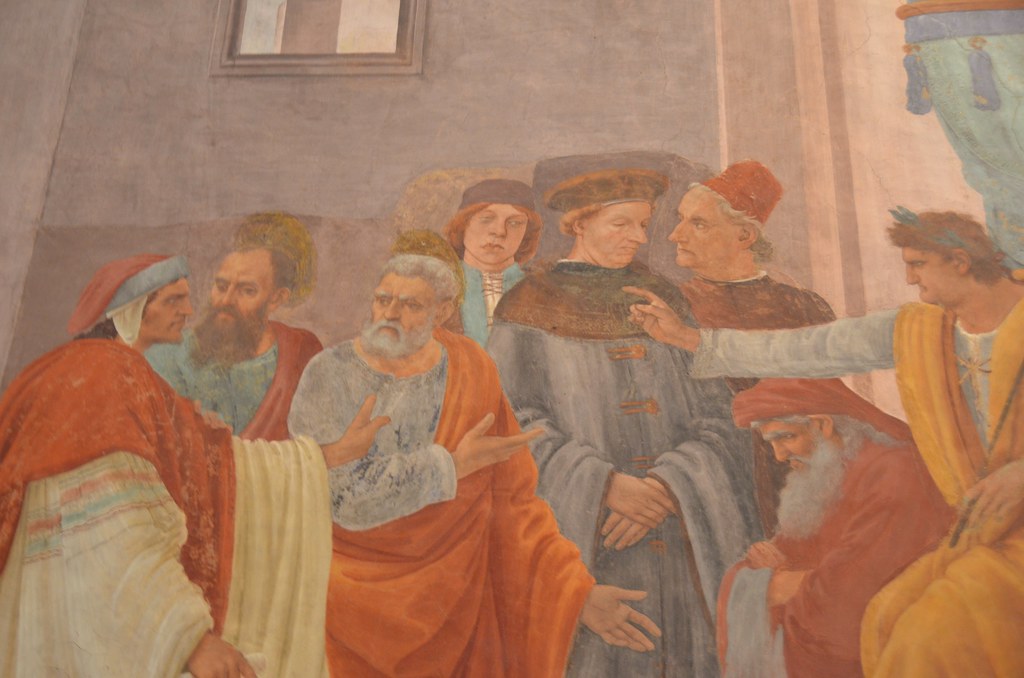
Disputation with Simon Magus, Filippino Lippi (1457-1504). Courtesy: Creative Commons
THE DISPUTE WITH SIMON MAGUS
  (after Filippino Lippi)

The apostles walk in lock step, red-capped 
and wearing long Florentine robes, their eyes 
steady with purpose. But he looks between them:
cropped black hair, long aquiline nose, almond eyes
that probe for more than wisdom in a leather-bound missal.

One in three, the third member of the trinity—man’s soul
curious beyond silver clouds, the harps of heaven,
doesn’t believe in a bended knee or simple names 
for an ancient mystery: “Jesus,” “Jehovah,” “I AM.”
Simon Magus carried in his black heart the beat

of God’s favourite angel, all the secrets he knew
 inside locked iron gates. From his grave grew a tree
of unforbidden fruit, the pulpy juice sticky and sweet
as poison that does everything but kill. Clerics walk
in lock step and never purchase with a bag of gold florins

the miracle of healing a withered hand, the secret
of daily resurrection. Simon’s dark eyes look
into ours asking only that we seek and find, knock
and open the door that leads to a downward staircase,
treasures the king hordes only for himself.

FULL IMMERSION

The first in my Sunday school class to walk down,
answer the altar call by myself, I was only twelve.
Only twelve but growing into a gray, confused age.
My father drank vodka from a flask in the church
parking lot; my mother was a perfumed ghost
with blood-red nails, there and not there.

I didn’t believe in Jesus or the grim preacher,
the pious rednecks in folding chairs who ate
saltine crackers and sipped warm grape juice from
shot glasses once a month. I hated hymns, 
never wanted to join the faithful on a “Beautiful 
Shore” or stand like a cheated fool at the foot

of the “Old Rugged Cross.”  But I liked 
the water rite, hoped to drown and come up 
someone else reborn with wings to fly away from
the new brick church with modern stained glass.
My only ticket out was dying in a tank behind
the altar, chlorine water in my nose and lungs

after being dunked three times. And on that day,
two Sundays later, I wore a choir robe and rubber 
boots, took three steps down into the blue-green
lukewarm water. The preacher pinched my nose
and held me deeper when he called down
the Holy Spirit. It didn’t work, not then

or now, not death enough but something different
for a few drowned seconds, heart pumping hard
from lack of air. My robe was soaked, my hair 
wet and pasted to my forehead. The organ
cranked out “Amazing Grace” as if I were saved,
a child sinner come home.


MY NEIGHBOUR IS A DEMONOLOGIST

He once told fortunes on the square but made no money.
Our super, he wears a black wifebeater t-shirt 
with a white upside-down cross and the angry words
across his chest: “Hail Satan!”

Never, unless it was a third-time request to fix a broken
smoke alarm or leaky pipe, did he speak to anyone,
his face hidden behind long dirty-blonde hair.
Kittens in his window looked out all day with sad eyes—
                                             
my next-door neighbor, a drunken bartender, swore
he sacrificed them, one by one, to the Devil.
Not until the hurricane that blew our lights and AC out
for eight days and three hours,

the temperature over 100 degrees, did his sallow skin
start to crack. He told me at midnight in the courtyard
that he wanted to go home to Indiana, buy a farm 
and live with cats he didn’t raise to sell to the best owners

he could find. He loved their mystery, their silence.
New Orleans had chewed him up. The mosquitos alone 
made us all victims, the water we had to boil 
for thirty minutes before we drank it, took a bath

or washed our hands. He was robbed for his shoes
and belt, stepped on a dirty needle walking home.
He wanted to see the seasons change, watch the leaves
tumble down and die a slow, lovely death.

Twenty miles from the nearest church, he’d live alone,
and never care if the moon meant anything more 
than light between the trees or on the grass—
twenty miles from any cross, upside down or not.

William Miller’s eighth collection of poetry, Lee Circle, was published by Shanti Arts Press in 2019.  His poems have appeared in many journals, including, The Penn Review, The Southern Review, Shenandoah, Prairie Schooner and West Branch.  He lives and writes in the French Quarter of New Orleans.

.

PLEASE NOTE: ARTICLES CAN ONLY BE REPRODUCED IN OTHER SITES WITH DUE ACKNOWLEDGEMENT TO BORDERLESS JOURNAL

Categories
Review

Sisterhood of Swans

Book Review by Rakhi Dalal

Title: Sisterhood of Swans

Author: Selma Carvalho

Publishers: Speaking Tiger Books

To feel a kind of belongingness, to find acceptance in a society is an inherent human desire. Perhaps this desire stems from the need to strengthen alliance with something larger than individual identities. It is not only family, but also the place we live in, the community we come from, as well as the prevalent societal and cultural norms which fall into this ambit for most of us. Sometimes the scales in life do not balance till this desire remains elusive. More so when one makes home a place not native to the community one belongs to.

Selma Carvalho is a British-Asian writer whose work explores the themes of migration, memory and belonging. She is the author of three non-fiction books documenting the Goan presence in colonial East Africa. She led the Oral Histories of British – Goans Project (2011-2014) funded by UK Heritage Lottery Fund. Her stories have been published in various journals and anthologies. She is the editor of two volumes of The Brave New World of Goan Writing & Art (2018 and 2020). Her work has been shortlisted for various literary prizes including London Short Story Prize and the New Asian Writing Prize. She is the winner of the Leicester Writes Prize 2018 and a finalist for prestigious SI Leeds Literary Prize 2018. Sisterhood of Swans, her debut novel, was shortlisted for Mslexia Novella Prize 2018 in the UK.

Carvalho’s book explores the complexities around this desire to belong and yet the inability to fully embrace the possibilities a place offers because of conceived notions a propos the idea of identity. Her writing, traversing the world of immigrant Indian community in London, is focused upon anxieties and their repercussions, as experienced by a second generation immigrant. Anna-Marie Souza is plagued by a yearning to belong and to hold onto the familiar. Her restlessness stems not only from the inescapability of ethnic alienation, being a Goan-Indian in Horton, but also from the inevitable suffering caused by her parents’ separation.

Consequently, she longs to find a soul mate, a bond for life. In her relationships, first with Nathu and then with Sanjay, she seeks a father figure, a man in whom she may find a resemblance of her father. The choices Anna-Marie makes are flawed and she carries on with them even while understanding that they might be doomed for failure.

The men in Anna-Marie’s world are all adulterers, diving into new relationships and then abandoning their families to move onto other women. It appears almost like a cycle. Every woman she comes across goes through the ordeal. Left in misery by their husbands/partners, they desperately try to put the pieces of their shattered selves together. Their kids endure fractured lives. But it is never the men who suffer, they keep moving on like a river flowing into another and renewing itself, unbroken and unburdened.

It is to this sisterhood of pain of women that Anna-Marie belongs. Like swans, these women look to pair for life but it is disappointment they are fated for. Whether it be her mother, Ines, Sanjay’s wife, Kaya, or her schoolmate, Jassie.

In drawing out the characters of Anna-Marie and her best friend, Sujata, Carvalho also puts the focus on what is inherited from parents subconsciously. In case of Sujata, her father’s illness comes a full circle to haunt her person as she grows up and try to make sense of her existence in a place she recognizes as her home but do not completely fit in. Anna-Marie on the other hand, start relating more to her mother once she steps into motherhood herself, recalling that it was never her father but mother who had always stood by her.

 Carvalho’s pen proficiently renders the intricacies brought about by intersection of different cultures and their consequent uncertainties. She handles the notions of belongingness delicately and with much sensitivity. Her characters are not without flaws and yet they are memorable for their openness and ability to perceive things genuinely. As pointed by Sujata, Anna-Marie comes to accept life as a constantly evolving construct in which to grow also means to allow oneself to evolve irrespective of the contradictions confronted with. To come to a juncture where the permanence of a place or constancy of people does not matter and lives are aglow with the radiance of all the love received.  

.

Rakhi Dalal is an educator by profession. When not working, she can usually be found reading books or writing about reading them. She writes at https://rakhidalal.blogspot.com/ .

.

PLEASE NOTE: ARTICLES CAN ONLY BE REPRODUCED IN OTHER SITES WITH DUE ACKNOWLEDGEMENT TO BORDERLESS JOURNAL. 

Categories
Poetry

Confidences & More…

By Anasuya Bhar

Garden of the Painter at Saint Clair (1908) by Henri-Edmond Cross (1856-1910). Courtesy: Creative Commons
Confidences

After a time 
You do not talk
Or even feel the need 
To unburden.
You look for peace
You sift your thoughts 
Into chapters that are closed. 
You begin to look within
Into the paths travelled,
The detours made,
The encounters, the altercations
Before you reached the thoroughfares
Of life and living. 
It is always the going, 
The quest that matters.

Routine 

There is some peace
In these familiar chairs
Though austere, stark, 
They bring tangible comfort, 
A sense of belonging.

These wide windows
Invite the gaze across
To the greenery beyond, 
Where the breeze 
Arrests the swaying branches.
Dry twigs, brittle leaves
Gather into brown heaps
All into a cyclical routine.

The chalk, the duster and 
The intellectual debate
Amid eager minds,
Share learning,
A part of the routine.  
But even so, 
Lost is the aura
From the past – 
We return with stories 
Of loss and care
Stowed in our bags
To travel anew on tracks
Of familiarity. 

Dr. Anasuya Bhar is an academic teaching English literature in St. Paul’s Cathedral Mission College, Kolkata, India. She would also want to be known as a poet.

.

PLEASE NOTE: ARTICLES CAN ONLY BE REPRODUCED IN OTHER SITES WITH DUE ACKNOWLEDGEMENT TO BORDERLESS JOURNAL

Categories
Slices from Life

Wooing Children to School

By Munaj Gul Muhammad

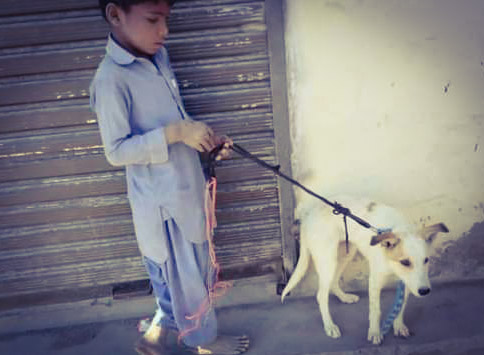
Shah Meer Sowali with the dog he wanted to sell. Photo Courtesy: Munaj Gul

Little Shah Meer Sowali got a dog with him to the bazaar in Turbat. He sold the dog for a small sum because he lives hand to mouth. His beloved and aged father is lame and they live in a broken room. Seeing the condition of little Shah Meer, members of an organisation called SFA (School for All) approached Shah Meer’s family and took the responsibility of the little boy and his little sister as before they both were out-of-school. The family had been unable to enroll the little children because of poverty.  Now, Shah Meer and his sister are enrolled in Bolan School.

The SFA is a non-profit organisation working for the promotion of education and reduction of student dropouts along with enrolling unschooled children into schools in Turbat since its establishment. It was established on October 1, 2020. Since its inception, the organisation has been successfully enrolling many orphans and disabled children along with financially weak children into different private and government educational institutions. The organisation is registered under Balochistan Charities Regulation Authority [BCRA] and is designed to serve the cause of education in the province. The organisation facilitates education of the enrolled students until they matriculate. These children are provided with books, shoes, bags, uniforms, stationery and fees along with other basic amenities.

Given that Pakistan is one of the most illiterate countries of the world, education for people is a daydream. Fahad Baloch, had to go to Quetta to get a basic education.  Unlike Fahad, his brother was not as fortunate. Despite wanting to go to school, he could not. A large chunk of children had no access to uneducated in his locality. But now this gap is being attempted to be bridged by the SFA.

The prime ambition of this organisation is to aid edifying the society where everyone acquires the opportunity to receive an education. They also hope to subsidise the costs. The organisation has successfully conducted three educational awareness programs in different areas of the region and received an affirmative response of the society to enrolling the out-of-school children into schools. The core drive of conducting such programmes was to impart a real sense or essence of education to the minds of the people in the region.

The SFA has been successful in enrolling 21 out-of-school children into private schools and 34 in government institutions. These enrolled children are registered by an agreement drawn up between the organisation and the parents of the children. They have even opened four bookstalls in the region to help get books to those who can read. “The benefits received by the SFA from the bookstalls go to these needy people,” said Kamran Gichki of the SFA. “Since the inception of the organisation, we approached many people, among them some were government officials from the concerned departments, and we shared our motives with them. We received affirmative and moral support from these officers but got financial support only from the middle-class residents in the region. The government is yet to support us in our efforts financially even though by Article 25A, they have made education a must for five to sixteen year olds.”

.

Munaj Gul Muhammed is a journalist and a LLB student at Faculty of Law, University of Turbat. He tweets at @MunajGul

PLEASE NOTE: ARTICLES CAN ONLY BE REPRODUCED IN OTHER SITES WITH DUE ACKNOWLEDGEMENT TO BORDERLESS JOURNAL

Categories
Poetry

Poetry of Michael Madhusudan Dutt

Ratnottama Sengupta translates Bengali poet Michael Madhusudan Dutt’s Bijoya Doushami (the last day of the festival of Durga Puja when the Goddess is supposed to return to her own home from her visit to her parents). This poem is a lament of Durga’s mother, who addresses her daughter as ‘Sati’ in the poem.

Bust of Michael Madhusudan Dutt at his memorial in Jessore, Bangladesh. Courtesy: Creative Commons

Michael Madhusudan Dutt (1824-1873) was a poet and dramatist who was a prominent precursor to Rabindranath Tagore. In his youth, he converted to Christianity (1843) and wrote in English and later turned to writing in Bengali. A product of Western education and the Bengal renaissance, he challenged the traditional literary systems. Multi-lingual and cognisant of several Indian and European languages, including Bengali, Tamil, Sanskrit, Greek and Latin, Meghnadbadh Kavya (1861) was his most important composition, an epic on the Ramayana theme and a tribute to Milton’s Paradise Lost. His repertoire includes Sarmistha (1858), based on an episode of the ancient Mahabharta, Brajangana (1861), a cycle of lyrics on the Radha- Krishna theme; and Birangana (1862), a set of 21 epistolary poems on the model of Ovid’s Heroides and much more.

DEPARTURE

“Do not, O night sky, leave
tonight, with your lot of stars --
Once you go, blissful night,
So will my heartbeat!
Once the merciless sun is up
in the East,
The apple of my eye will lose her shine!

“Full twelve months she shed true tears
before Uma came home. What a balm!
In mere three days, tell me
Oh starry-tressed,
can one have a fill
of delight?
The golden glow of brass lamps
has driven afar darkness
within and without.
Words, the sweetest of creation!
have circled my ears.

“Darkness twice as thick, I know
will engulf this homestead
once you blow out this lamp...” 
Entreated the Queen of Girish,
at the close of the ninth night...

Ratnottama Sengupta, formerly Arts Editor of The Times of India, teaches mass communication and film appreciation, curates film festivals and art exhibitions, and translates and write books. She has been a member of CBFC, served on the National Film Awards jury and has herself won a National Award. 

.

PLEASE NOTE: ARTICLES CAN ONLY BE REPRODUCED IN OTHER SITES WITH DUE ACKNOWLEDGEMENT TO BORDERLESS JOURNAL