Categories
Poetry

Two Sonnets by Asad Latif

Courtesy: Creative Commons
AN INDIA LIKE YOU
For Alma

Footprints in the dust on a Delhi street,
Or Singapore or Washington DC,
The siren world stays faithful at your feet,
But you find her wherever you might be.
And India, too. Tightly, she holds you:
"Never leave me, child. I've nowhere to go."
"I've left?" Alma says. "Indias are too few
to be born in, to see the world, and know.
I'm as Indian as you, India.
It is you, my Bhuvanamohini,
O land of immortals who lie too near
for unlit lamps to show the way to me.
Get a life of your own, female country. 
You've been Bharat always. Now, Bharati."


A TOY FOR YOU
For Ahaan

I've brought a toy for you Master Ahaan.
It's so large I can't get it through the door.
Come out and take a look, my sweet insaan
And it will remain just yours evermore.
"This map is blank," you say. "Nothing to see."
Fill it up with the colours of your mind,
With a river that runs through drought, a tree
Still standing, a spot where the sun can find
A freezing child, a school for girls to grow,
Indias made of laughter and of joy,
Harvests for outstretched hands to overflow
For all time to come. This map is your toy.
Al-Hind is your Āsthā, Bharat's Imân:
Do bigha zameen. Ek mutthi asmaan.


Glossary:
Bhuvanamohini: Charmer of the world
insaan: human being
Āsthā is the Sanskrit, and Imân the Arabic,  for faith
Do bigha zameen. Ek mutthi asmaan: Two acres of land. A fistful of sky

Asad Latif is a Singapore-based journalist. He can be contacted at badiarghat@gmail.com.

PLEASE NOTE: ARTICLES CAN ONLY BE REPRODUCED IN OTHER SITES WITH DUE ACKNOWLEDGEMENT TO BORDERLESS JOURNAL

Click here to access the Borderless anthology, Monalisa No Longer Smiles

Categories
Slices from Life

Near-Life Experiences: Hiking in New Zealand

Sometimes all it takes is a short break to get away from the stresses of your life to realise you have been too busy to be truly living the life you really desire. Sometimes all you need are some near-life experiences to bring you back to Earth. Keith Lyons escapes city life to find his happy place. 

Abel Tasman National Park. Courtesy: Creative Commons

It was almost midday when I finally started to relax and instinctively know that everything was going to be alright. But before then, things had been a little bit rushed. With just 15 minutes before the flight boarding call, the taxi was still spinning a few blocks away on the Uber app tracker. I counted down the minutes, worried not so much about the high fare but about missing the flight. 

Still half asleep, I kept a lookout from my window seat at the snow on the ridges of the Alps, finding amid the peaks and valleys an emerald alpine lake, impossible to reach. Half-an-hour later after the plane touched down, I walked from the airport to the neighbourhood where I grew up, locating the supermarket, and assembling my late breakfast with provisions I’d bought for the journey: half a dozen multi-grain bread rolls, a bag of salad greens, and a small block of extra tasty mature cheese. Suitably fortified, I found camping gas sold in the hunting and fishing shop, though when I walked out of Gun City having purchased one canister, I got a nasty look from the mother with her young child, as if I had just bought a semi-automatic rifle to run riot in a primary school. Seeking the best cafe in town to enjoy a cup of coffee, I found it further along the street, a man in a wheelchair mobility scooter leaving with a broad grin as if he had been given a new lease on life a good enough sign for me. The owner gave me a friendly welcome and a cafe latte in a real cup. With blood sugar and caffeine levels now elevated, it was time to hit the road, to hitchhike to the trailhead, but some primitive drive kicked in when I went past the pizza parlour, so I gave in and commenced carbo-loading on a 12-inch pizza, justifying to myself that I’d be walking it off. 

And I did walk. First, out of town to the crossroads where I only had to wait a few minutes until a science teacher on her way to pick up her children stopped. She told me about their financial struggles and how a generous government allowance kept their family afloat. She dropped me in the next town, and I ducked into the last supermarket just to cram one more packet of crackers into my day pack. 

It was now early afternoon, and the logical part of my brain was asking why I hadn’t started on the hike, which would take four hours. The other part of my brain reassured me that it didn’t really matter what’s ahead, what was here and now was more important. There wasn’t a cloud in the sky, and the sun felt hot on my skin. I walked to the edge of town, but with not so much traffic I was tempted to have a handmade ice cream with local frozen berries. By the time I cleaned my sticky hands with sanitiser, I looked up to see another car had stopped for me. A man with no legs. I moved the wheels of his chair further over in the back seat; later I worried he might not be able to reach them when he arrived at his destination. I was almost at mine. 

One final ride, with a former real estate agent who imparted some wisdom: Live your life to the full while you can, don’t wait till you are old, for then it might be too late, and health problems might blight your life. 

Inside, I felt that I needed this. To be on the road. To be travelling again after Covid lockdowns and fears about venturing out. I needed this to look beyond my day job, my family concerns, and my dilemmas with what to do to secure a long-term future. It seems ages ago, but when I woke up in the morning, the first email I had seen through bleary eyes was a quote from George Addair: “Everything you’ve ever wanted is sitting on the other side of fear.”

I felt buoyed by the interactions, the sharing of truths, and the lifelong lessons. I almost wanted to continue this hitchhiking, this random experiment, at the mercy of the road and its drivers. But I had a reservation for a bunk bed in a park hut, and the holiday I’d planned at the start of the year was now taking shape. 

The trail, the Abel Tasman National Park ‘Great Walk’ (in New Zealand’s South Island) was familiar enough that I felt like I was coming home. I recalled walking part of this track as a child and in recent years I’d hiked sections, including the first four hours. Despite its familiarity, I saw new things, noticed details, and lingered to take it all in. I was in no hurry. So much depended on your mood, your pace, and your company. I took detours down to sandy beaches. I got breathless climbing and climbing and climbing to viewpoints. I stopped to drink the water still cold in my bottle. I sat at strategically placed seats to marvel at the panorama of sea, sand, forest and the horizon. From dazzling sunlight, the route drops into the gloom of forest cover, where I could smell the earthy sweetness of honey-dew on the breeze. The landscape was scenic, but there was more it was doing for my soul. Moving through it was to be immersed in it, to be nourished by the sight, the colours of life, the contrasts, and the abundance of nature. In my head, my soundtrack had songs on repeat, repeat, repeat. Then it skipped to another, to repeat a few times. I needed to upgrade my internal Spotify. I noticed my breathing, and how it deepened. I still had some tension, but slowly it was seeping away, dissipating. Yes, I would like some more of this. Yes, please. 

Every few minutes walkers heading out from day trips or longer multi-day hikes passed by, with ‘hellos’. The Europeans and North Americans invariably walked on the ‘wrong’ side of the trail. Some were seeking suitable places for Instagram pictures. Others clutched the cardboard containers that once held their packed lunch from the ferry operator, looking for a trash bin, despite the notices that everyone must take out whatever they bring in. 

At the hut, most had larger packs than mine, apart from an American who seemed to be staying overnight without any food. We watched him sitting outside using the free wifi, as if he was Googling ‘nearest store’ or finding out if any delivery services worked there. They don’t. The wood fire was lit in the main dining area, and exhausted souls sat around eating camp food and sipping hot drinks. And laughing. It was only just 9.30pm but already half the 30 or so guests had retired to their bunk rooms. There was talk about the need to rise early to take advantage of the low tide crossing, saving an hour or so of extra slog. 

I was woken by the rustling of plastic bags, the clomping of hiking boots on the deck outside, and the hiss of gas cookers preparing porridge and tea. I rolled over and tried to sleep, as I was still tired, a tiredness residual from late nights, long hours working, and the demands of modern life. 

When I finally got out of my sleeping bag and squinted my eyes out at the day, the last of the overnighters were getting ready to leave. I found myself alone. And here I found it. Peace. Stillness. Calm. It is in that place. And it was inside me. 

Framed by the gable roof of the dining hall, through the trees, it was misty across the sheltered bay. The water was still and flat, but I could hear the distant breaking on the shore like a lullaby. I slowly sipped a cup of Lady Grey tea to add clarity. I heard just the twitter of birdsong and saw two tiny birds flit here and there. From a treetop, came the chimes and whirls and clicks of a native bird. Light rain was soft on the tin roof. I was content just to sit and gaze out at the scene, reduced to flat grey tones. I was happy enough just to be breathing the air, which was moist and life-giving. My warm scarf wrapped around my neck gave the embodiment of love, while the woollen hat on my heat topped it off. I was complete.

I felt the need to move, but not to go out in the rain which was getting heavier. Instead, I remembered some Qi Gong exercises, my arms flailing out, torso twisting, rotating. I pulled up energy from the earth below. And with that movement, and in that space, there was nothing I wanted. Just being fully present was enough. It was all I could be at that moment. 

And you. How about you? When will you stop over-thinking, obsessing, and worrying? Just breathe and believe that everything will work out.

Keith Lyons (keithlyons.net) is an award-winning writer, author and creative writing mentor, who gave up learning to play bagpipes in a Scottish pipe band to focus on after-dark tabs of dark chocolate, early morning slow-lane swimming, and the perfect cup of masala chai tea. Find him@KeithLyonsNZ or blogging at Wandering in the World (http://wanderingintheworld.com).

PLEASE NOTE: ARTICLES CAN ONLY BE REPRODUCED IN OTHER SITES WITH DUE ACKNOWLEDGEMENT TO BORDERLESS JOURNAL

Click here to access the Borderless anthology, Monalisa No Longer Smiles

Categories
Poetry

The Decliner

By Santosh Bakaya

Courtesy: Creative Commons
THE DECLINER

“Never seen a wife writing poems at her husband’s expense,”  
Remarked the aggrieved one with an expression very tense.
At me, he waved one almost-threatening admonitory finger,
the other on the mobile screen continued to resiliently linger.
  
One eye watched Miss Marple on the television screen.
The other keen on the cricket match on the mobile screen.
“How can anyone caricaturize ones’ husband, beats me,”
Said the bitter-half, sipping absently from the cup of tea.

“Hey, were you not on the verge of completing your book?”
I remarked, handing him the third cup, with an angry look.
“Hey, my protagonist is shovelling snow from the driveway.
Don’t disturb me, I beseech you, desist from nagging, I pray.
 
 And by the way, I see your ways you are still not mending.
You have been a storyteller, so what if your poems are trending?
Go and finish those novels three, and let me watch the World Cup.”
This cricket enthusiast was now on the offensive; was my time up?

I hastily ran towards my manuscript lying wordlessly on the table.
Hot-hooved horses thudded in my brain reducing it to a stable.
Suddenly a boisterous bellow came to my rescue from husband dear.
He is a jolly good fellow, so at his yells, I never quiver with fear. 
 
In a beseeching tone, he asked me, “What is the spelling of obsession?”
I gaped, scratching my head. No,  this was not a mere hallucination.
Before I could tell him the spelling, he eyed me into total silence.
Frantic his moving finger, furrowed his brow, in his eyes a glint intense.

Whispered he, “Hush, my protagonist is conferring with the butterflies.”
Hissed I, “I am fed up with your untruths, half-truths, and blatant lies.”
“I asked you a  spelling, and you are unspooling synonyms of mendacity."
He capped the pen, glared dangerously at me, and got up with alacrity.  

“There is some missing link, let me go watch Benedict Cumberbatch.
He has solved many a mystery; in him, I am sure to find my match.”
“He is only an actor, not a writer, writing seemingly unending tomes.”
“But, mind you, he is a much-appreciated actor playing Sherlock Holmes.”

This wagging of tongues and battle of wits continued for a  long time.
Who said, a petty squabble, short of fisticuffs between couples, is a crime?  
So right now, both of us are sitting together watching 'The Abominable Bride'.
Folks think we are made for each other, unaware that we just took them for a ride. 

Dr. Santosh Bakaya is an academician, poet, essayist, novelist, biographer. She has more than ten books to her credit , her latest books are a biography of Martin Luther King Jr. (Only in Darkness can you see the Stars) and Songs of Belligerence (poetry). She runs a very popular column Morning meanderings in Learning And Creativity.com.

PLEASE NOTE: ARTICLES CAN ONLY BE REPRODUCED IN OTHER SITES WITH DUE ACKNOWLEDGEMENT TO BORDERLESS JOURNAL

Click here to access the Borderless anthology, Monalisa No Longer Smiles

Categories
Essay

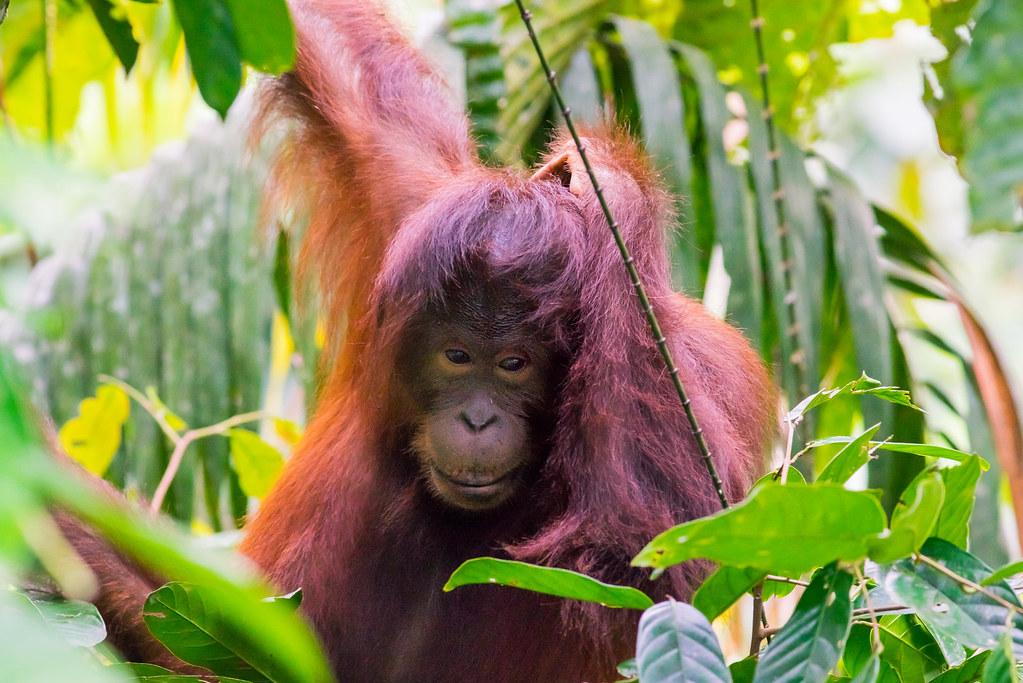
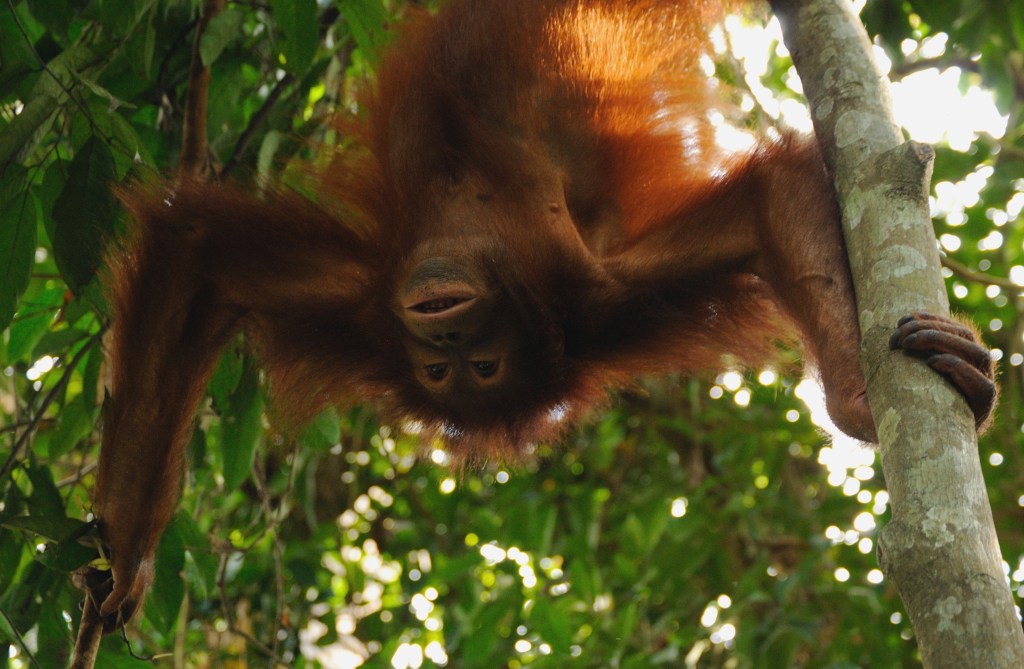
Orangutans & a School in Sarawak

By Christina Yin

Up up, SK Nanga Delok, up!

“Up up, SK Nanga Delok, up!” Clambering up the steep steps from the jetty and over a windy pathway, we reach the administrative office to be greeted by the school’s cheerful motto pasted outside the wooden door. Our small team is made of conservationists from the Wildlife Conservation Society Malaysia Programme, a local artist and myself, a writer and university lecturer of English academic and communication skills. It’s taken five hours on the road from Kuching to Lubok Antu and forty minutes with the sun beating down on us on a longboat navigating the lake created by the Batang Ai Dam and the River Ai’s tributaries that feed it. We’ve arrived at Sekolah Kebangsaan Nanga Delok, a government boarding school where 41 children ranging from seven to twelve years come from homes scattered around the national park.

We are deep in Sarawak, Malaysian Borneo at the fringes of two contiguous protected areas, Lanjak Entimau Wildlife Sanctuary and Batang Ai National Park, where the state’s largest known population of orangutans live untroubled by human activity. Encouraging messages about knowledge, virtue and wisdom are painted in English and Malay on the wooden walls of the school buildings constructed on slopes overlooking the river. Their water dispenser is a simple two-litre plastic capped bottle on a wooden shelf and three green plastic cups hanging from hooks outside different classrooms. A simple message in Malay with a picture of a smiling teacher in a baju kurung, the national dress, says: “Sila basuh cawan selepas minum, Terima kasih.” (Please wash the cup after drinking. Thank you.)The national flower, hibiscus, is painted on the wall right by the water dispenser with the 14-pointed yellow star against the blue as well as the red and white stripes of the Malaysian flag within its petals.

The children are curious and excited to see us: conservation through art and English after-school activities! They are wondering what these could be. But the most stunning message comes to me when I see the t-shirts these young boys and girls are wearing deep in the Bornean tropical rainforest. The names on their backs are bold — foreign and yet familiar: Hazard, Torres, Messi, De Bruyne, Messi[1].

The Dining Hall at SK Nanga Delok

In the dining hall, there are many colourful pictures and messages in Malay and English on the walls. “Welcome to Dewan Sri Nadala” in beautiful calligraphy is posted prominently on the green wall above the open counter that separates the kitchen from the dining area. It’s Tuesday, we’re told in Malay and English. Iban is the mother tongue of most of the student population, but at school, the medium of instruction is Malay and the second language is English. Coming to the boarding school from homes scattered on the banks of the Ai and its tributaries, the children are learning the national language, Malay, and English, the acknowledged lingua franca and the language of the White Rajahs and the former British colonists. Happy smiling cartoons of children urge the pupils to wash their hands before eating. Prayers are posted up on laminated paper framed with attractive borders and cartoon tiger cubs perched above the lettering. There are no tigers to be found in Borneo. The largest indigenous cat is the clouded leopard, but the children learn about tigers from schoolbooks, cartoons, television and the national crest of Malaysia.

The children stand and recite prayers, giving thanks for sustenance before every meal. When they have eaten, they stand and say an after-meal prayer of thanks as well. Indeed, there is much sustenance at the boarding school — so many meals! Breakfast, morning tea, lunch, afternoon tea, dinner, supper are served on the wooden tables covered with red and yellow flower patterned cloths protected by plastic for easy cleaning. Red and white checked cloths skirt the tables, matching the blue and white curtains that shade the glass louvres windows.

It is no wonder that many parents are happy that their children attend school, even if it means they have to be away from home at such a young age. At SK Nanga Delok, the government supplies the children with books, pencils and erasers, mattresses and pillows, and meals. Especially meals; six times a day: milky tea, bread, crackers, eggs, chicken or fish, rice, vegetables, fruit, Milo.

Talking about Orangutans

Art and English activities take place after the children’s regular school lessons. So, they are out of their dark blue and white school uniforms and in shorts or light track suit pants and t-shirts. Their hair is damp from baths and they are eager to find out what we’re all up to. The artist Angelina is teaching the older Primary 4-6 children to cut out shapes to make collages of orangutans and forests in one half of the dining hall.

In the other half, with the Primary 1-3 children, I have a plush orangutan on my lap. I give it to the child on my right and it is passed on from one child to another. We are sitting in a circle, telling a story together about Lucy, the orangutan. Each child continues the story with one sentence in English. This is how the story goes: Lucy is lost, but a big kind orangutan helps her find her way back to her mother. Of course, they have a nice meal of fresh fruits together on the way. A little boy named Rio Ferdinand is the one I remember the best. With a name like that, how could I not remember him?

Then it’s my turn with the older children. The story they tell is darker. It is about a “saviour” who takes the orangutan to a new home in a zoo. The orangutan escapes, taking his son with him, but is brought back to the zoo. One day, a scientist comes to the zoo and takes the orangutan and his son back to the forest where they eat durians and rambutans. Students come to the forest and take photographs. They go back to the city telling people that the orangutans are happier in the forest because it is their natural home. We see that some of the children really think that the animals belong in zoos. Our orangutan research team explains that wildlife belongs to the wild, in their natural habitats. We hope they understand that animals don’t belong in zoos.

At that point, the children ask to be excused because they must bring their foam mattresses in. It’s going to rain and their mattresses are airing in the sun. When they come back, we write Cinquain poetry[2] about wildlife. Their English is minimal, but they are happy, excited to learn new things and to talk to us. We talk about orangutans with the help of the Iban-speaking conservationists. The children know about orangutans. One 12-year-old tells us he saw an orangutan when he was five. He was with his father who told him he must never kill orangutans because they are protected animals. Another speaks of a traditional story she knows about orangutans becoming humans. Some of the children have seen orangutans near their homes at Mawang, Nanga Jambu, Sumpa and in the hills at Palak Taong. What, we ask, is the orangutan’s favourite food? The children shout happily: Durians!

Orangutan Stories and the Children of Nanga Delok

There is a group photograph of our team with the 41 children and their teachers at SK Nanga Delok. It was taken shortly after we had arrived and had signed the Visitor’s Book at the school’s office. The children and teachers were proud to have us visiting their school in this remote part of the state and we were honoured to be welcomed as guests. It was a happy moment for all of us.

It’s been four years since the photograph was taken. The children in the four oldest classes, Primary 3, 4, 5 and 6, would have moved on to one of the boarding schools for secondary school-aged children nearby at Lubok Antu or Engkilili. The tiny ones would be moving up the scale, now considered seniors to the new pupils. I wonder about the children and their stories and collages of the orangutans, their Cinquain poems and their shirts honouring their favourite European football players.

Dominic Helan Eric, the Park Warden at Semenggoh Wildlife Centre twenty minutes from the capital city, Kuching, tells me that his colleagues at the Forest Office at Lubok Antu reported that the number of orangutans at the Batang Ai National Park has grown. This is good news. I hope that the stories the children have heard about orangutan ancestors and lessons they have learned from their parents about protecting the red great ape will continue to be passed down to the future generations. And I hope that they will remember our stories about the orangutan belonging in the tropical rainforest and not in the enclosures of a zoo.

We know that the young people are leaving the rural towns, lured by jobs and the modern lifestyle in the cities. It is a natural consequence of development and progress. In a way, this will be good for the wildlife because there will be fewer people competing for the land and the food that can be found among the flora and fauna in the forests. But I wonder, like others do, what might be lost when the young people no longer return to their villages and longhouses. We ask ourselves, is it worth the gain of modern life, technology and progress? But it’s not a question we can answer, we who are city folk, the so-called educated and modern ones. For we live in urban areas and have access to that progress and development, so it’s not for us to say what’s best for those who live in the villages and longhouses far from modern amenities and the hubs of technology.

Although European football superstars may have reached far into the Bornean rainforest, all the way to Nanga Delok, and the lure of the modern connected city life beckons, not all of the young people have left Batang Ai. Some remain to be guides and porters, boatmen and cooks for research teams that seek to study the elusive red ape and conservation education teams that come to meet the longhouse folk. Eco-tourism brings adventurous travelers to the area as well, so there is an alternative livelihood for the villagers who choose to live on their ancestral land. Hopefully, our visit and the stories of conservation and the orangutans help to remind the children of their primate neighbours and how they can live peacefully and safely in the shared habitat.

As we push off from the jetty and the longboat putters out onto the open water created for the Batang Ai Dam, I look back at the boarding school high up on the hill hidden by the trees. I remember the school’s motto, “Up, up, SK Nanga Delok, up!”. I see the children passing Lucy, the plush orangutan to one another, adding to the story of the young red ape. I see them creating collages of orangutans and writing their Cinquain poems. But clearest in my mind is the memory of the children in their incongruous football t-shirts, imitations of the jerseys of European football stars. We are leaving this area where humans created a dam to provide electricity for the modern world; a place where some of the Iban still live the way their ancestors did, but where their children are given an education in two foreign languages, with a glimpse of a world beyond the River Ai and its tributaries.

We are heading for Lubok Antu and the long drive back to the capital. Somewhere in the forest on the far side of the river or behind us, there are orangutans. We hope that the national park and the neighbouring wildlife sanctuary will stay protected and untouched by human avarice. And we hope that the children of Nanga Delok will live happy useful lives wherever they eventually settle, whether it’s near or far from their birthplace where the orangutans still live freely in the wild.


[1] Football players

[2] A five-line poem popular among children

Christina Yin, PhD, is a Senior Lecturer at Swinburne University of Technology, Sarawak Campus. Her fiction and nonfiction writing have been published in eTropicNew Writing, and TEXT, among others.

PLEASE NOTE: ARTICLES CAN ONLY BE REPRODUCED IN OTHER SITES WITH DUE ACKNOWLEDGEMENT TO BORDERLESS JOURNAL

Click here to access the Borderless anthology, Monalisa No Longer Smiles
Categories
Poetry

The Light, the Sun, the Stars…

Poetry & Photographs by Luis Cuauhtémoc Berriozábal

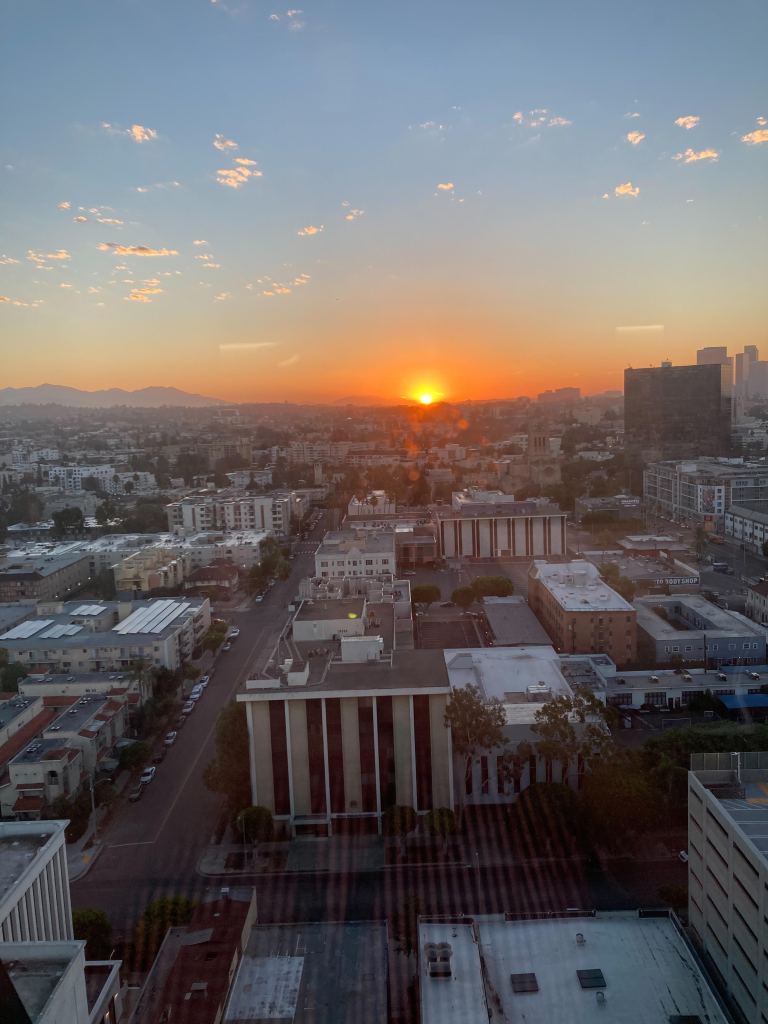
THE LIGHT

Who has seen the light?
Who has been blinded by the light?
The stars at night, the sun setting,
do you know it is not to be taken lightly?
Have you felt its significance?
Is the woman you love your light?
How much do you believe that?
You are surrounded by light.
Your head is filled with it.
There is a flash of light that shines on you
as your life is in danger.
You feel it on your skin.
It blinds your eyes, touches your heart.
If it ever goes away,
you will go away.
You must not take the light for granted.


MY LIKENESS

Dear, who are you?
My likeness and enemy.
Weaving false stories.
Who may you be?
Am I to blame?
Soft are your punches.
Almost like words.
You want to kill me.
I love you still.

Born in Mexico, Luis Cuauhtémoc Berriozábal lives in California and works in the mental health field in Los Angeles, CA. His poetry has been published by Blue Collar Review, Borderless Journal, Escape Into Life, KendraSteiner Editions, Mad Swirl, SETU, and Unlikely Stories.

.

PLEASE NOTE: ARTICLES CAN ONLY BE REPRODUCED IN OTHER SITES WITH DUE ACKNOWLEDGEMENT TO BORDERLESS JOURNAL

Click here to access the Borderless anthology, Monalisa No Longer Smiles
Categories
Review

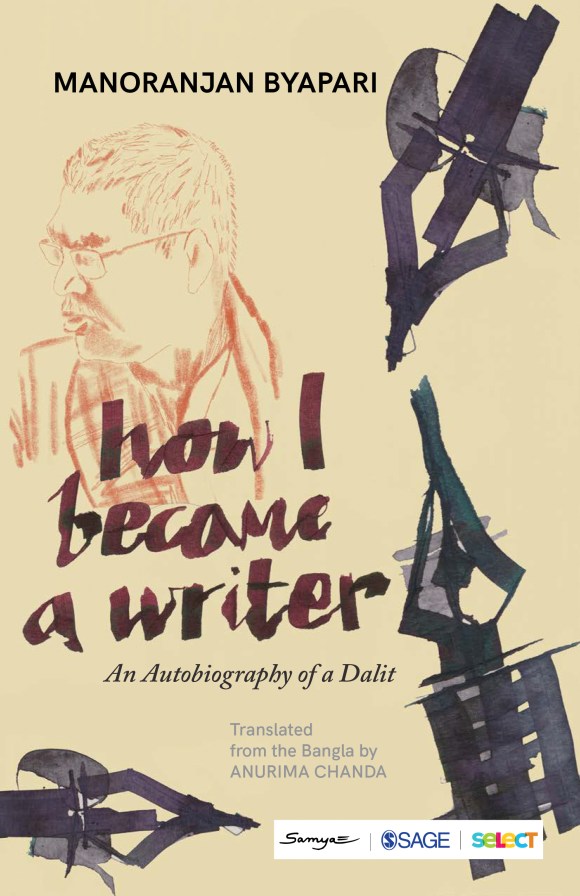
Manoranjan Byapari: “ Why did I even write?”

Book Review by Basudhara Roy

Title: How I Became a Writer: An Autobiography of a Dalit

Author: Manoranjan Byapari

Translator: Anurima Chanda

Publisher: SAGE Publications India and Samya under Samya SAGE Select imprint

The autobiography, as a literary genre, has a compound and far-reaching relevance. Among the many ways that it engages in a productive conversation with the world, is its staunch social impact. When and why does a person set out to write his or her life’s story? The answers to this could be numerous. Central, however, to each of them would be the perception of a threat to one’s experienced or imagined identity, the attempt to seize empowerment through the act of narration, and the identification of one’s individuality as having a widely referential social base that could encapsulate some meaning for humanity at large.

In the teeming, diverse and thoroughly spectacular life of writer, Manoranjan Byapari, an impulse towards all the three can be found. An unlettered rickshaw puller-turned indefatigable and award-winning fiction writer, and currently a member of the Legislative Assembly of West Bengal (Balagarh constituency) and the Chairperson of the Dalit Sahitya Akademi, West Bengal, Manoranjan Byapari’s How I Became a Writer: An Autobiography of a Dalit is the translation of the sequel to his Itibritte Chandal Jivan (Interrogating My Chandal Life) published in 2017 and winner of The Hindu Prize 2018 for non-fiction.

“I keenly believed that even though a life might be trivial, inferior or disgusting, there was something to learn from it which could come handy later. […] People who scavenged through dustbins would know that sometimes one might also find delicacies in the garbage,” writes the author (in the context of a particularly obnoxious character in the book), articulating a practical and philosophic doctrine that is hard to beat. If taken as a metaphor for his own life’s tireless trials, these words throw light on Byapari’s literary treatment of every little or mean episode in his life with sincerity, stubbornness and sagacity.

The sequel How I Became a Writer effectively takes off from where the first book ends – Byapari’s return to Calcutta from Dandakaranya and his taking up the job of a cook at the residential Helen Keller School for the Deaf and the Blind. Spanning a journey of around two decades, the book documents the arduous, painstaking, courageous and unrelinquishable labour of nurturing the ambition to write amidst the innumerable hazards-big and small-that threaten a Dalit’s dignified existence in India.

Comprising a series of thirty-four vignettes, the book is divided into two parts – ‘School Shenanigans’ and ‘The Right to Write’. The former section offers a close look at Byapari’s work-life – his workplace, duties, associates, and the systemic social inequities that are intended to steadily impoverish and dehumanize those who inhabit the lowest rungs of the class and caste hierarchies. The latter section focuses almost exclusively on his creative life, his intense literary and activist aspirations, and his relentless growth as a writer in the face of every obstacle to body, mind and spirit. The two sections, however, speak very intimately to one another with the result that they effectively build up one seamless narrative whole, animated, in each of its fibres, by “jijibisha” – the indomitable will to live that has characterised Byapari’s intellectual journey throughout.

In her ‘Foreword’ to the book, Sipra Mukherjee, the translator of Interrogating My Chandal Life, draws attention to the remarkable “non-marginality” of Byapari’s writing that, in the first part of his autobiography, exhibits and establishes itself in his choice of both language and geo-political space of creative exploration. In How I Became a Writer, Byapari’s marginal viewpoint on the history, narratives and psychology of the mainstream impresses further. His knowledge of the world is clearly staggering, his perception sharp, and his intuitive wisdom is matchless in its perspicacity. Alert, critical, and thoroughly versed in his Marxist epistemology, he understands the social dialogue of money and power and that of rights and denial, with deftness and insight. Most importantly, he is constantly aware of being not merely an individual but a representative of a social group – the proletariat who must attempt, by all means, to speak truth to power:

“Muttering furiously, she asked, ‘Royda asked you to make tea and you refused. Is that right?’

“I answered in the affirmative without an iota of tremor in my voice. I did what a representative of the working class would do had it been within the world of one of my own stories. The way Bordi, like one of the overlords, had called me forth to show off her positional power in front of her people, I too, was eager to show her that I was a knowledgeable and brave representative of my class of people.”

Throughout Byapari’s language, there is a quiet and determined authority intended to radically subvert the dense and intricate mainstream texts of injustice and victimization. One of his potent subversive tools is certainly his robust and well-toned satire, the other being his close reading of mythological material, folk tales, and indigenous wisdom located in anecdotes and proverbs. Bringing this local ontology and epistemology to bear on the mainstream knowledge involves a constant interrogation of the latter’s chosen socio-political and cultural texts, thus constituting a bottom-up view on social theory and praxis.

Glowing vividly in these pages is also Byapari’s unvanquished faith in literature as a means of social reform. He reiterates here, often, the necessity to take up the pen as a tool of protest, as a means of emancipation from indignity, and as the only method of scripting oneself into social discourse – “Somebody had said that a writer does not write with a pen, but with the spine.” But the act of writing which is often made to appear autonomous and independent of social interference, may not come as easily to everyone. To someone like himself, as Byapari insists, literacy itself has been a gift and the act of reading and writing, a liberation from his otherwise “insignificant, ugly and hateful life”.

In a society where writing has often been valorised as a private intellectual activity, Byapari strongly points out how privacy is, in itself, a privilege. Contrary to the fashionable notion of the writer as entitled to a ‘writing space’ both physically and temporally, Byapari’s autobiography projects him as accomplishing his writing in the oddest of spaces and hours, under the most threatening of conditions, and with the sole will to keep the fire in his soul alive. Both cathartic and revolutionary, his creative life becomes a valuable agency for him to wield his self-esteem against life’s diminishing forces.

But to be able to write and to, even, write well is not enough. To carve a niche for oneself in the writerly world, and to be heard and responded to is an enormous challenge in itself. There is, firstly, the significant handicap of financial investment in publishing a book; secondly, the apathy of prejudiced and non-discerning readers towards writers of the lower caste; and thirdly the entire nexus of publishers, marketing, reviewers and awards to negotiate with. To someone like Byapari, handicapped severely by both his caste and class, literary recognition has been very slow and unforthcoming.

It has, however, happened over the years, for as Byapari believes, in the world of literature, the way upward lies only through dedication, toil, perseverance, and the presence of an empathetic and like-minded literary community. But though the writer remains inordinately grateful for where he has arrived, there is also, at times in the book, a serious questioning of the practical outcome of meaningful literature in the world. Does it make a difference? Does it help transform the conscience of society? Does it lead to material improvement in a poor writer’s life circumstances? Byapari remains distinctly conscious of having been transformed from a writing person to a literary subject under the harsh glare of literary festivals, media and academics but his greatest fear of failure revolves around the possibility that his writing may have failed to make a dent on the world’s harsh indifference:

“Why did I even write? Would I be able to change this bloodsucking societal system standing atop the rotting thousand-year-old foundation with my pen alone? Would I be able to stop the inhumane religious brutality of the priestly class in the name of caste? The child lying on the footpath, who had curled up in the bitter cold, could I bring him a blanket? That child crying in his mother’s arms in hunger, would I be able to make him sit in front of a plate full of warm freshly made rice?

“I could not! I could not!”

However, as in the case of every true artist, Manoranjan Byapari’s love for writing triumphs over all misgivings. How I Became a Writer is a glowing celebration of his tribulations, grit, antagonisms, friendships and the generous support of many noble souls that helped pave his way to artistic maturity and fame.

For those who cannot read the book in Bengali, this translation by Anurima Chanda, an academic and translator,  arrives as a coveted gift. Organic, fluid, and maintaining the right balance between linguistic and semantic authenticity, this animated rendering of Byapari’s life introduces readers of English to a writer who remains etched in memory as much for his lyricism and humour as for his sheer honesty and brilliantly satirical social criticism.

.

Basudhara Roy teaches English at Karim City College affiliated to Kolhan University, Chaibasa. Drawn to gender and ecological studies, her four published books include a monograph and three poetry collections. Her recent works are available at Outlook India, The Dhaka Tribune, EPW, Madras Courier and Live Wire among others.

.

Click here to read the book excerpt from How I Became a Writer

PLEASE NOTE: ARTICLES CAN ONLY BE REPRODUCED IN OTHER SITES WITH DUE ACKNOWLEDGEMENT TO BORDERLESS JOURNAL

Click here to access the Borderless anthology, Monalisa No Longer Smiles
Categories
Slices from Life

Dismasted in Bass Strait

A real-life sailing adventure with photographs by Meredith Stephens

After an arduous day of upwind sailing from Bittangabee Bay on the east coast of Australia to Nadgee Beach we crept into our cabin beds at 9 pm. A few minutes after midnight, crew member Katie suddenly roused to a bright light and looked out of the window. She observed a boat moving towards her, first coloured lights and then a white light. Katie jumped out of bed screaming “He’s gonna hit us!” Then she heard the sound of the crunching of metal against our hull. Skipper Alex got up and blasted his air horn. The neighbouring skipper moved his boat around so he could talk to us. Crew member Verity screamed in terror “Go away!”

Alex called out across the water to the other skipper.

“I can’t see how much damage there is now. What’s your phone number?”

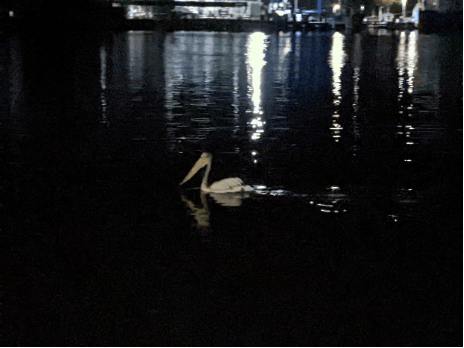
The skipper called his number across from his boat and set off on his midnight voyage. We were not due to sail out until 3 am when the conditions were predicted to become favourable, but we were so shocked at having been hit by another vessel that we could no longer rest. We decided to set out immediately. We headed to an anchorage at the uninhabited Gabo Island, dropped anchor, and slept from 3 am until 6 am. Then Alex roused himself and dutifully took himself to the helm, turned on the motor, raised the anchor and started the anticipated fourteen-hour voyage to Lakes Entrance. Ninety-nine nautical miles later, at 9.50 pm, we arrived at a free public dock, and were greeted by pelicans. Katie alighted onto the dock and secured the lines to cleats and returned to the boat. All crew members slipped into a grateful rest despite the harsh lights of the dock penetrating through the hatches.

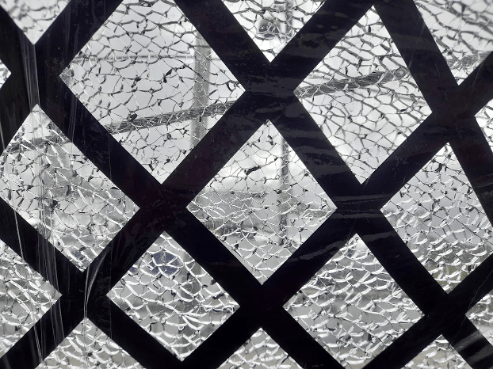
After a day ashore to rest and reprovision, we set off the following day at seven am. We had an uneventful sail until 10.30 pm when the halyard[1] to the gennaker[2] snapped. The gennaker trailed in the water between the hulls and Alex retrieved it, replacing it with the jib[3]. I trusted Alex with sails and halyards, and I could hardly keep my eyes open, so I retreated to my cabin and tried to sleep. Not for long though because I could hear Alex and Katie shouting to each other on the deck. My body was craving sleep, but I dared not succumb when there was obviously some sort of trouble. I had never heard Alex and Katie shout at each other. The only reason they were shouting must be in order to be heard over the wind on the deck. I forced myself out of the cabin bed and dropped from its formidable height which had been designed for much taller people. I made my way to the outside door, summoning the strength to venture outside and try and make myself useful, but the darkness, the wind and cold were intimidating. As I deliberated, I heard a crash. The front window had smashed into tiny pieces, which landed on the sofa and were scattered all over the floor. Alex was shouting from the deck, “The mast is down!” I glanced outside and noticed that the mast had landed on the portside deck, and several metres of its tip were trailing submerged behind the boat.

Meanwhile, the steering had been disrupted and the autopilot was no longer functioning. Alex tried to manually manoeuvre the boat to the right, but it would not respond, and he had to turn in circles to the left to attain the right direction. The mast dangling from our port stern was acting like a giant unwanted rudder. I glanced outside and noticed a fishing trawler about five hundred metres away on our portside. I alerted Alex and he was concerned that without steering we would inadvertently hit the trawler. He grabbed the VHF[4] radio and put out a warning on Channel 16 to alert them. No response. He tried again. Still no response. He gave up and returned to the deck in order to save the sails which were trailing us in the water. I remained inside and continued to try to make contact with the trawler, to no avail.

Then Alex realised that the VHF antenna was not working because it was at the end of the mast, which was now trailing in the water. He retrieved his hand-held VHF radio and tried to make contact again. This time the skipper of the trawler responded. They decided to stay close to us and then follow us, ready in case our situation deteriorated. We maintained radio contact with the other skipper until Alex managed to hoist some of the mast out of the water and regain autopilot control. At 3 am, we were confident that we could manage on our own, so we advised the other skipper and he took his leave. A stranger had obeyed the ancient maritime code to assist those in distress at sea, and we didn’t even know his name.

Alex headed for the aptly named Refuge Cove, but another vessel was sheltering there. He wanted a wide berth, so he was reluctant to stay near another boat in case we inadvertently swung into them. He took us on to Waterloo Bay, three nautical miles further. We moved deep into the bay over the next hour and arrived at a sufficiently sheltered spot to drop anchor at 10 am.

For the first time, Alex was able to carefully inspect the damage and was shocked to discover that the cross-beam[5] was broken in half and dangling precariously. This made it too risky to use the main anchor. Alex used a spare anchor instead. By this time, he had been awake for twenty-eight hours, so, we urged him to sleep.

“I think I’ll just tidy up the sails a bit before I sleep,” he insisted.

I also ventured onto the deck to help Alex and noticed the crashed mast, and the cross-beam which looked dented but had in fact snapped in half. Alex and Katie bound up the sails with ropes so as to keep them from falling into the water for the next leg of our trip. My hair was blown into knots around my face and the fierce Australian sunshine was forcing its way into my eyes. I briefly retreated inside to restrain my hair with a scarf and returned to the deck to see Alex and Katie persisting in the cold wind. I was barefoot as this was the best way to grip to the surface of the gently rocking vessel. As I gingerly walked towards Alex and Katie, I noticed shards of glass in front of me. Katie called out in warning, and I retreated. She pointed out the safe way to climb towards them and I trod in that direction, mindful not to fall. Next Alex took the dinghy to the tip of the mast to remove dangling lines and the still-attached jib.

I glanced up and noticed pristine white sands, turquoise waters, craggy mountains and even a few bathers who had obviously hiked here. There were no roads leading to this beach deep within a national park.

We spent the next day tidying up both the topside and the inside of the boat, in particular picking the scattered glass shards. Alex needed a block of wood to secure the mast, so we headed to shore to find one. If we were on holiday this beach would have been ideal. No-one was here, but there were deep footprints in the coarsely grained sand. We walked to the end of this idyllic beach, and I collected shells. Meanwhile, Alex found the perfect sized piece of wood.

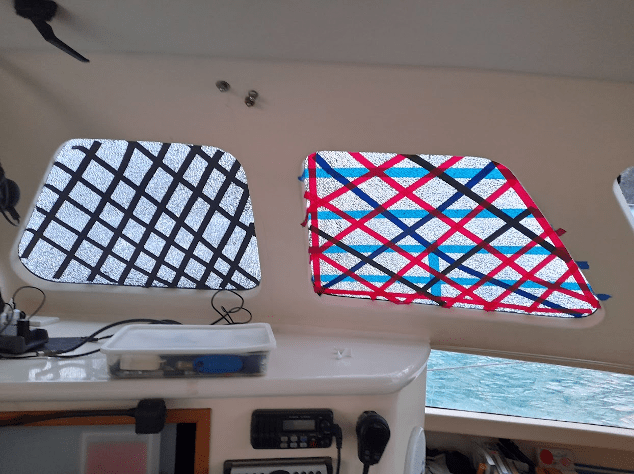
We returned to the boat for a few hours of relaxation before setting off for the night sail at 11 pm. Alex had chosen this time because the sea was predicted to be at its calmest over the next twenty-four hours. Before departing, Alex placed the block of wood under the mast to create a pivot point and winched the mast up to ensure it was completely clear of the water and would not drag. I was standing in the saloon as Alex adjusted one of the winches securing the mast, and suddenly heard a cracking noise. A third window shattered. We searched for duct tape to secure the window, but our stores had been depleted. Instead, we used electrical tape, and Katie, who happened to be an artist, taped across the windows until they had the criss-cross design of Tudor windows.

I was nervous about sailing off again into the dark ocean. Would the vessel be seaworthy? Would we be stuck in the dark waters distant from help? I had to rely on Alex’ judgment. I retreated to bed and noticed a bright light through the hatch in front of me.

“Is that a vessel ahead?” I urgently asked.

“No, that’s the moon!”

I peered myopically ahead and worked out that the large shining light ahead was the comforting moon and was shedding a kind light to guide us on the waters ahead.

Alex and Katie took charge of the vessel in the night to continue west along Bass Strait to Yaringa, the nearest marina that could host us. I could hear them calling out instructions to one another. The seas were not yet as calm as we had hoped, and Katie was worried. I didn’t know what to do and retreated to the security of my bed. Then I heard another shattering of glass. A fourth window cracked, and this time Alex was the one to use what little tape we had to secure it in a criss-cross pattern.

Alex and Katie took turns overnight to keep watch. I woke to daylight and the sea was calm. The vessel gently rocked as we cruised along Bass Strait, now powered by motor rather than sail. Finally we entered the channel east of Phillip Island.

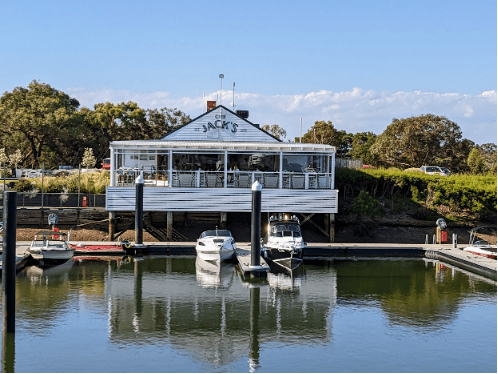
“The tide is in our favour. We are going to arrive early!” proclaimed Alex. “Shall I make a booking for dinner at the marina cafe?” he asked.

A resounding “Yay!” followed.

We followed the channel markers, passing small fishing vessels and a cruise ship. By 5.30 pm we arrived at Yaringa, and manoeuvred the vessel into the berth, all the while trying to prevent the mast, which was extending well beyond the boat, from hitting anything.

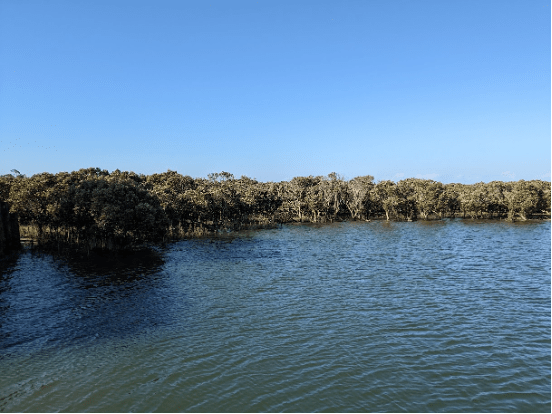
We had survived a fallen mast, four smashed windows, a broken cross beam and a disabled anchor, to arrive at the tranquility of a little-known marina at Yaringa, nestled in the mangroves on the outskirts of Melbourne. We gratefully stepped onto the pontoon, then walked ashore, savouring the sensation of terra firma. Even so, we were so used to the motion of the sea that we continued to sense the land itself rocking back and forth.

That night we enjoyed one of the best restaurant meals we have ever had, perhaps enhanced by our feelings of relief and gratitude.

We were in a quiet berth overlooking undisturbed mangroves. The boat was now motionless. There were no harsh overhead lights shining into our windows and the only ambient noise was birdsong. Alex had already contacted a shipwright and rigger who would attend to the damaged parts of the boat over the next months. We no longer needed to persevere sailing in darkness in a damaged vessel. In the relief of having reached safety, we fell into a well-deserved and deep sleep.


[1] A halyard is a rope that holds up a sail.

[2] A gennaker is a large sail attached to the bow used for sailing at right angles to the wind.

[3] The jib is a small sail set before the mast.

[4] Very High Frequency

[5] The cross-beam connects the two bows of a catamaran.

Meredith Stephens is an applied linguist from South Australia. Her work has appeared in Transnational Literature, The Muse, The Font – A Literary Journal for Language Teachers, The Journal of Literature in Language Teaching, The Writers’ and Readers’ Magazine, Reading in a Foreign Language, and in chapters in anthologies published by Demeter Press, Canada.

PLEASE NOTE: ARTICLES CAN ONLY BE REPRODUCED IN OTHER SITES WITH DUE ACKNOWLEDGEMENT TO BORDERLESS JOURNAL

Click here to access the Borderless anthology, Monalisa No Longer Smiles

Categories
Poetry

Innerworld

By Sutputra Radheye

There is someone. I am
scared of the shadow that forms
in the mirror when I stand in front 
of it. The horns on my head 
freak me out. This can’t be true.
No. Hell no. All of it is an illusion.
It laughs at me. The eyes are red
and they stare through me. A rugged
hand climbs to my throat like a vine.
It strangles me. Save me from this python.
Save me from this devil that lives in me.
It whispers -- urging me to commit sins
and fall. It calls me its fallen angel. 
I don’t want to be. It doesn’t let me sleep.
It keeps talking in my ear to get up
and hone myself. The war against God
is coming. It’s coming sooner than
you think. I stare at the mirror again.
I see the same shadow that looks 
just like me but isn’t me.

Sutputra Radheye is a young poet from India. He has published two poetry collections — Worshipping Bodies(Notion Press) and Inqalaab on the Walls (Delhi Poetry Slam)His works are reflective of the society he lives in and tries to capture the marginalised side of the story.

PLEASE NOTE: ARTICLES CAN ONLY BE REPRODUCED IN OTHER SITES WITH DUE ACKNOWLEDGEMENT TO BORDERLESS JOURNAL

Click here to access the Borderless anthology, Monalisa No Longer Smiles
Categories
Stories

The Slip

By Sushma R.Doshi

Her face looks pale. How do I console her?

It started with the onslaught of Covid and the sudden imposition of the lockdown. Fear enveloped the city. The otherwise congested city of Kolkata bore a quiet and eerie look. Rinku, our maid, who stayed in our servant’s quarters and worked in a couple of other houses apart from ours, was suddenly jobless.. Most households fired their part time maids without a thought and without a salary. The part-time maids were the ones who traveled by public transport or walked to work everyday, from their homes. Without any means of transport, they were unable to reach the houses they worked in.

The only domestic help who retained their employment were the full-time residents of the houses they worked in. Rinku was still fortunate. She had a place to live and continued to work for us and the old couple, the Ghoshes, who lived in the apartment next door. We didn’t fire her. It wasn’t because we were better human beings. The reason was that she lived in the servant’s quarters downstairs, and she wouldn’t bring in infections from other places. The Ghoshes retained her because they had no choice.

” Why did the rest of the houses chuck me out? Dipu da[1] and Mishti di[2] phoned me and told me not to work at their houses anymore…at least till Covid is over…Why?” Rinku asked me dismally. “I stay in your house and walk it down to their place. It takes me twenty minutes. I could easily have continued to work there.”

I didn’t answer. I couldn’t tell her that the urban educated upper classes of the city assumed that the maids coming from the ghettos and slums and traveling by public transportation were the carriers of the virus. Even those living close by in a tenement or in a servant’s quarters were not welcome anymore.

“Thank God that Ghosh jethu[3] has asked me to continue working for them,” Rinku finished with a tinge of relief in her voice.

The Ghoshes lived next door: Mr Ghosh, eighty-five and his wife, eighty-two and undergoing chemotherapy. Breast cancer — we had been told about a couple of years back. We would watch as Mr Ghosh, struggling with his arthritis, would walk down to the market to buy the week’s provisions. Treatment was expensive and appointing full time help or a cook on their pension was beyond their means. Rinku washed the utensils and mopped the floors in their house. On a good day, Mrs Ghosh would help her husband to cook and do the rest of the chores. On other days, the old gentleman would plod through the day with stoicism. The lockdown instilled fear in everyone but the Ghoshes couldn’t afford to let Rinku go. 

“You people are old, more prone to infections…don’t let the maid in,” they were advised by every well-meaning neighbor.

“We can’t,” Mr Ghosh stated dryly. “We simply cannot manage without help.”

Some not so well-meaning neighbors advised me not to let Rinku work in Mr Ghosh’s house.

“Why are you letting her work in their house? She stays in your house…Just threaten her with eviction…tell her she can work for you exclusively if she wishes to stay in your house.”

I couldn’t be so ruthless. I knew Rinku was under financial stress and that the Ghoshes needed a maid badly. I just decided to be a better human being this time around.

Rinku continued to work for us and the Ghoshes. Fear continued to rise with the news of the rising number of cases and subsequent rise in death rates. It was then that I heard the news.

“Do you know? Mrs Ghosh has tested Covid positive…she has been hospitalised,” Anita told me over the phone. “I’m told she visited the doctor in the hospital for her treatment. People are saying that’s where she got it from.”

I felt a cold chill in my bones. This was the first case in our locality. The news spread like wildfire. Had Mr Ghosh also contracted covid? What about Rinku? What was I to do if Rinku developed symptoms of Covid? Had I made a mistake by allowing her to work for the Ghoshes? I should’ve insisted she only work for us.

Fortunately, with contact-tracing that the government enforced, Mr Ghosh and Rinku were tested and the results were negative.

I wasn’t sure who was more relieved…. Mr Ghosh, Rinku or I. Then I felt guilty. My thoughts flew to Mrs Ghosh. Eighty-two, frail, sick and alone in the hospital.

“She’s as good as gone,” Anita told me soberly.

Yes. We knew. We wouldn’t be able to see Mrs Ghosh ever again. The neighbourhood fell into a melancholic mood. Phones buzzed with reminisces about the Ghoshes. People talked about the stories they had heard about them — how they had moved into the apartment, how desperately they wanted a child, undergone every treatment available to conceive but failed. Their love for each other withstood all trials and tribulations. They didn’t have anyone except each other.

“Remember the lovely sarees Mrs Ghosh would wear during Durga Puja and how Mr Ghosh would look at her?”

“She used to sing really well. I’ve heard her accompanied by her husband on the harmonium.”

“Her fish curry was incomparable…of course, before the cancer destroyed her.”

We all called Mr Ghosh to find out how his wife was faring in the hospital. Poor chap…he seemed dazed…at a loss.

“I don’t know much…this lockdown…can’t visit the hospital…they just keep telling me they’re doing the best they can,” he would say.

“Please pray for her,” he would finish softly.

I don’t know whether anyone in the neighborhood prayed for her. We were too busy worrying about ourselves. As a fortnight passed by, we stopped calling Mr Ghosh. We mused amongst ourselves whether it was best that Mrs Ghosh pass away peacefully. But how would Mr Ghosh manage? His life centered around his wife.

“I’ll take up the job of the cook in his house….in any case I’ve lost most of my jobs…I have ample time on my hands, ” Rinku said as she heard me discuss this over the phone with Anita.

“Yes. It’s a good idea,” I agreed.

“Have you spoken to him?” I queried.

“I did…but he didn’t answer…I don’t think anything is registering…seems to be totally lost,” Rinku replied sympathetically.

I nodded.

“How much money do you think I should ask for cooking in his house?” Rinku asked me the next day.

“You are just going to be cooking for one person…so not much I should think,” I shot back.

Rinku flushed. She understood the note of reprimand in my voice.

“I’m really hard up, I really need another job,” she retorted defiantly. “With his wife gone…he won’t have to pay for her treatment…I’m sure he can easily pay me what I deserve.”

I didn’t answer.

Another week passed with mounting deaths. We read and watched horror stories unfold across the world. On television, on our phones…everywhere. There was nothing else to read, talk or think about. People lost loved ones and heard about it on their phones. I lost a cousin and a friend to Covid. They were survived by their elderly parents, spouses and children. We all grieved our losses within the confines of our homes. Somewhere in the corner of our hearts, we were glad it wasn’t us or our children. We just prayed to survive tomorrow.

“I’ve heard the government is not allowing proper funerals for those dying of Covid. …because it’s so contagious…they’re just cremating all the bodies together…Is it true?” Rinku asked.

I nodded again.

“God…this is so wrong! Dark times indeed!” Rinku sniffed. “The soul is not liberated until the rites are performed…Ghosh jethu is such a religious man…he will be so disturbed if he cannot perform the last rites for jethi[4].”

I didn’t know whether religious rites brought peace to the dead. More important than what followed death was the way one met death. To die alone, in fear amongst strangers in a hospital was not the way anyone should die…certainly not Mrs Ghosh.

It was a hot sultry day. Rinku was mopping the floor. I was lazing on the bed. I heard the ringtone of my phone. I wore my spectacles to read who wa calling. It was Mr Ghosh.

I swallowed. News of death. Again. I pick up the phone. “Hello Ghosh da,” I spoke softly.

Rinku had stopped mopping the floor. She was unashamedly eavesdropping…as she usually does. Her eyes awee big and sympathetic.

“Sushmita!” Mr Ghosh’s voice rings out clearly. Elated. Euphoric. “She’s…I mean…Ronita…she’s recovered. The hospital called me. She is coming back tomorrow.”

“Recovered?” I shout in happy disbelief. “That’s great…God has been kind!”

“Yes!” Mr Ghosh.”Bye now…. I’ve to call the others.”

“Bye.”

I swivell towards Rinku smiling. I stop. Rinku has heard the news. Her face looks pale. How can I console her? I can’t tell her….”I’m sorry your hopes of being appointed as a cook in the Ghosh household have been dashed because Mrs Ghosh is alive” — life’s little ironies. I am not sure whether I should feel sorry for Rinku or just chuckle and say — there’s many a slip twixt cup and lip.

The Ghoshes continued to live in the apartment next door. People say that it was her husband’s love that brought back Mrs Ghosh from the dead. The pandemic is over or so they say and Rinku is not so hard up anymore. She continues to live in our house and work at the Ghoshes…mopping the floors and washing the utensils …. only. She works in a couple of other houses and manages to get by. I wonder what tomorrow will bring.

[1] Elder brother

[2] Elder sister

[3] uncle

[4] Aunty

Sushma R Doshi acquired a PhD in International Studies from Jawaharlal Nehru University, New Delhi. She dabbles in writing fiction and poetry.  Her short stories have been published by Contemporary Literary Review India, Writefluence, Culture Cult Magazine and Press and Sweetycat Press amongst others. 

PLEASE NOTE: ARTICLES CAN ONLY BE REPRODUCED IN OTHER SITES WITH DUE ACKNOWLEDGEMENT TO BORDERLESS JOURNAL

Click here to access the Borderless anthology, Monalisa No Longer Smiles
Categories
Poetry

Garlanded Guest

By Sharanya B

GARLANDED GUEST

I wish to invite Aphrodite over for chai
Katy Perry will do too
The blue-eyed goddess could arrive
On a dark horse and I shall stand
At the entrance of my brown house 
Too unconventional for a twenty first century conversation but perhaps I could greet her
With a tantalising inquiry
“How are enemies made?”
What fluxes out of your fingertips
Webbing and falling over abstinence
Like a silky cage and for heaven’s sake
Enlighten me on
“How do I make them stay?”

I am blind to anachronism so I 
Couldn’t tell if it’s an Aphrodite or Katy Perry
Brandishing their wisdom 
I would still stop them mid-sentence
To only return with something brewing
In an arabesque teacup

You see, it might be sweltering here
And revenge might be cold
But chai is best served hot

Sharanya B lives in Trivandrum, Kerala and studies English literature. Her poems have been published in several magazines/sites such as Madras Courier, Literary Vibes, Annual anthology by Poetry Society of India and many more.

PLEASE NOTE: ARTICLES CAN ONLY BE REPRODUCED IN OTHER SITES WITH DUE ACKNOWLEDGEMENT TO BORDERLESS JOURNAL

Click here to access the Borderless anthology, Monalisa No Longer Smiles