Categories
Poetry

Nature Poems by George Freek

NIGHT AT WONDER LAKE 

Clouds like pillows
smother the moonlight,
as waves beat the shore,
as if it were a door
they’re unable to open.
Like a moving circus
the cosmos passes over my head,
and I still have no idea,
who I am,
or why I’m even here.


EVENING AT WEST LAKE 

The years pile up
like snow on the roof.
The moon looks trapped
like an insect
in the branches of a tree.
A dove beckons
to his unheeding mate.
I think he’s too late. 
In frustration the dove
abandons his tree,
as life moves on.
What will be, will be.

George Freek’s poetry has recently appeared in The Ottawa Arts Review, Acumen, The Lake, The Whimsical Poet, Triggerfish and Torrid Literature.

PLEASE NOTE: ARTICLES CAN ONLY BE REPRODUCED IN OTHER SITES WITH DUE ACKNOWLEDGEMENT TO BORDERLESS JOURNAL

Click here to access the Borderless anthology, Monalisa No Longer Smiles

Click here to access Monalisa No Longer Smiles on Kindle Amazon International

Categories
Stories

Glimpses of Light

By Neera Kashyap

It took me a long time to understand that before each ‘episode’, Ma would have her mood. I was eleven on the first occasion. It was a Sunday and already noon, but Ma hadn’t bathed nor started preparing lunch. Still in her faded printed nightgown, she sat staring at the opposite wall, her small thin face drooped in confusion. Suddenly her expression turned stony, her right hand twitched as she waved it about, shooing something away. She got up hastily, asked for my earphones and plugged them in to music on her phone. Still her hand twitched. Her grey eyes narrowed in a strange mix of fear and hate, mostly fear. Her kinky uncombed hair felt alive with electricity. She muttered that her limbs hurt, her head felt on fire and that the voices wouldn’t go. By evening, she sat armed with a rolling pin and once threw it wildly across the room, bringing a copper jug crashing. Then she turned towards me, the rolling pin still poised in her hand. My fear was like electricity throbbing down my spine. But she only broke down and wept. Often, she felt that a snake had coiled around her — alive and poisonous. I would miss my father terribly. He would know what to do, for he was gentle and caring, but worked as a geologist far, far away in Saudi Arabia.

Before my father came and visits to the psychiatrist began, I spoke on the phone about Ma to Nani, my maternal grandmother. A widow, she lived in a distant town with her son’s family. Her voice crackled with concern, not so much for Ma as for me:

“Sushma has been possessed by a spirit. If only I could take her to the village. We would call a jagariya[1] to get rid of this…this evil thing. We don’t know when these spirits can come, take possession. Sometimes after 10, 20, 40 years. You be careful, Meenu. Just pray to Goddess Gaura Devi. She will protect you. She knew what it was to suffer, to be poor and hungry. Will you be alright, Meenu? Will you be brave? Talk to me often, theek[2]?”

“Evil spirit”? I gulped. My heart thudded like a big drum, its dull boom echoing through my body. My eyes filled with tears. Could Ma’s trouble be infectious? Would I also hear voices? Would I need ear plugs to shoo them off?

Ma began to sleep less and less during the nights. She would wander about and switch on lights wherever she went. Yet she was particular that she woke up on time to prepare my school tiffin. For this she used two phone alarms, each going off with different musical tones that rang without cheer. She cared less and less about how she looked as she walked me to the bus stop. Hunched in her night clothes, her hair all frizzy, her gaze faraway, her face unsmiling, she stopped joining other parents who chatted with each other. From my bus window, I would watch her slump away alone. More than discomfort, I would be embarrassed by what others thought of her, scared they would know that there was something wrong.

Baba[3]’s trips from Saudi Arabia became more frequent, though they continued brief. First there was a long tussle between him and Ma on the need for a psychiatrist. She said she was fine, except for this constant sadness, the same thoughts repeating themselves like objects stuck in a groove, in voices that seemed real. One evening she announced: “I have royal blood, the blood of the Panwar kings. We ruled for many centuries. The Nepalis came, they tried to destroy us, occupy our land. But we are rulers of Dev Bhumi – the land of the gods. We drove them out. Nobody can destroy the Panwars. Nobody.”

“Yes,” said Baba after a long silence. “Nobody could destroy the Panwars. They were righteous kings. The British helped them drive out the Nepali invaders. The Panwar Kings paid the British their military dues, but gave up their kingdom when we won our Independence from them.” After a thoughtful pause, he continued: “But we are not Panwars, nor royal, Sushma. We are landowners, simple landowners. Every year, our land holdings get smaller and smaller. As our families split up, so does our land. Without consolidated land we have no income from it. We are not royal Panwars, just small landowners.”

I could see Ma’s agitation mounting. Her hands trembled as she picked up the copper jug and stood up menacingly. Baba remained calm, not returning her gaze, just looking down at his hands clasped tight. Ma collapsed on the sofa in a heap, her breath ragged, tears streaming down her cheeks. Only when her breath calmed did Baba reach out to take her in his arms. It was then that visits began to the psychiatrists and Baba carefully monitored her medication cycle, long distance.

Baba would have been Ma’s best psychiatrist, but he was hardly around. It was when he was absent that I missed him most as a father and a friend. For he was fully absorbed in supporting Ma’s role as a housekeeper, in maintaining household expenses, in managing her episodes and most of all in motivating her to stick to her doctor’s appointments and to the medicines prescribed. By the time I was twelve, I would have heard his advice to me a thousand times: “You have to be strong. You have to be there for Ma. You must study hard and do well. Yes?”

“Yes? No…” I had flashed back once, in suffocation. “How can I be strong when I don’t know what will happen next? Whether she will fly into a rage or plaster me with kisses? I…I can’t talk to anyone except to Nani. I don’t want people to know. When she doesn’t sleep at night, I also can’t. How can I study and do well… all the time do well…do well?”

Baba had looked sad, but I was surprised that Ma had looked confused but stricken. For tears had run down my cheeks. Neither reached out physically, but some terrible gloom broke. My classmates had avoided me at school, calling me ‘sad girl’ behind my back, laughing their silly laughs with their silly normal lives. It was my old friend Rabiya who remained at my side. But then her home life was not normal either. Her father was an alcoholic. My mother had a mental illness that even Baba would not name. Rabiya and I couldn’t share much. We were frozen in our individual situations, but bound to each other by this sense that we both suffered.

Sometimes I thought about my own sadness and wondered if it was what they called depression. Some mornings Ma never woke up in time to make my school tiffin. Even though I would tell myself it was her medication, I would feel a terrible sadness as I buttered bread to take with me to school. The ‘sad girl’ remarks would ring in my ears. I would sleep more, study less, feel listless and sad, as if invisible chains were holding me down. Baba must have sensed this for, after one visit to the psychiatrist, he said: “Meenu, your fourteenth birthday is coming soon. Why don’t you plan something with your friends, take them out for lunch to some place where they also have games and things? Ma can take you. The doctor feels she is more stable now. Maybe some of your friends’ mothers would also join.”

“I don’t feel like it, Baba. I…I don’t have many friends…very few. These years….nobody has come home. Nobody, and I haven’t gone over either. Ma….it won’t work. If I could just focus on studying, that would be enough.” For the first time I saw my father slump in helplessness, twist his hands in his lap. But before he left for Saudi, he gave me a beautiful spiral bound notebook with the title, “In Peace”, and suggested gently that I keep a journal.

My first entry was an untitled poem:

Entry 1:
She is just like anyone else 
Cooking Phaanu  in the kitchen
Humming, tasting, smiling
She lets go of the ladle
Stands listening, asks if I 
Hear a baby cry.
I don’t answer,
Just switch off the gas
Search the fridge for 
Leftovers.
She is not like anyone else
I don’t know why.

*

Entry 16: I dread her rudeness for I never know what it will lead to. She broadcasts her thoughts, talks against members of the family, my father – how he has abandoned her, left her to cope alone in this cruel world. She calls me a lousy daughter – lousy at housework, lousy at caring for her, lousy at studies. Today, it all led to an episode. She stared at me, her grey eyes minced, her hair alive like snakes in the air and said, “You are not my daughter. You are someone else. Get out.” I felt my intestines twist in protest. My words came out in a flash: “You are not my mother either. Does a mother behave like this? Hot cold, hot cold. Only you count. Only your troubles count. I count for nothing. My sadness….I feel so helpless.” She reached up for a suitcase, opened my cupboard and started throwing my clothes in it. Halfway through, she stared at me, her eyes minced. Abruptly, she left the room. The half-full suitcase lay on the floor like the open mouth of a shark. I hated her. Yet, I found myself fully alert to the sounds in her room. She was talking to Nani. She would be alright.

*

It was a few nights later that she came into my room. It must have been around midnight. She had not put on any lights in the house. She walked in like a ghost and sat crouched in a chair near my bed. I don’t know if she was aware that I was awake but she must have been, for her voice flow was normal:

“I know I have not been a good mother, Meenu. But I really want to be. Nani tells me all the time to pray to goddess Gaura devi. I do. All the time, so I can be normal for myself, for you, for Baba. I don’t know what happens. It is as if I become someone else. Someone terrible – full of anger and hate. I say things, do things over which I have no control. There is no Gaura Devi then, no you, no Baba. Just this other….person. Sometimes I want to take all my medicines in one shot, so I either die or get well. But Baba is very strict, tells me to keep these thoughts out. He gets angry, begs, pleads. When I feel normal, there is still worry for you which makes me ask myself, will I ever be free of worry? Free.” After a pause, she said, “Can you forgive me, Meenu?”

I nodded in the dark. Ma must have sensed this for she stretched out her small body in the chair, clasping her hands as if in prayer. I didn’t know this goddess Gaura Devi. But I thought if I imagined her like Nani – plump and smiling, creased face and rosy cheeks with the snowy Nanda Devi peak as her backdrop – I could also pray to her. Ma left quietly and I began to visualise Gaura Devi as a kind lady, like my Nani.

Entry 36: Today on the net I read a mental condition that matched Ma’s exactly. Something called S. I can’t remember the name. It said it could be controlled but was generally incurable. Incurable? How can Ma’s state be incurable? Will I have to live with this forever? This is not possible, simply not possible. What if I could help cure it? Like Baba tries -- all the time. By being gentle and patient. By reasoning with her when she is calm. But I am not gentle nor patient. But I could do stuff that I can. Like take her for a walk. Or put on YouTube music that she likes. Like old film songs. Sit with her as she listens. Or maybe get her to mother me. Ask her to make me a chocolate mousse cake. No, no. That would agitate her if she can’t. A plain cake will be fine. Maybe I can get Rabiya to talk to her sometimes. Normal things like school things, projects. Anything.

Incurable?

Ma did come to me to say 
That sometimes she was two people
Not one
Maybe if I can see Ma as Ma
And the other person also as Ma
Then maybe, maybe I will see the two
As my one Ma.
She sees me weep sometimes
When I don’t let my rage follow hers.
That’s when she minces her eyes, 
Tries to see
She is not two people
Just one
My Ma.

*

At school, it was time for career counseling when each one in our class was scheduled individual sessions with a career counselor. Rabiya and I were no longer a twosome. We sat excitedly in groups trying to figure out our subject streams. Rabiya was consulted a lot for she was excellent in Maths, almost as good as a tutor. Classmates who were clear they would take up the commerce stream but unsure of their competence in Maths, asked her if they should substitute Maths with Business Studies or Computer Sciences. Rabiya never gave sweeping advice. One of her answers struck me as pretty wise. She said to Anjul, a short fat girl with a nervous tic: “See, if you feel Maths is a challenge, then take it up. If you rise to its challenge, it will not trouble you again, whatever course you take up. But if it depresses you and feels like a burden, then don’t!”

The career counselor had been allotted a room near the gymnasium – a large and well-lit room with many windows. Her face was like that too – large and well-lit. Though I knew my choice for a stream, I was tense. Miss Sridhar smiled as she studied my report card, then turned to her laptop to look at her comments against my name.

“Meenakshi Nautiyal”, she said. “You have a definite slant towards the humanities. Is that right?” She added laughingly, “Mind you, you could certainly improve your overall grades.”

I nodded. She asked what I liked about the humanities.

“Literature and history”, I said.

“What do you like about literature?”

“Poetry, I write poetry…”

“How wonderful. And what sort of poems do you write?”

“I write about my mother. She…she..she..”

It was as if a dam had been released. I couldn’t hold the waters back. They rushed out all stormy and sad and self-pitying, begging to know why Ma had to be like this. Not once did Miss Sridhar close her window-face. Not once did she say this was not her subject. Her handkerchief was large when she passed it to me. At the end, when the storm waters became a trickle, she said: “Yes, you will do very well with literature. Keep that journal going. Write your poems. Someday when your poems are not only about your mother, you will be able to read them to her. She will feel happy. She wants very much to be your mother, to be proud of you.”

It was not till my fifteenth birthday that I was able to approach my parents on a subject that had been churning within me. I wanted to celebrate my birthday. Ma was half asleep on the living room sofa, slumped towards Baba as he watched the evening news on television. I shook her awake. She looked up confused. My words came out in a rush:

“Ma, I have these friends I wanted to take to the mall for my birthday. This is their mothers’ list of names and phone numbers. My friends say many mothers join these get-togethers, so they get to know one another. Will you call to invite them once we decide on the venue?”

Ma suddenly looked alive and awake. Her hand trembled as she took the paper from me. Baba looked up at me, relief flowing from his face into his body, like a stream rippling through.

.

[1] A priest from the hilly region of Uttarakhand who uses drums and music to perform the elaborate ritual of Jagar. The ritual aims to invoke gods and a specific local deity to rid the possessed of the evil spirit by awakening divine justice that balances out some wrong committed in the ancestry.

[2] Alright?

[3] Father

[4] A soupy Garhwali dish made of a mix of lentils soaked overnight and cooked with spices

Neera Kashyap has published a book of short stories for young adults, Daring to Dream (Rupa & Co.) As a writer of poetry, short fiction, book reviews and essays, her work has appeared in several national and international literary journals and poetry anthologies.

.

PLEASE NOTE: ARTICLES CAN ONLY BE REPRODUCED IN OTHER SITES WITH DUE ACKNOWLEDGEMENT TO BORDERLESS JOURNAL

Click here to access the Borderless anthology, Monalisa No Longer Smiles

Click here to access Monalisa No Longer Smiles on Kindle Amazon International
Categories
Excerpt

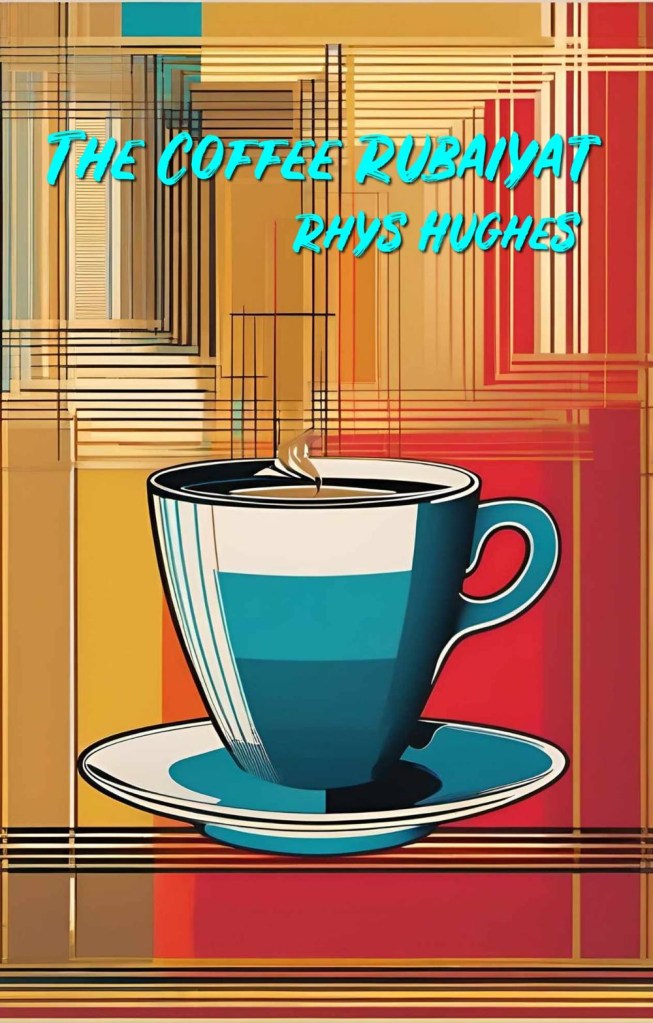
The Coffee Rubaiyat

Title: The Coffee Rubaiyat

Author: Rhys Hughes

Publisher: Alien Buddha Press

Introduction

The famous old poem called The Rubaiyat of Omar Khayyam is known to many through the translation Edward FitzGerald published in 1859. His first edition, a selection of 75 quatrains, is considered the best. He revised the quatrains several times, losing poetic force each time he did so.

His translations are regarded as highly inaccurate anyway, but they are musical, evocative and wistful, and I like them very much. They are among my favourite poems and I once resolved to learn them all by heart.

As it happens, I failed in that attempt, mainly through laziness, which is appropriate really, for FitzGerald himself was an especially lazy man, who wrote and did very little in his life.

The quatrains are all about the joys of wine. At any time of the day or night wine is good to drink. That is the essential message.

I have heard it said that Omar Khayyam’s wine is actually a metaphor, perhaps for God or enlightenment, but personally I find the idea unconvincing. Or rather, I lack the scholarly insight to feel the truth of that interpretation.

The verses seem to be about real wine, the kind that can get you drunk, though I am willing to entertain the notion that I am missing the point. At the very least they can be plausibly quoted in connection with real wine, and I have used them to justify drinking an extra glass, for yes, Omar is keen to insist that more is better than less, indulgence superior to restraint.

But although I am fond of wine, I am fonder of coffee by far. I can easily live without wine, but only with difficulty live without coffee.

Thus, I decided to write a Coffee Rubaiyat, matching FitzGerald’s first edition quatrain for quatrain but making mine all about coffee.

I daydream that copies of my slim collection will one day be found in the coffee shops of the world. If the cappuccino fits, wear it. So say I.

And now it is time for a coffee break and I shall say no more.

Rhys Hughes, June 2023

The Coffee Rubaiyat


I.

Awake! for the alarm clock next to the bed
Is ringing the bells that can wake the dead:
And Lo! The ruby rays of the rising sun
colour the espresso machine a pinkish red.

II.

Dreaming when Dawn’s Left Hand was in the Sky
I turned to Dawn with a very deep sigh,
“Crikey, dear, that’s a massive hand you’ve got.
Why not get out of bed and bring me coffee—a lot?”

III.

And, as the Cock crew, those who stood before
The coffee shop shouted—“Open then the door.
We all rather fancy a round of cappuccinos
Before grappling with our foes upon the floor.”


IV.

Now the New Year reviving caffeine desires,
The thoughtful soul to the kitchen retires,
Where the white froth on the large cappuccino
Flows out, and steam from the kettle perspires.

V.

Biscuits indeed are gone with all their crumbs,
And Sinbad is reduced to sucking his thumbs;
But still the coffee bush her lovely beans yields,
And still the waiter with our beverages comes.

VI.

And Dawn’s lips are coffee smeared; but in divine
Extra-strong roast, sighing, “The coffee’s all mine!
Cream but no sugar!”—the fox cries to the toad
But those dregs have gone cold and that’s not fine.


VII.

Come, fill the mug, and into the boiling kettle
Pour more pure water to cool the red-hot metal.
Strange folks prefer fashionable herbal teas
To sip—and Heck! They include leaves of nettle.

VIII.

And smells—a thousand aromas within one year
Wafted—and a thousand had no aroma to revere:
And this first breakfast time that brings burnt toast
Shall smear Sinbad’s ear on the sheer frontier.

IX.

Come with Coffee Khayyam and leave the lot
of juice bars and water bottles forgot:
Let gym instructors rant about overconsumption
Or doctors cry Enough—heed them not.


X.

With me at the quiet table of a terrace café
That divides the indolent from those gone astray,
Where one may slurp and dribble in peace
And pity the pedestrians who hurry on their way.

About the Book:

Settle into the enchanting rhythm of this coffee-themed adaptation of the classic Rubaiyat of Omar Khayyam, as each stanza awakens the senses with witty, humorous, and thought-provoking reflections on the joys and quirks of coffee culture.

The Coffee Rubaiyat embraces the essence of morning awakenings, midday pick-me-ups, and contemplative sips, all while exploring the comical and heart-warming encounters that revolve around this beloved brew.

This collection celebrates the endless nuances and pleasures that coffee brings. Coffee lovers, literature enthusiasts, and anyone with a penchant for the art of the bean will relish in the fusion of two worlds – the timeless verses of Omar Khayyam and the contemporary charm of Rhys Hughes.

A delightful literary adventure that will leave you yearning for another sip.

About the Author

Rhys Hughes is a writer of Fantastika and Speculative Fiction.

His earliest surviving short story dates from 1989, and since that time he has embarked on an ambitious project of writing a story cycle consisting of exactly 1000 linked tales. Recently, he decided to give this cycle the overall name of PANDORA’S BLUFF. The reference is to the box of troubles in the old myth. Each tale is a trouble, but hope can be found within them all.

His favourite fiction writers are Italo Calvino, Stanislaw Lem, Boris Vian, Flann O’Brien, Alasdair Gray and Donald Barthelme, all of whom have a well-developed sense of irony and a powerful imagination. He particularly enjoys literature that combines humour with seriousness, and that fuses the emotional with the intellectual, the profound with the light-hearted, the spontaneous with the precise.

His first book was published in 1995 and sold slowly but it seemed to strike a chord with some people. His subsequent books sold more strongly as my reputation gradually increased. He is regarded as a “cult author” by some and though pleased with that description, he obviously wants to reach out to a wider audience!

PLEASE NOTE: ARTICLES CAN ONLY BE REPRODUCED IN OTHER SITES WITH DUE ACKNOWLEDGEMENT TO BORDERLESS JOURNAL

Click here to access the Borderless anthology, Monalisa No Longer Smiles

Click here to access Monalisa No Longer Smiles on Kindle Amazon International
Categories
Slices from Life

Belongingness and the Space In-Between

By Disha Dahiya

Humans are in a perpetual state of motion — be it intercity, interstate, or inter-country — and the relentless quest to assimilate commences. Embracing a new culture, blending seamlessly with the locals, and adopting regional slangs and accents become daily endeavours. In this race without a finish line, a persistent anxiety takes hold. “What if I don’t quite fit in?” “Will people forever perceive me as an outsider?” “Could I lose touch with my roots?” Trust me, this apprehension intensifies when one immigrates to a foreign land.

The inner conflict of belonging experienced in transcultural migrations casts light on the concept of cultural dysphoria. When I first encountered this term, it piqued my interest in how individuals navigate their daily lives while carrying this weight. Cultural dysphoria, a recent term, is an extension of the concept of dysphoria. EverydayFeminism defines cultural dysphoria as: “…the dissonance between the societal expectations for an individual’s broad cultural performance or identity and their desired embodiment of that culture, or uncertainty about where they fit into cultural categories.”

In simpler terms, someone experiencing cultural dysphoria feels like an alien in a new culture. They grapple with the space between two distinct cultures. While their mind urges them to embrace the tenets of the new cultural paradigm, their heart insists on preserving their native cultural heritage.

It was only recently that I comprehended how the concept of cultural dysphoria applied to both me and my family. This understanding took nearly two decades to crystallise, but as the adage goes, “better late than never.” Such realisation would not have dawned upon me without the pursuit of my Ph.D. thesis. Over time, I delved into novels penned by first-generation South Asian American writers such as Chitra Banerjee Divakaruni, Amulya Malladi, Naomi Munaveera, and Bapsi Sidhwa. These authors were born in South Asian countries and subsequently migrated to America. Their literary works often delve into the challenges faced by immigrant families in a foreign land. Reading allows us to explore the world, but essays and books also furnish a window through which we can empathise with someone’s narrative. Nevertheless, one’s own story offers a distinct and nuanced perspective. Indeed, first-hand experiences yield unique vantage points.

I was a mere eight-years-old when my father obtained Canada’s Permanent Residency Card, and our journey towards establishing roots in a foreign land began. As a second grader, comprehending that you’re about to traverse over 7,000 miles is no small feat. At times, the gravity of such a situation eluded me. On other occasions, I found excitement in the impending turbulence. It was exhilarating, even though questions like ‘why are we relocating?’ and ‘why must I leave my school?’ continually lingered in my mind, spanning the distance from Delhi to our future home in Calgary.

This is the nature of belongingness – it doesn’t instantaneously manifest if you’ve have never before contemplated the possibility of residing in a country far removed from your homeland. The initial step in transcultural migration involves recognition, transcendence, and integration. One must acknowledge the reality of transcending boundaries, leaving behind their original cultural heritage, and stepping foot in a foreign land with its own distinct cultural tapestry. I refer to this stage as ‘Acceptance’, as it encompasses a multitude of thoughts regarding one’s capacity to accept and be accepted within this new environment.

For my family, the journey of assimilation began the moment we exited YYC Calgary International Airport in November 2006. A friend of my maternal uncle’s son welcomed us—a network woven through connections—a common phenomenon in Indian culture. Connecting with familiar faces, who then introduce you to others, and this chain keeps expanding, is deeply ingrained in our cultural fabric. From being surrounded by individuals of a different ethnicity to grappling with the nuances of time zones, my family sought to adapt to our new Canadian milieu. Isn’t it peculiar how one day you’re in the tranquility of your home, and the very next day, you soaring through the skies, crossing international borders?

Recalling the sequence of events surrounding our immigration, nearly two decades later, is no simple task. Much has evolved, particularly my perspective on life. What once seemed normal has shifted, no longer aligning with my current perceptions. This is the natural progression of personal growth – forgetting, reminiscing, comprehending, and de-constructing. Each emotion makes sense in hindsight, guided by wisdom acquired over time.

At times, we relegate certain emotions to the shadows of our heart. We normalise the experience of residing in the in-between and the accompanying sense of non-belongingness, presuming it to be an idiosyncrasy. However, South Asian diaspora members share these particular sentiments of the in-between. We accept our role as outsiders among the locals, convinced that this is the way it should be, right?

Navigating the new environment while endeavouring to retain a strong connection to one’s roots becomes paramount when relocating to a foreign country. A part of me yearned to return to India to celebrate the Festival of Lights with those left behind, while another part was eager to explore innovative ways of preserving our culture and traditions amidst the bustling streets of a land predominantly inhabited by individuals of a different ethnicity.

During those years, Canada had not yet become the Mecca for Indian students pursuing higher education, as it is today. The immigrant community consisted mainly of those who had relocated in the ’70s or ’80s in pursuit of a brighter future for their children. Consequently, the Indian community was relatively smaller.

The question of belongingness emerged from as early as my first day at school. Where does one truly belong in a classroom of over twenty students with varied ethnicity? Among these students, four were of Indian descent, two hailed from Pakistan, one each from Australia and France, while the remainder were Canadian natives. Yet none of these students were unequivocally ‘Indian.’

The logical assumption might be that I belonged with the group of four Indian-origin students. However, this was not the case because, fundamentally, I was Indian. A subtle distinction lies between being Indian and being of Indian origin. It wasn’t a matter of passports; it ran deeper. I was too Indian to seamlessly integrate with non-Indians and just slightly more Indian than those of Indian origin. I existed as an ‘other’ amidst the ‘others,’ with the four Indian-origin students occasionally amused by my Indian accent. Emerging from a decent background, having received education in a convent school, initiating casual conversations with a simple ‘hey, what’s up?’ was effortless. Yet, adopting a foreign accent was not within my purview. My peers of the same age knew precisely when and how to employ phrases like ‘screw it,’ ‘for God’s sake’, I’m not interested,’ and ‘nahhhh…’ The only phrase that came to mind whenever I wished to express my lack of interest was ‘it doesn’t matter’. As a non-native English speaker, it was the most apt phrase I could muster. Apparently, seamless alignment in terms of accent, language, and communication is pivotal to establishing friendships in a foreign land. Failure to do so results in being cast aside as an outsider.

The nagging thought that permeated my family’s collective consciousness during those early days in Canada was this: Do we belong here among people who do not perceive us as one of themselves? We had successfully traversed the initial stage of transcultural migration. Consequently, the second stage — which I’ve labelled ‘Non-belongingness’ — became a pivotal moment, shedding light on our lack of alignment with both people of Indian origin and non-Indians. Our cultural identity remained a poignant question mark, casting a shadow over our Canadian experience.

For my father, commuting to work entailed a daily two-hour journey to and from his workplace. Occasional weekend outings, mostly for groceries, marked the extent of our excursions. Indian suits were my mother’s customary attire, but how long would that persist? After a few months, she transitioned to wearing jeans and long shirts. While Indian suits exude grace and elegance, she lamented the difficulty of blending in. “Passing by a row of foreigners while wearing a salwar kameez is a daunting task; one becomes the subject of unwarranted stares,” she confided. Her eyes betrayed a longing for the life she left behind in India, where she could choose her favourite salwar kameez and embellish it with the most exquisite dupatta in her wardrobe without attracting undue attention. I sensed her yearning for India, particularly when my maternal grandfather — whom I affectionately called Nanu — phoned. Each call filled her with joy, and her countenance radiated even more than usual. Perhaps Nanu sensed her yearning to return, which manifested as glistening tears on my mother’s cheeks.

Life in Canada was a far cry from what it used to be in India. As Diwali approached, I eagerly anticipated the deluge of sweets and gifts that would typically inundate our home in India. However, that year, those customary tokens of celebration were conspicuously absent, a stark reminder that we had yet to establish a substantial social network in Canada. Everything had changed. People in Canada appeared disinterested in the Festival of Lights. It was just another day for them. Some were engrossed in preparations for Christmas, while others seemed oblivious to the existence of Diwali, India’s most eagerly awaited festival. With no candles adorning our home, no gifts to fuel our excitement, and nothing resembling the grandeur of an Indian Diwali, our spirits plummeted upon realising that we had yet to sever our emotional ties to our culture. It was a perplexing sensation. While I yearned to embrace the festivities of Christmas, the absence of enthusiasm for Diwali contrasted starkly with my Canadian expectations. I believe my parents experienced a similar sentiment because on that day, an uncharacteristic sombreness shrouded our smiles. We smiled for each other, but the glint in our eyes bespoke our longing for our true home, India.

In this narrative, where did we truly belong? Some may argue that we belonged where we resided at that moment, while others might reflect on their immigrant experiences and ponder their sense of belonging. This is where the bitter realisation of cultural dysphoria takes root. The inability to fully integrate into a foreign land, the feeling of being an outsider, and the disconnect between cultural expectations and reality culminate in a dysphoric sensation, marking the onset of the third stage in an individual’s transcultural migration journey. At this juncture, it becomes imperative to recognise that while certain aspects of one’s former culture must be relinquished, others must be preserved. I refer to this third stage as the ‘In-Between.’

The third stage of the transcultural migration experience delineates the unique space an individual occupies, betwixt and between two cultures. As immigrants, we embraced certain facets of the new culture while shedding some of our own, and vice versa, to carve out a niche that could accommodate and harmonise both cultures. Within this ‘In-Between,’ a new persona emerged. We remained too Indian for the world outside, yet our hearts affirmed it was for the best.

That year in Canada unfolded with a plethora of surprises. And then, we returned to India. But that’s a story for another essay!

The feeling of cultural dysphoria is far from uncommon. A majority of migrants grapple with the turmoil of cultural conflicts when transitioning to a new country. While this narrative offers a glimpse into how transcultural migrations can affect an individual, there exist countless other stories waiting to be shared with the world. In the area of transcultural migration, each thread tells a unique story, and my narrative is but one strand in this rich fabric of human experience. As my family and I navigated the in-between of two cultures, I am reminded that our journey is a testament to resilience, adaptability, and the enduring power of cultural identity. While the road may be fraught with challenges, the experience has imbued us with a profound appreciation for new cultures. Cultural dysphoria may cast its shadow, but it also offers a canvas for personal growth and understanding. It is my hope that by sharing our story, we illuminate the path for others embarking on similar journeys and foster a deeper understanding of the intricate web of the transcultural in-between.

Disha Dahiya is a PhD Research Scholar in English Literature. She has a keen interest in exploring the South Asian narrative across borders and boundaries while focusing on the cultural aspect of transcultural migrations.

.

PLEASE NOTE: ARTICLES CAN ONLY BE REPRODUCED IN OTHER SITES WITH DUE ACKNOWLEDGEMENT TO BORDERLESS JOURNAL

Click here to access the Borderless anthology, Monalisa No Longer Smiles

Click here to access Monalisa No Longer Smiles on Kindle Amazon International

Categories
Poetry

A Wave in the Ocean

By Avantika Vijay Singh

A wave in the ocean...
Here today, gone tomorrow,
Merged with the universe
Absorbed from whence it came.
Such is our life --
Here today, gone tomorrow
To merge with the Universe
Within the blink of a cosmic eye.

Our purpose,
Like the wave,
To create a stir
In the cauldron of the human ocean,
To add to humaneness
And the quality of our community.
That done --
It is time to merge the physical self
with the Universe.

The wave becomes a part of the ocean,
Its energy merging with that of others.
Its presence now a part of the ocean,
Manifesting in each drop left behind.
Each drop energised by the presence that was
Charged and changed deeply
By the manifestation deep within
Beyond the physical self.

Avantika Vijay Singh is the author of Flowing…in the river of Life and Dancing Motes of Starlight.

PLEASE NOTE: ARTICLES CAN ONLY BE REPRODUCED IN OTHER SITES WITH DUE ACKNOWLEDGEMENT TO BORDERLESS JOURNAL

Click here to access the Borderless anthology, Monalisa No Longer Smiles

Click here to access Monalisa No Longer Smiles on Kindle Amazon International

Categories
Review

Writing South Asia in the American South

Book Review by Gemini Wahaaj

Title: South to South: Writing South Asia in the American South

Editor: Khem K. Aryal

Publisher: Texas Review Press

Taken together, the stories and essays in the new anthology edited by Khem K. Aryal South to South, Writing South Asia in the American South, offer an intimate, richly articulated expression of what it means to live in the American South as a South Asian immigrant. Several stories construct the enduring feeling of loss, both for new immigrants and old. Sixteen authors have been featured. Some have dealt with the issue through fiction and some, through non-fiction.

In “The Immigrant”, a short story by Chaitali Sen, a young immigrant man Dhruv tries to compose a letter to his parents describing his new life in America but fails to find the language. While dining next to the hotel where he is staying during  a work trip, Dhruv is upset by the disappearance of a small boy and the fruitless search of the distraught parents, which reminds him of his own state in America, where he seems to have lost his way. In “Pine” by Hasantika Sirisena, a young Sri Lankan mother of two small children tries to hold on to her customs from home. Her husband walks out on her in a bid to make a new, successful life in America, unburdened by the trappings of culture and religion. She seems in danger of losing her two children also, who are more interested in Christmas trees than the rituals she wants to share with them. In a startling turn of events, she comes to terms with her own uprooting with touching courage.

Several stories remind us of the remarkable flexibility of South Asian immigrants, who transform themselves and become new people after putting down roots in a new place. One such story is Aruni Kashyap’s “Nafisa Ali’s Life, Love, and Friendships Before and After the Travel Ban”, about a young married woman from the war-torn region of Assam, whose mother and husband in India constantly worry about her safety. Nafisa lives next door to a couple as different from her as possible; they do not work, they drink and they have public sex – yet, Nafisa feels drawn to them as she embraces her new relationships and identity in America to escape her traumatic past. In “Nature Exchange”, Sindhya Bhanoo tells the story of a South Asian woman married to a white man whose relationship with her husband comes to an end when their son dies in an all too typical American phenomenon, a school shooting.

Repeatedly, we see immigrant women in a state of extreme desolation and isolation, left to their own devices to find meaning afresh in a foreign land. Whether they feel their children moving away from them or they literally lose a child, children seem to act as an anchor for the immigrant mother, but in each story, this most intimate of relationships only proves transitory. There are also contradictions. Whereas Sirisena’s story shows a man more willing to assimilate and adapt to America, in Kashyap’s story, the husband, sitting in India, draws easy conclusions about America (denouncing drinking, dancing, and their anti-immigration status), whereas the wife in America, tired of the stresses of living in a war-torn country, finds respite from her homeland’s history of trauma by partying with her office mates and Southern neighbors.

Parallel themes run through the entries. Both stories and essays articulate the craving for tea, one aspect of their identity that South Asians have carried overseas. Also poignant are tales of the early days of migration and the transformation people undergo over the years. Jaya Wagle writes of having an arranged marriage and making the long journey by plane with the man she marries to another country. The whole experience of her new marriage seems as unknown, fragmented, and mysterious as the new country to which they have come. The essay is poignant for the specificity of haunting details, and the transformation of an immigrant evident over the years.

But what makes these South Asian immigrant experiences uniquely southern? One pattern apparent through all the stories is the lack of public transport and public space. The new immigrants in these essays and stories are in cars and Ubers, tucked away in suburban houses or secluded apartments in small towns, the lack of public community accentuating their isolation. Added to this physical landscape is the South Asian immigrant’s alienation from the politics of the region.

The essays, compared to the stories, seem more concerned about identity and more strident about equating immigrant identity with patriotism and allegiance to the Democratic Party. In “Gettysburg”, Kirtan Nautiyal writes about playing the game Sid Meier’s Gettysburg based on the battle of Gettysburg, admiring Union army heroes, imbibing American history in school, and watching the film Gettysburg, wanting to prove himself an American. Throughout the essay, he seems to correlate being an immigrant with proving one’s patriotism towards his adopted country. He stretches it to a point where he would be willing die in a battle – a price, it seems, immigrants must be willing to pay to show their love for America. The essay, predictably, ends with the story of Captain Humayun Khan, who was killed in the Iraq war, told at the 2016 Democratic Convention. Anjali Erenjati writes about taking a fun car trip with her new immigrant friends who do not share her trauma of growing up in the deep South, where she faced a racist incident as a young teenager.

Essays, also, seem more directly to address the question of identity, specifically, being questioned about one’s identity. In Tarfia Faizullah’s humorous essay “Necessary Failure”, she is asked repeatedly where she is from, as her answer, “I grew up in Midland, Texas,” fails to satisfy her co-worker in a theater festival box office in Alabama. On Jaya Wagle’s first night in America, two policemen accost her husband in Texan English when she mistakenly calls 911. Later, the old women she meets at her library writing workshop ask her how long it took her to learn English, a language she has spoken all her life.

The editor Khem K. Aryal is an associate professor of English at Arkansas State University. He is a writer, editor, and translator from Nepal. His short-story collection, The In-Betweeners, is forthcoming from Braddock Avenue Books.

.

Gemini Wahhaj is the author of the forthcoming novel The Children of This Madness (7.13 Books, December 2023) and the forthcoming short-story collection Katy Family (Jackleg Press, Spring 2025). Her fiction is in or forthcoming in Granta, Third Coast, Chicago Quarterly Review, and other magazines.

PLEASE NOTE: ARTICLES CAN ONLY BE REPRODUCED IN OTHER SITES WITH DUE ACKNOWLEDGEMENT TO BORDERLESS JOURNAL

Click here to access the Borderless anthology, Monalisa No Longer Smiles

Click here to access Monalisa No Longer Smiles on Kindle Amazon International

Categories
Poetry

Poems for Halloween

By Michael Burch

A statue of Lorelei on the Rhine. Courtesy: Creative Commons
SIREN SONG	

The Lorelei’s
soft cries
entreat mariners to save her ...

How can they resist
her seductive voice through the mist?

Soon she will savour
the flavour
of sweet human flesh.


GHOST

White in the shadows
I see your face,
unbidden. Go, tell	
Love it is commonplace;

Tell Regret it is not so rare.			

Our love is not here
though you smile,
full of sedulous grace.

Lost in darkness, I fear
the past is our resting place.

(Published by Carnelian)

BELFRY

There are things we surrender
to the attic gloom:
they haunt us at night
with shrill, querulous voices.

There are choices we made
yet did not pursue,
behind windows we shuttered
then failed to remember.

There are canisters sealed
that we cannot reopen,
and others long broken
that nothing can heal.

There are things we conceal
that our anger dismembered,
gray leathery faces
the rafters reveal.


SOMETIMES THE DEAD 

Sometimes we catch them out of the corners of our eyes—
     the pale dead.
          After they have fled
the gourds of their bodies, like escaping fragrances they rise.

Once they have become a cloud’s mist, sometimes like the rain
     they descend;
	they appear, sometimes silver like laughter,
to gladden the hearts of men.

Sometimes like a pale grey fog, they drift
     unencumbered, yet lumbrously,
          as if over the sea
there was the lightest vapour even Atlas could not lift.

Sometimes they haunt our dreams like forgotten melodies
     only half-remembered.
          Though they lie dismembered
in black catacombs, sepulchres and dismal graves; although they have committed felonies,

yet they are us. Someday soon we will meet them in the graveyard dust
     blood-engorged, but never sated
          since Cain slew Abel.
But until we become them, let us steadfastly forget them, even as we know our children must ...
Courtesy: Creative Commons

Michael R. Burch’s poems have been published by hundreds of literary journals, taught in high schools and colleges, translated into fourteen languages, incorporated into three plays and two operas, and set to music by seventeen composers.

PLEASE NOTE: ARTICLES CAN ONLY BE REPRODUCED IN OTHER SITES WITH DUE ACKNOWLEDGEMENT TO BORDERLESS JOURNAL

Click here to access the Borderless anthology, Monalisa No Longer Smiles

Click here to access Monalisa No Longer Smiles on Kindle Amazon International

Categories
Musings

Ghosts, Witches and My New Homeland

By Tulip Chowdhury

Around the early ’70s, in my village home in Bangladesh, we kept ourselves far away from anything spelled “ghost or jinn.” I grew up hearing my Grandma saying, “Shh. Don’t even utter the word ‘bhut (ghosts) or jinn’ because words have power, and they might feel the vibe as an invite.” However, every Halloween is a culture shock for me after coming to Massachusetts, USA, when the celebrations of haunted houses, witches, ghosts, and spirits occur. My late Grandma might turn in her final resting place if I could message her, “Ghosts and witches are subjects of colorful celebrations, Grandma.”

Thoughts rewind to life with the villagers in Bongaon, when the fan-palm trees — taal gach — were supposed to be favourite places for ghosts and jinn. Myths held that ghosts and spirits lived as invisible souls among visible humans but liked to live on the trees. The trees they wanted to inhabit were trees standing beautiful and tall. Yet the beautiful sight was pregnant with danger. The long fonds looked like fingers beckoning passersby. The fan palm had delicious fruits called taal. The trees sent alarming vibes to the villagers. But getting the fruits from the tree was challenging and had to be done during broad daylight when ghosts were supposed to be non-active. The fan palm was not the only tree that welcomed them. The tamarind tree was also avoided, especially after sunset. Not just the trees, but their shadows spelled trouble too, and people avoided stepping in the shadows. The advice to weary souls was, “Don’t let the bhut get on your shoulders.” It seemed that the chosen place was the shoulder. It was different for the ghosts; they didn’t get into the victim’s head like other spooks.

Whenever I passed near our tamarind tree, I imagined a possessive spirit jumping down from the tree and landing on my shoulder. I would run for life faster than a deer when I passed one of them. Ghosts were known to haunt their victims for the rest of their lives if they got a chance to get on the shoulder. I ran home; I did not want to be possessed for the rest of my life.

According to the people in Bongaon, nighttime was the favourite time for ghosts and evil spirits. Starting from the late evening to the descent of darkness, no one walked without a flaming torch made from kerosene-drenched cloth on a thick stick. Much as darkness spelled fear and mystery, fire was the force to power the evil over to burn and destroy—similar to fantasy stories of modern times. In life, it seems we are connected like a spider’s web. A person suspected to be possessed by a spirit sought help from special prayers and charms. Some of the healers had harsh methods and had the victims smell burning dried chilli — supposed to clear the mind. And others sprinkled holy water around the person and the house.

Theories on haunting spilled beyond the trees and dipped below the waters surrounding my village. The water lilies in the rainy season bloomed in abundance in the swamps — haor, ponds, and the water-clogged areas around the town. The seeds and stems of the water were gastronomical delicacies for us. The stems cooked as curries and the grains got toasted over the fire. However, evil spirits and jinns were said to roam around swamps at night, and no one tried to pick these up in the dark. Growing up, I wondered if the whole thing around the evil supernatural was to keep people safe because plenty of water snakes coiled around the lily stems, and people were likely to get bitten. Often, people invented ghost stories when logical explanations failed or, perhaps, to safeguard without having to give lengthy answers.

The sweet shops and their connections to supernatural beings baffled me then and to this day. Few charming shops sold traditional deserts, like rosogolla, cholchom and kalojam; the display trays were usually well stocked. It was well known among people that if you entered the shops after the Muslim evening prayer, the Maghrib, the sweets would be gone from the trays. The good jinn were supposed to like the sweets and, on their way back from the mosque, feasted on them. Our village did not have electricity, and there was no refrigerators to preserve these. So, when fresh sweets were replaced on trays the next day, there was no explanation given for the disappearing trayful until the maghrib prayer. No customers came because they wanted to avoid jinn altogether since they could change from good to bad ones. The disappearance of the sweets at a particular time remains a mystery added to many others in my lifetime.

The people in Bongaon believed there were two kinds of jinn: good and evil. Good jinn were with the steady and truthful people who prayed regularly. If the good people, especially women, happened to walk with loose hair in the evening or night, they were exposed to danger of being possessed by the evil jinn. There were dos and don’ts, right and left, for women to keep themselves safe from evil jinn and ghosts. As far as I remember, men were almost excluded from the “wanted list” of the feared beings. How was that possible? The male-dominated society of the early 70s seemed to set boundaries for the ghosts and jinns. In the modern digital world, men and women have found some common ground, and even spirits no longer come only for female humans. Now that we have electricity, in the village scenario, women are smarter with computer skills; in reality, male dominance gets veiled. I am pretty sure the tamarind or the fan palm trees have their versions of the surreal world. However, the deep-rooted world of the spirit world still chains many, especially around the nighttime.

Nighttime and darkness seem to hold endless mysteries, and most are shrouded with danger in many cultures as they did in Bangladesh society. But was the dark so scary? Sleep at night came with dreams and nightmares. To be fair to the darkness, I would often sit on the porch and take in the night sky with its unique, moving life. The sky was never the same, moonlit or with the new moon. Clouds played hide and seek over the moon on rainy days. And the stars, their endless games of winking at me made me as happy as a child every time I looked up at them.Some nights, an owl would greet me with the “Twoo, twoo,” and I would whisper my hello back. I was sure the night bird heard me loud and clear; if it could see at night, why not hear at night, too? Whenever the owl called, thoughts winded to village childhood days, days when village myths held beliefs captive. Whenever we listened to owls’ hoot, we were urged to say, “good”, because if there were something ominous, the power of our words would take that away.

Halloween in Massachusetts digs into memories of my childhood’s haunted and ghost-ridden world in a Bangladeshi village. I was scared then, but now it’s more about exploring life. Life balances fears and hopes, sorrow and joy; between it all, ghosts, jinns, fairies, and angels hold me spellbound in real life. I relish every magical moment of it. I am not scared of witches, black cats, or ghosts that roam around my hometown during Halloween. The ghosts on the tamarind tree and the fan palm were kind to me, and I guess the evil spirits here will also be.

 In my present, the black cat on the shop window, the witch on the broom, or the masked stranger are said to spell danger. There are clubs and social groups that share experiences and do not avoid them like we did back home in Bangladesh. I stand in between cultures, wondering at the reality that connects the spooks I grew up with and the ones I grew into in my adopted world.

.

Tulip Chowdhury is a long-time educator and writer. She has authored multiple books, including Visible, Invisible and Beyond, Soul Inside Out, and a collection of poetries titled Red, Blue, and Purple. The books are available on Amazon, Kindle, and Barnes and Noble. Tulip currently resides in Massachusetts, USA.

.

PLEASE NOTE: ARTICLES CAN ONLY BE REPRODUCED IN OTHER SITES WITH DUE ACKNOWLEDGEMENT TO BORDERLESS JOURNAL

Click here to access the Borderless anthology, Monalisa No Longer Smiles

Click here to access Monalisa No Longer Smiles on Kindle Amazon International

Categories
Poetry

A Poem About Mysore

By Rhys Hughes

I decided to go to Mysore
because it seemed quite rude
not to pay it a visit
while I was in the mood.

Ate too much food.
Mysore tum!

Sat on a porcupine.
Mysore bum!

Walked for many hours.
Mysore feet!

Sat on a porcupine again.
Mysore seat!

Climbed one of the trees.
Mysore knees!

Then I was very tired
and booked a hotel room
to lie down on a bed.
Mysore head!

And while I slept I dreamed
of a problem philosophical,
namely who has the
twitchiest whiskers.
Mysore cats?

And that, my friends, was that.

Rhys Hughes has lived in many countries. He graduated as an engineer but currently works as a tutor of mathematics. Since his first book was published in 1995 he has had fifty other books published and his work has been translated into ten languages.

.

PLEASE NOTE: ARTICLES CAN ONLY BE REPRODUCED IN OTHER SITES WITH DUE ACKNOWLEDGEMENT TO BORDERLESS JOURNAL

Click here to access the Borderless anthology, Monalisa No Longer Smiles

Click here to access Monalisa No Longer Smiles on Kindle Amazon International
Categories
Musings of a Copywriter

Red Carpet Welcome

By Devraj Singh Kalsi

Even if it has nothing to do with Cannes or any other star-studded celebrity jamboree or political protocol, walking the red carpet is a dream come true for those attending marriage receptions. The red carpet is laid out right from the entrance gate to the podium where the newlywed couple remain ensconced in plush royal chairs to receive guests trudging with gifts and bouquets. The kick one gets when one walks on it is indescribable, as real-life experiences of such episodes remain fresh and permanently etched on my memory. It is the closest to what ordinary mortals can ever experience of celebrity status.

Have you ever wondered about the source of confidence in those who are sure of getting a red-carpet welcome in life? Perhaps it is faith in destiny or God or contacts or their talent. But for those who have none of the above factors skewed in their favour, it is the art of making the commonplace look uncommon and turning the massy into something of a bit classy that makes them celebrate ordinariness through elevation and derive pleasure in some measure to satiate their hunger of being dubbed as important folks that have walked on this planet. Even if there are no worthy guests on the list, the red carpet makes them all special in a democratic fashion. 

Ever since the realisation dawned that the surest way to downgrade the value of the red carpet is to make it so obvious or ubiquitous that there is no iota of status attached to those walking on it wearing anything from sandals to stilettos, I have contributed my fair bit by walking on the carpet wearing flip-flops and shorts. That was considered nothing less than a sacrilege.

Although a little hesitant about socialising, the idea of walking the red carpet without the tuxedo has never set my mind ablaze like a forest fire. I am more than cool to walk the red carpet wearing a sherwani[1] from the local tailoring unit or a pair of straight jeans from the retailer next door. I have relished the sight of those wearing dhotis[2] and walking the red carpet with a sense of pride over our remarkable strength to localise it. The white chappals with socks raised high to cover the varicose veins make it camera worthy. Visitors who do not feel intimidated by the veneer of superiority of the red carpet are the truly evolved ones who have successfully turned the special welcome into something quite mundane.

Women decked up in salwar kameez and posing for cameras to click their grand entry is a delectable sight. When their expectations are razed to the ground as the cameras show scant interest in the red carpet and focus more on those gorging on delicacies and gobbling up like gluttons, their family members freeze the moment of reckoning as well as their glam look while strutting the red carpet for social media posts only to be pushed aside by another jostling, impatient couple usurping the space for shutterbugs to randomly click them for their profile feeds before their makeup begins to melt under the harsh glare. With all the guests having staged their presence on the red carpet, there is a sense of contentment that they have finally done what their idol celebrities do with panache.    

The burgeoning middle class, thanks to marriage halls, has used the red carpet as a mandatory sign of affluence to pose as arriviste, making it a democratic exercise like the right to vote for all those who often feel they are going to miss the red carpet welcome in life due to their non-achiever status. Though the aspirational value of the red carpet welcome has, perhaps, waned a bit in recent times.

While the majority celebrates the red carpet becoming a reality for all, there are some who still detest at the idea of loss of exclusivity. Many families spread a red carpet in their homes and give an enthusing welcome to their guests every day. Even though they have done nothing to deserve it, they are happy with the fulfilment of luxury in a smart affordable manner. The trend of using the red carpet to flaunt status and deliver status to other people has become an everyday practice.

Imagine an entire family walking the red carpet with hands on the waist, posing for cameras even if the pictures do not appear in tabloids. Their social media handles garner likes, and the sharing of images makes them feel like a celebrity in their limited circle. Even after attending several such events and walking the red carpet multiple times, taming of desire remains a challenge. While it is easier to be rich and more difficult to earn fame, celebrity status redefines itself to widen the circle of pseudo-celebrities getting high after walking the red carpet as an antidote to assuage their bloated sentiments of undiminished narcissism.

.

[1] Long coat worn for formal occasions in South Asia

[2] A garment worn in lieu of trousers

.

Devraj Singh Kalsi works as a senior copywriter in Kolkata. His short stories and essays have been published in Deccan Herald, Tehelka, Kitaab, Earthen Lamp Journal, Assam Tribune, and The Statesman. Pal Motors is his first novel.  


PLEASE NOTE: ARTICLES CAN ONLY BE REPRODUCED IN OTHER SITES WITH DUE ACKNOWLEDGEMENT TO BORDERLESS JOURNAL

Click here to access the Borderless anthology, Monalisa No Longer Smiles

Click here to access Monalisa No Longer Smiles on Kindle Amazon International