Categories
Musings

Notes from Kerala: Running during COVID

By Shevlin Sebastian 

Every day, at 6 p.m., I set out from my home in Kochi for a run. In these coronavirus times, I have marked out a route that runs parallel to the main road. For a few days, the cops, in khaki uniform, were stopping cars and two-wheelers but they left the individuals alone. 

I have started running after a decade. During those years, I was swimming. But the pool, where I swim, is closed. The lifeguard has gone home. The club is shuttered. There is a lone watchman in a blue uniform standing at the gate and saying, “Nobody is here.” 

In my mid-fifties, it takes time for my body to move. The legs are stiff, and movements in the arms are negligible. But around 300 meters into my run, a miracle happens. My body shakes off the lethargy, my legs start moving rhythmically, and soon I am gliding across the road. A younger version has taken over. Or maybe, my muscle memory has asserted itself. 

It is a beautiful route. There are large trees with overhanging branches on either side.

Most houses have lawns in front where red and white roses bloom. In some homes, there are vegetable patches at the back. In the concrete jungle of Mumbai, you may have to pay crores of rupees to enjoy this. But in Kochi, these are the houses of middle-class people. How lucky we are!  

Over the rasping of my breath through my open mouth, I can hear birdsong. No longer are auto and car horns and the groaning exhaust of ill-maintained lorries the dominant sound. When I run, I no longer have to look at the road, as no vehicles are coming from the opposite direction, just a stray white dog who looks at me with mournful eyes as if asking, “Where have all the people gone?” 

But they are there, inside their houses, and outside too. 

I see a woman picking up a large blue bedsheet from a clothesline on the terrace of her house. I see a thirty-something woman, in a white nightgown, standing at the door, holding a sleeping baby, with a white headscarf, in her arms, and looking curiously at me. On another terrace, a woman is watering her plants, placed on the parapet, a row of red pots, using a green hose. “Nice colour contrast,” I think. 

On this hot, April summer day, with more than 95 per cent humidity, perspiration starts to drip down my forehead. My breath is rushing out, like water from a burst pipe, through my open mouth. Incredibly, at this moment, I think of my mother. 

Last night, when I went to meet her, she said she was thinking of her father. She said the entire family had gone to the St. Alphonsa Pilgrim Centre at Bharananganam (75 km from Kochi). “My father was about to fall into a deep pit, which was hidden under a canopy of weeds,” she said. “But at the very last moment, he bent and saw it. He said that St. Alphonsa had saved him.” 

It is a big family — many brothers and sisters. A few are scattered all over the world. Three have passed away. Her parents are both dead. Their house has become a private college. Where my grandfather used to sit in a low armchair, a short, squat man, with silver hair and a bald brown patch at the top of his head, in a large hall, where the tick-tock of a large black clock on the wall could be heard clearly, now college students come and listen, with drooping eyes, to the drone of a teacher, who looks bored and sounds listless. He’s been teaching the same syllabus for decades. 

As my mother spoke, I realized that she is an orphan. She can never meet her parents anymore except in her imagination. And in a matter of years, I will be an orphan too, as my father is now 93 and my mother is 83. What would life be like without parents? A friend, who lost his parents, told me that you think of them more when they have passed away rather than when they are alive. 

I run faster and expectedly I can feel a pain in my lungs, as my body tells me to slow down. And so I do. 

I am depressed. I have lost my job in the print media, and my 38-year career seems to have come to an end. What do I do now? Owing to the virus, the economy is at a standstill. And so am I. 

I have a daughter and a son in college. Early marriage, but late parenthood. Two miscarriages roiled my wife’s equanimity. But finally, after nine years of marriage, and several treatments at various fertility centres, God nodded and the babies came. But now, how do I pay my bills, their bills, our bills? Thankfully, my wife has a good job as a counsellor in a college. So, we won’t starve. 

Unfortunately, we have a bitter-sweet marriage. The pattern is one week of sweetness followed by three weeks of sourness. This routine has continued for a long time. “You are too self-absorbed,” she said. “I can’t handle it.” 

We have been married for 27 years.   

I partly agree with her. All writers go inside themselves all the time. You lose touch with the outside. You lose awareness of people and their emotional needs. Which woman likes that?

Since I have slowed down, my breath, through my wide-open mouth, has begun to go in and out easier. One day, there will be the last breath. Which day, month and year will it be? At what time? How old will I be? Who will be around me? Will I be in a hospital room all alone? Will my children be far away? In another country? Will they have any affection left for me? 

And will my wife be still around? Will she be staring at me, by my bedside, as I get ready to leave the planet; will it be a bittersweet moment for her? Sad that I am dying but happy for some crumbs of freedom after I am buried — free at last, free at last, thank God Almighty I am free at last. 

And nobody will point fingers at her, which might have happened if we had divorced. These accusations could have been shouted at her by relatives or our children. But this is the smoothest way to freedom. The bugger died. Not my fault. 

I feel my legs starting to move smoothly again. I think this is a second wind. If I want, I can stop. But I know I can continue if I keep going in this steady manner. Now my body has become like a machine. Of course, it is an ageing machine. 

It was my friend Sanjay who introduced me to running. I was a frail boy with black-framed spectacles, who liked to read books all the time. A nerd. He lived two buildings away on a street beside a large park in Calcutta. I don’t know how we first met, but we were in our teens. He was 6’ and I was 5’ 5”. And he had a passion for tennis. He played it every day at a club inside the park. And to keep fit, he would go for runs on the perimeter of the park. He urged me to come with him. 

“I have never run before,” I said. There is always a first time, he said. So I asked my parents to buy me a pair of white keds, and they gladly did so. They did not like me staying cooped up inside the house all the time. A shy boy with no friends. 

But when I started running, it was a revelation. I had a smooth style. Always, from the very beginning, I felt that I was gliding over the ground. “Man, you are good,” said Suresh, who showed thumbs up to me. There was a reason for his appreciation. He ran in a heavy lumbering way. Of course, he was 85 kgs and this weight proved a hindrance. It came as no surprise that through the decades, he never liked running. 

But I am sure he likes his present-day life a lot. He is a tennis coach at a millionaires’ club in Florida. Through shrewd real-estate deals and stock investments, Suresh has made a pot of money. He lives in a gated community that has a clear lake, an amber-blue swimming pool, a well-equipped gym and a gleaming black Mercedes Benz in his garage. But he has stayed in touch. Calls me once a month. Has retained his Indian accent and simplicity. When in the mood, both of us speak in Bengali, as a nostalgic tribute to our Calcutta roots. A Rajput and a Malayali speaking in Bengali. That’s the beauty of a syncretic India, now under furious attack by fundamentalists who are unwilling to accept that the people they demonise have a soul just like them. 

I am running steadily now. Three elderly men, in white and multi-coloured lungis, stand around, keeping the social distancing norms (Kerala has the highest literacy rates in India, so they know the rules) and chat about the hot weather. I go past. They pause to look at me. May make comments about me after I have gone some distance away. It does not worry me at all. But what I am worried about is the state of my knees.   

A decade ago, fearful that my knees would take a hit since I was always running on tarred roads, I shifted to swimming. And this turned out to be even better than running. Gliding through the water, every muscle getting a workover, especially the lower back, always a point of weakness for sedentary workers, the sense of rejuvenation I felt when I stepped out of the pool after a 45-minute session. There was nothing to match it. My brain became soaked in dopamine.   

And the moment my head hit the pillow, I was out, like a knockout blow to the chin by a professional boxer. 

But now, in the times of the virus, I have to rely on the good old legs but the dopamine that seeps out is a trickle, like the flow of water in a river during the middle of a drought. Still, something is better than nothing. Be happy.  

In the end, I stop running and take out my handkerchief and wipe my face and neck. And keep wiping it as the sweat continues to flow. I walk and walk, till I finally reach my home….an oasis as well as a battlefront.   
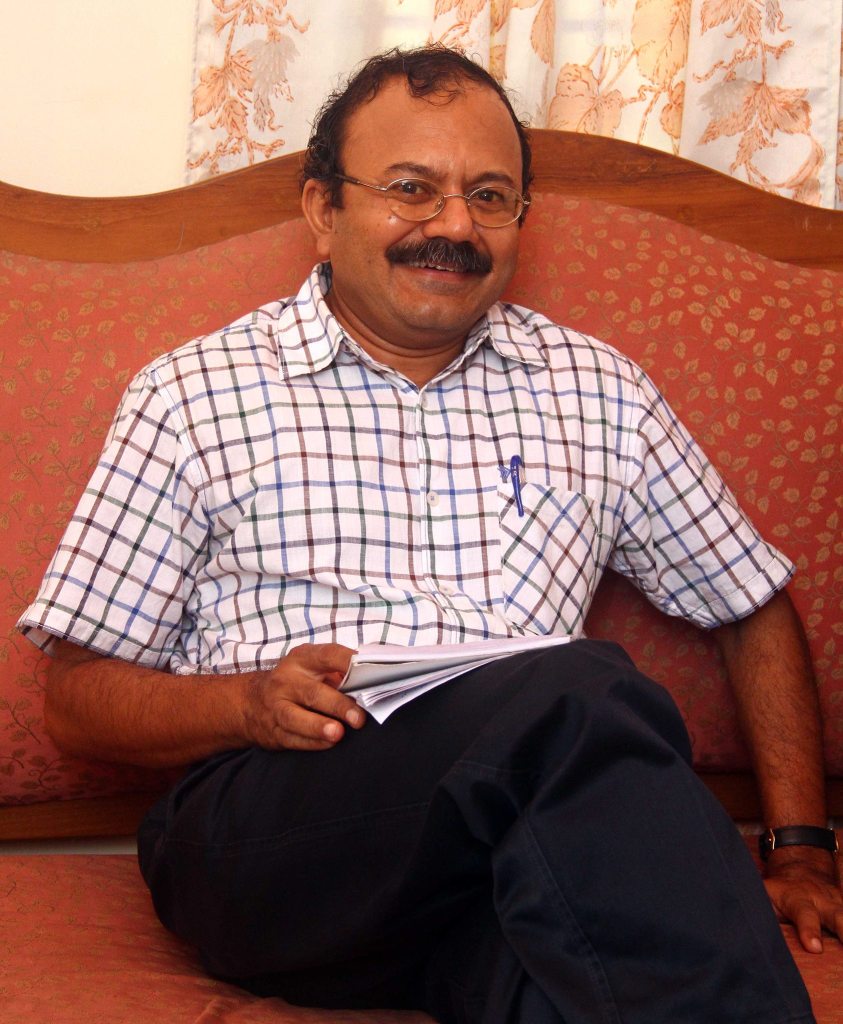
Shevlin Sebastian is a journalist based in Kochi. He has published around 4500 articles over 30 years, most of them feature stories. He has worked in Sportsworld magazine, (ABP Group), The Week magazine (of the Malayala Manorama Group), the Hindustan Times in Mumbai and the New Indian Express in Kochi and in DC Books, Kottayam. 

Categories
Poetry

Praying Mantis

By Orbindu Ganga

Painted in a shade 
Rested in her cave,
Silent enough to be staid
To be camouflaged
With the leaves,
Whirling from the obtuse
To touch the straight angle,
She echoes the form
In the way, she looks,
She creeps like a humanoid
To trigger the strive for higher form,
She drafts her movement
Like a saint for everybody’s well-being,
Seeing with a vision in two
To hear them mumble in one,
She was created 
To whisper in the ambiance,
Ingrained with gratitude
To seek the showers of blessings,
From the almighty 
With folded hands to him,
The human opened their eyes
To get intrigued to see the visual.
She stood still 
For as long she could,
Making her the cynosure
For rest to admire,
Showing all the species
The power of prayer,
The mantis is the prophet
Praying for all the species.

Orbindu Ganga is a post-graduate in science and the first recipient of Dr. Mitra Augustine gold medal for academic excellence. He worked in financial, banking and publishing domains, proving his finesse as a Soft Skills Trainer and Content Account Manager (Client Relationship Manager). Orbindu Ganga is a multilingual poet, author, critic, content writer, sketch artist, researcher, and spiritual healer. His poems have been published in many international publications and anthologies. He has published two research papers in poetry. His painting and article have been published in a spiritual journal – Awakening. He has authored the book “SAUDADE.”

Categories
Essay

Rebuilding After Corona

By John Scales Avery

A better world is possible!

It is hard to predict how long the terrible COVID-19 pandemic will last, but at some time in the future it will end, and we will be faced with the problem of rebuilding the world after the enormous economic and human destruction which the disease will have left in its wake. The pandemic has thrown light onto the world’s political and economic systems, and has shown them to be wanting. Most people today do not wish to return to the old normal. That “normal” was part of the problem. The post-pandemic world must be a new and changed world!

Is a better world possible? Of course it is! Our present world is filled with an almost unimaginable amount of injustice, greed and folly. Why is our present world so full of glaring faults? One reason can be found in the slow rate of change of genetic evolution, compared with the lightning-like rate of cultural evolution. We face the problems of the 21st century with an emotional nature that has not changed much since our ancestors lived in small tribes, competing for territory on the grasslands of Africa. Our emotional nature contains an element of tribalism to which militarists can all too easily appeal.

Recovery offers climate action opportunities

When the COVID-19 pandemic is over, governments will be faced by the task of repairing the enormous economic damage that it has caused. The situation will be similar to the crisis that faced US President Franklin D. Roosevelt when he took office during the Great Depression of the 1930’s. Roosevelt, encouraged by John Maynard Keynes, used federal funds to build much-needed infrastructure around the United States. His programs, the New Deal, ended the Great Depression in his country.

Today, the similar concept of a Green New Deal is being put forward globally. This concept visualizes government-sponsored programs aimed at simultaneously creating both jobs and urgently-needed renewable energy infrastructure. The Green New Deal programs could be administered in such a way as to correct social injustices.

A sustainable economic system

Economists, with a few notable exceptions, such as Nicholas Georgescu-Roegen, Aurelio Peccei and Herman Daly, have a cynical tendency to confine their discussions to the short-term future. With self-imposed myopia, they refuse to look more than a few decades into the future. This allows them to worship growth, and to advocate perpetual growth. But endless growth of anything physical, on a finite earth, is a logical impossibility.

Our present financial system is unsustainable, and it works for the interests of a few very rich people.  For the sake of the long-term future, we must build a sustainable, steady-state economic system, an economic system which reduces inequality, and which serves the broad public interest, an economic system with both a social conscience and an ecological conscience.

A new freely downloadable book

I would like to announce the publication of a book, which discusses the changes that we must make to create a better world after the pandemic has ended. The book may be freely downloaded and circulated by clicking on this link.

http://eacpe.org/app/wp-content/uploads/2020/04/Rebuilding-After-Corona-by-John-Scales-Avery.pdf

Other books and articles about  global problems are on these links

https://wsimag.com/authors/716-john-scales-avery

https://wsimag.com/authors/716-john-scales-avery

I hope that you will circulate the links in this article to friends and contacts who might be interested.

I hope that you will circulate the link in this article to friends and contacts who might be interested.

John Scales Avery is a theoretical chemist at the University of Copenhagen. He is noted for his books and research publications in quantum chemistry, thermodynamics, evolution, and history of science. His 2003 book Information Theory and Evolution set forth the view that the phenomenon of life, including its origin, evolution, as well as human cultural evolution, has its background situated in the fields of thermodynamics, statistical mechanics, and information theory. Since 1990 he has been the Chairman of the Danish National Group of Pugwash Conferences on Science and World Affairs. Between 2004 and 2015 he also served as Chairman of the Danish Peace Academy. He founded the Journal of Bioenergetics and Biomembranes, and was for many years its Managing Editor. He also served as Technical Advisor to the World Health Organization, Regional Office for Europe (19881997). http://www.fredsakademiet.dk/ordbog/aord/a220.htm. He can be reached at avery.john.s@gmail.com. To know more about his works visit this link. http://eacpe.org/about-john-scales-avery/

First Published in Countercurrents.org

Categories
Poetry

Virus, Unanswered Questions and more…

By Manu Dash

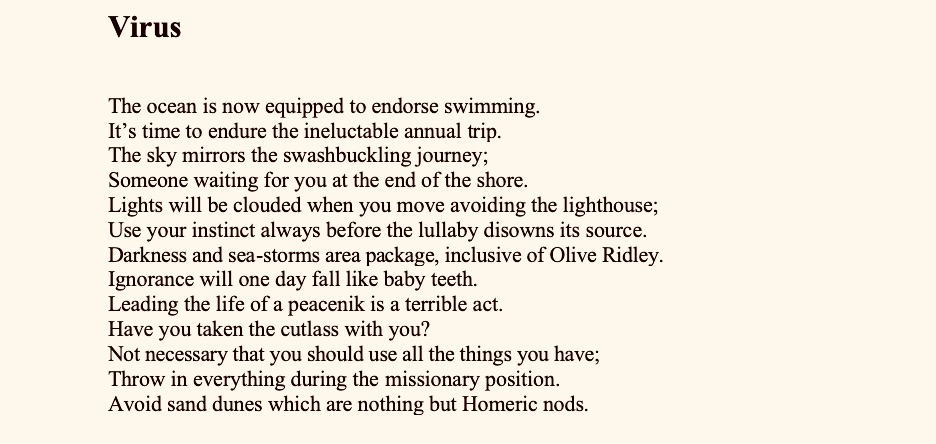
Virus


The ocean is now equipped to endorse swimming.
It’s time to endure the ineluctable annual trip.
The sky mirrors the swashbuckling journey; 
Someone waiting for you at the end of the shore.
Lights will be clouded when you move avoiding the lighthouse;
Use your instinct always before the lullaby disowns its source.
Darkness and sea-storms area package, inclusive of Olive Ridley.
Ignorance will one day fall like baby teeth.
Leading the life of a peacenik is a terrible act.
Have you taken the cutlass with you?
Not necessary that you should use all the things you have;
Throw in everything during the missionary position.
Avoid sand dunes which are nothing but Homeric nods.

An Unanswered Question


The little boy asked his mother,
‘Who made our village river?’

Mother raised her face from
The homework and answered, ‘God’.

‘Has he made our village too?’
‘Yes’ said she.
 ‘Why the inequality in making
 Buildings, roads, and facilities?’

‘Ask these questions with God
When you grow older,’
Mother laughed.

The following year, the boy met God
When his school bus plunged into the river.
But no one knew if he raised the question
Before God. 


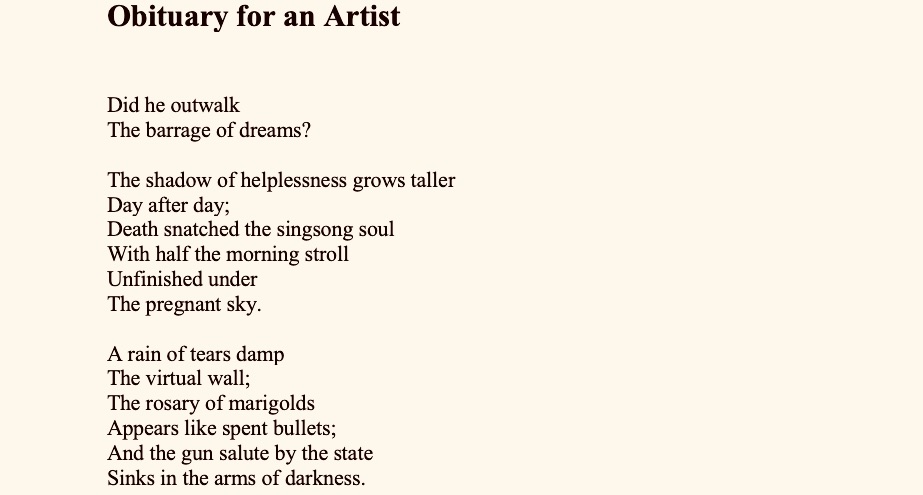
Obituary for an Artist


Did he outwalk
The barrage of dreams?

The shadow of helplessness grows taller
Day after day;
Death snatched the singsong soul
With half the morning stroll 
Unfinished under
The pregnant sky.

A rain of tears damp 
The virtual wall; 
The rosary of marigolds 
Appears like spent bullets; 
And the gun salute by the state
Sinks in the arms of darkness.

What’s there in the body
Without the soul;
What’s there in the soul 
Without the body?

You are thirdfourthfifthsixth
May be in this week alone.
Unfinished lines and incomplete brush strokes
Play with the washerman’s canine;
Experience the anguish of eternal waiting.
No one will bother to blame fragile memory
And wait for the echoing rhetoric.

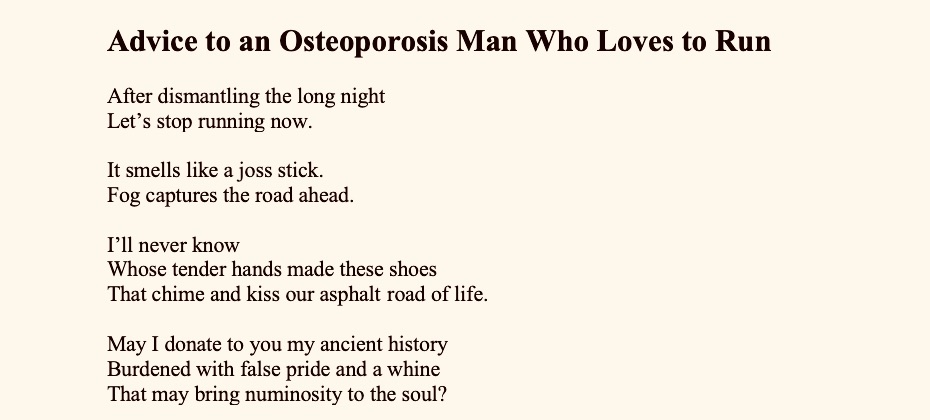
Advice to an Osteoporosis Man Who Loves to Run

After dismantling the long night
Let’s stop running now.

It smells like a joss stick.
Fog captures the road ahead.

I’ll never know
Whose tender hands made these shoes
That chime and kiss our asphalt road of life.

May I donate to you my ancient history
Burdened with false pride and a whine
That may bring numinosity to the soul?

Let’s turn back now.

The days go ahead in their spendthrift way
Before you pray a silent prayer
Where no prayer-flag is in sight.

You may drink the newspapers
Brimming with the retching of time.

(with permission taken from A Brief History of Silence, Dhauli Books 2019)

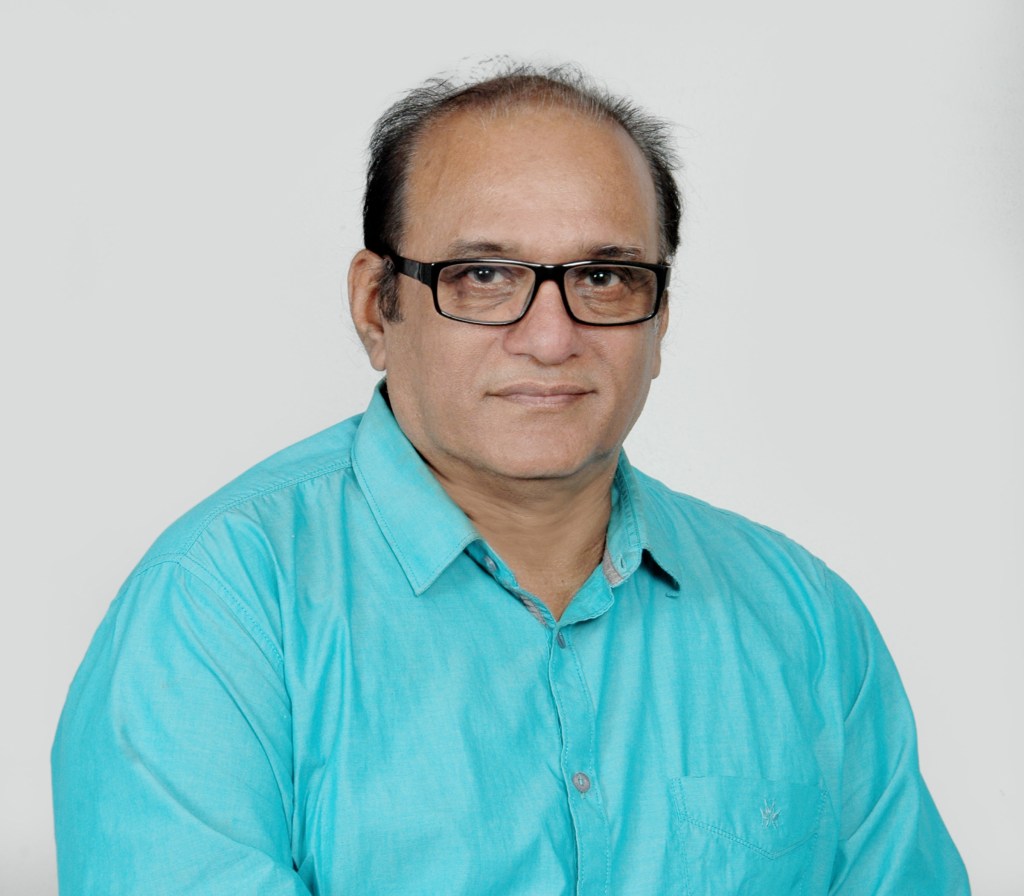
Manu Dash (1956) is a poet, editor, translator, publisher and curator of the annual Odisha Art & Literature Festival. He has published 25 books in Odia and English. While in college, he joined the “Anam Writers’ Movement” — an anti-establishment movement in Odia literature — shortly before the imposition of Emergency in India in 1975. He is the founder of Dhauli Books, which won the prestigious “Publishing Next Industry Award for the Best Printed Book of the Year in Indian Languages” in 2018.

Categories
Essay

Begum Akhtar: The ‘Mallika-e-Ghazal’

By Bhaskar Parichha

‘When I decided to be a singer, my mother warned me I’d be alone a lot. Basically we all are. Loneliness comes with life.’

-Whitney Houston

For Begum Akhtar loneliness came rather belatedly — after her marriage to barrister Ishtiaq Ahmed Abbasi. With marriage came the ban — no music, no concert. How can a Begum sing publicly?

However, Akhtaribai Faizabadi, as she was known before marriage, couldn’t have lived a day without a recital because she was born for it.

Her first guru was Ustad Imdad Khan, a great sarangi exponent. She was also trained under Ata Mohammed Khan. But it was in Kolkata in the early thirties that her musical career took a big twirl. She began learning music from such classical stalwarts like Mohammad Khan, Abdul Waheed Khan and Ustad Jhande Khan. There was no going back after that.

Begum Akhtar gave her first public performance at a very early age — fifteen to be precise and she took the music world by storm.  Sarojini Naidu — the nightingale of India — was so moved   by Begum Akhtar’s singing during a concert organised in the aid of victims of Bihar earthquake that she prophesied the materialisation of a great singer in the young Akhtaribai.

Ghazal singing was Begum’s forte. She cut her first disc for the Megaphone Record Company in the mid-thirties followed by a number of gramophone records carrying her ghazalsdadrasthumris.  What is little known about the ‘Queen of Ghazals’ is that she was a feminist to the core.  Begum lived her life like no other woman till her death in 1974. She had dared to play around with the freedom to make choices in life, revealing a true feminist soul.

With the advent of the talkie era in India, Begum Akhtar acted in a few Hindi movies. In fact, she was the leading lady in films of those times. Ek Din Ka Badshah (An Emperor for a Day) was her first film produced by the East India Film Company of Calcutta. Then came Nala Damayanti (1933).  Like others of her genre, she herself sang her songs. She continued acting and there were a couple of memorable films to her credit: Ameena (1934), Mumtaz Begum (1934), Jawaani Ka Nasha (The Drunkenness of Youth, 1935), Naseeb Ka Chakkar (The Circle of Destiny, 1935). She acted in Roti (1942) — produced and directed by Mehboob Khan — for which she sang six ghazals. The music was composed by melody maestro Anil Biswas.

Begum Akhtar’s association with films continued even after a face-off with Mehboob Khan. Music Director Madan Mohan gave her a chance to sing in two of his films– Daana Paani (Food-Water,1953) and Ehsaan (Favour,1954). Satyajit Ray’s Bengali film Jalsaghar (The Music Room, 1958) was her very last role where she played the role of a classical singer. Begum Akhtar alternated between Bombay and Lucknow in pursuit of her career. She had a stint in theatre too. But her voice needed to be regularly hoisted up. So, she gave up acting in theatre.

Begum Akhtar’s voice matured with time, adding richness and depth. She sang ghazals and light classical pieces in her inimitable style. She has nearly four hundred songs to her credit — an incredible inventory for someone who grew up amid harsh conditions.

A regular performer on All India Radio, she invariably composed her own ghazals and most of her compositions were raga– based. Begum Akhtar had a deep, husky and richly-timbered voice with nasal intonations. In her thumris she blended the Purab and Punjabi styles. She did not resort to taan patterns in a fast tempo. Her dadras were infused with a sprightly mood; her ghazals were thumri-oriented with much scope for improvisation.

The peculiar charm of her voice was easier felt than described. Hers was an extraordinary voice — not ‘round or petal-soft but angular and pincer-like.’ She was known to use a momentary split in her voice, called ‘patti’, which appeared like a crack in the upper register. It is said that her admirers waited for the ‘patti’ to come out when she sang.
Begum Akhtar was a scholar of Urdu poetry too. Her favorite poets were Ghalib, Dadh, Faiz Ahmed Faiz, Jigar Moradabadi, Shakeel Badayuni, and Kaifi Azmi. Many small poets rose to prominence when she selected their lyrics. It speaks highly of her music that she had an impressive following even in regions where Urdu or Hindi was not properly understood. In later years she sang in Bengali and Gujarati too. She taught for a trice at the Bhatkhande College of Music in Lucknow. Her disciples included Shanti Hiranand, Rita Ganguly, Vasundhara Pandit, and Rekha Surya.

The singing sensation’s last concert was held in Ahmedabad. It was here that she fell ill and had to be rushed to a hospital. Death came her way on the 30th of October, 1974 leaving a big void in ghazal singing. She was posthumously awarded the Padmabhushan, the third highest civilian award in India.

Begum Akhtar’s name is synonymous with the notion of ghazal gaayaki*. She immortalized her own definitive style of singing — a style that few have been able to be equivalent. She is fittingly called — Mallika-e-Ghazal.

*The mode of rendition

Bhaskar Parichha is a Bhubaneswar-based  journalist and author. He writes on a broad spectrum of  subjects , but more focused on art ,culture and biographies.His recent book ‘No Strings Attached’ has been published by Dhauli Books. 

Categories
Interview

In Conversation with Physicist-Novelist K.Sridhar

By Nalini Priyadarshni

K. Sridhar

K. Sridhar is a Professor of Theoretical Particle Physics and has published a book Particle Physics of Brane Worlds and Extra Dimensions published by Cambridge University Press. He has an edited volume on Integrated Science Education and more than a hundred research papers in physics.

He is also a writer of literary fiction, has published a work of fiction called Twice Written, a critical edition of which has also been published more recently. He is working on his second novel, provisionally entitled Ajita. He writes poetry though he does not publish his poetry. He dabbles in philosophy, especially of science, and writes reviews of visual art shows. He is fond of doing lectures on rock music and writing short pieces on Hindi cinema on social media. He lives with his wife and daughter in Mumbai. Poet Nalini Priyadarshni unravels his literary journey in an online interview.

Nalini: Thank you so much, Sridhar, for taking time to talk to Borderless Journal. It’s not every day that we get a chance to read literary fiction written by an accomplished scientist. What struck me when I was reading your book was its layered narrative, story within story and eminently relatable characters. Tell us, how Twice Written began? Was it a character or an image?

K. Sridhar: Actually, neither. I think it was the concept. I should remind you that Twice Written was called ‘Palimpsest’ originally and the title was changed only before it was published. It was really the idea of a palimpsest I was working with and about lives being erased and written over. So that is where it began, I think. Of course, as I got into the actual writing, I was drawing on a fund of characters and images that I had stored somewhere in my memory to flesh out the details of the book.

Nalini: Why is the unconscious mind a writer’s best friend?

K. Sridhar: I think it is what the unconscious tosses up into one’s writing that holds a lot of surprise, not just for the reader, but also for the writer. In fact some recurrent literary elements, some shades of a character that one has not even planned out make their appearance in the writing and helps break what would otherwise be very structured prose.

Nalini: Which of your characters of Twice Written do you feel more connected with? Why?

K. Sridhar: I feel connected to all the protagonists in the story. However, one of them, Prahlad is probably closest to the person I am — his story sounds pretty much like my own. But I connect also to the other characters, not just Prahlad.

Nalini: What’s the most difficult thing about writing characters from the opposite sex?

K. Sridhar: Writing any character is a challenge, even if it is ‘someone very much like you’. But when you don’t share sex, region, temporal location, class, caste with your characters it is an even bigger challenge. My own approach is to feel the person and write as honestly as one can about the person.

Nalini: What did you like to read as a child?

K. Sridhar: As a child and as a young adult, my reading was quite eclectic. I read virtually anything I could lay my hands on. But when I was about eight or nine, I read and reread the Mahabharata in English, written by C. Rajagopalachari and really remembered every detail of it. After the age of about 16, I started reading a good amount of philosophy and books related to science. I also started reading poetry seriously around then.

Nalini: What book are you reading these days? Which contemporary writer you enjoy reading the most?

K. Sridhar: Again, I read authors who I have been reading for a long time and it is over a period of time I have read them and my respect for them grows every time I return to them. I don’t worry about their contemporaneity. As for favourites, Borges, Kundera and Calvino are right up there.

Nalini: What authors are you friends with and if they influence your writing process. If yes, how?

K. Sridhar: I have a few friends who are authors, some even very successful and well-known. But I can’t say any on them has influenced my writing. It is partly because they think of themselves as writers and of me as a scientist who writes!

Nalini: E M Forster said “the only books that influence us are those for which we are ready, and which have gone a little further down our particular path than we have yet gone ourselves.” What do you think? Is there a book that left a lasting impression on you?

K. Sridhar: If you want me to name one book, I will probably choose Italo Calvino’s If On A Winter’s Night A Traveller . . .

Nalini: How do you manage being a globe-trotting scientist, an academician, an art critic, a writer and a poet? Did I miss music enthusiast and an avid movie buff?   

K. Sridhar: I think I owe this as much to my wide-ranging interests from an early age as I do to the fact that I do not take any of these tags too literally. I think it also helps that I have a good deal of self-belief so I don’t find it daunting to explore a new area of interest.

Nalini: What is your writing kryptonite?

K. Sridhar: I think for any writer, it would be distraction from what one is working on. Especially for writers of fiction, I feel that distraction can be a problem. It is when one lets oneself get distracted that one could hit a block. It is something one can handle only with perseverance and discipline.

Nalini: How did publishing your first book change your writing process?

K. Sridhar: Even when I was writing Twice Written, I knew I was writing it for myself, for the pleasure of writing. The process of publishing (and republishing – the book has got republished as a critical edition) has, if at all, convinced me even more that I should be writing the way I want to and write what I believe in. If that also appeals to a readership then all the better, if not, there will always be an intimate circle who will read it and appreciate it because they know what effort has gone into it.

Nalini: Do you have any writing quirks? Would you share them with the readers?

K. Sridhar – Nothing very much. But it may interest your readers to know that I typeset my novels using a typesetting system called LaTeX which is usually used for mathematical and scientific typesetting. But because I use it so much it is like second nature to me and so I also use it to typeset my novels with.

Nalini: Do you Google yourself?

K. Sridhar: I did a bit after the novel was just out but, after a while, no.

Nalini: If you could tell your younger writing self anything, what would it be?

K. Sridhar: This is a confusing question for me. I was not so young when I started writing my first novel. And now that I am deep into my second novel I don’t feel very old either. I guess I am the sort who feels that time flows like a river but it hasn’t done much beyond wetting my feet!

Nalini: Let me reconstruct my question, if you could time travel and communicate with Sridhar who had just started writing Twice Written, is there anything you would like to tell him? What would that be?

K. Sridhar: I guess it will be ‘You are off to a good start. Keep at it.’

Nalini: What words of advice do you have for writers just starting out?

K. Sridhar: I don’t want to sound pretentious and “advice” aspiring writers but I think it is good to remember that one writes for oneself. One cannot start writing by positing an imagined reader.

Nalini: Thank you so much once again. It was a pleasure talking to you.

(This interview was conducted via email.)

Nalini Priyadarshni is a feminist poet, writer, translator, and educationist though not necessarily in that order who has authored Doppelganger in My House and co-authored Lines Across Oceans with late D. Russel Micnhimer. Her poetry, prose and photographs have appeared in numerous literary journals, podcasts and international anthologies including The Lie of the Land published by Sahitya Akademi, New Delhi. A nominee for the Best of The Net 2017 she lives in Punjab, India and moonlights as a linguistic consultant.

Categories
Poetry

The Birds in These Strange Times and more…

By Matthew James Friday

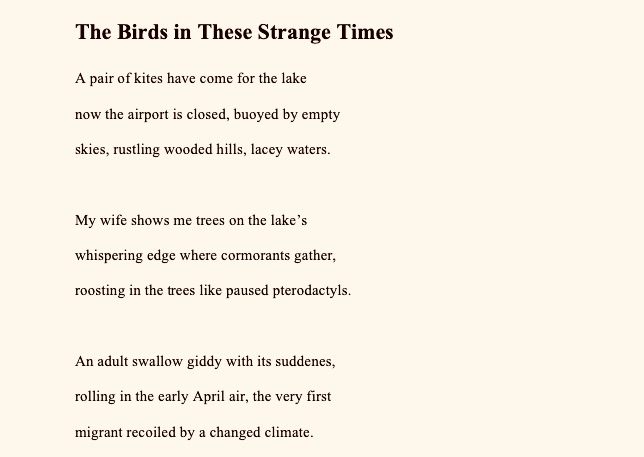
The Birds in These Strange Times
A pair of kites have come for the lake
now the airport is closed, buoyed by empty 
skies, rustling wooded hills, lacey waters.

My wife shows me trees on the lake’s
whispering edge where cormorants gather,
roosting in the trees like paused pterodactyls. 

An adult swallow giddy with its suddenes,
rolling in the early April air, the very first
migrant recoiled by a changed climate.


Back to Blue
Imprisoned in caution,
the cases rising, fear abundant,
school closed, classes cancelled.
All online now. I watch
a documentary about Miles Davis.

I have always struggled with Jazz,
berated the lack of melody,
felt lost amongst the jostling notes.
But following his story, the craft
from the chaos, the passion in tone

I choose to try again. Back to Blue
starts, and notes sound as alarming
as the online coverage but the jingling 
chords, the blasts of trumpet suddenly 
sounds peace while the world tears. 


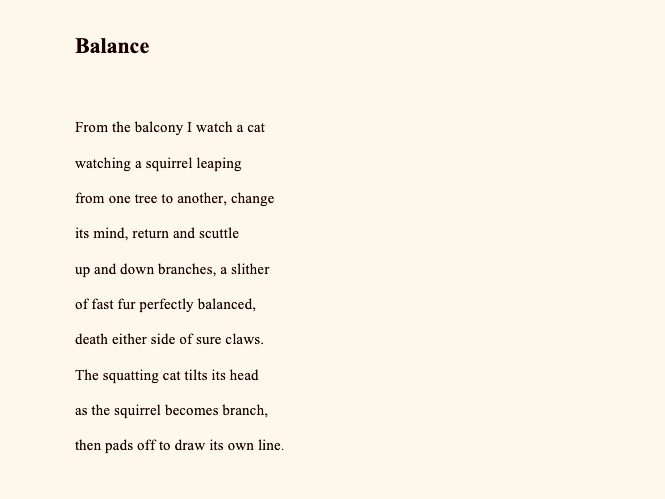
Balance

From the balcony I watch a cat
watching a squirrel leaping
from one tree to another, change
its mind, return and scuttle
up and down branches, a slither
of fast fur perfectly balanced,
death either side of sure claws.
The squatting cat tilts its head
as the squirrel becomes branch,
then pads off to draw its own line.

In Rooms, Therefore We Are

The rooms we build define us, shape us, create and consume us.

To function as a modern human is to be in a room: offices, classrooms, waiting rooms, shops, bedrooms, gardens, cafés, libraries, trains, airplanes, theatres, cinemas and stadiums.

Alone or confessing, on holiday, marrying, working or transgressing. Watching or waiting, dancing, defecating or contemplating.

Our own heads are a skeletal room we stare out of; thoughts, ideas and words bouncing around the bony walls. Billions pray to be safely ushered into the everlasting room beyond these rooms, to be reunited with those who were once in our rooms.

The number of rooms make all the difference between a slum resident and a billionaire, freedom and imprisonment; rooms that can be built from waste material or secreted into yachts; rooms that only the most valiant warriors can ascend to while others descend to the deepest unreachable rooms.

To feel free, we leap over the walls to the open, roomless countryside, though we return to rooms at night or make them using tents. We stare deeply and longingly into the blinking night sky, wondering if there are rooms on other planets like our planet, which is one giant, spinning room, moving through an ever-expanding room.

Even the atom itself is a kind of theoretical room, built mainly of nothing, of potentially something through which hums the moments of energy that we use to build up all the matter around us.

         Perhaps we love rooms because that is where we began, in our mother’s warm interior room; safe from everything outside and other. Perhaps it is the safety of this dark, nourishing room that is the shadow between every room thereafter.

As children we build pretend rooms, hide in them from the monsters that sneak into our rooms, that lurk in their own dark spaces in the corners.

As adults we spend days rushing in and out rooms. Now, confined to our rooms in fear of that which knows no walls, we are more thankful than ever for the walls. We stare at each other from balconies and buildings, all afraid in our rooms and wondering when the doors will open again.


Matthew James Friday has had poems published in numerous international magazines and journals, including, recently: All the Sins (UK), The Blue Nib (Ireland), Acta Victoriana (Canada), and Into the Void (Canada). The mini-chapbooks All the Ways to Love, Waters of Oregon and The Words Unsaid were published by the Origami Poems Project (USA).
Website:      http://matthewfriday.weebly.com

Categories
Slices from Life

Notes from Balochistan: Volunteers for humanity

By: Ali Jan Maqsood

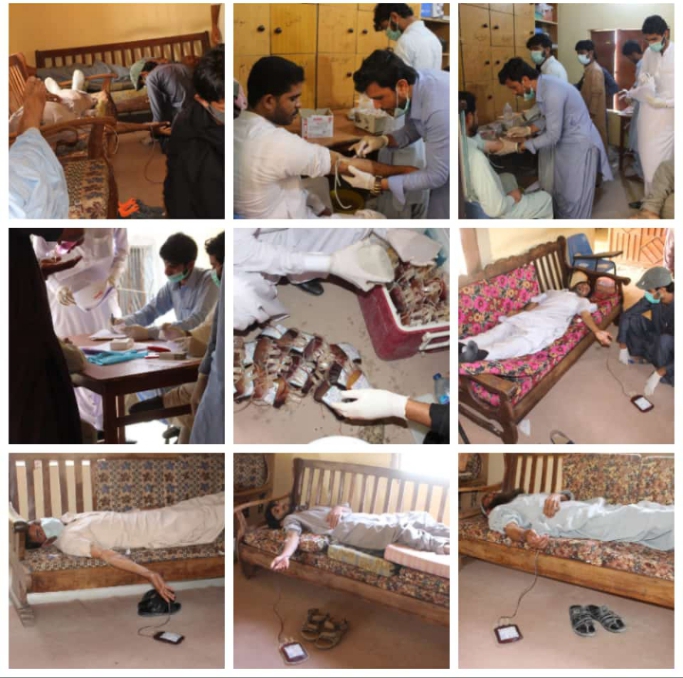
Blood Donation Camp set up by volunteers during COVID 19 restrictions

Pakistan, like many parts of the world, has announced a lockdown in most of the country. In some of the cities, however, there is a partial lockdown. The district Kech in Balochistan is partially locked down (from morning till five in the evenings with essential services still open like groceries, vegetables, banks, medical stores etc). However, all of the educational institutions will remain closed till May 31, with a warning that the date may be extended, depending on future developments.

Kech suffers from a great many medical services issues as the government gives very little attention to the affairs of the civil hospital. These have been further slowed down by the corona scare. On the other hand, Kech contains a number of — 286 — registered patients of thalassemia who need blood transfusion on a regular basis (some after every 15 to 20 days and the rest on monthly basis). The district does not own a single blood bank. Despite having three Members of Provincial Assembly (MPA) from the district with a Member of National Assembly (MNA), the need to build a blood bank in the district has not been addressed.

However, for the patients, a team of a social workers from Kech arranged a blood donation camp in the nearby tehsil of Buleda (about an hour and half of travel from Turbat) in order to collect blood for the needy thalassemia patients during the lockdown. Luckily, they got a good response from the locals of Buleda. The camp was set in Ruzhn School Mainaz Buleda under the support of Mr Zahoor Ahmed, the principal of Ruzhn school, and Mr Irshad Arif, a working faculty of Syed Hashmi High School Turbat and founder of Kech Blood Donors Team.

“A great many people supported us during the blood donation camp. I did not expect this kind of crowd since mostly people fear donating blood, but I am really amazed looking at such spirit from the people here, ” says Mr Arif in gratitude to the local people of Buleda. “I am wholeheartedly thankful to Mr Zahoor Ahmed for his kind help in our drive and all the people of Buleda for donating blood with high spirit.”

The principal of Ruzhn School Buleda was pleased looking at the youngsters doing their best to serve humanity. He said he was honoured to be part of the drive and had much hopes from the volunteers. “I was told they (Kech Blood Donors Team) were coming. I thought what would be more beautiful than to getting a chance to give your best to doing something for humanity in this very critical time,” Mr. Ahmed added

The blood camp got a huge number of donors. The team met their target only in four hours. However, many locals were rejected when they came forward to donate blood as they were considered unfit. They stood the whole time only in the hope they would be called back to give blood, added Murad Jan, a volunteer of the team.

The locals of Buleda have always helped when it came to do something for the people of the province. In such a critical time as the children affected by thalassamia are on the verge of death, they have showed their kindness by arranging the blood camps and supporting it to their best.

It is often said “Saving one human life is equal to saving the entire humanity.” The locals of Buleda proved it with their passion to help children fight death.

Despite the generosity of the residents, the government still needs to plan for a blood bank and a thalassemia centre in the district. Health is one of the basic needs that needs to be addressed. The people cast their precious votes and help politicians win elections, it is now their turn to pay back the community by providing basic facilities.

The writer is a student of Law at University Law College Quetta and a former teacher at DELTA in Turbat. He can be reached at alijanmaqsood17@gmail.com and tweets at @Alijanmaqsood12

Disclaimer: The opinions expressed are solely that of the author and not of Borderless Journal.

Categories
Musings

Life in Times of Corona

By Devraj Singh Kalsi

Her multiple complications turned worse around the time the first case came to light. During her last medical check-up, she was diagnosed with aggravated problems related to heart, liver, and gall bladder functioning. Hypertension, diabetes, arthritis, and cataract left out as routine and manageable disorders. She heard the doctor warn her of fatal consequences if angioplasty was not done immediately. She chose to bypass it with a smirk that offended the doctor and he prescribed three new tests at his specified diagnostic centre to locate more illnesses residing within her. 

Two months later, she heard the doctor had passed away. She was curious to know how his untimely end came. This is when she heard about COVID-19 for the first time. It sounded more like a prescription drug to her rather than a life-threatening infectious disease. When I simplified it with corona and explained what it was and how it was caused and transmitted, she grew interested in the pandemic, sneezed all of a sudden and asked: Can I get it? It was like —Am I eligible for it?

As the elderly folks with co-morbidity are at a higher risk, I urged her to practice social distancing. She did not get it, so I asked her to stay six feet away from people. She took this opportunity to cancel her scheduled blood pressure check-ups and blood sugar tests for a month.

She bombarded me with several questions. I searched online for the best answers to update her. From her facial expression she was not happy to learn that it came from China. Her xenophobic mind began to function. She blamed the Chinese for almost every evil in the world. She wanted to see a pangolin on my phone. After a proper look at the poor fellow looking cute and innocent, she said with regret: What else do you expect from people who eat snakes and dogs? She had no visible anger for bats or pangolins — only for the wet markets in China. 

She began to create conspiracy stories with impossible plots and angles, and this assured me that my creative streak was most certainly derived from her. She was not any different from what others were thinking except the fact that she did not know anything about bio-weapons. 

She took advantage of the fact that I was not born when China attacked India. She dramatized a few episodes. I had no option to verify. Since her emotional investment was evident from her expression, I chose not to interrupt her flow and nodded without conviction. Pakistan and China were the two countries she loved to bash indiscriminately whenever she got an opportunity or a person who harboured similar thoughts. Somehow, she had realised over the years that my intolerance for any nation had not peaked yet.   

                                                              *

Every day, from morning to night, she pops fifteen pills. But today she decided to skip pills. Just like people skip meals for dieting. I did not know how to react. Should I administer those pills with a word of caution or just let her do what she wanted to do? It appeared she was confident heart attack was unlikely to be the cause of her death. She did what she wanted to do — flirt with death.  

I told her to wear a mask for safety and she opened the window to see whether the lady in the adjacent house was wearing one. When she saw she was not wearing it at home, she refused to wear it. She kept the mask and said she would wear it when I entered her room after coming from the grocery store. To show she was taking some precaution, she agreed to keep the bottle of hand sanitizer with her.  

Although I myself was not sure about many possible ways of its spread, I added them all for extra safety. I mentioned how it behaves on various surfaces, how many days it lives, how easily it kills. This deepened her worry. She wanted to know whether her relatives were safe. She called them up to find out.

Armed with the knowledge derived from me, she began to use words like pandemic and social distancing and repeated preventive tips. She observed behavioural change in her close relatives. Those who used to express the desire to meet her were quiet now. She sought umbrage because nobody had invited her. I told her that relatives will not entertain or invite guests for one year at least. She said most of these were fake invites and so there was no harm in extending them, just to make others feel good. I explained that people were unwilling to take any kind of risk. You never know which crackpot turns up with a burning desire to meet once trains start running on the tracks.

The virus shared many attributes with God. It was also invisible just like God. She kept reading the holy texts as usual. I told her she must realise death is not caused by God’s will. Even a virus can kill people and faith cannot save people from Corona virus. This posed a big challenge to her faith. She began looking for a line of defence: Tell me, who created this virus? It is also God’s creation.

For once, she did not blame China for creating it. Before I could ask her why she felt so, she asked me to repeat the symptoms. I told her the virus can live in the human body for 21 days or more without any symptom. Now she got really worried and scared. She wore the mask and abused the virus in filthy language without showing any mercy – much of it I did not hear and what I heard I cannot put down.  

Devraj Singh Kalsi works as a senior copywriter in Kolkata. His short stories and essays have been published in Deccan Herald, Tehelka, Kitaab, Earthen Lamp Journal, Assam Tribune, and The Statesman. Pal Motors is his first novel. 

Categories
Musings

As History Unfolds

By Tehmina Khan

It started on Saturday, or perhaps even earlier on Friday, twenty-eight days ago, with tiredness and an odd tenseness in my body, which I attributed to stress. My husband returned to our home in Toronto from Pakistan on Monday afternoon and went into quarantine in our guestroom. Our COVID-19 days had begun.

By Tuesday morning, I had a sore throat, a dry cough, severe body pain, diarrhea, nausea and stomach cramps. I felt feverish though the thermometer gave a below average body temperature reading. My fever spells were followed by chills which set me shivering under a mountain of blankets. I made the terrible decision to get medical help.

I was worried because of COVID. The secretary at my doctor’s office asked me not to come in. My symptoms sounded too much like COVID and no one wanted to risk infection by seeing me.

 I called Telehealth and got bounced around until a nurse finally told me to get tested. Our closest assessment centre was North York General Hospital. This is where I gave birth to my son. This is where I had an uterine embolization and two surgeries a few years back. I associate kindness with this hospital. I am familiar with its corridors.

My husband was busy with a work-related call in the basement when I decided to walk the five kilometres to the hospital. I didn’t want to expose him or anyone else to my germs. The walk was slow and exhausting and the hospital I arrived at was not the place I was familiar with. They were construction workers erecting a pavilion of sorts outside the emergency department. The inside of the department looked like a scene from a war zone.

The doctor who finally saw me, spoke to me for a long while. He told me that while I was exhibiting all the symptoms other than fever (I had taken Tylenol before embarking on my walk), I did not meet their testing criteria. I was not over 65, immune compromised, or an essential worker. He was honest and told me that they do not have enough kits and therefore are conserving them for those most at risk. His last sentence to me before walking out was: “You are witnessing history unfold.”

I returned home and my condition continued to worsen. My husband and I swapped rooms. I was quarantined in the guestroom from my husband and two teenage kids. I was not bored. The trials my body was putting me through were relentless and left no scope for boredom. Around the two-week mark of my sickness, I had two days of feeling much better. I heaved a sigh of relief and announced my return to the land of the living.

But I was wrong, and I rapidly grew weaker. I became confused. I began spending much of my time crying from sheer weakness. As I felt my strength ebbing, I became convinced that I would not survive. At times, despite the layering of Advil and Tylenol, my pain was such that I almost wished for death.

My mental health lay in shambles. I could no longer read or write. I stared blankly at the same paragraphs trying to decipher the meanings behind the words. I felt I was a burden. I was unable to care for myself. People called to commiserate with my husband for being stuck taking care of me. I wanted to somehow magically return to my parents’ home in Karachi, Pakistan, and my mother’s care where no one would consider me a burden.

It is a strange thing to become dangerous to your own loved ones. My husband and I sleep in separate rooms. My children and husband use one bathroom, while I use the other. My family maintains physical distance from me. The last time I experienced human touch was more than three weeks ago. For the first two weeks of my husband’s return from Pakistan, our children did the groceries because both my husband and myself were under quarantine. I suffered guilt pangs knowing that we were placing our children in harm’s way in order to keep us fed.

Now, that my husband’s quarantine is over, he does the weekly grocery run. He and our kids also do all of the housework because I am unable to do more than take the few steps it takes to make it to the washroom.  People constantly call to tell me to thank God for His blessings. I wonder if they are simply trying to take advantage of my weakened state. They seem more interested in scoring brownie points with their God than in my well being because why else would you use this opportunity to intone God to a non-believer?

I eventually made a second trip to the Emergency department. It was a mistake caused by the burning in my chest. My family doctor the day before had prescribed an antibiotic and assured me that I should go to Emergency to get help if feeling worse. This time, I could barely manage the few steps into our car. I dissolved into tears at the hospital. I had trouble following the nurses’ instructions. They tested me for COVID. I was put on a drip and told that I was severely dehydrated. They did an EKG and a chest x-ray. Both were clear.

 By the time I left, it seemed that the attending doctor was just annoyed by my presence. She seemed to have decided on her own that my dehydration was caused by ongoing diarrhoea though I had informed her right in the beginning that my diarrhoea only lasted the first two days of my sickness. She lectured me on staying hydrated and sent me home where my symptoms continue till the present moment. My throat is still sore. My neck still hurts. The skin on my face and chest is red and splotchy. I still have bouts of nausea and dry heaving. My energy level is a bit better to the point where I was able to do a light housekeeping this morning, but even that bit of effort cost me, and so I am back to lying in bed. As for what is wrong with me? Who knows? But more importantly, who cares? We have all gone from being humans to just being statistics. Do you match these criteria? If not, please step aside.

This pandemic is the moment when we will reveal our humanity. Will we choose to overlook the ones who are easy to overlook? I don’t mean myself. I will be back to health soon enough.

I mean the ones who we have grown accustomed to overlooking; the people who were already struggling to exist. The ones who work multiple odd jobs and still barely manged to feed themselves. The ones who live in slums and have no access to clean water, decent food, education or health facilities. Others too, the elderly and the mentally and physically disabled who are not able to advocate for themselves. When we start to prioritize, as this pandemic will force us to do, who all will we choose to overlook?

 In our single-minded focus on COVID, we are neglecting all other illnesses and casting aside all other concerns. COVID is not the only health problem on the planet at the moment though it may be the only one on our television screens and while COVID is exacting its death tolls, shutting down the planet for a prolonged period will also exact a toll which we have not even gotten around to imagining as yet.

Tehmina Khan has her home in Toronto, where she lives with her husband, two children, and their dog, Luna. Mawenzi House published her collection of short stories, ‘Things She Could Never Have’, in the fall of 2017. She is currently working on retelling seven stories from ‘1001 Nights’. Her writing has appeared in the The Blue Minaret, ShedoestheCity, and The /temz/ Review.