Happiness and humour! Is that an unrealistic goal to achieve in this life? Moving away from the contentiousness of fame, of argument, of who achieves how much more and how much faster, we might be able to uncover a world sheathed in happy smiles. Is it only the pandemic spreading gloom?
The fear of dying or suffering does create a shroud of gloom that often interrupts our social interactions. The unreasonableness of fear draws us away from reality. Hans Rosling, a Swedish physician who called himself a possibilist, says: “There’s no room for facts when our minds are occupied by fear.” Fear or depression is the opposite of humour and happiness. The ability to think clearly and laugh at situations leaves us when we are fearful. Fear also leads to depression and the feeling of being oppressed. Humour is perhaps the only antidote to laugh away our fears and depression, to combat darkness and bring back smiles, hope and happiness. We have laughter clubs. Laughter binds all its members in happiness. And that is why we try to host plenty of it in Borderless Journal.
Embedded in the musings, fiction and poetry sections, we have humour, pathos, poignancy and laughter. Rhys Hughes with his tongue-in-cheek poetry, musings by Will Neussle and a short flash fiction by Brindley Hallam Dennis make us laugh outright as do some of the wonderful pieces written by youngsters in ‘Sara’s Selections’ hosted by Bookosmia, thanks to Nidhi Mishra and Archana Mohan. Michael Burch has also given us humour, happiness and poignancy in his collection of poems in memory of his mother.
We have introduced a new column that creates bridges across the world with not just facts but compassion and comprehension of the suffering and bravery of mankind by a woman who has traversed through diverse cultures all her life, Sybil Pretious. In this episode of ‘Adventures of the Backpacking Granny’, she explores the impact of Perestroika while in St Petersburg (Russia). Devraj Singh Kalsi has also given us an unusual piece talking about the impact of Partition on the family structure within the subcontinent. These two musings, while resting on major political events that changed the world for many of us, reflect different perspectives and are handled in vastly different ways by both the writers.
Reflecting on binaries, is a story from the imagined township of Ghumi, a series that Nabanita Sengupta has been publishing with us for more than six months now. Sohana Manzoor has given us a poignant story with a surprise ending from Bangladesh on the theme of witch-hunting, previously reflected upon in one of Aruna Chakravarti’s translations of Tarashankar’s famous story, ‘Daini’ (The Witch). Sunil Sharma has given us another interesting cross-cultural narrative based on his interpretation of Don Quixote and has also provided us a poem. We have a lovely collection of poetry this time, thanks to Michael Burch, who has helped with the editing and selection of poems. Vatsala Radhakeesoon has shared both her painting and a poem based on the painting with us – both vibrant and unusual works.
We have, for the first time a writer from Iran and translations from Persian to English by Davood Jalili of his works. A poem and an essay by Iranian poet Bijan Najdi give us a glimpse of their stories and perspectives. Jalili has also translated Devaki Jain’s interview to Persian to publish in the Arzhang, the online journal where the previously translated Aruna Chakravarti’s interview had found a home. We are very grateful to him for giving wider exposure to the content of Borderless as we are to Binu Mathews of Countercurrents for sharing our content in his popular site. Jalili with his translations to English brings in new perspectives into our fold as do Aditya Shankar with his translation from Malayalam poetry and Fazal Baloch with his translation of a Balochi folk tale.
The other major translation we have is that of a Nabendu Ghosh story by his late son, Dipankar Ghosh. ‘The Saviours’ had been translated previously by Bhashabi Fraser in a collection of Partition stories and was seen as representative of that era. However, as a literary paper from Universidad de Cádiz indicates, the story steps beyond the Partition to another relevant issue that continues to plague India — the divide created by wealth, caste and education, the absolute obtuseness of the affluent to the suffering of the less privileged, an issue that continues to shame as we reel from the pandemic.
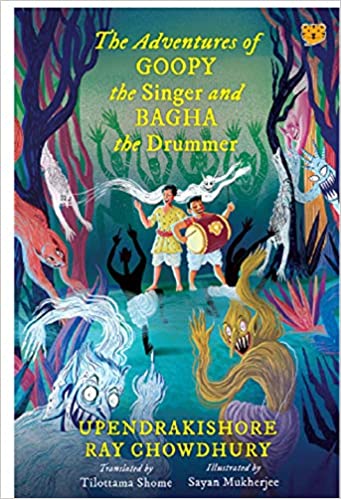
There is an in-depth book review of a translation of Satyajit Ray’s grandfather, Upendrakishore Ray Chowdhury, by academic Nivedita Sen. Immortalised by the grandson in an award winning film, Goopy Gyne Bagha Byne, the story has been recently translated to English from Bengali and published under the title of The Adventures of Goopy the Singer and Bagha the Drummer.
An essay on translations by eminent journalist Ratnottama Sengupta, who has been bringing out works of Bengali writers in English and Hindi, explains the need for building these bridges across time and cultures. Candice Louisa Daquin’s essay on the Kali Project, which resulted in an anthology of poems on feminist issues in India initiated by an American concern, attempts to transcend borders as does the interview with Suzanne Kamata, an award-winning writer based out of Japan but born and brought up in the USA.
Candice Daquin has also given us another powerful reflection on the core values of mankind. This theme of an exploration of humane values has been reiterated in our interview with Avik Chanda, the author of the best-selling history of Dara Shukoh.
Do visit and take a look at our oeuvre, which far exceeds what has been mentioned in this little note. We value both our contributors and readers. Please feel free to comment and make suggestions so that we can serve you better.
Have a lovely month, looking forward to spring and newness!
By Bijan Najdi, translated from Persian by Davood Jalili
The world does not become bitter with the sword.
It does not become bitter with shooting, cries and fists.
The bitterness of the world
Is not the deer’s necks
And leopard’s tooth
And the death of a fish.
In the throat of a heron, there is not a disaster.
Bitterness lies in
The dolls with bellies full of TNT
Which fell on Vietnam
And on the country lanes of Palestine.
Disaster.
The joy of our children is
That they have seen a doll on the ground
And run with cheers and smiles (towards it).
.
Republished with Permission: Our Children was first published in Reality is My Dream brought out by the publisher, Nashr e Markaz.
.
Bijan Najdi (Persian: بیژن نجدی, pronounced [biːʒæn nædʒdiː]; (15 November 1941 in Khash, Iran – 25 August 1997 in Lahijan, Iran) was an Iranian writer and poet. Najdi is most famous for his 1994 short story collection TheCheetahs who ran with me (Persian: یوزپلنگانی که با من دویدهاند)).
Davood Jalili (1956, Iran) is an Iranian writer, translator and poet. He has published many articles on Iranian websites and magazines and has three published books.
.
PLEASE NOTE: ARTICLES CAN ONLY BE REPRODUCED IN OTHER SITES WITH DUE ACKNOWLEDGEMENT TO BORDERLESS JOURNAL
“Be present in all things and thankful for all things.” Maya Angelou
Sometimes I have turned off the radio during lockdown — too many people complaining, not enough dwelling on their blessings. I preferred to take my attitude from my tenacious, pioneering parents, survivors from holocausts, long sieges and other disasters much worse than this one. It reminded me of one of the people I met on my travels.
In 2007, I travelled to Russia — a wonderful place for adventure — and plumped for a homestay in St Petersburg. This is not a travelogue, just a snippet of admiration for survivors.
On the flight, I sat next to a trainee travel agent.
“You are travelling to Russia on your own?” she queried.
I confirmed the fact.
“Do you speak Russian?”
I didn’t.
“Do you have family or friends here?”
I didn’t.
She had asked me how old I was and on gaining that information she just shook her head. This was not the kind of older traveller she was expecting to deal with in future.
In a rather decrepit taxi, I arrived at the homestay. You stayed with a family who provided a room, two meals and local knowledge. The apartment was situated in an enormous unpainted concrete building with a forbidding exterior. The taxi driver hollered, his face pointing to the upper stories. A face barely reaching the top of the balcony peered over and called back in Russian.
We waited.
A diminutive woman who looked childlike in stature came out of the heavy entrance door. We traded greetings. She spoke English.
I followed upwards and finally she produced an enormous bunch with giant keys. She unlocked the door. We went up some steps. The same procedure again twice more. I began to wonder if this was a castle in the air. After unlocking the final door, we were in the flat and the doors firmly locked behind us. I had to follow this procedure every time I went out. I settled in a large bedroom. She later called me for tea and special Russian cake.
With initial polite enquiries over, she began her story.
“When I was only two, my family was in the Siege of Leningrad.”I was very quiet. My attention was total. I knew that the siege in 1941 had lasted for almost three years — 872 days to be exact. Almost two million people lost their lives. I couldn’t imagine the hardships they would have gone through.
“Very soon our water was rationed, the thirst was awful. We had just this much bread (she put the tips of her thumb and forefinger touching in a circle) for one day. It was the coldest winter. We threw everything we had into the fires to keep warm – clothes, furniture, instruments, ornaments. Our family had only one iron bed left. Every family was the same and we had to support each other. It was so hard.”
I was silent. Now I could understand why she was so small. Her growth had been stunted by lack of nourishment in her early years, but her spirit was indomitable. A lesson indeed.
She went on,
“But now our Government try to give survivors from the siege compensation in money and also a trip to anywhere in Europe every year.”
I didn’t like to say that I thought nothing could compensate for what she had been through, but she was grateful and loved visiting Italy.
I learnt so much more about Perestroika which she did not approve of but that is not pertinent to this story. It was just to remind myself to count my blessings daily.
Sybil Pretious writes mainly memoir pieces reflecting her varied life in many countries. Lessons in life are woven into her writing encouraging risk-taking and an appreciation of different cultures.
.
PLEASE NOTE: ARTICLES CAN ONLY BE REPRODUCED IN OTHER SITES WITH DUE ACKNOWLEDGEMENT TO BORDERLESS JOURNAL
Title: The Adventure of Goopy the Singer and Bagha the Drummer
Author: Upendrakishore Ray Chowdhury, translated from Bengali to English by Tilottama Shome. Illustrations by Sayan Mukherjee.
Publisher: Talking Cub, an Imprint of Speaking Tiger Books, 2020.
Upendra Kishore Ray Chowdhury’s name was well-known as an innovative children’s writer, painter, musician, photographer and a pioneer printer-publisher in the late nineteenth century. His grandson, Satyajit Ray, immortalized his long short story for children ‘Goopy Gyne Bagha Byne’ as a reputed film that deployed a lot of music, dancing and fantasy elements.
This graphic version of the story, particularly its musical score that was penned and directed by Satyajit Ray himself, had almost obliterated the children’s tale that was a household word in Bengal earlier. Since it is a story about two naïve, rustic boys who desperately try to be a singer and a drummer respectively, Satyajit Ray worked on and elaborated the musical potential of the story by writing lyrics for songs that could be sung by Goopy, with Bagha’s drumming as accompaniment. The songs like Dekho re Nayan Mele ( Opening Your Eyes and Look), Bhuter Raja Dilo Bor (The King of Ghosts Grants a Wish) and Maharaja Tomare Selaam (Salute to you Maharaja) have been all time favourites for the last fifty years. The two sequels to the film, Hirak Rajar Deshe (Hirak King’s Kingdom) and Goopy Bagha Phire Elo (Goopy Bagha Return) were written by Satyajit Ray himself, although the latter was directed by Ray’s son Sandip Ray. The innocuous Bengali story therefore surfaced on the celluloid screen, and then extended through sequels to follow the adventures of Goopy and Bagha through time.
The status of an internationally acclaimed film also enabled the story to traverse across space by getting translated in different languages, particularly English. Among recent translations are those by Swagata Deb (Penguin, 2004) and Barnali Saha (Parabaas, 2012). Perhaps in order to communicate a different tone and emphasis, in this one, Tilottama Shome took up another translation. She has stuck to each and every word of the original. Although Upendrakishore’s stories have been translated by well-known scholars, editors and translators like William Radice, Madhuchhanda Karlekar and Arunva Sinha, this translation is also very fluent. The use of casual vocabulary in English that is used on a daily basis, like ‘vocal warm-ups’, ‘country bumpkins’ and ‘spooked’, add to the readability of it. The illustrations by Sayan Mukherjee, which include a lot of the ghosts, is brilliantly evocative of the ghostly fun and frolic in Ray’s film.
The story, which is something between a folk tale, a benign ghost story and a fantasy around a realistic setting with two ingenuous protagonists, has many violent episodes. Most of Bengali children’s folk-fairy tales like those in Dakshina Ranjan Mitra Majumdar’s Thakurmar Jhuli portray such unpleasant interludes, which is not different from Grimms’ or Hans Andersen’s Fairy Tales depicting brutal human behavior and blood and gore. Such violence and deaths go back to the earliest children’s stories, possibly to equip children with the overpowering truth that is an important, if an unsavoury, aspect of life. The violence becomes an indispensable component of children’s stories, since children need to be aware of what they might confront in the real world.
Bruno Bettelheim, a psychologist who tried to read fairy tales in terms of Freudian psychoanalysis, said that children need to be exposed to fairy tales with grim episodes in them. He demonstrated that these dark happenings, fantastic as they may be, expose and initiate the child to real life that is inclusive of the ruthless and the arbitrary and contribute to children’s holistic understanding of life. In this story, when Bagha goes home, he finds that his parents have died in the interim he was away. Goopy’s parents remain alive, perhaps to signify that deaths in real life are ubiquitous, imminent but random. But there is greater cruelty than death in children’s stories.
According to Ernest Jones, Sigmund Freud’s biographer and a psychoanalyst in his own right, the savagery in children’s stories represents expressions of the unconscious mind like the jealousy and hostility inherent within family relationships. He elaborated how abstract moral concepts like anger, fear and guilt are ‘physicalized’ and ‘externalized’ in children’s tales to enable children to conquer them. Also, after acknowledging these harsher primal feelings and instincts, the child gets to make sense of what is happening all around. Goopy and Bagha’s boat loses balance and capsizes due to their cacophonous singing and drumming, causing the passengers to tremble and roll around. This drowns and kills all the passengers except the two of them who are also terrified but keep afloat by clutching on to Bagha’s drum. But Gidwitz, a twenty first century children’s writer, explains how violence is deployed as a didactic tool to reinforce the moral certainty of good triumphing over evil, which must be punished. For example, in another episode where the garden house of the king is burnt down by the guards in accordance with royal injunctions, everyone who was responsible for proactively setting fire to the house dies but Goopy and Bagha, who are inherently good, escape with the help of their magic boots.
Goopy Gyne is also a ghost story with a difference. Ghosts appear in such a story within a realistic backdrop, not by invoking them or within a supernatural setting, but out of the blue. They also do not haunt an individual human being, a particular place/ house or a specific object, and are therefore aliens who are removed as suddenly as they appear from the forest in which they are discovered, after they have performed their task. They are not characters who take part in the narrative.
Goopy and Bagha initially get panic-stricken on seeing the glowing eyes of the ghosts that are like burning coal and their radish-like teeth. However, these are not the spirits of the dead that have revived to take revenge or to try to fulfill their unfulfilled desires in life. These ghosts continue to act as external agents who empower the two friends, much like the fairy godmothers in fairytales who grant boons to the protagonists and rescue them from perilous situations.
The terror that these ghosts have the potential to invoke is one that instead becomes a pleasant experience because Goopy and Bagha learn very soon that these spirits are extremely generous. The film is also enlivened with the scene with the ghosts. The narrative describes a curious reversal in which Goopy and Bagha are themselves mistaken as ghosts, thanks to all the miraculous scenes associated with their magical powers. But their achievement of raining delicacies and sweets, their accoutrements in looking like princes or the magic episodes of the two friends fleeing from any difficult situation with the help of their enchanted boots is actually an outcome of the three wishes granted to Goopy and Bagha by the ghosts. The ghosts are responsible for bestowing melody and rhythm to Goopy and Bagha’s music that used to be tuneless, jarring and noisy before.
The music in the story is wholly their contribution, something that has been underscored by Satyajit Ray in delightful compositions in the film. It might, in fact, be a pioneering enterprise, copyright permitting, to translate the screenplay that includes the songs.
Nivedita Sen is Associate Professor in English at Hansraj College, University of Delhi. She works on Bangla children’s literature, and has translated authors like Tagore, Sukumar Ray, Asha Purna Devi, Leela Majumdar and others for Harvard University Press, Vishwabharati Press, Sahitya Akademi, Katha, Tulika and more.
.
PLEASE NOTE: ARTICLES CAN ONLY BE REPRODUCED IN OTHER SITES WITH DUE ACKNOWLEDGEMENT TO BORDERLESS JOURNAL.
A story of 1950s indiscipline related by Brindley Hallam Dennis with a soupçon of humour
The cathedral doors were massive. They towered above them. Even the keyhole and the iron ring handle were above their heads. And you would think it was the youngsters’ fault, the way they got a severe reprimand when the headmaster and his group arrived on the riverbank. Perhaps he had a word with Mr Stephens too, on the quiet in the coach on the way home.
Sound travelled oddly in big old buildings like that cathedral. Something whispered in one place at the other end of the cloisters could be heard quite clearly, yet something spoken in a quite normal voice above the heads of the children couldn’t be heard in the middle of the nave. What was heard perfectly clearly by the children was the instruction to go back inside through the huge wooden doors because you were with Mr Stephens’ group. And what stuck in the minds of at least one of them for decades afterwards was the shock of seeing that vast, empty grey space when they did. Mr Stephens and his group had simply vanished. Perhaps there was another door out of the building, somewhere down towards the choir stalls, or behind the pulpit.
It was Bryan who poked around behind the candles and the rood screens and in several other gloomy places, but he found no-one. It was Bryan who suggested that they should go back outside and tell the headmaster that Mr Stephens and his group had disappeared. It was Bryan who went outside and came back in saying that the Headmaster and his group were missing too. Then they had all gone outside and stood at the foot of the Cathedral doors wondering what to do.
What memory hasn’t recorded is the life of the city that must have continued to pass by, to and fro, in front of the building where they stood, whatever the Headmaster and Mr Stephens and their groups were doing. All sorts of people must have gone by and noticed the five or six adult-less seven-year-olds huddled against those doors like medieval supplicants denied entrance on account of some unforgivable sin or unacceptable affliction. Perhaps even policemen on their beats passed by without intervening, along with Samaritans and other travellers.
It was Bryan, probably, being a precocious but thoughtful child, who suggested, that they should go down to the river where they were scheduled, after their picnic lunch, to go on a boat trip. Mr Stephens and the Headmaster and their groups would be bound to show up there, obviously. Bryan had a watch, perhaps, or maybe they looked up at the Cathedral clock, if there was one. I think Bryan would have been the sort of boy who would have had a watch. Perhaps several of them did. And perhaps too, children being more observant often, and attentive to adult memes, they had taken in the oft-mentioned half past twelve of the planned lunch break at the wooden tables down by the landing stage.
It would have been Bryan, if anyone, who guessed or even knew that if you want to find a river, going downhill is as good a strategy as any. Or it might have been blind luck of the good sort, as one must suppose the abandonment by Mr Stephens, or the Headmaster, if wilful neglect or lack of attention or plain unruliness in the children were not to blame, had been the bad luck.
Whatever the explanation for the recovery of the situation it came to pass that the children moved safely through that urban jungle and found themselves on the riverbank where boats plied for hire. There they waited the half hour or so that it took for Mr Stephens and the Headmaster and their groups to circumnavigate the city’s ancient walls. Which of these two arrived first, memory does not record but what remains clear is that the Headmaster was very cross and flustered. He may have wished that there had been enough parental volunteers among the group to have prevented the occurrence. Or maybe, he did not.
With a voice sharper than they were used to hearing, the negligent children were told, that, seeing as they had already consumed their picnics, and before the appointed time, he, the Headmaster, would take them personally around the walls as that been the major educational objective of the trip, before they embarked on the boat. This he did at a pace remarkable for such small legs, and the walls passed beneath them in a blur.
By the time they got back to the riverbank, the Headmaster had cooled down, and made it plain that there would be no more mention of the children’s momentary lapse of concentration, and that they should be glad that nothing untoward had come of their irresponsible behaviour. They were advised, for their own sakes, if they wanted such trips in the future, not to talk about their misdemeanour with their friends or brothers and sisters back at school, and certainly not with their parents. Such indiscipline was not to be tolerated, and though it need not be dwelt on, it might serve as a useful lesson to us all.
Going back a lifetime later what was most surprising was how small those Cathedral doors really were.
Brindley Hallam Dennis lives on the edge of England where he writes occasional plays, poetry, and essays. His writing has been published and performed. He blogs at www.Bhdandme.wordpress.com
.
PLEASE NOTE: ARTICLES CAN ONLY BE REPRODUCED IN OTHER SITES WITH DUE ACKNOWLEDGEMENT TO BORDERLESS JOURNAL
These poems by Michael R Burch are dedicated to his mother, Christine Ena Hurt (1936-2020)
Mother’s Smile
(for my mother, Christine Ena Burch)
There never was a fonder smile
than mother’s smile, no softer touch
than mother’s touch. So sleep awhile
and know she loves you more than “much.”
So more than “much,” much more than “all.”
Though tender words, these do not speak
of love at all, nor how we fall
and mother’s there, nor how we reach
from nightmares in the ticking night
and she is there to hold us tight.
There never was a stronger back
than father’s back, that held our weight
and lifted us, when we were small,
and bore us till we reached the gate,
then held our hands that first bright mile
till we could run, and did, and flew.
But, oh, a mother’s tender smile
will leap and follow after you!
Deliver Us ...
(for my mother, Christine Ena Burch)
The night is dark and scary—
under your bed, or upon it.
That blazing light might be a star ...
or maybe the Final Comet.
But two things are sure: your mother’s love
and your puppy’s kisses, doggonit!
Such Tenderness
(for all good mothers)
There was, in your touch, such tenderness—as
only the dove on her mildest day has,
when she shelters downed fledglings beneath a warm wing
and coos to them softly, unable to sing.
What songs long forgotten occur to you now—
a babe at each breast? What terrible vow
ripped from your throat like the thunder that day
can never hold severing lightnings at bay?
Time taught you tenderness—time, oh, and love.
But love in the end is seldom enough ...
and time?—insufficient to life’s brief task.
I can only admire, unable to ask—
what is the source, whence comes the desire
of a woman to love as no God may require?
The Poet's Condition
(for my mother, Christine Ena Burch)
The poet's condition
(bother tradition)
is whining contrition.
Supposedly sage,
his editor knows
his brain's in his toes
though he would suppose
to soon be the rage.
His readers are sure
his work's premature
or merely manure,
insipidly trite.
His mother alone
will answer the phone
(perhaps with a moan)
to hear him recite.
Delicacy(for my mother, Christine Ena Burch, and all good mothers)
Your love is as delicate
as a butterfly cleaning its wings,
as soft as the predicate
the hummingbird sings
to itself, gently murmuring—
“Fly! Fly! Fly!”
Your love is the string
soaring kites untie.
Final Lullaby
(for my mother, Christine Ena Burch)
Sleep peacefully—for now your suffering’s over.
Sleep peacefully—immune to all distress,
like pebbles unaware of raging waves.
Sleep peacefully—like fields of fragrant clover
unmoved by any motion of the wind.
Sleep peacefully—like clouds untouched by earthquakes.
Sleep peacefully—like stars that never blink
and have no thoughts at all, nor need to think.
Sleep peacefully—in your eternal vault,
immaculate, past perfect, without fault.
Michael R. Burchhas over 6,000 publications, including poems that have gone viral. His poems have been translated into fourteen languages and set to music by eleven composers. He also edits The HyperTexts (online at www.thehypertexts.com).
.
PLEASE NOTE: ARTICLES CAN ONLY BE REPRODUCED IN OTHER SITES WITH DUE ACKNOWLEDGEMENT TO BORDERLESS JOURNAL.
Translated to English from Bijan Najdi’s essay in Persian by Davood Jalili
Bijan Najdi is often identified with the collection of short stories, Cheetahs who ran with me. But he was a poet at heart. His melodic prose and his powerful stories have the traces of poetry between words. The flow of poetry in his stories evolved into a very exquisite flow of thoughts and perceptions. Najdi wrote an article entitled ‘The Third Perception of Man’ in which he considers poetry to be the outflow of the most intense emotions.
Man’s first perception of fire must have been to touch and burn himself, that is, to feel the burning with direct contact. The next step was to understand the fire to learn from his earlier experience. That is, we see the fire, and without touching it, we know that it burns. This third stage is understanding the fire of “poetry”. That is, if you can, without the fire in your presence, think of it, feel the burning in your fingertips that you have to put your hands under the tap, you have achieved a poetic moment in your life, without the help of words.
Now you can transpose this third stage from fire to the suffering of others, to the history of your land, to the massacre in Palestine, to freedom, to the mass burials in Herzegovina. Poetry does not need “words” in such circumstances. It is the highest form of expression of the most intense suffering of humankind.
The study of the traces of life and the survey of dreams, the nightmares of cavemen and the psychoanalysis of designs and shapes carved in stone prove that even before the advent of calligraphy and language, man had experienced all three stages of perception. The drawings on the stone that depict a human with bird wings on the back and legs of a deer and a human profile are an object of the same third sense.
Is suffering and love born of lines and words the only foundation for poetry? Does our understanding of God depend on our learning to write the word “God”?
However, it was but natural that after the evolution of language and the emergence of calligraphy, man tried to write that “third comprehension”. Henceforth, poetry was no longer seemingly independent of time. Poetry proved its objectivity with the help of the “word”.
In simpler language, basically, any kind of understanding does not necessarily need words, but with words, understanding can be built.
Form and content are a philosophical and academic discussion. They have nothing to do with poetry or at least they have nothing to do with the moments of composing poetry.
There are two types of thinking. Both can, perhaps, influence poets as well.
Some people look at their surroundings with inductive reasoning and want to get a whole by identifying and analysing the details. On the other hand, some people deduce by accepting and prove from a general rule. They would accept the thought for the presence of each component.
Both methods have scientific values. Poetry as the “third perception” is born of intense feelings that frees the poet from both when writing poetry: form and content.
There are poets who believe that form is the manifestation of poetry. In my opinion, this kind of formalism is just a way of thought; that they want by looking at an apple, to get an idea of its taste and smell, with the help of the word, and they want to reach “sense and understanding”. There is nothing wrong with that, but I think it conflicts with the “essence of knowledge.”
However, no one can stop this group from trying.
Volume has dimensions in its geometric definition, so it has an inside and an outside. However, the enclosed space is not the object of discussion. Every point of space is either in or out. That is, each point of it can be both inside and outside at a time. Volume poetry[1], according to Royaee[2], one of the most famous poets of this school, is the transcendence over length, width and height to float in the contraction and the expansion of the soul of the universe, which the poet enters with the “help of words”.
Volume poetry is a look at nature, objects and words that create a sense of yearning by discovering the form and inherent talent of the word to explain the inside and the out to escape from volume.
The spatial poetry of Royaee steps out of the volume enclosed in the words, to get help from the hidden spaces between words, oblivious to the consciousness of being a man. But in such poetry, you can neither sense the history nor the historical identity of the poet.
Nevertheless, poetry of Royaee is full of eagerness to know. But because he is not able to convey his eagerness in his manifesto of volume poetry, his adherents and he have diametrically opposing outputs. I think this is a kind of crisis in poetry, but we should not be afraid of it.
A real crisis arises in poetry when people’s eyes, ears, and minds become accustomed to only one type of poetry.
The crisis was the same as we had in the years before the revolution, when some people did not consider Sepehri[3] a poet because of his Marxist views.
The crisis was that under the pretext of modernism, poetry based on belief and mysticism could be rejected in a society. The culture of any society is the result of social behaviors. If these behaviors are restricted in a certain way, a crisis does arise.
The basic bedrock of any art is freedom, and no one should and can ignore the value of lyricists or post-revolutionary idealist poetry because of their interest in white poetry[4].
However, I do not know what poetry is and what good poetry is.
I have no reason to like a good poem as I feel a burning sensation in my fingertips without touching the fire. Believe me, I am neither a poet nor a novelist, I just love the literature of my country very much.
.
(Published with permission from Bijan Najdi’s wife and family)
Bijan Najdi (Persian: بیژن نجدی, pronounced [biːʒæn nædʒdiː]; (15 November 1941 in Khash, Iran – 25 August 1997 in Lahijan, Iran) was an Iranian writer and poet. Najdi is most famous for his 1994 short story collection TheCheetahs who ran with me (Persian: یوزپلنگانی که با من دویدهاند)).
Davood Jalili (1956, Iran) is an Iranian writer, translator and poet. He has published many articles on Iranian websites and magazines and has three published books.
[1]– Volume Poetry is a type of poetry written evolved around 1967. In 1969, Royaee and several poets published the essence of the volume poetry. Volumeism, mental movement, volumetric vision, mental distances, three-dimensional attitude, are other names that have been applied to this type of poetry
[2] – Royaee is an Iranian poet (1932) who now lives in Paris. He wrote a Manifesto of volume poetry
[3] –Sohrab Sepehri (born October 6, 1928 in Kashan – died May 1, 1980 in Tehran) was an Iranian poet, writer and painter. He is one of the most important contemporary poets of Iran and his poems have been translated into many languages including English, French, Spanish and Italian.
[4]White Or Sepid poetry or Shamloui poetry is a type of modern Persian poetry that appeared in the 1930s with a collection called Fresh Air by Ahmad Shamlou and may be compared to free poetry (in French : vers libre ) in Western literature. The main difference between these works and previous examples of new poetry was in the form of poetry. In this style, the rhyme of prosody is generally not observed, but the song and music are reflected. In the classification of modern Persian poetry, sometimes any poem that does not fit in the form of Nimai poetry (Nima Youshij the innovative of New Poetry) is called white poetry.
.
PLEASE NOTE: ARTICLES CAN ONLY BE REPRODUCED IN OTHER SITES WITH DUE ACKNOWLEDGEMENT TO BORDERLESS JOURNAL
The world was dipped in swirling, glittering celebrations with friends, family and unknown to embrace a new year. And this time it seemed to be more about desire and dreams to turn into flowers and butterflies. Because everyone needed that more than ever. Is that why they were out? To conceal from themselves the reality this year unleashed upon us — as if, it wasn’t our own doing. Humans.
And here I was, at home rolled up in a black-feathered blanket reading Love Story by Erich Segal. The perfect woody-scented book I have had for years but never read. Maybe I wasn’t ready before. Somewhere I had this prenotion — though I never read about the book or the plot — that it would go to a place that was desolate. I checked the time, thirty-five minutes to midnight, to the new year and I already knew the ending would be sad. I am talking about the book.
I was already wafting into the next year and how I wanted it to be. People make new year’s resolutions. I never did that. But I do long for something more, something different. Not small routine alterations, or self-improvement goals. Something real, something solid. Because that is where it is tough, the unknown. That toughness, even if I don’t think about it, exists. All through the day and night. Something’s sticking in my heart from inside — every second of my life.
My thoughts were interrupted by some party music outside. So, I returned back to the book. It was almost the end. With a tear resting on the top of my lower eyelid, I ended it at 10 minutes to midnight. Was this how I wanted to start new year, crying over a book I didn’t even bother to read in years, engulfed by deep sensation of unfair endings to great love? Then this thought came to my mind: If I don’t have to tell anyone about it, then yes. That was what I wanted to do. Dig deep into a story that was so perfect right from start that it had to be flawed, broken into pieces and spread all over my heart. I needed that rush of tears in my veins and the gushy feelings filling my being. But trust me, the tear didn’t flow.
There were ten minutes remaining. With my eyes closed, I let my thoughts, the uncomfortable ones return. I opened my heart and asked my soul: What is it that you want? And I don’t know exactly from where these words came flooding into my mind. I don’t know. No that’s true, I have really never known. And whatever it is that is outside is all fake. At least for me it is. And, I don’t get it. What do I think of those people partying outside? In this pandemic year, what is it that this year leaves behind? People are bothered more about partying instead of caring more about their friends, family and keeping them safe at home. Is being at home, happy — talking with your people and starting a new year that bad? It isn’t, right? Or, is it?
In those last few minutes, it struck me. Like that sound of the rumbling thunder that drags me deep into a feeling of fear and engulfs me so tightly that my mind, body and soul all belong to it. Yes, it struck me like that.
I am not real.
The life of posts and updates and deep poetic lines to justify the perfection of one’s journey – it’s not mine. The job, the money, the responsibilities of the family, doing things the right way and following laid-out plans, all this is making me blind.
There is a twitch in my little finger at least once every night. Just when I am about to sleep, it gives me a sensation that it’s not comfortable. My little finger is not comfortable in this body of lies. Thirty-one years of my life, thirty-one years of thoughts and opportunities to understand but my mind has been so beautifully organised that I fail to see; I fail to see that for me this perfectly programmed life is not right.
Drop the charade and face the reality. What matters to me? What really matters to me?
I don’t know. Then figure it out. This life you are leading is not mine and its eating me inside. So, figure it out now. It’s time.
Why hide behind conventions? What will happen when I cease to be this person? Will I miss her? Will I want to return to being her? Can I walk away from her?
This is one life, and it is too important to let it all just slide as I try to convince other people on how it is similar it is to theirs because it’s not. And, I don’t want it to be.
So, that is what I’ll do starting this year. Find. Find that me who I really want to be. I’ll find her and I’ll let her flow in my blood with pride. Will that be easy?
No.
I don’t even know where to start or how to even try. It won’t be easy to change. But it will be worth all my life. Yes, worth all my life.
.
Kritika Mehta is a Sr. Technical Analyst. Working in IT, her heart lies everywhere and her soul wants to write everything down. So, the bread-winner and writer parts are now locked in a struggle.
.
PLEASE NOTE: ARTICLES CAN ONLY BE REPRODUCED IN OTHER SITES WITH DUE ACKNOWLEDGEMENT TO BORDERLESS JOURNAL
Endless Expanse

An endless expanse swirls
over the tropical island.
At the foot of the Meditative Mountain,
birds, bees and butterflies wonder --
who is this mystic blue?

Sometimes it sings
the songs of poised mermaids.
Sometimes it churns
a divine warning
to humankind tempted to swim
in the baseless pit of darkness.

As the rain, wind and sun
harmonize with it,
seeds of security open
the Earth’s eyes
and the light of blessings shelters
the wise eternal soul
of solitary inspiration.
Vatsala Radhakeesoonis an author/poet and artist from Mauritius. She has had numerous poetry books published and she is currently working on her flash fiction/short stories book. She considers poetry as her first love and visual art as a healer in all circumstances. Vatsala Radhakeesoon currently lives at Rose-Hill, Mauritius and is a freelance literary translator and an interview editor of Asian Signature journal.
.
PLEASE NOTE: ARTICLES CAN ONLY BE REPRODUCED IN OTHER SITES WITH DUE ACKNOWLEDGEMENT TO BORDERLESS JOURNAL.
An exhaustive account of the inception and the fruition of the Kali Project by Co-Editor Candice Louisa Daquin
At the beginning of 2020 …
I had a conversation with Indian surrealist poet Devika Mathur about an anthology of Indian women poets. I had just edited Devika’s first poetry collection, Crimson Skins (Indie Blu(e) Publishing), and been reintroduced into the world’s love affair with Indian poets. Devika being so young and gifted, inspired me, along with Aakriti Kuntal, another trail-blazing Indian poet whom I have worked with many times, to approach successful Indian/American editor/poet/blogger Megha Sood about co-editing an anthology.
The purity of my appreciation for Indian poets writing in the English language, and their astounding ability to do this better than most native speakers, had struck deeply and fortunately. Megha Sood was as passionately interested in putting together a representative collection. We both agreed, given the current news reports of girls still being raped and molested in India, this would be our starting point and this gradually evolved into a fully-fledged project, with a book at its center. As soon as we put a call out, we were literally flooded with interest, and this is still the case. Not a day goes by when I do not get someone asking if they can write for The Kali Project, though the submission deadline closed in October 2020. That’s a fierce testament to the level of interest and need.
When my colleagues at Indie Blu(e) Publishing agreed to publish us, Megha came up with the unforgettable and utterly perfect name The Kali Project, and Kali was reborn! I felt confident, working alongside someone of Megha’s caliber, we couldn’t fail, but it was nonetheless a daunting task for myself, a French/Egyptian immigrant to America, I needed to further educate myself on Kali and what the women of India experienced. I was very lucky to find and befriend a huge group of Indian women poets and artists who through their generosity and knowledge, more than filled my head with relevant information and ideas. They are literally a whirlwind, a force to be reckoned with, and it only left me aware of how hard Indian women work.
We wanted to ensure we had a true mix of talent. It is never sufficient to invite only famous, or notable poets, but to consider all; all kinds of voices, all levels. The Kali Project has authors and artists as young as nine and well into their eighth decade. Those just starting out, those who have been doing this a long time. Kali is not exclusive to women. It is imperative men access The Kali Project and the reception we have received from our male readers thus far, has also been very positive. What good would it ever do to alienate the entire male gender, just to get across the point, gender inequality has to end?
Inception: Indie Blu(e) Publishing gets involved
Christine Ray and Kindra Austin, the women who created Indie Blu(e) Publishing, have actively sought to publish marginalised and oppressed voices from the very inception of their company, and it has remained their primary focus. Combining incredible authors with edgy, raw writing is the core of their mission as publishers. When they saw some of their Indian sisters speaking out about another atrocity of rape and murder of a young woman in India, there was no question they had to be involved.
As Christine Ray, Editor-In-Chief of Indie Blu(e) said: “The Kali Project is another example of setting alight the inequality of women in India by sharing their talented voices with an English-speaking audience. We wanted to introduce to our Western readers, those talents within India who speak with the same fierce voice and share the same goal of equality and an end to oppression. Indian writing has gravitas and brutal honesty that has existed for millennia, influencing poets from around the world.”
Poetry lovers may be familiar with how gifted Indian writers are, but an entire collection of women writers from India, sharing their experiences is a powerful cohesion of all aspects of oppression and defiance. From the very young to experienced, renowned writers, The Kali Project brings together the voices of Indian women speaking their truths. Be it infanticide, family violence, the emerging LGBTQ community in India, or the marital inequity Indian women face, these struggles are penned in exquisite poetry to enlighten and further awareness.
The Kali Project was born from a deep appreciation for Indian authors who write so beautifully in English despite it often being their second or third language. The craft and ability of these incredible writers is furthered by their passionate, vocal understanding of caste systems, familial inequality, subjugation, sexual assault, and ultimately, survival. It is important to note, those women at the extreme end of marginalization are harder to locate for an anthology edited and published in the West in English and we wish we had been able to access their voices because they remain, the most subjugated and continue to not have enough direct attention.
India is set to become the largest populated subcontinent in the world and already influences the West enormously with their art and eloquence of feeling and expression. Western readers can now appreciate an entire anthology devoted to Indian female poets, and their voices rising as one, for equality and respect. The Kali Project is an umbrella for all woman in India who have needed the strength of ‘Maa Kali’ during their life and speaks to every woman worldwide, who can tap into the fierce energies of The Kali and what she represents.
Indie Blu(e) Publishing continually offers the urgent subjects that matter most but are often overlooked by the mainstream. It has long been their mission to be that voice for indie authors and beyond, and they are delighted to offer The Kali Project a safe space to flourish. Having received over 1500 submissions, The Kali Project speaks to Indian women’s growing influence and power in the world, they are truly a force to be reckoned with, and Indie Blu(e) is extremely honoured to publish this collection. www.indieblu.net
Project Outcome
As The Kali Project is the most ambitious project Indie Blu(e) Publishing has published, in terms of size, we also had to address the elephant in the room; Is it appropriate for a Western press to publish Indian authors? Some had thought it wasn’t and didn’t submit for this reason, as is their right. This is how we saw it: Movements succeed when all groups of people support them. The original movements in the sixties here in America would not have succeeded as much, had people of all walks of life not joined them. Therefore, there is no exclusivity to the support of a movement. Where one has to be careful is in the handling of subjects beyond one’s experience. Hence why, even with the best intentions in the world, you would not publish a book about Black Lives Matter solely by Anglo authors, it just wouldn’t be representative or speak directly.
It felt publishing and editing a book of this magnitude required cultural knowledge and sensitivity, and we were lucky enough to have Megha Sood on board for The Kali Project. Born in India and of Indian heritage, Megha could speak directly to the experience of women in India. She also is a highly accomplished editor and writer in her own right. Additionally, we tried to be as receptive and responsive to concerns raised along the way. Of course, with any large project, it is impossible to please everyone and there were those who walked away from the project because Indie Blu(e) Publishing is an equal rights publisher, promoting feminism and LGBTQ themes.
The project was very positively received and the support and enthusiasm from the community we became a part of, has been a life-altering experience for us all. One must be particularly aware when working with a culture different from your own, but with the right team, and listening to the community, this can be achieved. The important thing is to put the people first and let their truths be heard. No wrong can come from that.
Another consideration was the graphic nature of some of the poetry received. Indie Blu(e) has not shied away from publishing graphic works. Be it in response to the #MeToo movement (We Will Not Be Silenced), the LGBTQ community (Smitten, This Is What Love Looks Like), or the recent #BLM, #Trump, #Covid-19 year of hell (As The World Burns). As a small press, we feel our social conscience is our touchstone.
Women of India have boldly addressed subjects of; rape, sexual inequality, racism, casteism, and femicide and despite some daunting obstacles, not least the threat of violence and retribution, Indian women’s courage has lent their voices an unparalleled power. The Kali Project identifies, acknowledges and emboldens that change, and aspires to act as a vehicle of social change. The graphic nature of say, a rape scene might be blatant, but it was decided that, as with most art and expression, this shouldn’t be dissuaded.
The balance of classical poetry, alongside more modern themed works, and art, lends the project a fluidity and relevance that fits the inauguration of the first female American Vice President, Kamala Devi Harris, of Indian and African heritage. We are experiencing a cultural and gender shift in how women and different races are perceived and what they are able to do in society. The poets and artists of The Kali Project are an expression of this galvanization toward complete expression and freedom of thought.
With a President in power for four years, who many women felt, didn’t speak for them, and many immigrants felt, didn’t support them, we now see the potential for change that could begin to open more ways to utilize art and language for social progress. As much as social media is invaluable, the true grit remains on the streets, with the people. Print books have gained a massive resurgence. Paper is still powerful. Maybe coming off 2020 the hardest year in a while, we’re primed for social action like never before.
All along our intention was to utilize The Kali Project as a tool for change, not simply a book. It was always our intention to effect change through increasing awareness in the West, as we had with, We Will Not Be Silenced, which was Indie Blu(e)’s inaugural publication. We were founded on the principle of equality and enlightenment. What we have personally learned from this experience has been momentous and the outcome of the project has only just begun. By opening up taboo subjects, we enable marginalised and frustrated voices to speak about continuing inequality. Indian women have done so much already but it cannot hurt to continue to highlight this in any way we’re able.
We wanted to contribute to a bigger picture. Start conversations. Shift thinking. We regret not being able to reach those most affected in India and were aware how difficult it would be to reach the most rural and poorest Indian women who do not have access to computers, who do not speak English, who cannot be easily reached on social media. As much as possible, we solicited contributions from women of diverse ages, gender identities, sexual identities, social class, oft-published writers as well as writers and artists who had never been published before. Is Kali completely representative of ALL Indian women? It cannot be. Can any anthology be completely representative? It’s a challenge. We do our best, despite knowing we omit some of those who still desperately need to be heard. It doesn’t negate the value of the project, but it’s a regret.
It should be mentioned, The Kali Project doesn’t resonate as ‘negative’ and ‘bad news’ at all. Of course, there is the reality, and the reality can be very painful. It can also be joyful. This must not be forgotten. The love, enriching strength, and joy of Indian women is also borne out in The Kali Project. We were particularly moved by N. Meera Raghavendra Rao’s poem ‘My Mother-In-Law Surprises Me’, an account of the author as a young bride, and her positive experience “When two women understand each other / And feel at home with one another.”
It is just as important to show all sides of being an Indian woman, for every atrocity, there is hope, and strength, and this is why Kali was the perfect Goddess to represent the project, she is multi-faceted and both nurturing and powerful. “Kali / embodies the / boundless freedom / epitome of Shakti / of strength and power / standing unbound from all / restrictions.” Mehak Varun, ‘The Kali in Me’.
Balance is everything. For every negative, there is a positive and we tried to reflect that balance throughout the collection, with hopeful poems, even on difficult subjects: “Do not call me Lakhi meye (good girl) / And tell me I’m an angel / When you only try to teach me wrongly that love lies camouflaged / within your dominant behavior” …“Stop saying I am not enough, not worthy, not great / Because I know I have conquered mountains and moons, flown / across the skies, over the waves / I have danced and taught and painted and calculated and done / everything you told me I could not.” Mandrita Bose, ‘Do not call me Durga’.
Other Influences
Just the other day I watched Rama Rau’s fascinating documentary, The Daughter Tree (2019), and was struck again, as I have been throughout time, to the necessity of speaking up for women. In the region of Punjab, 1000 boys are born for every 750 girls. The documentary is about a midwife in Punjab state challenging the tradition of aborting girl babies. There are other causes to care about, as a person of Sephardi Jewish descent, and LGBTQ I know this acutely. But we gravitate toward those who capture our hearts. In my case, equality.
I hear many times that equality for women is ‘complete’ and there is no need for feminism anymore. That simply isn’t true. There are countless examples of inequality persisting and those who say feminism is dead or should be dead, you wonder what the real motivation is behind that desire to shut it down? How can equality exist with statistics and realities saying otherwise?Take The Great Indian Kitchen, anIndian Malayalam–language film written and directed by Jeo Baby (2021). The experience of many Indian women and other women worldwide, is that of submissive, chained-to-the-kitchen wife, who is ‘unclean’ when she menstruates. With realities like this, women’s move for true equality cannot be diminished or ignored.
I’ve always wondered, if someone wants to shut feminism down so badly, what do they get out of that? Where is the benefit? And what is the harm in being a feminist, which only means, believing women and men can and should be equal. This is a lengthy subject, but I speak for many women in saying, as long as a woman is paid less than a man for doing the same job, as long as a woman’s reproductive rights are controlled by a system and not by herself, as long as she is told whom she can love and whom she cannot, as long as she is derided for her age, appearance, sexuality and gender, then feminism is relevant. And feminists are not man-haters. They are equality makers.
The Daughter Tree provoked a consideration I have had ever since we first talked about creating The Kali Project, which is; How do we speak directly to those most affected, and are their voices heard? I would have to say, no, the most affected voices were not heard either by The Kali Project or anything else, and that is the real problem. When you have mass poverty, illiteracy, control of female populations, then how can you speak directly to the women?
The poetry and art in The Kali Project is in part, an indirect observation of, rather than a direct experience of, for some of the authors. That’s because in India, those who are bilingual, with regular access to a computer and have the time to write, are invariably a higher income than those most affected. It is not to discount the suffering of all walks of life, but we did regret not having some way to engage with those whom we couldn’t even contact, because we are English speakers in a foreign country. Yes, that is a regret. But what do you do? Do nothing because you cannot do it completely? Or hope that by starting a dialogue you are making inroads? I would say the latter.
That said, it is our wish always to be inclusive, to show all sides of something, to give everyone a chance to speak. It was a frustration watching The Daughter Tree, not to have been able to reach those women and girls who cannot write, nor speak in a foreign language, nor have access to a computer. I would dearly have liked to have their stories and shared their views. Because until we do, we risk having a very selective approach to a multi-facetted, complicated subject. As The Daughter Tree points out, there are reasons for some of the traditions enduring, there are factors of consideration and outcomes borne from no better option, and until we address all of those, maybe nothing will really change.
But with awareness, comes progress, and whilst many girls are still sold into marriage or married very young and denied choices and education, the shift comes in all directions and we hope The Kali Project will contribute to this shift. As women, we all know there is work to be done in every country, India is not alone, and that was the point, to ensure Indian women knew, their sisters in other countries were watching, they heard them, they stood with them. Just as when Black Lives Matter movements occurred in the USA, they were taken up by people in all countries. It is that universalism bequeathed us by technology, we can harness and run with.
Finally, the financial considerations related to The Kali Project were long discussed. It has never been our goal to indiscriminately profit from authors, as anyone who works in publishing can attest, this is a lofty goal at the best of times. Indie Blu(e) has actively sought to promote affordable, worldwide publications that can be purchased by everyone, hence why we publish in Kindle and print. The Kali Project’s contributors are primarily based in India, as such we harnessed Pothi, who are based in India, to be another more affordable option for purchasing. In addition, we are set to produce a hardback version of the book for collectors.
For some, a poem’s title alone will stand as testimony: “Disrupting boundaries / Challenging the forecasts / Mocking at man-made wonders.” (Kaikasi V. S., ‘Why are Cyclones Named After Women?’) Others are simply universal in their gendered strength: “I have all the light I need; you’re here, stuck with me.” (Himangi Nair, ‘light & dark’). Some poems just resonate with rebellion and honed fortitude: “No one looked into our eyes with love. / If they had, they’d have heard our souls talk. / Instead, all they said was / She’s hysterical. Women are like that, / especially when they menstruate, / especially when they stop menstruating, / especially as they approach death.” (Anna Sujatha Mathai, ‘Hysteria’). It is truly rare to find a book at 600 pages where you keep going from one incredible read to another.
Kali as received by others
Of all the anthologies I have worked on, I have never seen such an enthusiastic outpouring and this included the terrific reviews we received. I share but a fraction with you:
“Featuring poets from India and the diaspora, creating the bond of shared experiences across continents The Kali Project draws in the voices of women as women, and women as professionals – teachers, mental health workers, writers, doctors, lawyers, bankers, social workers – adding newer dimensions and a sharper understanding of the inner realities that are sought to be silenced by the patriarchal structures which society, religion, community, and class sanction and sanctify.”
— Charanjeet Kaur, Former Chief Editor and Features Editor of Muse India, and currently the Contributory Editor for Indian writing in English of MI. Consultant Editor of the SPARROW (Sound & Picture Archives for Research On Women)
“From my love of history, I was acquainted with the basics of the Hindu faith and one of their goddesses, Kali/Devi. It was immediately apparent, reading The Kali Project, why Kali had been chosen to represent this poetry anthology. To many in India, irrespective of faith, the depiction of Kali is a sign of a woman’s strength. Whilst Kali is both death and goddess, she has a strong nurturing/mother-figure side with the possibility of compassion. In this, we can contrast her with the Christian Virgin Mary. Kali exceeds the potential power of any idol, because she has an active persona, her ‘shakti’ (feminine energy) is a reality and she has several expressive incantations that give her a wide range within the Hindu faith. Thus, it is no wonder Kail became the natural spearhead of The Kali Project.”
— Dr. Belinda Román, Economist/Researcher/Historian
“Fierce feminine energy of Kali is rising today so that we can save ourselves from total annihilation. This volume is a sublime expression of that emergence.”
— Dr. Neela Bhattacharya Saxena, Professor of English and Women’s Studies at Nassau Community College, USA. An academic expert on Kali, Dr. Saxena wrote our detailed foreword and continually supported this project of women speaking their truth.
Disclaimer: The opinions expressed are solely that of the writer.
.
Candice Louisa Daquin is a Sephardi immigrant from France who lives in the American Southwest. Formerly in publishing, Daquin is now a Psychotherapist and Editor, having worked in Europe, Canada and the USA. Daquins own work is also published widely, she has written five books of poetry, the last published by Finishing Line Press called Pinch the Lock. Her website is www thefeatheredsleep.com
PLEASE NOTE: ARTICLES CAN ONLY BE REPRODUCED IN OTHER SITES WITH DUE ACKNOWLEDGEMENT TO BORDERLESS JOURNAL








 Borderless