Nishi Pulugurtha explored the campus of a famed university with her camera and added words to embellish what her camera clicked
Spring was all around, offering, as it were, some much needed solace.It is easy to miss the sights of spring in the concrete of the city – sights that bring in some colour with the trees in bloom. Yellow, red, violet and a little orange peeping here and there – one just needs to pause and seek them out. Most city folk prefer heading out of the city to catch up with the blooms of spring
I was away too, in the town of Roorkee in Uttarakhand in northern India. I needed some rest, a breather. As I walked around the IIT campus in Roorkee in the evenings, I felt the greenery colour my soul. The tall trees reached high. Their branches were bare despite the red flowers hanging onto their skeletal limbs. A few flowers had fallen below. Parrots were engaged in animated exchanges on high leafy branches of other trees. There were colourful blooms almost everywhere I looked.
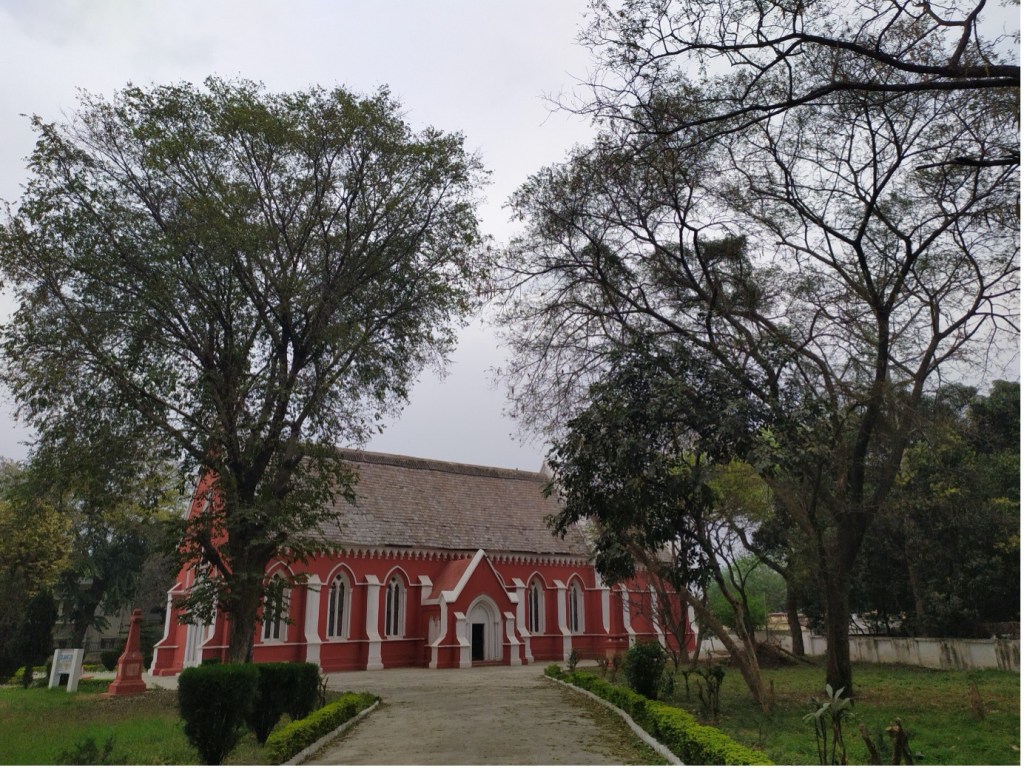
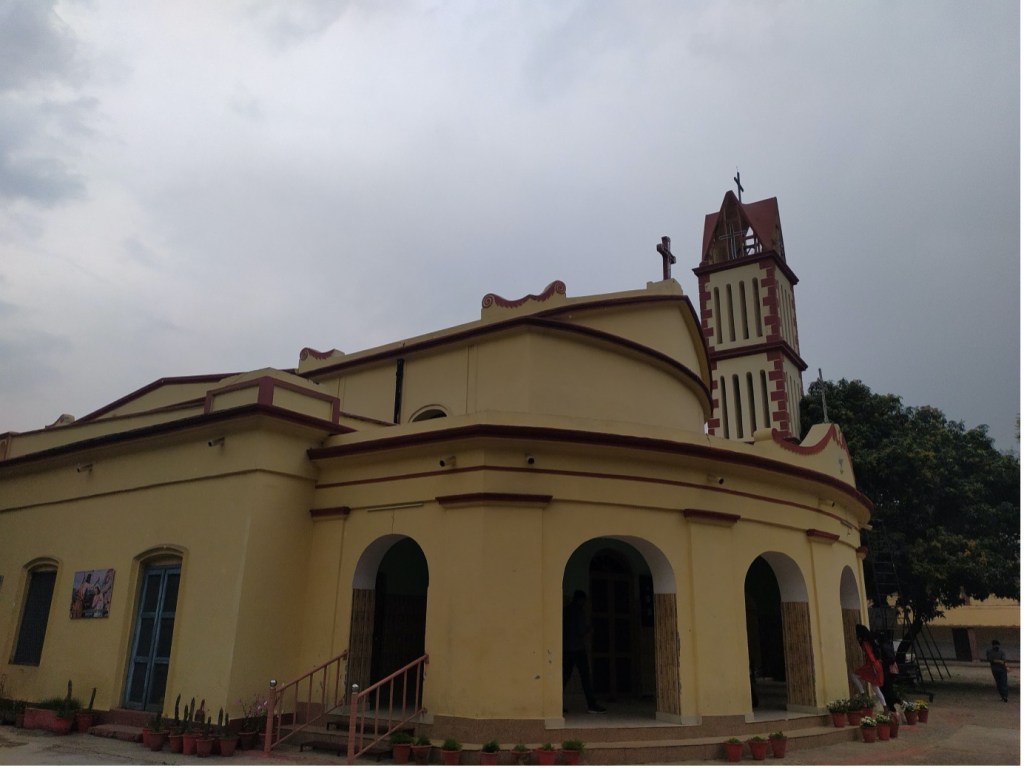
The small church with its beautiful lawns stretched out an invitation to the lazy dog asleep under a tree. The waters of the canal flowed fast. The yellow flower-laden tree, the weeping bottlebrush, the jackfruit tree with younger ones stuck to the trunk and fresh green leaves all around.
St. John’s Church within the IIT Roorkee campus.
An old lady was sitting on a bench. She smiled back as I walked around, soaking in the picturesque setting that is so rare in a big city of steel and concrete. The church would open only on Sunday’s at 8.30 am when the service was on, she said in response to my question. It was all locked up as the spring sun mellowed down.
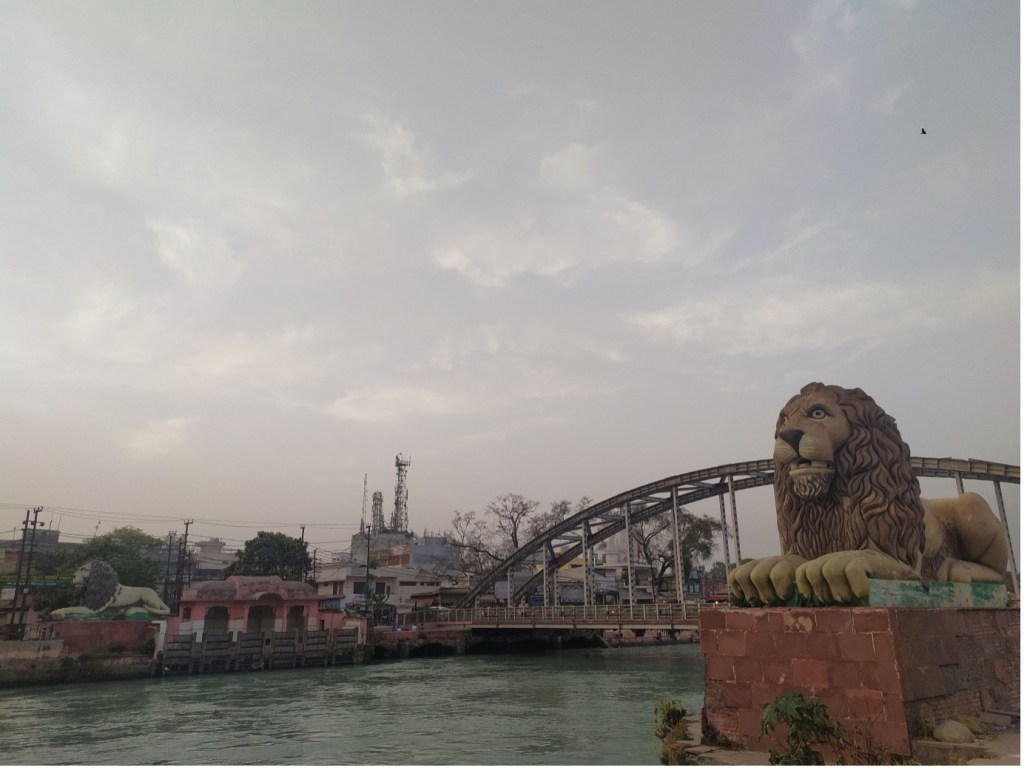
My walks took me along the canal with its two huge lions on guard, the bridges spanning the two sides and the foliage lining the canal. The yellow gulmohar tree was in full bloom — some of its branches entwined in the electric wires were reflected in the rippling water.
The Ganga Canal
The Ganga Canal was built in the nineteenth century for irrigation purposes. It seemed to flow in peace, guarded by lions. This is a setting that has been featured in many Hindi films.
Nature proliferated all over the campus.
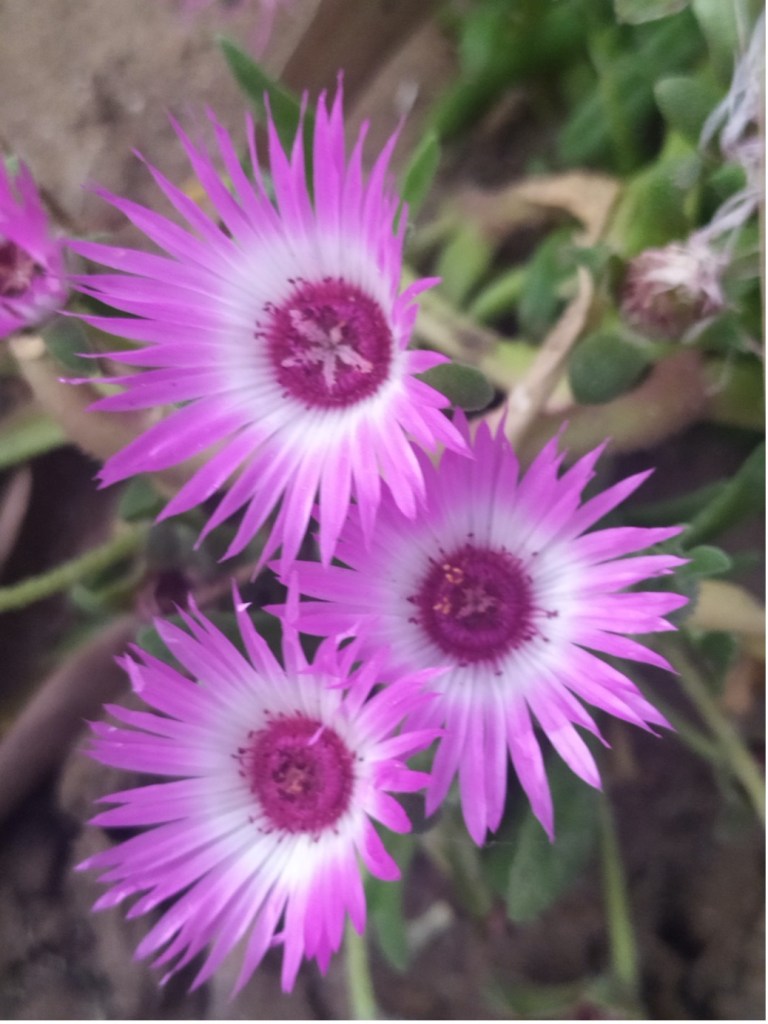
The Livingstone Daisy
The Livingstone daisy was commonplace. The magenta petals that emanated out were painted white within.
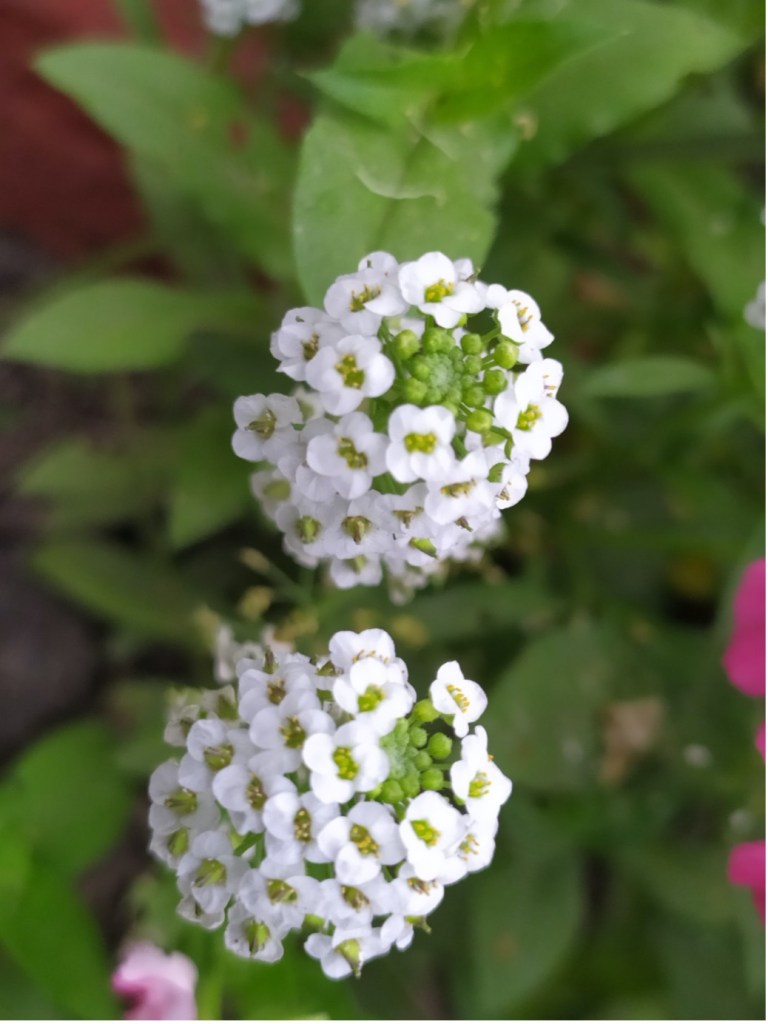
Sweet Alyssums
Sweet alyssum tufts held together amidst the green and the other blooms. And some magenta ones not only added colour but were curled into a ball.
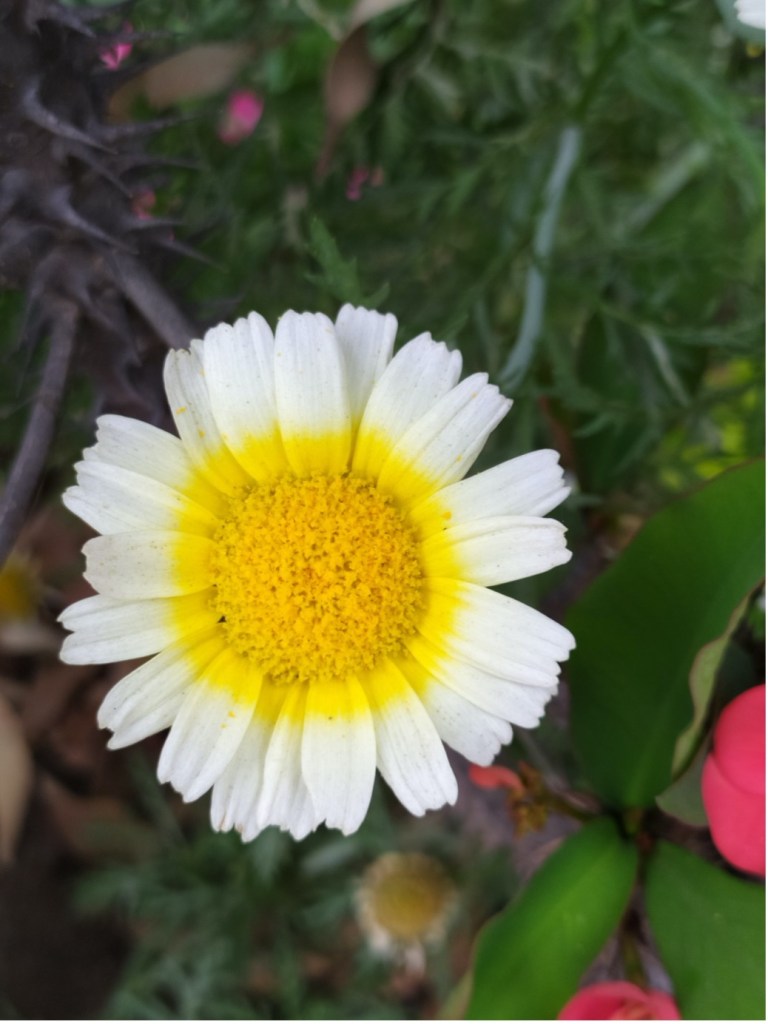
Daisy
This bi-coloured bloom also is a member of the daisy family. Its yellow adding brightness as I paused.
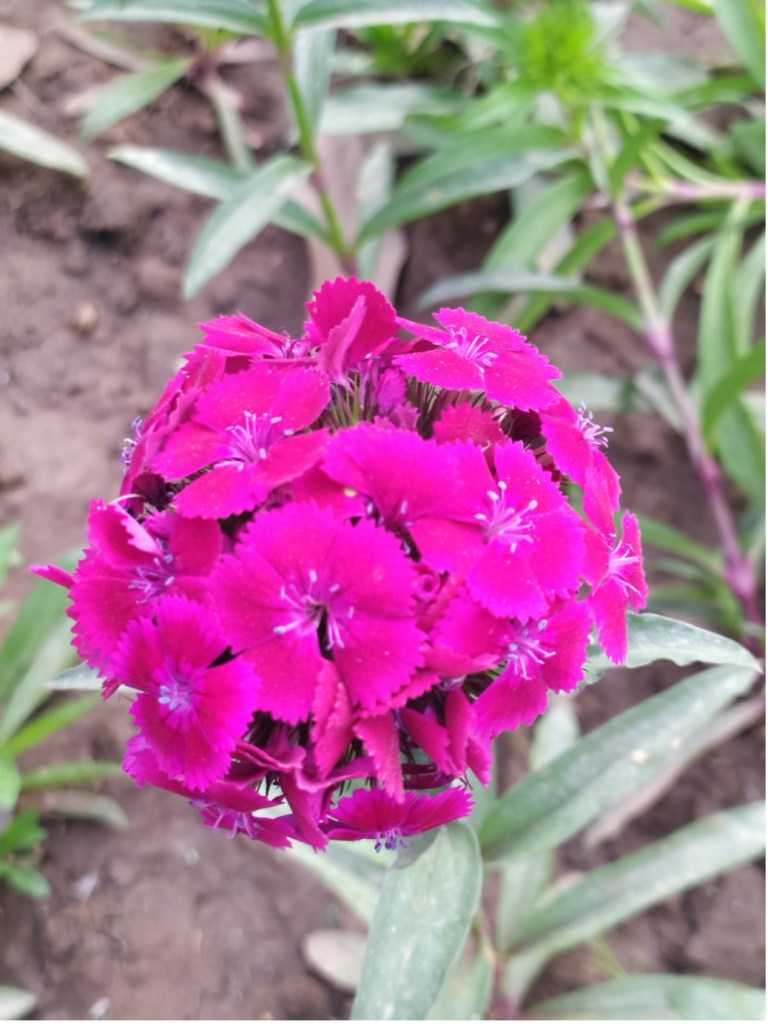
Sweet William
Tufts of the beautiful sweet William caught flies huddled together. A lone plant that stood among many others.
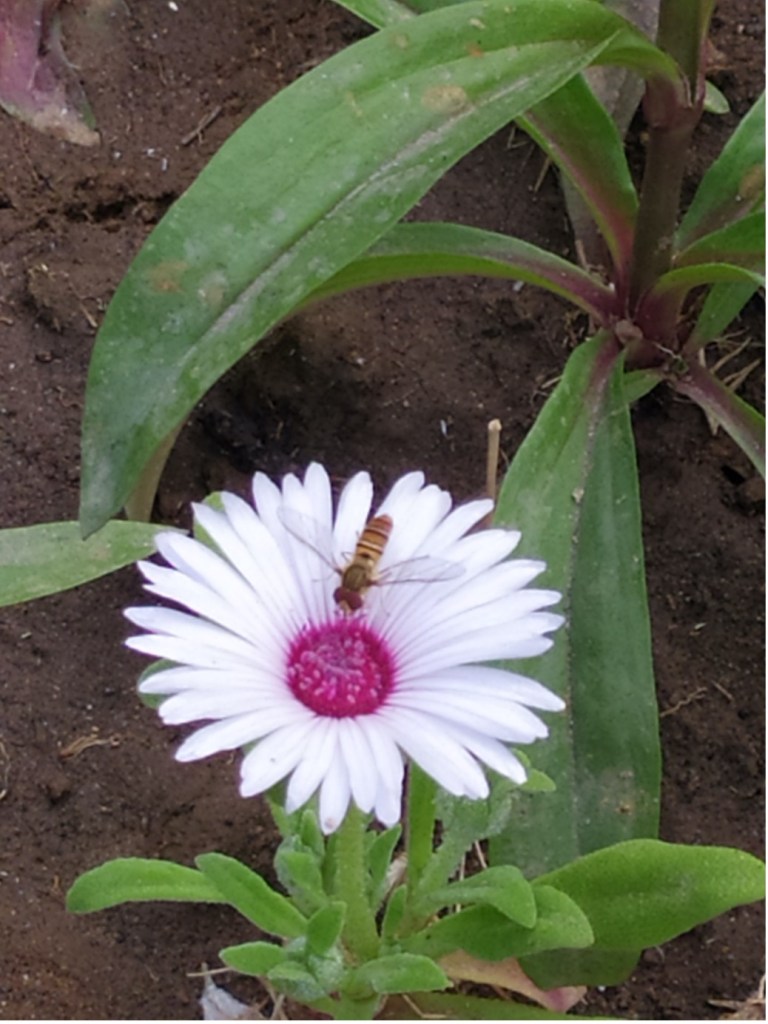
Livingstone Daisy
Another Livingstone daisy had some action going on – summer was still some time away.
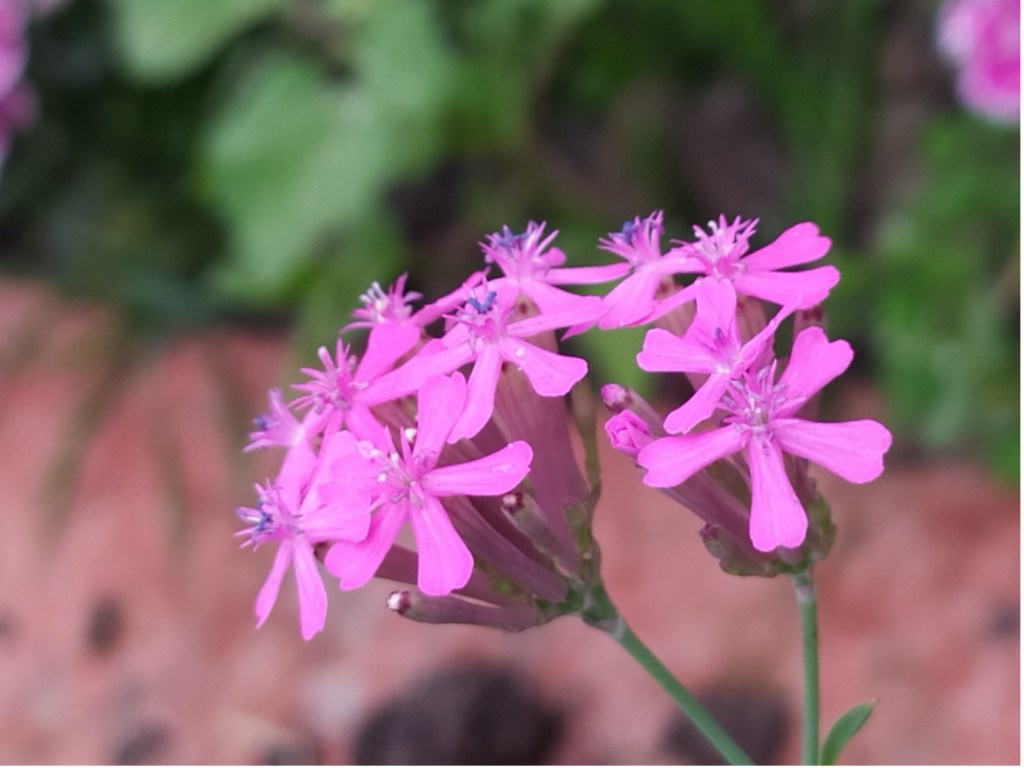
Ziziphora
Some ziziphora were green, a few turned violet in the centre before the entire bunch matures to a shades of the amethyst. All on one plant.
Easter Lily Vine
Herald’s Trumpet or the Easter Lily Vine bent down and looked out. They seemed to offer a colour contrast to the parrots with loud their screeching calls.
Cineraria
There were cineraria blooms lining the lawns, defining with their vibrancy.
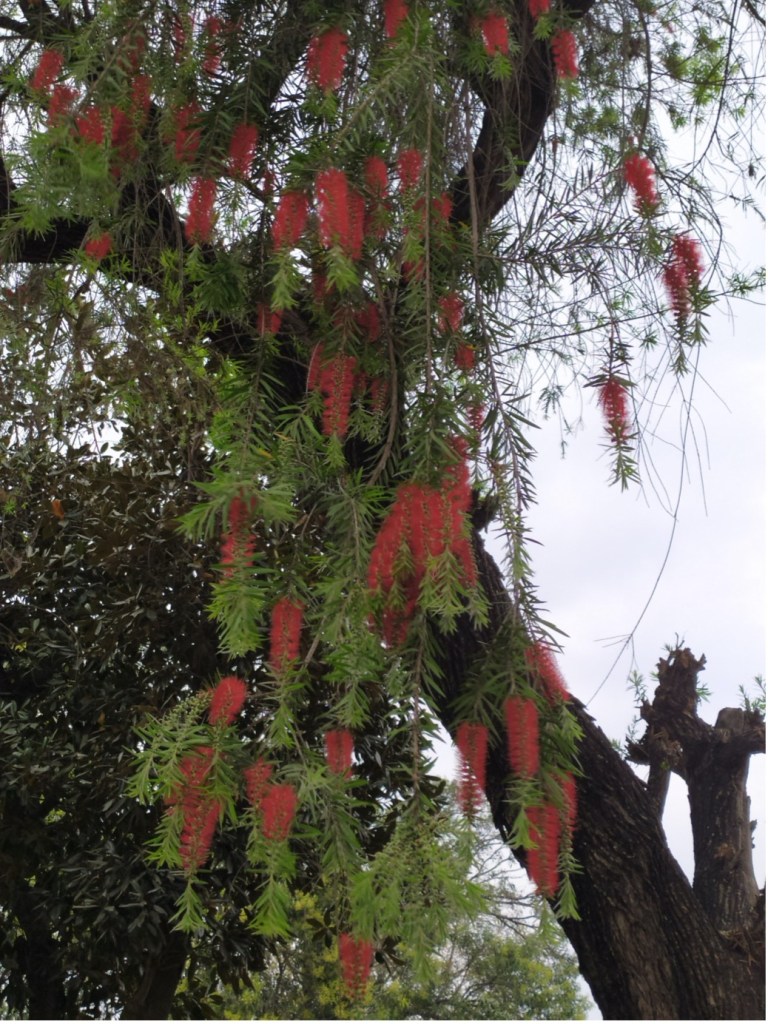
Weeping Bottle Brush
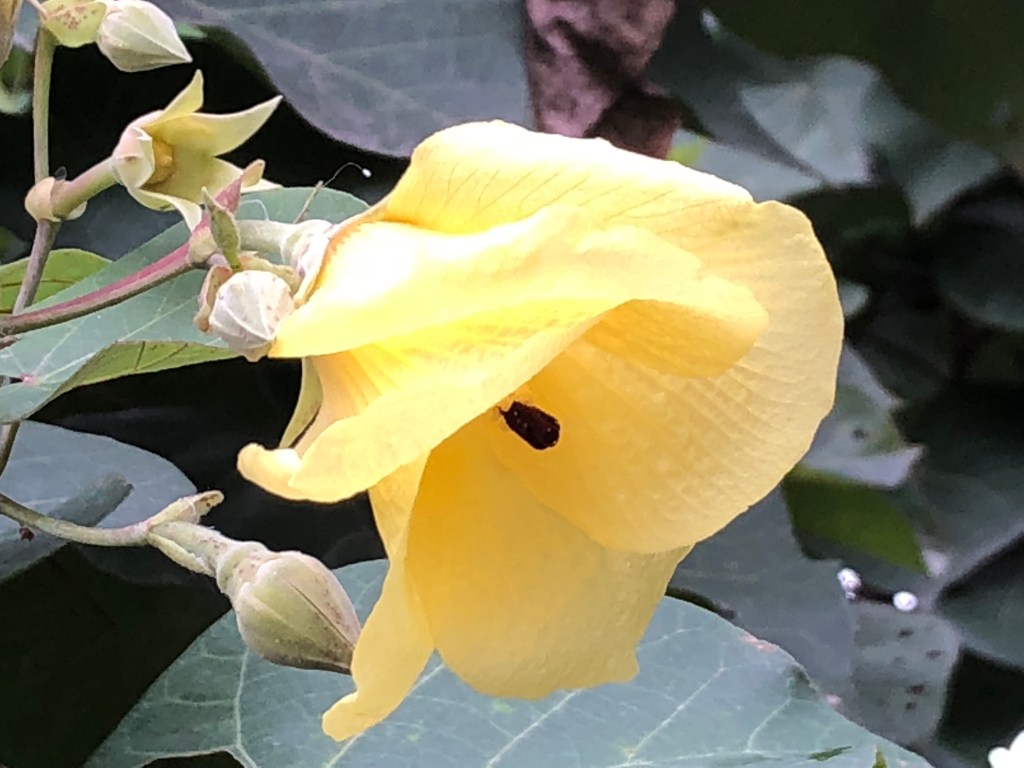
The weeping bottlebrush looked happy and bright despite the element of sadness in its name. These trees sometimes stood lone and sometimes, in the company of small shrubs and plants.
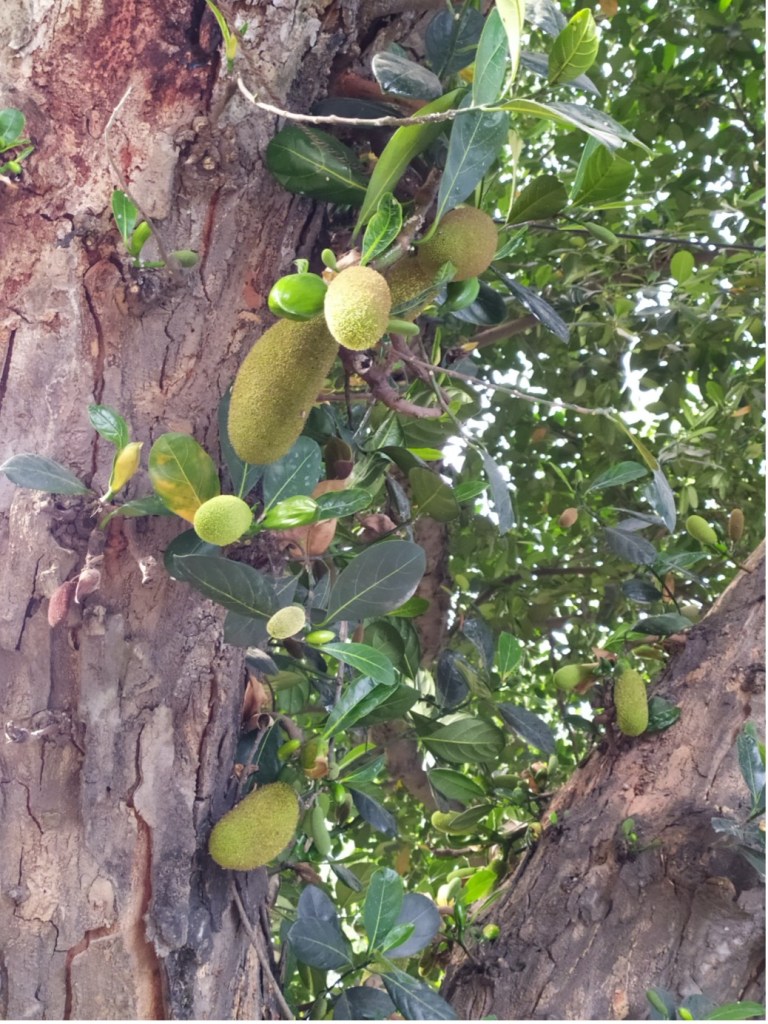
Jackfruit Tree
Small raw jackfruits hung on to the tall trees, reminding one of culinary delights that are part of summer menus.
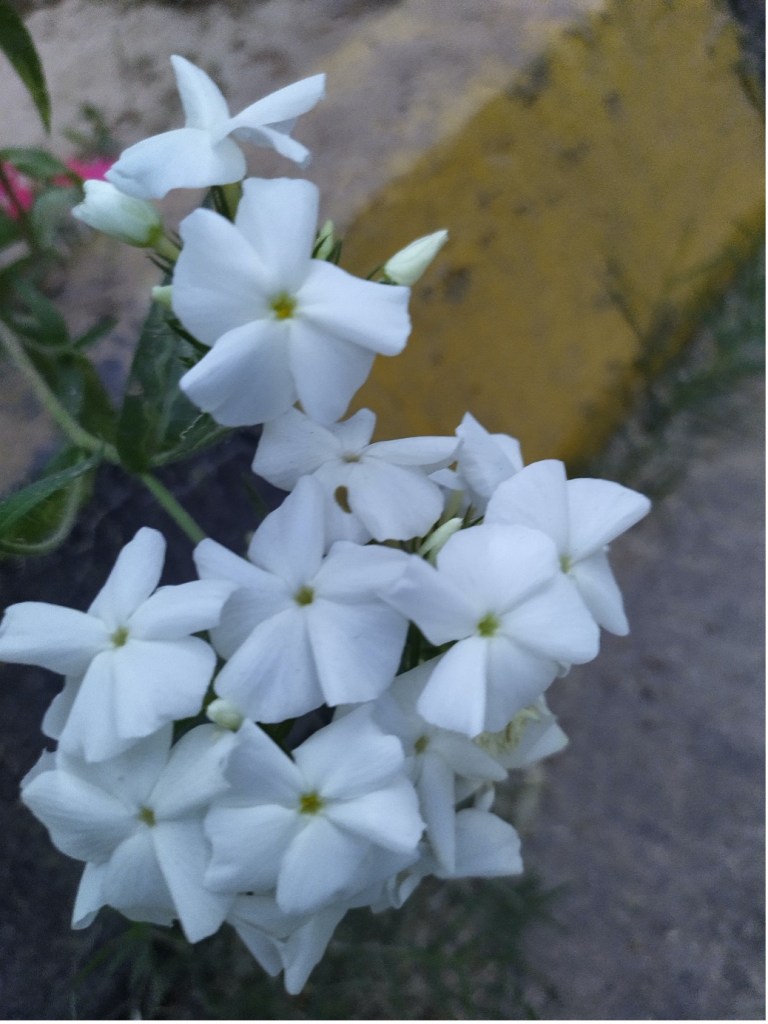
Periwinkle
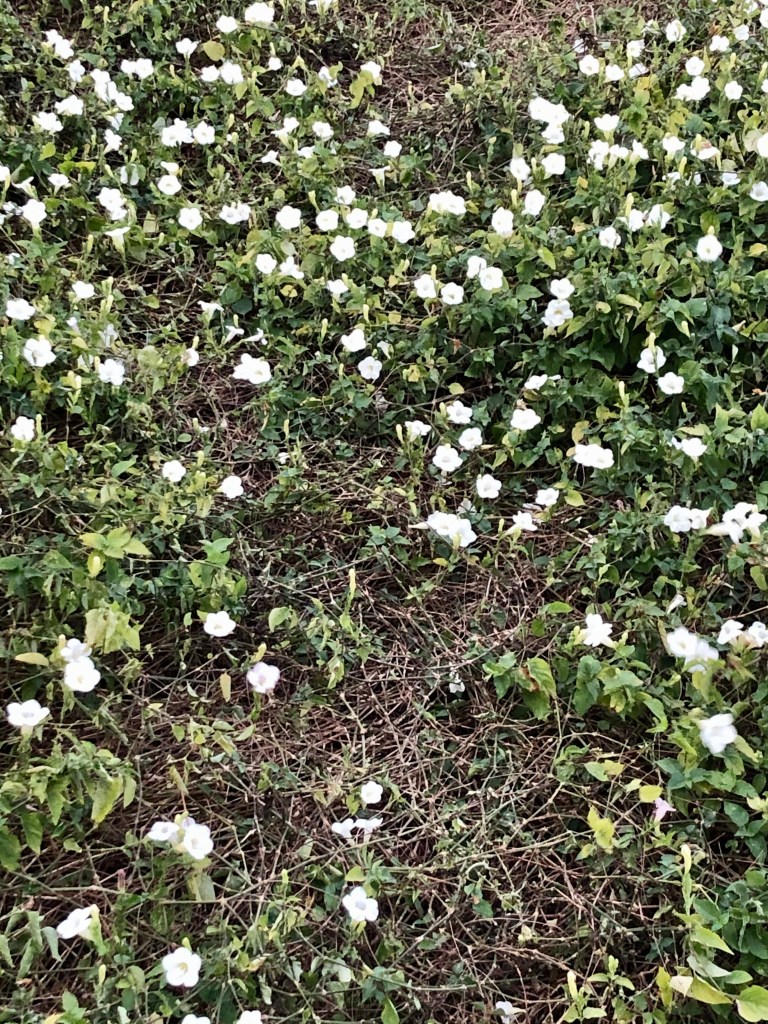
Bunches of white periwinkle, gently swayed just by the kerb, unmoved by social distancing norms.
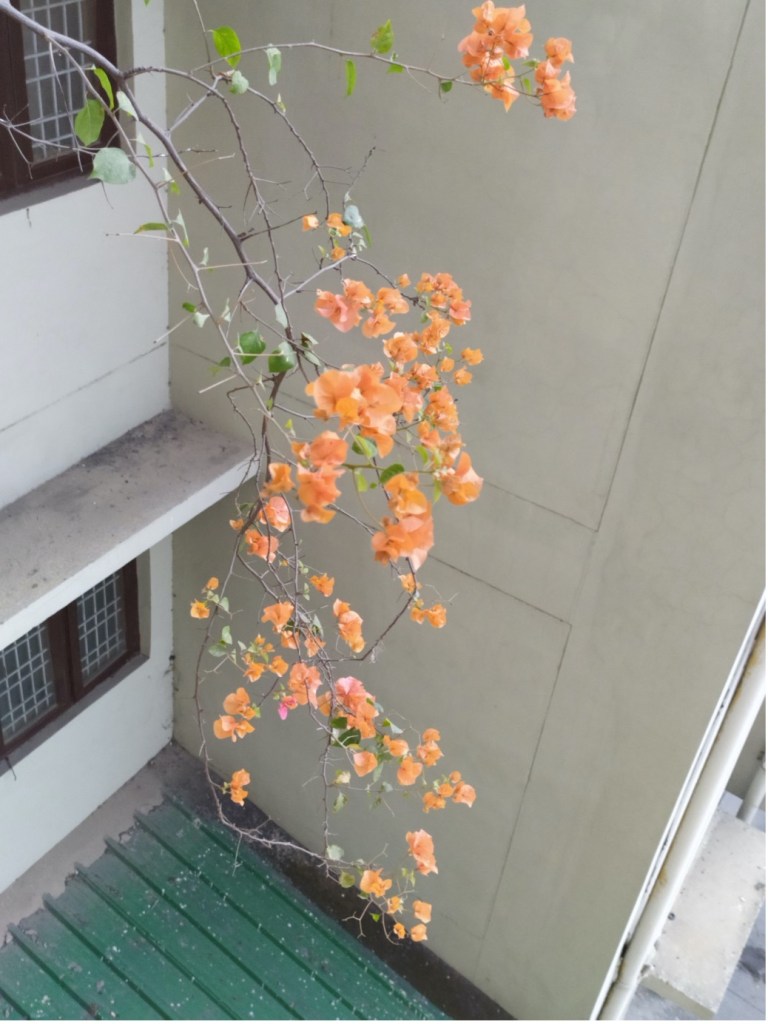
Bougainvillea
And amid all the concrete housing, an orange bougainvillea branched out.
The Sacred Heart Church
The Sacred Heart Church was close by. Its morning bells pealed at about 5.45 am every morning. As I peeped out of a window in its direction, I could see the lighted cross in the darkness.
The charm of what I saw has now become a part of my being. The smell of the greenery pervades my senses, with nostalgia that remain — that linger on for a while as life moves on, at times bumpy, at times slow.
.
Nishi Pulugurtha’s works include a monograph Derozio, travel essays Out in the Open, edited volume of travel essays Across and Beyond, and The Real and the Unreal and Other Poems.
.
PLEASE NOTE: ARTICLES CAN ONLY BE REPRODUCED IN OTHER SITES WITH DUE ACKNOWLEDGEMENT TO BORDERLESS JOURNAL.
The shadow of disappointment

is long and grey

it lengthens

when expectation rises -- like the sun

and shortens

when it meets the horizon


The shadow of disappointment is darkest when it's closer

And lightens as it goes farther

lingering ominously, over everything in the path of light

Casting a veil of darkness on all in sight

dulling the brightness, reducing the sheen

of every living and non-living being


The shadow of  disappointment allures

Turn, turn away, towards the light

And let it follow you -- silently into the quiet of the night

For that is where the shadow -- Erebus,

child of Chaos resides,

enveloped in the love of Nyx*”

Lay it at rest there so it no longer disappoints.


*Erebus – As per Greek mythology, was conceived as a primordial deity and represented darkness

*Chaos – was believed to be the father of Erebus. A state of void preceding the creation of the Universe

*Nyx- is the night as per Greek myth
Smitha Vishwanath is a banker turned writer. A management professional, she embarked on the writing journey in 2016, with her blog, https://lifeateacher.wordpress.com.Her poems and articles have been published in various anthologies. In July 2018, she co-authored a book of poetry: Roads – A Journey with Verses.
.
PLEASE NOTE: ARTICLES CAN ONLY BE REPRODUCED IN OTHER SITES WITH DUE ACKNOWLEDGEMENT TO BORDERLESS JOURNAL.
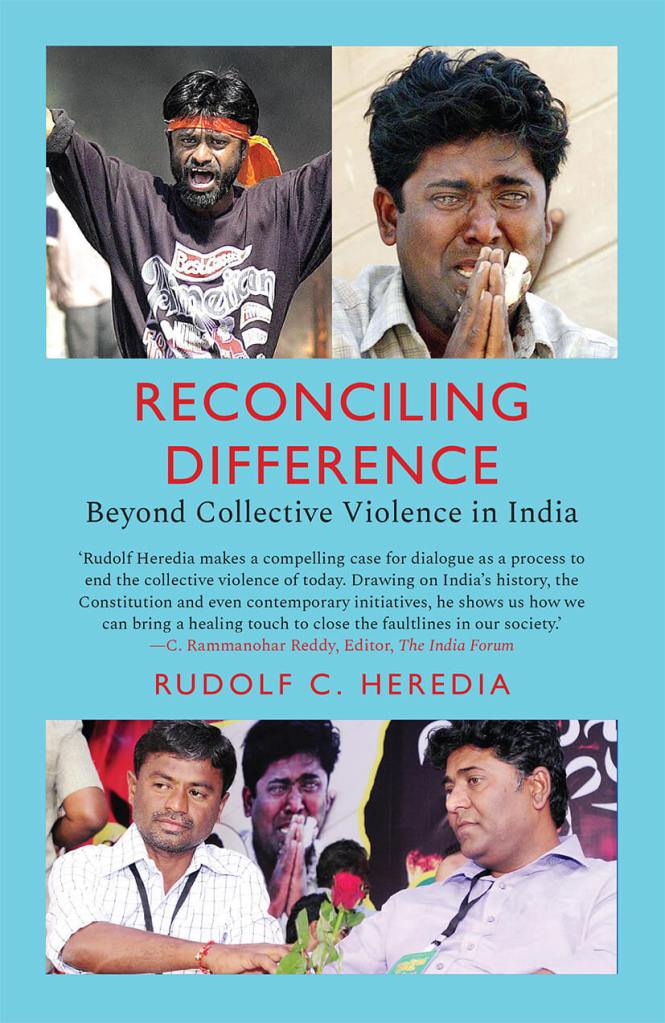
Title: Reconciling Difference— Beyond Collective Violence in India
Author: Rudolf C. Heredia
Publisher: Speaking Tiger Books, 2021
“When the British Imperialists left the Indian subcontinent in 1947, they left behind a legacy of governance based on communal and ethnic polarization. Since then, India has been engulfed by religious and ethnic violence—from the Partition to the more recent Gujarat riots of 2002 and Delhi riots of 2020. This trajectory is in direct opposition to the ideals of ‘justice, liberty, equality and fraternity’ enshrined in the Indian Constitution. Our increasingly polarized society is now faced with the question: Will India follow the ethnic nationalist route that seems to be becoming a global phenomenon?” enquires the blurb of this remarkable book.
Reconciling Difference — Beyond Collective Violence in India by Rudolf C. Heredia is an attempt by an anxious citizen and academic to understand the nature of hate and violence prevalent in India. It is also an effort to find practical ways to restore peace and harmony–so essential to present turbulent times.
A leading sociologist and thinker, Heredia is an independent writer and researcher. Based in Mumbai, he taught sociology at St Xavier’s College, where he was the founder director of the Social Science Centre. With a keen interest on issues related to religion, education and globalization, Heredia has authored Changing Gods: Rethinking Conversion in India andTaking Sides: Reservation Quotas and Minority Rights.
In the preface to the book, Heredia writes: “Violence has no borders. It is like a forest fire which once lit, even if by an accidental spark, in a dry, hot summer drought burns out of control, fanned by the wind until the entire forest is gone. It must then wait for the next rains to restore it. If the rain fails, desertification will inevitably follow.”
He continues: “But first the crisis must be recognized before it can be addressed, the problem understood, before a resolution can be attempted. The urgency of the present emphatically suggests that collective violence in India, with its brutalizing horrors, is now becoming the new normal.”
In this in-depth study, Heredia urges citizens to seek contexts beyond punitive justice. What he suggests is returning to the Gandhian ideas of ahimsa — non-violence and compassion — in order to heal the fraying fabric of the society. While doing so, he recalls Nehru’s ideas of a pluralist and inclusive India, as well as Ambedkar’s idea of the republic.
With eight reasonable and coherent chapters, Heredia inspires the readers to undertake a politico-historical journey — the way promises were broken and hopes betrayed, the cultural/psychic/political roots of the “spiraling violence”. In this quest, he feels the need to understand Gandhi as “a new hermeneutic is needed to dialogue with Gandhi’s counter-culture and its basic themes of swaraj, swadeshi and satya”.
Relying heavily on pedagogy, Heredia is unfaltering in his conviction. He feels intensely about restoring the country’s damaged polity. Drawing inspiration from the Truth and Justice Commission set up in post-Apartheid South Africa, he urges steady and thoughtful discourses between polarized citizens in order to heal the past wounds of collective violence. Drawing on India’s history, the Constitution and even contemporary initiatives, he shows us how we can bring a healing touch to close the fault lines in our society.
Sample this: “If this dream of peace is to become a reality, we must divest ourselves of a great deal of the presumptions and pre-options we have been, and still are being socialized into by exclusive communal identities and religious fundamentalisms, national extremists and radical rationalism.”
What distinguishes this volume from other such works is its ability to persuade the reader to see the disgruntlements of the times we are living in, comprehend the pathology of the limiting identities, cultivate the art of dialogue, understand plurality and differences, and move towards peace.
Heredia concludes the book by saying: “We need to deconstruct this ideology of exclusion and the politics of hate. We need a struggle, a jihad, a crusade, a padayatra for the idea of a sovereign, democratic secular socialist India. We need to sow the good seed of meaningful, relevant, liberating humane cultural and religious traditions for a hundredfold harvest of a harmonious peace, premised on tolerance and justice, forgiveness and reconciliation. For if we stop dreaming peace, we will stop dreaming India.”
Written in a florid yet graspable language, the argument put forward is persuasive and convincing. Far from being a hypothetical one, the 300 plus paged book is observant, dialogic and meticulously researched and with a touch of contemporariness. Heredia offers solutions to every problem and every delinquent behavior. Coming as it is from a renowned sociologist-activist, this book is an essential read, especially for those who are concerned about preserving the secular and democratic ideals of India.
.
Bhaskar Parichha is a journalist and author of No Strings Attached: Writings on Odisha and Biju Patnaik – A Political Biography. He lives in Bhubaneswar and writes bilingually. Besides writing for newspapers, he also reviews books on various media platforms.
.
PLEASE NOTE: ARTICLES CAN ONLY BE REPRODUCED IN OTHER SITES WITH DUE ACKNOWLEDGEMENT TO BORDERLESS JOURNAL
With the rain that kept falling and driving them loopy.
“I’m tired of this weather,” he grumbled again,
“All it does is rain, rain, rain.”
“Never mind Captain,” called Mick with a shout,
“Look over there, the sun’s coming out.”
“And look beyond,” cried Fay with joy,
“There’s a rainbow shining. Rainbow ahoy.”
The rainbow shone red and orange and gold,
Blue, violet and indigo and green and bold.
“What a wonderful rainbow,” the crew all cried.
“Humph!” said Blacktarn, “I’d rather it dried.
But wait a minute, there’s a tale I know.
Now what is it that lies at the end of a rainbow?
Gold! Yes of course, a crock of fine gold.
Below that rainbow there’s wealth untold.
Well come on crew, turn the ship,
Start to steer for the rainbow’s tip.”
“But Captain,” said Bob, “we can’t reach the end of a rainbow.”
“Of course we can,” said Blacktarn, “come on, let’s go.
I’ll be the richest pirate on all the Lemon Sea,
I’ll eat chocolate for breakfast, dinner and tea,
I’ll wear ten gold rings in each of my ears,
And wear cloth-of-gold trousers for years and years.”
“Well I think we should have some of this gold too,”
Said Bosun Mick to the rest of the crew.
“Well, maybe I’ll let you have a coin or so,”
Said Pirate Blacktarn as he paced to and fro.
But the crew felt annoyed and muttered and mumbled.
“It’s not at all right,” they sulked and grumbled,
“We do the work, why should Blacktarn have it all?
All he ever does is growl and bawl.
But first we must find this mysterious rainbow.
It’s very odd how it seems to come and go.”
All day they searched for the rainbow far and near.
But when they thought they were close, it seemed to disappear.
And when they reached the place where the rainbow should be,
There was nothing to be seen anywhere on the sea.
Everyone thought they knew the best course to take.
And each yelled at the others, “THAT way, for goodness sake!”
“Steer to starboard!” “No, to port!”
“No you fool, it’s the other way I thought.”
So they all grew crosser and crosser and then began to shout.
Until at last a horrible fight broke out.
And everyone joined in, with fierce kicks and punches.
And poor Tim’s feathers were pulled out in bunches.
But at last they grew weary and bruised and battered
And their heads were hurting and their clothes were tattered.
Then they heard a strange sound wafting over the sea.
“What’s that?” they asked, feeling rather panicky.
“It’s the people of Mer,” said Fay feeling sad,
“They’re laughing at us for being so silly and bad.
And do you know what’s happened now?
All the time we’ve been quarrelling and making such a row,
The sun’s gone down and the rainbow’s vanished.”
“Oh no,” cried Blacktarn, “my dreams of wealth are banished.”
“I’m very sorry,” said Big Bob, the cook.
“So am I,” said Rakesh with a shamefaced look.
“I didn’t really mean to pull out your feathers Tim,”
Said Bosun Mick, holding out a hand to him.
“And I wasn’t really trying to peck off your nose,”
Said Tim with a sigh, “or even gnaw your toes.”
Then they cleaned each other’s cuts and rubbed each other’s bruises.
And then they agreed that they’d all been losers.
“But look at our poor Captain,” cried Rakesh, “over there.”
For Blacktarn huddled by the stern, muttering, “It’s not fair.”
And he looked very miserable and gloomy and dejected
For all his hopes of gold hadn’t gone as he’d expected.
“Serves you right,” said a voice, “for being much too greedy.”
And Neptune himself rose from the deeps of the sea.
“We’re feeling very sorry,” said Stowaway Fay.
“So I should think,” said Neptune, “what a way to spend a day!”
But Big Bob the cook baked a great big cake,
The very best that he could possibly make,
And Blacktarn had the biggest piece with a nice cup of tea.
And Rakesh sang a song to try to make him happy,
Until at last he smiled again and seemed to cheer up,
While Neptune reminded him, as he took a cup,
“You can never find the end of a magical rainbow,
As every good sailor on the Lemon Sea should know.”
“Well of course I knew that,” said Blacktarn cheerfully,
“I was just testing the crew here, you see.
But now we’ve steered a long way off course.
It’s time we set sail again, to catch the salt-wind’s force.”
.
Note: The ‘Pirate Blacktarn’ poems were written in the early 1990s but were never submitted anywhere or shown to anyone. By lucky chance they were recently rescued from a floppy disc that had lain in the bottom of a box for almost thirty years. There are twelve poems in the series but no indication as to what order they were written in and the author no longer remembers. However, they seem to work well when read in any order. They all feature the same cast of characters, the eponymous pirate and his crew, including a stowaway and an intelligent parrot. The stories told by the poems are set on a fictional body of water named the Lemon Sea. (Dug up by Rhys Hughes from the bottom of an abandoned treasure chest).
Jay Nicholls was born in England and graduated with a degree in English Literature. She has worked in academia for many years in various student support roles, including counselling and careers. She has written poetry most of her life but has rarely submitted it for publication.
.
PLEASE NOTE: ARTICLES CAN ONLY BE REPRODUCED IN OTHER SITES WITH DUE ACKNOWLEDGEMENT TO BORDERLESS JOURNAL
The black star-filled evening seemed ready to flow into the horizon, down a gaping hole.
There was a time I was a loving husband. I know that was years ago but sometimes my memory is not capable of verifying this.
The escape I desired was in front of me all the time, or should I say above me? The oasis of being alone at home could only be accomplished by taking to the roof. The journey was transparent, open the window of my 3rd floor bedroom and the small, shingled cover would accept me with all my faults like the summer grass of my youth. This would be a new sanctuary: I could read, have my coffee, wave to the neighbors or simply close my eyes and listen to the sounds of the neighborhood. The roof shingles would be the canvas in my memory garden. Why would I spend mindless time watching television, surfing the internet, or worse having an affair or drinking? My view was like a virtual reality movie unfolding in front of my eyes. You might by now ask how the hell I got here: an old married man, alone and searching for any hope or happiness in what could be the last days?
My marriage after 35 years was falling apart, like my body, cars, house, and life. I know it is my fault that she is no longer happy and constantly, from morning to night, complains and blames me for everything and every choice I make. I always believed in the cliché only you can make yourself happy and I pray my wife will find peace. I feel I need to take to the roof and speak directly to heaven for God to hear me and that is another reason I sit here.
The neighbors I am sure would have another opinion of me. Why is the man sitting on the roof for hours on end? My neighbors as they were out walking would not make eye contact for fear of being brought into a higher decibel conversation. Most just waved and nervously smiled while walking into their perfect lives and marriages. I silently meditated on what their thoughts might be and if their own lives were absolutely perfect or just a façade?
Out in the distance, gray clouds were growing, and hot flashes could be seen and were complimented with a far-off roar. This brought to me a thought: to sit through the storm, right here in my safe place and if the lightening killed me, then I would have eternal relief. The start of winds awoke me to an epiphany, a sadness that this was the first time I ever thought of wanting to die.
At that moment, I became totally immersed with thoughts of the past. I was happy, each day a miracle of life for which I was grateful. I remembered my first date with the woman I would marry. The way we held hands, with the music like a background soundtrack to our jazz-infused love. The late-night conversations ending with hugs and whispers of I love you. I saw us both young and in our first year of marriage, I heard my wife tell me she was pregnant and remembered the joy we shared for the future as a family. The realization of the horrible husband I had become awakened me as the rain softly filled my face with cloud tears.
Down the street, a familiar car was finishing its journey home, holding my wife in its closed interior with her unknown emotions. The rain was increasing its intensity along with my apprehension.
The sound of her car excited me, closer and closer she would come to our new happiness. I hoped to welcome my wife home to the change she would see. I worried I was not too late, and our marriage could be saved. She looked up at me with wide eyes of amazement seeing me still on the roof with the impending storm whirling around in its uncertainty. I timidly ambled to the edge of the roof as she was walking swiftly to the front door now ignoring me, the way I did our marriage the last few years. Looking down at her my new love filling my eyes as my feet slipped over the edge and carried me home to her.
I felt free in my fear, my destiny awaited as she screamed below me. The scream grew louder and louder and I as drifted closer and closer, I closed my eyes before the impact knowing we would become one again.
.
Carl Scharwath has appeared globally with 170+ journals selecting his poetry, short stories, interviews, essays, plays or art. He has published three poetry books.
.
PLEASE NOTE: ARTICLES CAN ONLY BE REPRODUCED IN OTHER SITES WITH DUE ACKNOWLEDGEMENT TO BORDERLESS JOURNAL
The Poppy Field near Argenteuil, 1873 by Claude Monet. Courtesy– Creative Commons
Observance
Here the hills are old, and rolling
casually in their old age;
on the horizon youthful mountains
bathe themselves in windblown fountains . . .
By dying leaves and falling raindrops,
I have traced time's starts and stops,
and I have known the years to pass
almost unnoticed, whispering through treetops . . .
For here the valleys fill with sunlight
to the brim, then empty again,
and it seems that only I notice
how the years flood out, and in . . .
("Observance" has been published by Nebo, Piedmont Literary Review, Romantics Quarterly, Poetry Life & Times, Verses, Setu, Better Than Starbucks, The Chained Muse and in the anthology There is Something in the Autumn.) At Oncefor Beth
Though she was fair,
though she sent me the epistle of her love at once
and inscribed therein love’s antique prayer,
I did not love her at once.
Though she would dare
pain’s pale, clinging shadows, to approach me at once,
the dark, haggard keeper of the lair,
I did not love her at once.
Though she would share
the all of her being, to heal me at once,
yet more than her touch I was unable bear.
I did not love her at once.
And yet she would care,
and pour out her essence ...
and yet—there was more!
I awoke from long darkness,
and yet—she was there.
I loved her the longer;
I loved her the more
because I did not love her at once.
("At Once" has been published by The Lyric, Romantics Quarterly, The Chained Muse and Grassroots Poetry)
.
Michael R. Burchhas over 6,000 publications, including poems that have gone viral. His poems have been translated into fourteen languages and set to music by eleven composers. He also edits The HyperTexts (online at www.thehypertexts.com).
.
PLEASE NOTE: ARTICLES CAN ONLY BE REPRODUCED IN OTHER SITES WITH DUE ACKNOWLEDGEMENT TO BORDERLESS JOURNAL.
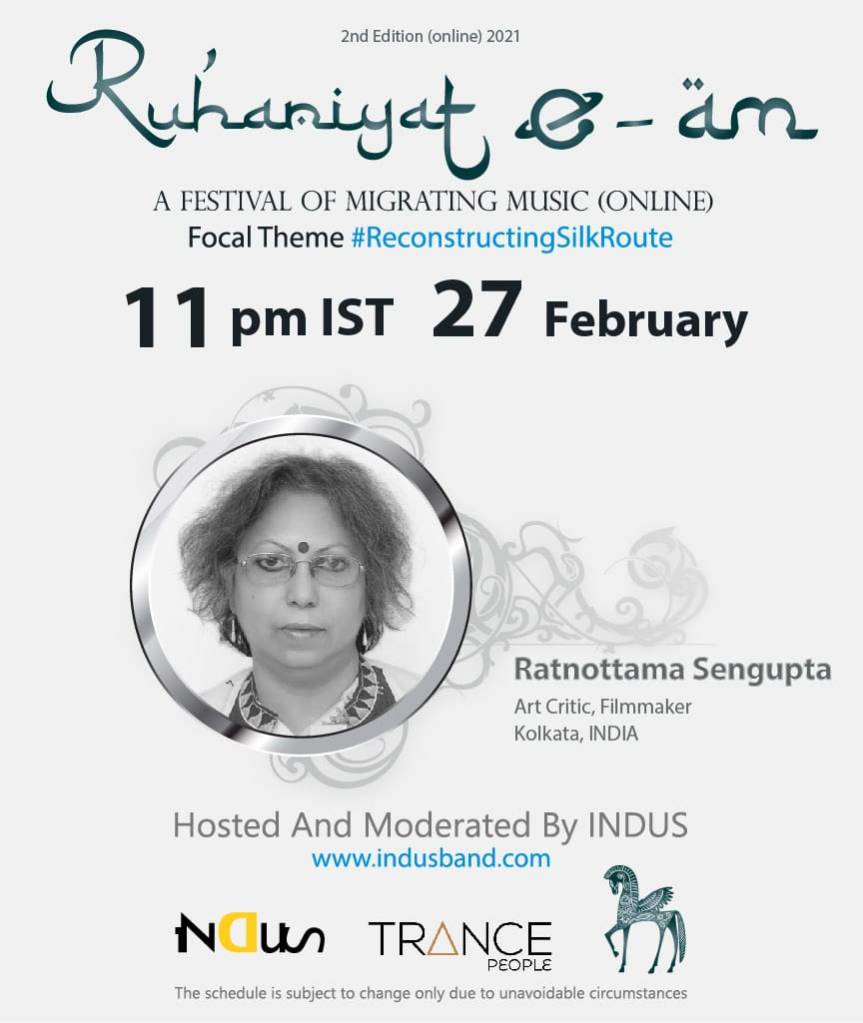
These contemplations have come out of Ruhaniyat-e-Aam, an online festival of migrating music. Hosted by Indus Band, its focal theme was ‘Reconstructing the Silk Route’. A webinar was the finale of the concept that was put into practice long before ‘COVID’ entered the Oxford dictionary – in 2018 when Somali Panda, founding head of the Kolkata-based Band came up with the novel concept of connecting online with performers in Greece. They played their music, we joined them with my reading, Tamal Goswami’s painting, and Somali’s songs.
Subsequently, during the pandemic, “when the world was compelled to stay indoors, the importance of connecting with the rest of humanity forcefully struck us,” says Somali. She then went on to host this series of interactions with musicians, artists, filmmakers and academicians from Greece, Czech Republic, Egypt, Iran, Kazakhstan and India — all participating in a celebration of the Human Migration that established bonding amongst nations, cultures, civilizations, and created a global community long before the term had come into existence.
The prime purpose of reconstructing the Silk Route — philosophically, ideologically, conceptually – was to forge a measure of friendship. Friends they became – Labros Kantos, singer from Greece; Saimir Bajo from the Czech Republic; Mesbah Kamal, academician from Dhaka; Sharofat Ara Bova, filmmaker from Tajikistan; Arqavaneh Folklore Ensemble from Isfahan, Iran; Mohamed Abu Zid from Cairo, Egypt; Sarower Reza Jimi, playwright from Lisbon, Portugal… Because music connects people most readily since it overrides the barrier of language, “and it gives inner peace and solace,” Somali adds.
By the time it ended, Ruhaniyat-e-Aam had traced the cultural exchange from the time of Alexander and helped to understand how Hellenic Culture became Hellenistic through synthesis. Most of us know that after Alexander conquered the Persians, he established the city of Alexandria (339 BC). A little more detail: this was in the Fergana Valley of Neb – around modern-day Tajikistan. Leaving the wounded warriors behind Alexander moved on, and in time the Macedonians intermarried with the indigenous populace creating the Greco Bactrian culture that flourished in the Seleucid Empire after his death.
*
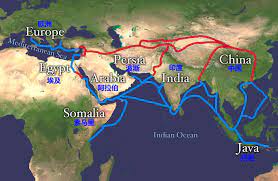
This festival of Migrant Music set me on a virtual journey down the Silk Road, the 6,400 km caravan tract that was actually an ancient network of trade routes. Formally established during the Han Dynasty of China, it linked in commerce the regions from China to Mesopotamia – should I say modern day Iran? – through India, Asia Minor, Egypt, the African continent, Greece, Rome and Britain too — between 130 BC and 1453 AD. Originating in Xian – now famed for its Terracotta Army – it followed the Great Wall of China to its northwest, bypassed the Takla Makan Desert, climbed the Pamirs, crossed Afghanistan, went on to the Levant region from where merchandise was shipped across the Mediterranean Sea.
What many of us don’t realize is that the Silk Route was not one single road. There were some that were longer and safer; some were shorter and more difficult. Some had been journeyed on much longer and thereby had witnessed more exchange than some of the shorter, more precarious roads and pockets like, say, Bhutan. And few travelled the entire length of the road: goods were handled in a staggered progression by middlemen.
The greatest value of the road lies in the exchange of culture it effected. Art, religion, technology, language, science, architecture — indeed, every other element of civilization was exchanged on these roads, along with the commercial goods that merchants traded from country to country
With the loss of Roman superiority and rise of Arabian power, the Silk Road became more and more unsafe. However, during the rule of the Mongols/ Mughals, Venetian explorer Marco Polo (1254-1324) travelled right up to China along the road that is now supposed to have been the main artery along which travelled the bubonic plague bacteria responsible for the pandemic of Black Death that decimated the Byzantine capital of Constantinople.
The network was used regularly till about 1453 when the Ottoman Empire boycotted trade with the west and closed the routes. By this time Europeans had become used to goods from the east, and so merchants set out to find new trade routes – over the oceans. That, as we know, led to the discovery of the New World and of new civilizations and forging of new cultures. In sum, we may say that laid the groundwork for the modern world.
*
What many of us don’t know: Part of the Silk Road still exists as a paved highway connecting Pakistan and the Uygur, an autonomous region of Xinjiang in China. It had given UN the impetus to plan a trans-Asian highway, and a railway counterpart of the road too had been proposed. The road had inspired cellist Yo-Yo Ma to found the Silk Road Project in 1999 in order to explore cultural traditions along its route and beyond, as a means for connecting arts worldwide, across cultures.
But why look back on the Road that has little to do with how it existed 2000 years ago? Forget the zeros – it is probably not like it was even two and half years ago! So what is its importance?
To my mind, the importance lies in the layers of history lining it. Glancing backward we realize that we stand on the shoulder of giants. Every visit into the past unearths stories of human civilization. And whenever I have done that – as I did in Kazakhstan as part of an ICCR effort in 2009 – I have got answers to questions like:
A) Where was the Road going and why?
B) Why was it such a life transforming journey?
C) The road traversed through remote parts of the world, especially a huge part was ice covered desert. Then, why did the horse become such an important part of the journey on this road?
D) Horse was only one of the animals that were traded on the route. So, who named it Silk Road and why?
Arabian Nights
It was so named by Ferdinand von Richthofen in 1877 CE because silk was a treasured part of the trade – indeed it was the primary attraction that started off the trade but few travellers walked the entire length of the road. They came to different posts on the route, exchanged goods, food, plants, and ideas along with spices and tea. Stories of The Arabian Nights give us an idea about the exchanges that were taking place in city like Baghdad. And we realise that the flying carpet was not a mere figment of imagination, it became a metaphor for journeying from one world to another.
*
Enough of history? Well then, let’s take note of the cultural exchanges closer to our life and times. Since Ruhaniyat-e-Aam was about Migrating Music, what we naturally traced was the commonality of instruments like sarod, santoor and violin… How come the last named string instrument most associated with Western Classical music gained such acceptance and became inseparable part of music in Iran and in South India’s Carnatic music? Was rabab, the folk accompaniment most widely associated with Afghanistan, the precursor of India’s sarod, internationalized by Ustads such as Ali Akbar Khan and Amjad Ali Khan? Indeed, it was from them that I learnt there have been several versions of the rustic musical instrument that was honed, refined, perfected and sophisticated until it became the sonorous voice of Indian classical music.
Again, our santoor has a close affinity with instruments in China, Persia, Greece, and so many other places. I remember my visit to China for the Festival of India under the aegis of the Ministry of Human Resources, then headed by Arjun Singh. As part of that government-to-government initiative, I visited some music schools and was amazed to see how much our santoor — once called shatatantri or hundred stringed veena — had in common with the Chinese hammered dulcimer, yangqin. There have been many versions of it – in Iran, Iraq, Greece, Armenia. I noticed that the music played on the Chinese instruments were a bit more staccato; in India I learnt from maestros closely identified with santoor — primarily Shiv Kumar Sharma and Bhajan Sopori – that strings have been added to get the murchhana or greater resonance so that the notes linger on…
If we go on to visual arts, the first name that comes to my mind is of Nicholas Roerich (1874-1947). The Russian lawyer-painter-archaeologist-philosopher born in St Petersberg had developed an abiding interest in Eastern religions, in Theosophy and Buddhism as much as Ramakrishna and Vivekananda, Tagore, Vedanta and Bhagavad Gita. His spiritual leanings took him across the Himalayas and make his home in the Himachal town of Naggar where he breathed his last.
Of greater consequence to Ruhaniyat-e-Aam was the fact that in mid-1920s the Roerichs together with their son and six friends went on a five-year-long Asian Expedition that started – in Roerich’s words – “from Sikkim and went through Punjab, Kashmir, Ladah, the Karakoram Mountains, Khotan, Kashgar, Qarashar, Urumchi, Irtysh, the Altai Mountains, Oyrot regions of Mongolia, the Central Gobi, Kansu, Tsaidam and Tibet…” A decade later he was to return to Mongolia and Manchuria to collect seeds of plants that prevent soil erosion.
In plainer words, because of these travels Roerich intimately knew not only the Himalayan range but a lot more of the Silk Road. This armed him with a scintillating palette of colours that painted mesmerizing mountains that are bold yet lyrical, rather mystical, even spiritual. I was absorbed by the tranquility that imbues the hypnotic series of 36 immersive images of the Himalayas preserved in the Roerich Gallery at the Chitrakala Parishath in Bangalore.
Roerich’s journeys along the Road had also prompted him to talk of preventing the destruction of art and architecture and work toward preserving the cultural wealth of the world. This had led to his nomination for the Nobel Peace Prize in 1929.
Deb Mukharji, a retired member of India’s Foreign Services, has also travelled through its hardy folds – and extensively photographed the Abode of Snow. The keen photographer who has authored Kailash and Mansarovar and exhibited Tall Tales of the Himalayas — among many others — is concerned about the ecosystem of the rugged and culturally rich Himalayas. “It is threatened by the highways that are being built through the mountains, either to promote religious tourism or for other purposes, he says after treks that took him from Garhwal to Nepal and Kailash to Manas.”
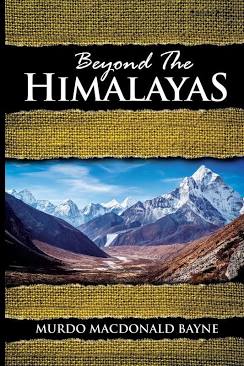
Cinematographer-director Goutam Ghose has journeyed through the Silk Route to make the ten-part documentary, Beyond the Himalayas. His project had started in 1994 and initially he had travelled with only 5-6 members who drove in a jeep and through the countries. “Our purpose was to look back from here and now in order to connect all the yesterdays that have transformed life and made us what we are today,” the celebrated filmmaker had said to me then.
So many stories of the exchanges enrich our literature too. Saradindu Bandopadhyay, author of many Bengali classics, had penned a story titled Maru O Sangha – The Monastery in the Desert. This was turned into a film, Trishagni/ Sandstorm (1989) by Nabendu Ghosh, another celebrated Bengali writer who became a legend as screenwriter of Hindi films. His film revolved around a monastery in Central Asia, somewhere on the Silk Route. It showed traders who came to the monastery with a ration of food, clothes and other essentials. Those were days when people could not fly in in a helicopter and drop supplies… it took months for these traders travelling in groups to reach from one stupa to another. There was a focus on the lifestyle of the times. Buddhism was the first organized religion, and monastery being the centre of Buddhism was thus the centre of such exchanges 2000 and more years ago. These monasteries subsequently became the prototype for Islamic Madrasas and before that, of Christian universities: they were built along the lines of the monasteries which dotted Central Asia. And it is believed that the Stupa also gave the concept of the gumbad, the round top of so many masjids and forts too.
Another important exchange that was happening came to light when Trishagni was screened in many international film festivals outside India – in Tehran, Cairo, Thailand… One of the questions that cropped up was this: “You are talking about Buddhism but why are the men (and women) dressed like they dress in Islamic countries? Islam wasn’t there then!” It had to be pointed out that philosophy – and religion is a part of that – and ideas travel but Geography moulds what we wear. Because of the weather, when there was no air conditioner or even fans around, people in some parts of Africa wore no garments and in some parts of the Asian desert men wore long robes to cover the body from head to toe from the hot flying sand particles. They started covering their heads and ears and part of the face, and that wisdom became a convention and then a tradition.
Thus, geographical reality moulded why people in certain parts of the world dress in certain ways. And with the journey of religion, these dress codes also journeyed. The Romans did not wear silk because they admired the style in which the Chinese wore it but because of the inherent quality of silk. Cotton was also much in demand on this route since it was hot in the desert. So was indigo – native to India, primarily, and sought in Mediterranean countries as pigment for dyeing, medicinal and cosmetic use.
These exchanges which are now history happened largely because of geography. Why? I got the answer in the course of a seminar where artistes and academics had come from Azerbaijan and Uzbekistan, Tajikistan and Turkey. I started realizing that people were travelling from China down to Northern tip of Africa or the Mediterranean country, certain lifestyle changes were taking place. These landlocked pockets that had no access to the sea, had little green and only animals to live off. Naturally, many turned their attention to what was going on the Silk Road. Two very interesting things happened:
1) Many became bandits who would rob these caravans.
2) Many did the opposite: they offered themselves as guards to protect the goods in the caravans from bandits.
So, the same problem generated two different approaches to life, two different lifestyles. Those who became guards would travel with the caravans and they became warriors. They became warriors because they were living in very tough terrains, and they became skilled warriors because they were fighting off bandits to protect the caravans. Before long these men turned aggressive. Wars between tribes became endemic – and many of the lands strived to find stability and prosperity for their people by going into the lands of other people. (Once again, geography and history came together to define lifestyle and culture.)
We find versions of this later when people set out from Europe and landed up in America, and a new culture and civilizational evolved. Another such change took place when people were forced to travel from the Queen’s England to Australia. All these migrations and journeys have influenced the arts, ideas, religion, food habit… Why is it that in India’s Northwest – Afghanistan, to be specific — people cook meat and roti in tandoor ovens while in Bengal well-being is synonymous with ‘maachh-bhaat’ – fish curry and rice? Once again the answer lies in the history of geography – that is, geography moulding tradition and shaping history.
*
In 1892 Rabindranath Tagore wrote Kabuliwala, a story that touches the heart of humans everywhere in the world even today. It pivots on a peddler from Kabul who comes to Calcutta each year to sell dry fruits, and befriends a child, Mini. Circumstances force him to go to prison on charges of stabbing a debtor. On his release he goes to meet Mini and finds she is getting married. Rahman realizes that his daughter, now grown up, will also not have any recollection of her father – and he starts on his return journey, towards home.
This story has been filmed in India in Bengali by Tapan Sinha (1957), in Hindi by Hemen Gupta (1961), by Kazi Hayat of Bangladesh (2006), by Anurag Basu for a television channel (2015), by Deb Medhekar in 2018. It has been reimagined in totally different contexts. Bioscopewala, set in 1990s, had Minnie going to Afghanistan where her father has died in a plane crash. In another script French Afghan writer Atiq Rahimi sets the story after the destruction of the Balmiyan Buddhas. This man from Kabul spells another exchange of ideas: he comes because this part of the world believes in reincarnation — and he is seeking his little girl who died during the destruction of the Buddhas!
Taking her cue from this same story, Sharofat Imam Arabova of Tajikistan made a lilting film where an Indian vendor selling things in that land strikes a friendship with a little girl. Desirous of paying a tribute to the author, the FTII-trained director approached Somali Panda to incorporate Tagore’s music in the script. “And when we did that using a santoor, it was so strikingly in sync!” says the music-maker from Kolkata who extensively used Raag Bhairavi. “That is the power of music – and also the bonding of migrant music,” she adds. And even as she spoke, I was reminded of Mrinal Sen’s Neel Akasher Neechey/ Under the Blue Sky (1959) wherein a Chinese hawker, Wang Lu, sold silk on the streets of Calcutta of 1930s, when India was under British rule. His life changed forever when he met Basanti, a housewife who gets arrested for her involvement in politics.
So what’s common between these stories? What connects the diverse players? Human situation where a man has travelled for work and struck friendship, an equation with a child – the most basic, most innocent form of humanity.
*
This is the importance of revisiting the Silk Route and renewing acquaintance with migrant music: that human beings everywhere in the world have been migrating. Individually too we have migrated. My grandfather migrated from East Bengal – Dhaka – to Patna, then a part of Bengal Presidency. Now Dhaka is a different country, and Patna is part of Bihar, a different state from West Bengal. My father ‘migrated’ from Patna to Calcutta to Bombay Presidency which became two states – Maharashtra and Gujarat. I was born in Bombay, which has become Mumbai, lived in Delhi which was earlier a Union Territory and now has become a state. At present, I live in West Bengal. My brother who was born in Patna studied in Pune, graduated in Medicine from Calcutta, lived in UK and worked in Germany, Brunei, Cyprus, Bosnia… So many migrations!
Today technology has opened new highways, new vistas of connecting with the world. And even as we speak (or read, as in this case) we are crossing boundaries almost every minute of our day. Within families to, a child goes out to study in London or New York, makes Singapore or Sidney his workplace, his family perhaps lives in Delhi, and he travels to Johannesburg to Rio, Texas to Tokyo, Moscow to Hong Kong, Sweden to Israel. So many outposts of civilization – just as people on the Silk Road once did, for their trade.
The crux of it? Stories that tell us about human lives and human emotions highlight one simple thing: Humans are the same everywhere. They are all born of their soil – geography. And geography moulds our history. Because we are creatures of these two forces, periodically we need to look back and trace our commonalities in order to transcend the schisms in society.
.
Ratnottama Sengupta, formerly Arts Editor of The Times of India, teaches mass communication and film appreciation, curates film festivals and art exhibitions, and translates and write books. She has been a member of CBFC, served on the National Film Awards jury and has herself won a National Award.
.
PLEASE NOTE: ARTICLES CAN ONLY BE REPRODUCED IN OTHER SITES WITH DUE ACKNOWLEDGEMENT TO BORDERLESS JOURNAL
William Blake at Felpham, West Sussex
To see a World in a Grain of Sand
And a Heaven in a Wild Flower,
Hold Infinity in the palm of your hand
And Eternity in an hour.From ‘Auguries of Innocence’, 1803
An unfurled question mark
answers the point where infinity begins.
Standing on the beach at Felpham,
studying the way the sea scars the horizon,
clouds pouring out in smoky angles,
cracks creating all kinds of illuminations;
shafting bolts of light and gloom.
No wonder Blake stood here
and thought the sea was talking to him,
tongues of sunlight and wind and cloud
fluttering through his mind. Here
at this unremarkable, passable place
where Human and Nature face each other,
taking turns to question and yawn,
the world turning under you, tides tugging
at that grander part that belongs
to something renewed every day, before
being, waves pounding, reeling
back again, a swell and releasing gift
unknown in its giving. Gulls cry you
back to when you saw worlds in the sand,
an eternity of assembling castles by hand,
then the cheering grief of waves taking
away your creation. Here is the heavenly
line drawn between times, stretched beyond,
suggested in the shallowest of curves.
The future remains uncertain, questionable
For now the horizon is enough.
When The Flowers Return
Those first snowdrops spearing coyly,
the speckled smiles of daisies, winks
of colour on leaf-laden forest floors.
Seeing them you are suddenly relieved
of your guilt: the thought that empty
fields will harden, deadened skies
be your last mirror, the spindly creak
of declining conversation, no summer
to talk of. You can be rejuvenated again
and pretend Nature does this for you,
that your witness is what gives worth,
that a poem is what spring needs.
Universal Knots
This is a struggle worthy of any split atom.
You’ve probably forgotten
how many fingers you needed,
how many hours of quantum patience
lost looping those string universes
around each other
only to end up entangled.
It’s a bit tricky, says a Kindergarten girl
and then she almost gives up.
Luckily, Mom is there to keep
the orbs moving: nearly there!
For what galactically important purpose?
So you could wear tied shoes?
You never asked your gods for that.
So Mom or Dad would stop stooping down
to your level, enter your orbit.
Who wants to grow up?
A Kindergarten boy starts with one shoe
and starts to bow the skill
around the black holes of immature
fingers. Getting there, says Mom.
Einstein had to learn.
Here is E=MC2 perseverance.
Both Moms ask their stars
how is it going?
Thumbs up, Milky Way grins.
Optimism, the gravity of learning.
Matthew James Friday has had poems published in numerous international magazines and journals, including, recently: All the Sins (UK), The Blue Nib (Ireland), Acta Victoriana (Canada), and Into the Void (Canada). The mini-chapbooks All the Ways to Love, Waters of Oregon and The Words Unsaid were published by the Origami Poems Project (USA).
.
PLEASE NOTE: ARTICLES CAN ONLY BE REPRODUCED IN OTHER SITES WITH DUE ACKNOWLEDGEMENT TO BORDERLESS JOURNAL.
Over 150 Authors and Artists from five continents, wrote on mental illness. Candice Louisa Daquin, a psychotherapist and writer and editor, tells us why this is important for healing
A watercolor of King Lear and the Fool from Act III, Scene ii. Courtesy: Creative Commons
When Indie Blu(e) put feelers out about creating an anthology based on mental illness, the passionate reception galvanized our belief it was a necessary subject. However, a few expressed concerns that an anthology about mental illness, would be ‘depressing’ and they wondered ‘who would want to read about mental illness?’ It is this perspective, acting like a fog, that separates those inflicted with mental illness from those who are not.
Such responses exacerbate feelings of isolation, unworthiness, and loneliness that many with mental illness already have. Through The Looking Glass, a metaphor from Alice in Wonderland, evokes this common feeling of separation, as poetry and prose has long had a tradition of doing. For many, this lack of understanding may be the tipping point leading to a premature death. If there is one reason to embrace mental illness in an anthology of art and poetry, it is to speak for, speak with and represent those who would be otherwise denied. To continue a tradition of poets and artists elucidating on the subject of suffering mentally:
If you Google ‘what causes depression?’ among the top ten searches will be ‘free yourself of depression’ and ‘depression is a choice’. As long as we blame the sufferer, the malady will become more entrenched. Mental illness is the only malady, aside from lung cancer caused by smoking, that we actively blame the sufferer for inflicting on himself. We bandy around terms like ‘chemical imbalance’ and ‘deficit of proteins in the brain caused by trauma’ but nobody really knows what ‘causes’ depression because like most disease, depression is epigenetic, hereditary and mal-chance and so many things we do not understand.
Depression can be a learned behavior, it can be transmitted through a virus, be the result of a series of debilitating personal events, or because you have stomach problems, and the serotonin and other chemicals are not manufactured in sufficient quantity. Depression can be the result of faulty mood regulation by the brain, genetic vulnerability, dementia, old-age, youth, hormones, drugs, eating disorders and sexual abuse. Or, depression can be caused by absolutely nothing! Usually it’s more than one thing, deeply complex and difficult to replicate in a laboratory setting.
As long as we as a society utilize words like ‘snap out of it’ and ‘be strong like …’ we will entirely miss the point. Not one person living chooses to be depressed, it is not a simple matter of one chemical being too low and another too high that can be ‘fixed’ with a pill or an adjusted attitude to life. We must distinguish between sadness, melancholy, situational sorrow, grieving, bouts of misery, feeling sorry for oneself, and medically defined depression.
The latter is a mental illness, it doesn’t mean you’re delusional or mad or unreliable, in fact depression strikes all but typically the more intelligent are more prone to it. One could argue, depression is a disease of insight and awareness of our ‘unbearable lightness of being.’ For some it manifests in childhood, others not until they’re elderly. All forms of depression are legitimate, and should not be shamed, rebuked, repulsed, diminished or ignored.
Whilst there is sense in saying we should not obsess over the subject, to the exclusion of efforts to brighten one’s life, by whatever means possible, we should equally not ignore those who are desperately struggling and usually without a single person to help them.
If your neighbor had cancer, you would not shame him for his ‘weaknesses tell him he was making a ‘bad choice’ and ask him to ‘get over it’ so why should you ever think it’s acceptable to do that for depression? Just as we are re-writing language for Trans Generations to be inclusive and supportive of insight and change, we should reconsider how we talk about depression. As long as we perceive depression to be a ‘bad attitude’ or ‘personality deficit’ or believe if Oprah could ‘get over it’ so could you, we condemn those who have obviously tried hard to do just that. They might feel it is their fault if they have not ‘succeeded’.
Encouraging someone to do things that help them when they are depressed, believing for some there is an end to their depression, those are all positive actions. We should take our depressed friends out for walks, to remind them there is joy in the world even when they are not able to see it, through no fault of their own. But we should also be careful that our well-intentioned prescriptivism does not become dogmatic and suggest the individual isn’t doing all they can. If they’re not (doing all they can), it may be that’s all they can do for now. Equally if you really believe someone isn’t doing enough, you can suggest things you feel might help without seeming accusatory.
From inception, we at Indie Blu(e) sought to offer a platform for those who might otherwise find no platform. Artists have historically endured mental illness in higher numbers than average. Reasons abound but there is no final analysis, it is thought whatever spurs creativity, may equally make certain illnesses more likely, just as left-handed-people are often more creative, perhaps it is about what parts of the brain are utilized and how.
No one group of people, based on gender, ethnicity, culture, doesn’t suffer from mental illness. Varied cultures have sought to shame others.
Likewise, mental illness has long been thought to affect women more than men and is tied inexorably with ‘hysteria’ (hyster/womb, the once-thought seat of mental illness in women). However, in The Noonday Demon: An Atlas of Depression, Andrew Solomon has said: “If one discounts depression triggered by anxiety about offspring, the rate of depression for men and women appears to equalize”, especially, with women seeking mental health counseling in higher numbers because of cultural approbation toward men owning any perceived vulnerability. This is further proven by the higher rate of completed suicide and ‘accidents’ among men, pointing to a social cause rather than one gender suffering more than the other.
With the stigma of mental illness well entrenched in most societies, and not likely to be eliminated, despite best efforts, the only course of action must be in continued awareness. The more we are aware and exposed to diversity, the more accepting we ultimately become, or so sociologists tell us. If there is any truth to this idea of ‘acceptance by exposure’ then being a vehicle of awareness is how to eventually overcome prejudice and bigotry. Solomon tells us: “The insistence on normality, the belief in an inner logic in the face of unmistakable abnormality, is endemic to depression.” These kinds of ‘certitudes’ can be the triggers that push someone suffering from moderate mental illness, to a breakdown. It is the lack of support, empathy or compassion that acts as a sharp rebuke to those who need the very opposite.
For those suffering from the myriad of mental illnesses that exist; stigma and shame are daily companions. While logically we know people never ‘choose’ mental illnesses, a societal prejudice can be deeply engrained, making it a greater challenge than ever not to blame oneself. How often have we heard the sayings: “If I could beat it, then I think anyone can and they’re not trying hard enough if they still suffer,” or something to that effect? How often do pronouncements like: “They don’t seem to be able to get themselves together,” or similar, indite people who are sick, when we would rarely use those same pronouncements on those with physical ailments?
In ‘The Will To Power’, Friedrich Nietzsche tells us: “(the mentally ill) represent the same ills. Health and sickness are not essentially different, as the ancient physicians and some practitioners even today suppose. I fact, there are only differences in degree between these two kinds of existence: the exaggeration, the disproportion, the nonharmony of the normal phenomena constitute the pathological state.”
Our penchant for judging, putting ourselves above others, ridiculing and labeling, seems boundless, and causes those who are already struggling to stay afloat, further grief. Why we feel the need to do these things, is too long a consideration for this foreword, but suffice to say, the more we put others down, the better we seem to feel about ourselves, if history is anything to go by. In many ways then, prejudice against the mentally ill, is not dissimilar to racism, homophobia or sexism. It shares that delight in rebuking someone else for who they are, and a relish in implying the accuser is of superior stock. When we look at it like that, it seems quite pathetic, and obvious, but when it’s subtly employed in modes of speech, everyday considerations and overall responses, it can be insidious and incredibly damaging. This could be a reaction from people who are unable to process the condition. They attack, as a form of unconscious self-defense.
In Psychology and Freudian Theory, Paul Kline says: “When we speak of defenses, we actually mean whole ways of perceiving reality such that important attitudes, for example prejudices and sexual views, are affected.”
When I trained as a psychotherapist, I wanted to ensure children and adults who were depressed had someone to go talk to, rather than fall into despair. Sadly, I found in the profession, such a high rate of ‘burn out’ that I could understand why therapists seemed so disinterested, uninvested and fatigued. If you see 12 clients a day, each for an hour and then have to write long notes and take phone calls, you simply cannot give enough of yourself to be competent. Psychotherapists have a duty through their profession to ‘nonmaleficence (do not harm) and beneficence (promote good) but psychotherapists are only human and possess human flaws, including their own prejudices and biases. When you combine those with an unrealistic workload, you may find psychotherapy doesn’t work as well in practice as it should, which is a pity, considering how necessary it remains.
Even in countries where insurance companies do not dictate how we label people, in order to be reimbursed, there are too many sick people for too few therapists and the patients really suffer a lack of quality care. One could argue this is an improvement from the days of mass mental institutions or even, the ‘care in the community’ model, that fell flat on its face and led to mass homelessness. One could also argue, what other way realistically exists? But we seem to find the money for other things, just not mental health, so the real issue is priorities. Mental health, despite its terrible fallout, has never been a priority and it doesn’t matter how many mentally ill mass shooters there are, it never seems to significantly alter policy or be considered important enough to truly invest in. Easier to dose with pills that are supposed to be short-term and have long-term side-effects.
Instead, stereotypes abound, and few people outwardly admit to being mentally ill for fear of condemnation or it is affecting their job or right to keep their children. Draconian as that might seem, without sufficient protections in place, mentally ill people have fewer rights than anyone else. This ‘going underground’ response means those in need, are even less likely to receive it and the sheer cost means those with serious mental disorders, are often unable to earn enough to pay for treatment. Whilst this echoes modern medicine and the health industry at large, mental illness has more in common with chronic illness, the kind that are invisible, or misunderstood, like Chronic Lyme and Fibromyalgia. The same brutal disregard for the suffering of these individuals is shared by those with chronic mental illnesses, they are an inconvenience at best, in societies that prize profit above all else.
In Owning Your Own Shadow: Understanding the dark side of the psyche, Robert A. Johnson contends: “The balance of light and dark is ultimately possible – and bearable. All nature lives in polarity – light and dark, creation and destruction, up and down, male and female. It is not surprising that we find the same basic laws functioning in our psychological structure.”
When reading submissions, we realized, even among mental health professionals, there is so much disagreement, and implied judgement. When someone talks of ‘those who can fight their way out of it’ they imply, those who cannot, are weaker. I’m sure that is not what is meant but language is so crucial when considering impression. Just as with racism, how we speak, indicates our biases and level of empathy. If we want to be non-judging, we should start with reworking how we speak about mental illness and consider how many times those suffering have been humiliated and judged by our lack of care in how we refer to their problem.
This is no less true in poetry, and some of those poems not selected for the anthology, whilst good and raw, had components within them that could have been misconstrued. This means even those who suffer mental illness may inadvertently judge themselves and others, through learned behaviors and language. One of the most judging people I spoke to about this anthology was an acquaintance with Bipolar 1 disease. Ironic yes, but not entirely surprising when you consider how we often emulate what has been done to us, so if we were judged our entire lives, we do it in turn.
Others would argue, what’s the harm in holding an opinion? When dealing with vulnerable populations who are trying to be treated equally and not labeled or dismissed, we must consider the importance of how we express ourselves. Of course, we’re all entitled to hold an opinion, but hate and prejudice are different, and judging is a form of prejudice that can act like a slow cancer. We should ask ourselves instead, why we feel the need to judge others when they are not like us, rather than consider how they are like us, or what we can do to help them? Why is claiming to be stronger than someone else, such a ‘thing’ in our society? Why do we relish putting others down?
When we learn to stop doing that, we may reach Psychologist Abraham Maslow’s highest level in his Hierarchy Of Needs, that of self-actualization, where we no longer live based on basic needs (physiological, safety, self-esteem) and begin to consider what we can do for others. If we don’t wish to do this, at least we could do no harm. When considering harm, we should bear in mind, words do not seem as apparently harmful as actions, but putting someone who is already struggling down, could be the last straw. Would any of us want to push someone over the edge just because we can?
Indie Blu(e) has published anthologies in response to the #metoo movement, LGBTQ equality and other socially minded subjects and with 2021 emerging from a year of hell, we saw how those with chronic mental and physical illnesses suffered silently without recourse. The umbrella of ‘art’ is one means by which, we have as humans have always expressed ourselves best. Art has led to societal change, acceptance, tolerance, elucidation. Art can heal, art has power.
It is our hope mental illness will one day be seen for what it is, an unavoidable malady that people try their entire lives to overcome. We have seen some of the best creative expression come from those suffering from mental illness and without mentally ill people, our world would be bland indeed. Mentally ill people are not typically mass shooters; they are creative, expressive, intelligent, and incredibly strong. A collection of work celebrating the talent of those who suffer from mental illness, seemed to be a necessary way to begin to shift old prejudices and shine light through the looking glass.
Candice Louisa Daquin is a Psychotherapist, LPC/NBCC. She is a Senior Editor at Indie Blu(e) Publishing & Co-Editor of their anthology exploring madness, Through The Looking Glass.
.
PLEASE NOTE: ARTICLES CAN ONLY BE REPRODUCED IN OTHER SITES WITH DUE ACKNOWLEDGEMENT TO BORDERLESS JOURNAL
A bird intending to leave flies away.

If you fail to catch a bird fluttering,

If you miss a ball ready to bounce away,

That's because a bird has its own soul,

Also, because a ball has its own freedom.

A bird's soul and a ball's nature must be respected.


If you want to confess your love,

You must keep the right time.

Just as there is a time when a poem is to be born,

There is a time when a bird will hatch.


A bird willing to be with you, finally sits next to you.

If you catch a bird ready to flutter away,

You would catch only a shabby feather-deprived thing.


That's not an answer to the equation.
Ihlwha Choi is a South Korean poet. He has published multiple poetry collections, such as Until the Time When Our Love will Flourish, The Color of Time, His Song and The Last Rehearsal.
.
PLEASE NOTE: ARTICLES CAN ONLY BE REPRODUCED IN OTHER SITES WITH DUE ACKNOWLEDGEMENT TO BORDERLESS JOURNAL.














 Borderless

