Categories
Poetry

Lunch Time

Written in Korean and translated by Ihlwha Choi 

Courtesy: Creative Commons
LUNCH TIME

Magpies eat the cat's lunch after the feline finishes.
Sparrows eat the leftovers after the magpies finish.
Since a monk gave the cat something to eat,
The cat ate lunch with relish.
The magpies and sparrows also were satiated. 
After all finished their lunch,
The monk entered his sunbang* to take a nap.
The cat climbed to the hill to rest in the shade.
The magpie and sparrows scattered in the field to play with friends.

*sunbang(禪房):A room for Zen meditation at a Buddhist temple

Ihlwha Choi is a South Korean poet. He has published multiple poetry collections, such as Until the Time When Our Love will FlourishThe Colour of TimeHis Song and The Last Rehearsal.

.

PLEASE NOTE: ARTICLES CAN ONLY BE REPRODUCED IN OTHER SITES WITH DUE ACKNOWLEDGEMENT TO BORDERLESS JOURNAL

Click here to access the Borderless anthology, Monalisa No Longer Smiles

Categories
Excerpt

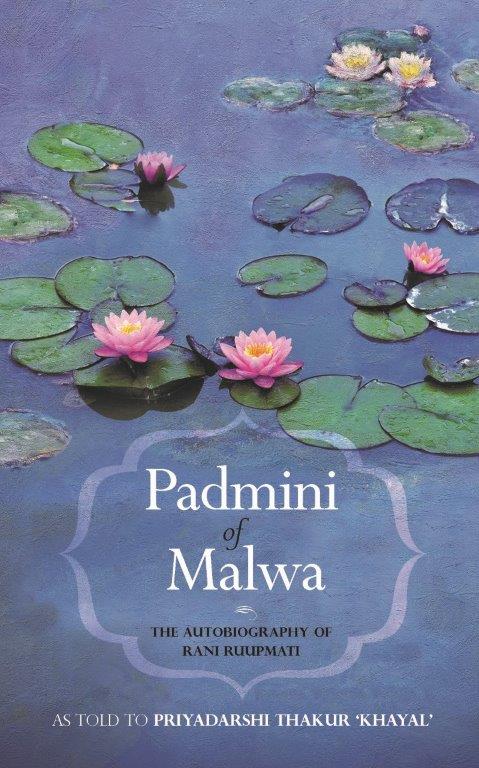
Padmini of Malwa: The Autobiography of a Medieval Princess

Book Review by Meenakshi Malhotra

Title: Padmini of Malwa: The Autobiography of Rani Ruupmati

 Author: Priyadarshini Thakur ‘Khayal

Publisher: Speaking Tiger Books

Padmini of Malwa :The Autobiography of Rani Ruupmati is a delightful piece of historical fiction cast in the form of autofiction or autobiographical fiction. It narrates, in the first person, the tale of Rani Ruupmati, who is kidnapped and brought up by Rao, tutored by Panditji or Pandijju, Ketki and Tara. Claiming to cover everything that history books leave out, this story employs a clever narrative ploy which is introduced in the ‘Scribe’s Note’. The scribe is Priyadarshini Thakur ‘Khayal’, author of eight volumes of poetry in Hindi and Urdu and ghazals sung by Jagjit Singh, the Hussain brothers and others. His poetic imagination seeps into the retelling of the story as he brings the medieval princess to life. ‘Khayal’ tells us in the note: “Believe it or not, this is truly Rani Ruupmati’s autobiography. I merely put on paper what she told me.” The royal subject  appears to him in all her resplendent beauty, the legendary queen over whom battles were fought, ready to tell her own story. In wresting this initiative, the story acquires a unique colour and assumes a life of its own, even as it compellingly propels the reader to dive into this narrative.

The narrative employs a dream vision to communicate events and episodes which are hardly remembered by the lost little girl, referred to as kunwarini, and various terms in the narrative. Emphatic in her desire to set the record straight about Baz Bahadur and his bravery and courage, she represents a voice which might have fallen through the cracks of historical narratives. The novel, retrieving fragments from shards of memory, is given to the reader in the form of visions.

The first vision is based in the mansion by the  maulshri tree, the second in a “seedy little fortress” by Garh Dharmpuri. Barely remembering the details of her natal home, she is told by her companions that she is the daughter of Reva Maiya. Thus she narrates to the scribe: “At times life seems like an elaborate play; a play full of heroes, villains and countless other characters of various shades—my life in Garh Dharmapuri, located on a river-isle of the Reva was the very opposite of what it had been in the deserted mansion…the kidnapping and the fall into the Reva that turned my life upside down, left me stunned and I remained mute for a long time.” In this fortress Ruup, as she is called, blossoms into womanhood in relative oblivion. And it is only through the eyes of others that she becomes aware of her burgeoning beauty. Steeped in her music and music lessons, she remains somewhat insulated from the ways of the world or her position in it. Hints are there a-plenty, but the text maintains its rhythm and builds up its momentum in this coming-of-age story.

A special annual occasion for Ruup is the festival of Navaraatra when she is the recipient of the ceremonial offering made to young pre-pubertal Hindu girls. On reaching puberty, Ruup is able to trace the shift or change since male guardian figures like Rao who Ruup calls ‘Baba’ start maintaining a distance. “My childhood seemed to be slipping away farther and my previous life in the maulshri mansion turned hazier by the day.” Tremulously poised on the brink of womanhood, she is hardly aware that her life is to be transformed.

Emboldened by a couple of forays into the forest by the magical lake “Ardhapadma” or half-moon lake, Ruup decides to venture out on her own. It is here that she meets Baz Bahadur, who eventually becomes the Sultan of Malwa. Their legendary meeting has been the source of many narratives, the theme of many ballads  and songs. Meanwhile Ruup comes to know about her and her family’s past and its chequered histories. She learns of her antecedents, but also comes to know that her guardian at the ‘garh’(fortress) is actually her father and the story unfolds in all its splendour and romance tinged in darker tones.

The novel weaves a fascinating tale as it narrates the dramatic rescue of Ruupmati by Baz Bahadur and his forces. The love story of the two is in a sense, doomed. Located in the rocky terrain of 16th century Malwa (Madhya Pradesh), the story captures the violence and deceit of internecine warfare, where danger lurks everywhere. Set   in a world of treachery, violence and intrigue, the novel does not romanticise the medieval world or sugar-coat it, instead it shows a world where every step is fraught with danger and threatened by violence. Even though the outcome of this tragic love story is foretold, the writer  in giving a voice to a historical– or herstorical subject, recuperates  that subject to give voice and agency to the beautiful queen of Malwa.

It is a beautifully retold narrative to be read and mulled in its poignant grandeur.

.

Dr Meenakshi Malhotra is Associate Professor of English Literature at Hansraj College, University of Delhi, and has been involved in teaching and curriculum development in several universities. She has edited two books on Women and Lifewriting, Representing the Self and Claiming the I, in addition  to numerous published articles on gender, literature and feminist theory.       

.

PLEASE NOTE: ARTICLES CAN ONLY BE REPRODUCED IN OTHER SITES WITH DUE ACKNOWLEDGEMENT TO BORDERLESS JOURNAL

Click here to access the Borderless anthology, Monalisa No Longer Smiles
Categories
Poetry

Performance Poetry by Dee Allen

Dee Allen
IMMENSE RIVER

On and off 
Erratic activity
Storm cloud convergence
Climate's hostility

This year's winter rain
Shown up full force
Descending upon us
Impaling pitchforks

Landslides, mudslides,
Service roads gone concave
Car sinks into gaping sinkhole
Stormwater comes in a wave

Flooded main streets
Arrive with merciless wind
Staccato rhythm of raindrops
The house roof might cave in

Leave town for higher ground
California's battered—disturbed climate's powers
Hot months—Cold months
Season of fires—Vicious showers

Outflow intense from the immense
River from the sky—
Continued use of coal and oil
Brought this on—some still deny.


LEAST LIKELY

Canyons have splendid broad-gauge views.
Beaches offered the same treasures, too,
As had forests where pine trees grew,
But see me in the desert? Not likely.

Sunny plains are pleasant—Not!
Treeless, unbearable, exceedingly hot.
Lack of lakes—what that terrain's got.
Will I visit the desert again? Not likely.

From longest road to highest bluff,
Every mile's similar—dry and rough.
Death Valley in Nevada—that was enough.
My chances of waltzing through desert again? Least likely.


BATDAWN

What makes this
New Mexico sunrise
So different
From others?

The bats
Are returning
En masse, animated
Cloud of leathery wings drift

To Carlsbad Caverns'
Caves from a long
Night's flight
Of freedom.

Dee Allen is an African-Italian performance poet based in Oakland, California USA, with 7 books and 67 anthology appearances, currently seeking a new publisher.

.

PLEASE NOTE: ARTICLES CAN ONLY BE REPRODUCED IN OTHER SITES WITH DUE ACKNOWLEDGEMENT TO BORDERLESS JOURNAL

Click here to access the Borderless anthology, Monalisa No Longer Smiles
Categories
Slices from Life

From Gatwick to Kangaroo Island

Phtographs & Narrative by Meredith Stephens

When I recently flew from Australia into Gatwick Airport, London, I was struck by the ease of passing through customs and immigration. Once I exited the plane, I was ushered to an empty lane and directed to a machine to present my passport. As I had nothing to declare I walked through the green lane. A group of four customs officers were engaged in conversation and did not notice me. I had entered the UK seamlessly in about five minutes without making eye contact with a single person.

Not so when travelling within my home state of South Australia. Alex, Verity and I were on our way from Adelaide to Kangaroo Island, situated across Investigator Strait off the southern coast of South Australia. We would have preferred to sail there, but Alex’s boat was high and dry, awaiting repairs to the mast and windows in Yaringa, eight hundred kilometres away in the state of Victoria. We had made a booking for the three o’clock ferry from Cape Jervis to Penneshaw, on Kangaroo Island. We left Adelaide at 1 pm, allowing ninety minutes for the drive and thirty minutes to board, as we always do.

Half an hour into our trip, we were stuck in a traffic jam along the arterial roadway heading south. We had never been trapped in a traffic jam in this direction before, because it was leading away from Adelaide towards sparsely populated farmland.

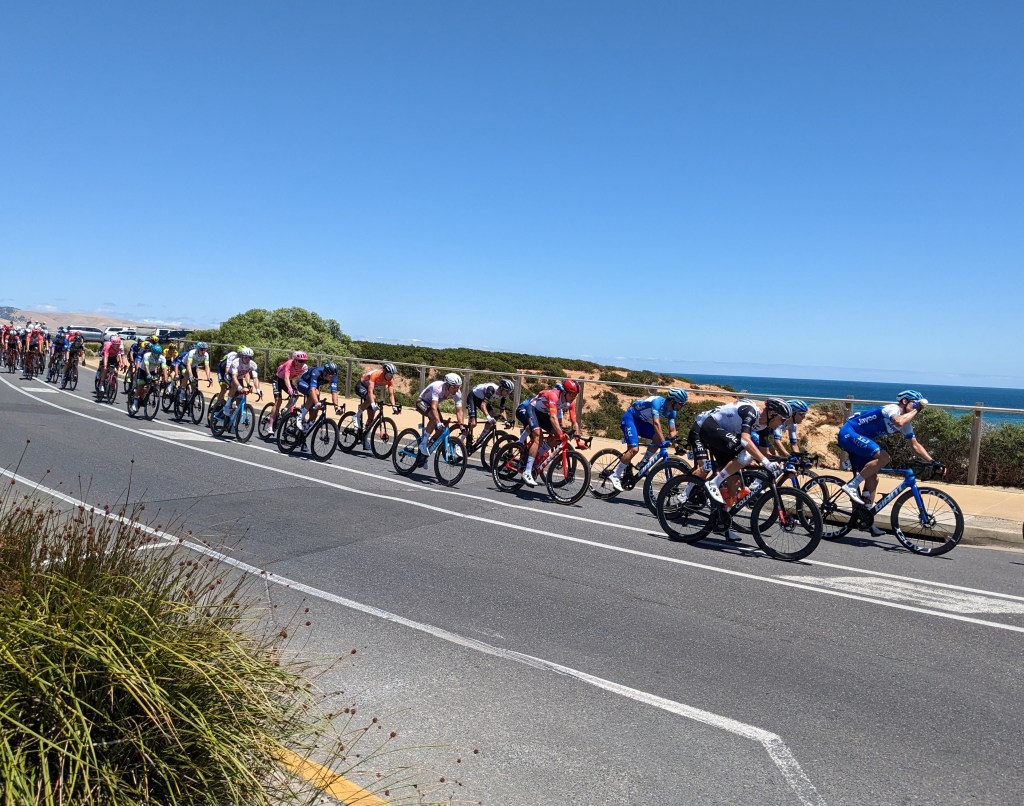
“Oh no! It’s the Tour Down Under! The road is closed for the cycling race,” lamented Alex.

He did a U-turn and headed west to the side streets in the hope of finding an alternative route along the Esplanade. After winding through the coastal suburbs, we arrived at a T junction facing the Esplanade, and were greeted by a woman in a bright orange vest holding a prominent sign saying ‘Stop!’

Onlookers lined the streets holding their cameras ready to snap the cyclists. We waited, all the while nervously checking the time on our phones, wondering whether we would miss our ferry. A few minutes later we heard an excited murmur run through the crowd, and sure enough, a group of cyclists whizzed past.

We glanced at the woman in the orange vest, hoping she would let us pass. She was on her walkie talkie and shook her head at us. Soon another group of cyclists raced past. Then the woman let us on to the Esplanade and we headed south. Soon after we were stopped by a police officer on a bicycle, who directed us away from the Esplanade. We turned east to weave our way back to our original route.

“We won’t make it to the ferry on time!” complained Alex, pressing heavily on the accelerator.

We arrived back on the highway that we had originally departed from and tried to turn right so that we could head south to Cape Jervis. A line of cars from the north were trying to turn right into our street.

“We’ll be here for hours. Best turn left and then do a U-turn,” announced Alex.

Alex turned left, accelerated, and braked when he found a gap in the oncoming traffic. He quickly did a U-turn and then headed south, passing the line of cars waiting to turn right onto the road where we had been waiting.

Would all of this be in vain? Would we get to Cape Jervis just after 3 pm to watch the ferry departing, on its way to Penneshaw? I held my phone to check the distance to Cape Jervis and noted that the estimated time of arrival was 2.54 pm. Alex tried to make up time by driving to the speed limit. A truck was labouring up the hill in front of us. Alex waited until we reached a passing lane, and then floored the accelerator. The estimated time of arrival was now 2.52 pm. Sitting next to Alex as he sped along the highway was more exciting than rides on a fairground had been when I was a child. I trusted his judgment and felt safe all the while enjoying the exhilarating speed. Next, there was a red car dawdling in front of us. Again, Alex waited until we reached a passing lane, and overtook them. The estimated time of arrival was still 2.52 pm. At least we had not been losing time as we were delayed by the slow coaches ahead of us. We entered the township of Cape Jervis, rounded the hill, and then descended to the ferry port, arriving as predicted at 2.52 pm. We expected boarding to be well underway. Instead, four lanes of cars were waiting in the line-up to board the empty ferry, which was running late. We slid into the shortest lane and turned off the engine. A biosecurity officer approached Alex’ window, his curly auburn ponytail blowing in the wind. Alex wound down the car window.

“Do you live on Kangaroo Island or are you just visiting?” he asked.

“We’re just visiting.”

“Oh, lovely! Do you have any honey?”

“No honey.”

“Do you have any bee-keeping equipment?”

“No, definitely not.”

“How about fruit?”

“We have some apples.”

“Are they from the supermarket?”

“Yes.”

“Where did you buy them?”

“In Adelaide.”

“How about potatoes?”

“No.”

“Do you have any plants?”

“We have some caper plants in the back.”

He looked at the back of our vehicle in acknowledgement.

“Oh capers! They look nice. Where did you get them?”

“From a business in Port Adelaide.”

The biosecurity officer seemed satisfied and waved us on.

“Have a lovely trip!”

Shortly after we boarded the 45-minute ferry for Penneshaw. We had been asked more biosecurity questions than at any other place on our travels, and we hadn’t even left our home state. I yearned for the ease of passing through immigration at Gatwick Airport. I had felt perversely miffed at Gatwick for having been ignored by immigration and customs officials.

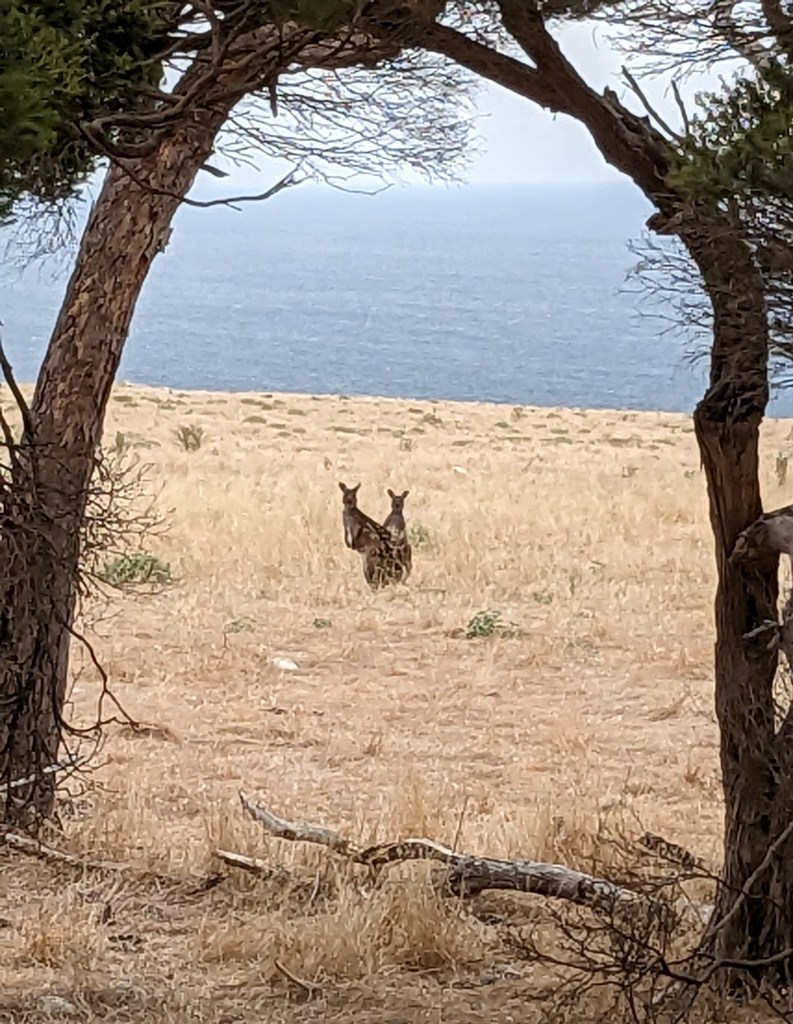
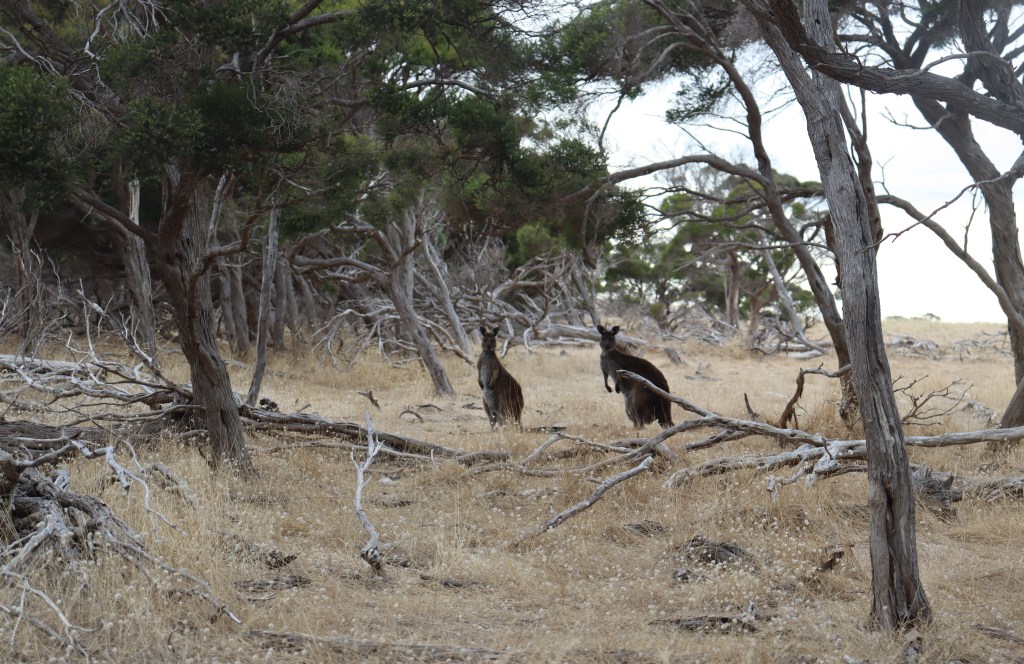
No sooner had we arrived at our destination though, did we spot a marvellous mob of kangaroos bounding across the property.

Then the following day we had a charming encounter with a Rosenberg’s Monitor looking for a drink of water – a species that is endangered on the mainland.

Rosenberg’s monitor lizard

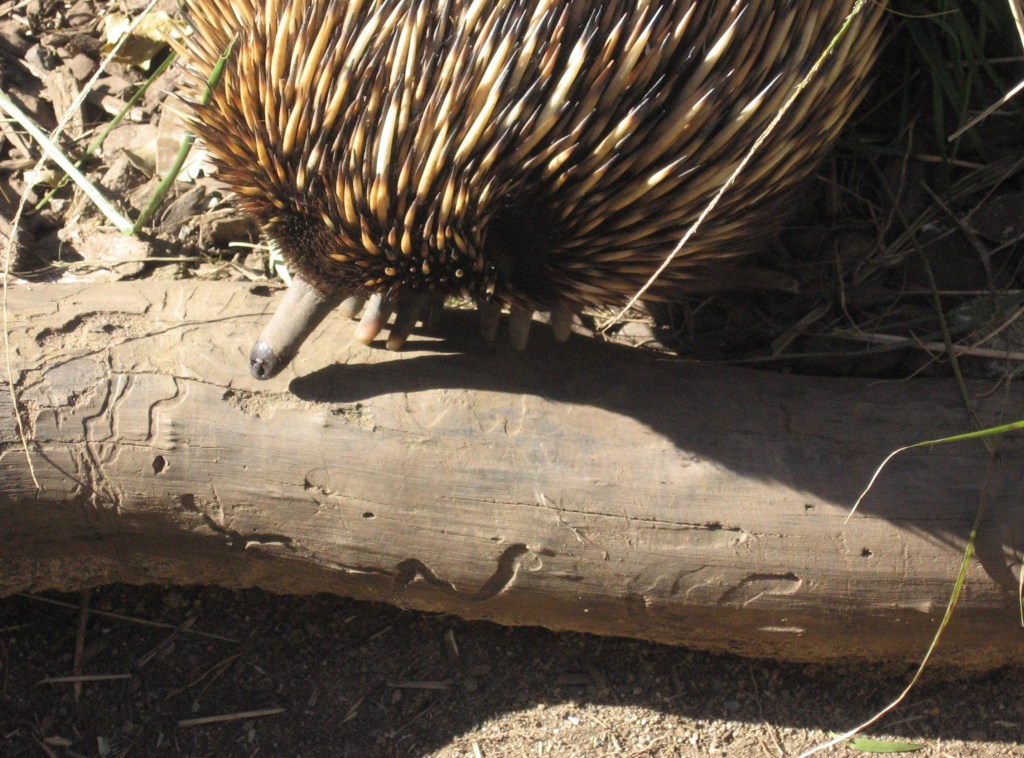
Verity later came across an elusive short-beaked echidna.

Short-beaked echidna

At last I could appreciate that protecting the fauna and flora of Kangaroo Island was important and necessary, and well worth the interrogations of a biosecurity officer.

Meredith Stephens is an applied linguist from South Australia. Her work has appeared in Transnational Literature, The Muse, The Font – A Literary Journal for Language Teachers, The Journal of Literature in Language Teaching, The Writers’ and Readers’ Magazine, Reading in a Foreign Language, and in chapters in anthologies published by Demeter Press, Canada.

PLEASE NOTE: ARTICLES CAN ONLY BE REPRODUCED IN OTHER SITES WITH DUE ACKNOWLEDGEMENT TO BORDERLESS JOURNAL

Click here to access the Borderless anthology, Monalisa No Longer Smiles
Categories
Poetry

It Happened Again

By Alex Z. Salinas

IT HAPPENED AGAIN
(for D.B.)

Today at the bookstore 

A poet introduced himself to me

We tossed up the same scribes

The same publisher (surprise)

Conversation flowed 

More than I wanted it to

But big bro had to’ve been on Decade 5 

The case of the slow chase

And he knew I too was on his same side

Come to my next gathering, he invited 

(Writers and painters and coffee breath, oh my)

Your book is here in the store, he inquired  

Moments later he remarked on a mad tale  

With New Yorker’s flair:

“Polished stuff, you can tell”

Then out into Van Gogh’s evening I sailed

Because I was dog sick drowning and had to 

Because the moment I’ve died for 

Arrived— 

The end flashing again like a cult film:

Them returning my cold raw heart on their own time.

Alex Z. Salinas is the author of poetry collections WARBLES and DREAMT, or The Lingering Phantoms of Equinox. He is also the author of a book of stories, City Lights From the Upside Down.

PLEASE NOTE: ARTICLES CAN ONLY BE REPRODUCED IN OTHER SITES WITH DUE ACKNOWLEDGEMENT TO BORDERLESS JOURNAL

Click here to access the Borderless anthology, Monalisa No Longer Smiles
Categories
Stories

Is it the End Today?     

Flash Fiction by Anjana Krishnan

She stood there with absolutely no movement. She couldn’t move. It felt like her whole body had paralysed. She hoped someone would see her standing like that, so that they could call her and she could wake up from what seemed like a dream. But no one did. She was all alone. It was utter chaos around her. She was standing beneath the streetlight opposite to the place where her house should have been. Now there were only bricks and debris. It was a wasteland, and not her home. She wanted to cry, because everyone had moved on.

 But not her…

 She could not.

 The house stood at the left end of the street. It was different from the other twelve houses in the colony. It had been the oldest one. It was where her grandparents and later her parents had lived. She grew up in that house. When, one by one, her parents and grandparents surrendered to death, the memories and the house were the only things that remained. And when the currents of life made her move to other parts of the world, her heart still longed to return.

What makes every journey unique is having a place to come back to, a final destination: HOME.

Time passed by. The house stayed empty and other members of the family treated it as an asset to sell at the highest price.

After six years, she had finally come back home. In the glory of the setting sun, she saw, to her terror that the colony did not exist anymore. It was just thirteen demolished houses.

The workers had left. The street lights came to life. It was all ruins she could see. Nothing else was left. She stood there, below the street light, opposite the ruins of her home or what was supposed to be her home.

She thought, “It is the end, isn’t it…?”

Anjana Krishnan was born and brought up in Ernakulam, Kerala, and is currently pursuing her undergraduate degree in B.A.(Hons)English from Lady Shri Ram College for Women, Delhi.

PLEASE NOTE: ARTICLES CAN ONLY BE REPRODUCED IN OTHER SITES WITH DUE ACKNOWLEDGEMENT TO BORDERLESS JOURNAL. 

Click here to access the Borderless anthology, Monalisa No Longer Smiles

Categories
Poetry

Cold Black Coffee

By Anjali V Raj

Courtesy: Creative Commons
It’s drizzling outside
I make a quick cup of steaming black coffee
Having the liberty to enjoy the warmth over the cold
The strong aroma is hanging around me
Just as I begin to take a sip from my coffee
My little nephew mewls from his cradle
I reluctantly run to prevent his deafening screams
I come back; my coffee mimics the weather
I gulp it down along with my unsettled resentments 
The bitterness overrides the sweetness on two spoons of sugar
Neither did he have the patience nor did I


Anjali V Raj is a natural science researcher from Kerala, India. She has recently published a few of her works on online platforms like Down to Earth, Café Dissensus Everyday, Borderless Journal and Times of India Reader’s Blog. Most of her poems are published on her WordPress blog (Outburst of Thoughts).

.

PLEASE NOTE: ARTICLES CAN ONLY BE REPRODUCED IN OTHER SITES WITH DUE ACKNOWLEDGEMENT TO BORDERLESS JOURNAL

Click here to access the Borderless anthology, Monalisa No Longer Smiles

Categories
Poetry

Air Traffic Control Has Never Heard of John Denver

By Ryan Quinn Flanagan

Courtesy: Creative Commons
The busiest airport on the continent –
air traffic control has never heard of John Denver,
I can hardly blame them, the job takes extreme focus;
did he lose his luggage? some caffeine-wired Pixie cut 
tries to be helpful.  He lost a lot more than that, I say.
YOU AGAIN? the shift supervisor walks in with his 
three cream, four sugar Tasmanian Devil mug
and I tell him he would make a great sumo wrestler 
with such a low center of gravity, but the Flat Earthers 
aren’t having it so the muscle is called in, in a sudden fit of protein 
to push me down those metal exterior stairs 
that lead back to baggage claim and all those husky four-legged 
drug sniffers that work their way up your leg while 
the 10:45 out of Dulles disembarks.

Ryan Quinn Flanagan is a Canadian-born author residing in Elliot Lake, Ontario, Canada with his wife and many bears that rifle through his garbage.  His work can be found both in print and online in such places as: Evergreen Review, The New York Quarterly, Borderless Journal, GloMag, Red Fez, and Lothlorien Poetry Journal.

.

PLEASE NOTE: ARTICLES CAN ONLY BE REPRODUCED IN OTHER SITES WITH DUE ACKNOWLEDGEMENT TO BORDERLESS JOURNAL

Click here to access the Borderless anthology, Monalisa No Longer Smiles
Categories
Poetry

The Language of Dreams

By Sister Lou Ella Hickman, I.W.B.S.

Courtesy: Creative Commons
dreams were our first language
handed down for the many millennia
to what we have become
they still speak their secret language
that was once voiced
in the cave drawings of vanished beasts:
mammoths, lions, horses, and deer
of hands stencilled red or black
and the men
who danced in the light of the primal fire
before their hunt
so, when dreams come
this ancient language
speaks our secret truths
like stories on walls reflected in the fire light . . .
one question remains
when dreams come
will we dare
to dance in the darkness of our own sacred fire
	

Sister Lou Ella Hickman, I.W.B.S. is a widely published poet. She published her first book of poetry in 2015 entitled she: robed and wordless.

.

PLEASE NOTE: ARTICLES CAN ONLY BE REPRODUCED IN OTHER SITES WITH DUE ACKNOWLEDGEMENT TO BORDERLESS JOURNAL

Click here to access the Borderless anthology, Monalisa No Longer Smiles