Categories
Excerpt

What Will People Say?

Title: What Will People Say?

Author: Mitra Phukan

Publisher: Speaking Tiger Books

PROLOGUE

Tinigaon

There were many Tinigaons within the city of this name. ‘Three Villages’ was the meaning in the local language. A small city in the folds of a valley in the middle of Assam. There was the Tinigaon that was still a small town, not in terms of size, but in the attitudes of the people. It was not just the middle-aged and older people who clung to tradition. Quite a few younger people did, too. And it was not always bad, this conservatism. Indeed, sometimes this unshakeable belief in the sanctity of the past was beautiful and illuminating. It was this conservatism that preserved the precious heritage of the past and kept it alive, preventing it from passing into oblivion.

But at other times, when conservatism became rigid, and sought to impose its beliefs on those who had a different mindset, dictating how they should behave, dress, what relationships they could or could not have, it could become a prison that prevented any kind of progress from taking place. As with much conservatism, the greatest restrictions were placed on women. There were strict codes of conduct for women and girls, codes that varied from age group to age group, but were authoritarian, nevertheless. Individual freedoms were always secondary to the ‘expected’ modes of conduct. ‘It’s always been like this,’ was a refrain often heard to justify the many rules which had lost all relevance in a swiftly changing world. If, indeed, they had ever been relevant at all.

The rules for girls and young women, though unyielding, at least took into account the rebelliousness of youth. ‘You are young, that’s why you think like this,’ was a sentence that was spoken grudgingly by parents or uncles and aunts, to people who were, in their eyes, guilty of ‘errant’ behaviour. But young people went outside the city, outside the state, to study, to work, and who knew what their lifestyles were there? Preferring to turn a blind eye to many rumoured ‘goings-on’ in the metro cities, goings-on in which their children were willing, even enthusiastic participants, they were for the most part relieved that at least when they came home, they behaved in ways ‘expected’ of them.

And so, even though they spoke viciously of that girl, WhatWasHerName, who was now living in with some boyfriend in Delhi, they preferred to keep silent about their own daughter who was doing the same. Grateful for small mercies, they pretended not to know anything when they visited her in the flat she rented in Gurgaon. They kept a deadpan face when they came across a shirt in size 42 hanging, forgotten in the cupboard in the second bedroom. They tried not to notice the other telltale signs that their daughter had been ‘cohabiting’ with a male, and refrained from asking where he had gone, now that they were here for three weeks. They did not ask about the long phone conversations that stretched to well past midnight and were only grateful that their daughter had been ‘considerate’ enough to spare them the trauma of meeting some unknown boy with whom she had been sleeping for the past so many months. They even pushed into a dark recess that worry of pregnancy, and the even greater worry of ‘WhatWillPeopleSay?’

Yes, in these changing times, people were learning, slowly, to ‘adjust’ to the fact that the younger people now were prone to living their lives in ways that were different from what was deemed to be ‘allowed’. But when it came to older people, things still remained as rigid as they had been for centuries. Especially for women. And especially, very especially, for widows.

True, Hindu widows were no longer expected to live a life that was, virtually, a death sentence. Younger widows, especially, ate non-vegetarian food, though their mothers, after the deaths of their husbands, still did not. They wore coloured clothes, though again, their mothers wore pale, traditional clothes, even though during the lifetimes of their husbands they had worn the most vibrant colours under the sun.

But there were, still, many restrictions on single women, widows, even divorcees or never-marrieds, in Tinigaon. They could go out in mixed groups, but never in a twosome with a man not closely related. They could not ‘date’ a man, and go out with him, even if it was as innocent as an outing to a theatre, or a music concert, or having a meal at a restaurant. There were always prying and peering eyes around who would ‘see’ what was happening, magnify it many times, load it with all kinds of intent, and then broadcast it with relish to salivating friends at the next kitty party that took place.

Mihika remembered the time a recently divorced forty-something mother of two had accepted a lift, two days running, from her superior, a married, fifty-plus man. Without a car at that time just after her divorce, she had been waiting on the pavement, in pouring rain, for a bus or auto or ricksha to take her home. As time passed and no vehicle stopped for her, she was growing increasingly desperate. The nanny who looked after the children would be leaving at six-thirty, and it was almost six already. She was greatly relieved, therefore, when her boss’s boss, whom she knew only slightly, stopped and asked her if he could drop her anywhere. It turned out her apartment was on the way to his house and she had gladly accepted the offer of the lift.

(Extracted from What Will People Say? A Novel by Mitra Phukan. Published by Speaking Tiger Books, 2023)

About the Book

When Mihika, 56 and a widow, gets drawn into a relationship with Zuhayr, a 60-year-old divorcee who was her late husband Aditya’s friend, it doesn’t seem to her like an event that should cause more than a raised eyebrow or two. Not in the twenty-first century, and not when their grown-up children are happy that their parents have found a second chance at happiness. But inTinigaon—a small town in Assam—it is just not done for a woman of Mihika’s age to have a romantic relationship—that, too, with a man from the Other Religion: a Muslim.Tinigaon’s Old Guard is scandalized as Mihika and Zuhayr are seen together in restaurants and cinema halls,‘flaunting’ their affair. And a nosy neighbour, Ranjana, keeps the moral brigade busy with juicy details of Zuhayr’s late-night comings and goings from Mihika’s house. Mihika decides to ignore the gossipmongering and slander and remain true to her relationship with Zuhayr, who has filled a void in her life after Aditya’s death five years ago.As long as her four closest friends,Tara,Triveni, Shagufta and Pallavi, stand by her, she doesn’t care if others turn away. But when the gossip turns into something more sinister that could threaten her daughterVeda’s happiness, Mihika is forced to take a call—should she give up the man she loves for her daughter’s sake, or is there an alternative that could give them both what they want? Writing with great sensitivity and gentle humour, Mitra Phukan proves once again that she is an extraordinary chronicler of the human heart. Rooted, like all her fiction, in the culture and sensibilities of Assam, What Will People Say? speaks to all of us, wherever we are, whoever we are.

About the Author

Mitra Phukan is an Assamese author, translator and columnist who writes in English. Her published works, fourteen so far, include children’s books, biographies, two novels, The Collector’s Wife and A Monsoon of Music, several volumes of translations from Assamese to English and a collection of her columns, Guwahati Gaze. Her most recent works are a volume of her own short stories, A Full Night’s Thievery, and a translation of a volume of short stories, by Sahitya Akademi Award-winning author, Harekrishna Deka, Guilt and Other Stories, both published by SpeakingTiger.

Categories
Excerpt

Poetry by Robin S. Ngangom

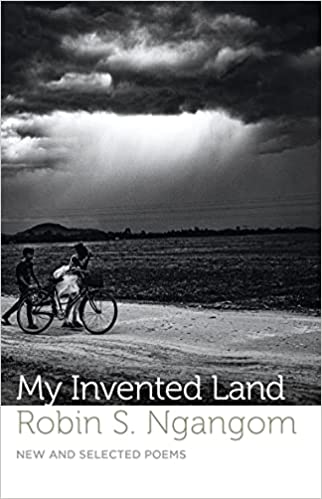
Title: My Invented Land: New and Selected Poems

Author: Robin S Ngangom

Publisher: Speaking Tiger Books

Poem for Joseph

It is never too late to come home.
But I must first find a homeland
where I can find myself,
just a map or even a tree or a stone
to mark a spot I could return to
like an animal lifting his leg
even when there’s nothing to return for.

Although it’s true
that in my native land
children had crawled out of burrows
they had gouged under their hard beds,
long after the grownups had fled
and roofs came apart
like charred heads.

You said you didn’t regret
how ethnic cleansers had palmed
your newly-built home off on a people
well on their trail back to unique blood,
you didn’t mind leaving behind
objects of desire
you had collected over twenty-five years,
or, how you came to live in a rented room
with your wife and children
in dog-eat-dog Imphal,
among the callous tribe
I call my own. 

Only the photographs you mourned,
the beloved sepia of a family tree,
since you’re the reason why your fathers lived;
but who’ll believe now
that you lived at all? 


After ‘Jashn-e-Azadi’
(a film on Kashmir by Sanjay Kak)

The kite transforming into smoke lacing
the chinars is not a symbol.
The rose has migrated from the garden of paradise.
Freedom will never come
poured into goblets waiting to be raised,
Martyrdom is a handout from the hagiographer.
Only poetry of ruins is real.
The incoherent rose still blooms
from some beloved breast torn open.


The First Rain

The first rain like the first letter of May
brings news to the hills.
Perched like the houses on the edge of a cliff
I’ve lived more days in exile
than years of my poor childhood.
As a fumbling fifteen-year-old
I abandoned my forward-looking native people
who entrusted terror, drugs and
a civilized plague to children.

Is it better to rejoice and forget
or to remember and be sad?
Only a foolish boy cannot wait to be a man,
adores winter, and leaves home to write poetry.

After the holocaust became a touchstone
we can indict an erring people
and make culture and carnage co-exist.
If I told you how babies have been shot down
from their mothers’ breasts
you would put it down to a poet’s overworked heart
but we like to believe in leaders who flock to the capital

An animal threatened with extinction
needs a lair for his mate and his young,
I’m not different.
I need the morning for its bright blood
and I need to seize the night.

There was not a day that changed my days.
When I listen to hills
I hear the voices of my faded life.
Whisky and Mehdi Hassan and Billie Holiday
make for strange fruit on nondescript evenings.

They can stop us but not our thoughts
from coming out into the streets,
they can shoot us but cannot kill the air
which carries our voices.

O my love, you are still asleep
when the rain carries the night till dawn.
After lying down with dreams of you
I awake in another day of bread and newspapers.

I’m banished to the last outpost of a dying empire
whose keepsakes have become the artefacts of the natives:
necklaces, pianos, lace and tombstones.
I’ve pursued horoscopes and
only promises and maledictions pursue me.
One day Venus was mine, joy and honey,
another day Saturn would not be propitiated.
I found a moment’s peace
in my little daughter’s face.

Before I met you
my dreams were limited by ignorance.
Sometimes at night
I put two drops of our past in my eyes
but they refused to close.

Can poetry be smuggled like guns or drugs?
We’ve drawn our borders with blood.
Even to write in our mother tongue
we cut open veins and our tongues
lick parchments with blood.

I read my smuggled Neruda
and sometimes listen to the fading fiddles
and the mourning voices of my land.

I’m the anguish of slashed roots,
the fear of the homeless,
and the desperation of former kisses.
How much land does my enemy need?

O my love, why did you fade
into the obscurity of my life
and leave me to look long at the mountain?

I’m the pain of slashed roots
and the last rain is already here.
I’ll leave the cracked fields of my land
and its weeping pastures of daybreak.
Let wolves tear our beloved hills.

I’ll leave the bamboo flowering
in the groves of my childhood.
Let rats gnaw at the supine map
of what was once my native land.

Native Land

First came the scream of the dying
in a bad dream, then the radio report,
and a newspaper: six shot dead, twenty-five
houses razed, sixteen beheaded with hands tied
behind their backs inside a church…
As the days crumbled, and the victors
and their victims grew in number,
I hardened inside my thickening hide,
until I lost my tenuous humanity.

I ceased thinking
of abandoned children inside blazing huts
still waiting for their parents.
If they remembered their grandmother’s tales
of many winter hearths at the hour
of sleeping death, I didn’t want to know,
if they ever learnt the magic of letters.
And the women heavy with seed,
their soft bodies mowed down
like grain stalk during their lyric harvests;
if they wore wildflowers in their hair
while they waited for their men,
I didn’t care anymore.

Extracted from My Invented Land: New and Selected Poems by Robin S. Ngangom. Published by Speaking Tiger Books, 2023.

About the Book

Robin S. Ngangom’s poetry is the poetry of feeling, which draws the reader deep into the poet’s world. The poems in My Invented Land showcase Ngangom’s remarkable range—tracing his poetic arc from the deeply personal to the political, from chronicles of private joys, sorrows and everyday epiphanies to the poetry of witness that gazes unflinchingly at the realities that haunt the Northeast, his native land.

About the Author

Born in 1959 in Imphal, Manipur, Robin S. Ngangom is a bilingual poet and translator who writes in English and Manipuri. After completing his high school in Imphal he studied English literature at Shillong’s St Edmund’s College and the North-Eastern Hill University where he currently teaches. His first collection, Words and the Silence, was published in 1988 and since then, he has published two more volumes of poetry and a book of translations.  He was invited to the UK Year of Literature and Writing in 1995, has read his poems at literary events in India and abroad, and his poems have appeared in several prestigious anthologies and magazines. He has also co-edited two significant anthologies of poetry from Northeast India.

Click here to read the review

PLEASE NOTE: ARTICLES CAN ONLY BE REPRODUCED IN OTHER SITES WITH DUE ACKNOWLEDGEMENT TO BORDERLESS JOURNAL. 

Categories
Review

My Invented Land: Poetry as Pilgrimage

Book Review by Basudhara Roy

Title: My Invented Land: New and Selected Poems

Author: Robin Ngangom

Publisher: Speaking Tiger Books

Into the myriad-doored faith of poetry, there are manifold ways to arrive. Some come to it for respite, some for resuscitation, some for refuge. To a lot of us, poetry is therapeutic; to many others, an arsenal; to yet others, an immortal witness. Through what door one seeks admission into poetry’s realm is important for the way poetry will speak to us and the kind of poetry we will, in turn, create.

To Robin Ngangom, poetry manifests itself as both companion and quest, currency in circulation and archive, vision and the language to communicate the thought. “Poetry cannot help anyone to get on in life,” he writes, “or make a successful human being out of anyone. But poetry should move us; it should change us in such a manner that we remain no longer the same after we’ve read a meaningful poem.” (‘Introduction’) As necessary, as native, and as effortless to him as breath, Ngangom’s poetry bespeaks an honest and wholehearted engagement with life that is rare.

My Invented Land: New and Selected Poems recently brought out by Speaking Tiger Books is Ngangom’s fourth poetry collection. Containing an admirable selection of his work from his three earlier collections Words and the Silence (1988), Time’s Crossroads (1994) and The Desire of Roots (2006) along with more than thirty new poems, this volume brings to us a fascinating diachronic document of Ngangom’s steady journey in and with poetry over the last thirty-five years. For readers familiar with his work, this volume is an asset. For those who wish to make an acquaintance with it, the book will be indispensable and an immensely appealing starting point.

In reading Ngangom’s poems, one is pleasantly startled, each time, by his distilled sensibility, his linguistic finesse and his inimitable lyrical fecundity. Simplicity is the catchword of these poems. One would be hard put to identify any posturing in Ngangom’s poetry. There are no mirages here, no postmodernist obsession with camouflage, no cautious construction of the self or deliberated distance between poet-observer-speaker. Personality, in fact, is such an important accompaniment of these poems that it casts each poem in the resolutely warm light of its familiarity, meeting in poem after poem, an expectation unarticulated but answered.

Self, land and poetry constitute an essential thematic triangle in My Invented Land – each theme inevitably leading to the other. For Ngangom, there is no poetry apart from the existential rootedness of the self in (home)land, this relationship being both a prism and a prison through which his sensibility is reflected upon the world – “But where can one run from the homeland,/ where can I flee from your love?” (‘The Strange Affair of Robin S. Ngangom’) In the best of times, this bond with the land becomes one of gratitude; in spans of torment, a burden he cannot do without; and during moments of reflection, an agonising search as in ‘Poem for Joseph’:

It is never too late to come home.
But I must first find a homeland
where I can find myself,
just a map or even a tree or a stone
to mark a spot I could return to
like an animal lifting his leg
even when there’s nothing to return for. 

Even love and its exploration through adolescence into manhood which is an important concern in Ngangom’s poetry, finds its expression in the distinct foreground and background of the landscape, so much so that be(love)d and land become one:

Maternal earth,
generous and callous.
You untouchable then,
and invulnerable now;
all your instincts 
rearranged with
your scattered hair. 

Were I to trace
my name on your frosted mirror
you would quickly efface it with your breath. (‘Age and Memory’) 

There is no denying the sharp political edge of this poetry, its inveterate honesty and its essential inability to water down the truth with fancy or idealism. In ‘To Pacha’, a moving elegy to Pacha Meetei, one of Manipur’s finest writers, Ngangom writes:

There are no more tears to shed
in this withered country where they
kill pregnant women and children; its
nipples have long gone dry, and leering 
death walks your homeland. 

In ‘The Strange Affair of Robin S. Ngangom’, patriotism is “admiring the youth who fondles grenades,/ patriotism is proclaiming all men as brothers/ and secretly depriving my brother,/ patriotism is playing the music of guns/ to the child in the womb.” ‘My Invented Land’ writes home as “a gun/ pressed against both temples/ a knock on a night that has not ended/ a torch lit long after the theft/ a sonnet about body counts/ undoubtedly raped/ definitely abandoned/ in a tryst with destiny.” The uneasiness between homeland and nation is a palpable presence in the telling use of the phrase ‘tryst with destiny’ as it is in many of the poems in this book. The golden jubilee of the nation’s independence becomes, in ‘15 August 2008, Northeast India’, “fifty years of discrimination festering in the periphery/ with another anniversary of murder and disappearances.” In ‘My Invented Land’, the homeland “has no boundaries./ At cockcrow one day it found itself/ inside a country to its west,/ (on rainy days it dreams looking east/ when its seditionists fight to liberate it from truth.)”

But this is not poetry of writing back, of witness, of resistance or of conscious activism. My Invented Land is poetry of observation, of quiet but ceaseless self-exploration and self-assessment (the land being an inalienable unit of the self and vice-versa), of lament and of agonis

ed truth-seeking with “only one pair of shoes/ but many roads” (‘Saint Edmund’s College’). One marvels at the beauty of the title, an apposite image for a body of poems that is invested so completely in poetry as this essentially nourishing collection of eighty-two poems is. This invented land, one realises, is as much Imphal or Manipur or Shillong or the Northeast of India as it is the land of memory, imagination, hope, language and poetry.

One must take special note of Ngangom’s deftness with language in this collection, his mastery over its opulence and crisis, its headiness and its insomnia, its velocity and meditativeness. Much of his poetry is pointedly and joyously literal with little need of metaphor to expand or accentuate his ideas. However, his language arrives from such depth in the soul that lyricism and beauty are innate to it, deluging the reader with an unsurmised assertion of its grandeur in a poem like ‘Laitlum’ for instance:

I want to be converted amongst houses kneeling
in the thick of firs of former lives,
randomly built without electricity.

It is characteristic of Ngangom to lift what would be, in most hands, a random assortment  of prosaic moments and to elevate it, with his heightened attention, into iridescent poetry. Observe the following lines from ‘Street Life’:

I’ve had decadence forced on me.
I let the rain waste my day, and arriving
at streets that do not even know my name
I take off just like that, waving to silhouettes,
buying drinks for anyone, even primates
for whom I have no great regard, hating the houses
which warn of dogs instead of welcoming me.

The new poems in this collection, while retaining a spiritual connect with the poet’s earlier work, branches off into greater profundity. Marked by the loneliness, uncertainty and despair of the Pandemic, the language has grown quieter and more serene so that a metaphysical restlessness animates these poems, quiet unlike the earlier ones – “All voyages will be inward from now,” (‘September’) The language of realism mutates here into unexpected symbols and uneasy images that haunt. ‘Postcard’ written for Jayanta Mahapatra finds “ghosts leaving friends on the road”; in ‘Home’, a river swirled with “brown waters/ until it died, strangled by garbage”; in ‘Flight’, “The most vulnerable will sell bodies./ Because in spite of the landmines/ they still shared limbs.”

But despite Ngangom’s disquiet with the world and his unceasing inquest into its maladies, love remains his avowed and timeless panacea. It is in and through love that human life acquires redemption and as one moves through the collection, one perceives it watermarked by love of many kinds – amorous, passionate, seductive, lustful, nostalgic, mythic, idyllic, ecological, fraternal and forgiving. Every despondency, for the poet, springs from an absence of love and can find an effective resolution in love – love for the beloved, for the homeland, for one’s brethren, for humanity, for poetry, and above all, for love itself. “…someone who cannot love is always alone,” he writes in his ‘Introduction’. In ‘Day’, he prays for the Pandemic’s end so that “a primeval need/ may be restored to us:/ the ability to hold another/ before the day ends.” The all-embracive and sustaining religion of love that leads him to fashion each word “from a private hurt”’ (‘Introduction’) can alone right the balance. In ‘January’, for instance, he believes that “If anyone were so much as to mention a word like ‘love’/ everything will fall quietly again as snow.”

Poetry, according to Ngangom, “should not merely amuse us or make us think: it should comfort us, and it must heal the heart of man.” (‘Introduction’) With a brilliant introductory essay by the poet (that makes one desperately wish there were more such essays by Indian English poets on their vision and craft) and its timeless verses, My Invented Land accomplishes this and more with poise, grace and an unquestionable claim to the glory of its writer in the canon of Indian English poetry, his committed pilgrimage in verse promising to be an inspiration for many poets to come.

Basudhara Roy teaches English at Karim City College affiliated to Kolhan University, Chaibasa. Author of three collections of poems, her latest work has been featured in EPW, The Pine Cone Review, Live Wire, Lucy Writers Platform, Setu and The Aleph Review among others. 

.

PLEASE NOTE: ARTICLES CAN ONLY BE REPRODUCED IN OTHER SITES WITH DUE ACKNOWLEDGEMENT TO BORDERLESS JOURNAL

Click here to access the Borderless anthology, Monalisa No Longer Smiles

Categories
Review

Yamuna’s Journey

Book Review by Somdatta Mandal

Title: Yamuna’s Journey

Author: Baba Padmanji, Translator: Deepra Dandekar

Publisher: Speaking Tiger Books

During the nineteenth century, among the various social concerns that plagued Indian society, three issues were greatly significant — the abolition of sati, or the burning of the widow on the pyre of her dead husband, the passing of the widow-remarriage bill by the British-Indian Parliament in 1856 augmented by the activism of reformers like Pandit Ishwar Chandra Vidyasagar, and of course the attempts at conversion to Christianity of people plagued, tortured and humiliated by the rigid strictures of class hierarchy and torture and humiliation imposed by Brahminical society during that period.

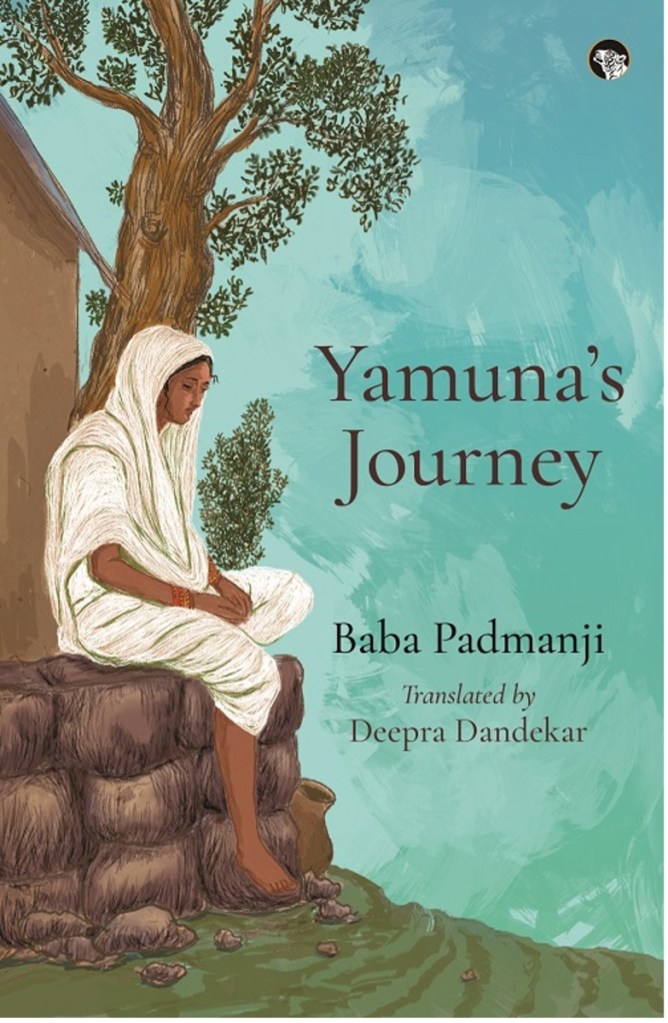
Baba Padmanji’s 1857 Marathi novel, Yamunaparyatan (translated as Yamuna’s Journey), is the first vernacular novel in India meant to provide a realistic account of the travails suffered by Hindu widows in Bombay Presidency region in particular and India in general and is based on empirical facts. It highlights the suffering of Hindu widows, forced into a life of loneliness and torture by their cruel Brahminical families. The heroine of the novel, Yamuna, starts off as a happily married woman, sharing a bond of mutual trust and respect with her husband. She travels with him across various regions of the Bombay Presidency and Western India and her interactions with widows on the way reveal the extent of their suffering within Hindu patriarchal and Brahminical society. Yamuna sympathises with them and calls for urgent reform, while advocating for widow remarriage.

Based on empirical research, and its main storyline composed of empirical anecdotes which were woven together in a single narrative, Yamunaparyatan was only written in the form of a novel. From the very beginning it was never meant to be a poetic, aesthetic book, and was always meant to be hard-hitting, and a realistic treatise. Deeply influenced by Rev. Surendra Nath Banerjea and his writings on women’s education and emancipation, Padmanji described the piteous situation of those young girls who were married off hastily as children to men decades older than themselves. Squeezed between marital duties, childbirth, and heavy domestic work, young girls became victims of their marital families. After their husbands died, they were subjected to further torture – tonsure, inadequate food and clothing, ill-treatment, a heavier than ever workload, and no creature comforts whatsoever. Padmanji argued that women within Brahminical families were constantly on the brink of abandonment and destitution, suffering deeply from the fear of becoming outcasts, even before they became widows.

When tragedy strikes and Yamuna is widowed, she too is tortured and stigmatised. But the feisty young woman manages to start a new chapter in life by converting to Christianity and remarrying a Christian man. In the last chapter of the novel, we are told how Yamuna-bai’s grief diminished gradually as she found solace in religion:

“After some time, God introduced her to an educated and religious young man, who became a loving and caring husband to her. With time, Yamuna dedicated herself to her new life companion and the couple thereafter spent the rest of their years in happiness, helping others and praising God.”

As mentioned earlier, Baba Padmanji was fiercely critical of the stigma accorded to widows within Brahmanical Hinduism and fought against it tooth and nail. In fact, one of the most enduring legacies of Yamunaparyatan is its portrayal of equal, romantic, conjugal partnerships, depicted between spouses of the same age, who shared religious, intellectual, emotional and moral proclivities and insights; spouses who were constantly in conversation and discussion with each other. Yamuna was not her husband’s junior, and their relationship constituted an ideal example of conjugal marital relationships for young, educated and reformed readers. This equality between spouses was something unimaginable in Hindu society of the time and one of Padmanji’s greatest anxieties was concerned with the hesitation of the educated and the reformed youth in taking the step to remarry widows. In fact, one of the book’s junior protagonists even outlines an evolved idea of running an organised, crowd funded, social movement in favour of widow remarriage. Padmanji even articulated the promise of happiness that reformed marriages held out for couples who could live together with social awareness, even if the women were widowed.

Apart from the proselytising mission by Baba Padmanji who himself converted to Christianity a few years earlier and thought it his duty to preach about its merits, especially the way women were respected in that religion, the novel is rather weak in structure. For instance, the last chapter begins in the following manner:

“The time has come for us to end the story and for our readers to finally know what the future held for Yamuna, Shivram, and his mother as the seeds of divine scripture sown in their hearts came to fruition.”

Labelled as the first of its kind in Indian literature, the novel’s weaknesses can of course be overlooked. It is true that the novel form in India was in its nascent stage at the time of composition of this text. The first vernacular novel in India was Fulmoni O Korunar Bibaran ( Fulmoni’s and Karuna’s Account) by Hanna Catherine Mullens published by the Calcutta Christian Tract and Book Society in 1852 and this Bengali book had its aim clearly mentioned in the subtitle –“Written for the purpose of educating women.” But since the author was not Indian by birth, the credit for being the first Indian author to pen a novel remains with Padmanji. It was about a decade later that writers like Bankim Chandra Chatterjee would gradually popularise the genre.  

What makes Yamuna’s Journey special even today is the bold feminist ideas expressed in the novel, and though it was published more than a hundred and fifty years earlier, one still feels the currency of the feminist issues that Padmanji had raised. When we read about the deplorable condition of Hindu widows in religious places like Varanasi and Vrindaban even today, we realise that the vice has not been eradicated from Hindu society even in this twenty-first century.  Not focusing particularly on the plight of lower-caste Hindus, Padmanji instead criticised middle-class Hindus (like the goldsmith caste, or Prabhus) for ritually aligning with Brahmins. The solution for him thus lay, not in focusing on lower-caste emancipation, but in strongly divesting Brahmins and Brahminism of demographic support, singling them out, and subjecting them to legal measures, social activism, and compulsory re-education. If Hindu society was bent on self-destruction by eliminating its women, then Padmanji felt that they had no right to be offended if these same women converted and lived respectful lives thereafter, as part of the Christian community that accorded them equality and dignity. Thus, reading the translation of this Marathi text, despite its proselytising tone and weak narrative structure, one still feels it to be rather significant.

Deepra Dandekar has done yeoman service by translating this vernacular Marathi text into English for a pan-Indian readership. In the note for the readers, she tells us how readability in the 21st century becomes the primary concern for her translation. Though she has kept Padmanji’s arguments intact, she has in other places paraphrased and desisted from providing verbatim translations, especially when Padmanji quotes Sanskrit passages or older Marathi religious texts. Since these verbatim translations do not add special meaning to the storyline, she has simplified the text in places, though she has also striven not to render it too simplistic. Dandekar also admits that in keeping with Padmanji’s aim of writing a fledgling romantic novel, she has desisted from making the text too academic. By avoiding footnotes, she has provided a glossary in the end that explains the meaning of vernacular words in context. So, Yamuna’s Journey is recommended for readers of all categories – those who want to study it as the first vernacular novel in India; those who want to know more about the larger debates concerning widow remarriage in the years 1856 and 1857; and those who want to read it as a feminist text propagating the drawbacks of Hindu contemporary society with its rigid class structures and embracing Christianity as a remedy to all social evils of the time.

.

Somdatta Mandal, critic and translator, is a Former Professor of English at Visva-Bharati, Santiniketan, India.

PLEASE NOTE: ARTICLES CAN ONLY BE REPRODUCED IN OTHER SITES WITH DUE ACKNOWLEDGEMENT TO BORDERLESS JOURNAL

Click here to access the Borderless anthology, Monalisa No Longer Smiles

Categories
Review

Ashoka and the Maurya Dynasty

Book review by Bhaskar Parichha

Title: Ashoka and the Maurya Dynasty: The History and Legacy of Ancient India’s Greatest Empire

 Author: Colleen Taylor Sen

Publisher: Speaking Tiger Books

In The Outline of History, H. G. Wells wrote of Ashoka: “In the history of the world, there have been thousands of kings and emperors who called themselves their highnesses, their majesties their exalted majesties and so on. They shone for a brief moment, and as quickly disappeared. But Ashoka shines and shines brightly like a bright star, even unto this day.”

Ashoka and The Maurya Dynasty: The History and Legacy of Ancient India’s Greatest Empire by Colleen Taylor Sen is a refreshingly ravishing account of the Mauryan empire. Two things stand out prominently in the book: flawless and wide-ranging. Sen has done something extraordinary in dealing with the most powerful empire in India – the amount of material she has used to write the book.

Says the blurb: “At its peak in 250 BCE the Maurya Empire was the wealthiest and largest empire in the world, extending across much of modern India, except a small area in the far south, Pakistan, and parts of Afghanistan up to the Iranian border. The Maurya capital, Pataliputra, was one of the largest cities of antiquity. India (although it was not yet called by that name) was a global power that traded and maintained peaceful diplomatic relations with its neighbors, as far afield as Greece and Egypt.”

Chicago-based, Dr. Colleen Taylor Sen is a culinary historian – having authored several books on food from across continents. A widely translated author, this book does full justice to the subject.

Says the book: “[O]f the seven or eight Maurya emperors, two are remembered today as among India’s greatest leaders: Chandragupta Maurya and his grandson Ashoka. Chandragupta, the founder of the Maurya dynasty, created his empire through both war and peaceful means. He was the first Indian leader known to have signed an international treaty (with the Greeks in the northwest). His grandson Ashoka, after conquering Kalinga in a bloody war in 261 BCE, renounced violence. He then spent the rest of his life advocating and propagating a policy of religious tolerance, kindness to all creatures, and peaceful coexistence in a multicultural society—a policy he called Dhamma.”

Sen discusses Emperor Ashoka’s life, achievements, and his legacy in her book. It also explores the legacy and influence of the Mauryas in politics throughout Southeast Asia, China, and India, as well as in contemporary popular culture. That makes the book broad-based.

An anecdotal reference to the book is in order. While searching for food histories in India, Sen found herself intrigued by Ashoka and began exploring more about him. After conquering Kalinga in a bloody war in 261 BCE, Ashoka renounced violence. He spent the rest of his life propagating religious tolerance and peaceful coexistence in a multicultural society.

In a book of about two hundred sixty adrenaline-charged pages, Sen deals with the rise, the highest point it reached, and the fall of the dynasty. She focuses on the accomplishments of Ashoka. In addition to a truthful account, she discusses Buddhist legends, the legacy of the Mauryas, and colonial South Asia. A captivating add-on tells the story of the rediscovery of the long-forgotten historical Mauryas in the 19th and 20th centuries. The intricacies of Mauryan historiography do not take her away from storytelling and she tells it rather profoundly. The result is a glowing record of one of the world’s most remarkable political eras.

The appendix to the book is as fascinating as it is inquisitive. She does a thorough analysis of how several historians unearthed the Mauryas and what led to those explorations. In her view, the post-Independent Indian historians took a ‘patriotic line’ and presented Ashoka as a ruler free of foreign influences. India’s first Prime Minister, Jawaharlal Nehru, saw in Ashoka the embodiment of a secular role. The Marxist historian, DD Kosambi, wrote that the Ashoka edicts were the first bill of rights for citizens. Then she says, despite extensive scholarship, many questions about the Mauryan empire remain unanswered. For example, what did the city of Pataliputra look like, and will it ever be excavated?

The book is a brilliant addition to the existing literature on Ashoka and the Mauryan Empire. A must-read for history professionals and general book lovers.

.

Bhaskar Parichha is a journalist and author of UnbiasedNo Strings Attached: Writings on Odisha and Biju Patnaik – A Political Biography. He lives in Bhubaneswar and writes bilingually. Besides writing for newspapers, he also reviews books on various media platforms.

PLEASE NOTE: ARTICLES CAN ONLY BE REPRODUCED IN OTHER SITES WITH DUE ACKNOWLEDGEMENT TO BORDERLESS JOURNAL

Click here to access the Borderless anthology, Monalisa No Longer Smiles

Categories
Review

Of the Raj, Maharajas and Me

Book Review by Bhaskar Parichha
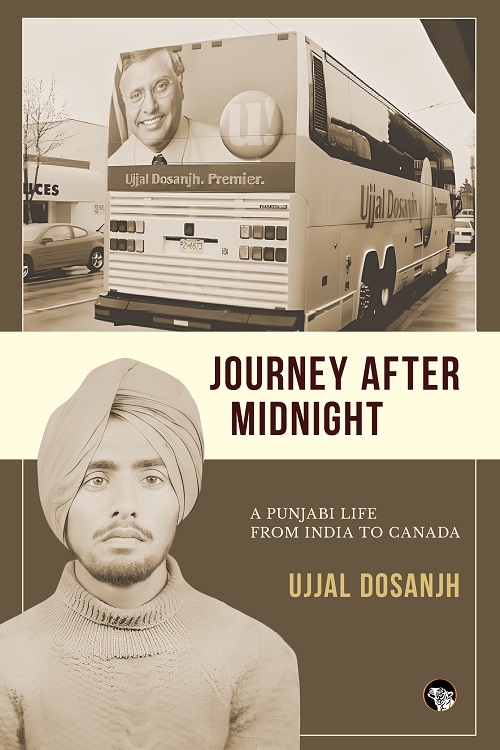


Title: Of the Raj, Maharajas and Me

Author: MA Sreenivasan

Publisher: Speaking Tiger Books

This is a delightful book for two reasons: One, it is a reminiscence of a civil service official with the princely state of Mysore and Gwalior, and later with the government of British India. Secondly, the stream of language and the lucidness with which the author has penned his recollections is remarkable. What is more, it reflects on the administrative practices of the former princely states of India.

M.A. Sreenivasan (1897-1998) lived through almost the entire 20th century and was among the very few people who witnessed at close quarters the enormous changes that took place in India during this period. Born in Madras, he belonged to a family that traced his subsequent generations of Pradhans (ministers) of successive kings of Mysore for 150 years. Sreenivasan joined the Mysore Civil Service in 1918 and, after a varied career both with the Mysore Government and the Government of British India. He became a Pradhan of the Maharaja of Mysore in 1943. In 1947, he was invited by the Maharaja of Gwalior to become the Dewan of that State. During that momentous year, he was a member of the Constituent Assembly of India and in regular touch with many of the leading figures (including Mountbatten) involved in the transfer of power from British to Indian hands.

Much more than an autobiography, the book is a rare portrait of India during and immediately after the British Raj. The princely States of India have been neglected by scholars, many of whom have tended to be unfairly critical. There is much in this book on the effectiveness of administration in two major princely States. It redresses the balance and makes the book a valuable document on the subject. Further, Sreenivasan provides sharp insights into the negotiations that led to the end of the Raj, and into the new polity that emerged after Independence. 

Writes Sreenivasan about Louis Mountbatten: “I had seen and talked to Mountbatten at lunch parties in Viceroy’s House and meetings of the Chamber of Princes. Tall of stature, with an enviable reputation as Supreme Commander of the Allied Forces during the War, he impressed everyone with his fine personality and pleasing manner. Standing on the dais that day, wearing his bright, white naval uniform, festooned with medals and decorations, he addressed the gathering as Crown Representative of His Majesty, the King of Great Britain, his cousin, and spoke of the King’s concern for the Princes of India with whom the Crown’s long-standing associations and obligations were soon to come to an end.”

Elsewhere in the book he writes about Sir CP Ramaswamy Iyer: “He was a remarkable man. Endowed with a fine personality and a keen intellect, he was learned and brilliant, an eloquent speaker, and a brave and dynamic administrator. In his early years, he was a much sought-after lawyer and one of the first, most ardent, champions of Home Rule for India. CP, as he was called by friends, was among the leaders and statesmen whose views were sought by successive British missions. He did not, however, take part in the Constituent Assembly or its committees. I knew he had plans of making Travancore an independent maritime State. I had always held him in esteem as a distinguished elder statesman and called on him at Travancore House in New Delhi, asking him why he had not agreed to the accession of Travancore.”

Write Shashi Tharoor in the foreword: “This book is simultaneously an exploration of the region’s glorious past and present and a memorable personal history, tracing Sreenivasan’s life and career, which was as challenging as it was deeply interesting. From the ups and downs of local politics to navigating the bureaucracy of nascent independent India, not to mention moving forays into Sreenivasan’s home life particularly relating to his beloved and constantly supportive wife, Chingu, there is little that is not covered. The reader follows the author through his myriad journeys, from Mysore to New York and London, to the Chambal Valley and beyond.”

The last few chapters of the book are notable. Whether it is the merger of the princely states or Prime Minister Nehru, Sardar Patel and the two Nobel laurates- CV Raman and Dalai Lama – Sreenivasan’s chronicles make for an absorbing read.

In the epilogue, he writes: “The years have witnessed revolutionary changes in India. There has been impressive progress in many directions and many remarkable achievements. The scourge of smallpox and plague has been eradicated. The shame of human beings carrying night soil has ended in many cities and towns. Infant mortality has been reduced, and life expectancy enhanced.

“The production of food grains and other needed crops has vastly increased. Thanks to generous foreign aid and increased revenues, huge dams and reservoirs have been built. Hydro-and thermal power generating stations installed. An industrial revolution has taken place. Thousands of mills and factories turn out myriads of products, from cotton cloth and silk to telephones, television sets, computers, locomotives, motorcars, and aeroplanes. Transport and communication have also been revolutionized. Scores of universities, hundreds of engineering and medical colleges and research institutions have been started and equipped. India can boast of having perhaps the largest surplus of scientists and technologists in the world for export. But progress has not come with both hands full. With great gains have come great losses. An irreparable loss is the grievous vivisection of India.”

This captivating life story will be of particular interest to students and scholars of modern Indian history as well as the general reader.

Bhaskar Parichha is a journalist and author of UnbiasedNo Strings Attached: Writings on Odisha and Biju Patnaik – A Political Biography. He lives in Bhubaneswar and writes bilingually. Besides writing for newspapers, he also reviews books on various media platforms.

.

PLEASE NOTE: ARTICLES CAN ONLY BE REPRODUCED IN OTHER SITES WITH DUE ACKNOWLEDGEMENT TO BORDERLESS JOURNAL

Click here to access the Borderless anthology, Monalisa No Longer Smiles

Categories
Review

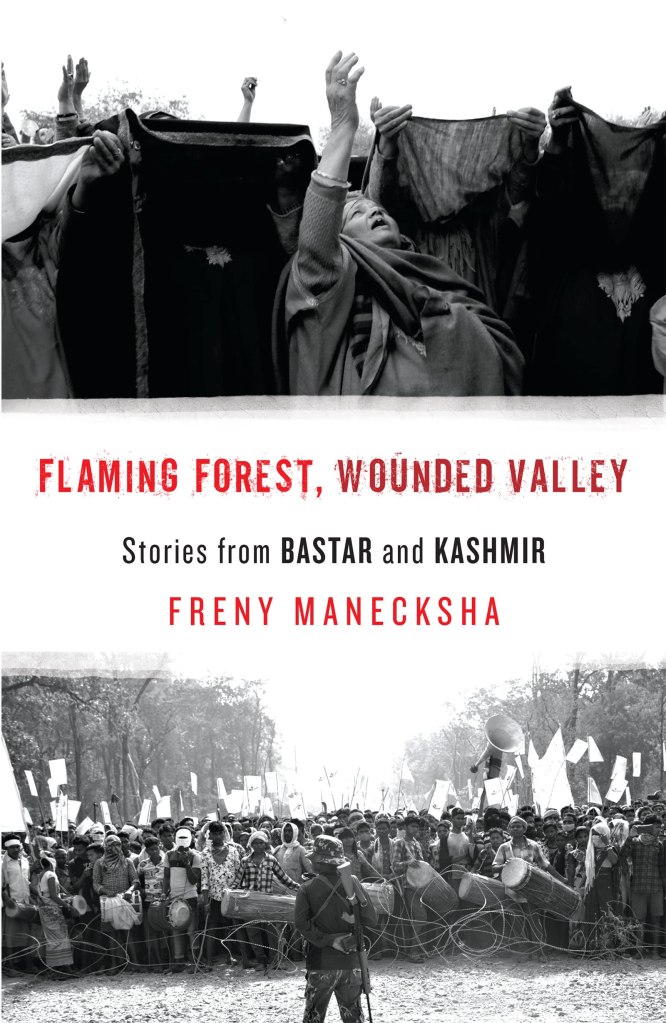
Flaming Forest, Wounded Valley

Book Review By Rakhi Dalal

Title: Flaming Forest, Wounded Valley: Stories from Bastar and Kashmir

Author: Freny Manecksha

Publisher: Speaking Tiger Books

People who have never lived in or around conflict riddled zones, have a scant notion of how the politics of a nation impact survival in such places. In the name of curtailing extremism, the punitive measures adopted, achieve little more than turning daily living into a nightmare. How would one feel if the forces employed by a state, supposedly to safeguard the common people, barge into their homes unannounced at any time whether day or night and leave them terrified? Or, if a group of civilian people are fired at by the forces while sitting in their fields discussing as routine a thing as celebration of a festival?

In a country like India where the mainstream media turns a blind eye and sometimes help propagate a biased and false narrative, it takes courage of a few who, despite looming threats, try to bring in stories from such places, stories that tell of the oppression of common people both at the hands of extremists and the state.

Flaming Forest, Wounded Valley by Freny Manecksha is one such attempt towards bringing out truth from two militarized zones of the country – Bastar and Kashmir. Manecksha is an independent journalist from Mumbai. She has worked with Blitz, The Times of India, Mid-Day and Indian Express. She has travelled and written extensively from Kashmir and Chhattisgarh. She is the author of Behold, I Shine: Narratives of Kashmir’s Women and Children.

In documenting the accounts from these restive places, Manecksha draws parallels between the everyday struggle of people to live in their villages or homes, the distrust for the forces or police system because of the brutalities suffered, the hesitation to file reports because justice is seldom achieved, the state narratives which usually demonstrate scant regard for the people and their right to live with dignity, the impunity with which their lives and their bodies, especially those of women, are disregarded and desecrated.

In case of Kashmir, “the Armed Forces Special Powers Act (AFSPA) gives blanket immunity to the security forces against crimes like unlawful detentions, torture and custodial killings.” As a result, they can force enter a home at any time for a raid and search the entire house while deploying a member as a ‘human shield’. This makes the concept of home as a safe and inviolate space alien for the people because anything can happen at any time.

Neither home nor outside is safe. Whereas in Bastar, public institutions like schools become places for interrogation and torture, in troubled towns of Kashmir, the hospitals becomes places for identifying and arresting protestors. Shot with guns or pellet guns, the bodies become spaces trampled by coercion and ruined or silenced by violence.   Their stories of suffering and pain find echo in a poet’s words:

“At an avant-garde cafe in uptown Pune
the reserved tables celebrate 
a teenager’s birthday in cosmopolitan English
My nearly dead phone flares up with a call from home
My mother laments in frayed Kashmiri: 
I am happy you aren’t at home, two other boys
Were shot dead today.”

The reports from these fractured lands are harrowing and forces one to delve into the motives and repercussions of State’s militarisation policy which, instead of maintaining peace, has brought unrest to people’s lives. Whether it is through Ikhwanis[1] in Kashmir or Salwa Judam[2]in Chhattisgarh, the state, irrespective of the Government at Centre, has tried to constrain people through violence. In the name of national interest, their lives have been dispossessed of the merit to normality. At stake as ‘collateral damage’, a term used by state or forces as matter of fact, has just not been their lives but also the dignity in death. The struggle, whether of the Adivasis of Bastar or of people from Kashmir, has been to reclaim their everyday life, their land and their homes.

These stories, however, are also those of resilience. The book celebrates the idea that even in the face of tortures and abuse, collective grief transforms into collective sharing which make people stand together and claim their rights to live. Manecksha writes with empathy and tenderness. Her reportage reflects the efforts that are put in collecting these narratives. It is a book as critical as it is relevant to our times. 


[1] Religious Militia

[2] Militia employed to crack down on counterinsurgents

Rakhi Dalal is an educator by profession. When not working, she can usually be found reading books or writing about reading them. She writes at https://rakhidalal.blogspot.com/ .

.

PLEASE NOTE: ARTICLES CAN ONLY BE REPRODUCED IN OTHER SITES WITH DUE ACKNOWLEDGEMENT TO BORDERLESS JOURNAL. 

Click here to access the first Borderless anthology, Monalisa No Longer Smiles

Categories
Review

Of Ghosts and Tantriks

Book review by Basudhara Roy

Title: Taranath Tantrik and Other Tales from the Supernatural

Author: Bibhutibhushan

Translator: Devalina Mookerjee

Publisher: Speaking Tiger Books

The book decides to arrive on a crisp Friday morning, its sunshine so keen and abundant that any thoughts of the supernatural can only be merrily chuckled over. The cover, however, is strangely disconcerting. It takes me time to mark that the brilliant art on it actually depicts skulls. Not ordinary enough to be dismissed as mere biological specimens, the skulls seem to represent, in their complexity, vibrancy and the silhouette of birds that haunt them on every side, a text that is both hauntingly familiar and eerily not so. Bibhutibhushon’s short stories exploring the supernatural and tantra, a practice associated with dark forces and the Goddess Kali, translated by Devalina Mookerjee from Bengali — could not, perhaps, have been showcased better.

Bibhutibhushan (1894-1950) was an eminent Bengali writer whose best known works are his novels, Pather Panchali (Song of the Road) and Aparajito – both immortalised into films by Satyajit Ray,  Chander Pahar (Moon Mountain) Aranyak (Of the Forest). Some of these books can be found in translation.To one even remotely acquainted with Bibhutibhushan’s oeuvre, his stories offer a definite assurance of being in good company. In reading , Taranath Tantrik and Other Tales from the Supernatural, however, what the reader might fail to bargain for is the almost complete obliteration of the physical world by the world of the book, and by the time the journey through the nine translated stories therein has been made, one is no longer sure where one world ends and the other begins.

It takes time to step out of the frame and to express admiration for the conduit that has led to this extraordinary experience in fiction – the translator. To transcend spatiality and temporality and conjure these tales again for an entirely different readership in an entirely different language is likely to have been a project fraught with its own pointed challenges. Mookerjee, however, seems to have successfully met them all, so much so that in the context of the English language, these spooky, unsettling tales offer not the slightest semblance of foreignness, even when they deal thematically with something as acutely local and specialised as tantra. The language is sparklingly contemporary and in its inflections, energy and dreaminess to allow these nine narratives to carve their own particular niches. The pace of the collection stays heady throughout and the atmosphere is completely overpowering.

Of special significance is Mookerjee’s nuanced and insightful twenty-seven paged ‘Introduction’ to the collection that calls upon the reader to visualise concrete connections between social justice and the genre of the supernatural. Mookerjee writes: “Seen against the background of what people are capable of doing to each other, stories of ghost may be seen as corrective mechanisms in the scales of justice. A person who has been wronged returns to tell their story, perhaps to wreak havoc on their tormentors. A disbeliever sits in a séance for which the medium is clearly not prepared, and chaos ensues. We have a word for this already. We call it karma.”

The ‘Introduction’ serves, also, as a brave attempt to place Bibhutibhushan’s writing in current socio-cultural perspective, and to bridge the disparate worlds of rural Bengal that birthed these stories and that of the contemporary English reader of these tales who could belong to almost any geographical space on the global map.

The first two stories of the collection are centred around the protagonist after who the book has been named, a dabbler in the dark arts, Taranath Tantrik. The remaining seven stories are each unique in their own ways as they chart their individual journeys into the terrain of the invisible and the occult with remarkable skill and clarity. “Human beings have historically shown very little need of support from the otherworld to behave in perfectly horrible ways with other people. This is the point at which the darkness of the uncanny and the darkness of people converge,” avers Mookerjee, pointing out how the surreal is often only another dimension of the real revealed in a disjointed spatial-temporality.

Not all of the nine stories strike with equal power. If ‘The Ghosts of Spices’ appears quite facile and juvenile in its description of a march-past of spice sacks on the deserted nocturnal streets, ‘A Small Statue’ appears rather simplistically cinematic in its  dream presentation of the tableau of the monk, Dipankar’s life. In the most evocative stories of the collection like ‘Maya’, ‘The House of His Foremothers’, ‘Arrack’ and ‘The Curse’, however, the quiet, intricate weaving of setting, psychology and idea dazzles in its brilliance, leaving behind a sense of both fracture and healing.

Bibhutibhushan’s poignancy is at its unsurpassable best in his delineation of place and in his exploration of links between physical place and human placed-ness. His most unforgettable stories are those in which people and places interact with each other organically and without inhibitions, creating a documented identity of both being-in-place and place-in-being. In ‘Maya’ for instance, the house acquires an identity of its own as its past inhabitants gently draw its present dweller/s into the folds of its mystery and inexplicable self-sufficiency. In ‘The House of His Foremothers’ similarly, the ghost-girl Lokkhi mourns for the bereft house more than her lost family and consistently haunts its silences in the hope of resurrection for the house which, unlike her, still lives across the family’s generational lifetimes.

To allow one’s imagination to be overpowered by these stories is to experience a strange welding of the probable and the improbable into the arc of the possible — to be awakened to a new dimension of being in which while vision remains at par, the other senses experience a heightened participation with what is positively undefinable but utterly undeniable.

Taranath Tantrik and Other Tales from the Supernatural, by thus placing the reality in the larger context of a world that still evades the cartography of reason, becomes a portal to a widened, heightened and more enlightened worldview. It helps remind of the intersections between our own human finitude and the infinite world with its geo-historical consciousness incapable of forgetting and thoroughly unable to forgive.

.

Basudhara Roy teaches English at Karim City College affiliated to Kolhan University, Chaibasa. Drawn to gender and ecological studies, her four published books include a monograph and three poetry collections. Her recent works are available at Outlook India, The Dhaka Tribune, EPW, Madras Courier and Live Wire among others.

.

Click here to read the book excerpt from Taranath Tantrik

PLEASE NOTE: ARTICLES CAN ONLY BE REPRODUCED IN OTHER SITES WITH DUE ACKNOWLEDGEMENT TO BORDERLESS JOURNAL

Categories
Excerpt

Tarnath Tantrik by Bibhutibhushan

Title: Taranath Tantrik: And Other Tales from the Supernatural

Author: Bibhutibhushan

Translator: Devalina Mookerjee

Publisher: Speaking Tiger Books

Since I was deep in meditation, it took a few seconds for the smell of musk to register on my consciousness.

It was with a smile that my mind turned towards the smell. What a wonderful fragrance, I thought, nature is truly magnificent in her bounty! Immediately after this my senses sharpened because it felt as if someone was standing behind me, on the other side of the trunk of the tree. It is true that I could not see the person, but that made me no less sure of her presence. Sometimes instinct serves better than eyes. My entire being was suddenly, completely awake and alert. The air went still. Then, I felt as if my body was on fire, burning embers scorching my insides and exploding outward. The excruciating pain was growing. Was I about to faint again? Just at that moment, the pain disappeared, and there was a woman standing in front of me. I was absolutely certain that she had not been anywhere near that spot even a heartbeat ago. The suddenness echoed exactly that night when I occupied the tantrik’s seat. But this time I knew that she had come for me. This time, I would not slide into unconsciousness. I looked at her. She seemed to be frowning in disapproval—’

***

‘Are you sure you saw this woman yourself, with your own eyes?’ The question slipped out of my mouth before I could stop it. Taranath heard my disbelief, and his tone became agitated and defensive—‘Did I see her with my own eyes? Of course I saw her with my own eyes!

There she was, large as life, standing in front of me! Look, you can believe me or not, that’s up to you. But you can’t say that I’m lying to you, because I’m not.’

‘What did she look like?’ I asked, hoping to appease him somewhat.

‘If I said she was beautiful, that would be less than a proper description. She was exactly as the incantation to call her says, a loveliness beyond words, beyond compare, beyond this world. I realised that the incantations of power I had been pronouncing for months were not simply words made up to call this being, they were descriptions of her power and beauty.’

‘Did you talk to her?’ I was hanging on to his words.

‘Talk to her?’ he scoffed. ‘I was just barely hanging onto consciousness, and you want to know if I talked to her! This was not a normal woman, you understand?

Not from any point of view was she ordinary. Her power radiated from her like the sun. And those eyes!

The incantation to call her mentions her eyes, I had thought those were just words to propitiate the goddess and compel her to respond to the call. My god, you should have seen those eyes—worlds could be conquered and burn in the fiery steel of those exquisite eyes.’

I became impatient. ‘Never mind the long descriptions! What happened? What did you talk with her about?’

He became circumspect. ‘What we talked about is private, between her and me. Such things are not for others to know.’

***

‘What happened is that Madhusundari Devi started to visit me every night. In that desolate place by the river, I had called her as a lover. But you must have guessed that already. After all, who could possibly be dull enough to listen to overcautious warnings from an old tantrik?

It was a mild winter. The waters of the Barakar river were gentle, and low in the bed. The lilies in the shallow water near the banks had become dry and yellow, revealing rock-minerals in the sand that sparkled in the light of the moon. The forests on both sides of the river were shedding leaves into the breeze. The skies were clear and blue in the day, and the moon shone in a cloudless sky at night. From that time on, for three months, she visited me every night. I felt completely alive in those three months, never before, or since, have I felt like that. It’s painful to talk about feeling like that now.

You cannot imagine the pain of it, the grief of loss over a self capable of that kind of joy. I reached a pinnacle of happiness and stayed there for three whole months. She was a goddess indeed. No ordinary human woman would be able to grant such experiences of love, such deep, perfect friendship. Being with her was heavenly, not of this earth. I can’t explain it to you. What words would I use? And you would disbelieve me anyway. You’d call me a liar, or say I’m mad. Perhaps you’re thinking those things right now, as I gabble on.

It’s not just you, even my wife does not believe me. She says the tantrik had used his black magic skills to shut my brains down.

That kind of happiness is intoxicating, like being drunk on very strong wine. But being drunk on strong wine also creates an ennui of its own. I would be listless all day, nothing in this real world held my interest. The daylight hours would go in longing for the evening.

When would dusk darken to twilight under the trees, in the forest by the river? When would she appear, my beautiful actress, perfect heroine to my new-found role as hero? The nights would pass like a dream, time slipping through my fingers like dry sand, each night deeply intoxicated and glittering with joy. My consciousness would expand outwards, grow unfettered, till the sky, the planets, the gods and goddesses were all part of my being, each night, under the stars by the river.

Then, something happened.

A young woman who lived in the nearby village used to come to the river to get water. Since she came every day, I saw her quite regularly.

Excerpted from Taranath Tantrik: And Other Tales from the Supernatural by Bibhutibhushan, translated by Devalina Mookerjee. Published by Speaking Tiger Books, 2022.

ABOUT THE BOOK

Ghosts are everywhere. Most are ghosts of ideas, feelings, memories. These are our personal ghosts, and they follow us alone. But there are other ghosts, in which we share a common fear. Thickening shadows pooling at the corner of the room, unexplained breathing in the dark, the child who steps out of an old photo—the shiver of supernatural frisson, a thin crooked finger of ice tracing its way down your spine. This fear, and thrill, is rightfully the domain of the kind of ghost you will meet in this book.

In Taranath Tantrik, Devalina Mookerjee translates nine stories of the uncanny and occult by legendary Bengali storyteller, Bibhutibhushan. Seven are short stories of séance, curses, return for revenge, and the desire for things that have no place in human lives. Two are about tantra, of necromancy, spiritual power, goddesses, and ghosts.

The borders of reality are porous in this world.

ABOUT THE AUTHOR

Bibhutibhushan Bandyopadhyay (1894–1950) is regarded as one of the greatest Bengali writers. His best known works are the autobiographical novel, Pather Panchali (The Song of the Road), which was made into a film by Satyajit Ray, Chander Pahar, and Aranyak.

ABOUT THE TRANSLATOR

Devalina Mookerjee is a translator and publisher. She is also a researcher in health and education. Her interest in ghosts is based on two decades of social science research. She learned to play bass over the lockdown, mostly jazz, blues and folk, and finds that the sound of the bass goes beautifully with stories of ghosts. She lives in New Delhi with her partner and five dogs.

.

Click here to read the review of the book

PLEASE NOTE: ARTICLES CAN ONLY BE REPRODUCED IN OTHER SITES WITH DUE ACKNOWLEDGEMENT TO BORDERLESS JOURNAL

Categories
Excerpt

Ruskin Bond Recalls…

Title: Between Heaven and Earth: Writings on the Indian Hills

Editors: Ruskin Bond and Bulbul Sharma

Publisher: Speaking Tiger Books

She was eighty-six, but looking at her you wouldn’t have guessed—she was spry and took some care to look good. Not once in the five years that we spent together did I find her looking slovenly. The old-fashioned dresses she wore were clean and well-ironed, and sometimes she added a hat. Her memory was excellent, and she knew a great deal about the flowers, trees, birds and other wildlife of the area—she hadn’t made a serious study of these things, but having lived here for so long, she had developed an intimacy with everything that grew and flourished around her. A trust somewhere in England sent her a pension of forty or fifty rupees, and this was all the money she had, having used up the paltry sum she’d received from the sale of her property.

She’d had a large house, she told me, which she had inherited from her parents when they died, and she’d had an ailing sister whom she had nursed for many years before she too passed away. As she had no income, she kept boarders in the house, but she had no business sense and was losing money maintaining it. In the end, she sold the house for a song to one of the local traders and moved into two small rooms on the ground floor of Maplewood Lodge, a kindness for which she remained grateful to her friends, the Gordon sisters.

It must have been lonely for Miss Bean, living there in the shadow of the hill, which was why she had been excited when I moved into the floor above her. With age catching up, she couldn’t leave her rooms and her little garden as often as she would have liked to, and there were few visitors—sometimes a teacher from the Wynberg Allen School, the padre from the church in town, the milkman twice a week and, once a month, the postman. She had an old bearer, who had been with her for many years. I don’t think she could afford him any longer, but she managed to pay him a little somehow, and he continued out of loyalty, but also because he was old himself; there wouldn’t have been too many other employment opportunities for him. He came late in the morning and left before dark. Then she would be alone, without even the company of a pet. There’d been a small dog long ago, but she’d lost it to a leopard.

Camel’s Back Road, going to a tea party at a friend’s house, the dog sitting in her lap. And suddenly, from the hillside above her, a leopard sprang onto the rickshaw, snatched the dog out of her hands, and leapt down to the other side and into the forest. She was left sitting there, empty-handed, in great shock, but she hadn’t suffered even a scratch. The two rickshaw pullers said they’d only felt a heavy thump behind them, and by the time they turned to look, the leopard was gone.

All of this I gathered over the many evenings that I spent chatting with Miss Bean in her corner of the cottage. I didn’t have anyone to cook for me in the first few years at Maplewood. Most evenings I would have tinned food, and occasionally I would go down to share my sardine tins or sausages with Miss Bean. She ate frugally—maybe she’d always had a small appetite, or it was something her body had adjusted to after years of small meals—so I wasn’t really depriving myself of much. And she returned the favour with excellent tea and coffee.

We would have long chats, Miss Bean telling me stories about Mussoorie, where she had lived since she was a teenager, and stories about herself (a lot of which went into some of my own stories). She remembered the time when electricity came to Mussoorie—in 1912, long before it reached most other parts of India. And she had memories of the first train coming into Dehra, and the first motor road coming up to Mussoorie. Before the motor road was built, everyone would walk up the old bridle path from Rajpur, or come on horseback, or in a dandy held aloft by four sweating coolies.

Miss Bean missed the old days, when there was a lot of activity in the hill resort—picnics and tea parties and delicious scandals. It was second only to Shimla, the favourite social playground of the Europeans. But unlike Shimla, it had the advantage of being a little more private. It was a place of mischief and passion, and young Miss Bean enjoyed both. As a girl, she’d had many suitors, and if she did not marry, it was more from procrastination than from being passed over. While on all sides elopements and broken marriages were making life exciting, she managed to remain single, even when she taught elocution at one of the schools that flourished in Mussoorie, and which were rife with secret affairs.

Do you wish you had, though,’ I asked her one March evening, sitting by the window, in the only chair she had in her bedroom.

‘Do I wish I had what?’ she said from her bed, where she was tucked up with three hot-water bottles.

‘Married. Or fallen in love.’

She chuckled.

‘I did fall in love, you know. But my dear father was a very good shot with pistol and rifle, so I had to be careful for the sake of the young gentlemen. As for marriage, I might have regretted it even had it happened.’

A fierce wind had built up and it was battering at the doors and windows, determined to get in. It slipped down the chimney, but was stuck there, choking and gurgling in frustration.

‘There’s a ghost in your chimney and he can’t get out,’ I said.

‘Then let him stay there,’ said Miss Bean.

Excerpted from Between Heaven and Earth: Writings on the Indian Hills, edited by Ruskin Bond and Bulbul Sharma. Published by Speaking Tiger Books, 2022.

ABOUT THE BOOK

 ‘What is it about the hills that draws us to them again and again?’ asks one of the editors of this collection. In these pages, over forty writers—from a daughter of the Tagore family and a British colonial officer in the 19th century, to a young poet and an Adivasi daily-wage worker in the 21st century—show us what the many reasons could be: Green hillsides glowing in the sun; the scent of pine and mist; the wind soughing in the deodars; the song of the whistling thrush; a ritual of worship; a picnic, a party, an illicit affair. They show us, too, the complex histories of hill stations built for the Raj and reshaped in free India; the hardship and squalor behind the beauty; the mixed blessings of progress.

Rich in deep experience and lyrical expression, and containing some stunning images of the hills, Between Heaven and Earth is a glorious collection put together by two of India’s finest writers, both with a lifelong connection with the hills. Among the writers you will read in it—who write on the hills in almost every region of India—are Rumer Godden, Rabindranath and Abanindranath Tagore, Emily Eden, Francis Younghusband, Jim Corbett, Jawaharlal Nehru, Khushwant Singh, Keki Daruwalla, and of course the two editors themselves. Together, they make this a book that you will keep returning to for years to come.

ABOUT THE EDITORS

 Ruskin Bond is one of India’s most beloved writers. He is the author of nu­merous novellas, short-story collections and non-fiction books, many of them classics and several of them set in the hills of north India. Among his best-known books are The Room on the Roof, Time Stops at Shamli, A Book of Simple Living, Rain in the Mountains and Lone Fox Dancing. He was awarded the Padma Shri in 1999 and the Padma Bhushan in 2014. He lives in Landour, Mussoorie.

Bulbul Sharma is an acclaimed painter and writer, author of best-selling books of fiction and non-fiction, including My Sainted Aunts, The Anger of Auber­gines, Murder in Shimla and Shaya Tales. Bulbul conducts ‘storypainting’ work­shops for special needs children and is a founder-member of Sannidhi—an NGO that works in village schools. She divides her time between New Delhi, London and Shaya, a village in Himachal Pradesh.

.

PLEASE NOTE: ARTICLES CAN ONLY BE REPRODUCED IN OTHER SITES WITH DUE ACKNOWLEDGEMENT TO BORDERLESS JOURNAL