Categories
Essay

Moving Images of Tagore


By Ratnottama Sengupta


Rabindranath Tagore spells different things to different people: National Anthems; the Nobel, Rabindra Sangeet, a veiled woman, Sriniketan or Santiniketan. A cineaste might think of Charulata or Kabuliwala, Chokher Bali (Best Friend) or Kadambari. But the subject ‘Tagore and Cinema’ would mean talking of Tagore’s exposure to cinema, his interest in the medium, the fate of his involvement with celluloid, the films based on stories penned by him, their interpretation in a world that is so far removed from his, in historical, economical, and cultural terms… In other words, it would mean talking of what about Tagore endures — and why it reaches out to the wide world of humanity.

To me, it is Tagore’s awesome, inspiring humanism that offers us immense scope to transcreate, reinterpret, relocate the socially relevant developments and rooted characters again and again onscreen. Like Shakespeare, his works are universal in terms of age, geophysical location, terrain of the mind and tugs of emotions…

Rabindranath was almost seventy when he exhibited his paintings that were so radically different from the style associated with the Tagore family artists, Abanindranath, Gaganendranath, Sunayani Devi, or Nandalal Bose. For, if the Bengal School looked East and sought inspiration in delicate miniatures, Chinese watercolours or the sparseness of Japanese zen, Tagore absorbed the boldness of German expressionism and created a unique style. It’s impossible for someone so open to avant garde trends to take no interest in cinema, the 20th century art form that was silently taking its juvenile steps in India when Tagore won the Nobel.

When he visited Russia, he watched Battleship Potemkin, the classic ‘handbook for editors’ (to quote Phalke winner Hrishikesh Mukherjee) that influenced a long line of filmmakers in India too. By 1931, the year when Alam Ara (Hindi) and Jamai Shasti’(Bengali) turned ‘movie’ into ‘talkie’, Tagore was in the last decade of his life. So, when he directed Natir Puja (The Dancing Girl’s Worship) at New Theatres, he was substantially assisted by Premankur Atorthi, who was the first to direct a film based on a Tagore composition. This was the only time when the Renaissance personality directly interacted with the celluloid medium. His nephew Dinendra wrote the screenplay, albeit under Tagore’s guidance, and students of Santiniketan acted in it. More importantly, Tagore himself essayed an important role in the dance-drama which was shot with a static camera over four days. However, the result was more a staged play than cinema. A greater tragedy is that the reels perished within 10 years, when a fire ravished the New Theatres Studio in 1941.

Atarthi’s own direction of Chirakumar Sabha (1932) set off a tradition that received a robust boost, first in the 100th year of the poet’s birth, and again in 2011, when he turned 150 and further. If literary treasures like Gora (1938) and Chokher Bali (1938) were adapted onscreen by Naresh Mitra and Satu Sen, they were remade and reinterpreted by Rituparno Ghosh who veered towards Tagore rather than Saratchandra, the more popular litterateur of Bengal who was a staple of Tollygunge for years. In fact all major names of Tollygunge, from Nitin Bose, Agradoot, Tapan Sinha, to Purnendu Pattrea, Partha Pratim Chowdhury and Rituparno Ghosh have announced their coming of age in cinema with a film based on a Tagore composition. 

It is interesting to note that when Tagore visited Russia in September of 1930 members of the Cinema Board who had a conversation with him regarding his “new film stories” were deeply impressed by the short versions of the stories (as narrated) by the Poet, and they met him at his hotel to discuss in detail the possibilities of filming them. Tagore himself had enough interest in cinema to visit the Amalgamated Cinema Union, where he was received by its president M Rutin and was shown Eisentein’s Battleship Potemkin and portions of Old and New, we learn from his Letters from Russia

Although evoking the Bengal of his time in divergent hues, Tagore’s stories continue to inspire man to go beyond divisions of nation, religion, caste or gender, perhaps because they explore how society shapes our love and relationships. This essay dwells on films that highlight the pervading themes of feminism, humanism and universalism in Tagore’s literary works.

Not Slave, Nor Goddess

The champion of women tells us to enunciate aami nari, I am a woman … with pride, because a woman is not a slave nor needs to be the other extreme, a goddess. That it is right for a woman, whether young, maiden, or widowed, to be a person of flesh and blood. That Tagore empathised so deeply with his women characters that today’s social historians are talking of an androgynous strain in the humanist.

* When Satyajit Ray filmed Ghare Bairey (The Home and the World), we got a glimpse of the regressive practices that ailed even the wealthy and educated households. However the most symbolic scene was the one where Bimala is inspired by Nikhilesh to step out of the inner quarters of the zamindar’s household. Even Sandip, the false god, hails it as a ‘social revolution’. Tagore the author goes on to criticise the pseudo rebel but at no point does he criticise Bimala — not even when her sister-in-law cautions Nikhilesh about the freedom his wife is abusing. We find a repeat of this theme in Char Adhyay (Four Chapters) – but we’ll come to that later.

* Chokher Bali, first filmed in 1938, turned the spotlight on the deprivations young widows were subjected to even after the reformist crusades of Raja Ram Mohan Roy and Ishwar Chandra Vidyasagar. Very sympathetically, and most aesthetically, it held a brief for their sensuality — even sexual needs, especially when Rituparno Ghosh filmed it in 2003. But even here, before Mahendra’s mother dies, she urges that in her memory he should host a feast for widows — “people feed Brahmins, beggars, even animals, but never for the unfortunate widows,” he underscores.

* Nitin Bose’s bilingual Noukadubi was probably the first to take Tagore to Hindi cine-goers. Incidentally Rituparno and Subhash Ghai’s Noukadubi were also bilingual. In 1944, Milan afforded Dilip Kumar opportunity to mature as an actor, for here Ramesh upholds the flag of humanism. After being boat wrecked he comes home with Kamala, the ‘bride’ he has not deigned to look at, and realises that she is in fact someone else’s wife. The gentleman in him decides to take her to a convent and give her not just protection (from a par purush, stranger) but also proper education — even at the cost of his own spotless reputation and his chances of finding happiness with his beloved, Hem Nalini. 

* In Charulata (1964), although Satyajit Ray continues to unfold her story from Amal’s point of view, his sympathy without reservation lies with the lonely wife. For half a century and more viewers have no doubt that Charu was an alter ego for Tagore’s Natun Bouthan – his sister-in-law Kadambari Devi, who took her own life. This story has inspired Bandana Mukherjee’s Srimati Hey and Suman Ghosh’s Kadambari (2015). Ray underscores this aspiration aspect in the film when Charu writes, gleaning from her experiences, and her writings are published in a magazine. This was unthinkable in the 19th century — and only a deeply humane soul could understand that a woman too needed to express her intellectual and creative self. (This aspect is completely missing in Charulata of 2011,  directed by Agnideb Chatterjee, although it unfolds from the woman’s perspective and unabashedly speaks of her physical intimacy with Amal.)

* For Tagore, perhaps the stifling of this intellectual self was as great a tragedy as the ‘burying’ of her potentials within the walls of domesticity. In the poem ‘Sadharan Meye’ (Ordinary Girl), he urges his contemporary Sarat Babu to write a novel where the protagonist — a scorned woman — goes on to study, travel abroad, re-valued by several admirers, including the man who ditched her for being an ‘ordinary’ woman. The core thought of this poem had inspired a script by Nabendu Ghosh, an altered (and unacknowledged) version of which was made by Hrishikesh Mukherjee as ‘Pyar Ka Sapna’ (Dream of Love, 1969). In recent times the theme has been most successfully revisited in Vikas Bahl’s Queen (2014).

* In Megh O Roudro (Clouds and Sunshine), Rabindranath’s short story creates a protagonist  whose struggle to affirm her dignity in the British ruled 19th century prompts her to read and write under the tutorship of a stubborn law student who is jailed for constantly challenging the discriminatory ways of the imperialists. By the time he is released, she is a prosperous widow who courteously acknowledges his role in her achieving self-confidence. In 1969, Arundhuti Debi, herself raised in Tagore’s ethos at Santiniketan, chose this for her second outing after Chhuti (Holiday) and her lyrical treatment brought her recognition as a director of substance.

* But what happens when a woman cannot fulfill her destiny, as in Streer Patra (A wife’s Letter, 1972)? How did Rabi Babu want his Mejo Bou — haus frau — to behave when the acutely male dominated household turns a blind eye to the injustice of marrying off the hapless orphan Bindu to a lunatic? Not drown her woes in the vast ocean at Puri but to slough off, in a moment of illumination, the shell of ‘Mejo Bou’ and become Mrinal, a woman with .her own soul and individual identity Why must she end her life like his Natun Bouthan — “Meera Bai didn’t,” he points out. And to us, even by today’s standards, it is the ultimate expression of feminism. 

* Perhaps because of the class she belonged to, and with the support of a rebellious brother, Mrinal could do what Chandara couldn’t in Shasti (Punishment, 1970). Tagore knew that neither his ‘Notun Bouthan’ nor his own wife Mrinalini got the opportunities enjoyed by his ICS brother’s wife. Far from it: Chandara’s husband Chhidam places the burden of his Boudi’s death at the hands of his elder brother on his wife. In the prevailing patriarchal society it wasn’t unthinkable: a wife was expendable because you could get another, but not a brother. But the unlettered Chandara has her own estimation of the sanctity that is the conjugal bond. When her husband comes to meet the wife condemned to hang, she denies him the right of visitation by disdainfully uttering a single word: “Maran!” How should we read it today? Go, drop dead or go hang yourself!

* Jogajog (Connection) was written in 1929 in a society where there were caste/ class distinctions even amongst zamindars. Tagore had first-hand experience of this within his family. His crude protagonist is a johnny-come-lately who seeks revenge by marrying the educated and cultured Kumudini. He cannot stand any expression of respect for her brother and feels belittled at the slightest hint of will in his wife. Matters go so far that in the 2015 film, director Sekhar Das can effortlessly trace moments of marital rape in their conjugal discord.

* Chitrangada had poised the question: where lies a woman’s true beauty – in her outward appearance or her inner worth? Should the princess, raised to be as good as a prince, deny her essential self to please a man? Or is she wrong to sacrifice her being for one she loves? In 2008, Rituparno Ghosh gave a whole new androgynous reading of the dance drama, with Madan/ Cupid becoming a psychoanalyst. 

Child — The Father and Mother of Man

Robi, who immortalised his childhood in Chhelebela (Boyhood), could never forget the restrictions imposed by adults and the suffocating effect it had on an imaginative soul. Therefore in Ichhapuran (Wish Fulfillment,1970), directed by Mrinal Sen for the Children’s Film Society of India, he effected a role reversal whereby their bodies get swapped. The naughty child Sushil becomes the father and the senior who covets the youthfulness becomes the free spirited son.

The comical confusion this ensues in the village leads both to realise the importance of their individual positions in life. They get back to their original self with the profound lesson for humanity – that each one of us has a place in the world no one else can ever fulfill.

* Of course the best known child in Rabindra Rachanabali (Creations of Tagore) is Amal. Essentially Dakghar (Post Office) was a testimonial against the crushing of childhood Tagore suffered. In the recent past actors Chaiti Ghoshal and Kaushik Sen have proved the enduring appeal of Dakghar — she in the form of a recorded audio play (CD); he on stage. Chaiti Ghoshal interprets the protagonist she had played with Shambhu and Tripti Mitra not as a Rabindrik character but as any child today, familiar with cricket and computer. Manipur’s Kanhailal has used elements of dance and drama to reinforce this message of freedom beyond frontiers. And, following the 2007 police firing in Nandigram (that killed 14 persons who were opposing state officials on land acquisition drive), Kaushik Sen had interpreted Amal’s desire to send a letter as a message to every household to raise awareness. 

Sen’s Dakghar, then, was not about death but about liberation from life in bondage. “Perhaps that’s why, a day before Paris was stormed during WWII, Radio France had broadcast Andre Gide’s French translation of the play,” Kaushik had said while staging the play. “Around the same time, in a Polish ghetto, Janus Kocak had enacted the play with Jewish kids who were gassed to death soon after.” After such multi-layered readings of the text, Dakghar as filmed by Anmol Vellani in 1961 remains a simplistic viewing — perhaps because it was made for the Children’s Film Society.

* In The Postmaster the child – an illiterate village girl in this instance – metaphorically becomes a mother and a priya , or beloved, of the pedantic city boy who is stirred by beauty of the moon but can’t wait to go back. When he falls critically ill she dutifully serves him and cares for him like a wife. When he is set to depart by simply tipping her with silver coins, the child with a maturity beyond her years refuses to say goodbye. Rejection doesn’t need words: she can negate his very existence by her silence.

* Samapti (Finale) the concluding story of Teen Kanya (1965) remade by Sudhendu Roy as Upahaar ( The Gift, 1975), builds on the flowering of a woman in an unconventional girl child. Mrinmoyee is certainly not a Lakkhi Meye…a good girl , she’s a scandal in rural Bengal of 100 years ago. She escapes her wedding night by climbing down a tree, she spends the night on her favourite swing on the riverbank, she snatches marbles from her friend, a boy… When they try to tame her by locking her up in a room she throws things at Amulya. But when he returns to Calcutta and she’s sent back to her mother’s, she realises grown up love for the man she’s married to, and sneaks into his room by climbing the same tree!

* Buddhadev Dasgupta had woven Shey from Tagore’s late novel written for his granddaughter, and then scripted a feature based on 13 poems by the bard. When we read a poem, certain images arise before our mind’s eye. The director interprets Tagorean poetry through such images and experiences. “It is about how a poet responds to another poet,” he explains.

Of Zamindars and Servants

Robi, the ‘good for nothing’ youngest son of Debendranath, had to prove himself in his father’s eyes by successfully performing the job he was entrusted with – that of collecting taxes, ‘khajna’, from the ‘prajas’, subjects, no matter how impoverished they were. We all know that in doing the job he came across a vast cross section of people of the land whom he would not otherwise get to know so intimately. And while he could not be lenient as his father’s representative, he created caring characters like the zamindar in Atithi ( The Guest) who brings home a vagabond, gives him education, and even prepares to give his daughter in marriage to the free spirited boy whose restless soul drives him away…

* But having seen the reality of the lives of the subjects Rabindranath also created uncaring zamindars like the one in ‘Dui Bigha Jami’ (Two Bighas of Land) that had inspired the Bimal Roy classic Do Bigha Zamin (1953), set in a post-independence India that was rapidly industrialising. Debaki Bose attempted a more literal visualisation as part of Arghya, his Centenary Tribute to Tagore, along with his poem ‘Puratan Bhritya’, (Old Retainer).

* Robi, the motherless child who was raised in a large household in the rigid care of servants, said ‘Thank You’ to them through characters like Kesto, the old family retainer who refuses to leave even when he’s dubbed a thief or driven away. Instead, he saves his master from small pox at the cost of his own life. Tagore, in fact, goes a step further in his short story, ‘Khokababur Pratyabartan’. The trusted servant even raises his son to eventually give him up as the master’s child lost to a landslide in the river! 

Oppression of Religion

Pujarini (Worshipper) was immortalised by Manjushri Chaki Sircar’s dance. Although set in the revivalist times of Ajatshatru who was set upon putting the clock back and wipe out the Buddhist tenor of his father Bimbisara, we can easily identify with Rabindranath’s condemnation of any excess – violence in particular – in the name of Religion. Visarjan (Immersion) too raises consciousness against violence in any form, against even animals, in the name of religion.

* Nor can we overlook instances where he raises his angst ridden voice against the inhuman treatment of humans on grounds of caste or creed. In Chandalika, the untouchable gets a new mantra to live by when the Buddhist monk Ananda says “Jei manab aami sei manab tumi kanya (You, lady, and I are part of the same humanity).” The act becomes a beacon for Sujata, the eponymous protagonist of Bimal Roy’s film, who is on the verge of ending her life (following casteist discrimination).

* Tagore’s poem called ‘Debatar Grash’ (God’s Greed), lashes out against the cruelty people can unleash through the heart rending plight of the mother whose child is snatched from her and thrown into the raging waters to appease the villagers superstitious belief in god’s wrath. Shubha O Debatar Grash (Shubha and God’s Greed, 1964) remains a signature film of Partha Pratim Chowdhury.

* Tagore questioned the very concept of belonging to ideological boxes. His time-transcending novel, Chaturanga (Four Quartet), points out that human experiments (like, say, Communism) have failed because they put ideology in watertight boxes that do not have any room for flexibility. This inspired Suman Mukhopadhyay to film it in 2008. Tagore, who himself created walls and broke them, questions this through Jyathamoshai, his uncle, and Sachish, who invite Muslim singers and feed them at shraddha or funeral as much as through Damini, whom Sachish wants to domesticate much against her wish. She even questions her husband’s authority to will her away along with his property, to his religious guru. Tagore uses the graphic imagery of a hawk and a mongoose that Damini has as her pet (it is well known that these animals cannot be domesticated).

Nationalism to Internationalism

‘Where the world has not been fragmented by narrow domestic walls, and the clear stream of reason has not lost its way into the dreary desert sand of dead habits: into that heaven of freedom’ Tagore, forever and always, wanted his compatriots to awake. That is why Nikhilesh, in Ghare Bairey, does not condone violence even in the name of nationalism. That is why he decries Sandip, who uses the passion of young freedom fighters and the wealth of the poor to fill his coffers.

Beware the false god: Tagore repeats the criticism in Char Adhyay. In 2012 Bappaditya Bandopadhyay revisits the novel filmed by Kumar Shahani in 1997, the golden jubilee of Independence. But Ela’s Char Adhyay review it for its politics, its backdrop of ultras and violence, for the debate that acquired a new validity in the world after 9/11. Tagore was much in favour of non-violence, so much so that he criticised the nationalist movement too when it turned violent. How much of a visionary he was to ask a full century ago: “What will be the state of the nation that is based on violence?”

Young filmmakers are amazed by Tagore’s vivid criticism of the deterioration of party structures although he himself never belonged to any party. Sarat Chandra’s Pather Dabi (Demands of the Path), written about eight years before Char Adhyay, had taken a populist stand while Tagore didn’t hesitate to say through the protagonist Atin, ‘I am not a patriot in the sense you use the term.”

* That Rabindranath was against any form of regimentation is well established. His play, Tasher Desh or the land of cards, perhaps, written to criticise the submission of the conscience in Hitler’s Germany, remains the ultimate critique of regimentation. Directed by Q in 2012, the text layers his criticism of contemporary society by “trippy” visuals. By Q’s own submission, it is a “quirky” retelling of the Tagorean allegory.

* Gora (directed by Naresh Mitra in 1938) goes further: He bows to his adopted mother, hails her as his Motherland and says, every child is equal for a mother, she does not differentiate on any ground. Tagore here gives us a blueprint for an ideal Republic where a hundred flowers can fill the air with a hundred different colours.

* Perhaps the ultimate example of Tagore’s humanism is Kabuliwala, directed in Bengali by Tapan Sinha in 1958 and in Hindi by Hemen Gupta in 1961. An Afghan selling his wares in a Calcutta 150 years ago and striking a friendship with a child who reminds him of his own daughter back home, is a story that will strike a chord in anybody, anywhere in the world, at any given point in time — even in a world swamped with internet, chat rooms, mobile phones and multimedia messaging. 

All of this reiterates the ‘forever-ness’ of Tagore. It also redefines the need to interpret his farsightedness, his comprehensiveness, his universality for our own times, in our own terms. Tagore himself had observed in a letter: “Cinema will never be slave to literature – literature will be the lodestar for cinema.” So we may conclude that since Tagore was primarily delving into human emotions, into the psyche of men and women placed in demanding situations that forced them to measure up to social, political, cultural or gender-based challenges, films based on his stories not only continue to be made but find an ever-growing audience in the globalised world.

(Courtesy: Tagore and Russia: International Seminar of ICCR 2011 held in Moscow. Har Anand publications, 2016. Edited by Reba Som and Sergei Serebriany)

.

Ratnottama Sengupta, formerly Arts Editor of The Times of India, teaches mass communication and film appreciation, curates film festivals and art exhibitions, and translates and write books. She has been a member of CBFC, served on the National Film Awards jury and has herself won a National Award. 

.

PLEASE NOTE: ARTICLES CAN ONLY BE REPRODUCED IN OTHER SITES WITH DUE ACKNOWLEDGEMENT TO BORDERLESS JOURNAL

Click here to access the Borderless anthology, Monalisa No Longer Smiles

Click here to access Monalisa No Longer Smiles on Kindle Amazon International


Categories
Interview Review

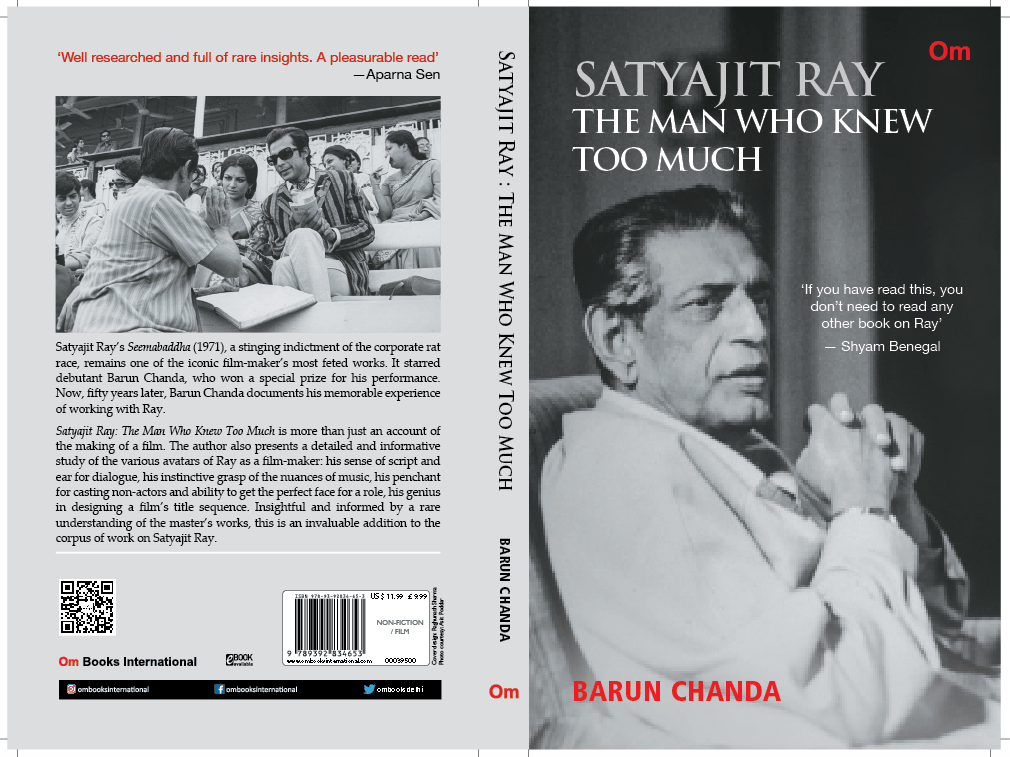
Satyajit Ray – Was he really ‘The Man Who Knew Too Much’?

In conversation with Barun Chanda, an actor who started his career as the protagonist of a Satyajit Ray film and now is a bi-lingual writer of fiction and more recently, a non-fiction published by Om Books International, Satyajit Ray: The Man Who Knew Too Much

“[O]ne would like to remember Ray as one of the last truly great renaissance men of Bengal, moulded much in the tradition of Tagore, in the sense that his genius manifested itself in manifold directions: film-making, photography, writing, composing poetry, limericks, music, designing, drawing, developing new typefaces, you name it.

“For a long time, he was also our most distinguished cultural ambassador to the world.”

This perhaps is the one of the most apt descriptions of a man whose films were legendary in our lifetime and a part of the concluding chapter in The Man Who Knew Too Much by Barun Chanda. The book is an exhaustive account of Ray and his major films, how he made the films, what were the influences he had, how he directed the films and how versatile he was. Chanda is clearly impacted by this giant of Bengal renaissance, which started with Raja Ram Mohan Roy in the eighteenth century and encompassed Tagore.

The book is as much a memoir by Chanda about Satyajit Ray as it is a narrative about his films. Structured unusually, this non-fiction has an introduction sandwiched between two sections, the first being Chanda’s own interaction with Ray as a hero of his award-winning film, Seemabadha[1](1971), and the making of the movie; the second being the narrative that covers the titular content (borrowed from Alfred Hitchcock’s famous 1956 thriller), The Man Who Knew Too Much, about the genius of Ray as a filmmaker. Chanda shows us how Ray was truly unique and very gifted. He would remember all the dialogues and be intent on being involved with every part of film making, from costumes to camera, lighting and makeup — which is probably why his films had a unique touch so much so that he has to date been the only Indian filmmaker to win an honorary Oscar which Hollywood actress Audrey Hepburn, collected for him as he lay sick in bed (1992) breathing his last, saying: “Dear Satyajit Ray, I am proud and privileged to have been allowed to represent our industry in paying tribute to you as an artist and as a man. For everything you represent I send you my gratitude and love.”

And this note has been quoted by Chanda to bring out the uniqueness of a man who counted luminaries like Arthur C Clarke, Jean Renoir, de Sica, Kurusawa, Cartier-Bresson among his friends. He has unveiled the unique persona further. “As Ray was wont to say, everything that he had done earlier in his career, helped prepare him to be a complete filmmaker. His sense of framing stemmed from his knowledge of still photography. His deep love of Western and Indian classical music helped shape him as a music director. His sense of art direction came from his earlier stint at D.J. Keymer. His power of illustration helped him design the sets of Hirak Rajar Deshe[2]and Shatranj ke Khilari[3], both marvellous instances of art direction. And a combination of these two factors facilitated his making of some of the most original and impressive cinema posters ever.”

Chanda goes on to describe the full genius of Ray’s film making which even stretched to scripts, songs — both the lyrics and music often, and of course his ability to visualise the whole movie beforehand. Ray is quoted as having said: “I have the whole thing in my head at all times. The whole sweep of the film.”

Interspersed with anecdotes about the films, the text highlights the eternal relevance of some of the dialogues and lyrics that Ray wrote himself. For example, listening carefully to the lyrics of ‘Ore Baba Dekho Cheye[4]’ (Goopy Gyne Bagha Byne, 1969), one could see it as a comment from a current pacifist in today’s war-torn world. This book actually seems like an eye opener not only to understand Ray’s films, but also to find out what the world needs from the media, an important comment in times of false news and sensationalism.

However, the book is not all adulation. It is also a critique of the persona of a visionary who could risk all for realising his vision. Chanda tells us how to attain perfection, Ray could risk necks: “There was an element in Ray bordering on ruthlessness. To get a certain effect on the screen he wasn’t averse to taking risks, at times to dangerous levels.”

New perspectives are brought in from unpublished interviews: “In an unpublished Bengali interview of Ray which is in the possession of Abhijit Dasgupta, one-time chief of Doordarshan, Kolkata, when asked about his film Sadgati[5], the maestro is quoted to have said: ‘One needed to make a film on this story immediately. As a Marxist, Mrinal Sen would have probably made it differently, more angry … Had this film been angrier I’m not sure it would have served the purpose any better. I don’t think display of anger alone can lead to much of an achievement. To my mind a truly politically angry film hasn’t been made so far. Until now what has been done is to shoot at safe targets. It hasn’t made any difference to establishments in any way. If one were to achieve this kind of a thing, I would sooner be a political worker than a filmmaker.’”

While looking at the maestro through an objective lens, Chanda finds it hard not to express his affection for the giant who impacted not just him but a whole generation of movie goers, film personnel and the world. His last sentence says it all:

“As far as I’m concerned, he [Ray] is always present. Not past. Not even past perfect.”

Chanda, a man who started his life working in the same advertising agency as Ray and dreaming of being an actor, with four books and multiple films under his belt, himself mesmerised audiences as a protagonist in Ray’s award-winning film and then suddenly withdrew from the industry for two decades. Why would he do that? Let us find out more about him and Ray in this interview.

Barun Chanda

First of all, let me tell you I am very honoured to be interviewing a Ray hero from a film I have watched multiple times. So, tell me, why did you act only in one Ray film, have a hiatus of twenty years and then go back to acting with Hirer Angti [6]  in 1992, the year Ray died. Did it have anything to do with Satyajit Ray’s presence or influence?

No. I’ll tell you what – after Seemabadha, I got a cluster of film offers, nine-ten offers and I did not accept anyone of them because they did not seem to be significant enough. I wasn’t interested in making money out of films or becoming a film star. I was interested in acting in good films. If they came my way, I would do. If they didn’t come my way, I wouldn’t. I would go back to my profession which is advertising. I was very happy there.

So, these offers that came didn’t quite satisfy me. And Manikda[7] did not call me back again for whatever reasons. The other significant filmmakers like Tapan Sinha, Mrinal Sen and Ritwick Ghatak – they did not call me. I suppose I was branded as a capitalist actor. Or Imperialistic actor! I suppose it became ingrained in their mind I was an executive and nothing else. They felt they could not bend me into the roles in their film. A pity!

Is this your first non- fiction? What led you to think of writing a book on Satyajit Ray?

Yes, it is my first non-fiction. I had harboured this thought for a long-long time but there is a natural reluctance about writing anything. I am, by and large, a lazy person and there were a whole lot of things that were pretty personal, and I thought, you know, let it be stored in my mind. Maybe, I could narrate to my close friends’ circle certain stories and certain things that happened between me and him. But not for everyone. Even in this book, I have not mentioned a whole lot of things that are too personal, which he confided to me in good understanding that I will not tell another. I won’t speak about it.

Then the centenary year came, and many asked me why I did not write my out my memories. Shantanu Ray Chaudhuri was one of them. He said the time is right and you have such wonderful anecdotes and experience, put it down for posterity. When I did the first part, I realised it could not just be my experiences but also something larger – in the sense what kind of a man was he in real life.

I was also dissatisfied with the books I have been reading about Ray and his works — starting with Marie Seton[8], who was supposed to be a gospel on Ray. I found it was a narration of his films in chronological order and what she thought of them. It was film-based assessment, not of the man himself or his qualities separated from the films. So, I decided to explore his persona. This book is quite different from any written on him. I have sections on music, editing with a whole lot of films but not in a chronological order. That is passé. The second part started with what has not been done. As I progressed, newer sections dawned on me – a whole lot of sections I have not used. I wanted a chapter on “The Rise and Fall of the Ray Empire” – but then thought I’d rather not finally. It would have been terrific, but I did not, perhaps want to spoil the public feeling about Ray. I did not want to criticise. I did do a chapter though — “Director or dictator”.

Absolutely. Your book is dispassionate but has no scandals or any unfair criticism. In fact, it seems to be based on not just your memories but also many interviews and lot of research. Can you tell us what went into the making of this book in this context? What kind of research and who all did you interview? How much time went into the making of the book?

I used Ray’s experiences with actors who are no longer alive – like Chabbi Biswas or Tulsi Chakraborty. I have used Aloknanda Roy who happened to work with Chabbi Babu in Kanchenjunga[9]. I used the living actors. I did not interview Soumitra Chatterjee – I know his feelings on Ray. So, I did not interview him separately. But there is a lot in the book about how Soumitra da perceived Ray or his equation with Ray.

The book worked well for me – I would have gone to a madhouse but for this book. You have to believe me. For it helped my sanity, writing this book during the Covid period[10]. The eighteen months—closer to two years. I could really concentrate on something as I am an outgoing person – not that I am a club person – but I would like to meet my friends, lead an active life. Suddenly, I felt imprisoned – it was like house imprisonment. So, I turned my attention to writing this book and whatever I could get out of YouTube, whole lot of other’s books, Ray’s interviews. One gentleman, Abhijit Dasgupta, who was the head of Kolkata Doordarshan, had conducted an interview. He gave me part of it which I found very intimate. You could do a book on Ray and Mrinal Sen dispassionately –Mrinal’s films would be of historical importance but not of relevance otherwise whereas Manikda’s films can be watched again and again because it touches your heart.

That is so true. Your book is structurally unusual with an introduction in the middle of two parts. Why did you follow such an unconventional format? Do you feel it helped your presentation in any way?

Yes. Because I was writing a different book. No one has written a biography in two parts. In a way it is not a biography, but it is trying to understand and appreciate Ray as a filmmaker. That’s what the book is.

I was in an advantageous position to write on Ray. Actually, Dhritiman Chatterjee could have done the same. I admire Dhriti for his thinking, but I guess there is an innate laziness. He did interview Manikda but I do not know where the tapes are.

I felt the way I did it was the right way. The book came naturally to me. For somethings, I went out of my way — like the titling.

To this date, no Indian director has made a film where the title is relevant to the film. The film follows from the title. The thought is not there. But it is there in the West. That is why you have people like Saul Bass. Ray wanted to do things himself – that might have been why he did the titling too. He would draw and present to the art director who would work further on it. I should have had a whole lot of drawings in this book, but it was not readily available.

I continue to feel I could embellish certain chapters, especially on music. Debojyoti Mishra, a film music director, has written a book in Bengali which actually traces from where Ray has borrowed what piece of Western Classical music. It is not unlike Tagore – there are analogies in the use of music between the two.

Ray spent a few years in Santiniketan when he was young, I think around 1940. Was he impacted by Tagore? Can you tell us about it? Did he meet Tagore or have any conversation with him as it was a year before Rabindranath passed on?

He did not actively seek out Rabi Thakur. He was a very shy person. There is no mention anywhere in his writings about seeking out Tagore, knowing very well Tagore held his father and grandfather in great esteem. His mom knew Tagore well. But he never sought him out. It is rather difficult to understand why he did not utilise the time speaking with Tagore. Maybe, Tagore was inaccessible. I could have asked him, but I never did. I do not know why I never asked.

Why would you borrow from Alfred Hitchcock to name probably one of the last of the Bengal renaissance men? Can you please elaborate?

I thought that the title was absolutely apt. As a director he knew more than any director did. It described him to perfection. He would draw, give music and work with his basic idea with the rest of the team.

What would you say is Ray’s most major contribution to the world?

The brilliance of Ray’s portrayal of the village was outstanding. You watch the film and think you cannot improve on it. And Ray knew it and has said it.

Does Ray continue to impact current trends in cinema?

Ray was a classicist. The film making style has moved away from that. He would not move the camera unless it became imperative to his film. But now, cameras are handheld, and they have fast shooting. Film making has transformed with the emergence of the web series. Shooting has become so much easier and quick, though they work very hard. There is something more raw about web series. The feature film is more stately, more crafted. Films have enough time. You cannot get a good film if the actors are not brilliant. You cannot shoot a good film in ten or twelve days as they do for web series. That is not physically possible. In the West, they take eighty to ninety days to shoot a film.

Ray wrote many novels on Feluda and Professor Sonkhu. Yet made few films on them. He made films of others’ books rather than his own. Can you tell us why?

Maybe, the writing part started late in his life. It was propelled by his need to feed Sandesh[11] and he had to supply stories to Desh[12] — one per year, for the puja [13]special. His writing came as an offshoot – it was an accident. But the preparation was there – if you read his scripts or lyrics, they are fantastic. The scripts he wrote were brilliant. There is much to admire and respect about him. He was a writer too.

You are known to be a writer too. Are your books impacted by your association with Ray?

What I learnt from him was how to write dialogues. The publisher of my Bengali books, Tridib Chatterjee, said he found my dialogues “smart”. Ray’s writing was very tight. I tighten my descriptions. I do not expect the readers to read a book like Tom Jones[14].

Can you tell us about your other books? Coke (2011) interestingly, is available in both Bengali and English. So, which came first — the Bengali book or the English? Are they both your handiwork? Tell us a bit about your novels?

I wrote it in Bengali first and then wrote it in English later. Actually, it was not a direct translation. I write in both the languages. Another one which is in English is Murder in the Monastery. The second edition is being brought out by Rupa, should be available on Amazon soon hopefully. Post-Covid, people have gone into hibernation. So, many have complained they cannot get it.

I have two books in English, Coke and Murder in the Monastery. The others are in Bengali.

Which genre is preferable to you — murder, mystery thrillers or non-fiction like this one?

I get my high writing fiction, especially crime.

Are you giving us any new books in the near future?

Yes, a collection of short stories in Bengali, probably after the pujas. I have created a character called Avinash Roy. He is learned and intelligent but not overtly brilliant like Sherlock Holmes. My favourite character [fictional] among detectives is that of Inspector Morse – I have seen the TV series but not read the books. He was very human. Absolutely brilliant. But coming back to my current book, it is also facing delays, but I am hoping it will be out this October.

Thank you for giving us your time and answering our questions


[1] Translates to ‘bound by limits’

[2] 1980 film by Ray, translates from Bengali as ‘In Hirak Raja’s Kingdom’

[3]1977 film by Ray, translates from Hindi as ‘The Chess Players’

[4] Translates from Bengali to ‘Oh dear look around’

[5] 1981 television film by Ray, translates from Hindi as ‘Deliverance’

[6] A film by Rituporno Ghosh, translates as ‘Diamond Ring’

[7] Satyajit Ray – he was often referred to as such by his friends

[8] Marie Seton: Portrait of a Director: Satyajit Ray, 2003

[9] Ray film released in 1962

[10] Lockdown due to the Pandemic

[11] A magazine started by Ray’s grandfather, Upendrakishore Ray in 1913

[12] A Bengali magazine that was started in 1933

[13] Durga Puja, the main festival of Bengalis, where the Goddess is said to return to her parent’s home for five days

[14] The History of Tom Jones, a Foundling (1749) by Henry Fielding

.

(This review and telephonic interview has been conducted by Mitali Chakravarty.)

.

.

PLEASE NOTE: ARTICLES CAN ONLY BE REPRODUCED IN OTHER SITES WITH DUE ACKNOWLEDGEMENT TO BORDERLESS JOURNAL

Categories
Interview Review

The Making of Historical Fiction: A Conversation with Aruna Chakravarti

Aruna Chakravarti reveals how she wove a historic novel, The Mendicant Prince(Published by Picador India, 2022),  from a controversial court case that took place in the early twentieth century and created ripples through not just Bengal but the whole country and even England.

Aruna Chakravarti. Photo courtesy: Swati Bhattacharya

Perhaps we can call her the queen of historical fiction or an author inspired by history, but Aruna Chakravarti, an eminent award-winning Anglophone writer, evokes the past of a united Bengal – long before the Partition along religious lines in 1947 — repeatedly giving us a glimpse of an age where culture superseded beliefs. She recreates a period where we can see the seeds of the present sowed. In her last novel, Suralakshmi Villa (2020), she gave a purely fictitious account of a woman who pioneered changes in a timeframe that dates back to more than a century. Before that in the Jorasanko novels (2013, 2016), she brought to life the Tagore family history. By then, she had written her own family history set in the same period called The Inheritors (2004), which was shortlisted for the Commonwealth Award. Perhaps, her grounding comes from having translated Sunil Gangopadhyay’s First Light and Those Days, both novels set around the nineteenth and early twentieth centuries. She also won the Sahitya Akademi Award for translating Sarat Chandra’s Srikanta, a novel again set in a similar timeframe. She started her journey as a writer translating Tagore songs for which she won the Vaitalik award. Perhaps, this grounding has made her what she is today – a powerful re-creator of history where the characters come to life. You emote and react to their statements and on their actions. Her narrative carries you with it.

Her novel based on the real story of the Bhawal Prince which was launched last month,  gives a clear glimpse of the event with historical accuracy. The Bhawal prince turned mendicant after losing his memory in 1909 in Darjeeling. He was recovering from a bout of syphilis. He fell prey to intrigue and might have been poisoned. The prince was abandoned as a corpse during his cremation and yet he survived …and then, twelve years later, he returned — having travelled through much of the country with a band of Naga sadhus — to claim his rightful place. Swapan Dasgupta, a journalist turned politician, wrote when he thought of the Bhawal case, the “Dreyfus affair in late 19th century France, the John F. Kennedy assassination in the US and the James Hanratty case in Britain are ones that come readily to mind.” He was reviewing an earlier historical narrative written by Partha Chatterjee(2002) called A Princely Imposter?, which Chakravarti tells us she has used as a resource.

Set against the independence movement and colonial era, she has painted a man, who though flawed, gains the sympathy and wins the heart of the reader. The writing is fluid and evocative. Given that the trial lasted for more than sixteen years, and his first wife and her family refused to acknowledge the prodigal prince, the story has been made into films multiple times, once Sanyasi Raja (Bengali, Mendicant Prince, 1975), the second time, a remake in Telugu Raja Ramesh (1977) and more recently somewhat anachronistic, a movie called,   Ek je Chhilo Raja (There was a King, 2018). The Mendicant Prince departs from the films in being a stickler for the period, the historicity and brings to fore events and nuances the author researched by interviewing surviving Bhawal family relatives. What is amazing is the way in which Chakravarti has fleshed out each character to make the persona real, to the point where, as in her earlier Jorasanko novels, the reader can visualise them. Aruna Chakravarti’s strength is definitely her mastery over the language and her ability to breathe life into the past.

In this interview, Aruna Chakravarti tells us how she has woven the novel into the timeframe and created a novel based on history – an excellent lesson for aspiring writers of historical fiction from the empress of the genre herself.

What moved you to write a novel on the Prince of Bhawal?

The controversial prince of Bhawal, Ramendra Narayan Roy. The top is a picture of the claimant and the bottom has the picture of the prince as a Naga sannyasi or mendicant.

I first heard of the Bhawal case in 1950 when I was about ten years old. The time was the aftermath of Indian Independence and Partition when many Hindus from Pakistan were relocating in India. A family from East Bengal came to live in the government quarter next to ours and became very friendly with us. One of its members, we called him Uncle, was an excellent story teller and regaled us with many tales.

One was about a legal case concerning a prince turned sannyasi [mendicant] then prince again. It had taken place in Bhawal, a principality in present day Bangladesh. The case was still fresh in his memory. The Privy Council verdict had been announced as recently as July 1946 and it was natural for him, still nostalgic for the land he had left behind, to wish to talk about it. I was so mesmerised by the tale that it stayed with me for decades afterwards.

I never thought of writing about it till recently, when some friends distantly related to the royal family urged me to. ‘You have already done two novels on the Tagores so why not the Bhawals?’ I didn’t take to the idea easily. It seemed too big and complex a project. Then, during the Covid years, in the state of incarceration we all found ourselves, I started thinking seriously about it. But I was constantly beset with anxiety. ‘Would I be able to pull off such a delicate operation?’ A meticulous adherence to the facts together with dates was called for since these were already out in the public domain. There was no way I could take liberties with them. A reconstruction of the life and times of the concerned people, within these limits, called for tremendous imaginative power and an equal amount of discipline and concentration. Covid worked in my favour. In the complete silence and absence of activity; in the total encapsulation of self by the mind; I found myself getting slowly entrenched in the world I was creating. A world of queens and mistresses, liaisons and stratagems, faith and betrayal and a desperate British imperialism slowly eroding under the pressure of an awakening nationalism.

It seems amazing to me now. But it worked.

What kind of research went into it? Did you travel to Jaidevpur?

No. That was one of the hurdles Covid put in my way. For all my other novels I have made it a point to do an extensive amount of field work. This time, travel being rendered impossible, I had to depend entirely on secondary sources. My chief source was Dr Partha Chatterjee’s book A Princely Imposter? It contained a treasure trove of information. Articles in Bangladeshi journals of which there was quite a significant number and other books, both English and Bengali, fiction and non-fiction, helped me to understand and visualise the context in which the drama had unfolded. The two films Sanyasi Raja and Ek je Chhilo Raja also offered a few glimmerings. These, however, were negligible. What came in truly useful was the first-hand research I had done for my earlier work such as my translations and other novels. As also the conversations I had with some distant relatives and family friends of the Bhawals.

How much of your story is fact and how much is fiction?

This question, invariably put to me in the context of my creative writing, is difficult to answer since it is impossible to put a quantum to either. All I can say is that the events the reader is taken through in The Mendicant Prince are historically accurate and documented. But the book is not history. It is a novel; an imaginative reconstruction of a prominent legal case fought in the dwindling twilight of British India. The fictional element travels beyond the case to the lives of the people it affected, particularly the women of the family. Nothing much is known about these women so I have had to give them backgrounds and contexts; personalities and distinguishing characteristics that are wholly imagined.

It is true that you have woven history and fiction meticulously and seamlessly in the book. In creating the ambience of the period, you have touched on prevalent myths such as the education of a woman results in her widowhood. You have also mentioned bedes and kheersapati mangoes. Were these actually part of what you found in the Bhawal story? Or is it something you introduced? If so, what was the intention?

No. They had nothing to do with the Bhawal case. These details were provided to intensify the ambience; to make the world of early twentieth century Bengal come dynamically alive. Reformers like Ishwar Chandra Vidyasagar, Raja Ram Mohan Roy and Debendranath Tagore had advocated education for women. But the idea was fiercely resisted by the conservative section of Bengali society. Many clung to an age-old belief that educated women were liable to become widows. It was natural for Rani Bilasmoni [the prince’s mother], with her disdain for education even for her sons, to hold such a belief. In terms of the novel, this is a distinguishing trait of her character and brings into focus Bibhavati’s difficulties with her mother-in-law and her alienation in her husband’s home.

Pannalal Basu’s preference for kheersapati mangoes, along with other fictional details about his nature and tastes, takes him out of the realm of history and gives him a personality and voice. The presence of bedes at the river bank, just before the monsoon sets in, is a regular feature of the riverine culture of East Bengal, now Bangladesh. The addition of this detail enhances authenticity. In this case it provides a bit of dramatic irony as well. The band is travelling to Bhawal. Bhawal which has been the central focus of Pannalal Basu’s life for over six years…

You discussed the story with a relative of the royal family. What kind of interview did you have with him? Please share with us.

Actually I spoke to several members of the family. None of them are directly connected to the royal line. The person with whom I interacted most closely is the grand-nephew of the bara rani [the eldest queen], Sarajubala Debi. It was not a structured interview. Some family gossip and reminiscences, were shared, from time to time. That, too, mainly in connection with the bara rani. Among the bits of information I gathered, was the bricked over Bhawal vaults, filled with gold vessels, which ran across one entire wall of a room in the palace. Another was the conversation in which Bibhavati tells Sarajubala about the aridity of her sex life. I also came to know that the mejo kumar’s [second prince’s] second marriage was arranged by Sarajubala and that she had initial doubts about its suitability since Dhara Debi was small and slight and the mejo kumar very tall and hefty.

Your characters, each one are very well drawn, and the narrative makes readers travel back in time. How do you manage this? How do you gauge the reactions of the characters?

It is difficult to answer this. It has, I suppose, to do with instinct and the ability to internalise. In a historical novel, characters are conceived within a factual framework to begin with, then internalised and allowed to evolve through the course of the novel. The process is not planned. There is no strategy involved. It flows naturally and spontaneously. Not only the characters… the world that the author is recreating expands and grows in depth and richness as one goes along. Gradually it pervades one’s whole consciousness. So much so that sometimes one is not even aware of where fact ended and the imagination took over. I find myself in this state of confusion quite often. Did I read or hear about this somewhere, I’m often caught wondering, or did I imagine it?

Some women in your Jorasanko and Suralakshmi Villa are path breakers. But in The Mendicant Prince, they are more within the stream of history. Was this a conscious call or was it the circumstances? Please elaborate.

Suralakshmi Villa was pure fiction and I wanted to project a certain kind of woman as the central character. A woman who is far ahead of the times in which she lives; who breaks stereotypes and lives on her own terms; who dismisses societal expectations without giving it a second thought. A complex, enigmatic character whom people find difficult to understand, even a century later.

In Jorasanko, some of the characters were indeed path breakers. Digambari forbade her husband entry into his own home because, in her opinion he had strayed from the moral path. Jogmaya refused to obey her brother-in-law’s diktat that his entire family embrace the Brahmo faith, resulting in the rift that divided the Tagores into the Hindu branch and the Brahmo branch. Tripurasundari refused to give up her husband’s property. Jnanadanandini introduced many changes in the way the women of the household lived. These were real people and their actions are documented facts. There were no such progressive women in the Bhawal family. So how could I present them as path breakers?

The Bhawal case had been a mystery for a long time and no one knew why the prince’s first wife, Bibhavati, refused to recognise him. Have you figured that one out? Do you have an opinion on it?

No one knows the truth. Bibhavati’s insistence that the sanyasi was not her husband has left people baffled to this day. The case was fought many years after the alleged death and cremation of the prince and the verdicts given were based mostly on circumstantial evidence. I have tried to rationalise her stance and find a cause for it.  This is where the fictional element comes in. It lies in the kind of person Bibhavati is and her relationship with her brother. In terms of the novel, I mean. Nothing has been made very explicit. But there are hints. I’m hoping readers will be able to figure it out for themselves.

You have written historical novels before this one. You have dealt with the Tagore family ancestry and your own. How different was working on this novel?

The difference was that this one dealt with a court case the details of which were already out in the public domain. There was very little known about the Tagore women and my own family of course. For the latter, I had to depend on what I had heard from family members, which was very little. For the Tagore women project I gleaned titbits of information from their own writing, biographies of Rabindranath, and Rabindranath’s autobiographical writing. The facts being few and far between the imagination was allowed full play.  

Writing The Mendicant Prince was a different proposition altogether. The facts were well known. What could I add to them to justify a new work? And then an idea came to me. How would it be if I were to bring to the fore the women of the family who were strongly affected by what was happening but about whom nothing is known? They were only names in the drama that was unfolding around them. I could flesh out these women, give them thoughts, emotions, aspirations and distinguishing characteristics. This component would be pure fiction. As a result, the book came to be structured on two levels. It is an authentic record of the Bhawal case supported by  documents like letters, diary entries, newspaper cuttings, legal papers and case histories. But the account is interspersed with the personal revelations of the women of the family. Gradually the musings of a few other characters were added. The District Judge and some of the subjects were also given a voice.

Do you have another book on the cards? What should we look forward from you next?

 A collection of stories titled Through a looking glass: Stories is scheduled for publication by Om International. It should be in the market in a few months. There are nine stories showcasing women from across the spectrum of Indian society. Though coming from diverse religions and provincial cultures, they are all trapped in the tradition of silence which is the woman’s lot. Each has a secret space within her with a hidden story.

Thank you for giving us your time.

The Prince of Bhawal before he became a mendicant, early 1900s.

Click here to read the book excerpt

(This online interview has been conducted by Mitali Chakravarty)

.

PLEASE NOTE: ARTICLES CAN ONLY BE REPRODUCED IN OTHER SITES WITH DUE ACKNOWLEDGEMENT TO BORDERLESS JOURNAL