Aruna Chakravarti writes of the Bauls (wandering minstrels) of Bengal and the impact their syncretic thought, music and life had on Tagore
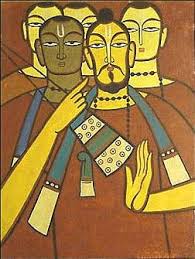
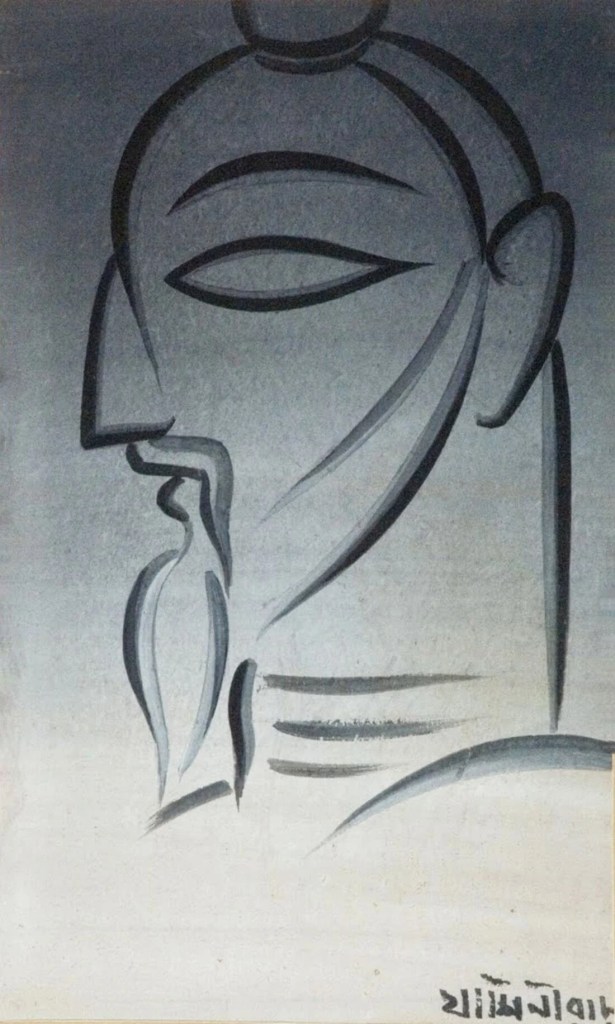
Bauls by Jamini RoyBaul Singer by Jamini Roy Paintings by Jamini Roy (1887-1972). From Public Domain
Religious movements such as Bhakti and Sufi have spanned time and territory and entered Bengal, in successive waves, creating a syncretic culture in which music and poetry are amalgamated. One of the forms in which these movements find creative expression is Baul Gaan —the singing of itinerant minstrels.
Universally recognised as foremost among the oralities of Bengal, the Baul Sampradai is a community for whom singing is synonymous with worship. The Baul expounds a philosophy of humanism which rejects religious orthodoxies and stresses human equality irrespective of caste, class, religion and gender. The Baul sets himself on a spiritual journey, lasting a lifetime, towards discovering his moner manush (man within the heart) thereby alienating the notion of seeking the Divine in external forms such as mosques, temples, images and sculptures. Since God is believed to reside within man, the human body is viewed as the site of the ultimate truth –that which encompasses the entire universe. This tenet of Baul philosophy is known as deha tatwabad—the belief that the soul being pure the body that houses it, together with all its functions, is pure and holy.
Concentrated mostly in Kushthia, Shilaidaha and Sajadpur in East Bengal (now Bangladesh) and Murshidabad and Birbhum in West Bengal, the Baul tradition, though drawing elements from Tantra, Shakta and Sahajiya[1], stems from two main sources — Muslim Sufi and Hindu Vaishnav. Hence the simultaneous presence of Hindu and Muslim bauls in the villages of Bengal and great composers from both streams—Lalon Fakir, Duddu Shah, Madan Baul, Gagan Harkara and Fakirchand. Rejecting religious codes such as Shariat and Shastras, caste differences, social conventions and taboos, which they see as barriers to a true union with God, they sing of harmony between man and man. “Temples and mosques obstruct my path,” the Baul sings, “and I can’t hear your voice when teachers and priests crowd around me.”
Refusing to conform to the conventions of religion and caste ridden Bengali society, Bauls (the word is sourced from the middle eastern bawal meaning mad or possessed) are wandering minstrels who sing and dance on their way to an inner vision. Essentially nomadic in nature walking, for them, is a way of life. “No baul should live under the same tree for more than three days” — the saying seems to stem from the Sufi doctrine of walking an endless path (manzil) in quest of the land where the Beloved (the Divine) might be glimpsed. Bauls live on alms which people give readily. In return the Baul sings strumming his ektara[2] with dancing movements. The songs are rich with symbolism, on the one hand, and full of ready wit and rustic humour on the other. The Baul rails against the hypocrisy of religion and caste and takes sharp digs at the clergy but totally without rancour.
Many of the composite forms found in an older culture of Bengal have become sadly obscured in the present scenario of identity politics. But the one that has not only survived but is gaining in recognition day by day, is the Baul tradition. This is, in no small measure, owing to the intervention and interest taken by Rabindranath Tagore. In his Religion of Man Rabindranath tells us that, being the son of the founder of the Adi Brahmo Samaj, he had followed a monotheistic ideal from childhood but, on gaining maturity, had sensed within himself a disconnect from the organised belief he had inherited. Gradually the feeling that he was using a mask to hide the fact that he had mentally severed his connection with the Brahmo Samaj began tormenting him. And while in this frame of mind, travelling through the family estates in rural Bengal, he heard a Baul sing. The singer was a postal runner by the name of Gagan Harkara and the song was “Ami kothai paabo tare/ amaar moner manush je re[3].”
“What struck me in this simple song,” Rabindranath goes on to say, “was a religious expression that was neither grossly concrete, full of crude details, nor metaphysical in its rarefied transcendentalism… Since then, I’ve often tried to meet these people and sought to understand them through their songs which are their only form of worship.” In his Preface to Haramoni[4], Rabindranath makes another reference to this song. Quoting some lines from the Upanishads— Know him whom you need to know/ else suffer the pangs of death— he goes on to say, “What I heard from the mouth of a peasant in rustic language and a primary tune was the same. I heard, in his voice, the loss and bewilderment of a child separated from its mother. The Upanishads speak of the one who dwells deep within the heart antartama hridayatma[5]and the Baul sings of the moner manush. They seem to me to be one and the same and the thought fills me with wonder.”
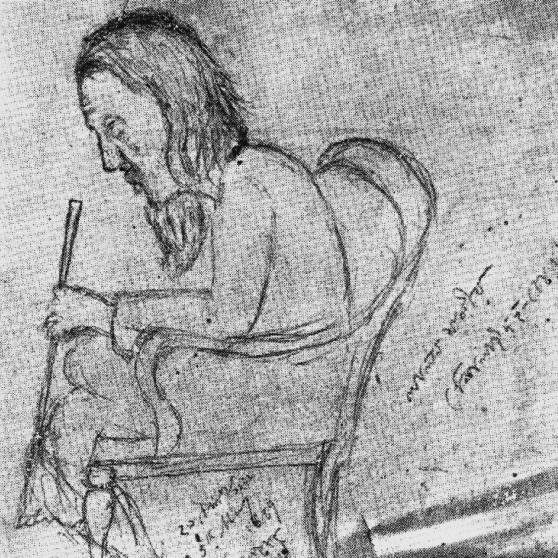
A Portrait of Lalon Fakir sketched by Jyotindranath Tagore(1849-1925)
Lalon Fakir’s commune was located in the village of Chheurhia which fell within Rabindranath’s father’s estates. Though there is no authentic record of a meeting between the two, it is a fact that the poet was the first to recognise Lalon’s merit which had the quality of a rough diamond. His inspiration was powerful and spontaneous but, lacking in clarity of expression, lay buried in obscurity till Rabindranath brought it out into the open. Publishing some of the songs in some of the major journals of the time, Rabindranath took them to the doors of the educated elite. Not only that. They gained in popularity from the fact that he, himself, often used Baul thought and melody in his own work. “In some songs,” he tells us in his Manush er Dharma[6], “the primary tunes got mixed up with other raags – raaginis which prove that the Baul idiom entered my sub conscious fairly early in life. The man of my heart, moner manush, is the true Devata[7]. To the extent that I’m honest and true to my knowledge, action and thought — to that extent will I find the man of my heart. When there is distortion within, I lose sight of him. Man’s tendency is to look two ways — within and without. When we seek him without — in wealth, fame and self- gratification — we lose him within.”
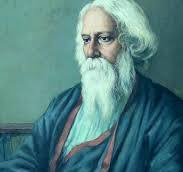
But it wasn’t only in his compositions that Rabindranath disseminated Baul ideology. It went deeper than that. The primitive simplicity and freedom of Baul thought and living charmed him so completely that he started imbibing them in his own lifestyle. He grew his hair long, kept a flowing beard and wore loose robes. He created Baul like characters in his plays and dance dramas and enacted the roles himself. And, as he grew older, a restlessness; an inability to stay in one place took hold of him. Leaving the ancestral mansion of Jorasanko he relocated to Santiniketan but even there he could not stay in the same house for more than two months. In the last two and half decades of his life, a tremendous wanderlust seized him. He travelled extensively both within the country and without, earning for himself the sobriquet of ‘roving ambassador for India’.
Perhaps, the most powerful testimony of the evolution of Rabindranath from a princely scion of the Tagores of Jorasanko to the man he finally became is found in Abanindranath’s portrait of his uncle. It depicts an old man with flowing white locks and beard, wearing a loose robe and holding an ektara high above his head. The limbs are fluid in an ecstatic dance movement. It is a significant fact that the painting is titled Robi Baul.
Robi Baul (1916): Painting by Abanindranath Tagore (1871-1951). From Public Domain
[1] Different schools of philosophy and religion. The Sahajiya is a philosophy that embrace nature and the natural way of life.
[3] Translates from Bengali to: “Where will I find Him — He who dwells within my heart”
[4] The Haramoni (Lost Jewels) is 13-volume collection of Baul songs compiled by Mansooruddin to which Tagore wrote the preface for the first volume published in 1931
[5] Translates to ‘innermost part of the heart and soul’
[6] Collection of Lectures by Tagore in Bengali, published in 1932
Aruna Chakravarti has been the principal of a prestigious women’s college of Delhi University for ten years. She is also a well-known academic, creative writer and translator. Her novels, Jorasanko, Daughters of Jorasanko, The Inheritors, Suralakshmi Villa and The Mendicant Prince have sold widely and received rave reviews. She has two collections of short stories and many translations, the latest being Rising from the Dust. She has also received awards such as the Vaitalik Award, Sahitya Akademi Award and Sarat Puraskar for her translations.
.
PLEASE NOTE: ARTICLES CAN ONLY BE REPRODUCED IN OTHER SITES WITH DUE ACKNOWLEDGEMENT TO BORDERLESS JOURNAL
Raja O Praja, an essay by Tagore, has been translated from Bengali as The King and His Subjects by Professor Himadri Lahiri. It formed the lead essay in his book of the same name published in 1908.
Translator’s Introduction: Rabindranath Tagore’s essay “Raja O Proja” was first published in the well-known Bengali periodical Sadhana (Sravana, 1301/1894). It is anthologised in Rabindra Rachanabali (Sulabh Sanskaran) 5th volume (Visva-Bharati, Pous 1394): pp. 727-31. Tagore unravels the nature of the relationship between the colonial masters and the subjugated subject people. Much before Edward Said, Tagore examined how the colonial masters resorted to the practice of stereotyping, a strategy that denies human qualities to the colonised and renders them inferior and uncivilised. Set against the contemporary political background, the essay provides an incisive analysis of the behaviour patterns of both the British colonial government and the subjugated Indian population. It should be considered a significant contribution to the study of colonialism.
The King and his Subjects
When the British civilian, Radice Sahib1, insulted and persecuted a certain zamindar in Orissa by violating laws, Lieutenant-Governor MacDonnell2subjected the offender to a one-year-punishment.
If we reflect on this incident, it should not have surprised us. In reality, however, this act of justice was incredibly startling to the general public. This explains why some naive individuals expressed their unusual delight.
Shortly afterwards, when MacDonnell Sahib was duly replaced by Elliott Sahib3, the latter freed Radice from the punishment by illegally reversing his predecessor’s order and even promoted him to a higher post. Now the same naive people have started expressing their profound sorrows.
The task is accomplished by the will of the master. Only the master knows why he [i.e. Elliott] violated the rule; we are left desperately groping in the dark. It may be that one civilian protected the prestige of another. But the decision was surely inappropriate – this incident dented MacDonnell Sahib’s prestige, and even that of the government.
In course of their conjectures, people are providing different theories; all of these may turn out to be incorrect. On the whole, it may be said that only the government knows the ins and outs of its own policies; we are merely blind puppets being controlled by these policies.
Hence, it is my opinion that driven by our delusions, we instinctively express our happiness and sadness at the moral and immoral decisions of the people at the helm of affairs. Where everything is done at the master’s will, where our good fortune or bad depends greatly on the character and whim of a particular person, there we should consider both the auspicious and the inauspicious, the moral and the immoral as merely momentary, accidental episodes. What MacDonnell Sahib did was the result of his own will, and what Elliott Sahib did was also produced by his own caprice; we are merely ruses.
Even then, we cannot help feeling distressed or shocked by the appalling events or delight at their praise. But we should always remember the specific instances that will make us happy and contribute to our people’s glory.
This can be achieved only when all the common people develop so intense a sense of conscience and alertness that we can feel the pain together in the face of insult and injustice, and also when the government absorbs into its own system an obligation to respect the conscience of the people; only then can we genuinely rejoice.
Usually, our moral conscience, our understanding of our work culture, and our apprehension of vilification all combine to guide us to the path of duties. The principles of responsibilities of our governments are largely determined by moral conscience and work culture. Their connection with the subject people’s ideology of good and evil is very weak.
It is universally known that when conscience comes into conflict with work culture, the latter sometimes prevails. During this conflict, the moral compass of those individuals not involved in the conflict can help reinforce one’s own conscience. When we will find the subject people’s criticism being appropriately reflected in the government’s activities, we will express our happiness.
In the absence of the subject people’s criticism, the sense of moral duty of the British in India imperceptibly slackens and degenerates to such a level that their moral ideals begin to radically differ in nature from those of the native British. For this reason, we find on the one hand, the Englishmen in India hate us, and on the other, they express their utmost intolerance towards their own countrymen’s opinions, as if both were alien to them.
There might be several reasons for this. One reason is that due to the remote location of their country, the British in India forget how social criticism typically motivates or impacts actions of their own countrymen. In addition to this, the Englishman’s relationship with us is primarily based on selfish interest as they do not share any emotional bond that stems from nation-based kinship. Hence, for various reasons, it becomes challenging for the British in India to maintain the same purity of selfless duties towards their subjects. Consequently, a distinct and specific code of duty begins to develop for the colonials in India – this arises from various factors such as their self-interest and pride of power, the moral conscience of the weak, subjugated nation, and the complexities involved in administering a foreign country. The English of England sometimes fail to recognise this distinct code of duty.
Certain talented Englishmen with exposure to colonial India have taken upon themselves the responsibility of effectively introducing this unique object [i.e., this new ideology of difference] in England. By virtue of their talent, they are demonstrating that this new object has its own unique appeal.
Rudyard Kipling’s name may be cited as an instance. He has exemplary power. By invoking that power, he has created in the English imagination an image of the Orient as a cattle pen. He is trying to convince the native Englishmen that the Indian government is, indeed, a circus company. He is skillfully orchestrating our actions as a performance of strange and spectacular animals of various species before the civilised world, implying once the spectators take off their steady gaze, all the animals could immediately spring upon them. The animals are to be observed with intense curiosity, they will have to be kept under control with the proper combination of fear of the whip and temptation of pieces of bone. Of course, certain doses of compassion for animals are also required. But if you raise here issues of principles, love, and civilisation, it will be difficult to keep the circus going, and it will also be dangerous for the proprietors.
The image of strong human animals being controlled solely by willpower and compelled to dance at the mere gesture of the master’s finger is likely to fascinate the English as a curious spectacle of entertainment. This generates in them an interest in the uniqueness of the human animal and also a racial pride. There is also a profound satisfaction in being able to control someone who embodies an imminent threat, and this seems delightful to the inherent nature of the English people.
On another front, the number of Anglo-Indian team members is also increasing day by day. Anglo-Indian literature too is gaining popularity. The influence of Anglo-Indians is gradually finding roots in the English soil, spreading its branches all around. In this context, it should be mentioned for the sake of justice that many Anglo-Indians, after retiring from their assignments in India, have displayed extreme benevolence towards the helpless Indians.
For all these reasons, many native English people are sceptical about whether it would be a quixotic stupidity for them to discharge to the oriental animals those duties usually reserved for themselves, whether this act of showing equality will reveal the civilised islanders’ intellectual narrowness and inexperience, and whether this would also harm animals of various species. English philosophers such as Herbert Spencer believe that it is not only inevitable that moral ideals vary according to the standard of civilisation but also necessary according to the norms of evolution.
The truth of these opinions will be judged on some other occasion. For the time being, I can only say that its (i.e., the practice of treating Indians unequally) consequences are very painful for us. Apprehending an uprising after noticing some posters on trees in the state of Bihar, opinions have been expressed in several English newspapers that a genuine union of love is never possible between Oriental and Occidental races. The former has to be subjugated forcibly by means of fear of threats. All these, it seems, are being expressed more openly these days than ever before.
Our opinion is that even if we admit that the principles of duty in freedom-loving Europe may not be suitable for application in every corner of the ever-subjugated Orient, it is indeed an unrealistic dream for them to maintain the usual rhythm of the Oriental life here for the simple reason that our king is a European. If our country were free, the monarchy that would have evolved in the natural process in this Oriental space would surely have been different in multiple aspects. It may be that, from one perspective, the king’s excessive power would have appeared greater than it is now. Similarly, from another perspective, the subjects, by limiting the king’s authority, would have channelised their own desires in various forms and through multiple avenues. Natural compatibility can be best expressed through natural means. Howsoever they may want, the English cannot achieve that (artificially) just through policy making.
Hence, the Englishmen can behave with us just in the way they do; if they willingly distort it, that will amount to misbehaviour, it will never become an Indian behaviour. They can break their own ideal, but in its stead what will they build and how? However, the English, fallen from their ever-familiar native ideal, may turn out to be big, ferocious animals. From the hints of cruelty, laced with aggression of power, that we can trace in the works of authors like Rudyard Kipling, it seems that man often wishes to jump into the primitive barbarity of wild nature of the forest by ripping through the fine, hundred-threaded strong net of civilisation. On their arrival in India, the Anglo-Indians taste the exquisite wine of power that may create this overwhelming intoxication. The natural, spontaneous embodiment of masculinity in the writings of these loveless, difficult, power-boasting talented men has a kind of extreme fascination. That is literature for the English but for us, it is indeed a recipe for death.
Secondly, the way authors in their contemporary novels represent the Orient as appearing mysterious to the Occident is largely fictitious. There are numerous intersections between us. The similarities of the heart are often overshadowed by external differences. Modern writers tend to apply colour to, and even exaggerate, the unfamiliarity of these external features to please the readers; they do not try to unearth the similarities lying deep within, neither are they capable of doing that.
The significance of making all these statements is simply this: the idea that European values are exclusively meant for Europe is gradually spreading not only in India but also in England. Indians are supposedly so different a race that the civilised values are not completely applicable to them.
Under such circumstances, if our ethical values become strong, the policy of governance cannot go off the right track. When the English are conscious of the fact that their actions are being closely watched by the entire Indian population, they will not be able to do anything by completely disregarding India.
Recently, some evidence of this is being noticed. When India witnesses some misdeeds committed by the English, she begins to call for justice in her own feeble voice, invoking civilisational and moral values. This naturally angers the colonials, but at the same time, they are forced to remain somewhat vigilant.
Even then, full results are yet to be seen. The British consider it an admission of their weakness to adhere to codes of values that exhibit respect towards us all the time and under all circumstances. They find it insulting and harmful if one of them commits a crime against us and is punished by the law. They fear that Indians will perceive it as curtailment of power.
It is impossible for us to identify the nature of thoughts of government officials. However, I feel the untimely promotion of Radice Sahib can be linked to the above policy. This suspicion is reinforced specially when such an event is found to have occurred repeatedly. The government is, as if, silently declaring, it is your audacity to expect an English official to be humiliated for harassing and insulting one of you. Even if we have to violate conventions and neglect the rules of governance to crush that audacity, it will be desirable. The English race is greater than the norms of ethics, they are beyond the jurisdiction of justice!
For the sake of truth, it has to be admitted that the government tends to keep not only the English but also its own employees a notch above the rule of justice. This has been observed in one or two contemporary incidents. In the Baladhan4 murder case, all those involved, right from the English judge to the Bengali police personnel who were openly blamed in the judgement of the High Court, have been rewarded and encouraged by the colonial Bengal government.
We are individuals outside the realm of politics, we are not familiar with its internal complexities. There might be a hidden motive behind it [the government’s decision]. The authorities may believe that the local judge in the Baladhan case did not issue an incorrect ruling – around five to seven individuals should have been hanged in some manner. They might have nurtured a biased opinion that the incident in reality happened despite the lack of concrete judicial evidence, and that only the local judge could have determined the truth which was inaccessible to the High Court judge.
We want to say that openly rewarding, instead of punishing, individuals who have been publicly condemned by the highest court of the country, who have been proven guilty in the eyes of the public, amounts to the disregard of the moral judgment of the public. Everyone’s told we do not feel the need to offer any explanation to you about our duties. The government is not bothered about whether you praise or criticise it – our government is strong enough to withstand such scrutiny!
The governor who demolishes the anguish and moral judgement of the subjects under his shoes, and drowns their feeble, insecure voices beneath the marching sounds of their feet, is indeed a strong ruler in Anglo-India!
It is unnecessary to disclose whether this highlights their power or reveals our utmost weakness. This insolent disregard of the government suggests that, in its view, the moral judgement of the Indians is not strong enough to evoke a feeling of embarrassment in them. Instead, this unapologetic recklessness seems to them as the manifestation of a genuine power over an ever-oppressed nation.
If we can really convince the agents of the government that we do not consider the violation of ethics as bravado, that injustice, however powerful it may appear, is held as equally despicable and reprehensible in our Oriental system of judgement, and that the lack of courage to dispense justice everywhere firmly and impartially is also considered by us as a sign of weakness, only then the English would be forced to respect our norms of duties. The reason is that they will be able to discover the correspondence between our ideal and their own.
When we forget the bitter lessons of our prolonged subjugation, when we decide not to consider the injustice of the powerful as the manifestation of divine will — something that must be endured in silence — when we consider attempts at the redressal of injustice, even if it fails, as our duty, and when for these reasons, we stop being averse to sacrifice ourselves and bear pains, only then the days of true happiness will bloom. At that point, the sense of justice of the British government will never be derailed by any selfish policy and eccentricity of any individual; it will stand like a resolute mountain firmly based on the foundation of the subjects’ hearts. At that time, good gestures of the government will not accidentally be showered on our bowed heads like momentary favours; we will, on the contrary, accrue them as respect. What we are getting as alms today will be received as our rights.
Questions can be raised – offering advice is easy, but what about the solution? To that, we may retort that no proper bliss can be achieved by clever strategies alone; for that we have to pay the entire price due to it. All of us must strive to our utmost potential, proper lessons should be imparted to siblings and children in every household, a strong ideal of justice needs to be established in both the family and society, and careful attention must be paid to one’s own behaviour. Like all good advice, this too is easier to hear, difficult to implement, and is indeed age-old. However, there is no new, short-cut or hidden path other than this long, open, and ancient highway.
Translator’s Notes:
1. Mr. C.A. Radice belonged to the Indian Civil Service cadre during the late nineteenth and early twentieth century. He was posted as an Assistant Magistrate and Collector in Murshidabad in 1890 and was “vested with third class powers” (Appt. File 5C—4. Proceedings B. 1—3, Ja. 1890). He was ‘degraded’ for “prosecuting Babu Radha Shyam Nissanta Mahapatra, zaminder of pargana Balinkandi in the district of Balasore” [Judl. File J-1P—113(1-21), Proceedings 134-55, Aug. 1893]. Radice’s ‘reversion’ to 2nd grade became effective in February 1895. [(Appt., File 6C—8(3.8). Proceedings B. 716-21, Feb. 1895)]. The translator of this essay traced these pieces of information in the entry on “Radice, C.A. Mr., I.C.S.—” pp. 1126-1128. Kindly see: https://sadte.wb.gov.in/uploads/pdf/D12/D1224.pdf
2. Antony Patrick MacDonnell (1844–1925) joined the Indian Civil Service in 1865. He was the Lieutenant-Governor of Bengal during the period 1893-1895. MacDonnell was respected as an expert on the Indian land reformation and famine relief. “His sharp temper and unwillingness to tolerate inefficient subordinates earned him the nickname ‘the Bengal Tiger.’” Kindly see the entry on “MacDonnell, Antony Patrick” contributed by Patrick Maume, in Dictionary of Irish Biography. https://www.dib.ie/biography/macdonnell-antony-patrick-a5180.
3. Sir Charles Alfred Elliott (1835-1911) was the Lieutenant-Governor of Bengal during the period 1890-1893. Tagore’s reference to MacDonnell being replaced by Eliott is confusing because Eliott indeed preceded MacDonnell, and did not succeed him.
4. Tagore refers to an incident which is popularly known as “Baladhan Murder Case.” It took place in Baladhan Tea Garden in the Cachar district of Assam on 11 April, 1893. Several persons barged into the manager’s bungalow in the tea garden at night and killed the manager (Mr. Cockburn) and the chowkidar and seriously wounded Mr. Cockburn’s Indian paramour named Sadi. Money and other valuables were looted. Later six Manipuris and a Gurkha were arrested. They were tried by the sessions judge John Clark (and a panel of three Indian assessors) at Sylhet who sentenced four of the accused to death. Babu Kamini Kumar Chanda took up the case to Calcutta High Court which acquitted all the accused (Sanajoba 234). “On December 11, 1893, Calcutta High Court Judges Ameer Ali and H.T. Prinsep acquitted all of the prisoners on account of the many ‘irregularities’ and ‘illegalities’ committed during the police investigation and trial, as well as the lack of corroborating evidence” (Kolsky 145).
See pp.142-48 [in Chapter 4 titled “One scale of justice for the planter and another for the coolie”: law and violence on the Assam tea plantations” (pp. 142-184)] in the book Colonial Justice in British India edited by Elizabeth Kolsky (Cambridge University Press, 2010) and p. 234 of Th. Babachandra Singh’s chapter “The Manipuris in the Politics of Assam” (pp. 213-36) included in the book Manipur, Past and Present: The Heritage and Ordeals of a Civilization, Volume 4 (Pan-Manipuris in Asia and Autochthones), edited by Naorem Sanajaoba, Mittal Publications, 2005. (Google book link: https://books.google.co.in/books?id=CzSQKVmveUC&printsec=copyright&redir_esc=y#v=onepage&q&f=false)
.
Himadri Lahiri retired as Professor of English, the University of Burdwan, West Bengal, India. He is currently teaching English at Netaji Subhas Open University, Kolkata.
PLEASE NOTE: ARTICLES CAN ONLY BE REPRODUCED IN OTHER SITES WITH DUE ACKNOWLEDGEMENT TO BORDERLESS JOURNAL

 Borderless