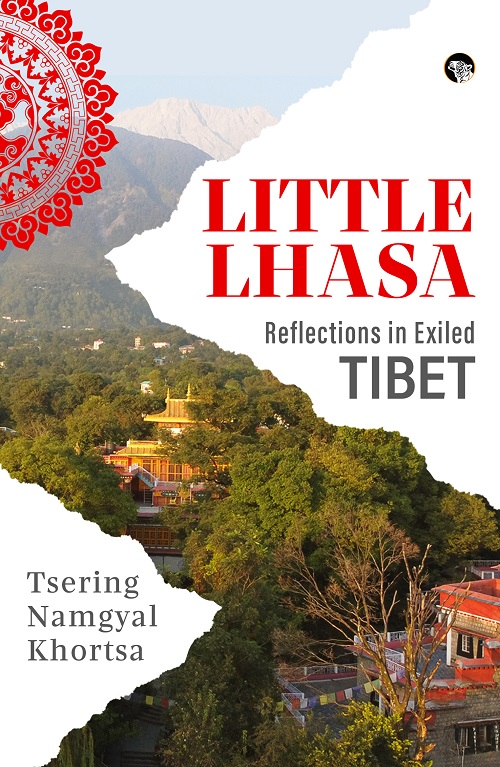
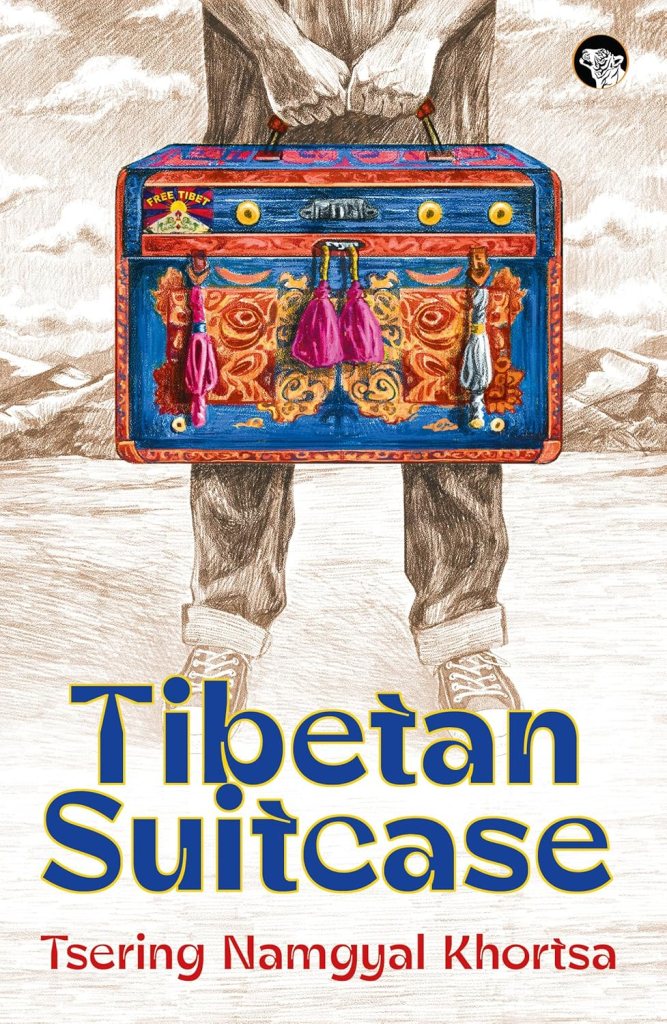
Titles: Little Lhasa: Reflections in Exiled Tibet and Tibetan Suitcase
Author: Tsering Namgyal Khortsa
Publisher: Speaking Tiger Books
Following the forced escape of His Holiness the Dalai Lama in March 1959, thousands of Tibetans were forced to flee Tibet, and it was these refugees who formed the early exiled community. The refugee community now stands at a figure of around 130,000, with Tibetans spread across numerous settlements in India, Nepal and Bhutan, and thousands more displaced all around the world. The Tibetan government in exile is based in Dharamsala, India. It is called the Central Tibetan Administration (CTA) and was founded in 1959 by the 14th Dalai Lama. In the 1980s, a second wave of Tibetans fled due to political repression. The CTA advocates for human rights, self-determination, and the preservation of religion and culture for Tibetans. The CTA has a parliament, judiciary, and executive branch and its principles include truth, non-violence, and genuine democracy. The Dalai Lama has said that the exile administration would be dissolved as soon as freedom is restored in Tibet.
After over seventy years of being in exile, a whole generation of Tibetans have come of age in a land far from home. With the Dalai Lama and other great masters as their spiritual guides, they have grown up cut off from their homeland. Their experiences have been unique, as they have, despite globalization, kept alive their religion and culture. In Little Lhasa: Reflections in Exiled Tibet, Tsering Namgyal Khortsa writes comprehensively about the different aspects of their life today. Comprising of ten essays and six interviews, this volume becomes an eye-opener on the multifarious aspects of the present situation of Tibetans at large. Beginning with different writers writing about Tibet and exile in the very first essay titled ‘Little Lhasa’, the next one ‘Shangrila Online’ tells us about the role of social media, internet cafes and how technology in remote Dharamsala often enables one to participate in other people’s experiences in real time. The writer describes in detail how such lifestyle changes in contemporary times have enabled the creation of a “virtual Tibet”. In the next essay ‘Buddha’s Children’, Khortsa describes the young generation of exiled children in India and how their religious identity has triumphed over all other identities. We are also told about the different kinds of foreigners who come to India to take religious courses, and the writer wonders whether they go home feeling merely inspired by their visit to India and their meetings with Tibetan masters or whether such exposure and experience actually triggers a paradigm shift in the way they view the world.
In the next essay we are told how Tibetans lead demonstrations in Dharamsala and other parts of India every year, especially the one held on March 10th that commemorates the anniversary of the failed uprising against Chinese invasion. ‘Movies and Meditation’ mentions a film festival in Dharamsala which reveals how recent Tibetan films highlight a growing and vibrant filmmaking community within the Tibetan diaspora, but Khortsa laments the paucity of full-length films about Tibetans in exile and the issues they confront, namely patriotism, individualism, and reconciliation of personal fulfilment with the Tibetan cause. The titles of the three following essays, ‘Dharma Talk’, ‘The Lure of India’ and ‘The Monk at Manali’ are self-explanatory. The last essay of this section ‘Nation of Stories’ tells us about writers who write and publish in the English language, and though diverse in terms of their education, upbringing, background and geographical location, one common condition that they all share is the collective trauma of the Chinese occupation of Tibet, which is invariably a leitmotif in Tibetan literature.
Part Two consists of six interviews, each one different in perspective than the other, and they must be mentioned here to understand the kaleidoscopic nature of the people involved in the Tibetan cause. Thus, we have conversations with Lisa Gray as ‘A Western Buddhist’, Ananda Nand Agnihotri as ‘An Indian Tibetan Buddhist,’ Ngawang Woeber, ‘An Ex-Political Prisoner’, Nyima Dhondup, ‘A Swiss Tibetan’, Tenzing Sonam, ‘A Tibetan Writer and Filmmaker’ and Tenphun, ‘The Tibetan Poet’. All in all, Little Lhasa becomes a valuable record of the life of a people who refuse to bow down or forget, and even while adapting to a rapidly changing world, continue to nurture their roots.
II
After the non-fiction, Tsering Namgyal Khortsa comes up with a brilliant piece of fiction and read together, each text complements the other beautifully. In the ‘Editor’s Note’ at the very beginning of the novel Tibetan Suitcase, Tsering Namgyal Khortsa tells us that while he was working as a business journalist in Hong Kong he once ran into Dawa Tashi, an old acquaintance and an aspiring novelist from Dharamsala, India who was working as a meditation teacher and was quite busy with his job. He had a suitcase full of letters and documents and wanted him to turn the contents of the suitcase into a book. After going through the collection, Khortsa discovered that the contents of the suitcase, if organized with care and discipline, could indeed make for an epistolary novel. So, he declares that except for correcting a few typos here and there and add note and datelines to the letters, he had not done anything. He also categorically states, “None of the letters are mine, except some entries that I wrote, making the book partly fictionalized.” He also wanted to leave room for readers to imagine (or ‘feel’ for themselves) what is not mentioned in the book, in deference to the Tibetan culture of reticence and taciturnity, rather than turning himself into an all-knowing chatterbox.
Tibetan Suitcase is a remarkable novel about the peripatetic Tibetan community in exile. It is divided into six parts, beginning roughly from 1995 to 2000. It opens in Hong Kong where a tycoon Peter Wong opens a meditation centre and employs Dawa Tashi, our protagonist as a meditation teacher and a guru, though he is not really trained to be a lama. Dawa Tashi is an India-born Tibetan. His parents fled Tibet when the Chinese invaded, and Dawa has grown up in the quiet, verdant Indian Himalayas. When Dawa applies to a well-known university in America (Appleton University in Wisconsin) to pursue a course in creative writing, his hitherto ordinary life changes dramatically. At the university he befriends, and falls in love with, Iris Pennington, an unusual American student who is studying Buddhist literature. He also comes in contact with Khenchen Sangpo, a renowned scholar of Buddhism and a reincarnated Rinpoche himself. Circumstances lead Dawa back to India too soon, but the connections he makes take his life into many new directions. Some, with Iris and Khenchen, take him deeper into the mystical and mysterious world of Buddhist scholarship. Other journeys take him back to his roots, making him question his life’s directions.
Apart from the interesting incidents and characters we meet in the first four parts of the novel, Part Five is an exceptionally engrossing to read. Beginning with the reportage in the Fall Issue of the journal Meridian, which is edited by Brent Rinehart, we are told that on his seventy-ninth birthday Khenchen decided that he had to go back to Tibet to see his native land. Having gained a quick residency status in the United States, and possessing an American passport, Khenchen still had many relatives in Tibet, some of them quite alive and well, despite the Chinese occupation. He travels to Lhasa in 1996 and goes for a trip to Lake Manasarovar but things take a different turn when he is arrested by the Chinese authority because he was apparently “endangering national security”. What follows are different press releases from the US Statement Department, reports from the International Association of Tibetan Studies in London, address by the President of Appleton University and as Iris writes to Dawa, she never expected herself to be so politically involved and “did not realize Tibet was such a political subject”. It was ironic that one of the world’s most spiritual places was one of its most burning political issues. Tibet might be a small place, but it has a reasonably big space in the collective consciousness of the world. Of course, Khenchen Sangpo is ultimately released and without disclosing the actual ending of the novel, which in a circular fashion ends in Hong Kong from where it began, many loose ends are tied up and life came to a full circle for everybody, especially for Iris Pennington who finally managed to find her roots.
Both the non-fiction and the fiction book by Tsering Namgyal Khortsa prove to be eye-openers for all readers who have very little knowledge about the sorrow and plight of the uprooted Tibetans who live in exile and many of whom do not even have a country to call their own. Based in Dehradun, India at present, Khortsa’s narratives are so powerful that it has aptly prompted Speaking Tiger Books to reprint the updated versions of both the books in 2024 and one can call it a yeoman service to readers both serious and casual. A must read.
.
Somdatta Mandal, critic and translator, is a former Professor of English at Visva-Bharati, Santiniketan, India.
.
PLEASE NOTE: ARTICLES CAN ONLY BE REPRODUCED IN OTHER SITES WITH DUE ACKNOWLEDGEMENT TO BORDERLESS JOURNAL
I sipped on my cup of piping hot, sugary tea at Kardang monastery, twelve thousand feet above sea level. The chomo who prepared it chatted away the details of the snow festival that happened a few months ago. The edges of her maroon robes fluttered in the wind. ‘Chomo’ — I learned a new word that day – in Tibetan, it means a female Buddhist monk.
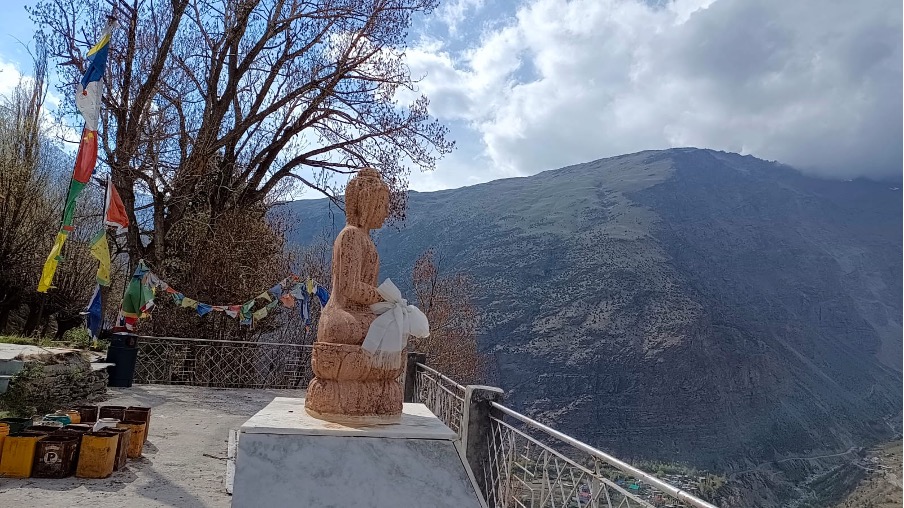
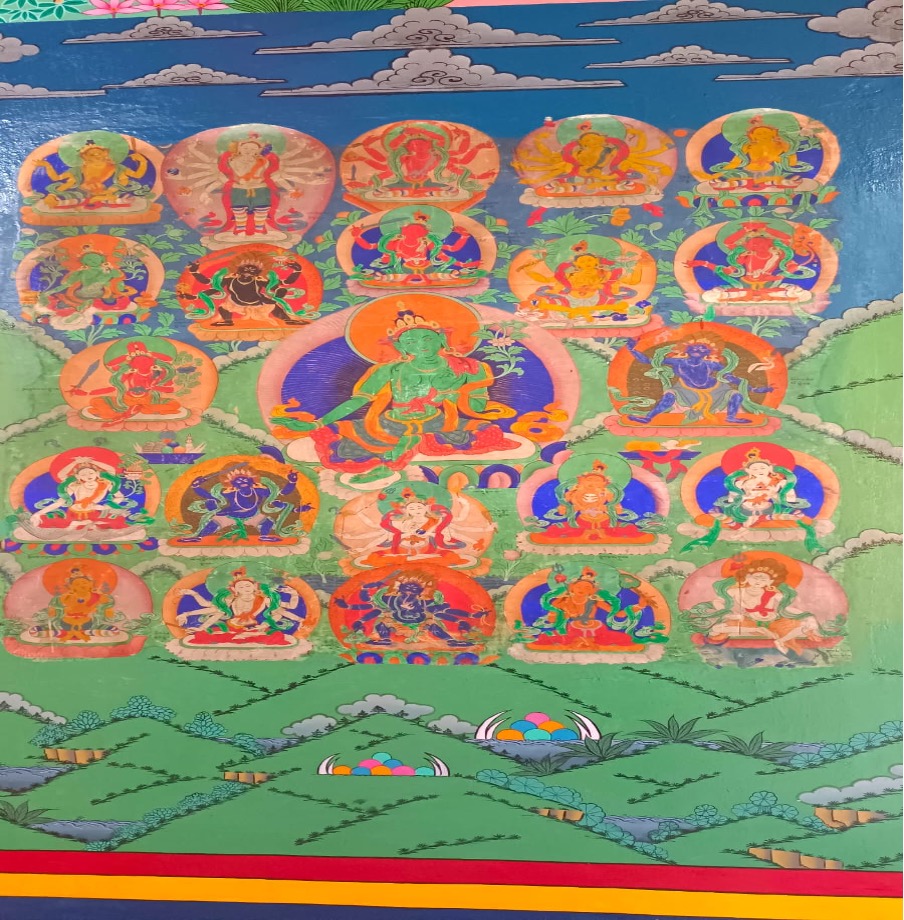
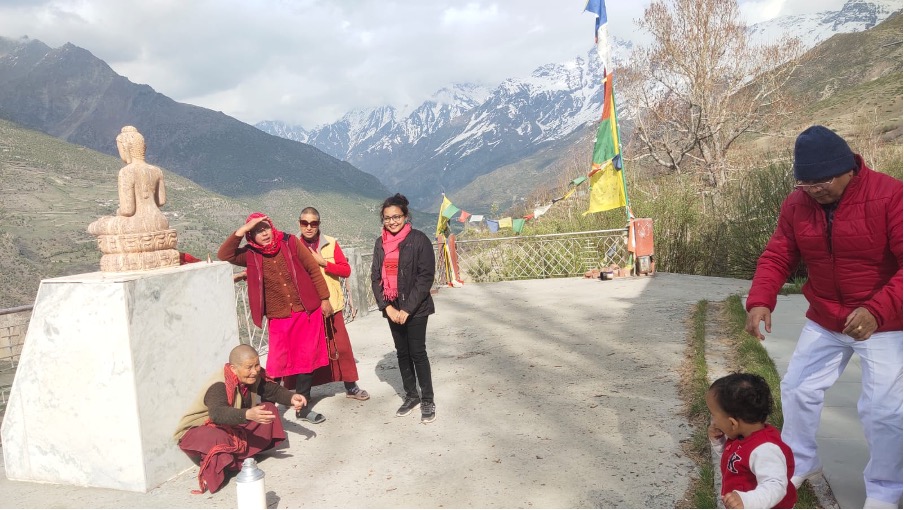
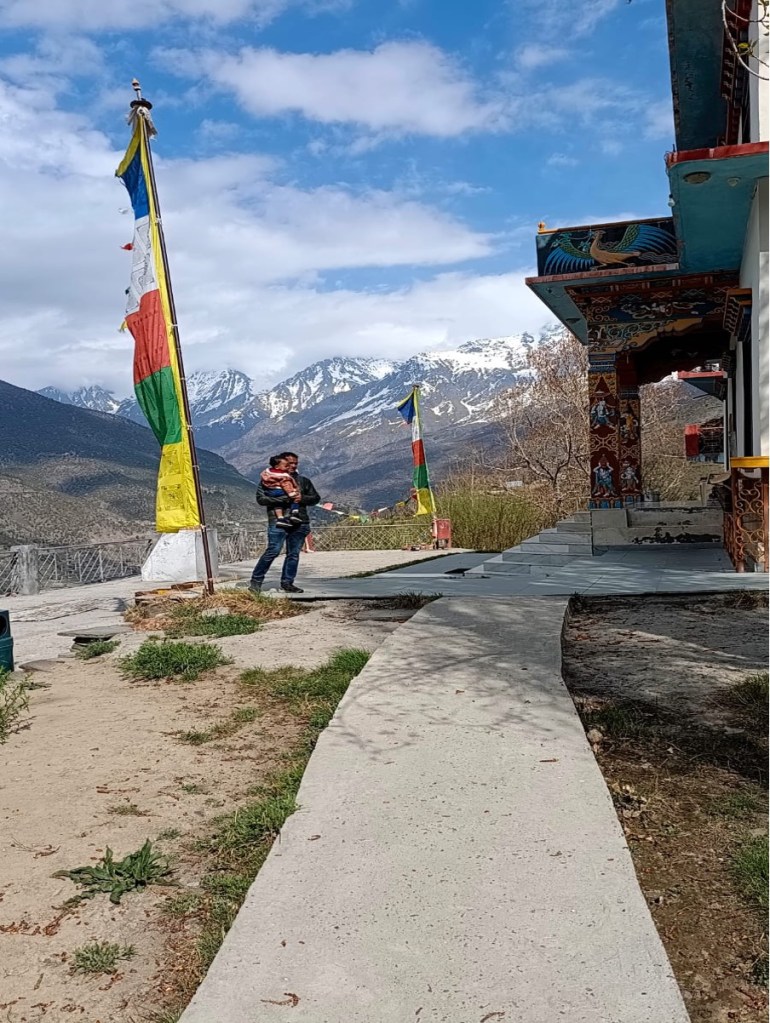
The monastery is an important one of Drukpa lineage[1] built in the twelfth century. The beautiful white facade with gold details gleamed in the sunlight. Intricate thangka paintings adorned the walls and ceiling of the monastery. It was perched on the barren mountain of Lahaul with multi-coloured Buddhist flags swaying in the wind. An imposing statue of Lord Buddha sat in the courtyard, looking over the whole valley. There was still some snow on the mountain tops, spring had just set in.
The chanting of the lamas filled the air. It was part of the evening ritual. Gentle drum beats punctuated the chanting. I felt fortunate to be in such a tranquil space. It was a happy concoction of the high altitude, the rhythmic rituals, and the lack of human habitation around the monastery that left me in a self-contained peace bubble.
A thangka painting
“How did you know about this place? Not a lot of tourists come here,” the chomo asked me with a twinkle in her eyes. My mind browsed through the incidents that led me here.
It all started two years ago. My penchant for zoning out to Tibetan chanting mantras on YouTube, and love for off-beat places in the Himalayas led me to some serious research. Lahaul district in Himachal seemed to fit the bill perfectly to get a taste of both. It was easily approachable from Manali, where my family could stay with all creature comforts. Our travel group included our one-year-old son and elderly parents.
The beautiful monasteries in dramatic mountainous settings were as much a reason to visit Lahaul as the adventure to travel to such harsh terrains. We based ourselves in Manali and acclimatised ourselves for a few days before climbing to twelve thousand feet. We hired a local car and driver to visit the Lahaul district. When we told our local driver that we wanted to go to the Kardang monastery, he looked at us blankly. It dawned upon me that it was even more remote than I had realised.
We started from Manali towards the Atal tunnel, a nine-kilometre-long highway underpass in the Pir Panjal range of Himalayas, on the Manali- Leh highway that connects two districts of Himachal. The Atal tunnel was opened in October 2020 after several years of work and today connects the remote Lahaul district with the rest of Himachal.
We left the verdant coniferous forests and mountains with gushing streams on one side of the tunnel and gaped at the dry snowy mountains with freshly sowed fields at the base of the mountains of Lahaul on the other side. It was a dry desert with farming done in little patches at the base of the mountains. The difference was stark.
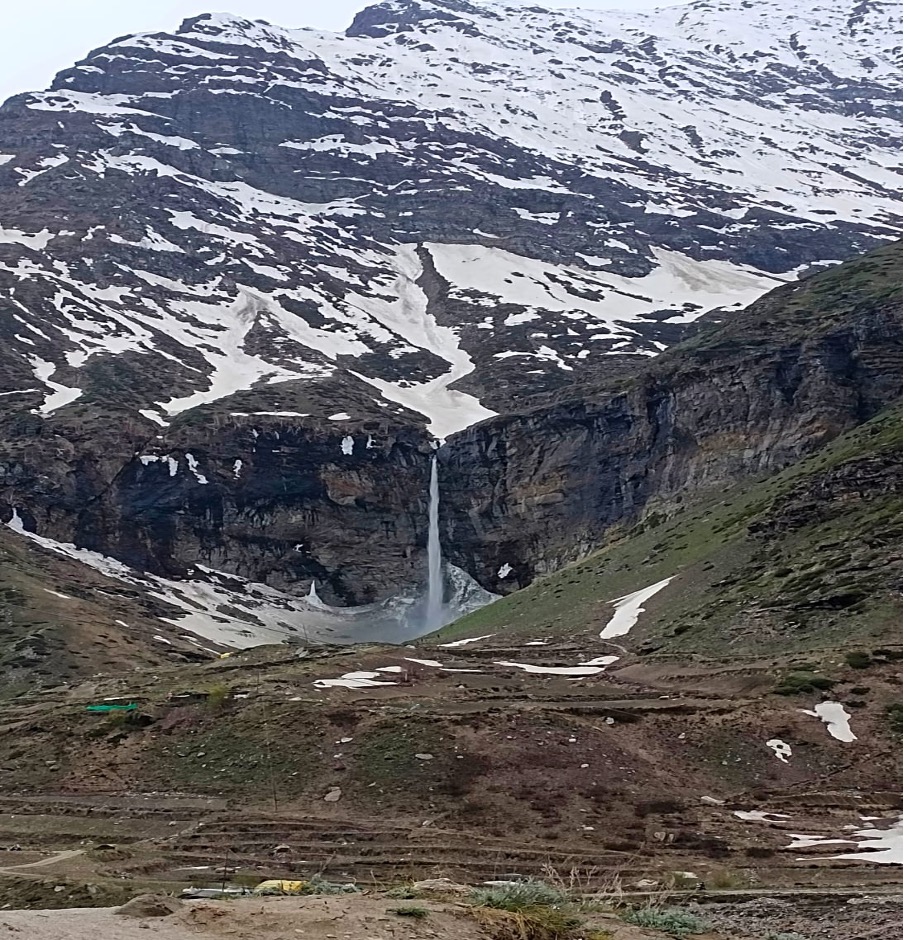
We stopped at the helipad by the Sissu waterfall in Lahaul district, to recharge ourselves with tea and steaming momos. I saw my father-in-law skip around like a little boy, his jaws dropping every time he looked at the waterfall coming straight out of the glacier that cradled it. It was his first time being in such a terrain. All of us, including my one-year-old son, seemed to be breathing fine and enjoying ourselves, in spite of the sudden gain of altitude to eleven thousand feet. I sighed in relief; no acute mountain sickness (AMS) for us.
We set out to the monastery following google maps and stopped for lunch on the way. After some conversation, the restaurant folks told us that we were going in the wrong direction. Apparently, google maps didn’t work very well in this region beyond the well-travelled tourist circuit. They told us how to reach and from the sound of it would involve off-roading. After losing our way twice, we finally discovered a bumpy path that led to the monastery. We found out later that the best option was to take the mud road on the right after the lone petrol pump in Sissu.
The bumpy mud road that we took instead was devoid of human habitation or road signs till the Kardang village. On each serpentine turn, I could see my travel companions digging their fingers deep into the seat in anxiety. On some stretches, there were walls of ice on the mountain side and the car had to cross the several streams that these walls caused. Later, we all laughed about how each of us was praying for dear life during that treacherous journey.
After a good thirty-minute climb we finally reached the Kardang village and the metalled road was in sight. The Kardang village had a few homestay signposts but none were open in spring. Soon we crossed the signs of the pilgrimage trek of Mt. Drilbu Ri and we were at the gate of the monastery. The short walk to the monastery was nice but we did it slowly as the lack of oxygen was palpable. Kardang monastery is nestled in the ridge below the fifteen thousand feet Rangcha peak. Kardang is the starting point for the Buddhist pilgrimage of Mt. Drilbu Ri.
Upon reaching, we found the door of the monastery closed. Soon we were greeted with the Tibetan greeting ‘Juley Juley’ by a smiling monk who opened the door for us. His name was Sonam Dawa. He was happy to show us around and answer our questions about the prolific thangka paintings on the walls and ceiling of the monastery, on Buddha’s life, dakinis [woman spiritualists], and other important figures of Tibetan Buddhism. Tibetan Buddhism with its characteristic animism and symbolism of Bon culture is a hallmark of this Lahauli monastery. A few lamas and chomos joined us and offered us tea. We were touched by their warmth. They played with my son, told us a lot about the snow festival that happens every February and asked us to come back during the celebration.
To this day I am not sure if it was the high altitude, the aromatic incense, or the space itself that made it feel so special. I remembered the chant on Youtube that started this journey for me and am glad I followed that instinct.
.
[1] The Drupka lineage of Tibetan Buddhism dates back to the twelfth century.
.
Sayani De is a bibliophile, compulsive traveller and sustainability enthusiast. Her work has been featured on Women’s Web and been selected for publication at Muse India for its May-June issue.
.
PLEASE NOTE: ARTICLES CAN ONLY BE REPRODUCED IN OTHER SITES WITH DUE ACKNOWLEDGEMENT TO BORDERLESS JOURNAL
With its four-storey outlet in GK-2, Ajay Jain has made Kunzum the new happening place for book lovers in Delhi-NCR. He converses with Shantanu Ray Chaudhuri about his journey and about making brick and mortar stores viable in the era of Amazon as the writer browses through the different sections of the bookstore.
Book event with actor, Kabir BediBook event with Booker winner, Geetanjali ShreeIn Kunzum Bookstore. Photos provided by Shantanu Ray Chaudhuri
It is a bookstore unlike any I have been to, and that’s saying a lot. I visited it first sometime in December 2022, when it was still a work in progress, and even then it was stunning enough for me to get my aged parents, who need walking sticks, and my wife, who at the time was nursing a broken ankle, to visit this as a new year outing on 1 January 2023. Since then Kunzum at M Block Market, Greater Kailash 2, New Delhi, has grown to four floors spread over 10,000 square feet. The first floor is the regular bookstore, the second the Penguin bookstore. The third the ‘Theatre Kunzum’ – a 125-seater events hall – and the fourth an eighty-seater theatre, with plans for a café. There are other Kunzum bookstores which are a more modest 2500 square feet each. The original Kunzum Travel Café is approximately 500 square feet.
I enter it and am transported to a book lover’s paradise. Its very affable owner, Ajay Jain, and brilliant curator, Subir Dey – who generates in me a huge complex with his awareness of books and a hole in my pocket with his recommendations for the same – have time and again asked me to work out of the store. Which I would have gladly done, but for the fact that, one, it is impossible to get any work done once you enter its precincts (the only work it allows is browsing its shelves), and, two, I fear that I will end up spending all my salary at the store.
What makes it remarkable is that Ajay can visualise a store chain like this in this day and age where we hear a constant refrain of brick and mortar stores closing down. Of how difficult it is to sustain one in the age of Amazon. Most of the major bookstores across the country have devoted a large part of the space to stationery and toys. Ajay is determined not to do that. As far as he is concerned, a bookstore is a bookstore. And there will be no dilution of the space. As Ajay says, “I was very clear from day one. We will not sell teddy bears, stationary, croissants (chuckles). It might be a slightly steeper learning curve, but we want to learn how to sell more books. If I’m not selling enough books, why am I in this business? I could have invested this money somewhere else. For me, it’s a social mission to push more people to read. If everyone, every human being on this planet, reads books, it would be a much better place to live in. When we read books, we also challenge rampant consumerism – we are taking the money away from buying other stuff to buy books.”
Given the quite extraordinary range of books, including rare and collectors’ editions – I picked myself a mind-blowing one on iconic book covers, The Look of the Book, by Peter Mendelsund and David Alworth – Subir Dey, the curator, is the backroom star of the show. A quiet, self-effacing book lover, Subir says, “I have been doing this for myself, at home, before Ajay started the bookshops. One day, I just picked up the phone and asked him, how can I help? Then, there is the community angle. I talk to fellow bibliophiles both online and offline who point out all the amazing editions of great books. The curation team at Kunzum is indispensable. Everyone has their favourite genre and we all diligently keep track. The classics and graphic novels are an easy target because of their popularity. Then there are collected works and anniversary/commemorative editions that we try to keep track of. Publishers help us with that too. For example, the Dune series picked up when the new movie came out. There are so many beautiful editions of the book that it is hard to choose. There are graphic adaptations of long-form novels like 1984, Animal Farm, The Kite Runner that we tracked down and have in stock. These are great books for someone who is intimidated by the traditional long-form novel format. This could be their gateway drug into reading and Kunzum would love to get them addicted. Special editions are a brilliant gifting idea. Books are the best gift you can give to people. Most of us have friends who are avid readers. These special editions are a very thoughtful gift. We tell our customers to bring a book to a party full of people who are bringing bottles of wine. We all used to give and receive books as gifts, growing up. Those books shaped our worldview. We are rolling out ads on social media to highlight the special editions available with us and pretty soon you will see more of these titles highlighted not just online but in our stores too. There is a demand for it, we have seen an uptick in the interest among buyers who are looking for specific edition of their favourite books and our team is happy to track them down.”
The Beginnings
Ajay Jain: I have a background in engineering and management, so I worked in the IT industry for five years. Then I got into sports management, and did that for five years. At the age of 31, I dropped everything and moved to the UK to study journalism. I did my master’s in journalism there. I came back in 2002, worked for the Express group, started a youth newspaper, got into blogging and freelance writing – mostly business and tech writing – which I did till about 2006–07. I was one of the earliest professional bloggers in the world. As a journalist/blogger/ influencer (the word wasn’t there at the time), and as somebody who wanted to write books, I figured I wanted to do something where I could create more of a legacy.
Early Reading
Ajay Jain: Growing up, I read the usual staple. You had your Enid Blyton, Nancy Drew, Hardy Boys, Famous Five. Unlike my classmates, I never read Agatha Christie or PG Wodehouse, but I had read all of James Hadley Chase by the time I was in Class 8. My headmaster used to ask me why I was borrowing these books from the library. I did so because they were there! I read a whole mixed bag of books in middle school and high school, even in college. I read Sidney Sheldon, Jeffrey Archer, Ayn Rand – a mixed bag. Anything that caught my fancy.
Travel Writing
Ajay Jain: Around 2007, at a personal and professional crossroads and unable to relocate from Delhi, I said to myself, ‘Okay, let me do the next best thing,’ and I became a travel writer. I’d done a few short road trips around India, and I was really enjoying travelling. Since I’d also learnt photography, I was doing a lot of that. I thought, why not make it a profession? So I hit the road.
I didn’t want to write a Lonely Planet kind of book, and I also didn’t want it to be a literary piece. I was thinking of my own format. The first trip I actually went on was to this place called Spiti in Himachal. I spent a night in Manali, and then headed for Spiti. I crossed the Rohtang Pass. Till then, it was fine because there were other people. I’d never done that kind of terrain ever. I drove for hours in a high-altitude desert area with no road signs, no mobile signals, nothing! Just a track where you followed earlier track marks. After a while I realised I was lost!
The Defining Moment – the Birth of Kunzum
Ajay Jain: I just kept driving, not coming across another human being for hours. Imagine not seeing another human being for hours in a country like India. Suddenly I came upon a plateau, upon a sign that said ‘Kaza’, which was where I was headed! That spot, where I stood, was the most astounding place. As I looked around, the only thing I saw was snow peaks, Buddhist flags flying, complete silence. It was breath-taking. I thought to myself, if this is what the planet is, if this is what India is, I want to be a travel writer. In that moment, not only did I find my direction to Kaza, I found my direction in life as well. The spot where I stood was Kunzum-La.
After I returned, I called my blog Kunzum.com. A little accident in technology worked in my favour. I had reserved the domain called traveltattoo.com as my travel blog. For some reason, the registrar didn’t inform me that my domain was up for renewal. It got taken by someone else. In losing traveltattoo.com, I got Kunzum.com. That’s how the name Kunzum came up.
Kunzum Gallery, Hauz Khas Village
Ajay Jain: I did a few shows for my photography at places like Habitat Centre and got a decent response. I was encouraged to open a place of my own and came across a place in Hauz Khas Village. I picked it up in 2009 and opened up a gallery there. On the first day I sold a print, and then for the next year or so I didn’t sell a single thing! So, I was just sitting there with some friends, mulling over what to do, and we realised that all the people who bought my prints in Habitat just happened to be passing by. They saw the prints, they liked it, and bought it on the spot because the prints weren’t very expensive. I decided to do something there (in the gallery in Hauz Khas) that would get people in. That’s when we decided to offer seating in the gallery- let people come in, enjoy free WiFi, etc.
We set up a small library so that people could borrow books, and decided to serve up tea, coffee and cookies. We thought we could pay for all of this. When we looked at the numbers (and crunched them), we realised that if we pay for everything and a certain number of people come, and nobody pays, we will be out of pocket by so much, but will have acquired some customers for that price of coffee and cookies and all.
Funding the Enterprise
Ajay Jain: I was still freelancing, and had been investing over the years with whatever I’d saved from my various ventures. I was just getting by. We decided to rebrand the place in Hauz Khas from Kunzum Gallery to Kunzum Travel Café. The place took a life of its own. A few days after we opened, someone came in asking if we could do a poetry reading, to which I agreed. Before we knew it, we had over 200 events happening in the café every year. There were all sorts of events – book launches, film screenings, poetry events, talks, etc.
We were clear about the financials. If you benefited commercially from it, you pay us. If there was nothing commercial, if you didn’t have the budget, okay, you could use the space anyway (if the event was suitable). We kept it flexible. My main motivation was to get people in, to see my photography and my books, which were sold at the café.
Bookstore Chain in the Time of Amazon
Ajay Jain: During the pandemic, I was reassessing a lot of things. I have always believed that just because we are doing something well, we should not be doing it all our lives. With the pandemic, I had to shut Kunzum Café for over two years, making do with a skeletal staff throughout. I wrote my first novel. I kept wondering: how do I find an audience for my books? No matter how big your publishers are, or how big you are as an author, you still need to find your own readership. Then I thought, why don’t I set up a book club? A national book club, something that would have many people. The response came in quickly as well. I enrolled a couple of thousand members.
That’s when I thought, why don’t I turn Kunzum Travel Café into a chain of reading rooms? Build a model where we create reading rooms across the country, where people come and sit and read. The numbers didn’t add up though. There was no model that would make this sustainable for me. Enough people wouldn’t pay enough money to make this a library-type of model. It wouldn’t work in this climate, especially when real-estate had become so expensive. I had learnt how to build a community, how to bring people together through Kunzum Travel Café, but I didn’t know how to monetise it.
People had asked me, will there be more Kunzum Travel Cafes? Will there be a Kunzum Travel Café franchise? For me, Kunzum Travel Café was more of an exercise in personal branding. For the external investor, there would be no ROI since the only one benefiting from Kunzum Café was one Ajay Jain. In the process, I started making money doing brand endorsements through Kunzum Travel Café. It was more like a PR agency, so the only guy benefiting would have been me.
That is when I realised I should open a chain of bookshops! The model would be Kunzum Travel Café, but with a bookshop added to it. I did some back-of-the-envelope market research. There were people buying books, publishers doing business. In absolute numbers, there were more books being sold than ever before. I went to the bookshops which had good business – like Bahrisons, Faqir Chand, Midlands, etc. They had a huge legacy and were located in prime locations. I figured that I’d learnt how to make Kunzum Café in Hauz Khas a destination, and that I’d make this new venture a destination also. I didn’t really feel too daunted by this, I knew we’d figure things out as we went along. If I started asking too many questions, I would have been dissuaded immediately, so I thought that I’d figure it out on the road.
We have five locations. The GK one has four floors, so you can consider them either four stores or just one. At the core, the business model is simple – sell books, and sell enough books to make a profit. It’s still early days for us, we are on the way as we speak. I know that trends are right, and within this year we will be operationally profitable, so I’m not too worried about that.
I did a bit of reading, given that stores were closing all over the world, and the rise of Amazon. If Amazon did not exist, or if Amazon did not offer such discounts, many more bookshops would be open today. People would still prefer to walk into a bookstore for the experience of buying a book over buying it online. Because Amazon offers such discounts, most people think books are easier to buy online. I blame publishers squarely for this, not Amazon.
The Irony of Publishers Killing Bookstores
Ajay Jain: If books and readership are being challenged by other forms of entertainment, and readers are distracted, one needs to look at this as something cultural. That’s why experiences become important. Experiences are connected to physical spaces. That’s how you expand readership. Unfortunately, when I started interacting with publishers, I noticed that they show little intent to expand readership in society. They are making enough money not to think about expanding readership. It’s not enough for publishers to tell me, “Hey, I love what you’re doing at Kunzum Café.” They need to plug the discounting at Amazon, and the piracy of books. More than piracy, I think the discounting is a problem, which publishers can solve partly through lobbying, and partly through curtailing supply, if they want to. They own the product, and if they say no, that can change things.
The publishers’ argument is that they give the books to distributors to be sold, and these distributors are not within their control. The fact is, everyone is traceable. Publishers know who is selling their books, and can plug supply. If a reseller picked up a book on Amazon to resell, the publisher could tell Amazon to stop them. It could get into a cat-and-mouse game but eventually, it would dissuade them so much that the incentive to play this game would go down.
France Shows the Way
Ajay Jain: Look at what happened in France. The government in France forbade Amazon from offering discounts of more than 5 per cent on books. The French government realised bookshops were a national cultural asset. Because of this, bookshops that were struggling are now flourishing, and new bookshops are opening. This change came through legislation.
In India, if publishers want, they can move the Competition Commission, and say that discounting on Amazon is an unfair trade practice. In a country like India, where you have the MRP [Maximum Retail Price], if you can’t sell above MRP, how can you sell below MRP? Especially because all governments in India have the same stated position on FDI [Foreign Direct Investment] in retail, which is to ‘protect the small trader’. So, Competition Commission could look at how these discounting practices are putting businesses in such a precarious situation. If the publishers make enough of a song-and-dance about it, if they lobbied, if they took legal recourse, I think this issue can be resolved. We have a precedent in France now.
Financial Viability
Ajay Jain: When I was doing research, I wasn’t researching into whether I could open bookshops or not. I was researching how to make it viable. I had already decided I was going to commit to this venture. I’d started acquiring the real estate for it. I read someplace, “Bookshops don’t fail. Bookshops run by lazy booksellers fail.” In today’s day and age, not just books, you have to sell every commodity as an experience. You could be selling shirts, shoes, books, anything, because everything you want is available online. But if you want people to come to the stores, shopping malls, markets, you need to create that experience for people.
The Four Cs of Bookshop Design and Marketing
Ajay Jain: I have formulated what I call ‘The Four Cs of Bookshop Design and Marketing’. First is Configuration, which is basically the way you design the stores. If you look around, we’ve designed them in a way that the shelves don’t overwhelm you. There is enough space to move around, to sit down, to go through the books. You have browsing space and you can maintain a distance between yourself and the shelves. Not only is the vibe inviting, the design also allows you to discover books which you may not have discovered in an overstocked bookstore. The whole mood of being inside a bookstore is extremely important.
The second C is Curation. The kind of titles we select, the way we display them, and the way we help customers discover new material. Finding books customers were not looking for makes for a delightful experience. That is what will bring them back. These customers will say, “Hey, you know what? I went to Kunzum and found this great book! I loved it. It was money well-spent and time well-spent.” This is where Subir and his team come in.
The third C is Community, which we were doing at Kunzum Travel Café. We wanted to build a community of not just readers, but creators – writers, artists, designers, editors, everyone involved in creating books. Again, like Kunzum Travel Café, look at it like a larger cultural thing. So, bring in musicians, film-makers, puppeteers! We wanted to bring these people together to create a community.
The fourth C, Convene, aims to bring these people together for events. Ever since we’ve been fully operational, we’ve already hosted over 500 authors. We’re adding many more events, more programming, more partnerships, so that people can come and use our spaces. We make sure that there is enough space for people at our events, and that people don’t have to push bookshelves in order to be able to participate. We have dedicated spaces for events.
Since many people in my team come from the book retail industry, when the first store opened, the first question they asked was, “Sir, haven’t you wasted a lot of space?” The event space is going to be your brand ambassadors, your marketing agents. People will want to come for these events. We built the whole model on these four Cs. The signs are positive. People will come and talk about you, and be here, and will want to buy books from you. It’s just a matter of time before enough people will buy these books.
The Penguin Floor and Other Initiatives
The Penguin floor
Ajay Jain: In GK 2 we had just one floor, the first floor, a general bookstore, to begin with. Then an opportunity came to acquire the rest of the building above. Because the terms were attractive, I agreed. Then I thought, why not have thematic floors? One thought was that half of the second floor could be a graphic comic and art store, and the other half would be for children’s books, with the rest of the spaces above being dedicated to events. I was in the Penguin office having a general talk about multiple things. I really loved their office, so I said, “Look, it’s like a bookstore in itself.” I proposed that we should have an exclusive Penguin store. Penguin is one publisher with such range and distribution in books, no other publisher has ever come close. Their international collection is only increasing, and they have so much to offer. I don’t think the exclusive floor in our bookshop would have worked with any other publisher, just because no other publisher can offer the range Penguin has. They have graphic novels and comics – an important genre for us.
Then we got an offer from the top management, and I got excited. Like everything else in life, I ran with the idea, and decided to work out the viability later. The idea is that our bookshop showcases the best Penguin has to offer, incentivising Penguin to bring in their best in terms of their programming, their authors, and their events. It technically becomes a Penguin showcase. For us, it’s an opportunity to work closer with the world’s biggest publishing house. A few weeks ago, the UK Penguin team confirmed to me that this (the floor of the bookshop) was the only exclusive Penguin store in the world.
As part of a community, we’ve actually taken a lot of initiatives. One of them is called Book Bees, which is a book club for children, for kids up to twelve. Our children’s book section is called Kunzum Book Bees now. We also have a general book club called the Kunzum Book Club. Anyone can become a member for free. If you become a member, you get priority invites to events, we will give you first access to signed editions, which are always in limited supply; we will give you a little discount on our books, stuff like that. That’s part of the community-building exercise.
We launched the Kunzum CEO Book Club, where we’re getting corporates to come on board to encourage the culture of reading. The proposition being that all leaders are readers. If you want to nurture leadership within your organisation, you need to promote readership. We’re reaching out to them, asking them to buy books on a structured basis to distribute them amongst their employees, and maybe go even beyond that, by distributing them amongst their vendors, their customers, to spread the culture of reading.
We launched this programme called ‘Kunzum Key’ which is open to everyone, but primarily for creators of all kinds. You could be an actor, a dancer, a film-maker, a producer, an event-manager, a musician, anything! We give a free membership card that allows them to create at Kunzum – keep their own sort-of-office as long as they follow a fair-use policy. These creators can come, sit here, do their work, hold meetings, have interactions, brainstorm, showcase their work in some way. They will be offered free WiFi, which we don’t offer our regular customers. Every time these creators come they will be given a no-questions-asked complimentary cup of coffee or tea, and the bookstore will give them a very hefty 20 per cent discount on all the books they buy at the store.
Then there are the lit-fests. We are reaching out to every possible event where there are likely to be people who will buy books. We are asking them to make us their official bookstore partner.
Reaching Out to the Underprivileged
There’s a limitation to how many bookstores we can set up and how much we can do in each store. We don’t want to expand our physical spaces indiscriminately because we want to stay true to the culture we are trying to create. If we expand too much, or thin ourselves out, even if we get funding, which comes with its own pressures, we don’t want to lose our essence.
Our idea of expansion is to take Kunzum to potential readers. The corporate sector is a very obvious one. We’ve started doing small book fairs and events at different localities to promote the culture of books and reading at your doorstep. Schools and colleges are important to us. The intent is there. We’ve already reached out to a few schools, some of the DAV schools, where we did some events. There’s around a thousand schools there. Each school in the DAV chain cuts across all segments of society. We’ve also been approached by a few universities and colleges. We have a limitation of manpower. We want to make sure our manpower can pay for itself. We want to reach out to schools to, again, promote this culture of reading. If schools start buying at an institutional level from us, they can make books available for students who are not able to afford books. That’s where, again, we go back to the whole ethos of ‘Curation’ we are trying to create. Don’t just buy books that you think everyone is reading for the sake of being like everyone else. We’ll help you select books that you may not have thought of. I have been thinking of a programme where enthusiastic readers who are unable to afford books can be matched with someone who could fund their books. Of course, we will have to do it in a slightly more structured way. When I meet anyone from above a certain economic stratum, I see how privileged they are because they can afford to buy books but they are not reading books. There are people out there who want to read books…
At an LGTBQIA event that we had done, a guest who loves books said she couldn’t read anymore because of an eyesight problem. There was another young person there who wanted to read books but could not afford to buy. They just got chatting, they’d never met each other, and the former bought the book for the latter. She said, “I can’t read, but you can, so here’s the book for you.” How do we kind of institutionalise this programme? We’ll have to figure it out.
Regional Language Library
There are a couple of issues here. We will have a space constraint – where do we store it? Number two, how would we curate it? Because every language would require a different curator. In a city like Delhi, there would be enough Telugu readers, Bengali readers. But then, Bengali readers may want something other than the popular titles we might store. They might be looking for a larger collection. A lot of vernacular readers invest a lot in their respective languages. We might not be able to build depth to cater to that audience, so that’s a challenging situation to be in.
Going Ahead
We want to be present in every community – corporates, residential neighbourhoods, schools and colleges, etc. In a small way, we are sending books to rural areas too. For that to pick up pace, we need to look at it slightly differently. For now, we’re doing it in our small capacity. The whole idea is, irrespective of how many stores we have, we just want to go out there and get more people to read. Whether they borrow books and read, or buy books from Kunzum or not, let that be secondary. It falls upon every book lover to spread the good word, and encourage other people to read. Once you overcome that inertia and start reading, you stay with it.
Ajay Jain in Kunzum Bookstore
(Published in multiple sites)
Shantanu Ray Chaudhuriis a film buff, editor, publisher, film critic and writer. Books commissioned and edited by him have won the National Award for Best Book on Cinema twice and the inaugural MAMI (Mumbai Academy of Moving Images) Award for Best Writing on Cinema. In 2017, he was named Editor of the Year by the apex publishing body, Publishing Next. He has contributed to a number of magazines and websites like The Daily Eye, Cinemaazi, Film Companion, The Wire, Outlook, The Taj, and others. He is the author of two books: Whims – A Book of Poems(published by Writers Workshop) and Icons from Bollywood (published by Penguin/Puffin).
“Whatsoever is needed on the Path is always supplied.”
~ OSHO
I read the lines again. And yet again. They spoke to me. I felt like I knew the person who had written them, even though I had not met her. Reaching out, I gently touched the lilac handmade paper on which the poetry was written in purple ink. The lines touched my heart: it was an original poem, but unfinished.
I had never felt such spontaneous poetry coming from myself, but reading these lines, I felt some lines forming spontaneously in my head. I pulled out a pen and started writing some words in the space left on the paper. The stranger’s lines and mine now matched beautifully.
*
I had come to Manali on a whim. I was between jobs — just having had my fill of my first one and not yet wanting to start the next one. Idly looking at my Instagram feed, I had seen so much of the beautiful mountains, attractive waterfalls and serene cloudscapes that I just had to get on a bus and come to Manali. I could not believe that I, Kabir Kulshrestha, in all of my twenty-eight years on earth, had not thought of visiting this slice of heaven before. Up until now, I had been passively aggressive in my daily life, cribbing about the boring routine, the never-ending work pressures and imagining that everyone besides me had near perfect lives, as evidenced by their Instagram feeds and the stories and reels they shared. For the first time ever, I felt that belief dilute a little, as I finally felt more alive with a new awareness and appreciation of my surroundings growing automatically, as I watched the greens, blues and whites of nature all around me.
I had taken the overnight bus from Delhi to Manali. When the bus passed Kullu, I did not know, but when we reached Manali and I opened my eyes as we were entering it, I was in heaven. Or as close to heaven on earth as I could get.
All around were green mountains, tall 50-60 feet high trees, ancient paths leading to god-knows-where and the endless, cloudy blue sky. I inhaled deeply and felt some of the lethargy and humdrum sameness of the past months slide away.
Deliberately, I had not booked any hotel online, preferring to choose one upon reaching the place. The bus had dropped me in the middle of new Manali. I felt a little disappointed, surveying the hotels there. It all appeared like any other tourist town at the first glance – the same greasy restaurants, the shops selling cheap touristy memorabilia and tawdry conveniences. Fortunately, I had packed light — just a backpack of essentials and my camera bag. I decided to go off in search of a better place to stay – somewhere more authentic and closer to the real Manali experience.
After walking through a road going up and passing beside an untouched meadow with tall pines, I decided to cross over the river Beas to the other side and look for interesting homestays that I had seen pictures of on Instagram. Walking up the mountain, down the steps leading to the bridge across the raging Beas was a pleasure as I felt a bit stiff after the overnight bus ride. The tall, silent trees, some more than two arm-spans wide (yes, I had tried to hug one!) the birdcalls, the early morning pristine silence pervading the mountains and the tumultous Beas below, all framed a beautiful picture in my mind. Along the shores of the Beas were orange blossoms; I was surprised by their tenacity. Also, along the old Manali side were what looked like very interesting cafes, with names such as Nirvana, Café 1947, Bella Pasta, Dylan’s etc. Their menu boards were brightly handwritten notices or sometimes, simply blackboards on which the day’s menus were handwritten in white chalk. Their signboards were vivid splashes of hand-painted pictures, and Bob Marley and his ‘Ganja Gun’ anthem could be heard from many a café. Add to these, the colourful flowers growing beside the Beas and in the planters of the cafés by the window seats. It is not just an unforgettable scene but a nuanced one.
I promised to myself that I would visit them all one by one. Crossing over the bridge, I stopped to admire the scene — a slice of heaven on earth — the blue sky, the raging river foaming white at the edges and the tall, green, graceful sentients as far as I could see. Yes, I would definitely be back later, with my camera, but for the moment, I just wanted to enjoy being there, present with beauty inundating my senses.
With a deep breath of contentment — even the air smelled different here — I crossed over and started walking up the steep path. On both sides, cafés, restaurants and interesting shops continued up the road. I didn’t know what I was looking for, but I knew that I would know when I found it.
More than halfway up the path, I paused and stood under a tree, to rest a moment. As I looked around, I saw a vibrantly painted, two-storied wooden house. It had red doors and blue windows! It was a little distance away from the main lane, with a tiny winding path of its own. I could see feathered dreamcatchers waving in the wind, on its second-floor wraparound balcony. Automatically, my feet turned to that path. Reaching the house, I had raised my hand to knock on the door when a voice called out to me, “Hi! What are you looking for?”
Looking up, I saw a young woman, a little older than me, walking towards me. ‘Colourful’ seemed to be the theme of the place, as even she was dressed like a rainbow, albeit an aesthetic one! Her multiple bracelets and necklaces of brass and colourful threads swayed as she came nearer. She was followed by three Pahadi Bhotia dogs, in varying shades of brown. I smiled and said, “Hi, I’m Kabir. I’m looking for a place to stay for a few days and don’t want to stay at a hotel. Could you recommend a homestay or something similar? For some reason, I was drawn to your place the moment I saw it from the path. Cute dogs there, by the way!”
The lady smiled and replied, “Thanks! I’m Ragini. This is my home and my homestay. You can stay here if you want. Are you coming from Delhi?”
“How did you guess?”
She gave a hearty laugh and said, “That is where we get most tourists from.”
“I’m from Delhi, yeah, but I’d appreciate it if you didn’t call me a tourist. I prefer traveller!”
“Woohoo! Then we are kindred spirits! I think you will like it here. Come, I’ll show you the two rooms that are available. The rest are filled by a group of travellers from Spain.”
“Great! Lead the way!”
I found a home away from home there. Ragini turned out to be a wonderful host, having created a warm, welcoming space that immediately made everyone feel right at home. Having chosen the room at the back, which faced towards the mountains, I settled in. The homestay also had a small but varied library and a music corner, which hosted many impromptu musical duets in the evenings, where many a language and accent were heard.
The meals at her homestay were from all over the world. Ragini and her helper Jigme had a real talent in that department. Every breakfast was a medley of tastes from Lebanese to Italian to South Indian, and of course, the staple offered in all mountain towns — aloo paratha[1]with tomato chutney!
I had expected the typical Maggie or paratha option for breakfast, but these were veritable feasts! Lunches I preferred to have outside, wherever I happened to be at the moment, like the other day when I followed the main path in old Manali leading up all the way to the top, past the wooden Manu temple. At the top I found a Japanese man with a modest restaurant, making sushi, which turned out to be out of this world! The second day, I went the opposite way, towards the riverbank, and had the best tiramisu of my life, after a meal of falafel and gyros.
My trip was turning out to be a discovery of tastes. Between mealtimes, I explored outside and within myself, for it was also turning out to be a time of self-discovery; I had never felt closer to myself. I met people from different walks of life, exchanging life stories and travel experiences. I walked to various places. I hiked up various slopes, sometimes to just sit at the top, admiring the landscape and letting it soothe my soul, writing, taking pictures, meditating or simply sitting.
I found that the more I sat with myself, the more I was able to appreciate the without, and the better became the quality of my creations. I went where my feet led me, sometimes by myself, sometimes with other people I met at the cafés, restaurants and stores. I was developing quite an eclectic mix of friends — there was Pedro from Mexico, hitchhiking his way through Peru, Bangladesh and now India. He had met and befriended Francine, a French professor on a sabbatical of self-study, come to India to explore yoga in Rishikesh, Tiruvannamalai and later Goa, somehow ending up in Manali! She too, had interesting stories of her own travels to share. Then there was Loki, whose Japanese name was difficult to pronounce and hence shortened to Loki, who had made Manali his home for the past two months. He was slightly temperamental – some days jolly enough to sing with us in the evenings, the others sitting with his old ukulele and playing some nameless tune over and over again.
I admired the way these people lived, following the flow and just taking in all life had to offer. The evenings were spent either with these people or with the Spanish group back at Ragini’s, with music or a night of storytelling after a delicious dinner. And such stories they were! Enough to cause itchy feet in the most stalwart of homebodies!
I was enthralled to hear about the diverse backgrounds all the guests came from. At first glance, they appeared like hippies, with their ragged jeans, loose kurtas, thread anklets and jute bags, but one was a particle physicist, another a music teacher, and still another a biologist! I promised myself to never, ever again to judge a book by its deceptive cover. It could be hiding the most riveting personality behind its carefree façade.
The experience dispelled my long-standing bias to an extent too, that people are as good as they appear. This belief was further shattered by a teacher from England, who had been travelling to India every year for the past 15 years, to teach English to Ladakhi children, that too without any financial interest. This year, before heading back to his home country, he had decided to go to Delhi via Manali.
I was learning that people made choices, often difficult ones, leaving comfort and the complacency of lucrative jobs to do what their hearts guide them to do. I was learning, melting down prejudices and emerging with a more open mind and heart.
It was in this frame of mind that I went out each day to shoot pictures, capturing the natural beauty of the place and the simplicity of the people living there. I also found that there was in actuality, very little that one needs to live a full life — a good set of friends, good food, an open space to sit and contemplate and live with nature to embark on a journey of introspection and reflection.
One day, I sat in a riverside café after a successful morning of breathtaking photography session. I had just finished a gruelling session of yoga with Francine and then hiked to a special place that someone had told me about, to take pictures of a waterfall. Later, I had photographed the trees – pines and oaks. I believed some of the images taken that day managed to capture the silence emanating from the trees. Totally satisfied with a morning well spent, I ordered a sumptuous lunch of tofu sandwiches with an avocado salad, to be followed by a slice of apple pie. I had never eaten so much in one meal back home! I noticed also that so much of walking around was helping my body become much healthier, even though I was eating amazing meals at least three times a day, without worrying about calories.
While waiting for my food, my eyes fell on a notice board on one of the bright yellow walls of the café. It had a big notice board on it. As I walked over to it, I heard strains of ‘Bella Ciao‘ being played on a mandolin, from a corner of the café. A local group was singing there for the evening. There were various papers stuck to the board — advertisements, people wanting a homestay, people wanting to sell stuff, like watches, a guitar and even a Canon Mach III! I found the fantastic mix of things here a sharp relief from the overly organised things back home.
As the strains of the song got more energetic, I returned to the present. I noticed that on the lilac-coloured sheet, a few lines of poetry were written in Hindi. It appeared out of place amongst the notes in English, Spanish, French and Russian. The lines were –
“It is just a bubble of water,
Which loses itself in but a moment”
As I read, I felt some words forming in my mind. I took out my green felt tip and in my bold scrawl, which I liked to believe was very artistic, jotted down some lines on the sheet –
“So live fully in the moment, don’t be sad,
These are the moments of life, don’t lose them”
Satisfied and feeling some kind of connection to the original writer, I came back to my table to find that my order had arrived. For a while, the tofu sandwich and the food I had ordered managed to hold my full attention. But after a while, I found myself thinking about the lines on the paper as I ate.
I tried to create a mental picture of the person who had written the lines and found that I could only conjure a shadowy image. That image accompanied me as I paid at the counter, picked up my backpack and my camera and went down the path towards the river. I could not get enough shots of the foaming, dancing, raging river. In my mind, it seemed to be a young girl, full of life and poetry, dancing as she flowed through life.
The next day, for some reason, I felt pulled towards the same café. I tried to convince myself that it was because I wanted to try their Lebanese platter, but the lilac-coloured paper floats in front of my eyes. I was curious, “Would she have replied? Will I find more lines added to the poem?”
As I entered, I tried hard not to let the board be the first thing I saw, but even as I tried this, my eyes lifted that way of their own volition. And a jolt of electricity went through me — there were some more lines there! Even before ordering my food, I headed over to read them.
I smiled as I read, for even as I read, I was formulating the next few lines. And this went on, till we had completed three poems, and I had tasted all the dishes in the café. I felt as if I really knew her, but I did not write my number or pen a request to meet. I did not want to scare her away with my ardour.
The next day, I had this weird feeling, a type of intuition, as if something was changing, something was about to end and a new phase about to begin. Although I could not understand the feeling, I went about my day as I usually would. There was a crowd in the corner of the café that held the board.
I waited for the people to move away so I could see the board. As the people shifted, I caught a glimpse of the board. There was a single fresh lilac sheet there. Only one line appeared to be written on it. I rushed near and read it. It said – “Whatsoever is needed on the Path is always supplied.” It was a quote by Osho.
Suddenly, I felt a prickling sensation at the back of my neck, like someone was looking at me. I immediately turned back. As I did so, I saw a girl turn towards the door and step out. She held a lilac paper in her hand — the last completed poem. It took a little while for me to get through the throng of people crowding the place. That day was a live show, so there was a big crowd there.
As I opened the door and stepped out into the dusky evening, a sudden brisk shower started. I saw her get into an auto and move across the bridge. I tried going after her, but the sudden downpour had increased the traffic on the bridge and she blended into the crowd. I rushed back inside the café, to the single sheet on the board, took it off and scanned it hurriedly, as if to find some hint of who she was, her name, number, something, anything! As I turned it over, I found two words written in the same purple ink. ‘Leh Market’. I smiled. I had my next destination. I knew I would be meeting her again. When, how, I did not know. But somehow, I also liked the not knowing. And the search began again. With a new poem, in a new city!
Shivani Shrivastav is a a UK CGI Chartered Secretary and a Governance Professional/CS. She loves meditation, photography, writing, French and creating.
PLEASE NOTE: ARTICLES CAN ONLY BE REPRODUCED IN OTHER SITES WITH DUE ACKNOWLEDGEMENT TO BORDERLESS JOURNAL


 Borderless