Ratnottama Sengupta introduces a prolific, popular and celebrated Bengali writer and an artist
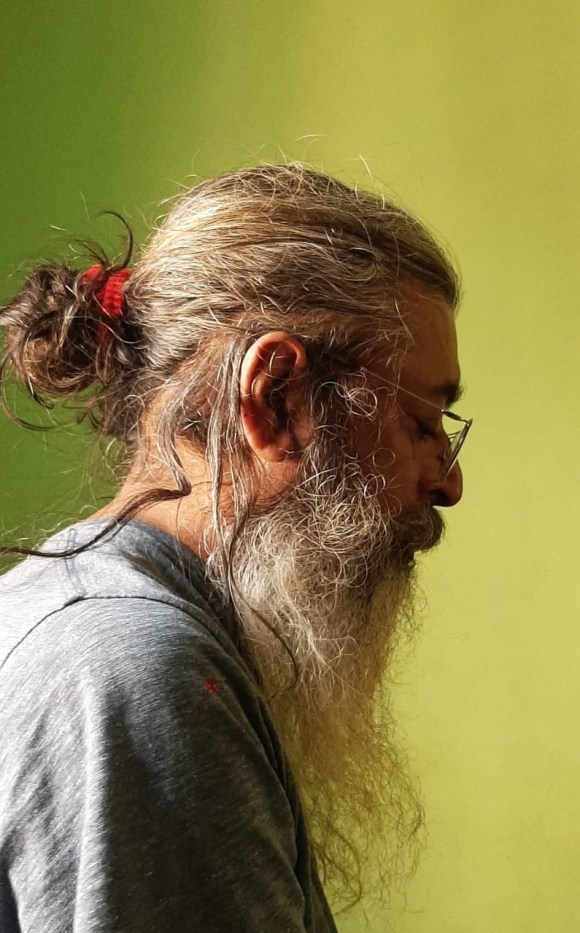
“Dhruba Esh, born 1967, is a full time cover designer – and a part time writer. He has authored stories for children and thrillers for grown-ups. A total of 40 books — or maybe more.”
This is from the cover flap of one of the artist’s published works. Cryptic? Yes. But it does not fail to convey the whimsy every Dhaka-based publisher and poet identifies with the name, Dhruba Esh. Read what Humayun Ahmed (1948-2012), a prolific author, dramatist and director of unforgettable films like Ghetuputra Kamola[1], saysabout the designer in Chaley Jaay Basanta Din[2]. “Must get hold of Dhruba Esh. For some unknown reason he’s been out of reach. Pasted on the front door of the flat he lives in is an A4 sized paper. It is adorned with the sketch of a crow in flight and is signed off with these words in Dhruba’s handwriting: ‘The Bird has Flown the Nest.’
“What I need to do is this: Throw away that A4 sheet and replace it with another, inscribed by these words: ‘Come back, Birdie!’
“Dhruba Esh might not know, but a bird that takes to its wings always returns to its nest. Only the caged bird has nowhere to fly off to. Its only reality is to stay put in one location…”
Why am I taking a serious note of what Humayun Ahmed wrote? Not only because Dhruba Esh has penned the biography, Tumi Achho Kemon, Humayun Ahmed? More so because this custodian of Bangladesh literary culture, who continues to be a top seller at Ekushe Book Fair[3], is one of the cornerstones of modern Bengali literature on either side of the barbed wires.
Dhruba Esh is himself a legend in the Bangla literary firmament, I learn from Kamrul Hasan Mithon, a photographer turned publisher cum writer has been instrumental in reconnecting me with my father, Nabendu Ghosh’s roots in Kalatiya, once a village in Dhaka district that is now a suburb of the capital city. Bhaiti, as I affectionately address him, has been writing a column, Dyasher Bari (Ancestral Home), in Robbar (Sunday) magazine published online from Kolkata. Featured in it are all the major names of Bengali art, literary and cinema world — from Suchitra Sen, Mrinal Sen, Paritosh Sen to Ganesh Haloi, Miss Shefali, Sabitri Chatterjee and not forgetting Baba.
“Dhruba Esh is just one of his kind. He does not have a wife, no mobile, nor a Facebook page. He does not even ride a bus or train. If a destination is too long to walk, he travels only by rickshaw. He is most indifferent to money matters. But he is most enthusiastic about painting and designing.
“Starting in 1989, when he was still a second year student at the Dhaka University, he has designed nearly 25,000 book covers. In addition he has designed music albums – and T’s too! Three years ago he was bestowed with the Bangla Academy Literary Award for his contribution to Children’s Literature – with titles such as Ayng Byang Chang [4] and Ami Ekta Bhoot[5].”
I fell for ‘Amiyashankar…’ at the very first reading. How effortlessly the surreal narrative etches a contemporary reality obtaining in the land of my forefathers!
Amiyashankar Go Back Home
Story by Dhruba Esh, translated from Bengali by Ratnottama Sengupta
“Amiyashankar Go Back Home!”
“That’s the title of the book?”
“Yes Sir.”
“Is there a poem by this name?”
“No Sir. There’s no mention of Amiyashankar in my poetry.”
“No mention at all? Oh!”
“Can I send you some of my poems?”
“You may send.”
“Can you do the cover within this month?”
“Not this month. You’ll get it on the 12th of the next month. Only sixteen days to go now.”
He started laughing.
He’s a small town poet. A young professor. I have been to the town where he teaches in a girls’ College. It’s like a watercolour painting. There’s a river to the north of the town. Blue mountains in the distance complete the view.
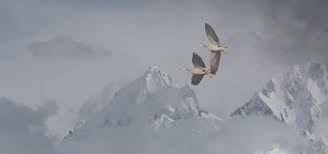
The geese of Subachani had flown over this town on their journey towards the Manasarovar to restore Ridoy to his human size. The poet was unaware of this. He has not read Buro Angla[6].
“What is the book about? Birds?”
“You can find the PDF on Google.”
“Thanks. I will read it.”
Two days later he called. “Reading Buro Angla has sparked some fireflies in my mind. I’d not read the book until now.”
He was given my number by Rasul Bhai, a poet and a cricketer from the same town. He just about looks after the family publishing business. A good person. Last year I had done the cover for his book of poems, Lake Mirror of the Full Moon.
The poet had emailed his poems. He had said he’d send some poems, instead he had sent the PDF of the complete book. On the basis of Divine Selection I read 13 poems. He cannot be faulted for not reading Buro Angla. This poet writes good poetry. In two days I readied the cover for his book.
*
“Is Amiyashankar a friend of yours?”
“No.”
“Why are you telling him to go back home?”
“Because he is Amiyashankar.”
“What?”
“His wife waits for him.”
“He has no one of his own but his wife?”
“He has kids. One son, one daughter.”
“What does he do?”
“He’s a teacher in a government primary school.”
I was startled. Subhankar, Tushar, Amiyashankar, me — we are childhood friends. Our Amiyashankar is a teacher in a government primary school. He has a son and a daughter. The poet who lives in another town has never been to our town. He is not likely to have set his eyes on or made an acquaintance of Amiyashankar. Or, is a person likely to know another person through social media?
“I am not on social media,” said the poet.
“Why?”
“I get disoriented. Confused.”
“Oh. Your Amiyashankar’s wife is named Mitra?”
“Mitra. Yes, I did not tell you, sorry. Amiyashankar’s son is called Arnab, his daughter is Paramita.”
“Why are you creating Amiyashankar?”
“I have no friend.”
Our Amiyashankar’s wedded wife is Mitra. His son is Anu, Miti his daughter.
I call him.
“Hey, what’s the proper name of Anu and Miti?”
“Here — Anu is Arnab…”
“And Miti is Paramita?”
“Yes. You know it already.”
Really tough to suffer this.
I mentioned the poet. Amiyashankar did not read or write poetry. He had never heard of the poet.
“A modern poet?” he was curious.
“A post-modern modern poet.”
“Now what is THAT? Good to eat or wear?”
“Eat. Wear.”
“Does it hide your shame?”
“It covers your shame.”
“Good if it hides all.”
“Yes. Right. Where are you now?”
“I’m here, at Moyna and Dulal’s stall, sipping tea.”
“Aren’t you cold? Go back home.”
Amiyashankar, go back home.
*
On the 12th I sent the EPS file of the cover to the poet.
“If you don’t like it you may discard it,” I messaged.
Reply: “Will you design another cover then?”
Reply: “No.”
Reply: “This will do. I like it. There’s no Amiyashankar but one can visualise him. Thanks. Do I pay you online through bKash?”
I sent my bKash number. He sent the money.
End of give-and-take.
*
I blocked the poet’s number. I deleted every bit of communication in the mail. We had an Amiyashankar in flesh and blood. The poet had concocted an identical Amiyashankar. That Amiyashankar did not live and breathe – how’s that? Such convolution and complication! I was fed up of continuously, endlessly, unendingly living in complexity.
Better to shut my eyes and think of uncomplicated glow worms in my mind.
.
[1] A 2012 film by Humayun Ahmed centring around the exploitation of ghetupatras – young boy performers, Komala being a ghetupatra.
[2] The spring day passes
[3] Known as Eternal Twenty-first Book Fair is the largest organised by the government in Bangladesh.
[4] Bang is frog in Bengali. The rest are fun rhyming words.
[5] I am a ghost
[6] Book by Abanindranath Tagore (1871-1951, nephew of Rabindranath Tagore) published in 1953. Buro Angul is Thumb in Bengali. This is the humorous story about a mischievous boy, Ridoy, who was shrunk to the size of a thumb. He had to journey to the Mansarovar in Himalayas to regain his original size and meets various creatures, including the geese referred to here.
Dhruba Esh, born 1967, is a full time cover designer — and a part time writer. He has authored stories for children and thrillers for grown-ups. A total of 40 books — or maybe more. This story was first published in Bengali in a hardcopy journal called Easel.
Ratnottama Sengupta, formerly Arts Editor of The Times of India, teaches mass communication and film appreciation, curates film festivals and art exhibitions, and translates and writes books. She has been a member of CBFC, served on the National Film Awards jury and has herself won a National Award.
.
PLEASE NOTE: ARTICLES CAN ONLY BE REPRODUCED IN OTHER SITES WITH DUE ACKNOWLEDGEMENT TO BORDERLESS JOURNAL
Click here to access the Borderless anthology, Monalisa No Longer Smiles
Click here to access Monalisa No Longer Smiles on Amazon International
 Borderless