Categories
Excerpt

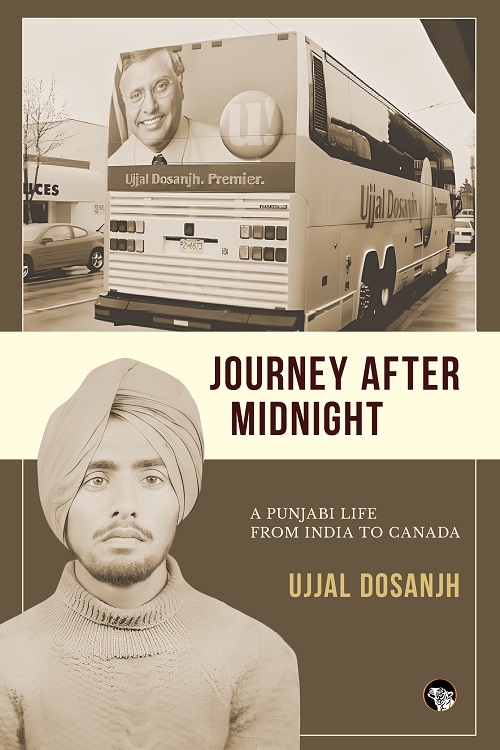
Journey After Midnight

Title: Journey After Midnight: A Punjabi Life from Canada to India

Author: Ujjal Dosanjh

Publisher: Speaking Tiger Books

50

A variation on the common Indian expression “Mullan de daur maseet taeen,” which roughly translates as “An imam’s ultimate refuge is the mosque,” sums up my relationship with the world: India is my maseet. I have lived as a global citizen, but India has been my mandir, my masjid, and my girja: my temple, my mosque, and my church. It has been, too, my gurdwara, my synagogue, and my pagoda. Canada has helped shape me; India is in my soul. Canada has been my abode, providing me with physical comforts and the arena for being an active citizen. India has been my spiritual refuge and my sanctuary. Physically, and in the incessant wanderings of the mind, I have returned to it time and again.

Most immigrants do not admit to living this divided experience. Our lack of candour about our schizophrenic souls is rooted in our fear of being branded disloyal to our adopted lands. I believe Canada, however, is mature enough to withstand the acknowledgement of the duality of immigrant lives. It can only make for a healthier democracy.

Several decades ago, I adopted Gandhi’s creed of achieving change through non-violence as my own. As I ponder the journey ahead, far from India’s partition and the midnight of my birth, there is no avoiding that the world is full of violence. In many parts of the globe, people are being butchered in the name of religion, nationalism and ethnic differences. Whole populations are migrating to Europe for economic reasons or to save themselves from being shot, beheaded or raped in the numerous conflicts in the Middle East and Africa. The reception in Europe for those fleeing mayhem and murder is at times ugly, as is the brutal discrimination faced by the world’s Roma populations. The U.S. faces a similar crisis with migrants from Mexico and other parts of South America fleeing poverty and violence, in some cases that of the drug cartels. Parents and children take the huge risk of being killed en route to their dreamed destinations because they know the deathly dangers of staying. Building walls around rich and peaceful countries won’t keep desperate people away. The only lasting solution is to build a peaceful world.

Human beings are naturally protective of the peace and prosperity within their own countries. A very small number of immigrants and refugees, or their sons and daughters, sometimes threaten the peace of their “host” societies. But regardless of whether the affluent societies of western Europe, Australia, New Zealand and North America like it or not, the pressure to accept the millions of people on the move will only mount as the bloody conflicts continue. Refugees will rightly argue that if the West becomes involved to the extent of bombing groups like ISIS, it must also do much more on the humanitarian front by helping to resettle those forced to flee, be they poverty-driven or refugees under the Geneva Convention. With the pressures of population, poverty and violence compounded by looming environmental catastrophes, the traditional borders of nation states are bound to crumble. If humanity isn’t going to drown in the chaos of its own creation, the leading nations of the world will have to create a new world order, which may involve fewer international boundaries.

In my birthplace, the land of the Mahatma, the forces of the religious right are ascendant, wreaking havoc on the foundational secularism of India’s independence movement. I have never professed religion to be my business except when it invades secular spaces established for the benefit of all. Extremists the world over—the enemies of freedom—would like to erase both the modern and the secular from our lives. Born and bred in secular India, and having lived in secular Britain and Canada, I cherish everyone’s freedom to be what they want to be and to believe what they choose to believe.

I have always been concerned about the ubiquitous financial, moral and ethical corruption in India, and my concern has often landed me in trouble with the rulers there. Corruption’s almost complete stranglehold threatens the future of the country while the ruling elite remain in deep slumber, pretending that the trickle of economic development that escapes corruption’s clutches will make the country great. It will not.

Just as more education in India has not meant less corruption, more economic development won’t result in greater honesty and integrity unless India experiences a cultural revolution of values and ethics. The inequalities of caste, poverty and gender also continue to bedevil India. Two books published in 1990, V.S. Naipaul’s India: A Million Mutinies Now and Arthur Bonner’s Averting the Apocalypse, sum up the ongoing turmoil. A million mutinies, both noble and evil, are boiling in India’s bosom. Unless corruption is confronted, evil tamed, and the yearning for good liberated, an apocalypse will be impossible to avert. It will destroy India and its soul.

On the international level, the world today is missing big aspirational pushes and inspiring leaders. Perhaps I have been spoiled. During my childhood, I witnessed giants like Dr. Saifuddin Kitchlew of the Indian freedom movement take their place in history and even met some of them. As a teenager, I was mesmerized by the likes of Nehru and John F. Kennedy. I closely followed Martin Luther King and Robert Kennedy as they wrestled with difficult issues and transformative ideas. I landed in Canada during the time of Pierre Trudeau, one of our great prime ministers. Great leaders with great ideas are now sadly absent from the world stage.

The last few years have allowed me time for reflection. Writing this autobiography has served as a bridge between the life gone by and what lies ahead. Now that the often mundane demands of elected life no longer claim my energies, I am free to follow my heart. And in my continuing ambition that equality and social justice be realized, it is toward India, the land of my ancestors, that my heart leads me.

Extracted from the revised paperback edition of Journey After Midnight: A Punjabi Life from Canada to India by Ujjal Dosanjh. Published by Speaking Tiger Books, 2023.

About the Book: Born in rural Punjab just months before Indian independence, Ujjal Dosanjh emigrated to the UK, alone, when he was eighteen and spent four years making crayons and shunting trains while he attended night school. Four years later, he moved to Canada, where he worked in a sawmill, eventually earning a law degree, and committed himself to justice for immigrant women and men, farm workers and religious and racial minorities. In 2000, he became the first person of Indian origin to lead a government in the western world when he was elected Premier of British Columbia. Later, he was elected to the Canadian parliament.

Journey After Midnight is the compelling story of a life of rich and varied experience and rare conviction. With fascinating insight, Ujjal Dosanjh writes about life in rural Punjab in the 1950s and early ’60s; the Indian immigrant experience—from the late 19th century to the present day—in the UK and Canada; post-Independence politics in Punjab and the Punjabi diaspora— including the period of Sikh militancy—and the inner workings of the democratic process in Canada, one of the world’s more egalitarian nations.

He also writes with unusual candour about his dual identity as a first-generation immigrant. And he describes how he has felt compelled to campaign against discriminatory policies of his adopted country, even as he has opposed regressive and extremist tendencies within the Punjabi community. His outspoken views against the Khalistan movement in the 1980s led to death threats and a vicious physical assault, and he narrowly escaped becoming a victim of the bombing of Air India Flight 182 in 1985. Yet he has remained steadfast in his defence of democracy, human rights and good governance in the two countries that he calls home—Canada and India. His autobiography is an inspiring book for our times.

About the Author: Ujjal Dosanjh was born in the Jalandhar district of Punjab in 1946. He emigrated to the UK in 1964 and from there to Canada in 1968. He was Premier of British Columbia from 2000 to 2001 and a Liberal Party of Canada Member of Parliament from 2004 to 2011. In 2003 he was awarded the Pravasi Bharatiya Samman, the highest honour conferred by the Government of India on overseas Indians. 

Click here to read the interview with Ujjal Dosanjh

.

PLEASE NOTE: ARTICLES CAN ONLY BE REPRODUCED IN OTHER SITES WITH DUE ACKNOWLEDGEMENT TO BORDERLESS JOURNAL. 

Categories
Interview Review

Women, Taliban & More: In Conversation with Andrew Quilty

 August in Kabul: America’s Last Days in Afghanistan and the Return of the Taliban is a real-life account of a journalist who returned to Kabul from Dubai to be with his “friends”, to let them know that their well-wishers had not abandoned them, even while the American forces withdrew and the Taliban took over. Most, including President Ghani, were flying out of Kabul while acclaimed photojournalist who had spent eight years there, Andrew Quilty, flew back from Dubai on 14th August, 2021.

His account traces the history of the takeover, the inception of the Taliban, the reactions of the people to their earlier regime dating from 1996 to 2001: “The Taliban were initially welcomed there, and many young, uneducated male residents, enamoured by the group’s piety, joined their ranks. But to Soviet-era communist officials, senior Hezb-i Islami figures and those with tertiary educations or financial means, the Taliban’s devoutness foretold merciless intolerance, and they left the country, travelling to the West through costly smuggling networks or to neighbouring Pakistan or Iran, joining the millions who had moved there during the Soviet war, as refugees.”

He is vocal about the Doha Agreement made by the Trump regime and executed by Biden, where the handing over left gaps which caused suffering not only among foreigners but also the local population of Afghanistan. Citizens died trying to find safety for themselves and their loved ones. Chaos prevailed and both Taliban forces and American soldiers killed innocents. With more than hundred interviews, Quilty brings the plight of these people to light. What touches the heart in this narrative is the human suffering caused by political games and beliefs. This has been captured well in the account.

That the current acknowledged rulers of Afghanistan, the Talibans, have reverted in certain senses to their past stance, especially pertaining to a major issue, the freedom of women has been acknowledged. But is this an issue that is related essentially to Taliban only or does it run deeper within the culture? Through the narrative of a young girl, Nadia, the author relates the equation for Afghani women: “Preserving the safety of women is a common sleight of hand used by Afghan men to keep those within their family under control. Neglecting such a duty and allowing a young woman the freedom to walk when they wish in the streets, to socialise with unrelated men, and to develop their understanding of the world outside the home and their ideas about their place therein, is deduced by many outside the immediate family to imply the woman is what Nadia refers to euphemistically as a ‘bad girl’. Boiled down, a ‘bad girl’ is one who cavorts and sleeps with men out of wedlock—a prostitute in Afghan terms, a great stain on a family’s honour. To avert such a possibility, rather than confront those who deliberately misinterpret the young woman’s ways and use it to undermine her family, instead, her brothers, father and male members of the extended family more often elect to restrain her behaviour.”

Women are not the only victims of a society that balks at liberal or out of the box thinking. The book is an eye-opener and reveals how the events of that August unfolded in 2021. It was an amazing coincidence that the takeover was completed on a date that coincided with the Independence Day celebrations of its neighbours, India (15th August) and Pakistan (14th August).

This account varies from an earlier account of Afghanistan written almost a century ago in its tone – that was humorous essays, a memoir by Syed Mujtaba Ali translated by Nazes Afroz from Bengali, called In a Land Far from Home: A Bengali in Afghanistan. This is a journalistic account. But one thing that runs through both the narratives is the bonding both these writers experienced with the locals, perhaps a bond born of friendship with people who have lived in oppressed communities and the need to get the world to hear their voices. The social norms still sound the same with wild gun shots marking celebrations. But what was not mentioned in the earlier were the scars left by Soviets and American weapons – because Mujtaba Ali’s account ended at the start of the civil war (1928-29), long before the superpowers intervened in a major way, even though the then-ruler Amanullah Khan (1892-1960) had abdicated and escaped to British India.

Andrew Quilty in Kabul. Photo provided by Quilty

Andrew Quilty who gives a splendid coverage of the current scenario, had been in Afghanistan since 2013. He is the recipient of nine Walkley Awards, including the Gold Walkley, for his work on Afghanistan. He has also received the George Polk Award, the World Press Photo Award and the Overseas Press Club of America award for his investigation into massacres committed by a CIA-backed Afghan militia. In this conversation, Quilty tells us more about the writing of the book and his own responses to the change in regime and the takeover, and most of all what made him return to a conflict zone.

What made you return to Kabul, when others were fleeing from a Taliban takeover?

There were two things: as a journalist and photographer, the days ahead of when I decided to return to Afghanistan were going to be the country’s most pivotal since the US invasion in 2001. Having covered the country for eight years at that point, despite the risk, I really wanted to be present to cover the period that was to follow. But more than that, at the time I really just wanted to be with my friends, both foreign and Afghan, with whom I had experienced so much with in the country over the years leading up to August 2021. While many of my Afghan friends felt the international community was abandoning them, I didn’t want them to feel their friends had as well.

In your ‘Epilogue’, you tell us that the book turned out to be different from what you had thought it would be at the start. What was it that you had wanted to start with and how has it departed from the way you had visualised it earlier?

I had envisaged writing a book about the way international military special forces had, through their tactics of night raids and air strikes, turned much of the rural Afghan population against the central government and the US-led military coalition.

You are a well-known photo-journalist and yet your book is written only in words. Why did you opt to use words instead of photographs this time?

I am currently working on a photo book that will cover the entire time I spent in Afghanistan (2013 – 2022). But my photos of the events of 2021 alone wouldn’t have been sufficient to tell the story of what happened in the detail the way words can.

In the twentieth century, a book had been written by Syed Mujtaba Ali in Bengali and translated by a journalist who was in Afghanistan, Nazes Afroz, talks of the dislodging of Amanullah by Bacha-ye-Saqao (Habibullah Kalakani) during the civil war. Can Bachai-ye-Saquao be seen as some kind of a precursor to the making of Taliban? Please elaborate.

Not really. He was of Tajik descent and so didn’t have the support of the majority Pashtuns. Also, his rule didn’t even last a year. The Taliban that took control of Afghanistan in 1996 are a closer replica of the Taliban that took control of the country in 2021 than Kalakani.

Afghanistan seems to be a country torn by the politics induced by Cold War, which of course is said to have concluded now. How would you compare the Soviet intrusion from 1979 to 1989 with the recent American intrusion which concluded with the Taliban takeover? You have mentioned how bio warfare by Soviets ruined the countryside. Please elaborate.

There are a lot of comparisons that could be made. Both the Soviets and the US-led coalition had superior technology, equipment and training. The Mujahedin and the Taliban (whose fighters call themselves Mujahedin) had poor quality weapons, funding and training, but they had a motive to fight that invading nations could never match. The nature of the style of warfare they used also made them very hard to defeat — ie. an insurgency that lives among the population, whose fighters are very difficult to distinguish from the local non-combatants.

Reading some of the case stories that you have taken up in your non-fiction, the oppression of women seems to be an accepted social norm in Afghanistan and persisted before the current invasion of the Taliban. Can you please comment on this?

While there were improvements for women in Afghanistan after the Taliban were ousted in 2001 — education was once again permitted, they were allowed to work in all sectors of the workforce and allowed to own property etc. — across much of the country, especially in rural areas, many women’s lives were still highly restricted by conservative cultural norms. Despite the constitution giving women many more rights than they had previously, culture often overrode the law. That said, the Taliban have now enshrined the most conservative interpretation of cultural norms in law, and so for those families who had permitted women to live under the more permissive post-2001 laws, the choice is no longer theirs to make.

One of the major issues one gathers from various narratives as well as yours in Afghanistan is not only the lack of freedom to women but also extends to freethinkers. Is this a cultural issue, religious issue or Taliban induced?

I think this is more about stamping out dissent as well as ideas that don’t conform to the Taliban’s worldview, like communism or democracy for example. So, it’s both religious as well as a means for the Taliban to enforce those under their control to follow their very strict worldview.

The Taliban destroyed the Bamiyan Buddha. Have they changed since then to become more accepting of diverse thought?

I had hope that they might be. Most Afghans cautioned my optimism, and they seem to have been proven vindicated. While the Taliban haven’t yet destroyed any cultural heritage like the Buddhas, it took them five years in control to do that in 2001. The way they have rolled back rights in the 18 months they have been in control, it doesn’t bode well for what the next few years will bring. So far, however, they don’t seem to have been targeting ethnic minorities specifically or systematically.

The Taliban had taken control once earlier to be driven out by Americans in 2001. Can you tell us a bit about the origin of Talibans? Are they the same as Mujahedins?

The Taliban emerged from several groups that, combined, were known internationally as the Mujahedin. Once the Soviets left Afghanistan in 1989, the seven Mujahedin factions fought for control of the country. The Taliban, whose fighters were mostly drawn from religious madrasas, and known to be better-disciplined than the other lawless factions, promised to bring order to the country. Initially they were welcomed.

Photo provided by Andrew Quilty

You had moved to Afghanistan in 2013. Would you think of returning there now? Why?

I hadn’t planned to live in Afghanistan. Initially I went for two weeks to photograph the Afghan cricket team for an Australian magazine. I only planned to stay two weeks but quickly fell in love with the country and my work there and stayed nearly a decade. I have no plans to return as yet, but it will always be close to my heart, and I would love to return one day when it feels right.

Are you planning more books in the future? On Afghanistan?

Yes. As I mentioned, I will publish a photo book on Afghanistan later this year with Melbourne University Press. After that, let’s see.

Thank you for your time.

(This review and the online interview conducted through emails are by Mitali Chakravarty)

Click here to read the Book Excerpt

PLEASE NOTE: ARTICLES CAN ONLY BE REPRODUCED IN OTHER SITES WITH DUE ACKNOWLEDGEMENT TO BORDERLESS JOURNAL

Click here to access the Borderless anthology, Monalisa No Longer Smiles