Lara Geyla converses about her memoir, Camels from Kyzylkum, and her journey as an immigrant.
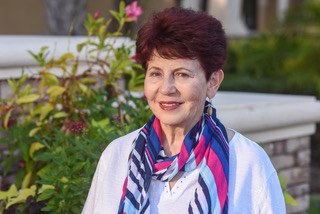
Lara Geyla
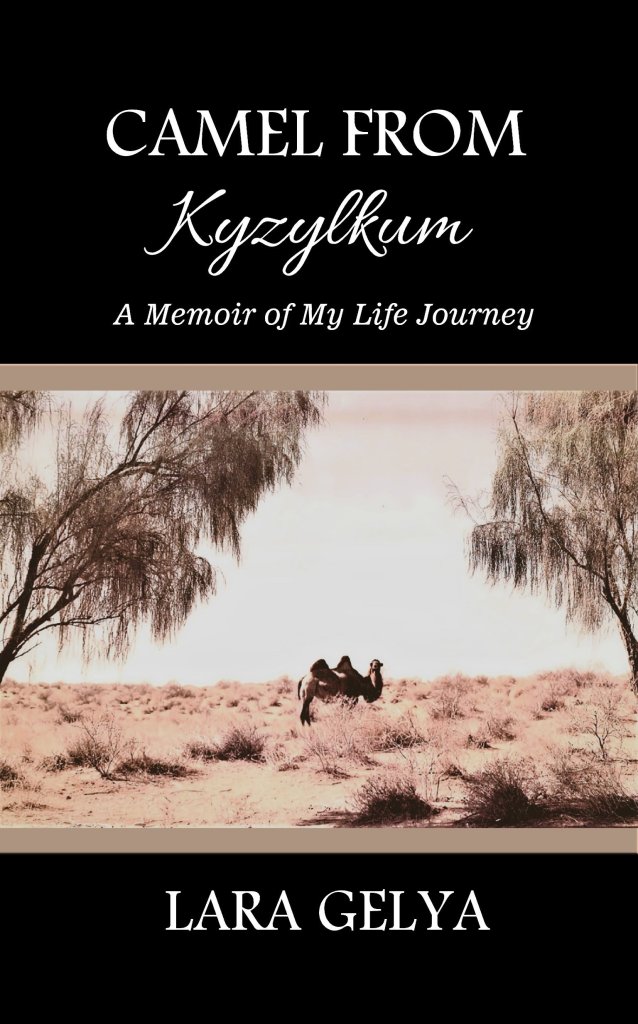
A migrant’s journey is never easy – it’s rife with adjustments and changes. Adapting to a country that is totally different from the one in which an immigrant is born, requires adjustments of various kinds, including learning new languages. Migrants also need to find acceptance and friends in the country they move to as did Lara Geyla, when she migrated out of a crumbling USSR to America, pausing by the way of Austria and Italy. She recorded her journey in Camels from Kyzylkum: A Memoir of my Life Journey.
Kyzylkum is a desert located in Uzbekistan. Geyla lived and worked in the desert for twenty years. She learnt that the camels were the hardiest of creatures. Her life’s journey like that of any other immigrant, had been hard. So, at the start of her memoir, she tells us: “I am a camel from Kyzylkum, too. Like a camel, I have adapted and found ways to help myself survive in the desert. As a camel stores his energy in its hump as part of its legendary ability to travel hundreds of miles without food and water, I stored the energy of my spirit to help me stay strong as I crossed continents alone, with two suitcases and $140 in my pocket in my search for a better life.”
Perhaps, this is a resilience that each migrant needs to unearth to settle into a country of their choosing, or sometimes thrust on them due to external factors like war and climate change. Through her memoir, we get glimpses of different parts of the world as she inched her way closer to the country she sought. People helped her along. At one point, when she arrived at the wrong destination for an interview with the American embassy that was crucial to her move to the country of her choice, an Italian taxi driver drove her at breakneck speed to the right address, where after a few questions, she was given the permission to emigrate.
This was in the 1990s. After moving to America, she helped more of her family to move to the country which gave her refuge. She found acceptance in a firm as a programmer/ analyst in Maryland. She lives now in her new home in Florida with her new family and friends and basks in their acceptance and love. In this exclusive, she talks to us of her journey.
Tell us what made you write Camel from Kyzylkum?
I had wanted to write my life story for a long time, as I believed my life journey was filled with incredible places and events. However, while I was working, I never had the time to focus on writing. Even then, I knew that if I ever wrote a book, it would be titled Camel from Kyzylkum. I finally wrote my story during the COVID 19 pandemic in 2020–21, when we were confined to our home.
Where in the Soviet Union did you grow up? What was your childhood like? Tell us about your schooling and a child’s life in the Soviet Union? How was it different from what we find in other countries?
I was born into a Jewish family in Vinnitsa, a city in southwestern Ukraine, not far from the capital, Kiev. At the time, Ukraine was part of the Soviet Union. Life wasn’t easy for those born into Jewish families in the Soviet Union; being Jewish was considered a nationality, not a religion. In fact, during my time there, we lived under the slogan: “Religion is poison for the people.” Religion was heavily suppressed, and atheism was strongly promoted during my time there. Although I grew up much like other children—playing the same games and attending the same schools—I was aware from a young age that there was a stigma attached to being Jewish. I felt different but didn’t understand why. After 1948, anti-semitism in the Soviet Union reached new heights, particularly during the anti-cosmopolitan campaign, when numerous Yiddish poets, writers, painters, and sculptors were arrested or killed. During my time there, antisemitism was consistently supported by the Soviet state and used as a tool to consolidate power.
When I was about 12 years old, my parents divorced, and my mother and I moved to Belarus to live with my grandmother. We all shared the same apartment. Soon after, I was sent to a boarding school, which I hated but had no choice and stayed there until I graduated. I’ve written about all of this in my book.
How was life different from what we find in other countries? That likely depends on the country you compare it to. Despite the many challenges and negative aspects of life in the Soviet Union, one notable advantage was the education system. It was of quite high quality, mandatory, and free.
You moved with your husband to the desert of Kyzylkum. What was it like living in the desert? In tents?
For the first three years, our young family lived in a small settlement belonging to a geological expedition. It really was in the middle of nowhere. The nearest civilized city, Navoi, was 200 kilometers (124 miles) away. Our settlement, simply called Geological Party #10, and it consisted of about two dozen barracks under the blistering sun, set in a barren landscape devoid of vegetation and offering hostile living conditions for humans, plants, and animals alike. The summers were extremely hot. The winters were harsh. At night, the wind became a growling, tumbling mix of sand and snow. I lay awake for hours, listening to the eerie howling outside. It was one of those winds that frayed nerves, made your hair stand on end, and left your skin crawling.
After three years, we moved to Muruntau, a slightly larger geological settlement, but we still lived in barracks. From there, we relocated to Zarafshan, a city in the heart of the Kyzylkum Desert of Uzbekistan, where we finally got our first apartment.
I have written extensively about our life in Zarafshan in my memoir, Camel from Kyzylkum. However, you might find it interesting to read an article by a Canadian reporter who accidentally stumbled upon Zarafshan while exploring Google Earth. He wrote and published the piece online in 2011, In Zarafshan.
What work were you doing there? What jobs did you do in the USSR? Did you go back to university there?
I earned my degree from a geological college in Kiev and worked as a geophysicist in the Kyzylkum Desert, focusing on gold and uranium deposits. Geophysics involves using surface methods and specialised equipment to measure the physical properties of the Earth’s subsurface and identify anomalies. These measurements help to make interpretations about a geological site, detect and infer the presence and location of ore minerals. Geophysical data is then integrated with surface geological observations to develop a comprehensive understanding of a region’s geological structure and history.
My job required me to work in various environments, including the open fields of the desert, open-pit and underground mines, as well as in the office. In fact, the Muruntau gold deposit in the Kyzylkum Desert, where I once worked, was and still is being mined as the world’s largest open-pit gold mine.
You have told us you were part Ukrainian and part Jewish? Judaism is faith — not a geography. So, were both your parents Ukrainian?
I was born into a Jewish family in Ukraine, which was part of the Soviet Union at the time. Both of my parents were Jewish and born in the Soviet Union. In my time there, Judaism was not considered a faith but rather a nationality. Nationality was stated in one’s passport. Synagogues were closed, and like most other Jewish families in the Soviet Union, our did not follow Jewish religious or spiritual practices. Instead, we celebrated all Soviet holidays. However, I do remember my father’s family gathering for Hanukkah and giving us, little kids, gifts and money. My husband, however, was Ukrainian, which made our daughter part Ukrainian and part Jewish.
Were you there during glasnost? Did things improve for you after the Perestroika and Glasnost? Please elaborate. How long did you stay after the dissolution of the USSR within your country of birth?
I would like to answer to this question with excerpt from my memoir Camel from Kyzylkum:
“Glasnost was understood as the movement in the USSR towards greater openness and dialogue. In the period from 1987-1991, Glasnost became synonymous with “publicity,” “openness,” and it reflected a commitment by the Gorbachev administration to allow Soviet citizens to publicly discuss the problems and potential solutions of their system.

I still lived in Zarafshan and took an active part in Perestroika and Glasnost—I was not afraid to express my opinions or attend meetings. I truly believed that we could change life for the better. One day I came to work only to find out that agents from the KGB had searched my office. KGB stands for Komitet Gosudarstvennoy Bezopasnosti, which translates to “Committee for State Security” in English.

At the time of Perestroika and Glasnost, books that previously had been available only through the underground distribution in the Soviet Union became legal, and excerpts were printed in many publications. I read a lot, and these books opened my eyes to the bloody recent history of our country—from the 1918 Revolution to the present day, on to all of the misleading, hidden truth, hypocrisies of our government, and the Soviet system as a whole. I realised that all of the concepts and ideas that they had taught us from early childhood were mendacious.”
I left the Soviet Union in October 1989, and as punishment, my citizenship was revoked. The Soviet Union ultimately collapsed on December 26, 1991, by which time I was already living in the United States.
Why did you want to move out of the Soviet Union? Can you give us the timeframe in which you moved out in terms of Glasnost and other events?
The Glasnost period in the Soviet Union was from 1987 to 1991. I left in 1989.
The late 1980s were years of exodus from the Soviet Union. Gorbachev opened the door of the “iron curtain” and everyone who could escape was leaving. I moved from Zarafshan, Uzbekistan, to Gomel, Belarus, in 1988. At that time, every single day platforms at the Gomel railroad station were full of people: families who were lucky to get exit visas, and relatives and friends who came to say their last goodbyes to them.
There was a code word: “to leave.” If you whispered it with a mysterious gravitas, there would be no need to ask further questions.
When I was asked if I would consider leaving, I said “yes” with no hesitation. I did not know what leaving would entail, but I started to go through the process as everyone else did. I apprised the family members, but there was no need or time to have long discussions—it was a once-in-a-lifetime chance, and the “iron curtain” could be down again at any time. We all knew how challenging and frightening immigration could be, but we had a hope that after all of the suffering, we could build a better life.
How is it you were on the list for visas and others were not given the privilege? Who were the people given the right to leave the Soviet Union?
Under Soviet law, no person could leave the country without the government’s permission, granted through an exit visa. This regulation applied not only to Soviet citizens but also to foreigners, including diplomatic personnel. Emigration policies varied over time and were always challenging to navigate.
In the 1970s, Jewish people in the USSR, often referred to as “refuseniks,” staged hunger strikes to protest the Soviet government’s refusal to grant them permission to emigrate to Israel. These protests highlighted the severe restrictions on their right to leave the country and garnered international attention, becoming a pivotal part of the movement advocating for Soviet Jewry, an international human rights campaign for Soviet Jews.
In the late 1980s and early 1990s, liberalised emigration policies allowed many Soviet Jews to leave, with more than half of the Jewish population emigrating, primarily to Israel, the United States, Germany, Canada, and Australia. However, it wasn’t only Jewish individuals departing; anyone who could endure the convoluted emigration process took the opportunity to leave. As a punishment, those who emigrated had their citizenship revoked.
The Hebrew Immigrant Aid Society (HIAS) played a vital role in assisting people leaving the Soviet Union, supporting them on their journeys to new destinations. HIAS continues to advocate for the protection of refugees and ensures displaced individuals are treated with the dignity they deserve.
For me, navigating the bureaucratic barriers of Soviet emigration policies in the late 1980s was extremely difficult, but my Jewish heritage worked to my advantage. After overcoming numerous hurdles, I left the Soviet Union at the end of October 1989. I had two suitcases, $140 in my pocket, and no certainty about my final destination. With my Soviet citizenship revoked, I became a “citizen of the World”.
Why did you choose to move to the USA over all other countries?
When I left the Soviet Union at the end of October 1989, I knew my point of departure but not necessarily my destination. The only identity document I had was an exit visa from the USSR and the train ticket to Vienna, Austria. I held no citizenship in any country and knew very little about immigration laws or processes. My ultimate goal was to reach America because I believed that the United States was the land of opportunity like no other country. During my interview in Austria, I was given the option to select a country I wanted to go to, and I chose the United States.
Other than language, did you have to study further to get a job in the US? How is working in the US different from working in the USSR?
Yes, I wore many hats and attended various schools before landing my professional job in the USA. First, I had to learn English. My journey began with earning a certificate as a nurse assistant. Next, I attended school to become a medical assistant, followed by completing a two-year program and passing the exam to become an X-ray technician. I worked in that role until I later completed a course for computer programming.
My first job in the US, however, was clearing tables at Burger King. I worked as a waitress, cleaned people’s houses, worked in department stores, and babysat young children. I did whatever it took to survive and was never afraid of hard work.
Working in the US was vastly different from working in the USSR, mainly because of the many barriers I faced: learning a new language, navigating cultural differences, adapting to unfamiliar social norms, and constantly acquiring new skills. Despite the challenges, I succeeded. Now, I’m happily retired, enjoying life in a beautiful community in Southwest Florida.
Have you ever returned to Russia after you migrated? How did you find it, especially as the Soviet Union broke up into so many countries?
My husband and I traveled to Ukraine in 2010, by which time it was an independent country. This was after the Orange Revolution1, a series of protests primarily in Kiev in response to election fraud. The revolution, which unfolded between late November 2004 and January 2005, brought significant political upheaval. Viktor Yushchenko was elected president on December 26, 2004, after weeks of turmoil that thrust the country into chaos.
As the informal leader of the Ukrainian opposition coalition, Yushchenko was one of two main candidates in the 2004 presidential election, the other being Prime Minister Viktor Yanukovych. During the campaign, Yushchenko survived an assassination attempt when he was poisoned with dioxin, leaving him disfigured. Despite this, he persevered and emerged victorious in the re-run election.
When we visited Ukraine in July 2010, the memory of the Orange Revolution was still fresh. We explored many cities, stayed with my childhood friend in Vinnitsia, and visited relatives in Yalta, Crimea. Crimea, sadly, was annexed from Ukraine by Russia in 2014.
The changes in Ukraine since my time living there were noticeable, but some things remained the same. We especially enjoyed our time in Yalta—a vibrant city filled with cheerful faces, where people celebrated life at this beautiful Black Sea resort.
In June 2018, during a cruise around the Baltic countries, we spent a day in St. Petersburg, Russia. The city and its museums are undeniably remarkable, as they always have been. However, the rude customs control at the port, long lines at the museums, being rushed through the exhibits, and other all-too-familiar experiences immediately brought back unpleasant memories from the past. After this brief visit, I have no desire to ever return to this country.
So, are you writing more books?
I’m considering it. However, finding the time to focus has been challenging. Between our extensive travels, my photography and video projects, marketing my memoir, and other everyday activities, my schedule hasn’t left much room for writing another book.
I wonder what people felt at the turn of the century, with Waterloo behind them now; and the Crimea and the hundred wars fought by men to prove I'm not sure what. I wonder what they felt as the thick black smoke of industry cleared now on the skyline; and there, for the first time, they saw the blue sky, the sunlight shining through. I wonder what they felt when they saw their century slip away, like a fine ship pushed out to sea. And there, before them, the great unknown; mile on mile of endless ocean. Did they feel hope or fear, I wonder? Or maybe both? And, seeing the gravestones in the rain, perhaps a sense of sadness, too, for those who had not made it. For many had lived, but many more had died.
II
We survived the shock of the millennium, with Passchendaele behind us now; and Auschwitz, Hiroshima, Korea, Vietnam. And, I wonder, as the years subside, what we will feel at the turn of our century... With Iraq behind us now, and Gaza and Ukraine and the hundred wars yet to be fought by men to prove I'm not sure what. I wonder what we'll feel as the thick clouds of radioactive gas clear slowly on the skyline. And there, for the first time, we see the blue sky, the sunlight shining through. I wonder what we'll feel as our century slips away, like part of a rocket jettisoned silently in outer space. And there, before us, the great unknown; a thousand light years, bright with stars; yet so very, very far away. Will we feel hope or fear, I wonder? Or maybe both? And, seeing the gravestones in the rain, perhaps a sense of sadness, too, for those who did not make it. For many will live, but many more will die.
Stuart MacFarlane is now semi-retired. He taught English for many years to asylum seekers in London. He has had poems published in a few online journals.
.
PLEASE NOTE: ARTICLES CAN ONLY BE REPRODUCED IN OTHER SITES WITH DUE ACKNOWLEDGEMENT TO BORDERLESS JOURNAL
Lesya Bakun, a poet and writer, tells her story of escape from war-torn Ukraine. Her narrative maps the past and the present.
“I woke up around 4 am with the sound of a loud explosion. And I heard all around me people running. They were leaving as they knew it (war) had started,” said Lesya Bakun, an applied linguist who worked as a youth worker and Non-Formal Education trainer in Kharkiv, Ukraine. This was on 24th February 2022. The offensive that is devastating a huge country with a population of 43,273,062 had started.
Lesya faced bombs as she tried to get food to her mother from her home as supermarkets were not functioning. She went live on Facebook while the shelling continued, using the footage as a defence mechanism. She elucidates: “I have documented my trip to bring my mother some food. It was scary because I heard explosions all the time. I was partly doing that as a security measure so that if anything happened to me it would be caught live on video. I had told my friends, if anything happened to me, they had my permission to disclose it. I had been sharing the overall story of the war. Many followed me on FB live from different countries because I was involved in European Commission’s Erasmus Programme for nine years and I knew people from pretty much all around Europe. I had connections also because I was a moderator for Virtual Poetry Readings. I had friends from every continent. People were following my story. It is one thing to watch the events in news but another to watch someone live through it. Eventually, people started recommending me to journalists in other countries. I gave five interviews to Canada, USA, Lithuania, Georgia and Italy. I became a bit famous. Weird though, not on the basis of who I am but on the basis of where I was and what I experienced. Like I am doing right now.”
Born five years before the USSR was dissolved, Lesya lived the first part of her life in the city that has been ground to pulp with the bombing, Mariupol. She moved to Kharkiv when she was twelve. She has memories of her past growing up in a Ukranian-speaking home, she was exposed to Russian and English together at kindergarten.
She unfolds the story of the current aggression bit by bit. The war this time was anticipated, she tells us. “This (attack) was anticipated because pretty much the whole world warned us that this would happen. And I had been warned by my friends from Lithuania and Latvia. My friend from Lithuania warned me three days before the attack and my friend from Latvia, three weeks before the attack. Russia and Belarus had prepared troops nearby, but a lot of people did not believe it would happen as they believed the Russian propaganda for dozens of years. I could have left earlier but my mum was really ill. She had COVID and pneumonia in January. She was in hospital. Then we brought her home with the oxygen machine.”
She had been going through family crises when the war started. She tells us: “Even though I was warned, I had not packed at all. In December, my grandmother died of a long illness. Then in January, my mum got ill with COVID. I had formalities of the funeral and all that. I was definitely not mentally prepared for war. How can you ever be prepared? I think even Putin was not prepared though he knew Russia’s plan. But he definitely did not understand how the Ukranians would meet him and his troops. Because for some reason, he was sure Ukranians would be happy to meet them. But Ukranians were not happy at all. He anticipated welcome like in Crimea (2014) where people did not fight. Unfortunately, eight years ago, lot of Ukranian troops and Crimea just gave up and changed the flag just like that. So, they have broken their promise to the Ukranian nation.”
She spells out clearly that Ukranians want their identity respected and not annihilated. “It is not a clash of ideologies. It is a fight for our country and nation to exist.”
The sense of resentment runs strong. The feeling of being let down is evident. She talks of the Budapest Memorandum signed in 1994, which led to the denuclearisation of Ukraine, here as she did in her poem. “Budapest Memorandum is an agreement between Russia, USA and UK. It says these three countries will protect us if we are attacked. When Russia took away Crimea eight years ago, no one came to protect us. There was a war with people dying in the East of Ukraine. Now as Russia attacks us, will Russia protect us? The United States and United Kingdom did not protect us from Russia. Thank you for all the help, help to refugees, for weapons. But the world would not need to face millions of refugees if they had respected the Budapest Memorandum eight years ago.”
Lesya gives a backgrounder to elucidate the need to withstand the Russian forces: “Ukraine is a multi-ethnic country, we have ethnic Greeks, Germans, Hungarians, Belarusians, Poles, Jews, Tartars, many others — not only Ukrainians and Russians, so it was never about ‘evil Ukrainians want to forbid Russian language and oppress Russian-speakers’ as they said in propaganda for years. Ukrainian Constitution protects the right for every nation and language to exist — but for Russia, just the existence of the Ukrainian language is an insult and a ‘threat to their existence’ (that they apparently need to protect by bombing Russian-speaking cities among others).
“For centuries, massive anti-Ukraine politics have been lead, targeted to wipe out Ukrainian language, culture, and identity, in the Tsarist Russia, in the USSR, and even after the Ukrainian independence. People have been brainwashed, and even our own TV shows often made fun of Ukrainians. A lot of common people (in some regions, up to 50%) believed the Russian propaganda. Films and media were still in Russian despite our breaking away, for years, which made me — a Ukrainian speaker — feel like an unwanted element in my own country. Only Yushchenko — our third President – introduced the law that all movies had to be dubbed in Ukrainian. Poroshenko — our fifth President — introduced Ukrainian-speaking quotas on the Radio — and a lot of business owners opposed that, and from that point, rumours of ‘Ukrainians suppressing Russians’ intensified. Russia wanted Russian to be the sole ‘inhabiter’ of our narrative and media, and the mere existence of Ukrainian media in Ukraine was perceived aggressively as ‘Ukrainian Nazism’ and ‘Ukrainians hating Russians’, ‘oppression of Russian-speakers’ and ‘Russian language needing protection in Ukraine’ (by destroying kindergartens and maternity hospitals, apparently).”
She gives an example of a woman who believed the ‘Russian narrative’ just before the war started. Lesya had gone for a lung check up to the hospital as she was coughing. This is what she says she encountered. “Two days before (the war started), I went to the hospital. I went for a fluoroscopy of my lungs. Then I could not take my results because the war began. But I still went to see the doctor before the war. A patient waiting with me asked, ‘If you do not have the results of the flouroscopy, why are you waiting to see the doctor?’ And I told her, ‘What if tomorrow the war starts?’ And this woman was too scared to believe.”
Lesya comes from a family of academics and intellectuals. She tells us about her mother, who despite the shelling continues to live in Kharkiv. A university lecturer, a Slavist and a dialectologist, her mother researched on language policies. Lesya explains: “My mother researched the Habsburg dynasty language policy in Wien and saw the originals of documents and laws. The laws of the Austro-Hungarian Empire were issued in local languages — among them, Ukrainian, Polish, Czech. There were magazines and books published in Ukrainian — while in the part of Ukraine under Tsarist Russia it was impossible. The existence of Ukrainian press, theatre, education, independent thought was forbidden. While in the Tsarist Russia, there had been a sets of laws that gradually forbade the use of Ukrainian in all wakes of life. Under the Soviet occupation, the situation did not improve. While on paper you could use Ukrainian, but in reality, all ‘other-thinkers’ were executed, sent to Siberia or suppressed and mentally broken until they started writing only ‘Social realism’ and praise of the Soviet regime and Stalin.”
Lesya draws from the past to explain how long Ukranians have faced oppression and why they felt the need to stand up to Russia. “You could not tell the story of Ukranian oppression in USSR because then you would be killed. Both my grandparents’ families have lived through the genocide of Holdomor genocide of 1932-33. Food was taken from the children and sold to the West, creating an artificial famine. Millions of Ukranians died of hunger. My grandfather’s family survived that, but his aunts died of hunger. And my grandmother’s family went through that. Their whole life, they were together, but they only started speaking to each other about the Holodomor genocide and their families’ experiences after Ukraine got its independence in 1991. Speaking about all this was forbidden so that even within the family people were scared to discuss it.”
To explain the current crises, Lesya drew upon the past. “We wanted to exist. Ukranian history, culture and language had been destroyed for centuries. We wanted to exist as a nation. The weak and faulty Soviet economy was another reason why not just Ukraine, but most of the Soviet republics, wanted independence. That was very noticeable even to common citizens despite all the anti-West propaganda and the Iron Curtain. I only have faint memories of it as I was five when the USSR collapsed, but I heard and read a lot of stories, and saw photos of empty shells of Soviet shops — there was this huge deficit of even the most needed things. The ‘planned economy’ was a ‘disaster’. Like if you wanted to buy milk, you needed to wake up at 4 am and stand in queue for two hours. There was the Iron Curtain — citizens of Soviet Union were forbidden to go abroad, or Western products brought in. Only if you were thoroughly screened by the KGB, you would be allowed to go abroad, and that would mainly be to the ‘Socialist block’ countries, on a preliminary very thoroughly planned visit. The KGB would continue to follow each of your steps while you were on a visit abroad. Only several dozen people were allowed to leave USSR for a short period of time, on a route agreed by the KGB — mostly diplomats or huge cultural actors (like ballet dancers). No such thing as ‘travel’ outside of Soviet Union could even happen.
“Of course, we had notion of international friendships, India, African countries, Cuba. We were curious. One of my closest friends is Ukranian-speaking half-Cuban — one parent is Cuban and the other Ukranian. They fell in love when as a student, one of them came from Cuba to study in Ukraine. We have had international friendships but only with socialist countries.”
Lesya tells us more about the suffering within her family in the Soviet Union. “Individual businesses were forbidden in USSR. My grandmother’s uncle was executed for owning a windmill. Being an entrepreneur was impossible. In my family, we have lots of such stories. My grandfather from my father’s side (who I did not know because he died before my parents married) believed in the Soviet propaganda, and he crossed over from Poland across the border with Belarus on foot. My grandfather eventually got married and had a daughter. But he was convicted on false allegations that he was a Polish spy and sent for ten years to Siberia. When he returned, his family had forsaken him in order not to live under the black mark of a ‘family of an enemy of the state’.
“With time, my grandfather managed to create another family and have my father — I am carrying this grandfather’s surname. My father, despite being born in Belarus from a Polish person, was documented as a ‘Russian’ in order to save him from a similar fate. Now imagine how many people in the Soviet Union were written as ‘Russian’ despite not being such? When he met my mother and he told her the truth, but my mum was okay because she said her father was also ‘an enemy of the state’.”
Lesya’s pride in her heritage is strong. She talks of her city and grandfather, mingling it with the present. “My city of Mariupol is being ruined by the Orcs (as we call the Russians) so much so that now the city almost does not exist. The city is an important cultural, naval (port), technological and industrial centre. It is a city in which my grandfather, Nil Andriyovych Karnaushenko, was a professor of metallurgy. And he has 32 patents that have been used in the local metallurgical works.
You have heard about the tragedy of civilians and the military — sheltered and simultaneously trapped in the metallurgical factory Azovstal. One of them is my cousin, who has been captured by the Russians*. The metallurgical works of Illicha and Azovstal were working non-stop even during the WW2 and the four years it’s been fought on Ukrainian territory – my grandfather said if the blast furnace gets stopped, it takes a lot of efforts and days to start it again, with a risk you could not start it at all. So the furnaces were working even during the four years of war.
“And now – two months of war with Russia – the metallurgical works that used my grandfather’s 32 inventions, all of his life’s work – are being destroyed. The university in which he lectured until his last breath – has lost half if its personnel. The city almost ceased to exist. And this is a primarily Russian-speaking city (despite being created by Greeks and being surrounded by ethnic Greek villages).
“It is not just Mariupol, but multiple cities, towns, villages near the Azov and Black seas, were built by Greeks. We have many ethnic Greeks living in and around Mariupol, we have lot of villages that are mostly populated by ethnic Greeks — that are now either wiped out or seized (after being wiped out) by Russians. We used to have a Greek consulate in Mariupol. It was as important cultural city, and hopefully will be again — after we win and rebuild it. And each of the 24 regions and the temporarily occupied Republic of Crimea in Ukraine have their own centuries of history and their own distinct story to tell — which is not Russian at all.
“They came to ‘liberate the people of Donbas’. Apparently, by creating multiple mass graves, burning thousands of civilians in moving crematoriums and deporting tens of thousands to Siberia without documents and means of communication.”
She draws from the past and tells us, “I am not a historian but a linguist. But the stories that my family have lived through and passed to me are a work in history. The story of Ukraine has not started by breaking away from Russia in 1991. It has started much earlier than Keivan Rus’ (882-1240). Ukranian history began more than one million years ago when the first Ukranian settlers began to inhabit the terrain of Ukraine. Long ago, the first horse was domesticated in Ukraine along with wheels. The first metal was developed in Ukraine.”
Lesya explains from a linguist’s perspective. “We have many ethnoses living in Ukraine for centuries. Our Constitution has been protecting all of them since Independence. We have local minorities of Romanians, Hungarians, Greeks, Poles, Germans, Karaims. We have a local minority of Crimean tartars (an ethnos native to Crimea). They had been deported by Stalin to Siberia — thousands of people dying in trains travelling to this cold place. Some survived and continued to live in Siberia. Imagine, for example, all people from Spain being sent to Greenland, with barely any clothes or food. Stalin banned the return of Crimean Tartars to their native, warm Crimea from Siberia — and only when Ukraine got its independence, we allowed them to come back. People returned home, after generations to see their homes taken by the Russian military or people exported from all over Soviet Union into their empty homes. This tragedy has been depicted in Jamala’s Eurovision-winning song “1944”. Ukraine had given Crimean Tartars the status of ‘nation local to Crimea’. While the Soviet Union and Russia as its heir had expelled them from their homes and deported them, without the right to return home, for three generations. This is why Crimean Tartars are so loyal to Ukraine as a country, and vocal in support of Ukraine after Crimea was forcefully taken. And this is one of the reasons why the tale ‘Crimea has always been Russian’ is a blatant lie.
Jamala’s song — the 2016 Eurovision winner
“We have many Jews. Belorussians. So, there are many more languages spoken in Ukraine other than Ukranian, Russian and English. Some people in Transcarpathia speak a mix of languages, you can see traces of Hungarian and sometimes Romanian — not pure Ukrainian. Ukraine is a huge country, geographically the biggest in Europe. Historically, unfortunately, our territory has been often split between different countries, each with their own policy about ethnic minority nations and languages. Russia had been very efficient trying to exterminate the Ukranian language, history and culture for centuries. And downgrading our sense of self-worth and installing in us a feeling we are not anything. Also installing a myth that Ukranian language and nation does not exist. In my part of Ukraine, Russian has been spoken widely just because they have a policy of destroying other languages. Also, sometimes people who speak Ukranian switch to Russian because they want to ‘fit in’ and be perceived as ‘higher rank’ or better educated — all because of centuries of conditioning that if a person speaks Ukrainian, they are an uneducated villager, and Russian is ‘high profile’ and overall better.
“When the Soviets came to the western part of Ukraine, they were very repressive. People were executed just for speaking Ukranian, or simply having the blue-and yellow (Ukrainian) flag. The place in which thousands of people were tortured and executed by the Soviets, is now Lonsky Prison National Memorial Museum (the National Museum-Memorial of Victims of Occupation Regimes) in Lviv. And that is why people in the West of Ukraine fought against the Soviets during the World War II and till 1956 when the Ukranian Rebel Army was totally destroyed — the rebels called ‘Nazists’ by the Soviet propaganda in Ukraine for the fact they were fighting against Soviet oppressors — a lie that had lived on for dozens of years and manifested in war now.”
Some of this may sound unreal or perhaps surreal to the world that continues entrenched in their everyday existence where the pandemic protocols continue a major concern along with having enough money to sustain oneself. Perhaps, the majority of people are most hit by the rise in oil and food prices, a threat of widespread hunger and stocks going awry. But for Lesya, it is her very existence as she recounts how she got out of Ukraine to the safety of Lithuania. Her choice was made because a friend from Lithuania warned her about the upcoming war and offered her a place to stay three days before the bombing. She adds: “Also, Lithuania has had a lot in common with Ukraine historically — the countries being together in the Grand Duchy of Lithuania (1236-1795), old Ukrainian being one of the official languages there. Lithuania had also suffered under the Soviet occupation. When I finally reached Lithuania, I found that the country was very supportive of Ukrainians. Many Lithuanians were volunteering, gathering humanitarian help. There were lots of Ukrainian flags and messages of support everywhere.”
Her escape to Lithuania was an adventure that lasted for eight days. When asked if she could relate her experience, this is what she had to say: “I can disclose part of the escape — not all because it will put others at risk for no reason… Actually, for the first five days I was trying to convince my mum to leave, to pack. But it was almost impossible. One of the reasons is she is still connected to the Oxygen machine. She can stay only for some time without the machine, but a long time would not be a good idea. And then she could not find her documents. And she was definitely not in a psychological condition to pack and go somewhere. Neither was I — but she was in a worse condition than me. I had been trying to convince her for five days, but she did not budge.
“My mother was the first one who saw smoke really close to her home and she called her friends and acquaintances to find out if they knew anything about the source. That did not convince her to leave. But it convinced me. It was the day after the Kharkiv administrative building had been bombed. The next day the neighbourhood in which we lived, in the centre of the city, was bombed. That is when I started to blog and do Face Book live — something that I almost had never done before – to document my trip to carry some food to my mother from my home.”
She continued her narrative explaining how she got help to leave the country from a voluntary group formed by citizens to take people to safety out of Ukraine: “There are several organisations. In Kharkiv, I know of two. Probably there are more. They are helping people get out of Kharkiv. One organisation was taking people to Poland or wherever the person wants to go but it would have to be outside the city. There is also a group of volunteers who help people reach the train station to leave by the evacuation train because it is hard to reach the train station without public transportation. Public transport is no longer functioning. And the taxi drivers were asking for absurd prices — like a month’s salary where earlier it was a hundred now, they wanted 5000 or 7000 hryvnias. I did not know what to do, for it would take me about three hours to walk to the train station under normal circumstances. Now with my backpack and belongings under constant shelling, it seemed pretty much impossible.
“At that juncture, I got to know there is an organisation which I will not name till the war stops, that helps people out and I registered with them in a google form writing where I wanted to go. In the form, they asked us to fill the number of people who needed evacuation, the number of children, pets. Their priority was to get whole families out. I was just one person — that was one of the reasons why it took me so long to get to the border as families were a priority.
“One of the people affiliated to this organisation is a friend of mine. She is also a writer who used to document war crimes in the Donetsk region for eight years. So, that day she called me at 7 am and asked me if I could be ready in fifteen minutes, I said I could not be ready in fifteen minutes as I was at my mum’s. Then I rushed home and packed whatever I could. There was a chance that the cars with the fleeing residents would be bombed. The most important things needed to be in the backpack — money and documents and in my case, the laptop. Because even though I do not use it much, you can work anywhere if you have your laptop. I had thirty minutes to pack to leave.”
“One or two days before that, the electricity got cut for the evening. I was afraid the meat would be ruined. I did not know when the electricity would be back. So, I boiled all the meat from the fridge. Before leaving, I gave the two bowls of boiled meat to my neighbour who at that point had not planned to leave. I also gave her my massage cover that I had bought in December. In our tradition, leaving something behind is a sign you will return.
“At that point my neighbour did not want to leave as she had family near Kharkiv. But now, she is in Germany. When the war started, she was wondering when it would all end. I was looking at her and thinking how our grandparents faced war for four years during the Second World War. I bet they did not ask when will it all end! I knew that it will not be quick, that is not how wars are fought. At that point, it was the third day of full-scale war, and it was weird that she constantly asked, ‘When it will all end?’ and was eagerly waiting for the result of peace talks between our diplomats. I knew no peace talks were really possible: they would demand half of Ukrainian territory, we would not agree, end of discussion, the war continues. What peace talks? On the basis of what? Us surrendering? ‘Demilitarisation’? Why would we do that? There was no common ground for discussion. We want to be left alone, to continue being an independent country with a path towards NATO (North Atlantic Treaty Organisation) and the EU (European Union), and we want Crimea and the occupied territories of Donetsk and Luhansk regions back. They want Ukraine to cease existing (what they call ‘demilitarisation’), Ukrainians as a nation assimilated (what they call ‘de-Nazification’). These are their demands. There is no ground for discussion here.
“I took the dry food which would not go bad during the trip. I did not know how long the trip would take and what I would face. I took only the food that did not need to be cooked.
“I packed what I could and then I found my friend calling me. I had not heard the phone ring. I am really thankful she did not leave without me because people really need to leave the city very early as the bombing would start early, maybe at 9am, and then it repeats with pauses — every two hours, about five times a day. You hide in a self-created bomb shelter while the shelling continues. When it stops, you sit there for some time, trembling and unsure; and by the time you get your guts together to go buy some food or supplies (in my case, medicine or pulse oximeter batteries for mom), the shelling begins again, and you cannot leave. You just sit at home, frozen, in the constant state of crippling fear.
“My trip to Lithuania was nothing special. But I have never been not able to travel as I want. Also, I never had to travel with bombs and outside of curfews. I live fifteen minutes by bus from the airport. But the biggest airports of Ukraine were closed the night before the war started. That is why it took so long. Each city, each neighbourhood have their own curfews. You cannot be outside the curfew.
“I started my journey as, first, an internally displaced person, and then, a refugee, on the sixth day of war. My friend picked me up. I got in the bus and put my luggage aside. All you needed was your money, documents and your smart phone.
“I thanked my friend for taking me, but she said, ‘My dear how would I leave you?’ And I whispered under my breath, ‘I love you.’ I felt relieved. We started driving. Within five minutes, I saw several bombed buildings. I saw with my own eyes how real it all was.
“After that we went to the house of my friend’s parents, outside Kharkiv. That had been converted to a refugee shelter. It was a point where you waited for the next part of the transport. More people were waiting there.
“We made plans for our trip. My friend also arrived. She apologised that she could not take me as the next two buses were loaded with families and they do not part families. So, I stopped there with her family. I waited two days for the next transfer. It was nerve racking as it was close to Kharkiv and we heard warplanes flying. The bombs were exploding in our part of the town.
“You made connections with the people in the house because you do not know how long you would have to wait. You do not know if the bus would be bombed, if the bus driver will be alive. You do not know. You are in the complete dark. I managed to make friends with the people there. I slept on the sofa in the same room. My friend’s mother cooked for us free of charge. The people in the village had to stand in a queue for one and a half hours to buy food. The good thing was that at least there was food in the shops.
“There were no sirens because we were not in the city. The city defence system did not actually cover us. And the city air raid warning system also did not cover us. If you hear the planes and the explosions, you know it is time to go inside as the bombs can hit your house. Sometimes, you take shelter in the cellars which is used to store vegetables. One of the children in the shelter was a special needs kid and therefore restless and would scream. My coat was ripped but I did not have the inner strength to sew it. I had two foreign passports. I used the part that was ripped to hide documents and money, in case I’d need to run with no luggage. It is legal in Ukraine to have two foreign passports. I had some money there which, unfortunately, I could not exchange after the war started.
“Finally, we left early in two buses. In Ukraine you travel between curfews. On the road, we had two stops in local kindergartens or schools on the borders of the region at night for the curfew. The bus driver had to monitor to navigate us safely — watching all the while where the road was destroyed, where the bridge was destroyed.
“We would start around six seven in the morning every day and then stop for shelter at 2 pm or 3 pm or 4 pm so as not to move outside the curfew. We were welcomed in kindergartens or schools. Sometimes we slept on the floor. We were not the first and we will not be the last. Lots of families with children waited. And we were brought to a refugee centre in the centre of Ukraine which is the office of the organisation that was helping us. In the city, I will not name till the end of the war and probably later, we stayed in a very old Soviet hotel with running water but no hot water. We had to hide in the bomb shelters three times a day just in case. It was a hotel full of people from Kharkiv. I have been in Lithuania now for almost a month. And this organisation is still helping people.
“We stayed in the centre of Ukraine. It was not modern, but it was a shelter, and they gave us food on a voluntary basis. So, some people decided this would be their final destination. Some refugees are now volunteering for arranging transportation, giving information, fund raising. They are trying to arrange buses but sometimes, there are buses but no driver, sometimes drivers but no buses, sometimes no petrol — it is war. So, we waited there two or three days. I cannot recall the number of days exactly. We waited for buses to take us to Warsaw as this organisation has an agreement with Poland. There is a hotel in which we could stay in Warsaw.
Food at the hotel without hot water. Photos sent by Lesya Bakun
“They gave us food three times a day and we did not have to pay anything. I spoke to two young women, mother and a teenage daughter. Their home was destroyed near the Constitution Square and they were living in the hotel. They had bombed the Constitution Square and the Independence Square… Those two women have been left without a home and stay in the hotel. I had given interviews to Canada, Romania by then and I went around asking people if they would like to give interviews, but people did not want to. So, in that sense, I am unique.
“Every person deals with stress in different ways. They were not ready to talk of their trauma. But for me it is natural to talk. So, this woman refused to talk about it. Their experience is their home did not exist anymore. The mother had to be dug out of the rubble when there was an explosion. The daughter was like the Terminator. The cupboard fell on her and she got up and put everything back to order and dug her mother out of the rubble in the bathroom. Her mother stayed in the hospital emergency care for one day as her face was covered with broken glass. Then the next day, their relatives came, helped dig out two suitcases and, mind you, it was February, and they had only two suitcases left. If you live in the centre of Kharkiv, it means your life is good. They lost everything.
“My friend from Lithuania was wondering if I were ready to go. When I told him I would probably have to go to Warsaw, he started searching for ways for me to get to Lithuania from Warsaw. Apparently, there are volunteers who are taking people from the border of Poland to Lithuania but not from Warsaw. So, he told me to go to the border of Poland and find this person and say that I need help.
“We arrived by bus to the border town of Lviv. My friend from Lithuania had a relative there whose wife worked in the school, which was used to house us. This relative’s wife helped me buy some cough medicine, as I was coughing, and a power bank… We spend the night in the village and started our trip. It was a green corridor bus so I thought it would go faster. They would not check the documents so thoroughly. But there was a huge crowd of buses and people. We had to wait at the border for eight hours. It was 1 am when we crossed the border. To get from the border to Lithuania was not easy. No one knew how long one has to wait at the border. Some people had been waiting two days at the border. Eight hours later, I got out and I felt my adventure had ended. But actually, it was just starting.”
Lesya Bakun at the Polish border
A special message from Lesya Bakun:
“If you want to help Ukraine in its hour of need, I urge you to donate to Ukrainian military — because if Ukraine loses, there will no longer be need for humanitarian help. You can support local humanitarian actions — things that are really needed in these specific locations in this specific time. You can donate to the fund “Come back alive/Povernys’ Zhyvym“. Please click here to donate. And you can help Ukrainian families, children, and pets get to safety by donating to the volunteers who bring people like me and all the people I met en route.
“I also urge you to support Ukraine by buying Ukrainian books, inviting Ukrainian artists to poetry, musical, and visual arts events – or offering residencies and shelter to Ukrainians fleeing from war, and learning more about the reach Ukrainian culture and the history of its fight for freedom.
“Together, we will win!” — Lesya Bakun
*Updated on 9th May, 2022, from an email message by sent by Lesya Bakun: “My cousin, the defender of Mariupol, has been captured by Russians.”
(This article is based on an online interview conducted by Mitali Chakravarty from voice messages and written texts on the social media platform of Telegram.)
Lesya Bakun has given a list of some places where donations can be made.
BENEFICIARY

RJABKO VASILIJ 64703, Ukraine,region Kharkivska,city Kharkiv,street Akhsarova,building 15a,flat 27

IBAN:
UA273052990262046400929572634

ACCOUNT

5169 3600 1722 8341

BANK OF BENEFICIARY
Банк отримувача
JSC CB PRIVATBANK, 1D HRUSHEVSKOHO STR., KYIV, 01001, UKRAINE
SWIFT CODE/BIC: PBANUA2X

CORRESPONDENT ACCOUNT

0011000080

INTERMEDIARY BANK

JP MORGAN CHASE BANK
SWIFT CODE/BIC: CHASUS33

Card currency:
USD

BENEFICIARY
Отримувач (П. І. Б. отримувача рахунку латиницею)
RJABKO VASILIJ 64703, Ukraine,region Kharkivska,city Kharkiv,street Akhsarova,building 15a,flat 27

IBAN:
UA513052990262016400929572635

ACCOUNT
Рахунок в банку одержувача (номер пластикової карти або поточний рахунок в Приватбанку)
5169 3600 1722 8358

BANK OF BENEFICIARY
Банк отримувача
JSC CB PRIVATBANK, 1D HRUSHEVSKOHO STR., KYIV, 01001, UKRAINE
SWIFT CODE/BIC: PBANUA2X

CORRESPONDENT ACCOUNT
Рахунок банку одержувача в банку-кореспонденті
623-160-5145

INTERMEDIARY BANK
Банк-корреспондент
J.P.MORGAN AG, FRANKFURT AM MAIN, GERMANY
SWIFT CODE/BIC: CHASDEFX

Валюта карти:
EUR

Riabko Vasyl 095 555 06 58
papakarlowas@gmail.com
For Western Union or PayPal
PLEASE NOTE: ARTICLES CAN ONLY BE REPRODUCED IN OTHER SITES WITH DUE ACKNOWLEDGEMENT TO BORDERLESS JOURNAL.
Disclaimer: The opinions expressed in this interview are solely that of the interviewee and not of Borderless Journal.
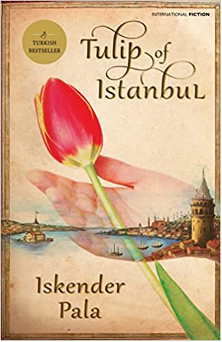
Tulip of Istanbul was originally written in Turkish in 2009, is a historical novel by Iskender Pala. The translation to English by Ruth Whitehouse and its publication by Niyogi Books in December 2021 has put it within the reach of the larger community of Anglophone readers.
Iskender Pala is a professor of Turkish (Ottoman) Divan Literature, an author, and a columnist. He is a recipient of the Turkish Writer’s Association Prize (1989), The Turkish Language Foundation (1990), The Turkish Writer’s Association Essay Prize (1996), and was honoured with The Presidential Culture and Arts Grand Award in literature in 2013. He has been conferred the title of “The People’s Poet” by popular vote in Usak, Turkey. Ruth Whitehouse is a scholar of Modern Turkish Literature and translator with multiple translations from Turkish.
Tulip of Istanbul , a fictionalised historical romance, is a murder mystery that is woven to highlight the period that followed the Treaty of Passarowitz in 1718. The story spans 1729 to 1730. Also known as the Tulip Age, this was a time when the glory of the peaceful period since the 1718 treaty was interrupted by an outbreak of a public revolt that showed resentment to over-indulgence and wastage, leading to social and economic downfall. The book has 66 brief chapters that seek to answer a question that is set as the title of each chapter. In the ‘Preface’, the author claims he wrote the book under the influence of a handwritten anthology of Turkish poetry by an anonymous compiler from an “Auction of Stamp Collections and Old Books” outside Istanbul’s Marmara Hotel. Impressed by the book, he wanted to showcase part of the Ottoman history as a storyteller. Thus was born the One Murder, Sixty-six Questions in Turkish translated as the Tulip of Istanbul.
The ‘Prologue’ reveals that “truth must not remain concealed” and so, the story is told two weeks after the October Revolution that deposed Sultan Ahmet III and slayed his son-in-law Grand Vizier Ibrahim Pasha of Nevsehir. The book opens with the question, “Is There No Limit to Self-Sacrifice?” The mysterious murder of Naksigul, the bride with heavenly beauty on the first night of the wedding, left the husband, Falco, distraught and deranged. The death of his wife had him thrown to prison as the prime suspect. Naksigul was holding a rare and beautiful purple twin bud tulip when she died. Two lovers were brought together by fate when Falco escaped the jailors. They jointly set out to solve the mystery.
In the story, Pala beautifully alludes to the rich culture and history of Istanbul. He manages to introduce the readers to the ninth-century music therapy called “Farabi”; historical figures who visited the empire of the time, the poet Nedim, the painter Van Mour and dignitary Lady Wortley Montagu; and to the Empire’s culture of maintaining insane asylums, prisons, lodges, and coffee houses. The narrative is interestingly infused with plots that are a story-within-a-story about the social life of the Ottoman Empire, the accounts behind the architectural beauties of the walled city of Istanbul, the picturesque sunsets of the Turkish straits be it by the Bosporus or sea of Marmara, the magnificent domed mosques, and palaces with fashionable gardens.
The action peaks to an important juncture at the house and garden of the most coveted tulip cultivator Hafiz Celebi. In the story, Pala includes mesmerising tales on the nomenclature, symbols, and meanings of the “Tulip” flower, which metaphorically and literally relate to the flourishing business, architectural beauty, and exchange of politics, art, and aesthetics of the Empire with the countries like Iran, Austria, Holland or Crimea. Through the story, Pala aptly accommodates how the Horticulturist community indirectly played a role in the policies and well-being of the state. Tulips are strewn through the story binding it into a poetic whole. Pala mentions the upgrade in information sharing with the coming of the first printing press in Turkey and succeeds in connecting it to the ongoing social unrest and the gruesome revolt that ensued in the Tulip Era. The mystery livens up till the end of the story where love guides and transforms, its own meaning and the seeker.
The language used by the translator in the story aids in understanding the appreciation for elegance and perfection in the art and aesthetics of the Ottoman Empire. Tulip of Istanbul is a potent read with a capacity to broaden the perspective about a culture one knows less about, a perfect springtime read. Changing seasons and social change serve as the backdrop to the dreamlike story filled with intrigues of royal secrets and suspense wreaths with those that pursued power alongside those that pursued love.
.
Gracy Samjetsabam teaches English Literature and Communication Skills at Manipal Institute of Technology, MAHE, Manipal. She is also a freelance writer and copy editor. Her interest is in Indian English Writings, Comparative Literature, Gender Studies, Culture Studies, and World Literature.
.
PLEASE NOTE: ARTICLES CAN ONLY BE REPRODUCED IN OTHER SITES WITH DUE ACKNOWLEDGEMENT TO BORDERLESS JOURNAL


 Borderless