Categories
Musings

Hope in Troubling Times

By Nishi Pulugurtha

My college is closed, classes are off and examinations have been deferred. We need to go in only if and when there is a need. It is not a holiday as I keep telling all my students, it is a shutdown, done for the sake of social distancing and isolation.  It is difficult convincing all about the seriousness of it all, how important it is to take precautions. There are many who dismiss it as media hype, as unnecessary, as India is safe, etc. Convincing does not seem to work, nor does rationale, some just refuse to see logic and reason.  No, I am not in a state of panic, just being careful. Trying to do my bit. As I began writing this. news came in of the first case in Kolkata.

As I was reading news about COVID_19 a few days ago it seems like some dystopia, a sci-fi movie or novel, only this time it is not fiction. It is for real and the earlier we realize it and take all necessary measures the better. Life for the daily wage earner could be even more difficult. The driver who came in yesterday morning told me that since many like me who will not be needing their services for sometime, his income is going to fall sharply. What happens to people like us, he said. I did not have an answer.

The shutdown gives most of us time to slow down, to work at other things that we can. I recorded my first lecture last night, a brief one, a test one. I shared it with my fourth semester students in a group that we created, our virtual classroom for the time being. I need to make sure that they are connected to their books and studies. Some of them did watch my video and even asked pertinent questions. I am sure many more will do it too, will take it seriously. Yes, we are angry and disturbed that so many of our plans, our schedules, our trips, our holidays, our getogethers, our parties, our functions, our movie dates, our programmes, so much of our lives that we looked forward to are all cancelled. We need to make the best of a bad situation. We are all in it together and maybe that is what will help us tide over it all.

Yesterday I noticed a post by a young dentist interning right now, miles away from home, she spoke about restraint, about taking precautions, about being careful. That post gave me hope, that in spite of the many who are throwing precautions to the wind and taking things very casually, there are sane voices. I know things sound depressing, who wants to be stuck at home. Even though I have prepared a long list of things I plan to do during this shutdown, I am not sure how much I will actually get down to doing.

It is going to be difficult for the elderly and for those with other health issues and ailments. My mother is in an advanced stage of Alzheimer’s Disease and is immobile now. I have been writing about our journey with the disease for some time now so as to create an awareness, just to talk about it, to give voice to those who are no longer able to speak for themselves as the tangled nerves in their brains prevent them from doing so. I need to be extra cautious as a result. She needs constant supervision, her hands need to be washed as she very often puts her fingers into her mouth, just like a baby. The caregivers at home have been instructed to take precautions.

A group of friends came up with a brilliant idea to reach out to those who need help. The Facebook post which I then shared spoke of reaching out to parents of friends, colleagues and acquaintances living alone in Kolkata as their children are abroad or in other parts of the country and are unable to come back now. It spoke of reaching out to them, checking on them to find out if they are alright, if they need anything, of making arrangements so that they have basic supplies, medicines they need. Work on it has already begun, people on both sides have begun to reach out, help is reaching homes. A friend is worried about her father undergoing dialysis at a city hospital and the worry is absolutely justified. The most I can do is to reach out to her. A word of help, of consolation, I believe work.  That friend, too, is part of this group reaching out to the elderly. There surely is much hope and compassion in times such as these. Let us look out for them, reach out, just be there.

Dr. Nishi Pulugurtha is Associate Professor in the department of English, Brahmananda Keshab Chandra College and has taught postgraduate courses at West Bengal State University, Rabindra Bharati University and the University of Calcutta. She is the Secretary of the Intercultural Poetry and Performance Library, Kolkata (IPPL). Her research areas are British Romantic literature, Postcolonial literature, Indian writing in English, literature of the diaspora, film and Shakespeare adaptation in film and has presented papers at national and international conferences in India and abroad and published in refereed international and national journals. She writes on travel, film, short stories, poetry and on Alzheimer’s Disease. Her work has been published in The Statesman, Kolkata, in Prosopisia, in the anthology Tranquil Muse and online – Kitaab, Café Dissensus, Coldnoon, Queen Mob’s Tea House, The World Literature Blog and Setu. She guest edited the June 2018 Issue of Café Dissensus on Travel. She has a monograph on Derozio (2010) and a collection of essays on travel, Out in the Open (2019). She is now working on her first volume of poems and is editing a collection of essays on travel.

Categories
Poetry

Two Covid-19 viruses meet Albert Camus

(A Dystopian spoof on Corona and Camus)

By Ra Sh

The world was calm now. And silent.

Only the birds chirped tweeted sang cawed.

Only the animals barked mewed mooed growled.

Only the river gurgled.

Only the sky thundered.

Only the fires crackled.

Two covid-19 teenage viruses walked around the city

assessing the damage. On Route vers l’ouest, they found

mansions with cars parked in front and little gardens.

Four dogs ran out of the house dragging a well dressed

woman and a naked man. It was the posh area of the city

and in house after house dogs feasted.

On Route Vers le nord, that led to the fields, unharvested paddy

lay in the fields. That was the operational area of the rodents,

snakes and the jackals. On Route vers l’est, that led to the offices,

the road lay thick with the police, applicants, clerks, officers and

mounts of paper. The vultures landed on them and tore away

the flesh.  It was a mass of rotting flesh, blood, hair and

official communiqué.

On Route vers le sud, that led to the river, peacocks danced on

the road. From the two theatres that showed no films, super stars

grinned from posters. Weeds were slowly climbing up the

courtyards of the college and the schools. The grounds were

covered with bodies , furniture, lab instruments and aprons.

The teenage viruses reached the river and sat holding hands.

Being young, they were in love and being idealistic a tad bit

sad about the end of humans.

They then spied a human in a trench coat and trousers angling for

fish  on the bank. He smoked a pipe and chuckled while he spoke

to the fishes. The adolescent viruses approached him and asked,

“Who are you sir, how come you are in one piece when

all humans are dead all over the world?”

The man chuckled again and retorted, “I am Camus

and I wrote a novel ‘The Plague’ long back. I wrote that the city

was happy, life went on, but the plague bacillus never dies or

disappears for good. It can lie dormant for years and years

in bedrooms, cellars, trunks and bookshelves and perhaps the day

would come when it roused up its rats again and sent them

into a happy city.  You are those rats now and you are the plague.”*

The Gen X viruses who could barely understand him, watched

as Camus gathered his things and made his way up stream with

fishing rods, bait and the day’s catch, whistling to himself.

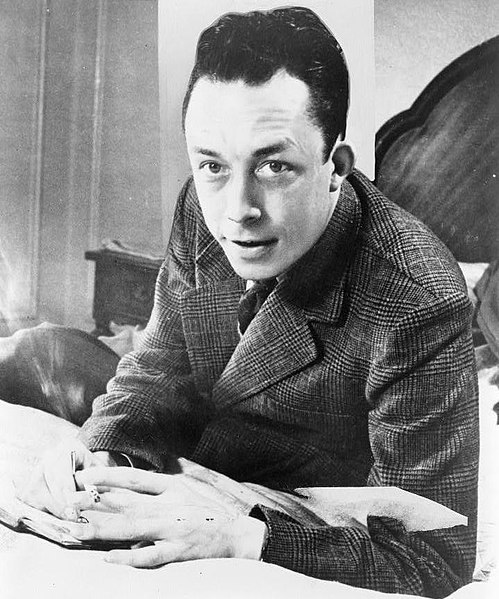
Albert Camus

*From the last lines of the Albert Camus novel, The Plague.

Ra Sh is a poet based out of Kerala

First published in Countercurrents.org

Categories
Editorial

Hello World!

Welcome to Borderless — a journal that hopes to roll out an invitation to all those who are willing to venture into the vastness of wonders, ideas and creativity. It seeks out thoughts that can soar above borders not just like birds but also like clouds. Clouds waft without pausing at differences, join together and bring water to the parched lands across all terrains as do writers and readers who look beyond differences. The writing will be like raindrops that create a downpour of love, tolerance, kindness, wit and humour. With a little soupçon of such values, we hope to unite into a world that can override differences, hatred, angst, violence and COVID-19. 

In these pages, we welcome hope for a future that makes us happy; we welcome all writers of all ages to come and revel in words and ideas and we invite readers to come and read and give us comments and write to us about what they would like to read at editor@borderlessjournal.com.  They are also welcome to try their hands at writing. In a world forced to segregate for the sake of survival, this is a way to connect with ideas. 

We start the journal with some input from the team from the editorial board, constituting a few writers who are outstanding and eminent in their own areas. You can read about the team in ‘About Us’ and savour some of their work under the different subheads: essays, reviews, stories and poetry. 

Dustin Pickering, somewhat of a rebel poet, a Pushcart nominee and a brilliant essayist, columnist and publisher, has contributed a scholarly essay on ‘Poets as Warriors’ — I love the idea even though I differ with some of his surmises. Maybe a war of words can convince people eventually that war with weapons is not the best way to maintain peace. Meenakshi Malhotra, a specialist in gender studies, bring us an essay on whether solidarity between women is possible. What do you think?

Namrata, a writer who hides behind fuchsia curtains and spills out lovely reviews, has a tempting review on a book edited by Sarita Jenamani and Aftab Husian — Silences between the Notes. Curious? Read and find out.

Sarita Jenamani, the PEN Austria general secretary, herself has contributed poetry — like the tinkling of crystal chandeliers evoking an evening in Vienna where she lives. Sohana Manzoor, the literature page editor in Daily Star, Bangladesh, has contributed a story, the title of which brings a smile — ‘Parul and The Potato Prince’ — reminded me a little of an O’ Henry in a Bangladeshi setting! 

Nidhi Mishra, a successful publisher of children’s stories, rolled out a fabulous piece on corona that hovers between an essay and a slice of life. It is in a grey zone — and that is why there is a new name for it — Musings. In Musings, you will also find Debraj, a popular columnist and an associate professor in Delhi University, with an unusual piece — again hovering between multiple genres. That is partly also what we hope do in Borderless, we explore genres and non-genre based writing to create new trends. 

Read it all and tell us what you think.

I look forward to Borderless as ‘your’ journal — a site that hosts contributions and looks for readership from all of you! 

Thank you all for your goodwill and friendship. 

Welcome again to a world without borders!

Mitali Chakravarty