Categories
Interview

Folklore, Fiction, Ghosts and Grammar

Storytelling is central to the life and work of Malaysian author, editor and teacher, Daphne Lee. Keith Lyons finds out what keeps her up at night.

When I1 first met Daphne Lee in person, in a Chinese Buddhist cafe in Christchurch, New Zealand, on a summery day. I was struck by her curiosity. And I came away impressed, not just by how she delights in hearing ghost stories, myths, supernatural tales, and folklore but how she makes connections to the universality of storytelling, and what lies beneath.
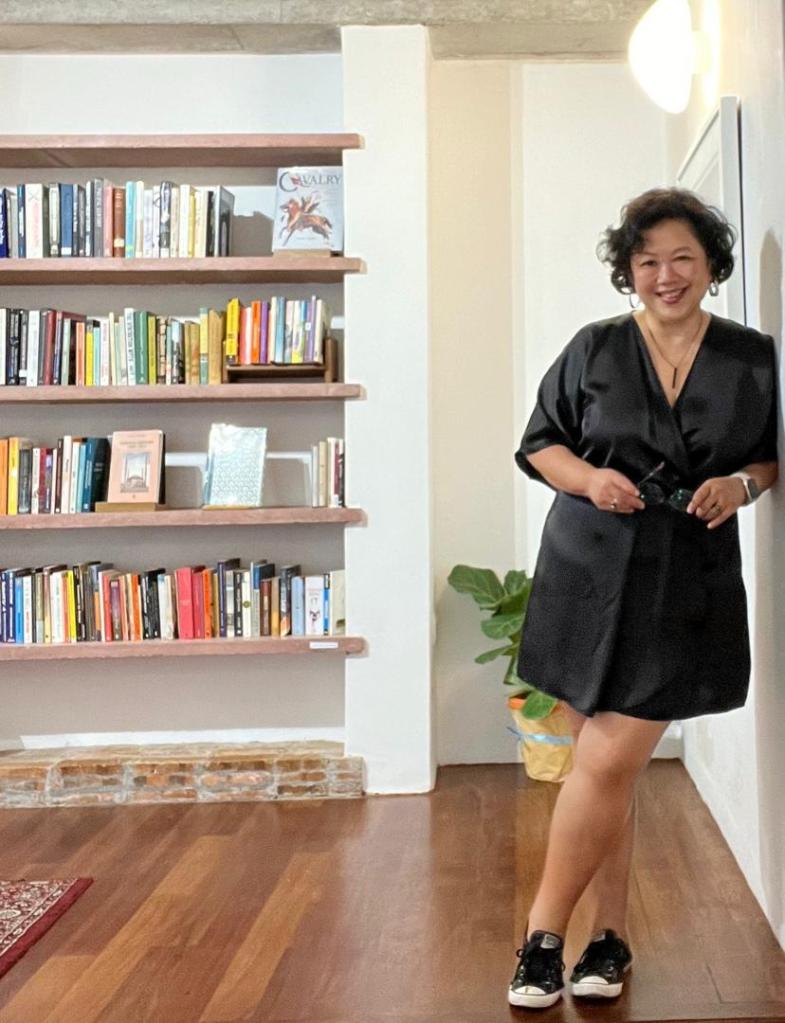
Daphne Lee

As well as being a collector and curator of stories, she’s a writer, a creative writing teacher, and an editor—since 2009 she’s been consulting editor at Scholastic Asia.  She’s been active in supporting the work of writers and illustrators of children’s and young adult literature with Asian content. Daphne curated and edited Malaysian Tales: Retold & Remixed (ZI Publications) in 2011 and Remang: An Anthology of Ghostly Tales (Terrer Books) in 2018, while Bright Landscapes, Daphne’s first collection of short stories, was published in 2019. She’s working on a new short story collection, and her first novel, which she is currently revising while in New Zealand on a writing retreat, far from the streets of Kuala Lumpur and her Roman Catholic school upbringing.You can find out more about the multi-talented Daphne at her website https://daphnelee.org/.

Interview with Keith Lyons

What inspired you to create Remang: An Anthology of Ghostly Tales?

Malaysians love ghost stories. We would rather any misfortune or unusual occurrence be caused by a spirit or other supernatural phenomena than try to figure out a logical reason. Having said that, I don’t believe in ghosts, but I do enjoy ghost stories. I thought it would be fun to edit a collection of these, but I was wrong …  

How do you approach writing and curating ghost stories? What elements do you feel make a truly eerie and memorable tale?

I prefer a story to suggest a mood and to be atmospherically or suggestively spooky than to be full of gory and blood-curdling details. I like the sort of ghost stories that are frightening only if you read between the lines or that seem unremarkable at first, but months later, you suddenly realise what it all means.

Your work often draws from Asian folklore and supernatural beliefs. Are there any particular myths or legends that have influenced your storytelling?

Nothing in particular, but I have heard the same stories all my life and with surprisingly few variations and differences. I enjoy retelling the old tales or building on elements in them. Hopefully, I make a completely new story, but with recognisable features because I like reading stories in which there are some familiar details.  

Do you have a personal ghost story or supernatural experience that shaped your interest in this genre?

My family lived in a haunted house in my hometown (Segamat in Johor, the peninsula’s southern-most state) and we experienced things like lights going on and off, footsteps, odd, unexplained sounds, and so on. I can’t remember much, but I don’t think any of us ever felt threatened during the eight years we lived there. If there were spirits, they were not malevolent. My interest in the supernatural was probably more shaped by the films I watched as a child, including The Exorcist and the Hammer House of Horror — Dracula films starring Christopher Lee.

As an editor, what do you look for in a compelling ghost story?

The problem with the ghost stories we tell one another is that they are usually just anecdotal fragments. I look for fully-formed stories with well-developed characters—the ghostly element might even seem merely incidental to the plot yet be significant enough to make an impression. It should haunt you a long time after you’ve stopped reading.

How do you balance creative freedom with maintaining a strong thematic or narrative structure in an anthology?

I’ve curated two anthologies—one of ghost stories and the other of retellings of folktales, myths and legends. For both the brief was quite open and I welcomed a variety of styles and voices.

What are some of the challenges you face when working with authors, particularly in speculative fiction and folklore-based stories?

I find that when it’s an open call, it can be challenging to gather enough suitable stories for an anthology. Once you’ve made the selection, the editing process is usually long and laborious, with more back and forth than the deadline allows. It’s a much more straightforward process when experienced authors are invited to contribute to an anthology. With the authors published by my day-job (at Scholastic Asia), the major challenge is when the author is too precious about what they’ve created and is adamant about retaining something that doesn’t work or refuses to/is unable to develop a half-formed idea. Fortunately, that has rarely been the case. It’s imperative that authors trust their editors and, thankfully, I’ve had a good relationship with most of the writers with whom I’ve worked.

Youve been deeply involved in the Malaysian publishing scene. How has the landscape for local horror and supernatural fiction evolved over the years?

I’m not directly involved in the scene as most of my work as an editor is with an American publishing house, albeit its Asian imprint. However, I am a reader of locally published books and do read some supernatural fiction written in the Malay language. When I was a teenager, I was a fan of a series of books with the series title Bercakap Dengan Jin (Talking with a Jinn)—they were dark tales that featured a witch doctor, set in rural Malaysia, with lurid covers and badly designed interior pages. The production value of horror fiction has improved, but the stories that are most popular are still the ones we are familiar with, especially about the ghosts that haunt every school and hospital in the country. They are hastily written and barely edited, with high print runs—horror sells, second only to romance novels.

How important is it for Malaysian and Asian supernatural stories to be represented in the broader literary world?

The world needs to realise that there is more to Asia than just what the West is showing it. Right now, a handful of houses controls what most of us are exposed to and end up reading. Even if Asian fiction is getting on the shelves, it’s only what these publishing houses have decided is worthy. In Asia, especially those countries that were colonised, readers are still stuck with the idea that books out of the UK and the US are better than those published locally. In Malaysia, we have some authors who have ‘made it’ in the West—people like Tan Twan Eng, Tash Aw, Preeta Samarasan and Zen Cho. They are excellent writers, but I don’t know if many Malaysians would pay attention to their work if they were published by Malaysian houses. Unfortunately, we don’t appear to be very discerning readers. Penguin Random House SEA, which runs out of Singapore and is riding on the Penguin brand, fails to offer sufficient editorial support to its authors and seems to be prioritising marketability and quantity over quality. Readers buy the books because Penguin is supposed to equal quality. Writers sign contracts with the house because they recognise PRH as a popular brand with a great reputation. They complain about the poor editing but choose to stay with the company. This is a kind of horror story too!

Do you think traditional ghost stories still resonate with modern readers? How do you adapt them to contemporary audiences?

I think so. I think part of the attraction of ghost stories is that people like to be scared as long as they can also feel safe while feeling terrified. Traditional ghost stories are the perfect comfort reads. They are thrilling yet familiar. You know what’s coming—all the scary bits, but there’s usually a happy ending too, when the ghosts are put to rest and the humans go back to their boring lives.

Many Western readers are familiar with ghosts like the vengeful spirit or the haunted house trope. What uniquely Malaysian or Asian ghostly elements do you wish more people knew about?

The Asian ghosts most familiar to Western readers are probably the Japanese yokai. Once again, there is a degree of gatekeeping going on. A Malaysian author I know was looking for a lit agent and was told that although her writing was good, her stories were ‘too South-east Asian’. What does that even mean? Western publishers and agents underestimate the ability of readers to relate to subjects unfamiliar, especially when they originate in South-east Asia. Often you hear that a publisher or agent already has a South-east Asian on their list and does not have room for more. Yet, there are officially eleven countries that make up the region. They are not interchangeable, and do not share a common language, history or culture. Malaysia has many types of ghosts and they each reflect the various beliefs and attitudes Malaysians have towards life and all its big and petty questions. To know these spirits is to know the fears and anxieties of the common Malaysian.

Youre planning an online archive of Malaysian folktales. Could you share more about this project and why its important to preserve these stories?

I was recently on a panel about folktales with two other Malaysian authors who write books that draw on folktales for inspiration and one of them said that the folktales that stick around are the ones that mean something to the community. This may have been true in the past when folktales were shared orally. These days, the ones that survive are those that get included in collections or are retold and reimagined into films etc. The same ones get recycled time and time again, probably because they are the most dramatic or sentimental. Collecting as many folktales as possible and storing them online gives them all a fair chance of surviving. What may be insignificant to one generation, may resonate for another. The main thing is to let each generation decide, and for the stories to be available and accessible.

Bright Landscapes was your first personal collection of short stories. How did that experience differ from curating Remang?

For Bright Landscapes I had only myself with whom to argue and disagree. My editor and I were, fortunately, on the same wavelength, but she really helped me improve on the quality of the stories. I wouldn’t undertake another project like Remang unless more time and more resources were available.

Can you share any details about your upcoming novel? What themes or ideas are you exploring?

During the pandemic I completed a novel but on reading it, I realised how rubbish it was. It’s very close to my heart, but I think it’s not quite the right time for a rewrite. It needs to ‘cook’ more, in my subconscious. That novel is set in a world where gods and humans live side-by-side, during a time of religious reform. The protagonists are a priest and a deity, and the story deals with questions of friendship, integrity, religious belief, and faith. I have a second novel that I am currently working on—a coming-of-age story set in a convent school in a small Malaysian town in the 1980s. It also explores questions of friendship and faith. I attended two Convent schools from age five to seventeen, and I was raised Roman Catholic. I did think of becoming a nun when I was in my early teens, like the protagonist of my novel, but I have been an atheist since my early twenties, although I am now probably more agnostic than anything. Religious belief and faith are subjects fascinating to me.

As a creative writing teacher, what advice would you give to aspiring writers interested in supernatural fiction?

The same advice I would give any aspiring writer: Read widely and voraciously. And write every day, about anything and everything.

If you could collaborate with any author—living or deceased—on a ghost story, who would it be and why?

I don’t want to collaborate with anyone, but I would like to have a conversation with Elizabeth Bowen about the handful of ghost stories she published. They are my favourites—quiet, mysterious, melancholy, sardonic. I have questions about them that still keep me up at night, decades after I first read them.
  1. Keith Lyons ↩︎

Keith Lyons (keithlyons.net) is an award-winning writer and creative writing mentor originally from New Zealand who has spent a quarter of his existence living and working in Asia including southwest China, Myanmar and Bali. His Venn diagram of happiness features the aroma of freshly-roasted coffee, the negative ions of the natural world including moving water, and connecting with others in meaningful ways. A Contributing Editor on Borderless Journal’s Editorial Board, his work has appeared in Borderless since its early days, and his writing featured in the anthology Monalisa No Longer Smiles.

.

PLEASE NOTE: ARTICLES CAN ONLY BE REPRODUCED IN OTHER SITES WITH DUE ACKNOWLEDGEMENT TO BORDERLESS JOURNAL. 

Click here to access the Borderless anthology, Monalisa No Longer Smiles

Click here to access Monalisa No Longer Smiles on Kindle Amazon International
Categories
Musings

My Patchwork Year

Reflecting on the last 12 months, Keith Lyons finds some things fade away, others reveal themselves, and mighty trees fall.

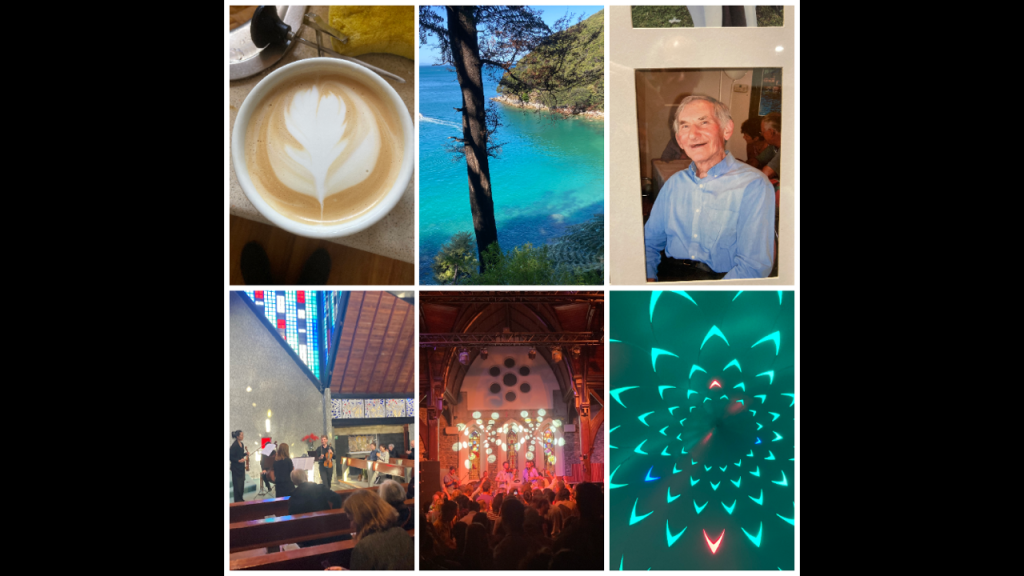
Collage courtesy: Keith Lyons

Am I over-sharing if I confess that the first photo on my iPhone of my 2024 year is a spectacle lens prescription? Or that the summary photo for 2024 — chosen by Apple and its algorithm — is of a coffee cup with the best of my efforts to create the basic latte art design: a monk’s head?

Looking back on the year, I wonder about the interplay of personal and global, a year which started with me learning how to make an origami crane, the symbol of peace, hope, longevity and good fortune, and ended with me getting ill, losing my father, without a paying job, and facing an unexpected massive bill. 

The trick to making a paper crane is to have a good teacher. I was fortunate enough to connect with a semi-retired Japanese man (Mocchan) whose gift to the world is to meet strangers, have a cup of coffee, and patiently show them the dozen or so steps how to fold, flip, and unfold a piece of paper until it becomes a paper crane. 

As for ill health, loss, unemployment, and debt, there are no easy tricks; you just need to go through them. “Survive til ’25” has been the mantra of bank economists and real estate pundits, recognising that 2024 has been a rough year for many sectors and most people, with inflation (and with it, rising living costs) the primary concern of citizens all around the world. Many countries are in economic recession, geopolitical threats are on the horizon, and the globe is warming faster than expected. The economic challenges were highlighted for me when earlier this year friends admitted to me they had changed their brand of coffee beans to a cheaper, no-frills variety, to cope with the cost of living squeeze. Yes, a First World problem. But who in 2024 has not examined their expenditure, put something back on the shelves, or not completed an online purchase — known as ‘cart abandonment’?

So, if I was to look back at the year in review, as a tapestry or a mosaic, what would I see? Fragments of memories, experiences, events. The days of my life, some almost the same as the previous day, others with unanticipated twists and turns. Welcome to the journey of 2024.

January

In the very centre of my city, Christchurch (New Zealand’s most English of cities), where a quake-damaged cathedral sits un-repaired, I get transported into another world, an immersive world of lights and colours in the giant inflatable sculpture Arborialis Lunminarium, made by the Architects of Air (https://www.facebook.com/watch/?v=901452564787031). Inside the labyrinth of tunnels and designs like cathedral stained-glass windows, I take time to sit in alcoves and lay in the centre of one of the domes, bathing in the natural light filtering through the installation, breathing in the tones, listening to the echoes and reverberations. 

February

My next-door neighbour’s house goes on the market. I go across to an open home in the weekend. The neighbours left without saying goodbye. “Gone to Australia,” the real estate agent tells me. “Better jobs.”

Most of the prospective buyers are recent arrivals in New Zealand. 

Looking across to my house, I realise, I need to do some work on my property, including having some trees cut and trimmed. I make a mental note to mention it to a friend who often meets with an arborist. 

A few weeks later, the house sells at auction, for a price way beyond its valuation.

March

I go on a hiking trip with a friend in Fiordland, at one point missing a direction arrow and going off the trail, with others following us up a rocky stream-bed. After much faffing around, we retreat to the last known marked part of the trail, just as other hikers find the next marker without any problems. Lesson: sometimes the directions are up above your eyesight. Look up. 

Back in internet-land, I find much merriment in watching Penn Holderness rapping in the style of Eminem wisdom found on pillows and cushions with quotes. Also, online I find a post detailing things to do for a low-dopamine morning, to sharpen mental clarity, reduce stress and anxiety, and improve long-term brain health. They include not watching Facebook reels or videos first thing in the morning (wait an hour at least), as well as drinking water, getting natural night and fresh air soon after waking, eating a high-protein breakfast, and delaying your first morning coffee for at least an hour. 

April 

For the first time in ages, I go out to a venue at night, listen to live music, have a few drinks, and end up dancing. The venue is a former Anglican church, built in the Gothic revival style in 1875 with an octagonal layout, and later becoming a theatre and then a Japanese wedding chapel. It is a unique setting with a micro-brewery, stained glass windows, and bouncers at the door. I am trying to recall the last time I went out to a live band and danced. My companion is also speculating that she’d also had not been out dancing since the Covid-19 pandemic. We are both in our 50s but are heartened to see others even older than us moving and grooving to the Balkan-Latin fused dub beats of Yurt Party. 

May

I am late for a musical performance in the capital Wellington, and only hear half a composition that has been composed in memory of my brother. Fortunately, the performers agree to repeat the piece afterwards, to enable recording of it, and also so I can call my father so he can listen to ‘Heal’ by Salina Fisher over the phone. It is quite special. I know my father is also deeply moved by the classical composition, even without being in attendance at the Futuna Chapel, regarded as one of the outstanding pieces of 20th-century architecture in New Zealand, combining Maori and European design elements. 

A day later we celebrate my father’s 88th birthday. My father is dying. A few weeks later, we are holding him and speaking with him as he takes his last breath. 

June

The arborist I wanted to come cut down and trim trees on my property dies suddenly in an accident while felling a large tree on an extensive hillside property he is restoring. At a memorial service the only way through the loss is to retell stories about his character, adventures and humour.

An old friend from school days has sent a native tree to plant in memory of my father, and on the shortest day I think about where I might plant it. Winter is considered the best time to allow trees to establish in the wetter months, but it is cold outside, so I keep the tree inside in my sunroom, and ponder where it might grow best. 

July

One night after visiting my mother, I come across an event that seems both crazy and appealing in the coldest time of the year. ‘Rogaining’ is a cross-country navigation sport where teams try to visit as many checkpoints as possible within a time limit. A winter series mixing strategy, adventure, orientation and the challenges of darkness. I resolve to rope in some friends to form a team. Can I offer to be the main navigator given that I’ve gotten lost in unfamiliar terrain more than once?

A pair of WWII binoculars used by my father as a naval navigator ended up in a private collection museum. It is a bittersweet part of letting go, hoping that something once connected to someone special will be put to good use, and is in good hands. When I show the photo to my mother and sister, we have a small sense of closure. 

August

My work contract finishes, as our programme wraps up. The significance of the end dawns on me, as I realise the impact on many people and communities from the end of the collaborative research, including early career scientists who now may have to change professions, or go overseas in the hope of work. 

In my garden, daffodils bloom bright yellow, and I bring in the flowers to spread the promise of new beginnings inside. My parents planted the bulbs when we were children. 

September 

Having put off appointments because of being busy at work, I get advice from a dietary nurse, fitness trainer and stress coach on improving my health, fitness, and sleep. Ultimately, I am caring for my heart. My blood pressure and cholesterol have been high in recent years. I don’t want to die ‘young’. 

I go on holiday to the comforting golden sands and clear waters of Abel Tasman National Park, where I have fond memories from family trips in the 1970s. I make new memories and feel more connected to my father and brother as I gaze at night up to the vast Milky Way, with the five stars of the Southern Cross emerging over the horizon. 

October

In an effort to improve my skills for employment and leisure, I start a coffee-making barista course. Each week, there is a test and challenge. I have to learn the names of the parts of the espresso machine, because at the start I only know their functions and not their exact names: group head/gasket, portafilter, basket, drip tray, steam wand. 

A friend of my brother visits, bringing his partner and their child, whose first name is a composite of my brother’s name Ian, and the boy’s grandmother’s name. 

November

On the barista course, we learn how to pull the perfect shot of espresso, by ensuring the best combination of freshly roasted beans, fine grind size, and how it is pressed (or tamped) to extract the full flavour of the coffee. At each one-on-one session, my tutor Masako extends my knowledge and practical skill. I have to prepare two different styles of coffee in under four minutes, from order to dispatch. I don’t make them in time. The next week, I have to make four coffees in under eight minutes — latte, long black, mocha, flat white. I am over time. Will I ever improve to be able to work in a busy cafe?

My speaking blood pressure monitor reads out my levels in mercury pilar and concludes: Result Normal. I attribute the reduction — without medication — to taking on board the advice of the Mayo Clinic around improving sleeping, reducing stress, less salt, limiting alcohol, lowering weight, and exercising frequently. After positive feedback from my health professionals on the lifestyle changes I’ve made, I felt like I undo my progress when an old school friend visits my house mid-afternoon with a carton of 18 beers and a six-pack of Guinness. 

December

The day after the visit, I find the spot to plant the tree the school friend gave me in memory of my father. The tree will bloom in spring with yellow flowers to attract nectar-eating native birds. My father loved birds. 

To get the temptation out of sight, I give the remaining beers away to my builder who turns up to guide an engineer through recent quake repairs to my house. The engineer, originally from China, finishes his inspection saying everything seems allright. His visit has cost me over $2,000, an unexpected extra cost due to the previous professional’s work being discredited. 

I don’t even get an interview for a job I thought I was dead-certain to be shortlisted for. But another door opens, and I get a job offer for a role starting in the new year. I know I am lucky, given the tough employment market, but I know that while I might be ‘pale’ and ‘male’, I ain’t stale. 

I finish my barista course, and take away the need for patience, consistency and practice. 

But then, after feeling tired from a gym session, a bike ride and a hydrotherapy class, I come home and feel inertia drag me down. Will I have time to finish this piece for Borderless, I wonder? Then I test positive for Covid-19.

Best wishes to you, wherever you are.

May the past be your lesson, the present your gift, and the future your motivation.

.

Keith Lyons (keithlyons.net) is an award-winning writer and creative writing mentor originally from New Zealand who has spent a quarter of his existence living and working in Asia including southwest China, Myanmar and Bali. His Venn diagram of happiness features the aroma of freshly-roasted coffee, the negative ions of the natural world including moving water, and connecting with others in meaningful ways. A Contributing Editor on Borderless journal’sEditorial Board, his work has appeared in Borderless since its early days, and his writing featured in the anthology Monalisa No Longer Smiles.

.

PLEASE NOTE: ARTICLES CAN ONLY BE REPRODUCED IN OTHER SITES WITH DUE ACKNOWLEDGEMENT TO BORDERLESS JOURNAL. 

Click here to access the Borderless anthology, Monalisa No Longer Smiles

Click here to access Monalisa No Longer Smiles on Kindle Amazon International
Categories
Essay

Farewell Keri Hulme

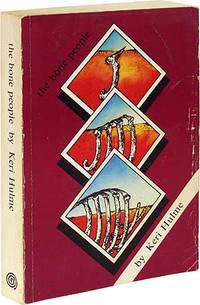
Author Keri Hulme (1947-2021) was the first New Zealander to win the prestigious Booker prize for the bone people*. Keith Lyons recalls times he spent in a remote coastal settlement with the humble writer, who remains a divisive enigma.

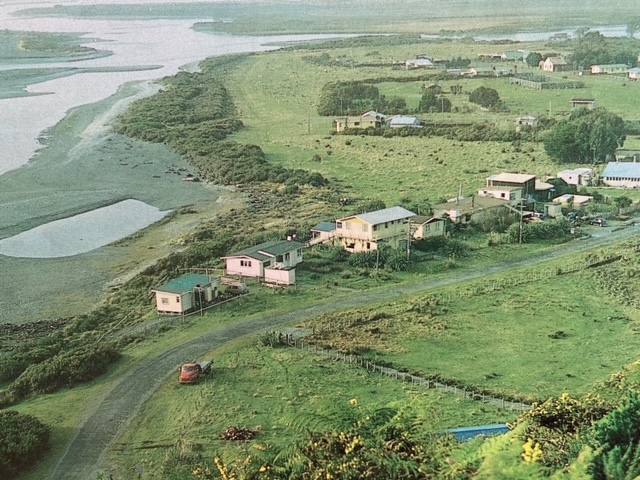
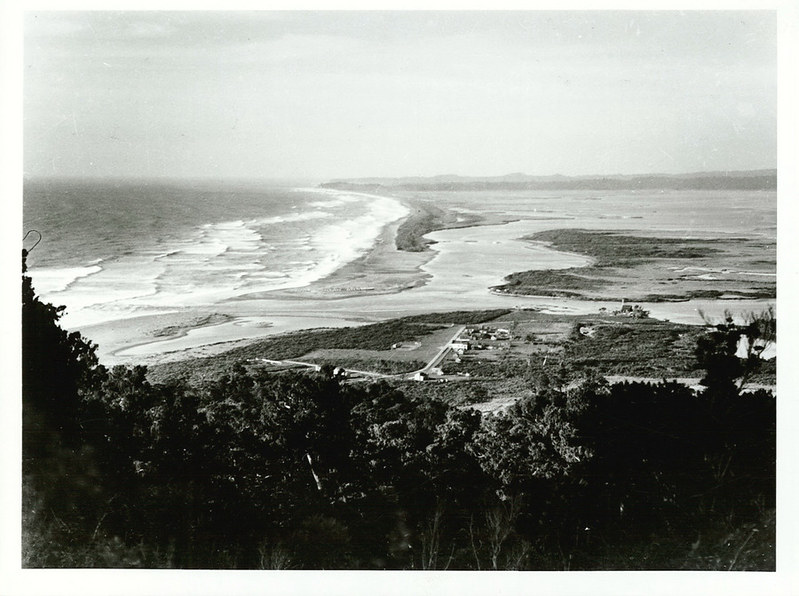
Okarito, home of Keri Hulme. Courtesy: Creative Commons

“You want to know about anybody? See what books they read, and how they’ve been read…” Keri Hulme

I was in high school when I heard the news that Keri Hulme’s the bone people had won the 1985 Booker Prize, literature’s most prestigious award for a novel in English. At 38 years old, she was the first New Zealander to receive the prize. Hulme became the first author to win with their debut novel. Later, in 2013, Eleanor Catton became the second Kiwi, the youngest winner of the Man Booker Prize, and also holds the record for the longest novel, 832 pages.

The following summer while hitchhiking around the South Island, I visited the small settlement of Okarito on the West Coast, where Keri had built her own house and lived since the 1970s. A converted schoolhouse in the former 1860s gold mining town was the main accommodation available: a youth hostel with bunk beds. I’d been attracted to the area because of the rugged coastline, placid tidal lagoon, mountain views and the elegant white herons which nested in the nearby forest.

Even though I’d struggled through an early edition of the bone people, I wasn’t as enthralled about the book as some of my fellow travellers who occupied bunk beds in the spartan hostel. Several European visitors carried copies of the book, which had been translated into many languages, several with different covers. It seemed that every day I went out walking along the main street of the settlement (population: 13 permanent residents), there would be an earnest woman from Cologne clutching Unter dem Tagmond or a young couple from Aarhus plodding along the road in the hope of finding Keri’s octagonal tower two-story house. Visitors wandered over the sand dunes desiring to encounter the acclaimed pipe-smoking author, beach combing for driftwood or gemstones washed up on the high tide.

There for the scenery and sanctuary of the coast, lagoon and native forest, rather than to spot the world-famous author, I did locate her house further along the settlement’s main road. A sign on the gate read “Unknown cats and dogs will be shot on sight”. The hostel warden Bill Minehan, who lived next door to Keri, told me she didn’t really like the attention or surprise visitors. Some of the other residents, protective of the community’s drawcard, would give wrong directions, so visitors after sightings of the elusive author could be seen pacing up and down the rutted grass airstrip — signposted Okarito International Airport and flying the Okarito Free Republic flag — or sidestepping around sheep grazing on the settlement’s rough golf course.

Often, after rains, Keri’s front yard flooded, creating a moat to protect her from rubberneckers. The Okarito Free Republic flag sometimes fluttered from a flagpole at Keri’s house, along with an alternative New Zealand flag, with a stylised spiral fern frond, made by Austrian painter and artist Friedensreich Hundertwasser. She moved to Okarito after winning a ballot for a section of land in 1973, building the house herself, lining bookcases with some 6,000 books, and setting up her writing desk with views out to the sea.

Keri was increasingly portrayed as reclusive. Rumours were that she’d spent all her Booker Prize thousands on alcohol from the Whataroa Hotel, some 25 km away. She didn’t like meeting strangers. She was reluctant to give interviews, and very rarely did she allow anyone into her house. She preferred solitude. “A large part of my life is the surge of the sea, listen to the sea, the pulse of the sea,” she once said.

I did catch a glimpse of Keri on my last day when returning a key to Bill — she was wielding a hammer, fixing the side of her house. The sweet aromatic scent of pipe tobacco floated in the humid air. Then I realised it was probably her I’d seen surf-cast fishing while on a long coastal walk towards the lagoon’s outlet into the Tasman Sea.

Bill let slip that Keri was formidable, but not unbeatable, at Scrabble. Having told him I had been at a Catholic boys’ school in Christchurch, and that I was also a writer, he asked if I knew any good high-scoring Scrabble words. I gave him ‘exorcise’ and ‘queazy’.

One of Keri’s favourite Scrabble words, I later found out, was ‘syzygy’, meaning the alignment of three celestial bodies. Three main characters make up ‘the bone people’. Keri said the characters for her book first came into her imagination when she was eighteen years old. After dreaming about a mute child with strange green eyes, she mused over the vision, eventually developing it into the character of the shipwrecked boy Simon Peter, whose life is intertwined with what one critic described as ‘his child-battering stepfather and a virgin feminist’.

The eldest daughter of a carpenter, whose parents came from Lancashire, and a mother who came from Orkney Scots and Māoris, she grew up in my hometown Christchurch. Her father died when she was aged eleven. After leaving school she dropped out of university part way through a law degree. She worked as a tobacco picker, in a woollen mill, delivering mail, cooking fish and chips at a takeaway shop, as a pharmacist’s assistant, a proofreader at a local newspaper, and in television production.

It took her almost two decades to finish the novel. She spent a dozen years trying to find a publisher. All New Zealand’s main publishing houses rejected the manuscript outright or insisted on extensive heavy re-writing before they would consider taking on the book.

In the end, it was published by a small obscure three-woman feminist collective (it was only the second book they produced), and typeset by students at a university newspaper, with an initial print run of just 2,000 copies. The book, which contained numerous typographical errors, was launched at an event at a teacher’s training college.

The year after its humble beginnings, the bone people won the Oscars of world literature, against the odds and against such literary heavyweights as Peter Carey, Doris Lessing and Iris Murdoch. The somewhat controversial win showcased writing from New Zealand to an international audience, who would perhaps only be aware of the likes of modernist short story writer Katherine Mansfield or Janet Frame, who explored madness and language.

Hulme’s contribution, blending indigenous myth and Celtic symbology, and set in a distinctly wild coastal New Zealand setting, is described as “an unusual story of love”’  or in the Amazon blurb “a true evocation of loneliness and attempts by deeply flawed people to connect to each other”. The main character of three, part-Māori artist Kerewin is convinced that her solitary life is the only way to face the world. How autobiographical is it, you ask? The more you delve into it, the more you find similarities with the unusual literary star, who increasingly got dubbed “reclusive” by the media because she wished to remain out of the limelight.

Part of the legend around Hulme is about the surprising success of her debut novel. She didn’t fancy her chances of winning the Booker Prize, so was in the US when the awards ceremony was held in London (plumes of cigarette smoke swirled up in the film footage) — she was the only contender not in the audience at London’s Guildhall. When she was called in her Salt Lake City hotel room during the event, she didn’t believe the news down the phone line. “You’re pulling my leg, aren’t you?” she said, “Oh, bloody hell.”

She was full of self-doubt. The literary world had a mixed response to her breakout novel. “Set on the harsh South Island beaches of New Zealand, bound in Māori myth and entwined with Christian symbols, Miss Hulme’s provocative novel summons power with words, as a conjurer’s spell,” wrote one New York Times review. “She casts her magic on three fiercely unique characters, but reminds us that we, like them, are ‘nothing more than people’, and that, in a sense, we are all cannibals, compelled to consume the gift of love with demands for perfection’.

Another review in the same publication was more critical. “It’s not so much that the novel offers ‘a taste passing strange’ as the author notes in the preface — interior monologues, disjointed narratives and vulgar language, after all, are hardly news these days. It’s more that the novel is unevenly written, often portentous, and considerably overlong.” The Guardian described the bone people as “a morass of bad, barely comprehensible prose.”

Even one of the Booker Prize judges, Joanna Lumley, was against it being picked as the winner, saying its subject matter was ‘indefensible’. A recent article described the bone people as one of the most divisive novels in Booker Prize history. The four words to sum up the book were violent, disturbing, poetic and striking.

While dismissed by some as unreadable and pretentious, in New Zealand the novel combining reality with dreams was seen as a masterpiece by others with its vision of a society regenerated by the adoption of Māori values and spirituality. For some, it challenged their worldview and sense of place at home in the world. Author Joy Cowley wrote, “Keri Hulme sat in our skulls while she wrote this work . . . she has given us — us.”

Keri said she wanted the novel to harmonise New Zealand’s two major cultural influences, indigenous Māori and European-descendent settlers (she herself shared both heritages). If you were to discover other authors who have explored in new ways what it means to be Māori, look up works by Patricia Grace and Witi Ihimaera, or for a raw look at the debilitating effect urban life has had on Maori, Alan Duff’s Once Were Warriors.

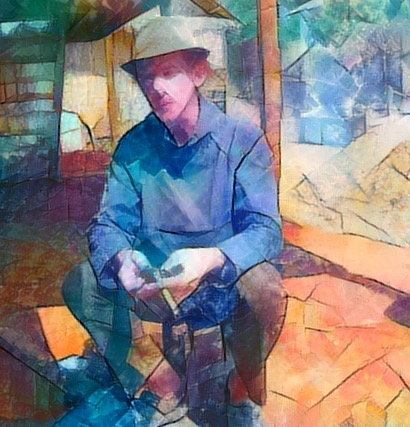
By the time I returned to Okarito the following August holidays to write a story for the Youth Hostel Association, the secluded hamlet had grown in population with the addition of a few more hardy souls and holiday houses, I only saw Keri a few times. One time, after gutting some snapper, she was off to clear the mailbox and collect the newspaper at the highway junction (there was no shop in the township). Another time she was cleaning a gun, bespectacled, and wearing her trademark red bush shirt. Like Hemingway, Keri liked hunting, (she favoured a .22 Ruger rifle among her collection of guns, swords and knives), and often took to the forest in search of deer.

Another time she was assembling poles, screens, nets, waders and buckets for the official start of the white baiting season. My father had worked in marine administration for decades, which included the monitoring of whitebait jetties and official seasons, so I knew a few things about the obsession. “Are the whitebait running yet?” I asked as she made the finishing touches to repairing nets. “Any day now,” she replied, looking expectedly towards the clouds billowing in the west. The season officially started the following day, and she had already checked her favoured locations for a 5am start. Normally a night owl and late riser, even her writing routine was swept aside for the ten weeks of the season when she was out trying to catch the coveted tiny fish. While throughout the year she might be catching rig or kahawai in the surf, netting for flounders in the lagoon, or trying to land salmon or trout in the rivers, her main springtime preoccupation was catching whitebait, the prized juveniles of migratory Southern Hemisphere fish.

I helped Bill load up driftwood onto the back of his vehicle before the rains set in, for use as firewood at the hostel (with a load for Keri too) and found some fool’s gold in quartz rock. Bill confirmed my folly. I gave him some more Scrabble words: Quartzy and Quickly.

That next summer I returned again to ‘The Big O’, hitching on the dusty corrugated gravel road to the coast with its pounding surf, driftwood sculptures and star-filled nights. Just before Christmas, with Bill away, Keri asked me if I could look after things at the hostel and check her place while she visited relatives on the other side of the South Island. The only other person staying medium-term was a German dwarf actor, who joked with me that he was a big man in European television and movies. Before she left, she dropped off a carton of a dozen beer, and some frozen whitebait, silvery eyes glistening through the plastic bag, with advice on how to make a batter for fritters with beer, flour, salt, and fresh parsley growing outside the hostel. “You could spice it up with some chilli pepper,” she said, pointing to a half-full jar of pepper left behind in the communal pantry by a Chilean backpacker.

Later, as we drank beer and watched the sunset from the old wharf, I mentioned to Manfred that even though Keri showed typical West Coast conviviality, we never once talked about writing. We’d talked about the moods of the weather, birdcalls from creatures seldom seen, what remedies protected vegetable gardens from slugs, and strange things which washed up on remote beaches. Having lived in that place for so long, she had plenty of stories about incidents, characters, or her own eccentric foibles. And I think that seeing her as a three-dimensional person (almost ignoring that she was a Booker Prize winner) rather than a 2-D writer made a difference, because it took away the pretensions and the expectations. She was direct, and also had a dry sense of humour. Manfred liked her rugged independent spirit, and kindly nature, not just because she had given us a box of beer. “She is like a good Kiwi bloke, yah?”

However, in the literary world, there was an expectation that a second novel was due. Her debut novel was on track to sell over a million copies. She’d retained the film rights, as its form couldn’t be easily adapted to the big screen. She believed that some stories work best ‘behind human eyes, not in front of them’. Surely she wasn’t going to be a ‘one-hit wonder’ like the band who sang the Macarena, Harper Lee’s To Kill a Mockingbird or The Catcher in the Rye by J. D. Salinger?

She finally announced her second novel, about fishing and death, she finally announced. And it would be called BAIT. She published a second collection of poems in 1992, and two collections of short stories appeared in 1986 and 2005. As for BAIT, it later would be published along with its twinned novel, On the Shadow Side.

She once declared she didn’t believe in writer’s block. “I know about distractions, laziness, daydreaming, stressful events that push writing to the background, and the sheer enjoyment of doing other things for a change … I am a slow, but very, very persistent writer.”

I can’t exactly recall when the last time it was I saw Keri. I just remember seeing her heading out on a fishing trip, along the windswept beach towards the lagoon and its ever-shifting outlet to the sea. She gave me a nod, and gradually faded into the misty greyness of the day and the distance. That night, after sunset at the beach, I witnessed the rare phenomena sometimes seen when the surf glows neon-blue from a bioluminescent algal bloom or plankton. Above it and beyond, the stars twinkled.

A decade ago, after almost forty years at Okarito, Keri left to move to the other coast, where she felt more at home. She had been dismayed by the development with ‘very ugly McMansions’ holiday homes visited by outsiders who would fly in by helicopter or plane. Her council rates were becoming unaffordable. She was also suffering from arthritis in her hips, back and elbows.

A few years ago, I went back to Okarito with a friend, but it felt different without her being there. We both hold the wish to buy her house, mainly in memory and tribute to Keri’s life and work, and also, to inspire our own writing. Though we both admit that Keri has fished all the best words, and woven the most compelling tales.

The much-anticipated second novel was never published, nor was the promised third. She died in late December last year. A family representative said she wasn’t after fame or fortune. “There were stories of her being this literary giant. It wasn’t really something that she discussed. It was never about fame for her, she’s always been a storyteller. It was never about the glitz and glam, she just had stories to share.”

*Please note ‘the bone people’ all lower case is the correct version of her title

 A view over Okarito and its lagoon and beach. Photo Courtesy: Keith Lyons

Keith Lyons (keithlyons.net) is an award-winning writer who gave up learning to play bagpipes in a Scottish pipe band to focus on early morning slow-lane swimming, the perfect cup of masala chai tea, and after-dark tabs of dark chocolate. Find him@KeithLyonsNZ or blogging at Wandering in the World (http://wanderingintheworld.com).
.

PLEASE NOTE: ARTICLES CAN ONLY BE REPRODUCED IN OTHER SITES WITH DUE ACKNOWLEDGEMENT TO BORDERLESS JOURNAL

Categories
Essay

Countdown to Lockdown: Fear and Loathing in the Trolley Race at the End of the World

Keith Lyons from Christchurch discovers that the big world seems very small when it comes to stockpiling for the coronavirus.

If I had to choose a place to be to sit out the coronavirus pandemic sweeping over the globe, there are probably few places better than the South Island of New Zealand. A significant number of the world’s super-rich have invested in the Southern Hemisphere nation, some even buying residency through a controversial and secretive ‘Investor Plus’ scheme. Tech startup incubator for Reddit, Dropbox and Airbnb, Sam Altman, Pay Pal’s Peter Thiel, and the co-founder of LinkedIn Reid Hoffman are among those who have invested, buying secluded boltholes and luxury bunkers. One US company has constructed more than three dozen doomsday bunkers in New Zealand. Several of my friends have worked for ‘high net worth individuals’ as staff at remote lodges and on luxury super-yachts.

Kim Dotcom, of Megaupload, is among those who have decided to call New Zealand home. I call New Zealand home because I was born here. And now I’ve returned ‘home’ after more than a decade living in China and spending the last few years in South East Asia.

In February, this year, my route back from India via Myanmar took me through Phuket airport where a taxi driver had already been infected with the coronavirus. Transiting Kuala Lumpur’s KLIA2, after an overnight in Denpasar International Airport in Bali, I discovered no tests had been made to determine if anyone had the virus. Then a short stopover in Melbourne, Australia, where there seemed to be no additional measures to combat the spread of the corona virus. Even on arriving in my hometown Christchurch, there were no temperature checks or questioning to see if I had come from China, Italy or South Korea. In mid-February, the most stringent measures encountered were in Central Phuket Festival mall, where the handful of customers going from one half of the normally teeming mall to the other side were stopped for a temperature check.

If 9/11 meant greater security with screening for knives, box-cutters, and nail files, and having to take out water bottles, mobile phones and laptops, almost two decades on, we are now adding to the security screening with thermal cameras and the symbol of 2020: thermometer guns. After the masked official at the Phuket mall held his gun to my forehead, satisfied that I didn’t have a raised temperature indicating fever, he turned it around so I could see the digital reading: 36.8 C. Now, I am not expert on human health, so assumed it was not too hot and not too cold, as I couldn’t make out if the official was smiling or grimacing behind his mask. At least they aren’t taking the readings the old-fashioned way, rectally.

One of the things about the coronavirus is that is it invisible and faceless. Like an imaginary menace. Its presence is only made more tangible and real when we see on TV the patients in ICU units, doctors and nurses in masks and glove hurrying around with beeping ventilators and tubes, maps showing the spread of the new virus which threatens like a hurricane.

The other thing about the coronavirus is the speed at which it moves, spreads, and intensifies. When I travelled back from Asia to Australasia, coronavirus was primarily a Chinese problem, with some possible spread to Italy. But as February turned into March, it became more apparent that this Wuhan wet market virus was going global big time.

I guess we should have all been ready for something like this to happen. It was corona virus — COVID19 — there was bound to be a pandemic which would sweep the world, infecting millions and killing many. After all, such an event has been predicted by everyone from Nostradamus and Bill Gates to author Dean Koontz (see conspiracy theories) and The Simpsons. There are even some among us who believe one episode of The Simpsons foretold the self-isolation of Tom Hanks.

There are also those among us who having known something like this was going to happen have made preparations for their survival. This is now an ‘I told you so’ occasion for the smug ‘preppers’ who feel vindicated having lined their shelters with emergency rations, first aid kits and firearms, though this coronavirus thing is turning out to be mild compared to the much-anticipated zombie apocalypse scenario. Instead, it seems the ‘always carry’ list for those fighting the hidden enemy includes wet wipes, hand sanitiser, and N95 masks. The US company Preppi at one stage marketed a special US$10,000 prep bag which included gold bars for bartering.

My hometown, Christchurch, has experienced several traumatic events this last decade. A large earthquake in mid-2010 followed by a more devastating quake in early 2011 damaged nearly 100,000 buildings, half the city’s roads, and killed 185. A year ago, a white supremacist gunman shot dead 51 people at two city mosques. New Zealand is geologically young, and prone to natural disasters including earthquakes and volcanic eruptions, so most homes have emergency kits with food and water to last at least three days.

However, the prospect of an infectious pandemic with a lengthy lockdown period has taken most citizens by surprise. When on the second-to-last day of February news broke of the first case of coronavirus in New Zealand, brought by a resident returning from Iran, I was in my local supermarket a few hours after the announcement. There was no flour available, the shelves of the 1.5kg bags and 5kg bags were empty. It was not just the ordinary white flour, it was high-grade flour too, along with self-rising flour and wholemeal flour. On the next aisle of the Countdown supermarket, a Thai woman was posing for a photograph in front of shelves half empty of rice. I mentioned my observations later to friends and family, wondering if there was a shortage or some other reason.

A few days later there was news of a second case, this time arriving from Italy. But even though this virus had arrived on our shores, it seemed like its impact would be insignificant, as it was not spreading, and those returning to New Zealand had mild symptoms, not unlike a cold you pick up during a long haul flight. There were reports that some supermarkets have been swamped by customers buying toilet paper, hand sanitiser and tinned food.

Ten days later, the news was full of events happening far, far away in Italy, Iran and South Korea. The coronavirus had spread to more than 100 countries, and infected more than 100,000 — a few days earlier the World Health Organisation declared it an official pandemic. In New Zealand, the sixth case of the virus is confirmed. This did not deter my parents, who did their regular Saturday morning shopping at their usual supermarket. “Yes, it was quite busy, busier than normal,” my father noted.

During our Sunday dinner, I casually mentioned that maybe this was the last weekend that we would have the freedom to do things as normal, and perhaps from now on, it might be best if I went and did the shopping instead. My parents looked at me as if I have overstepped the line between parent and child. Over-reacting again, they are probably thinking.

An international cricket match between New Zealand and Australia was played in an empty stadium, and then the rest of the tour called off. Cancelled too was the memorial service for the mosque attacks. I visited the neighbours of my parents, bringing them a date and walnut cake I had especially made according to a detailed Iraqi recipe. My visit interrupted an interview with a documentary crew from BBC about their son Hussein who was shot dead trying to stop the gunman.

I felt like I am moving between worlds, from the warmth of the kitchen to the coldness of a massacre, and then outside, there was something sinister and foreboding which was looming bigger than kindness, bigger than tragedy, an acute existential crisis that was unknown in its quantity and impact.

In the following week, I set about sourcing various things from around town, and stocking up on supplies. I got some seeds to plant for autumn and winter harvest. I visited two Indian grocery shops to procure green cardamom seeds, almonds, ready-made chapatis, MTR ready-to-eat meals and dosa flour mix. I loaded the boot and back seat of my parent’s Toyota Ractis until its suspension springs almost snap from 450kg of wooden pellets for their fire. With my mother we did one big shop, making sure we got her favourite brands and the foods preferred by my father who is recuperating from an operation for bowel cancer.

During my daily shopping visits, I noticed that this wasn’t the normal shopping experience anymore. I did not witness any of the stockpiling in the early days of the crisis, though at a store I did overhear a staff member tell his colleague, “We need to bring out the remaining fruit stock we have out back, as it is all selling fast. I am not sure why.”

In early March, there was already a run on particular items, most noticeably and perhaps misguidedly, folks were stocking up on toilet paper. I am not sure the rationale behind this, somehow extrapolating that toilet paper might not be available in the future. It seems many people had the fear reaction triggered, and it was compounded by seeing supermarket shelves already half empty of toilet rolls. Toilet paper is non-perishable and will all eventually be used, so it is not an unnecessary purchase. It also is bulky and takes up space, so its absence in supermarket shelves signals to us ‘shortage’, while having it stocked up at home fulfils some primitive need to be prepared and ready, and also signals that we are smart shoppers, having ample supplies of large 16-roll 4-ply toilet paper, what a bargain and an easy way to relieve worries of not being prepared for the impending doom.

There is a meme doing the rounds with a kid asking his mother, “What is the corona virus?” with the parent replying, “Shut up and eat your dinner” with a picture of a bowl serving a roll of toilet paper. The panic buying of toilet paper was a reaction to the mixed messages about the possible severity of the coronavirus, something of an emotional pacifying purchase to gain control over our hygiene. In other countries where a bidet, bum gun or old-fashioned scoop and water pail is used, there must have been some eye-rolling when stories emerged of Westerners stockpiling toilet paper, price gouging and even scuffles in aisles to secure the rolls of toilet paper.

The government was quick to reinforce the message that was enough to go around, and that essentials would be available. That seemed like the sensible approach. And it was an appeal to people’s sense of community and togetherness in fighting the virus spread. But in times like these, a different mindset kicks in. One of my longtime friends showed me a photo of his partner in the supermarket. After finding the shelves stripped bare of toilet paper and hand sanitizer, they found a whole carton of sanitiser behind other items on another aisle, and much to the shame of my friend, his partner (from South America) loaded the carton into their shopping trolley, later posting on social media of her cache.

That shared image, along with the footage of empty shelves and shopping trolleys piled high with supplies reinforce the panic buying mentality across the world. In Hong Kong, thieves held up a supermarket to steal a delivery of toilet paper. In Australia, a newspaper printed eight extra pages for use as emergency toilet paper in case supplies run out. Now in many supermarkets, there is a limit of two items for these symbolic products along with other essentials, with security guards and supermarket staff patrolling aisles and scrutinising shopping carts.

I noticed during my pre-lockdown shopping excursions quite a range of responses by fellow shoppers. Many were doing big shops, marking off items on a checklist. Some were clearly in unfamiliar territory or were struggling to decipher the list given to them by their partners or friends. “Is tomato puree the same as tomato puree?” one man asked me rather than call his wife again to clarify the differences. In the aisles, it was interesting to observe the interactions of couples, with usually one being ultra-cautious and thorough, while the other (usually a male) being more carefree and unperturbed. “Shouldn’t we get one just in case?” I heard a woman still in her airline uniform ask her husband, who was displaying the typical New Zealand ‘no worries’ attitude. “No, she’ll be right. We can always get it later.”

As well as tension between shoppers, there was also a new dynamic I noticed. Individuals or families were largely in their own bubbles, increasingly aware of the need to stay clear of others who might be contagious. But shoppers were also aware of the goods others had purchased, peering into nearby trolleys, noting what products others were stocking up on, or what items they had secured the last of. On a few occasions, my eyes met others after a mutual trolley check out, and I made a mental note to get a particular item, or even scoffed at other’s purchases.

As well as the hoarding of toilet paper and hand sanitizer, it was the quick sell-out of perishable items which suggested widespread fear of missing out. Bread and milk were coveted items, along with eggs, meat and fresh vegetables.

However, it was the stockpiling of non-perishable items which contributed to the overloaded shopping carts and baskets, and perhaps revealed most about our globalised connected world. Despite the news being full of footage from northern Italy about the horrors of the virus, in New Zealand and Australia, and other countries, shoppers opted for Italian food. Pasta, pasta sauces, tinned tomatoes, risotto rice and olive oil quickly disappear from shelves. On one supermarket run, I found only a few packets of flat lasagna, just the wholemeal and wheat-free varieties, and the following day, nothing except a couple of damaged packets of cannelloni, the pasta meal that requires the most preparation.

But it was not just Italian food we sought for comfort in our emergency supplies and lockdown rations. While most of the fresh produce is still grown locally, increasingly more things are being imported from Asia, in particular China, along with Vietnam and Thailand. Even homegrown brands are sourced from overseas or made of ingredients from as far away as Chile, the USA, Ecuador or Spain. Closely reading the fine print on a bag of mashed potatoes reveals it was made in Belgium, the tuna was canned in Bangkok, while the frozen strawberries hail from Peru. In the dry noodle section, I have to choose between Mamee from Malaysia or Yum Yum out of Thailand. It is a small world after all.

As I shop locally but collect items from around the world, I wonder if it is being sensible or selfish. I wonder about those that can’t afford to stock up, who survive week to week.

As the coronavirus morphed from a foreign plague to a resident contagion, stores imposed limits on some items, increased cleaning and hygiene, and tried tactics to ease consumer’s concerns. My local Countdown placed a pallet of toilet paper just inside the entrance to signal that there was plenty of stock available. Health authorities reinforced the key message that soap and hot water for a 20-second hand wash was better than sanitizer. I started to get emails, some obvious ‘cut and paste’ jobs, from every business about how they were protecting their staff and customers.

Around this time, there was news of a case in Christchurch. The next day, the government announces it was closing its border, to all but citizens and permanent residents. On the following Saturday, 21st March, New Zealand Prime Minister Jacinda Ardern announced on a four-level alert system, raising it to Level 2, then a couple of days later raising it to Level 3 and outlining the move to its highest level 48 hours later. Businesses and schools have been closed, everyone had to stay at home, the only reason to venture outside was to shop at supermarkets for essentials, visit a pharmacy, or doctor. It was a lockdown, though people could go out to exercise as long as they did it in their neighbourhood and did not mix with others.

This pandemic quickly changed the boundaries and borders.

It spread. New hotspots light up the world map.

My own personal geography changed too. Other than my local supermarket, less than a 15 -minute-walk, I also factored into my shopping a fresh vegetable market nearby, and a branch store bakery offering bread, milk, savouries and sweets. I figured that this trio of shops within walking distance could be relied upon for my future shopping, along with the pharmacy.

When I first visited the bakery, it was business as usual, and I was rather surprised to see the staff not wearing any additional protective masks or gloves. Three days later, it was a completely different story. I had to wait outside to be called in. There was a station set up with hand sanitizer and blue gloves to be worn (optional) and customers were reminded to keep their distance from others. At the checkout, items had to be placed on the counter, and the customer was asked to step back behind a line so the clerk could price the purchases. The choreography meant the shop assistant would step back and the customer then approached the counter, to pay by card (no cash was accepted), pack their own bags, and then exit, allowing the next person in the queue to go through the routine. On returning home, I described the new shopping behaviour to my parents, who seemed amused at all the fuss. I was half expecting them to say it was all ‘health and safety gone mad’.

The next day I checked Facebook for the store hours and there was a notice that the outlet was now closed to the public. The greengrocer who had reduced hours to ensure more time for restocking also posted a similar notice, not being able to ensure a safe space, and also deemed by the government to be non-essential.

Yesterday I braved the cold winds and ventured out to Countdown (a New Zealand supermarket). Having to wait outside in a long queue, spaced 2m apart, operating on a one-out/one-in rule that meant when I finally got in and cleaned my basket handles, most aisles only had one or two shoppers nervously avoiding each other, and imploring with dagger eyes ‘keep your distance, buddy’. In the chilled food section, I had a moment when I thought I might sneeze, and I worried that if I did, security guards would bundle me up into a bag to be dispatched the hospital. On my list of items to buy was black pepper, but I skipped that, fearing that a whiff of pepper might induce a sneezing fit.

Back home, gloves discarded, hands washed, items sprayed, I pondered the craziness of it all as I savoured my cup of hot miso soup from Japan. All of my shopping could be in vain if I get the virus. One of the first symptoms noted by doctors in Europe is that those with the coronavirus lose their sense of smell and taste.

Keith Lyons (keithlyons.net) is an award-winning writer, author and creative writing mentor, with a background in psychology and social sciences. He has been published in newspapers, magazines, websites and journals around the world, and his work was nominated for the Pushcart prize. Keith was featured as one of the top 10 travel journalists in Roy Stevenson’s ‘Rock Star Travel Writers’ (2018). He has undertaken writer residencies in Antarctica and on an isolated Australian island, and in 2020 plans to finally work out how to add posts to his site Wandering in the World (http://wanderingintheworld.com).