Categories
Excerpt

The Wanderers, Lost and Seeking

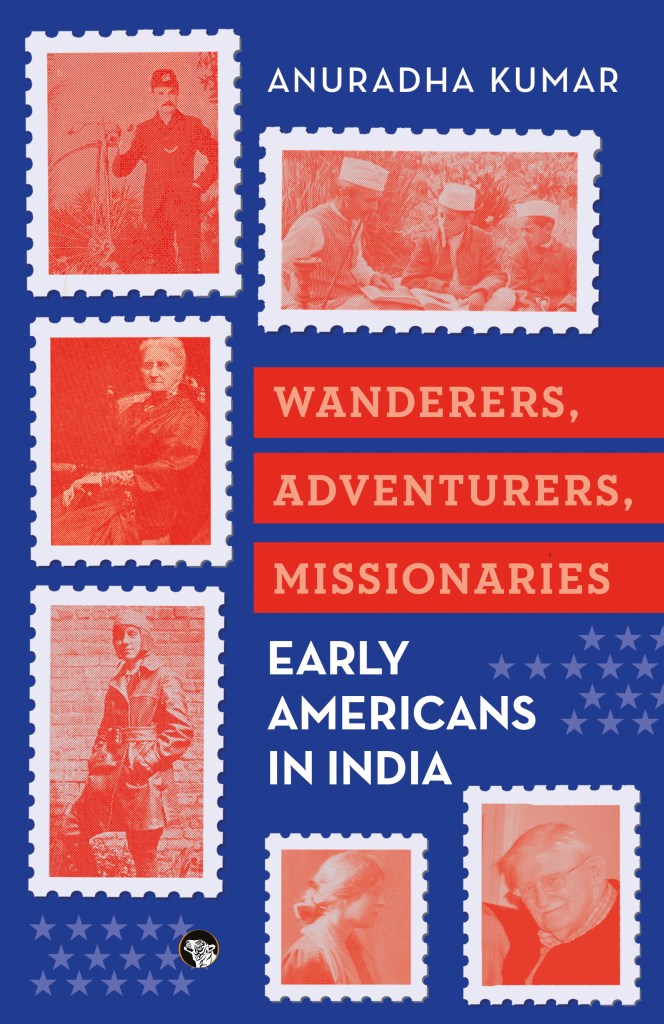
Title: Wanderers, Adventurers, Missionaries: Early Americans in India

Author: Anuradha Kumar

Publisher: Speaking Tiger Books

INTRODUCTION

The Wanderers, Lost and Seeking

The people you will meet here—the ‘first Americans in India’—were indeed all wanderers. They came, not attached to the intentions of a country, or even protected by it, unlike their peers, the Englishmen who made up the East India Company, and who came to trade backed by a royal charter granted by Elizabeth I in the year 1600.

The wanderers, the first of whom came at a time when the United States of America had not come into being—and their actions, thus, were different from what was ordained as state policy. The ‘wanderers’ were not ‘state actors’ in that sense, but they, men, and some women, came to India, on their own, driven by their own spirit of search. They were brought here by a sense of adventure, or by a wild dream—that of finding something that would make their fortune—gold or inspiration quite like gold—or by the need to do something good and enobling.

But they were in some ways quite lost after they came to India.

Stepping Into a Mosaic

To these wanderers who travelled to Asia between 1700-1950s, India came as a mosaic of many impressions, a spread of colour and many experiences. It offered a field of new sensations compelling them to revise received knowledge. They were intrigued, they saw its contradictions, its strangeness, and how things were very different from the homes they had left behind. In the process, life for these wanderers was made afresh.

They came as traders, adventurers, military men, fortune hunters, seekers of knowledge, storytellers, mystics, those seeking a new career, or who came simply to serve.

To them, India—that looked quite different from what it does now—was a land of adventure. A land to make a fortune in, or to find fame.

It was a mysterious, magical place, one that fuelled the imagination, a land that contained the ancient truths of the universe. Yet it was a place caught in the ‘medieval age’, a place they had been sent to, a matter ‘divinely ordained’—as the missionaries and mystics believed—to save souls.

A place one could write about, for it was as strange as fiction; it was a land that offered inspiration and where one could find new, yet old, wisdom. A place to serve and cure and heal. A land where a new world was possible, or an arena to set the world aright.

The wanderers were awed and overwhelmed, and then, scandalized and shocked in equal measure. Some of what they wrote mirrored each other’s experiences. For example, their surprise at the number of servants that were needed. The astonishing beauty of the temples. The majesty of the Taj Mahal. The artistry produced by craftsmen and artisans, an art passed down generations. The riot of unexpected colour—in the bazaars, in the turbans men wore, and in the forests with ‘exotic’ fauna and flora yet to be named and classified by the new science of taxonomy. Balmy days spent on houseboats—‘doongas’—in Kashmir. The spiciness of the food, the liberal doses of pepper in curries. And then, the sad state of its women, especially the child brides, and the young widows, who had to be ‘saved’. The timeless stubbornness of the caste system. The very unchanging nature of things.

Change in America

To look at this period—1700-1950—and talk of Americans is somewhat anomalous. For one thing, for the early part of this time, America was a British colony. By the mid-1770s things would change. The United States of America emerged as a new political entity only in 1776.

On the other hand, from the early 18th century onward, the once dominant Mughal Empire was in decline. Aurangzeb, the last powerful ruler of that dynasty, had worn himself and the empire out with his battles in the Deccan and the upsurge of discontent elsewhere that he failed to contain. Even before the Battle of Plassey in 1757 tilted the balance—beginning in the east—in the East India Company’s favour, India was a patchwork of regional rulers, each brimming over with ambition and jostling for power. To adventurers and fortune-seekers—like the ‘wanderers’—who had no master, who came lacking the conqueror’s zeal, but who had their own sense of adventure, such a state of affairs was ideal to make a fortune, to remake a life.

It is thus of little surprise that the first of the wanderers came as part of the East India Company, to associate themselves with it, as ordinary private traders. America at that time, showed the same precarity that characterized India. It was a continent divided up between competing European powers, and to the west of the continent, the different native American groups too had their territories.1

In the next decades, as America extended westward into new frontiers, set its own foundations as a young democracy, some of the wanderers, citizens of a new nation, also faced their own frontiers, as they sailed eastward onto an unknown land.

Most of these early travellers were those who lived on the northeastern seaboard of the American continent, that is, in the port towns of New England that had historic links with England since the early 17th century. These travellers who came all the way from the faraway West to the East were immigrants themselves, children of people who had moved a generation or two ago, a westward journey from Europe to the ‘New World’. The wanderers to India—the South Asian subcontinent—were thus children of wanderers themselves.

(Extracted from Wanderers, Adventurers, Missionaries: Early Americans in India by Anuradha Kumar. Published by Speaking Tiger Books, 2025)

THE BOOK

In 1833, Frederic Tudor, an American businessman, made history when he shipped 180 pounds of ice harvested from Walden Pond in Boston, to Calcutta—this luxury item being much in demand amongst the elites of British India. Tudor was deservedly christened the ‘Ice King’, and soon built a flourishing trade exporting American ice to India.

Others were drawn to the country by less materialistic goals. Like the ‘medical missionaries’ who were deeply concerned with the ‘women’s condition’ in India. Ida Scudder’s efforts in the 1900s resulted in the setting up of the Christian Medical College in Vellore, which continues to save lives till this day; in 1873, ‘Doctor Miss Sahiba’ Clara Swain set up the first hospital for women and children in Asia, in Bareilly, on land donated by the Nawab of Rampur.

There were also those who came to stay. Twenty-two-year-old Samuel Evans Stokes came to Kotgarh in the Himalayan foothills in 1904, embraced Hinduism and became Satyanand Stokes. He revolutionized apple cultivation in the area, now in Himachal Pradesh, by introducing the ‘Red Delicious’ apples of Missouri; today, his descendants still live and work in the region. Likewise, the Alter family. Martha and David Emmet Alter arrived in Mussoorie in 1917, to spend the summer studying at the Landour Language School; in 1941, Emmet became principal of Woodstock School, just around the hillside. Twenty-five years later, his son Robert occupied the same position. Robert’s son Stephen continues to live in Mussoorie, pursuing a successful writing career; his cousin Tom Alter was a much-loved actor in Indian films until he passed away in 2017.

These are just some of the ‘first Americans in India’ who came here, beginning in the 1700s, with different motives and dreams—as adventurers, traders, reformers, writers and artists. All of them, without exception, were fascinated, astonished, moved and, in the end, profoundly changed by their ‘Indian experience’.

Anuradha Kumar’s skilful and well-researched account of these early visitors makes this an important and engrossing book that informs, surprises and amuses in equal measure.

THE AUTHOR

Anuradha Kumar lived in Mumbai for over a decade, where she worked for the Economic and Political Weekly. She now lives in New Jersey in the US, and writes often for Scroll, The India Forum, The Missouri Review, Catamaran Literary Reader, The Common and Maine Literary Review. Two of her essays received ‘notable’ mention in Best American Essays editions of 2023 and 2024.

PLEASE NOTE: ARTICLES CAN ONLY BE REPRODUCED IN OTHER SITES WITH DUE ACKNOWLEDGEMENT TO BORDERLESS JOURNAL

Categories
Review

The History Teacher of Lahore by Tahira Naqvi

Book Review by Somdatta Mandal

Title: The History Teacher of Lahore: A Novel

Author: Tahira Naqvi

Publisher: Speaking Tiger Books

Tahira Naqvi, the Pakistani American writer, has extensively translated the works of Saadat Hasan Manto, Khadija Mastur, Hajra Masroor, and the majority of works by Ismat Chughtai from Urdu into English. As a teacher/professor of Urdu language and literature at New York University, she has regaled us with several short stories that speak of cross-cultural encounters of immigrant Pakistanis in America, especially about how women experience acculturation in the New World. The History Teacher of Lahore is her first novel where she recollects the sights, sounds, and ambience of growing up in Lahore in intimate details. The setting of this novel is the nineteen eighties, which was particularly a time of unrest in Lahore. In this debut political novel, Naqvi eloquently portrays the struggle between a besieged democracy and the rise of Islamic fundamentalism on the one hand, and the thriving cultural traditions of Urdu poetry on the other.

The story begins with the young protagonist Arif Ali who moves from his hometown of Sialkot to Lahore with a dream of being a history teacher and a poet. A ‘tall, slight man in his late twenties,’ we find him relaxing on a bench in Jinnah Park — a place that has become haven for him to spend his time reading, far away from the ferocity of traffic and street crowds. In the days that followed, Arif realised that in the Government Model School for Boys where he taught, he was forced to teach the boys another kind of history for his sake as much as theirs. But that required deep thought, time, and enthusiasm. He befriended Salman Shah, another teacher in his school, and his rapport with him grew stronger by the day. But once again, Arif found the atmosphere in the school was becoming increasingly confining. He would often engage in animated chatter with the high school Islamiyat teacher Samiullah Sheikh, whom he found disagreeable. Not only dressed in Shariyah compliant clothes, but this man was also waiting for his opportunity to teach at a madrassah[1]. This was the period when bans were being imposed on popular music of the kind Nazia Hasan and her brother sang for the younger generation, and even though ‘Disco Deewane’ and ‘Dreamer Deewane’ were sung loud, fear had become an elixir for rebellion. Arif was forced to resign from the school and along with his friend Salman. he ultimately got another position as a history teacher in another private school, Lahore Grammar Institute, where there was more freedom to teach than in the earlier one. The free socializing among the sexes here was new and noteworthy for Arif.

As Arif’s impotent rage towards the increasing religious intolerance grew, he joined his friend’s uncle Kamal and his partner Nadira to secretly help them rescue underprivileged children in clandestine ways. In the meantime, his poetic creations found great impetus when he found a secret admirer in Roohi, Salman’s sister, and started sending her his poems regularly. Though they never met, Roohi would write letters to him every week, and gradually, the more letters Arif received from her, the more his feelings for her grew. The secrecy of their epistolary courtship continued for quite some time till things were disclosed and after a lot of twists and turns in the story, they were finally engaged to get married.

In the meantime, his friend Salman got engaged to a colleague Zehra Raza, and despite the Shia-Sunni clashes that prevailed in society all around, they were unaffected by such ideology. The three of them developed a close camaraderie among themselves, but soon after, the General’s death brought in a lot of political turmoil in the city. The mentality of the public also changed, people went en-masse to watch public flogging, and trouble loomed ahead when Sunni Shia, Ahmadi non-Ahmadi, Punjabi Urdu-speaking, Protestant-Catholic, divisions and sub-divisions, inter-faith, inter-class and inter-religion issues became more and more marked in all spheres of society. The warp and weft of faith produced such tangled intricacies as could only be imagined in nightmares.

As the nation was caught in the vortex of religious extremism, Arif’s position also underwent a great change in the school when he wanted to teach ‘true’ history to his students. He was caught in a dilemma when he found he was forced to teach false historical information in the doctored textbook that Aurangzeb with his hatred of other religions was adored whereas Akbar with more religious tolerance was totally sidelined. He tried to rectify the errors by providing supplementary notes to his students, but that landed him in more trouble. Apart from differences of opinion with the other teachers in school, Arif’s was gripped with a kind of fear and frustration when some unidentified goons threatened him to stay away from issues that did not concern him. Things got worse when a Christian student in his class was falsely accused of blasphemy and Arif decided to save him from being arrested. He embarked on a dangerous mission to resolve this Christian-Muslim conflict that landed him in the middle of sectarian clashes and without giving out all the details, one just mentions that the novel ends at a tragic moment.

In the acknowledgement section Naqvi states that she is grateful to her father for many things but especially for his Urdu poetry which she has used freely in translation. These poems, ghazals and nazms, help to explain the different moods of the protagonist and his mental situation very clearly. One interesting aspect of the novel is that each of the twenty-two chapters is prefaced by a small quote that in a way summarizes the mood and content of that chapter. Most of these quotes are from Jean-Paul Sartre, while others are from Spinoza, Ghalib, Shakespeare’s Sonnet 116, H.W. Longfellow, Jacques Derrida, Tertullian, Thomas Mann, and four entries particularly from The Lahore Observer dated 15 September 1990, December 1990, January 1997, and January 1998 respectively. These wide-ranging quotes not only increase the story-telling impact, but also endorse the erudition of the novelist herself.

To conclude we can say that Bapsi Sidhwa’s The Ice-Candy Man gave us the sights, sounds and details of Lahore during the Partition in 1947, and the same city becomes wonderfully alive again through the pen of another woman writer from Pakistan who had spent her growing years there, and who gives us details about it from the 1980’s onwards when  the political situation of the country was once again very murky. The novel wonderfully portrays the radical Islamisation of the country that included murder, mayhem, and public flogging and more that was visible in Lahore, as this process resulted in terrible uncertainty in the lives of the city’s residents from all walks of life. Strongly recommended for all readers, we eagerly wait for more novels by Tahira Naqvi in the future. The insider-outsider’s point of view offered by her is remarkable and this debut novel can be counted as a collector’s item.

[1] Muslim religious school

Somdatta Mandal, critic and translator, is a former Professor of English from Visva-Bharati University, Santiniketan, India.

.

PLEASE NOTE: ARTICLES CAN ONLY BE REPRODUCED IN OTHER SITES WITH DUE ACKNOWLEDGEMENT TO BORDERLESS JOURNAL
Click here to access the Borderless anthology, Monalisa No Longer Smiles

Click here to access Monalisa No Longer Smiles on Kindle Amazon International

Categories
Review

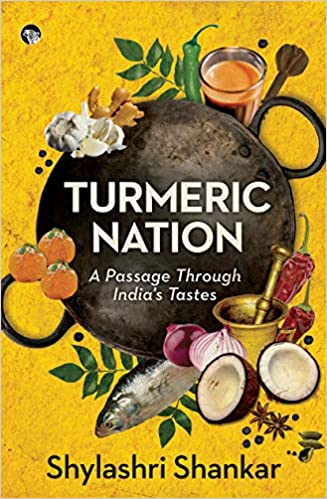
Turmeric Nation: A Passage Through India’s Tastes

Book Review by Meenakshi Malhotra

Title: Turmeric Nation: A Passage Through India’s Tastes

Author: Shylashri Shankar

Publisher: Speaking Tiger Books

Shyalashri Shankar is an academic whose third non-fiction, Turmeric Nation: A Passage through India’s Taste, won a woman author’s award in India called the AutHer Award (2021). This book is a detailed and rich journey through India’s multiple cuisines and culinary cultures divulging interesting facts like Aurangzeb was a vegetarian.

In the literature of food writing, we have both advocates of diversity, food fusionists as well as food fashionistas. Shankar’s approach is fairly eclectic and informed, drawing on the anthropology and sociology of both food and the cultures they originate from. Professing to write a “food biography” of India, she also realises that such a task is both “challenging and daunting”, given the magnitude and diversity of the task involved. She describes Indian cuisine as layered and pluralistic, where there is no one cuisine which can be described as ‘Indian’. Her book proceeds to map these regional diversities not only in food and food cultures, but also cooking styles.

Giving veritable gastronomic glimpses into the fascinating world of the great Indian kitchen, Shankar explores food histories of ancient India dating back to Harappans, while keeping a keen eye for networks of customs, habits and styles of living. From time to time, the cuisine has absorbed new methods of food processing and cooking and been hospitable to new and foreign influences. At the same time, it has at times exerted injustices since the sociology of food is shown to be intricately linked to the that of the caste as shown in the section on Dalit foods. Shankar rightly refuses to mythify or romanticise food, instead she refers to social anthropologist James Laidlaw’s notion that nowhere in the world are food transactions socially or morally neutral, and that the politics of and around food are probably the sharpest in South Asia.

She draws from the theories of ethnologist Claude Levi-Strauss, who, she argues, analysed different cooking techniques to put forward an influential structuralist idea of the raw and the cooked. Food, according to this theory, is a medium between nature and culture. The activity of cooking performs a process of civilising nature.

Shankar asks more fundamental questions: Did our ancestors determine the way we eat? What is the DNA of food preferences? Which is a better diet — vegetarian, non-vegetarian or paleo (what Is paleo)? Does food have a religion? What food creates ardour and desire? What are the transgressions and taboos on certain kinds of foods? What is the purpose and function of certain rituals around food — for instance, the logic of feasting and fasting? As Shankar takes us on this fascinating journey of culinary exploration, we see the emergence of a rich map of cultural anthropology.

Turmeric Nation is an ambitious and insightful project which answers these questions, and then quite a few more. Through a series of fascinating essays—delving into geography, history, myth, sociology, film, literature and personal experience—Shylashri Shankar traces the myriad patterns that have formed Indian food cultures, taste preferences and cooking traditions. From Dalit ‘haldiya dal’ to the last meal of the Buddha; from aphrodisiacs listed in the Kamasutra to sacred foods offered to gods and prophets; from the use of food as a means of state control in contemporary India to the role of lemonade in stoking rebellion in 19th-century Bengal; from the connection between death and feasting and between fasting and pleasure, this book offers a layered and revealing portrait of India, as a society and a nation, through food. It takes us on a fascinating culinary journey through the length and breadth of the subcontinent.

The proof of the pudding, many might feel, is in the eating. Why such a learned dissertation on food, gastronomy and culinary traditions? Is it ultimately to map unity, diversity, and work towards an idea of syncretism? Either ways, the book is worth keeping on our shelves and stocking in libraries, swelling the corpus on food studies which is now studied as an important part of Cultural Studies in many universities. The book ultimately gives us much food for thought as it theorises the practices of cooking and eating across Indian cultures.

.

  Dr Meenakshi Malhotra is Associate Professor of English Literature at Hansraj College, University of Delhi, and has been involved in teaching and curriculum development in several universities. She has edited two books on Women and Lifewriting, Representing the Self and Claiming the I, in addition  to numerous published articles on gender, literature and feminist theory.       

.

PLEASE NOTE: ARTICLES CAN ONLY BE REPRODUCED IN OTHER SITES WITH DUE ACKNOWLEDGEMENT TO BORDERLESS JOURNAL