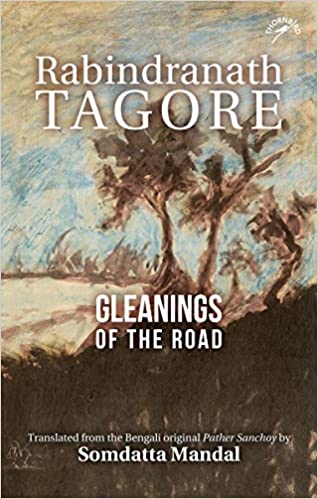
Travels formed an integral part of the personae and creative artist that was Rabindranath Tagore. During his travels to England and the America (1912-13 and 1920) Tagore wrote essays for publication in various Bengali journals. Rabindranath Tagore was an inveterate traveller who travelled to the furthest corners of the globe. Detailing his travels in the colloquial everyday language (also referred to as ‘chalit’ bhasha or language) during his tour of England and USA in 1912-13, he used to publish regularly in journals like Prabasi, Bharati and Tattwabodhini Patrika. As the translator-editor Somdatta Mandal informs us, Vishwa Bharati Publication Department in 1946 decided to discard Rabindranath’s own selection. They went back to the earlier formal register and included writings of the 1912 tour, irrespective of whether they were related to his travel.
The book blurb says: “In 1939, Tagore selected fourteen of these essays and an appendix containing seven letters he had written to some of the teachers in the Santiniketan ashram while he was on these trips, for publication as a volume. It was at this point that he rewrote the original essays then using the colloquial instead of the formal language; he also revised the texts substantially. Later editions altered the number of essays, sometimes digressing from Tagore’s own selection, sometimes going back to Tagore’s original formal language.”
The travelogue, if it can be called that, provides an insight into Tagore’s perception of the different facets of western life and the diverse philosophical issues that cross his mind as he journeys from one continent to another. Thus perhaps it is more appropriate that the collection is named “gleanings’’ rather than a travel account or narrative. They are philosophical ruminations where Tagore holds forth on various aspects of civilizations and cultures.
In the very first segment, Tagore’s critical observations about Indian society comes to the fore. Thus he comments on what he sees as cultural differences and civilizational clashes, in “Prelude to the Journey”: “We always comfort ourselves by saying that we are a religious and spiritual race”. He sees this as a compensatory move by Indians to cover up our own sense of inadequacy, about our “weakness” in the external world.(Tagore was acutely conscious of India’s status as a colonised country). “Many of us boast that poverty is our asset”, dwelling perhaps in a haze of pseudo-spiritualism which balks at admitting that this attitude is merely a kind of bravado.
Tagore’s essay here unpacks the notion of the binary that the West is materialistic while the East is spiritual by lauding certain aspects of Western and European culture. Thus he writes that “if we go to Europe with the aim of a pilgrimage, our journey will not be in vain”. He further explains that this is not only because of the material developments achieved by Western culture, but their spirit and attitude.
Power, according to Tagore, is more than an external manifestation; rather, it has to do with a sense of real inner strength. He goes on to cite the instance of the Titanic and people’s altruism and self-sacrifice that was in evidence at that time, to interrogate the view, held by many Indians, that the average European is self-centred and self-serving. On the other hand, Tagore also gives plenty of instances where the spiritual poverty of Indians was in evidence. Thus he writes, “I know there has been a clash between our welfare and that of Europe and because of that we are suffering deep anguish and pain. We do not trust their religion and we criticise their culture as being too materialistic.” However, he continues that there are aspects of European culture which are worthy of emulation, which we would do well to follow, without feeling that it threatens our culture. He strongly commends that the path to seek the truth is a pilgrimage on which we should proceed without being blinded by ego, prejudice and false pride.
Coupled with this contrast of cultures, are observations about people and places. Thus he talks about the women of Bombay who are visible on the beaches of Bombay and contrasts it with the city of Calcutta, which according to him, is bereft of women in public places. Tagore also muses on the vast and limitless ocean which to him offers a cornucopia of literal and symbolic meanings. The sea and the ocean signify vastness, depth, boundlessness and infinitude, as well as the lure of the unknown. In contrast, he bemoans the loss of man’s ties with nature signified to him by the colonial appropriation of the river. He reflects that the river “Ganges was once one of Calcutta’s ties with nature…It was the one window of the city from where you could look out and realize that the world was not confined to this settlement.” He bemoans the fact that the once natural strength of the Ganga had been dissipated, “it has been dressed up in such tight clothes on both its banks and its waist band has been tightened so that the Ganges seems to be the image of a liveried footman of the city”. In contrast, the “special glory of the sea is that it serves man but does so without wearing the yoke of slavery on its neck.” His evocative description brings to life the various aspects of the landscape in full measure.
Tagore’s ‘travel’ writing is not just a mapping of people and places, but shows him as the supreme cartographer of the imagination. Witness his contrast of the earth and the ocean. The earth is compared to an excessively doting mother who binds her children to her and does not allow them to venture far away; the ocean by contrast “constantly allures him to venture towards the unattainable”. He adds, “Those who responded to that call and moved out are the ones who conquered the world.” Moreover, “that race of people on this earth who have specially welcomed this ocean have also found the unceasing effort of the ocean in their character.” Travelling on the Arabian sea, glimpsing distant shores, he stresses that the union of the two — the land and the ocean — signifying stability and movement are vital to an understanding of the truth.
The urge to travel, to move forward continuously, is forever present in man. In a philosophical vein , the poet muses that the soul “always wants to travel” and that it dies if it does not do so.In a series of similes and metaphors drawn from nature, he reflects: “Let us keep moving on, like the waterfall, the waves of the ocean, the birds at dawn, the light at sunrise.” He even transcends to the next plane when he says that “even the call of death is nothing but just a call to change the dwelling place”. In almost the same breath, he compares himself to a fairy princess who is fast asleep and who cannot be woken from her slumber, except with a golden wand.
Part anthropological study– at one point, the poet reflects that the vastness of the surrounding sea would have elicited devotion among many Indians, unlike the European traveller who is intent on enjoying the comforts and varieties of entertainment on the ship-part philosophic meditation, “Gleanings” represents the quintessential Tagore. His interrogation of Indian claims to spirituality is made in the tone of a concerned father warning his children not to fall prey to false pride and vanity. Deeply patriotic as well as an internationalist, he straddled two contrasting worlds of materiality and spirituality, without succumbing to limiting binaries and stereotypes.
Ably introduced and translated by Somdatta Mandal, a renowned Tagore scholar, the translation captures the iridescent and luminous quality of Tagore’s prose and its chiaroscuro effects.
Dr Meenakshi Malhotra is Associate Professor of English Literature at Hansraj College, University of Delhi, and has been involved in teaching and curriculum development in several universities. She has edited two books on Women and Lifewriting, Representing the Self and Claiming the I, in addition to numerous published articles on gender, literature and feminist theory.
.
PLEASE NOTE: ARTICLES CAN ONLY BE REPRODUCED IN OTHER SITES WITH DUE ACKNOWLEDGEMENT TO BORDERLESS JOURNAL
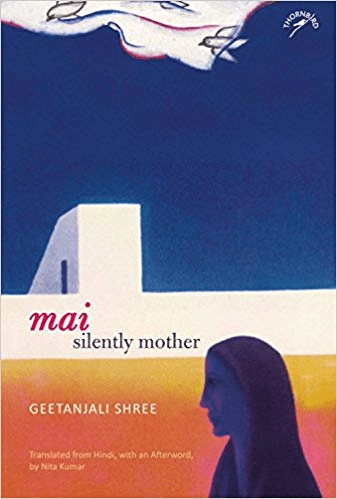
Rakhi Dalal reviews Geetanjali Shree’s Mai, Silently Mother, a Sahitya Akademi winning translation of the Hindi novel by Nita Kumar
Title: Mai, Silently Mother
Author: Geetanjali Shree, Translator: Nita Kumar
Publisher: Niyogi Books
To live in a South Asian country means to grow up with an absolute idea of a mother. A mother is always giving, nurturing, sacrificing and working. Her day begins and ends with looking after the household. In context with India, this notion also seems to be defined by the structures of caste and class. Although an opinion of her position, based upon the ideas imbedded in conscience, takes on different interpretations when seen broadly from the lenses of patriarchy or feminism. With the former, it is more of a responsibility or duty that is taken for granted and in many cases not even given a second thought. In the case of latter, it might be considered as oppression in some situations, where the mothers are deliberately subjugated into drudgery of family grind by the patriarchal structure.
Mai by Geentajali Shree presents to us the complexities brought about by the conflict between both of these ideas in a domestic realm. However more than that it compels us to think when we talk of a mother, exactly whose opinions are being discussed and whether we also explore it from the point of view of the mother herself.
It is the debut Hindi novel of the author and is centred on the world of a mother as observed by her daughter. The English translation of Mai by Nita Kumar had won Sahitya Academy Award in 2002 and was shortlisted for the Crossword Book Award in 2001. Ret Samadhi by Geetanjali Shree, whose English translation Tomb of Sand by Daisy Rockwell won International Booker this year, also has at its centre a mother.
Shree writes stories and novels in Hindi. Her much acclaimed novels Tirohit and Khali Jagah have also been translated into English. She has written a biography of Premchand in English and is also associated with theatre. Nita Kumar, the translator of Mai, is a Brown Family Professor of South Asian History at Claremont McKenna College, Claremont, California. She has also authored several books and is engaged in innovative education in Varanasi since 1990.
The household in Mai is a typical middle class in a small North-Indian town where the patriarch set the diktats rolling for a joint family. Governed by the binaries of outside and inside, the roles of each member are clearly defined. ‘Outside’ is a world to be conquered by the men whereas the confines within the house are to be looked after and cared for by the women. Three generations of a family living under the same roof offer resonance with confirmations and contradictions inherent to the structure they are bound by.
With this backdrop, the author successfully pulls strings to present an image closer to the familiar realities of such a household. Silently mother, the subtitle of Mai, is the identifier which Sunaina, the third generation daughter, associates with her mother. From her early childhood, she has watched her mother attending to the call of her family silently. Always bent, always working, from behind her purda, the mother seemed weak. Slowly however, and with much subtlety, Shree offers the reader certain glimpses into the character of silent Mai. Instances which, as Kumar suggests, mean that her silence does not equate with being speechless. At the most crucial points, we witness the mother speaking up for her children, even if it is only a single word or sentence is being uttered. She never questions their choices or decisions, thereby giving them freedom to get on with their own lives, something which makes them closer to her than to their father or grandparents.
The reader also finds that mother does have her own moments of joy when she retires at night to the bedroom she shares with her children, lets go off her veil and laughs at their jokes, when she appears in the forbidden courtyard humming a song or when she takes on the responsibility of entire house after her husband meets a tragic accident.
For Sunaina and her brother Subodh however, her silence equates with oppression. They are obsessed with the idea of rescuing her from the fetters which they believe are afflicted upon her. So much so that it becomes the sole purpose of their lives. With passage of time, their mission nevertheless remains unaccomplished as they realise in frustration that their mother doesn’t need to be saved. It is only towards the end that they realise her strength and contribution in building their lives.
In the afterword, Kumar says, “We do not know ‘what’ mothers are, we do not know if a given mother is ‘fulfilled’ in what she does, or what else she ‘wants’. But we could progressively know whether to ask certain questions, how to ask some others, what any of them might imply, how to refrain from asking and retrack, how to pause and begin to comprehend little glimpses better. We could start evaluating silence differently from what we do in our dichotomous, rationalist world, like Subodh and Sunaina’s tells us to. We could question agency, strength and weakness anew.”
With an impressive 50 page critique of Mai, the afterword is an added treat to the reader. Kumar writes on the matter of mother and looks at it from the point of history and anthropology. She discusses the challenges associated with the task of translation and her discourse engages the reader, bringing focus on her work which is done exceptionally well.
This splendid novel by Geetanjali Shree, with its nuanced portrayal of sensibilities across class, gender and age, invites the reader to look closely into the preconceived as well as acquired notions around ‘mother’. It stresses profoundly that the mothers are not only made invisible by the veil which patriarchy forces upon them but also by the partial and opinionated understanding of their desires. Maybe if we try to catch the little glimpses better, we may start seeing her coming out of shadows.
.
Rakhi Dalal is an educator by profession. When not working, she can usually be found reading books or writing about reading them. She writes at https://rakhidalal.blogspot.com/ .
.
PLEASE NOTE: ARTICLES CAN ONLY BE REPRODUCED IN OTHER SITES WITH DUE ACKNOWLEDGEMENT TO BORDERLESS JOURNAL.
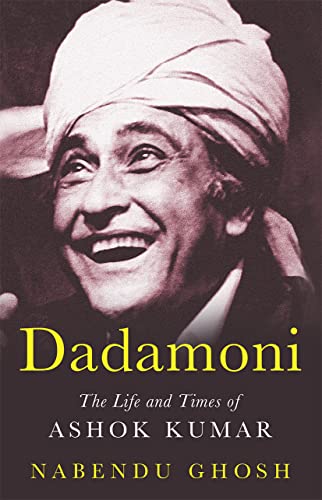
Dadamoni: The Life and Times of Ashok Kumar by Nabendu Ghosh (1917-2007) is a reflection on the Hindi film industry as much as it’s a biography of the legendary actor. An eminent scriptwriter in Bollywood and director, Ghosh was an award-winning Bengali writer whose oeuvre of work includes thirty novels and fifteen collections of short stories. As a script writer, he wrote the scripts in Hindi for iconic films like Devdas, Bandini, Sujata, Parineeta and many more.
Ashok Kumar (1911-2001) was a part of both the small and the big screen in India while he lived. Was Ashok Kumar a star? What was his position in the Hindi film industry? When did he become a character actor? Was he a good actor? These questions are very easy to answer about others but when it comes to ‘Dadamoni’, as he was fondly called, the answers become nebulous.
Ashok Kumar started his career in the early 1930s which makes him senior to stars like Raj Kapoor, Dilip Kumar and Dev Anand who made their debuts and attained stardom when Ashok Kumar was already a reigning star. Ghosh knew Ashok Kumar personally for many years. And the personal touch comes through in many places – through anecdotes and because of the regard that shines through the narrative. The jokes that Ashok Kumar cracked from time to time, the things the thespian told the author, all find place in the book. There is also a visible attempt to protect Dadamoni’s reputation against any allegation of vices generally attributed to stars. Ghosh, who had gone to Bombay as part of Bimal Roy’s team, constantly tries to establish Dadamoni as a gentle, thoughtful and educated person.
But this gentle, thoughtful and educated person didn’t have it easy in the world of films. Ashok Kumar had a shaky start. A shy and retiring person, he had gone to Bombay while studying to become a lawyer in Calcutta — to become a director. The ambition was idealistically driven – films, a new medium then, could be a means of educating people. But fate intervened. The person supposed to play the hero’s role in Achhut Kanya(Untouchable Maiden, 1936) had gone missing and the search for a replacement was on.
One day, Ashok Kumar, an employee of Bombay Talkies then, discovered the owner of the studio, Himanshu Rai, quizzically looking at him. Rai had found the replacement for the hero of Achhut Kanya. But for the hero, it was beyond belief that he could act in a movie. The most endearing part of the book is how this diffident hero finds his footing in the industry becoming its earliest and biggest star. And the most poignant part is the gradual decline and death of the studio system even as its product – Ashok Kumar – rose to new heights.
As the narrative draws to a close, one is left wondering what is Ashok Kumar’s position in the legion of Bollywood stars? This has been answered exhaustively in the ‘Afterword’ by Ratnottama Sengupta, eminent film critic and Ghosh’s daughter, who brings in not only personal lore but also her own experience. She tells us Ashok Kumar served “as a textbook for actors wanting to perfect characterisations, voice control, timing, gestures postures” and that he transformed “the acting style in Indian cinema from theatrical to naturalistic – which is still the cinema language worldwide.”
Naming him the “Elder brother of the industry”, Sengupta asserts, “I’d say he is the one personality who symbolises Indian cinema’s journey from Bombay Talkies to Bollywood.” She brings in his stories of interactions with film stars, his hits and directorial ventures, his launching of major actors and his deep links with them, including his acclaimed brother, Kishore Kumar, with more anecdotes from multiple eminent actors like Shammi Kapoor, Moushumi Chatterjee, David Lean and his associates and family ties that stretch to embrace actors from different religion and race. Bharti Jaffrey, Ashok Kumar’s daughter, who has written a heartfelt forward for this edition, is married to actor Saeed Jaffrey’s elder brother.
What makes this book unique is that Ghosh wrote this book in English himself and it has been republished posthumously[1] with the addition of a forward and an exhaustive afterword by the well-known daughters of the two film icons. It also has classic photographs of Ashok Kumar. Both the emotionally charged forward by award-winning actress Bharti Jaffrey, and the afterword by Sengupta, a national film award-winning journalist, explore further the enigma that was Ashok Kumar. By the end of the ‘Afterword’, one realises how deeply tied and organic are the Bollywood families and how much they do to try and create bridges and close gaps – the Ashok Kumar Foundation being one such effort. The whole package – the forward, the narrative, the photographs and the afterword — leaves one spellbound.
[1] First published in 1995 by Harper Collins – mentioned in the ‘Preface’ written by Ghosh in 1995 and reproduced in this edition published by Speaking Tiger Books.
.
Indrasish Banerjee has been writing and publishing his works for quite some time. He has published in Indian dailies like Hindustan Times and Pioneer, and Café Dissensus, a literary magazine. Indrasish is also a book reviewer with Readsy Discovery. Indrasish stays and works in Bangalore, India.
.
PLEASE NOTE: ARTICLES CAN ONLY BE REPRODUCED IN OTHER SITES WITH DUE ACKNOWLEDGEMENT TO BORDERLESS JOURNAL
Evolutionary biology is a branch of biology that deals with the processes responsible for the evolution and diversity of life on earth. From the very first ancestor to all life on earth to the very first modern human ancestor, a lot of questions remain answered. The emergence of related fields like genetics and specialised tools like radiocarbon dating has enabled scientists and evolutionary biologists to put together a clearer picture of how life would have probably evolved.
Explaining Life Through Evolution by Prosanta Chakrabarty opens a window to four billion years of eight million species that we see on this planet. It not only adds to existing literature but also gives straight answers to straight questions on the evolution of life on earth. Indeed, it is an unputdownable book that explains life.
Chakrabarty is an evolutionary biologist at Louisiana State University where he is a professor and curator. A Senior Fellow at TED, a Fulbright Distinguished Chair, and a Fellow of the American Association for the Advancement of Science, this is his first and indeed a great work.
The schema of the book is clear: it does not simply narrate the story of evolution; it is more than about where we came from. It brings to light who we are. As humans, we logically focus more on identifying differences between us; no matter how small they are. Chakrabarty demystifies the notion to emphasise our similarities with each other than many of us are willing to believe.
As more and more people take ancestry tests, sending their DNA samples and money to genealogy testing centres, Chakrabarty says, we need to be educated on what the results actually mean, scientifically; and we all have to decide together what it means socially. We should be celebrating the fact that this diversity comes from the same little drops of water and sunlight, each just shining a little differently. Like all species, we are defined by our differences as much as by our similarities.
He begins the book by saying: “There is a beautiful Sanskrit word, ‘ayurveda’ that translates in English to the science of life. Although generally relating to human health or homeopathic medicine, I’d like to see the shift of the usage of ayurveda to its literal translation as perhaps an enlightened synonym of biology, élan vital or perhaps of evolution. It is a term that makes me think of how words and phrases can have different meanings for different people and how words too can evolve. Even the word evolution’ evolved in Charles Darwin’s time from a meaning closer to development (in the sense of a developing embryo) to its current definition, essentially the accumulation of heritable changes in organisms that can lead to the formation of new species from ancestral forms.”
He goes on: “Interestingly, Darwin and others instead used the now obsolete word transmutation, which then meant something closer to our current definition of ‘evolution. Over time, the meanings of words can change, but previous usages remain part of their history, just like species can retain the historical features of their ancestors. Except in biology, modifications often lead to entirely new species, so perhaps if we changed ‘ayurveda’ to ‘ayurvedology’ we’d have a better fit with the evolution analogy.”
Through this intelligent and aptly illustrated book, Chakrabarty encourages us to think of life which is always in the making. If we look at the eight million species with who we share this planet, we have to imagine them all as having evolved over four billion years. They’re all the product of that fruition. Visualise all as young leaves on this ancient and gigantic tree of life and we will appreciate that all of us are connected by invisible branches not just to each other, but to our extinct relatives and our evolutionary ancestors.
Divided into four parts (‘A Personal Prologue’, ‘The Evolution Revolution’, ‘Questions and Misconceptions’ and ‘Why Understanding Evolution Matters’), this book — all of the 230 pages– is a reader’s delight. Chakrabarty weaves his lived experiences into this poignant discussion on evolution, covering key concepts that are vital to the understanding of current conditions like change and natural selection.
If it is important for any book on evolutionary biology to discuss how the discipline has been misused to puff up socially constructed categories like gender, Chakrabarty does that with precision.
The glowing analysis sheds light on the problems with historical and present-day interpretations of evolution while enlightening us about those who work at the cutting edges of the field. Another important feature of the book is that it guides us through viral pandemics and social change, and provides the three R’s[1] to enable us to work together toward a thriving future.
Somewhere in the book Chakrabarty differentiates between science and religion. “Science is about observing and testing natural phenomena in order to give a reasoned, evidence-based explanation for those events. Religion, on the other hand, can provide answers to questions science doesn’t cover (e.g., what is the meaning of life?) but it can also provide answers that can’t always be tested. For instance, let’s say your answer to why apples drop to the ground when they fall out of a tree is ‘God made it happen’; that isn’t something I can prove false, because I can’t test it. There isn’t room for questioning things or scientific inquiry if you believe flatly that ‘God controls everything that happens’.”
He further points out the pitfalls of deep-seated religious conviction in the present-day world: “The other problem with teaching religion in a science class is that there are many religions with a variety of beliefs. Faith-based beliefs about creation differ by your religious persuasion. In one version of the Hindu creation myth, the Earth was part of the lotus flower that grew from the navel of Vishnu, and then the world was populated by Brahma and will be destroyed by Shiva. If l taught that version of creation as the truth in my science class, [I] wouldn’t last very long as a teacher. However, maybe this religious take would do well in the so-called ‘Indian Science Congress’, especially among participants pushing fringe Hindutva ideas that take some religious ideas literally (e.g. Brahma discovered dinosaurs).”
Chakrabarty presents one of the most accessible texts about evolution. It is a handy volume for an educator, scientist, or curious reader because the presentation of the theory of evolution provides a charmed balance between solid scientific research and hilarity that teaches, advises, and entertains.
Meaningful, wide-ranging and argumentative, this is a must-read book. It will propel us to imagine and reimagine life around us.
[1] Guiding principles like reading, writing Arithmetic
.
Bhaskar Parichha is a journalist and author of Unbiased, No Strings Attached: Writings on Odisha and Biju Patnaik – A Political Biography. He lives in Bhubaneswar and writes bilingually. Besides writing for newspapers, he also reviews books on various media platforms.
.
PLEASE NOTE: ARTICLES CAN ONLY BE REPRODUCED IN OTHER SITES WITH DUE ACKNOWLEDGEMENT TO BORDERLESS JOURNAL
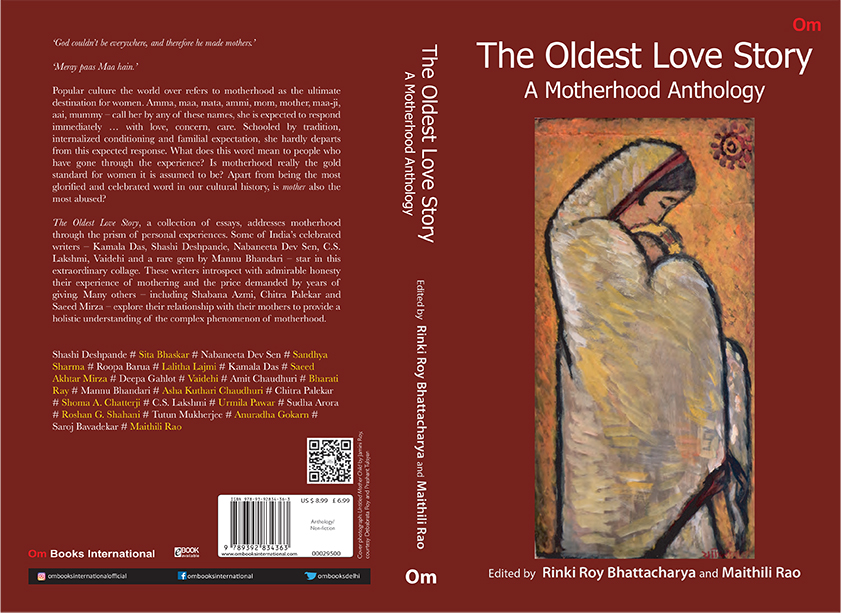
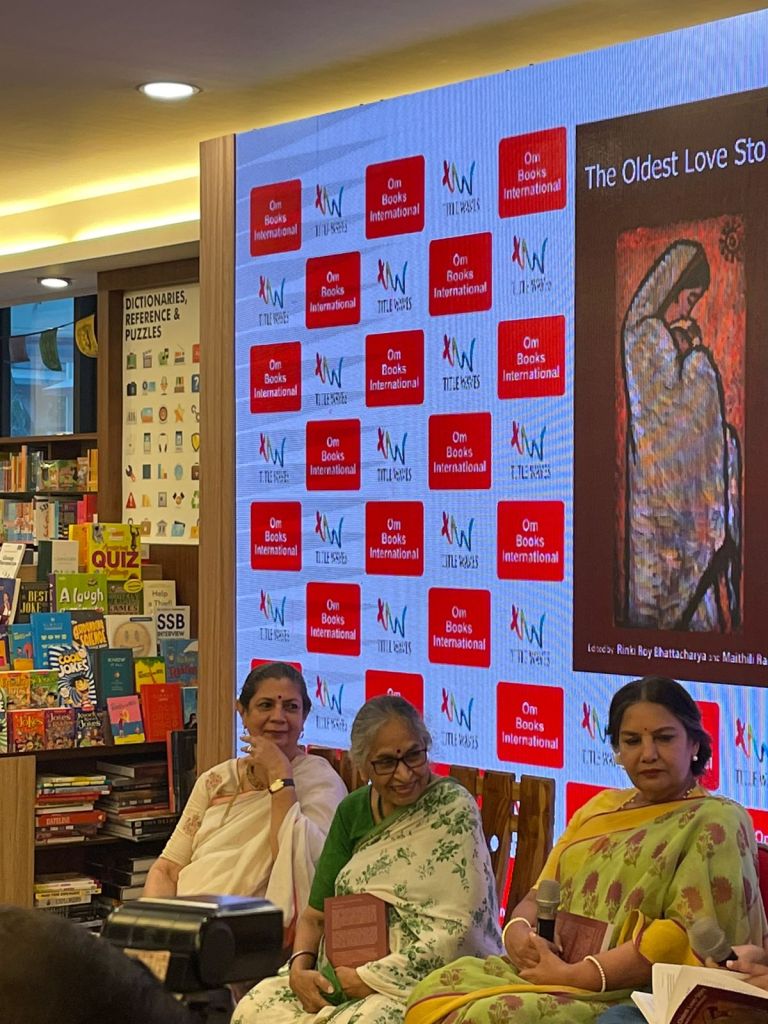
The Oldest Love Story, edited and curated by Rinki Roy and Maithili Rao published by Om Books International, 2022, carries multiple voices across cultures on a most ancient bond and nurtures pertinent questions and observation, which hope to redefine the role.
‘Antara 1’

Antara rising from primordial waters
As the first sun, forever new, forever old,
You made me the universe.
History and prehistory filed through me hand in hand
In gradual evolution.
Antara, because of you
I have earned the right to enter
The tenfold halls of my foremothers.
Clutching your baby hands in my fist,
I have made the future a debtor to me
Antara, in an instant you have filled all time
By your grace I am coeval with the Earth today.

-- Nabanita Dev Sen, The Oldest Love Story(2022)
The Oldest Love Story, curated by two eminent authors and journalists, Rinki Roy Bhattacharya and Maithili Rao, is an anthology that not only describes a human’s first love, their mother, and their lives, but also explores the social and psychological outcomes and ramifications of motherhood with powerful narratives from multiple writers. They range from eminent names like the late Nabanita Dev Sen, Shashi Deshpande, Kamala Das to Bollywood personalities like Shabana Azmi and Saeed Mirza and contemporary names like Amit Chaudhuri or Maithili Rao herself.
The anthology has narratives clubbed into three sections: ‘Being a Mother: Rewards and Regrets’, ‘Outliers’, ‘Our Mothers: Love, Empathy and Ambivalence’. The headings are descriptive of the content of each section. These real-life narratives, some of which include translations by editors Roy and Rao among others, make for interesting and fresh perspectives of the age-old story that is as natural as water or air. More than two dozen diverse voices as well as Roy’s powerful “Preface” and Rao’s exhaustive “Introduction” paint motherhood in new colours, giving it an iridescence that glitters with varied shades. Stories of what mothers faced — bringing up a child with Down’s syndrome, a child who drove his roommate to suicide and yet another daughter who marries a man old enough to be her father — bring us close to issues we face in today’s world.
One of the most interesting and unusual aspects of this book is at the end of each essay is a takeaway from the narrative where the writers write about themselves. This is not a biography but a description of the writers’ perception about their mother or what they learnt from their experience of motherhood. The most interesting takeaway is given by Shabana Azmi, who wrote of her dynamic mother Shaukat Kaifi (1926-2019).
“I am cut from the same cloth as her. But who am I?
“I would say I’m a woman, an Indian, a wife, an actress, a Muslim, an activist, etc. My being Muslim is only one aspect of my identity but today it seems as though a concerted effort is being made to compress identity into the narrow confines of the religion one was born into, at the absence of all other aspects. This is not the truth about India. India’s greatest truth is her composite culture.
“The Kashmiri Hindu and the Kashmiri Muslim have much more in common with each other because of their ‘Kashmiriyat’ than a Kashmiri Muslim and a Muslim from Tamil Nadu in spite of them sharing a common religion. To me, my cultural identity is much stronger than my religious identity.”
And she concludes: “My mother taught me that identity must not be a melting pot in which individual identities are submerged. It should be a beautiful mosaic in which each part contributes to a larger whole.”
Major social issues are taken up in multiple narratives. Mirza used the epistolary technique to describe how his mother discarded her burqa forever in Pre-Partition India.
“You were emerging from the hall of the Eros theatre and were about to wear your burqa in the foyer when Baba popped the question to you.
“‘Begum, do you really want to wear it?’
“You told me you paused for a moment, and then you shook your head. And that was that. The rest, as they say, is history.
“I am trying to imagine that moment. The year was 1938 and you had been wearing a burqa ever since you were thirteen years old.”
Mannu Bhandari’s spine-chilling narrative of her mother, a child bride around the time when Mirza’s mother shed her burqa, shows a young girl punished and abused for accidentally tearing her sari. It showcases a conservative, abusive culture where women turn on women. An extreme contrast to the bold maternal outlook described by Mirza or Azmi, the narrative highlights the reason why women need to protest against accepting familial abuse bordering on criminality. That these three mothers lived around the same time period in different cultures and regions of India only goes to enhance the large diaspora of beliefs, customs and cultures within one country.
Dalit writer, Urmila Pawar’s reasserts her mother’s belief, “A woman is a wife for only a while/ She is a mother all her life.” “Screams Buried in the Walls” by Sudha Arora dwells on the abuse borne by women to pander to societal norms. Narratives of abuse of women who could not stand up to social malpractices seem to have turned into lessons on what not to do for daughters who condemn patriarchal norms for the suffering their mothers faced.
On the other hand, Shashi Deshpande tells us: “Motherhood becomes a monster that devours both her and her young; or, when the children go away, there is an emptiness which is filled with frustration and despair. I have been saved from this because of my work. My children no longer need me, but my life does not seem empty.” While Shashi Deshpande found her catharsis by writing her stories, Deepa Gahlot, justifies her stance of remaining unmarried and childless by espousing a voice against motherhood. She contends that the only reason to perceive motherhood as a viable alternative would be propagation of the species. But concludes with an interesting PS: “Does it even make sense to bring a child into such an ugly, nasty, brutal world?” As one hears of senseless violence, wars and mass shootings in the news, Gahlot’s words strike a chord. She has actually researched into the subject to draw her conclusions. But one would wonder how would humankind propagate then — out of test tubes in a bleak scenario like Aldous Huxley’s Brave New World (1932)? Would humans really want such an inhuman existence?
I would rather go with Dev Sen’s outlook. While she emoted on motherhood in her poems on her daughter Antara, she has given a powerful prose narrative elucidating her own perspective. Antara, the daughter to who these poems are addressed, has given a beautiful takeaway on her mother at the end of Dev Sen’s narrative. Despite being abandoned by her husband, Amartya Sen, who later became a Nobel laureate, Dev Sen not only fulfilled herself as a woman and a mother but threw out an inspiring statement that well sums up motherhood for some: “[C]ould I do anything to make this planet worthy for my kids?”
Rinki Roy Bhattacharya, one of the editors of this sparkling collection and author of a number of books, especially on the legendary film maker, her father, Bimal Roy (1909-1966), had published an earlier collection on a similar theme called, Janani (Mother, 2006). She agreed to tell us more about the making of this meaty and gripping anthology, The Oldest Love Story.
Editor Rinki Roy Bhattacharya at the book launch in Mumbai. Photo sourced by Rinki Roy
Motherhood as a concept that is ancient, natural, and yet, not fully understood nor explored. What made you think of coming up with this collection that highlights not only stories of mothers and how it influenced women but also discusses the process of being a mother?
The present collection, titled “The Oldest love Story” goes back several decades. This is mentioned in my preface. It began when I woke up to the fact that I was redundant as a mother. By the time the children had grown up one-by-one and left home. I began to explore the situation with other women to understand, why we give so much importance to motherhood? Foolishly, I felt. Motherhood as a concept is indeed natural but taken for granted. I have a problem with that. My maid, Laxmi, is a classic example of a mother who is exploited to the hilt by her children. She is blind to their exploitation and refuses any change that will help her live with comfort or dignity. As if women are just mothers and nothing else?
Was it a personal need or one that you felt had to be explored given the current trend towards the issue where women are protesting the fact that looking after children saps them of individuality? Can you please explain?
I answered this issue as have others in this book. The deep resentment that follows after raising kids who then go away to find greener pastures, is an extremely common, and collective experience for most parents. Particularly in the Indian context. Parents cannot let go. The main reason, I think is, the parent’s fear. The fear of who will light the funeral pyre if not the son? In the event of not having a son, a close male relative takes over. Do you see the gender bias, the patriarchal assumption? Daughters are not considered legitimate enough to light the pyre?! Yet it is daughters who care for elderly parents in most cases.
This is not the case in Europe, nor the West, where children are expected to become independent very early. In fact, European teenagers seize their independence at the earliest opportunity. It is the expected thing, and no one resents that inevitable shift.
You had an earlier collection called Janani (Mother). Did that have an impact on this book?
I am glad you referred to Janani, published by Sage books in 2006. That collection is the cornerstone of our new book. In this collection, we have included eight extraordinary essays from Janani. We have retained, for example, Kamala Das and Shashi Deshpande to name two. And guess what we discovered out of the blue? In the oldest love story, we have several Sahitya Akademi winners amongst our writers, including these stalwarts. This raises our book to a huge literary stature.
How was it to work jointly on a book with Maithili Rao? Did you both have the same vision for the book?
Working with Maithili was fantastic, and it was great fun. She is the most generous of people and shares without fuss. Ours was a good partnership. I could not have produced this book without Maithili. She has been and continues to be a rock.
You have done many translations for the book. Why is it we did not find an essay from you as we did from Maithili Rao?
Yes, I did. I helped fine-tune Mannu Bhandari’s story It ranks as one of my personal favourites. Her narrative is beautifully visual. I find it cinematic. I also translated Sudha Arora’s poignant essay. Sudha is a noted Hindi writer. It was, however, difficult for me to write my personal story. But the hope is, our next reprint will carry a story I wrote on my son Aditya’s birthday in 2021. In this I have given graphic details of how childbirth robs women of their dignity in the so-called natural process of birthing children. My essay is entertaining and somewhat satirical in style.
You have written a beautiful preface to the book, reflecting your own experience with your children. Were you, like the other writers, impacted by your mother?
I take that as a compliment. Yes, I wrote a heartfelt preface. My relationship with my mother, admittedly, was a strained one. Our age difference was just eighteen years…whatever the reason, I have not been able to fathom or pinpoint it. So, I thought it was best to refrain from the troubled territory.
Would you say that Bollywood had some bearing on the book as a number of writers are from within the industry? Also, your father, the eminent Bimal Roy, made a movie called Maa in 1952. If so how. Please explain.
I do not see any bearing from Bollywood. The fact we have eminent personalities from the world of cinema, for example, Shabana Azmi, Saeed Mirza, and Lalita Lazmi do not make it a Bollywood-driven work. My father, Bimal Roy’s Bombay debut was with a film called Maa. Apparently, Maa was inspired by a Hollywood film titled Over the Hills. The main protagonist was an elderly mother of two sons. Maa bared a socially relevant issue, elder abuse, that has been globally recognised and is prevalent. My father’s empathy for the elderly is well documented in this fictional account. In day-to-day life, my father supported the elderly. His widowed aunt in Benaras was maintained by him. His brothers were educated and helped by his generosity. Compassion was his second nature. From him, I learned that a silent, discreet way to support others is the best way to reach out.
There are so many women in the anthology who reiterated the huge impact their mothers had on them, and they were quite critical of their ‘patriarchal’ fathers. Do you think this is true for all women? At a personal level, did your father or mother have a similar impact on you?
I am glad to hear that these woman are critical of their patriarchal fathers…while most women tend to overlook the patriarchal aspect. In general, women tend to ignore or even neglect, their mothers. In my case, it was distinct. My cultural upbringing was instilled by my father’s secular and inclusive vision and social values. These played a decisive part. Much more than my mother, who was a gifted photographer. My parents, by the way, were a made for each other couple. Rarest of rare in the movie industry. My father is my mentor. If you contemplate his well-loved films, let us take Sujata[1959], for one. I have yet to see another film that speaks so eloquently of social boycott. It is not just the caste issue of Sujata, which doubtless is the main thrust. It is the combined forces of class, caste, and gender that play havoc with human relationships as portrayed compassionately in this work.
Yes, Sujata is indeed a beautiful film and your book has taken up many of the issues shown in the movie through the voice of mothers, whether it is caste or religion. Was this intentional or was it something that just happened?
The voices of our contributors in the book are of individuals who write with exemplary honesty and spontaneously. Nothing is contrived in their writings. We did not brief our writers to take up any specific issue. They wrote from the heart.
One of the trends that emerged from my reading of the book was that educated and affluent mothers through the ages had it easier than child brides and less educated mothers, whose children also reacted with more vehemence, looking for a better world for themselves. Do you feel my observation has some credence? Please comment on it.
I do not agree entirely. Bearing children, and raising them in our complex, the confusing socio-economic culture is a challenging matter for all mothers. For all parents in fact. Child brides are subjected to it more intensely than others. There are no shortcuts, nor ready-made answers.
There is an essay against motherhood in this anthology. Do you agree with the author that it is a redundant institution and can be replaced by test-tube babies? Do you not think that could lead to a re-enactment of what Aldous Huxley depicted in Brave New World?
I think, you mean Deepa Gahlot’s essay. This was from the earlier collection. Deepa is entitled to her views. As are others. I think many younger women would agree with Deepa. Balancing motherhood with one’s professional life is a knotty business. I know women who have opted for one or the other to do full justice to it.
Yes, it was Deepa Gahlot’s essay. As you have rightly pointed out in your preface, motherhood can be interpreted variously. What do you see as the future of motherhood in India, and in the world?
Motherhood, remains subjective. Interpreted differently in each case. Every childbirth is a different experience. It may be life-threatening. A case to note is my dear friend Smita Patil’s. She died giving birth. But, I doubt women will stop being mothers, or abandon stereotypical mothering options that live up to that Deewar [Wall, 1975] dialogue: “Mere paas maa hain [I do not have a mother]”. There is a change, a shift, nonetheless, it is slow. Women are afraid to rock this entrenched image of motherhood. At least in India. I know successful women filled with guilt that they failed to be good mothers.
Well, that is certainly a perspective that needs thought.What books and music impact your work?
I read both Bangla and English. After leaving Calcutta where I read the children’s Ramayana, Raj Kahini, or stories by Tagore and Sukumar Ray. But there was an interruption when I got into an English medium school. Culturally I moved out of Bengal. During that phase, my mother introduced me to Agatha Christie. I was 12 years perhaps…I devoured her works. And I still do. Christie fascinates me.
I fell in love with the piano and began to learn it. As a result, Chopin, Mozart, and Liszt were my musical inspirations. I also learned Rabindra sangeet and Manipuri dance in Calcutta…. there was no dearth of cultural grooming. We are especially fortunate that our parents enjoyed the best in performing arts. Pandit Sivakumar Sharma, the great santoor maestro who just passed away, played at home. Sitara Devi danced for private programs. We were wrapped in a rich tapestry of culture.
What is your next project? Are you writing/ curating something new?
I am a compulsive writer, always itching to write. I believe that writers do not age…they mature and get better. Currently, I am compiling non-fiction episodes about some of the most celebrated artists from Indian cinema who I was privileged to meet…the collection may be titled, Brief Encounters. Writing keeps me creatively busy. Before I sign off, we have to thank our editor Shantanuray Chaudhuri for his unconditional support to make this book a reality. He has been marvellous.
Thank you for taking our work seriously.
Thank you for giving us your time and answering the questions
From Left to Right: Rinki Roy, Maithili Rao and Shabana Azmi at the Mumbai book Launch in June 2022. Photo sourced by Rinki Roy
(This is an online interview conducted by Mitali Chakravarty.)
PLEASE NOTE: ARTICLES CAN ONLY BE REPRODUCED IN OTHER SITES WITH DUE ACKNOWLEDGEMENT TO BORDERLESS JOURNAL
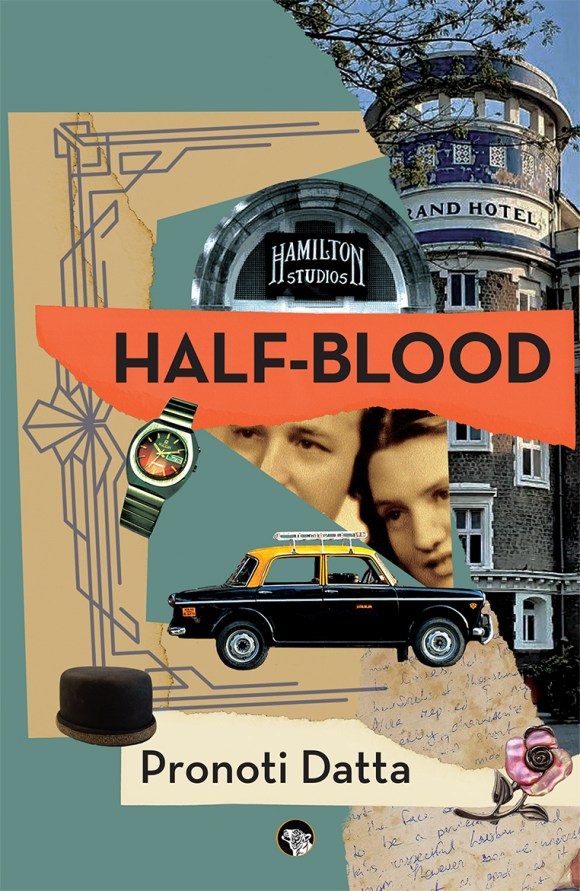
Half-blood by Pronoti Datta is a gripping noir-fiction that speaks about the harsh realities of urban settings, morally negotiated characters, dysfunctional families, and atypical individuals with dark secrets and surprises. Pronoti Datta was a journalist for about a decade and a half, covering culture and society in Bombay, the city from which she draws inspiration. She resides in Bombay and works as an editor of digital content. Half-blood is her debut novel.
The novel starts with a letter from Burjor to Moonie (Maya), the two main characters of the novel. In the letter, Burjor clandestinely explains his reason for disappearance by writing, “You see, Moonie, I did a terrible thing for which I had to leave Bombay. I don’t want to burden you, in this letter, with the details of my deed – or my life. It’s a long story and I’m not a man of words.” The prologue with this letter sets the tone for the story. The book has thirty-two chapters with an ‘Epilogue’ that gives the new order of things and “a sense of having created meaning” to life, or rather to newer ways of looking at life.
The story gives a glimpse into the lives of the dwindling Parsi population of Mumbai. The narrative spanning generations, time and space is a perfect read for those who love city stories, or love to know more about multicultural India. Most importantly, it is a fascinating story for those who love crime and suspense with a touch of history and culture. Datta brings to fore snippets specific to the lives of people and places in the then Bombay and now Mumbai. The author successfully addresses the failures, shortcomings, and the uglier side of life with wit and humour.
Maya, a journalist, who is young, talented, confident, ambitious, and disillusioned with life suffers from an existential crisis. She resurrects the past in search of her roots and meaning in life. Through the limited clues left in the “letter” from her biological father, she traces her bloodline. She embarks on a journey, stumbling upon unexpected facts and fiction on the life of Mumbaikars and Parsis some of who are poor and sometimes half-blooded or of mixed ethnicity. This is a story of rags-to-riches, underrated heroes and people in the sidelines. Burjor Elavia, a half-blood, a “fifty-fifty” is an “Adhkachru” — an illegitimate child of a Parsi man and a tribal woman. He accepts poverty and bondage to resist being pushed aside as a non-existent bastard.
Through the story of Burjor and Maya in Mumbai from the seventies, at the time of the prohibition till the 26/11 attack in 2008 in recent times, Datta weaves the less explored facets of history of the city into her fiction. The characters in the novel range from different religions, language backgrounds, and communities residing and crisscrossing paths to give voice to the culturally diverse mega-city.
Maya, born to Mini and Burjor, is adopted by an unusually matched Bengali parent. Brought up in Mumbai, she grew up in a locality with a good mix of residents from different communities and religions. Moved by stories of those who “persisted in their beliefs, fielding scorns and disapprobation, and emerged victorious,” she goes on to study Philosophy in Delhi and mingles with friends from across the country. Datta presents a realistic picture of a young girl of mixed descent from Mumbai, pursuing her path of self-discovery by connecting the past with the present. In this quest, she unravels smaller plots that add to the larger picture. As she unravels her own past, Maya describes her situation as similar to that of the Prince of Denmark — Hamlet. She says, “I am Hamlet looking into my father’s ghost.” Datta grinds a story that carries a peek into the time and gives a space to those at the margins and the unconventional like the infamous “Aunty Bars,” savage liquor barons, Adivasi women, scandalous navjotes[1], and children growing up in multicultural society
The novel is an aesthetic rebellion as it delves into the Parsi way of life including that of poor Parsis, good-hearted rogues, crime and punishment in defiance of pigeon-holes and labels about a community or group. Half-blood as the title suggests, reveals wider horizons and deeper nuances of identity. A fiction about modern India, this book takes us on a tour of less revealed nooks of history and culture to unearth beauty in diversity. Elegantly presented with a cover design by Maithili Doshi Aphale, which speaks for itself, the Speaking Tiger book, Half-blood breaks through stereotypes and clichés to win your heart.
[1] A religious initiation to Zoroastrianism, the religion followed by Parsis
.
Gracy Samjetsabam teaches English Literature and Communication Skills at Manipal Institute of Technology, MAHE, Manipal. She is also a freelance writer and copy editor. Her interest is in Indian English Writings, Comparative Literature, Gender Studies, Culture Studies, and World Literature.
.
PLEASE NOTE: ARTICLES CAN ONLY BE REPRODUCED IN OTHER SITES WITH DUE ACKNOWLEDGEMENT TO BORDERLESS JOURNAL
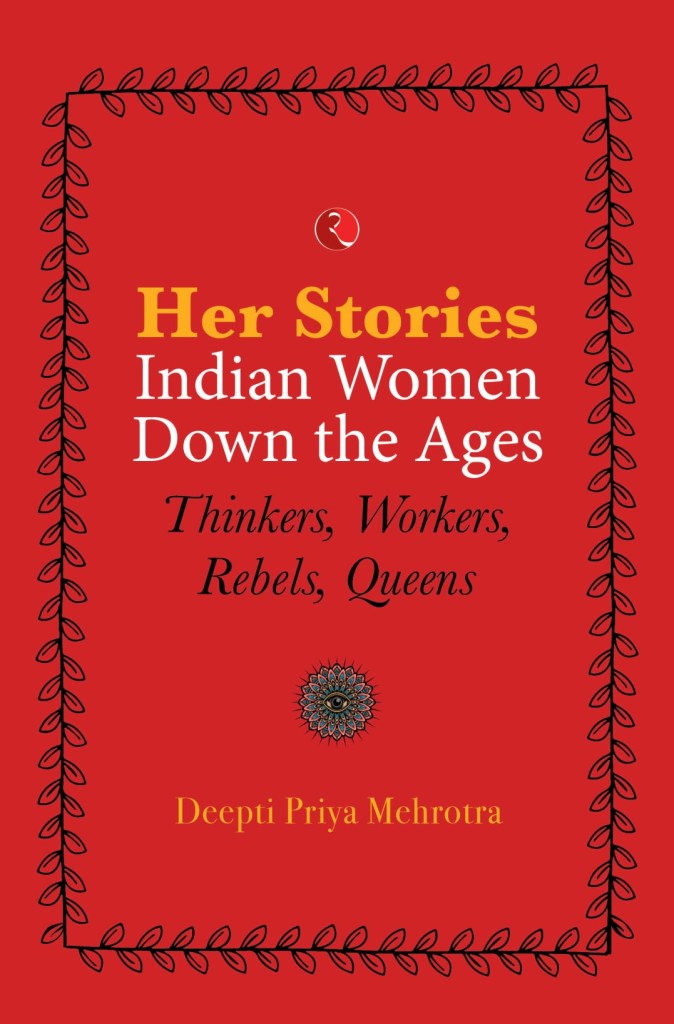
Title: Her Stories –Indian Women Down the Ages —Thinkers, Workers, Rebels, Queens
Author: Deepti Priya Mehrotra
Publisher: Rupa Publications
This is a motivating book and a curious one too. Talking about several women of substance, it goes to jog your memory about their contributions to the respective arenas.
Her Stories–Indian Women Down the Ages- Thinkers, Workers, Rebels, Queens by Deepti Priya Mehrotra is a bold account of the women who have been overlooked and ignored. A political scientist with cross-disciplinary interests, Mehrotra counsels civil society organisations on gender and education issues. Having taught social science at Delhi University and TISS (Tata Institute of Social Sciences), she is the author of pioneering books that include Home Truths: Stories of Single Mothers, A Passion for Freedom: The Story of Kisanin Jaggi Devi, Gulab Bai: The Queen of Nautanki Theatre and more.
Says the book’s blurb: “Some were celebrated, others vilified. While some were casually neglected. Yet, the story of these women lived on Her-Stories is a discussion of women from Indian history whose contributions have been all but forgotten. These were poets, performers, warriors, saints, philosophers, activists and more, yet we hardly remember their courage and contributions. The time has come to bring their history to the fore.
“Their stories describe desperate situations, ingenious strategies and brilliant sparks of feminist consciousness. Rather than accounts of isolated ‘great women’, these stories place at the center the ordinary woman, in all her splendid diversity, multifaceted struggle and achievement. The women profiled were encouraged and supported by others—their achievements represent the aspirations of many in the past and provide inspiration for us in the present.”
Spanning different regions of India, the book presents in chronological order from the second millennium BCE to the mid-nineteenth century India stories of women who have been thinkers, doers, movers and shakers who have subverted hierarchies, brought peace out of chaos and survived despite routine devaluation. Philosopher Sulabha, philanthropist Vishakha, fearless Uppalavanna, wandering bard Auvaiyar, justice maker Leima Laisna, astronomer Khona, mountain queen Didda, radical poet Akkamahadevi, intrepid Sultan Razia, martial artiste Unniyarcha, poet-saint Janabai, Gond Rani Durgavati, historian Gulbadan, cultural ambassador Harkha, pepper queen Abbakka, fakira Jahanara, brave Onake Obavva, Dalit rebel Nangeli, dancer-diplomat Mahlaqa Bai Chanda, lion queen Jindan, Nawab Begum Qudsia, sharpshooter Uda, guerrillera Hazrat Begum and feminist writer Tarabai Shinde.
Writes Mehrotra in the introduction: “Where mainstream histories display yawning gaps, feminist scholarship, and Dalit, subaltern and gender studies have gradually unearthed rich data, and made analytical advances. Some gaps persist, for historical sources are inevitably limited. One needs to sift through document, legend, myth and hagiography, to arrive at the most plausible truth. While remaining true to evidence, through empathy and imagination facts grow wings and characters come alive.”
The book is incontestably a saga of valiant women achievers, dissenters, fighters and advocates who changed the wave of complacent human existence. Igniting the spark of feminist consciousness, it celebrates the stories of women with forgotten glory.
In ‘Didda: Mountain Queen’, she contends: “Didda ruled in Kashmir for 50 years: nearly half of it is as an absolute sovereign. She earned the rare distinction of bringing stability into the fractious kingdom. Didda’s father-in-law, Parvagupta, was a clerk until in 949, he killed King Sangramdeva and grabbed the throne, only to die within a year. His son Kshemagupta took over, and proved as incapable as his young wife, Didda, was capable. Kshemagupta married Didda immediately after assuming power, slyly calculating that her royal lineage would provide legitimacy to his rule. Didda’s father was Simharaja, king of Lohara, and her maternal grandfather was Bhima Shah, powerful ruler of Kabul and Gandhara. Didda was in her mid-20s when she married, later than the usual age of marriage—quite likely because she suffered from a disability.”
Mehrotra reasons about the book: “Critical feminist subaltern historiography asks new questions and makes fresh interpretations. The move away from androcentric elite history breaks down walls, releasing a surging ocean of human beings who have much to tell. Women characters emerge from nooks and crannies; each different, in varied circumstances, yet each laboring against the grain of patriarchy, in some or the other aspect of her life. For centuries, patriarchy has defined and limited, reserved the public sphere for men and assigned subsidiary roles in the private domain to women.”
“Mainstream male-stream-history has colluded with these constructions, naturalizing women as stereotypical daughters, wives, mothers symbols of domesticity, rather than active human being Dalit and working-class women have been, additionally, naturalized as workers whose labor belongs to the elite.”
In about three hundred pages, Mehrotra writes about the injuries without making it an insipid narrative. She captures the drama concealed beneath the surface. If the women she dwells on in the book were not just victims, but makers of history and of literature, philosophy, law, medicine, science, art, architecture, music and religion, Her Stories goes that extra mile to bring out the tale of survival in a system rooted in domination and defeat.
.
Bhaskar Parichha is a journalist and author of Unbiased, No Strings Attached: Writings on Odisha and Biju Patnaik – A Political Biography. He lives in Bhubaneswar and writes bilingually. Besides writing for newspapers, he also reviews books on various media platforms.
.
PLEASE NOTE: ARTICLES CAN ONLY BE REPRODUCED IN OTHER SITES WITH DUE ACKNOWLEDGEMENT TO BORDERLESS JOURNAL
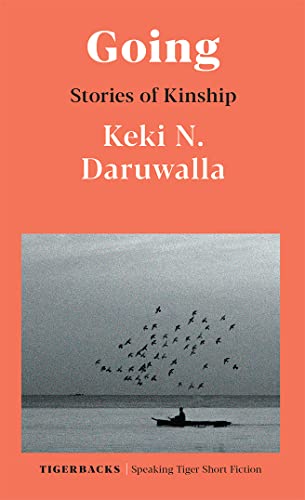
There are short stories where the ending is a collective culmination of all their subplots and themes, somewhat like a novel, but if you have read Somerset Mugham, you know what I mean. And there are stories which couldn’t care less. They move from one event to another, one subplot to another, make abstract observations and then suddenly come to an end. Maybe because every story must come to an end, but it’s the journey you must enjoy; it’s the journey that’s of greater importance. There are readers who like the former style – they appreciate its logical pattern of one thing leading to another. And there are readers who like the journey and believe disorderliness is a better reflection of life’s idiosyncrasies – and reflect on the sudden ending to connect it with what happened earlier. It is a delight to discover a writer. I knew Keki N. Daruwalla’s works – For Pepper and Christ – but had never read him. And now that I have read Going: Stories of Kinship, I will move back and try out his other works.
Among Keki N. Daruwalla’s acclaimed short story collections are Sword and Abyss (1979), The Minister for Permanent Unrest and Other Stories (1996) and Love Across the Salt Desert (2011). His first novel, For Pepper and Christ, was shortlisted for the Commonwealth Fiction Prize in 2010. He was awarded the Padma Shri in 2014. But Keki N. Daruwalla is better known for his poetry. His poetry volumes include Under Orion, The Keeper of the Dead (winner of the Sahitya Academy Award, 1984), Landscapes (winner of Commonwealth Poetry Award, 1987) and the Map Maker. Most recently he was honoured with the Poet Laureate award at the Tata Literature Live, Mumbai Litfest, 2017.
Thematically connected short stories are in fashion. But it’s difficult to identify any common thread running across the stories in Going. Each one is different.
Sometimes that sudden or understated ending can be a reference to a subplot within the story. Lionidas Campbell, in ‘The Bhahmaputra Triology’, many years after making love to an Indian woman discovers that he had sired a son from the relationship – and the story ends there. It can sometimes be reflective of the larger message the story wants to convey. After Ardeshir’s daughter, Arnavaz, elopes with a Muslim boy against her father’s wishes refusing to be dissuaded by her father’s attempt to invoke the history of persecution of Parsees by Muslims, Ardeshir is a heartbroken man. At the end, while wallowing in grief, sitting on armchair, Ardeshir suddenly feels the “frail silhouette of Arnavaz adrift on his memories” – and a yearning for his daughter grips him. The climax makes two messages very clear. The helplessness of a man seeing personal concerns of his daughter triumphing over a need for historical justice; filial love prevailing over community loyalty and concerns about history.
As much as all the stories, to an extent, explore the inner lives of characters, Bikshu is more so. The entire story is about Bikshu’s inner journey, its conflicts, evolution, emotional layers with occasional detours to Bikshu’s past, his family and mother. At the end of the book, I discovered the commonality. When you have read the stories and reflect on them as a collective, you feel they are about human relationships and how they evolve over time.
Indrasish Banerjee has been writing and publishing his works for quite some time. He has published in Indian dailies like Hindustan Times and Pioneer, and Café Dissensus, a literary magazine. Indrasish is also a book reviewer with Readsy Discovery. Indrasish stays and works in Bangalore, India.
.
PLEASE NOTE: ARTICLES CAN ONLY BE REPRODUCED IN OTHER SITES WITH DUE ACKNOWLEDGEMENT TO BORDERLESS JOURNAL
Meenakshi Malhotra visits Harsh Mander’s Locking down the Poor contextualising it against the current scenario
Title: Locking down the Poor: The Pandemic and India’s Moral Centre
Author: Harsh Mander
Publisher: Speaking Tiger Books
Harsh Mander’s Locking down the Poor: The Pandemic and India’s Moral Centre is a moving and poignant account of a crisis that he views as preventable. He gives us a detailed account of the havoc wreaked by the sudden announcement of a nation-wide lockdown in March. In early 2020, the first cases of Covid-19 infection were confirmed in India, and on 24 March the country’s prime minister announced a nationwide lockdown, giving the population of over 1.3 billion just four hours’ notice. It became obvious within a matter of days that India had plunged into a major humanitarian crisis.
In this stringent and harsh critique, Mander, a social activist, demonstrates how grave this crisis has been, and why it has had a lasting impact, from which the economy is still reeling. The author further shows us that this impact is the direct consequence of public policy choices that the governance made, particularly of imposing the world’s longest and most stringent lockdown, with the smallest relief package. The underprivileged were abandoned even as their livelihoods were destroyed and the blue collared work force were pushed to the brink of starvation.
Mander brings us voices of out-of-work daily-wage and informal workers, the homeless and the destitute, all overwhelmed by hunger and dread. From the highways and overcrowded quarantine centres, he brings us stories of migrant workers who walked hundreds of kilometres to their villages or were prevented from doing so and detained. His book can be seen as an expose that lays bare the callous disregard for basic needs during an emergency closure of a country where tens of crores continue to live in congested shanties or single rooms, on pavements with no toilets and no running water and no possibility of physical distancing, even though more than seven decades have passed after independence.
While the pandemic was a world-wise crisis which forced nations and countries to take emergency measures, Mander contends that the response within the country was a betrayal of the common people, the starving millions of India who live on the edge of hunger and poverty. Their increased precariousness, the author believes, was a result not only of a natural but a man-made, humanitarian crisis. It was the result, he says, of a short-sighted governance operating with a middle-class bias, who just refused to take into cognisance the ironies of pronouncements like “wash your hands” “stay home, stay safe”.
The author’s concerns here can be framed in the larger context of his anxiety and fears about the erosion of democratic politics in India. Speaking with the authority of an ombudsman wielding a blunderbuss, Mander backs his account with facts and statistics, observation and detailed reporting. Carrying out relief work in the unauthorised urban slums of Delhi, he sees the desperate situation of the people who are more threatened by hunger than the pandemic. That the government turned a blind eye to the omnipresent reality of hunger and poverty, was appalling to the author. Further, the alarming rise of domestic violence during the pandemic has also exposed the domestic space as a precarious location for many women in India and elsewhere. This fact has been well documented across a range of platforms and though this is not a primary concern in Locking Down the Poor.
The book concerns itself with hunger, the uncertain fate of migrants, daily wage labourers, the deepening class divides and many other issues of relevance. Mander points out the neglect of food security and the dismantling of informal labour rights, the wilful blindness of the courts and the state machinery which forced people into the space of their ‘homes’ regardless of the distress or human cost which has been colossal and disastrous. Commenting on the impact of the lockdown on the upper classes, Mander comments, “For the rich and middle classes, the lockdown was disorienting and a nuisance, but largely seen as necessary.” However, in the absence of safety nets, it was the poor who had to bear the brunt of the devastation that followed.
Thus, he writes that while the “appallingly planned lockdown offered zero protection to the poor, it placed the burden of the most destructive costs on their shoulders.” He also quotes journalist Ipsita Chakravarty who wrote in stark terms that “with the nationwide lockdown, the government drew a cordon around the bodies it wished to protect…pulling up the drawbridges to guard the chosen-those who could afford to stay in. On the bodies of those outside this charmed circle, the lockdown wrought havoc.”
Looking at the crisis of the first lockdown in 2020, after a gap when some time has elapsed, we realise that much of his critique holds true even now. The lack of foresight and proper planning became evident in the second wave as well, given the colossal tragedy of humongous proportions that unfolded in front of us and made all of us — rich, poor, middle -class citizens — mute victims and witnesses. A very comprehensive account of the impact on India of the Covid crisis, Locking down the Poor is also a chronicle of our times, of brutal exclusions that we practice unthinkingly on a daily basis. The book is in a sense as the blurb says a “ledger of our accountability at a time when the poor of India have been brought to despair and abjection by a callous state and an uncaring, unequal society”.
Dr Meenakshi Malhotra is Associate Professor of English Literature at Hansraj College, University of Delhi, and has been involved in teaching and curriculum development in several universities. She has edited two books on Women and Lifewriting, Representing the Self and Claiming the I, in addition to numerous published articles on gender, literature and feminist theory.
.
PLEASE NOTE: ARTICLES CAN ONLY BE REPRODUCED IN OTHER SITES WITH DUE ACKNOWLEDGEMENT TO BORDERLESS JOURNAL
The Post Office by Tagore was written, translated and performed in multiple languages throughout Europe. Rakhi Dalalrevisits the original translation done by Devabrata Mukherjee in 1912.
Title: The Post Office
Author: Rabindranath Tagore
Translator: Devabrata Mukherjee
Publisher: Niyogi Books
Dakghar was written in Bengali by Rabindranath Tagore in 1911. Devabrata Mukherjee, an Oxford University student at the time, translated the play into English in 1912. It was first published in London by Cuala Press in 1914 with an introduction by W.B.Yeats. He, along with Lady Gregory, had also directed its first staging in English in 1913 by the Abbey Theatre in Dublin. The production then transferred to the Court Theatre, London, later the same year before the Bengali original was staged at Tagore’s Jorasanko theatre in Calcutta in 1917.
This play was translated into French by André Gide and was read on the radio the night before Paris fell to the Nazis. During World War II, there were 105 performances of The Post Office in concentration camps in Germany. Perhaps one of the most noteworthy was its staging by Janusz Korczak, a Polish-Jewish educator who ran a Jewish orphanage in a ghetto in Warsaw. It was there that the play was organised for children just a few weeks before they, as well as Korczak, were deported to the concentration camps of Treblinka.
The story revolves around a young child Amal, an orphan adopted by his Uncle Madhav, who suffers from an ailment. On the instruction of the physician treating him, he is restricted within the house and is not allowed to go outside. In his quest to explore the world beyond the confines of his home, he sits near a window facing a road and talks to people passing-by. He becomes fascinated by the newly constructed post office near his window and imagines receiving letters from the king. The play presents a vivid picture of Amal, his longings, his ideas of life and the limitations that he faces.
Nirmal Kanti Bhattacharjee, in the introduction to this edition, quotes the bard from the letter he wrote to Andrews in 1921 where he says, “Amal represents the man who has received the call of the open road – he seeks freedom from the comfortable enclosure of habits sanctioned by the prudent and from the walls of rigid opinion built for him by the respectable.”
The narrative traverses through the realms of a mind born free, eager to understand and appreciate the beauty of the natural world and, yet with time, constrained by the ideas fostered as acceptable by societal norms. Amal would rather venture outside and hop like a squirrel than sit at home, toiling at books which his Uncle thinks makes a man learn. He would rather cross mountains and go farther to seek work than be disheartened by their imposing structure. To his Uncle, the hills are barriers whereas to Amal, they are the hands of earth raised into the sky, beckoning people from far off.
The play also explores the nature of human dealings with outsiders, the usual conventions of a society while dealing with persons we may only come across as strangers and seem to emphasise upon the virtue of the sense of fraternity which the otherwise busier life tends to disregard. Amal meets a dairyman, a watchman, a flower gathering girl, a gaffer and a headman while sitting at his window and leaves an impression on each of them. He endears as a persona in harmony with nature as well as in his interactions with other people through his life so that the journey becomes more joyous for everyone.
This play is written in two acts. In the first act, Amal wishes to discover the world outside his restrictions while sitting at his window. In the second act his condition worsens, and he is confined to his bed where he spends his time waiting for the postman to deliver a letter from King. And finally, he sinks into his last sleep.
In its October issue of 1914, The Times Literary Supplement wrote: “This is the first impression that the play gives, as a play should: an impression of actuality, complete within the limits of human life as seen and heard in a real world.” The second act may be seen as a wait for the messenger of God/death which delivers the final fate for Amal. W.B. Yeats says that the “play conveys to the right audience an emotion of gentleness and peace” which is epitomised by Amal’s character.
This play translated by Mukherjee more than a hundred years ago continues to touch hearts to this date. Given our present context, impaired by the excessive capitalistic tendencies of the age, marred by wars, blurred by frenzies of hatred seeping into the fabric of societies, this comes as a gentle reminder of the necessity to live in peace, to approach nature and humans, even strangers, with compassion and to show more consideration in our dealings with them. It helps us understand that a mind that can live in harmony with nature and with humankind, can eventually embrace the final call in tranquillity.
The Post Office is a splendid play written with a poetic cadence which has elements of tragedy and yet manages to leave the reader with a sense of serenity that seems to be the writer’s message for a life to live in harmony with nature, with humankind and with oneself.
.
Rakhi Dalal is an educator by profession. When not working, she can usually be found reading books or writing about reading them. She writes at https://rakhidalal.blogspot.com/ .
.
PLEASE NOTE: ARTICLES CAN ONLY BE REPRODUCED IN OTHER SITES WITH DUE ACKNOWLEDGEMENT TO BORDERLESS JOURNAL.




 Borderless