Categories
Musings

Great Work…Keep Going!

By G Venkatesh

It has been so since my boyhood days. Quite instinctively, I have had to learn to look for silver linings in dark clouds. By a mixture of choice and compulsion, more of the latter though. I missed the bus often. When this happened literally, the silver linings were the kilometres I aggregated on foot, and in retrospect, considered that a blessing in disguise – a predilection to walking became an obsession and stayed with me.

Metaphorically, the missed bus would make me think and convince myself that what passed me by was not destined for me…it forced me to think laterally and imagine a divine purpose in the delay, which often would fester into a denial and necessitate numbing introspection. I thought of myself as a batsman at the crease being peppered with bouncers and beamers all the time, and having to invent new ways of scoring runs off these…quite like someone once decided to move away and hook and nullify the potency of bouncers. Just when I thought I had fought away the worse, deadly toe-crushers were being hurled at me, and I had to learn not only to block them but also dexterously play them on the leg-side and score runs. Bouncers, beamers and toe-crushers kept coming and I had to counter them. I felt exhausted. Tired. Were the rewards just the runs I was scoring, during these testing times?

‘Great work, bro…keep going. You are an inspiration.’ Every non-striker who would come in to partner me would say. The same compliment. Repeatedly. ‘Okay, but I am tired of setting examples, which I really do not wish to,’ I would think to myself.

I would wait patiently for the calm after the storm. Perhaps, the captain of the fielding side would bring on a gentler seam-bowler who would just bowl a good length on or outside the off-stump and enable me to relax into my orthodoxy.

Perhaps, there would be slow spinners who would give me a little bit of respite…Perhaps…Perhaps… But what if I become so exhausted by having to deal with these bouncers and yorkers and beamers for the sake of my team, that I get out? Of course, my teammates coming in at the right time, and facing the right bowlers would reap the rewards. Good for the team, they say. Is that how it will always be?

‘No, bro. There will be other teams with bowlers who are not so hostile as these ones. And there, you will be able to bat without a care, in fact.’ A friend counselled me, and wanted me to pat myself on the back for doing what many others may not be able to. I wonder. Time is fleeting past. Where are these other teams?

If I am wont to just facing the metaphorical bouncers all the while, I may well end up forgetting everything else. And yes, most importantly, age catches up, while one waits and expects something well-deserved – rather richly deserved and long overdue sense of being divinely protected – to just appear out of thin air, you realise you have to bid adieu.

What is right, I think to myself? Is it just being at the right place at the right time interacting with the right person? But how do I make it happen? It happens, they say. If destined to, they add. It is this addition that I did not want to hear. ‘You have to trust and have faith, only then it will happen,’ a smart alec chips in. And then, I think, what if this faith is shaken momentarily, and the trust is eroded by merciless winds of ill-luck and misfortune? Do I then lose, and does all the faith I nursed in my heart till that moment of crisis, just evaporate into nothingness? Just as getting out on 99 is not equivalent to having scored a century?

The more bitter the struggle, much better is the reward, says a holy man. ‘Much better’. Now, that is a comparative form of the adjective ‘good’, right? Much better than what? What is the reference point? Much better than the reward obtained by one who did not have to go through as bitter a struggle as I did? And does God really know what would make me feel vindicated? For when I look around, ponder the past and introspect, nothing that comes to mind seems to have the ability to provide me with that vindication which will at once make all the pain and trauma, all the sleepless nights and nagging doubts go away. So, is there something which my mind is not in a position to imagine, that may be found in God’s Santa-sack of Christmas gifts?  

I make myself a cup of coffee, and pad up to face the bouncers of the day that has dawned. I am out there at the crease, waiting for my batting partner and the fielding side. The sun is smiling at me, sarcastically. There is a crow on the pitch…perhaps, a dear departed one has sent some message. It stays for a while, then flies away. 

.

G Venkatesh (50) is a Chennai-born, Mumbai-bred ‘global citizen’ who currently serves as Associate Professor at Karlstad University in Sweden. He has published 4 volumes of poetry and 4 e-textbooks, inter alia. 

.

PLEASE NOTE: ARTICLES CAN ONLY BE REPRODUCED IN OTHER SITES WITH DUE ACKNOWLEDGEMENT TO BORDERLESS JOURNAL

Categories
Musings

Cycling for my Life

What can be more scary and life-threatening than the risk of getting Covid-19? Keith Lyons finds how his daily joy has menacing dangers

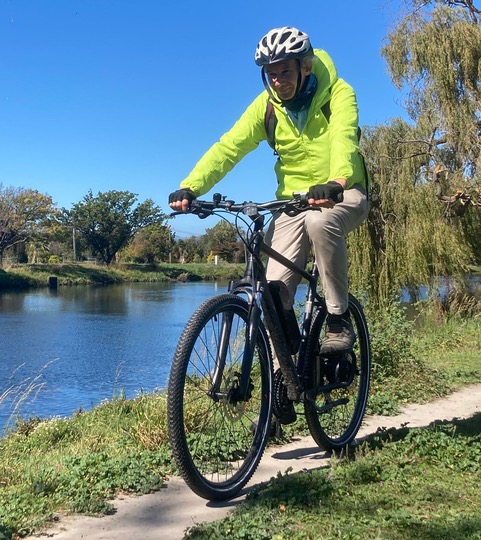
Cycling in New Zealand. Photo shared by Keith Lyons

“When the spirits are low, when the day appears dark, when work becomes monotonous, when hope hardly seems worth having, just mount a bicycle and go out for a spin down the road, without thought on anything but the ride you are taking.”

Arthur Conan Doyle

While out cycling recently with a friend on a weekend ride, I was reminded that the Covid-19 pandemic has been raging waning and morphing for the last two years. With Covid cases set to peak this week in my part of the world, optimistically we hope that we’ll be in a post-pandemic world by the time 2023 starts.

Many of us are wishing for a return to normal, to the good old days of 2019. But we know deep down that while enterprise and everyday life may resume again, there is no return to normal. We can’t turn back the clock. My parents in a retirement village and rest home are still shielded to ensure the virus doesn’t spread. I have people I’m close to who have died from Covid. On both hands I can count how many friends and acquaintances continue to live despite the pandemic.

Looking back on the last two- and a-bit years, one of the good things to come out of it was that I bought a bike and got into cycling. The first bicycle I found abandoned during my lockdown walks. The second one, an e-bike, I bought in mid-2020, and last year got its mountain-bike sibling, With public transport more inconvenient as well as slightly hazardous, biking would seem to be an ideal solution for commuting and recreation. I do like the freedom it gives me, though as I found out yesterday, cycling in the rain loses its romantic notions when your every item of clothing is sodden.

Cycling has been a great vehicle of joy for me, not just for the quick run to the greengrocer, or an outing to a beach, a cafe or the hills. So today when I met a buddy for an easy ride beside a meandering river to the sea, I couldn’t but feel happy to be freewheeling along, appreciating the clarity of the river, the trees turning into autumn colours, the pleasantness of it all.

However, for me, the joy of cycling has a flip side. Even in a flat city like the one I live in, which seems so well suited to cycling. Even with its network of cycle lanes and dedicated cycle paths. I’ll be honest with you, cycling scares me like nothing else in my life. What terrifies me is the vulnerability I feel when on my bike in traffic. I feel small, insignificant and sometimes invisible.

Cars, buses and trucks speed by at 50-80km/hr within touching distance away. Not only are they travelling three or fours times faster than me, but they also weigh 15 or so times my weight. If a driver is inattentive or distracted (for example, on the phone), and I get hit or clipped or rammed by a vehicle, I know that I will unlikely be able to walk away from the crash.

My rational mind fights with my fearfulness. After all, studies show that cycling is more likely to extend your life than to shorten it — physical inactivity contributes to 1-in-8 deaths. And cyclists can fall off bikes by themselves with no other vehicles around. Yet almost every time I venture out on my bike, I have a near-miss. It could be a motorist running a red light, making a turn cutting me off, opening a car door without checking, or exiting a driveway too fast.

It is not just cyclists who are vulnerable. Walkers, children, the elderly, and motorcyclists are all neglected in transport planning, where motorised vehicles are given priority over other users who aren’t shielded or protected from impact. Recent research estimates that an adult pedestrian has around 20% of dying if struck by a car at 60km/hr. The odds are worse if it is a truck. Have you ever heard of a cyclist crashing into a motorised vehicle and causing damage or injury? Probably not.

Yet, for health and fitness, for reducing emissions and for the good of the planet, getting on your bike is good for your being, your body and the world. I cycle cautiously, wishing that my fellow road users are exercising the same alertness and consideration.

Keith Lyons (keithlyons.net) is an award-winning writer, author and creative writing mentor, who gave up learning to play bagpipes in a Scottish pipe band to focus on after-dark tabs of dark chocolate, early morning slow-lane swimming, and the perfect cup of masala chai tea. Find him@KeithLyonsNZ or blogging at Wandering in the World (http://wanderingintheworld.com).

Click here to read an excerpt from the anthology.

PLEASE NOTE: ARTICLES CAN ONLY BE REPRODUCED IN OTHER SITES WITH DUE ACKNOWLEDGEMENT TO BORDERLESS JOURNAL

Categories
Musings

Can Peace come Dropping by…

Candice Louisa Daquin explores war and peace pausing over the attack on Ukraine

Courtesy: Creative Commons

War is among the main stays in human history. Is anything more instinctive than to go to war? I’ve never been able to relate to this but perhaps that’s because I have the advantage of living in a society where we’re protected from the literalisms of war. Or perhaps it’s because I’m female, although I don’t think it is as simple as being a male prerogative (though we can never be sure until a history of women making decisions proves this). To the outsider, war always seems futile. But what we must always do in order to fully understand something is to understand the other side. Not our own opinions but those we do not comprehend. As French philosopher Albert Camus said: “We used to wonder where war lived, what it was that made it so vile. And now we realise that we know where it lives…inside ourselves.”

Why would anyone ever want to go to war?

Imagine the first reason war was enacted. Was it as simple as Cain and Abel? Or one village attacking another village? One child attacking another child?

War tends to be on a larger scale, but perhaps it begins on a smaller scale.

It is said murderers have ‘symptoms’ of evolving as killers as do rapists and predators. If this is true, then watching children and seeing them skinning a cat as a predictor to future violence, could also be applied to war-mongering behaviour. Or conversely, could we establish what experiences that child has that engenders him/her to favour war?

If children who become violent often witness violence, then it stands to reason children who support wars or encourage wars, may witness something that in their minds is pro-war. What could it be? If you grow up in a war-torn country, surely you are more likely to seek peace and an end to violence, than to crave it? The fifth century famed military strategist Sun Tzu is quoted as saying: “Victorious warriors win first and then go to war, while defeated warriors go to war first and then seek to win.” Is war about the appearance of bravery or perceptions of strength? Ironically, Sun Tzu also said: “The wise warrior avoids the battle.” But do we follow this wisdom?

Studies show wars are committed by groups who are cohesive and decide (on invasion) and groups who defend. In essence, there is an aggressor and a protector. Sometimes wars start with two aggressors, but rarely with two protectors (this would cancel the desire for war out). Therefore, the thing everyone has in common who enters a war, is they are either seeking to invade or protect.

If people did not seek to protect, the invader would arrive and receive no resistance, and thus there would be no war. Sadly, it wouldn’t stop the invaders from say, raping and pillaging, so laying down arms and hoping for fairness, may lead to slaughter and oppression.

If people did not seek to invade, there would be no need to go to war.

What are the main reasons historically people have warred? Over land. Religion is a close second. The historic wars were over disputes of land or religion or other reasons related to both of these. The seizure of assets is related to greed/wealth/power, same as seeking to enslave people or promote an agenda (social control – another form of power). Essentially then all invasions can be reduced to one sentence: Seeking power.

One group believes they should have (more) power over another group. They invade. The other group defends or capitulates. This is the essence of war.

If we assume then most wars are enacted over a need to gain power of one sort or another, the next question becomes; Are all humans as likely to war? Or do certain societies promote war more than others? Throughout history there have been wars, many times one group did not want to go to war but were forced to in order to defend themselves. It implies there are those who are (warmongers) and there are those who are not (peacemakers or pacifists) and possibly while the latter may not seek war, they get involved if there is no alternative.

War then is to some extent – a luxury. Odd that if this is so, it’s often during the hardest times in human experience that a war begins. Wouldn’t you think if war is a luxury (by being a choice, as no war is enacted because the invaders have no choice), they’d choose not to go to war during hard times? Yet, the reverse is true.

We’re still in the struggling with the pandemic, but instead of seeking reconciliation and safety, Vladimir Putin has started the invasion into Ukraine. On the face of things this makes no sense because Russia must be hurting economically post the pandemic. To go to war when you are struggling seems madness.

Yet if this is often the case, maybe it’s like when everything is hard, people are less balanced and considerate than when things are easier? People are more charitable when they feel they can be, versus when it’s an emergency. That’s when they start looting and trampling over others. There is an inherent selfishness to humanity where they feel. “If I am alright I might be charitable but if I’m not alright you’re on your own’. It takes a really truly charitable person to stay behind and help others. Most people flee.

If we use this ‘typical’ personality trait and then apply it to a megalomaniac leader, it becomes less surprising they would choose an inopportune moment to strike. Perhaps it’s as inconvenient for everyone else as it is for Putin, therefore they have the element of surprise and inconvenience. They strike when the iron is hot, so to speak. The other impact of war is misdirection. If everyone believes something won’t happen (the invasion of Poland by Germany 1939 in WW2) when it does happen, everyone’s so surprised that they have a delayed reaction (which adds to the invader’s strengthen).

War strategy aside, do some people actually relish war ‘games’ and enjoy the enactment and planning of war? Boys are taught culturally to play with guns, war-gaming, mock-battles etc. If they were not, I suspect they would be no more inclined to go to war than a woman. Then again since we cannot prove or disprove this, we can only guess what is nature and what is nurture. Without doubt, the machinations of the war ‘machine’ promote an ideology of war – not unlike the machinations of a religion to promote an ideology. It’s a form of brain washing. Perhaps, one can agree that “In war, truth is the first casualty.”

When countries encourage a percentage of their population to join the military and have a robust army, they tend to be primarily pro-war – in that – they may not wish to die fighting nor encourage a war, but if one happens, they’re ready and, perhaps, they want it to happen because that’s what they have trained for. If you spend billions on war machines, would you wish them never to be used? Or would you see them as more than deterrents? Would you want to manufacture all this impressive battalion equipment only to see it do nothing? The problem with the creation of tools of war is then someone wants to use them. It is much like the debate raging in America over whether the ownership of guns perpetuates violence. On the one hand some believe if we didn’t have (access to) guns we’d have less violence or gun-deaths. They point to countries with lower rates of gun-ownership to ratify their beliefs. On the other hand, people say it’s not the gun but the person who wields the gun; if they don’t use a gun, they will use something else. They point to the rates of stabbing deaths and other forms of violence endemic in countries with low gun-ownership and to countries with high gun ownership (Switzerland/Canada) who have low gun crime.

There is no easy answer here. Guns have caused countless futile deaths, and gun ownership is a hot topic not likely to be resolved. But if we had less machines of war, would we be less inclined to go to war? Critics point to this as a reason to scale back the US military, whilst others say without such deterrents there would be more attacks on America (or any country without a robust military) because peace is actually wrought by both sides having enough machines of war (and nuclear weapons) that neither side feels they can strike without the other side striking back – and this is what enables us to avoid war. It’s a pretty twisted scenario that makes sense until someone in power decides – I’m not going to play by those rules. In non-interventionist theory, there was a drive to establish international courts to adjudicate disputes between nations and an emphasis on war contributing to moral decline and brutalisation of society in general. Whether true or not, it hasn’t stopped millions signing up for war.

In considering whether being anti-war is realistic, we must analyse the history of war, why humans go to war, what war means to us and what provokes it, as well as whether we can realistically avoid it? It’s one thing to wish for no war, I think a great many of us would share that perspective. But there is an old joke about this: A woman meets a genii and she gets one wish, she wishes for world peace. The world grinds to a halt. Why would the world grind to a halt? Do we depend on war so much? Personally, I don’t think war keeps us ticking over but if we consider our history, much of what we have done revolved around war of some kind (or the prevention of) and thus, we’d have a very different planet earth today if we had world peace. Classics like  All Quiet on the Western Front (1929) by German writer Erich Maria Remarque, have become part of a canon of anti-war media, that enduringly influences the pacifist movement. Perhaps without knowing war, we cannot know why war is such a terrible price to pay.

I am utopian in that I would like to see world peace. Imagine a world where people received funding for healthcare and food rather than bullets and violence? But is that like wishing human nature should have been different? Can we ever hope to become enlightened enough to actually stop wars from occurring? In 2022 as with history thus far, humanity as a whole has not been enlightened sufficiently to stop war from occurring. America, as a developed nation, is the only country to have used nuclear bombs on another country in our entire history. A less developed country that has historically been a trigger for war, may have more growing pains and therefore more wars. But let us not believe in ‘developed’ versus ‘developing’ to judge the pacifist intent of one country over another. Historically, we’re all guilty.

“Just war theory has been converted into a form of apologetics for whatever atrocities your favoured state is carrying out,” says Noam Chomsky in his book What We Say Goes: Conversations on U.S. Power in a Changing World. It’s not ethnicity, income or development that causes war. It’s human beings. Within us is a penchant for going to war, that cannot easily be explained but clearly has existed since the beginning of (human) time. Until we can come up with alternatives to war, this destructive cycle shows no hope of ending. We can reason ourselves to death, but it only takes one unpredictable leader, the right speech, and we’re at war again. What we know if nothing else is, humans go to war. What we don’t yet know, is how to remove that impulse.

Is it an impulse like sexual attraction or hunger? Something as intrinsic and hard-wired or more of a defense mechanism for men? Again, I think without proof of this, it makes more sense to assume this is a human predilection and not a gender-driven one. Would women go to war as gladly as men? We may not have enough historical precedence to substantiate this issue. It could be argued they were working with a masculine model, but we have no proof either way. Rather than entering the ‘blame game’ what would be a way to avoid war altogether?

Negotiations only go so far. What one country may wish another country to do, doesn’t mean they will. If that country feels that is a deal breaker, then war is on. How can you ever alter that outcome when it’s as common place as two people disagreeing? This will always occur and if those two people are world leaders, then war may be the result. Is it unavoidable even if so many of us wish for peace? What are the ‘necessities’ of peace? German philosopher, Immanuel Kant was one of the earliest exponents of the idea that “perpetual peace could be secured through universal democracy and international cooperation.” Democracy isn’t a save-all and has severe down-sides, making ideas in reality, less like their philosophical ideal. Novelist Victor Hugo contended, “Peace is the virtue of civilisation. War is its crime.”

I feel fortunate I did not grow up in war-torn countries, but even in my lifetime, I have heard of so many wars. All wars are a huge waste of money. Even the World Wars, where nearly every country entered in order to fight off the invading fascists. Whether anti-imperialism, an end to totalitarianism or nuclear disarmament, are the answers for enduring peace, they’re complicated and don’t explain the enduring penchant for violence and war within humanity.

One thing I noticed when I immigrated to America was how many people believed being pro military meant being pro war. People would say things like; ‘they are defending our freedom’ and I would ask; ‘how are they defending our freedom if our freedom was never in jeopardy?’ I felt most of the wars in America since WW2 were completely unnecessary. Not a single one of them was really justified (in terms of it being necessary to defend America against a true threat). Most were born out of paranoia and a need for control (anti-communism) or greed and a need for control (Afghanistan and beyond). They were not ‘as advertised’ meaning the average American thought America invaded countries for one reason but it was often a completely different reason.

When 9/11 happened, the entire world was shocked. America did not have a history of being attacked on their soil since the Civil War (and that, by their own populous). The outrage with a staggering death toll of about 3000 was so stunning that a need for vengeance or rectitude was experienced. The result was the longest drawn war in American history which led to billions being spent and weapons getting into the hands of ‘the enemy’ which so often has been the case. How can this be a good thing? Anymore than creating a generation of young men who seek vengeance for what was done to their countries in the name of ‘freedom.’

The polarisation of religion, culture, politics and ethos seems more acute than ever before. There is no universal agreement and those who sue for peace, must realise that just wishing for it, isn’t going to resolve those long-standing fractions. Maybe it’s simply not in our nature to want to all get along, to avoid war and seek peace. Maybe humans are warmongers and we’ve replaced the hunt of big game with fighting each other. Maybe the veneer of our so-called civilisation is very thin and waiting for any excuse to implode. That said, I’m an optimist. As such I believe there are ways to gain peace and avoid war. I don’t think it’s as simple as putting our weapons down, because someone will always cheat. Trust must be earned and even then. But if we seek the same goal, that’s a start. It may not happen in my lifetime, but it is my hope with every generation we come closer to a rejection of war. There are quite simply, too many other needs and just imagine — if we poured our collective funds into helping those in need, we could live in a paradise instead of buying bullets that erase life. Ultimately every single one of us is responsible for what happens going forward, collectively.

Quoting Ralph Waldo Emerson, “Nobody can bring you peace but yourself.”

Candice Louisa Daquin is a Psychotherapist and Editor, having worked in Europe, Canada and the USA. Daquins own work is also published widely. She has written five books of poetry, the last published by Finishing Line Press is called Pinch the Lock. Her website is www thefeatheredsleep.com

.

PLEASE NOTE: ARTICLES CAN ONLY BE REPRODUCED IN OTHER SITES WITH DUE ACKNOWLEDGEMENT TO BORDERLESS JOURNAL.

Disclaimer: The opinions expressed are solely that of the author and not of Borderless Journal.

Categories
Musings

An Existential Dilemma

By G Venkatesh

Thermodynamics’ – the word itself evokes images of entropy and chaos (heat and disorderly motion). However, it is a science which looks for the elusive order in the chaos its name evokes. There is classical thermodynamics – the macroscopic sister to statistical thermodynamics which is the bottom-up approach to understanding the behaviour of systems (studying the parts with the expectation of understanding the whole). While the classical is a mere approximation (better than not able to describe at all), the statistical is a mere prediction (something close, but not exactly).

During a period of intense and painful introspection in a coffee shop in Karlstad, Sweden, an idea perhaps floating around in the realm above the astral, settled on yours sincerely.

Picture a closed cylinder filled with ‘ideal’ gas. Students of thermodynamics often befriend the ‘ideal’ gas ideally, even though this friend is just an illusion. The gas is composed of numerous molecules, which are moving around at random, colliding with each other and with the walls of the cylinder. Indeed, over any period of time, all the molecules do not suffer the same number of collisions with others, or for that matter, do not ‘bang’ into the inner wall of the cylinder to be ricocheted back into the pack, at identical frequencies.

If the cylinder is opened for a short period of time, and then closed, some gas would leak out. Of course, while all molecules may look alike, what they experience within the cylinder is never the same for all of them. Some molecules would leak out into ‘freedom’. That seamlessly brings us to our analogy with souls on Earth.

Now, replace the small cylinder with our planet Earth. And the gas molecules with individual human souls. Pause for a minute and you would perhaps be able to visualise. Souls trapped in human bodies wander about on Earth, interacting with others (analogous to the collisions among molecules), supposedly reaping the rewards of their  karma, repeatedly. Let us assume that the law of action and reaction holds good, indisputably, the reaction in this case being from the universe or God. Just as one defines the quality of energy as ‘exergy’, if one conceives a property which represents the qualities (degrees) of good deeds, bad deeds, rewards and punishments, and labels the same as ‘exergy’ then, it must follow that:

  1. Exergy (Good deeds) = Exergy (Rewards)
  2. Exergy (Bad deeds) = Exergy (Punishments).

In other words, the higher the quality of a good deed, the better the reward, and the graver the bad deed, the more serious the punishment. Now, does this apply to every individual soul during its sojourn on earth in a specific bodily envelope? Does one find a perfect correlation? Definitely not. After all, the equations used to understand the state and behaviour of gases, do not apply to every single molecule, do they? We tend to easily tide over this impasse, just as we do in thermodynamics, by theorising that:

3. Σ Exergy (Good deeds) = Σ Exergy (Rewards)

4. Σ Exergy (Bad deeds) = Σ Exergy (Punishments)

If someone wishes to know the time period over which these summations apply, one will say that this would be the entire length of time humankind will walk on Terra Firma, and for all the reincarnations of all the souls.

Indeed, I or you will not be able to test this in any way, just as we would never be able to summarily and conclusively prove that there is life after death, while we are walking around on Earth. Further, how does one define the quality factor of good deeds and rewards, punishments and bad deeds? Who decides? So, that is that! We then turn to the Bible or the Gita or the Koran or the Zend Avesta or the Guru Granth Sahib or the Torah or any other religious text just as we refer to textbooks of thermodynamics for those equations.

For generalisations. To simplify and pretend that we understand everything, or to be humble enough to admit that we do not. To calm our minds and believe that our turn would come. We would never know where we are placed in the queue to receive rewards or accept punishments. After all, like those molecules inside the cylinder, we are tossed about here and there, and find ourselves at the wrong place, at the wrong time, with the wrong set of ‘molecules’ around us. ‘My turn would come’, implies being in the right place, at the right time, with the right people. They give this a name – divine timing. Is it random? I do not know. Neither do you.

Which souls (molecules) would ‘leave deceitful knaves for the higher and better society of gods and goddesses’ (from a play referred to by Ralph Waldo Emerson in his essay called  ‘Heroism’ in The Essential Writings of Ralph Waldo Emerson) and when, none knows. Surely, the equations (1) and (2) will never hold true for you when the time comes for you to ascend to the astral realm. You may either have been very fortunate or extremely unfortunate; may have got a fair-enough deal, or may have been scapegoated ever and anon. You would need to return to help equations (3) and (4) to manifest themselves at the fag end of the human race – perhaps at the Big Crunch or much before that….again, just as the gas molecules which are ‘freed’ may be brought down by rain again to the terrestrial hydrosphere, to cycle back and forth.   

.

G Venkatesh (50) is a Chennai-born, Mumbai-bred ‘global citizen’ who currently serves as Associate Professor at Karlstad University in Sweden. He has published 4 volumes of poetry and 4 e-textbooks, inter alia. 

.

PLEASE NOTE: ARTICLES CAN ONLY BE REPRODUCED IN OTHER SITES WITH DUE ACKNOWLEDGEMENT TO BORDERLESS JOURNAL

Categories
Musings

Breaking the Fast

By P Ravi Shankar

The dosa was perfect! Crisp, thin and a rich golden brown. A beautiful symphony of flavours with the green chilli and the red chilli chutneys and the spicy, aromatic sambar. I was enjoying the breakfast buffet at a hotel in Coimbatore, known as the Manchester of South India. A major manufacturing centre located at the foothills of the Western ghats, Coimbatore (also known as Kovai) is the second biggest city in the southern Indian state of Tamil Nadu.  

I enjoy a hearty breakfast. I admit I am partial toward South Indian fare. I absolutely love dosais, and upma. I enjoy crispy medu vadas. Appam and coconut stew is a duet made in heaven. Panizhayaram is Tamil delicacy along with Pongal. I am not very fond of idlis, however. The breakfast buffets in Kovai are superb. I believe and many agree that Kovai combines the best of Tamil Nadu and Kerala. I also enjoy the wide variety of dishes in an American breakfast ranging from toast, eggs in different forms, porridge, cereal, hash browns, bacon, and sausage. All washed down with juices and coffee and tea. A variety of breads are available, especially in Europe. Pancakes are also delicious, especially with maple syrup. Many hotels in the United States do not serve a continental breakfast, however. A few hotels in Kovai offer you both South Indian and western breakfast choices.

As with most other beliefs created in today’s information overload, the role and status ofbreakfast has become confusing. The traditional advice was to never skip breakfast as it was the most important meal of the day. In today’s world, as prolonged periods of fasting and the requirement to have stretches of time with low blood sugar levels have gained footage, some began skipping breakfast and moved directly to lunch. Traditionally humans had their last meal of the day at sundown. A long period of fasting till breakfast, the next morning, was a natural outcome. With the advent of artificial lighting, the time of dinner was steadily pushed back.

In Nepal most people do not have a big breakfast. They usually have tea and biscuits and sit down for a big lunch at ten or even earlier in the morning. Different breakfast snacks are available in the Kathmandu valley. The trekking lodges in Nepal do offer breakfast on their menu to cater to western trekkers. The hotels in Kathmandu and other tourist towns also offer a variety of choices. In the plains bordering northern India, breakfast is usually north Indian fare. When I trek, my breakfast of choice is usually muesli with milk. This is filling and provides both instant and slow-release energy and keeps me going for a few hours. It is said to have been developed around 1900 by a Swiss physician, Maximilian Bircher-Benner for patients in his hospital. The major problem with muesli is that it is dry and requires effort and copious amounts of milk to wash down. Cornbread and toast sometimes find their way into the menu. Nepalese cooks are ingenious and dishes like Swiss rosti are also available. In the Everest region, potato pancakes are dominant though they may not be available for breakfast as they take long to prepare.  

North India has a variety of filling breakfasts. Chana bhatura is filling though oily and most bus stations and train stations in the north will have breakfast stalls with such fare. Piping hot pooris are a perennial favorite. When I was working in Nepal, I sometimes used to travel through the eastern Uttar Pradesh town of Gorakhpur. The stuffed parathas are a delight to the palate and are filling. They can be made with aloo (potatoes), radish, cauliflower and even with finely minced meat. Having these piping hot with a dollop of clarified butter on a chilly winter morning is a pure joy. The lower canteen at PGI (Post Graduate Institute), Chandigarh, serves delicious aloo parathas. Kachoris are also eaten for breakfast along with jalebis. Samosas could make a hearty breakfast along with chole. Punjabi samosas are huge and filling and the stalls in the market at Punjab University in Sector 11 in Chandigarh has some of the best samosas I have eaten.

Many cultures may have independently discovered the nutritional benefits of combining cereals and pulses. Considering the lack of knowledge about nutrients and nutrient quality in those days, this was a significant achievement. The combination can be samosas and chickpeas, idlis/dosas and sambar, baked beans and bread, and so forth. Breakfast should provide immediate energy to get you going and slowly release sugars to continue to provide energy. Eggs provide high quality proteins and are an important part of the western breakfast. Meats are also eaten in many parts of the globe.

In Malaysia, noodles of different varieties are eaten for breakfast. Nasi lemak (rice cooked in coconut milk) is also a perennial favourite though I do struggle to eat rice early in the morning. Our breakfast habits are an acquired taste heavily influenced by our childhood. South Indian foods like thosai, idlis, upma, vada and Pongal are also available attesting to the multicultural diversity of the country. Breakfast can be creative in Kerala, God’s own country at the southern tip of India and considered one of the best breakfasts in the world. Among the highlights are appam with different vegetarian and non-vegetarian curries, puttu with black gram curry or puttu with small bananas. Puttu is made of steamed rice flour and grated coconut and can be dry hence requiring curry or bananas for lubrication.

Cultures globally have created a variety of rich and delicious foods for breakfast. There are similarities in the use of leavened or unleavened bread (in different forms and shapes), a combination of grains and pulses, eggs, fruits and tea or coffee. Many have fruit juices for breakfast. After the long overnight fast, getting your sugar levels up again and providing you with the energy resources to get through a long and challenging day is important. At Kuala Lumpur, I usually have my breakfast at the Shirdi Sai canteen at the university. I usually have dosas or upma and sometimes I have uthappams. They also make delicious pooris in the great Tamil tradition served with hot and filling yellow potato curry. Starting your day on a full stomach will surely make you happy, healthy, and wise and if you are lucky, even wealthy.            

.

Dr. P Ravi Shankar is a faculty member at the IMU Centre for Education (ICE), International Medical University, Kuala Lumpur, Malaysia. He enjoys traveling and is a creative writer and photographer.

.

PLEASE NOTE: ARTICLES CAN ONLY BE REPRODUCED IN OTHER SITES WITH DUE ACKNOWLEDGEMENT TO BORDERLESS JOURNAL

Categories
Musings

For the want of a cloth…

By Ratnottama Sengupta

Roti Kapda aur Makaan/ Maang raha hai Hindustan…

India is demanding food, clothing and shelter…

Sometime in 1949 writer-director-actor Manoj Kumar had heard a young man recite these lines in post-Partition Punjab. The simple line had stayed on in his mind and almost two decades later he came up with the film Roti Kapda aur Makaan (food, clothes and housing). By then India had its third prime minister Indira Gandhi who had swept into the office in 1967 winning with a huge popular mandate on the wings of the slogan Garibi Hatao (Do away with poverty). The three tenets of identifying poverty then outlined were – yes, lack of food, clothing, and roof over people’s head.

These, needless to add, were the prime concern of millions who had been uprooted, disowned by the nation they so far knew to be their own, driven out of their ancestral homes with barely a change of clothes, spending days and nights in refugee camp queues for one square meal and perhaps the vaguest hope of some employment.

In 1949 the Constituent Assembly was already meeting but had yet to formally adopt the Bharatiya Samvidhan – the Constitution of India that came into effect on 26th January 1950, the day that is gloriously celebrated every year with a gratifying display of our military might and cultural wealth on the Rajpath of the Capital. Full seven decades ago the Constitution  laid down a framework that delineates the fundamental code, the directive principles that would govern the political structure, powers, and duties of the government and its institutions – as much as it set out the fundamental rights and the duties of citizens.

We were perhaps receiving our first lessons in civics when Indira Gandhi stepped into the prime minister’s office. We learnt by rote the Preamble that asserts the solemn resolution of the People of India to Constitute the land into a Sovereign Democratic Republic that would secure every one of its citizens Justice – social, economic and political; Liberty – of thought, expression, belief, faith and worship; Equality – of status and opportunity; and Fraternity which would assure the dignity of individual and unity of the nation.

We were not, however, aware at that age that the two years before India gave itself the Samvidhan, nations of the world had united in declaring that recognition of the inherent dignity and equal and inalienable rights of all members of the human family is the foundation of freedom, justice and peace in the world. By the end of the barbaric World War II they had realised that disregard and contempt for human rights had resulted in the nightmarish acts that continue to outrage the conscience of mankind. By this time, universally, nations were keen to forge a world wherein humans would enjoy “freedom of speech and belief, freedom from fear and want.” These, it was proclaimed by one and all, were “the highest aspiration of the common man,” anywhere on the globe.

By the time the British left India to its destiny, the imperial power too had realised that, if man were not compelled to recourse to the last resort – rebellion against tyranny and oppression – then human rights ought to be protected by the rule of law.

So, in the Charter, the peoples of the United Nations reaffirmed their “faith in fundamental human rights, in the dignity and worth of the human person, and in the equal rights of men and women.” The Human Rights Declaration was, then, meant “to promote social progress and better standards of life for larger freedom.”

By proclaiming the Universal Declaration of Human Rights as “a common standard of achievement for all peoples and all nations,” member States of the United Nations had pledged the promotion of universal respect for and observance of human rights as fundamental to every freedom. Keeping the Declaration constantly in mind, they will “strive by teaching and education to promote respect for these rights and freedoms, and by progressive measures, national and international, to secure their universal and effective recognition and observance.”

*

When I read this, I am astounded that Nabendu Ghosh, writing five years before the Universal Declaration of Human Rights, was almost setting the charter for nations to follow once they lose the harness of imperialism and emerge out of the shadow of colonialism. “When, despite repeated pleas, a man is deprived of his basic needs, what else can he do?” – wonders the leader portrayed in the mould of a Gandhi in Bastrang Dehi (Give Me a Rag, Please). “Millions and zillion years of civilisation has taught him to cover his natural anatomy, today how can he forget that nudity is primitive and accept nudity as normal? How can age-old norms hold sway over dire needs?” the writer poses.

In the swiftly developing crisis that engulfs the entire community which is suffering the aftermath of rationing and subsequent profiteering in clothes, the village Brahmin Bhattachajji is not apologetic for wearing a lungi, the mark of a mullah: bhaagte bhoot ki langot bhali! – one could add the Hindi proverb to imply, when one is running to save one’s skin, even a loincloth is most acceptable (something is better than nothing). Profiteering, we realise before the end draws up, is the worst of crime against mankind, for it fishes in troubled waters.

The writer ends by describing two opposite reactions – one, of a leader; the other, of a common man. Nationalist Manish turns his face away from the howling surrounding the half-naked corpse of Harimati: the sight and sound was ridiculing his leadership, taunting the failure of his processions to procure more than false promises, mocking his manhood, he felt. But Teenkori, Harimati’s husband, does not cry. He is lynched, he is jailed, he becomes a thief in his attempt to procure a sari for his abused wife who eventually commits suicide – but no, he does not shed a drop of tear. He becomes vicious, a savage look descends in his eyes, his fingers tingle just as do soldiers’ when they confront enemies.

To me, representing a generation which has, since it started walking, celebrated Republic Day by singing paeans to the Hindustan better than the rest of the world, Bastrang Dehi brought home truths that no history book has ever taught. Yes, I knew about the Bengal Famine of 1943 that saw millions starved for the want of rice dying on the streets of Calcutta – the erstwhile capital of the jewel in the British crown. Yes, they were uprooted; they were compelled to leave their homes and hearth in the villages and flock to the city in search of a meal. Yes, I knew that they died of cholera and dysentery as they snatched food out of bins from the jaws of snarling dogs too. But did I know that clothes too were rationed, and sold in the black market, sending saris and dhotis beyond the reach of peasants? Once the ‘Quit India!’ slogan rang out, most Indians would not touch the clothes from the English mills while the British were sending everything — food and handloom clothings produced in the Province — to the Theatre of the War in the North East, where American GIs were joining British Tommies to beat back the Japs who were regularly bombing Bengal.

Nabendu Ghosh, a devotee of the Buddha, must have read this gospel. A disciple of the Enlightened One complained that one of his flock was indifferent to his sermons. He was sorely disappointed that Tathagata’s teachings were falling on deaf ears. One day the Buddha accompanied the disciple to the hut from where he had been shooed away. The Buddha offered the man a bowl of rice, then turned to his disciple and calmly said, “Could you see the man was starving? Truth can be served to him only in a bowl of rice.”

Ghosh derived the title of Bastrang Dehi from the popular invocation of Goddess Durga that rings through Bengal year after year after year, at the advent of the Autumnal Festival: Rupang Dehi, Jayang Dehi, Yasho Dehi Disho Jayee! ( grant me Beauty, grant me Victory, grant me Fame!) By adapting the prayer to seek something as mundane as a piece of cloth, the writer underscores that food, clothing and shelter may be basic individual needs, but if humans constitute society these must be enshrined as basic rights even before we enshrine political liberty, rule of law, equality of worship, freedom of expression… Else democracy and justice and other lofty ideals of human life will go for a toss.

Decades after the history books have changed the way we look at the past, why do I still cringe when I read Bastrang Dehi? Because I know that those who do not learn from history are doomed to repeat it.

*

I am certain Anshu Gupta has never read Bastrang Dehi. But ‘Give me cloth’ was the plea that had launched his journey with Goonj – and it has earned him the Magsaysay Award, World Bank’s Development Marketplace award, Mother Teresa award, NASA’S Game Changing Innovation, the prestigious Ashoka fellowship… they are still coming in.

What had spurred the young man and his wife to start Goonj with merely 67 items of clothings? The realisation that clothing was overlooked as a basic human right. Today the NGO registered under Societies Act and for exemption under several sections and for foreign contributions etc, deals with more than 3500 tonnes of material every year. 

A real life incidence had prompted Gupta to start this arduous journey. One night, going home in Delhi’s winter, he met a three-wheeler scooter rickshaw driver, Habib. His rickshaw had this inscribed on its side: Laawarish laash uthaane wala (I pick up unclaimed dead bodies). Talking to him Gupta learnt that for every dead body Habib carried to the crematorium, he got twenty rupees and two metres of cloth. That, workload in winter was more than in summer. That, many underprivileged families don’t have enough clothes to stave off the cold. So much so that Habib’s little daughter Bano told Anshu, “When I feel cold, I hug a dead body to sleep. It does not turn around, it does not trouble me…”

Anshu Gupta deserves every single award that has come his way. For, unlike nationalist Manish of Bastrang Dehi, he did not turn his face away. That one meeting ignited in him the impulse to address the sufferings of millions due to shortage of clothing. He started collecting under-utilised used material, to maintain human dignity rather than to give them as charity. In the process he has triggered development with dignity across the land.

*

Saare jahaan se achha... I still sing on Republic Day, and I still sing Sakal desher shera amaar janma bhoomi Independence Day. But when I run into Anshu Gupta at a conference perhaps in Budapest, I hang my head in shame. I am elated that Goonj has clothed millions. But even today, if a Tsunami, an Amphan or a Yaas sweeps the shores of Midnapur or Sundarbans, a Kendrapada or Bhadrak, in Bengal or Odisha – even today, I hear the cries of women and men cry out, ‘Give me a rag, please!”

It is a cry to save their dignity.

.

Glossary:

Saare jahaan se achha… A song written by Iqbal in 1904 and adapted as a song for marching by the Indian army. Literally, translated to mean, the best in the world.

Sakal desher shera amaar janma bhoomi A song written by  Dwijendralal Ray (1863-1913). Literally translated to mean, the best country is my land of birth.

.

Ratnottama Sengupta, formerly Arts Editor of The Times of India, teaches mass communication and film appreciation, curates film festivals and art exhibitions, and translates and write books. She has been a member of CBFC, served on the National Film Awards jury and has herself won a National Award. 

.

PLEASE NOTE: ARTICLES CAN ONLY BE REPRODUCED IN OTHER SITES WITH DUE ACKNOWLEDGEMENT TO BORDERLESS JOURNAL

Categories
Musings Tagore Translations

Two Birds: Musings on Tagore

Ratnottama Sengupta muses as she translates Tagore’s song, Khachar Pakhi Chilo (1892, The caged bird was)

TWO BIRDS

In a coop of gold, lived Cage Bird,
In the forest dwelt Free Bird --
How did the twain meet on a dawn?
What had Fate ordained?

"Dear One in cage," Free Bird called out,
"Come, let's fly into the wood."
"You come inside," chirped Cage Bird,
"The enclosure can be our home!"
"No!" Free Bird cried, "the chains are not for me!"
"Alas!" Cage Bird sighed, 
"How can I live in the holt!"

Free Bird sat outside and sang
All the forest songs he loved.
Cage Bird parroted all 
The tricks it had been taught -
'Twas as if they spoke two tongues!
Free Bird pleaded, "Dear one!
For me sing one Forest song!""
Cage Bird said, "You better rote
Songs of the cage, loved one!"
"No!" Free Bird wailed, 
"I do not parrot cliches!"
"Alas," sobbed Cage Bird,
"How do I sing what I've never heard!"

The Free Bird chimed, "Deep is the blue 
Of the sky above,
There's no bar in its expanse!"
"See!" Cage Bird twittered,
"How well-netted is the aviary
on all its four sides!"
"Let go of yourself!" Free Bird whistled,
"In the clouds above, just once!"
"This cosy corner is so very tranquil!"
Cage Bird chirped, "Why not 
Submit to its peace?"
"No! Where will I then fly?"
"Alas! Where in the clouds 
Will I find a perch?"

Thus the two birds loved each other
But could not unite.
Through the gaps their beaks would kiss
Their eyes bespoke their longing
But neither could understand
Nor express to the other
Their biding constraints.
They flapped their wings
They stretched their arms
"Come to me dear, let me
Hold you to my heart!"
"No!" the Free Bird feared,
"The door might snap shut!"
"Alas!" lamented the Caged Bird
"I have no might to fly!"
Birds in a large cage in Saratchandra’s home. Photo Courtesy: Ratnottama Sengupta

Growing up in a Vaishnav family where kirtan was a part of daily life, I had always loved this song Rabindranath Tagore composed in the kirtan style. In my later years I thought the Universal Poet had penned the Natya Geeti — song drama — in the context of the Freedom Struggle. No, I learnt in an essay by the poet: it was penned in 1892 to put into words a more universal philosophy — the duality that is part of every human existence. 
Difficult to comprehend? Perhaps not, once we obliterate the sameness of the two birds and attribute gender markers to them. Tagore himself thought of the caged bird as the woman in every man, and the free bird as the man in every woman. Perhaps that is why it is structured along the lines of the traditional Shuk Shari samvad — a conversational song between between two birds (parrots perhaps?) — wherein Shuk is a follower of the masculine, Purushottam Krishna, and Shari of Radha, the essence of femininity. However, I was prompted to look up the poem recently when I saw a large birdcage in a corner of Saratchandra Chatterjee’s house in Deulti some 60 km from Kolkata. It was pretty routine, apparently, for households then to have aviaries ‘domesticating’ finches, canaries, parakeets, cockatiels, lovebirds and other feathered pets — much like today’s people with pet dogs and cats. But I was struck by a different thought: Did the two birds represent the two stalwarts of Bengali Literature who lived at the same time? Did one look inside homes and scan woes besetting the happiness of their human relationships? And did the other take off from his perch on a branch of the tree rooted in terra firma, to swim in the boundless ocean above? Even today, one draws you out into the vast expanse while the other pulls you homeward. Together? They give us a  universe…

Notes:

Kirtan is devotional music.

Tagore (1861 to 1941) and Saratchandra (1876-1938) were contemporaries. While Saratchandra wrote stories based on real life to expose and reform social ills, Tagore’s work was more philosophically inclined, though he has written of such societal issues too.

In 1894, Rabindranath wrote in Aadhunik Saahitya while commenting on the works of the poet Biharilal Chakraborty –

“… There is an independently moving masculine entity within our nature, which is intolerant to bondage alongside a feminine one which preffers to be enclosed and secured within the walls of the home. Both of them remain united in an inseparable fashion. One is eager to develop significantly his undying strength in a diverse way by savouring ever-new tastes of life, exploring ever-new realms and manifestations and the other remains encircled within innumerable prejudices and traditional practices, enthralled with her habitual deliberations. One takes you out into the vast expanse and the other seems to pull towards home. One is a forest bird (or the free bird of the translation by Ratnottama Sengupta) and the other is a caged bird. This forest bird is the one that sings much. Although, its song expresses with its diverse melodies the whimper and its craving for unrestricted freedom.”

Rabindranath Tagore was a brilliant poet, writer, musician, artist, educator – a polymath. He was the first Nobel Laureate from Asia. His writing spanned across genres, across global issues and across the world. His works remains relevant to this day.

Ratnottama Sengupta, formerly Arts Editor of The Times of India, teaches mass communication and film appreciation, curates film festivals and art exhibitions, and translates and write books. She has been a member of CBFC, served on the National Film Awards jury and has herself won a National Award. 

.

PLEASE NOTE: ARTICLES CAN ONLY BE REPRODUCED IN OTHER SITES WITH DUE ACKNOWLEDGEMENT TO BORDERLESS JOURNAL

Categories
Musings

The Great Freeze

P. Ravi Shankar shuttles through winters from Everest to New York to Kerala to Aruba in the Caribbean

My friend and colleague was turning blue. The cold wind hit me with the force of a sledgehammer. We both had on all the warm clothes we could bring. I had on me a woollen blazer, a full sleeve sweater, my shirt, a half sleeve sweater, and underneath it a thermal. The freezing wind cut through these layers like the proverbial knife through butter. I was beginning to lose sensation on my nose and extremities. We were in freezing weather for less than a minute crossing the road to where the car was parked. We were inadequately dressed for a February morning in New York city. A nor’easter had hit a day before and the temperature was below minus 24 degrees Celsius. The news channels mentioned it was the coldest day in over two decades. Luckily for us, the car was heated, and the seats could also be warmed. We slowly thawed after the flash freeze.  

We had flown from sunny Aruba (Dutch Caribbean) the previous day. Miami had perfect weather, but New York was freezing. Manhattan is full of skyscrapers. There is no direct rail line from the airport to Manhattan. New York has a decent public transport infrastructure but no airport metro. The city’s infrastructure does need some serious investment on upgrade and maintenance. The hotel room was warm and toasty. Outside, it was snowing. I saw the homeless on the freezing sidewalks trying to shelter from the bitter cold. Poverty amid opulent wealth.

I have mostly lived in warm places where your major concern is staying cool in the humid heat. In Kerala, in the south of India, a mundu or a lungi wrapped around the waist was the common male attire. The mercury in most areas never goes below 20 degrees Celsius. In New York during winter, the major concern was staying warm. Suddenly, common English expressions began to make sense. Warm welcome, warm greetings make sense when you are coming in from a freezing weather. When you are all hot and sweaty, the warmth seems unwelcome. Also, the European style of dressing was designed to minimise heat loss. Socks, hats, gloves, coats, tie, scarf. The buildings all had double doors to keep out the cold and keep in the warmth. Central heating kept the inside warm.

Keeping warm is expensive. I did some rough calculation and worked out that I would have to spend USD 1500 on winter clothing and over USD 250 monthly on heating bills. The tempo and rhythm of life changes in the northern latitudes with the change of seasons. Winters mean short days and time spent mostly indoors. The wily COVID virus is capitalising fully on this human behaviour. Summers translate to warm temperatures and long days. With global climate change, the highs in summer and the lows in winter are becoming extreme.  

On another occasion I was strolling by the shores of Lake Michigan in Chicago enjoying the early morning view. There were gardens and walking paths by the shoreline. Suddenly a cold wind blew across the lake from Canada. Despite all the winter clothing I donned, I was frozen. In cold weather, it is important to have a waterproof and wind proof outer shell. These are expensive however, and as occasional visitors to cold climates, we were unwilling to invest in such clothing. Upstate New York is even colder than New York city, and Rochester is said to be among the snowiest cities in America.

New York city is relatively well-prepared for snowy weather with double doors, central heating, winter clothing and snow ploughs. So is Chicago. Some of the southern cities in the US also experience snowy weather due to climate change and are not prepared for occasional winter storms. The plains of northern India experience cold weather from December to March. A thick layer of smog blankets the plains. Trains and planes are delayed, and driving could become hazardous. Air pollution rises and the air becomes dangerous to breathe. The sun succeeds in clearing the fog only after ten in the morning. Kathmandu in Nepal also experience fog and increased pollution during winter. Pokhara is a Nepalese city without fog in winters. I have often wondered why. With beautiful views of the Annapurna range, winter mornings in Pokhara are occasions to be savoured. In these places there is no central heating. Quilts are widely used. I enjoy the quilt which slowly warms you up using your own body heat.

In the mountains of Nepal, external heating devices are common. In the Everest region, there is the yak dung burning cast iron stove in dining rooms. In the Annapurna region north of Pokhara, wood burning stoves are common. In Thak Khola, charcoal burning stoves under the table are used. The bedrooms, however, are unheated and freezing. I had stayed in Lobuche in the Everest region, at around 4900 m for over a month for a research project and the nights were freezing. The water bottle used to freeze. If you wanted something to not freeze, you kept it beside you on the bed inside the quilt.

Watching snow fall is relaxing. The snowflakes glide down and blanket the trees and the ground in white. The cold reduces a bit. Rain is more noisy and violent and often accompanied by thunder and lightning. Walking on snow is difficult. Soon the snow melts during the day and refreezes again at night and turns into ice. Ice is extremely slippery and dangerous to walk on. Snow is a rare treat for persons from tropical climates. However, living in snow covered regions is challenging.

Near the equator the climate is constant throughout the year. The rains cool down the atmosphere, but the hours of sunlight do not vary much. Life is not influenced by the seasons. The further north or south you go from the equator, seasons begin to colour your life. Summer brings long days, sometimes extreme heat and more time spent outdoors. Winter brings longer nights, snow, and more time indoors. In both New York and Chicago, in winter, the trees were totally bare, bereft of leaves. I could not believe they were still alive. With the coming of spring the green twigs would sprout again and the cycle of life resumes. The writing of poets and authors from temperate countries about the dreariness of winter and the warmth of spring and summer began to make sense to me — a person from and living in the tropics.      


.

Dr. P Ravi Shankar is a faculty member at the IMU Centre for Education (ICE), International Medical University, Kuala Lumpur, Malaysia. He enjoys traveling and is a creative writer and photographer.

.

PLEASE NOTE: ARTICLES CAN ONLY BE REPRODUCED IN OTHER SITES WITH DUE ACKNOWLEDGEMENT TO BORDERLESS JOURNAL


Categories
Musings Travel

The Ocean & Me

Meredith Stephens writes of her sailing adventures in South Australia

The international borders are finally opening, but we still hesitate to embark on overseas or even interstate travel. The travel ban has afforded us the opportunity to explore our home state of South Australia, which until now we have largely ignored. After so long remaining here in this drawn-out pandemic, and the constant uncertainty about changing travel requirements, we lack the courage to venture abroad again.

Just as well, because after our local hiking adventures to Eyre Peninsula and Yorke Peninsula, Alex announces that next we will be sailing to Kangaroo Island. We will stay at Brian and Rochelle’s shack on Emu Bay. Alex drives Verity and me down the Fleurieu Peninsula, south of Adelaide, until we reach Carrickalinga Beach. Alex has taught me how to hike, and now he wants to share his excitement about sailing. He spends time on the long drive to Carrickalinga testing me on my sailing vocabulary. I have learnt words such as ‘headsail’, ‘mainsail’ and ‘jennika’. (Well, I thought it was ‘jennika’, but Alex tells me it is ‘jenniker’.) Meanwhile we pass through the sleepy towns of Myponga and Yankalilla, each boasting country bakeries with an array of doughnuts, buns and pasties which I try to put out of my mind. We successfully navigate these towns without stopping and I make do by simply remembering the array of treats at a sumptuous cafe in Moonta from our last trip.

Photo Courtesy: Meredith Stephens

“Just wait a little longer,” Alex entreats me. Brian and Rochelle will have some really healthy food for us at their shack.

Brian and Rochelle are waiting for us at Carrickalinga with sparkling smiles and generous hugs. We maneuver ourselves and our luggage into the dinghy and head out to the boat. It’s moored in deeper water, and I have to scramble out of the dingy and onto the boat all the while making sure my laptop does not drop into the ocean depths. I clamber in and place the laptop inside the boat where it can’t get wet. Then I move outside to position myself at the bow where I sit with Brian and Rochelle. Alex is at the helm.

Photo Courtesy: Meredith Stephens

The others had busied themselves unfurling the sails but Alex tells me that my job is simply to look for dolphins. Before long five of them are approaching the front of the boat. They proudly swim in between the two hulls, gracefully easing themselves in perfect arcs in and out of the water to catch a breath. One turns her head around, her body at an angle, so we can make eye contact.

Photo Courtesy: Meredith Stephens

Once away from the shore and leaving the buffer of the hills, the wind picks up and Alex proudly announces that we are sailing at 16 knots. Carrickalinga has receded.

Photo Courtesy: Meredith Stephens

I sit at the bow for hours, trying to hide from the punishing Australian sun, wrapping my hair around my neck. It’s too choppy to risk walking along the side of the boat to retrieve my cotton scarf. Water splashes on my legs but I dare not move.

As the hours pass Emu Bay looms into view. We spot the bright yellow ball on the ocean surface which signals the mooring below. Alex directs the boat toward the ball while Brian extends a long pole towards it and hooks it up. He then drags it on the boat and tethers it to a cleat.

When alighting the boat onto the dinghy I will have to make sure once again my laptop does not drop into the ocean. Alex detaches the dinghy and loads our provisions onto the front end. Then he pulls the motor cord repeatedly but it does not start. Brian and Alex confer but the motor refuses to be coaxed back to life. The sun is retreating. I can see Brian and Rochelle’s shack on the coast tantalizingly close.

“Shall we paddle in?” I suggest.

“It’s a bit choppy,” explains Alex. “We could wait until the waters are calmer tomorrow morning. We could sleep on the boat.”

I yearn for a bed on dry land, but there are five of us and I have to consider what the others might want. We all seem to be concerned about imposing on the others. Verity comes up with a solution.

“Let’s have a secret ballot,” she suggests.

Verity tears up some paper into five pieces. We each write down our preference, “boat” or “shore”. I write “shore”. Rochelle seems to be taking a long time writing down her preference. Verity collects the pieces of paper and spreads them on the table. Two say “shore” and two say “boat”. The remaining one says “I don’t mind sleeping on either the boat or going to shore.” It’s evenly split. Meanwhile sunset continues to approach, the wind is picking up and the water starts to look foreboding. Could we safely put four adults and their luggage into a dinghy? Verity seems to have read my mind.

“I think Meredith wants to go ashore,” she announces.

“That’s our decision then,” confirms Alex. “We will paddle to shore in the dinghy.”

Alex asks Rochelle and me to hop into the dinghy. He places our laptops and phones in a waterproof bag. Brian enters next and Alex detaches the dinghy from the boat. Then we maneuver the dinghy close enough for Alex to slide in. Meanwhile, Verity kayaks to shore.

We each have a paddle, Rochelle and I on the left of the dinghy and Alex and Brian on the right. Alex identifies the safest place on the cove to reach land.

“Girls paddle harder,” he urges. “Meredith, you’ve got the paddle the wrong way around.”

I look down. Typically visually unobservant, I look down at my paddle and turn it around.

We labour, pulling the paddles more firmly and deeply, until we reach the rocks. We disembark and pick up our luggage. I gingerly tread over the craggy rocks in my sandals.

“Where’s the shack?” I ask Brian.

Brian points ever upwards. I follow the direction in which he is pointing and drag myself up in my wet sandals while carrying as many bags as I can. Finally we see the house on top of the hill, and gratefully allow Brian to usher us in. Brian immediately pours us some tonic water decorated with a slice of dried orange.

Photo Courtesy: Meredith Stephens

After nibbling on some nuts, cheese, hummus and crackers, Brian appears with home-made lentil burgers that he has revived from the freezer, topped with smashed avocado and haloumi. We devour these greedily as reward for our long sail and trek up the hill with luggage.

Photo Courtesy: Meredith Stephens

 I find myself enjoying a spacious bed with clean sheets. Sleep is as delicious and pleasurable as a drink when I am thirsty, or a longed-for meal when I am hungry. I savour these moments of the comfort of the bed and suddenly it appears to be morning.

The sunshine forces its way into my bedroom. The silence of the corner of this remote island is punctuated by the lively tones of Alex, Verity, Brian and Rochelle’s voices. How could they have recovered so quickly? Despite the sunshine penetrating my closed lids, I persist in a somnolence which is just as delicious as the evening before.

Meredith Stephens is an applied linguist in Japan. Her work has appeared in Transnational Literature, The Blue Nib, The Font – A Literary Journal for Language Teachers, The Journal of Literature in Language Teaching, The Writers’ and Readers’ MagazineReading in a Foreign Languageand in chapters in anthologies published by Demeter Press, Canada.

.

PLEASE NOTE: ARTICLES CAN ONLY BE REPRODUCED IN OTHER SITES WITH DUE ACKNOWLEDGEMENT TO BORDERLESS JOURNAL

Categories
Musings

Crotons

By Kavya R K    

The pandemic, I feel, has made us very contemplative. We’ve begun to ponder over subjects that range from the grave aspects of life to the most trivial ones. There is also this category of thoughts that belong somewhere in the middle. They usually begin as silly musings but gradually transform and align with thoughts of greater dimensions. Although I’m not sure where to classify my current thoughts, I think that this very ambiguity gives them a place in the middle.

I have never been a keen observer of gardens. I love to spend time in parks, but someone would usually accompany me, and we’d get immersed in conversation. This used to keep me off the pleasure of savouring the blossoms, even though their tempting fragrance had always seduced me. However, those visits used to be brief and the acquaintance temporary.

For some weeks now, I have been taking back-and-forth cycle rides in my courtyard; thanks to us, the ‘obedient’ citizens, and the lockdown. One such day, I chanced upon the front row of decorative plants in my home. Until then, I hadn’t really paid attention to these. I was aware only of the flowering plants, rose and hibiscus, which grew at the two corners of the front yard. Like any other hopeless romantic, I also had an affinity for these flowering plants. I used to have imaginary baby showers and baptism ceremonies every time they bore a new flower. Although these were at the relatively unnoticeable part of the house, I used to spare some time to visit them.

Now this front row, which suddenly came into being for my eyes, had some densely grown croton plants. I realised that it actually made up the lion’s share of our front yard. I looked at it for a while. The croton leaves have always appeared to me as too chaotic and flamboyant. They have seemed to me quite undisciplined and shabby, because of the multi-coloured large leaves. They somehow didn’t fit into the norms of beauty I was conditioned to believe in. I used to feel that they lacked the sort of uniformity and harmony that nature upheld; something which should have been ingrained in the hues they were blessed with. But that day, the croton leaves held a different attraction for me. The variegated leaves seemed to breathe out a serenity I had never imagined them to have. The leaves were nestled close to each other, in a wholesome embrace that seemed to shield them from all adversities. Designed and coloured differently, no two consecutive leaves looked alike. Yet, the way they held each other, the way they grew wide, and withstood the direst of heat and rains, I realised, is the zenith of harmony and togetherness.

As I pedaled back, my mind reverberated with the voice of the crotons that echoed the universal concept of peaceful co-existence. The kind that demands us to accept the uniqueness of all identities and modes of being. That which relishes every single hue in the spectrum of humanity. A life that no longer insists on blossoms but learns to cherish the beauty of the bloomless. And therefore, the one that reconnects us to the relentless potential of nature where all it takes to grow, is a perspectival change.

Kavya R K is a Research Scholar at The Department of Indian and World Literatures, The English and Foreign Languages University, Hyderabad. Her writings have been published in The Hindu Open Page, readingroomco.in , and in the anthology titled “100+ Splendid Voices“.

.

PLEASE NOTE: ARTICLES CAN ONLY BE REPRODUCED IN OTHER SITES WITH DUE ACKNOWLEDGEMENT TO BORDERLESS JOURNAL